Original Article
Artigo Original
Andréia Fernandes Graziani
1Ana Paula Fukushiro
1Katia Flores Genaro
1Descritores
Fissura Palatina Sistema Estomatognático Estudos de Validação Fonoaudiologia Avaliação
Keywords
Cleft Palate Stomatognathic System Validation Studies Speech, Language and Hearing
Sciences Evaluation
Correspondence address: Katia Flores Genaro
Alameda Doutor Octávio Pinheiro Brisola, 9-75, Vila Universitária, Bauru (SP), Brasil, CEP: 17012-901. E-mail: [email protected]
Received: 05/24/2014
Study carried out at the Physiology Laboratory, Hospital for Rehabilitation of Craniofacial Anomalies, São Paulo University – USP –Bauru (SP), Brazil.
(1) Graduate Program in Rehabilitation Sciences, Hospital for Rehabilitation of Craniofacial Anomalies, São Paulo University – USP – Bauru (SP), Brazil.
Financial support: Coordenação de Aperfeiçoamento de Pessoal de Nível Superior – CAPES. Conlict of interests: nothing to declare.
Proposal and content validation of an orofacial
myofunctional assessment protocol
for individuals with cleft lip and palate
Proposta e validação do conteúdo de um protocolo de avaliação
miofuncional orofacial para indivíduos com issura labiopalatina
ABSTRACT
Purpose: To create and validate the content of an orofacial myofunctional assessment protocol for individuals with cleft lip and palate. Methods: The irst version of an orofacial myofunctional assessment protocol for individuals with cleft lip and palate was created by two speech-language pathologists, who contemplated the structural and functional aspects of the stomatognathic system. This version was analyzed by other two speech-language pathologists experienced in cleft lip and palate assessment, who suggested changes that led to the second version of the protocol. Dynamic and static images necessary for performing the orofacial myofunctional examination were recorded from three individuals with cleft lip and palate, who represented three life stages: childhood, adolescence, and adulthood. Five examiners evaluated the images, applied the proposed protocol, and judged each item regarding its clarity to validate the content, from Content Validity Index. Results: The assessment protocol was inalized with 13 items, ten related to structural aspects and three related to functional aspects, with their corresponding sub-items. The general agreement in the validation of its content was 100%, so that only one stage was required. Conclusion: A protocol to evaluate the orofacial myofunctional aspects of individuals with cleft lip and palate was created with 13 items, as well as their corresponding sub-items, and its content was validated.
RESUMO
INTRODUCTION
Cleft lip and palate can affect the lip, the palate, or both, and
can be associated with other more complex malformations
(1).
In such cases, a number of stomatognathic system structures
are affected, which requires us to understand the alterations
presented. Thus, the use of a protocol to perform the orofacial
myofunctional assessment facilitates establishing the
diagno-sis, deining the conduct and treatment planning, and carrying
out all relevant referrals.
It is recommended
(2)that the evaluation be performed at
least twice in the irst year and once in a year until
adoles-cence, the period when the pharyngeal tonsil undergoes the
process of involution; and after this phase, it should be
con-ducted every 2 years until the completion of dental-skeletal
development. Furthermore, it should also be performed before
and after the interventions. This assessment shall include
aspects such as anatomy and physiology, language, speech,
and voice, as well as investigate the velopharyngeal function
by instrumental methods
(3).
The use of a standardized assessment tool facilitates the
comparison of pre- and post-treatment results and leads to
the discussion among professionals from different study
ields
(4-6). In several areas of health, the validation of
assess-ment tools has been performed to obtain more accurate
and reliable results
(7-9). In Speech-Language Pathology and
Audiology, some studies validated assessment protocols for
diverse populations
(10-14).
Speciically for individuals with cleft lip and palate, the
lit-erature presents some validated instruments
(14,15), which cover
aspects related to speech. In Brazil, professionals who assist
individuals with cleft lip and palate use their own forms of
evalu-ation, which require standardization and validation to facilitate
the comparison of results and the development of research. This
paper aims to contribute to the development and validation of
the contents of a speciic orofacial myofunctional assessment
tool for individuals with cleft lip and palate, which favors the
scientiic improvement
(16)in this ield and supports the
pro-posal of the Orofacial Motricity Committee of the Brazilian
Society of Speech-Language Pathology and Audiology.
METHODS
The study was approved by the Research Ethics Committee
of the Hospital for Rehabilitation of Craniofacial Anomalies of
University of São Paulo (USP), under protocol no. 200.397,
and all participants signed an informed consent.
For the development of the irst version of the orofacial
myofunctional assessment protocol, literature was consulted
and, based on the clinical experience of two experts in
orofa-cial motricity, particularly in cleft lip and palate patients, items
and subitems were proposed on aspects related to the
stomato-gnathic system and the performance of orofacial functions, in
addition to possible answers for each item.
This version was presented to two other guest
speech-language pathologists, with broad experience in the
assess-ment of individuals with cleft lip and palate, who analyzed
the protocol with respect to the items, subitems, and
pos-sible responses, and thus the second version was obtained
after adjustments.
Static and dynamic images of three operated unilateral
cleft lip and palate individuals at ages 7, 14, and 20 years,
representing three stages of life: childhood, adolescence,
and adulthood, were selected. Such individuals, randomly
selected, were taken from a sample of 75 individuals from
another study, and individuals with neurological or motor
problems, hearing loss, syndrome or other associated
mal-formations were not included.
For image capturing, subjects sat on a chair with a back
support and feet lat on the loor. The images obtained with a
digital camera (Sony DSC-HX1 model) helped in the
assess-ment of each item and subitem of the proposed protocol, and
an endoscopic camera (CCC Waterproof USB Endoscope, 10
mm), speciically for capturing oropharyngeal images, was
used as well. The camera was attached to a tripod and
posi-tioned in front of the participants. The lenses were 1 m away
from them, to frame the shoulders, neck and face. To have a
better visualization of lips, tongue, hard palate, and soft
pal-ate, the camera was approximated. A single professional was
responsible for capturing the images, which were stored in a
computer and transferred to a mobile device (lash drive) to be
subsequently analyzed.
Five new examiners with clinical experience ranging from
6 to 20 years in the care of individuals with cleft lip and palate
analyzed the images from the proposed protocol. They received
previous verbal and written guidance as to the completion of
the protocol. After assessment, the examiners rated each item
on its clarity in a four-point scale: 1 = no clarity; 2 = unclear;
3 = clear and 4 = very clear, to perform content validation by
applying the equation of the Content Validation Index (CVI)
(17).
If the examiners marked options 1 or 2, the items had to be
reformulated
(18).
RESULTS
The orofacial myofunctional assessment protocol speciic
for individuals with cleft lip and palate was elaborated after
analysis by four speech-language pathologists. It contains 13
items, 10 related to structural aspects and 3 related to
func-tional aspects, with their corresponding subitems (Appendix 1).
The items included referenes to the lips, tongue, cheeks, teeth
and occlusion, palatine tonsils, hard palate, soft palate, and
uvula and pharyngeal walls, as well as breathing, speech, and
velopharyngeal functions.
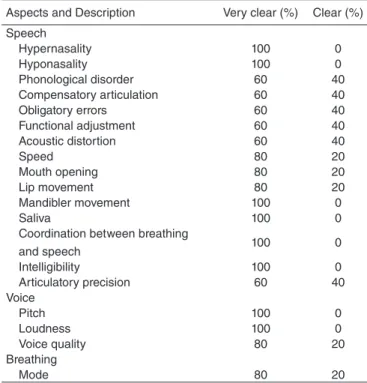
In content validation, the investigators examined the items
on the basis of their clarity for the calculation of the CVI
(Tables 1 and 3); 75% of the examiners classiied the items as
“very clear” and 25% as “clear”, with 100% agreement.
DISCUSSION
aspects concerning the general orofacial myofunctional
assess-ment, such as mobility, muscular tonus, chewing and
swallow-ing, were not anticipated, as it is believed that such assessments
do not differ from those applied in other cases and thus other
available assessment tools
(5,6)can be used.
The elaboration of the items contemplated in the
pro-posal was based on professional experience and in the
lit-erature on the ield of orofacial motricity and related to cleft
lip and palate
(4,5,19-29).
In the irst version proposed, the examiners who
ana-lyzed it suggested some adjustments related to possible
answers, which helped clarify the proposal. According to
Table 1. Distribution of the frequency of the content validity index regarding the assessment of aspects of the lips, tongue, cheeks, palatine tonsils, teeth, occlusion, and hard palate
Aspects and Description Very clear (%) Clear (%) Lips
Habitual position 60 40
Upper lip appearance 60 40 Lower lip appearance 20 80
External mucosa 80 20
Internal mucosa 20 80
Upper mouth vestibule 60 40 Length of the upper lip 60 40 Tongue
Habitual position 40 60
Width 60 40
Height 40 60
Mucosa 80 20
Extension of the frenulum 80 20 Fixation of the frenulum on the
tongue 40 60
Fixation of the frenulum on floor 80 20
Function limitation 100 0
Cheeks
Mucosa 100 0
Palatine tonsils
Presence 80 20
Size 60 40
Teeth
Dentition 100 0
Number of teeth 100 0
Missing teeth 80 20
Teeth health 80 20
Gum health 80 20
Use of orthodontic appliances 100 0
Dental prosthesis 80 20
Occlusion
Horizontal relationship 80 20 Vertical relationship 80 20 Transverse relationship 80 20 Hard palate
Aspect 80 20
Depth 60 40
Width 60 40
Fistula 80 20
Table 2. Distribution of the frequency of the content validity index regarding the assessment of aspects of the soft palate, uvula, pharynx, and mirror test
Aspects and Description Very clear (%) Clear (%) Soft palate
Aspect 80 20
Diastasis 60 40
Symmetry 60 40
Extension 100 0
Fistula 60 40
Insertion of the levator muscle 100 0
Mobility 60 40
Uvula
Aspect 100 0
Pharynx
Lateral walls 60 40
Posterior wall 100 0
Mirror test
Blowing 100 0
“/a/” 100 0
“/u/” 100 0
“/i/” 100 0
/f/ 100 0
/s/ 100 0
/∫/ 100 0
Phrases /p/ 100 0
Phrases /b/ 100 0
Phrases /t/ 100 0
Phrases /d/ 100 0
Phrases /k/ 100 0
Phrases /g/ 100 0
Phrases /f/ 100 0
Phrases /v/ 100 0
Phrases /s/ 100 0
Phrases /z/ 100 0
Phrases /∫/ 100 0
Phrases /ȝ/ 100 0
Table 3. Distribution of the frequency of the content validity index regarding the assessment of aspects of speech, voice, and breathing
Aspects and Description Very clear (%) Clear (%) Speech
Hypernasality 100 0
Hyponasality 100 0
Phonological disorder 60 40 Compensatory articulation 60 40
Obligatory errors 60 40
Functional adjustment 60 40
Acoustic distortion 60 40
Speed 80 20
Mouth opening 80 20
Lip movement 80 20
Mandibler movement 100 0
Saliva 100 0
Coordination between breathing
and speech 100 0
Intelligibility 100 0
Articulatory precision 60 40 Voice
Pitch 100 0
Loudness 100 0
Voice quality 80 20
Breathing
some authors, the assessment of the instrument by
experi-enced and competent examiners in the speciic area to be
tested is essential and should be considered in the content
validation process
(8,13,29).
The content validation refers to the judgment from
differ-ent examiners of an instrumdiffer-ent, who must consider the items
regarding content and the relevance of objectives to be
mea-sured, as well as make suggestions on how to remove, add,
or modify items
(7).On the basis of evaluation conducte by a
group of experts, some authors performed content validation
only by means of qualitative analysis
(18,29), whereas other
authors considered it highly relevant to perform a
quantita-tive analysis
(8,13).
In this study, for the content validation, performed through
analysis from the examiners, images from individuals with
complete unilateral cleft lip and palate were selected, due to
its incidence and also because this type of cleft affects many
aspects of the stomatognathic system. Thus, all items proposed
in the protocol could be included. In addition, one individual
at every stage of life (childhood, adolescence, and adulthood)
was selected so that the instrument could be applied to
dif-ferent age groups.
In the content validation, the CVI was used to measure
the percentage of agreement between the ive examiners who
assessed the second version. The 100% agreement was obtained,
in which 75% examiners classiied the items as “very clear” and
25% as “clear.” According to some authors, as the examiners
did not mark the “no clarity” and “unclear” options, there was
no need to exclude or reformulate any item
(18).
The proposal was adequate and the content of the
instru-ment was validated in a single step, with a percentage of
agree-ment above that established in the literature to be considered
valid
(13,17,18,29). Thus, the content of the instrument proposed in
this study was considered to be a valid and accurate measure
for the 13 items evaluated, as well as their subitems.
This study did not aim to establish assessment criteria for
the judgment of certain items, which will be conducted in a
new study, as well as the continuity of the validation process
of the instrument. In the course of this study, it was veriied
that the quality of images requires suitable equipment and
techniques to facilitate the visualization of detailed
struc-tures for assessment.
CONCLUSION
A proposed protocol for the orofacial myofunctional
assess-ment of individuals with cleft lip and palate, consisting of 13
items covering both structural and functional aspects, was
developed and its content was validated.
*AFG participated in the study idealization, data collection, analysis and interpretation, and drafting of the article; APF participated in the idealization of the study, data analysis, and interpretation; KFG participated in the idealization of the study, data analysis and interpretation, and drafting of the article.
REFERENCES
1. Dixon MJ, Marazita ML, Beaty TH, Murray JC. Cleft lip and palate: understanding genetic and environmental. Nat Rev Genetic. 2011;12(3):167-78.
2. American Cleft Palate-Craniofacial Association [Internet]. Parameters for evaluation and treatment of patients with cleft lip/palate or other craniofacial anomalies: revised edition. November 2009 [cited 2014 May 25]. Available from: http://www.acpa-cpf.org/uploads/site/Parameters_ Rev_2009.pdf
3. Kuehn DP, Moller KT. Speech and language issues in the cleft palate population: the state of the art. Cleft Palate Craniofac J. 2000;37(4):348-35.
4. Felício CM, Ferreira CLP. Protocol of orofacial myofunctional evaluation with scores. Int J Pediatr Otorhinolaryngol. 2008;72:367-75.
5. Genaro KF, Berretin-Félix G, Rehder MIBC, Marchesan IQ. Avaliação miofuncional orofacial - Protocolo MBGR. Rev CEFAC. 2009;11(2):237-55.
6. Felício CM, Folha GA, Ferreira CLP, Medeiros APM. Expanded protocol of orofacial myofunctional evaluation with scores: validity and reliability. Int J Pediatr Otorhinolaryngol. 2010;74:1230-9.
7. Raymundo, VP. Construção e validação de instrumentos: um desaio para a psicolinguística. Letras de Hoje. 2009;44(3):86-93.
8. Fujinaga CI, Scochi CGS, Santos CB, Zamberlan NE, Leite AM. Validação do conteúdo de um instrumento para a avaliação da prontidão do prematuro para início da alimentação oral. Rev Bras Saúde Matern Infant. 2008;8(4):391-9.
9. Cunha VLO, Capellini AS. Construção e validação de instrumento de avaliação da compreensão de leitura para escolares do terceiro ao quinto ano do ensino fundamental. CoDAS. 2014;26(1):28-37.
10. Brancalioni AR, Magnago KF, Keske-Soares M. Validação de um modelo linguístico Fuzzy para classiicar a gravidade do desvio fonológico. Rev CEFAC. 2012;14(3):448-58.
11. Paulinelli BR, Gama ACC, Behlau M. Validação do questionário de performance vocal no Brasil. Rev Soc Bras Fonoaudiol. 2012;17(1):85-91.
12. Marchesan IQ, Andrade IS, Farias MS, Uliano IAM, Zullo VD, Nemr K. Validação do Protocolo MBGR em adultos sem queixas miofuncionais. In: 19º Congresso Brasileiro e 8º Internacional de Fonoaudiologia; 2011 out-nov; São Paulo. Anais. São Paulo: SBFA; 2011;1520.
13. Siqueira MMM. Construção e validação da escala de percepção de suporte social. Psicol Estud. 2008;13(2):381-8.
14. John A, Sell D, Sweeney T, Harding-Bell A, Williams A. The cleft audit protocol for speech-augmented: a validated and reliable measure for auditing cleft speech. Cleft Palate Craniofac J. 2006;43(3):272-88. 15. Wermker K, Jung S, Joos U, Kleinheinz J. Objective assessment of
hypernasality in patients with cleft lip and palate with the nasalview system: a clinical validation study. Int J Otolaryngol. 2012;1-6. 16. Henningsson G, Kuehn DP, Sell D, Sweeney T, Trost-Cardamone JE,
Whitehill TL. Universal parameters for reporting speech outcomes in individuals with cleft palate. Cleft Palate Craniofac J. 2008;45(1):1-15. 17. Alexandre NMC, Coluci MZO. Validade de conteúdo nos processos de
construção e adaptação de instrumentos de medidas. Ciênc Saúde Colet. 2011;16(7):3061-8.
18. Wynd CA, Schmidt B, Schaefer MA. Two quantitative approaches for estimating content validity. West J Nurs Res. 2003;25(5):508-18. 19. Genaro KF, Yamashita RP, Trindade IEK. Avaliação clínica e
instrumental na issura labiopalatina. In: Ferreira LP, Bei-Lopes DM, Limongi SCO, organizadoras. Tratado de Fonoaudiologia. São Paulo: Roca; 2004. p. 456-77.
20. Marchesan IQ. Avaliação miofuncional. In: Marchesan IQ. Fundamentos em Fonoaudiologia: aspectos clínicos da motricidade orofacial (ou oral). 2ª edição. revista e ampliada. Rio de Janeiro: Guanabara Koogan; 2005. p. 19-27. 21. Konst EM, Rietveld T, Peters HFM, Weersink-Braks H. Use of
22. Kummer AW. Velopharyngeal dysfunction (VPD) and resonance disorders. In: Kummer AW, editor. Cleft palate and craniofacial anomalies. San Diego: Singular; 2001. p. 145-76.
23. Peterson-Falzone SJ, Trost-Cardamone JE, Karnell MP, Hardin-Jones MA. The clinician’s guide to treating cleft palate speech. St. Louis: Mosby; 2006. 24. Sell D. Issues in perceptual speech analysis in cleft palate and related
disorders: a review. Int J Lang Comm Dis. 2005;40(2):103-21. 25. Trindade IEK, Genaro KF, Yamashita RP, Miguel HC, Fukushiro AP.
Proposta de classiicação da função velofaríngea na avaliação perceptivo-auditiva da fala. Pró-Fono R Atual Cient. 2005;17(2):259-62.
26. Bakke M, Bergendal B, Macaliester A, Sjögreen L, Astem P. Development and evaluation of comprehensive screening for orofacial dysfunction. Swed Dent J. 2007;31:75-84.
27. Sell D, John A, Harding-Bell A, Sweeney T, Hegarty F, Freeman J. Cleft Audit Protocol for Speech (CAPS-A): a comprehensive training package for speech. Analysis. Int J Lang Comm Dis. 2009;44(4):529-48. 28. Marchesan IQ, Berretin-Felix G, Genaro KF. MBGR Protocol of
orofacial myofunctional evaluation with scores. Int J Orofacial Myology. 2012;38:38-77.
Orofacial Myofunctional Assessment – Cleft Lip and Palate
Name: ______________________________________________________________________________Date of birth: ___/___/___ Age:_______
Registration number: __________ Date of examination: ___/___/___ Clinical Condition: ______________________________________________
Type of Cleft: [ ] Lip: ☐ complete ☐ unilateral [ ] Palate: ☐ complete [ ] Lip and Palate: ☐ unilateral ☐ incomplete ☐ bilateral ☐ incomplete ☐ bilateral Lips [ ] Sum all scores (best result = 0 and worst result = 11)
Habitual position: (0) closed (1) closed with tension (1) Sometimes open, sometimes closed (1) Half-open (2) Open Aspect: - Upper (0) absence of cleft (1) scar with little fibrosis (1) scar with much fibrosis
(1) non-operated - Lower: (0) no alteration (1) with eversion (1) presence of pits (points of depression)
Mucosa - External: (0) normal (1) dry (1) injured
- Internal: (0) normal (1) with teeth marks (1) injured
Upper mouth vestibule:(0) normal (1) partial lip adherence (1) complete lip adherence
Length of the upper lip:(0) covers 2/3 of the incisors (1) covers more than 2/3 (1) covers less than 2/3 Notes: _________________________________________________________________________________________________
Cheeks [ ]Sum all scores (best result = 0 and worst result = 6)
Mucosa: (0) normal (1) teeth / braces marks R (1) teeth / braces marks L
(1) R alba (white) line (1) L alba (white) line
(1) injured R (1) injured L Notes: _________________________________________________________________________________________________
Tongue [ ]Sum all scores (best result = 0 and worst result = 14)
Habitual position: (0) not visible (1) on mouth floor (2) protrude between the teeth Width: (0) adequate (1) increased
Height: (0) adequate (1) increased
Mucosa: (0) normal (1) geographic (1) cleft (1) with teeth marks (1) with braces marks (1) injured
Frenulum:
Extension: (0) adequate (1) short
Tongue fixation: (0) middle section (1) anterior to middle section (2) at the apex
Fixation on the floor of the
mouth: (0) between caruncles (1) between caruncles and the alveolar crest (2) on alveolar crest
Limitation of function: (0) absent (1) present
Notes: _________________________________________________________________________________________________
Palatine tonsils [ ]Sum all scores (best result = 0 and worst result = 1)
Presence: ☐ present ☐ not visible
Size: (0) adequate (1) hypertrophy (side) ______
Notes: _________________________________________________________________________________________________
Teeth [ ] Sum all scores (best result = 0 and worst result = 8)
Dentition: ☐ deciduous ☐ mixed ☐ permanent
Number of teeth: R upper ___________ L upper _________ R lower _________ L lower ___________________________________________ Missing teeth: (0) absent (1) present (elements): ________________________________________________________________
Oral health: Teeth: (0) good (1) regular (2) bad
Gum: (0) good (1) regular (2) bad
Orthodontic appliance: (0) absent (1) present ☐ retainer ☐ braces
Dental prosthesis: (0) absent (1) fixed (1) removable ☐ partial ☐ total
Notes: ______________________________________________________________________________________________________________
Occlusion [ ] Sum all scores (best result = 0 and worst result = 6)
Horizontal relationship: (0) adequate (1) bite on top (2) overjet (2) crossbite Vertical relationship: (0) adequate (1) bite on top (2) overbite (2) open bite
Transverse relationship: (0) adequate (1) unilateral posterior crossbite __________________________ (2) bilateral posterior crossbite Notes: ______________________________________________________________________________________________________________
Hard palate [ ] Sum all scores (best result = 0 and worst result = 6)
Aspect: (0) intact (1) operated, with little fibrosis (1) operated, with much fibrosis (1) dehiscent (1) non-operated Bony notch:(0) absent (1) present
Depth:(0) adequate (1) increased Width:(0) adequate (1) reduced
Fistula:
(0) absent (1) present (1) vestibular (side): _____ (1) hard palate
Size: Shape:
[ ] small [ ] circular
[ ] medium [ ] linear
[ ] large
[ ] irregular [ ] other: _____________________________________ Note: ______________________________________________________________________________________________________________
Soft palate[ ] Sum all scores (best result = 0 and worst result = 14)
Aspect: (0) intact (1) operated, with little fibrosis (1) operated, with much fibrosis
(1) dehiscent _____
(1) non-operated (1) pharyngeal flap Diastasis: (0) absent (1) present
Symmetry: (0) present (1) absent: ___________________________________________________________________________________ Extension: (0) long (1) regular (2) short ☐ pharyngeal flap
Fistula:
(0) absent (1) transition (1) soft palate
Size: Shape:
[ ] small [ ] circular
[ ] medium [ ] linear
[ ] large
[ ] irregular [ ] other: __________________________________________________ Insertion of the levator muscle:(0) posterior part (1) middle part (2) anterior part ☐ undefined ☐ pharyngeal flap
Mobility - speaking “a” repeatedly: (0) good R
(0) good L
(1) regular R (1) regular L
(2)little R (2) little L
(3) absent R
(3) absent L ☐ pharyngeal flap Notes:__________________________________________________________________________________________________
Uvula[ ]Sum all scores (best result = 0 and worst result = 1)
Aspect: (0) normal (1) altered ☐ hypotrophic ☐ grooved ☐ bifid ☐ dehiscent ☐ operated ☐ non-operated ☐ pharyngeal flap
Notes: ______________________________________________________________________________________________________________
Pharynx [ ]Sum all scores (best result = 0 and worst result = 4)
Lateral walls - speaking “a” repeatedly: Right: (0) good
Left: (0) good
(1) regular (1) regular
(2) little (2) little
☐ unobservable ☐ unobservable Posterior wall (Passavant ridge): (0) present ☐ tentative ☐ unobservable
Notes: ______________________________________________________________________________________________________________
Breathing[ ]Sum all scores (best result = 0 and worst result = 5)
Type: (0) medium/lower (1) medium/high
Mode: (0) nasal (1) oronasal (2) oral
☐ functional ☐ organic: _______________ Possibility of breathing through the nose (0) 2 minutes or more (1) between 1 and 2 minutes (2) less than 1 minute
Notes: ______________________________________________________________________________________________________________
Nasal flux
(use mirror)
Before blowing: ☐ similar between nostrils ☐ mildly asymmetry ☐ severely asymmetry After blowing in order to
clean hygiene: ☐ similar between nostrils ☐ mildly asymmetry ☐ severely asymmetry Notes: ______________________________________________________________________________________________________________
Velopharyngeal function:
Mirror test [ ] Sum all scores (best result = 0 and worst result = 19)
(0) absent (1) present: [A] mild [B] moderate [C] intense
[ ] Blow [ ] “a” “u”[ ] [ ] “i” [ ] /f/ [ ] /s/ [ ] /∫/
Phrases:
Plosives: [ ] Papai pediu pipoca [ ] O tatu estava na toca [ ] Cacá cortou o cabelo [ ] A babá beijou o bebê [ ] O dedo da Dada doeu [ ] Gugu gosta do gato
Fricatives: [ ] A fita da fada é de filó [ ] O saci sabe assobiar [ ] Chico chupa chupeta [ ] Vovó viu o vestido [ ] A casa da Zezé é azul [ ] O jipe é do Juca
Speech analysis[ ]Sum all scores (best result = 0 and worst result = 19)
Hyponasality: (0) absent (1) mild (2) moderate (3) severe Phonological
disorder: (0) absent (1) present: ☐ omission ☐ substitution ☐ others (describe):___________________________
Compensatory
articulation: (0) absent (1) present: ☐ glottal stop ☐ pharyngeal plosive ☐ middorsum palatal stops ☐ pharyngeal
fricative ☐ velar fricative ☐ posterior nasal fricative Obligatory errors: (0) absent (1) present: ☐ hypernasality:[ ] mild [ ] moderate [ ] severe
☐ nasal air emission ☐ weak consonant ☐ nasal turbulence ☐ nasal grimacing Functional
adjustment: (0) absent (1) present: ☐ interdental tongue ☐ deviations from articulation place
☐ frontal lisp ☐ lateral lisp ☐ other __________________________________________ Acoustic distortion: (0) absent (1) present (describe):___________________________________________________________________________
Speed: (0) adequate (1) increased (1) reduced Mouth opening: (0) adequate (1) reduced (1) increased Lip movement: (0) adequate (1) reduced (1) increased Mandible
movement: (0) adequate (1) altered: ☐ reduced ☐ deviation R ☐ deviation L ☐ anteriorization Saliva: (0) swallowed (1) at lip corners (1) at lower lip (1) splashes (1) slobbers
Coordination between breathing
and speech: (0) adequate (1) altered (describe):____________________________________________________________________ Intelligibility: (0) adequate (1) altered: ☐ slightly ☐ highly ☐ unintelligible
Articulatory
precision: (0) adequate (1) altered(describe): ___________________________________________________________________ Notes: ______________________________________________________________________________________________________________ Voice [ ] Sum all scores (best result = 0 and worst result = 3)
Pitch: (0) adequate (1) altered: (describe): _______________________________________________________________________ Loudness: (0) adequate (1) altered: (describe): _______________________________________________________________________ Voice quality: (0) adequate (1) altered: (describe): _______________________________________________________________________ Note: _______________________________________________________________________________________________________________ Speech- Samples for registration: - Spontaneous speech, Count from 1 to 20 and months of the year, Reading/repetition of phrases, Reading of texts
Description Isolated SyllableTherapeutic testWord Phrases
Bilabial
[p] [b] [m] Labiodental [f][v]
Interdental
[t] [d] [n]
Alveolar
[s] [z] [ l] [r] [ l ] group [ r ] group
Palatal
[∫] [ȝ] [η] [λ]
Velar
[k] [g] [R] Archiphonemes {R} {S} Affricates [t∫][dȝ]