1 Recebido para publicação em 6.2.2013 e aprovado em 9.5.2013.
2 Centro de Ciências Agrárias, Universidade Estadual do Oeste do Paraná, Marechal Cândido Rondon, Paraná, Brasil, <[email protected]>.
S
ELECTIVITY OFC
LOMAZONE ANDS-M
ETOLACHLORA
PPLIED AFTERC
ASSAVAP
RUNING1Seletividade do Clomazone e do S-Metolachlor Aplicados Após a Poda da Mandioca
COSTA, N.V.2, ANDRADE, D.C.3, SONTAG, D.A.3, SCARIOT, C.A.3, and TSUZUKI, L.H.2
ABSTRACT - The objective of this work was to evaluate the selectivity of clomazone in two formulations and S-metolachlor applied on shoots of different sizes after pruning of ‘Baianinha’ cassava. The experiment was arranged in a randomized block design in a factorial 5 x 2 (5 treatments x 2 sizes of shoots after pruning – 10 and 33 cm) with four replications. The herbicides evaluated were: clomazone (encapsulated suspension – 900 g h-1), clomazone
(encapsulated suspension – 1,080 g ha-1), clomazone (emulsifiable concentrate 900 g ha-1),
S-metolachlor (1,920 g ha-1) and an untreated control. During the experiment, all plots were
kept free of weed interference by hand weeding. It was concluded that both the formulations of clomazone and S-metolachlor were selective when applied on both the shoot sizes evaluated. However, the application of S-metolachlor on 33 cm shoots gave higher selectivity to ‘Baianinha’ cassava plants.
Keywords: Manihot esculenta, microencapsulated, weed, clomazone, S-metolachlor.
RESUMO - Objetivou-se neste estudo avaliar a seletividade do clomazone em duas formulações e do S-metolachlor aplicados em diferentes tamanhos de brotos depois da poda da mandioca Baianinha. O delineamento experimental utilizado foi o de blocos ao acaso, em esquema fatorial 5 x 2 (5tratamentos x 2tamanhos de brotos após a poda – 10 e 33cm), com quatro repetições. Os herbicidas
avaliados foram: clomazone (suspensão de encapsulado 900gha-1), clomazone (suspensão de
encapsulado 1.080gha-1), clomazone (concentrado emulsionável 900gha-1), S-metolachlor
(1.920gha-1), além da testemunha sem aplicação. Durante a condução do experimento, todas as
parcelas foram mantidas livres da interferência das plantas daninhas por meio de capinas manuais. Concluiu-se que ambas as formulações do clomazone e o S-metolachlor apresentaram-se seletivas quando aplicadas em ambos os tamanhos de brotos avaliados; no entanto, a aplicação do S-metolachlor em brotos de 33 cm proporcionou maior seletividade às plantas de mandioca Baianinha.
Palavras-chave: Manihot esculenta, microencapsulado, planta daninha, clomazone, S-metolachlor.
INTRODUCTION
Cassava (Manihot esculenta), having
originated from Brazil and being cultivated in over 90 countries, is a plant very tolerant to drought and low soil fertility, commonly grown and consumed by small farmers in areas of poor soils and where the weather conditions are often unfavorable to other cultures (Doretto, 1993; Sagrilo et al., 2002). However,
it is one of the main economic sources of carbohydrates in the tropical regions, playing a key role in human and animal nutrition and in the industrial processing of flour and starch (Albuquerque et al., 2008).
million tons of roots in the 2011/2012 harvest,
with an average yield of 22.6 t ha-1 (IBGE, 2012).
However, despite cassava yield in the state of Paraná is 55.9% higher than the national
average (14.5 t ha-1), it still is below the
potential crop yields. Cassava growers in this region report that the disturbance caused by weeds reduces significantly the crop yields, and weeds control is extremely difficult because of the high cost of weeding and the lack of options for selective herbicides for the culture.
Another important issue with regard to the cassava management is pruning of the varieties produced for the industry. Such varieties have a cycle of 18 to 24 months, and the plants are often pruned during the period of physiological rest or dormancy (10 to 12 months after planting), especially after the occurrence of frosts, in order to diminish the source of inoculums of pests and diseases, to facilitate cultural practices or to obtain stem cuttings or new planting areas (Takahashi, 1998). According to Andrade et al. (2011), cassava plants prunig during the dormant period increases the production of roots, which tend to present more dry mass and lower flour production at the end of the cycle. Likewise, Sagrilo et al. (2002) observed that the second stage of the physiological rest of the varieties Mico, IAC 13 and IAC 14 was more beneficial to harvest than a single growing cycle due to the increased production of tuberous roots (92.5%), dry mass (125.0%), and starch (144.0%). These are important characteristics for the starch industry.
Hence, beginning with cassava pruning, a new period of development of the culture takes place, and the weeds interference can significantly impair the production and quality of the roots, requiring the adoption of control measures.
Weeds can compete for limiting environmental resources (mostly water, light and nutrients); release allelopathic substances and thus prevent sprouting of cassava shoots; host pests and diseases that are common to the culture; interfere with the crop yields (Pitelli, 1985). The level of disturbance of the weeds community with the cassava culture may decrease the production of roots and starch from 89.8 to 100% (Peressin, et al., 1998; Alabi et al., 2001; Chikoye et al., 2001;
Johanns & Contiero, 2006; Albuquerque et al., 2008; Biffe et al., 2010).
Thus, chemical control appears to be an excellent alternative for the control of weeds in cassava cultures for allowing intervention in large areas with little dependence on manpower and due to its quick application (Silva et al., 2012; Silveira et al., 2012). However, in Brazil only ametryna+clomazone, clethodim, clomazone, isoxaflutole and metribuzin are registered herbicides for cassava cultures (Rodrigues & Almeida, 2005). Among these herbicides, clomazone (carotenoid inhibitor) stands out as the herbicide more commonly used in the pre-emergence of the culture and is commercially available in two formulations (Emulsifiable Concentrate – EC and Encapsulated or Microencapsulated Suspension – ES), and the ES clomazone formulation was developed recently to minimize losses by volatilization, photodecomposition (photolysis), besides providing a slower release of the molecule into the environment and, as a consequence, maximizing the residual effect on the soils on the weeds seed bank (Webster et al., 1999; Bollich et al., 2000). Therefore, there are few studies on the differences of selectivity of the clomazone formulations in the different cycles of cassava growth.
According to Silva et al. (2012), there are several molecules of herbicides that allowed satisfactory research results on the control of weeds, being selective for cassava, but they are still pending on register. Among these products we can cite S-metolachlor, which showed to be selective and can be included in the weeds management programs (Silva et al., 2009; Biffe et al., 2010).
Thus, the objective was to evaluate the selectivity of clomazone in two formulations and S-metolachlor applied in different sizes of shoots after pruning of ‘Baianinha’ cassava.
MATERIAL AND METHODS
The experiment was conducted at the IAPAR’s Experimental Station in the municipality of Porto Mendes-PR. The area has been cultivated for 18 years in the no-tillage system, rotating with soybean in summer and maize in winter. Before the experiment, maize was cultivated (sowing in February/2010) with spacing of 0.9 m between rows and 4.0 plants per meter. After the maize has been harvested, the area was desiccated (Aug/2011) using glyphosate (Atanor 360) in a mixture with
2.4-D (Aminol 806), in dosages of 3.3 + 1.0 L ha-1 of
the commercial products.
Planting of the ‘Baianinha’ variety was made in Sept 12/2010 in the no-tillage system, with the help of a mechanized planter with row spacing of 0.9 x 0.7 m. In the first cycle of the culture, the weeds were controlled with pre-emergent chemical control with application of sulfentrazone (Boral 500 SC),
in the dosage of 1.0 L ha-1 of the commercial
product, and 20 days after planting clomazone herbicide (Gamit 500 EC) was used at
the dosage of 2.0 L ha-1 of the commercial
product.
Chemical analysis of the soil indicated the
following characteristics: pH (CaCl2) = 5.6;
organic matter (g dm-3) = 22.6; P (mg dm-3) =
4.0; H+Al, K, Ca, Mg, SB and CTC (cmolc dm-3)
= 4.61; 0.51; 8.09; 1.88; 10.48 and 15.09, respectively; and V% = 69.45; and the soil composition indicated 15.0% of sand; 30.0% of silt and 55.0% of clay.
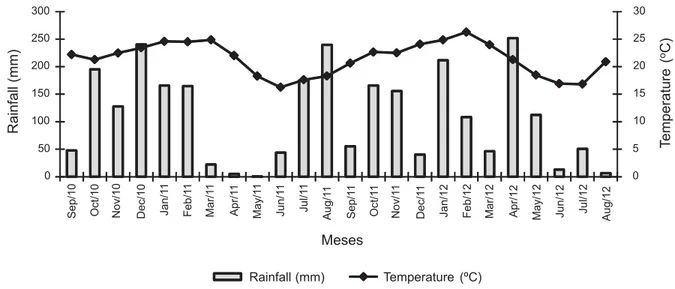
The experimental design was randomized block in a 5 x 2 factorial design (5 treatments x 2 sizes of shoots after pruning) with four replications. The treatments evaluated in the experiment are described in Table 1. Data on average temperature (°C) and rainfall (mm) during the period of the experiment are described in Figure 1.
Table 1 - Treatments evaluated in the experiment. Porto
Mendes-PR, 2010-2012
1/ commercial product Gamit 360 ES (Encapsulate suspension); 2/ commercial product Gamit 500 EC (Emulsifiable
Concentrate); 3/ commercial product Dual 960 EC (Emulsifiable
Concentrate).
Treatment Dosage (g ha-1) Shoot size (cm)
Control --- 10
Control --- 33
Clomazone1/ 900 10
Clomazone1/ 900 33
Clomazone1/ 1.080 10
Clomazone1/ 1.080 33
Clomazone2/ 900 10
Clomazone2/ 900 33
S-metolachlor3/ 1.920 10
S-metolachlor3/ 1.920 33
Figure 1 - Average temperature (oC) and rainfall (mm) during the experiment’s period of time. Porto Mendes-PR, 2010-2012.
0 5 10 15 20 25 30
0 50 100 150 200 250 300
Sep
/10
Oct
/10
Nov
/10
Dec
/10
Jan/1
1
Feb/1
1
Mar/1
1
Apr/1
1
May
/1
1
Jun/1
1
Jul/1
1
Aug
/1
1
T
emperature
(
oC)
Rainfall
(mm)
Meses
Rainfall (mm) Temperature (ºC)
Sep
/1
1
Oct
/1
1
Nov
/1
1
Dec
/1
1
Jan/12 Feb/12 Mar/12 Apr/12 May
/12
Jun/12 Jul/12 Aug
The plots consisted of 5 rows of cassava with space of 0.9 m and 7.0 m long (4.5 x 7.0 =
31.5 m2). Total area of the experiment =
1,260 m2. During the conduction of the
experiment, all plots were kept free from the interference of weeds by means of manual weeding.
The application of the treatments was performed at the end of the first cycle of growth of ‘Baianinha’ cassava after management of stem cuttings. The first application was performed in Sept 28/2011, when the shoots had an average size of 10 cm, while the second application was made in Oct 18/2011, when the shoots had an average size of 33 cm.
A backpack sprayer was used, pressurized
by CO2 and equipped with a bar with four flat
tips (Jet Model 110-LD-02), spaced in 50 cm, and the consumption of the solution was
equivalent to 200 L ha-1 using pressure of
45 Lb pol-2.
The applications were made in the late afternoon, and the first and second applications had the following conditions of temperature, relative humidity and wind speed: 26.1 and
23.3 oC; 50 and 54%; 2 and 4 km h-1,
respectively.
Evaluations of phytotoxicity in the cassava plants were made visually, using a scale of percentage of grades, in which 0 (zero) corresponds to no injury shown in the cassava plant and 100 (one hundred) to the death of the plants (SBCPD, 1995). The criteria used for the grades were: growth inhibition, amount and uniformity of injuries; plants’ sprouting ability; and amount of dead plants. Evaluations
were performed at the 7th and 21st days after the
first and second application of the herbicides.
At the 57th and 37th days after the first and
second applications, respectively, five plants at random at the three central rows of the plots were assessed to determine height (m). The evaluation was made using a graduated rule (2 m), and measures of the plant were taken from the soil to the apex.
By the time of harvest of the cassava roots (Aug 24/2012 – 23 months cycle), the plants from the three central rows of the plots were harvested, disregarding one plant at each end of the row. After weighing the roots, yields
were determined (t ha-1). From each plot a
sample of 5.0 kg of roots were collected to determine the percentage of starch, using the method of hydrostatic scale as proposed by Grossman & Freitas (1950).
The results obtained were submitted to the analysis of variance by F test, and the averages statistically analyzed by the LSD average test at 5% probability. The percentage data of phytoxicity were transformed into arcsine
√x/100.
RESULTS AND DISCUSSION
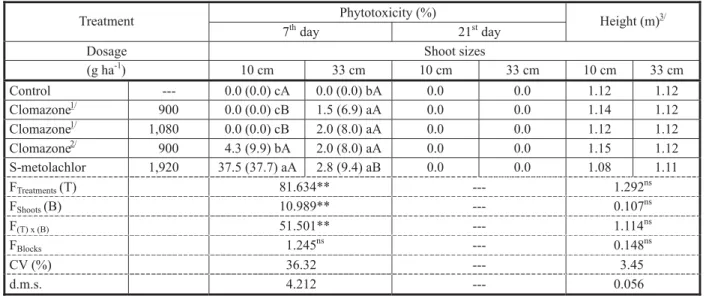
The mean percentages of phytotoxicity and plants height after application of herbicides in different sizes of shoots after pruning of ‘Baianinha’ cassava are presented in Table 2. There was interaction between the herbicides and the shoots size in the first evaluation of phytotoxicity of the cassava plants. It was
observed that at the 7th day, only clomazone
(900 g ha-1) in the formulation of the
emulsifiable concentrate and S-metolachlor
(1,920 g ha-1) provided symptoms of
phytotoxicity in the plants of 4.3 and 37.5%, respectively, when applied in the 10cm shoots. These symptoms can be considered of mild and moderate intensity. The formulation of clomazone encapsulated suspension caused less injury than the emulsifiable concentrate formulation, regardless the dosage used in the initial stage of development of the shoots of ‘Baianinha’ cassava.
These results were not present in the applications with more developed shoots. However, despite the herbicides have caused phytotoxicity when applied in 33cm shoots, the symptoms were considered very mild (< 3.0%), which indicated more tolerance of the culture when the shoots are more developed, considering especially S-metolachlor (1,920 g
ha-1).
herbicides have a higher residual effect on the weeds seed bank, particularly in clay soils such as of the present study (55.0% of clay); however, selectivity to cultures should be maintained even with higher dosages.
The injuries caused by clomazone corresponded to the occurrence of small chlorotic spots on the leaf blade while S-metolachlor caused curling, shrinking or stunting of the leaf surface and subsequent formation of chlorotic and necrotic areas. But the phytotoxicity symptoms disappeared
completely from the 21st day in all treatments
for both sizes of shoots under analysis. According to Bollich et al. (2000), clomazone may cause chlorosis (bleaching), stunting, late maturity, and stand reduction, depending on the soil characteristics, the application dosage and environmental conditions.
These results indicate that the initial shoots after management of cassava pruning represent a way of absorption of herbicides, as well as the absorption may be dependent on the herbicide and the formulation used, especially considering the early sprouting stages. It is also worth noting that the good recovery of ‘Baianinha’ cassava when applying
mainly S-metolachlor can be explained by the weather conditions that were favourable to the plants development (Figure 1) and by the plant’s ability to metabolize the molecules, probably due to the use of the starch stored in the roots, which represent a key source of energy for the plant, corroborating the study hypotheses.
Likewise, the herbicides did not reduce the height of the cassava plants, when applied in shoots of 10 and 33 cm long (Table 2).
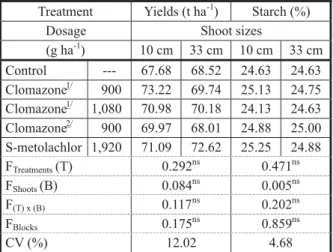
Table 3 shows the data on roots yields and percentage of starch in the ‘Baianinha’ cassava plants after application of herbicides. It was observed that there was no interaction between the treatments and the shoots size, and the herbicides did not differ statistically from the control samples considering root yields and starch percentage. However, the results of phytotoxicity in this study indicate that applications of
S-metolachlor (1,920 g ha-1) in the early stages
of development of the shoots of ‘Baianinha’ cassava should receive special attention in order to prevent stress of the plants, once the
occurrence of high phytotoxicity (≥ 37.5%)
followed by long hot periods (hydric stress) may
Table 2 - Phytotoxicity (% of plant injury) and height (m) of ‘Baianinha’ cassava plants after application of herbicides to different
shoot sizes after pruning. Porto Mendes-PR, 2010-2012
Means followed by the same lowercase and uppercase in the row do not differ statistically by the ‘LSD’ test (p > 0.05). The percentage values of phytoxicity were converted into arcsine √x/100 (in brackets ); ** significant at 1% probability; ns non-significant; 1/ commercial
product Gamit 360 ES; 2/ commercial product Gamit 500 EC; 3/ Shoots measuring 10 cm long (57 days after application) and shoots
measuring 33 cm long (37 days after application).
Phytotoxicity (%) Treatment
7thday 21stday Height (m)
3/
Dosage Shoot sizes
(g ha-1) 10 cm 33 cm 10 cm 33 cm 10 cm 33 cm
Control --- 0.0 (0.0) cA 0.0 (0.0) bA 0.0 0.0 1.12 1.12
Clomazone1/ 900 0.0 (0.0) cB 1.5 (6.9) aA 0.0 0.0 1.14 1.12
Clomazone1/ 1,080 0.0 (0.0) cB 2.0 (8.0) aA 0.0 0.0 1.12 1.12
Clomazone2/ 900 4.3 (9.9) bA 2.0 (8.0) aA 0.0 0.0 1.15 1.12
S-metolachlor 1,920 37.5 (37.7) aA 2.8 (9.4) aB 0.0 0.0 1.08 1.11
FTreatments(T) 81.634** --- 1.292ns
FShoots(B) 10.989** --- 0.107
ns
F(T) x (B) 51.501** --- 1.114ns
FBlocks 1.245ns --- 0.148ns
CV (%) 36.32 --- 3.45
impact negatively the development of the plants, the root yields and starch contents (Cayón et al., 1997; Santisopasri et al., 2001). Oliveira Jr. et al. (2001) mention that
metolachlor (2,000 g ha-1), when applied in
pre-emergent ‘Espeto’ cassava, caused mild
phytotoxicity at the 28th day after planting and
caused reduction of 29.6 and 33.6% in the plants’ height and in the production of roots, respectively in relation to the control weeded sample. Biffe et al. (2010) mention that
S-metolachlor (1,920 g ha-1), when applied at
the pre-emergent cultivars of ‘Fécula Branca’ and ‘Fibra’ cultivars, showed to be selective, and may be used as a control tool of weds in cassava cultures.
S-metolachlor inhibits the cell division, being registered in Brazil for the control of weeds in pre-emergent cultures of soybean, beans, maize, sugarcane and cotton, while clamazone inhibits the synthesis of carotenoids and has register for the control of weeds in pre-emergent cultures of tobacco, rice, sugarcane, cassava, potato and cotton, and can also be used in irrigated rice plantations soon after the plants emergence (Rodrigues & Almeida, 2005). Thus, the potential use of both clomazone and S-metolachlor formulations also after the cassava pruning may explore the residual
effect on the weeds seed bank in the soil, in isolate applications or mixed with other herbicides having distinct mechanisms of action.
The selection of other selective herbicides to cassava and that have different mechanisms of action, such as for example S-metolachlor, can contribute to the management of weeds and prevent the selection of biotypes that are resistant to the herbicides in cassava cultivation areas (Beckie, 2006; Beckie & Reboud, 2009; Mello et al., 2012; Vencill et al., 2012).
So, it can be concluded that the herbicides were selective to the ‘Baianinha’ cassava plants when applied to 10 and 33 cm shoots, and the application of S-metolachlor in 33 cm shoots showed more selectivity to the plants.
LITERATURE CITED
ALABI, B. S. et al. Giant sensitiveplant interference in cassava. Weed Sci., v. 49, n. 2, p. 171-176, 2001.
ALBUQUERQUE, J. A. A. et al. Interferência de plantas daninhas sobre a produtividade da mandioca (Manihot esculenta). Planta Daninha, v. 26, n. 2, p. 279-289, 2008.
ANDRADE, J. S. et al. Épocas de poda em mandioca. R. Ci. Agron., v. 42, n. 3, p. 693-701, 2011.
BECKIE, H. J. Herbicide-resistant weeds: management tactics and practices. Weed Technol., v. 20, n. 3, p. 793-814, 2006.
BECKIE, H. J.; REBOUD, X. selecting for weed resistance: herbicide rotation and mixture. Weed Technol., v. 23, n. 3, p. 363-370, 2009.
BIFFE, D. F. et al. Avaliação de herbicidas para dois cultivares de mandioca. Planta Daninha, v. 28, n. 4, p. 807-816, 2010.
BOLLICH, P. K. et al. Rice (Oryza sativa) response to the microencapsulated formulation of clomazone. Weed Technol., v. 14, n. 1, p. 89-93, 2000.
CAYÓN, M. G.; EL-SHARKAWY, M. A.; CADAVID, L. F. Leaf gas exchange of cassava as affected by quality of planting material and water stress. Photosynthetica, v. 34, n. 3, p. 409-418, 1997.
CHIKOYE, D.; EKELEME, F.; UDENSI, U. E. Cogongrass suppression by intercropping cover crops in corn/cassava systems. Weed Sci., v. 49, n. 5, p. 658-667, 2001.
Table 3 - Yields and percentage of starch in the ‘Baianinha’
cassava roots after application of herbicides to different sizes of shoots after pruning. Porto Mendes-PR, 2010-2012
ns non-significant; 1/ commercial product Gamit 360 ES; 2/
commercial product Gamit 500 EC.
Treatment Yields (t ha-1) Starch (%)
Dosage Shoot sizes
(g ha-1) 10 cm 33 cm 10 cm 33 cm
Control --- 67.68 68.52 24.63 24.63
Clomazone1/ 900 73.22 69.74 25.13 24.75
Clomazone1/ 1,080 70.98 70.18 24.13 24.63
Clomazone2/ 900 69.97 68.01 24.88 25.00
S-metolachlor 1,920 71.09 72.62 25.25 24.88
FTreatments(T) 0.292ns 0.471ns
FShoots(B) 0.084 ns
0.005ns
F(T) x (B) 0.117ns 0.202ns
FBlocks 0.175ns 0.859ns
CUMMING, J. P.; DOYLE, R. B.; BROWN, P. H. Clomazone dissipation in four Tasmanian topsoils.
Weed Sci., v. 50, n. 3, p. 405-409. 2002.
DORETO, M. Distribuição da cultura da mandioca no Paraná nos anos 80. Londrina: IAPAR, 1993. 19 p. (Informe dePesquisa, 102).
FERRI, M. V. W. et al. Sorção do herbicida acetochlor em amostras de solo, ácidos húmicos e huminas de Argissolo submetido à semeadura direta e ao preparo convencional. R. Bras. Ci. Solo, v. 29, n. 5, p. 705-714, 2005.
GROSMAN, J.; FREITAS, A. C. Determinação do teor de matéria seca pelo peso específico em raízes de mandioca.
R. Agron., v. 14, n. 160/162, p. 75-80, 1950.
INSTITUTO BRASILEIRO DE GEOGRAFIA E ESTATÍSTICA – IBGE. Levantamento Sistemático da produção agrícola:pesquisa mensal de previsão e
acompanhamento das safras agrícolas no ano civil. Levant. Sistem. Prod. Agríc., v. 25, n. 12, p. 1-84, 2012.
JOHANNS, O.; CONTIERO, R. L. Efeitos de diferentes períodos de controle e convivência de plantas daninhas com a cultura da mandioca. R. Ci. Agron., v. 37, n. 3, p. 326-331, 2006.
KIRKSEY, K. B. et al. Clomazone dissipation in two Tennessee soils. Weed Sci., v. 44, n. 4, p. 959-963, 1996.
MELO, M. S. C. et al. Alternativas para o controle químico de capim-amargoso (Digitaria insularis) resistente ao glyphosate. R. Bras. Herbic., v. 11, n. 2, p. 195-203, 2012.
MERVOSH; T. L. et al. Clomazone sorption in soil: Incubation time, temperature, and soil moisture effects.
J. Agric. Food Chem., v. 43, n. 8, p. 2295-2300, 1995.
OLIVEIRA JR, R. S. et al. Manejo químico de plantas daninhas em área de plantio direto de mandioca. R. Bras. Herbic., v. 2, n. 3, p. 99-106, 2001.
PERESSIN, V. A. et al. Acúmulo de matéria seca na presença e na ausência de plantas infestantes no cultivar de mandioca SRT59 – Branca de Santa Catarina. Bragantia, v. 57, n. 1, p. 135-148, 1998.
PITELLI, R. A. Interferência de plantas daninhas em culturas agrícolas. Inf. Agropec., v. 11, n. 129, p. 16-17, 1985.
RODRIGUES, B. N.; ALMEIDA, F. S. Guia de herbicidas.
5.ed. Londrina: 2005. 592 p.
SAGRILO, E. et al. Efeito da época de colheita no crescimento vegetativo, na produtividade e na qualidade de raízes de três cultivares de mandioca. Bragantia, v. 61, n. 2, p. 115-125, 2002.
SANTISOPASRI, V. et al. Impact of water stress on yield and quality of cassava starch. Indust. Crops Produc., v. 13, n. 2, p. 115-129, 2001.
SILVA, D. V. et al. Manejo de plantas daninhas na cultura da mandioca. Planta Daninha, v. 30, n. 4, p. 901-910, 2012.
SILVA, F. M. L. et al. Moléculas de herbicidas seletivos à cultura da mandioca. R. Trop.: Ci. Agr. Biol., v. 3, n. 2, p. 61-72, 2009.
SILVEIRA, H. M. et al. Sensibilidade de cultivares de mandioca ao herbicida mesotrione. R. Bras. Herbic., v. 11,
n. 1, p. 24-31, 2012.
SOCIEDADE BRASILEIRA DA CIÊNCIA DAS PLANTAS DANINHAS – SBCPD. Procedimentos para instalação, avaliação e análise de experimentos com herbicidas. Londrina: 1995. 42 p.
TAKAHASHI, M. Épocas de poda na cultura da mandioca na região noroeste do Paraná, Brasil. Braz. Arch. Biol.
Technol., v. 41, n. 4, p. 495-500, 1998.
VASILAKOGLOU, I. B.; ELEFTHEROHORINOS, I. G. Persistence, efficacy, and selectivity of amide herbicides in corn. Weed Technol., v. 17, n. 2, p. 381-388, 2003.
VENCILL, W. K. et al. Herbicide resistance: toward an understanding of resistance development and the impact of herbicide-resistant crops. Weed Sci., v. 60, n. 1, p. 2-30, 2012. (Edição Especial)