A flexible framework
for Rogue Access Point
detection
Ricardo Jorge Esteves Gonçalves
Mestrado Integrado em Engenharia de Redes
e Sistemas Informáticos
Departamento de Ciências de Computadores 2016/2017
Orientador
Pedro Miguel Alves Brandão, Professor Assistente, Faculdade de Ciências da Universidade do Porto
Coorientador
Manuel Eduardo Correia, Professor Assistente, Faculdade de Ciências da Universidade do Porto
Todas as correções determinadas pelo júri, e só essas, foram
efetuadas.
O Presidente do Júri,
Abstract
Nowadays wireless communications are ubiquitous and getting over requested. It has become a demand in modern days life; people have to be connected always and everywhere. To meet these needs there is an increasing number of WiFi Access Points (APs), located everywhere: schools, coffee shops, shopping malls, airports, trains, buses, and all the free ones from the Internet Service Providers (ISPs) distributed by users’ home networks.
Among all theseAPs how can a user be sure that is connecting to a trusted source?
In a small-medium sized company, without spending much money, how do they guarantee their wireless security?
In order to address these questions there is the need to detect Rogue Access Points (RAPs). There are solutions described in the literature and enterprise solutions. Relative to the latter, it has become obvious that they are not accessible to everyone (high prices), and the first ones do not address all the types of RAPs.
Apart from these solutions we did a thorough study on the most commonly used and recent types of WiFi attacks. With this knowledge we were able to develop a solution to detect RAPs which covers the most commonly known attacks.
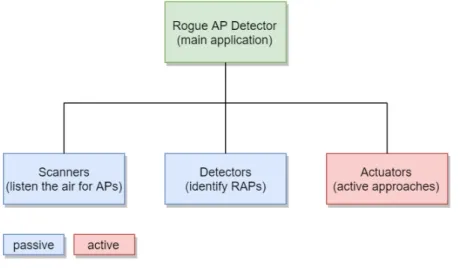
The proposed solution, is a modular framework composed of Scanners, Detectors and Actuators, which are responsible for: scanning for available APs, apply a set of heuristics to detect RAPs and alert the application user. And finally, apply a countermeasure mechanism.
Resumo
Hoje em dia, as comunicações sem fios são ubíquas e cada vez mais requisitadas. Tornando-se uma exigência para a maioria das pessoas, causando uma necessidade de estarem ligadas, sempre e em qualquer lugar. Para responder a esta necessidade existe um número crescente de Pontos de acesso (PA) WiFi, localizados em todos os lugares: escolas, cafés, shoppings, aeroportos, comboios, autocarros e osPAgratuitos dos Internet Service Providers (ISPs) distribuídos através das redes domésticas dos utilizadores.
Entre todos estesPA como é que um utilizador pode ter certeza de que se está a ligar a uma rede confiável?
Numa pequena ou média empresa, sem gastar muito dinheiro, como se pode garantir a segurança da rede sem fios?
De forma a responder a estas questões existe a necessidade de se detectarPArogue. Para tal,
existem soluções descritas na literatura e soluções empresariais. Estas últimas, não são acessíveis para todos (preços altos), e as primeiras não abordam todos os tipos dePA rogue.
Para além das soluções mencionadas, foi feito um estudo completo aos tipos de ataques mais recentes e frequentes a redes sem fios. Desta forma, foi possível desenvolver uma solução para detectar PArogue, que cobre os ataques mais conhecidos.
A solução proposta é uma ferramenta modular composta por Scanners, Detectors e Actuators, que são responsáveis por: escutar o ar de forma a encontrar PAdisponíveis, aplicar um conjunto de heurísticas para detectar PA rogue e alertar os utilizadores. E finalmente aplicar uma
contramedida.
Contents
Abstract i
Resumo iii
Contents vi
List of Tables vii
List of Figures ix Listings xi Acronyms xiii 1 Introduction 1 2 Background 3 2.1 Wireless Network . . . 3
2.1.1 Types of wireless networks . . . 3
2.1.2 Wireless Network Architecture . . . 5
2.1.2.1 Wireless Network Components . . . 5
2.2 The 802.11 Standard . . . 7
2.2.1 Frame types. . . 7
2.2.2 802.11 Security . . . 10
2.2.3 802.11 Channels . . . 12
2.3 Taxonomy of Rogue Access Points (RAPs). . . 12
2.4 WiFi Attacks . . . 14
3 Related Work 19 3.1 Available 802.11 security to protect from RAPs . . . 20
3.2 Available RAP Detection approaches . . . 21
4 Architecture 29 4.1 Profiles . . . 30 4.2 Modules . . . 30 4.2.1 Scanners. . . 31 4.2.2 Detectors . . . 31 4.2.3 Actuators . . . 33 5 Development 37 5.1 Overview . . . 37 5.2 Scanners . . . 40 5.3 Detectors . . . 44 5.4 Actuators . . . 45 6 Results 49 6.1 Proof of Concept . . . 49 7 Conclusions 53 7.1 Future Work . . . 54 Bibliography 55 vi
List of Tables
2.1 802.11 frame subtypes . . . 8
3.1 Evil Twin Coexistence techniques . . . 22
3.2 Coexistence and Replacement Evil Twin techniques . . . 23
3.3 Detection techniques . . . 27
3.4 Strengths and weaknesses of existing techniques . . . 27
6.1 Test cases . . . 52
List of Figures
2.1 Connection for open authentication . . . 9
2.2 Evil Twin RAP type . . . 13
2.3 Passive Scan . . . 15
2.4 Karma attack in Active Scan . . . 15
2.5 RAP with radius server attack . . . 16
4.1 Framework architecture . . . 29
4.2 Framework Modules . . . 31
5.1 Application structure . . . 38
5.2 iwlist scan output. . . 42
5.3 Parsed iwlist scan output . . . 42
5.4 Wireshark scan . . . 43 6.1 Detection 1 . . . 50 6.2 Detection 2 . . . 50 6.3 Detection 3 . . . 51 6.4 Detection 4 . . . 51 6.5 Detection 5 . . . 52 ix
Listings
4.1 Whitelist heuristic . . . 32
4.2 Encryption heuristic . . . 32
4.3 RSSI heuristic. . . 32
4.4 Call Active Detectors module . . . 32
4.5 Blacklist heuristic. . . 33
4.6 Active Detectors heuristics. . . 34
4.7 Association process . . . 34
4.8 Detection of Karma attacks . . . 35
5.1 Scanning APs algorithm . . . 40
5.2 Scanning APs tuned algorithm . . . 40
5.3 Filter AP algorithm . . . 40
5.4 Scapy scan snippet . . . 43
5.5 Passive RAP algorithm detection . . . 44
5.6 Random SSID Prob requests . . . 46
5.7 Generate random SSIDs . . . 46
5.8 Deauthentication request . . . 46
Acronyms
AP Access Point
PA Pontos de acesso
RAP Rogue Access Point
MITM Man-in-the-Middle LAN Local Area Network
WLAN Wireless Local Area Network WPAN Wireless Personal Area Network WANET Wireless Ad Hoc Network MANET Mobile Ad Hoc Network
WMAN Wireless Metropolitan Area Network ISP Internet Service Provider
IANA Internet Assigned Numbers Authority WWAN Wireless Wide Area Network
WAN Wide Area Network
WMN Wireless Mesh Network
IEEE Institute of Electrical and Electronics Engineers
OSI Open Systems Interconnection
OFDM Orthogonal frequency-division
multiplexing
NIC Network Interface Card
ATIM Ad Hoc Traffic Indication Map
FCS Frame Check Sequence
MAC Media Access Control
CRC Cyclic Redundancy Checking
BS Base Station
PNL Preferred Network List
SSID Service Set Identifier
BSS Basic Service Set
BSSID Basic Service Set Identifier
RSSI Received Signal Strength Indication
RSS Received Signal Strength
TSF Timing Synchronization Function
DNS Domain Name Server
DHCP Dynamic Host Configuration Protocol IP Internet Protocol
TCP Transmission Control Protocol
HTTP Hypertext Transfer Protocol RTT Round Trip Time
LRTT Local Round Trip Time WPA WiFi Protected Access
WPA2 WiFi Protected Access II TIM Traffic Indication Map
WEP Wired Equivalent Privacy xiii
RC4 Rivest Cipher 4
IV Initialization Vector
XOR Exclusive OR
TKIP Temporal Key Integrity Protocol AES Advanced Encryption Standard
CCM Counter with CBC-MAC
OCB Offset Codebook Mode
CCMP Counter-Mode/Cipher Block
Chaining Message Authentication Code Protocol
WRAP Wireless Robust Authenticated
Protocol
RADIUS Remote Authentication Dial In
User Service
WPA-PSK WPA Pre-shared key PSK Pre-shared key
PAP Password Authentication Protocol
EAP Extensible Authentication Protocol
EAP-TLS EAP Transport Layer Security EAPOL Extensible Authentication Protocol
over LAN
EAP-SWAT Simple Wireless Authentication
Technique
CA Certificate Authority
SSL Secure Sockets Layer
MSK Master Session Key
PMK Pairwise Master Key
PTK Pairwise Transient Key
GTK Group Transient Key
MIC Message Integrity Code
KCK Key Confirmation Key
KEK Key Encryption Key
GEK Group Encryption Key
GIK Group Integrity Key
IDS Intrusion Detection System
VPN Virtual Private Network
SSH Secure Shell
SVM Support Vector Machine
DWSA Distributed Wireless Security Auditor API Application Programming Interface
Chapter 1
Introduction
The dimension of the Internet these days is something unmatched with a past not so far away where the tasks were mainly focused in information search. In the days we live in, the Internet tasks evolved to banking, shopping, messaging, video calls, gaming, social networks and geolocation. In short a lot of essential requirements for the day-to-day of several persons. In addition to the evolution in terms of use and services, the Internet has also transformed itself in the eyes of its users. With the arrival of devices with wireless capabilities we had a transition to WiFi, which today takes the Internet to almost everywhere. We can say that the Internet, is nowadays the world in its virtual format.
These changes have associated new requirements for its users, most online services require permissions and access to personal data that then move to and live in the virtual environment. The Wireless Local Area Networks (WLANs) are wireless computer networks that connect users’ devices using wireless transmissions within a limited area, such as home, university or office. Allowing its users to access the network as long as they are within the covered range of the WLAN. Associated with the WLANs, we have Access Points (APs) which are responsible for coordinating the wireless users and connecting them to the wired part of the network and thus to the Internet. APs are usually wireless routers, and transmit and receive radio frequencies with which devices with wireless capabilities communicate. TheseAPs are everywhere, from schools to hospitals, bus, airports, coffee shops and shopping malls, in order to provide Internet connections.
In a generic scenario of Internet usage severalAPs are used, this happens because the majority of the users’ devices such as laptops, smartphones and tablets are meant to ensure mobility for its users and thus the possibility of being "always" connected to the Internet. When a user wants to connect to the Internet, mainly two alternatives are available: using mobile cellular networks or through WiFi networks. The first option carries a higher cost and usually has a traffic limit for the users although it guarantees a greater autonomy (i.e., there is no need to look for a WiFi hotspot). The second option in some cases is free, which makes it a better option for many users. But when a user requests a wireless Internet connection, how can they be sure that they are
2 Chapter 1. Introduction
connecting to a trusted source?
In order to understand and answer this question, the work of this dissertation addresses the problem of false APs that were not installed by an authorized network administrator, i.e., Rogue Access Points (RAPs). The word "rogue" clarifies the intention of this type of APs that is a malicious one.
When an attacker sets up aRAP he will monitor all the traffic that goes through it and will be able to perform several type of attacks, being the most common Man-in-the-Middle (MITM) [44] attacks, resulting in traffic monitoring, DNS Hijacking, SSL MITM and Application attacks. Hence, when a benign client connects to that AP, this client which is now a victim, will be exposed to these security issues. Lets say that that person wants to check his electronic bank account. Since the person is on theRAP network, the attacker could forge the original electronic bank page and steal that users’ credentials. Therefore, we should be able to identify whether an AP is a trusted one or a rogue.
It is important to notice the fact that we are concerned about detection, and we are aware of prevention mechanisms, such as the 802.1X [1] which is one of the most widely known and used in the enterprise world.
With this in mind we focused on the possible solutions to this challenge, meaning detection methods. For such, we studied several works from the state of the art literature, using them for our proposed model.
In the first part of this dissertation it is exposed the existing types ofRAPs and the security mechanisms available to prevent them, this is, the state of the art proposed works. This information will be the basis for the development of this project: theRAPdetection tool. Further on, we describe the architecture model of our proposal and explain how it is designed. Ending with a proof of concept derived from the developed tool.
One of the motivating factors for the development of this tool and dissertation was the ease with which theseRAPs are created and the contrasting difficulty in identifying them, driven by the lack of a standard method that allows their identification and blockage.
Chapter 2
Background
In this chapter we are going to analyze the main theory behind the subject of this project. We start by describing and explaining the types of wireless networks, and then architectures and their components. After this, we introduce the 802.11 standard and explain its security. Finally we present the taxonomy of RAPs according to the literature and explain the most common WiFi attacks.
2.1
Wireless Network
A wireless network consists of a number of nodes which communicate with each other over a wireless channel [23]. There are some wireless networks which contain a wired backbone with only the last hop being wireless, it can be cellular voice, data networks or mobile IP. In other types of wireless networks all of its links are wireless. An example of these networks is Mobile Ad Hoc Networks (MANETs). As more examples of wireless networks we can have Wireless Local Area Networks (WLANs), wireless sensor networks, satellite communication networks or terrestrial microwave networks. The implementation of the radio communications used in wireless networks takes place at the physical layer of the OSImodel.
In the following sections we will explain the different types of wireless networks in order to understand the ones related to the subject of this project.
2.1.1 Types of wireless networks
• Wireless Personal Area Network (WPAN)
TheWPANs, as it names suggests, relates to networks of a personal scope that interconnect devices within small areas. As an example we have Bluetooth radio and infrared light technologies which can provide the personal area network that gives the connectivity between the desired devices; this could be between a mouse device and a computer or a pair of headsets and the computer.
4 Chapter 2. Background
For the scope of this project networks of this kind are not relevant. • Wireless Local Area Network (WLAN)
In a WLAN typically we have a user that connects to a Local Area Network (LAN) through a wireless radio connection which is used to transmit and receive the data over the air. Usually these are short distances networks and the connection is done through an Access Point (AP) which will provide the internet access. The possibility of a user remaining connected to the network while moving around within the area is due to spread-spectrum andOFDM technologies. Regarding theWLANs technologies there are a family of specifications, 802.11 standard developed by the Institute of Electrical and Electronics Engineers (IEEE). The base standard, the 802.11, provides the basis for wireless network products using the WiFi certification.
TheWLANand the 802.11 standard will be of much importance in this dissertation since the main activity, Rogue Access Points (RAPs) deployment and its detection, will use the messaging, state machines, and other details of the standard.
• Wireless Ad Hoc Network (WANET)
This type of network is also known as Wireless Mesh Network (WMN) or MANET. Here, a group of radio nodes are organized in a mesh topology and build the network. The messages are forwarded and routed through the nodes. The wireless network is decentralized and does not rely on a pre existing infrastructure, it builds itself by its member nodes. Since there is no infrastructure such as routers or access points this type of networks will not be relevant for this thesis.
• Wireless Metropolitan Area Network (WMAN)
WMAN connects several wirelessLANs. WMANs interconnects users in a geographic area or region, usually within a city or town and serves as an Internet Service Provider (ISP) for larger LANs.
• Wireless Wide Area Network (WWAN)
WWAN covers a large geographical area. For example, a country or a continent. A Wide Area Network (WAN) interconnects severalLANs orWMANs and provides solutions to companies or organizations working from distant geographical locations. Thus, users and devices from different locations are able to communicate with users and devices from other locations.
2.1. Wireless Network 5
2.1.2 Wireless Network Architecture
As in wired networks the wireless networks also utilize components; but its components have different scopes, here it is necessary to convert the information signals into a form suitable for transmission through the air medium. Apart from that, the different components of the WLAN should be designed and arranged in order to create the network architecture.
The main reference for this section is the: Wireless System Architecture: How Wireless Works, from Cisco Press articles 1.
2.1.2.1 Wireless Network Components
In the life-cycle of a wireless network there are a series of components involved. These components support the communications using radio or light waves that propagate through the air.
• Users
A user is anything that interacts with the wireless network. The most common type of user is a person and it is a key factor in the network since the user will provide data that will flow through the network and will receive the benefits of using the wireless network. As an example, someone accessing the Internet from a public wirelessLAN at a coffee shop or shopping mall is a user. Also, network administrators, are another example of users. These two examples play an important role in the scope of this project since alerting them of possibleRAPs is the main motivation behind this project.
and therefore they play an important role in the scope of this dissertation since alerting the users of possible RAPs is the motivation
We can differentiate three types of users: mobile, portable and stationary. The mobile type, are the kind of users which tend to move around a facility or city. And thus, the assurance of mobility is a key benefit from wireless networks. An example for this type of user is the case where a person is chatting from a smartphone while on a bus or walking through a shopping mall. Here the smartphone must establish frequent connections to the APs in different networks, i.e., theAP in the bus andAPs in the shopping mall.
The portable type of users stay at a particular location while using the wireless network for a specific period of time. Here we can use the example of using a laptop to access the wireless network during a meeting conference and at the end the user will turn off the laptop and no longer be connected. Regarding the stationary users, it is considered the cases where a person uses the wireless network from a fixed place for longer periods. For example, a user in its home network, or an employee in the work station.
Here the wireless network does not need to support continual movement. For the last type, stationary users, it is a type that operates from one place for an indefinite period of time. An example is a user working from a wireless computer in the work office.
6 Chapter 2. Background
• Computer Devices
The computer devices, also referred as clients, operate on a wireless network. There are computer devices specifically for users, that can be for example: smartphones, laptops, desktop pcs, printers or desk phones, and end systems, such as: servers, databases and websites. All the computer devices are crucial parts for this project as they are all involved in the process of interaction between the users and the services, which run on the devices. • Network Interface Cards (NICs)
The NIC stands for network interface card and its function is to provide the interface between the computer devices and the wireless network infrastructure. There are NICs that are inside the computer device and others that are external network adapters. There are wireless network standards that define how theNICs operates. The IEEE 802.11 standard has the information for wireless LAN NICimplementation. Therefore the NIC will only be able to interface with wireless network infrastructures complying with that standard.
An important point to our work are the antennas of the wirelessNICs. An antenna converts electrical signals to radio or light waves for propagation over the air medium [37] for transmission. It realizes the reverse process for reception. The antennas can have many structures, as they can be external, internal, permanent, or detachable. For this project we will mainly focus on WiFi antennas, once they will be used to perform WiFi attacks,RAP deployment and detection.
• Air Medium
It is in the air medium where the wireless communications signals propagate, these signals are the "engine" for the wireless networking. The air is the conduit by which the information flows among the computer devices and the wireless infrastructure. In this medium we have the same problem as in a simple conversation which is, as we get further apart from someone we are talking to we will eventually stop listening to that person’s voice. As radio signals lose power as distance increases, the separation between transmitter and receiver is paramount for viable communication. We should also consider the presence of obstacles in the medium which may lessen or scatter the strength and range of the signals. For WLAN type of networks things like walls, furniture or electronic devices are some examples of obstacles that may interfere with the signal. In WMANs or WWANs weather conditions as rain, snow or smog will influence the propagation of wireless communications signals as other obstacles like trees or buildings.
• Wireless Network Infrastructure
The wireless infrastructure is where users and end systems communicate. These infrastruc-tures are composed by hardware and software resources that make possible the network connectivity, communication, operations and management.
The network infrastructure is often composed by base stations, access controllers, application connectivity software, and a distributed system. To this project it is important to understand
2.2. The 802.11 Standard 7 the Base Station (BS) component, which interfaces the wireless communications signals traveling through the air medium and bridges them to a wired network. A base station enables the network users to access the network services, such as web browsing, e-mail access, online gaming, video messaging and others. Depending on the purpose, a base station can have different names. For example, anAP represents a generic base station for a wireless LAN. And consequently, a generic example of a network infrastructure could be a set of APs within a WLANwhich would give mobility to its users in that facility. Then, the NIC in the users device would connect him to the nearestAP giving him access to the network infrastructure. As the user moved through the facility he gets automatically reconnected to the nearest AP. Another example of base stations can be gateways and routers. The gateway can work as access controller and application connectivity. And a router would manage a facility giving network capability to several devices simultaneously.
2.2
The 802.11 Standard
In this dissertation when we mention wireless we are addressing the 802.11 Standard2, which is a set of rules on how to implement and use wireless networks. Previously, we overviewed some types of wireless networks from where we can understand that there are two basic modes of operation: the infrastructure and ad hoc. As explained, in networks using infrastructure mode, the wireless clients, for example a smartphone, has to connect to an AP to join the network. Thus, we are going to focus on the infrastructure mode of 802.11 as we are addressing issues between users andAPs, in particular, rogue APs.
2.2.1 Frame types
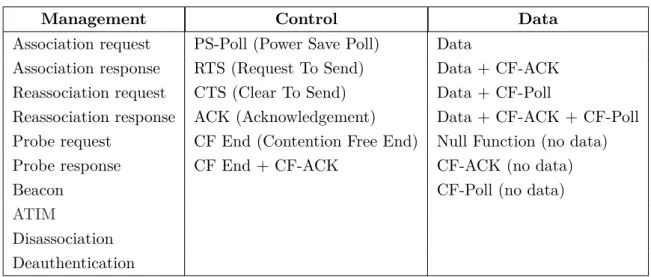
In 802.11 networks we have three packet frame types: management, control and data. Each of them has subtypes, listed in Table 2.1.
The management frame types are mainly used for network management and admission control, for example they allow WLANdevices to initiate and maintain communications. The control types are usually used for access control, i.e. allow some stations to access the medium while denying access to other. And the data frame types are used for data transmission [9].
Our main focus is in the management frame (and its subframes), since it is there where all theAPs main interactions happens. For our work we need to clarify howAPs are deployed and how they advertise themselves. As well as what they advertise and the type of capabilities they have.
Beacon frames information
The APs sends out periodically broadcast frames called Beacon frames to announce its
8 Chapter 2. Background
Management Control Data
Association request PS-Poll (Power Save Poll) Data
Association response RTS (Request To Send) Data + CF-ACK Reassociation request CTS (Clear To Send) Data + CF-Poll
Reassociation response ACK (Acknowledgement) Data + CF-ACK + CF-Poll Probe request CF End (Contention Free End) Null Function (no data) Probe response CF End + CF-ACK CF-ACK (no data)
Beacon CF-Poll (no data)
ATIM
Disassociation Deauthentication
Table 2.1: 802.11 frame subtypes
presence, i.e., a wireless LAN. They contain all the information about that respective network. A beacon frame, like other frame types, has a structure which consists of a header, frame body and a Frame Check Sequence (FCS). In the header it has the source and destination MAC addresses and information regarding the communication process. TheFCSis based on the Cyclic Redundancy Checking (CRC) algorithm and it is applied to bytes from the header and body. The relevant part for our understanding resides in the frame body which contains the following information [18]:
• Beacon interval - amount of time between beacon transmissions. A station needs to know the beacon interval (before entering power save mode) in order to wake up to receive the beacon.
• Timestamp - when a station receives a beacon frame, it uses the timestamp value to update its local clock. This enables the synchronization between all stations that are associated with the sameAP. This information will be useful in the process of identifyingRAPs, since software based access points have accuracy flaws in the timestamps [32].
• Service Set Identifier (SSID) - identifies a specific WLAN. Prior to associating with a WLAN, a station must know theSSIDto connect to. The NIC’s firmware will be set for this SSIDfor connection.
• Supported rates - information that describes the rates that some WLANsupports. With this information, the stations can use performance metrics to choose which APto associate with.
• Parameter Sets - information about the specific signaling methods. For example, a beacon would include, in the right parameter set, the channel number that an AP is using. Furthermore, a beacon belonging to frequency hopping network would indicate the hopping pattern and live time.
2.2. The 802.11 Standard 9 • Capability Information - requirements for stations that want to connect to theWLANthat the beacon represents. For example, this information may indicate that all stations must use WiFi Protected Access (WPA) so they can associate on the network.
• Traffic Indication Map (TIM) - are sent periodically by anAP(within a beacon) to identify which stations using power saving mode have data frames waiting for them in the APs buffer. The TIMidentifies a station by the association ID that theAP assigned it during the association process.
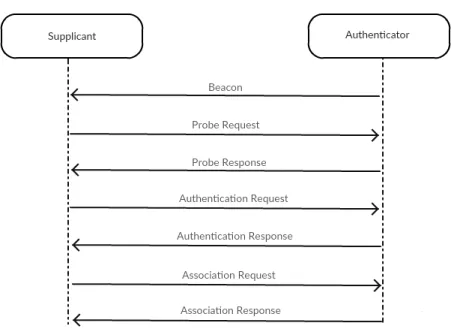
Figure 2.1: Connection for open authentication
In a typical scenario theAP transmits beacon frames periodically in order to announce its presence and send information. The information contained in a frame will be of much interest for the development of our tool, for instance it contains information like: Beacon interval, Timestamp, SSID and Capability Information. The clients (radio NICs) continually scan all 802.11 radio channels and listen to beacons in order to choose which APis the best to associate with [19]. On the other hand the clients can actively send probe requests, which has the SSID that it wants to connect to, in order to identify APs within range. In response to these probe requests, the AP sends a probe response frame, much like the beacon frame, that contains information like supported rates and capabilities of the network. After this discovering phase, the client should be authenticated by the AP, and associated, in order to get more privileges, where authentication and association messages are exchanged. In the authentication process the identity of the client is sent to the AP through an authentication request frame, then theAP either accepts or rejects its identity (with an authentication response). The default system is the open authentication, shown in figure 2.1, where there is no identity checking, i.e., the AP only sends the authentication response with acceptance or rejection. After this the client will send an association request in order to enable the AP to allocate resources and establish the synchronization with the user. TheAP send the association response with the information of
10 Chapter 2. Background
its acceptance or rejection [34]. Hereupon, the user and the AP can exchange data. In secure connections it is sent an Authentication challenge to the supplicant, and the specific details are explained in the next subsection.
2.2.2 802.11 Security
In order to establish a secure communication the connection model needs additional steps. In particular, it is necessary to perform a four-way handshake [26], where the wireless client (supplicant) and the AP (authenticator) derive the encryption keys to be used to encrypt the
wireless data frames which will guarantees the communication security.
Encryption
• Wired Equivalent Privacy (WEP)
In the WEP, as the name suggests, the main goal was to provide a confidentiality level close to that from wired networks. Let us divide the WEP algorithm in two sections: Authorization and Traffic Encryption. Starting from the Authorization part theWEP, it has two methods for the authentication: open system and shared key. In the open system the client does not need to provide any credentials in order to connect to the AP. The authentication gets completed after the exchange of two messages. In these scenarios the network can be protected with white lists of specific MAC addresses. The shared key authentication uses the four-way handshake prior to the client joining the network. In particular, (i) the client sends an Authentication Request message with the MACaddresses of the both parties (client andAP); (ii) then the APresponds with a challenge message which contains a 128 bits random number; (iii) the client sends the response message which contains the random number encrypted with theWEP shared key. Then the AP decrypts the previous messages using its shared key. Then if both numbers match, theAP acknowledges that the client has the shared key. In the final step (iv), the AP sends an Authentication Response message with the outcome of the authentication process. As we can conclude from this reasoning the authentication process is unidirectional where theAP authenticates the client [31].
Regarding traffic encryption, WEP makes use of the Rivest Cipher 4 (RC4) algorithm for confidentiality and CRC-32 for message integrity. The confidentiality process uses a static key (called root key), and it can be of two types (regarding key size): WEP-40 and WEP-104.
The WEP-40 key is the basis for the generation of a session key and supports key sizes of 40 bits. Here only the data frames are protected, management and control are unprotected. The process of encrypting a packet involves the following steps: First, is generated a 24-bit long Initialization Vector (IV). Then, a root key is appended to the IVdefining the "per packet key", which will seed the RC4 algorithm to produce a key sequence, known as keystream. Finally, this keystream is XORed with the concatenation of the packet plaintext
2.2. The 802.11 Standard 11 and itsCRC-32 value which will create the packet ciphertext. The WEP-104 uses the same process with a key size of 104 bits.
• WiFi Protected Access (WPA)
TheWPAis a security technology introduced in the 802.1X to fix the weaknesses of the original security mechanism. The lack of native wireless security was the main factor to the development of 802.11i. Therefore,WPA was a transitional point while WiFi Protected Access II (WPA2) was being developed. In WPAstronger encryption mechanisms were introduced: Temporal Key Integrity Protocol (TKIP) and Advanced Encryption Standard (AES). Furthermore, WPA addressed critical security issues, like mutual authentication through the use of 802.1X and the Extensible Authentication Protocol (EAP), better IV lengths, stronger integrity check mechanism and secure re-keying function. WPA may make use of central authentication servers like Remote Authentication Dial In User Service (RADIUS) for user authentication, access control and management. This practice is mainly used in enterprise environments. For home users a variation ofWPAwas developed, named WPA Pre-shared key (WPA-PSK). This is a simplified version ofWPA which uses a passphrase as a pre-shared secret key for the network users.
• WiFi Protected Access II (WPA2)
The commonly knownWPA2, developed inIEEE802.11, was an amendment to the original IEEE 802.11 standard in order to increase the security of the protocol. The current version of the standard, 802.11ac [2] still uses the 802.11i as the primary security protocol. RegardingWPA2we will focus on the Key Construction process and Traffic Confidentiality and Integrity.
In the Key Construction process all the keys are derived from a single key (the key in the highest layer of the hierarchy). This key will have two types resulting from the authentication method used. The two methods that can be used inWPA2 for the authentication process may be based on a pre-shared key or on the 802.1X framework. If the first is used, the top key will be called Pre-shared key (PSK), if the second is chosen, the top key will be called Master Session Key (MSK).
Then, the top level key is used to generate the primary keying material, which is the Pairwise Master Key (PMK). The next level of the keying hierarchy is composed by the Pairwise Transient Key (PTK) and the Group Transient Key (GTK), these keys are specific to client-AP pair and are produced during the authentication process.
Finally thePTKkey is split in five sub keys: one temporal encryption key, two temporal Message Integrity Code (MIC) keys,EAPOL-Key Key Confirmation Key (KCK),EAPOL -Key -Key Encryption -Key (KEK). Within these keys, the temporal key is the one used to encrypt or decrypt unicast traffic.
TheGTK is split in two keys: Group Encryption Key (GEK) used to encrypt or decrypt multicast traffic, and Group Integrity Key (GIK) used for verifying theMICof multicast or broadcast traffic.
12 Chapter 2. Background
Regarding the traffic confidentiality and integrity of WPA2, it supports three alternative protocols for protecting the network traffic. These methods are: TKIP which is based in RC4algorithm, Counter-Mode/Cipher Block Chaining Message Authentication Code Protocol (CCMP) based on the AES algorithm in CCM mode, and Wireless Robust Authenticated Protocol (WRAP) which is based on AES OCB.
2.2.3 802.11 Channels
All WiFi networks transmits and receives data on a certain frequency, or channel. In the current 802.11 standard there are five distinct frequency ranges: 2.4 GHz, 3.6 GHz, 4.9 GHz, 5 GHz, and 5.9 GHz bands [2]. Each of these ranges is divided into channels, where the number of allowable channels is defined by country as well as the number of allowed users and maximum power levels. As the WiFi data is digital, different devices are able to communicate successfully in the same channel. When more than one device is using the same channel, although the data does not interfere with each other, the channel gets contended. When devices are in neighbor channels the transmissions will start to interfere with each other causing other issues than contention in the case of single channel. This happens because the transmissions are not restricted to one frequency and thus the communication is spread across five channels in total. For example if a device (router) was on channel 6 the communication will range channel 4 to channel 8, then the neighbor channels (for example 5 or 7) will suffer from interference.
2.3
Taxonomy of
RAP
s
We will consider the taxonomy of RAPs based in the current literature. Thus,RAPs are classified into four categories: Evil-Twin, Improperly Configured, Unauthorized, and Compromised. In [5] two more types of RAPs are also classified: RAP-based deauthentication/disassociation attacks and forging of the first message in a four-way handshake type.
• Evil Twin
This type of RAP is sometimes referred as Spoofed AP and its name represents, in a figure of speech, the type of the attack. Evil Twin RAPs rely on a software-based AP which is often installed/configured on a portable device. This portable device must have a wireless card capable of working in monitor mode. It is also quite common the use of external wireless antennas. With these conditions the attacker can make use of tools like Airbase-ng3 in order to set up theRAP.
In the IEEE802.11 standard there are only two parameters to identify APs to users. They are: the SSID and the BSSID (Media Access Control (MAC) address of the AP). The main problem resides in the fact that these identifiers can be spoofed, and therefore the
2.3. Taxonomy of RAPs 13 benign APwill be cloned (spoofed) in an Evil Twin AP and both will be indistinguishable from the point of view of the wireless users.
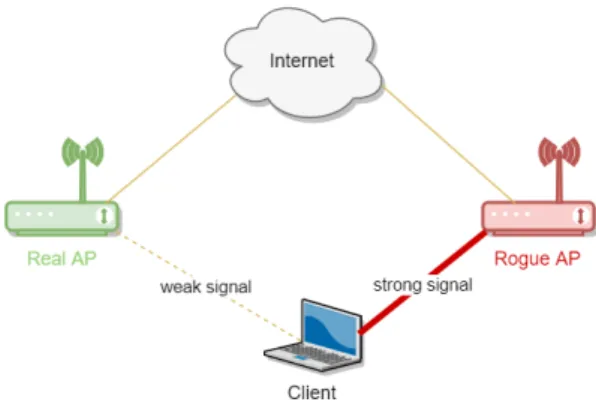
The Evil TwinRAP type can exists in two forms: Coexistence and Replacement. In the first one the legitimate AP and the Evil Twin coexist in the same location. The process is like the one previously described, with the extra detail of the attacker increasing theRAP signal strength to force the users to connect to it. And as the IEEE 802.11 standard states that WLANclients must connect toAPs that have the strongest signal, the attacker will benefits from it. In the second type, Replacement, the Evil Twin replaces the legitimate APby shutting it down. Here the RAP needs to have an Internet connection while in the first case it could relay the packets to the legitimateAP.
Figure 2.2: Evil Twin RAP type
Evil Twin RAPs are mainly used to listen to users traffic (as they browse the Internet), and carry out attacks such as interception, replaying, and traffic manipulation, to these users devices [47].
The configuration of an Evil TwinAP might require some extra steps to avoid Intrusion Detection Systems (IDSs), in these cases an attacker masquerades theAP MACaddress and SSID, configures a Domain Name Server (DNS) server to connect to the Internet and a Dynamic Host Configuration Protocol (DHCP) server to assignIP addresses.
Nowadays, Evil Twin APs can be deployed from smartphones and therefore harden the task of identifying them even more.
• Improperly Configured AP
This type ofRAP, as its name suggests is anAP which was improperly configured, there is no adversary involved in the creation process. This can happen when, for instance, an administrator does not use robust authentication and encryption settings. APs can also become vulnerable after some software updates [36] or the lack of upgrades. The issue with this type ofRAP is the consequence of possible backdoors in an organization network infrastructure that might enable attackers to bypass authentication, explore and exploit the network.
14 Chapter 2. Background
• Unauthorized AP
Type of RAP installed by employee or naive user without the network administrator permission. This RAP is connected to the wired side of the network (like a legitimateAP) and thus it is considered part of the WLAN. A RAPof this kind can exist in the network of an organization for the convenience of its employees, i.e., access some external network resources, that otherwise might be blocked by a firewall. Apart from this, it can also be deployed with malicious intentions and thus it will create an entry point in the organization network and compromise its security. Hence, unauthorized users will be able to eavesdrop and launch attacks like in the previous types.
• Compromised AP
When the shared keys used to secure the network communications gets compromised, the APbecomes a rouge. Thus, the person who obtains the keys (the attacker), will be able to join the network and has previously described, will be able to eavesdrop and launch a series of attacks to the network and its users.
2.4
WiFi Attacks
There are several types of wireless network attacks that target all the pillars of the information security: confidentiality, integrity and availability. For our work we are interested in the RAP type of attacks which target: the access control mechanisms, attempting to penetrate a network, Confidentiality attacks, which attempt to intercept private information sent over the wireless, and Authentication attacks, where legitimate user identities and credentials are stolen to access private networks and services [42].
Thus, we explain the most commonly used techniques to perform WiFi attacks:
• RAP with stronger signal: in this specific attack, theRAP behaves as an Evil Twin, as described in2.3. Here the attacker entices the victim to connect to the Evil TwinAP. This attack does not require any special hardware apart from a wireless adapter with access point capabilities, and in order to accomplish this, it is often used the Aircrack-ng4 tool. The first step in this type of attack is to set the wireless card to monitor or promiscuous mode in order to start capturing traffic and gather information about the near by APs and its clients. With this information an attacker can use the same tool and create a newAP matching the desired victim AP. The common way an attacker performs this attack is by creating the Evil Twin AP with the same SSID,BSSID and channel, and increasing the APsignal power in order to overcome the signal of the legitimate one.
At this stage, the attacker has a RAP, specifically an Evil Twin, waiting for victims to connect.
4
2.4. WiFi Attacks 15 An important point for the detection process is that usually in this type of attacks the Evil TwinAP is created with Open authentication which will ease its detection. On the other hand, if the attacker gets the PSK of the network, they will be able to create an exact clone of the legitimateAP which will be more difficult to detect.
These two factors have direct influence in the next topic, deauthentication attacks, because if no authentication (Open) is used, the signal strength will not matter, this is because of the way wireless roaming works, where it will only work when theAPs have the sameSSID, BSSID, security mode and passphrase. We should also understand that the channel is often different and non-overlapping. On top of that the target station should support roaming. Only with these conditions the target victim would automatically switch to anotherAP with a better signal strength.
• Deauthentication attacks: In order to bypass the stated issue, attackers often use deathentication attacks to force their victims to connect to theRAP.
This attack is possible because of the special deauthentication frame in the 802.11 standard. The attacker sends this special frame to the desired victim on behalf of the legitimate AP and consequently the target victim will be deauthenticated from that AP. Then, in the process of re-authentication, the victim will automatically reconnect to the strongest known AP.
• Karma attacks: In the previous attack, we described that the attacker chooses a specific AP to clone, they monitors the network and selects the desired AP. In karma attacks, things are different, it goes from a manual process of selecting and creating a specificAP to an automatic process where it listens to the networks the wireless devices request and creates them on demand. This is possible because of a vulnerability in the method of discovering available WiFi networks [15].
When a client wants to connect to a network he must perform a scan for available networks (Probe request) and then select one matching its Preferred Network List (PNL). And as seen in 2.2.1, there are two types of scan: passive and active. Thus, this attack will target the active scans, which are probe requests that are sent with the SSIDs of the client preferred networks. With this information the attacker will be able to respond to the probe request by sending the probe response matching the network requested by the victim.
16 Chapter 2. Background
Even being an old attack [15], the karma attack can still affect clients that are using active probing authentication. And to perform it, an attacker could use a Pineapple AP5 or a Pwn Phone 6 that are portable devices that make the attack much simpler to accomplish. • Rogue AP with radius server: The attacks seen so far target private/home and open
networks and are the most known and easy to accomplish.
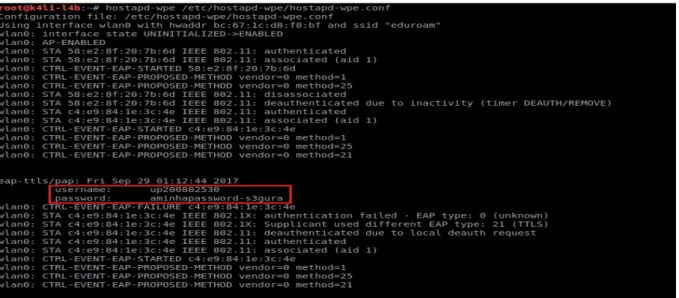
When facing WPAEnterprise it is also possible to attack this scheme and in particular, impersonate a WPA Enterprise AP. To this purpose there are a couple of tools that can be used by an attacker: hostapd-wpe 7 and freeradius-wpe8. These tools will implement IEEE 802.1X Authenticator and Authentication Server impersonation attacks in order to obtain client credentials and establish connectivity to the client.
In order to better understand this attack we deployed an RAP using the hostapd-wpe. The createdRAP had theSSIDeduroamin order to impersonate the school APs. With this test we could see that in cases where the clients did not had theCA certificate, the tool was capable of retrieving the victims credentials in clear text, this was possible because the inner authentication configured in the eduroam APs is Password Authentication Protocol (PAP) which transmits unencrypted passwords over the network.
Figure 2.5: RAP with radius server attack
This is important to notice as some users configure the network connection without adding theCA certificate, and to prevent such cases a strong authentication algorithm should be enforced. 5 https://hakshop.com/products/wifi-pineapple 6 https://store.pwnieexpress.com/product/pwn-phone2014b/ 7 http://pkg.kali.org/pkg/hostapd-wpe 8 http://pkg.kali.org/pkg/freeradius-wpe
2.4. WiFi Attacks 17 This background knowledge was crucial to the development process of the RAP detection tool. The taxonomy guarantees the scope of the project and the type of attacks creates the base cases for the proof of concept.
The Beacon frames information,2.2.1, was fundamental in understanding what is announced by anAP and consequently detect anomalies in this advertisement, that in some cases represents
rogues. More details about how these Beacon frames are represented in a Wireshark 9 capture are presented in the Development section, chapter5.
Chapter 3
Related Work
To proceed with the development of our tool we searched for current work, namely counter-measures and solutions for the Rogue Access Points (RAPs) issue. There are different types of countermeasures, for example it is important to identify passive and active detections, and classify if the solution targets more than one type ofRAP. Furthermore, there are techniques that require protocol modifications or some use of specific hardware. In a passive type the detector radio listens on each channel for beacons sent periodically by an Access Point (AP). While in an active type, the detector radio transmits a probe request and listens for a probe response from an AP. The problem with active approaches is that a RAP does not reply to active probing and so passive methods are often preferred.
The solutions that we analyzed and compared, in order to understand the state of the art and to support the development of our tool are divided into two categories: Server-side (or Operator) tools and Client-side ones. It is important to clarify and understand the scope of these two types, for instance, in the Server-side type Intrusion Detection Systems (IDSs) are used, which are implemented on theAPs or routers. In this type, the AP, in addition to serving the traffic, also works as an intrusion detector. In the case of Client-side type the main objective is detectingRAPs and for this it is necessary to overcome some challenges, in particular: a client has fewer privileges and has difficulties to gather WLANtraffic from the gateway. Contrasting with this, the Server-side, that is, the operator, has all the privileges to work with the network and overcome these issues. Thus, we can look at the Server-side to identify and if possible, physically locate the RAP, and the Client-type to detect and thereby avoid the connection of a client to a RAP. For these detections, a wireless or wired approach can be used. The wireless approach is used to detect theRAP only through the wireless traffic, and in the wired mode the detection of theRAP works on the wired side, where all the wireless traffic relayed by the switch or router is analyzed.
The majority of techniques to detect RAPs have focussed on Evil Twin RAPs types and consequently will also detect RAP-based deauthentication/disassociation attacks. There are techniques to detect UnauthorizedAPs, but detection of CompromisedAPs is scarce. And as revised in [5] there is no single technique to detect allRAP types.
20 Chapter 3. Related Work
3.1
Available 802.11 security to protect from
RAP
s
The security mechanisms described in the 802.11 Security subsection, 2.2.2, are not enough to protect against all RAP types. Looking back to Wired Equivalent Privacy (WEP) it has two characteristic weaknesses: the IV is frequently reused, and the secret key is not changed often enough, which makes it difficult to guarantee that key streams will, with great probability, be different. On top of this, an attacker can eavesdrop the IV being transmitted. And in a situation where two messages are encrypted using the same IV along with an original message, the encrypted messages are likely to be decrypted using the XORoperation. Thus, when the attacker gathers the key streams the key can be retrieved [49]. Because of these weaknesses, WEP will fail to protect against RAP.
WiFi Protected Access (WPA) (developed usingIEEE802.1X) was meant to be an access control method for network users. Apart from this, it also provides port security for unauthorized accesses to the network resources. InIEEE 802.1X there are three important components: the supplicant (wireless device that wants to connect to the network), the authenticator (the one responsible for providing access) and the authentication server (responsible for the authentication decisions). The most secure EAPauthentication process used inWPA is the EAP Transport Layer Security (EAP-TLS), which uses public key cryptography. In this method, clients and servers use certificates, and it supports mutual authentication and dynamic key derivation [4]. Because of the difficulty in faking an authentication server, this method is capable of protecting against Evil Twin and Compromised APs. Today smartphones, tables and laptops have easy mechanisms to configure WiFi hotspots with these security methods and consequently it should be always used even in a simple task like sharing Internet connection. A drawback that can be stated from this method is that the server certificate validation is optional, and consequently the authentication server may be faked through the capture of the four-way handshake messages [7].
Apart from these security methods, sometimes universities, airports, shopping malls and hotels implement a Web-based Authentication. For example, in our school campus we have a WiFi network of this type, wifi_eventos. Also, all of the free WiFi networks provided by the WiFi Internet Service Providers (ISPs) are of this type (MEO_WIFI and FON_ZON in Portugal). In an authentication of this type, the user is redirected to a web portal where they will need to login with their credentials (previously registered to that service). Some authentication software that comes in this Web-based portal uses openWLAN, and some of the authentication portals are still implemented usingHTTP. Furthermore, the authentication process depends on a firewall responsible for redirecting the requests to the login webpage and blocking the other requests. After the user provides the right credentials the access to the network resources is granted. The main issue regarding open WLANs and Web-based authentication resides in the fact that all the communication can be seen by anyone in the network, even without being authenticated or authorized to access the network resources. For this, an attacker can simply use tools such as Wireshark or tcpdump 1 in order to listen to the communications broadcast frames. Hence, this
1
3.2. Available RAP Detection approaches 21 method will not protect againstRAPs, and furthermore, login web pages are easy to clone which will ease the process of stealing users credentials (Phishing).
Another technology used to protect Internet connections from unsecure environments are Virtual Private Networks (VPNs). In aVPNimplementation a tunnel is created over IP and in some types it uses Secure Sockets Layer (SSL) to give an extra layer to the communication process. Even so, there are several unsolved attacks to SSL and consequently theVPNconnections may be compromised and aborted [41]. Thus, this method is not able to protect in someRAPs types. Nevertheless, is one of the best countermeasures to protect against all the RAPs types.
We have seen some methods that address the protection of data frames, for instance 802.11i uses 802.1X for authentication/authorization and CCMPfor encryption and consequently the frames are encrypted which even if an attacker captures them will not be able to decrypt them and obtain the original data. But 802.11i only protects data frames, thus, management frames are still exposed to attacks, for example if an attacker obtains the MAC address of a client, they can send disassociation requests to the client on behalf of anAP and disconnect the client (a common technique used by attackers in some Evil Twin RAPs approaches and to capture handshakes to brute force PSKs). To address this issue, 802.11w was developed, that is, protect wireless management and control frames. Thanks to this, the deauthentication and disassociation processes are protected and so it is unfeasible to forge these frames. The issue here relates to the deployment of this standard, upgrading the firmware and hardware of millions of WLANdevices in order to make it compatible is extremely complex. Thus, the majority ofWLANs still do not implement this standard.
3.2
Available RAP Detection approaches
As we could see, the previous methods are not able to protect against all theRAPs types, in particular they are not even well directed to this purpose, they are mainly security mechanisms of the 802.11. And in order to complement them there are several novel approaches that have been proposed by researchers.
In this section we explain some of the proposed methods as well as some methods available on the market.
• Protection against Evil Twin Coexistence
As we already saw in section2.3, the Evil Twin type deploys in the WLANaRAP which is a clone of the legitimate AP. Table 3.1 presents some of the techniques proposed by researchers regarding the issue of Evil Twin Coexistence, i.e., a RAP that is presented simultaneously in the network with the legitimate AP.
Taking a look in a chronological order, in [46] we have an approach based on the fingerprint model, the authors used Support Vector Machine (SVM) technique to train and validate
22 Chapter 3. Related Work
Technique Year Mode
Time Interval [29] 2014 Passive Client-side [40] 2012 Passive Cipher types [11] 2012 Passive Duplicate RSSI [30] 2012 Passive ETsniffer (v2) [54] 2012 Active
WiFihop [38] 2011 Active
DNS server two hops (v2) [25] 2011 Active
RAPiD [43] 2010 Passive
ETsniffer (v1) [47] 2010 Active DNS server two hops (v1) [24] 2009 Active Active behavioral [10] 2008 Active Authentication + SVM [46] 2006 Active Table 3.1: Evil Twin Coexistence techniques
the precise timing measurement related to the authentication procedure and with this distinguish fingerprints based on this timing.
The fingerprint active model in [10] uses network discovery and takes advantage of security tools like Nmap 2. The method sends a request frame and waits for the response from where it will be able to determine how the devices react to fragmented or manipulated frames. Once the technique uses an active detection it can be avoided by attackers. Another drawback from this technique is the possible interference with the regular WLANtraffic. The method described in [25] is a timing-based scheme and explores the expected two hops that happen when the user connects to theDNSserver. They used Round Trip Time (RTT) to determine if an AP is legitimate or not. The detection of the RAP happens because in this case the network traffic is relayed through the DNS server of the legitimate AP. This will create a delay resulting from two hops that occur between the user and theRAP, instead of the natural one-hop process.
Taking a closer look to this method we can state that it only focus on a specific type of cause (the delay in a WLAN), where causes like interference, collisions and highly traffic-loaded WLANs may create this kind of delay. Hence, this tool can have a high false positive detection rate.
RAPiD method, described in [43] takes an indirect approach in RAP detection. It uses Local Round Trip Time (LRTT) of TCPpackets to measure the delay.
The WiFiHop [38], is another method that uses an active approach, here test packets are sent to see if the RAP relays the packets on a different wireless channel. The proposed method in [30] focus in the case where the attacker device has more than one Received Signal Strength Indication (RSSI). Then the detection happens through the deviation
2
3.2. Available RAP Detection approaches 23 between the two APs Received Signal Strength (RSS). This is one more method focused in the scenario where the RAP relays the traffic through the legitimateAP.
The next approach is [11], where the authors used the authentication and cipher types of the AP to detect RAPs. Here the information present on the authorizedAPs (SSID, authentication type and cipher type) is stored in a database. With the information stored they are able to sniff the beacon frames and compare its parameters with the ones stored. Thus, if they do not match, an alert will be triggered. The authors designed this method to be implemented on the client side for protection in airports or shopping malls, but as we know the WiFi hotspots in those locations use open authentication and only one cipher type, which makes this approach not practical.
The [40] method addresses the situation where two APs broadcast the same SSID and BSSID, their method checks if theIP addresses are the same and then compares the trace routes to a known machine. A drawback with this method is that it is not able to determine which AP is authorized and which one is not, otherwise would be possible to identify spoofed IPs, as the trace route of sameIPs will eventually be different. Once more this is a method where only Evil Twin types are identified, the case where the RAP relays the packets to a legitimate AP.
Last but not least, the approach in [29] is based on the beacon time interval deviation. It takes in consideration the approximated time when beacon frames are sent, (approximately every 100 ms). Then, the time interval between two consecutive beacon frames is used to identify suspicious activities. Unfortunately this approach can not be used in real scenarios, because of the interference within different types ofWLANdevices, 802.11b, 802.11g and 802.11n.
• Protection against Coexistence and Replacement Evil Twin
Here we focus on approaches that solve not only the Coexistence Evil Twin RAP problem but also the Replacement Evil Twin issue.
Technique Year Mode
Prob Request stimuli [32] 2015 Active Adjacent Channel [32] 2015 Active
CETAD [39] 2014 Active
Clock Skew + Temperature [33] 2014 Passive Clock Skew [39] 2014 Passive Radio frequency [51] 2012 Passive Clock Skew [6] and [27] 2010 Passive
EAP SWAT [20] 2010 Active
EAP SWAT [8] 2008 Active
Radio frequency [50] 2006 Passive Table 3.2: Coexistence and Replacement Evil Twin techniques
24 Chapter 3. Related Work
TCP flows based on measurements collected passively. They use an iterative Bayesian inference algorithm to compute the fraction of wireless TCP flows and the degree of certainty that a TCP flow traverses a WLAN inside the network. Even though their algorithm converges to the unique maximum likelihood estimate of the two quantities it is not appropriate to be deployed in real time, because of the time it takes to converge. TheEAP-based authentication methods [8] and [20] are referred by its authors as Simple Wireless Authentication Technique (EAP-SWAT), and it uses the Secure Shell (SSH) trust-on-first-use approach. The trust is certified on the first connection to theAP, then the next connections to theAP are ensured to be authenticated by the coexistence of the certificates. These methods imply a change in the standard or protocol used, and would imply a change to drivers and firmware on the supplicants and APs which is not feasible.
Taking advantage from the hardware fingerprint some authors used it to detectRAPs based on the characteristics that uniquely match aWLANdevice. With this in mind, the authors in [6] and [27] propose a clock skewing approach using the timestamp from beacon frames Timing Synchronization Function (TSF). This method compares theTSFgenerated at the APwith the inter-arrival time of the frame at the user station. And as we already stated on previous methods this will not work properly because of the delays inWLANmedium. Then in [39] and [33] the time skew method uses theTSFin order to differentiate hardware and software based APs. The method in [39] has a combination ofISP-based detection and timing-based detection. In this service the ISPreceives a set of IPaddresses provided by Internet Assigned Numbers Authority (IANA) (the authority in charge of managing global IPaddresses), so they can provide a unique global IP address to clients using this service. The information in each global IPaddress is publicly available on the web. Hence, in this approach a request is sent to these servers, and with the information response about the requestedAP they managed to distinguish Evil Twin APs from legitimate ones. In a ISP-based detection method it is not possible to identify Evil Twin APs sharing the same Internet connection as the legitimate AP, this happens because the Evil TwinAP uses the same Internet service.
• Unauthorized AP Countermeasures
As previously explained unauthorizedAPs are connected to the wired side of the network without the permission of the administrator. To prevent suchRAPs, in [53] the authors use a verifier placed in the wired part of the network which sends test packets to the wireless side of the network. Consequently, theAPs that relay those packets are detected as RAPs and the administrator will be able to locate them. This verifier can monitor the active users on the wired side and with the test packets that it sends it is able to differentiate APs from users, because in the case of anAP it will receive the packet and forward it to the wireless side.
One of the first approaches is the one proposed in [13] where wireless frames are sniffed and the packets are sent to an analyzing engine which contains a list of legitimate APs (white-list), in fact this approach is the base for further approaches and similar mechanisms
3.2. Available RAP Detection approaches 25 that are present in some known wireless routers [35] and [14]. Once this analyzing engine gets the packet with the information about the new AP it will check it with the authorized list in order to identify suspicious nodes. This approach can be bypassed with a spoofed AP, which will match an authorized AP from the white-list and become a RAP.
The countermeasure presented in [3] has three components: a filtering engine, anomaly detection sensors, and shadow honeypot code. The first component is the first layer of protection, here it uses an authentication list to filter unauthorized APs. Therefore, any traffic sent from a sourceMACaddress that is not on that list will not pass and is considered a RAP. When some traffic passes the first detection mechanism (an authenticated user) it will arrive to the second layer of protection, the anomaly detection sensors. Here the characteristics of the packets will be examined and sent to the inner layer, shadow honeypot. This is the final stage and works in similar way as an anti-virus system, it uses signatures of worms and attacks and compares them with the network trace. As drawbacks, for instance the authors did not take care of the MAC address spoof case, where a spoofed MACaddress of a legitimateAP presented on the white-list will pass to the other stages. • Deauthentication/Disassociation Countermeasures
As analyzed in 3.1 the security standard used in 802.11 is the IEEE 802.11i [21] which provides data confidentiality, integrity, and mutual authentication in the Media Access Control (MAC) layer. And as seen before, if IEEE 802.11w is not implemented the management frames will be vulnerable to deauthentication and disassociation attacks. Hence, taking advantage of this vulnerability, attackers will use it to their profit, for example they send these packets to disconnect a client from the legitimateAP and then, because of the traditional scheme of increasing the signal strength power of RAPs, the clients will get connected to theRAP.
Apart from the 802.11w standard which may not be present in a network, there are some approaches which aim to detect deauthentication and disassociation attacks.
One of the first approaches proposed in the research community was the sequence number, described in [17,22,52], where they tried to detect MACaddress spoofing coming from deauthentication attacks. The base theory behind this method is the assumption that a wireless user generates a sequence of numbers which will make it difficult for an attacker to manipulate the sequence to get the same match numbers. Eventually this will create a gap between the sequence number from the legitimate AP and the attacker (RAP) and identify a spoofing situation. However, this kind of detection can be traversed by injecting deauthentication frames after the sent frames from a specific user or AP.
Another kind of approach are the RSSI based ones [12, 45], here the authors try to differentiate WLANdevices based on their location. For this they use theRSSI from the devices, taking in consideration that a wireless device does not increase or decrease its transmission power on a regular basis; it might happen because of multi-path and absorption effects but it is not a general rule or commonly of a great influence. Consequently, obvious changes inRSSI from the sameMACaddress is considered as an indicator of spoofing and
26 Chapter 3. Related Work
will identify aRAP. An attacker may overcome this method by deploying theRAP with the same signal of the legitimate AP, i.e., it would increase or decrease the signal strength in order to mimic it. Also, if the attacker is close to the legitimate AP it would be difficult to identify the RAP.
• Protection against multiple RAP types
Following a chronological order, the authors of [28] present a Distributed Wireless Security Auditor (DWSA) tool which works both on Linux and Windows-based systems providing continuous wireless assessments. This tool also uses the trusted wireless clients as distributed sensors in order to find anomalies. To detect and locateRAPs it uses 3D trilateration [16]. With DWSAit is possible to detect Evil Twin and Unauthorized RAPs.
In [36] it is possible to detect Evil Twin, Unauthorized and Compromised RAPs types. For such, this hybrid method combines the distributed wireless media surveillance and centralized wired end socket level traffic fingerprinting. A disadvantage of this approach is the fact that it must be packaged with the router or the switch resulting in overloads when dividing the jobs, i.e., serving wireless and running theIDS.
The method proposed in [48] is another type which strongly depends onAPsMACaddresses and therefore is vulnerable for spoofing attacks. The method itself works in a multi-agent form and can detect Evil Twin and Unauthorized RAPs, it is composed by a master agent and a slave. The master regulates the authorization processes in the WLAN, while the slave answers to the master agent identifying active APs in theWLAN. For this, the slave is connected to an AP and gathers its relevant information (SSID,BSSID, vendor name and channel number). When the master agent receives this information it compares it with an authorized list (same as white-lists).
In some companies wireless sniffing solutions are used where they deploy sensors across the network perimeter in order to gather physical and data link layer information.