• Nenhum resultado encontrado

Interactions of Plasmodium blood and liver stages within a single host

N/A
N/A
Protected

Academic year: 2021

Share "Interactions of Plasmodium blood and liver stages within a single host"

Copied!
187
0
0

Texto

(1)

Universidade
de
Lisboa


Faculdade
de
Medicina


Instituto
de
Medicina
Molecular


I

NTERACTIONS
OF
P

LASMODIUM


B

LOOD
AND


L

IVER


S

TAGES
WITHIN
A


S

INGLE


H

OST

Sílvia
Vilar
Portugal


A
dissertation
for
the
degree
of
Doctor
of
Philosophy
in
Biomedical
Sciences


Specialization
in
Biopathological
Sciences


Supervised
by
Maria
Manuel
Mota,
M.Sc,
Ph.D


Principal
Investigator
of
Unidade
de
Malária
in
Instituto
de
Medicina
Molecular


Auxiliary
Professor
at
Faculdade
de
Medicina
da
Universidade
de
Lisboa


2010


(2)

A
 impressão
 desta
 dissertação
 foi
 aprovada
 pela
 Comissão


Coordenadora
 do
 Conselho
 Cientifico
 da
 Faculdade
 de
 Medicina
 da


Universidade
de
Lisboa
em
reunião
de
13
de
Abril
de
2010.


As
 opiniões
 expressas
 nesta
 publicação
 são
 da
 responsabilidade
 do


seu
autor.


(3)

(4)

The
research
described
in
this
thesis
was
performed
at
the
Instituto


de
 Medicina
 Molecular,
 Lisboa,
 Portugal,
 and
 was
 financially


supported
 by
 Fundação
 para
 a
 Ciência
 e
 Tecnologia,
 Portugal


(SFRH/BD/31523/2006).


O
 trabalho
 de
 investigação
 descrito
 nesta
 tese
 foi
 realizado
 no


Instituto
 de
 Medicina
 Molecular,
 Lisboa,
 Portugal,
 e
 foi
 financiado


pela
 Fundação
 para
 a
 Ciência
 e
 Tecnologia,
 Portugal


(SFRH/BD/31523/2006).


(5)

Preface

This
 dissertation
 assembles
 data
 obtained
 during
 my
 Ph.D
 research


project,
 developed
 at
 Faculdade
 de
 Medicina
 da
 Universidade
 de


Lisboa,
 Instituto
 de
 Medicina
 Molecular,
 Unidade
 de
 Malaria,
 under


the
 supervision
 of
 Prof.
 Maria
 M.
 Mota,
 from
 October
 2006
 to
 April


2010.


This
thesis
is
structures
in
5
chapters,
preceded
by
a
summary
both
in


Portuguese
and
English,
outlining
the
aims,
results
and
outcomes
of


this
project.


The
first
chapter
provides
an
insight
on
previous
malaria
knowledge,


and
the
aims
of
this
work.


The
 second
 chapter
 contains
 the
 description
 of
 the
 methods
 and


materials
employed
to
carry
out
the
present
work.


The
third
chapter
contains
the
original
data
regarding
this
project.


Chapter
 four
 encloses
 an
 overall
 discussion
 and
 conclusions
 of
 the


studies
performed,
together
with
a
section
where
future
perspectives


of
the
work
developed
are
described.


In
 the
 Appendix
 is
 included
 a
 table
 with
 the
 information
 obtained


with
a
microarray
analysis
performed
during
the
course
of
this
work.


The
data
described
in
this
dissertation
is
the
result
of
my
own
work.


This
work
has
never
been
previously
submitted
for
any
degree
at
this


or
any
other
university


(6)
(7)

Acknowledgements

T

he
 ones
 who
 got
 to
 know
 me
 during
 my


time
 in
 Lisbon,
 know
 that
 I
 like
 a
 lot
 to


work,
always
as
much
as
I
can,
and
have
it


done
 as
 soon
 as
 possible.
 But
 most
 of
 the


times,
 in
 order
 to
 be
 able
 to
 do
 almost
 as


much
as
what
I
planned
for,
I
counted
with


many
 important
 people
 without
 whom
 it


would
have
been
impossible
to
achieve
all


this.


Thank
you
Jeremie
for
the
photo.


À
Maria,
por
achar
que
valia
a
pena
ter‐me
no
laboratório
desde
o
dia
em


que
 me
 propus
 vir.
 Pela
 responsabilidade
 que
 me
 foi
 gradualmente


atribuindo
e
que
me
permitiu
crescer
no
laboratório
até
hoje.
E
pela
pressão


boa,
 que
 sempre
 me
 fez
 sentir,
 para
 estar
 à
 altura
 do
 que
 precisava
 o


trabalho.


Obrigada
 pelo
 projecto
 que
 deu
 origem
 a
 esta
 tese,
 e
 obrigada
 por
 tantas


vezes
teres
acreditado
que
a
solução
estava
já
ali
na
próxima
experiência,
e


obrigada
 ainda
 por
 muitas
 e
 muitas
 vezes
 teres
 minimizado
 o
 facto
 de
 que


não
tínhamos
encontrado
solução
nenhuma...


À
 Mar,
 porque
 me
 ensinou
 a
 mexer
 na
 bancada,
 me
 deixou
 participar


activamente
 no
 seu
 trabalho,
 e
 no
 final
 me
 delegou
 responsabilidades


efectivas
na
finalização
de
projectos
seus.
E
por
ter
feito
isto
tudo
com
um


carinho
sempre
presente
e
sempre
muito
visível.


À
AnaGomes,
à
Mosq
e
ao
Johny,
por
tantas
vezes
serem
correio
de
caixas


com
gelo
seco
e
amostras,
ou
por
me
levarem
e
trazerem
ao
lab
às
hora
que


tenho
que
lá
estar,
por
aceitarem
os
meus
horários
e
ainda
me
ouvirem
falar


das
experiências
durante
o
jantar
sempre
atrasado.
E
a
AnaGomes
fez
isto


vezes
sem
conta!!


Sem
 vocês
 seria
 efectivamente
 muito
 mais
 difícil
 ou
 incrivelmente
 mais


aborrecido.


To
 Unidade
 de
 Malária,
 to
 everyone
 i
 met
 in
 the
 several
 UMAs
 I
 crossed


since
 the
 summer
 of
 2005.
 All
 of
 you,
 I’m
 sure,
 at
 a
 certain
 moment


contributed
to
the
work
presented
here,
and
to
the
fun
I
had
producing
it.


(8)

In
 particular
 I
 thank
 Céline
 for
 the
 contribution
 with
 the
 analysis
 of
 the


microarray
 results
 and
 for
 helping
 me
 interpret
 them
 with
 so
 much


patience.


Depois
 em
 particular
 quero
 dizer
 muito
 obrigada
 à
 Vanessa
 pelo
 trabalho


que
deram
as
minhas
amostras
em
Munique
e
pela
imensa
disponibilidade


para
discutir
trabalho
ou
ajudar
com
um
casaco
de
Elton
John
ou
um
gorro


de
 Nikita;
 à
 Carina
 pelas
 discussões
 científicas
 ou
 as
 conversas
 da
 vida


quando
ficámos
a
trabalhar
até
às
mil;
ao
Miguel
pelas
críticas
eficientes
e


por
exemplo,
por
atravessar
meia
cidade
comigo
de
mota,
para
repor
antes


das
10h
o
tremos
que
parti
da
UBD;
à
Sá,
à
Pamplona
e
à
Margarida
Vigário


por
 ajudarem
 nas
 minhas
 dúvidas
 de
 imunologia;
 à
 Sá
 por
 me
 ensinar
 a


esplectomizar
ratinhos,
à
Fernanda
por
me
permitir
pedidos
de
mosquitos


fora
de
tempo
e
por
encurtar
as
minhas
ausências
da
casa
dos
animais
com


uma
injecção
aqui
ou
ali
enquanto
viajo;
e
à
Eliana
pela
prontidão
com
que


me
aceitou
na
sua
casa
que
me
permitiu
experiências
relâmpago
em
Paris.


To
 Mario
 Recker
 for
 the
 great
 help
 in
 producing
 the
 model
 that
 allowed


fitting
 the
 results
 produced
 in
 the
 lab
 during
 this
 thesis,
 with
 field


observation
in
malaria
endemic
settings.


To
Chris
Newbold,
Hal
Drakesmith
and
Andy
Armitage
for
the
input
on
the


hepcidin
experiments,
and
for
the
help
preparing
the
final
article.


À
 Lígia
 pela
 contribuição
 com
 os
 hepatócitos
 primários,
 e
 por
 tornar


agradáveis
dias
a
produzir
muito
menos
células
do
que
as
que
gostaríamos.


Ao
Cláudio
Marinho
por
gostar
de
falar
comigo
sobre
o
projecto
que
levou
a


esta
tese,
e
pelas
tantas
perguntas
que
fez
sempre.


Ao
João
Ferreira
e
ao
Bruno
Silva
Santos
que
enquanto
Comité
desta
tese
me


questionaram
 e
 me
 incentivaram
 a
 perseguir
 os
 objectivos.
 E
 por


perguntarem
sempre
como
é
que
está?!
o
mistério.


A
todo
o
staff
das
casas
dos
animais
do
IMM
e
do
IGC,
e
à
Alina,
à
Dolores
e


ao
 Manel
 em
 particular
 por
 me
 deixarem
 abusar,
 atender
 os
 pedidos
 de


ratinhos
 em
 cima
 da
 hora,
 usar
 a
 câmara
 de
 fluxo
 sem
 marcação,
 por


acreditarem
que
era
importante
eu
poder
trabalhar
tudo
o
que
quisesse.


(9)

À
 Rosa
 Maria
 pela
 prontidão
 com
 que
 produziu
 os
 vários
 anticorpos
 que


usei
ao
longo
deste
trabalho.


To
 all
 of
 you
 that
 read
 parts
 of
 this
 thesis_
 Miguel,
 Pat,
 Teresa,
 Bruno,


Margarida,
Vanessa,
Pamplona,
and
Andy


Thank
you
for
your
time,
your
comments,
corrections,
and
suggestions.
I
hope


I
did
it
right!


Ao
Ruben,
ao
Daniel
e
ao
Pedro
obrigada
por
tratarem
do
meu
computador.


À
Cati
e
ao
seu
amigo
Manel
que
me
ajudaram
a
identificar
o
nome
do
que


escolhi
para
a
capa
desta
tese.
E
ao
César
que
aceitou
imprimir.


À
prima
Paula
que
no
início
me
deu
a
sua
casa
por
mais
de
um
ano.


Depois
à
Ana
por
não
se
importar
de
partilhar
casa
com
uma
quase
sempre


ausente,
por
se
preocupar
que
durma,
que
coma,
que
descanse.


Aos
 meus
 pais
 por
 participarem
 activamente
 agora
 como
 antes,
 desde
 o


tempo
em
que
o
meu
pai
vendia
os
calendários
dos
escuteiros
que
deveria


vender
eu,
até
a
tempos
mais
recentes
em
que
a
minha
mãe
forra
as
gaiolas


dos
mosquitos
com
rede
e
nastro
que
nos
servem
a
todos
no
lab.
E
à
Quel


que
tantas
segundas‐feira
me
levou
ao
comboio
a
horas
indecentes
para
que


pudesse
 começar
 a
 trabalhar
 a
 horas
 decentes.
 E
 à
 Di
 por
 me
 perdoar
 os


tantos
ratinhos
sacrificados.


Obrigada
por
me
deixarem
continuar
a
ser
cuidada
por
vocês.


E
ao
Ricardo
pelo
ímpeto
que
me
dá
o
seu
amor,
em
tudo
e
mais
no
trabalho.


Obrigada
por
me
ouvires
já
demasiado
tarde
e
ainda
sobre
trabalho,
por
vires


comigo
 ao
 lab
 em
 noites
 ou
 madrugadas
 em
 que
 devíamos
 só
 namorar,
 por


leres
 as
 coisas
 que
 escrevo
 ainda
 que
 tarde,
 e
 por
 perguntares
 e
 se
 fosse


assim...?
por
ajudares
no
nome
da
tese
e
por
arranjares
os
artigos
acabados
de


sair
do
prelo
ou
da
“arca
da
velha”,
aos
quais
não
tenho
acesso.


(10)
(11)

Resumo

A
 infecção
 pelo
 agente
 causador
 da
 malária,
 o
 parasita
 Plasmodium,


encontra‐se
 ainda
 hoje
 disseminada
 pelas
 populações
 de
 108
 países
 no


mundo.
A
malária
produz
sintomas
que
variam
entre
febres
ligeiras
até
ao


coma,
anemia
severa,
síndrome
respiratória
aguda
ou
malária
cerebral.
Só


em
 2008
 esta
 infecção
 foi
 responsável
 por
 mais
 de
 800000
 mortes,
 das


quais
 a
 maioria
 se
 ficou
 a
 dever
 ao
 parasita
 Plasmodium
 falciparum.


Adicionalmente
a
malária
é
ainda
responsável
por
uma
redução
de
1.3%
no


crescimento
económico
dos
países
de
maior
endemicidade.


O
 parasita
 Plasmodium,
 pertence
 ao
 filo
 Apicomplexa
 e
 partilha
 com
 o


Homem
 a
 presença
 na
 Terra
 desde
 o
 próprio
 aparecimento
 da
 espécie


humana,
tendo
a
adaptação
parasita‐hospedeiro
vindo
a
evoluir
ao
longo
do


tempo,
 procurando
 um
 balanço
 entre
 a
 transmissão
 do
 parasita
 e
 a


sobrevivência
do
hospedeiro.


É
com
a
picada
de
uma
fêmea
de
mosquito
Anopheles
que
o
parasita
chega


ao
 hospedeiro
 mamífero.
 Depois
 de
 uma
 passagem
 pela
 pele,
 os


esporozoítos
 migram
 via
 corrente
 sanguínea
 até
 ao
 fígado
 onde
 depois
 de


atravessar
 vários
 hepatócitos,
 invadem
 um
 último
 com
 a
 formação
 de
 um


vacúolo
 parasitário.
 No
 hepatócito
 dá‐se
 um
 processo
 de
 crescimento
 e


replicação
 que
 no
 homem
 demora
 vários
 dias
 até
 à
 formação
 de
 vários


milhares
 de
 merozoítos
 que
 serão
 libertados
 de
 novo
 na
 corrente


sanguínea.
 Uma
 vez
 no
 sangue
 os
 merozoítos
 entram
 numa
 nova
 fase
 de


reprodução
 assexuada,
 com
 sucessivos
 ciclos
 de
 invasão
 de
 eritrócitos,


replicação
 e
 libertação
 para
 a
 corrente
 sanguínea
 e
 nova
 invasão
 de


eritrócitos.
 É
 nesta
 fase
 da
 infecção
 que
 todos
 os
 sintomas
 associados
 à


malária
surgem.


(12)

Ocasionalmente,
 o
 ciclo
 de
 reprodução
 assexuada
 dentro
 dos
 eritrócitos


para
 formação
 de
 novos
 merozoítos
 é
 substituído
 pela
 formação
 de


gametócitos
 femininos
 ou
 masculinos
 que
 poderão
 ser
 aspirados
 durante


uma
nova
picada
de
mosquito.
É
no
hemocélio
deste
vector
que
se
dá
a
fase


sexual
do
parasita
da
malária
com
a
formação
de
um
zigoto
e
subsequente


oocineto
que
migra
para
a
lâmina
basal
onde
se
transforma
num
oocisto.
A


partir
 da
 esquizogonia
 dos
 oocistos
 surgem
 novos
 esporozoítos
 que
 uma


vez
chegados
às
glândulas
salivares
do
mosquitos
estão
prontos
para
que
se


inicie
uma
nova
infecção.


Em
 zonas
 de
 alta
 transmissão
 de
 Plasmodium
 é
 provável
 a
 ocorrência
 de


sobreposição
das
fases
hepática
e
sanguínea
num
só
hospedeiro,
bastando


para
 isso
 que
 uma
 picada
 infecciosa
 ocorra
 num
 indivíduo
 que
 alberga
 já


uma
 infecção
 circulante
 proveniente
 de
 uma
 picada
 anterior.
 Apesar
 de


potencialmente
 importantes,
 as
 possíveis
 interacções
 entre
 as
 diferentes


fases
de
desenvolvimento
do
parasita
e
o
hospedeiro
que
os
acolhe
nunca


foram
objecto
de
estudo.


O
 objectivo
 desta
 tese
 prende‐se
 precisamente
 com
 o
 estudo
 das


interacções
que
surgirão
desta
situação
a
que
damos
o
nome
de
re‐infecção.


Quão
 efectivos
 serão
 os
 esporozoítos
 na
 infecção
 do
 fígado
 de
 indivíduos


com
Plasmodium
no
sangue,
quando
comparados
com
a
infecção
do
fígado


de
indivíduos
sem
qualquer
parasita
de
malária
presente?


Fazendo
 uso
 de
 modelos
 animais
 previamente
 estabelecidos
 e
 diferentes


clones
 de
 parasitas,
 que
 nos
 permitiram
 distinguir
 as
 infecções
 hepática
 e


sanguínea
 nos
 animais
 re‐infectados,
 verificámos
 uma
 redução
 fortíssima


na
 infecção
 no
 fígado
 de
 animais
 re‐infectados.
 A
 capacidade
 dos


esporozoítos
para
infectar
hepatócitos
de
ratinhos
com
infecção
sanguínea
a


decorrer
 apareceu
 altamente
 limitada
 quando
 comparada
 com
 a
 mesma


capacidade
para
infectar
hepatócitos
de
ratinhos
naive.


(13)

O
 estudo
 detalhado
 deste
 fenómeno
 permitiu‐nos
 relacionar
 a
 redução
 da


infecção
 hepática
 com
 a
 diminuição
 tanto
 do
 número
 como
 do


desenvolvimento
 das
 formas
 exo‐eritrocíticas
 (EEF
 no
 original)
 no
 fígado.


Esta
redução
verificou‐se
independente
do
nível
da
parasitémia
da
infecção


primária,
desde
que
esta
se
encontrasse
acima
de
um
valor
que
se
mostrou


ser
 baixo
 e
 rapidamente
 atingido.
 Mais
 ainda,
 verificou‐se
 que
 a


administração
de
um
tratamento
anti‐malárico
aos
ratinhos
infectados
com


Plasmodium
 no
 sangue
 antes
 da
 re‐infecção,
 resulta
 na
 perda
 deste
 efeito


protector.


Várias
hipóteses,
baseadas
em
trabalhos
anteriores
a
este
e
num
estudo
de


expressão
genética
que
realizámos
para
melhor
compreender
as
alterações


hepáticas
 em
 resposta
 à
 presença
 de
 Plasmodium
 no
 sangue,
 foram


colocadas
 na
 tentativa
 de
 entender
 o
 mecanismo
 pelo
 qual
 se
 observa


tamanha
redução
na
infecção
de
fígado
de
ratinhos
re‐infectados.
Diversas


moléculas
 associadas
 ao
 sistema
 imunitário,
 à
 inflamação
 e
 à
 apoptose
 no


fígado
 foram
 testadas
 por
 meio
 de
 ratinhos
 transgénicos,
 ou
 pelo
 uso
 de


anticorpos
 depletantes
 ou
 drogas
 bloqueantes
 sem
 que
 nenhum
 dos


factores
testados
indicasse
ser
relevante.


A
 infecção
 de
 hepatócitos
 co‐cultivados
 com
 eritrócitos
 infectados
 com


Plasmodium,
 não
 mostrou
 ser
 eficiente
 em
 produzir
 o
 mesmo
 tipo
 de


redução,
afastando
a
hipótese
de
um
factor
solúvel
libertado
pelo
eritrócito


infectado.


Ao
 avaliar
 alterações
 no
 fígado
 relacionas
 com
 a
 disponibilidade
 de


nutrientes
 verificámos
 que
 o
 gene
 codificante
 da
 hormona
 reguladora
 do


ferro,
 hepcidina
 se
 encontrava
 sobre‐expresso
 no
 fígado
 de
 animais
 com


parasitas
no
sangue.
Sabendo
que
a
disponibilidade
de
ferro
pode
limitar
o


crescimento
de
vários
patogénios
incluindo
o
Plasmodium,
perguntámo‐nos


se
seria
esse
o
cerne
da
redução
na
infecção
verificada.


(14)

A
 expressão
 do
 gene
 codificante
 da
 hepcidina
 provou
 estar
 intimamente


ligada
à
presença
de
eritrócitos
infectados
no
sangue
de
ratinhos,
subindo


rapidamente
 com
 poucos
 ciclos
 replicativos
 de
 Plasmodium
 no
 sangue,
 e


voltando
 rapidamente
 a
 valores
 basais
 com
 o
 tratamento
 anti‐malárico,
 o


que
 rapidamente
 reduz
 a
 parasitemia
 para
 zero
 permitindo
 então
 que
 a


infecção
 hepática
 se
 processe
 como
 em
 ratinhos
 naive.
 Além
 disso,
 pôde


verificar‐se
 uma
 redistribuição
 de
 ferro
 no
 fígado,
 perdendo‐se
 parte
 do


conteúdo
 nos
 hepatócitos
 para
 incrementar
 o
 conteúdo
 em
 macrófagos


residentes
e
infiltrados
no
fígado.


Adicionalmente,
mostrou‐se
que
a
hepcidina
per
se
pode
reduzir
a
infecção


hepática.
A
administração
a
ratinhos
de
um
adenovírus
expressando
o
gene


codificante
 desta
 hormona
 reguladora
 de
 ferro
 confirmou
 que
 este


componente
 promovido
 pelo
 parasita
 no
 sangue,
 mesmo
 na
 sua
 ausência,


pode
actuar
limitando
a
infecção
por
esporozoítos.


Ao
 tentar
 perceber
 a
 implicação
 destes
 resultados
 na
 malária
 humana,


deparámo‐nos
 com
 dados
 epidemiológicos
 há
 muito
 conhecidos
 mas


parcamente
 explicados.
 Em
 áreas
 altamente
 endémicas
 é
 conhecido


consistentemente
que
a
incidência
da
infecção
aumenta
inicialmente
com
a


idade
 das
 crianças
 para
 depois
 decrescer,
 possivelmente
 pela
 acção
 da


imunidade
 adquirida.
 Ao
 mesmo
 tempo,
 a
 complexidade
 da
 infecção,
 em


número
de
clones
de
parasitas
diferentes
no
sangue
de
indivíduos,
aumenta


à
medida
que
as
crianças
crescem
em
idade.


Divisando
 um
 modelo
 baseado
 unicamente
 na
 existência
 de
 um
 valor


mínimo
de
parasitémia
que
inibisse
o
estabelecimento
da
infecção
hepática,


tal
 como
 foi
 observado
 no
 decurso
 desta
 tese,
 e
 assumindo
 o
 há
 muito


estabelecido,
que
a
densidade
de
parasitas
no
sangue
decresce
com
a
idade


dos
 indivíduos.
 Institui‐se
 então
 que
 a
 probabilidade
 de
 um
 picada


infecciosa
produzir
infecção
depende
do
nível
de
parasitémia
no
momento


(15)

da
infecção
e
da
história
clínica
do
hospedeiro
no
que
concerne
a
episódios


prévios.
 Sob
 estas
 assumpções
 mínimas
 o
 modelo
 criado
 prevê


correctamente
 um
 aumento
 inicial
 de
 infecções
 nas
 crianças
 seguindo‐se


um
 declínio
 à
 medida
 que
 os
 indivíduos
 adquirem
 imunidade
 devido
 a


repetidas
infecções.
Quer
isto
dizer
que
uma
densidade
mínima
de
parasitas


no
sangue,
da
qual
dependa
a
inibição
de
novas
infecções
de
Plasmodium
no


fígado,
 pode
 por
 si
 justificar
 o
 aumento
 do
 risco
 de
 infecção
 e
 crescente


complexidade
das
mesmas
em
crianças
novas.


A
 aplicação
 do
 modelo
 com
 os
 resultados
 esperados
 é
 mais


proeminentemente
observada
quando
testado
segundo
áreas
com
taxas
de


transmissão
 moderadas
 ou
 elevadas,
 e
 permite
 explicar
 ainda
 algumas


diferenças
de
incidência
da
doença
ao
longo
da
idade
das
crianças
em
áreas


com
diferentes
taxas
de
transmissão.


O
 ciclo
 de
 vida
 do
 Plasmodium
 tem
 vindo
 a
 desenvolver‐se
 ao
 longo
 de


milhões
 de
 anos
 de
 co‐evolução
 das
 interacções
 hospedeiro‐parasita,
 com


implicações
 importantes
 para
 a
 saúde
 humana.
 A
 infecção
 de
 eritrócitos


acima
de
uma
densidade
mínima
eleva
a
produção
da
hormona
reguladora


do
ferro,
hepcidina,
que
redistribuindo
o
ferro
protege
o
nicho
do
parasita


existente,
 inibindo
 o
 estabelecimento
 de
 uma
 infecção
 secundária,


prevenindo


assim


a


superinfecção.


Este


fenómeno


actua


independentemente
e
de
forma
complementar
à
imunidade
adquirida
e
vem


aclarar
 observações
 epidemiológicas
 prévias,
 podendo
 ainda
 ter


implicações
em
futuras
intervenções
na
luta
contra
a
malária.


(16)
(17)

Summary

In
regions
of
high
malaria
transmission,
infected
individuals
are
constantly


exposed
 to
 potential
 re‐infection.
 Mosquito
 bites
 transmit
 liver‐tropic


sporozoites
into
subjects
who
already
have
blood‐stage
parasitaemia.
How


these
 two
 stages
 of
 the
 Plasmodium
 life
 cycle
 interact
 within
 their
 host
 is


unknown.
 Here,
 using
 a
 rodent
 model,
 we
 show
 ongoing
 blood
 stage


infections
 impair
 the
 growth
 of
 subsequently
 inoculated
 sporozoites.


Secondary
 infections
 are
 arrested
 in
 liver
 hepatocytes
 and
 fail
 to
 compete


for
colonization
of
red
blood
cells.
This
protection
of
the
erythrocyte
niche


only
occurs
beyond
a
certain
threshold
of
blood
parasite
density,
and
so
is


phenotypically
akin
to
quorum
sensing.
We
eliminate
Plasmodium‐secreted


factors,
host
cell
survival
and
innate
or
adaptive
immunity
as
explanations


for
 this
 observation.
 Instead,
 we
 find
 parasitized
 erythrocytes
 induce


expression
 of
 the
 host
 iron
 regulatory
 hormone
 hepcidin,
 which
 by


diverting
iron
from
hepatocytes
to
macrophages,
limits
Plasmodium
growth


in
the
liver.
Presuming
a
similar
interaction
between
malaria
and
the
human


host
 we
 demonstrate
 how
 parasite
 threshold‐density
 dependent
 growth


inhibition
alone
can
explain
the
epidemiological
patterns
of
age‐related
risk


and
 complexity
 of
 infections
 in
 young
 children.
 Our
 findings
 thus
 have


broad
 implications
 for
 malaria
 and
 have
 general
 relevance
 for


understanding
host‐pathogen
interactions.


(18)
(19)

Top 10 Abreviations

CQ


Chloroquine


EEF


Exo‐Erythocytic
Forms


EIR


Entomological
Inoculation
Rate


gfp


Green
Fluorescent
Protein


hamp


Hepcidin


hprt


Hypoxanthine
Guanine
Phosphoribosyltransferase


iRBC


Infected
Red
Blood
Cell


PbA


P.
berghei
ANKA


PbNK


P.
berghei
NK65
iRBCs


RBC


Red
Blood
Cell


(20)
(21)

Table of contents

Preface


V

Acknowledgements


VII

Resumo


XI

Summary


XVII

Top
10
Abreviations


XIX

Table
of
contents


XXI

Introduction


1

Malaria


3

Plasmodium
phylogeny
and
its
co­evolution
with
man


4

The
Plasmodium
life
cycle
in
mammals


8

Malaria
transmission
and
naturally
acquired
immunity


22

Aims


28

Materials
and
Methods


31

Results


47

Blood
stage
Plasmodium
parasites
suppress
co­infection
in
the
liver


49

Additional
Results


87

Discussion


99

General
discussion
and
conclusions


101

The
next
in
line


123

Appendix


127

Bibliography


153

(22)
(23)
(24)
(25)

From
the
beginning…


Malaria

Descriptions
 of
 malaria
 appear
 in
 history
 prior
 to
 its
 name
 in
 several


ancestral
civilizations.
Ancient
Chinese
manuscripts
dating
as
early
as
2700


BC
have
descriptions
of
patients
with
fever
accompanied
by
enlarged
spleen


(reviewed
 in


1

).
 Later,
 Indian
 and
 Egyptian
 manuscripts
 also
 recorded


indications
 of
 malaria
 infection.
 Furthermore,
 DNA
 of
 one
 of
 the
 species


causing
 malaria,
 Plasmodium
 falciparum
 was
 recently
 isolated
 from
 an


approximately
 4000
 year
 old
 Egyptian
 mummy


2


 and
 Plasmodium


falciparum
 DNA
 was
 also
 found
 in
 the
 mummy
 of
 Egyptian
 King


Tutankhamun
and
three
members
of
his
family


3

.
Reports
by
Hippocrates
in


400
 BC
 described
 for
 the
 first
 time
 the
 various
 periodic
 malaria
 fevers.
 In


the
Corpus
Hippocraticum,
he
distinguished
the
intermittent
malarial
fever


from
 the
 continuous
 fever
 of
 other
 infectious
 diseases,
 and
 also
 noted
 the


daily,
 every‐other‐day,
 and
 every‐third‐day
 increase
 in
 body
 temperature


(reviewed
in


4

).


Fig.
 I1.
 La
 Mal'aria


 (1850‐1851),
 oil
 over
 canvas
 by
 the
 French
 artist
 Antoine


Auguste
 Ernest
 Hébert
 (1817‐1908).


Reproduction
 rights

requested
 to
 Museé
 d’Orsay
 and


Museé
Hébert.

(26)

The
 name
 Malaria
 appears
 later
 from
 the
 Italian
 mal'aria,
 translating
 into


bad
air,
as
in
Rome,
where
the
disease
raged
for
centuries,
it
was
commonly


believed
 until
 the
 20th
 century
 that
 swamp
 and
 marshes
 produced
 the


illness
(reviewed
in


5

).


In
world
history,
the
disentanglement
of
the
Greek
Empire
is
attributed
to


malaria
and
the
disease
is
also
believed
to
have
stopped
armies
of
European


and
Asian
empires
on
different
occasions


1

.
Now
as
then,
malaria
still
limits


civilizations.
 Indeed,
 in
 the
 second
 half
 of
 the
 20

th


 century,
 countries
 with


intensive
 malaria
 showed
 an
 average
 increase
 of
 gross
 domestic
 product


(GDP)
5
times
lower
than
that
observed
for
non‐malarial
countries


6

.


The
 clinical
 features
 of
 malaria
 infection,
 which
 made
 it
 so
 recognisable


throughout
 centuries,
 occur
 only
 during
 the
 asexual
 cycles
 of
 Plasmodium


parasite
 inside
 red
 blood
 cells
 (RBCs).
 In
 humans,
 symptoms
 range
 from


mild
fever
to
coma,
severe
anaemia,
respiratory
distress
or
cerebral
malaria


7

.
The
2009
World
Malaria
Report
of
the
World
Health
Organization
(WHO)


states
 that
 108
 countries
 were
 endemic
 for
 malaria
 in
 2009,
 and
 that


863000
deaths
were
attributable
to
malaria
in
2008,
the
majority
of
which


were
 African
 children
 under
 5
 years
 of
 age


8

.
 Moreover,
 the
 disease
 is


estimated
to
be
responsible
for
an
annual
average
reduction
of
1.3%
in
the


economic
growth
for
those
countries
with
the
highest
burden


9

.


From
the
very
beginning…


Plasmodium
phylogeny
and
its
co­evolution
with
man


Plasmodium
 is
 the
 causative
 agent
 of
 malaria
 and
 belongs
 to
 the


Apicomplexa
phylum.
Apicomplexans
have
probably
been
present
on
earth


since
 the
 earliest
 animals
 appeared
 and
 modern
 Plasmodium
 species


descend
 from
 apicomplexans
 that
 interacted
 and
 adapted
 to
 increasingly


sophisticated
 hosts
 over
 hundreds
 of
 millions
 of
 years


10

.
 Species
 of
 the


(27)

evolution.
P.
falciparum,
P.
vivax,
P.
ovale
and
P.
malariae
are
the
species
that


systematically
infect
humans.
In
addition,
a
fifth
one,
P.
knowlesi,
a
natural


parasite
 of
 macaque
 monkeys
 in
 southeast
 Asia,
 was
 recently
 reported
 to


infect
 considerable
 numbers
 of
 humans


11

,
 besides
 several
 reports
 on


isolated
 cases
 in
 several
 Asian
 regions


12,13

.
 Likewise,
 recent
 work
 reports


that
 P.
 falciparum
 infections
 are
 not
 rare
 in
 gorillas


14

.
 These
 species


represent
 only
 a
 glimpse
 of
 the
 systematic
 and
 ecological
 diversity
 of


Plasmodium
and
related
genera
of
Apicomplexa
parasites.
Several
hundreds


of
 malaria
 parasite
 species
 use
 squamat
 reptiles,
 birds,
 and
 mammals
 as


vertebrate
 hosts
 along
 with
 many
 genera
 of
 dipteran
 vectors


15

,
 but
 the


evolutionary
 and
 ecological
 events
 that
 led
 to
 this
 diversification
 and


success
remain
poorly
resolved.
Recent
genetic
data
challenged
the
classical


systematic
 classification
 of
 malaria
 parasites,
 both
 within
 the
 Plasmodium


genus,
 and
 in
 its
 relations
 among
 the
 currently
 recognized
 genera
 of
 the


order
Haemosporidiae
of
Apicomplexa
parasites.
A
study
recovering
multi‐

gene
 phylogeny
 of
 malaria
 parasites,
 including
 the
 analysis
 of
 sequencing


data
from
4
genes,
indicated
that
parasites
identified
as
Plasmodium
species


fall
 in
 two
 major
 clades,
 each
 clade
 being
 associated
 with
 a
 unique
 vector


family,
one
clade
containing
parasites
of
mammals,
and
other
of
lizards
and


birds.
 Within
 the
 mammalian
 parasite
 clade,
 there
 are
 4
 monophyletic


lineages:
 the
 human
 parasite,
 P.
 falciparum,
 a
 ‘‘primate”
 lineage
 that


contains
 P.
 vivax
 and
 P.
 knowlesi,
 a
 lineage
 of
 parasites
 that
 infect
 African


rodents,
and
the
three
samples
of
Hepatocystis
isolated
from
bats


16

.


Evolutionarily,
Plasmodium
emergence
was
accompanied
by
a
major
change


in
 parasite’s
 life
 cycle
 that
 differed
 from
 other
 genera.
 In
 addition
 to
 an


initial
round
of
asexual
replication
in
fixed
tissues
that
was
general
for
all


parasites,
 the
 Plasmodium
 life
 cycle
 includes
 additional
 rounds
 of
 asexual


reproduction
 in
 blood
 cells,
 revealing
 increasing
 complexity
 when


compared
 to
 ancestral
 parasites.
 There
 was
 also
 a
 shift
 to
 the
 use
 of


(28)

mosquito
vectors,
which
seems
to
have
made
the
exploitation
of
a
greater


variety
of
vertebrate
taxa
as
hosts
possible


16

.


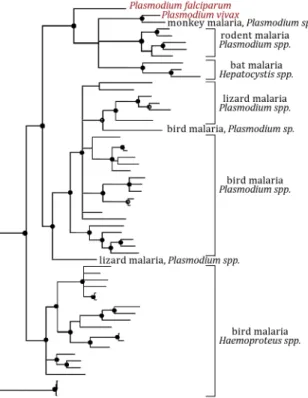
Fig.
I2.
Phylogenetic
tree


of
malaria
causing
parasites
Adapted
from
a
multy‐

gene
 analysis
 study
 performed
 by
 Ellen
 S.
 Martinsen
 and
 collaborators,
 using
 11


mammalian
 parasite
 species,
 7
 species
 that
 infect
 lizards,
 and
 39
 lineages
 from


avian
hosts.


It
 has
 been
 established
 that
 Plasmodium
 entered
 mammals
 only
 once,


coincident
 with
 a
 switch
 from
 Culicine
 to
 Anopheline
 mosquitoes


17

.
 All


known
 vectors
 of
 mammalian‐infecting
 Plasmodia
 belong
 to
 the
 Anopheles


genus


18

,
 indicating
 that
 the
 shift
 of
 Plasmodium
 into
 mammals
 was


associated
with
specialization
to
anopheline
vectors.
It
is
well
accepted
that


the
 closest
 identified
 sister
 taxon
 of
 P.
 falciparum
 is
 P.
 reichenowi
 whose


host
is
the
chimpanzee


19

.
It
was
recently
proposed
that
extant
P.
falciparum


(29)

likely
by
a
single
host
transfer


20

,
an
event
that
appears
to
have
happened


frequently
between
primates,
including
humans


19

.
Others
believe
that
the


appearance
 of
 P.
 falciparum
 occurred
 even
 later
 during
 the
 initiation
 of


agriculture,
 ten
 thousand
 years
 ago


21

.
 Still,
 there
 is
 some
 controversy


around
 these
 proposals
 and
 the
 relationship
 between
 P.
 falciparum
 and
 P.


reichenowi
is
not
yet
completely
clear.


Nevertheless,
it
is
clear
that
Plasmodium
(or
its
ancestors)
and
their
hosts


had
 millions
 of
 years
 to
 co‐evolve
 and
 co‐adapt,
 leading
 to
 a
 balance


between
 parasite
 replication
 and
 host
 survival
 enabling
 transmission
 to


other
hosts.
A
possible
explanation
for
P.
falciparum
being
the
most
virulent


species
infecting
humans
is
the
fact
that,
being
much
more
recent
than
other


Plasmodium
 species,
 it
 has
 not
 yet
 had
 the
 necessary
 time
 to
 fine‐tune
 its


effects
on
the
host
population.


Despite
 the
 significant
 burden
 of
 malaria‐related
 mortality
 only
 a
 small


proportion
 of
 infections
 lead
 to
 severe
 disease
 or
 death.
 Plasmodium


infections
 in
 malaria
 endemic
 regions
 most
 often
 go
 unnoticed
 even
 in


children,
 who
 are
 the
 most
 affected
 sector
 of
 the
 population.
 In
 children,


around
 half
 of
 all
 infectious
 bites
 produce
 no
 infection,
 about
 a
 quarter


leads
 to
 asymptomatic
 infections,
 roughly
 the
 other
 quarter
 gives
 rise
 to


uncomplicated
 malaria
 with
 mild
 symptoms,
 and
 only
 a
 very
 small


proportion
 of
 the
 infective
 bites
 will
 induce
 severe
 malaria
 with


manifestations
 such
 as
 coma,
 cerebral
 malaria,
 respiratory
 distress,
 or


severe
anaemia


22


that
can
ultimately
lead
to
death.
Still,
the
prevalence
of
P.


falciparum
 is
 high
 enough
 to
 kill
 more
 than
 half
 a
 million
 children
 every


year
in
sub‐Saharan‐Africa.


Evidence
for
the
adaptation
of
Plasmodium
to
man,
and
man’s
strategies
to


circumvent
 malaria
 infection
 can
 be
 seen
 in
 how
 the
 infection
 has


modulated
 certain
 human
 genes
 in
 affected
 populations,
 selecting
 for


resistance.
As
Haldane
hypothesised
and
Allison
demonstrated


23

,
malaria
is


(30)

known
to
be
a
strong
evolutionary
force
of
selection
in
the
recent
history
of


the
 human
 genome.
 Sickle‐sell
 disease,
 thalassemia,
 and
 glucose‐6‐

phosphatase
 deficiency,
 among
 other
 erythrocyte
 defects
 that
 together


comprise
 the
 most
 common
 Mendelian
 human
 diseases,
 are
 under


Plasmodium
infection
selection
force,
and
can
aid
understanding
the
genetic


basis
 of
 resistance
 shown
 by
 some
 exposed
 populations.
 Indeed,
 different


resistant
 alleles
 have
 been
 identified
 for
 sickle
 cell
 trait
 in
 different
 areas


and
at
different
times,
suggesting
convergent
evolution
(reviewed
in


24

).


Plasmodium
modus
operandi…


The
Plasmodium
life
cycle
in
mammals


Alfonse
 Laveran
 identified
 the
 exflagelating
 malaria
 parasite
 in
 human


blood
 in
 1880


25

.
 Eight
 years
 later,
 using
 an
 avian
 model,
 Ronald
 Ross


attributed
the
transmission
of
malaria
disease
to
the
anopheline
mosquito


26

.
The
first
observation
of
the
pre‐erythrocytic
stage
parasite
was
described


later
in
1948
by
H.
E.
Short
and
P.
C.
Garnham
in
the
liver
of
a
simian
model


27

.
The
three
stages
of
malaria
infection
were
then
described,
and
from
there


on
research
tries
to
fill
in
the
gaps,
and
understand
the
exact
details
of
the


entire
 life
 cycle,
 what
 the
 parasite’s
 needs
 are,
 and
 how
 host
 and
 vector


molecules
contribute
to
or
fight
infection.


During
its
life
cycle
the
malaria
parasite
takes
many
forms,
shifting
between


invasive
 and
 replicative
 stages
 both
 in
 the
 vertebrate
 host
 and
 in
 the


anopheline
vector.


(31)

Fig.
I3.
Plasmodium
life
cycle


(A)
During
a
blood
meal
an
anopheline
mosquito


injects
 Plasmodium
 sporozoites
 into
 the
 host
 dermis.
 (B)
 After
 reaching
 a
 blood


vessel,
 sporozoites
 will
 travel
 to
 the
 liver
 where
 after
 traversing
 several


hepatocytes,
 sporozoites
 invade
 a
 final
 one.
 (C)
 After
 asexual
 replication
 and


development
 inside
 a
 hepatocyte,
 merozoites
 are
 released
 into
 the
 blood
 stream.


(D)
 Merozoites
 infect
 red
 blood
 cells
 during
 cycles
 of
 asexual
 replication.
 (E)


Occasionally
 replication
 cycles
 will
 originate
 female
 and
 male
 gametocytes.
 (F)


Through
another
blood
meal,
a
mosquito
ingests
gametocytes
into
its
midgut.
(G)


Fertilization
 of
 gametes
 occurs
 in
 the
 mosquito
 midgut
 with
 the
 formation
 of


ookinetes
and
later
the
oocysts.
(H)
Sporozoites
released
from
the
oocyst
migrate


to
the
salivary
gland
of
the
mosquito
awaiting
the
next
blood
meal.


Deposition
in
the
skin.
All
natural
human
malaria
infections
start
with
the


deposition
of
Plasmodium
sporozoites
by
a
female
anopheline
mosquito
in


the
host’s
dermis,
during
a
blood
meal.
Each
sporozoite
is
approximately
10


µm
long
and
1
µm
wide,
and
once
in
the
dermis,
one
of
four
possible
fates


will
determine
its
future:
(i)
it
can
invade
a
blood
vessel
and
reach
the
liver


27

,
(ii)
it
can
invade
a
lymphatic
vessel
and
accumulate
in
the
draining
lymph


node


28

,
(iii)
it
can
remain
in
the
dermis


29

,
or
(iv)
it
can
be
re‐ingested
into


the
 mosquito
 gut
 during
 the
 blood
 meal


30

.
 Only
 the
 first
 of
 these
 fates


(32)

In
the
avascular
tissues
of
the
dermis,
sporozoites
actively
glide
forward
in


random
 directions.
 This
 movement
 however,
 seems
 to
 be
 specific
 to
 its


substrate,
 as
 it
 differs
 from
 the
 one
 observed
 in
 salivary
 gland
 ducts
 and


from
 that
 exhibited
 in
 vitro


28

.
 Like
 other
 apicomplexan
 parasites,


Plasmodium
 sporozoites
 display
 a
 unique
 kind
 of
 locomotion,
 known
 as


gliding
motility,
defined
by
the
lack
of
obvious
modification
in
the
moving


cell
 shape,
 and
 the
 need
 for
 a
 supporting
 substrate


31

.
 The
 parasite
 glides


both
 to
 achieve
 motility
 and
 to
 invade
 cells,
 and
 the
 two
 mechanisms
 are


made
possible
by
the
same
acto‐myosin
motor
located
in
the
cortical
space


in
between
the
plasma
membrane
and
the
inner
membrane
complex
(IMC),


a
continuous
layer
of
flattened
vesicles
underneath
the
plasma
membrane


31‐34

.
 In
 this
 space,
 trans‐membrane
 proteins
 displaying
 adhesive


extracellular
 domains
 and
 anchored
 to
 the
 motor
 trigger
 either
 forward


locomotion
 or
 penetration
 into
 the
 host
 cells


31,35,36

.
 One
 such
 molecule
 of


particular
 importance
 is
 the
 thrombospondin‐related
 anonymous
 protein


(TRAP),
whose
expression
is
restricted
to
Plasmodium
sporozoites


37,38

.


Most
sporozoites
remain
in
the
dermis
for
at
least
5
minutes,
as
the
removal


of
 the
 biting
 site
 5
 minutes
 after
 the
 bite
 greatly
 reduces
 the
 number
 of


infections
 in
 mice.
 However,
 a
 similar
 removal
 15
 minutes
 after
 the


mosquito
 bite
 does
 not
 cause
 any
 significant
 alteration
 in
 the
 outcome
 of


liver
infection


39

,
showing
that
during
this
timeframe
following
inoculation
a


significant
and
sufficient
proportion
of
the
sporozoites
leave
the
biting
site


to
 find
 a
 blood
 vessel,
 which
 will
 later
 lead
 to
 infection
 of
 hepatocytes.


Nevertheless,
 it
 takes
 one
 hour
 for
 half
 of
 the
 inoculated
 sporozoites
 to


leave
 the
 dermis,
 either
 into
 blood
 or
 lymphatic
 vessels,
 and
 sporozoites


have
been
found
in
the
dermis
up
to
7
hours
after
injection


40

.
During
this


period
 in
 the
 skin,
 sporozoites
 might
 trigger
 the
 first
 line
 of
 immune


response.


(33)

To
 leave
 the
 dermis
 sporozoites
 may
 make
 use
 of
 their
 ability
 to
 traverse


cells


41

,
disrupting
membranes
of
endothelial
cells
and
penetrating
vessels.


Several
proteins
have
been
identified
as
essential
for
cell
traversal,
such
as


the
 sporozoite
 microneme
 protein
 essential
 for
 cell
 traversal
 (SPECT)


42

,


SPECT2


43

,
cell
traversal
protein
for
ookinetes
and
sporozoites
(CelTOS)


44

or
 phospholipase
 (PL)


45

.
 Indeed,
 sporozoites
 lacking
 SPECT
 are
 unable
 to


reach
blood
vessels


41

.


Close
to
one
third
of
sporozoites
inoculated
into
mice
through
mosquito
bite


are
later
found
in
lymphatic
vessels


28

.
From
there,
only
a
few
sporozoites


can
be
rescued
back
to
blood
circulation,
while
the
rest
are
drained
to
the


closest
 lymph
 node.
 Once
 there,
 some
 sporozoites
 have
 been
 observed
 to


develop
into
young
and
small
Exo‐Erythocytic
Forms
(EEFs)
during
the
first


hours.
 This
 initial
 development
 is
 not
 continued
 and,
 instead,
 these
 small


EEFs
 are
 then
 cleared,
 which
 seems
 to
 contribute
 to
 the
 initiation
 of
 an


immune
response


46

.


The
mechanism
of
invasion
of
the
blood
vessels
is
still
not
fully
understood.


It
has
been
described
that
gliding
speed
is
decreased
when
sporozoites
are


in
contact
with
the
vessels
and
it
is
known
that
the
entry
process
lasts
less


than
a
minute


47

.


The
liver
stage.
Once
inside
the
vessel,
sporozoites
are
carried
in
the
blood


flow
at
the
same
speed
as
erythrocytes


40

,
and
will
later
be
arrested
in
the


liver
by
not
completely
understood
mechanisms.
Circumsporozoite
protein


(CSP),
a
protein
encoded
by
a
single
copy
gene,
and
the
major
coat
protein


of
Plasmodium
sporozoites


48

,
has
been
shown
to
be
involved
in
this
process.


Indeed
recombinant
CSP
binds
specifically
to
sulfated
glycoconjugates


49

.
It


has
 been
 proposed
 that
 heparan
 sulfate
 proteoglycans
 (HSPGs)
 of
 stellate


cells
 extending
 through
 endothelial
 fenestrations
 to
 the
 sinusoidal
 lumen,


can
attract
and
arrest
sporozoites.
These
cells
synthesize
proteoglycans
that


are
eight
times
more
sulphated
than
those
of
hepatocytes
and
incorporate


(34)

twice
 the
 amount
 sulphate
 into
 heparan
 sulphate,
 known
 to
 be


preferentially
 attractive
 to
 sporozoites


50

.
 Being
 unable
 to
 pass
 through


fenestrations
of
the
liver
sinusoid,
sporozoites
must
migrate
through
cells,


mostly
 Kupffer
 cells,
 using
 their
 capacity
 to
 traverse
 barriers
 and
 finally


access
 the
 liver
 parenchyma


51

.
 Still,
 this
 is
 a
 matter
 of
 controversy
 and


some
authors
have
proposed
that
the
passage
through
Kupffer
cells
occurs


by
a
mechanism
akin
to
phagocytosis


52

.
Once
having
gaining
free
access
to


the
liver
parenchyma,
sporozoites
traverse
several
hepatocytes,
disrupting


their
 plasma
 membranes
 to
 get
 in
 and
 out
 of
 cells


 53

,
 until
 they
 ultimately


invade
a
final
hepatocyte
with
formation
of
a
parasitophorous
vacuole
(PV).


Different
studies
have
shown
hepatocyte
traversal
makes
sporozoites
prone


for
final
hepatocyte
infection,
either
by
activating
sporozoites
to
form
a
PV


54,55


or
by
leading
to
the
release
of
hepatocyte
growth
factor,
which
sustains


host
cell
viability


56

.
Importantly,
although
demonstrated
to
be
beneficial
for


infection,
traversal
ability
of
Plasmodium
sporozoites
has
been
shown
not
to


be
 essential
 for
 hepatocyte
 invasion
 in
 vitro,
 since
 parasites
 lacking


essential
 proteins
 for
 cell
 migration
 as
 SPECT,
 CelTOS
 or
 PL
 still
 invade


hepatocytes
 and
 complete
 liver
 stage
 development
 similarly
 to
 wild
 type


parasites


42‐44

.
 Not
 much
 is
 known
 about
 the
 signal
 to
 stop
 migration
 and


invade,
but
mouse
studies
indicate
that
sporozoites
are
activated
to
initiate


the
 invasion
 process
 in
 the
 presence
 of
 cells
 expressing
 high
 levels
 of


sulfated
HSPGs


50,54

.


To
 invade
 hepatocytes,
 Plasmodium
 sporozoites,
 like
 other
 apicomplexan


parasites,
 release
 proteins
 from
 apical
 organelles
 termed
 rhoptries,


micronemes
and
dense
granules,
and
attach
to
host
cells
using
cell‐adhesive


domains
 of
 some
 of
 these
 proteins.
 TRAP
 seems
 to
 be
 essential
 to
 this


process


57

.
Although
adhesion
to
the
host
cell
is
initially
reversible,
it
later


becomes
irreversible,
forming
tight
junctions
that
will
allow
the
parasite
to


move
forward
propelled
by
its
acto‐myosin
motor,
allowing
it
to
enter
the


(35)

cell.
 With
 the
 completion
 of
 the
 tight
 junctions,
 the
 sporozoite
 is
 included


inside
the
host
cell
surrounded
by
the
PV
membrane


58

.


Inside
hepatocytes,
sporozoites
develop
and
replicate
originating
thousands


of
 merozoites
 that
 ultimately
 will
 proceed
 to
 blood
 infection.
 The


astonishing
replication
rate
observed
most
certainly
implies
strong
cellular


and
molecular
host‐parasite
interactions.
Although
little
is
known
about
the


intra‐hepatic
 development
 of
 Plasmodium
 parasites,
 recent
 studies
 have


provided
a
new
and
more
comprehensive
insight
into
gene
expression
and


protein
 abundance
 profiles
 of
 Plasmodium
 liver
 stage


59

.
 Plasmodium


sporozoite
 and
 liver
 stage
 asparagine‐rich
 protein
 (SLARP)
 has
 been


observed
 to
 be
 essential
 for
 initiation
 of
 EEF
 development,
 as
 parasites


mutant
 for
 this
 protein
 are
 arrested
 in
 very
 early
 development


60

.
 Other


parasite
proteins
have
been
shown
to
be
essential
for
development
inside


hepatocytes.
 Parasites
 deficient
 for
 the
 microneme
 protein
 P36p
 present


reduced
 invasion
 and
 impaired
 development


61

,
 and
 up‐regulated
 in


infective
 sporozoites
 genes
 3
 an
 4
 (UIS3)‐
 or
 (UIS4)‐deficient
 parasites


present
 impaired
 development


62

.
 Plasmodium
 Fatty
 Acid
 Synthesis
 II


pathway
 enzymes
 were
 found
 to
 be
 modulated
 during
 infection,
 and
 later


functional
studies
revealed
that
type
2
fatty
acid
synthesis
is
important
for


liver
stage
development


63


and,
more
specifically,
essential
for
the
late
steps


of
 liver
 stage
 development


64

.
 Another
 recent
 study
 showed
 that
 cGMP


dependent
 protein
 kinase
 (PbPKG)
 disruption
 in
 sporozoites
 leads
 to
 an


arrest
of
liver
stages


65

.


Host
molecules
have
also
proven
to
be
important
for
complete
development


of
 the
 Plasmodium
 parasite
 inside
 hepatocytes.
 The
 expression
 of
 several


host
 genes
 is
 modulated
 during
 liver
 infection,
 as
 shown
 recently
 in
 a


microarray
 study
 comparing
 infected
 and
 non‐infected
 cells
 patterns
 of


gene
 expression
 over
 the
 time
 course
 of
 infection


66

.
 In
 functional
 studies,


(36)

important
for
liver
stage
development.
Their
absence
reduces
liver
infection


to
very
low
levels
in
rodent
models.
Yet
another
functional
screen,
aimed
at


the
 host
 kinome,
 has
 linked
 an
 efficient
 parasite
 infection
 with
 several


human
kinases


69

.


During
 the
 liver
 stage,
 as
 will
 later
 be
 shown
 for
 the
 blood
 stage,


Plasmodium
parasites
seem
to
export
proteins
beyond
the
PV
to
the
cytosol


of
 the
 hepatocyte
 or
 even
 to
 the
 hepatocyte
 nucleus.
 Up
 to
 now
 this
 has


been
 shown
 for
 CSP,
 and
 mutant
 parasites
 incapable
 of
 this
 export


movement
show
impaired
development


70

.


By
the
end
of
exoerythrocytic
stage,
merozoites
are
released
in
the
blood‐

stream
 within
 large
 vesicles
 known
 as
 merosomes


71

.
 These
 budding


structures
 full
 of
 merozoites
 squeeze
 through
 endothelial
 cells,
 and
 are


initially
 hidden
 from
 the
 host's
 innate
 immune
 system
 by
 being
 covered


with
a
hepatocyte‐derived
membrane.


The
 blood
 stage.
 After
 reaching
 circulation,
 merosomes
 release
 the


merozoites
 into
 the
 blood‐stream.
 This
 seems
 to
 occur
 only
 when


merosomes
reach
the
lung
microvasculature.
Although
the
reason
behind
is


not
 known,
 it
 has
 been
 speculated
 that
 low
 macrophage
 density
 and


reduced
 blood
 velocity
 with
 reduced
 shear
 forces
 within
 the
 lung


microvasculature
enhances
the
ability
of
merozoites
to
invade
erythrocytes,


since
once
merozoites
are
free
in
circulation
they
quickly
have
to
find
a
red


blood
cell
to
infect.


72

.


Merozoites
invade
RBCs,
highly
differentiated
cells,
whose
main
purpose
is


oxygen
 distribution
 throughout
 the
 body.
 However,
 RBCs
 lack
 several


cellular
 functions
 as
 they
 are
 anucleated,
 transcriptionally
 and


translationally
 inactive,
 lack
 any
 secretory
 apparatus,
 have
 only
 a
 limited


repertoire
 of
 solute
 and
 iron
 transporters,
 and
 are
 readily
 removed
 from


circulation
when
damaged
(reviewed
in


73

).


(37)

Invasion
 of
 RBCs
 follows
 sequential
 steps:
 cell
 recognition,
 merozoite


binding,
reorientation
and
deformation
of
the
RBC,
junction
formation
and


parasite
entry.
In
in
P.
falciparum
alone,
more
than
50
surface
and
secreted


proteins
 have
 been
 identified
 as
 playing
 a
 role
 in
 these
 events


74

.
 Initial


host‐parasite
 contact
 is
 believed
 to
 be
 random
 but,
 once
 it
 has
 happened,


merozoite
surface
proteins
(MSP)
immediately
mediate
adhesion
to
the
host


cell


75

.
 The
 merozoite’s
 surface
 is
 covered
 in
 glycosylphosphatidylinositol


(GPI)‐anchored
proteins
and
their
partners


76

.
Many
of
these
proteins
seem


to
act
as
ligands
for
RBCs.
Besides
sharing
GPI‐anchors,
surface
proteins
of


the
 merozoite
 also
 share
 with
 sporozoites
 and
 gametes
 the
 cysteine‐rich


domains
 that
 have
 been
 shown
 to
 potentiate
 adherence


77


 of
 Plasmodium


species.
As
such,
it
is
believed
they
play
similar
roles
in
the
cytoadherance


during
 the
 blood
 stage
 of
 infection.
 In
 order
 to
 invade
 RBCs,
 merozoites


make
use
of
complex
mechanisms,
evidencing
great
adaptation
to
their
host.


Some
parasite
strains
that
depend
on
sialic‐acid
receptors,
for
example,
can


even
shift
their
invasion
pathway
to
a
sialic‐acid
independent
entry
process


78

.


After
this
initial
binding,
there
is
a
reorientation
of
the
merozoite
in
order
to


position
 its
 apical
 and
 secretory
 ornanelles
 (rhoptries,
 micronemes
 and


dense
granules)
in
contact
with
the
RBC
membrane.
An
indentation
is
then


formed
 in
 the
 contact
 zone.
 A
 number
 of
 proteins
 of
 the
 apical
 organelles


bind
to
specific
erythrocyte
receptors.
Apical
membrane
antigen
1
(AMA‐1)


is
 known
 to
 establish
 the
 apical
 interaction
 through
 parasite
 adhesins


initially
 located
 at
 the
 neck
 of
 the
 rhoptries
 and
 in
 the
 micronemes


79

.


Recently,
 parasites
 with
 green
 fluorescent
 protein
 (GFP)‐tagged
 AMA‐1


were
 used
 in
 live
 imaging
 studies
 that
 revealed
 this
 protein’s
 crucial


function


80

.


The
actual
invasion
process
involves
two
major
protein
families,
the
Duffy


binding‐like
 (DBL)
 protein
 family


81

,
 and
 the
 P.
 falciparum
 reticulocyte


(38)

binding
 protein
 homolog
 (PfRh)
 family


82

.
 DBL
 and
 PfRh
 proteins
 are


important
for
merozoite
invasion
of
RBCs,
but
are
not
considered
essential,


as
gene
disruption
for
each
of
them
in
different
P.
falciparum
lines
still
show


normal
 blood‐stage
 growth
 rates


83‐87

.
 This
 might
 be
 due
 to


complementation
 between
 different
 family
 members
 or
 to
 a
 great
 level
 of


adaptation
 of
 Plasmodium
 to
 its
 host
 cell.
 When
 the
 apical
 interaction
 is


formed,
the
merozoite
establishes
a
tight
junction,
which
is
accompanied
by


the
 release
 of
 more
 proteins
 from
 the
 microneme
 and
 rhoptry
 organelles.


When
 attachment
 is
 finally
 achieved,
 the
 merozoite
 is
 hypothesised
 to


discharge
 mediators
 into
 the
 RBC,
 and
 although
 these
 have
 not
 yet
 been


identified,
 visualization
 of
 merozoite
 invasion
 by
 electron
 migrographs


suggests
 material
 transfer


88

.
 Entry
 is
 then
 mediated
 by
 activation
 of
 the


acto‐myosin
motor
in
the
pellicle
of
the
invading
merozoite


89

.
At
the
end
of


the
invasion
process,
the
RBC
bilayer
envelops
the
invading
merozoite
in
a


new
vacuole


90

,
which
lacks
normal
proteins
of
the
RBC
membrane.
Proteins


like
Band
3
are
cleaved
by
proteolytic
enzymes
secreted
by
the
parasite


91

and
 are
 replaced
 by
 recruitment
 of
 detergent‐resistant
 membrane
 (DRM)


raft
proteins,
making
the
PV
richer
in
lipid
rafts
and
its
proteins


90

.


Inside
 the
 normally
 quiescent
 environment
 of
 a
 RBC,
 the
 merozoite


undergoes
 some
 rounds
 of
 nuclear
 division,
 transforming
 sequentially
 in


ring,
trophozoite
and
schizont
stages.
It
eventually
egresses
and
releases
16


to
 32
 new
 merozoites
 that
 will
 follow
 the
 same
 sequence
 of
 events.
 In
 P.


falciparum,
the
ring
stage
lasts
approximately
24h,
accounting
for
half
of
the


entire
erythrocytic
cycle


92

.


Following
 entry,
 and
 throughout
 all
 the
 developmental
 and
 replication


processes,
 the
 parasite
 modifies
 the
 permeability
 and
 adhesive
 properties


of
its
host
cell,
possibly
to
promote
its
own
survival.


The
 ring
 stage
 is
 followed
 by
 the
 trophozoite
 stage,
 during
 which
 most
 of


the
 cytoplasm
 of
 the
 RBC
 is
 consumed,
 a
 process
 that
 leads
 to
 the


Imagem

Fig.
 I1.
 La
 Mal'aria 
 (1850‐1851),
 oil
 over
 canvas
 by
 the
 French
 artist
 Antoine
 Auguste
 Ernest
 Hébert
 (1817‐1908).
 Reproduction
 rights 
 requested
 to
 Museé
 d’Orsay
 and
 Museé
Hébert
Fig.
I2.
Phylogenetic
tree
 of
malaria
causing
parasites
Adapted
from
a
multy‐
Fig.
I3.
Plasmodium
life
cycle
 (A)
During
a
blood
meal
an
anopheline
mosquito
 injects
 Plasmodium
 sporozoites
 into
 the
 host
 dermis.
 (B)
 After
 reaching
 a
 blood
 vessel,
 sporozoites
 will
 travel
 to
 the
 liver
 where
 after
 traversing
 severa

Referências

Documentos relacionados

Relativamente aos serviços centrais e considerando as diretrizes vindas da casa mãe, propõe-se a elaboração de um plano estratégico, sendo este posteriormente divulgado

The objective of the problem is to determine the optimal fleet size with the minimum total distribution cost, which considers fixed and variable routing costs and direct delivery

A ideia de realizar este projeto de investigação partiu da atual polémica de restruturação da Colina de Santana e o consequente destino dos Hospitais de São José, Santa

Redes de saúde são estruturas organizadas para o desenvolvimento das ações e serviços de saúde que buscam garantir a integralidade do cuidado. Este estudo discorre sobre a rede

A inclusão dos Estudantes com Necessidades Educacionais Especiais é vivenciada nas escolas por meio do enfrentamento de desafios que são próprios da complexidade e da subjetividade

Teve-se como objetivo central auxiliar os alunos na compreensão dos fundamentos da porcentagem e dando ênfase em situações cotidianas colocando-se em prática

Infection rate, infective mosquitoes, larvae melanization and annual transmission potential (ATP) of mosquitoes infected with Dirofilaria immitis , captured in Itacoatiara, State

Given the high prevalence of HBV markers in the different regions of the state of Santa Catarina, the high risk of transmission of HBV infection through transfusions and the high