Universidade de Lisboa
Faculdade de Ciˆencias
Departamento de Inform´atica
Intrusion Tolerance in Large Scale
Networks
Giuliana Teixeira dos Santos Veronese
DOUTORAMENTO EM INFORM ´ATICA
ESPECIALIDADE ENGENHARIA INFORM ´ATICA
Universidade de Lisboa
Faculdade de Ciˆencias
Departamento de Inform´atica
Intrusion Tolerance in Large Scale
Networks
Giuliana Teixeira dos Santos Veronese
DOUTORAMENTO EM INFORM ´ATICA
ESPECIALIDADE ENGENHARIA INFORM ´ATICA
Tese orientada pelo Prof. Doutor Miguel Nuno Dias Alves Pupo Correia e pelo Prof. Doutor Lau Cheuk Lung
Resumo
O crescimento da dependˆencia na utilizac¸˜ao de servic¸os inform´aticos em redes de larga-escala demanda sistemas que fornec¸am um servic¸o correcto e ininterrupto. Por este motivo, algoritmos tolerantes a faltas bizantinas (BFT) tˆem recebido consider´avel atenc¸˜ao nos ´ultimos anos. A ideia fundamental destes algoritmos ´e replicar um determinado servic¸o num conjunto de servidores, assegurando a sua operac¸˜ao cont´ınua mesmo na presenc¸a de um n´umero limitado de servidores faltosos. Cada servidor ´e uma r´eplica, uma m´aquina de estados determin´ıstica que executa operac¸˜oes em resposta a requisic¸˜oes realizadas por clientes.
Para que servic¸os replicados sejam tolerantes a faltas, modos comuns de falhas devem ser evitados, essa ´e a principal motivac¸˜ao desta tese. Mais especificamente, a tese trata de falhas causadas por desastres naturais, falta de energia e ataques f´ısicos. Para que a ocorrˆencia destas falhas afecte um n´umero limitado de servidores ´e necess´ario distribuir as r´eplicas geograficamente. Esta distribuic¸˜ao, requer que os locais onde se situam as r´eplicas sejam conectados por uma rede de larga-escala (WAN), como a Internet.
Infelizmente, quando as r´eplicas est˜ao distribu´ıdas geograficamente o desempenho dos algoritmos BFT actuais ´e afectado pelas limitac¸˜oes de largura de banda e latˆencias heterog´eneas, t´ıpicas em redes de larga-escala. A fim de tratar destas limitac¸˜oes esta tese introduz novos algoritmos BFT que s˜ao simultˆaneamente eficientes e seguros. Alguns destes algoritmos s˜ao baseados em um modelo de faltas h´ıbrido, por exemplo, parte do sistema ´e considerado seguro pela sua construc¸˜ao. Uma importante contribuic¸˜ao desta tese ´e a definic¸˜ao e concretizac¸˜ao de um servic¸o confi´avel m´ınimo: o gerador de identificador ´unico e sequencial (USIG).
A tese descreve como concretizar algoritmos de consenso bizantinos com 2 f +1 processos, usando um algoritmo de reliable multicast que requer um componente confi´avel, uma abstrac¸˜ao do USIG. O servic¸o USIG e a primitiva de reliable multicast s˜ao aplicados como componentes nucleares na concretizac¸˜ao de dois novos algoritmos BFT introduzidos nesta tese: MinBFT e MinZyzzyva. Estes algoritmos s˜ao m´ınimos em termos de n´umero de r´eplicas, complexidade do componente confi´avel e n´umero de passos de comunicac¸˜ao.
algoritmo base. Finalmente, os mecanismos e t´ecnicas desenvolvidos ao longo desta tese s˜ao combinados com o objectivo de definir o EBAWA, um novo algoritmo BFT que ´e adequado para suportar a execuc¸˜ao de servic¸os replicados em redes de larga-escala.
PALAVRAS-CHAVE:
sistemas distribu´ıdos, tolerˆancia a intrus˜oes, confiabilidade,Abstract
The growing reliance on wide-area services demands highly available systems that provide a correct and uninterrupted service. Therefore, Byzantine Fault-Tolerant (BFT) algorithms have received considerable attention in the last years. A service is replicated over several servers and can survive even in the presence of a bounded number of Byzantine failures.
The main motivation for this thesis is that for a replicated service to be fault-tolerant, common mode failures have to be avoided. More specifically, the thesis is concerned with common mode failures caused by natural disasters, power outages and physical attacks, which have to be prevented by scattering replicas geographically. This requires the sites where the replicas reside to be connected by a wide-area network (WAN) like the Internet.
Unfortunately, when the replicas are distributed geographically the performance of current BFT algorithms is affected by the lower bandwidths, and the higher and more heterogeneous network latencies. In order to deal with these limitations this thesis introduces novel BFT algorithms that are simultaneously efficient and secure. Some algorithms of this thesis are based on a hybrid fault model, i.e., considering that a part of the system is secure by construction. A notable contribution of this thesis is the definition and implementation of a minimal trusted service: the Unique Sequential Identifier Generator (USIG).
The thesis describes how to implement a 2 f + 1 Byzantine consensus algorithm using a 2 f + 1 reliable multicast algorithm that requires a trusted service, that is an abstract version of the USIG. Then, the USIG service and the reliable multicast primitive are applied as a core component to implement two novel BFT algorithms introduced in this thesis: MinBFT and MinZyzzyva. These BFT algorithms are minimal in terms of number of replicas, complexity of the trusted service used, and number of communication steps. In order to mitigate performance degradation attacks, this thesis proposes the use of a rotating primary defining a novel BFT algorithm, Spinning, that is less vulnerable to attacks caused by a faulty primary and attains a throughput similar to the baseline algorithm in the area.
replicated services.
KEY-WORDS:
distributed systems, intrusion tolerance, dependability, security, ByzantineResumo Estendido
Com a difus˜ao dos servic¸os inform´aticos de larga escala ´e necess´ario o desenvolvimento de sistemas que fornec¸am disponibilidade, confiabilidade e d´ebito significativo para atender os requisitos de sistemas de alta demanda.
A tolerˆancia a intrus˜oes ´e um paradigma de seguranc¸a que tem recebido atenc¸˜ao recen-temente e promete satisfazer estes requisitos. Este paradigma reconhece a dificuldade em construir sistemas completamente seguros e confi´aveis, por isso, utilizando esta abordagem ataques e intrus˜oes s˜ao permitidos porque s˜ao tolerados. Sistemas tolerantes a intrus˜oes geralmente s˜ao constru´ıdos utilizando algoritmos tolerantes a faltas bizantinas (BFT). A ideia fundamental destes algoritmos ´e permitir que um determinado servic¸o continue operacional mesmo na presenc¸a de componentes que exibam comportamento arbitr´ario.
A investigac¸˜ao em tolerˆancia a faltas bizantinas ´e focada no desenho de sistemas dis-tribu´ıdos baseados em protocolos de troca de mensagens e que geralmente utilizam t´ecnicas de replicac¸˜ao. A abordagem de m´aquina de estados ´e uma t´ecnica de software para tolerar faltas utilizando hardware comum. Nesta abordagem, cada servidor cont´em uma c´opia do servic¸o, clientes acedem o servic¸o atrav´es de um algoritmo de replicac¸˜ao que assegura que mesmo na presenc¸a de falhas o servic¸o continua operacional. Estes algoritmos tipicamente requerem 3 f + 1 r´eplicas para tolerar f servidores bizantinos, por exemplo, 4 r´eplicas para tolerar um servidor faltoso.
O servic¸o replicado ´e considerado mais confi´avel que um servic¸o centralizado se cada um dos servidores ´e protegido utilizando as melhores pr´aticas actuais e se os servidores n˜ao compartilham as mesmas vulnerabilidades. Para que os servidores falhem de forma independente ´e necess´ario que as r´eplicas possuam diferentes sistemas operacionais, diferentes softwares, etc. Isto envolve um custo adicional consider´avel para cada r´eplica, n˜ao apenas em termos de hardware mas especialmente em desenvolvimento de software, aquisic¸˜ao e gest˜ao. Para tolerar desastres naturais, ataques em larga escala como ataques de negac¸˜ao de servic¸o distribu´ıdo ´e necess´ario tamb´em a diversidade em termos de localizac¸˜ao geogr´afica. R´eplicas devem ser distribu´ıdas em diferentes s´ıtios conectados por uma rede de larga escala.
que tipicamente possuem limitac¸˜oes de largura de banda, latˆencias heterog´eneas e partic¸˜oes. Algoritmos BFT s˜ao geralmente baseados em algoritmos de consenso por isso os efeitos causados por atraso na comunicac¸˜ao entre as servidores ´e ampliado uma vez que s˜ao necess´arias m´ultiplas trocas de mensagens para que as r´eplicas acordem sobre a operac¸˜ao a ser executada. Al´em disso, nestes algoritmos os clientes devem esperar pela maioria das respostas a fim de realizar uma votac¸˜ao sobre os resultados retornados pelos servidores, consequentemente a latˆencia efectiva pode ser limitada pela r´eplica mais lenta.
Algoritmos BFT geralmente confiam numa r´eplica prim´aria (ou l´ıder) que ´e respons´avel em definir a ordem das requisic¸˜oes que devem ser executadas. Em redes de larga escala esta r´eplica prim´aria torna-se um ponto de estrangulamento que limita o d´ebito do sistema. Algoritmos que utilizam uma replica prim´aria sofrem de um padr˜ao de comunicac¸˜ao desbalanceado uma vez que a r´eplica prim´aria tende a processar mais mensagens que as demais. Al´em disso, uma r´eplica prim´aria faltosa pode degradar o desempenho do sistema deixando-o quase inutiliz´avel. O objectivo desta tese ´e lidar com as limitac¸˜oes dos actuais algoritmos BFT em ambientes de larga escala fornecendo algoritmos que apresentam alto desempenho em WANs. Estes algoritmos permitem a construc¸˜ao de servic¸os confi´aveis mesmo na presenc¸a de ataques, intrus˜oes ou a destruic¸˜ao f´ısica de algum dos sites.
Alguns destes algoritmos s˜ao baseados em um modelo de faltas h´ıbrido. Este modelo assume que diferentes partes do sistema pode ter diferentes modos de falhas. Por exemplo, assume-se que a maior parte do sistema pode falhar de forma arbitr´aria, incluindo faltas maliciosas, com excepc¸˜ao de poucos componentes que s˜ao considerados seguros pela sua construc¸˜ao. Uma importante contribuic¸˜ao desta tese ´e a definic¸˜ao e concretizac¸˜ao de um servic¸o confi´avel m´ınimo: o gerador de identificador ´unico e sequencial (USIG). O USIG cont´em basicamente um contador e uma func¸˜ao de assinatura digital. Esta simplicidade ´e importante uma vez que a complexidade dos sistemas ´e a causa da maior parte das vulnerabilidades inseridas nas fases de desenho e concretizac¸˜ao, permitindo que ataques sejam bem sucedidos.
usando um algoritmo de reliable multicast que requer um componente confi´avel. O componente confi´avel utilizado ´e uma abstracc¸˜ao do servic¸o fornecido pelo USIG. Esta ´e uma contribuic¸˜ao relevante uma vez que o consenso ´e um problema de reconhecida importˆancia te´orica e pr´atica na ´area de sistemas distribu´ıdos. O servic¸o USIG e a primitiva de reliable multicast s˜ao aplicados como componentes nucleares na concretizac¸˜ao de dois novos algoritmos BFT introduzidos nesta tese: MinBFT e MinZyzzyva.
MinBFT segue o padr˜ao de comunicac¸˜ao do algoritmo referˆencia nesta ´area, o PBFT. A r´eplica prim´aria utiliza contadores confi´aveis fornecidos pelo USIG para atribuir identificadores ´unicos `as requisic¸˜oes dos clientes. Estes identificadores s˜ao utilizados para assegurar que todas as r´eplicas correctas consideram a mesma sequˆencia de mensagens e concordam sobre a ordem de execuc¸˜ao das requisic¸˜oes. O segundo algoritmo - MinZyzzyva - ´e baseado em especulac¸˜ao, servidores executam requisic¸˜oes dos clientes sem executar um algoritmo de consenso. As r´eplicas optimisticamente adoptam a ordem de requisic¸˜oes proposta pela r´eplica prim´aria (que utiliza o USIG) e respondem imediatamente para o cliente. Estes dois algoritmos s˜ao m´ınimos em termos de n´umero de r´eplicas, complexidade do componente confi´avel e n´umero de passos de comunicac¸˜ao.
A fim de mitigar os ataques de degradac¸˜ao de desempenho esta tese prop˜oe o uso de um prim´ario rotativo, definindo assim um novo algoritmo BFT, o Spinning. Al´em de ser menos vulner´avel a ataques de degradac¸˜ao de desempenho, o Spinning atinge um d´ebito similar ao algoritmo base e ´e mais eficiente que outros algoritmos que toleram este tipo de ataque.
Finalmente, os mecanismos e t´ecnicas desenvolvidos ao longo desta tese s˜ao combinados com o objectivo de definir o EBAWA, um novo algoritmo BFT adequado para suportar a execuc¸˜ao de servic¸os replicados em redes de larga-escala. O EBAWA tem um reduzido n´umero de passos de comunicac¸˜ao, ´e o primeiro algoritmo BFT para WANs que requer apenas 2 f + 1 r´eplicas e introduz uma s´erie de mecanismos focados em prover bom desempenho em redes de larga escala.
Acknowledgments
I am grateful to many people that contributed, supported and encouraged this work.
First, I must thank my thesis supervisor, Miguel Nuno Dias Alves Pupo Correia for teaching me so much during these last years, for his constant support and wise advice. I feel very fortunate for having had the chance to work closely with him. In addition, Professor Lau Cheuk Lung, who convinced me to attend this Ph.D. program, I thank him for his encouragement and support.
I would like to express my sincere thanks to my colleagues in the Navigators group and the LASIGE laboratory. It was a great opportunity to work with a talented team of researchers. I am grateful to Professor Paulo Ver´ıssimo for his example of professionalism, dedication and for making scientific research really challenging.
I specially thank Professor Alysson Neves Bessani, his observations and comments helped me establish the overall direction of the research and move forward with investigation in depth. I also thank Professor Hans Heiser for his suggestions and availability to discuss my doubts about virtualization. I thank Wagner Dantas for his help in experiments configuration and for discussions about BFT and life.
I want to thank Professor Yair Amir and Jonathan Kirsh from Johns Hopkins University for generously sharing their time and knowledge in discussions and suggestions about the Spinning algorithm. I thank Klaus Kursawe, Luis Sarmenta, Jean-Philippe Martin, and Eduardo Alchieri for discussions about algorithms, comments on the papers, and help with several implementation aspects.
for all my life. Special thanks also goes to Odorico Mendizabal (my dear Dodo), Vin´ıcius Cogo (my son of heart), Desir´ee Miguel, Marcia Hislab˜ao, Marcirio Chaves, Lu´ıs Brand˜ao, Patricia Nunes, Sim˜ao Fontes, Bruno Vaval´a, Suzana Guedes, Andr´e Santos, Paulo Carapinha, and Jos´e Carapinha for making my life fun and contributing to a pleasant working place.
Finally, this thesis would not have been possible without the confidence and endurance of all my family. I want to thank my parents and dedicate this thesis to my husband, Marcello Veronese, an infinite source of inspiration and encouragement.
I gratefully acknowledge the financial support from Programme ALBAN and Fundac¸˜ao de Ciˆencia e Tecnologia de Portugal.
Table of Contents
Table of Contents i
Lista de Figuras v
Lista de Tabelas vii
1 Introduction 1
1.1 Objective and Contributions . . . 3
1.2 Structure of the Thesis . . . 6
2 Context and Related Work 9 2.1 Intrusion Tolerance . . . 10
2.1.1 Properties . . . 10
2.1.2 Fault Models . . . 11
2.1.3 Time Models . . . 14
2.1.4 Mechanisms and Techniques . . . 15
2.1.5 Diversity . . . 18
2.2 Intrusion-Tolerant State Machine Replication . . . 19
2.2.1 PBFT – Practical Byzantine Fault Tolerance . . . 19
2.2.2 Zyzzyva – Speculative Byzantine Fault Tolerance . . . 20
2.2.3 Prime – Byzantine algorithms under attacks . . . 21
2.2.4 Aardvark – Making BFT Systems Tolerate Byzantine Faults . . . 23
2.3 Intrusion-Tolerant SMR with fewer Replicas . . . 25
2.3.1 TTCB – Tolerating Half Less One Byzantine Nodes . . . 25 i
2.4 State Machine Replication on WANs . . . 29
2.4.1 Mencius – Building Efficient Replicated State Machines . . . 29
2.4.2 RAM – Low Latency State Machine Replication . . . 31
2.4.3 Steward – Scaling Byzantine Fault-Tolerant Replication . . . 32
2.5 Trusted Computing . . . 34
2.5.1 Trusted Platform Module . . . 36
3 Byzantine Consensus with 2f + 1 Processes 39 3.1 System Model . . . 41 3.2 2 f + 1 Reliable Multicast . . . 42 3.2.1 Trusted/trustworthy component . . . 43 3.2.2 The algorithm . . . 44 3.3 2 f + 1 Byzantine Consensus . . . 45 3.3.1 Consensus algorithm . . . 47 3.3.2 Correctness . . . 49
3.4 Unique Sequential Identifier Generator Service . . . 51
3.4.1 Implementing the trusted component . . . 53
3.4.2 Implementing the USIG service with the TPM . . . 54
3.5 Confirmable Reliable Multicast . . . 57
3.5.1 The algorithm . . . 58
3.5.2 Correctness . . . 59
3.6 Conclusion . . . 61
4 Minimal Byzantine Fault Tolerance 63 4.1 System Model . . . 67
4.2 MinBFT . . . 69
4.2.1 Clients . . . 70
4.2.2 Servers: normal case operation . . . 71 ii
4.2.3 Servers: garbage collection and checkpoints . . . 72
4.2.4 Servers: view change operation . . . 73
4.3 MinZyzzyva . . . 75
4.3.1 Gracious execution . . . 76
4.3.2 Non-gracious execution . . . 77
4.3.3 Garbage collection and checkpoints . . . 78
4.3.4 View change . . . 79
4.4 Implementation . . . 80
4.5 Performance Evaluation . . . 83
4.5.1 Micro-Benchmarks . . . 84
4.5.2 Effects of Communication Latency . . . 86
4.5.3 Comparing Different USIG Versions . . . 87
4.5.4 Hardware-based USIG Performance . . . 90
4.5.5 Macro-Benchmark . . . 91
4.6 Related Work . . . 92
4.7 Conclusion . . . 94
5 Byzantine Fault Tolerance with a Rotating Primary 97 5.1 System Model . . . 99 5.2 Spinning . . . 100 5.2.1 Algorithm overview . . . 100 5.2.2 Algorithm . . . 102 5.2.2.1 Normal Operation . . . 103 5.2.2.2 Merge Operation . . . 104 5.2.3 Garbage collection . . . 106 5.2.4 Punishing misbehavior . . . 107 5.2.5 Timeout configuration . . . 109 5.2.6 Optimizations . . . 109 5.3 Evaluation . . . 111 5.3.1 Experimental Evaluation . . . 111 iii
5.3.1.3 Spinning vs. Related Solutions . . . 116
5.4 Related Work . . . 118
5.5 Conclusion . . . 120
6 Efficient Byzantine Agreement on WANs 123 6.1 System Model . . . 125
6.2 EBAWA mechanisms . . . 125
6.3 The EBAWA Replication Algorithm . . . 128
6.4 Performance Evaluation . . . 132
6.4.1 Algorithm Implementation . . . 133
6.4.2 Methodology . . . 134
6.4.3 Local Area Network . . . 135
6.4.4 Emulated WAN – Emulab . . . 137
6.4.5 Real WAN – PlanetLab . . . 141
6.5 Related Work . . . 144
6.6 Conclusion . . . 146
7 Conclusion 147 A Correctness proofs 151 A.1 MinBFT Correctness . . . 151
A.2 MinZyzzyva Correctness . . . 159
A.3 Spinning Correctness . . . 162
A.4 EBAWA Correctness . . . 169
References 179
Lista de Figuras
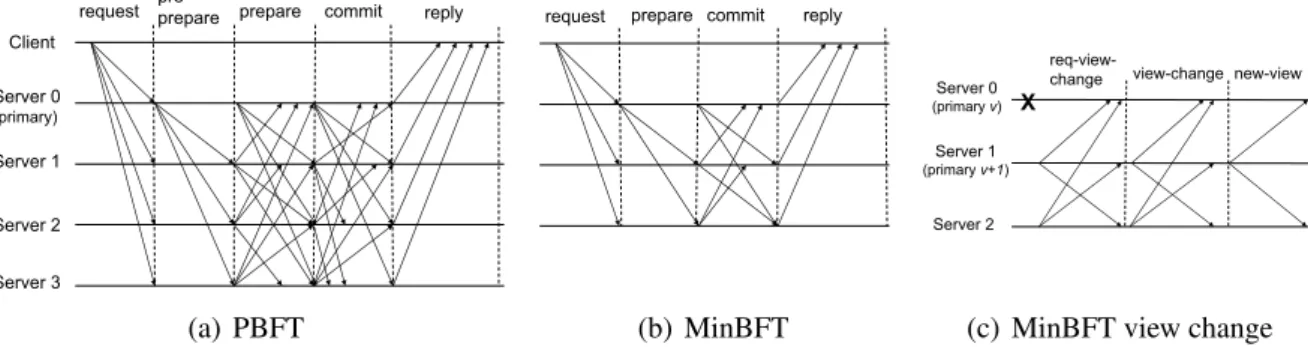
2.1 The AVI composite fault model. . . 12 2.2 Intrusion tolerance mechanisms and the AVI model. . . 16 3.1 USIG service implementation scenarios. . . 53 4.1 Normal case operation of PBFT (a) and MinBFT (b). View change operation of
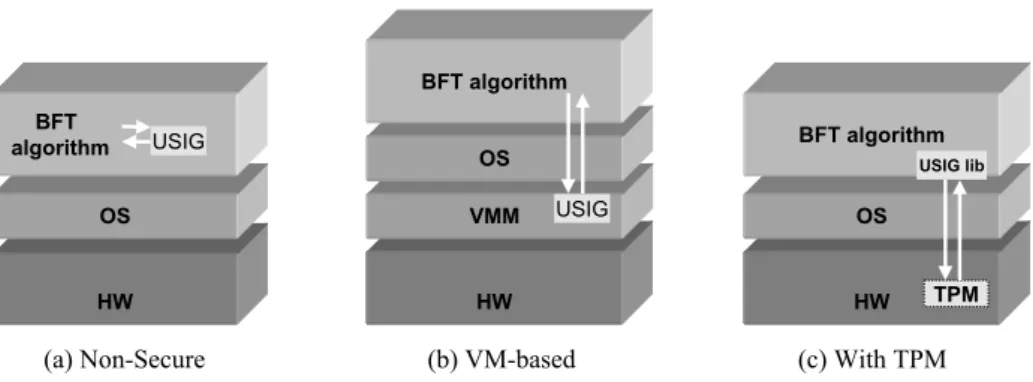
MinBFT (c). . . 70 4.2 MinZyzzyva basic operation. . . 75 4.3 Different versions of the USIG service: Non-Secure - the service is inside the process;
VM-based - the service is in an isolated virtual machine; TPM - the service is supported by a trusted hardware. . . 81 4.4 Peak throughput for 0/0 operations for the best versions of MinBFT and MinZyzzyva,
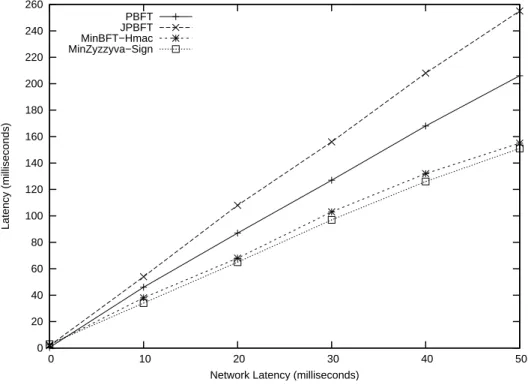
together with PBFT and a similar Java implementation.. . . 85 4.5 Latency for 0/0 operations with several link latency values. . . 86 4.6 Latency of 0/0 operations for MinBFT and MinZyzzyva using several USIG
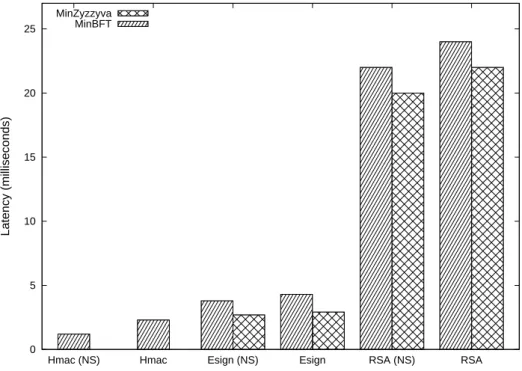
implemen-tations. . . 88 4.7 Peak throughput for 0/0 operations for MinBFT and MinZyzzyva using several USIG
implementations. . . 89 5.1 (a)Normal operation, communication pattern between the servers, with the
communi-cation with a client for one request superimposed. (b) Merge operation. . . 102 5.2 Peak throughput for 0/0 operations for PBFT, JPBFT, Spinning lock-step and Spinning
with window size equals 10. . . 113 5.3 Peak throughput for 0/0 operations for PBFT, JPBFT, Spinning (LS) and Spinning (10)
under different levels of attacks (dattackof 1, 10 and 100 ms). . . 115
5.4 Number of messages processed by the primary per client request in Spinning and Prime for several values of f and b. . . 117
6.1 Communication patterns of a single agreement (a) in PBFT and Spinning and (b) in EBAWA. . . 126 6.2 Latency of algorithms on a fault-free LAN. . . 136 6.3 Throughput of algorithms on a fault-free LAN.. . . 137 6.4 Latency on an emulated fault-free WAN. (a) Clients in the same sites of the servers.
(b) Clients and servers distributed on a WAN. (c) Heterogeneous latency among clients and servers. . . 139 6.5 Service latency when the load changes from site A to B. . . 141 6.6 Comparison of the algorithms’ latencies in WAN-Europe (a) and WAN-America (b). . 142
Lista de Tabelas
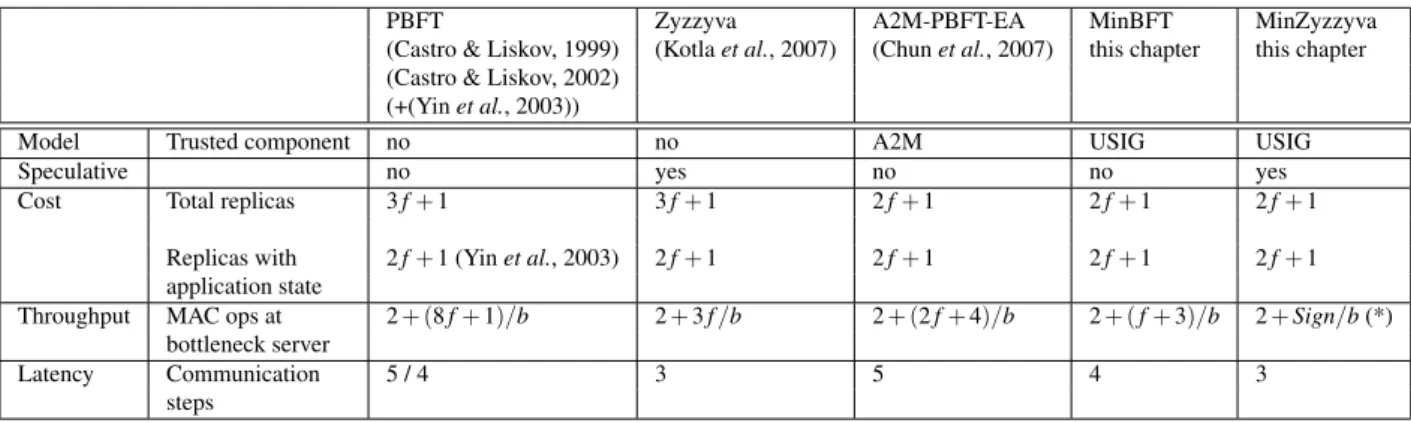
4.1 Comparison of BFT algorithms. (*) MinZyzzyva does 2 batches and one signature. . . 67 4.2 Latency results varying request and response size for the best versions of MinBFT and
MinZyzzyva, together with PBFT and a similar Java implementation. . . 84 4.3 Overhead (in milliseconds) of UI creation and verification for messages with 20 bytes
(the size of request hash). . . 88 4.4 Latency and peak throughput of MinBFT and MinZyzzyva using the TPM USIG. . . . 90 4.5 Macro-benchmark: latencies of JNFS alone and replicated with BFT algorithms
(milliseconds) . . . 92 5.1 Labels given to fields in messages.. . . 102 5.2 Latency results (in ms) varying request and response size for PBFT, JPBFT and Spinning.112 5.3 Latency of 0/0 operations (in ms) for PBFT, JPBFT, Spinning (LS) and Spinning (10)
under different levels of attacks (dattackof 1, 10 and 100 ms). . . 114
6.1 Labels given to fields in messages.. . . 129 6.2 Latency among clients and replicas on different sites used on the experiment with
results presented on Figure 6.4(c). Values based on Table 6.3. . . 140 6.3 Network Latency on a real WAN in America and Europe. . . 142 6.4 Latency of 0/0 operations (in seconds) for JPBFT, MinBFT and EBAWA under different
levels of attacks (dattackof 1, 5 and 10 seconds, on the WAN-America scenery). . . 144
A.1 Variables and structures at a server s. . . 162 A.2 Auxiliary functions used in the algorithm. . . 163 A.3 Variables and structures at a server s. . . 169 A.4 Auxiliary functions used in the algorithm. . . 170
1
Introduction
With the diffusion of wide-area computer services there is an increasing need to build systems that provide high availability, high reliability and high throughput for highly demanding services. One security paradigm that gained momentum recently, promising to satisfy these requirements, is intrusion tolerance (Fraga & Powell, 1985; Verissimo et al., 2003). This approach recognizes the difficulty in building a completely reliable and secure system, therefore instead of trying to prevent every single intrusion, the latter are allowed, but tolerated. Intrusion-tolerant systems contain mechanisms that prevent intrusions from generating failures.
The main motivation for new security paradigms like intrusion tolerance has been the poor state of security in the Internet, yearly reported in documents like (Gordon et al., 2006). How-ever, a more recent motivation is a great concern about the security of critical infrastructures. Critical infrastructures consist of physical and information technology facilities, networks and services whose disruption would have a serious impact on the health, safety or economic well-being of populations. Often, these infrastructures are indirectly connected to the Internet, thus exposed to the same types of threats as home-banking, online shops or personal computers (Verissimo et al., 2006). However, they have a much higher socio-economic value than most Internet systems. Some of them, for instance nuclear plants, are even safety-critical because their failure may cause human deaths and serious harm to the environment. Therefore, using mechanisms that raise the protection of these infrastructures to a new level is a fundamental issue.
Critical infrastructures usually rely on data for several important purposes. For instance, stored monitoring data is critical for the right commands to be done by human operators at the right moment. If this data is unavailable or modified with the malicious intent of making the
operators do wrong operations, the physical infrastructure may not function correctly or even be physically damaged. Therefore, critical infrastructures require highly-resilient fault-, intrusion-and disaster-tolerant services that function correctly even under harsh cyber-attacks that manage to corrupt some of the computers involved.
Intrusion-tolerant or Byzantine fault-tolerant (BFT) algorithms tackle this problem by allowing critical services, like storage and processing of monitoring data, to continue to operate correctly even if some of their components are compromised by malicious attackers (Amir et al., 2006; Amir et al., 2008a; Castro & Liskov, 2002; Chun et al., 2007; Clement et al., 2009; Cowling et al., 2006; Correia et al., 2004; Kotla et al., 2007; Yin et al., 2003; Mao et al., 2009; Vandiver et al., 2007; Preguic¸a et al., 2008). Research in Byzantine fault tolerance has been centered in designing distributed systems, based on message-passing protocols and they are usually built using replication techniques. The state machine approach is a software technique for tolerating failures using commodity hardware (Schneider, 1990). The critical service to be made Byzantine fault-tolerant is modeled by a state machine. Copies of the state machine are placed on different servers and clients access the service through a replication algorithm which ensures that, despite failures, the service continues operational. These algorithms typically require 3 f + 1 replicas to tolerate f Byzantine servers, e.g., 4 replicas to tolerate one faulty (Castro & Liskov, 2002).
The resilience of the replicated system is based on the assumption that replicas fail independently, but this is true only if they do not have common vulnerabilities. This involves using different replicas, different operating systems, different application software, etc. (Littlewood & Strigini, 2004). In order to tolerate natural disasters and large-scale attacks like distributed denial-of-service, there should be also diversity in terms of geographical location, i.e., replicas have to be deployed in different sites connected by a wide-area network (WAN).
Current BFT algorithms perform well on local area networks (LANs) but their message complexity limits their ability to scale to WANs, which typically have lower bandwidth, higher and heterogeneous latencies, and exhibit partitions. BFT algorithms are usually agreement-based, therefore the effects of networks with non-negligible communication delays are magnified since servers need multiple rounds of message exchange to reach an agreement. Moreover, in these algorithms clients must wait for the majority of the replies in order to do a
1.1. OBJECTIVE AND CONTRIBUTIONS 3
voting on the output of the servers, consequently the effective service latency may be limited by the slowest replicas.
BFT algorithms usually rely on a primary replica (or leader) that is in charge of defining the order in which client requests are executed. In large scale environments, the primary replica becomes a bottleneck that limits the system throughput. Furthermore, leader-based algorithms lead to an unbalanced communication pattern that limits the utilization of bandwidth available in the network links (Mao et al., 2008), and it has been shown that a faulty primary can degrade the performance to let the replicated service so slow that it is barely usable (Amir et al., 2008a). The limitations of current BFT algorithms on wide-area networks constitute the main motivation of this thesis, which presents replication algorithms that are efficient in WANs and stable even if under attack.
1.1 Objective and Contributions
The thesis was developed within the Navigators group of the Large-Scale Informatics Systems Laboratory (LASIGE), at the Informatics Department of FCUL. The objective of this thesis is to cope with the limitations of current BFT algorithms in large-scale environments, providing algorithms that present high performance on wide-area networks. These algorithms allow the implementation of highly-resilient services in WANs even if there are cyber-attacks, intrusions or the physical destruction of some of the sites. The main contributions of this thesis are summarized in the next sections.
Byzantine Consensus with 2f+1 Processes
Byzantine consensus in asynchronous message-passing systems has been shown to require at least 3 f + 1 processes to be solvable in several system models (e.g., with failure detectors, partial synchrony or randomization). Recently a couple of solutions to implement Byzantine fault-tolerant state machine replication using only 2 f + 1 replicas have appeared (Correia et al., 2004; Chun et al., 2007). This reduction from 3 f + 1 to 2 f + 1 is possible with a hybrid system
model, i.e., by extending the system model with trusted/trustworthy components that constrain the power of faulty processes to have certain behaviors.
This thesis presents how to implement a 2 f + 1 Byzantine consensus algorithm using a 2 f + 1 reliable multicast primitive that requires trusted/trustworthy components. A notable contribution of this thesis is the definition and implementation of a minimal trusted service – Unique Identifier Generator (USIG) – which is much simpler than the services used by the above mentioned BFT algorithms. USIG contains basically a counter plus a digital signature scheme. This simplicity is important once complexity and extensibility of current computer systems is the cause of exploitable software bugs and configuration mistakes.
Minimal Byzantine Fault Tolerance
Based on the USIG service, this thesis presents two BFT algorithms, MinBFT and MinZyzzyva, that are minimal in several senses. First, they require only 2 f +1 replicas, instead of the usual 3 f + 1. The above mentioned need of avoiding common mode failures requires diversity of software of the replicas, which involves additional considerable costs per replica, in terms not only of hardware but especially of software development and management. Then, reducing the number of replicas has a significant impact in the system cost. Second, the trusted service (USIG) in which this reduction of replicas is based is arguably minimal, so it is simple to verify and implement. Third, in nice executions the two algorithms run in the minimum number of communication steps for non-speculative and speculative algorithms, respectively 4 and 3 steps.
MinBFT follows the communication pattern of PBFT (Castro & Liskov, 2002). The fundamental idea of MinBFT is that the primary uses trusted counters to assign sequence numbers to client requests. This is used to guarantee that all non-faulty replicas take into account the same messages and, ultimately, agree on the same order for the execution of the requests.
The second algorithm – MinZyzzyva – is based on speculation, i.e., on the tentative execution of the clients’ requests without previous agreement on the order of their execution. MinZyzzyva is a modified version of Zyzzyva (Kotla et al., 2007), the first speculative BFT
1.1. OBJECTIVE AND CONTRIBUTIONS 5
algorithm. In MinZyzzyva, replicas optimistically adopt the order of requests proposed by the primary and respond immediately to the client, without reaching agreement on the order of the requests. The performance evaluation shows that, even with the trusted component access overhead, MinBFT and MinZyzzyva can have better throughput than Castro and Liskov’s PBFT, and better latency in networks with non-negligible communication delays.
Byzantine Fault tolerance with a Rotating Primary
Most Byzantine fault-tolerant state machine replication (BFT) algorithms have a primary replica that is in charge of ordering the clients requests. Recently it was shown that this dependence permits a faulty primary to degrade the performance of the system to a small fraction of what the environment allows (Amir et al., 2008a). Besides, as mentioned above, in a WAN it is difficult to detect that the primary is faulty or that the latency and/or bandwidth of its communication with the other replicas has become a bottleneck for the service performance. This thesis presents Spinning, a novel BFT algorithm that mitigates performance attacks by changing the primary after every batch of pending requests is accepted for execution. This novel mode of operation reduces the message complexity, which makes it suitable to run in WANs. Spinning follows the communication pattern of PBFT with three communication steps. It has no view change operation, since views are always changing anyway, but it has a merge operation, which is in charge of putting together the information from different servers to decide if requests in views that “went wrong” are to be executed or not.
We assess the advantages of Spinning comparing it with related protocols both experimen-tally and analytically. We show experimenexperimen-tally that rotating the primary does not impair the performance of the system, but instead brings some throughput gains in fault-free executions. The rotating primary is a simple and effective strategy to make a BFT replication algorithm tolerate performance attacks from malicious servers. Finally, we show analytically that Spinning presents important advantages when compared with other solutions to deal with performance attacks.
Efficient Byzantine Fault Tolerance on Wide-Area Networks
There are a few BFT algorithms in the literature that were proposed specifically for WANs (Amir et al., 2006; Mao et al., 2009). These algorithms follow a “fate-sharing” model, in which servers communicate through the WAN but clients send requests only to their local server via a LAN. This lets clients within a site unable to use the system if the local server is compromised. This thesis presents and evaluates a novel BFT algorithm called EBAWA that requires fewer communication steps, fewer replicas and has better throughput and latency than others in literature. EBAWA has a flexible architecture. While previous works about BFT replication in WANs consider that clients are in the same site than servers (e.g., in the same data center), in EBAWA clients can be placed anywhere, increasing the resilience of the replicated service.
EBAWA is based on Spinning, MinBFT and a set of mechanisms focused in improving performance in WANs. Like Spinning, EBAWA constantly rotates the primary letting it mostly unaffected by certain performance degradation attacks, and does load balancing by distributing the burden of ordering requests by all the servers. EBAWA uses the USIG trusted service from MinBFT to reduce the number of communication steps of the agreements. This number is an important metric for the delay of the communication tends to have a major impact in the latency of any distributed algorithm. EBAWA uses several mechanisms that have an important impact in the performance: asynchronous views, batches of messages, and skip messages. The goal of these mechanisms is to reduce the number of messages sent and the overhead of cryptographic operations. This reduces the latency of the algorithm, as seen by the clients, and improves the throughput because there are less messages being processed.
A thorough evaluation of performance has shown that EBAWA is competitive with other BFT algorithms in LAN environments, while outperforming all of them in several WAN settings, most especially with the higher heterogeneity of a real WAN.
1.2 Structure of the Thesis
1.2. STRUCTURE OF THE THESIS 7
• Chapter 2 gives the context in which the thesis appears and presents related work in the literature.
• Chapter 3 presents how to implement a 2 f + 1 Byzantine consensus algorithm using a 2 f + 1 reliable multicast algorithm. The chapter presents the USIG service and its design based on COTS components.
• Chapter 4 shows the implementation of two BFT algorithms using the USIG service, MinBFT and MinZyzzyva. The chapter shows how the minimal trusted service can be used in order to improve the performance and the scalability of BFT algorithms.
• Chapter 5 gives the implementation of another BFT algorithm, Spinning, that uses a rotating primary in order to tolerate the performance attacks and to improve the algorithm’s performance.
• Chapter 6 takes a final step towards the definition of an efficient BFT algorithm for wide-area networks. It combines the best attributes of the previous algorithms, using the minimality of MinBFT with the rotating coordinator of Spinning, and other mechanisms in order to obtain an efficient and simple BFT algorithm suitable for WANs.
2
Context and Related Work
Intrusion tolerance has been proposed for some years now as a paradigm for computer systems security (Fraga & Powell, 1985; Verissimo et al., 2003; Lala, 2003). The idea is to apply the fault tolerance paradigm in the domain of systems security, accepting that malicious faults (attacks, intrusions) can not be entirely prevented, and that highly resilient systems have to tolerate these faults.
This chapter presents the context in which the thesis appears. The document presents state machine replication algorithms that can be used to implement highly-resilient services for critical infrastructures based on intrusion tolerance. The chapter starts by giving an overview of concepts related to intrusion tolerance and discusses the relation between the dependability and the security areas. The following sections present a survey on Byzantine-resilient state machine replication, covering different aspects like number of replicas, resilience to attacks, and performance on wide-area networks.
One of the main contributions of this thesis is the definition and implementation of a minimal trusted service employed in the design of BFT algorithms in order to improve their performance and scalability. Due to the simplicity of this component, it is possible to implement it even with COTS trusted hardware, such as the Trusted Platform Module (TPM) (Trusted Computing Group, 2007a). Therefore, the last section of this chapter presents the notion of trusted computing and its evolution, since the first works that deal with software protection until the current specifications provided by the Trusted Computing Group.
2.1 Intrusion Tolerance
The complexity and extensibility of current computer systems have been causing a plague of exploitable software bugs and configuration mistakes. Accordingly, the number of cyber-attacks has been growing making computer security as a whole an important research challenge. To meet this challenge several Byzantine fault-tolerant algorithms have been proposed.
The main idea of these algorithms is to allow a system to continue to operate correctly even if some of its components exhibit arbitrary, possibly malicious, behavior (Amir et al., 2006; Castro & Liskov, 2002; Chun et al., 2007; Correia et al., 2004; Cowling et al., 2006; Fraga & Powell, 1985; Kotla et al., 2007; Li & Mazieres, 2007; Martin & Alvisi, 2006; Reiter, 1995; Yin et al., 2003). These algorithms have already been used to design intrusion-tolerant services such as network file systems (Castro & Liskov, 2002; Yin et al., 2003), cooperative backup (Aiyer et al., 2005), large scale storage (Adya et al., 2002), secure DNS (Cachin & Samar, 2004), coordination services (Bessani et al., 2008), database management systems (Vandiver et al., 2007; Preguic¸a et al., 2008), certification authorities (Zhou et al., 2002) and key management systems (Reiter et al., 1996).
Byzantine fault-tolerant systems are usually built using replication. The state machine approach is a generic replication technique to implement deterministic fault-tolerant services. It was first defined as a means to tolerate crash faults (Schneider, 1990) and later extended for Byzantine/arbitrary faults (Reiter, 1995; Castro & Liskov, 2002). The algorithms of the latter category are usually called simply BFT. There are, however, other algorithms in the literature that are Byzantine fault-tolerant but that provide weaker semantics, e.g., registers implemented with quorum systems (Malkhi & Reiter, 1998; Martin et al., 2002). When we speak about BFT, we do not include these.
2.1.1 Properties
Dependability is the property of a computer system that allows reliance to be justifiably placed on the service that it delivers. Many concepts of intrusion tolerance are derived from the dependability area. This body of research defines a set of paradigms – including fault tolerance
2.1. INTRUSION TOLERANCE 11
– and its aim is to obtain a set of fundamental properties (Avizienis et al., 2004):
• Availability – readiness of the systems to provide a correct service during a time interval. • Reliability – continuity of provision of a correct service.
• Safety – absence of catastrophic consequences on the users and the environment. • Integrity – absence of improper system alteration.
• Maintainability – ability to undergo modifications and repairs.
These dependability properties are also used in the intrusion tolerance area that, in order to attend the security requirements, also includes the following properties of the security area:
• Authencity – refers to the truthfulness of origin. If a message identifies its author, it is authentic if it was truly authored by that entity.
• Confidentiality – the absence of disclosure of information by unauthorized users. Disclosure of information is hard to detect so it is usually prevented using cryptographic mechanisms.
2.1.2 Fault Models
Dependability aims at preventing the failure of the system. A system failure occurs when the delivered service deviates from fulfilling the system function. Failures are caused by errors. Errors occur at runtime when some part of the system enters an unexpected state due to the activation of a fault. Faults are defects, an incorrect step, process, or data definition which causes the system to perform in an unintended or unanticipated manner. Faults can be a bug in a program, a configuration problem, and an interaction originated from an external system or a user. Note that an error may not necessarily cause a failure, for instance an exception may be thrown and the overall operation of the system still behaves conforming to the specification. The basic scheme described above is called fault-error-failure chain. As a general rule, a fault when activated can lead to an error which may lead to another error or a failure.
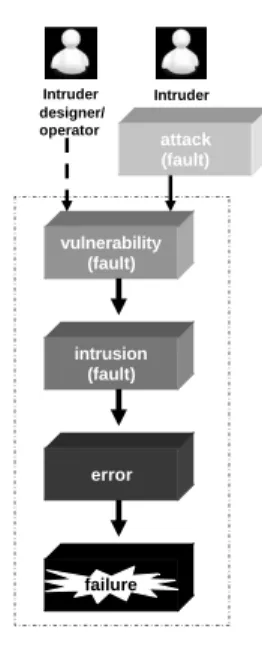
In the context of intrusion tolerance, the fault-error-failure chain was extended to include the notion of attack, vulnerability and intrusion. The AVI composite fault model was developed in the MAFTIA project (Verissimo et al., 2000; Adelsbach et al., 2002; Verissimo, 2003). A vulnerability is a fault in the system that can be exploited with malicious intent, i.e., a program bug or a misconfiguration. An attack is a malicious operational fault attempted with the objective of exploiting vulnerabilities, for instance, a malicious user that manages to guess a privileged account password. An intrusion is a result of a successful attack on a vulnerability, e.g., a malicious user with a privileged account password penetrates the system violating the security properties. This intrusion may cause an error which can later cause the system failure. An intrusion campaign is the sequence of attack → vulnerability → intrusion, occurring recursively in a coherent chain of events generated by an intruder. Figure 2.1 presents the AVI composite fault model.
vulnerability (fault) intrusion (fault) error failure Intruder designer/ operator Intruder attack (fault)
Figura 2.1:The AVI composite fault model.
Faults can be classified in several types according to different criteria. In the context of this thesis we are interested in the intent of the fault: accidental or intentional. The algorithms presented in this thesis consider malicious intentional faults, also called Byzantine faults. The classical fault tolerance defines the omissive and assertive fault models (Verissimo & Rodrigues, 2001). Omissive fault models include those faults in which the component does not interact as specified. The assertive fault models comprise faults in which the component interact as specified but the service delivered is semantically or syntactically invalid.
2.1. INTRUSION TOLERANCE 13
In intrusion tolerance, malicious faults can be simultaneously omissive and assertive, therefore, in this area it is assumed an arbitrary fault model that encompasses both previous fault models. The reason is the difficulty of constraining or predicting the behavior of adversaries that attempt to corrupt the system performing malicious faults. In fact, this arbitrary model is the most adequate to represent the adversary intelligence.
A fault model can also be classified as controlled and hybrid, considering the system architecture and the interaction between components. A controlled fault model specifies qualitative and quantitative bounds on component faults. For example, we can assume for a given system, only crash failures (e.g., crash of servers) or omission failures (e.g., loss of packets in the network). An arbitrary fault model specifies no qualitative or quantitative bounds on failures of the components. However, faults in systems are inevitable, therefore, usually it is specified the number of components that can fail, e.g., less than one third of the components.
Hybrid fault models assume that different parts of the system can have different failure type distributions. For instance some components of a system can exhibit a fail controlled behavior, i.e., only crash faults, whilst the remainder of the system is still allowed to fail arbitrarily. We call these components simply wormholes following Verissimo’s nomenclature (Verissimo, 2006). Wormholes are enhanced components with properties usually not available in the rest of the environment. The design and implementation of the these components has to enforce the fault model in order to avoid that naive assumptions about a component’s behavior be a target to attackers.
For some algorithms in this thesis – presented in the Chapters 3, 4 and 6 – it is assumed a hybrid fault model. Other examples of hybrid models can be found in earlier works such as (Powell et al., 1988; Verissimo et al., 1997; Correia et al., 2002). We assume a trusted/tamperproof component that provides the USIG service (detailed in the Chapter 3). Each server contains a local trusted/tamperproof component that provides a correct service. The hybrid fault model states that servers can deviate arbitrarily from their specification. However, the USIG service is tamperproof, i.e., always satisfies its specification, even if it is in a faulty server.
2.1.3 Time Models
A distributed system is considered synchronous if bounds of processing delays, message delays and drift rate among local clocks exist and are known. Due to the timing assumptions, this model is not practical to be used in intrusion-tolerant systems, especially in unpredictable environments like the Internet. Moreover, these timing assumptions are susceptible to be attacked. An attacker can delay processors, messages and clocks. Therefore, the research in the intrusion tolerance has been centered in asynchronous and partial synchronous models.
A system is considered asynchronous if there are no bounds on communication and processing delays. Assuming this kind of model is very important in order to prevent the success of attacks against time. On the other hand, the FLP impossibility result (Fischer et al., 1985), states that no deterministic protocol can solve consensus in an asynchronous system if a single process can fail by crashing.
In order to deal with this limitation, some works have proposed intermediate models, designated as partial-synchronous models (Christian & Fetzer, 1998; Verissimo & Almeida, 1995; Chandra & Toueg, 1996; Chandra et al., 1996) making additional assumptions. The partial-synchronous models were introduced by (Dwork et al., 1988). For instance such model can state that in all executions of the system, there is a bound ∆ and an instant GST (Global Stabilization Time), so that every message sent by a correct server to another correct server at instant u > GST is received before u + ∆, with ∆ and GST unknown. The intuition behind this model is that the system can work asynchronously (with no bounds on delays) most of the time but there are stable periods in which the communication and processing delays are bounded. In practice this stable period has to be long enough for the algorithm to terminate, but does not need to be forever. This assumption of partial synchrony is needed to guarantee the termination of BFT algorithms (Castro & Liskov, 2002; Aiyer et al., 2005; Cowling et al., 2006; Kotla et al., 2007; Amir et al., 2008a). Other works proposed alternative solutions, such as failure detectors (Chandra & Toueg, 1996).
2.1. INTRUSION TOLERANCE 15
2.1.4 Mechanisms and Techniques
The development of a dependable system requires a set of techniques and mechanisms. The main goal of these techniques and mechanisms is to avoid system failures, or at least to reduce the number of system failures. The dependability area uses four classes of techniques: prevention, forecasting, tolerance and removal of faults.
Fault prevention – precludes that faults are incorporated into a system. This can be accomplished by using development methodologies whose intent is to eliminate the circumstances by which faults arise (e.g. software inspection).
Fault removal – is divided into two categories: removal during development and removal during use. Removal during development requires verification of the dependability properties during the development process. Detected faults are removed before the system is deployed. Once systems have been deployed, it is necessary to detected failures and to remove them obeying a maintenance cycle.
Fault forecasting – estimates the presence, creation and consequences of faults.
Fault tolerance – refers to the use of techniques that allow a system to deliver the required service even in the presence of faults. It is carried out by error processing and fault treatment. Error processing consists in removing errors from the computational state (if possible before the failure occurrence) and is based on the following mechanisms:
1. error detection that identifies states being erroneous;
2. error diagnosis that assesses the damage caused by detected errors;
3. error recovery that substitutes an erroneous state by an error-free state, using one of the following three methods: (i) compensation or masking (contains enough redundancy to mask an error); (ii) forward recovery (finds a new state from which th system can operate). (iii) backward recovery (substitutes an erroneous state by an error-free state already occupied prior to error occurrence).
Fault treatment aims at preventing faults being re-activated and requires the following mechanisms:
1. fault diagnosis that consists of identifying the cause, location and nature of the errors; 2. fault isolation that prevents the re-activation of the faults performing physical or logical
exclusion of the faulty components from further participation in service delivery;
3. reconfiguration which either switches in spare components or reassigns tasks among non failed components.
All these techniques and mechanisms provide a common framework used to implement both, fault and intrusion-tolerant systems. The Figure 2.2 shows how a combination of these techniques can be used in order to cope with security events. Attack prevention consists in employing techniques to avoid or minimize the action of intruders, e.g., firewalls. Vulnerability prevention can be obtained using adequate design practices. Vulnerability removal includes to detect and to remove vulnerabilities correcting software bugs or misconfiguration, disabling unused network services, etc. Intrusion prevention can be obtained with special devices that
vulnerability removal vulnerability (fault) intrusion (fault) error failure Intruder designer/ operator Intruder attack (fault) vulnerability prevention attack prevention intrusion prevention intrusion tolerance
2.1. INTRUSION TOLERANCE 17
monitor network and/or system activities for malicious or unwanted behavior and can react, in real-time, to block or prevent those activities, e.g., intrusion prevention and detection systems.
All these mechanisms can prevent intrusions but some attacks may still be able to activate vulnerabilities causing an intrusion, therefore intrusion tolerance is still needed. Intrusion tolerance is usually obtained with replicated components using error masking techniques.
The focus of this thesis is the use of compensation through the redundancy of software and hardware in order to obtain error masking. We use active replication, also called the state machine approach, which is a generic fault tolerance mechanism that provides error masking and is used to implement deterministic services (Schneider, 1990).
The state machine approach consists of replicating a service in a group of servers. Each server maintains a set of state variables, which are modified by a set of operations. These operations have to be atomic (they can not interfere with other operations) and deterministic (the same operation executed in the same initial state generates the same final state), and the initial state must be the same in all servers. The properties that a state machine replication algorithm has to enforce are:
• safety – all correct servers execute the same requests in the same order; • liveness – all correct clients requests are eventually executed.
Research has shown that in general a system which tolerates f accidental faults must have 2 f + 1 replicas (Schneider, 1990). The extra replicas are used as evidence to decide which of the replicas are correct and which are faulty. Special cases can improve these bounds (Lamport, 2003). It is not difficult to see that the minimum number of replicas required is three: if one replica has a fault, it is possible to know which replica is faulty by comparing the state of the three replicas, the faulty one presents a different state. Two replicas are not enough because there is no way to know which replica is the faulty one.
In order to tolerate Byzantine faults, the number of replicas has to be increased to 3 f + 1 and messages have to be signed using cryptographic primitives. A little deduction shows that the minimum number of replicas is four: considering three replicas A (faulty), B and C; the first
client sends a command <WRITE x = 1 > and gets replies from A and B. The second client
sends a command <READx > and gets replies from A and C; The server A attempts to create
equivocation by replying x = 0. The faulty server A convinces the correct server C to execute different requests. As a result one client sees x = 1 whereas the other client sees x = 0. Several algorithms to implement the state machine approach tolerating Byzantine, possibly malicious, faults have been designed and some of them are presented in the Section 2.2.
2.1.5 Diversity
Intrusion tolerance is usually obtained by replicating the system in a set of servers, which behave according to the system specification even if there are intrusions in up to a certain threshold of the replicas.
For tolerating attacks and intrusions, the replicas can not be identical and share the same vulnerabilities, otherwise causing intrusions in all the replicas would be almost the same as in a single one. Therefore, there has to be diversity among the replicas, i.e., replicas shall have different operating systems, different application software, etc. (Littlewood & Strigini, 2004; Obelheiro et al., 2006). If each replica is protected using the current best practices, and there is diversity, the overall system is ensured to be more trustworthy than if it was centralized. On the other hand, this involves additional considerable costs per-replica, in terms not only of hardware but especially of software development, acquisition and management.
BASE is a replication technique that enables an opportunistic form of diversity taking advantage of distinct, off-the-shelf implementations of common services (Castro et al., 2003). The existence of standard protocols that provide identical interfaces to different implementations (e.g. ODBC and NFS) simplifies this replication technique and keeps the cost of implementing adapters and conversion functions low. BASE describes a methodology to implement these adapters and conversion functions by defining a common abstract service state and how each operation manipulates the state. BASE defines functions that are used to map from the concrete state of each implementation to the common abstract state. This replication approach reduces the development and maintenance costs and also the long time-to-market.
2.2. INTRUSION-TOLERANT STATE MACHINE REPLICATION 19
2.2 Intrusion-Tolerant State Machine Replication
Recent works have demonstrated that BFT algorithms are a promising technique for using redundancy to improve integrity and availability. The Castro and Liskov work has brought a new impulse to research in this area by showing that BFT systems can be practical (Castro & Liskov, 1999). Kotla et al. proposed Zyzzyva, an algorithm that uses speculation to reduce the cost and simplify the design of Byzantine fault-tolerant state machine replication (SMR) (Kotla et al., 2007). Amir et al. (Amir et al., 2008a) showed that BFT leader-based algorithms are vulnerable to performance degradation attacks, while Clement et al. (Clement et al., 2009) proposed a set of techniques to mitigate these vulnerabilities.
These works present algorithms that influenced in some way this thesis, therefore they are described in the next sections.
2.2.1 PBFT – Practical Byzantine Fault Tolerance
Practical Byzantine Fault Tolerance (PBFT) is an algorithm proposed to support the implementation of efficient intrusion-tolerant services using the state machine approach (Castro & Liskov, 1999). In the PBFT algorithm a service is replicated in a set of servers and clients submit requests to these servers. The service tolerates f malicious servers out of 3 f +1. Servers move through a succession of configurations called views. In a view one replica is the primary and the others are backups. The system model assumes a partial-synchronous model in order to assure the liveness of the algorithm. The authenticity of the messages exchanged by the algorithm is protected with signatures based on public-key cryptography or message digests produced with collision-resistant hash functions.
The algorithm works basically as follows: (1) A client sends a request of an operation to all servers; (2) The primary multicasts the request in aPRE-PREPAREmessage to the replicas; (3)
When a replica receives aPRE-PREPAREmessage, it validates the message and then multicasts
aPREPARE message; (4) When a correct replica receives 2 f + 1PREPAREmessages, it sends a
COMMITmessage; (5) Each replica that receives 2 f +1COMMITmessages accepts and executes
result.
A replica validates a PRE-PREPARE message if the signatures in the request and the PRE
-PREPARE message are correct and if thePRE-PREPAREmessage was created by the primary of
the current view. The primary replica defines the order in which client requests are executed by all replicas. When the primary is suspected to be faulty, a view-change protocol is executed in order to provide liveness by allowing the system to make progress. View changes are triggered by timeouts that prevent replicas from waiting indefinitely for requests to be executed.
Periodically replicas exchangeCHECKPOINT messages with a proof of their current state.
When a replica collects 2 f + 1CHECKPOINTmessages with the same state signed by different
replicas, it learns that at least 2 f + 1 replicas have progressed and all messages related with earlier requests can be discarded. In terms of performance, PBFT is often considered the baseline of today’s Byzantine fault-tolerant algorithms, probably because it was the first efficient algorithm in the area and many others derive from it, e.g., (Amir et al., 2008a; Clement et al., 2009; Cowling et al., 2006; Kotla et al., 2007). A comparison of these BFT algorithms using a simulator in (Singh et al., 2008) analyses the effects of changes in the costs of cryptography operations, workloads, network conditions and faults, showing that one-size-fits-all algorithms may be hard to design.
2.2.2 Zyzzyva – Speculative Byzantine Fault Tolerance
Zyzzyva is a Byzantine state machine replication algorithm that explores speculation in order to reduce the overhead caused by the agreement protocol (Kotla et al., 2007). In Zyzzyva, replicas optimistically adopt the order of requests proposed by the primary and respond immediately to the client, without reaching agreement on the order of the requests. Thus, replicas can become inconsistent when the primary is faulty. In these cases, clients detect these inconsistencies and help the replicas to converge on a single total ordering of requests.
Zyzzyva is executed by 3 f + 1 replicas and also uses the concept of views. In each view one server is designated as a primary and the others are backups. In normal operation a client sends a request to the primary, the primary forwards the request to the replicas, and they execute the request and send their responses to the client.
2.2. INTRUSION-TOLERANT STATE MACHINE REPLICATION 21
The response sent by the servers contains the result of the operation requested by the client. The client only accepts a result when it receives a sufficient number of matching responses (3 f + 1), to ensure that all correct replicas have executed the request and all preceding requests in the same order. Therefore, the servers send responses that include the result and the history. The history is the sequence of all requests executed by a replica prior to and including this request.
Clients wait for 3 f + 1 matching responses during a time interval. If a client receives between 2 f + 1 and 3 f matching responses then it sends these 2 f + 1 matching responses in a message to all replicas. This set of messages composes a commit certificate that proves that 2 f + 1 replicas agree on the order that the requests were executed. Hence, only when 2 f + 1 replicas acknowledge receiving a commit certificate, the client accepts the result and acts on it. If the client receives fewer than 2 f + 1 responses, then it retransmits the request to all replicas and during a time interval replicas wait that the request is ordered. If the primary does not order the request replicas there is a view change and a new primary is chosen.
If the primary is faulty, replicas can become temporarily inconsistent with one another, but when clients detect these inconsistencies in the responses, they help correct replicas to converge on a single total ordering of requests. To do this, replicas have to perform rollback of some executed requests. The amount of information about the state that is stored by each replica is limited by a checkpoint mechanism that also reduces the cost of performing view changes.
The performance results presented by Zyzzyva show that speculation can improve the performance of existing BFT protocols in fault-free settings. On the other hand, in networks with heterogeneous latency among client and replicas Zyzzyva tends to perform similarly to a two-phase quorum protocol like HQ (Cowling et al., 2006). Besides, for some kind of applications performing rollback of operations is not practical.
2.2.3 Prime – Byzantine algorithms under attacks
BFT algorithms derived from PBFT, like Zyzzyva, are based on a primary (or leader) server that is in charge of ordering client requests (Cowling et al., 2006; Kotla et al., 2007; Clement et al., 2009). In these BFT algorithms, servers move through a succession of configurations
called views. Each view has a primary. Often, the primary server remains the same as long as no faults are detected. When a subset of the servers suspects that the primary is faulty, they choose another server to be the primary.
This basic scheme has been shown to be vulnerable to performance attacks by Amir et al. (Amir et al., 2008a). More precisely, these authors have shown two attacks that can degrade the performance of PBFT and other BFT leader-based algorithms to let them so slow that they are barely usable. Byzantine-resilient replication algorithms satisfy safety under any conditions and provide liveness under certain conditions, normally during periods of sufficient synchrony. In the first attack, called pre-prepare delay, a faulty primary delays the ordering of requests from some of the clients, causing a considerable increase of the latency of those requests and a great reduction of the throughput. Leader-based algorithms like PBFT impose a maximum delay on the execution of requests, but only on the first request of the queue of pending requests, so a faulty primary can process one request at a time, strongly delaying most requests. In the second attack, timeout manipulation, faulty servers manage to increase the timeouts used by the algorithm, seriously degrading the performance of the system. These attacks also apply to some of the algorithms that derive from PBFT, like Zyzzyva, or that use PBFT as a component, like Byzantium (Preguic¸a et al., 2008).
Amir et al. propose a performance-oriented metric to evaluate BFT algorithms and present Prime, a Byzantine-resilient state machine replication that performs according to this metric (Amir et al., 2008a). The Prime replication algorithm establishes the total order of requests in two phases. In the first phase, each server disseminates requests received from the clients to the other servers and coordinates an agreement protocol, which preorders those requests. In the second phase, the primary coordinates a global ordering algorithm, which establishes a total order on batches of preordered requests. Prime also defines a reconciliation phase assuring that all correct servers receive requests even when malicious servers preorder requests without sending them to all servers.
Prime uses a suspect-leader mechanism that is in charge of (1) dynamically determining how fast a timely leader should perform, (2) monitoring the performance of the current leader, and (3) suspecting the leader if it is not performing fast enough. Together with the two phases replication algorithm, the suspect-leader mechanism makes the system able to detect several
2.2. INTRUSION-TOLERANT STATE MACHINE REPLICATION 23
performance attacks and change the leader when it degrades the performance of the system. The performance evaluation shows that in fault-free cases Prime has a greater latency than PBFT algorithm due to the additional communications steps. However, under performance degradation attacks Prime showed to be much more robust than PBFT.
2.2.4 Aardvark – Making BFT Systems Tolerate Byzantine Faults
The main motivation for the implementation of the Aardvark algorithm was the existence of some vulnerabilities in BFT state machine replication algorithms (Clement et al., 2009). Although some recent algorithms, like Zyzzyva, have reduced the cost of BFT replication, their optimizations have introduced vulnerabilities making these algorithms not tolerate Byzantine faults properly. In fact, a single faulty client or a server can increase the service latency reducing significantly the throughput of the system.
In order to improve their performance, some BFT algorithms use vectors of message authentication codes (MACs) for authentication, rather than digital signatures (Castro & Liskov, 1999; Cowling et al., 2006; Kotla et al., 2007). Vectors of MACs do not provide non-repudiation, i.e., after validating a message’s MAC, a server cannot be sure that any other server in the system will also validate that message. For BFT algorithms this is problematic because correct replicas need to make the same decision with respect to the validity of messages. Castro describes in his thesis (Castro, 2000) that due to this limitation of vector of MAC, a faulty client can force view-changes. For example, a faulty client sends a request with a good MAC for the primary but a bad MAC for all other replicas. The primary authenticates and assigns a sequence number seq to the request and sends aPRE-PREPAREmessage to the replicas. The replicas are
unable to authenticate the request, thus they do not send aPREPAREmessage. At this point, no
request with sequence number greater than seq can be executed, thus the progress stops until a view-change operation occurs and the client can repeat its behavior in the new view.
As described in the Section 2.2.3, a faulty primary can delay processing requests in order to affect the system performance. Besides, a faulty primary can discard some client requests, corrupt clients’ MAC authenticators, introduce gaps in the sequence number space, etc. Even non-primary servers can affect the system availability by flooding the network with large junk
messages causing significant impact on the overall system throughput.
To cope with these problems Clement et al. propose Aardvark. The main idea behind Aardvark is to provide a robust algorithm that presents a good performance during gracious executions (when execution is synchronous and servers behave correctly) and, keep this performance during uncivil executions (up to f servers and an arbitrary number of clients are Byzantine and the execution is synchronous with a short bound message delay defined).
Aardvark follows the communication pattern of PBFT. The main differences are:
• Signed client requests - although message authentication codes (MACS) using symmetric-key cryptography is three orders of magnitude faster than public-key cryptography operations, in Aardvark clients sign their requests using digital signatures to ensure non-repudiation and that all correct replicas make identical decisions about the validity of client requests. In PBFT, a faulty client can sign a request with a partial valid MAC making some correct replicas validate the request and others not.
• Resource isolation - in Aardvark each pair of replicas is connected by separate network interface controllers (NICs) and cables. The idea is to prevent faulty servers from interfering with timely delivery of messages from correct servers. It also allows avoiding denial of service attacks by disabling compromised NICs.
• Regular view changes - Aardvark proposes the use of periodical view changes in order to prevent performance degradation attacks where a faulty primary reduces the throughput of the system by delaying the message that defines the order of requests. Replicas monitor the performance of the current primary: if the primary fails to provide an acceptable throughput, replicas initiate a view change.
Due to these modifications, Aardvark limits the vulnerability to disruption caused by any client, primary or server. The performance of this algorithm was compared with a set of BFT algorithms and shown that although it presents a good performance, Aardvark does not achieve results as good as PBFT in the fault-free case. However, it presents the best performance for a broad range of cases with injected faults.