Early physical and occupational therapy in mechanically
ventilated, critically ill patients: a randomised controlled trial
William D Schweickert, Mark C Pohlman, Anne S Pohlman, Celerina Nigos, Amy J Pawlik, Cheryl L Esbrook, Linda Spears, Megan Miller, Mietka Franczyk, Deanna Deprizio, Gregory A Schmidt, Amy Bowman, Rhonda Barr, Kathryn E McCallister, Jesse B Hall, John P Kress
Summary
Background Long-term complications of critical illness include intensive care unit (ICU)-acquired weakness and neuropsychiatric disease. Immobilisation secondary to sedation might potentiate these problems. We assessed the effi cacy of combining daily interruption of sedation with physical and occupational therapy on functional outcomes in patients receiving mechanical ventilation in intensive care.
Methods Sedated adults (≥18 years of age) in the ICU who had been on mechanical ventilation for less than 72 h, were expected to continue for at least 24 h, and who met criteria for baseline functional independence were eligible for enrolment in this randomised controlled trial at two university hospitals. We randomly assigned 104 patients by computer-generated, permuted block randomisation to early exercise and mobilisation (physical and occupational therapy) during periods of daily interruption of sedation (intervention; n=49) or to daily interruption of sedation with therapy as ordered by the primary care team (control; n=55). The primary endpoint—the number of patients returning to independent functional status at hospital discharge—was defi ned as the ability to perform six activities of daily living and the ability to walk independently. Therapists who undertook patient assessments were blinded to treatment assignment. Secondary endpoints included duration of delirium and ventilator-free days during the fi rst 28 days of hospital stay. Analysis was by intention to treat. This trial is registered with ClinicalTrials.gov, number NCT00322010
.
Findings All 104 patients were included in the analysis. Return to independent functional status at hospital discharge occurred in 29 (59%) patients in the intervention group compared with 19 (35%) patients in the control group (p=0·02; odds ratio 2·7 [95% CI 1·2–6·1]). Patients in the intervention group had shorter duration of delirium (median 2·0 days, IQR 0·0–6·0 vs 4·0 days, 2·0–8·0; p=0·02), and more ventilator-free days (23·5 days, 7·4–25·6 vs 21·1 days,
0·0–23·8; p=0·05) during the 28-day follow-up period than did controls. There was one serious adverse event in 498 therapy sessions (desaturation less than 80%). Discontinuation of therapy as a result of patient instability occurred in 19 (4%) of all sessions, most commonly for perceived patient-ventilator asynchrony.
Interpretation A strategy for whole-body rehabilitation—consisting of interruption of sedation and physical and occupational therapy in the earliest days of critical illness—was safe and well tolerated, and resulted in better functional outcomes at hospital discharge, a shorter duration of delirium, and more ventilator-free days compared with standard care.
Funding None.
Introduction
Advances in the management of mechanically ventilated patients have improved outcomes and survival rates for this patient population.1–3 As patients survive acute
illness, long-term complications are more apparent. Weakness is a frequent complication and is associated with major disability and protracted rehabilitation.4–6 In
addition to physical debility, neuropsychiatric dysfunc-tion is often profound. Delirium during intensive care unit (ICU) stay (ICU-associated delirium)is common in patients undergoing mechanical ventilation, and is associated with increased mortality,7 longer length of
stay in intensive care and in hospital,8 and increased
duration of ventilation.7
Clinicians working in the ICU often focus on treating circulatory, respiratory, and renal function to ensure patient survival. Accordingly, most patients on mech-anical ventilation receive sedative and analgesic drugs
to reduce distress and oxygen consumption;9 how ever,
this approach can result in long periods of un con-sciousness and immobility.10 Protocols geared to
keeping sedation to a minimum, such as daily inter-ruption of sedation,11 and mobilisation of mechanically
ventilated patients via physical therapy12,13 in the earliest
days of critical care, can result in improved patient outcomes. Specifi cally, observational studies of patients on mechanical ventilation for at least 4 days who were subsequently transferred to a dedicated respiratory ICU (post-acute care) have shown that physical therapy is feasible, safe, and promotes more rapid return to ambulation.12,13 More recently, in a prospective,
non-randomised cohort study, Morris and colleagues14
showed that an early mobilisation team increased physical therapy services for medical ICU patients with respiratory failure; this intervention also shortened length of stay in the ICU and in hospital.
Lancet 2009; 373: 1874–82
Published Online May 14, 2009 DOI:10.1016/S0140-6736(09)60658-9 See Comment page 1824
Department of Medicine, Division of Pulmonary, Allergy and Critical Care Medicine, University of Pennsylvania, Philadelphia, PA, USA
(W D Schweickert MD); Department of Medicine, Section of Pulmonary and
Critical Care (M C Pohlman MD,
A S Pohlman MSN, C Nigos RN, K E McCallister BS, Prof J B Hall MD, J P Kress MD), and Therapy Services
Department (A J Pawlik PT,
C L Esbrook OTR/L, L Spears PT, M Miller OTR/L, M Franczyk PT, D Deprizio OTR/L), University of Chicago, Chicago, IL, USA; and Department of Internal Medicine, Division of Pulmonary Diseases, Critical Care, and Occupational
Medicine (Prof G A Schmidt MD,
A Bowman BSN), and Department of Rehabilitation
Therapies (R Barr PT),
University of Iowa, Iowa City, IA, USA
Correspondence to: Dr John P Kress, Department of Medicine, Section of Pulmonary and Critical Care, University of Chicago, 5841 South Maryland, MC 6026, Chicago, IL 60637, USA
Additionally, the identifi cation of ICU-associated delirium and its association with poor outcomes has highlighted the need for interventions that might alter its course.15 Although several possible factors might result
in ICU-associated delirium, so far only sedation with dexmedetomidine as a replacement for a benzodiazepine has been shown to reduce the duration of ICU-associated delirium.16
The implementation of daily interruption of sedation combined with physical and occupational therapy in the earliest days of critical illness might prevent sedative-related immobility. We postulated that this intervention, tested in a randomised controlled trial, would aff ect both functional outcomes and neuro psychiatric outcomes, such as ICU-associated delirium.
Methods
PatientsWe recruited study participants at two medical centres: University of Chicago Medical Center (Chicago, IL, USA) and University of Iowa Hospitals (Iowa City, IA, USA). The institutional review boards at both centres approved the study, and written informed consent was obtained from participants or their authorised represen-tatives.
Patients in the medical ICU were screened daily to identify adults (≥18 years of age) who had been on mechanical ventilation for less than 72 h, were expected to continue for at least 24 h, and who met criteria for baseline functional independence (defi ned a priori as a Barthel Index score ≥70 obtained from a proxy describing patient function 2 weeks before admission).17,18 Patients
were excluded for the following reasons: rapidly developing neuromuscular disease, cardiopulmonary arrest, irreversible disorders with 6-month mortality estimated at more than 50%, raised intracranial pressure, absent limbs, or enrolment in another trial.
Procedures
Patients were randomly assigned in a 1:1 ratio to exercise and mobilisation (physical and occupational therapy) beginning on the day of enrolment (intervention) or to standard care with physical and occupational therapy delivered as ordered by the primary care team (control). Neither site routinely provides physical therapy for patients who are on mechanical ventilation for less than 2 weeks, nor has dedicated physiotherapists for such practice. At both sites, a computer-generated, permuted block randomisation scheme was used to allocate patients to study group. Each assignment was designated in a consecutively numbered, sealed, opaque envelope by an investigator with no further involvement in the trial.
Every morning, unresponsive patients in the inter-vention group underwent passive range of motion exercises for all limbs (ten repetitions in all cardinal directions). Sedatives were interrupted as previously described.1 Therapy was delivered by a physical and
occupational therapist and coordinated with daily interruption of sedation. Once patient interaction was achieved, sessions began with active assisted (with manual assistance) and active (independent) range of motion exercises in the supine position. If these exercises were tolerated, treatment was advanced to bed mobility activities, including transferring to upright sitting. Sitting balance activities were followed by participation in activities of daily living (ADLs) and exercises that encouraged increased independence with functional tasks. The session progressed to transfer training (ie, repetition of sit-to-stand transfers from bed to chair or bed to commode), and fi nally pre-gait exercises and walking. Progression of activities was dependent on patient tolerance and stability. Therapy intervention continued on a daily basis throughout the patient’s hospital stay until he or she returned to a previous level of function or was discharged.
The following criteria indicated unstable patient conditions that prevented the initiation or continuation of physical and occupational therapy: mean arterial blood pressure less than 65 mm Hg or more than 110 mm Hg, or systolic blood pressure more than 200 mm Hg; heart
1161 medical ICU patients screened
818 patients eligible for enrolment
714 patients excluded
150 inability to obtain consent (44 refusal, 106 no family/family discord/goals for comfort care) 171 extubation order at the time of assessment 122 cardiac arrest as cause for respiratory failure 126 irreversible condition with 6-month mortality
estimated at >50%
103 rapidly developing neurological/neuromuscular disease 30 participation in conflicting study
5 advanced dementia 1 raised intracranial pressure 6 multiple absent limbs
104 patients enrolled and randomised
49 patients assigned to intervention 0 discontinued protocol 0 lost to follow-up
55 patients assigned to control 0 discontinued protocol 0 lost to follow-up
49 analysed in ITT population 55 analysed in ITT population 343 patients did not meet eligibility criteria
1 aged <18 years
161 duration of mechanical ventilation >72 h 181 significant baseline dependent functional status*
Figure 1: Trial profi le
rate less than 40 beats per min or more than 130 beats per min; respiratory rate less than 5 breaths per min or more than 40 breaths per min; and pulse oximetry less than 88%. Additionally, the following fi ndings were contraindications for initiation of therapy: raised intracranial pressure; active gastrointestinal blood loss; active myocardial ischaemia; continuing procedures including intermittent haemodialysis (but not including continuous ultrafi ltration or haemo dialysis); patient agitation that needed increased sedative administration in the past 30 min; and unsecure airway. Further criteria that prevented continuation of therapy were marked ventilator asynchrony; patient distress (evidenced by non-verbal cues, gestures); the patient being physically combative; new arrhythmia; concern for myocardial ischaemia; and concern for airway device integrity.
Patients in both intervention and control groups were managed by goal-directed sedation guided by the Richmond Agitation Sedation Scale (RASS)19,20 and
underwent daily interruption of sedatives or narcotics, or both. Contraindications to daily interruption of sedation were: persisting neuromuscular blockade; sedative infusion for active seizures or alcohol withdrawal; escalating sedative doses because of persisting agitation; evidence of active myocardial ischaemia in the previous 24 h; and evidence of raised intracranial pressure. Study personnel undertook daily independent neurological assessments of patients by use of the RASS for level of arousal and the Confusion Assessment Method for the ICU for delirium and coma.21,22
Weaning patients from mechanical ventilation was done via a protocol,3 with the decision to extubate made
by the primary care team. All patients were started on enteral feeding and those who showed three glucose concentrations of more than 8·3 mmol/L were treated with insulin infusions.23
The primary endpoint was defi ned a priori as the number of patients returning to independent functional status at hospital discharge. Independent functional status was defi ned as the ability to perform six ADLs (bathing, dressing, eating, grooming, transferring from bed to chair, using the toilet)24,25 and walking independently.
Historically, functional assessments of survivors of critical illness include outcomes of ADLs and walk distance.4,12,13,26,27 This composite endpoint was selected to
refl ect these milestones and the targeted goals of the intervention. The rating scale of the Functional Independence Measure was used to quantify functional status. ADL scores that were rated ≥5 were deemed as performed independently by the patient (ie, no need for physical assistance).28
Secondary endpoints were: (1) number of hospital days with delirium; (2) number of days alive and breathing without assistance (ventilator-free days) during the fi rst 28 days of hospital stay; and (3) length of stay in the ICU and in hospital. Additionally, the following measurements were taken at hospital discharge: (1) Barthel Index score; (2) number of functionally independent ADLs; (3) dis-tance walked without assisdis-tance; (4) number of patients diagnosed with ICU-acquired paresis;29 and (5) hand-grip
strength scoring at ICU and hospital discharge.
Patients were assessed by physical and occupational therapists who were unaware of randomisation assign-ment. Every 48 h, these therapists assessed patient strength and ability to perform ADLs and to walk, including a fi nal assessment and Barthel Index scoring within 24 h of discharge. Strength in the upper and lower extremities was scored by use of the Medical Research Council (MRC) examination,30,31 followed by three
measurements of dominant hand dynamometry (Jamar hand-grip dynamometer; Sammons Preston Rolyan, Bolingbrook, IL, USA). ICU-acquired paresis was diag-nosed when an awake and attentive patient had a muscle strength sum score of less than 48 when all muscle groups were able to be assessed.29
To maintain blinding, the group of assessment therapists was distinct from the therapists who undertook the intervention. Before each assessment, the patients and any visitors were instructed (via a structured intro ductory statement) not to discuss previous inter ventions. Furthermore, assessments occurred in the afternoon at a time distant from the morning therapy intervention.
Safety was monitored by research staff and bedside nurses continuously during the study. In accordance with the requirements of the institutional review boards, if research-related adverse events were to occur, the intervention should be stopped, followed by immediate medical treatment in the ICU. Furthermore, all serious
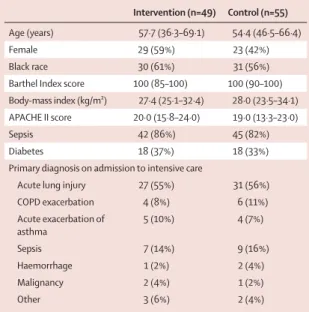
Intervention (n=49) Control (n=55)
Age (years) 57·7 (36·3–69·1) 54·4 (46·5–66·4)
Female 29 (59%) 23 (42%)
Black race 30 (61%) 31 (56%)
Barthel Index score 100 (85–100) 100 (90–100) Body-mass index (kg/m²) 27·4 (25·1–32·4) 28·0 (23·5–34·1) APACHE II score 20·0 (15·8–24·0) 19·0 (13·3–23·0)
Sepsis 42 (86%) 45 (82%)
Diabetes 18 (37%) 18 (33%)
Primary diagnosis on admission to intensive care
Acute lung injury 27 (55%) 31 (56%)
COPD exacerbation 4 (8%) 6 (11%)
Acute exacerbation of asthma
5 (10%) 4 (7%)
Sepsis 7 (14%) 9 (16%)
Haemorrhage 1 (2%) 2 (4%)
Malignancy 2 (4%) 1 (2%)
Other 3 (6%) 2 (4%)
Data are number of patients (%) or median (IQR). APACHE II=Acute Physiology and Chronic Health Evaluation II. COPD=chronic obstructive pulmonary disease. Barthel Index scale 0–100, APACHE II scale 0–71.
adverse events were to be reported to the institutional review boards within 48 h.
Therapy sessions in which the patient met the criteria for instability or in which unplanned extubation or equipment removal occurred were tracked prospectively. Individual decisions by the primary care team or intervention team to discontinue a therapy session were categorised and reported. Serious adverse events, in accordance with recently published literature, included fall to knees, endotracheal tube removal, systolic blood pressure more than 200 mm Hg, systolic blood pressure less than 90 mm Hg, and desaturation to less than 80%.12
Finally, the time to taken to accomplish additional functional milestones (such as the fi rst day getting out of bed, standing, marching in place, transferring to a chair, walking [even with assistance]) were recorded from nursing and physiotherapy notes to emphasise patient progression in the two groups.
Statistical analysis
On the basis of observations of functional outcomes in a cohort of critically ill patients with respiratory failure who were functional at admission to intensive care, we noted that 50% of patients achieved return of independent functional status at hospital discharge. We calculated that a total sample size of 100 patients would be needed to detect a 30% diff erence in the number of patients achieving return to independent functional status between the two groups with 80% power and a two-sided signifi cance level of 0·05.
Data were analysed by an intention-to-treat approach. Patients who died during the study were assigned scores of 0 for ventilator-free days, strength testing (MRC examination and hand grip), ADL total, walk distance, and Barthel Index score. We used the χ² test or Fisher Exact test (as appropriate) to compare categorical variables between the two study groups, including the primary endpoint, and the Wilcoxon-Mann-Whitney two-sample rank-sum test or t tests to compare continuous variables.
To compare the eff ect of the treatment protocol on the time to return to independent functional status, we used time-to-event analysis. A cumulative event curve (cen-sored endpoints) was estimated with the Kaplan-Meier procedure. The eff ect of the treatment protocol on the endpoint was compared between groups with the log-rank test. Additional analysis was done with logistic and Cox regression models that adjusted for the main baseline factors that predict outcomes (age, APACHE II, presence of sepsis) and the presence of the intervention. We checked the assumption of proportionality of hazard functions in our Cox regression model. Hazard ratios (HRs), together with 95% CIs, were estimated with these models. To assess for an interaction between study centre and treatment with respect to the primary endpoint, we included an interaction term in a proportional odds logistic
regression model with return to independent function as the dependent variable.
We used GraphPad Prism software (version 5.0) for all statistical analyses apart from the Cox regression analysis, which was done with SPSS software (version 8.0). An independent biostatistician reanalysed the fi nal dataset and verifi ed all our results. Signifi cant diff erences between groups or across time were reported at the alpha level of 0·05. All reported p values are two-sided. This trial is registered with ClinicalTrials.gov, number NCT00322010.
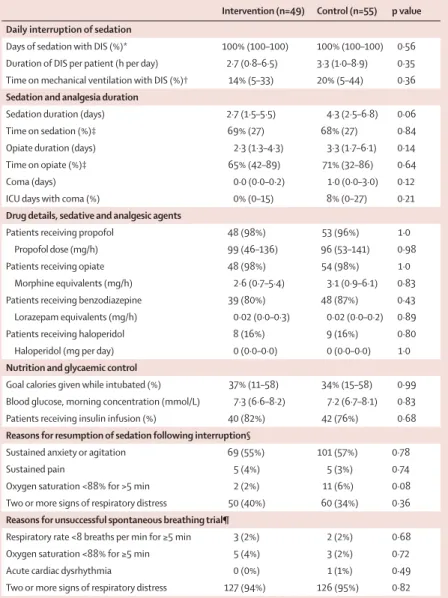
Intervention (n=49) Control (n=55) p value
Daily interruption of sedation
Days of sedation with DIS (%)* 100% (100–100) 100% (100–100) 0·56 Duration of DIS per patient (h per day) 2·7 (0·8–6·5) 3·3 (1·0–8·9) 0·35 Time on mechanical ventilation with DIS (%)† 14% (5–33) 20% (5–44) 0·36 Sedation and analgesia duration
Sedation duration (days) 2·7 (1·5–5·5) 4·3 (2·5–6·8) 0·06
Time on sedation (%)‡ 69% (27) 68% (27) 0·84
Opiate duration (days) 2·3 (1·3–4·3) 3·3 (1·7–6·1) 0·14
Time on opiate (%)‡ 65% (42–89) 71% (32–86) 0·64
Coma (days) 0·0 (0·0–0·2) 1·0 (0·0–3·0) 0·12
ICU days with coma (%) 0% (0–15) 8% (0–27) 0·21
Drug details, sedative and analgesic agents
Patients receiving propofol 48 (98%) 53 (96%) 1·0
Propofol dose (mg/h) 99 (46–136) 96 (53–141) 0·98
Patients receiving opiate 48 (98%) 54 (98%) 1·0
Morphine equivalents (mg/h) 2·6 (0·7–5·4) 3·1 (0·9–6·1) 0·83
Patients receiving benzodiazepine 39 (80%) 48 (87%) 0·43
Lorazepam equivalents (mg/h) 0·02 (0·0–0·3) 0·02 (0·0–0·2) 0·89
Patients receiving haloperidol 8 (16%) 9 (16%) 0·80
Haloperidol (mg per day) 0 (0·0–0·0) 0 (0·0–0·0) 1·0
Nutrition and glycaemic control
Goal calories given while intubated (%) 37% (11–58) 34% (15–58) 0·99 Blood glucose, morning concentration (mmol/L) 7·3 (6·6–8·2) 7·2 (6·7–8·1) 0·83
Patients receiving insulin infusion (%) 40 (82%) 42 (76%) 0·68
Reasons for resumption of sedation following interruption§
Sustained anxiety or agitation 69 (55%) 101 (57%) 0·78
Sustained pain 5 (4%) 5 (3%) 0·74
Oxygen saturation <88% for >5 min 2 (2%) 11 (6%) 0·08
Two or more signs of respiratory distress 50 (40%) 60 (34%) 0·36 Reasons for unsuccessful spontaneous breathing trial¶
Respiratory rate <8 breaths per min for ≥5 min 3 (2%) 2 (2%) 0·68
Oxygen saturation <88% for ≥5 min 5 (4%) 3 (2%) 0·72
Acute cardiac dysrhythmia 0 (0%) 1 (1%) 0·49
Two or more signs of respiratory distress 127 (94%) 126 (95%) 0·82
Data are median (IQR), mean (SD), or n (%). DIS=daily interruption of sedation. ICU=intensive care unit. *Eligible days began 36 h following start of mechanical ventilation. †Total duration of sedative and analgesic interruption (h) divided by duration of mechanical ventilation (h). ‡Proportion of hours undergoing continuous sedative/opiate infusion versus total duration of mechanical ventilation (h). §Resumption of sedation following interruption occurred 126 and 177 times in the intervention and control groups, respectively. Patients may have had more than one event. ¶Unsuccessful spontaneous breathing trials occurred 135 and 132 times in the intervention and control groups, respectively. Patients may have had more than one event.
Role of the funding source
There was no funding source for this study. The corre-sponding author had full access to all the data in the study and had fi nal responsibility for the decision to submit for publication.
Results
From June, 2005, to October, 2007, 1161 patients were screened, of whom 104 were enrolled and randomised. Figure 1 shows the trial profi le. Nine (18%) patients in the intervention group and 14 (25%) patients in the
control group died before hospital discharge. All 104 patients were included in the intention-to-treat population. Table 1 shows the baseline characteristics of the enrolled patients.
Of the 49 patients in the intervention group, 46 (94%) underwent physical and occupational therapy (three died before any intervention). For the intervention patients as a group, therapy occurred on 87% of days on study. There are three reasons why therapy did not occur all of the time: (1) the patient was unstable (defi ned by criteria listed in the Methods section); (2) the patient was unavailable for therapy (competing procedure or travel for intervention or test outside of the ICU); and (3) goals of care were changed to comfort measures only.
The median duration of physical and occupational therapy during mechanical ventilation diff ered between groups (intervention 0·32 h per day, IQR 0·17–0·48; control 0·0 h per day, 0·0–0·0; p<0·0001). Patients in the intervention group underwent therapy at a median of 1·5 days (1·0–2·1) after intubation whereas controls had therapy initiated at 7·4 days (6·0–10·9) after intubation (p<0·0001). However, time to therapy for patients in the control group was shorter than the median length of stay in the ICU (7·9 days, 6·1–12·9). The median duration of physical and occupational therapy during the time not receiving mechanical ventilation was similar between groups (intervention 0·21 h per day, 0·08–0·33; control 0·19 h per day, 0·0–0·38; p=0·70). Of 22 patients in the control group who were extubated and survived to hospital discharge but never returned to independent functional status, 21 (95%) underwent therapy.
Sedation and analgesia practice did not diff er between groups, including occurrence and duration of daily interruption of sedation and proportion of time on mechanical ventilation that was spent receiving sedative or opiate. However, total sedation duration was longer in controls than in patients in the intervention group, which refl ects the diff erence in duration of mechanical ventilation between the groups (table 2). Reasons and occurrence rates for resumption of sedation were similar for both groups.3 Both groups had very high spontaneous
breathing trial performance rates on days when this screen was passed (intervention 200 [96%] of 209); control 197 [98%] of 201). Reasons and occurrence rates for unsuccessful spontaneous breathing trials were also similar between groups.3 All 104 patients received enteral
nutrition only, and both groups were similar with regard to goal calories given while intubated, median morning glucose concentration, and proportion of patients receiving insulin (table 2).
Return to independent functional status at hospital discharge occurred in more patients in the intervention group than in the control group (29 [59%] patients vs
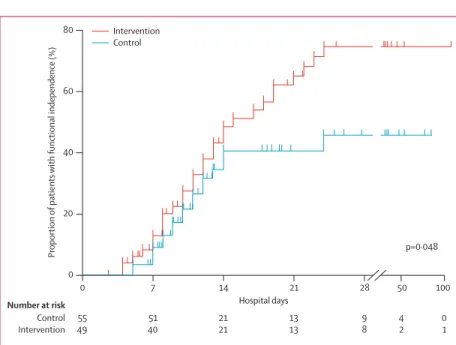
19 [35%] patients; p=0·02; odds ratio 2·7 [95% CI 1·2–6·1]; table 3). A log-rank (survival) analysis for return to independent functional status confi rmed this
Figure 2: Probability of return to independent functional status in intervention and control groups
80
60
40
20
0 0
Number at risk
Control Intervention
Hospital days
p=0·048
Proportion
of patients
with functional independence (%)
55 49
51 40
21 21
13 13
9 8
4 2
0 1
7 14 21 28 50 100
Intervention Control
Intervention (n=49)
Control (n=55)
p value
Return to independent functional status at hospital discharge
29 (59%) 19 (35%) 0·02
ICU delirium (days) 2·0 (0·0–6·0) 4·0 (2·0–7·0) 0·03
Time in ICU with delirium (%) 33% (0–58) 57% (33–69) 0·02
Hospital delirium (days) 2·0 (0·0–6·0) 4·0 (2·0–8·0) 0·02
Hospital days with delirium (%) 28% (26) 41% (27) 0·01
Barthel Index score at hospital discharge 75 (7·5–95) 55 (0–85) 0·05 ICU-acquired paresis at hospital discharge 15 (31%) 27 (49%) 0·09
Ventilator-free days* 23·5 (7·4–25·6) 21·1 (0·0–23·8) 0·05
Duration of mechanical ventilation (days) 3·4 (2·3–7·3) 6·1 (4·0–9·6) 0·02 Duration of mechanical ventilation, survivors (days) 3·7 (2·3–7·7) 5·6 (3·4–8·4) 0·19 Duration of mechanical ventilation, non-survivors (days) 2·5 (2·4–5·5) 9·5 (5·9–14·1) 0·04
Length of stay in ICU (days) 5·9 (4·5–13·2) 7·9 (6·1–12·9) 0·08
Length of stay in hospital (days) 13·5 (8·0–23·1) 12·9 (8·9–19·8) 0·93
Hospital mortality 9 (18%) 14 (25%) 0·53
Data are n (%), median (IQR), or mean (SD). ICU=intensive care unit. *Ventilator-free days from study day 1 to day 28. Barthel Index scale 0–100, APACHE II scale 0–71.
observation (fi gure 2), and showed that the eff ect of the intervention is delayed by approximately 2 weeks. Variables associated with achievement of functional independence by Coxproportional hazards analysis were age (hazard ratio [HR] 0·96, 95% CI 0·94–0·98; p=0·001), absence of sepsis (HR 2·26, 1·03–4·97; p=0·04] and the intervention (HR 1·84, 1·02–3·31; p=0·04). No association was detected with APACHE II score (HR 0·97, 0·92–1·02; p=0·22). There was no signifi cant interaction between study centre and treatment with regard to the primary endpoint (data not shown).
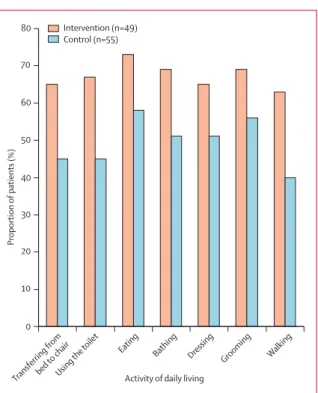
Patients in the intervention group had higher Barthel Index scores (table 3), a higher number of independent ADLs (table 4), and greater unassisted walking distance at hospital discharge than did controls (table 4). ICU-acquired paresis (MRC examination score <48) was noted at hospital discharge in 15 (31%) patients in the intervention group and in 27 (49%) controls (p=0·09). Figure 3 shows rates of independence with individual ADLs and walking. Median MRC examination score and hand-grip strength at hospital discharge did not diff er between groups (table 4). Patients in the intervention group were able to achieve several activity milestones during mechanical ventilation, such as sitting at the side of the bed (38 patients [78%]), standing (25 patients [51%]), marching in place (13 patients [27%]), transferring to a chair (21 patients [43%]), walking two steps or more (12 patients [24%]), and walking more than 30·5 m (three patients [6%]).
The subsequent locations of patients after hospital discharge are shown in table 5. The median duration of ICU-associated delirium was half as long in patients in the intervention group than in controls despite no diff erences in sedation (table 3). Additionally, patients in the intervention group spent a median of 2·4 more days alive and breathing without ventilatory support (ventilator-free days). Length of stay in the ICU and in hospital did not diff er between groups (table 3).
Serious adverse events were uncommon: one event in 498 physical and occupational therapy sessions (one desaturation less than 80%).12 There were no extubations,
falls, or systolic blood pressure changes less than 90 mm Hg or more than 200 mm Hg. Additionally, one radial arterial catheter was inadvertently removed in the intervention group. Discontinuation of therapy as a result of patient instability occurred in 19 (4%) of all sessions, most commonly for perceived patient-ventilator asynchrony.
Discussion
In this randomised controlled trial, daily interruption of sedation combined with physical and occupational therapy from the start of critical illness in patients on mechanical ventilation resulted in an improved return to (premorbid) independent functional status at hospital discharge compared with daily interruption of sedation and standard care. Additionally, patients in the
inter-vention group had a shorter duration of ICU-associated delirium by 2·0 days and spent 2·4 more days alive and breathing without assistance than did controls. Early physical and occupational therapy, combined with daily interruption of sedation, was safe and well tolerated. Thus, this trial shows that both functional and psychological outcomes of patients on mechanical ventilation can be improved by the implementation of physical and occupational therapy in the earliest phases of critical illness. However, in this study, these outcomes did not translate into any diff erence in length of stay in
Intervention (n=49) Control (n=55)
Activity of daily living 80
70
60
50
40
30
20
10
Proportion
of patients (%)
0
Transferring frombed to c hair
Using the toilet
Eating Bathing
Dressing Grooming Walking
Figure 3: Proportion of patients able to perform activities of daily living and to walk independently at hospital discharge
Intervention (n=49)
Control (n=55)
p value
Time from intubation to fi rst PT/OT session (days) 1·5 (1·0–2·1) 7·4 (6·0–10·9) <0·0001
Independent ADLs total at ICU discharge 3 (0–5) 0 (0–5) 0·15
Independent ADLs total at hospital discharge 6 (0–6) 4 (0–6) 0·06 MRC examination score at hospital discharge 52 (25–58) 48 (0–58) 0·38 Hand-grip strength at hospital discharge (kg-force) 39 (10–58) 35 (0–57) 0·67 Greatest walking distance at hospital discharge (m) 33·4 (0–91·4) 0 (0–30·4) 0·004 Time from intubation to milestones achieved (days)
Out of bed 1·7 (1·1–3·0) 6·6 (4·2–8·3) <0·0001
Standing 3·2 (1·5–5·6) 6·0 (4·5–8·9) <0·0001
Marching in place 3·3 (1·6–5·8) 6·2 (4·6–9·6) <0·0001
Transferring to a chair 3·1 (1·8–4·5 6·2 (4·5–8·4) <0·0001
Walking 3·8 (1·9–5·8) 7·3 (4·9–9·6) <0·0001
Data are median (IQR). ADLs=activities of daily living. ICU=intensive care unit. MRC=Medical Research Council. PT/OT=physical therapy and occupational therapy. MRC examination scale 0–60.
the ICU or in hospital between intervention and control groups.
As critical illness incidence and survival increase, issues surrounding ICU recovery will aff ect many patients. Investigations have highlighted the substantial morbidity and mortality and increased health-care needs associated with ICU-acquired weakness and neuro psychiatric illness in survivors of critical illness.4,32–34 Deep sedation and
immo bility might potentiate these com plications, espe-cially ICU-acquired weakness.35 DeJonghe and colleagues29
found that duration of mechanical ventila tion before awakening to establish the diagnosis of ICU-acquired paresis was a risk factor for the presence of the condition, independent of the duration of multiple organ failure. Repeated daily passive mobilisation pre vents muscle atrophy in mechanically ventilated patients receiving neuromuscular blocking agents.36 Finally, studies have
shown that keeping sedation to a minimum reduces the rate of ICU-related complications.37,38
The adverse eff ects of skeletal muscle immobility are well recognised; atrophic processes begin within 72 h and even healthy, well-nourished individuals can show loss in muscle mass and strength within 10 days of bed rest.39,40 Furthermore, the loss of independence
during acute hospital admission can be profound, even in the absence of critical illness.41,42 Accordingly,
mobilisation is prescribed to maximise return to independence and avoid complications of atelectasis, pressure wounds, indwelling catheters, and delirium.43,44
However, mech anical ventilation and sedation displace these therapies from routine practice in the earliest days of critical illness. In this study, we implemented daily interruption of sedation combined with mobilisation done within 48 h of the start of critical care; this method is distinct from previous studies of mobilisation. This study shows the safety of this early intervention and quantifi es clinical benefi t.
Delirium and neuromuscular function are un-doubtedly linked. Without intact cognition, physical activity is either self-limited or iatrogenically limited, cooperation with therapy is poor, and any immobilisation injury is likely to be exacerbated. Patients in post-acute care with persistent delirium have shown poor functional
recovery.45 In non-ICU inpatients, development of
delirium during hospital admission is associated with a raised subsequent risk of cognitive impairment or dementia. The relation between the duration of ICU-associated delirium and chronic or permanent cognitive impairment is complex; limited data suggest such an association.46 These functional and cognitive
impairments might provide the most likely reason for the excess longer-term mortality associated with delirium.7,47
Sedative-induced immobility is a preventable con-tributor to ICU-acquired weakness and functional impair-ment. However, other factors exist, including systemic infl ammation (particularly sepsis), age, drugs, and severity of illness. As shown in this study, sepsis and age were independently associated with functional depend-ence. Beyond simply reversing immobility, another factor might have contributed to the success of the inter-vention. Because there were substantial diff er ences between functional measurements despite no signifi cant diff erence in absolute MRC examination or hand-grip strength scores between groups, it is possible that patients had a learning eff ect. Indeed, learning to function independently despite weakness is a goal of physical and occupational therapy.
The nature of the intervention prevented any blinding from patient and health-care providers, and knowledge of group allocation and witnessed interventions risk bias of study results. To address this drawback, we randomly assigned patients to treatment groups and managed them with daily interruption of sedation, daily spon-taneous breathing trials, strict glycaemic control, and balanced nutritional intake between groups during the course of mechanical ventilation. Most importantly, serial assessments were done in a manner to maintain blinding of the assessor. However, decisions about sedation initiation or reinitiation, extubation, and ICU and hospital discharge were not controlled by protocol and might have been aff ected by knowledge of the inter-vention. However, we noted no diff erences between groups in indication for sedation reinitiation and spontaneous breathing trial failure or performance rates. Furthermore, the post-ICU hospital admission duration reported for both groups in this study accord with fi ndings from a cohort study of mobilisation.14
Rates and timing of physical and occupational therapy and nursing behaviours might have been additionally aff ected (in either direction) by other confounding factors. The data show that neither centre routinely performs physical and occupational therapy in patients who receive mechanical ventilation for less than 2 weeks without a developing neuromuscular disease. Although it is possible that other ICUs might practise more aggressive early physical or occupational therapy than our control group, we were able to fi nd little evidence of such practice in the published literature.48 Furthermore,
recent studies highlight the infrequency of physical
Intervention (n=49) Control (n=55)
Home* 21 (43%) 13 (24%)
Acute rehabilitation 13 (27%) 17 (31%)
Subacute rehabilitation 0 (0%) 6 (11%)
Long-term rehabilitation 5 (10%) 3 (5%)
Nursing home 1 (2%) 1 (2%)
Hospice 0 (0%) 1 (2%)
Death 9 (18%) 14 (25%)
*p=0·06 for comparison of home discharge to all other possible locations for the comparison of both groups.
therapy in the ICU.14,49 For example, in a standard care
group within a single-centre study directed at promoting the mobility of critically ill patients, only 47% of patients received physical therapy at any time during their hospital stay, and only 6% of patients received physical therapy at any time in the ICU.14 In our study, patients in
the control group for whom consultation of physical and occupational therapy would be typical (ie, extubated survivors unable to perform ADLs and unable to walk) received therapy 95% of the time. The median duration of therapy for patients not undergoing mechanical ventilation was similar between groups. These fi ndings, together with a median time to therapy earlier than ICU discharge, suggest that the treatment given to the control group was a fair representation of routine care, and identify the very early ICU therapy as the diff erence between groups. The work by our group and by others12–14
supports the feasibility and safety of early mobilisation in patients on mechanical ventilation in intensive care. Our study shows the benefi ts of this intervention on restoration of functional independence as well as delirium reduction. The trend towards better discharge rates to home (intervention 43% vs control 24%; p=0·06 for comparison of home discharge to all other possible locations for the comparison of both groups) is intriguing. We now need to determine whether early mobilisation in intensive care can enhance successful home discharge and reduce the burden of post-ICU rehabilitative care.
The results of this study cannot be assumed to be directly applicable to all patients on mechanical ventilation. This is a select population of patients—critically ill, yet indepen-dent in premorbid health. Trial enrolment rates refl ect the selective nature of these patients, yet their baseline functional independence was necessary to prove the prevention of functional loss. Physical and occupational therapy probably cannot result in a functional status after critical illness that surpasses baseline health. The relation of improved functional status at hospital discharge with long-term outcomes in this population is unclear. Studies in patients with chronic obstructive lung disease, patients with traumatic brain injury, and in elderly hospital inpatients suggest connections with improved morbidity, quality of life, and survival.41,50–53
Thus, a strategy for whole-body rehabilitation— accomplished by interruption of sedation, protocol-driven spontaneous breathing trials, and physical and occupa tional therapy—resulted in better outcomes compared with current standard approaches to sedation and activity during mechanical ventilation and its recovery. Patients assigned to intervention had shorter duration of delirium and left the hospital with better functional status. This study highlights the robust outcomes that can be achieved with the coordinated eff orts of multiple disciplines dedicated to the survival and mental and physical recovery of critically ill patients receiving mechanical ventilation.
Contributors
WDS, ASP, CN, JBH, and JPK participated in the conception of the trial. WDS, ASP, CN, AJP, CLE, LS, MM, MF, DD, JBH, and JPK participated in study design. WDS, MCP, ASP, CN, GAS, AB, KEM, and JPK recruited patients and collected data; AJP, CLE, LS, MM, MF, DD, and RB collected data alone. WDS, MCP, ASP, GAS, KEM, JBH, and JPK analysed the data. All authors participated in interpretation of the results. WDS drafted the manuscript, and all authors contributed to critical review and revision of the manuscript. All authors have seen and approved the fi nal version of the manuscript.
Confl icts of interest
We declare that we have no confl icts of interest.
Acknowledgments
We thank the ICU staff at the University of Chicago Medical Center and the University of Iowa Hospital for their invaluable participation in this study.
References
1 Kress JP, Pohlman AS, O’Connor MF, Hall JB. Daily interruption of
sedative infusions in critically ill patients undergoing mechanical ventilation. N Engl J Med 2000; 342: 1471–77.
2 Acute Respiratory Distress Syndrome Network. Ventilation with
lower tidal volumes as compared with traditional tidal volumes for acute lung injury and the acute respiratory distress syndrome.
N Engl J Med 2000; 342: 1301–08.
3 Girard TD, Kress JP, Fuchs BD, et al. Effi cacy and safety of a paired sedation and ventilator weaning protocol for mechanically ventilated patients in intensive care (Awakening and Breathing Controlled trial): a randomised controlled trial. Lancet 2008; 371: 126–34.
4 Herridge MS, Cheung AM, Tansey CM, et al. One-year outcomes in
survivors of the acute respiratory distress syndrome. N Engl J Med
2003; 348: 683–93.
5 De Jonghe B, Lacherade JC, Durand MC, Sharshar T. Critical illness neuromuscular syndromes. Crit Care Clin 2007; 23: 55–69. 6 Schweickert WD, Hall J. ICU-acquired weakness. Chest 2007;
131: 1541–49.
7 Ely EW, Shintani A, Truman B, et al. Delirium as a predictor of mortality in mechanically ventilated patients in the intensive care unit. JAMA 2004; 291: 1753–62.
8 Ely EW, Gautam S, Margolin R, et al. The impact of delirium in the intensive care unit on hospital length of stay. Intensive Care Med
2001; 27: 1892–900.
9 Kress JP, O’Connor MF, Pohlman AS, et al. Sedation of critically ill patients during mechanical ventilation. A comparison of propofol and midazolam. Am J Respir Crit Care Med 1996;
153: 1012–18.
10 Weinert CR, Calvin AD. Epidemiology of sedation and sedation adequacy for mechanically ventilated patients in a medical and surgical intensive care unit. Crit Care Med 2007; 35: 393–401. 11 Schweickert WD, Kress JP. Strategies to optimize analgesia and
sedation. Crit Care 2008; 12 (suppl 3): S6.
12 Bailey P, Thomsen GE, Spuhler VJ, et al. Early activity is feasible and safe in respiratory failure patients. Crit Care Med 2007; 35: 139–45. 13 Thomsen GE, Snow GL, Rodriguez L, Hopkins RO. Patients with
respiratory failure increase ambulation after transfer to an intensive care unit where early activity is a priority. Crit Care Med 2008;
36: 1119–24.
14 Morris PE, Goad A, Thompson C, et al. Early intensive care unit mobility therapy in the treatment of acute respiratory failure.
Crit Care Med 2008; 36: 2238–43.
15 Pun BT, Ely EW. The importance of diagnosing and managing ICU delirium. Chest 2007; 132: 624–36.
16 Riker RR, Shehabi Y, Bokesch PM, et al. Dexmedetomidine vs
midazolam for sedation of critically ill patients: a randomized trial.
JAMA 2009; 301: 489–99.
17 Mahoney FI, Barthel DW. Functional evaluation: the Barthel Index.
Md State Med J 1965; 14: 61–65.
18 Collin C, Wade DT, Davies S, Horne V. The Barthel ADL Index: a reliability study. Int Disabil Stud 1988; 10: 61–63.
20 Ely EW, Truman B, Shintani A, et al. Monitoring sedation status over time in ICU patients: reliability and validity of the Richmond Agitation-Sedation Scale (RASS). JAMA 2003; 289: 2983–91. 21 Ely EW, Inouye SK, Bernard GR, et al. Delirium in mechanically
ventilated patients: validity and reliability of the confusion
assessment method for the intensive care unit (CAM-ICU). JAMA
2001; 286: 2703–10.
22 Ely EW, Margolin R, Francis J, et al. Evaluation of delirium in critically ill patients: validation of the Confusion Assessment Method for the Intensive Care Unit (CAM-ICU). Crit Care Med
2001; 29: 1370–79.
23 van den Berghe G, Wouters P, Weekers F, et al. Intensive insulin therapy in the critically ill patients. N Engl J Med 2001; 345: 1359–67. 24 Katz S, Ford AB, Moskowitz RW, Jackson BA, Jaff e MW. Studies of illness in the aged. The index of ADL: a standardized measure of biological and psychosocial function. JAMA 1963; 185: 914–19. 25 Katz S, Akpom CA. 12. Index of ADL. Med Care 1976; 14: 116–18. 26 Ip SP, Leung YF, Ip CY, Mak WP. Outcomes of critically ill elderly
patients: is high-dependency care for geriatric patients worthwhile?
Crit Care Med 1999; 27: 2351–57.
27 Bigatello LM, Stelfox HT, Berra L, Schmidt U, Gettings EM. Outcome of patients undergoing prolonged mechanical ventilation after critical illness. Crit Care Med 2007; 35: 2491–97.
28 Keith RA, Granger CV, Hamilton BB, Sherwin FS. The functional independence measure: a new tool for rehabilitation.
Adv Clin Rehabil 1987; 1: 6–18.
29 De Jonghe B, Sharshar T, Lefaucheur JP, et al. Paresis acquired in the intensive care unit: a prospective multicenter study. JAMA 2002;
288: 2859–67.
30 Kleyweg RP, van der Meche FG, Meulstee J. Treatment of Guillain-Barre syndrome with high-dose gammaglobulin. Neurology 1988;
38: 1639–41.
31 Kleyweg RP, van der Meche FG, Schmitz PI. Interobserver agreement in the assessment of muscle strength and functional abilities in Guillain-Barre syndrome. Muscle Nerve 1991;
14: 1103–09.
32 Cheung AM, Tansey CM, Tomlinson G, et al. Two-year outcomes, health care use, and costs of survivors of acute respiratory distress syndrome. Am J Respir Crit Care Med 2006; 174: 538–44. 33 Angus DC, Musthafa AA, Clermont G, et al. Quality-adjusted
survival in the fi rst year after the acute respiratory distress syndrome. Am J Respir Crit Care Med 2001; 163: 1389–94. 34 Ali NA, O’Brien JM, Hoff mann SP, et al. Acquired weakness,
handgrip strength, and mortality in critically ill patients.
Am J Respir Crit Care Med 2008; 178: 261–68.
35 De Jonghe B, Sharshar T, Hopkinson N, Outin H. Paresis following mechanical ventilation. Curr Opin Crit Care 2004;
10: 47–52.
36 Griffi ths RD, Palmer TE, Helliwell T, MacLennan P, MacMillan RR. Eff ect of passive stretching on the wasting of muscle in the critically ill. Nutrition 1995; 11: 428–32.
37 De Jonghe B, Bastuji-Garin S, Fangio P, et al. Sedation algorithm in critically ill patients without acute brain injury. Crit Care Med 2005;
33: 120–27.
38 Schweickert WD, Gehlbach BK, Pohlman AS, Hall JB, Kress JP. Daily interruption of sedative infusions and complications of critical illness in mechanically ventilated patients. Crit Care Med 2004;
32: 1272–76.
39 Kortebein P, Ferrando A, Lombeida J, Wolfe R, Evans WJ. Eff ect of 10 days of bed rest on skeletal muscle in healthy older adults. JAMA
2007; 297: 1772–74.
40 Tesch PA, von Walden F, Gustafsson T, Linnehan RM, Trappe TA. Skeletal muscle proteolysis in response to short-term unloading in humans. J Appl Physiol 2008; 105: 902–06.
41 Sager MA, Franke T, Inouye SK, et al. Functional outcomes of acute medical illness and hospitalization in older persons.
Arch Intern Med 1996; 156: 645–52.
42 Covinsky KE, Palmer RM, Fortinsky RH, et al. Loss of
independence in activities of daily living in older adults hospitalized with medical illnesses: increased vulnerability with age.
J Am Geriatr Soc 2003; 51: 451–58.
43 Mudge AM, Giebel AJ, Cutler AJ. Exercising body and mind: an integrated approach to functional independence in hospitalized older people. J Am Geriatr Soc 2008; 56: 630–35.
44 Inouye SK, Bogardus ST, Charpentier PA, et al. A multicomponent intervention to prevent delirium in hospitalized older patients.
N Engl J Med 1999; 340: 669–76.
45 Marcantonio ER, Simon SE, Bergmann MA, Jones RN, Murphy KM, Morris JN. Delirium symptoms in post-acute care: prevalent, persistent, and associated with poor functional recovery.
J Am Geriatr Soc 2003; 51: 4–9.
46 Jackson JC, Hart RP, Gordon SM, et al. Six-month
neuropsychological outcome of medical intensive care unit patients.
Crit Care Med 2003; 31: 1226–34.
47 Lin SM, Liu CY, Wang CH, et al. The impact of delirium on the survival of mechanically ventilated patients. Crit Care Med 2004;
32: 2254–59.
48 Hodgin KE, Nordon-Craft A, McFann KK, Mealer ML, Moss M. Physical therapy utilization in intensive care units: results from a national survey. Crit Care Med 2009; 37: 561–66.
49 Needham DM, Wang W, Desai SV, et al. Intensive care unit exposures for long-term outcomes research: development and description of exposures for 150 patients with acute lung injury.
J Crit Care 2007; 22: 275–84.
50 Yohannes AM, Baldwin RC, Connolly MJ. Predictors of 1-year mortality in patients discharged from hospital following acute exacerbation of chronic obstructive pulmonary disease. Age Ageing
2005; 34: 491–96.
51 Walter LC, Brand RJ, Counsell SR, et al. Development and validation of a prognostic index for 1-year mortality in older adults after hospitalization. JAMA 2001; 285: 2987–94.
52 Poon WS, Zhu XL, Ng SC, Wong GK. Predicting one year clinical outcome in traumatic brain injury (TBI) at the beginning of rehabilitation. Acta Neurochir Suppl 2005; 93: 207–08.