Study
―
Determinants of Corporate Risk using Option-Adjusted
Spreads: The case of Portugal
‖
Student: Paulo José Martins Jorge da Silva, L38420
Supervision: Raquel Gaspar, PhD
ABSTRACT
This study analyses the determinants of corporate bond spreads in Portugal. Using an Option-Adjusted Spread (OAS) approach we overcome the difficulties of comparing bonds with different cash-flow characteristics. OAS considers credit risk and contingent cash-flow risks, which allows the determination of a contingent premium analysis based on the bond’s characteristics. Our findings suggest that corporate bond risk spreads are determined by firm specific factors, bond characteristics, sovereign risk, macroeconomic conditions and external variables. We also find evidence of high dependency of the banking industry implicit funding costs on the sovereign risk proxy variable and the ratio of Public Debt to GDP.
KEYWORDS
Option-adjusted spreads, corporate bond risk, sovereign risk, Portugal
RESUMO
Este estudo analisa os determinantes dos spreads de taxas de juro das obrigações de empresas no mercado obrigacionista português. A utilização da abordagem Option-Adjusted Spread
ultrapassa as dificuldades na definição das emissões de dívida pública de referência para o cálculo dos spreads de taxa de juro e permite a comparação de obrigações com diferentes características. Os resultados do estudo sugerem que os indicadores das empresas que reflectem a gestão realizada, as características das obrigações, o risco soberano, as condições macroeconómicas do país e os efeitos externos, concorrem para a determinação dos níveis dos prémios de risco requeridos pelos investidores em obrigações de empresas. Os resultados obtidos apontam, também, para uma elevada dependência dos custos de financiamento do sector bancário local relativamente ao risco soberano e ao nível de endividamento público na economia.
Palavras-chave
AKNOWLEDGEMENT
I especially want to thank my supervisor, Prof. Raquel Gaspar, for providing guidance and support, and also for permanent encouragement to complete this study.
I would like to thank my colleagues, Marta Piedade, Patrícia Silva, and João Soares for all their support and friendship during classes and team work assignments.
Table of Contents
1. INTRODUCTION ... 5
2. LITERATURE REVIEW ... 7
3. OPTION-ADJUSTED SPREADS ... 10
4. RESEARCH FRAMEWORK AND RESULTS ... 13
4.1. DATA DESCRIPTION ... 13
4.2. REGRESSION ANALYSIS ... 22
4.2.1. POOLED REGRESSION MODEL –TESTS AND RESULTS ... 23
4.2.2. LONGITUDINAL ANALYSIS –TESTS AND RESULTS ... 33
4.3. COMPARING WITH THE LITERATURE ... 36
5. CONCLUSIONS ... 37
REFERENCES ... 38
Tables and Figures
Table 1. Description of variables ... 14
Table 2. Descriptive Statistics ... 15
Table 3. Explanatory Variables and Expected Signs on the Coefficients of the Regression ... 16
Table 4. Determinants of Portuguese Corporate OAS ... 24
Table 5. Determinants of Portuguese Corporate OAS – Excluding the Recreational Sector ... 26
Table 6. Determinants of Portuguese Corporate OAS – Summary Information per Sector ... 27
Table 7. Determinants of Portuguese Corporate OAS – Banking Sector ... 28
Table 8. Determinants of Portuguese Corporate OAS – Residual Statistics ... 29
Table 9. Determinants of Portuguese Corporate OAS - Multivariate Linear Regression – Using Zscores -Collinearity Diagnostics ... 31
Table 10. Determinants of Portuguese Corporate OAS - Multivariate Linear Regression – Using Zscores - Collinearity Statistics ... 32
Table 11. Determinants of Portuguese Corporate OAS - Multivariate Linear Regression – Using Factor Components Scores ... 32
Table 12. Determinants of Portuguese Corporate OAS - Longitudinal Analysis -Multivariate Linear Regression – Fixed Effects ... 34
Table 13. Determinants of Portuguese Corporate OAS - Longitudinal Analysis -Multivariate Linear Regression – Fixed Effects and AR(1) ... 35
Table 14. Correlation Matrix of explanatory variables - Longitudinal Analysis -Multivariate Linear Regression – Fixed Effects and AR(1) ... 36
Table A.1. Description of Excluded Independent Variables ... 40
Table A.2. Correlation Matrix of Explanatory Variables -Pearson ... 41
Table A.3. Correlation Matrix of Explanatory Variables - Spearman ... 42
Table A.4. Bond Issues Included in the sample – ISINs and Sector. ... 43
Figure 1 – Volatility of Stocks ... 18
Figure 2 – Bond characteristics – Time to Maturity ... 19
Figure 3 – Sovereign Risk Proxy Indicator ... 21
Figure 4 – Portuguese Macroeconomic Indicators ... 21
Figure 5 – Volatility Index VSTOXX 12M ... 22
Figure 6 – Histogram of OAS Regression Standardized Residual ... 29
Figure 7 – OAS Regression Standardized Residual – Cumulative Probability ... 30
Figure 8 – Scatter Plot OAS Regression Standardized Residual and Predicted Value ... 30
Figure A. 1– Scatter Plot OAS and Independent Variables – StataIC ... 45
Figure A. 2 - -OAS Time Series per Sector - Charts ... 46
Figure A. 3 – OAS Time Series - All Sectors ... 47
Figure A. 4 – Firm-Specific Variables - Building Materials & Fixtures (1 company) ... 48
Figure A. 5 – Firm-Specific Variables - Transportation Services (1 company) ... 48
Figure A. 6 – Firm-Specific Variables - Recreational Services (2 companies)... 49
Figure A. 7 – Firm-Specific Variables - Telecommunications (1 company) ... 49
Figure A. 8 – Firm-Specific Variables - Conventional Electricity (2 companies) ... 50
1. INTRODUCTION
In this study we analyse the determinants of corporate bonds spreads in the Portuguese bond market. Although we are aware of the low liquidity of this market, and the importance of the banking sector on Portuguese corporate funding arrangements, there are still a relevant number of firms using the debt market as a main source of capital for financing their activities. We are particularly interested on assessing the importance of firm-specific variables, bond characteristics, sovereign risk, macroeconomic conditions and external factors as well as industry effects on yield spreads demanded by bond investors.
Since the 2007 debt crisis, the market confidence, related to countries and corporate capacity to fulfill their debt obligations, suffered enormous pressure, and resulted in extreme situations, on state aid to corporations and banks, and also on country bailouts. The most recent country bailout was performed by Portugal that agreed, on April 2011, with the International Monetary Fund, European Commission, and European Central Bank, a financial assistance package to avoid bankruptcy of the public administration and mitigate systemic risks on the private sector. We have witnessed a major escalade on yield spreads of government and corporate bonds in European peripheral countries due to capital scarcity and increase on risk awareness.
As a consequence of the downgrade of credit rates of the Portuguese Republic by major rating companies, the Portuguese financial institutions, and large Portuguese corporations’ ratings were downgraded. This indirect effect, called the ―sovereign ceiling‖1, was of particular importance to domestic corporations, unlike Portuguese branches of multinational companies. Our goal in this study is to investigate the determinants of the credit spreads of Portuguese corporate bonds.
Although spill-over effects on Portuguese government debt are being extensively studied, we decided to focus on the Portuguese private firms that finance their activities on corporate bond market, and test some of the more widely used variables to explain yield spreads.
The sovereign risk is also included in our study, because the Portuguese Government faced an increasing public debt in the last decade, thus violating the Stability and Growth Pact of the European and Monetary Union. As referred by Gerlach, Schulz and Wolff (2011), sovereign risk has become increasingly interconnected with banking risk, due to the possibility of financial sector rescue package. This can ultimately result in relevant fiscal burdens which increase the risk of sovereign default.
1
We follow closely the work by Cavallo and Valenzuela (2010), and Peter and Grandes (2005). Our Option-Adjusted Spread approach is based on the paper by first authors, with some adaptations to study a country case - Portugal. From Peter and Grandes (2005), we adapted their empirical procedures to study a country case with the data available from the corporate OAS analysis by Bloomberg. We use an unbalanced panel dataset2 of Portuguese corporate bond OAS, thus avoiding the pairing of corporate bond issues and government bonds with the same characteristics.
The sample of the Portuguese corporate bond market used in this study suffers from: (i) low trading, resulting in absence of quotations/prices for some dates; (ii) the small number of bond issuers as a result of a corporate preference by banking loan arrangements and short term debt instruments.
We focus on the determinants of the corporate yield spreads for 97 bonds issued by 11 corporations in 6 industry sectors, for a time period of 26 consecutive quarters from 31st December 2004 until 31st March 2011, with available data in Bloomberg.
Our main results confirm that firm-specific variables, bond characteristics, macroeconomic conditions, sovereign risk, and global factors are all determinants of credit risk in Portuguese corporate bonds. We also found evidence of high dependency of the banking industry funding costs on sovereign risks variables, and indicator Public Debt to GDP macroeconomic ratio. There were some findings related to bond characteristics and firm-specific variables that presented unexpected results which may be a consequence of shorter durations of bond issues and some bias on our data sample that is dominated by local companies with non-tradable goods and services.
We contribute to the existing literature in at least one front: we are, to the best of our knowledge, among the first to employ OAS to explore the determinants of corporate bond spreads in the Portuguese bond market.
The structure of the document is as follows. In section 2 there is a literature review and Section 3 sets out the Option-Adjusted Spreads framework. In Section 4 the empirical strategy, the choice of variables and the regression results are presented. In Section 5 we present our major conclusions, and discuss areas of improvement, and adjustments for future work.
2
2. LITERATURE REVIEW
There is an extensive work on the determinants of corporate bond spreads, and on the factors affecting the risk premium required by corporate bondholders. There are some misleading concepts regarding credit risk, default risk, liquidity risk and risk premium, depending on the perspectives developed by different authors or the synonyms that are used on several papers. However, in this study we will consider the corporate yield spread as a proxy for a aggregate risk premium over risk free interest rate.
Our study is related to the literature on the determinants of corporate risk and follows closely the work of Cavallo and Valenzuela (2010), who developed the empirical tests of credit risk using as a proxy the option-adjusted spread (OAS). The major difference is that they performed a cross-country analysis for emerging countries, while we centre our analysis on a single country – Portugal. Furthermore, we also investigate the effects from industry-specific factors.
The work of Peter and Grandes (2005), is also a main reference for this study for using single country data set similar to ours. The paper focuses on the impact of sovereign risk and company-specific factors on corporate default premium (measured by the corporate yield spread). They worked with bonds of publicly traded firms in South Africa issued in local currency, but they did not use OAS.
The use of OAS is an incumbent approach on literature related with the analysis of the
determinants of corporate bond spreads which was developed in the late 1960’s and mid
1970’s.
There was a seminal paper related with the OAS approach by Huang and Kong (2003) where they used both weekly and monthly OAS from bond indices to examine the determinants of corporate bond credit risk in the United States. They found that credit spread changes for high-yield bonds are more closely related to equity market factors, and they also provide evidence in favour of considering macroeconomic factors into credit risk models.
Cavallo and Valenzuela (2010) used OAS analysis and found that firm-specific variables (profitability, capitalization, leverage and size), country and industry fixed effects, sovereign risk, bond characteristics and global factors, all account to explain the corporate bonds spreads in emerging market economies.
Merton (1974) was amongst the first to study the pricing of corporate debt as a yield spread
(1973) theory of options pricing. In fact, the basic equation for the pricing of financial instruments is used to find a theoretical price for the corporate debt. The intrinsic firm value is included in the analysis as Merton proves the Modigliani-Miller theorem3 (in the presence of corporate bankruptcy), and deduces the required return on corporate debt as a function of the debt-to-equity ratio. According to Merton, the corporate default spread is an increasing function of firm-value volatility and leverage, which can be an increasing or decreasing function of remaining time to maturity, depending on the level of leverage. The results by the Merton model, as referred by Peter and Grandes (2005), produces a flexible shaped term structure of credit spreads. This term structure of credit risk spread is a downward slope for high-leveraged firms, hump-shaped for medium-leveraged firms, and an upward slope for low-leveraged firms. The impact of these variables on the yield spread is dynamic, depending on the debt-to-equity ratio.
Altman et al. (1968, 1989, 1997) analyse default risk based on credit ratings. They investigated the marginal migration rates, and found that impacts on asset price changes are a function of credit quality changes. These results lead to subsequent work on the adequate management of credit risk using credit-risk-derivatives. They defined a 7-variable model (the popular Zeta model4) as the most reliable in various validation procedures regarding the prediction of corporate default risk: return on assets, stability of earnings, debt service, cumulative profitability, liquidity, capitalization, and size. They also found that these variables were highly correlated with corporate bond ratings.
Collin-Dufresne et al. (2001) found that the dominant changes on corporate bond market spreads are driven by a systematic factor, related to local supply/demand shocks that are independent from liquidity measures and credit-risk changes. These results had already been tested by Boudoukh et al. (1997), as well as Duffie and Singleton (1999). These conclusions questioned the theoretical models of default risk that were being used. Although the structural models of default pointed to firm-specific factors as the driver of credit spreads, there is evidence that the credit spread of individual bonds is explained by an aggregate factor common to all corporate bonds. Elton et al. (2001) also present an explanation for the yield spread on corporate bonds, based on a risk premium to compensate investor for systematic risk, closely related to the factors that affect risk premiums for stocks. They show that the yield spread required by corporate bond investors is larger due to the fact that the corporate bond risk is systematic and not diversifiable. Huang and Huang (2002) have also shown that
3
The Modigliani-Miller theorem states that the value of the firm is invariant to its capital structure obtains, which means that the value of the firm can be treated as exogenous to the analysis.
4
only a small fraction of the corporate-treasury yield spread is explained by credit risk. The robustness of this finding is tested in different models.
On another front, the work of Campbell and Taksler (2003), based on Merton (1974), develops the following idea:
―When volatility increases, the value of the put options increases, benefiting equity
holders at the expense of bondholders. The volatility that is relevant for option value, and thus for corporate debt, is total firm volatility, including both
idiosyncratic volatility and systematic or market-wide volatility.‖
This rational is the basis for the paper where they measure the causes of variation in corporate bond yield spreads relative to Treasury bonds. In fact, they show that even in the presence of credit rating, the equity volatility is as explanatory as credit rating.
Longstaff et al. (2005) used information from credit derivatives – credit default swaps - as a way to measure the size of the default and non-default component in corporate yield spreads. They found that the majority of corporate spreads is represented by the default component, and thus suggest that the market price of credit risk may be larger than the amount implied by some structural estimates. Additionally, they also found that changes in the non-default component are related to measures of Treasury richness – such as the on-the-run/off the-run spread5– as well as to measures of the overall liquidity of fixed income markets, such as the flows into money market mutual funds. This enhanced an area of research related to the effects of liquidity on security prices. One example of this was given by Chen et al. (2007), who found that liquidity is priced on corporate yield spreads, strengthening the idea that neither the level, nor the dynamics of yield spreads are fully explained by default risk determinants. Their results mean that liquidity is a key determinant in yield spreads, and explains as much as half of the cross-sectional variation in yield spread levels, and as much as twice the cross-sectional variation in yield spread changes that is explained by credit rating. The different approaches from the literature suggest some lack of consensus regarding the magnitude of the major determinants of corporate-treasury yield spreads. The reasons appear to be related with the specific models developed to estimate credit default risk, as well as with the different sources of data regarding the market price of risks.
5
The ―off-the-run treasuries‖ are all Treasury bonds and notes issued before the most recently issued bond or
note of a particular maturity. These are the opposite of "on-the-run treasuries". As ―off-the-run securities‖ are
3. OPTION-ADJUSTED SPREADS
The most popular measure of yield in the bond market is the yield to maturity6 (YTM) (Fabozzi, 2007). The computation of the YTM is done by a numerically trial and error process where a yield rate is set in order to equalize the present value of expected cash to the dirty price of the bond. The YTM is a special case of an internal rate of return calculation where the cash-flows are certain if the security is held to the maturity date.
The investment in fixed income securities is exposed to different types of risk: interest rate risk, call and prepayment risk, yield curve risk, reinvestment risk, credit risk, liquidity risk, exchange-rate risk, volatility risk, inflation risk, event risk, and sovereign risk. The structure of a bond – coupon rate, time to maturity, embedded options, and currency – changes some of these risks.
The traditional evaluation analysis of fixed income securities is based on YTM comparisons for bonds with similar characteristics (Miller, 2007). The assumptions on which these comparisons are made are relatively reliable for bullet bonds7. However the use of this method to compare bonds with embedded options raises a fatal flaw in the conclusions. The uncertainty of the cash-flows is not taken into account on valuing the bond, and thus, the incremental risk is not accurate. Even if the benchmark for the bond issue presents the same characteristics (including same features on options), that does not guarantee an effective analysis, unless options are exercised at the same time.
To overcome these difficulties, some analyses compare bonds with the yield to call/put or yield to worst. This method lacks accuracy when dealing with yield spread analysis (or credit spreads) because a relevant bulk of the potential cash-flows can be eliminated. When a yield spread refers to a bond that has an option, a component of the spread accounts for the risk associated with the embedded option8. The yield spreads are referred to as nominal spreads — in the sense that the value of embedded options has not been removed in computing an adjusted yield spread. The yield spread that adjusts for the embedded option is referred to as the option-adjusted spread (OAS). As in Fabozzi et al. (2005):
―The OAS for a security is the fixed spread (usually measured in basis points) over
the benchmark rates that equate the output from the valuation process with the actual market price of the security. For an optionless security, the calculation of OAS is a relatively simple, iterative process. The process is much more analytically challenging with the added complexity of optionality. And just as the value of the
6
The yield to maturity (YTM) is the interest rate that equals the present value of a bond’s cash-flows to its market price plus the accrued interest.
7
A bullet bond is a bond that is not possible to be redeemed prior to maturity and pays the entire principal at maturity. It is also known as vanilla bond, straight or fixed bond because it has no special features.
8
option is volatility-dependent, the OAS for a fixed income security with embedded
options or an option-like interest rate product is volatility dependent.‖
The bond market participants developed the habit of valuing the securities using yield spreads, rather than price spreads (Martellini et al., 2003). That is the reason why comparison of theoretical price of different bonds, with embedded options, with the market price is based on a yield spread. The value of this yield spread, added to all spot interest rates derived from valuation models (default-free term structure of interest rates), equalizes de theoretical price of the bond with its available market price. This OAS is, thus, a relative measure that deals with the pricing of the contingent cash-flows that are dependent on the embedded price options of the bond. Therefore the OAS depends on the volatility parameter defined in the valuation model of the bonds: the higher the volatility of the short-term interest rate, the lower the theoretical price of a callable bond, and, hence, the lower the OAS of the callable bond (and inversely for a putable bond).
Because the bond valuation models are calibrated to the term structure of government interest rates, the OAS of a bond with, or without, an embedded option can be interpreted as a credit premium on the bond over a ―risk free‖ interest rate.
The OAS analysis benchmarks the bond’s expected cash-flows against reference rates in the market, and values the embedded options against market volatility; thus enhancing a consistent assessment of the risk premium demanded by investors, and a meaningfull comparison between bonds. As a result, this approach overcomes the major flaws in traditional yield spread.
The Bloomberg Professional Analysis, available to Bloomberg users9, develops the OAS analysis based on calculation engines for the early redemption features of the selected security, so it is possible to make relative value judgments based purely on credit risk. It is also possible to compare bonds with different redemption features on a similar basis, and identify expensive/cheap securities.
The OAS is computed by Bloomberg for most of the bonds in the market (that have prices/quotations). The OAS Bloomberg valuation model is based on a benchmark spot curve derived from the well-known bootstrapping method (using the conventional normal model for the term structure of interest rates, also referred to as the Hull-White/Jamshidian, Extended Vasicek, or Gaussian model).
For conventional bonds the OAS function utilizes the ―benchmark spot curve‖ to value a bond using the appropriate discount factor for each cash-flow. Therefore, instead of using a yield to
9
maturity comparison with a benchmark issue, the OAS is a constant spread that adds to the benchmark spot interest rate in order to equalize the market price of the risk-free bond – calculated by the pricing model – to the observed market price of the corporate bond.
The OAS spread for bonds with embedded options is calculated based on a one-factor, arbitrage-free binomial tree of normally distributed short-rates10, in order to establish a distribution of different interest rate scenarios, which are driven by the volatility input for the interest rate. The exercise events are introduced according to options features, and interest rates are calculated over the time horizon until maturity. The modelled cash-flows are valued using the discount rates found in the tree, and the OAS is then calculated in order to equalize the theoretical price plus the spread to the current market price of the bond. The OAS is therefore a spread adjusted by the option premium embedded in the bond.
The computation process of OAS allows a pooling comparison of bonds (with or without options). However, this is only possible if the spreads are derived using the same interest rate modelling process and taking into account the same volatility or the same term structure for the volatility.
10
4. RESEARCH FRAMEWORK AND RESULTS
The issue we want to address in this study is the assessment of the determinants of corporate risk using OAS for Portuguese corporate bonds issued in Euro.
Our study follows a model approach based on Cavallo and Valenzuela (2010). We test the several determinants grouped into six sets: 1) firm-specific variables related with corporate risk; 2) firm market value risk defined by the equity volatility; 3) bond characteristics; 4) sovereign risk using proxy indicators; 5) macroeconomic conditions at country level affecting the risk of all firms; and 6) external factor reflecting global factors. The results point to a set of independent variables that explains over 80% the spreads.
As referred by Martellini, Priaulet and Priaulet (2003) and Huang and Kong (2003), the OAS is a spread in relation to a term structure of default-free interest rates that remunerates investors for a portfolio of risks: the expected default loss, the contingency of future cash-flows, liquidity and also tax charges. The OAS for liquid bonds is available daily, but we defined quarterly average OAS per bond, as the majority of corporate financial information and macroeconomic indicators are available only on a quarterly basis. As in Cavallo and Valenzuela (2010), we applied the natural logarithm to the OAS, and that is the dependent variable on our regression11. In the regression analysis we included industry-dummies to analyse industry effect, and assess the heterogeneity of the industry risks on Portuguese corporate bond market.
During the preliminary specification process of the multivariate linear regression we abandoned several independent variables, due to high level of correlation, or because they were not statistically significant (see excluded variables on Table A.1 in the appendix).
4.1.DATA DESCRIPTION
To build the database we used information from 97 bonds, available at Bloomberg, issued by 11 listed Portuguese corporations, over 6 sectors between 31st December 2004 and 31st March 2011. The companies are in the following sectors: Building Materials & Fixtures (1 company), Transportation Services (1 company), Recreational Services (2 companies), Telecommunications (1 company), Conventional Electricity (2 companies) and Banking (4 local banks).
11
The sample selection was based upon data availability. The country and firm-specific variables are typically reported on a quarterly basis, while bond spreads and indices are reported daily. To avoid time noise effects, we transformed the daily data into quarterly frequency by computing the corresponding period average.
Our sources of information were: 1 - Bloomberg database on publicly traded firms; 2 - Financial statements and announcements from company sites and the Portuguese securities supervisory authority (CMVM); 3 - Bank of Portugal and National Statistics Institute (INE) for macroeconomic variables; 4 European Central Bank for government bond yields, and 5 -STOXX for external factors.
The type of data and availability lead to an unbalanced panel data of 97 euro denominated corporate bonds, from 11 firms over a time frame of 26 consecutive quarters.
The historical data of the dependent variable – OAS of Portuguese corporate bonds issued in euro – was limited due to the fact that the less liquid bond issues have infrequent quotes. This is the result of a limited interest of market investors, and consequently historical OAS was not available for illiquid bonds.
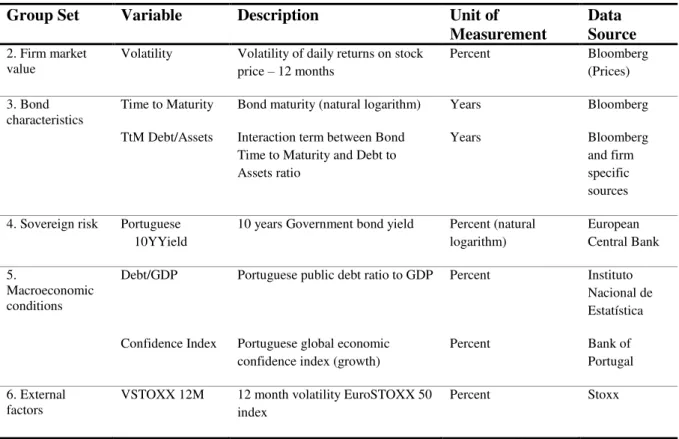
The independent variables are grouped into six sets. We also include industry-dummies to analyse industry effects. Table 1 provides a list of the variables, definitions and sources.
Table 1. Description of Variables
Group Set Variable Description Unit of
Measurement
Data Source
Dependent variable
Corporate OAS OAS Option Adjusted Spread for corporate bond issues
Percent (natural logarithm)
Bloomberg
Independent variable
1. Firm specific Size Amount of assets Millions euro (natural logarithm)
Financial Statements , firm sites and Comissão do Mercado de Valores Mobiliários (CMVM) Equity/Debt Ratio of equity to company debt Percent
Debt 12/Assets Ratio of debt to company assets Percent
Ebitda/Assets Ratio of EBITDA to company assets
Percent
Debt/Ebitda Ratio of Debt to company EBITDA Percent
12
Group Set Variable Description Unit of Measurement
Data Source
2. Firm market value
Volatility Volatility of daily returns on stock price – 12 months
Percent Bloomberg (Prices)
3. Bond characteristics
Time to Maturity Bond maturity (natural logarithm) Years Bloomberg
TtM Debt/Assets Interaction term between Bond Time to Maturity and Debt to Assets ratio
Years Bloomberg
and firm specific sources
4. Sovereign risk Portuguese 10YYield
10 years Government bond yield Percent (natural logarithm)
European Central Bank
5.
Macroeconomic conditions
Debt/GDP Portuguese public debt ratio to GDP Percent Instituto Nacional de Estatística
Confidence Index Portuguese global economic confidence index (growth)
Percent Bank of Portugal
6. External factors
VSTOXX 12M 12 month volatility EuroSTOXX 50 index
Percent Stoxx
The descriptive statistics for the variables tested in the regression are included in Table 2. There are some indicators that reflect the heterogeneity of the sectors, and also some outliers that are related to the data from the companies of Recreational Services sector.
Table 2. Descriptive Statistics
Variables N Mean STD Skewn
ess Kurtosis Min Max
Percentiles
25 50 75
OAS 741 0.52 0.97 -0.27 -0.62 -2.23 3.08 -0.12 0.59 1.29 SIZE 741 10.14 1.46 -1.89 4.17 4.47 11.51 9.56 10.53 11.30 EquityDebt 741 151.04 127.64 1.01 1.34 -31.02 702.45 49.03 86.99 281.43 DebtAssets 741 23.89 21.80 0.68 0.11 1.32 104.82 2.81 26.55 38.25 EBITDAAssets 741 6.19 6.11 0.27 -0.26 -18.49 26.47 0.77 7.82 9.55 DebtEBITDA 741 195.17 7,036 -25.44 681.85 -187,126 31,601 279.00 396.47 459.61 Volatility 741 30.58 11.41 0.33 0.48 10.96 82.13 19.25 33.61 37.47 TimeToMaturity 741 1.05 1.09 -1.03 1.75 -3.95 2.99 0.47 1.17 1.80 TtMDebtAssets 741 0.30 0.42 -0.30 4.45 -2.81 1.39 0.01 0.07 0.62 Portuguese10Y
Yield
On Tables A.2 and A.3 in the appendix we present the correlation matrixes for Person coefficient and also using Spearman due to the existence of the referred outliers. There are some high correlation coefficients that must be taken into account on the conclusions. The relations between variables are also presented on Figure A.1 in the appendix where we use scatter plot chart to analyse potential correlations. In relation to time series, we present several time charts on Figures A.2 and A.3 in the appendix, which suggest a similar behaviour between the OAS and the yields on the 10Y Portuguese Government Bonds. For illustrative purposes we also include in the time charts the yield spread between the Portuguese 10 year bond and the German bund.
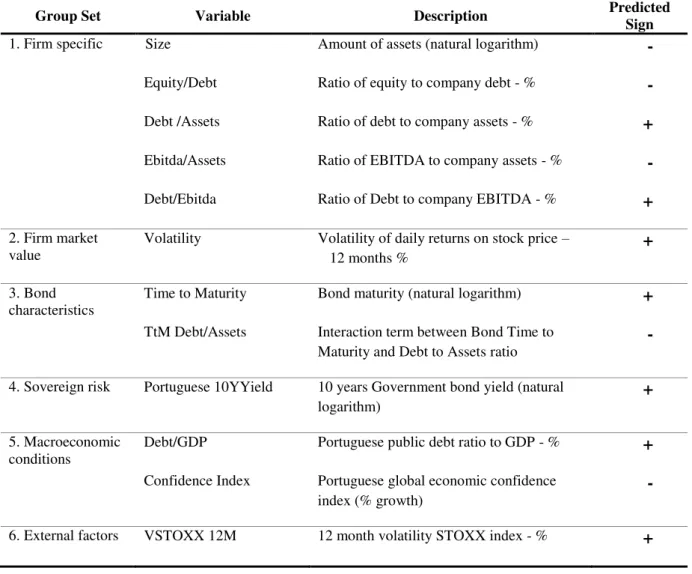
For the economic intuition of the effects in our regression, and to indicate the expected signs on the coefficients of the regression, we refer to the work of Huang and Kong (2003) and Collin-Dufresne et al. (2001). Table 3 provides a predicted sign on the coefficients of the regression for potential explanatory variables.
Table 3. Explanatory Variables and Expected Signs on the Coefficients of the Regression
Group Set Variable Description Predicted
Sign
1. Firm specific Size Amount of assets (natural logarithm) -
Equity/Debt Ratio of equity to company debt - % -
Debt /Assets Ratio of debt to company assets - % +
Ebitda/Assets Ratio of EBITDA to company assets - % -
Debt/Ebitda Ratio of Debt to company EBITDA - % +
2. Firm market value
Volatility Volatility of daily returns on stock price –
12 months %
+
3. Bond characteristics
Time to Maturity Bond maturity (natural logarithm) +
TtM Debt/Assets Interaction term between Bond Time to
Maturity and Debt to Assets ratio
-
4. Sovereign risk Portuguese 10YYield 10 years Government bond yield (natural
logarithm)
+
5. Macroeconomic conditions
Debt/GDP Portuguese public debt ratio to GDP - % +
Confidence Index Portuguese global economic confidence
index (% growth)
-
1) Firm-specific variables
The firm level determinants of corporate risk (mainly financial risk factors) are based on Altman (2000), but we focus on the following indicators: the size of the company – total assets; the capital structure of the firm (ratio equity/debt); the leverage of the company (Debt/Assets); the capacity to generate operational results (EBITDA/Assets), and the percentage proportion of Debt to operational results. The more leveraged is a firm, and the less capacity company have to generate earnings–compared to total debt – the more remuneration investors ask, and hence the higher is the expected credit spread risk. The other variables are expected to have a negative impact on spreads, because investors tend to associate scale and company core results with lower risk of default. The ratios with EBIDTA were adjusted on first 3 quarters of the year by a prorata temporis effect13. In Figure A.4 to A.9 we present the variables per each sector.
2) Firm market value
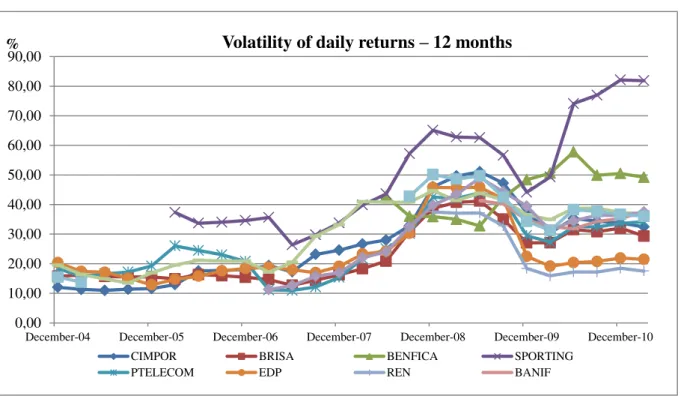
Following Campbell and Taksler (2003) and Merton (1974) findings, Cavallo and Valenzuela (2010) we included the volatility of equity as up-to-date information regarding a forward looking on firm future value. In fact, the higher the volatility, the higher the probability that the market value of the company may be similar to the debt market value, thus resulting in a higher probability of default. Therefore, to compensate for the risk of default, bondholders will demand higher remuneration, i.e. higher spreads. We use the yearly volatility at quarter-end per each stock of the 11 firms. We did not consider the rating changes as in Cavallo and Valenzuela (2010), because, as referred by Ederington et al. (1984), they found that investors base their evaluations of an issue's credit worthiness on more than the agencies' ratings, as they take decisions using a set of readily available financial accounting statistics14.
13
The quarterly data with information on the 3 month period was extrapolated to yearly data using a prorata
temporis adjustment by ¾, ½ and ¼.
14
Figure 1 – Volatility of Stocks
3) Bond characteristics
In this set is included the time to maturity of the bond (years to maturity in natural logarithm), in order to incorporate the uncertainty of default. The longer the maturity, the higher is the associated risk by bondholders. The findings by the Merton model, as referred by Peter and Grandes (2005), produces the classical hump-shaped ―term structure of credit spreads‖. As in Cavallo and Valenzuela (2010), we also include the control factor time to maturity (in natural logarithm)*Debt to Assets ratio, in order to capture the possible non-linear incidence of the term structure effect at different levels of leverage. We expect to have a positive effect on credit spreads in the regression regarding the time to maturity in a standalone basis, but the economic intuition points to a negative effect with the interaction term; as for a leverage company the more time to maturity the more opportunities to recover, if necessary, and thus the time promotes a less demanding risk premium.
0,00 10,00 20,00 30,00 40,00 50,00 60,00 70,00 80,00 90,00
December-04 December-05 December-06 December-07 December-08 December-09 December-10
% Volatility of daily returns – 12 months
CIMPOR BRISA BENFICA SPORTING
Figure 2 – Bond characteristics – Time to Maturity
Building Materials & Fixtures (1 company)
Transportation Services (1 company)
Recreational Services (2 companies)
Telecommunications (1 company)
,00 1,00 2,00 3,00 4,00 5,00 6,00 7,00 8,00 9,00 10,00
31-12-2004 31-12-2005 31-12-2006 31-12-2007 31-12-2008 31-12-2009 31-12-2010 %
Time to maturity
-4,00 -2,00 ,00 2,00 4,00 6,00 8,00 10,00
31-12-2004 31-12-2005 31-12-2006 31-12-2007 31-12-2008 31-12-2009 31-12-2010
%
LN Time to Maturity
,00 1,00 2,00 3,00 4,00 5,00 6,00 7,00 8,00 9,00 10,00
31-12-2004 31-12-2005 31-12-2006 31-12-2007 31-12-2008 31-12-2009 31-12-2010 %
Time to maturity
-4,00 -2,00 ,00 2,00 4,00 6,00 8,00 10,00
31-12-2004 31-12-2005 31-12-2006 31-12-2007 31-12-2008 31-12-2009 31-12-2010
%
LN Time to Maturity
,00 1,00 2,00 3,00 4,00 5,00 6,00 7,00 8,00 9,00 10,00
31-12-2004 31-12-2005 31-12-2006 31-12-2007 31-12-2008 31-12-2009 31-12-2010 %
Time to maturity
-4,00 -2,00 ,00 2,00 4,00 6,00 8,00 10,00
31-12-2004 31-12-2005 31-12-2006 31-12-2007 31-12-2008 31-12-2009 31-12-2010
%
LN Time to Maturity
,00 1,00 2,00 3,00 4,00 5,00 6,00 7,00 8,00 9,00 10,00
31-12-2004 31-12-2005 31-12-2006 31-12-2007 31-12-2008 31-12-2009 31-12-2010 %
Time to maturity
-6,00 -4,00 -2,00 ,00 2,00 4,00 6,00 8,00 10,00
31-12-2004 31-12-2005 31-12-2006 31-12-2007 31-12-2008 31-12-2009 31-12-2010
%
Conventional Electricity (2 companies)
Banking (4 local banks)
4) Sovereign risk
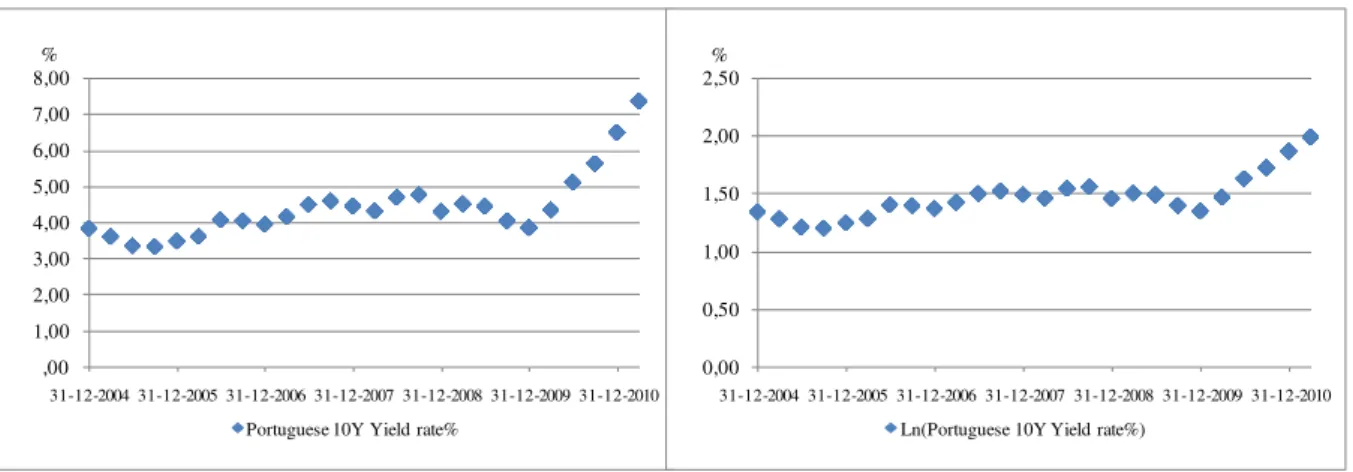
We consider as sovereign risk the market perception of prospective economic conditions that are reflected in government debt yields. This variable is normalized by using the natural logarithm. This variable is an absolute prospective value for the country risk required by bondholders. We expect to have a positive effect on credit spreads in the regression from this independent variable. However, some sectors may be affected in different proportions, as the higher the yield spreads on public debt, the higher is the possibility of banking system vulnerability due to the traditional firm leverage on the financial industry. However, we have to be cautious on the analysis, due to high correlation that exists between this variable and the Public Debt to GDP ratio (Tables A.2 and A.3 in the appendix).
,00 1,00 2,00 3,00 4,00 5,00 6,00 7,00 8,00 9,00 10,00
31-12-2004 31-12-2005 31-12-2006 31-12-2007 31-12-2008 31-12-2009 31-12-2010 %
Time to maturity
-4,00 -2,00 ,00 2,00 4,00 6,00 8,00 10,00
31-12-2004 31-12-2005 31-12-2006 31-12-2007 31-12-2008 31-12-2009 31-12-2010
%
LN Time to Maturity
,00 1,00 2,00 3,00 4,00 5,00 6,00 7,00 8,00 9,00 10,00
31-12-2004 31-12-2005 31-12-2006 31-12-2007 31-12-2008 31-12-2009 31-12-2010 %
Time to maturity
-6,00 -4,00 -2,00 ,00 2,00 4,00 6,00 8,00 10,00
31-12-2004 31-12-2005 31-12-2006 31-12-2007 31-12-2008 31-12-2009 31-12-2010
%
Figure 3 – Sovereign Risk Proxy Indicator
5) Macroeconomic conditions
In this set, we consider the macroeconomic conditions that impact mostly on credit corporate risk. After preliminary tests on the regression analysis using the stepwise method, several variables were excluded. The Public Debt to GDP ratio and the Economic Confidence Index growth were the variables which presented the better explanatory capacity. We expect to have a positive effect on credit spreads in the regression of the Public Debt ratio, and a negative effect from positive economic perspectives by the agents in the economy. The computation of quarterly Public Debt to GDP ratio was adjusted on first 3 quarters of the year by a prorata temporis effect.
Figure 4 – Portuguese Macroeconomic Indicators
,00 1,00 2,00 3,00 4,00 5,00 6,00 7,00 8,00
31-12-2004 31-12-2005 31-12-2006 31-12-2007 31-12-2008 31-12-2009 31-12-2010
%
Portuguese 10Y Yield rate%
0,00 0,50 1,00 1,50 2,00 2,50
31-12-2004 31-12-2005 31-12-2006 31-12-2007 31-12-2008 31-12-2009 31-12-2010
%
Ln(Portuguese 10Y Yield rate%)
50,0 55,0
60,0 65,0
70,0 75,0
80,0
85,0 90,0 95,0
100,0
31-12-2004 31-12-2005 31-12-2006 31-12-2007 31-12-2008 31-12-2009 31-12-2010
%
Debt/GDP (adjusted by prorata)
-20,0 -15,0
-10,0 -5,0
0,0 5,0 10,0 15,0
20,0
31-12-2004 31-12-2005 31-12-2006 31-12-2007 31-12-2008 31-12-2009 31-12-2010
%
6) External factors
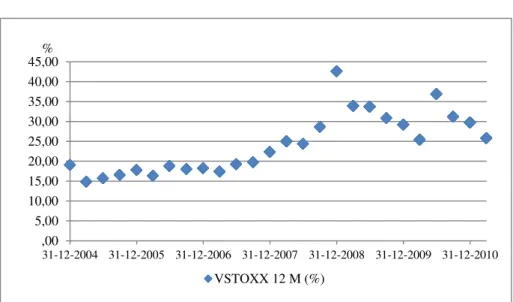
On preliminary work, we found that European bond indices Iboxx Euro Aggregate Corporate Total Return and Iboxx Euro High Yield Total Return, provided by Markit, were not statistically relevant, and were thus excluded. However, a forward looking indicator, as the volatility index VSTOXX 12M15, was retained as a measure of market expectations of long-term volatility based on the EURO STOXX 50 options prices. We expect to have a positive effect on credit spreads in the regression.
Figure 5 – Volatility Index VSTOXX 12M
4.2.REGRESSION ANALYSIS
We run linear regression analysis based on a model from Cavallo and Valenzuela (2010) for the unbalanced panel data. However our study is developed on a pooled regression model, as referred by Yaffe (2003) and Park (2009), because we have no country effects, and the time effects were not statistically significant16. We use two statistical techniques: multivariate linear regression and longitudinal analysis on linear regression with fixed effects for robustness tests.
15
The EURO STOXX 50 Volatility Index (VSTOXX) measures the implied variance across all options of a given time to expiry. The options contract on the EURO STOXX 50 is one of the products of Eurex with the highest trading volume. This model has been jointly developed by Goldman Sachs and Deutsche Börse. The VSTOXX and its eight sub-indices are updated every five seconds. The VSTOXX is calculated on the basis of eight expiry months with a maximum time to expiry of two years.
16
The results of a regression including date order as an additional independent variable present a decrease on the
F-statistics from 324 to 297 and the T-statistics present a pSig. of 0,013 accepting the Ho: β = 0 at 1%
confidence level. The adjusted R Square improves marginally from 0.814 to 0.815. ,00
5,00 10,00 15,00 20,00 25,00 30,00 35,00 40,00 45,00
31-12-2004 31-12-2005 31-12-2006 31-12-2007 31-12-2008 31-12-2009 31-12-2010
%
We used a 5% confidence level in all analysis. We performed the calculations using the
software ―IBM SPSS Statistics 20‖ for the multivariate linear regression and the Stata IC for the longitudinal analysis.
4.2.1. POOLED REGRESSION MODEL –TESTS AND RESULTS
As previously referred, our strategy was based on a sample of corporate OAS. We tested the explanatory relevance of proxy variables related with firm specific factors as size, financial performance, debt and industry effects, as we wanted to reflect the heterogeneity of the industry risks on Portuguese corporate bond market.
Our formula in the regression on the determinants (excluding the dummies) of the normalized OAS – the variable – is the following:
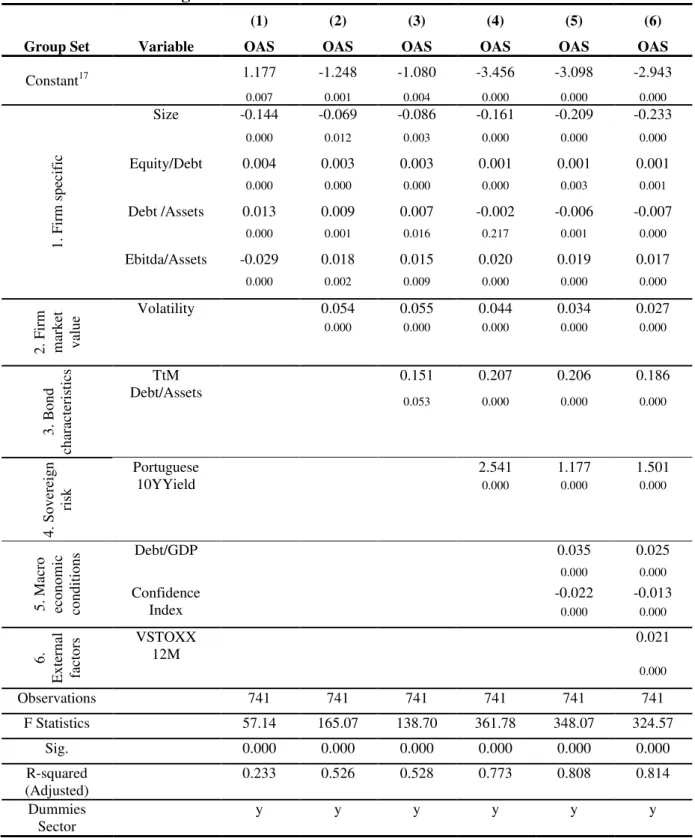
On Table 4 we present the results of a sequential increment of independent variables in our regression model.
The firm specific variables are depicted on column (1) and include dummy sector variable. The size and firm profitability coefficient are negative and statistically significant. The coefficients for Equity/Debt and leverage indicator (Debt/Assets) are positive and statistically significant. The coefficient for ratio Debt/Ebitda was insignificant, and statistically irrelevant. Although, these results are as expected, regardless of the low the irrelevancy of Debt/Ebitda was unexpected. The economic rational suggests that bondholders of riskier companies (high leverage) require higher spreads.
Table 4. Determinants of Portuguese Corporate OAS
Multivariate Linear Regression
Group Set Variable
(1) (2) (3) (4) (5) (6)
OAS OAS OAS OAS OAS OAS
Constant17 1.177 -1.248 -1.080 -3.456 -3.098 -2.943
0.007 0.001 0.004 0.000 0.000 0.000
1 . Firm s p ec if ic
Size -0.144 -0.069 -0.086 -0.161 -0.209 -0.233
0.000 0.012 0.003 0.000 0.000 0.000
Equity/Debt 0.004 0.003 0.003 0.001 0.001 0.001
0.000 0.000 0.000 0.000 0.003 0.001
Debt /Assets 0.013 0.009 0.007 -0.002 -0.006 -0.007
0.000 0.001 0.016 0.217 0.001 0.000
Ebitda/Assets -0.029 0.018 0.015 0.020 0.019 0.017
0.000 0.002 0.009 0.000 0.000 0.000
2 . Firm m ar k et v alu
e Volatility 0.054 0.055 0.044 0.034 0.027
0.000 0.000 0.000 0.000 0.000
3 . B o n d ch ar ac ter is
tics Debt/Assets TtM 0.151 0.207 0.206 0.186
0.053 0.000 0.000 0.000
4 . So v er eig n ris k Portuguese 10YYield
2.541 1.177 1.501
0.000 0.000 0.000
5 . Ma cr o ec o n o m ic co n d itio n
s Debt/GDP 0.035 0.025
0.000 0.000
Confidence Index
-0.022 -0.013
0.000 0.000
6 . E x ter n al fac to rs VSTOXX 12M 0.021 0.000
Observations 741 741 741 741 741 741
F Statistics 57.14 165.07 138.70 361.78 348.07 324.57
Sig. 0.000 0.000 0.000 0.000 0.000 0.000
R-squared (Adjusted)
0.233 0.526 0.528 0.773 0.808 0.814
Dummies Sector
y y y y y y
We introduced the bond characteristic factors in column (3): the variable Time to Maturity was statistically insignificant but the interaction term between time to maturity and leverage ratio (Debt/Assets) is significant. The coefficient on the latter presents, however, an
17
unexpected sign. The reason may be related with the sample (relatively high leveraged companies), and probably shorter durations on the bond issues (the average time to maturity is 3 year). These facts in conjunction with a country specific risk environment may lead to a higher risk premium, because bondholders may not perceive firm capacity to accomplish debt obligations on a shorter term basis. The Debt/Assets ratio on a stand-alone basis, although statistically significant is irrelevant.
In column (4), the sovereign risk proxy variable is included, and that results on a relevant improvement on .that increases to 0.773. This variable is statistically significant, and has a relevant contribute to variance. The coefficient sign enters the regression with the expected sign. The introduction of this variable leads to a sign change on Debt/Assets ratio that becomes almost irrelevant ( ).
Country specific indicators – macroeconomic variables – are included in column (5) with all the signs according to expectations, and statistically significant. The companies benefit from positive economic perspectives, but are penalized when the ratio public debt to GDP deteriorates. The introduction of these variables impacts on the size of the point estimates of sovereign risk, especially on the Portuguese 10YYield variable. The effect is the result of a high correlation between the public debt ratio and this country risk proxy. We understand that market risk perception derived from the sovereign debt crisis, on peripheral countries of the Eurozone, is a key driver for this high correlation. However, we include the variable to assess the impact on sector specific effects.
The external factor is introduced in the last column (6). The volatility index on Eurostoxx50 has a positive effect on corporate credit spread, and is statistically significant. However, it does not have a relevant impact on the .
The global results of the linear regression indicate that firm specific-variables, market value of the firm, bond characteristics, sovereign risks, country factors and external factors are all determinants of the corporate OAS.
Portuguese economy – the longer the maturity of the bond the higher are the possibilities of recovery. Hence, there may be better conditions to comply with debt obligations, and thus a possible decrease on default risk can occur. On the contrary, if the company is highly leveraged, introducing the time effect can potentiate the risk of default. This, probably, also results from the data used to run the regression analysis due to constraints on availability. We were expecting a relevant and positive impact on the Debt/Ebitda ratio, as it is an
indicator of the firm’s capacity to generate earnings from the business. The higher this
capacity (thus the lower the ratio), the higher the negative impact on the OAS. However, it was not neither relevant nor statistically significant. This needs further investigation, and probably a broader range of sector in future samples. The irrelevance of this indicator is unexpected. Also unexpected is the negative impact on the leverage ratio, although we can point the irrelevance on determining the OAS. The collinearity amongst firm-specific variables can also be an explanation for the decreasing impact for this ratio.
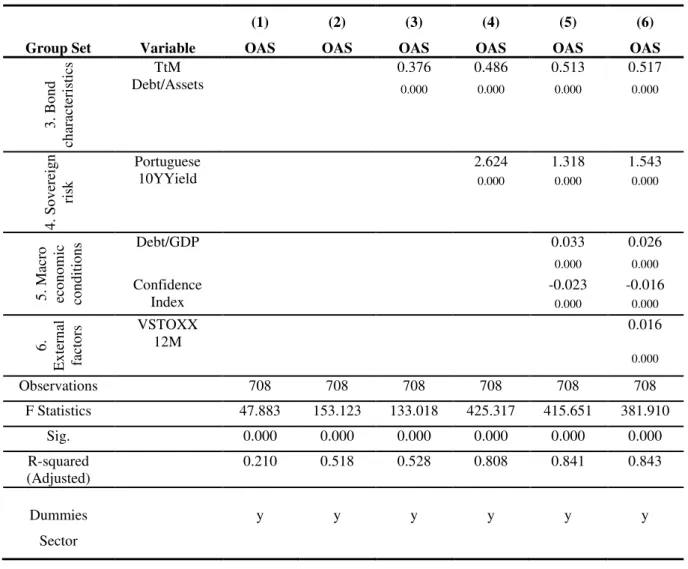
In Table 5, we perform the regression excluding the Recreational sector, which accounts for 2 sportive firms (Football clubs) where bondholders may consider different reasons to invest in this type of firms as referred by Ameriks et al. (2009). All results on impacts stand, but there are some changes on the coefficients: especially on the bond characteristics time control effect, where the impact size increases from β=0,186 to β=0,517. There is also an improvement on the .
Table 5. Determinants of Portuguese Corporate OAS – Excluding Recreational Sector
Multivariate Linear Regression
Group Set Variable
(1) (2) (3) (4) (5) (6)
OAS OAS OAS OAS OAS OAS
Constant18 -1.734 -2.339 -2.260 -4.699 -4.499 -4.425
0.012 0.000 0.000 0.000 0.000 0.000
1
.
Firm
s
p
ec
if
ic
Size 0.107 0.004 -0.004 -0.079 -0.105 -0.117
0.060 0.935 0.924 0.006 0.000 0.000
Equity/Debt 0.005 0.004 0.004 0.001 0.001 0.001
0.000 0.000 0.000 0.000 0.000 0.000
Debt /Assets 0.014 0.013 0.007 -0.004 -0.008 -0.009
0.000 0.000 0.022 0.048 0.000 0.000
Ebitda/Assets 0.006 0.026 0.025 0.032 0.032 0.032
0.548 0.001 0.001 0.000 0.000 0.000
2
.
Firm
m
ar
k
et
v
alu
e Volatility 0.058 0.059 0.048 0.037 0.031
0.000 0.000 0.000 0.000 0.000
18
Group Set Variable
(1) (2) (3) (4) (5) (6)
OAS OAS OAS OAS OAS OAS
3 . B o n d ch ar ac ter is
tics Debt/Assets TtM 0.376 0.486 0.513 0.517
0.000 0.000 0.000 0.000
4 . So v er eig n ris k Portuguese 10YYield
2.624 1.318 1.543
0.000 0.000 0.000
5 . Ma cr o ec o n o m ic co n d itio n
s Debt/GDP 0.033 0.026
0.000 0.000
Confidence Index
-0.023 -0.016
0.000 0.000
6 . E x ter n al fac to rs VSTOXX 12M 0.016 0.000
Observations 708 708 708 708 708 708
F Statistics 47.883 153.123 133.018 425.317 415.651 381.910
Sig. 0.000 0.000 0.000 0.000 0.000 0.000
R-squared (Adjusted)
0.210 0.518 0.528 0.808 0.841 0.843
Dummies Sector
y y y y y y
In relation to adherence per sector (Table 6), we run regression including sector dummies, and the results point to a relevant explanation of OAS except for sector 2 – Recreational Services which presents a relatively low of 0,560.
Table 6. Determinants of Portuguese Corporate OAS – Summary Information per
Sector - Multivariate Linear Regression
OAS Sector 0 Sector 1 Sector 2 Sector 3 Sector 4 Sector 5
Observations 26 53 33 119 183 327
F Statistics 33.401 108.703 5.070 38.561 146.305 330.593
Sig. 0.000 0.000 0.001 0.000 0.000 0.000
R-squared (Adjusted)
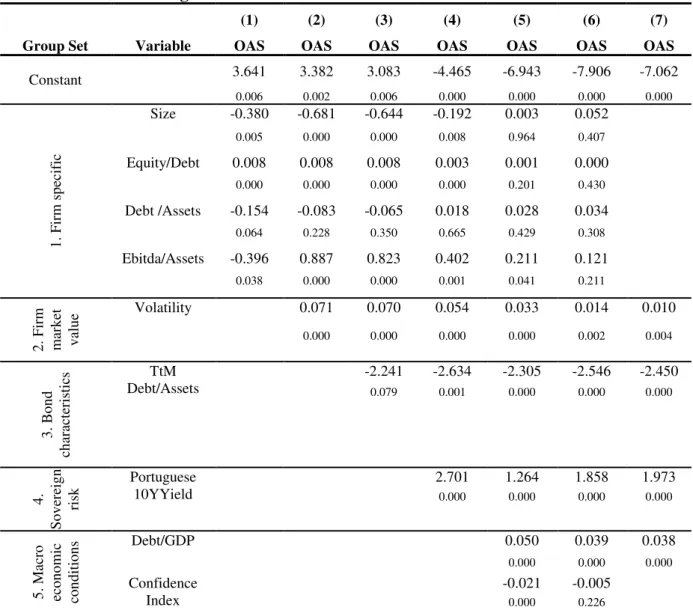
0.928 0.954 0.560 0.761 0.889 0.910
new specification are presented in Table 7 column (7). The is relatively high, and there is a change of determinants for the OAS. The firm specific variables are statistically insignificant, and the main impacts are from sovereign risks and bond characteristics. This is in line with the work by Gerlach et al. (2010), which refers that ―when aggregate risk increases, countries with large banking sectors and low equity ratios in the banking sector experience greater widening in yield spreads, suggesting that financial markets perceive a larger risk that governments will have to rescue banks, increasing public debt and therefore
sovereign risk.‖
There are, however, high levels of collinearity between the variables from sovereign risk set, and between the Debt to GDP ratio. In this regression the signs of the coefficients are unchanged from base regression.
Table 7. Determinants of Portuguese Corporate OAS – Banking Sector
Multivariate Linear Regression
Group Set Variable
(1) (2) (3) (4) (5) (6) (7)
OAS OAS OAS OAS OAS OAS OAS
Constant 3.641 3.382 3.083 -4.465 -6.943 -7.906 -7.062
0.006 0.002 0.006 0.000 0.000 0.000 0.000
1 . Firm s p ec if ic
Size -0.380 -0.681 -0.644 -0.192 0.003 0.052
0.005 0.000 0.000 0.008 0.964 0.407
Equity/Debt 0.008 0.008 0.008 0.003 0.001 0.000
0.000 0.000 0.000 0.000 0.201 0.430
Debt /Assets -0.154 -0.083 -0.065 0.018 0.028 0.034
0.064 0.228 0.350 0.665 0.429 0.308
Ebitda/Assets -0.396 0.887 0.823 0.402 0.211 0.121
0.038 0.000 0.000 0.001 0.041 0.211
2 . Firm m ar k et v alu
e Volatility 0.071 0.070 0.054 0.033 0.014 0.010
0.000 0.000 0.000 0.000 0.002 0.004
3 . B o n d ch ar ac ter is tics TtM Debt/Assets
-2.241 -2.634 -2.305 -2.546 -2.450
0.079 0.001 0.000 0.000 0.000
4 . So v er eig n ris
k Portuguese 10YYield 2.701 0.000 1.264 0.000 1.858 0.000 1.973 0.000
5 . Ma cr o ec o n o m ic co n d itio n
s Debt/GDP 0.050 0.039 0.038
0.000 0.000 0.000
Confidence Index
-0.021 -0.005
Group Set Variable
(1) (2) (3) (4) (5) (6) (7)
OAS OAS OAS OAS OAS OAS OAS
6
.
E
x
ter
n
al
fac
to
rs VSTOXX
12M
0.039 0.042
0.000 0.000
Observations 327 327 327 327 327 327 327
F Statistics 58.561 98.514 83.148 276.104 316.585 330.593 649.344
Sig. 0.000 0.000 0.000 0.000 0.000 0.000 0.000
R-squared (Adjusted)
0.414 0.599 0.602 0.855 0.897 0.910 0.909
Dummies Sector
n n n n n n n
Related with residual analysis for the regression model, as referred in Table 8 and Figures 6-8, we find that results are relatively robust, in spite of some outliers.
Table 8. Determinants of Portuguese Corporate OAS – Residual Statistics
Multivariate Linear Regression
Residuals Statistics
Minimum Maximum Mean Std. Deviation N
Predicted Value -1.440241 3.123523 0.5225 0.88000 741
Residual -1.5110584 2.2142003 0.0000 0.41735 741
Std. Predicted Value -2.230 2.956 0.000 1.000 741
Std. Residual -3.596 5.269 0.000 0.993 741
Figure 7 – OAS Regression Standardized Residual – Cumulative Probability
Nevertheless, we identify relatively high levels of collinearity between some of the independent variables that will focus our attention in future analysis, which will have to incorporate a broader spectrum of industry sectors. In this study, we developed some procedures to overcome these effects.
Robustness Tests
In order to attenuate the multicollinearity issues identified in the base regression by tolerance indicator and variance inflation factor (VIF) – three of the explanatory variables have a value inferior or equal to 2 and the rest are between this level and 7.5 – as well as by the Eigenvalue indicator and Condition Index – there are four variables with value superior to 15 – we rerun the regression using Zscores of the independent variables19. We defined a model for the OAS using normalized predictors based on the 10 independent variables of the pool regression. Results on the Eigenvalues and condition indices are improved, as indicated on Table 9.
Table 9. Determinants of Portuguese Corporate OAS - Multivariate Linear Regression –
Using Zscores -Collinearity Diagnostics
Collinearity Diagnostics
Model Dimension Eigenvalue Condition Index
1 4.275 1.000
2 1.842 1.523
3 1.062 2.009
4 1.000 2.068
5 0.942 2.130
6 0.763 2.367
7 0.443 3.086
8 0.308 3.728
9 0.200 4.621
10 0.091 6.866
11 0.071 7.746
19
Table 10. Determinants of Portuguese Corporate OAS - Multivariate Linear Regression
– Using Zscores - Collinearity Statistics
Coefficients
Model Dimension Coefficient Sig. Collinearity Statistics
Tolerance VIF
Constant 0.523 0.000
Zscore (Size) -0.341 0.000 0.294 3.399
Zscore (EquityDebt) 0.100 0.001 0.242 4.134
Zscore (DebtAssets) -0.151 0.000 0.148 6.758
Zscore (EBITDAAssets) 0.106 0.000 0.484 2.067
Zscore (Volatility) 0.307 0.000 0.315 3.172
Zscore (TtMDebtAssets) 0.079 0.000 0.542 1.845
Zscore (Portuguese10YYield) 0.332 0.000 0.199 5.035
Zscore (DebtGDP) 0.299 0.000 0.133 7.507
Zscore (ConfidenceIndex) -0.075 0.000 0.559 1.789
Zscore (VSTOXX12M) 0.144 0.000 0.255 3.926
However, the collinearity statistics reported on Table 10 are unimproved after the regression. This is because the Z-score transformation does not change the correlation between two variables. As a multicollinearity diagnostic, the condition index is useful for flagging datasets that could cause numerical estimation problems in algorithms that do not internally rescale the independent variables. The Z-score transformation solves this problem, but for improving the variance inflation it is necessary to use another procedure – factor analysis.
Table 11. Determinants of Portuguese Corporate OAS - Multivariate Linear Regression
– Using Factor Components Scores
Coefficients
Model Dimension Coefficient Sig. Collinearity Statistics
Tolerance VIF
Constant 0.523 0.000
Regr factor score 1 0.636 0.000 1.000 1.000
Regr factor score 2 -0.156 0.000 1.000 1.000
Regr factor score 3 0.454 0.000 1.000 1.000
Regr factor score 4 -0.074 0.000 1.000 1.000
Regr factor score 5 -0.087 0.000 1.000 1.000
Regr factor score 6 -0.071 0.000 1.000 1.000
Regr factor score 7 0.182 0.000 1.000 1.000
Regr factor score 8 0.283 0.000 1.000 1.000
Regr factor score 9 -0.084 0.000 1.000 1.000
We used the factor analysis to create a set of independent variables that are uncorrelated and fit the dependent variable as well as the original explanatory variables. These new variables are used on a regression where the independent variables are the principal components extracted from the Z-scores20. The results of the regression confirm that the variables that are statistically significant do not change from the original regression (Table 11).
In addition to these procedures we also run a regression on differences. The model specification changed, but five variables from the original regression were statistically significant – volatility, Time to Maturity*Debt/Assets, Portuguese 10YYield, Economic Confidence Index and VSTOXX12M. The is 0.423, which is relatively low, but there are no issues with collinearity–VIF is below 2 for all variables and Condition Index is below 3. The signs of the coefficients are in accordance with our expectations.
With this test we can overcome the collinearity issues. However it is necessary to investigate further types of independent variables, because we anticipate that the explanation of the changes in the OAS is also related to events and communications to the market. At this stage, this analysis is outside the scope of current study, but it is interesting subject for future research.
4.2.2. LONGITUDINAL ANALYSIS –TESTS AND RESULTS
To complement the analysis with the pooling regression model we also run a linear regression for panel data using StataIC (Park, 2009). As we have an unbalanced panel data with a cross section variable (the bond issue) observable in different moments, we tested a fixed effect21 to analyse group differences in intercept and also the autocorrelation effect using a auto regressive model with 1 period lag – AR(1).
The initial results, without the time lag, presented on Table 12, indicate a change of two explanatory variables, compared with the multivariate linear regression. The size is not statistically significant and was dropped. The time to maturity enters the regression with a significant effect but an opposite sign to economic intuition. The negative impact is explained by the same reasons that support our interpretation on the Time to Maturity*Debt/Asset. The high leverage ratio of the companies favours the credit risk for longer maturities.
20
The model fit is the same as for the model with the original explanatory variables.
21
Table 12. Determinants of Portuguese Corporate OAS - Longitudinal Analysis -
Multivariate Linear Regression – Fixed Effects
Fixed-effects (within) regression Observations 741
Group variable: Bond N. Groups 97
Obs. Per group: min 1
R-sq: within 0.7934 avg. 7.6
between 0.6135 max 26
overall 0.6500 F Statistics 243.41
Corr (ui, Xb) = 0.1574 Sig. 0.0000
Explanatory Variables Coef. STD Err t Sig. (95% conf. Interval)
Equity/Debt 0.00106 0.00021 5.02 0.000 0.00065 0.00148
Debt /Assets 0.01533 0.00264 5.81 0.000 0.01015 0.02020
Ebitda/Assets 0.01227 0.00557 2.20 0.028 0.00134 0.02320
Volatility 0.02313 0.00205 11.26 0.000 0.01910 0.02716
Time to Maturity -0.26605 0.03266 -8.15 0.000 -0.33019 -0.20191
TtM Debt/Assets 0.35985 0.07162 5.02 0.000 0.21922 0.50049
Portuguese 10YYield 1.28724 0.11162 11.53 0.000 1.06805 1.50644
Debt/GDP 0.01019 0.00292 3.49 0.001 0.00446 0.01593
Confidence Index -0.01606 0.00252 -6.37 0.000 -0.02101 -0.01111
VSTOXX 12M 0.01532 0.00350 4.37 0.000 0.00844 0.02219
Constant -3.83495 0.20100 -19.08 0.000 -4.22965 -3.44025
sig u 0.57747
sig e 0.28338
rho 0.80592 (fraction of variance due to u i )
F test that all u i = 0 F (97;634) = 13.35 Sig = 0.0000
Table 13. Determinants of Portuguese Corporate OAS - Longitudinal Analysis -
Multivariate Linear Regression – Fixed Effects and AR(1)
Fixed-effects (within) regression with AR(1) disturbance Observations 644
Group variable: Bond N. Groups 87
Obs. Per group: min 1
R-sq: Within 0.7919 avg. 7.4
Between 0.5546 max 25
Overall 0.6300 F Statistics 208.12
Corr (ui, Xb) = 0.1467 Sig. 0.0000
Explanatory Variables Coef. STD Err t Sig. (95% conf. Interval)
Equity/Debt 0.00099 0.00022 4.57 0.000 0.00056 0.00141
Debt /Assets 0.01516 0.00280 5.42 0.000 0.00967 0.02066
Ebitda/Assets 0.01322 0.00586 2.26 0.024 0.00171 0.02473
Volatility 0.02296 0.00219 10.47 0.000 0.01865 0.02727
Time to Maturity -0.28268 0.03614 -7.83 0.000 -0.35387 -0.21187
TtM Debt/Assets 0.35450 0.07623 4.65 0.000 0.20476 0.50424
Portuguese 10YYield 1.30427 0.11827 11.03 0.000 1.07195 1.53658
Debt/GDP 0.00823 0.00307 2.68 0.008 0.00220 0.01424
Confidence Index -0.01492 0.00273 -5.47 0.000 -0.02028 -0.00956
VSTOXX 12M 0.01474 0.00376 3.92 0.000 0.00735 0.02213
Constant -3.67427 0.21761 -16.88 0.000 -4.10173 -3.24680
Rho ar 0
sig u 0.57747
sig e 0.28363
rho 0.83903 (fraction of variance due to u i )
F test that all u i = 0 F (86;547) = 12.95 Sig = 0.0000