VOLUME 11 | ISSUE 1 | 2016 | 99
Effects of swim training on energetic and
performance in women masters’ swimmers
MARIA I. FERREIRA 1,2 , TIAGO M. BARBOSA 2,3, MÁRIO J. COSTA 2,4, HENRIQUE P. NEIVA 1,2, JOSÉ VILAÇA 2,4, DANIEL A. MARINHO 1,2
1 University of Beira Interior, Department of Sport Sciences, Covilhã, Portugal 2 Research Centre in Sports, Health and Human Development, Covilhã, Portugal 3 National Institute of Education, Nanyang Technological University, Singapore 4 Polytechnic Institute of Guarda, Portugal
ABSTRACT
Ferreira, M.I., Barbosa, T.M., Costa, M.J., Neiva, H.P., Vilaça, J., & Marinho, D.A. (2016). Effects of swim training on energetic and performance in women masters’ swimmers. J. Hum. Sport Exerc., 11(1), 99-106. The aim of this study was to analyze and compare the changes of performance and energetic profile of female masters swimmers over a season, in three distinct time periods (TP): December (TP1), March (TP2) and June (TP3). Eleven female masters swimmers performed an all-out 200 m freestyle to evaluate the swimmers’ energetic adaptations. The 200 m freestyle performance, the total energy expenditure (Etot) and the partial contribution of aerobic energy source (%Aer), partial contribution of anaerobic lactic energy source (%AnL) and partial contribution of anaerobic alactic energy source (%AnAl) contributions were estimated or assessed. Female masters swimmers improved significantly the 200 m freestyle performance over a season. However, a non-significant improvement was found on their energetic profile. Hence, one might speculate that performance improvement might be related to other performance determinants, such as, technical enhancement. Aerobic metabolism was the major contributor for Etot whereas anaerobic alactic was the second major contributor. Key words: training, gender, metabolic determinants, swimming season.
1 Corresponding author. Universidade da Beira Interior. Departamento de Ciências do Desporto, Rua Marquês de Ávila e
Bolama, 6201-001 Covilhã. Portugal. E-mail: [email protected] Submitted for publication April 2014 Accepted for publication September 2014
JOURNAL OF HUMAN SPORT & EXERCISE ISSN 1988-5202 © Faculty of Education. University of Alicante
100 | 2016 | ISSUE 1 | VOLUME 11 © 2016 University of Alicante
INTRODUCTION
In recent years, given the growth in sport participation by masters athletes and the interest that individuals have in healthy sport participation with the advancing of age, there has been an increase in interest in subject related to the enhancement of the performance of those athletes (Ransdell et al., 2009). The follow-up of physiological and performance changes over a season provides useful information on the chronic response to training (Costa et al., 2012). Some literature was found about this topic in male swimmers in elite swimmers (Capelli et al., 1998; Pendergast et al., 2006; Figueiredo et al., 2011; Costa et al., 2012; Sousa et al., 2013). However, no studies have been conducted, so far, to determine the energetics adaptations to annual training in female masters swimmers. Since performance depends, among others, from energetic profile (Barbosa et al., 2010), the purpose of this study was to assess the effect of several months of training on the energetic profile and performance of female masters swimmers.
METHODS
Subjects
Eleven female swimmers (34.7±7.3 yrs old; 1.63±0.05 m of height; 58.5±5.4-kg of body mass; 22.14±1.85 kg m-2of body mass index; 1.57±5.19 m of arm span; 200.73±25.02 of personal record in 200 m freestyle event).
Female swimmers, aged 26-46 years, were recruited by detailed announcements at a local swimming club. The following inclusion criteria were considered: (i) 25-50 years-old (iii) have a background as swimmer participating in national swimming events; (ii) be engaged in a systematic masters swimming program. The exclusion criteria included: (i) any physical challenge; (ii) musculoskeletal injury, pathology or condition; (iii) pregnancy; (iv) more than 3 consecutive weeks of absence during the follow-up period.
All subjects gave their written informed consent before participation. The study was approved by the local ethics committee and is in accordance to the Declaration of Helsinki.
Procedures
A 200 m freestyle time trial performed in a 25 m length swimming pool, was used to evaluate the swimmers’ energetic adaptations. In addition, elapsed time for 200 m was measured with a stopwatch (S141, Seiko, Tokyo, Japan) by two expert evaluators (ICC=0.98). The oxygen uptake (VO2) was measured
with a backward technique immediately after the 200 m trial (K4b2, Cosmed, Rome, Italy). The swimmers were instructed to breathing during the last cycle before touching the wall. After finishing the trial, the swimmer leaned on the wall, while an operator fixed a portable mask on his face during all recovery period. No breathing cycle was made until the portable mask was on the swimmer’s face. The oxygen uptake (VO2) (in ml⋅kg‐1⋅min‐1) reached during the trial was estimated through the backward extrapolation of the
oxygen (O2) recovery curve (the mean value in the 6 s after the VO2 detection during the recovery period)
(Laffite et al., 2004). The first measure of VO2 values before the highest VO2 measurement was not
considered, because it corresponded to the device adaptation to the sudden change of respiratory cycles and to O2 uptake. The device adaptation never exceeded 2 s (Costa et al., 2010; Laffite et al., 2004). Fingertip capillary blood samples were collected before the 200 m and at the 3rd, 5th, and 7th minutes after finishing the trial. Samples were then used to determine blood lactate concentrations (Accusport, Boherinnger Mannheim, Germany). The maximal blood lactate concentration after exercise (Lapeak) was
VOLUME 11 | ISSUE 1 | 2016 | 101 considered to be the highest blood lactate concentration in post-exercise condition (Termin & Pendergast, 2000).
The total energy expenditure (Etot, in kJ) was calculated for the 200 m trial, corresponding to the swimmer’s
maximal effort (Zamparo et al., 2011):
Etot=Aer+Anl+AnAl (1)
where Aer represents the aerobic contribution (in kJ) based on the total oxygen volume, Anl is the energy derived from lactic acid production (in kJ) and AnAl stands for the energy derived from phosphocreatine (PCr) splitting in the contracting muscles (in kJ). The total oxygen volume consumed during the 200 m was estimated as:
VO2=VO2net · t · M (2)
where VO2net (in ml⋅kg‐1⋅min‐1) is the difference between the oxygen uptake measured during exercise and
at rest, t (in min) is the total duration of the effort and M (kg) is the mass of the subject. Aerobic contribution was then expressed in kJ assuming an energy equivalent (Zamparo et al., 2011) of 20.9 kJ⋅lO2-1.
The O2 equivalent (in ml O2) was obtained according to:
O2Eq=Lanet · 2.7 · M (3)
where Lanet represents the difference between the lactate concentration measured at the end of 200 m and
the lactate at rest, 2.7 is the energy equivalent (in ml O2⋅mmol‐1
⋅kg‐1) for lactate accumulation in blood (di Prampero & Ferretti, 1999). Thus, the anaerobic contribution (in ml O2) was expressed in kJ assuming (Zamparo et al., 2011) an energy equivalent of 20.9 kJ⋅l O2‐1. Lastly, the alactic contribution (AnAl) can be
calculated as:
AnAl=PCr · (1- e-t/τ) · M (4)
where t is the time duration, τ is the time constant of PCr splitting at work onset (23.4 s, as proposed by Binzoni and colleagues (Binzoni et al., 1992), and PCr is the phosphocreatine concentration at rest. The energy derived from the utilization of the PCr stores was estimated assuming that, in the transition from rest to exhaustion, the PCr concentration decreases by 18.5 mM⋅kg-1 muscle (wet weight) in a maximally active muscle mass (assumed to correspond to 30% of body mass) (Zamparo et al., 2005) AnAl can be expressed in kJ by assuming (Capelli et al., 1998) a P/O2 ratio of 6.25 and an energy equivalent of 0.468
kJ⋅mM.
Statistical Analysis
The normality of distributions was verified using Shapiro-Wilks tests. Parametric or non-parametric tests were selected accordingly. Mean plus one standard deviation and quartiles were computed for each TP. Data variation was assessed with ANOVA repeated measures followed by the Bonferroni post-hoc test (P≤0.05), or Wilcoxon Signed‐Rank Test (P≤0.05), to assess differences between time periods.
102 | 2016 | ISSUE 1 | VOLUME 11 © 2016 University of Alicante
RESULTS
Swimming performance
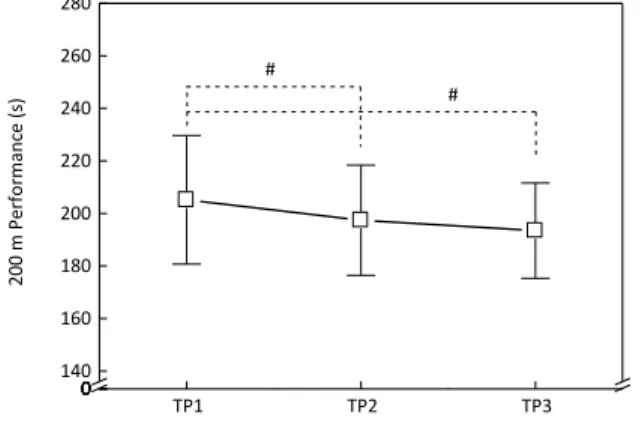
The 200 m performance improved over the season (TP1: 205.18±24.46 s; TP2: 197.45±20.96 s; TP3: 193.45±18.12 s) with significant differences between TP1-TP2 (-3.8%; p<0.001) and TP1-TP3 (−5.7%; p<0.001) (Figure 1). TP1 TP2 TP3 00000 140 160 180 200 220 240 260 280 # # 20 0 m Pe rf orma nc e (s )
Figure 1. Mean±SD values of the 200 m freestyle performance in the three TPs. (#) significant differences between TP1-TP2 (p<0.001); TP1-TP3 (p<0.001).
Total energy expenditure
Etot was 192.81±30.9 kJ (TP1), 193.18±20.98 kJ (TP2) and 199.77±25.94 kJ (TP3), representing a
non-significant increase over the season (TP1-TP2: 2.5%; TP2-TP3: 3.4%; TP1-TP3: 6.0%) (Figure 2).
TP1 TP2 TP3 00000 140 160 180 200 220 240 Etot (k J)
Figure 2. Mean±SD values of the energy expenditure (Etot) in the three TPs.
Energetic pathways
Figure 3 presents the values of the partial contribution of aerobic (%Aer), anaerobic lactic (%AnL) and anaerobic alactic (%AnAl) energy sources to Etot in the three TPs. Aerobic metabolism was the major
contributor representing in 77.67±3.56% (TP1), 79.40±3.63% (TP2) and 78.40±5.54% (TP3) of Etot. Female
swimmers showed a non-significant increase in %Aer from TP1-TP2 (3.3%), decrease from TP2-TP3 (-1.3%) and increase from TP1-TP3 (2.0%).
VOLUME 11 | ISSUE 1 | 2016 | 103 The %AnL had a partial contribution of 9.56±3.58% (TP1), 7.95±2.76% (TP2) and 9.31±4.71% (TP3) for Etot. Results showed a non-significant decrease from TP1-TP2 (−20.0%), an increase from TP2-TP3 (17.1%)
and decrease from TP1-TP3 (−6.3%).
The %AnAl was 12.76 ± 1.27% (TP1), 12.65 ± 1.14% (TP2) and 12.30 ±1.48% (TP3). Results showed a non-significant decrease between TP1-TP2 (−4.1%), TP2-TP3 (−2.8%), and TP1-TP3 (−6.7%).
TP1 TP2 TP3 0 10 70 80 90 100 Perce nt age con tri bu tio ns (%) Aer AnL AnAl
Figure 3. Mean±SD values of the Aer, AnL, AnAl in the three TPs.
DISCUSSION
The aim of this study was analyze the changes of performance and energetic profile of female masters swimmers over a season. Female improved their performance over the season. Aerobic metabolism was the major contributor to Etot, followed by anaerobic lactic and anaerobic alactic metabolism.
Swimming performance
Female masters swimmers improved significantly their performance over the season. Performance depends, among others, from energetic profile (Barbosa et al., 2010). However, female swimmers presented a non-significant variation of the partial contribution of the three energy sources which may be due to the characteristics of the training. Thus, may be the exercise intensity and duration of the training was not the sufficient to promote substantial adaptations in the energetic profile of these swimmers.
Total energy expenditure
The increase in Etot observed in female swimmers may be related with the increase in speed (Pendergast
et al., 2006), once a significant improvement of swimming performance, and consequently a increase in swimming velocity, was found. Comparing data for this study with the results of others but with young and elite swimmers (Figueiredo et al., 2011; Sousa et al., 2013) female masters presented lower Etot.
Differences between studies may rely on the sample characteristics (male vs. female) and age-group (masters vs. young/elite swimmers).
Partial contribution to total energy
The percentage contributions of %Aer, %AnL and %AnAl obtained in other studies was represented in Table 1. Aerobic metabolism was the major pathway for Etot whereas alactic metabolism were the second
major contributors. The role of aerobic energy system during high intensity exercise was reported by Gastin (2001) and the data of the present study are in agreement with previous studies as well (Capelli et al.,
104 | 2016 | ISSUE 1 | VOLUME 11 © 2016 University of Alicante
1998; Pendergast et al., 2006; Figueiredo et al., 2011; Sousa et al., 2013). The increase of the aerobic partial contribution found is likely related to the higher percentage of workout focused on the aerobic
capacity at expense of strength, speed, and power (Weir et al., 2002).
The absence of significant improvement in %AnL and %AnAl can be attributed to the lower anaerobic training load (TP1: 7.19%; TP2: 9.65%; TP3: 8.64%) over the season. Indeed, this is a characteristic reported for training sessions of masters athletes and periodization programs (Eskurza et al., 2002). Furthermore, the decrease in anaerobic performance may also, be attributed to changes in morphological factors (decreased muscle mass, type II muscle fiber atrophy), muscle contractile property (decreased rate of force development) and biomechanical features (changes in enzyme activity, decreased lactate production), factors that occurred with ageing (Reaburn & Dascombe, 2009). The type II fiber uses anaerobic metabolic processes to generate ATP, enabling short contraction time and the ability to produce high tension (Reaburn & Dascombe, 2009). Therefore, it is expected that female swimmers muscles lose their ability for power strength as a result of the preferential fibers atrophy (Macaluso & Vito, 2004) and lower anaerobic contribution.
The %AnL was lower than those obtained by Capelli et al. (1998), and Pendergast et al. (2006). With increasing age, anaerobic capacity decreases (Benelli et al., 2007; Donato et al., 2003; Reaburn & Dascombe, 2009) and the human skeletal muscle undergoes both structural and functional changes, the most striking of which are the reduction in muscle volume and muscle strength (Faulkner et al., 2007). Area of muscle mass of old individuals was found to be significantly smaller and the total number of fibers significantly fewer than those of young individuals. The number of fibers seems to have the greater influence on the muscle area. For all age groups average type II fiber size is diminished with age while the size of type I fibers is much less affected, marking short contraction time and the ability to produce high tension, as already mentioned.
The %AnAl values are similar to those obtained by Capelli et al. (1998), and Sousa et al. (2013) being, however, lower than those of Pendergast et al. (2006) and Figueiredo et al. (2011). These differences may be attributed to the method of estimation of AnAl. Capelli et al. (1998) considered that PCr concentration decreases, in transition from rest to exhaustion, by 18.5 mM⋅kg-1 muscle (wet weight) in a maximally active muscle mass equal to 30% of the overall body mass (similar to our study), but Figueiredo et al. (2011) found that this value was 27.75 mM⋅kg-1 and assumed the maximally active muscle mass corresponds to 50% of body mass.
Table 1. Percentage contributions of aerobic (%Aer), anaerobic lactic (%AnL) and anaerobic alactic (%AnAl) obtained in other studies
Authors Aer (%) AnL (%) AnAl (%) Performance level Gender
Capelli et al.(1998) 61.5 24.7 13.8 Elite swimmers Male
Pendergast et al. (2006) 38 43 19 Elite swimmers Male
Figueiredo et al. (2011) 65.9 13.6 20.4 Sub-elite swimmers Male
VOLUME 11 | ISSUE 1 | 2016 | 105
CONCLUSIONS
Women masters’ swimmers improved significantly their 200 m freestyle performance over a season. There is a non-significant improvement on their energetic profile. Hence, one might speculate that performance improvement might be related to other performance determinants, such as, technical enhancement.
REFERENCES
Barbosa, T.M., Bragada, J.A., Reis, V.M., Marinho, D.A., Carvalho, C., and Silva, A.J. (2010). Energetics and biomechanics as determining factors of swimming performance: updating the state of the art. Journal of Science and Medicine in Sport / Sports Medicine Australia, 13(2), 262–269.
Benelli, P., Ditroilo, M., Forte, R., De Vito, G., & Stocchi, V. (2007). Assessment of post-competition peak blood lactate in male and female master swimmers aged 40-79 years and its relationship with swimming performance. European Journal of Applied Physiology, 99(6), 685–693.
Binzoni, T., Ferretti, G., Schenker, K., & Cerretelli, P. (1992). Phosphocreatine hydrolysis by 31P-NMR at the onset of constant-load exercise in humans. Journal of Applied Physiology, 73(4), 1644–1649. Capelli, C., Pendergast, D.R., & Termin, B. (1998). Energetics of swimming at maximal speeds in humans.
European Journal of Applied Physiology and Occupational Physiology, 78(5), 385–393.
Costa, M.J., Marinho, D.A., Reis, V.M., Silva, A.J., Marques, M.C., Bragada, J.A., & Barbosa, T.M. (2010). Tracking the performance of world-ranked swimmers. Journal of Sports Science and Medicine, 9(3), 411–417.
Costa, M.J., Bragada, J.A., Mejias, J.E., Louro, H., Marinho, D.A., Silva, A.J., and Barbosa, T.M. (2012b). Tracking the performance, energetics and biomechanics of international versus national level swimmers during a competitive season. European Journal of Applied Physiology, 112, 811–820. Di Prampero, P.E., & Ferretti, G. (1999). The energetics of anaerobic muscle metabolism: a reappraisal of
older and recent concepts. Respiration Physiology, 118(2-3), 103–115.
Donato, A.J., Tench, K., Glueck, D.H., Seals, D.R., Eskurza, I., & Tanaka, H. (2003). Declines in physiological functional capacity with age: a longitudinal study in peak swimming performance. Journal of Applied Physiology, 94(2), 764–769.
Eskurza, I., Donato, A.J., Moreau, K.L., Seals, D.R., & Tanaka, H. (2002). Changes in maximal aerobic capacity with age in endurance-trained women: 7-yr follow-up. Journal of Applied Physiology, 92(6), 2303–2308.
Faulkner, A.J., Larkin, L.M., Claflin, D.R., & Brooks, S.V. (2007). Age-related changes in the structure and function of skeletal muscles. Clinical and Experimental Pharmacology & Physiology, 34(11), 1091– 1096.
Figueiredo, P., Zamparo, P., Sousa, A., Vilas-Boas, J.P., & Fernandes, R.J. (2011). An energy balance of the 200 m front crawl race. European Journal of Applied Physiology, 111(5), 767–777.
Gastin, P. B. (2001). Energy system interaction and relative contribution during maximal exercise. Sports Medicine, 31(10), 725–741.
Laffite, L.P., Vilas-Boas, J.P., Demarle, A., Silva, J., Fernandes, R., & Billat, V.L. (2004). Changes in physiological and stroke parameters during a maximal 400-m free swimming test in elite swimmers. Canadian Journal of Applied Physiology, 29(S1), S17–S31.
Macaluso, A., & Vito, G. (2004). Muscle strength, power and adaptations to resistance training in older people. European Journal of Applied Physiology, 91(4), 450–472.
Pendergast, D.R., Capelli, C., Minetti, A.E., & Mollendorf, J. (2006). Biophysics in swimming. Revista Portuguesa de Ciências Do Desporto, 6(23), 185–189.
106 | 2016 | ISSUE 1 | VOLUME 11 © 2016 University of Alicante
Reaburn, P., & Dascombe, B. (2009). Anaerobic performance in masters athletes. European Review of Aging and Physical Activity, 6(1), 39–53.
Sousa, A., Figueiredo, P., Zamparo, P., Vilas-Boas, J.P., & Fernandes, R.J. (2013). Anaerobic alactic energy assessment in middle distance swimming. European Journal of Applied Physiology, 113(8), 2153–2158.
Termin, B., & Pendergast, D.R. (2000). Training using the stroke frequency-velocity relationship to combine biomechanical and metabolic paradigms. The Journal of Swimming Research, 14, 9–17.
Toussaint, H.M., & Hollander, A.P. (1994). Energetics of competitive swimming. Implications for training programmes. Sports Medicine, 18(6), 384–405.
Weir, P.L., Kerr, T., Hodges, N.J., McKay, S. M., & Starkes, J. L. (2002). Master swimmers: How are they different from younger elite swimmers? An examination of practice and performance patterns. Journal of Aging and Physical Activity, 10(1), 41–63.
Zamparo, P., Capelli, C., & Pendergast, D. (2011). Energetics of swimming: a historical perspective. European Journal of Applied Physiology, 111(3), 367–378.
Zamparo, P., Pendergast, D. R., Mollendorf, J., Termin, A., & Minetti, A. E. (2005). An energy balance of front crawl. European Journal of Applied Physiology, 94(1-2), 134–144.