1
Resistance strategies through the CEO communications in the media
Adelaide Martins [email protected] Delfina Gomes [email protected] Lídia Oliveira [email protected]
Paper presented at the 2017 Critical Perspectives on Accounting Conference, July 2nd – 5th, Québec City, Canada
2 Abstract – Organisations can symbolically manage their activities through organisational communication, thus this study assumes that organisations are not passive agents and have a choice when pressured by the institutional environment in which they operate. This paper adopts Oliver’s (1991) and Elsbach’s (1994) theoretical frameworks to examine organisational strategic responses to the pressures and institutional expectations provided in the CEO communications in the media. This analysis was developed through an interpretative case study of EDP – Energias de Portugal, S.A., the largest Portuguese group in the electricity sector during the period from 2010 to 2014, which includes the Economic and Financial Assistance Programme (EFAP) to Portugal. The results show that through the CEO communications in the media, EDP attempted to influence stakeholders’ perceptions and to legitimate organisational behaviour. The case study demonstrates that the CEO used subtle ways to introduce positive bias, thus demonstrating that organisations do not blindly conform to the expectations of the institutional environment but adopt complex responses involving active agency and organisational interests. Finally, the study demonstrates that like self-interest and power, the constituents’ expectations play an important role in determining the specific strategic responses to the institutional environment.
Keywords: Media; CEO; Strategic responses; Legitimacy; Power and self-interest, Electricity sector.
Introduction
The energy sector has been the stage of profound institutional change in Europe. In addition to institutional pressures that affect most organisations, electricity utilities are subject to specific pressures (Cooper 2003). The need for regulation and its importance to society means that “it is a politically sensitive industry and therefore one in which government will have an interest” (Cooper 2003, p. 235). The cost of electricity affects the whole economy and society and can interfere with the level of competitiveness and throw families into situations of “energy poverty” (Entidade Reguladora dos Serviços Energéticos (ERSE) [Energy Services Regulatory Authority] 2013, p. 2). At state level, energy costs are under intense scrutiny, resulting in many cases in the revision of support systems for the production of electricity under the ordinary and special (co-generation and renewables) regimes (Gomes 2013c).
EDP is the largest business group operating in the electricity sector in Portugal and is the case study of this research. Production contracts and support schemes in the electricity system represent controversial issues that directly affected EDP in the period from 2010 to 2014. In particular, the Custos para a Manutenção do Equilíbrio Contratual (CMEC) [Costs for the Maintenance of the Equilibrium System] paid to EDP under the ordinary regime generated a lot of negative publicity in the media, an organisational legitimacy barometer (Deephouse 1996). Portugal requested external financial assistance in May 2011. As a result,
3 Portugal signed a Memorandum of Understanding (MoU) with the European Commission (EC), the European Central Bank (ECB) and the International Monetary Fund (IMF), which included a set of measures with an impact on the electricity sector.1
The purpose of this paper is to develop a contextualised, detailed and in-depth analysis of EDP’s strategic responses through its CEO communications in the media against a background of high institutional pressures and expectations. Taking into account the importance of organisational communication in managing stakeholders’ perceptions, the following research question guides the analysis: why and how are the CEO communications of EDP used in the media in response to the institutional environment?
The economic, political and social context from 2010 to 2014 is a determinant to answer the research question. During that period, the evolution of the Portuguese economy was characterised by low growth and the correction of macroeconomic imbalances (Banco de
Portugal (BdP) [Bank of Portugal] 2014). The international economic and financial crisis
reached the Portuguese economy in a situation of economic vulnerability (BdP 2014). Organisations providing a public service (“utilities”) are subject to high technical and institutional pressures (Scott and Meyer 1991, p. 123). EDP has a significant national presence as it provides an essential public service and operates in an environmentally sensitive sector and is constantly exposed to ethical, political and social issues. The high visibility of EDP attracts stakeholders’ attention, making it particularly important to manage public perceptions of its activities.
The documental sources examined include CEO communications in the media from 2010 to 2014. In order to meet the expectations and interpretations of key societal actors with regard to EDP’s behaviour, we have used other data sources, which allowed us to understand the social, political and economic context in which the challenges to the company occurred. Oliver’s (1991) and Elsbach’s (1994) theoretical frameworks have been applied to analyse the CEO communications. A common feature to these frameworks is that both recognise that organisations are not passive actors and therefore they have a choice when pressured by the institutional environments in which they operate. Based on a perspective of new institutional sociology, these two theoretical approaches recognise that there is a difference of interest between organisations and external constituents and that the issues related to power and interests are usually on the basis of institutional processes. Corporations are, “for all intents and purposes, the primary locus of power and influence” (Gray 2010, p.57). This paper applies the
4 institutional concepts of power, self-interest and resistance to examine the CEO communications. Suchman (1995 p. 574) defined legitimacy as “a generalized perception or assumption that the actions of an entity are desirable, proper or appropriate within some socially constructed system of norms, values, beliefs, and definitions”. Organisations attempt to obtain stability and legitimacy (DiMaggio 1988, Oliver 1991). The importance of legitimacy for organisations is more obvious in times of crisis or controversy when legitimacy is challenged (Elsbach 2003). Because challenges to legitimacy can threaten organisational survival, organisations have an incentive to defend their legitimacy (Dowling and Pfeffer 1975, Suchman 1995, Lamin and Zaheer 2012). The meaning of organisational actions is provided to a great extent by top management (Ginzel et al. 2004). The CEO has “a degree of power to define social reality for many corporate stakeholders” (Amernic et al. 2010, p. 28). In many companies, as argued by Craig and Brennan (2012, p.171, emphasis in the original), “THE CEO IS THE COMPANY”. 2
Organisations do not always conform to the myths, rules or expectations of their external environment (Oliver 1991). Literature suggests that organisations which are the targets of institutional pressures can adopt a variety of strategic responses aimed at withstanding threats to their survival (Oliver 1991, Elsbach 1994, Canning and O’Dwyer 2013). They have interests and capacity that influence their choices. Organisations are not just passively constrained by external pressures and expectations, but they also consciously and strategically attempt to promote their interests and influence stakeholders’ perceptions (Oliver 1991, Shapiro and Matson 2008). To appear legitimate is an important means of protecting key resources. However, empirical evidence suggests that little attention has been given to organisational strategic choices to deal with institutional environment (e.g. Clemens and Douglas 2005, Jamali 2010).
The media, consumer organisations, regulatory agencies and industry experts shape and influence stakeholders’ perceptions of organisations (Pollock and Rindova 2003, Desai 2011, Zavyalova et al. 2012). In particular, the media is an often used tool to address issues of public interest and it acts as a social arbiter influencing stakeholders’ expectations about organisations and their leaders (Wiesenfeld et al. 2008, Bednar et al. 2013). Organisations often provide a public response through the media in an attempt to influence external perceptions about the appropriateness of organisations’ activities (Aerts and Cormier, 2009, Zavyalova et al. 2012, see also Rindova et al. 2006).
2 See also Amernic et al. (2010).
5 First, this paper aims to contribute to the literature by providing new evidence concerning the process through which organisations manage stakeholders’ perceptions of their actions. A broad spectrum of information sources has been drawn upon in addition to annual reports, such as press releases and top management communications, which have not been fully explored by the literature. Second, this paper also aims to contribute to a deeper understanding of the organisation’s legitimation process, by focusing on the defence of organisational legitimacy following controversies (Lamin and Zaheer 2012). Third, by examining the EDP case, this research contributes to a better understanding of how companies in oligopolies, taking into account their economic power, respond to institutional pressures. Finally, in practical terms, this study intends to be useful to researchers and accounting professionals, auditors and regulators, given the complexity and relevance of the electricity sector to the economy and to families.
The remainder of this paper is organised as follows: the second section develops Oliver’s (1991) and Elsbach’s (1994) institutional frameworks that guided the analysis of research. The third section presents EDP, the case study chosen for this research, devoting particular attention to one of the CEOs of EDP with more media coverage, António Mexia. The fourth section presents the research method applied in order to address the research question of this study. Subsequently, the fifth section describes the controversy surrounding EDP on the issue of electricity bills and excessive rents. The section following this examines António Mexia’s communications in response to the institutional environment in the media from 2010 to 2014. Finally, the last section discusses the findings, summarises the conclusions and identifies the contributions and opportunities for further research.
Theoretical framework
This section provides a description of the typology of strategic responses as developed by Oliver (1991) and the model of symbolic management of organisational legitimacy proposed by Elsbach (1994).
Oliver’s (1991) typology of strategic responses
Drawing on a convergence of the resource dependence perspective and institutional arguments, Oliver (1991) demonstrated how organisational responses to institutional demands may vary from passive conformity to active resistance. This framework provides a theoretical basis for several empirical studies and theoretical extensions (e.g. Goodstein 1994, Ingram and Simons 1995, Carmona and Macias 2001, Seo and Creed 2002, Clemens and Douglas 2005,
6 Greenwood and Suddaby 2006, Shapiro and Matson 2008, Jamali 2010, Guerreiro et al. 2012, Pache and Santos 2010, 2013, Canning and O’Dwyer 2013). In order of increasing active resistance, the five types of strategic responses are acquiescence, compromise, avoidance, defiance and manipulation.
The passive acquiescence strategy is the conformity to institutional pressures and can take three different forms: habit, imitation and compliance (Oliver 1991). Institutional research suggests that the visibility of organisations leads to a greater expectation in relation to institutional acquiescence (Goodstein 1994, Ingram and Simons 1995). Failing to comply with normative expectations can result in a loss of the license to operate (Oliver 1991, Bansal 2005).
The compromise strategy is only a partial compliance and organisations are more active in promoting their interests (Oliver 1991). This response represents the first step in organisational resistance to institutional pressures and it may include balancing competing expectations, pacifying resistant external constituents or bargaining amendments to the demands imposed (Oliver 1991). When organisations are confronted with inconsistencies between institutional demands and internal organisational goals related to efficiency or autonomy, a compromise strategy may occur (Oliver 1991). Negotiation is a political process, which creates a perception of an organisation without necessarily having to proceed to substantive changes (Kostova et al. 2008). However, the compromise approach may not allow organisations to ensure full support over the long term from important institutional stakeholders (Pache and Santos 2013).
Avoidance is defined as the attempt to preclude the necessity of conformity to institutional processes using tactics of concealment, buffering and/or escape. The concealment tactic consists of “disguising nonconformity behind a facade of acquiescence” (Oliver 1991, p. 154) or “managing the impression of compliance” (Criado-Jiménez et al. 2008, p. 250, see also Bozzolan et al. 2015, Cooper and Slack 2015). This tactic includes “window dressing”, ritualism, ceremonial compliance or symbolic acceptance of institutional norms or rules (Oliver 1991). A symbolic strategy of concealment of financial information may be useful in preventing any criticism from some constituents that the organisation is not contributing enough to their “cause” (Soobaroyen and Ntim 2013, p. 104). Buffering tactics (or decoupling) refer to the attempt to reduce the scrutiny or external evaluation by decoupling technical activities from external demands (Oliver 1991). Organisations may also create a “scapegoat” to organisational problems (Lamin and Zaheer 2012, p. 54). Institutional theorists typically see decoupling as a defence mechanism to minimise legitimacy threats (Oliver 1991, Boxenbaum and Jonsson 2008, Pache and Santos 2013).
7 Defiance entails not only a rejection of institutional demands, but also a public demonstration of organisational resistance (Oliver 1991). This strategy represents a symbolic action by “questioning the questioner” and an attempt to damage the credibility of the accuser in the eyes of the stakeholders (Lamin and Zaheer 2012, p. 54). Defiance comprises the tactics of dismissal, challenge, and attack (Oliver 1991). The dismissal tactic consists of ignoring institutional rules and values. Organisations that challenge institutional pressures adopt an offensive posture (Oliver 1991). An attack tactic aims to strongly censure institutional demands and external constituents that support them (Oliver 1991). Defiance is a stronger form of denial (Lamin and Zaheer 2012). As with denial, defiance indicates a resistance to changing the business model of the organisation, or to pursuing goals other than profitability (Lamin and Zaheer 2012).
Manipulation is the most active response to institutional demands and expectations and includes an opportunistic attempt to co-opt, influence or control them. Organisations which adopt this approach attempt to change the content of institutional demands or the sources that impose them (Oliver 1991). Co-optation includes the opportunistic use of institutional links to institutionalised features to “demonstrate the organization’s worthiness and acceptability” to external constituents (Oliver 1991, p. 158, Elsbach 1994, p. 59). Organisations may also attempt to influence institutionalised values and beliefs or accepted practices (Oliver 1991), as well as to control the source of the pressure. Like defiance, manipulation involves the mobilisation of political capital (Pache and Santos 2010).
Oliver (1991) identified five factors that motivate strategic responses to institutional pressures. These are cause, constituents, content, control and context. Cause refers to the expectations or objectives behind the external pressures. Organisational scepticism about strategic utility of conformity to pressuring sources induces more active responses (Oliver 1991). Constituents refer to shareholders/investors, the state, interest groups and the general public who exert heterogeneous and conflicting pressures on organisations (Oliver 1991, Neu et al. 1998). Content represents the extent of the consistency of the pressures with organizational goals. Specific features of an organisation influence its ability to resist change (Oliver 1991, Henisz and Zelner 2005, Pache and Santos 2010). In this regard, Henisz and Zelner (2005, p. 375) refer the organisation’s linkages to the policy-making process: a “`privileged´ organization, such as a long-standing incumbent, a state-owned enterprise or its privatized progeny, or a national champion, possesses the strongest ties to relevant political actors,”
8 namely those who control resources required by an organisation.3 Institutional control describes the means by which pressures are imposed on organisations. The imposition of institutional requirements by powerful institutional actors is likely to meet modest resistance (Goodstein 1994). Organisational capacity, information resources and wealth are crucial factors in determining the power of organisations’ resistance to institutional demands (Shapiro and Matson 2008, Canning and O’Dwyer 2013). The context corresponds to the conditions through which institutional pressures are exerted. Organisational decision makers usually prefer stability and predictability (DiMaggio 1988). When organisations face high environmental uncertainty, less active strategies are expected (Oliver 1991).
Elsbach’s framework: a perspective of symbolic management
The institutional perspective suggests that when organisational legitimacy is challenged, organisations attempt to obtain constituents’ support by emphasising normative and widely endorsed organisational features (Meyer and Rowan 1977, DiMaggio and Powell 1983). However, institutional theorists have neglected the use of verbal accounts by individual actors, such as the CEO, in managing organisational legitimacy (DiMaggio 1988, DiMaggio and Powell 1991, Elsbach 1994). Elsbach (1994) linked concepts from impression management and institutional theories to develop a model describing the management of organisational legitimacy in a symbolic management perspective. The model combines two broad forms of verbal accounts with two broad types of contents – accounts may be defined by both their form (i.e. how they are framed) and their content (i.e. how they are built) – and characterises how both the forms and contents affect perceptions of organisational legitimacy.
The two broad forms of accounts include denials and acknowledgments (Schlenker 1980, Elsbach 1994). Like concealment tactics, denials are symbolic responses (Ashforth and Gibbs 1990). A denial is a dismissal of the claim that a problem exists, or has existed, with organisational actions (Elsbach 1994, Lamin and Zaheer 2012). Elsbach (1994, p. 65) recognises that organisational spokespersons frequently give “emotionally charged denials as their initial response to controversial events”. On the other hand, acknowledgments consist in claiming that: “a negative event occurred, but ...”, “it wasn’t our fault” or “we had a good reason for our actions” or “the ultimate outcome was positive” (Elsbach 1994, p. 65).
3 Henisz and Zelner (2005) argue that examples of companies whose competitive advantages appear linked to managing relationships with governments are abundant, especially in capital intensive industries or those marked by a strong public interest.
9 Acknowledgments have the advantage of improving organisational actors’ credibility (Sutton and Callahan 1987).
The two types of account content refer to technical or institutional features of organisations (Elsbach and Sutton 1992, Elsbach 1994, Scott 1995). Technical features are related to organisational efficiency and effectiveness issues (Scott 1995). On the other hand, the institutional features consist of normative and socially endorsed organisational practices (Meyer and Rowan 1977, DiMaggio and Powell 1983, Elsbach and Sutton 1992). These indicate legitimacy with large segments of society and correspond to organisational features, such as institutional structures (legitimate hierarchies and roles), institutional procedures (legitimate rules and processes) or institutional goals (legitimate goals or outcomes) and structural decoupling (separating legitimate and illegitimate structures) (Ashforth and Gibbs 1990, Elsbach 1994).
The effectiveness of accounts is explained by the audience’s perceptions of the type and seriousness of a controversy, their expertise on the issue and their expectations regarding organisational responses (Elsbach 1994). The author suggests that verbal accounts combining acknowledgments with references to widely institutionalised features are the most effective in protecting organisational legitimacy. Denial response is suggestive of intransigence and can undermine public trust in the organisation (Ashforth and Gibbs 1990, Lamin and Zaheer 2012). As a matter of fact, this strategy stigmatises organisations with the public negatively affecting their legitimacy (Ashforth and Gibbs 1990, Elsbach 1994, Lamin and Zaheer 2012). Verbal accounts that refer to technical features may be also ineffective in protecting organisational legitimacy (Elsbach 1994). Constituents may perceive technical accounts as “self-serving rhetoric that puts industry interests ahead of the welfare of the public”, or as insufficient explanations for organisational actions (Elsbach 1994, p. 75).
The verbal accounts provided by individual actors: how they are framed and how they are built, as developed by Elsbach (1994), may be combined with different types of strategic responses, as proposed by Oliver (1991).
The company and its CEO
This paper is based on the EDP case for several reasons. First, the company is a significant object of study for research on organisational strategic responses while facing constant challenges to its legitimacy during the study period from 2010 to 2014. Public expectations that EDP had to meet with institutional rules and pressures were high. The second reason is related to the visibility and economic importance of the company in the domestic
10 business environment. EDP is regarded as a relevant company in a sensitive sector from a political and social point of view, and therefore it is exposed to strong pressures and institutional expectations. The electricity sector and EDP in particular were targets of intense debate and political attention over the period under study. Public expectations that EDP should comply with the rules and the institutional pressures were particularly high. When a sector is “`politically salient´ as a result of economic, political, historical, or cultural attributes”, it creates a “widespread public interest in its operation and outcomes” (Henisz and Zelner 2005, p. 362). In this sense, EDP proved to be a subject matter of interest for a theoretical understanding of “how” and “why” companies respond strategically to institutional processes through the CEO communications in the media.
António Mexia assumed the leadership of EDP in 2006. The CEO of EDP is regarded as a management awards collector (Andrade 2014). He is also considered to be a CEO with greater media coverage and a Portuguese manager with highly developed communication skills, which gave him “media strength and power to influence his peers” (Sobral et al. 2013, p. 23). António Mexia used that capacity in favour of, and to defend, EDP interests but no matter how great was his ability to communicate, he still had “a long way to win popularity” (Sobral et al. 2013, p. 23). Tormented in the public arena for his salary and his millionaire bonuses (over three million Euro in 2009 and 2012), António Mexia had also “against him the public opinion, always critical about the rise in the cost of energy” (Sobral et al. 2013, p. 23). The resignation of the Secretary of State for Energy, Henrique Gomes, was a moment that was “irredeemably linked to the power of António Mexia” (Andrade 2012, p. 67). Henrique Gomes was known to have publicly questioned the power of EDP on the electricity sector. During the eighth stage of EDP privatisation, the CEO “has succeeded to curtail the reformist impetus of the Secretary of State for Energy to apply a special levy on the energy sector which had EDP as the primary target” (Prado and Garrido 2014, p. 30). The proposal failed. António Mexia defended “tooth and nail” EDP contracts and rents before the government (Prado 2012b, p. 6).
The issue of the rents in energy leapt into the public arena with the signing of MoU. International bodies assumed that there were excessive rents in the electricity sector. Regarding the energy policy, the MoU included a set of measures that Portugal was obliged to respect relating to the electricity sector. The need to comply with these measures and the financial and economic crisis intensified the debate on national energy policy (Araújo and Coelho 2013). The sustainability of the electricity system and the worsening of electricity bill costs were two concerns of Troika with an impact on the competitiveness of the Portuguese economy. Renewable energy and CMEC were two of the compensation schemes imposed by cost
11 reduction measures to ensure the sustainability of the national electricity system. The CMEC scheme was a significant part of EDP profits, which had always rejected benefiting from excessive rents, making the government task to limit the policy costs embedded in CMEC difficult.
Henrique Gomes left the government nine months after the beginning of the legislature in March 2012. The exit of the Secretary of State for Energy was widely reported in the main media in Portugal and the criticisms against EDP and its CEO intensified. EDP was regarded as “a state within a state that gave orders to successive governments” and its CEO was accused of “challenging the government” in office.4 Officially, Henrique Gomes left the government for personal reasons, but what transpired to the public opinion was that he had lost the “war” against António Mexia to reduce excessive rents (Andrade 2012, p. 67, Baptista 2012, p. 8). The weekly newspaper Expresso described the former Secretary of State for Energy as “an annoying voice (...) because he was the first to face the interests of one of the most powerful lobbies in Portugal: the electricity sector” (Expresso, 2013, p. 2). On April 23rd 2013, in an interview on the TV station SIC Notícias, the Minister of Economy acknowledged that the exit of Henrique Gomes was due to a mechanism of energy lobby interests, a version which was confirmed by Henrique Gomes himself in an interview with the same TV station the day after.
António Mexia enjoyed “a relationship with [political] power” that provided him “praise and, of course, criticism” (Prado and Garrido 2014, p. 30). Critics argued that António Mexia was the strong man in the energy sector in Portugal and had won the renegotiation of EDP rents (Bastos and Saraiva 2012). The media recognised that António Mexia is “both bright and controversial” (Andrade 2012, p. 67). The CEO of EDP was awarded by the Instituto Superior
de Economia e Gestão (ISEG) [Institute of Economics and Management] with an honorary
doctorate. In a room full of businessmen, politicians and other personalities of the Portuguese social environment (Marcelino 2013), the press coverage of the ceremony highlighted the influence and media attention received by the CEO of EDP:
Looking at the audience that listened to him, you could see well his influence: the power of this regime and of the previous one, the financial, political, academic and business strength was there. His career reveals well, in fact, the depth but also the dispersion of this influence. (Sobral et al. 2013, p. 22)
Research method
4 See http://www.tvi24.iol.pt/videos/antonio-mexia-e-uma-pessoa-muito-poderosa/53f502113004540d1c4ea06d/ 2240, accessed on 17 July 2012, and also http://economico.sapo.pt/noticias/mexia-e-uma-pessoa-muito-poderosa_ 140493.html, accessed on 8 April 2012.
12 This research adopts a case study method to examine EDP’s strategic responses to institutional pressures and expectations and the consequent challenges to its legitimacy. To follow, the sources and the method of analysis are described.
Sources
All source documents are publicly available. Thirty one communications by António Mexia in the media from March 2010 to February 2014 were collected. These include interviews in newspapers, magazines, and on radio and television stations, as well as statements in press conferences (see Table 1). The CEO interviews on the radio and television stations were transcribed by the first author. It was additionally required to elicit a detailed examination of other relevant sources to understand institutional expectations in relation to EDP’s activities. These documents allow us to understand the environment in which EDP operated and to obtain useful information on relevant institutional actors. These data sources include: ERSE reports and opinions of the ERSE Tariff Council; reports, recommendations and communications from the Autoridade da Concorrência (AdC) [Portuguese Competition Authority]; the Memorandum of Economic and Financial Policies; the MoU; reports and press releases of the IMF, the EC and the ECB; reports by the BdP and the Organisation for Economic Cooperation and Development; government reports and press releases; several legal acts; press releases issued by the Associação para a Defesa do Consumidor (DECO) [Portuguese Association for Consumer Protection]; statements of officials and former officials; statements by representatives of the IMF, the ERSE, trade and industry associations and business leaders to the media; EdpON Magazine5, EDP annual reports and communications to the market; national newspapers and websites.
[insert Table 1 here]
Institutionalists suggest that the analysis of media sources may be particularly useful to study the process of organisational legitimation (Baum and Powell 1995). Previous research finds that corporate communications in the media provide appropriate “data that offer real-time accounts on events” (Sonpar et al. 2010, p.5). Stakeholders’ statements in the media provide
5 This magazine is “the only internal communication means that is available outside the workplace” – intended for active and retired employees, but it is also “delivered to important external partners – parliament chambers, parliamentary groups, academic institutions ... A dual function that makes this one of the most strategic means within the EDP Group” (EDP 2013, p. 34).
13 information about institutional demands and expectations in regard to organisational behaviour. Indeed, a major function of the media is to provide a platform for disseminating the point of view of stakeholders related to organisations (Bednar et al. 2013). We believe that public debate in the media can reflect the main arguments of the parties on the social contract between EDP, stakeholders and society.
The use of more than a single media source enables more informed interpretations of particular events (Archel et al. 2009). We believe that the newspapers and magazines and also the television stations we have selected provide a reasonable indication of the extent and tone in media coverage of controversial issues involving EDP and of the strategic responses by its CEO.6 The identification of relevant publications for analysis was performed weekly through a search on the on-line newsstand at the beginning of the research. Later in the period from the end of 2011 until September 2014, considering the attention on the issue of electricity prices and excessive rents, it became an almost daily process. Whenever the full text of the press communications was not provided on-line, we used a paper copy. During the research process, any António Mexia’s interview that was missing was obtained in the Biblioteca Municipal de
Braga [Municipal Library of Braga].
Method of Analysis
From the sources used to understand the environment in which EDP operated, the initial objective of the analysis was to draw up a schedule of successive events and attacks to EDP’s image and legitimacy to identify key stakeholders and understand their roles in the institutional process from 2010 to 2014. Through an examination of the chronologically organised data, it was possible to understand how societal actors perceived the information provided by EDP, what they expected from the company and what they considered to be appropriate organisational behaviour. With this contextual approach, we were able to capture “relevant features of shared understandings” or “sets of collective meanings that condition how organizational actors interpret and respond to the world around them” (Suddaby et al. 2007, p. 336, see also Ventresca and Mohr 2002, p. 819). The CEO communications were also organised chronologically. In the next stage of the analysis, we investigated whether and how EDP responded to the expectations of societal actors. Thus, the purpose of the schedules was to map the sequence of the charges against EDP and its responses and actions in order to understand
6 All articles and interviews published in print media and used in this research are publicly available on paper version in the Hemeroteca Municipal de Lisboa [Municipal Newspaper Library of Lisbon]. In Portugal, there are no databases which provide access to the full text of articles published in the print media.
14 how responses, as well as the public discourse around EDP, evolved. In order to increase the reliability of our conclusions (Shapiro and Matson 2008), we have highlighted examples that illustrate interpretations and expectations of key societal actors on EDP’s behaviour and its CEO’s, as well as several excerpts from António Mexia’s interviews.
Consistent with previous qualitative research, we used a modified form of content analysis (e.g. Suddaby et al. 2007, Shapiro and Matson 2008, Canning and O’Dwyer 2013) to analyse the CEO communications.7 The analysis was not limited to examining the manifest content of the evidence, but also extended to the latent content (Berg, 2001).8 From this perspective, the “content analysis is not a reductionist, positivistic approach. Rather, it is a passport to listening to the words of the text, and understanding better the perspective (s) of the producer of these words” (Berg 2001, p. 242). Thus, it “was necessary to consider not only what was said, but also why it was said” and “under what circumstances” (Shapiro and Matson 2008, p. 205). Oliver’s (1991) and Elsbach’s (1994) theoretical frameworks were used as an interpretive lens to explain strategies adopted by EDP in response to institutional pressures and expectations. Concepts of power and interests of institutional agents, as developed by institutional theorists, were particularly useful to understand EDP’s strategic responses. We conducted a careful and repeated reading of the texts as we proceeded to a reiterated interaction between evidence and theory. This process was conducted by the main author and afterwards was analysed separately by the other co-authors. Later a joint analysis was made and any discrepancies were resolved. The purpose of this contextual analysis was to build a coherent explanation of EDP’s responses in the media through its CEO communications, addressing the institutional environment that affected its interests and constituted threats to its organisational legitimacy.
The issue of electricity bills and rents in the electricity sector – an endless debate
The cost of electricity was considered a threat to the competitiveness of the Portuguese economy and marked the agenda of the EC and the IMF during the EFAP. The issue had the media attention and it proved to be controversial for EDP. The company was accused of being the main beneficiary of the excessive rents in the electricity sector at the expense of consumers
7 Qualitative content analysis is the appropriate term to describe the way adopted to process the data (e.g. Berg 2001, Canning and O’Dwyer 2013).
8 The manifest content refers to what is said or written explicitly in the text (literal meaning), while the latent content refers to the implicit meaning (deep structural meaning). In the latter case, the analysis is “extended to an interpretative reading of the symbolism underlying the physical data” (Berg 2001, p. 242).
15 and the economy, which gave rise to an endless debate concerning electricity bills and rents to energy producers.
In fact, the deterioration of the Portuguese economy illuminated the controversy around electricity prices. In 2009, serious criticism arose regarding the Portuguese energy policy. The support schemes to renewable producers faced growing opposition from certain sectors of the civil society and economy, which defended that the subsidies to renewable energies granted to producers contributed to “aggravate, in an unjustifiable manner, the electricity prices to smaller and retail end-users of electricity, particularly families” (Silva 2010, p. 18). However, renewable energies were not the only ones with additional costs which in turn increased electricity bills. This reality was extendable to electricity production under the ordinary regime (Gonçalves 2010, p. XI). The opinion by the tariff council of the ERSE confirmed that the sustainability of the electricity sector was at stake (ERSE 2010).
The proposal for the average rise in electricity prices for 2011 was conditioned by the new increase of the Custos de Interesse Económico Geral (CIEG)9 [Costs of Services of General Economic Interest] in electricity bills and amounted to EUR 2.4 billion (ERSE 2010).10 In December 2010, the DECO submitted a petition to the Portuguese Parliament to pressure the government into reducing the CIEG. The president of the ERSE also stood by, referring that if nothing was done, “expressive impacts on tariffs” (Marcelino and Carvalho 2011, p. IX) would occur. The Confederação da Indústria Portuguesa (CIP) [Confederation of the Portuguese Industry] ensured that the companies in Portugal were subjected to excessively high energy prices – way above the prices of Spain, hence impairing them in their competitiveness (Prado 2011).
The strong impact that the CMEC had on end-user electricity prices led the EC, the IMF and the ECB to impose a revision of the compensation paid to producers under the ordinary regime until the end of 2011. The decision would affect the expected EDP revenues, a reason for which the company led by António Mexia fought against any change which would harm the contract value previously assumed by the Portuguese government. The highlight of the battle fought between EDP and the government took place in 2011 during the last phase of the privatisation process of the company (Gonçalves 2013). On this occasion, the Ministry of Finance did not want the rent-reducing measures to have an impact on the company value and,
9 The CIEG include the additional costs associated with the production of electricity under the special and ordinary (CMEC, Contratos de Aquisição de Energia (CAE) [Power Purchase Agreements]), and power guarantee mechanism) regimes, the rental payments to the municipalities and others costs, such as those engendered by the geographical situation of the Portuguese autonomous regions (ERSE 2011).
16 in turn, on the success of the privatisation, which was at the EFAP (Garrido and Prado 2012b). As a consequence of the breach in the negotiation process between EDP and the Ministry of Economy “the confrontation tone between Henrique Gomes and the CEO of EDP, António Mexia, rose” (Ferreira 2012b, p. 7) at the end of September 2011. Months later, Henriques Gomes announced that he was able to reach an agreement in principle regarding renewable energy production, but as far as the CMEC are concerned it was essentially “EDP which opposed and moved its influences” (Prado 2012d, p. 8, see also Ferreira 2012b).
The year of 2012 revealed itself to be a very contentious one for EDP with the involvement of the government and the company in “disputes around the rents” in the electricity sector (Prado 2013b, p. 16). The renegotiation of the support to energy producers was one of the most newsworthy of the year and motivated reactions from a range of political backgrounds. In an interview with a business newspaper, when questioned on the position taken by EDP regarding the revision of the CMEC, Henrique Gomes defended that “to the excessive market power and influence of EDP, the government must impose public interest. It is a question of sovereignty.” (Prado 2012a, p.10). Jorge Vasconcelos, former president of ERSE, stated that, in ten years of political functions, he had “the opportunity to interact with seven Ministers of Economy and all of them, with no exception, benefited, one way or another, the national champion [EDP]. (...) it is completely privatised, but there is an unhealthy culture of promoting national champions” (Ferreira 2012a, p. 4).
In response to measure 5.15 of the updated MoU, the office of the Secretary of State for Energy produced a report on the evaluation of the effective rates of return for the different generation regimes to derive the excessive rents from. The report revealed that the CMEC, the wind energy and the power guarantee mechanism, represented the overwhelming majority of the excessive rents in the electricity generation sector (Garrido and Prado 2012a).11 All the CMEC power plants belonged to EDP. The total value of excessive rents associated with the CMEC scheme up to 2020 was EUR 2,133 million; as such, they represented the main source of imbalance in the national electricity system.12 Right from the start, the conclusions of the report have been the subject of criticism by several CEOs and businessmen from the energy industry. This report set the sector “boiling” and contributed to the radicalisation of positions
11See also http://www.tvi24.iol.pt/aa---vídeos---sociedade/edp-henrique-gomes-tvi24/1343990-5795.html, accessed on 18 May 2012.
12 This value has been determined by evaluating differences between the benchmark on rate of return estimated by Cambridge Economic Policy Associates (7.55 per cent) and the effective rate of return for the generation assets under CMEC regime (14.22 per cent).
17 between the Secretary of State for Energy and EDP (Ferreira 2012c, p. 2). The press release by the EC, ECB, and IMF on the third review mission to Portugal highlighted:
Long-standing entry barriers and a web of excessive rents are stifling economic dynamism. The resulting high non-tradable prices not only curb external competitiveness, but also put socially unfair burdens on consumers and taxpayers. First reform successes include measures to level the playing field in the telecommunication sector, and meaningful steps to reduce rents in energy markets, particularly electricity, are underway. Both the pace and scope of these reform efforts should be stepped up. (IMF, 2012)
Henrique Gomes resigned as Secretary of State for Energy after having been hindered in presenting his remarks at the ISEG on the case of excessive rents (Garrido 2012a). Already after his resignation, Henrique Gomes publicly denounced an extremely serious event: the report drawn up by the office of the Secretary of State for Energy and sent to the office of the Prime Minister, a few hours later, was in the hands of the board of EDP (Pereira 2012, Sequeira 2012). EDP indicated on several occasions that it would fight to defend their interests and always left open the possibility of taking legal action (Gonçalves 2013, Prado 2013b). The written and on-line press commented that no one expected it to be easy to face groups “which are accustomed to being protected in their revenues and businesses” (Garrido 2012b, “A strong determination”, para.7). The third review of the EFAP imposed an obligation to eliminate the power guarantee mechanism support and to reduce explicit subsidies for the cogeneration regime. In other areas, which included the CMEC of EDP and the renewable energies, the government acknowledged the limitation and adopted a negotiation approach on a voluntary basis. The differential treatment was justified by the existing contracts between the state and the companies, where EDP would take on a special weight. The EC underlined the need for further assessment of the cost-efficiency of the support schemes for renewables (EC 2012a). The excessive rents in the CMEC regime, identified by the office of the Secretary of State for Energy, cost each family over EUR 27 annually (Garrido and Prado 2012a).
The renegotiation process to limit the additional cost associated with the production of electricity restarted by the end of March 2012. The CMEC could only be reduced with the EDP agreement. In May 2012, the Portuguese Government announced a set of measures to reduce excessive rents and to address the sustainability of the national electricity system with the aim of saving EUR 1,800 million by 2020. EDP renegotiated with the Portuguese Government. It set an adjustment to the interest rate applicable to the tariff repercussion of the yearly fixed amount of the CMEC, which on average, for the period 2013 to 2027, was of EUR 13 million per year, corresponding to a present value of EUR 120 million (Decree-Law no. 32/2013 on
18 February 26).13 EDP estimated that in global terms the economic and financial impact for EDP Group, once all the measures were in effect (2014), corresponded to 1 per cent of Earnings Before Interest, Taxes, Depreciation and Amortization (EBITDA) or 2.5 per cent of Earnings per Share per year (EDP 2012).
EDP was pointed out as having remained unscathed in the announced cuts. Criticism did not take long to appear as far as the limited impact on group financial incomes was concerned. The DECO alerted that the measures announced fell short of what was expected, “much due to the unavailability of electricity generating companies to waive a part of their revenues from indecorous contracts” (DECO 2012, “Cutting the producers rents”, para.4). According to some critics, the CMEC configured “government support, which was illegal under European law” and they had “an economic mismatch in the electricity system which was illegitimate” (Prado 2012d, p. 8). The media claimed that the reduction on the CMEC represented savings with a “less significant impact on household energy bills” (Prado 2013a, p. 11, see also Ferreira 2013). On the fourth review mission to Portugal the EC and the IMF asked for more determination “to push through reforms in areas that touched sensitive political and vested interests” (EC 2012b, p.5). The announcements were not new, but they were significant due to the insistence with which they were repeated.14 Recalling that the CMEC regime was “one of the main factors behind the continued build-up of the tariff debt”, the EC pointed out that the important issue of containing the tariff debt through a reduction of excessive rents has not been adequately addressed as the proposed elements for a solution (mainly voluntary renegotiations and reduction in support schemes) appeared insufficient (EC 2012b, p. 36). The head of the IMF mission, Abebe Selassie, warned that the elimination of remaining excess rents was an important subject to ensure that the sacrifices would be fairly shared (Simões 2013). The national media highlighted that the statement by Abebe Selassie revealed that the market power of some companies and sectors remained unaffected, as was the case with the electricity sector (Garrido 2013).
The Siderurgia Nacional [National Steelyard] admitted closing the facilities in Portugal and relocating its economic activity to Spain with the threat of dismissal of 750 employees (Lopes, 2013). At stake were the high electricity costs: “totally inadequate as far as the reality is concerned” (Andrade and Atalaia 2013, p. 17). The energy-intensive companies accused António Mexia of hiding the truth regarding the prices EDP charged to the bigger companies
13 Regarding the policy costs embedded in CMEC, the Government reduced the CMEC annuity discount rate from 7.55 per cent to 4.72 per cent.
19 (Palma-Ferreira 2013). The representatives of the Portuguese industry appealed for stronger action against the excessive rents in order to reduce the weight of CIEG in electricity tariffs (Teixeira 2013). In turn, the DECO claimed that electricity prices were still too high (Figueira 2013).
In October 2013, the Government announced a special levy on energy operators. Part of the revenue generated by this levy aimed to reduce the tariff debt. The largest energy operators protested against the new measure. EDP was one of the first to react. The “arm wrestle” became quite clear (Mendes 2013, p. 14). The newspaper, Expresso, announced that “the Portuguese Government does not want to lose face in Portugal, where excessive rents on the electricity sector are a hot theme” (Campos 2013, p. 21). The special levy on energy generators was “a stone in the shoe of the institutional relationship between EDP and the government” (Campos and Costa 2014, p. 12), but EDP did not succeed in avoiding the levy collection.
The AdC identified a problem of distortion in the system services market and recommended that the government conduct an independent audit on risk of over-compensation in the adjustment calculations of the CMEC scheme (AdC 2013). This regulator pointed out that the manner in which [...] CMEC are calculated enabled EDP to control the compensations received and “enlarge the economic advantage over its competitors” (AdC 2013, p. 6). According to the report of the regulator, the compensation scheme for CMEC represented between 14.9 and 34.2 per cent of profit before taxes for the EDP group.
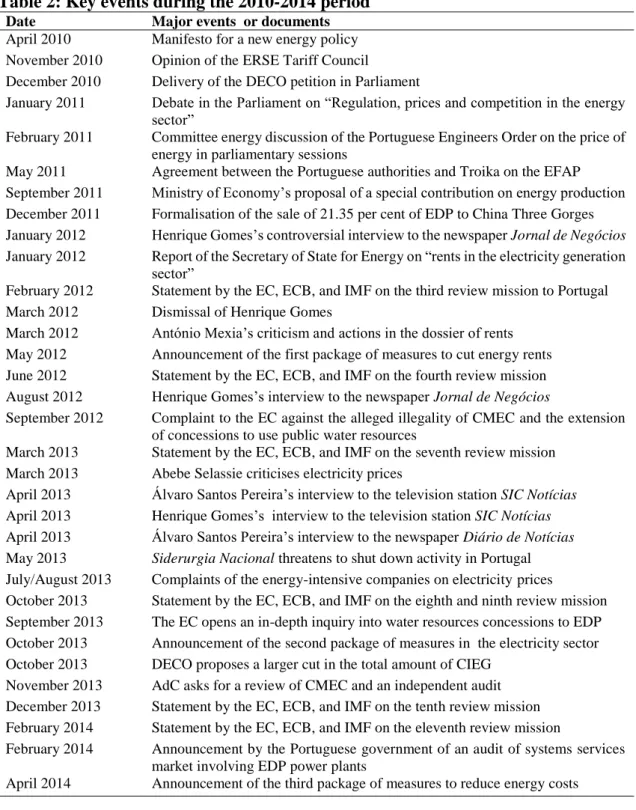
After ten reviews to the EFAP, the rent-reducing measures implemented so far to eliminate the tariff debt by 2020 and to ensure the sustainability of the electricity system appeared to be insufficient (EC 2014). The 2014 Budget law set a new levy on energy operators imposed to boost state revenues with the additional effect of curbing excessive rents in the energy sector. Three years after the start of the EFAP, the media stated that the group led by António Mexia had some losses during the Troika intervention, “but the hole could have been bigger. The revenues from the hydro power plant (CMEC) and wind energy remained essentially unaltered. The energy rent cuts were scattered by several players, thus mitigating the impact on EDP annual accounts” (Prado 2014, p. 6). EDP continued to be blamed for benefiting from “rents created at the expense of end-users and the Portuguese economy” and remained heavily criticised (Campos and Gozblau 2014, p. 14). Table 2 shows the dates of the main events and documents which exert institutional pressure and impose expectations on EDP.
20 António Mexia in the media: the social face of EDP
The controversy involving EDP on the issue of electricity bills and excessive rents in the electricity sector gave rise to several accusations which took on newsworthy contours. The chronology of the events described in the previous section, together with the contextual information, enabled the identification of the main accusations addressed to EDP over the 2010 to 2014 period. Table 3 resumes the accusations and the corresponding strategic responses by the EDP CEO, which will be then analysed.
[insert Table 3 here]
Strategic responses to accusation 1: denial and manipulation
The denial strategy, as presented by Elsbach (1994), was followed by António Mexia. The CEO had always denied that electricity prices in Portugal were higher than in other European Union (EU) countries and he defended that there was competition in the liberalised electricity market. As the company became the target of even more accusations by a wide variety of important stakeholders, EDP made increasing use of strategic responses beyond the simple denial, moving on to manipulation (Oliver 1991). In fact, when confronted with the growing number of complaints from representatives of the national industry, as well as from DECO, about high electricity prices in Portugal, EDP adopted more active strategies. The company tried to manipulate its institutional environment through an influence tactic. António Mexia defended that electricity prices were not a problem for Portugal’s competitiveness, for households or even for companies, and he relied on Eurostat and Instituto Nacional de
Estatística (INE) [National Statistical Institute] – two institutional references. It seems likely
that this indicates that the CEO intended to render its accounts more trustworthy, consistent with Elsbach and Sutton (1992) and Elsbach (1994). This approach suggests an attempt to influence the external constituents’ perceptions in relation to electricity prices and their impact on the competitiveness of the Portuguese economy, as evidenced by Shapiro and Matson (2008).
The CEO of EDP seemed to believe that the reference to these normative features would provide constituents with validating evidence to support the accounts, consistent with Elsbach (1994). The IMF, the EC and the ECB expressed their views on the high electricity costs and the lack of competition in the electricity market within the scope of the MoU. Always sticking to the European or national statistics not adjusted for purchasing power, António Mexia fought back, repeatedly, that the electricity prices in Portugal were below the EU average.
21 The selection of specific Eurostat’s official statistics (not expressed in purchasing power standards) reveals an attempt by the CEO to influence the perception of external constituents on the “myth” regarding the idea that electricity was a part of the problem of Portuguese economic growth. Following a resistance strategy to external expectations, the CEO continually stated that it made no sense to focus criticism on the national electricity sector, which represented only 20 per cent of the national energy sector, as the following transcripts confirm.15
Instead of distributing dividends to the shareholders and raising the wages of the employees, did you not think more about your customers? A lot has been said on the price of electricity.
This is a very important issue! The last statistical data from Eurostat – not ours, people like European statistics, here it is, Eurostat. And Eurostat tells us one thing: Portugal has, both for domestic and for industrial, prices below the European average and that of Spain. (Ferreira
2011)
The question of the excessive rents was highly debated. Is it reasonable? The Portuguese
can rest assured, in the sense that energy is on the side of the solution in Portugal. Much is said about electricity, but the big problem in Portugal is not in electricity, which represents 20% of the energy; it is rather in our huge dependency on oil, which represents 80%. We have focused on discussing the wrong problem, when deep down we must discuss how to make the country less dependent on oil and more energy-efficient. That is the first question. The second has to do with the fact that the prices in Portugal are lower than in Spain, our neighbour, and the European average. That is true for companies, which makes it easy to understand that there is no competitiveness problem for electricity. It only represents 1.7% of business costs. (...) Energy represents 2.5% of the shopping basket of households. All these figures come from Eurostat or other European statistics. We do not, therefore, have any problem with competitiveness or quality of life due to electricity. (Marcelino and Baldaia 2012, p. 9)
Strategic responses to accusation 2: denial and avoidance
EDP was accused of being responsible for the increase in electricity bill costs. António Mexia adopted denial and avoidance strategies as a response. More specifically, the company used a buffering tactic to reduce the scrutiny of external constituents by avoiding any responsibility for the increase in electricity bills. This defensive response was used between 2010 and 2013 when EDP was facing pressure and expectations from the government and the remaining constituents, whose prescriptions conflicted with the business interests of the company. The repeated use of this tactic suggests, as theorised by Elsbach (1994), that buffering the company would make denials more logical and believable, and in this sense, EDP may have considered the buffering response as a protection mechanism to minimise the threats to its legitimacy. By examining António Mexia’s communications, five buffering tactics were observed. The evidence suggests that the CEO brushed off responsibility for any increase in
15 The choice made was to transcribe in bold the questions asked during the interviews, every time they proved to be relevant to clarify the strategic response or whenever the emphasis places in the question clearly showed the importance the external constituents placed upon a particular social problem and, as consequence, the institutional pressures exerted on EDP. The quotation identifies the journalist to whom António Mexia granted the interview.
22 electricity bills onto other agents or external factors and in this way tried to create a scapegoat for the problem, corroborating the study by Lamin and Zaheer (2012).
Buffering tactic 1: EDP has nothing to do with the setting of electricity tariffs. The electricity price is defined by ERSE or by the market.
António Mexia resorted to buffering tactics (Oliver 1991) to withdraw any responsibility in determining the definition of the electricity tariff, arguing that it was defined by ERSE in the regulated market and by competition in the liberalised one. The reference to a normative procedure –ERSE – seems to support the denial tactic making it more believable.
It is clear! But regarding the petition by Deco: is there, or is there not, margin to lower the electricity bill in the short term? Once again, I would like it to be clear: the establishment of
the electricity bill has to do with decisions – whether from the regulator [ERSE], in the regulated market, or options of energy policy – which are not ours to be made. Both the former and the latter – we have nothing to do with that. And in the component “energy”, it is all about competition. EDP has, nowadays, strong competition, particularly from the Spanish operators: Endesa, Iberdrola, Gás Natural... all of them. (Marcelino 2011, p. 4)
Buffering tactic 2: EDP assures that, in the electricity bill, it acts as an agent charging third parties, as the energy policy is defined by the Government.
António Mexia tried to disconnect EDP from the problem by claiming that the company had nothing to do with CIEG as EDP only charged this in order to later hand in the revenue. This clarification came in the sequence of the petition presented by DECO, which asked for cost-cutting measures in the electricity sector. António Mexia wanted to make it clear that there was a set of costs charged in the bill which were related to the energy policy defined by the government and not by the company.
Following the complaint by DECO regarding the composition of the electricity bill, even after the explanations presented [by EDP], people still think they pay the most expensive electricity in Europe. To us, that issue was important. Firstly, it enabled us to explain that, in
more than half the households bill, EDP is charging for a third party. I believe the message went through. We did an opinion survey which concluded that people understood that there are a lot of things which have nothing to do with energy. Will it matter to repeat it yet again? Then that is what we will do. (Lima and Andrade 2011, p. 6)
Buffering tactic 3: EDP underlines that part of the production of electricity under the special regime has nothing to do with renewable energy.
The so-called CIEG included the additional costs associated with electricity production under the special regime relating to renewable and non-renewable energies. António Mexia supported electricity generation from renewable energy sources, highlighting, however, that it was “fundamental” to bet on more mature technologies, namely wind energy, and to separate the different technologies (Prado 2011a). For the CEO of EDP this separation was justified so
23 that the public did not get the wrong idea about the real cost of electricity production from renewable energy sources. In December 2010, António Mexia was heard at the Portuguese Parliament by the Economic Affairs and Energy Committee, to which he presented the version of EDP on the impact of such technologies on the electricity sector. The CEO underlined that the production of electricity under the special regime was divided into 55 per cent wind energy and 45 per cent cogeneration: the latter benefiting mainly the industry and not having anything to do with renewable energies (Jornal de Negócios 2010).
The main arguments against the strong policy emphasis on the production of energy under the special regime were not related to technology, but rather with the ineffective policy of subsidising. António Mexia defended that the renewable energies in Portugal were not a structural additional cost. The denials were supported by institutional and technical arguments, such as presented by Elsbach (1994). The reference to the institutional goals included the positive effect of renewable energies both on the stability of electricity prices and on the national energy bill. The denials were also combined with reference to technical features. In fact, the CEO argued repetitively that the cost of renewable energy in Portugal was below the EU average, noting that the wind tariff was the most reduced one in the EU. He explained that wind energy generation was fully competitive, justifying the bet on this type of technology on the basis of its efficiency. The repeated use of technical and institutional arguments to sustain his explanations extended throughout the EFAP as the following transcripts evidence:
There is a petition from DECO against... Before the petition from DECO... I have absolutely
no doubt that, from the renewable point of view, the joint bet on wind and water is very important – on which we have, right now, the biggest project for water development of all Europe; they are own resources, which replace imports. And all renewable sources of energy, last year, saved Portugal EUR 850 million in transfer of wealth abroad. This means that, the Portuguese need to work less hours today in order to import energy. This is the main issue. Energy is half the external deficit. What we are doing here is handle the main problem for Portugal, which is a problem of external indebtedness, external deficit, half of which is energy. Renewables, including water, are fundamental for the Portuguese not to transfer wealth abroad. This is a crucial aspect. (Marcelino 2011, p. 3)
Do you bluntly stand by that what the consumers pay extra for the production under special regime in the bill should be maintained because there is a strong wind component and is it justified? What I think is that we have the lowest wind tariff in whole Europe. It is the lowest
remuneration of the entire new wind farm there is in Europe. (Ferreira 2011)
One of the reasons why EDP grew was the existence of a favourable political setting for the energy sector. What will happen if there are elections soon and a new Government wants to alter the energy policy? (...) I am not worried. A wind farm today, with a barrel of
oil at 105 dollars – even taking into account the thermal backup energy when there is no wind – is competitive, for example, with a gas central. (Lima and Andrade 2011, p. 6)
Buffering tactic 4: A great percentage of the installed capacity of wind energy in Portugal does not belong to EDP.
24 In the political discussion on the production of energy, António Mexia defended that EDP was only one of the market players and almost all of the business of EDP Renováveis was situated outside Portugal.
The deadline ends at the end of the month, the Troika makes the decision regarding the next tranche of loan to Portugal depend on the solution of this commitment. (...) Very often [the
attention] is focused on EDP, but there are many other operators. Particularly, EDP has only 16 per cent of the renewable in Portugal. There are 84 per cent which belong to other operators.
(Sousa 2012)
Buffering tactic 5: EDP states that the increase in electricity prices is owed to other factors and not just the costs of renewable energy.
António Mexia placed the burden on a fiscal reason, explaining that the increase of the VAT rate from 6 to 23 per cent for electricity in 2011 led to an increase in the price of electricity. The CEO also argued that the international evolution in the price of fossil fuels was largely responsible for the rising of the electricity tariffs. In this regard, António Mexia underlined that most of the tariff debt was incurred in 2008 when the government impeded the pass-through of oil price increases in the end-users’ tariffs.
In the situation we are now, should there no longer be any subsidisation to the wind energy production? That would lower the electricity bill… No. The deficit (tariff) was created in
2008, in Portugal, due to the rise of the price of fossil fuels. It has nothing to do with the renewable energy (...). (Lima and Andrade 2011, p. 6)
Strategic responses to accusation 3: denial, avoidance, and manipulation
EDP was accused of accumulating exceptional profits at the expense of consumers and the economy. The behaviour of EDP was seen as a breach of the social contract (Dowling and Pfeffer 1975). António Mexia denied that EDP’s profits were due to electricity prices, rejecting that the consumer was the one subsidising the EDP group’s activity. Avoidance and manipulation strategies were used as a response to institutional pressures. The denial relied on “technical-accounting language” (Aerts and Tarca, 2010, p. 421) and a symbolic strategy of concealment of financial information which are susceptible to undermine organisational legitimacy, according to the theoretical arguments of Ashforth and Gibbs (1990). António Mexia claimed that EDP’s profits were a consequence of its internationalisation and better operational efficiency. The CEO seemed to consider that these technical arguments made its accounts more believable. The concealment tactic (Oliver 1991) was seen through the repeated presentation of EDP’s EBITDA, in an attempt to manage external impressions of organisational action. In this case, António Mexia emphasised that EBITDA increased mostly due to the strong growth in international markets, whereas in the national one EDP’s EBITDA had not grown since 1997.