Mould-makers in Global Value Chains: case studies in Central and Eastern Europe
Leonor Sopas
Centro de Estudos de Gestão e Economia Faculdade de Economia e Gestão Universidade Católica Portuguesa
R. Diogo Botelho, 1327 4169-005 Porto – Portugal Phone: +351 22 619 62 00 E-mail: [email protected] Financed by FCT, POCI 2010 September 2005
Mould-makers in Global Value Chains: case studies in Central and Eastern Europe Leonor Sopas
Faculdade de Economia e Gestão - Universidade Católica Portuguesa
Rua Diogo Botelho1327; 4169 005 Porto
Tel.: +351 22 6196229; fax: +351 22 6196229; e-mail: [email protected]
Keywords: organization of production; networks, other machinery (mould-making), Eastern Europe; JEL Codes: L23, L14, L64, O52
Introduction
Moulds for plastic are customized tools, purchased by many different industries. Every product incorporating plastic components – a car, a vacuum cleaner, a computer –requires as many moulds as the number of plastic parts it includes1. The most complicated plastic shapes require injection moulding2. Therefore, automotive, electronic and telecommunications, electric appliances and electric material are the most important customer industries of moulds for plastic injection.
The production of cars, consumer electronics and almost all industrial goods is increasingly organized in international production networks, within which different activities of the same value chain are located across the globe, to take advantage of differences in costs, resources, logistics and markets (Unctad, 1993, 2002; Gereffi, 1999). These networks differ across industries, countries and even firms. Automotive producers tend to organize their networks on a regional basis, assembling in Europe most of the cars to be sold in that market and acquiring or producing in the same region most of the necessary components. Nevertheless, the international network of Toyota is much more global oriented than the one of Volkswagen or Renault (van Tulder et al., 1998). In consumer electronics there are several products with
global production networks but other products are still produced within more regional networks (Luthje, 2002).
Moulds are technologically complex, involving the combination of knowledge from different disciplines, such as mechanics, materials technologies, electronics, optics, and information technologies. Customization and technological complexity require frequent exchanges of information between the firm producing the mould and its customer. Even though communication requirements are likely to be more intensive in the early phases of the project, they go on throughout production and continue during after sales assistance. As a result, mould making is a rather relation-intensive industry and relations tend to be long-term. Until recently developed countries were the indisputable leaders in this industry. Top exporters include Germany, Italy, Canada, USA, Japan, South Korea and Portugal in 7th place3. Leadership from firms in these countries was achieved by excelling in quality and innovation, especially for complex tools, which require a more efficient use of engineering resources, superior project management, and deep functional know-how. Moreover, tool-makers from developed countries benefit from strong relations both with their customers and with their supplier network. Finally, the risk of ordering sophisticated tools from distant low cost suppliers was often enough to discourage customers to look for suppliers in locations such as China or India (Ittner and Wullenweber, 2004). As a consequence, competition in mould making, at least for the more sophisticated tools, has been essentially confined to the developed world.
The failure of socialist regimes in Eastern Europe, in the early 1990s, initiated the process of economic transition to free markets for a large number of countries in Central and Eastern Europe (CEE)4. Even if their state-owned industry was largely obsolete and bankrupted, these countries benefited from a long industrial tradition, a reasonably well-educated work force, low wage costs and geographic proximity to the most important industrial areas of the EU.
Moreover, since the early nineties trading agreements with EU granted industrial products from CEE free market access, along with financial aid for industrial restructuring; this was followed by the accession of 8 of these countries to the UE in May 2004, while Bulgaria and Romania are expected to join in 2007. Besides launching large-scale privatisation programmes, CEE governments created a favourable investment climate, lowering corporate tax rates and offering investors help to find appropriate industrial locations with all the necessary infrastructures. Many Multinational Companies (MNCs) have relocated production and/or oriented their new investments to CEE, either by acquiring local state-owned firms or by investing green-field. Automotive, electric and electronic MNCs are among the top investors in CEE5. Besides investing in CEE, Western firms have asked some suppliers to follow them to the new locations and have also started to outsource production from local suppliers. At the same time, privatised CEE firms have to find customers for their products and these customers can either be local firms or foreign affiliates present in the domestic market. In a nutshell, inward foreign direct investment and external trade have played a major role in integrating CEE firms in international production networks6. For western suppliers these changes carry some risks: existing buyer-supplier relationships may be disrupted. Portuguese mould-makers have been watching closely CEE. Automotive is presently their major customer industry, representing 60% of sales, followed by households, electric appliances and electronics. Most customers are located in foreign markets: 90% of Portuguese mould production is exported, especially to Germany (20% of total exports) and France (18% of total exports). Portuguese mould-makers have seen several foreign customers delocalising production and/or directing their new investments to CEE. Some customers mentioned having already bought some moulds in Hungary and in the Czech Republic because prices were cheaper and the quality was good. Other customers asked Portuguese mould makers to invest in CEE since they could not find suppliers for more sophisticated moulds.
Due to large foreign direct investment inflows and industrial restructuring the demand for moulds in CEE is likely to be strong and growing. But little is known about the exact amount and the type of moulds procured in CEE. Information on the number, production capacities and capabilities of local mould makers is even scarcer. Aggregation of economic activity classifications prevents any exact account of mould-making firms. Naturally, their production and engineering competencies are even more difficult to determine. If the demand for moulds exceeds local supply or does not match its characteristics there might be business opportunities for Portuguese mould makers. But if supply is in excess of demand then CEE mould-makers may fell tempted to find customers in neighbouring markets, such as Germany. In any case, mould makers in CEE sooner or later are likely to establish relations with local foreign affiliates from the automotive, electric and electronics industry and enter their global production networks. In that case foreign customers may contribute to the upgrading of local mould-makers, as they have done in Portugal in the past. This is likely to have an impact on existing relationships between Portuguese mould-makers and their customers.
Buyer-supplier relationships emerged as a critical aspect in all the above discussion. As CEE firms are integrating in the world economy new relationships are established and developing and other relationships fail and come to an end. This may put western suppliers at risk. Available research on the development of relationships between foreign affiliates and local CEE firms has mostly considered the point of view of MNCs and has not covered the case of mould-makers (Meyer, 2000; Luthe, 2002; Radosevic and Yoruk, 2000; Radosevic and Rozeik, 2005). This paper will focus on examining the processes CEE mould makers have used to establish their first contacts with customers and to develop these relationships. Particular attention will be given to firms supplying western MNCs in the automotive and electronics global chains. Implications for Portuguese mould-makers are also discussed.
This paper is organized as follows. In the next session a literature review on inter-firm relationships and global value chains is presented, followed by a methodological session. Six case studies are then presented. The final session discusses some of the main results and contributions to existing literature.
Literature Review
During the last two decades the study of inter-organizational relations and networks have progressed fast and interested strategic management researchers. Advancements in information technology, growing knowledge and product complexity, increased customization of demand and globalisation are creating pressures for greater specialisation of firms and better coordination of activities. To respond to these pressures firms look for new organizational forms; international production networks, global value chains and inter-firm relationships are just some of the concepts developed to describe these forms (Unctad, 1993; Doz and Hamel,1998; Dyer, 2000; Nooteboom, 2004).
Different disciplines have been contributing to the study of inter-firm relations. According to Global Value Chains (GVC) literature, globalisation processes are seen as systems of governance -involving multinational companies (MNCs) - that link firms together in a variety of sourcing and contracting agreements.
A value chain describes the full range of activities which are required to obtain a product / service from conception, through the different phases of production, delivery and final disposal after use. Even though activities are linked along the chain, different firms may perform each activity; when these firms are located in different countries we talk about GVC. Since activities may be performed by independent firms, there is a need for coordination and governance of relationships (Gereffi, 1999).
The literature on GVC underlines the importance of global linkages and the way global companies, along with global standards7, set the terms under which local producers operate and enter global markets (Humphrey and Schmitz, 2000, 2001, 2004). The core competence of many MNCs lie in research and development, design, branding and in the coordination of suppliers in different parts of the world. Local firm’s advantages are usually based on low costs but over time some firms proved able to develop other competencies, in other words to upgrade and increase future earnings. Empirical evidence suggests that upgrading opportunities of local firms are often influenced by the type of GVC they connect into (Gereffi, 1999; Schmitz and Knorringa, 2000).
GVC may be characterized in terms of governance, starting from pure market transactions. When the buyer plays a role in product definition or where there are risks of supplier non-compliance the interactions between companies in GVC tend to be governed by other patterns of interaction8: networks, in which interdependent firms divide essential value chain competences among themselves and cooperate in information intensive (symmetrical) relationships; quasi-hierarchy, when one lead firm exercises a high degree of control over other firms in the chain, specifying the characteristics of product and sometimes also the processes and the control mechanisms; hierarchy, when the lead firm takes a direct ownership of activities of the chain (Humphrey and Schmitz, 2002). Other researchers identified another form of governance: modular networks, in which buyers design and purchase customized products (meaning they need to exchange information with suppliers) but codify large amounts of information according to international norms (Sturgeon, 2002). Simultaneously, suppliers have the necessary skills for the tasks performed and use generic machinery, reducing the level of transactional dependence on both sides; this means buyers can easily switch suppliers and the latter work for various customers.
To examine whether there is a relationship between chain governance and upgrading it is useful to distinguish between 4 types of upgrading: process upgrading (that results in efficiency gains), product up-grading (in which more sophistication leads to increased unit prices); functional up-grading (as functions in the chain are acquired/abandoned in order to increase the skill content of activities); inter-sectorial upgrading (when the knowledge developed in particular chain activity is used to move into different chains).
Empirical evidence shows that in quasi-hierarchical chains, local producers experience fast product and process upgrading but not always make progress in functional upgrading. Local producers tend to learn from global buyers about how to improve production quality and consistency of deliveries and how to reduce response times. The upgrading is not automatic; local producers have to invest continuously in equipment, human resources and organization. Also buyers are not always willing to help: those that had some production experience tend to be best tutors than those who did not. The probability of buyers contributing to upgrading also varies positively with the unavailability of competent suppliers, with the level of transactional dependence and with the sophistication and quality of the products being supplied.
Buyer resistance and resource/capabilities requirements were identified as the two most important obstacles to functional upgrading in quasi-hierarchical networks. As brands, marketing, distribution and product development increasingly become the source of power in GVC, lead firms invest in these activities and, naturally, are not willing to share them with suppliers (Schmitz and Knorringa, 2000; Bazan and Návas-Aleman, 2004). Also the investment, specific knowledge and skills necessary to functional upgrade are substantial, entailing high risks (Bair and Gereffi, 2001; Gibbon, 2000). Notwithstanding, there are firms that operate in more than one type of chain simultaneously and manage to upgrade by applying what they have learn from one chain to another. Firms may acquire design and/or
marketing experiences from participating in quasi-hierarchical chains and use it to upgrade functionally and export to new markets (Bazan and Návas-Aleman, 2004).
Since they generally posses high levels of competence and are closer to important markets, developed country firms are less likely to engage in quasi-hierarchical networks. Under certain specific conditions, however, they are willing to enter into such chains and prove it is profitable to do so. In these cases, firms usually have competencies that enable them to make useful suggestions, a characteristic more typical of networked-based chains. There is still no evidence on the long-term sustainability of this strategy (Rabellotti, 2004).
Networked-based chain support any type of up-grading and are more likely to arise between developed country firms that can contribute with complementary competences to innovation (Meyer-Stemer et.al., 2001; Nadvi and Halder, 2002). Nevertheless, empirical evidence shows the emergence of modular networks in which firms from less developed countries may participate, developing competencies in process technologies, logistics and flexible production, supplier relations and even product development. These firms tend to sell to a variety of customers but stay away from the core activities performed by their customers. Market-based chains neither support nor block producers upgrading. Empirical evidence shows that functional upgrading seems to be easier when producers deal with small customers but not all producers are willing to make the necessary investments (Hsing, 1999; Bazan and Navas-Aleman, 2004).
In summary, the explanatory power of GVC approach increases with the strength of chain governance being higher in the case of quasi-hierarchical chains. Moreover, the direction of causality is not only from chain governance to upgrading: as suppliers upgrade, governance patterns can change. Additionally, there are other factors influencing the up-grading prospects of local firms and their role tends to increase with the leap in upgrading. Cluster effects
(access to specialised suppliers and traders, benefits from pool of specialised workers, spill-over of knowledge, local rivalry along with horizontal and vertical cooperation between firms, supportive local institutions), government policy, social networks and firm strategy are some of these factors (Humphrey and Schmitz, 2004). Finally, research has shown that besides upgrading there are other forms to raise firms’ earnings. It all depends on the distribution of gains along the value chain. Traditionally one tends to think profit margins are smaller in production activities compared to product development or marketing. In some cases, however, the deepening of competence within a particular activity of the chain (specialisation) may be preferable to upgrading (Rabellotti, 2004).
Empirical research using the GVC framework has focused on developing country firms and more recently some cases of developed countries firms were also studied. This means firms from countries in transition, such as CEEC, were largely uncared for (Kaminski and Smarzynska, 2001). Available evidence, however, argues that integration into the production and marketing arrangements of MNCs may offer many benefits to firms located in transition economies (Tulder, 1998; Meyer, 2000; Radosevic and Rozeik, 2005).
Method
This paper focus on the processes CEE mould makers have been using to establish their first contacts with customers, especially those in automotive and electronics GVC. Six case studies with a moderate level of detailed are presented in order to guarantee a reasonable level of diversity. Case study methodology is considered to be the most adequate to the research question (Eisenhardt, 1989; Yin, 1994). Among CEE countries we have decided to focus on mould makers from acceding countries because these are the ones most likely to become competitors of Portuguese firms in the short-term.
The identification of mould makers in CEE revealed to be a difficult task because economic activity classifications (NACE - Statistical Classification of Economic Activities in the European Community, Revision 1- or ISIC - International Standard Industrial Classification of All Economic Activities, Revision 3.1) include mould-makers in a larger category. As a consequence it is not possible to obtain a list of mould making companies from official directorates of firms. For similar reasons mould makers are also not identified in databases produced by firms like Dun & Bradstreet. As a consequence we have looked for alterative sources of information. These included generic sources, such as the foreign delegations of ICEP Portugal9, Chambers of Commerce and Industry in CEE countries, internet searches, and more specialised institutions like the national associations of mould makers in CEE with whom Cefamol (The Portuguese Association for the Mould Industry) has established relationships, technological centres and universities that are partners of Centimfe (Technical Centre for Mouldmaking, Special Tooling and Plastic Industry) in R&D projects, and, foreign customers and suppliers of Portuguese mould makers.
We use multiple sources in order not only to get a list of firms as complete as possible but also to gather information about firms that enabled a selection of a diversified set of firms to this exploratory study (Yin, 1994). Selected firms differ on location, ownership structure (public, private, foreign, group of firms) and degree of vertical integration (specialised in tool making or vertical integrated; independent or part of a group).
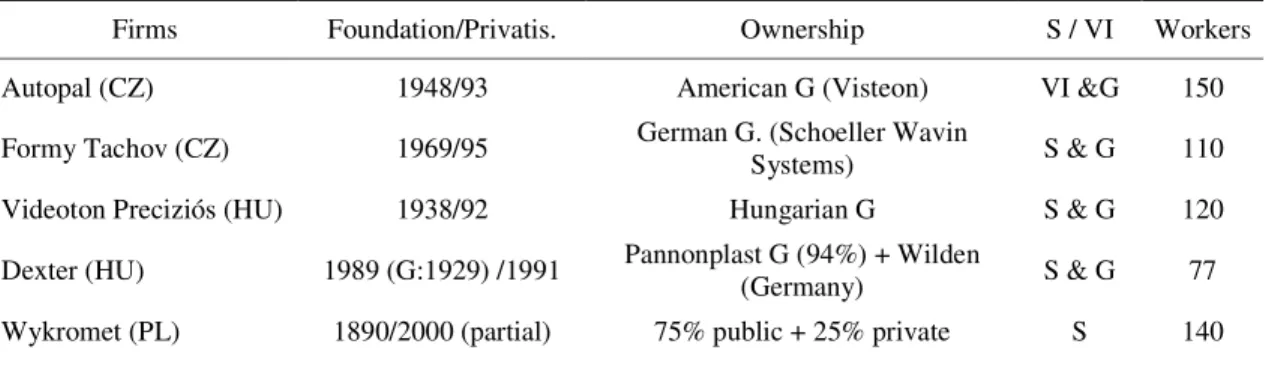
Table 1 Foundation and privatisation dates, Ownership and degree of vertical integration* Firms Foundation/Privatis. Ownership S / VI Workers Autopal (CZ) 1948/93 American G (Visteon) VI &G 150 Formy Tachov (CZ) 1969/95 German G. (Schoeller Wavin Systems) S & G 110 Videoton Preciziós (HU) 1938/92 Hungarian G S & G 120 Dexter (HU) 1989 (G:1929) /1991 Pannonplast G (94%) + Wilden (Germany) S & G 77 Wykromet (PL) 1890/2000 (partial) 75% public + 25% private S 140
Magic Systems (RO) 1992 (Moulds: 1997) Jv of romanians (25%) and one German VI 60 * Jv = joint-venture; G = Group of firms; S = specialised firm; VI= vertically integrated firm
First contacts were established by e-mail and phone, in which a short presentation of our project was included along with a request for a visit and interview that should take place between April and October 2003. Local institutions mediated most contacts contributing to the number of positive answers received.
Firms were visited after collecting and analysing the information available on the Internet. Interviews were semi-structured, based on questions previously prepared but leaving room for exploring issues that were raised during the interview. Besides gathering basic information on firms (shareholder structure, number and types of equipment and software used, number and qualification of human resources, dimensions and complexity of mould produced), particular attention was paid to customers and the relationship each firm was developing with its customers (what type of customers do these firms have, since when, the kind of services firms have been supplying to customers from the beginning of the relationship, customer’s requests they have not been able or willing to satisfy, etc). To collect this information a team of interviewers took a detailed tour of the production and engineering departments of each firm, followed by a long meeting with the owner(s) or the general managers of the firm and also with people in charge of sales: between 2 and 5 people were interviewed in each firm. The team included a researcher from the university, the general secretary of Cefamol and at least one manager of a Portuguese mould-making firm able to evaluate the technology available in each firm in order to take advantage of complementary knowledge and experience from the academic and business communities. After each interview the team compared and discussed the impressions of the field and the notes taken; a report of the interview and a list of information collected were then prepared. Missing information was filled through e-mails (Yin, 1994).
Each interview was object of an analysis and interviews were compared along a series of dimensions identified in the literature review, looking for similarities and differences in the form relationships were established; patterns concerning the evolution of relationships with customers, especially foreign affiliates in the domestic market and customers located in foreign countries, were also investigated (Miles and Huberman, 1994).
Case studies
Under socialist regimes most firms in CEE were vertical integrated (VI) and their tool department supplied all the means needed for production. Hence, a firm normally produced different tools: tools for pressing, stamping or punching, dies for drawing or extruding metal and moulds for a variety of materials, including plastic. In some CEE countries there were already a few small private firms selling to public firms or to final customers.
After economic transition large state-owned firms soon discovered they were not competitive. Many VI firms were organized in departments that were incorporated and included in privatization programmes. However a few firms were privatised as a whole. Former employees benefited from preferential clauses in privatisation and were able to acquire some firms; private investors, including foreign affiliates and even CEE emigrants that returned to their countries of origin after the political changes, bought others. Most of these new owners have already some professional experience in tool making or in customer industries. Several firms were organized in groups, both multinational and domestic. At the same time some private firms were established Greenfield by local or foreign entrepreneurs. These firms could profit from the large supply of industrial facilities and specialised labour that resulted from privatization programmes and industrial restructuring.
Since privatisation in 1993 Autopal (founded 1948) is the wholly-owned Czech subsidiary of Visteon Corporation, a leading global automotive supplier that in 2000 completed its spin-off from Ford. Being a leading exporter in the Czech Republic it exports lighting, climate control and engine cooling components to 73 plants in 22 countries on five continents. Carmakers in Germany, France and Great Britain- Aston Martin, Audi, Citroen, Fiat, Ford, Jaguar, Peugeot, Porsche, Renault, Seat, Skoda Auto, Volkswagen, and Volvo- are its biggest customers; part of production also goes to customers in the USA. The Autopal Lighting Technical Centre, in Nový Ji ín (CZ) is the Visteon centre of excellence for lighting systems. Capabilities include prototyping solutions, as well as program management and product development expertise for all Visteon front and rear lighting applications in Europe.
Autopal’s tool room was established in 1948 to produce stamping dies for Tatra Skoda, a company producing buses and tractors and VAZ, a former soviet automotive company. After 1978, the production of dies reduced and the company started to build injection moulds for the same companies and also for Skoda plants in the actual Slovakia. Presently the tool room employees 150 workers that design, produce and test moulds (65% of total sales), progressive stamping dies (20%) and Fixtures (15%); in addition to the tools, customers can buy the production of parts in one of the Autopal’s plants. 80% of tools produced are supplied to Autopal plants or other firms within the Visteon/Ford universe: it started by supplying Ford affiliates in CEE and then exported to Visteon in Mexico, United Kingdom and France; nevertheless exports account for just 20% of sales. Although it is producing mainly for internal use, the tool room is competing with external suppliers for orders. At the same time, Autopal has been able to continue the relationship with Skoda, that has introduced the company to its new owner VW. Presently Skoda/VW and PSA are among Autopal’s important customers. Autopal looks for customers exterior the group and from different
industries. The integration in Visteon facilitates the establishment of contacts with new customers that are invited to visit the firm.
Table 2 – Autopal main customers of moulds in the Automotive industry
Customers Countries ALBA Hungary Ford PSA A. Raymond VDI Nitra Visteon Charleville VW Skoda Jaguar Hungary Several countries Several countries n.a. Slovakia France
Czech Republic and other countries United Kingdom
As regards CAD (Computer Added Design) softwares and equipment to mould production Autopal is an up-to date company. It values the possibility of subcontracting work, whole moulds or some components, to tool producers located in a 50Km distance. Even if there are many tool producers in the Czech Republic, only a few (around 10) have the capacity to produce medium sized moulds (between 6 and 12 tons) to the automotive industry and Autopal has close relationships with these firms: they meet regularly to exchange information on technology and market trends.
Formy Tachov (Czech Republic)
Founded in 1969, Formy Tachov supplied moulds for a diversity of industries such as automotive (Skoda), crates (Appolinaris and Prague Breweries), technical components for the electric appliances and consumer electronics industry (Tesla, ETA-Hlinsko) and households. In 1995 Schoeller Arca Systems International Systems GmbH, German logistic and transport Group, bought Formy from Strojplast. This explains that moulds for bottle crates and other transport packaging account for 35% of total sales; these are exported to the parent company
and to its customers located all over the world. Formy also keep on supplying crates to its former owner, Strojplast, and to Novoplast.
As far as the rest of production is concerned, the automotive industry accounts for 45% of sales. Despite the privatisation of both Skoda and Formy, they have been able to maintain a relationship that started in the early 1970s. Today Formy is supplying many other automotive companies and their suppliers. The high volume of foreign investment in injection moulding in the Czech Republics and Hungary has increased the demand for repair and maintenance services since many foreign affiliates do not have a tool department. Even if they bring mould from their western operations or import new moulds, they still have to outsource repairs and maintenance to local mould producers like Formy. This has been very useful to establish the first contacts with potential customers and show them the technical capacities of the firm; being a Skoda supplier also helps in this process. Some of these foreign affiliates have started to order moulds from Formy. Prices are the major problem since foreign customers expect prices to be at least 30% lower in the Czech Republic as compared to Germany.
Table 3 – Formy Tachov main customers in the Automotive industry
Customers Country
BTV plast
EuWe Eugen Wexler
Kendrion systems Wachtersbach Peguform Bohemia
Robert Bosch Stomak Bohemia
Faurecia Innenraum Systeme Kendrion Systems Bohemia
OLHO-Technik Oleff & Holtmann OHG Pegufrm GMbH
Rahau GmbH
Thomas Schroder Industrievertretungen De Hann Metaaltechniek Czech Rep. Czech Rep. Czech Rep. Czech Rep. Czech Rep. Czech Rep. Germany Germany Germany Germany Germany Germany Netherlands
As a result Formy values having customers from different industries and takes advantage of its long experience to keep on supplying moulds to customers from the electric, consumer electronics and household industries. Nevertheless, relationships with customers in these industries are not always long-term.
Table 4 – Formy Tachov customers in other industries
Customers Country Industry
Black & Decker
Ejot Kunststofftechnik Dozwill AG Samsonite Europe N.V.
Danfoss A/S
Centrotherm Abgastechnik NINKAPLAST GmbH
Protec KAbel Produktion GmbH SGT Spritzgiesstechnik GmbH TTF Thermoplast Technik Wekutec GmbH Hauroton GmbH TeeJet Technologies BV IdeePro GmbH Markutec GmbH
Pagette Sanitar Produktions-u-vertriebs Vermop Salmon Czech Rep. Czech Rep. Belgium Denmark Germany Germany Germany Germany Germany Germany Belgium Germany Germany Germany Germany Germany Technical compon. Technical compon. Technical compon. Technical compon. Technical compon. Technical compon. Technical compon. Technical compon. Technical compon. Technical compon. Other Other Other Other Other Other
Formy, certified according to ISO 9001: 2002 has modern production equipment and Cad software. Since 2000 it has been investing in a major reinforcement of machinery, equipment, CAD software, electronic management and production planning system. Formy has been expanding its production capacities to be able to produce bigger moulds.
Formy subcontract some parts and components to smaller companies. It exchanges information and meets informally with other mould producers, namely those supplying the automotive industry.
Founded in 1938 and nationalised after the war Videoton gradually developed into the biggest state owned firm in Hungary, supplying consumer electronics (TVs, radios and cassette players), computer and defence electronics to COMECON markets. All these products required a variety of tool- moulds, dies and stamping devices – produced inside the company. Privatisation of the VI firm was initiated in 1991 and Hungarian investors that become actively involved in its management bought the firm. They decided to retreat from being producers of final products to become a Contract Electronics Manufacturer (CEM), because this was a rapidly growing activity, expanding from the USA to Europe. Today it is the largest independent CEM in the CEE region, its in TOP 30 worldwide, and TOP 10 in EU (www.mfgmkt.com). Business partners include European OEMs (e.g. Philips, Valeo) as well as Japanese and US multinational OEMs. In addition to global CEM services these MNCs cooperate with companies operating on a regional basis, such as Videoton, that can offer classical manufacturing services, along with full-scale supply chain management, back-end technologies and engineering services (Radosevic and Yoruk, 2000).
Since 1992 Videoton is organised as an holding company with a 100% stake in most of its 30 member companies (subsidiaries, associates or joint ventures), including Videoton Precision Ltd (VP), the biggest tool manufacturing company of Hungary with 120 employees. It also includes 2 other tool making companies, in Kaposvár (HU) and in Bulgaria (result of an acquisition of state-owned DZU, in 1999). Using the same 3D software (Pro-engineering, AutoCad) for design and programming the 3 companies can co-operate with each other, taking advantage of similarities and differences in equipments. These 3 companies form the biggest tool manufacturing capacity under the same control in CEE.
Even if only 5 to 10% of tools produced by VP are sold to other firms of the group, their engineering and tool making capacities are key to Videoton’s strategy of increasing the range and added-value of services provided to customers. At the same time, other firms of the group
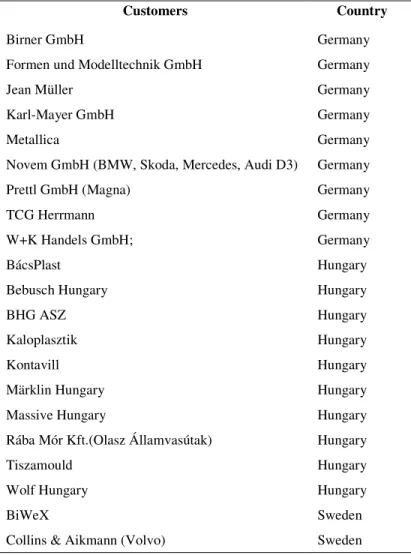
and Videoton representative offices in Germany and Sweden have referred many customers to VP. Additionally, the fact that Videoton is active involved in developing industrial parks in same of its industrial locations and it helps foreign firms during the entire process of setting up business in those parks, further enhance interaction between the group and foreign partners: VP and 60 other firms (21 foreign) are located in the same industrial park. Also, VP is a regular presence at international trade fairs like Fakuma - International Trade Fair for Plastic Processing that takes place, every two years, in Germany. More than 60-years experience in tool manufacturing and integration in a major regional player such as Videton are good references of the firm’s capacities and reliability as a business partner to multinational customers (table 5). Between 60% and 70% of production is exported.
Table 5 – Videoton Precision main customers
Customers Country
Birner GmbH Germany
Formen und Modelltechnik GmbH Germany
Jean Müller Germany
Karl-Mayer GmbH Germany
Metallica Germany
Novem GmbH (BMW, Skoda, Mercedes, Audi D3) Germany
Prettl GmbH (Magna) Germany
TCG Herrmann Germany
W+K Handels GmbH; Germany
BácsPlast Hungary
Bebusch Hungary Hungary
BHG ASZ Hungary
Kaloplasztik Hungary
Kontavill Hungary
Märklin Hungary Hungary
Massive Hungary Hungary
Rába Mór Kft.(Olasz Államvasútak) Hungary
Tiszamould Hungary
Wolf Hungary Hungary
BiWeX Sweden
INM Plast Sweden
Nolato Sweden
Collins & Aikmann (Land Rover) United Kingdom
VP acknowledges that technological development in the area of tool manufacturing has benefited from the contribution of customers such as Akai, Kenwood, Plastro M and Starmix. The company has obtained ISO 9001:2000 quality certification and ISO/TS 16949/2000. Dexter (Pannonplast group – Hungary)
Pannonplast, founded in 1929, nationalised after the War and privatised between 1991 and 1994, is a leading plastic packaging manufacturer group in Hungary. It includes other industrial activities, such as technical plastics where parts for electronics, automotive and household appliances are produced. In 1989, Hewlett-Packard (HP) wanted to transfer the production of plastic parts for printers from Spain to Hungary and asked Pannonplast to supply both the parts and the moulds. Since Pannonplast had no tool production expertise, HP suggested a joint-investment with its supplier of moulds, a Portuguese firm from Marinha Grande. This firm was not willing to invest in Hungary therefore, a joint venture was established with Wilden AG, a german partner that contributes with its know-how in mould production and a minority stake of 2,5% in the capital of Dexter; 94% are owned by Pannonplast. Dexter employs 80 people and uses advanced CAD-CAM systems and the latest CNC-controlled manufacturing equipment to produces high-precision tools, up to 10 tons. It is certified according to ISO 9001:1994.
Although it is part of a plastic group, the majority (85%) of moulds are exported to customers external to the group, including its partner Wilden. This is a result of most foreign affiliates only transferring plastic injection to Hungary, sending the moulds from western locations. Nevertheless, several customers, such as Magyar Suzuki come to Dexter through referrals from other firms of the group. Other customers come through a commercial agent of the
group Pannonplast in Germany and through a long lasting relationship with a commercial office in Belgium. Most customers are multinational companies and their affiliates (table 6).
Table 6 – Dexter main customers
Automotive industry Other industries
FWB (Hella, Johnson Controls, Donelly ) Germany Filterwerk Mann+Hummel GmbH Germany Mahle Filtersysteme GmbH Germany
DST Draexlmaier Systemtechnik GmbH Germany Sarnatech Paulmann&Crone GmbH Germany Delphi, Packard Electric Germany
ITT Germany
Loranger Ipari Kft. (Ford) Hungary Magyar Suzuki Hungary
Prettl Kabelkonfektion GmbH (Bosch) Hungary Knorr-Bremse Hungary
Visteon (Ford Hungária Ltd.) Hungary Visteon/Plastic Omnium (Toyota) France
Grundfos S.A. -France -Engineering plastics HPL Hydrauplast -France -Engineering plastics Injecto Mold, Inc. -USA -Engineering plastics Laing Pipe Kft. -Hungary -Engineering plastics Oskar Voltz -Germany -Engineering plastics BielsteinerVerschlusstechnik -Germany -Cosmetics Pannonpipe Plastics Ltd. -Hungary -Infrastructure Tungsram Schréder Lighting Equipm. Ltd. -Hungary Wilden AG. -Germany - Medical industry
HTM Tyrolia Sport-und F. -Austria -Sport & Leisure LMM Kft. (Lego) -Hungary -Toy industry
Households Consumer electronics and electronic
Braun GmbH -Germany Plastconsult -Germany
Pöppelmann GmbH & Co. -Germany Joh. Panick GmbH & Co. KG -Germany Curver/Rubbermaid Europe S.A. -Netherlands Frigidaire Home Products (Electrolux) -USA Lehel/Electrolux -Hungary
Pestorp -Austria Saunier Duval –France
Nolato-Protec Kft. (Philips) -Hungary General Plastics (Philips) -Hungary
Rejlek Metal & Plastics Group (Philips)- Austria Perlos oy -Finland
Hewlett Packard -Spain ; Amag N. V. -Belgium Ganz Kapcsoló -Hungary GE Lighting -Spain IBK GmbH -Germany
Dexter treat customers as partners with which it develops long-term relationships based in answering their requests in a systematic, precise and reliable way. It is able to provide customers a full service package including product development, design and production of many complex tools, processing of metal and plastics and part assembly. This explains some customers have come to Dexter after referral from other customers.
Wykromet (Poland)
Founded in 1890 in Czestochowa, Poland, Wykromet was the main supplier of FSM – one of the 2 automotive producers in the country. In 1992 FIAT acquired FSM and started to import all the tools, leaving Wykromet, with its 1.300 workers, without customers. The firm went through a profound industrial restructuring that lead to partial privatisation in 2000. Presently Wykromet employs 140 workers. The firm needs to modernise its machinery and equipment and has already obtained some finance from the state. Simultaneously, it is looking for ways to use all the industrial facilities left empty after restructuring and it is open to partnerships. During industrial restructuring former workers founded 20 spin-offs. Wykromet cooperates with the spin-offs, using them as suppliers of tool components and even whole tools.
Finding new customers was the top concern of Wykromet. In Poland it approached local firms taking advantage from a large and well-known experience in the automotive industry and from having equipments to produce both injection moulds for plastic rubber and metal and stamping tools up to 10 tons. There are many mould producers in Poland but few have these capabilities. As a result Wykromet was able to start selling moulds to some local firms that were mainly producing to the domestic market and other Eastern countries. Additionally, the managers used their network of personal contacts, both in Eastern and Western Europe to find customers. Before economic transition, the workers of public firms in CEE tend to meet in several occasions: in meetings organized by suppliers of machines or software, in negotiations held by the government for big purchases of mould and tools, in professional training actions
or when working abroad. The participation in some of these activities was restricted to CEE firms but in other occasions some western firms were also invited to participate. After transition the partners and managers of CEE privatised firms have used these relationships whenever they need to find orders to fill the production capacity or to get information about new technologies and suppliers.
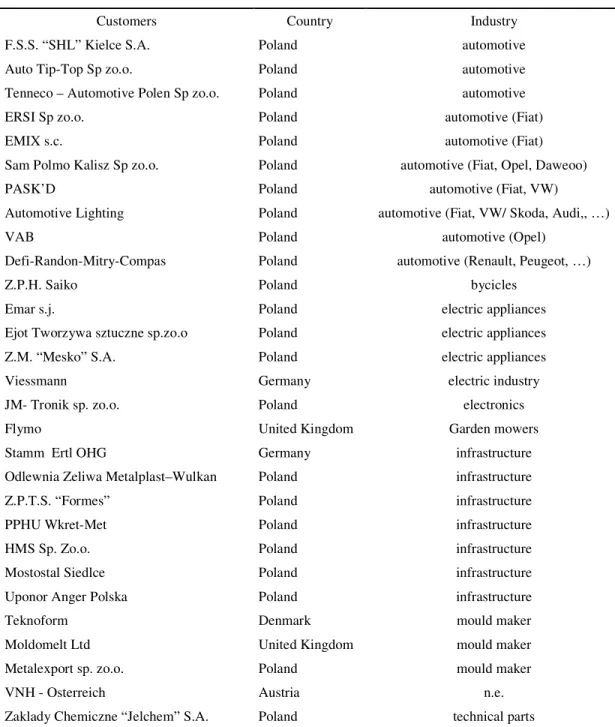
Table 7 – Wykromet main customers
Customers Country Industry
F.S.S. “SHL” Kielce S.A. Poland automotive
Auto Tip-Top Sp zo.o. Poland automotive
Tenneco – Automotive Polen Sp zo.o. Poland automotive
ERSI Sp zo.o. Poland automotive (Fiat)
EMIX s.c. Poland automotive (Fiat)
Sam Polmo Kalisz Sp zo.o. Poland automotive (Fiat, Opel, Daweoo)
PASK’D Poland automotive (Fiat, VW)
Automotive Lighting Poland automotive (Fiat, VW/ Skoda, Audi,, …)
VAB Poland automotive (Opel)
Defi-Randon-Mitry-Compas Poland automotive (Renault, Peugeot, …)
Z.P.H. Saiko Poland bycicles
Emar s.j. Poland electric appliances
Ejot Tworzywa sztuczne sp.zo.o Poland electric appliances Z.M. “Mesko” S.A. Poland electric appliances
Viessmann Germany electric industry
JM- Tronik sp. zo.o. Poland electronics
Flymo United Kingdom Garden mowers
Stamm Ertl OHG Germany infrastructure
Odlewnia Zeliwa Metalplast–Wulkan Poland infrastructure
Z.P.T.S. “Formes” Poland infrastructure
PPHU Wkret-Met Poland infrastructure
HMS Sp. Zo.o. Poland infrastructure
Mostostal Siedlce Poland infrastructure
Uponor Anger Polska Poland infrastructure
Teknoform Denmark mould maker
Moldomelt Ltd United Kingdom mould maker
Metalexport sp. zo.o. Poland mould maker
VNH - Osterreich Austria n.e.
The firm has also a regular participation in Plastpol, the largest plastics trade fair in Eastern Europe, organized in Kielce, Poland, since 1997. It attracts hundreds of exhibitors from different countries and is visited by thousands of potential customers. Wykromet established contacts with foreign affiliates located in Poland, which along with reference from customers lead to some initial orders. One customer lead to another and today Wykromet is again supplying Fiat Auto Poland through a series of Tier 1 suppliers (Table 7). Contacts in Plastpol were also on the basis of exports to England and Denmark. These were significant during a time but more recently the percentage of export on sales has gone down to 20% due to the sharp increase in the local demand for moulds – especially from the growing number of foreign affiliates located in the country10. A number of former foreign customers still buy the moulds from Wykromet but leave them in Poland, where they have moved the injection. Magic Systems, S.A. (Romania)
Magic Systems, S.A., a Romanian firm was founded in 1993 by 3 Romanians, one of which has German citizenship, to supply 3D animation, digital video and technical computing solutions. In 1997 it acquired the tool shop of a public company that used to produce tractors. The original idea was to offer CAD/CAM services to customers and to produce tools for thin wall packaging used in the main business activity. However this led to the development of a specific know-how and attracted customers that were looking for local suppliers.
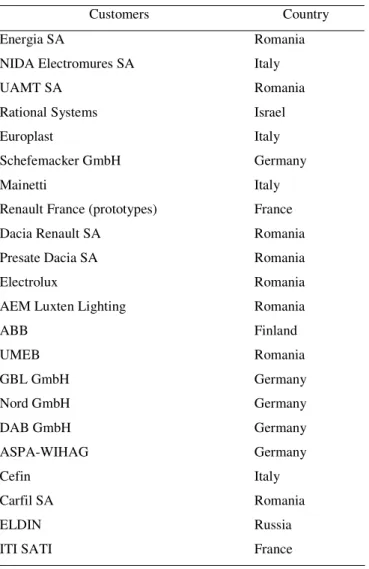
In 2000 Dacia-Renault challenged the company to develop CAD/CAM solutions for stamping and to invest in moulds for plastic injection and since then a straight relationship has been developing between the two firms; Magic Systems is already supplying prototypes to Renault France. The same has happened in the relationships with Autoliv, the worldwide leader in automotive safety systems with plants in Romania and other CEE (Czech Republic, Estonia, Hungary and Poland).
One customer has led to another and in a few years the company has grown from 20 to 60 workers. Only 25% of sales are exported due to the increasing demand for moulds in Romania. Today Magic Systems has the internal capabilities to offer a complete service to customers starting by product development, digital mock-ups, process simulations, moulds for plastic injection, other tools and also maintenance and training services.
Table 8 – Magic Systems main customers
Customers Country Energia SA NIDA Electromures SA UAMT SA Rational Systems Europlast Schefemacker GmbH Mainetti
Renault France (prototypes) Dacia Renault SA
Presate Dacia SA Electrolux
AEM Luxten Lighting ABB UMEB GBL GmbH Nord GmbH DAB GmbH ASPA-WIHAG Cefin Carfil SA ELDIN ITI SATI Romania Italy Romania Israel Italy Germany Italy France Romania Romania Romania Romania Finland Romania Germany Germany Germany Germany Italy Romania Russia France Discussion
Mould makers in CEE have a diversified set of customers. This is quite common in this business since moulds are tools used in any industry that incorporates plastic components. Therefore, mould makers tend to integrate several GVC simultaneously. The fact they
produce dies and stamping tools, along with moulds, is not as frequent but it is easily explained by their background in socialist times.
The main focus of this paper was to study the forms used by CEE firms to initiate relationships with customers, after economic transition to market economies.
Table 10 – Forms used to establish relationships with new customers
Firms Forms used to establish relationships with new customers:
Autopal (CZ) -internal customers (Visteon); -maintain relationships with former customers; - approach foreign affiliates present in the country and invite customers to visit facilities, benefiting from Visteon reputation.
Formy Tachov (CZ) -internal customers (Scholer Arca Systems); -maintain relationships with former customers and take advantage of these customers new network of relationships after privatisation; -contacts that result from provision of repair and maintenance services to foreign affiliates locates in the country.
Videoton P. (HU) internal customers (Videoton); customers referred by other companies of the group; -representative offices of the group; -proximity to foreign affiliates located in the industrial parks developed and managed by the group; -receive contacts from local customers benefiting from reputation of being integrated in major regional player; -exhibition in an international trade fair.
Dexter (HU) -internal customers (Pannonplast); -customers referred by other companies of the group; -referrals from customers - commercial agents from the group; -long-term relationship with a commercial company.
Wykromet (PL) -leverage on experience and local reputation to attract local customers (polish firms and foreign affiliates); -personal networks of managers and private owners; - exhibition inn a domestic trade fair.
Magic Systems (RO) -internal use; -answer to challenges of local foreign affiliates; -referrals from customers.
None of the firms studied revealed to have a planned commercial strategy, preceded by a detailed study and approved by the top management. Top management very often handled relationships with customers, using a large variety of ways to find new customers. Traditional commercial and marketing initiatives, such as a regular presence in domestic and international trade exhibitions of equipment and plastic producers was only mentioned by two of the firms studied and each of these firms was only participating in one exhibition. Firms justify being
absent from trade exhibitions because it was expensive and unnecessary since orders from regular customers were enough to occupy their production capacity. This was not always confirmed by what we saw during the visit to the production floor. Simultaneously, almost all firms had commercial brochures and websites but with the exception of Formy Tachov, these have very limited information regarding mould making. In short, commercial function was largely under-developed in the firms studied, at least as far as mould making was concerned. Partial or total acquisition by foreign firms was the quicker form of being integrated in the GVC of the new owners. This integration was more pronounced in the case of Autopal and less in the other 3 acquisitions. In any case, being part of a group has revealed to be an important facilitator of contacts with new customers through a diversity of forms: other firms of the group, especially those supplying plastic parts, referred their customers to the mould maker; representative offices of the group in foreign countries were also able to find customers for moulds; and, at a more generic level the mould making company could benefit from the commercial efforts of other companies of the group and even from other activities, such as in the case of VT the building of industrial parks and the provision of set-up services to foreign affiliates entering CEE, which facilitated the establishment of relationships between VT and these firms. This illustrates the importance of intra and inter-firms relationships in the process of entering GVC, suggesting that the literature on cooperative advantage and buyer-supplier relationships in the automotive industry may contribute to a better understanding of these processes (Sako 1992; Nisiguichi, 1994; Dyer, 1996; Mudambi and Helper, 1998 ). Even though 5 of the firms studied were privatised (at least partially) during the 1990s, most of them were able to maintain the relationships with their former customers even though these were also privatised. In the case of Autopal and Formy Tachov, the fact Skoda was bought by VW has even enlarged the range of potential relationships. Wykromet tells a somewhat different story because it has lost its most important customer after the Italian Fiat acquired it.
Even so, after some years, the firm was able to recover the relationship with Fiat Auto Poland, supplying several of its Tier 1 suppliers. In a nutshell, relationships in this industry seem to be rather resilient; this is certainly a topic that deserve to be further explored in future research. Another interesting topic is the use of managers’ personal networks to find new customers, such as Wykromet did. Understanding the impact of personal networks developed before economic transition in the actual integration of CEE firms in GVC, comparing the chains that already existed before transition and the ones that emerged afterwards are just some of the issues that could benefit from the contribution of the literature on social and inter-firm networks (Granovetter, 1985; Burt, 1992; Larson, 1992; Uzi, 1996,1997; Nooteboom, 2004). Finally, industrial restructuring and the still increasing presence of foreign affiliates in CEE has lead to an increase in the local demand of maintenance and repair services and also of moulds that work in favour of local suppliers. Formy constitutes an interesting example of a company that have used the demand for repair and maintenance services from firms located in its neighbourhood to establish contact with potential customers and prove them it has the necessary technical competencies to be their mould supplier. Local content requirements in FDI support schemes financed by CEE governments and policies promoting clusters encourage relationships between foreign affiliates and local suppliers (OECD, 2005). The firms we have studied were particularly well positioned to take advantage of this situation since they have a large experience and well-established reputation. Privatisation favoured their industrial restructuring and modernisation, further strengthening their image. Ownership and/or trading relationships with multinationals are further contributions. As a consequence, these are likely to be among the favourite suppliers of foreign affiliates in CEE. And, a happy customer is likely to refer other customers.
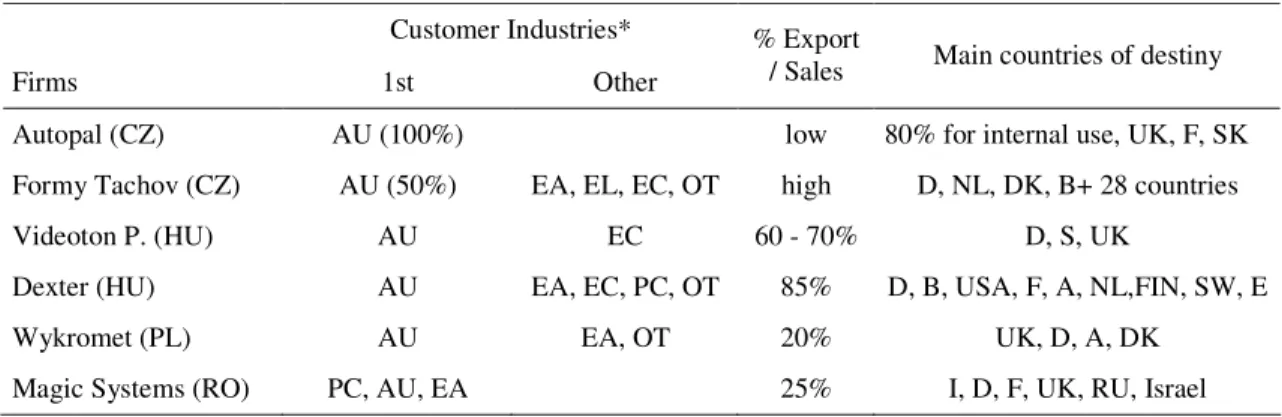
Automotive industry is the main customer of the six cases studies confirming ISTMA Europe - International Special Tooling & Machining Association – statement during its last meeting
in Brno, Czech Republic: “The current European moulds market is strongly linked to the automobile industry, and this is the dominant partner in all the represented countries.”11. Electric appliances, consumer electronics and households are other important customers.
Table 9 – Main customer industries and Export destinations
Customer Industries*
Firms 1st Other
% Export
/ Sales Main countries of destiny Autopal (CZ) AU (100%) low 80% for internal use, UK, F, SK Formy Tachov (CZ) AU (50%) EA, EL, EC, OT high D, NL, DK, B+ 28 countries
Videoton P. (HU) AU EC 60 - 70% D, S, UK
Dexter (HU) AU EA, EC, PC, OT 85% D, B, USA, F, A, NL,FIN, SW, E
Wykromet (PL) AU EA, OT 20% UK, D, A, DK
Magic Systems (RO) PC, AU, EA 25% I, D, F, UK, RU, Israel AU = Automotive; EA= Electric Appliances; EL = Electric; EC = Electronics; PC= Packaging; OT = Other In the automotive and electronics value chains, mould makers are generally supplying firms producing plastic components. Assuming these chains are organized in tiers of suppliers around an OEM, mould makers are very seldom Tier 1 suppliers and only a few are Tier 2. To be a Tier 1 supplier a mould maker must have engineering skills that enable an active involvement in product development with the OEM, production capacity to manufacture the plastic parts and to assemble these parts in modules or systems; as a result, only vertically integrated firms or those supplying smaller companies such as BMW may qualify as Tier 1. To be Tier 2 a mould maker must still have internal capacities (engineering and manufacturing) and dimension that make possible a direct relationship with a Tier 1 suppliers, often multinational firms like Delphi or Visteon. As a consequence most mould makers are further down the supply chain. As regards households and electric appliances, mould makers are more likely to have direct relationships with firms that develop and manufacture the final products, especially when these firms are smaller.
With the exception of Magic Systems, the firms studied are large mould-makers, comparing to the world average of 20 employees. Moreover, 4 of these firms are integrated in groups:
Autopal in a Tier 1 automotive multinational, Formy Tachov in a German based transport group, VP and Dexter in major CEE regional players. Ownership and dimension help to explain the composition of their customer portfolio. All the firms studied were supplying at least some Tier 1 foreign affiliates of multinational companies, confirming they are already well integrated in international automotive and electronic production networks. The degree of involvement in these GVC varies across firms. Naturally Autopal was mainly supplying these customers since it was automatically included in its parent company GVC. But even the smaller, independent Magic Systems managed to have Renault as a customer.
The importance of exports on total sales is variable among firms and in time because, as stated above, domestic demand is growing fast in many CEE countries fuelled by domestic and foreign investment, combined with local content requirements. Germany is the top export destiny, followed by UK, France, Italy, many other Western European countries and USA. The reduced number of CEE-owned firms in main customers’ lists of the firms studied, along with the fact relations with suppliers are essentially local and subcontracting is occasional , suggests that up to now CEE firms have been mainly integrating GVC organised around Western firms. Apparently, despite local policies encouraging clusters, especially in the automotive industry, the division of labour within CEE is still in its early stages and CEE multinationals are just emerging, at least in moulds’ customer industries. Nevertheless, as industrial restructuring proceeds, relationships between firms located in different CEE countries are likely to be more frequent and regional value chains may well develop. Wykromet mentioned to be supplying Polish firms that were trying to sell in Russia and other Eastern markets, trying to re-establish commercial relations broken during transition.
As far as upgrading is concerned investment in new machinery, CAD and production management programmes create the conditions for fast process upgrading. This is further supported by the reduction of lead times and the capacity to maintain price competitiveness
while wages and other costs are rising. Firms integrated in groups tend to have easier access to resources required for process upgrading. Other firms studied, such as Wykromet, lack the financial resourced to buy all the equipment needed to upgrade: its owners did not have the means, banks were reluctant to lend to local firms only a few well connected firm have been able to get EU money. In any case, most firms refer to the scarcity of human resources familiar with more recent technologies as the main obstacle to development. The bankruptcy of specialised training centres that existed in socialist times and the shortage of financing available to public technical schools, equipped with very old machines, seem to be major constraints to future growth. Trying to reverse this situation some firms are investing in local technical schools and offering their students scholarship and training.
The samples of plastic components produced with moulds supplied to each customer confirm the existence of durable relationships and product upgrading since increasingly more complex parts are ordered; the fact customers allow suppliers to include their names in commercial brochures and internet sites constitutes another proof of these relations. As relationships with customers developed, some of these start to challenge suppliers to develop their engineering capabilities in order not only to be able to develop and supply more complex tools (including rapid moulds and prototypes) but also to be able to play a future role in cooperative product development. In a way this could be considered functional upgrading, yet closely connected with product upgrading. Being vertically integrated, at least at the level of the group, enable firms to provide their customers moulds, pre-series, full series and in some cases even assembly; at the same time firms are able to provide customers maintenance and repair services even for moulds produced elsewhere. This does not mean, however, firms are able to cooperate in product development. In fact, the firms visited are experiencing difficulties in answering their customers requests since the type of competencies required take time to develop and there are few local partners they can rely on; despite public initiatives promoting
the development of local clusters, these are in a very embryonic phase. As a result, several firms are looking for foreign partners that could enable them to answer their customers’ requests faster. Even though some of the firms studied used to produce their own products during the socialist days, they have stopped doing so after transition either because they were disintegrated before privatisation or because their management has decided to do so; we have described the successful functional downgrading of Videoton into a CEM. There seems to be a downside to this strategy: the fact firms, even when integrated in groups, lost competencies in product development. Now they benefit from being close to several foreign affiliates that are looking for local suppliers and as a consequence are willing to contribute to their up-grading. The question remains, however, whether foreign affiliates will be willing to promote the development of vertically integrated firms/groups that may become future competitors. Mould-makers integrated in groups may benefit from the fact they are supplying different industries since they may use the knowledge developed in a particular chain to move into a different chain. We found no evidence of this movement in the firms studied but this could be researched in the future.
Several opportunities for Portuguese mould makers seem to result from this discussion. Local supply of more complex moulds and upstream engineering services appear to be scarce. Both customers and CEE mould makers are looking for suppliers and partners with the required competencies. There are a number of Portuguese mould makers with the adequate profile, which can be proved by the fact these firms are already supplying the same or similar customers in Western markets. Portuguese firms could leverage the long-term relations with some customers that invested in Eastern countries to enter these markets. In addition Portuguese mould makers know they could subcontract more simple moulds in Eastern Europe in order to increase their price competitiveness in orders that include several moulds
with different degrees of complexity. Finally, entering into CEE countries can be a significant step towards other Eastern countries with which CEE firms have good connections.
On the other hand, through these case studies, Portuguese mould makers confirmed not only that many of their customers are already buying moulds from CEE suppliers for sometime but also that they are contributing to the upgrading of these suppliers. Some Portuguese firms found evidence that some customers that have stopped buying certain types of moulds in Portugal (for example moulds for TV cases) are buying them in CEE. Moreover, there were significant signs of both process and product upgrading. Since local demand seems to increase faster than local supply, the export propensity of CEE mould-makers is decreasing. Nevertheless, some firms studied confirmed to have started exporting moulds through the reference of foreign affiliates located in their domestic market. This means CEE mould– makers are already competing with the Portuguese ones in some Western markets. Judging from the list of export destinations of the firms studied, they may be already competiting in the German market. Further research is needed to confirm these trends. It would be especially interesting to study foreign customers that are buying both in CEE and Portugal.
Other topics for future research have to do with the different internationalisation strategies available for Portuguese SME to take advantage of CEE markets potential and the main obstacles these firms might face in the process. The numbers of Portuguese mould makers selling, investing or developing other types of relationships with CEE markets is still very small. Nevertheless it would be interesting to study these cases and to compare them with case studies of mould makers from other countries (Spain) already present in CEE.
Bibliography
Bair, J. and Gereffi, G. (2001) ‘Local clusters in global chains: the causes and consequences of export dynamism in Torreon’s blue jeans industry’, World Development, 29 (11), pp 1885-1903.
Bazan, L. and Návas-Alemán, L., (2004) ‘The underground revolution in the Sinos Valley: a comparison of upgrading in global and national value chains’, in H. Schmitz (eds.) Local Enterprises in the Global Economy: Issues of Governance and Upgrading, Cheltenham: Edward Elgar, pp 110- 139.
Burt, R.S. (1992) Structural Networks: the social structure of competition, Cambridge: Harvard University Press.
Doz, Y. and Hamel, G. (1998) Alliance Advantage: The Art of Creating Value through Partnering, Boston: Harvard Business School Press.
Dyer, J.H. (1996) ‘ Specialized Supplier Networks as a source of Competitive Advantage: evidence from the auto industry’, Strategic Management Journal, 17: 271-291.
Eisenhardt, K. M. (1989) ‘Building Theories from Case Study Research’, Academy of Management Review, 14: 532-50.
Gereffi, G. (1999) ‘International trade and upgrading in apparel commodity chain’, Journal of International Economics, 48 (1), pp 37-70.
Gibbon, P. (2000), ‘Back to basics through delocalisation: the Mauritian garment industry at the end of the twentieth century’, CDR Working Paper 00-7, Copenhagen, Centre for Development Research.
Granovetter, M. (1973) ‘The Strength of Weak Ties’, American Journal of Sociology, 78, pp 1360-1380.
Granovetter, M. (1985) ‘Economic Action and Social Structure: the problem of embeddedness’ American Journal of Sociology, 91, pp 481-510.
Havlik, P., Landesmann, M, Romisch, R., Stehrer, R, Gillsater, B. (2001) ‘Competitiveness of Industry in CEE Candidate Countries’, Final Report, Vienna, The Vienna Institute for International Economic Studies (WIIW).
Hsing, Y.-Y. (1999) ‘Trading companies in Taiwan’s fashion shoe networks’, Journal of International Economics, 48 (1), pp 101-120.
Humphrey, J and Schmitz, H. (2000) ‘Governance and upgrading: linking industrial cluster and global value chain research’, IDS Working Paper 120, Brighton: Institute of Development Studies, University of Sussex.
Humphrey, J and Schmitz, H. (2000) ‘Governance in global chains’, IDS Bulletin 32 (3), Brighton: Institute of Development Studies, University of Sussex.
Humphrey, J and Schmitz, H. (2002) ‘How does insertion in global value chains affect upgrading in industrial cluster?’, Regional Studies, 36 (9), pp 1017-1021.
Humphrey, J and Schmitz, H. (2004) ‘Chain governance and upgrading: taking stock’, in H. Schmitz (eds.) Local Enterprises in the Global Economy: Issues of Governance and Upgrading, Cheltenham: Edward Elgar, pp 349- 381.
Ittner, T. and Wullenweber, J. (2004) ‘Tough times for toolmakers’, The McKinsey Quarterly, 2, pp 14-16.
Kaminski, B. and Smarzynska, B.K. (2001) ‘Foreign Direct Investment and Integration into Global Production and Distribution Networks: the Case of Poland’, Working Paper, New York: World Bank.
Larson, A. (1992) ‘Network Dyads in entrepreneurial Settings: A study of the Governance of Exchange Relationships’, Administraive Science Quarterly, 37 (1), pp 76-104.
Lung, Y. (2003) ‘The Changing geography of the European Automobile System’ Cahier 10, Bordeaux: Groupement de Recherches Economiques et Sociales, Université Montesquieu. Luthe, B. (2002) ‘Electronic Contract Manufacturing: Global Production and the International Division of Labor in the Age of the Internet’, Industry and Innovation, 9 (3), pp 227-247. Mudambi, R. and Helper,S. (1998), ‘The ‘Close but Adversia’ Model of Supplier Relations in the U.S. auto industry’, Strategic Management Journal, 19: 775-792.
Meyer, K.E. (2000) ‘International Production Networks and Enterprise Transformation in Central Europe’, Comparative Economic Studies, 42 (1), pp 135-150.
Meyer-Stamer J., Maggi, C., Siebel, S. (2001) ‘Improving upon nature: creating competitive advantage in ceramic tile clusters in Italy, Sapin and Brazil’, Report 54, Duisburg: Institut fur Entwicklung und Frieden, Gerhard Mercator University.
Miles, M.B. and Huberman, A.M. (1994) Qualitative data Analysis: an expanded sourcebook, Thousand Oaks: Sage Publications.
Nadvi, K. and Halder, G (2002) ‘Local clusters in global value chains: exploring dynamic linkages between Germany and Pakistan’, IDS Working Paper 152, Brighton: Institute of Development Studies, University of Sussex.
Nishigichi, T. (1994) Strategic Industrial Sourcing: The Japanese Advantage. Oxford, Oxford University Press
Nooteboom, B. (2004) Inter-firm Collaboration, Learning & Networks: An integrated approach, London: Routledge.
OECD (2005) Business Clusters: Promoting Enterprise in Central and Eastern Europe. Paris: OECD Publishing.