Universidade de Trás-os-Montes e Alto Douro
Movement synchronisation during training and
competition of elite footballers
Tese de Doutoramento em Ciências do Desporto
Candidato: Hugo Miguel Cardinho Alexandre Folgado
Orientador: Professor Doutor António Jaime da Eira Sampaio
Universidade de Trás-os-Montes e Alto Douro
Movement synchronisation during training and
competition of elite footballers
Tese de Doutoramento em Ciências do Desporto
Candidato: Hugo Miguel Cardinho Alexandre Folgado
Orientador: Professor Doutor António Jaime da Eira Sampaio
Composição do Júri:
Presidente: Professor Doutor Luís Herculano Melo de Carvalho
Vogais:
Professor Doutor António Jaime da Eira Sampaio
Professor Doutor Bruno Filipe Rama Travassos
Professor Doutor Pedro Tiago Matos Esteves
Professor Doutor Rui Marcelino Maciel Oliveira
AGRADECIMENTOS
Numa viagem, o caminho que percorremos é muitas vezes mais importante que o destino a que chegamos. A todos quantos fizeram parte deste meu percurso, o meu obrigado. A caminhada não termina ainda...
À minha mãe, por ter sempre depositado a maior das confianças em tudo quanto fiz. Por me ter ensinado que para colher, temos que semear. Ao meu pai. Que me passou o hábito de questionar e o carácter racional.
Aos meus irmãos, André e Miguel. Como somos melhor todos juntos! À Dora, pelo tempo que lhe roubei. Sei que estás sempre comigo...
Ao Luís Laranjo, ao Jorge Bravo e ao Ricardo Duarte, pela amizade e pelo companheirismo de sempre.
Ao Armando Raimundo, Nuno Batalha e José Marmeleira, por sempre terem acreditado e estimulado o meu trabalho.
Ao Orlando Fernandes, que me ensinou muito de Matlab, mas também que não há rotinas que nos organizem a vida...
À Guida Veiga, que tem partilhado comigo as angústias e sucessos deste processo. Faltas tu... A todos os restantes colegas do Departamento de Desporto e Saúde da Universidade de Évora. Tem sido uma caminhada larga desde 2001. Que o futuro traga ainda mais conquistas! A todos os colegas do CreativeLab, e em particular ao Bruno Gonçalves, por tão bem me saberem receber sempre que visito a UTAD. Esta tese faz muito mais sentido aqui!
À Faculdade de Motricidade Humana, pela colaboração e cedência pronta dos GPS para as nossas recolhas.
Ao Pedro Marques, pelo apoio que nos deu para chegarmos a estes dados. Mas também por toda a colaboração técnica e científica ao logo deste percurso.
A todos os meus alunos, principalmente aos que fazem perguntas para as quais não tenho resposta.
A todos os meus professores, por me mostrarem o caminho. Mas muito particularmente ao Professor Jaime Sampaio. Será sempre a referência neste mundo académico. Pela competência científica, mas acima de tudo pelas qualidades humanas. Obrigado por tudo!
ABSTRACT
Recent technology allows capturing football players’ positioning during the game with a high degree of accuracy. This information has provided relevant insights for performance analysis, particularly related to physical performance. Very scarce attention has been given to the interaction process between players within the game, or tactical behaviour, identified as an important football performance indicator. One possible method to assess this interaction process is to measure players’ interpersonal synchronisation, a characteristic present in several human behaviour manifestations. As such, the aim of this thesis was to understand the role of movement synchronisation in elite football performance. First, we addressed the methodological procedures for the study of players’ interpersonal coordination using Global Positioning System devices. The accuracy and error measured between two units positioned at a known distance was evaluated, followed by the calculating the relative phase of the units’ displacement. Results revealed the usability of these devices, based in adequate procedures. Afterwards, we assessed players’ movement synchronisation during matches, according to different factors – match final outcome; opposition level; and the number of days between fixtures. Positional data in these studies were collected using either GPS or semi-automatic video tracking systems. Players’ presented higher levels of movement synchronisation in winning matches. Similar results were observed when the team was facing higher-level opponents. A smaller interval between matches impaired players’ movement synchronisation results, with the evaluated team presenting a lower level of synchronisation during congested fixtures. Finally, players’ movement synchronisation was assessed in large-sided games, played during the first four weeks of the preseason. Players’ performance was compared according to the initial two weeks or the later two weeks training sessions. Results revealed a trend for a development of players’ movement synchronisation during the preseason. In conclusion our results support the use of players’ movement synchronisation as a tactical performance indicator, based on their interaction within the game, and able to depict performance variations during matches and training sessions.
Keywords: Performance analysis; tactical performance; match performance; synchronisation; football; team sports; GPS.
RESUMO
Os recentes desenvolvimentos tecnológicos permitem capturar as posições dos jogadores de futebol durante a sua prática, tanto em treino como em jogo, com um elevado grau de precisão e baseado em procedimentos simples. Esta informação tem proporcionado o acesso a conhecimento relevante para a análise da performance, particularmente relacionado com a performance física. Pouca atenção tem sido dada ao processo de interação que os jogadores estabelecem durante o jogo, ou comportamento táctico, identificado como um indicador de performance importante no futebol. Um dos possíveis métodos de controlo deste processo de interação é a medição da sincronização interpessoal entre os jogadores, uma característica presente em diversas manifestações do comportamento humano. Assim, o objectivo desta tese foi compreender o papel da sincronização de movimentos na performance em futebol de elite. Primeiro, foram abordados os procedimentos metodológicos para o estudo da coordenação interpessoal de jogadores através de aparelhos de Sistema de Posicionamento Global. Foram avaliados o grau de precisão e o erro medidos entre dois aparelhos colocados a uma distância conhecida, seguidos do cálculo da fase relativa entre o deslocamento dos equipamentos. Os resultados revelaram a possibilidade de uso destes aparelhos, baseado em procedimentos adequados. Seguidamente, avaliámos a sincronização do movimento de jogadores durante jogos, em função de diferentes factores – o resultado final do jogo; o nível da equipa opositora; e o tempo entre jogos. Os dados posicionais destes estudos foram capturados recorrendo ao sistema GPS ou a um sistema de captura de posicionamento semiautomático baseado em vídeo. Os jogadores apresentaram níveis mais elevados de sincronização do movimento quando ganharam. Resultados semelhantes foram observados quando uma equipa era confrontada com opositores de nível mais elevado. Um menor tempo de intervalo entre jogos reduziu os resultados da sincronização do movimento entre jogadores, com a equipa a apresentar valores de sincronização inferiores durante um período congestionado de jogos. Finalmente, a sincronização do movimento entre jogadores foi avaliada durante situações de treino baseadas em jogo, desenvolvidas durante as primeiras quatro semanas de treino do período preparatório. A performance dos jogadores foi comparada entre os treinos realizados nas duas primeiras semanas e os treinos realizados nas duas semanas subsequentes. Os resultados revelaram uma tendência para o desenvolvimento da sincronização do movimento entre jogadores durante o período preparatório. Em conclusão, os nossos resultados suportam o uso da sincronização do movimento entre jogadores como um indicador da performance
táctica, baseado na sua interação durante o jogo, e capaz de diferenciar variações de performance durante o jogo e o treino.
Palavras chave: Análise da performance; performance táctica; performance em jogo; sincronização; futebol; jogos desportivos colectivos; GPS.
LIST OF PUBLICATIONS AND COMMUNICATIONS
Peer-reviewed papers in international journals
Folgado, H., Duarte, R., Fernandes, O., & Sampaio, J. (2014). Competing with lower level opponents decreases intra-team movement synchronisation and time-motion demands during pre-season soccer matches. PLoS ONE, 9(5), e97145. doi:10.1371/journal.pone.0097145
Folgado, H., Duarte, R., Marques, P., & Sampaio, J. (Under Review). The effects of congested fixtures on tactical and physical performance in elite soccer.
In preparation
Folgado, H., Fernandes, O., & Sampaio, J. Accuracy and error measurements between individual GPS units - Methodological approach for working with GPS data in the analysis of players’ interpersonal coordination in team sports.
Folgado, H., Duarte, R., Marques, P., & Sampaio, J. Intra-team movement synchronisation as a measure of teams’ tactical performance in professional football
Folgado, H., & Sampaio, J. Physical, physiological and tactical responses to large-sided games during preseason of elite footballers.
Comunications
2012 – Lecture: “Métodos de tracking para o estudo do comportamento dos desportistas: o sistema GPS” at the Human Kinetics PhD course of the Faculdade de Motricidade Humana, Universidade Técnica de Lisboa.
2012 – Oral Presentation “A coordenação diádica intra-equipa durante o período preparatório e de acordo com o nível de oposição em futebol” at the seminar "O Comportamento Coletivo em Equipas de Futebol: Estudos e aplicações", during the XIII Jornadas da Sociedade Portuguesa de Psicologia do Deporto, at Universidade Lusófona de Humanidades e Tecnologias, Lisboa
2013 – Oral Presentation: “O Período Preparatório e Competitivo: Mitos e Realidades” at the seminar “O Dia do Futebol na FMH – A Teoria e a Prática no Futebol Profissional”, organized by the Faculdade de Motricidade Humana, Universidade Técnica de Lisboa.
ÍNDICE GERAL
Agradecimentos ... III Abstract ... IV Resumo ... V List of Publications and Communications ... VII Índice Geral ... IX List of tables ... XII List of figures ... XIII
1. General Introduction ... 1
Performance analysis in football ... 1
Physical performance in football ... 1
Tactical performance in football ... 3
Synchronisation ... 4
Measuring synchronisation in football ... 5
Thesis outline ... 6
References ... 9
2. Accuracy and error measurements between individual GPS units - Methodological approach for working with GPS data in the analysis of players’ interpersonal coordination in team sports ... 12 Abstract ... 12 Introduction ... 13 Methods ... 14 Results ... 17 Discussion ... 20 Conclusion ... 22 References ... 23
3. Intra-team movement synchronisation as a measure of teams’ tactical performance in professional football ... 25
Abstract ... 25
Introduction ... 26
Results ... 29
Discussion ... 33
Conclusions ... 35
References ... 36
4. Competing with lower level opponents decreases intra-team movement synchronisation and time-motion demands during pre-season football matches ... 38
Abstract ... 38 Introduction ... 39 Methods ... 41 Results ... 44 Discussion ... 49 Conclusions ... 52
5. The effects of congested fixtures on tactical and physical performance in elite football. 56 Abstract ... 56 Introduction ... 57 Methods ... 59 Results ... 62 Discussion ... 67 Practical Applications ... 69 Conclusions ... 70 References ... 71
6. Physical, physiological and tactical responses to large-sided games during preseason of elite footballers. ... 74 Abstract ... 74 Introduction ... 75 Methods ... 78 Results ... 80 Discussion ... 84 Conclusion ... 87 References ... 88 7. General Discussion ... 91 Overview ... 92
Practical applications ... 96 References ... 99
LIST OF TABLES
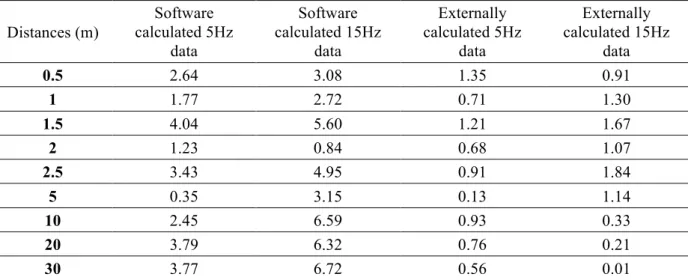
Table 2.1 Overall RMSE results for both GPS models at a static position by distance and type of data treatment. ... 18 Table 2.2 Overall RMSE results for both GPS models while in motion at a walking speed by distance and type of data treatment. ... 18 Table 4.1 Total distance covered (m) and distance covered at several intensities by opposition level. ... 44 Table 5.1 Total distance covered (m) and distance covered per speed categories according the number of days since the previous fixture. ... 62 Table 6.1 Physical and tactical variables comparison by training period ... 81 Table 6.2 Physical variables comparison by position ... 82
LIST OF FIGURES
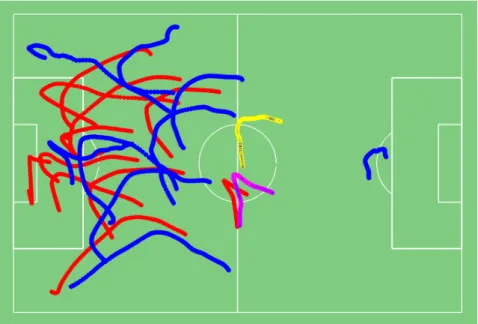
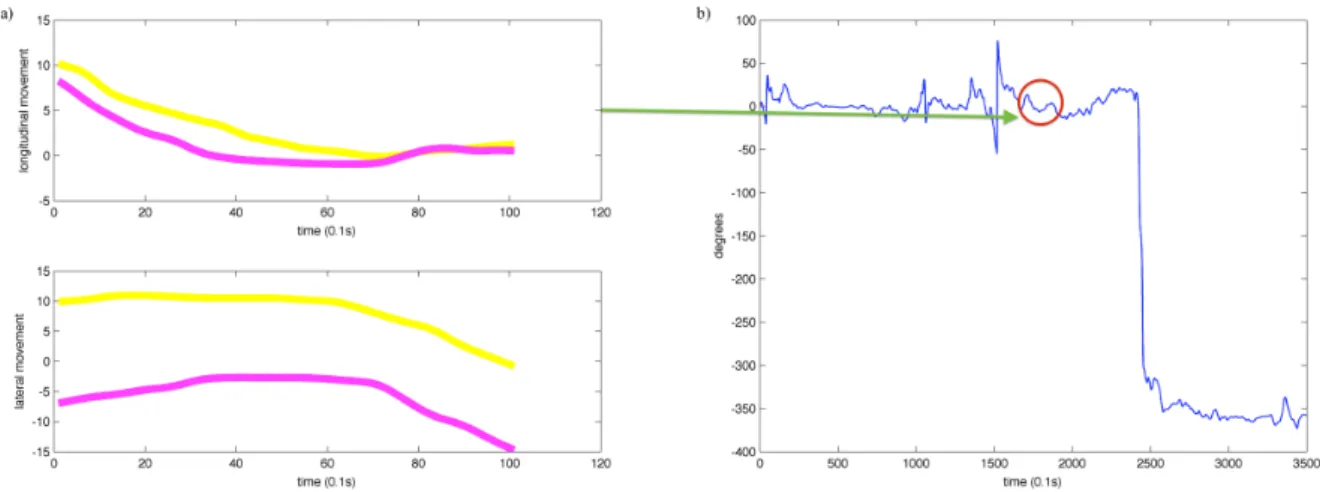
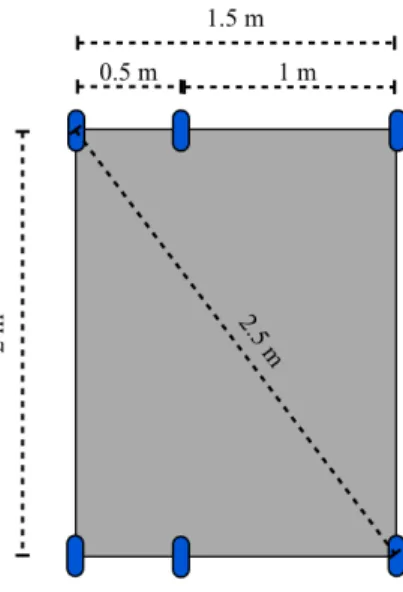
Figure 1.1. Players’ movement during 10 seconds of a match. The central defenders presented in different colours will serve for synchronisation procedures exemplification. ... 5 Figure 1.2 Central defenders movement in the longitudinal and lateral axes from the previous presented situation (a) and longitudinal relative phase results between these players, highlighting the correspondent time (b). ... 6 Figure 2.1 Schematic representation of the custom trolley build for GPS accommodation and predetermined distances between units. ... 15 Figure 2.2 Schematic representation of the course used for the small distances data collection.
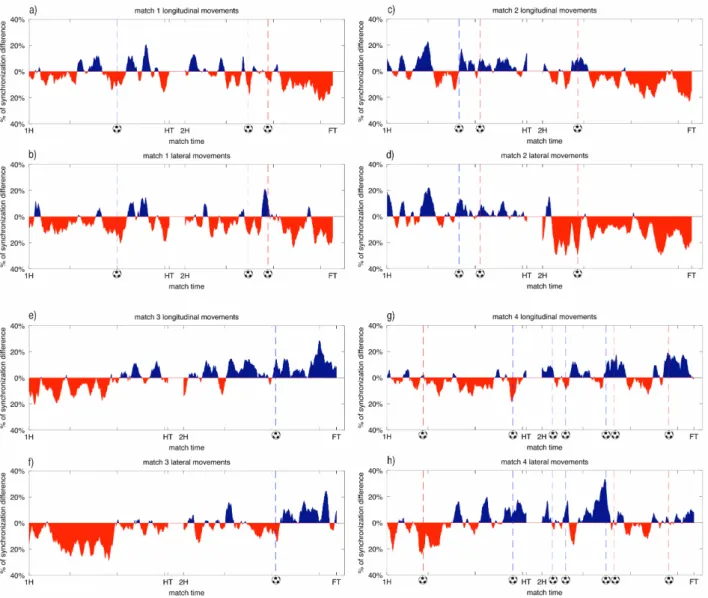
... 15 Figure 2.3 VAF results for both GPS models in static (a) and in motion (b) conditions, by distance and type of data treatment. ... 19 Figure 2.4 Relative phase results for 5Hz (a- longitudinal; b- lateral) and 15Hz GPS model (c- longitudinal; d- lateral) by type of data treatment. ... 20 Figure 3.1 Pairwise comparison of longitudinal and lateral intra-team movement synchronisation between opposing teams. ... 30 Figure 3.2 Synchronisation results difference between opposing teams during the lost (panels a, b, c and d) and won matches (panels e, f, g and h), for each displacement axis, in a moving window of two minutes. The analysed team is displayed by the blue colour and the opposing teams are displayed by the red colour. Traced vertical lines represent the goals of each team. ... 31 Figure 3.3 Pairwise comparison of longitudinal and lateral intra-team movement synchronisation between offensive and defensive positions dyads. ... 32 Figure 4.1 A rotation matrix was calculated from the field vertices and applied to the players’ positions, rotating the data through an angle θ in order that the longitudinal displacements were aligned with the x-axis and the lateral displacements were aligned with the y-axis. ... 42
Figure 4.2 Standardised effect sizes and 95% CI of pairwise differences between opposition levels for time motion (a) and intra-team synchronisation (b) variables. Positive values represent superior results in matches opposing the higher-level team. ... 45 Figure 4.3. Percentage of time of dyadic synchronisation according to the opposition level. a) Longitudinal and b) lateral displacements for the whole analysed half and by different movement speed categories. *: Significant differences at p<0.05 ... 46 Figure 4.4 . K-means clustering of players’ according to the percentage of time of dyadic synchronisation. a) Longitudinal and b) lateral displacements of defenders (D), midfielders (M) and forwards (F). Solid lines represent the higher synchronisation group; dashed lines represent the intermediate synchronisation group; dotted lines represent the low synchronisation group. ... 47 Figure 4.5 Clustering groups’ percentage of time of dyadic synchronisation according to the opposition level. a) Longitudinal and b) lateral displacements. Solid lines represent the higher synchronisation group; dashed lines represent the intermediate synchronisation group; dotted lines represent the low synchronisation group. *: Significant differences at p<0.05 ... 48 Figure 5.1 Percentage of time of dyadic movement synchronisation for the whole match and by different speed categories, according to the fixtures periods – a) longitudinal; b) lateral displacements. ... 63 Figure 5.2 Standardised effect sizes and 95% confidence intervals for physical (time-motion) and tactical (movement synchronisation) variables. Negative values represent lower results during congested fixtures. ... 65 Figure 5.3 Percentage of time of movement synchronisation for each dyad in longitudinal (a) and lateral (b) displacements, according to the fixtures periods (DR – right defender; DL – left defender; DCR –right centre defender; DCL left centre defender; DMC -defensive centre midfielder; MC - centre midfielder; AMF – attacking midfielder; FWR – right forward; FWL – left forward; FWC – centre forward). ... 66 Figure 6.1 Movement synchronisation results by training period, according to dyads positions
... 83 Figure 6.2 Movement synchronisation results by training period, according to dyads professional experience. ... 84
Figure 7.1 General effect sizes of players’ movement synchronisation, according to the studied factors (a – match outcome; b – opposition level; c – congested fixtures; d – training effect) in the present thesis. Positive results indicate higher synchronisation results. ... 91
1. GENERAL INTRODUCTION
Performance analysis in football
“Performance analysis is an area of sport and exercise science concerned with actual sports performance rather than self-reports by athletes or laboratory experiments.” Peter O’Donoghue, 2010
Performance analysis in sports is the study of athletes, players and/or teams performance, assessed during their actual competition or training (O’Donoghue, 2010). For this analysis, several performance indicators may be measured based in technical, physical, physiological or tactical variables (Hughes & Bartlett, 2002) displayed by the performers during their activity. All of this process serves the well-defined purpose of performance analysis – to improve sports performance, by providing to coaches and players relevant information about their performance (Hughes & Franks, 2008; O’Donoghue, 2010). Team sports, such as football, rely on particular time motion and notational analysis performance indicators for training and competition (e.g. see Carling, Williams, & Reilly, 2005). However, the recent advances in technology, particularly in the capture of players’ positioning (Castellano, Alvarez-Pastor, & Bradley, 2014; Cummins, Orr, O'Connor, & West, 2013), have provided new insights to players’ performance, leading the way to an innovative and distinctive performance analysis approach (Carling, 2013; Glazier, 2010; Travassos, Davids, Araújo, & Esteves, 2013). In this chapter we will address some of the notational and time motion approaches to performance analysis, and how this process is evolving based in new theoretical frameworks and data collection tools.
Physical performance in football
One of the most commonly used performance indicator in football, either in training or competition, is the study of the players’ physical demands imposed by the match or drill situation (Carling, Bloomfield, Nelsen, & Reilly, 2008). This is achieved both by quantifying match demands and by characterising the fitness impact of different training situations
(Bangsbo, Mohr, & Krustrup, 2006; Dellal, Drust, & Lago-Penas, 2012). The major benefit from this information is a better preparation of the training sessions, which improves the physiological adaptations considered relevant for the match performance. Following this line of study, several researchers have approached the relation between players’ physical performance and their competitive level or competition outcomes, establishing that higher levels of physical performance were related to the highest levels of play (Mohr, Krustrup, & Bangsbo, 2003; Vigne et al., 2013).
However, some recent investigations have provided contradictory information about this relation. For instance, top-level players in matches of the Premier League have presented a lower amount of distance covered and distanced covered at high intensity than lower level leagues (Bradley et al., 2013). Despite this change, all players from the different competitive leagues presented similar fitness levels, measured by an endurance test. In another approach, the Italian teams classified in the top-5 final ranking of the Serie A league, also covered less distance and distanced covered at high intensity than the bottom-5 teams (Rampinini, Impellizzeri, Castagna, Coutts, & Wisloff, 2009). Also, despite the measured effects of fatigue on players’ performance (Nedelec et al., 2012), their time motion result does not seem to be affected by lower recovery periods during congested fixtures. In fact, players’ tend to present similar physical performance results during congested and non-congested fixtures (Carling, Le Gall, & Dupont, 2012; Dellal, Lago-Penas, Rey, Chamari, & Orhant, 2013; Lago-Penas, Rey, Lago-Ballesteros, Casais, & Dominguez, 2011).
These results highlight that the relation between physical variables and performance needs to be reviewed (Carling, 2013), changing the common “more is better” to a more context depending approach, where different factors may effect players’ physical responses during the match (McGarry, 2009). Existing studies approaching the effects of different playing formations (Bradley et al., 2011), an early dismissal (Carling & Bloomfield, 2010) or the score line (Bradley & Noakes, 2013), pave the way for this line of data interpretation.
Tactical performance in football
Tactics are adaptations to new configurations of play and to the circulation of the ball. They build up during action, with players moving according to the events of the game.
Jean-Francis Gréhaigne, 1999 (adapted)
In contrast to the majority of individual sports, where there is a relatively direct link between athletes’ skills and conditioning to their performance outcome, football performance depends mostly on an interaction process between both opposing teams/sides, rather than players’ individual characteristics (Lames & McGarry, 2007). This characteristic strengthens the previous consideration for physical performance, but also highlights the need to consider the interaction process a performance indicator itself. In this way, tactical performance in football may be understood as the individual and collective behaviours, emerging from the opposing sides interactions, while attempting to gain advantage over the adversary, both attacking and defending (Gréhaigne, Godbout, & Bouthier, 1999).
A common approach for studying this interaction process is to consider sports performance as a non-linear dynamical system (McGarry, Anderson, Wallace, Hughes, & Franks, 2002). Previous studies have identified football as a dynamical system, by characterising coordination patterns emerging from the players’ interaction (see Travassos et al., 2013). The characterization of different trends of coordination as enabled to differentiate the pre and post levels of tactical performance in non-professional football, participating in football tactical-based practical lessons (Sampaio & Maçãs, 2012). Finally, a recent approach identified players’ movement synchronisation as a characteristic of competitive football performance (Duarte et al., 2012). It was observed that players tended to be more synchronised in the longitudinal direction of the pitch, and suggested that the higher levels of synchronisation were related to the creation and prevention of attacking and defending instabilities. Given these findings, it may be considered that players’ will exhibit different synchronisation results according to different factors that might promote or impair their tactical performance.
Synchronisation
“For reasons we don’t yet understand, the tendency to synchronise is one of the most pervasive drives in the universe (…)”
Steven Strogatz, 2003
Synchronisation may be defined as the process of rhythm adjustment between two oscillators, which represent the time evolution of any given signal, in order to operate with the same frequency (adapted from Tass, Popovych, & Hauptmann, 2009, p. 627). As stated by Strogatz (2003), this is a rather common phenomenon, manifested in several observable and measurable events. For instance, fireflies tend to synchronise their light flash during the night and pendulum clocks, hanged in the same wall, tend to synchronise their pendulum swing (Strogatz & Stewart, 1993). Several manifestations of human behaviour have been shown to promote the synchronisation between individuals. For instance, reading at the same time tends to promote an evenly paced temporal pattern between words (Bowling, Herbst, & Fitch, 2013). Some investigation go even further, suggesting not only behavioural, but also brain function synchronisation in interpersonal interactions (Hari, Himberg, Nummenmaa, Hamalainen, & Parkkonen, 2013)
However, one of the most interesting aspects of synchronisation is that it seems to be related to performance enhancement strategies and to the performer skill level. In a study of animal groups collective behaviour, the presence of a threat promoted a more synchronised movement (Bode, Faria, Franks, Krause, & Wood, 2010). This behaviour was identified as strategic for reducing the risk of being captured by a predator. Also, in a study evolving a specific Aikido task and a non-specific hand-clapping task, the performance of skilled and unskilled participants level revealed that the higher level of expertise promoted a stronger dynamic synchronisation between participants in the specific task, though results were not generalised for the non-specific task (Schmidt, Fitzpatrick, Caron, & Mergeche, 2011).
Measuring synchronisation in football
Measuring synchronisation in football may be achieved by analysing player movement during the match. As seen earlier, recent technological advances in positional, computational and imaging tools have allowed the collection of players’ in-field position data, either in competition or training scenarios, with a higher degree of accuracy and a small time demand for the data analysis and interpretation. This technological advances are mostly based in individual GPS units (Johnston et al., 2012; Varley, Fairweather, & Aughey, 2012), radio frequency systems (Frencken, Lemmink, & Delleman, 2010) and/or semi-automated video tracking systems (Di Salvo, Collins, McNeill, & Cardinale, 2006). These systems provide the bases to analyse tactical behaviour, as they deliver players’ in-field position in each moment relative to their teammates and opponents.
A commonly used method for capturing players’ coordination is the relative phase (Glazier, Davids, & Bartlett, 2003; Palut & Zanone, 2005). The relative phase is used to describe the different modes of coordination displayed by two coupled oscillators. The different modes of coordination may vary between in-phase (0º) and anti-phase (180º) patterns, or in a practical approach, if two players are moving in the same or in opposing directions (Figure 1.1). Based in this analysis, it is possible to measure the amount of time players movement is synchronised by quantifying in the time spent in the nearinphase zone, normally between -30º and -30º (Figure 1.2).
Figure 1.1. Players’ movement during 10 seconds of a match. The central defenders presented in different colours will serve for synchronisation procedures exemplification.
Figure 1.2 Central defenders movement in the longitudinal and lateral axes from the previous presented situation (a) and longitudinal relative phase results between these players, highlighting the correspondent time (b).
Thesis outline
All of the previous insights provide the bases for establishing a link between players’ movement synchronisation, measured by calculating the relative phase of their lateral and longitudinal displacements, and their tactical performance. In the current doctoral thesis, football players’ positional data collected during matches and training sessions, by either GPS units or a semi-automatic camera tracking systems, were used to quantify their movement synchronisation. These results were compared according to different factors such as the match outcome, opposition level or number of days between, in order to comprehend how players’ movement synchronisation might serve as a tactical performance indicator. As such, our general aim was to understand the role of movement synchronisation in elite football performance. Therefore, our hypotheses were the following:
- Football teams present a higher level of players’ movement synchronisation when winning than when losing;
- Football teams present a higher level of players’ movement synchronisation when facing higher level opponents;
- In matches played during congested fixtures, football teams present a lower level of players’ movement synchronisation;
- Football teams’ training effects during the preseason allow the increase the players’ movement synchronisation.
A total of 5 original research manuscripts were prepared, which constitute the main body of this document. All of these studies account for a methodological and practical approach for the use of movement synchronisation results as a performance indicator.
In the first chapter we addressed the theoretical foundations of synchronised behaviour and established the relation between synchronisation and performance.
Chapter 2 – Accuracy and error measurements between individual GPS units -
Methodological approach for working with GPS data in the analysis of players’ interpersonal coordination in team sports – aimed to determine the error and accuracy
measured between two individual Global Positioning Systems units, developed for outdoor team sports analysis. In this chapter we also addressed the use of this tools to measure players’ interpersonal coordination, by quantifying synchronisation results between devices, while displacing in a custom trolley. The bases for the methodological procedures intended to the study of synchronisation were established in this article. More particularly, the procedures used for the relative phase calculation, replicated in all of the following chapters.
Chapter 3 is entitled: Intra-team movement synchronisation as a measure of teams’
tactical performance in professional football. In this study we aimed to identify if the
outcome of professional football matches is affected by intra-team movement synchronisation. Two levels of analysis were measured – comparing intra-team movement synchronisation results between two opposing teams during a match; and comparing intra-team movement synchronisation results of several matches of the same intra-team, ending with different outcomes. Finally, synchronisation trends according to players’ positions were also presented in this study.
In chapter 4 – Competing with lower level opponents decreases intra-team movement
synchronisation and time-motion demands during pre-season football matches – our
main goal was to quantify the intra-team movement synchronisation of a professional football team, while playing against different level opponents in their preseason matches. Match time-motion demands presented by the different level opponents were also measured in this study, and interrelated with synchronisation results, by analysing the relative phase results according to players’ displacement intensities. Finally, a method for players’ functional classification, based in their synchronisation results, was presented in this chapter.
In chapter 5 – The effects of congested fixtures on tactical and physical performance in
professional team, under congested (i.e. matches distancing three days from the previous fixture) and non-congested (i.e. matches distancing six or more days from the previous fixture) fixture periods. Similar to the previous, this study also analysed the match time-motion demands and synchronisation results according to players’ displacement intensities. Chapter 6 – Physical, physiological and tactical responses to large-sided games during
preseason of elite footballers – aimed to identify changes in tactical, physical and
physiological performances during large-sided games during the preseason of elite footballers. This study focused on players’ movement synchronisation as a measure of tactical development by analysing a large-sided game, including time-motion demands, heart rate measures, overall movement synchronisation and movement synchronisation according to players’ displacement intensities.
Finally, in chapter 7 we combined all of the movement synchronisation results according to the studied factors and presented the overall effect sizes results. A general discussion, theoretical and methodological considerations, and practical applications were also addressed in this chapter.
References
Bangsbo, J., Mohr, M., & Krustrup, P. (2006). Physical and metabolic demands of training and match-play in the elite football player. J Sports Sci, 24(7), 665-674. doi: 10.1080/02640410500482529
Bode, N. W., Faria, J. J., Franks, D. W., Krause, J., & Wood, A. J. (2010). How perceived threat increases synchronization in collectively moving animal groups. Proc Biol Sci,
277(1697), 3065-3070. doi: 10.1098/rspb.2010.0855
Bowling, D. L., Herbst, C. T., & Fitch, W. T. (2013). Social origins of rhythm? Synchrony and temporal regularity in human vocalization. PLoS One, 8(11), e80402. doi: 10.1371/journal.pone.0080402
Bradley, P. S., Carling, C., Archer, D., Roberts, J., Dodds, A., Di Mascio, M., . . . Krustrup, P. (2011). The effect of playing formation on high-intensity running and technical profiles in English FA Premier League soccer matches. J Sports Sci, 29(8), 821-830. doi: 10.1080/02640414.2011.561868
Bradley, P. S., Carling, C., Gomez Diaz, A., Hood, P., Barnes, C., Ade, J., . . . Mohr, M. (2013). Match performance and physical capacity of players in the top three competitive standards of English professional soccer. Hum Mov Sci, 32(4), 808-821. doi: 10.1016/j.humov.2013.06.002
Bradley, P. S., & Noakes, T. D. (2013). Match running performance fluctuations in elite soccer: indicative of fatigue, pacing or situational influences? J Sports Sci, 31(15), 1627-1638. doi: 10.1080/02640414.2013.796062
Carling, C. (2013). Interpreting physical performance in professional soccer match-play: should we be more pragmatic in our approach? Sports Med, 43(8), 655-663. doi: 10.1007/s40279-013-0055-8
Carling, C., & Bloomfield, J. (2010). The effect of an early dismissal on player work-rate in a professional soccer match. J Sci Med Sport, 13(1), 126-128. doi: 10.1016/j.jsams.2008.09.004
Carling, C., Bloomfield, J., Nelsen, L., & Reilly, T. (2008). The role of motion analysis in elite soccer: contemporary performance measurement techniques and work rate data.
Sports Med, 38(10), 839-862.
Carling, C., Le Gall, F., & Dupont, G. (2012). Are physical performance and injury risk in a professional soccer team in match-play affected over a prolonged period of fixture congestion? Int J Sports Med, 33(1), 36-42. doi: 10.1055/s-0031-1283190
Carling, C., Williams, A. M., & Reilly, T. (2005). Handbook of soccer match analysis: A
systematic approach to improving performance. New York, NY: Routledge.
Castellano, J., Alvarez-Pastor, D., & Bradley, P. S. (2014). Evaluation of research using computerised tracking systems (Amisco and Prozone) to analyse physical performance in elite soccer: a systematic review. Sports Med, 44(5), 701-712. doi: 10.1007/s40279-014-0144-3
Cummins, C., Orr, R., O'Connor, H., & West, C. (2013). Global positioning systems (GPS) and microtechnology sensors in team sports: a systematic review. Sports Med, 43(10), 1025-1042. doi: 10.1007/s40279-013-0069-2
Dellal, A., Drust, B., & Lago-Penas, C. (2012). Variation of activity demands in small-sided soccer games. Int J Sports Med, 33(5), 370-375. doi: 10.1055/s-0031-1295476
Dellal, A., Lago-Penas, C., Rey, E., Chamari, K., & Orhant, E. (2013). The effects of a congested fixture period on physical performance, technical activity and injury rate during matches in a professional soccer team. Br J Sports Med. doi: 10.1136/bjsports-2012-091290
Di Salvo, V., Collins, A., McNeill, B., & Cardinale, M. (2006). Validation of Prozone ®: A new video-based performance analysis system. Int J Perform Anal Spor, 6(1), 108-119.
Duarte, R., Araújo, D., Freire, L., Folgado, H., Fernandes, O., & Davids, K. (2012). Intra- and inter-group coordination patterns reveal collective behaviors of football players near the scoring zone. Hum Mov Sci, 31(6), 1639-1651. doi: 10.1016/j.humov.2012.03.001 Frencken, W. G., Lemmink, K. A., & Delleman, N. J. (2010). Soccer-specific accuracy and
validity of the local position measurement (LPM) system. J Sci Med Sport, 13(6), 641-645. doi: 10.1016/j.jsams.2010.04.003
Glazier, P., Davids, K., & Bartlett, R. (2003). Dynamical systems theory: a relevant framework for performance-oriented sports biomechanics research. Sportscience,
7(retrieved from sportsci. org/jour/03/psg. htm).
Glazier, P. S. (2010). Game, set and match? Substantive issues and future directions in performance analysis. Sports Med, 40(8), 625-634. doi: 10.2165/11534970-000000000-00000
Gréhaigne, J., Godbout, P., & Bouthier, D. (1999). The Foundations of Tactics and Strategy in Team Sports. J Teach Phys Educ, 18(2), 159-174.
Hari, R., Himberg, T., Nummenmaa, L., Hamalainen, M., & Parkkonen, L. (2013). Synchrony of brains and bodies during implicit interpersonal interaction. Trends Cogn Sci, 17(3), 105-106. doi: 10.1016/j.tics.2013.01.003
Hughes, M., & Franks, I. (2008). The Essentials of Performance Analysis. New York, NY: Routledge.
Hughes, M. D., & Bartlett, R. M. (2002). The use of performance indicators in performance analysis. J Sports Sci, 20(10), 739-754. doi: 10.1080/026404102320675602
Johnston, R. J., Watsford, M. L., Pine, M. J., Spurrs, R. W., Murphy, A. J., & Pruyn, E. C. (2012). The validity and reliability of 5-Hz global positioning system units to measure team sport movement demands. J Strength Cond Res, 26(3), 758-765. doi: 10.1519/JSC.0b013e318225f161
Lago-Penas, C., Rey, E., Lago-Ballesteros, J., Casais, L., & Dominguez, E. (2011). The influence of a congested calendar on physical performance in elite soccer. J Strength
Cond Res, 25(8), 2111-2117. doi: 10.1519/JSC.0b013e3181eccdd2
Lames, M., & McGarry, T. (2007). On the search for reliable performance indicators in game sports. Int J Perform Anal Spor, 7(1), 62-79.
McGarry, T. (2009). Applied and theoretical perspectives of performance analysis in sport: Scientific issues and challenges. Int J Perform Anal Spor, 9(1), 128-140.
McGarry, T., Anderson, D. I., Wallace, S. A., Hughes, M. D., & Franks, I. M. (2002). Sport competition as a dynamical self-organizing system. J Sports Sci, 20(10), 771-781. doi: 10.1080/026404102320675620
Mohr, M., Krustrup, P., & Bangsbo, J. (2003). Match performance of high-standard soccer players with special reference to development of fatigue. J Sports Sci, 21(7), 519-528. doi: 10.1080/0264041031000071182
Nedelec, M., McCall, A., Carling, C., Legall, F., Berthoin, S., & Dupont, G. (2012). Recovery in soccer: part I - post-match fatigue and time course of recovery. Sports Med, 42(12), 997-1015. doi: 10.2165/11635270-000000000-00000
O’Donoghue, P. (2010). Research Methods for Sports Performance Analysis New York, NY: Routledge.
Palut, Y., & Zanone, P. G. (2005). A dynamical analysis of tennis: concepts and data. J Sports
Sci, 23(10), 1021-1032. doi: 10.1080/02640410400021682
Rampinini, E., Impellizzeri, F. M., Castagna, C., Coutts, A. J., & Wisloff, U. (2009). Technical performance during soccer matches of the Italian Serie A league: effect of fatigue and competitive level. J Sci Med Sport, 12(1), 227-233. doi: 10.1016/j.jsams.2007.10.002
Sampaio, J., & Maçãs, V. (2012). Measuring tactical behaviour in football. Int J Sports Med,
33(5), 395-401. doi: 10.1055/s-0031-1301320
Schmidt, R. C., Fitzpatrick, P., Caron, R., & Mergeche, J. (2011). Understanding social motor coordination. Hum Mov Sci, 30(5), 834-845. doi: 10.1016/j.humov.2010.05.014
Strogatz, S. (2003). Sync. New York: Hyperion.
Strogatz, S. H., & Stewart, I. (1993). Coupled oscillators and biological synchronization. Sci
Am, 269(6), 102-109. doi: 10.1038/scientificamerican1293-102
Tass, P. A., Popovych, O. V., & Hauptmann, C. (2009). Brain Pacemaker. In R. A. Meyers (Ed.), Encyclopedia of Complexity and Systems Science (pp. 626-644). New York, NY: Springer New York.
Travassos, B., Davids, K., Araújo, D., & Esteves, P. T. (2013). Performance analysis in team sports: Advances from an Ecological Dynamics approach. Int J Perform Anal Spor,
13(1), 83-95.
Varley, M. C., Fairweather, I. H., & Aughey, R. J. (2012). Validity and reliability of GPS for measuring instantaneous velocity during acceleration, deceleration, and constant motion. J Sports Sci, 30(2), 121-127. doi: 10.1080/02640414.2011.627941
Vigne, G., Dellal, A., Gaudino, C., Chamari, K., Rogowski, I., Alloatti, G., . . . Hautier, C. (2013). Physical outcome in a successful Italian Serie A soccer team over three consecutive seasons. J Strength Cond Res, 27(5), 1400-1406. doi: 10.1519/JSC.0b013e3182679382
2. ACCURACY AND ERROR MEASUREMENTS BETWEEN INDIVIDUAL GPS UNITS
-METHODOLOGICAL APPROACH FOR WORKING WITH GPS DATA IN THE ANALYSIS OF PLAYERS’ INTERPERSONAL COORDINATION IN TEAM SPORTS
Abstract
The main objective of this study was to determine the accuracy and error measured between two GPS units positioned at a known distance, in both 5 and 15Hz GPS models. Two different procedures for data collection were compared – proprietary software calculated positions and externally calculated positions. Also, the relative phase of the units’ displacement was calculated for determine the usability of the GPS devices for coordination trends assessment. Root mean square error (RMSE) and variance accounted for (VAF) were used as accuracy measures. Data collection was divided by small (0.5 to 2.5m) and large distances (5 to 30m), and performed while the devices were static and in motion. Results showed that GPS devices presented a considerable low degree of accuracy for small distances (lower than 5 meters), however, the proposed procedures for externally calculated positioning improved the accuracy of both 5 and 15Hz models. Finally, despite the measured accuracy results, GPS devices seem to be adequate instruments for capturing coordination process between two players, as the relative phase results revealed a clear trend for in-phase pattern. In conclusion, GPS technology provides a functional tool for the study of interpersonal process in team sports. However, researches should be aware that when measuring small distances tasks, the accuracy of the GPS devices is not sufficiently precise to depict movement variations.
Introduction
The use of Global Positioning Systems (GPS) to study outdoor team sports performance has been widely disseminated in the recent years. These systems have promoted access to important data insights, such as players’ distance covered or pace intensity in either training and competition situations (Cummins, Orr, O'Connor, & West, 2013).
The use of GPS devices presents some advantages over other positional data collection systems such as radio frequency system or semi automated video tracking systems. One of the main advantages is its portability and collection site flexibility, opposed to other systems that have a relatively complex apparatus, making difficult their transportation and adaptation to different fields. Conversely, one of the main disadvantages of GPS systems is being based in independent devices. Opposed to radio frequency and semi automated video tracking systems, were a common structure is used by all individual devices or were the same cameras capture different players positions, each individual GPS units communicates independently with available satellites in sight. As such, each individual unit is an independent system, not establishing any communication with other nearby devices in use. This particular aspect may help justify the low results of inter-unit reliability presented in some recent research, with several GPS working at different collection rates (Akenhead, French, Thompson, & Hayes, 2013; Varley, Fairweather, & Aughey, 2012). Though this characteristic does not pose limitations for the assessment of players’ individual physical responses, it reduces the potential use of these devices for capturing players’ collective behaviours, since no information is available on the degree of accuracy established between two or more devices. Despite the traditional approach to players’ time-motion demands, recent studies using positional data have focused on collective variables. Some examples of collective variables are the distance between teams’ centroids (Frencken, Poel, Visscher, & Lemmink, 2012), team length and width relation (Folgado, Lemmink, Frencken, & Sampaio, 2014), or the stretch index (Bourbousson, Seve, & McGarry, 2010). Studying the dynamical evolution of these linear variables relies on accurate tools, able to capture positional data with a high sample rate. Commonly, the methodological procedures of these studies are based in manual digitalisation of video captured matches. However, these are time-consuming procedures, not adequate for large scale collections and not easily adaptable when video capture is not possible. Again, GPS technology may be suitable for data collection in these cases.
Finally, given the rise of use of non-linear methods, used in the study of human movement (Harbourne & Stergiou, 2009), and more particularly in the dynamical evolution of team sports behaviours (Duarte, Araújo, Correia, & Davids, 2012a; Vilar, Araújo, Davids, & Button, 2012), it seems important to understand the usability of the GPS devices for capturing these collective movement characteristics.
As such, the main objective of this study was to determine the accuracy and error measured between two units positioned at a known distance, in both 5Hz and 15Hz GPS models. This analysis was performed while the devices were kept static and also while in motion. Two different procedures for data collection were compared – proprietary software calculated positions and externally calculated positions. Also, the relative phase of the units’ displacement was calculated for determine the usability of the GPS devices for coordination trends assessment.
Methods Subjects
Two different models of individual global positioning system (GPS) units (SPI Pro, GPSports, Canberra, Australia) with a collection frequency of 5 and 15Hz respectively, were used separately in this study to calculate inter-device accuracy. Data collection was divided in two moments, according to the magnitude of distance between units – small distances (0.5 to 2.5 m); large distance (5 to 30m).
Data collection
For the small distance between devices, a custom trolley was build (Figure 2.1) in order to accommodate 6 GPS units at different distances (0.5; 1; 1.5; 2 and 2.5m). The trolley was first maintained static and then pulled by a research team member that walked around a predetermined course in a football field, marked with cones (Figure 2.2). For the larger distance between devices two members of the research team, using one GPS unit each, hold a marked rope at a constant distance.
Figure 2.1 Schematic representation of the custom trolley build for GPS accommodation and predetermined distances between units.
The research team members were first maintained motionless and then walked in a random pattern in a football field, while keeping the marked rope stretched at specific distances (5; 10; 20 and 30m). Two courses were completed for data collection with each GPS model (5Hz and 15Hz devices), for both small and large distances.
Figure 2.2 Schematic representation of the course used for the small distances data collection.
Data Preparation
After the data collection for both GPS models, the positional data was retrieved from the devices using the provided proprietary software (TEAM AMS R1 2011.8, GPSports, Canberra, Australia). This software allows transferring positional data from the GPS devices
in two different measurement units, based in the latitude and longitude geographic coordinates collected – as meters and as decimal degrees. In the provided user manual no information is specified on how the positional data is converted into meters by the proprietary software, nor how the spatial referential is defined.
After gathering the positional data from the GPS devices, two separate datasets were prepared for accuracy analysis. One dataset was created containing the positional data for each evaluated distance, collected from both GPS device models, and retrieved from the proprietary software in meters. The only alteration performed to this dataset before the accuracy analysis, was the resampling of missing data gaps using an interpolation method. This procedure was performed to unsure equal time series length between units.
Other dataset was created containing latitude and longitude positional data for each evaluated distance, collected from both GPS device models in decimal degrees. Similar to the first dataset, missing data gaps were resampled using an interpolation method. Then, positional data were converted from decimal degrees to meters, using the Universal Transverse Mercator (UTM) coordinate system (Palacios, 2006). This procedure ensured all GPS data shared a common spatial referential with equal units in both axes. Lastly, the positional data were smoothed using a 3 Hz Butterworth low pass filter. This is a common procedure executed to positional data, intending to deal with error produced by instrumentation noise (Winter, 2009, p. 35 to 38). These procedures were performed using MATLAB 2011b (The Mathworks Inc., Natick, MA, USA).
Methodology
Based in the datasets of both 5 and 15Hz GPS devices, inter-unit accuracy was calculated by the root mean square error (RMSE) and the percentage of variance accounted for (VAF) for each measured distance:
𝑅𝑀𝑆𝐸 = Σt=1
n GPS distancest− real distancest 2 n
% 𝑉𝐴𝐹 = 100×(1 − Σt=1n (GPS distancest− real distancest)2 Σt=1n (GPS distancest)2
The RMSE was used to quantify the inter-unit GPS linear error. The VAF was used to quantify how close to the expected values the inter-unit GPS measures were.
Finally, in order to determine the usability of positional data gathered using GPS devices for measuring non-linear variables, the relative phase of the units’ displacement was calculated. The relative phase quantifies the position relations between two signals by measuring the phase differences between them (Travassos, Araújo, Duarte, & McGarry, 2012). Different modes of coordination may vary between in-phase (0º), when both signals are displacing in the same way; and anti-phase (180º), when signals are displacing in opposite directions. For this analysis, only the data collected using the trolley was used, to ensure the GPS units were displacing at the same pace and direction. Relative phase analysis was divided by displacement axes – lateral and longitudinal displacements.
Statistical analysis
Paired samples T-test were used to compare accuracy measures calculated from the proprietary software positions and from the externally computed positions, according to each GPS model. Statistical calculations were done using IBM SPSS Statistics (version 20.0, IBM Corporation, Somers, New York, USA) and the statistical significance was maintained at 5%.
Results
Within some degree of variation, each model of GPS tended to present similar RMSE for all of the measured distances. Also, no particular trend of error alteration was observed according to different distances, while the GPS units were static or in motion (see 2.1 and 2.2). However, the procedures used for externally calculate the positional data revealed a lower RMSE in both static and in motion conditions, for the 5Hz model (static: t(29)= -6.96, p<0.001;
in motion: t(29)= -7.07, p<0.001) and the 15Hz model (static: t(29)= -6.80, p<0.001; in motion:
Table 2.1 Overall RMSE results for both GPS models at a static position by distance and type of data treatment. Distances (m) Software calculated 5Hz data Software calculated 15Hz data Externally calculated 5Hz data Externally calculated 15Hz data 0.5 2.64 3.08 1.35 0.91 1 1.77 2.72 0.71 1.30 1.5 4.04 5.60 1.21 1.67 2 1.23 0.84 0.68 1.07 2.5 3.43 4.95 0.91 1.84 5 0.35 3.15 0.13 1.14 10 2.45 6.59 0.93 0.33 20 3.79 6.32 0.76 0.21 30 3.77 6.72 0.56 0.01
Table 2.2 Overall RMSE results for both GPS models while in motion at a walking speed by distance and type of data treatment. Distances (m) Software calculated 5Hz data Software calculated 15Hz data Externally calculated 5Hz data Externally calculated 15Hz data 0.5 2.21 2.21 1.38 1.12 1 1.77 2.11 1.13 1.25 1.5 3.04 3.98 1.30 1.87 2 1.13 1.02 0.79 0.83 2.5 2.35 3.78 1.03 1.69 5 3.15 5.75 0.72 1.61 10 3.86 5.82 1.26 0.56 20 3.90 5.77 0.60 1.20 30 4.03 6.60 0.68 1.19
The VAF analysis revealed a tendency for higher accuracy results as the distance between units increased (Figure 2.3). This trend was observed for both models and for both positional data calculation procedures.
Figure 2.3 VAF results for both GPS models in static (a) and in motion (b) conditions, by distance and type of data treatment.
Again, externally calculated positional data revealed higher VAF values than the proprietary software data – 5Hz model (static: t(29)= 3.86, p=0.001; in motion: t(29)= -5.50, p<0.001);15Hz
Figure 2.4 Relative phase results for 5Hz (a- longitudinal; b- lateral) and 15Hz GPS model (c- longitudinal; d- lateral) by type of data treatment.
Finally, the relative phase analysis showed a high percentage of in-phase result between GPS units (Figure 2.4). Results were very similar for both calculation procedures. The total percentage of time spent in the -30º to 30º bin was the following: 5Hz model, software calculated positions – 99.7% (longitudinal) and 93.9% (lateral); 5Hz model, externally calculated positions – 99.7% (longitudinal) and 94.9% (lateral); 15Hz model, software calculated positions – 99.4% (longitudinal) and 97.6% (lateral); 15Hz model, externally calculated positions – 99.4% (longitudinal) and 98.0% (lateral). No statistical differences between procedures were revealed.
Discussion
The main objective of this study was to determine the accuracy and error measured between two units positioned at a known distance, in both 5Hz and 15Hz GPS models. Since existing studies on GPS accuracy measures do not follow similar methods, no equivalent results for direct comparison were available. Still, our results are in line with the 3 to 5 meters absolute
The 5Hz units revealed higher accuracy results for both RMSE and VAF measures when comparing proprietary software results. Other studies have reported higher inter-unit reliability for lower sample units, while comparing distinct GPS models (Duffield, Reid, Baker, & Spratford, 2010). However, higher accuracy has been systematically reported in higher sample models (Jennings, Cormack, Coutts, Boyd, & Aughey, 2010; Portas, Harley, Barnes, & Rush, 2010; Varley et al., 2012). Some authors relate these results to the inadequacy of lower sample units to collect high intensity displacements (Akenhead et al., 2013; Rawstorn, Maddison, Ali, Foskett, & Gant, 2014). As such, our results may be limited to the specific task assessed in this study, which did not consider displacements at different speeds.
One important finding of our study is the possible optimisation of positional data by externally processing the latitude and longitude measures, rather than using the proprietary software data in meters. This procedure ensured a lower error and higher accuracy for both 5Hz and 15Hz models. Given the classical use of these devices in the quantification of distances covered by an individual athlete (Cummins et al., 2013), existing software does not consider the possibility of assessing relative positioning of players, measured by the GPS. So, software calculated positional data, exported in meters, seems to not always share a common spatial referential between two individual devices, given that this is not a required procedure for individual measures calculations. This software characteristic limits the possibilities for the study of interpersonal behaviours, and promotes an increase in the relative error between units, diminishing the accuracy. Our suggested approach, for externally conversion of the positional data to meters, seems to overcome this limitation by ensuring positional data shares a common referential. This adaptation promotes a lower relative error and increases the relative accuracy in both GPS models, as observed in the VAF results (Figure 2.3).
Our data also suggests that RMSE measures are independent of the GPS devices distances, considering scales relevant for team sports scenarios (0.5 to 30 m). As such, when considering a relative measure, such as VAF, the absolute error tends to dissipate as the distance between units rises. This aspect promotes a higher relative accuracy for larger distances. Taking into account this setting, a cut point of about 5-10 meters may be determined for the study of relative positioning in team sports. Researchers should be aware that GPS might not be an adequate instrument for the study of tasks involving distances smaller than 5 meters, such as the interpersonal distance between attacker and defender (Duarte et al., 2010b). The level of
accuracy provided by these devices is not sufficiently developed for capture small changes in players’ behaviour, and different approaches should be considered for data collection, such as video tracking or other types of electronic tracking systems (Duarte et al., 2010a; Frencken, Lemmink, & Delleman, 2010).
Finally, the relative phase analysis results showed a clear trend for an in-phase pattern. These were expected results, as the devices were all attached to a common structure, displacing conjointly. However, opposing to the evaluation of accuracy in linear distances, there was no difference in the positional data calculation procedures. These results are a consequence of the relative phase, commonly to other non-linear methods, use of the direction and magnitude of the time-series to calculate dynamical coordination patterns, rather than using absolute values. As such, differences in accuracy are not relevant for this technique, which is more dependent in the validity of the device for capturing players’ displacements.
Conclusion
GPS devices are accurate tools for capturing players’ behaviour in outdoor team sports. Given the presented accuracy, it is recommended not to use this tool in for less than 5 meters distance calculation. However, this aspect does not compromise capturing of players direction and magnitude of displacement, particularly for non-linear methods calculations, such as the relative phase. Researchers should consider the use of this tool in tasks were the distance between players is typically greater than 5 meters, such as small-sided games (Sampaio & Maçãs, 2012), or when focusing in pattern formation aspects (Duarte et al., 2012b).
References
Akenhead, R., French, D., Thompson, K. G., & Hayes, P. R. (2013). The acceleration dependent validity and reliability of 10Hz GPS. J Sci Med Sport. doi: 10.1016/j.jsams.2013.08.005
Bourbousson, J., Seve, C., & McGarry, T. (2010). Space-time coordination dynamics in basketball: Part 2. The interaction between the two teams. J Sports Sci, 28(3), 349-358. doi: 10.1080/02640410903503640
Cummins, C., Orr, R., O'Connor, H., & West, C. (2013). Global positioning systems (GPS) and microtechnology sensors in team sports: a systematic review. Sports Med, 43(10), 1025-1042. doi: 10.1007/s40279-013-0069-2
Duarte, R., Araújo, D., Correia, V., & Davids, K. (2012a). Sports teams as superorganisms: implications of sociobiological models of behaviour for research and practice in team sports performance analysis. Sports Med, 42(8), 633-642. doi: 10.2165/11632450-000000000-00000
Duarte, R., Araújo, D., Fernandes, O., Fonseca, C., Correia, V., Gazimba, V., . . . Lopes, J. (2010a). Capturing complex human behaviors in representative sports contexts with a single camera. Medicina (Kaunas), 46(6), 408-414.
Duarte, R., Araújo, D., Freire, L., Folgado, H., Fernandes, O., & Davids, K. (2012b). Intra- and inter-group coordination patterns reveal collective behaviors of football players near the scoring zone. Hum Mov Sci, 31(6), 1639-1651. doi: 10.1016/j.humov.2012.03.001
Duarte, R., Araújo, D., Gazimba, V., Fernandes, O., Folgado, H., Marmeleira, J., & Davids, K. (2010b). The ecological dynamics of 1v1 sub-phases in association football. Open
Sports Sci J, 3, 16-18.
Duffield, R., Reid, M., Baker, J., & Spratford, W. (2010). Accuracy and reliability of GPS devices for measurement of movement patterns in confined spaces for court-based sports. J Sci Med Sport, 13(5), 523-525. doi: 10.1016/j.jsams.2009.07.003
Folgado, H., Lemmink, K. A., Frencken, W., & Sampaio, J. (2014). Length, width and centroid distance as measures of teams tactical performance in youth football. Eur J
Sport Sci, 14 Suppl 1(sup1), S487-492. doi: 10.1080/17461391.2012.730060
Frencken, W., Poel, H., Visscher, C., & Lemmink, K. (2012). Variability of inter-team distances associated with match events in elite-standard soccer. J Sports Sci, 30(12), 1207-1213. doi: 10.1080/02640414.2012.703783
Frencken, W. G., Lemmink, K. A., & Delleman, N. J. (2010). Soccer-specific accuracy and validity of the local position measurement (LPM) system. J Sci Med Sport, 13(6), 641-645. doi: 10.1016/j.jsams.2010.04.003
GPSports. Global Satellite Systems Positional Accuracy. from
http://gpsports.com/gpsports_website/faqs/GPS_Positioning_Accuracy.pdf
Harbourne, R. T., & Stergiou, N. (2009). Movement variability and the use of nonlinear tools: principles to guide physical therapist practice. Phys Ther, 89(3), 267-282. doi: 10.2522/ptj.20080130
Jennings, D., Cormack, S., Coutts, A. J., Boyd, L. J., & Aughey, R. J. (2010). The validity and reliability of GPS units for measuring distance in team sport specific running patterns. Int J Sports Physiol Perform, 5(3), 328-341.
Palacios, R. (2006). deg2utm. MATLAB Central File Exchange. Retrieved October 20 2012, 2011, from http://www.mathworks.com/matlabcentral/fileexchange/10915
Portas, M. D., Harley, J. A., Barnes, C. A., & Rush, C. J. (2010). The Validity and Reliability of 1-Hz and 5-Hz Global Positioning Systems for Linear, Multidirectional, and Soccer-Specific Activities. Int J Sports Physiol Perform, 5(4), 448-458.
Rawstorn, J. C., Maddison, R., Ali, A., Foskett, A., & Gant, N. (2014). Rapid Directional Change Degrades GPS Distance Measurement Validity during Intermittent Intensity Running. PLoS One, 9(4), e93693. doi: 10.1371/journal.pone.0093693
Sampaio, J., & Maçãs, V. (2012). Measuring tactical behaviour in football. Int J Sports Med,
33(5), 395-401. doi: 10.1055/s-0031-1301320
Travassos, B., Araújo, D., Duarte, R., & McGarry, T. (2012). Spatiotemporal coordination behaviors in futsal (indoor football) are guided by informational game constraints.
Hum Mov Sci, 31(4), 932-945. doi: 10.1016/j.humov.2011.10.004
Varley, M. C., Fairweather, I. H., & Aughey, R. J. (2012). Validity and reliability of GPS for measuring instantaneous velocity during acceleration, deceleration, and constant motion. J Sports Sci, 30(2), 121-127. doi: 10.1080/02640414.2011.627941
Vilar, L., Araújo, D., Davids, K., & Button, C. (2012). The role of ecological dynamics in analysing performance in team sports. Sports Med, 42(1), 1-10. doi: 10.2165/11596520-000000000-00000
Winter, D. (2009). Biomechanics and motor control of human movement. Hoboken, NJ, USA: John Wiley & Sons, Inc.
3. INTRA-TEAM MOVEMENT SYNCHRONISATION AS A MEASURE OF TEAMS’ TACTICAL PERFORMANCE IN PROFESSIONAL FOOTBALL
Abstract
The aim of the present study was to identify if the outcome of professional football matches is affected by intra-team movement synchronisation. Positional data from 77 players were collected during four matches of an English Premier League team (season 2010/11) by using the ProZone® tracking system. Intra-team movement synchronisation was calculated using the relative phase from all possible pairing combination of outfield players (dyads), by quantifying the percentage of time spent in-phase (-30º to 30º bin). A 2x2 mixed-model ANOVA was used to compare the dyads movement synchronisation per displacement axes for each confronting team and according to the match final outcome. For complementary description purposes, each match movement synchronisation results were plotted across time in a moving window of two minutes. A two-way ANOVA was used to compare movement synchronisation according to dyads’ in-field position (defensive or offensive) and match final outcome. Despite singular dynamical trends during each match, the analysed team tended to exhibit lower movement synchronisation when losing. Also, defensive role dyads seem to present a more synchronised behaviour during the match than the offensive role dyads. Results suggest that movement synchronisation may serve as a tactical performance indicator, reflecting the dynamical interaction between teammates and opponents during the match.