Configuring Supply Chain Networks in Technology-based
Start-ups
Ricardo Daniel Nogueira Barbosa
Dissertação de Mestrado
Supervisor at FEUP: Prof. Américo Azevedo
Mestrado Integrado em Engenharia Industrial e Gestão
No great discovery was ever made without a bold guess. Isaac Newton
Abstract
Year after year, start-ups have been increasing their relevance in global economy and in changing people’s lives with innovative products. However, building a successful start-up isn’t an easy task. Start-ups go through several development phases in their short life till maturity and this work is focused in the last part of it, the scale-up phase. This phase can either represent a big boost in sales and operations with and a big transformation in the company as the fast increase of human resources or the ruin of the young organisation. The scale-up phase is a deadly valley where around 80% of start-ups go into and don’t survive. The biggest problem to pass this phase is connected with the alignment of the triangle: product design, market and supply chain. This work will address the supply chain problem of that triangle adapted to the start-ups’ reality.
The methodology proposed for this work is semi-structured interviews with start-ups in scale-up phase. The sample for this study is based in two groscale-ups: (a) Wearable Devices Start-scale-ups and (b) Technology-based Start-ups in general. The selection of a specific market takes place for a comparison to understand which strategies can be applied across all the technology-based start-ups and which are part of an emergent market such as the wearable devices. To hit this problem in the best way possible, a literature review with focus on entrepreneurship and supply chain problems was conducted. An interview protocol was then formulated to be used in interviews with start-ups, that highlighted the understanding of the start-ups’ problems and enabled a tailored approach to solutions and best practices. The analysis of data has three different axes: wearable start-ups analysis, national (Portuguese) and international start-ups analysis within the wearable market and the analysis for the technology-based start-ups in general.
The start-ups’ strategies may change according to their business model, their product and even their nationality, however some interesting points can be concluded from this study. Start-ups that work with medical wearable devices fight a big problem with their products quality, which leads them to control their tier 2 suppliers and to assure quality control. International start-ups are more likely to not control their tier 2 suppliers and rely on one assembly supplier to manage the supply chain upstream activity. All the technology-based start-ups in this work sample maintain their product design and engineering, software and customer support in house and outsource hardware production. More strategies are discussed along the work and not all are of a consensus or are not the ideal solution when compared with the literature. Examples include the discussion about the distribution channels options or the extreme lack of information flow through the supply chain. This work contributes with important insights related with supply chain management in start-ups in scale-up phase and provides some evidence that justifies future research in this understudied but very important topic.
Configuração da Rede da Cadeia de Abastecimento em Start-ups de
base tecnológica
Resumo
Ano após ano, as start-ups têm vindo a aumentar a sua importância na economia mundial e a mudar vida das pessoas através de produtos inovadores. No entanto, levar uma start-up ao sucesso não é uma tarefa fácil. As start-ups passam por várias fases durante a sua curta vida e este trabalho está focado na última das fases, a fase de scale-up (escalada). Esta fase é caracterizada por um grande aumento nas vendas e operações sofrendo uma grande transformação na empresa com o aumento exponencial dos seus recursos humanos, ou na ruina da jovem empresa. A fase de scale-up é vale da morte onde cerca de 80% das start-ups caem e não sobrevivem. Foi identificado que os maiores encontrados para ultrapassar esta fase fazem parte do triângulo: design do produto, cadeia de abastecimento e mercado. Este trabalho irá então abordar os problemas da cadeia de abastecimento adaptado à realidade das start-ups.
A metodologia proposta para este trabalho passa por entrevistas semiestruturadas com start-ups que estejam em fase de scale-up. A amostra para este estudo é composta por dois grupos: (a) Start-ups de produtos vestíveis (Wearable Devices Start-ups) e (b) Start-ups de base tecnológica no geral. Foi selecionado um mercado específico para comparação para perceber que estratégias podem ser aplicadas por todas as start-ups de base tecnológica e que outras estratégias podem ser adotadas por mercados emergentes como o das tecnologias vestíveis. Para abordar o problema descrito anteriormente da melhor maneira possível, foi feito uma revisão de literatura com foco em empreendedorismo e problemas da cadeia de abastecimento. Foi posteriormente elaborado um protocolo de entrevista, a seguir durante as entrevistas com as start-ups, que focasse da melhor maneira possível a perceção dos problemas das start-ups que permitisse uma correta abordagem para encontrar as melhores práticas e soluções seguidas por elas. A análise dos dados incide sobre três eixos diferentes: a análise das start-ups de tecnologia vestível, a análise de start-ups nacionais (Portuguesas) e internacionais dentro do mercado das tecnologias vestíveis e a análise a start-ups de base tecnológica no geral e em qualquer mercado.
As estratégias das start-ups podem mudar de acordo com o modelo de negócio, de acordo com o seu produto e até de acordo com a sua nacionalidade, no entanto, podem ser retirados alguns pontos importantes. As start-ups que trabalham com tecnologias vestíveis direcionadas para a área médica lutam para conseguir os seus produtos com a qualidade desejada e para isso necessitam de controlar a sua segunda camada de fornecedores (tier 2 suppliers). As start-ups internacionais são mais propícias a não controlar a sua segunda camada de fornecedores, contando com os seus fornecedores de montagem (assembly suppliers) para gerir a atividade de fornecimento por eles. Todas as start-ups de base tecnológica fazem a engenharia e desenvolvimento do seu produto, constroem o seu programa (software) de apoio, tratam do apoio ao cliente e compram a produção do equipamento físico (hardware). Mais estratégias como estas são discutidas ao longo do trabalho e nem todas enfrentam um consenso ou serão a solução ideal. Como, por exemplo, a discussão da escolha dos canais de distribuição ou a extrema lacuna existente na circulação de informação pela cadeia de abastecimento. Este trabalho contribui com conhecimento importante relacionado com a gestão da cadeia de abastecimento em start-ups na fase de scale-up e fornece alguma evidência que justifica uma futura pesquisa neste tópico pouco estudado, mas de grande relevância.
Acknowledgements
I would like to express my deepest gratitude to my co-supervisor Prof. Rita Tedim, for trusting and believing in me during the whole time. Her endless energy guided me during the development of this work that has been of most value for it and I am grateful for the unconditional support.
To my supervisor Prof. Américo Azevedo, for his guidance, and sharing his knowledge and expertise when I needed the most.
To Dr. Ana Barros for all the help and support in crucial moments during this work.
To all my friends at INESC TEC especially Dario, Danielly, Michele, Bruno, Samuel, Claudio, Eric, Solange, Luís, Paola and Catarina for their friendship and support during all this work.
To all the professors that I was lucky to met and mentors that advised for the best of me, especially Prof. Marques for being a crucial person in my academic journey and shared his wisdom which I will remember forever.
To all my family, and especially my Mother, for the unconditional love and support given in every moment.
To all my friends, since childhood, high school, university, Erasmus, to all of them, for the friendship, brotherhood, hard moments, advices and endless joy that shaped me and contributed for being who I am today.
Table of Contents
1 Introduction ... 1
1.1 Motivation and Project Fit ... 1
1.2 The VR2Market Project ... 1
1.3 Objectives ... 2
1.4 Methodology and Work Plan ... 3
1.5 Report Structure ... 3
2 Literature Review ... 4
2.1 Start-up Definition and Description ... 4
2.1.1 Technology-based Start-up ... 5
2.1.2 The Border Line Between Start-ups and Stablished Companies ... 6
2.1.3 Start-up Phases ... 7
2.2 Supply Chain ... 9
2.2.1 Supply Chain Management ... 10
2.2.2 Supply Chain Network ... 11
3 Research Methodology ... 14
3.1 Case Study Research ... 14
3.2 Unit of Analysis and Data Collection ... 14
3.3 Data Analysis ... 17
4 Case Studies Results and Analysis ... 18
4.1 Analysis of the Wearable Devices Start-ups ... 18
4.1.1 Make or Buy Strategy ... 18
4.1.2 Upstream Strategy ... 19
4.1.3 Downstream Strategy ... 22
4.1.4 Supply Chain Network Configuration ... 24
4.1.5 Summary ... 26
4.2 National and International Analysis of the Wearable Devices Start-ups ... 27
4.2.1 Make or Buy Strategy ... 27
4.2.2 Upstream Strategy ... 28
4.2.3 Downstream Strategy ... 30
4.2.4 Supply Chain Network Configuration ... 32
4.2.5 Summary ... 32
4.3 Analysis of the Technology-based Start-ups ... 33
4.3.1 Make or Buy Strategy ... 33
4.3.2 Upstream Strategy ... 34
4.3.3 Downstream Strategy ... 36
4.3.4 Supply Chain Network ... 37
4.3.5 Summary ... 38
4.3.6 Comparison of Technology-based Start-ups in general with the Wearable Devices Start-ups ... 39
4.4 Framework for the Wearable Devices Start-ups ... 41
5 Conclusions and Future Work ... 42
5.1 Wearable Devices Start-ups ... 42
5.2 National and International Comparison ... 43
5.3 Technology-based Start-ups ... 43
5.4 Future Work ... 44
References ... 46
APPENDIX A: Individual Analysis Example ... 48
APPENDIX C: Supply Chain Networks of Wearable Devices Start-ups ... 51 APPENDIX D: Supply Chain Networks of Technology-based Start-ups ... 54
List of Abbreviations and Acronyms
B2B - Business to Business B2C - Business to Consumer CEO - Chief Executive Officer CFO - Chief Financial Officer COO - Chief Operating Officer CTO - Chief Technology Officer IT – Information Technology MVP - Minimum Viable Product MWD – Medical Wearable Devices NDA - Non-Disclosure Agreement SCM - Supply Chain Management SCN - Supply Chain Network SWD – Sports Wearable Devices USA - United States of America WDS – Wearable Devices Start-up
List of Figures
Figure 1 – Dissertation project work plan ………...………...3
Figure 2 – Differences between supply chains (adapted from Stevens and Johnson, 2016) ….………...6
Figure 3 – Start-up’s stages (from Joglekar and Lévesque, 2013) ………...7
Figure 4 – The two “Valley of Death” (adapted from Tedim et al., 2015) ………...8
Figure 5 – Conceptual framework (from Tedim et al., 2015) ………..………...9
Figure 6 – Managing business processes across the Supply Chain (from Lambert, 2008) ………...10
Figure 7 – Levels for supply chain comprehension across years (Harland, 1996) ………...11
Figure 8 – Examples for types of networks (adapted from Mentzer et al., 2001) ………...11
Figure 9 – Network example (from Stevens and Johnson, 2016) ………...12
Figure 10 – Network example (from Lambert et al., 1998) ………...12
Figure 11 – Global Supply Chain Networks (from Johnson and Stevens, 2016) ……….…...13
Figure 12 – Different levels of analysis ………..…...17
Figure 13 – Chart for in-house and outsourcing comparison ……...19
Figure 14 – Number of times a reasons is used when choosing a critical component supplier ……….20
Figure 15 – Number of times a combined reasons is used when choosing a critical component supplier ...20
Figure 16 – Number of times a strategy is used when choosing a critical component supplier ………...21
Figure 17 – Number of times a combined strategy is used when choosing a standard component supplier...21
Figure 18 – Number of times a strategy is used when choosing an assembly supplier ………...21
Figure 19 – Number of times a combined strategy is used when choosing an assembly supplier ………...21
Figure 20 – Number of times that a distribution strategy is chosen ………...22
Figure 21 – Number of times that a combined distribution strategy is chosen ………...22
Figure 22 – Number of times that a strategy is used in warehousing ………...23
Figure 23 – Supply Chain Networks for MWD (a) and SWD (b) start-ups ………...25
Figure 24 – Chart for in-house and outsourcing comparison in national start-ups …………...28
Figure 25 – Chart for in-house and outsourcing comparison in international start-ups ………...28
Figure 26 – Nº times a strategy is used when choosing a critical component supplier - national …...29
Figure 27 – Nº times a combined strategy is used when choosing a critical component supplier – national ……..29
Figure 28 – Nº times a strategy is used when choosing a critical component supplier - international ……...29
Figure 29 – Nº times a combined strategy is used when choosing a critical component supplier - international ...29
Figure 30 – Nº times a strategy is used when choosing an assembly supplier - national ………...30
Figure 31 – Nº times a combined strategy is used when choosing an assembly supplier - national ………...30
Figure 32 – Nº times a strategy is used when choosing an assembly supplier - international ………...30
Figure 33 – Nº times a combined strategy is used when choosing an assembly supplier - international …...30
Figure 34 – Nº times that a distribution strategy is chosen - national ………...31
Figure 35 – Nº times that a combined distribution strategy is chosen - national ………...31
Figure 36 – Nº times that a distribution strategy is chosen - international ………...31
Figure 37 – Nº times that a combined distribution strategy is chosen - international ………...31
Figure 38 – Nº times that a strategy is used in warehousing - national ………...31
Figure 40 – Proposed Supply Chain Networks for National (a) and International (b) start-ups ………...32
Figure 41 – Chart for in-house and outsourcing comparison ...33
Figure 42 – Number of times a strategy is used when choosing a critical component supplier ………...34
Figure 43 – Number of times that a combined strategy is used when choosing a critical component ………...34
Figure 44 – Number of times a strategy is used when choosing a standard component supplier ………...35
Figure 45 – Number of times that a combined strategy is used when choosing standard component ...35
Figure 46 – Number of times a strategy is used when choosing an assembly supplier ………...35
Figure 47 – Number of times a combined strategy is used when choosing an assembly supplier …………...35
Figure 48 – Number of times that a distribution strategy is chosen ………...36
Figure 49 – Number of times that a combined distribution strategy is chosen ………...36
Figure 50 – Number of times that a strategy is used in warehousing ………...37
Figure 51 – Proposed Supply Chain Network for technology-based start-ups in a general market ………...37
List of Tables
Table 1 – List of interviewed start-ups ………...15
Table 2 – Semi-structured interview protocol ………...16
Table 3 – Comparison of different SCN with SCN combinations model ………...26
Table 4 – Comparison of different SCN with SCN combinations model ………...38
1 Introduction
This section will present an overview of the project. The project, the organization and the motivation that led to the problem and investigation. It will also include the goals that this project proposes to achieve, the methodology carried along the way and introduce the work to the following chapters.
1.1 Motivation and Project Fit
Supply chain strategy and management have a significant impact on the entrepreneurship field (Kickul et al., 2011; Joglekar and Lévesque, 2013; Tedim et al., 2015). It’s important not only for the Minimum Viable Product (MVP) definition, but specially for the scale-up of operations and the sales boost needed to enter in the market successfully. Basically, supply chain strategy and management will support the start-up growth and turn it in an established company. This work aims at, filing the existing gap in the literature in connecting supply chain and entrepreneurship concepts towards helping start-ups defining strategies for the business growth.
This thesis addresses the supply chain problems which start-ups have to face in the scale-up phase in order to grow and boost their operations and sales. It’s integrated with the VR2Market project, more specifically in the supply chain strategy task that is carried out at INESC TEC in the Centre for Enterprise Systems Engineering (CESE). INESC TEC is a research institution, so this thesis has double relevance for the organization, the contribution to the supply chain strategy task of the project and also the contribution for the scientific research in this field and consequently give contribute for the literature in entrepreneurship and supply chain.
1.2 The VR2Market Project
INESC TEC is a private non-profit research institution, with around 600 researchers (270 PhD), whose main activities are scientific research and technological development, technology transfer, consulting and advanced training programs in: Industrial and
Manufacturing Engineering, Business Networking, Information Technology,
Telecommunications and Electronics, Energy, and Innovation Management. It´s also an associated laboratory of Fundação para a Ciência e a Tecnologia (FCT), the Portuguese Foundation for Science and Technology. INESC TEC has a long history of conducting state-of-the-art research and is divided in: Administration Board, Scientific Advisory Board (international), Scientific Board (internal), Center Board, and in 12 different centres (CPES, CITE, CESE, CEGI, CROB, CAP, CTM, C-BER, CSIG, LIAAD, CRACS, HASLab). This thesis was developed in the centre CESE.
The Centre for Enterprise Systems Engineering (CESE) is composed of about 60 researchers (14 PhD) and includes activity areas related with Operations Management and Enterprise Information Systems, applied to industrial companies and enterprise collaboration networks. The main areas are: Enterprise Cooperation Networks; Supply Chain Management; Operations Management; Logistic Systems; Intelligent Automation and industry 4.0, Advanced Planning and Scheduling Systems; Big data and Business Analytics and Interoperability. The centre promotes applied research projects, in partnership with software houses, aiming at the development of innovative products in its specialization domains. INESC TEC is recognized as Associated Laboratory in the field of Enterprise Cooperation Networks.
VR2Market is a project of the Carnegie Mellon Portugal Program, an international partnership between Portuguese universities, research institutions and companies, and Carnegie Mellon University. The project partners are INESC TEC, Instituto de Telecomunicações (IT) (Portuguese Telecommunications Institute), University of Aveiro (UA), and the company Biodevices. From the CMU’s side the project counts with the Robotic Institute and consultants from the Centre for Disease Control – National Institute for Occupational Safety and Prevention and from the University Hospital of Pittsburgh University.
The project has two different parts: the part related with the development of a wearable technology product and a second part related with business models and supply chain strategy (BM&SCS). The first part is coordinated by other centres in INESC TEC and the second part is carried by CESE in partnership with CITE, that’s where this work is involved. The supply chain strategy task of the BM&SCS part has two main goals that connect directly with this work: Supply chain levels and understand how start-ups align their design and supply chain decisions to enable the exploration of a major number of market segments at lower cost. So, what originated this work was, in first place, the tasks from the business models and supply chain strategy from the VR2Market project and also the need to address the gap in the literature with this topic that is related with the INESC TEC’s project and mission.
1.3 Objectives
The dissertation goals are: (a) Identify the different configurations in the supply chain of technology-based start-ups; (b) connect the configurations with the business model of each start-up and (c) find strategies in supply chain that allow start-ups to surpass the challenges in the scale-up phase.
INESC TEC has the mission to connect the academic world to the business world. To accomplish this has defined some objectives: production of science and technology capable of competing in a national and international level, help in the formation of human resources of good scientific and technical quality and contribute to the evolution of the scientific and technological teaching system modernizing it and adapting it to the business and economic scenario. The CESE objectives are aligned with the INESC TEC objectives but more oriented to the areas of Enterprise Cooperation Networks, Supply Chain Management, Operations Management and Logistic Systems.
The VR2Market project in the BM&SCS task has as goals: (a) understand current business models for wearable medical devices (WMD) start-ups and challenges associated; (b) to identify the major challenges of wearable devices start-ups at product design, market, supply chain levels (c) understand how start-ups align their design and supply chain decisions to enable the exploration of a major number of market segments at lower cost and (d) understand how start-ups join their design and supply chain decisions to enable experimenting a major number of market segments at lower cost.
So, this work proposes to help INESC TEC in achieving its goals in the form of papers submission, conferences attendance and the thesis results itself and help the VR2Market project by the completing the task goals.
From the dissertation side, the objectives were aligned with the VR2Market goals, but with little changes. Since the main goal is to fulfil and contribute to the VR2Market project, the objectives were chosen with that purpose, however, this could restrict the investigation only for wearables. So, the scope of this work was extended to technology-based start-ups in order to enrich the literature and contribute in a better way to the INESC TEC objectives.
1.4 Methodology and Work Plan
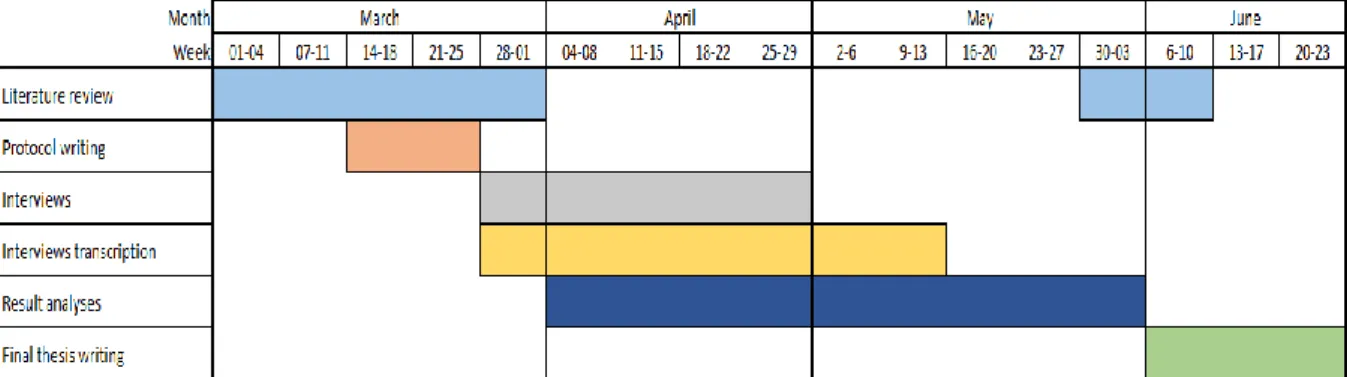
This dissertation project starts with literature review, in order to create a knowledge base about the project and supply chain issues. Due to the exploratory nature of the research the research methodology chosen was the case study research. This methodology consists in selecting case studies (technology-based start-ups) and carrying out semi-structured interviews as data collection method that culminated in three different result analyses: technology-based market, wearable market and national/international market. For this, in an early stage, an interview protocol had to be defined. The research methodology is further explained in chapter 3 of this thesis. Figure 1 presents the work organization and plan.
1.5 Report Structure
The remainder of this dissertation is structured in four further chapters. Chapter 2 encompasses the relevant literature review on entrepreneurship and supply chain. It’s defined the borders of a start-up as a company and studied supply chain materials related with supply chain management and supply chain networks. Chapter 3 describes the research methodology followed during the project. It includes the unit of analysis for the project as well the way the data was collected and analysed. Chapter 4 presents the findings of the case study analysis and the material for the literature that aims to help start-ups to scale operations. It includes the supply chain strategies and configurations within cases and also in cross-case analysis. Chapter 5 concludes the thesis by reviewing each conclusion of the study and suggesting relevant topics for future research development.
2 Literature Review
A few studies have been conducted in order to understand how start-ups behave, how their environment works and why they are different from stablished companies. This literature review gathers the relevant material about these topics adding the general idea for technology and makes the connection with the focal theme that is the supply chain configuration of start-ups.
The literature about supply chain, supply chain configuration, supply chain network and supply chain management is more relevant and abundant in stablished and well developed industries such as automotive or retailing. Despite this, there are common points between these industries and start-ups environment, as well as studies in literature that are applied to both cases. This section puts together the literature for entrepreneurship (start-ups) and supply chain.
2.1 Start-up Definition and Description
The information in literature about of what a start-up is or how it appeared is scarce and divergent, but there is an author that gathers the most consensus among the community about start-up topics, is Steve Blank. He stated that “a start-up is a temporary organization in search of a scalable, repeatable, profitable business model” adding that “a start-up is not a smaller version of a large company” (Steve Blank, 2012).
Aligned with the previous definition we’ve got the one from Paul Graham (2012), he said that “a start-up is a company designed to grow fast” (similar with the idea of scalable of Blank). Graham also added that “not every newly founded company is a start-up” and “most are service businesses—restaurants, barbershops, plumbers, and so on” justifying that these kind of companies can’t grow fast and defining ‘growing fast’ as making “something you can sell to a big market. That's the difference between Google and a barbershop. A barbershop doesn't scale… A barbershop serves customers in person, and few will travel far for a haircut. And even if they did the barbershop couldn't accommodate them.” or for other words, a start-up as always the aim to go global, and it’s something that is associated with the definition of scalable.
Eric Ries, the author of the movement “The Lean Start-up”, described start-up as a “human institution designed to create a new product or service under conditions of extreme uncertainty” (Eric Ries, 2011). He introduces the idea of innovation and uncertainty in the start-up definition, however he lacks in not adding the ideas of scalable business model and global.
These were more theoretical and published definitions of start-up, but the insights and opinion from actual start-up founders are also interesting. Like Neil Blumenthal, cofounder of Warby Parker, says that “a start-up is a company working to solve a problem where the solution is not obvious and success is not guaranteed” (innovation and uncertainty). Or Adora Cheung,
cofounder and CEO of Homejoy, “a start-up is a state of mind. It’s when people join your company and are still making the explicit decision to forgo stability in exchange for the promise of tremendous growth and the excitement of making immediate impact” (uncertainty and fast growth, scalable). And Dave Mcclure, the founder partner of “500 start-ups” that is working in Silicon Valley for twenty-five years and in companies such as PayPal, Founders Fund, Facebook, LinkedIn, Twilio, Mint.com, Simply Hired, O'Reilly Media, Intel and Microsoft, says that “a start-up is a company that is confused about: What its product is, who its customers are and how to make money” (uncertainty, innovation, repeatable business model).
The vision of founders about of what a start-up is, seems more market driven or human perspective not including the operations side. In this work we gather the most relevant and assertive definitions about this topic and defined a start-up as being a sketch of an innovative company in search for a scalable, repeatable and profitable business model that aims to go global under extreme uncertainty (adapted from Blank, Graham and Ries).
2.1.1 Technology-based Start-up
The definition of the start-up part is presented above, but the definition of technology is still to clarify. Technology can be defined as “the application of tools, materials, processes, and techniques to human activity’’ (Shane, 2009). A more complete definition can be found as “a body of knowledge, tools and techniques, derived from science and practical experience, that is used in the development, design, production, and application of products, processes, systems, and services” (Abetti, 1989, Steensma and Corley, 2001, Buganza et al., 2015). The definitions of technology referred above are still too broad and could fit in almost everything we do daily. The definition of technology should be followed by the idea of time and innovation. The caveman could consider the use of a spear to hunt the use of technology, in the same way that nowadays a carpenter can say that he’s using technology while using a hammer to produce furniture. In this way technology should be defined as the use of innovative tools and techniques, derived from science and practical experience, that is used in the development, design, production, and application of products, processes, systems, and services (adapted from Abetti, 1989). Everything used that has a substitute that does it better and efficiently in substantial way, should be considered as rudimentary technology.
Technology was grouped in four distinct ways: industry-based, firm-based, product-based and life-cycle based while introducing the concept of innovation (Steenhuis and Brujn, 2006). Industry-based is related with the use of research and development in an industry and its influence on sales percentage. The remaining three definitions follow these same principles but more focused in the company (firm-based), product (product-based) and product life-cycle (life-cycle based). For the purpose of this work, the focus will be in the product-based technology idea. Steenhuis and Brujn also stated that “technology is generally described as being embodied in three components: software, hardware and humanware”. Presented this and since the software alone uses an existent technology to work and doesn’t build a technological tangible product, the definition of technology-based start-up used will be a start-up with products that use research and development produced by humanware in form of hardware or both hardware and software.
Commonly the terms ‘tech start-up’ or ‘tech companies’ are used to refer to companies as Facebook or Java, but their product is not tangible and doesn’t fit in the definition proposed. The focus of this work is in start-ups that produce a tangible or hardware products, in need or not of a software support. This is related with the definition of technology above and also with what this study purpose, the supply chain network configuration. Incorporating start-ups
that produce only software with start-ups that produce hardware would result in a much different supply chain network (see Figure 2) and wouldn’t be productive for conclusions and results, because the study unit wasn’t homogeneously. Note: for these networks the suppliers of office material like pens and paper where not considered.
2.1.2 The Border Line Between Start-ups and Stablished Companies
The coherence in the start-up definition is not the best, but it gets worse in the transition from calling an organization start-up to call it company. This issue is particularly important to understand in which phase the interviewed organizations in this project are.
The best way to say that an organization is no longer a start-up is when it stops to look for a business model (Blank, 2012). When the business model is defined, the organization finds its soul and that business model is profitable, it’s no longer a start-up. However, for a start-up to successfully pass the scale-up phase, it needs some stability and without the definition of the business model this is not possible in the majority of the cases. By this, it will be taken in consideration that the time that a start-up managed to get a stable business model.
The main measurable aspects that entrepreneurs discuss in this topic is about the time that the organization has, the number of employees and the sales volume. For these issues Alex Wilhelm (2014) proposed a new rule “50-100-500”. He stated that “$50 million revenue run rate (forward 12 months); 100 or more employees; Worth more than $500 million, on paper or otherwise” it can’t be considered a start-up. However, this rule is not a good way to view this problem because it depends on the local reality and in the market that the organization is in. Despite the fact that the aim of a start-up is to be global, the dimension of the national or local economy where the start-up is in influences the sales volume and the capacity that the start-up has to collect financial help. As well the market where it is influences the velocity that it can scale-up operations and obtain profit, so the year aspect is also very particular. Start-ups that were also acquired by bigger and stablished companies will not be considered start-ups anymore because of the integration with the company and the financial resources that it will have access thenceforth.
Figure 3 - Start-up’s stages (from Joglekar and Lévesque, 2013)
Since there is no consensus in the definition, a dose of good common sense as well as the mix of the aspects referred previously, for this work and taking in consideration the market were start-ups are in, it will be used the following criteria to define a start-up that transformed in a stablished company: 1) was acquired by a stablished company; 2) an organization that works with the same profitable business model at least for 3 years; 3) use the “50-100-500” rule. If the organization passes one of these criteria it will not be considered a start-up.
Adding to the scale-up literature review, a start-up will be considered in the scale up phase if the development is supported by further rounds of financing and is an aggressive and highly focused business.
2.1.3 Start-up Phases
Start-ups are not like every company, they have different challenges and pass through different stages that are intrinsic to their natural environment. Start-ups always start with the discovery of an opportunity that is not being availed by others. Either by improving an existing product, discovering a new one or exploring new markets. We can look to the word start-up itself, they start to discover something, now let’s go up on this. The problem is that very often, the start-up founders aren’t aware of what is expecting them.
Joglekar and Lévesque (2013) proposed a framework with four development phases for start-ups: discover, commit, organize and grow (see Figure 3). They defined that the discover stage is when the opportunity is recognized. The commit stage comes when the individuals who discovered the opportunity, start to commit more people and gather financial resources to their idea. The organize stage is when future needs are stablished to transform the organization into a business that can release a product. The grow stage is when the product achieves some market success and the start-up needs to grow. In their work, it is not clear where the foundation of start-up (registered company) occurs, for future work it will be consider the formation of the start-up in the commit stage. Since that doesn’t make sense that you create a start-up when you didn’t find the opportunity yet, the start-up formation should be inserted in the commit stage that is when you start to gather more people to your idea and financial resources.
Figure 4 - The two “Valley of Death” (adapted from Tedim et al., 2015)
The start-ups need to succeed in these four stages to achieve the category of stablished company, but there are two main problems along the way. These problems are called “The Valley of Death” in start-up world (see Figure 4). The first problem, or ‘valley’, comes somewhere around the transition from second to third stage defined by Joglekar and Lévesque, “it is the gap between the technical invention or market recognition of an idea and the efforts to commercialize it” (Markham, 2002). Failing at this valley means that the start-up couldn’t find a fit in the market for its product or couldn’t adapt its product in the way to satisfy a certain market. This stage is particularly important for a start-up because prior to this valley is when entrepreneurs try to capture the first investments in their organization and studies show that 30% of start-ups fail at passing the first valley. Moreover, from start-ups that weren’t able to attract investments the probability of failing rises to 90% (Gompers and Lerner, 2002). The second valley comes in the last stage, grow. It is the stage when the start-up transforms in a highly focused business achieving sufficient returns from productive activities, it’s now a whole team with a business which exists by winning orders, shipping products and making money (Vohora et al., 2004). After all the process to become a stablished company, comes the challenge to scale and for that start-ups need to attract more investment so they can scale their operations in order to answer the market needs and who succeeds crosses the valley, otherwise they fall in it. The numbers clearly justify why this second valley is so important, around 80% of financed start-ups fail and if you ask how many fail their projection the probability rises up to 95% (Shikhar Ghosh, 2012).
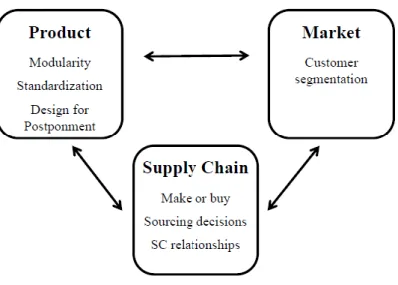
This means that a correct design of operations, the creation of flexible and robust strategies (Lévesque et al., 2012), is the key to be part of the 20% minority that pass the 2nd valley of death. Therefore, Tedim et al. (2015) proposes studying the relationship between product, market and supply chain (see Figure 5) for an increased success and sustainability of start-ups.
Figure 9 - Conceptual framework (from Tedim et al., 2015)
In this linkage, despite the fact all the three parts should be aligned, the supply chain is the part which can integrate all the others and that looks to the company as whole thing and overall perspective that can, at least, make the start-up satisfy the demand of a given market and enable it to scale. That is why configuring the supply chain network strategies accordingly to the start-ups’ needs is the best way to achieve operations excellence that will allow them to cross the valley. This work aims at contributing to this purpose.
2.2 Supply Chain
Supply chain is not a new concept, this term is already referred in books and articles from the beginning of the 20th century (Frankel et al., 2008; Hugos, 2011). Despite that, what we define today as supply chain exists since civilizations started to organize themselves as societies, as in form of military expeditions or commerce. Names as Alexander the Great and Napoleon Bonaparte have been associated with ancient supply chain has generals of their military. Their incredible achievements as leaders is associated with their great success in creating and managing the supplies to their army (Hugos, 2011).
Nowadays Supply Chain can be defined as “a network of facilities and distribution options that performs the functions of procurement of materials, transformation of these materials into intermediate and finished products, and the distribution of these finished products to customers” (Ganeshan and Harrison, 1995). Or a more succinct definition “a supply chain is the alignment of firms that bring products or services to market” (Lambert et al., 1998). So, by my own words, a supply chain is all the intermediary companies in the production of a given product since the early raw materials until the ultimate consumer. As Chopra and Meindl (2001) say “A supply chain consists of all stages involved, directly or indirectly, in fulfilling a customer request. The supply chain not only includes the manufacturer and suppliers, but also transporters, warehouses, retailers, and customers themselves” or as Mentzer (2001) “a supply chain consists of multiple firms, both upstream (i.e., supply) and downstream (i.e., distribution), and the ultimate consumer”.
Figure 6 - Managing business processes across the Supply Chain (from Lambert, 2008)
2.2.1 Supply Chain Management
Supply Chain Management isn’t also a new concept, it arose in the 1980s (Oliver and Webber, 1982) and widespread in the 1990s (Frankel et al., 2008; Hugos, 2011). This concept has received increasing attention from academicians, consultants, and business managers (Croom et al., 2000) because “many organizations have begun to recognize that SCM is the key to building a sustainable competitive edge for their products or services in an increasingly crowded marketplace” (Li et al., 2005).
Supply Chain Management can be defined as “the integration of business processes from end user through original suppliers that provides products, services and information that add value for customers” (The International Centre for Competitive Excellence, 1994). A deeper view of the supply chain management can be presented as “the systemic, strategic coordination of the traditional business functions and the tactics across these business functions within a particular company and across businesses within the supply chain, for the purposes of improving the long-term performance of the individual companies and the supply chain as a whole” (Mentzer et al., 2001). A more practical definition that sums the more relevant aspects of SCM can be found as “the coordination of production, inventory, location, and transportation among the participants in a supply chain to achieve the best mix of responsiveness and efficiency for the market being served” (Hugos, 2011). However, the definition that fits the most with the intent of this work and has a more relevant view of the question is the one from Lambert (2008) “supply chain management is about relationship management, it’s managed, link-by-link, relationship-by-relationship, and the organizations that manage these relationships best will win”. See Figure 6 for these relations management representation.
Figure 7 - Levels for supply chain comprehension across years (Harland, 1996)
Figure 8 - Examples for types of networks (adapted from Mentzer et al., 2001)
2.2.2 Supply Chain Network
The word ‘chain’ suggests that a supply chain is linear or a circle of activities, however, in reality, a supply chain is a network of companies all connected like a web. “Recognizing the supply chain as a network of relationships (Harland, 1996) not a sequence (or chain) of transactions enabled leading firms to gain improved performance, operational efficiencies, and ultimately sustainable competitiveness (Choi and Hong, 2002). This model is based on recognizing that the supply chain is a non-linear network with connections between firms” (Stevens and Johnson, 2016). Also Stock and Boyer (2009) see the Supply Chain Management as “the management of a network of relationships within a firm and between interdependent organizations and business units consisting of material suppliers, purchasing, production facilities, logistics, marketing, and related systems that facilitate the forward and reverse flow of materials, services, finances and information from the original producer to final customer with the benefits of adding value, maximizing profitability through efficiencies, and achieving customer satisfaction”.
Harland (1996) explained how the comprehension of supply chain networks evolved since 1960s, where people connected it with logistics, until 1990s and dived it in 4 levels (Mills et al., 2004) (see Figure 7).
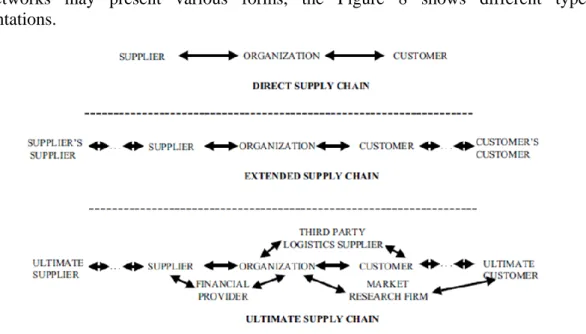
The networks may present various forms, the Figure 8 shows different types of representations.
Figure 9 - Network example (from Stevens and Johnson, 2016)
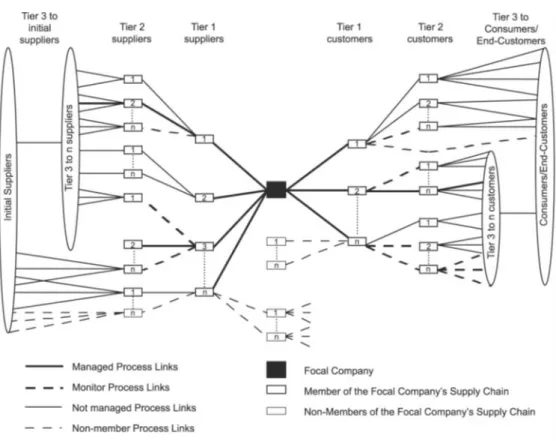
Figure 10 - Network example (from Lambert et al., 1998)
For supply chain networks examples see figures 9 and 10. These networks are more conceptual and related with the “ultimate supply chain” concept from Mentzer and can only be seen in old and well developed industries like automotive or retail. The start-ups’ networks are more similar with the “direct supply chain” and “extended supply chain” concepts from Mentzer.
Figure 11 - Global Supply Chain Networks (from Johnson and Stevens, 2016)
These types of networks are already too complex and hard to manage. “The work on the empirical relationship between system size, connections, and stability carried out by Disney et al. (1997) identified two important phenomena relevant to supply chain operating model design as: 1) as the number of nodes increases the probability of a stable operation decreases dramatically, and; 2) as system connections increases the network swiftly crosses the “switching” line and becomes unstable” (Stevens and Johnson, 2016). The suggestion is that in the future the supply chains become global supply chain networks. The idea is the interaction inter-supply chains to form a bigger and global one transforming some supply chains in a single node and connection in more embracing supply chains (see Figure 11) to make them more stable and operations friendly.
The most relevant literature presents us with these definitions and configurations for supply chain networks. These don’t work the same for every company or business and the literature always focus in the same industries (Mills et al., 2004). The purpose of this work is to enrich the literature with different industries and points of view in this topic with the focus on technology-based start-ups. Typically, the start-ups’ networks, will not be as complex and developed as the networks presented before, mainly because of their youth as a company and the type of business they are in. Still, common ideas will be pointed out and new ways of seeing this topic will be added.
The next chapter presents the research methodology followed along the work and how data will be structured and analysed.
3 Research Methodology
This chapter describes the research methodology used in the research for the problem of configuring supply chain networks of technology-based start-ups as well as the strategy to obtain the best results.
3.1 Case Study Research
In order to analyse the different network configurations of start-ups the methodology chosen was the case study. The exploratory nature of the research makes the choice obvious since the case study research focuses on understanding the dynamics present within specific settings (Eisenhardt, 1989). The qualitative data needed and the type of questions made makes the case study research a more relevant choice as Yin (2009) states “the more that your questions seek to explain some present circumstance (e.g., "how" or "why" some social phenomenon works), the more that the case study method will be relevant. The method also is relevant the more that your questions require an extensive and “in-depth" description of some phenomenon”.
3.2 Unit of Analysis and Data Collection
Since the problem to work on is the configuration of technology-based start-ups’ supply chain network, the unit of analysis is the technology-based start-up (see Table 1). The data collection method used was semi-structured interviews with the start-ups’ CEO, Operations Manager, or C-level managers (see Table 2 for interviews’ guide). It includes start-ups from Portugal (national) and international start-ups. Interviews have the duration of approximately 40 minute and were recorded, transcribed and coded in order to identify the supply chain networks implemented by the case start-ups. Some interviews carried out with technology-based start-ups recorded previously within the VR2Market project in 2015 were also considered. Since the main goal is to help start-ups pass the second valley of death or scale-up phase, the interviews will be conducted in start-ups that are in this phase or already overcome it in order to understand their needs and challenges in this phase. This will make the results more accurate to solve the start-ups’ problems and decrease the rate of start-ups that die in the scale-up phase.
To conduct the research with the best accuracy, these research goals and research questions were defined:
G1: Examine and build the operations strategy choices of start-ups during the scale-up phase. G2: Match and identify the different start-ups’ supply chains.
Table 1 – List of interviewed start-ups
Q1: Which strategies start-ups in scale-up phase adopt?
Q2: Do wearable start-ups apply the same strategies among them?
Q3: Can a technology-based start-up from a specific market use the same strategies from other technology-based start-up in a different market?
To fulfil this goals and answer to these questions was made an interview protocol presented in table 2. Case Study (start-up) Market Interviewee position Number of employees Year of foundation Location A Wearables
(medical) CEO 15 2010 Portugal
B Wearables
(medical) COO 8 2007 Portugal
Ci Wearables
(sports) CEO 12 2013 USA
D Wearables
(medical) COO 19 2013 Portugal
E Wearables
(sports) COO 40 2007 Portugal
Fi Wearables
(sports) COO 45 2012 Sweden
Gi Wearables
(medical) Co-founder 7 2012 USA
Hi Wearables
(medical) COO 50 2009 Canada
1 Information
Technology (IT) CEO 60 2001 Portugal
2 Information
Technology (IT) CFO 40 2004 Portugal
3 Renewable
Energies CEO 8 2014 Portugal
4 Location
Trackers COO 10 2014 Portugal
5 Information
Technology (IT)
Head of
Operations 40 2012 Portugal
6 Medical
Equipment CTO 10 2012 Portugal
7 Clinical
Table 2 – Semi-structured interview protocol
Question References
Supply Chain Configuration
Who are your supply chain partners? Where are they located?
Stevens and Johnson (2016), Alinaghian and Srai (2014), Fine et al. (2005), Hugos (2011), Naslund and Williamson (2010), Mills et al. (2004), Jafarian and Bashiri (2014), Karlsson and Christensen (2015), Lambert et al. (1997), Mentzer et al. (2001)
Where are your clients located? Stevens and Johnson (2016), Mills et al. (2004), Hugos (2011)
Which are your distribution channels?
Fine et al. (2005), Stevens and Johnson (2016), Alinaghian and Srai (2014), Karlsson and Christensen (2015)
Supply Chain Management
Why did you choose these partners and how did you find them?
Fine et al. (2005), Stevens and Johnson (2016), Hugos (2011), Naslund and Williamson (2010), Karlsson and Christensen (2015), Lambert et al. (1997)
Who are your key partners? Why?
Stevens and Johnson (2016), Hugos (2011), Mills et al. (2004), Karlsson and Christensen (2015), Lambert et al. (1997)
What kind of contractual agreement do you have with your
partners/suppliers?
Fine et al. (2005), Stevens and Johnson (2016), Hugos (2011), Naslund and Williamson (2010), Mills et al. (2004), Lambert et al. (1997)
Do you outsource production? Which parts and why?
Stevens and Johnson (2016), Mills et al. (2004), Karlsson and Christensen (2015)
How did your partnerships evolve along the way?
Stevens and Johnson (2016), Hugos (2011), Mills et al. (2004), Jafarian and Bashiri (2014), Karlsson and Christensen (2015)
Do you maintain inventory? To whom does it belong to? Where is it?
Why?
Stevens and Johnson (2016), Mills et al. (2004), Alinaghian and Srai (2014), Karlsson and Christensen (2015), Lambert et al. (1997)
Do you have after sales service? How does it work?
Stevens and Johnson (2016), Mills et al. (2004), Hugos (2011)
Information Flow
Which information do you share with your partners and why? Which
do they share with you and why?
Stevens and Johnson (2016), Naslund and Williamson (2010), Mills et al. (2004), Karlsson and Christensen (2015), Lambert et al. (1997), Mentzer et al. (2001)
Figure 12 - Different levels of analysis 3.3 Data Analysis
The case research will have different levels of analysis. Case studies can involve either single or multiple cases, and numerous levels of analysis (Yin, 1984). This study considers three levels of analysis: 1) technology-based products market level, 2) wearables technology market level and 3) national (Portugal)/international level (see Figure 12). The analysis of the interviews is made individually and posteriorly a comparison between the same questions taking in consideration the different levels of analysis defined previously is carried out (see Appendix A for example). The configurations will be analysed according to these levels in order to validate the configuration and decisions in different situations (see Appendix B for examples). This strategy strengthens the theory building of the case study research enriching the quality of the conclusions.
4 Case Studies Results and Analysis
This chapter presents the results obtained from the interviews analysis. The discussion is aligned with the strategy outlined in the previous chapter, i.e. examine the operations strategy choices and capture supply chain strategies with special focus in the wearable market. The results of the samples will be critically discused within the methodology proposed. The analysis includes the most relevant issues to the supply chain strategy definition and it’s divided into upstream and dowstream strategies. Start-ups don’t have the same supply chain issues as established companies. The cases show that suppliers’ strategy and markets entrance strategies were the most difficult ones to surpass. This led to the separation of the analysis between upstream and dowstream strategies. A supply chain configuration of each level taking into consideration the communalities observed is proposed.
4.1 Analysis of the Wearable Devices Start-ups
Several start-ups of the wearable technologies industry were selected in alignment with the VR2Market project objectives and are used in comparison with the different levels of analysis to figure out which strategies are similar and which make a better fit with this industry. This analysis includes eight start-ups (code A to H)
4.1.1 Make or Buy Strategy
Before dividing the market analysis in the supply chain upstream and downstream, let’s take in consideration the make or buy strategy followed by the start-ups in order to have a better understanding of the configuration adopted.
All the start-ups commercialising wearable technologies considered, outsource the production of their hardware. It’s easy to understand why since every start-up begins with the idea of a product and don’t have the know-how to make the components or assembly the final product in an efficient way. However, the first prototypes are developed and assembled in the company, because they are still trying to improve the product and trying to take the maximum advantage from the product taking in consideration the market needs. This strategy follows the literature vision of Stevens and Johnson (2016) where they state that nowadays companies should focus on their own business instead of trying to control all the production chain of the final product. Another common point in the outsource strategy was the transportation of the products to the next point in the supply chain since there’s economic inefficient to have own transportation in low quantities and great distances. One important task that differs considerably between start-ups is the distribution that will be addresses latter in this section.
Figure 13 - Chart for in-house and outsourcing comparison
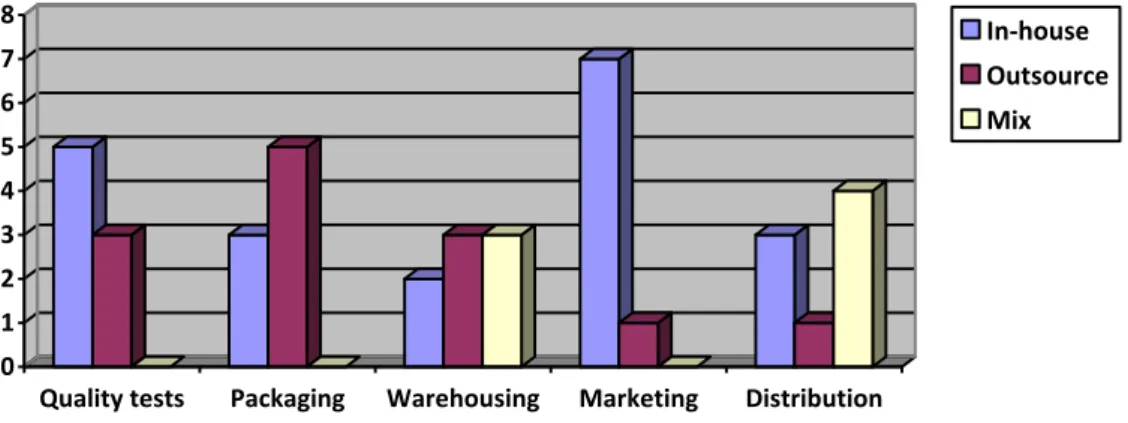
From the interviewed companies there is a common strategy used by all of them for what they make in-house: the product design and engineering, software and customer support. From all the in-house strategies there are 3 main tasks there aren’t common: quality tests, packaging and warehousing. Around 40% of these 3 tasks are done in-house by the start-ups (not necessarily combined). The chart presented in the Figure 13 makes the comparison between the tasks that are not common to all companies.
0 1 2 3 4 5 6 7 8
Quality tests Packaging Warehousing Marketing Distribution
In-house Outsource Mix
The quality tests task is made when there isn’t a full confidence in the final supplier and the start-up needs to validate the job, when that confidence is built, the tests are made by the own company. In some cases, they can have someone from the start-up making the quality tests inside the final supplier company. The packaging task depends on the product design and how the supply chain is organized and that will have an impact in what type of contract that they have with the supplier. This often has to do with quantities that they ask for production and in start-ups in scale-up phase normally they have low quantities, so start-ups’ trend is to outsource when insource doesn’t pay it. Warehousing also has to do with quantities and taking in consideration the marketing strategies.
To sum up, the common outsourcing strategies are hardware production and transportation services. In-house common strategies are product design and engineering, software and customer support.
4.1.2 Upstream Strategy
The upstream part of the supply chain strategy concerns with the suppliers of raw materials, components or manufacturing partners. The suppliers within this study can be divided in components (i.e., transistors, Velcro), manufacturer (i.e., printed circuit board, textile) and assembly (i.e., putting all parts of the product together). Sometimes the manufacturer also does the assembly and in some cases the start-ups control the components used by a manufacturer. Components suppliers can be tier 1, 2 or 3; manufacturers can be tier 1 or 2 and assembly suppliers are tier 1. The tiers characterization is the number of levels, or ‘companies distance’ that one supplier is from the start-up in the study. The suppliers’ choice is of major importance in the supply chain strategy and influences the configuration in a considerable way, so there will follow a detailed analysis of the choices made by the start-ups.
Figure 14 – Number of times a strategy is used when choosing a critical component supplier
Figure 15 – Number of times a combined strategy is used when choosing a critical component supplier
Components Suppliers
The components suppliers may vary a lot and so it was created a sub-division that includes critical components suppliers and standard or non-critical components suppliers. It was observed that critical components suppliers were manufacturers most of the times. The reasons to choose the critical components suppliers vary according to the type of product, if the start-ups need a product with more quality, lower price or with lower lead times in delivery (factors quality, price and geography). In the figures 14 and 15 is made the comparison of these three factors. And from now on, the figures on the left present the number of times a strategy was chosen and the figures on the left the exam strategy followed by the start-up. 0 1 2 3 4 5 6 7 8
Price Quality Geography
0 1 2 3 4 5 6 7 8 Quality and Price Quality and Geography Price and Geography just Quality
The empirical evidence shows, start-ups choose mostly quality over price or geography when searching for a critical component supplier. The justification is simple, quality means more customer satisfaction and more reliability in their product. The winning combined reason, quality and price, seems obvious since everyone wants the best quality at the best price to increase profits. But analysing the quality reason deeply, is found another relevant aspect, this market is divided in two products, for medical use and for sports use. All the start-ups that commercialize medical wearables devices (MWD) choose quality as first reason. This has to do with the strict rules and processes to certificate their product in this area, so they need to be sure that the product meets all the requirements from the certification entities, and from the customer point of view you need to assure that the product is reliable in measuring critical factors.
Price was really the last option to take in consideration, so let’s observe geography more deeply. This characteristic is the second most chosen and it comes from a previous phase in the start-up. While doing and testing the prototype they need to ask more from the supplier that has more importance for the product, because they are always doing changes and ask for support, so they need short distances. Interviewed managers said that, since that supplier is already with them from the beginning (already created a connection), knows their product and has the adequate know-how to do it, they keep with them. This seems logical, however, they should always keep searching for alternatives that are better for the company and for their current strategy, don’t get stuck in the past, or you won’t scale.
An important analysis to add here is how start-ups make their contracts with their suppliers and this is a lot different in the two cases (critical and standard components). For the critical components supplier, the process is more complex. These contracts are not typical long-term
Figure 16 - Number of times a strategy is used when choosing a critical component supplier
Figure 17 - Number of times a combined strategy is used when choosing a standard component supplier
Figure 18 - Number of times a strategy is used when choosing an assembly supplier
Figure 19 - Number of times a combined strategy is used when choosing an assembly supplier
or short-term contracts that fix quantities and prices. Since these suppliers work with important parts of your product and all the products have a patent protection, they have a Non-Disclosure Agreement (NDA) signed. Besides that, the contracts signed also have conditions regarding: quantities/orders, technical support, transportation, quality standards and exclusivity on buying that product only to them.
Now, concerning to the standard components suppliers, the reasons change from the previous analysis, the figures 16 and 17 show the data relevant to these cases.
0 1 2 3 4 5 6 7 8
Price Quality Geography
0 1 2 3 4 5 6 7 8 Quality and Price Quality and Geography Price and Geography just Price
Opposite to the critical components suppliers, the most chosen strategy is the price. Almost 70% also consider that quality is important but looking to the other chart we can see that is due to the price/quality relation and not for the quality itself. This type of components is usually easy to find in the market and so, to compensate the greater amount of money spent in the critical component, price is the most relevant decision in this strategy. Also emphasize that the decision ‘just price’ has almost 30% of start-ups considering it. The contract strategy to these kind of suppliers is simple, there’s no contract between companies and start-ups just ask for the quantities they need, but there’s also the need to build a relationship first in some cases.
Assembly Suppliers
Side by side with the critical components suppliers, the assembly suppliers are of major importance since they are the ones who finish your product and most of times have to adjust their production to your product that requires a good relationship and working together in prototypes. The figures 18 and 19 make que comparison with the different decisions.
0 1 2 3 4 5 6 7 8
Price Quality Geography
Figure 20 – Number of times that a distribution strategy is chosen
Figure 21 - Number of times that a combined distribution strategy is chosen
The strategy with the assembly suppliers is identical with the critical components suppliers, however geography gains more relevance here. The same strategy happens, the assembly suppliers also play an important role in the product development and the tendency is to stay the same, however the same recommendation is made about the search of new partnerships. Interviewed start-ups also stated that they need to be close to the end of their production line, by product changes or quality controls, if anything happens they can be there in few hours instead of few days. So there’s a pattern to highlight here, for assembly suppliers choose quality and proximity so you can have a better control over your product and assure that your product is from the best quality, especially in the MWD case. The contracts with the assembly suppliers are done with the same principles as the contracts with the critical components suppliers, because assembly suppliers are, in 90% of cases, critical suppliers.
4.1.3 Downstream Strategy
The downstream activities are related with how you reach and deal with your clients, such as distribution channels, warehousing and customer service. A wrong choice in this strategy and your scale can never happen, it’s a crucial connection point with your costumer and you need to align it with your start-up strategy when attacking the market. A detailed analysis of the start-ups choices in this activity will follow.
Distribution Channels
The distribution channel is how we reach the client and how they can buy our products. Previously, in section 4.1.1, was stated that around 40% of start-ups do the distribution only by themselves (in-house), 10% fully outsource it and 50% use a mix between in-house and outsource, the figures 20 and 21 show the distribution of this percentages more deeply in order to get a better understanding of the strategies followed.
0 1 2 3 4 5 6 7 8
Direct Sales Distributors Retailers
Direct sales is the favourite way, chosen by the start-ups, to reach the consumer. Around 90% use it. Direct sales can be divided in sales by their own website and by an agent that sells the product, again here’s the different between MWD and SWD. In MWD start-ups the business is directed to B2B while in SWD start-ups the business works B2C. The B2B business uses an agent, or someone from the company in charge of doing so, to sell the products and the B2C business use their own website to sell the products. The ‘only Direct Sales’ option and also