Repositório ISCTE-IUL
Deposited in Repositório ISCTE-IUL:
2019-01-11Deposited version:
Post-printPeer-review status of attached file:
Peer-reviewedCitation for published item:
Ferreira, J. C., Martins, A. L. & Gonçalves, F. (2018). A blockchain and gamification approach for smart parking. In 2nd EAI International Conference on Intelligent Transport Systems, INTSYS 2018.
Further information on publisher's website:
--Publisher's copyright statement:
This is the peer reviewed version of the following article: Ferreira, J. C., Martins, A. L. & Gonçalves, F. (2018). A blockchain and gamification approach for smart parking. In 2nd EAI International
Conference on Intelligent Transport Systems, INTSYS 2018.. This article may be used for non-commercial purposes in accordance with the Publisher's Terms and Conditions for self-archiving.
Use policy
Creative Commons CC BY 4.0
The full-text may be used and/or reproduced, and given to third parties in any format or medium, without prior permission or charge, for personal research or study, educational, or not-for-profit purposes provided that:
• a full bibliographic reference is made to the original source • a link is made to the metadata record in the Repository • the full-text is not changed in any way
The full-text must not be sold in any format or medium without the formal permission of the copyright holders.
Serviços de Informação e Documentação, Instituto Universitário de Lisboa (ISCTE-IUL) Av. das Forças Armadas, Edifício II, 1649-026 Lisboa Portugal
Phone: +(351) 217 903 024 | e-mail: [email protected] https://repositorio.iscte-iul.pt
Parking
João Carlos Ferreira1,3, Ana Lúcia Martins1,2 , Frederica Gonçalves4
1 Instituto Universitário de Lisboa (ISCTE-IUL), Portugal 2 Business Research Centre (BRU-IUL)
3Information Sciences, Technologies and Architecture Research Center (ISTAR-IUL), Portugal 4Madeira-ITI, University of Madeira, Funchal, Portugal
Abstract. City parking is increasingly complex and available parking spaces
are scarce. Being able to identify a space to park their cars can lead many driv-ers to drive around the intended parking area several times, increasing traffic density and pollution. In this research, we propose a collaborative blockchain solution with gamification for parking. Users collaborate to report free spaces and receive free parking minutes for their service to the community. In parallel, this approach can be used to collect beacon information from the parked vehicles and create a low-cost collaborative approach for managing a parking control process platform Blockchain that can handle this distributed process and the gamification platform increases users’ participation.
Keywords: Blockchain, Collaborative, Gamification, Parking
1
Introduction
Parking is one of the major concerns in the cities due to the reduced availability of space and the time-consuming process for finding a parking place. Several studies show that in the majority of cities about one-third of traffic is generated by drivers on the search for a parking space, which corresponds to average times of 10 minutes [1]. Drivers cover, on average, a distance of 4.5 km to find a parking place [1], which corresponds to an average of 1.3 kg of CO2 per month, or about 100 km per month, and to an additional estimated cost of about 10€ per month. In the Lisbon region (Por-tugal’s capital), for example, the average number of vehicles per day is of 250 to 300 thousand [2]; if one considers that the demand for parking spaces affects part of this number of vehicles, an estimate of 100 thousand vehicles could be removed from the roads. In this scenario, it can also be estimated 1 M€ per month of additional expenses and additional production of 130 tons of CO2 that could be avoided. Considering only the example of Lisbon, the annual distance travelled in search of parking place (4.5km-day x 230 days annual work x 100 000 cars) would allow to take about 2800 rounds to the planet and represents about 36 000 hours of work lost. In the city, inner zones parking spots are difficult to find. It is often that trucks looking for cargo un-loading spots find that those spots have been used by another driver (not involving
logistics). This scenario stresses the need for solutions to identify if a parking spot is free and, consequently, guide the driver to those places. One such conventional sys-tem in closed environments (an example of parking spaces at malls) has sensors at each parking spot with a light that indicates if it is available or not. The same ap-proach can be applied to street parking, and this data can be transferred to a driver’s App, but the cost of this solution is prohibitive and involves high maintenance cost. For example, Avenida Liberdade, in Lisbon, has around 1,1 km and a solution with parking sensors was implemented with an investment value of 80K€ with the associated annual maintenance cost of 10K€. The proposal in this research aims at avoiding these costs (investment and maintenance) and is based on a collaborative approach to detect if parking spaces are occupied, along with a gamification incen-tive.
2
State of the art
2.1 Sensors
Many parking systems have been proposed in recent years. These work based on in-stalled sensors that collect information about each individual parking spot. These sensors detect the presence of a vehicle or other objects. They can range from a sim-ple ultrasonic sensor that detects a vehicle based on a threshold distance or RFID chips that are activated based on distance to complex optical sensors. These sensors can be divided into two main categories:intrusive and non-intrusive sensors [3]. Intru-sive sensors are sensors that are typically installed in holes on the road surface, in-cluding active infrared sensors, inductive loops, magnetometers, magneto-resistive sensors, pneumatic road tubes, piezoelectric cables, and weigh-in-motion sensors. The main problem of these sensors is the installation and maintenance cost. Non-intrusive sensors, by their nature, do not have the installation problem and encompasses mi-crowave radar, passive acoustic array sensors, passive infrared sensor, RFID, ultra-sonic, BLE beacons and video image processing. Non-intrusive sensors can be easily installed and maintained and do not affect the surface involved in the process.
Active infrared sensors detect vehicles based on infrared energy. These can detect the amount of energy reflected, and most of the installation effort is based on multiple beams that can measure the vehicle position, speed and class [3, 4]. The main working problem is its sensitivity to weather conditions (examples are fog or snow).
The Inductive Loop Detectors are used mainly for getting accurate occupancy measurements based on wire loops with frequencies ranging from 10 to 50 kHz. This frequency oscillation changes with vehicle presence, and it is one of the most used sensors to detect the presence of a vehicle in a spot. The main issues are the installa-tion and maintenance costs and the fact that these sensors are sensitive to water, espe-cially if the pavement is cracked.
Fluxgate magnetometers work by detecting a perturbation in a magnetic field and have an as main advantage being insensitive to weather condition such as snow, rain, and fog. They are also more accurate and less susceptible to traffic stress than loop
detectors. Among the disadvantages of using fluxgate magnetometers are the small detection zones in some models that require that multiple units are needed for full lane detection as well as the close proximity required for accurate detection [3,5].
Magnetometer Induction or search coil magnetometer identifies the presence of a vehicle in a spot by measuring the change in the magnetic flux lines caused by the moving vehicle according to Faraday’s Law of induction [3, 6]. Some models can be installed without the need for pavement changes and have the advantage of being insensitive to weather conditions.
The magnetoresistive sensor is in general light and small, allowing versatile instal-lation, low cost and are able to work in all temperature registers in earth surface [7]. They work by simply being energized with constant current [6].
Piezoelectric sensors are created from a material that is able to convert kinetic en-ergy into electrical enen-ergy when subjected to vibration or mechanical impact, so it can detect when the vehicle is on and can detect speed and vehicle distance axle. For parking situations, it has the disadvantage of the need to use multiple detectors to detect a vehicle presence in a parking spot.
There is also a diversity of others sensors like: Pneumatic road tube, Weight-in-Motion (WIM) sensors, Microwave radar, Passive infrared sensors, RFID and Ultra-sonic sensors.
There is also the possibility of using CCTV systems with the drawback of some in-cident position of the working system. This approach works well in closed environ-ments, but on streets, there is the problem of the sunlight reflecting at the beginning and end of the day. They are based on advanced digital signal processing (DSP) that transforms video cameras into intelligent counting sensors. Its stand-alone design enables it to detect and count vehicles utilizing video received from an IP and/or analogue video cameras. The software even stabilizes the video image by removing the camera and vibration effects. Advanced background algorithms then ignore any nuisance images, such as shadows or lighting changes uncertain limits. Once an ob-ject is detected, a filter is applied to avoid counting non vehicle items, such as humans and luggage, or vehicles not moving in the desired direction.
Sensors implanted, in general, are expensive to deploy and maintain (e.g.,[8] cost USD$500 per system for each parking space, and [9] cost USD$400 per system for each car). These sensors may underperform in extreme weather conditions. Using mobile phones is cheaper, more convenient, and more flexible.
There is a new type of sensor devices that opens several business opportunities in healthcare, sports, beacons, security, monitor and home entertainment industries, the Bluetooth Low Energy (BLE) sensors. A BLE sensor is a wireless personal area net-work technology that once compared to the Classic Bluetooth is intended to provide much-reduced power consumption and cost while maintaining a similar communica-tion range. Bluetooth is a low-cost, short-range wireless technology with small foot-print, small power consumption, consistent throughput and hence suitable for various small, battery-driven devices like mobile phones, PDAs, cameras, laptops, etc. Also in this context, there are beacons with around 3-5 centimetres, a small hardware radio device that broadcasts data over Bluetooth Low Energy (BLE). BLE operates a spec-trum band (2402-2480 MHz), divided into 40x2MHz physical channels and uses
GFSK variation, attaining a data rate up to 1 Mbps. Typical ranges of the radio signal are up to 20 or 100 meters (60-300 feet), and it is easy to fit it in many applications and contexts. Beacons offer the versatility of being placed anywhere - indoors or out-doors position. The challenge arises when beacons are deployed in environments that are disposed to weather conditions such as rain or humidity. Also, beacons can be managed centrally without the need of going physically to where they are located.
Additionally, it is straightforward to interact BLEs with mobile devices sensors, like GPS, Accelerometer, and gyroscope creating a continuous monitoring process since users carry mobile devices all the time. This generates massive data (big data).
2.2 Parking Solutions
Most of the parking solutions implement the concept of reservation and the evalua-tion of available places based on the informaevalua-tion in video cameras or sensors, to de-tect the occupation of the parking place. From the diversity of existing systems, many are in the sense of allowing the reservation of place and the consequent elimination of search for a parking space in the private car park. For example, the Reservation of places with recourse to short message services (SMS) [10], or the New "Smart Park-ing" System Based on Resource Allocation and Reservations. [11], which implements the concept of seat reservation with the problem of another driver taking the reserved seat because he arrived first. This mechanism can in itself be a barrier to the dissemi-nation of the system, since depending on the parking regulations and operational models of the management companies, the concept of reservations in street places is difficult to implement or simply impracticable. Hence there is the need for a concept that is not dependent on the concept of the reserve, but which optimizes the search for a vacant place. Other examples are: An Intelligent Parking Guidance and Information System by using the image processing technique. [12] and Intelligent Parking Man-agement System Based on Image Processing. [13], which, based on video image pro-cessing, allow us to determine whether the place is vacant or not. Another example is the Automatic Parking Management System and Parking Fee Collection Based on Number Plate Recognition [14]. This solution is more management oriented and not so operational, therefore not giving the necessary support to the end user and, consequently, self-limiting the dissemination of the concept.
2.3 Collaborative Approach - Gamification
Mobile devices allow accurate tracking of world-related information and (physical) activities of citizens by taking advantage of people willing to collaborate toward a continuous data harvesting process called crowdsensing. According to [15]: “While crowdsourcing aims to leverage collective intelligence to solve complex problems by splitting them into smaller tasks executed by the crowd, crowdsensing splits the re-sponsibility of harvesting information (typically urban monitoring) to the crowd”. In other words, crowdsensing is the process where people or their mobile devices act as sensors and actuators to continuously harvest data and take actions upon the results [15]. It is a challenging task since several socio-technical issues may occur, such as
the quantification of the sensing density. The users’ participation and cooperation are essential in crowdsourcing [16], but users’ participation consumes their resources such as battery and computing capacity [17]. This problem leads to the inevitable fact that many users might be reluctant to participate, which is a major obstacle to mobile crowdsourcing [13]. To avoid this, an incentive mechanism is needed to ensure users’ participation.
Geo-referencing is available through GPS on mobile devices, and the mobile app only receives the beacon signal. Rinne et al. [18] presented the pros and cons of mo-bile crowdsensing. As observed, parking can be made smart, then it can be gamified. Some gaming thoughts and techniques can be added to make this parking process more exciting and safe. To gamify the parking process, the concept is introduced for providing points to drivers. The higher the number of points the more will be the chances of winning. This gamified version of parking can create a process of virtual learning to the drivers who have just started their driving duty.
3
Proposed Approach to Control Parking Process
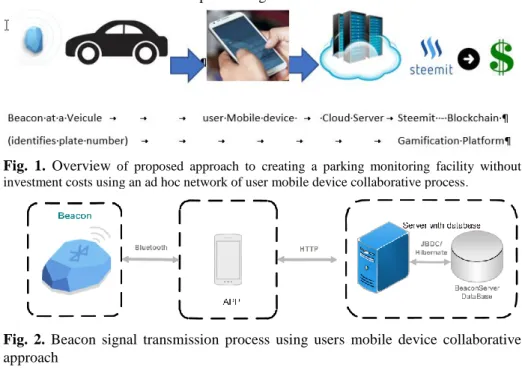
The present proposal intends to work with the problem of the management of plac-es in open spacplac-es using probabilistic calculation on data history, and the collaboration of the users, which allows to determine in which places have a higher probability of being empty. The use of probabilities allows dealing with the uncertainty associated with this process through past data analysis (data history), which allows reducing uncertainty using Artificial Intelligence (AI) algorithms. This uncertainty will also be incorporated into the route optimization algorithms, allowing to indicate optimal paths to find the desired parking place function of the probability functions associated with the location. For example, it is possible that the optimal path is not related to the higher probability of a vacant place, but rather the route of maximizing the different probabilities. From the research done by the authors of this idea, it is innovative and has not yet been implemented in any solution of this type. Figure 1 shows the devel-oped approach for mobile device application. It is possible to control parking spots based on the use of BLE beacons in vehicles. These beacons transmit an identification signal that can be captured by mobile devices, which can add a GPS position and be transmitted to a central system.
The current proposal is distinguished by the involvement of users, by analyzing the data history to determine the probability of empty space, by combining the concept of carpooling and by not implying the installation of any infrastructure, which increases complexity and makes any solution more expensive.
We implemented in a test environment a Steemit (www.steemit.com) that allows the account the distributed user inputs about free parking places and associated points (free parking minutes) in a gamified approach. Each street we define a number of inputs needed for system work properly, when a number of inputs are below we point increased and when are above points decrease. The platform allows this flexible con-figuration, and in a big implementation scenario (not available yet) we can explore the power of this approach.
To incentive users’ participation, a reward mechanism based on free parking is in-troduced. First-time drivers should register and request for a beacon. Being part of this network allows them to have reduced parking fees. In order to monitor parking activity, our proposal is the installation of a beacon in each vehicle (it costs around 3€, with a battery lifetime span of 2 years). These requirements should be reinforced by law and maintenance should be the responsibility of the owner of the vehicle. This works like an electronic plate number that allows vehicle identification. To avoid the creation of infrastructure and networking, our approach is innovative as it uses citi-zens and their mobile devices. In this model, users get rewards for each different bea-con picked and transmitted to the central parking application. This reward could be free parking time (for instance, 5 minutes parking for each transmission) and the re-ward could be increased if an infraction is identified. This process is performed cen-trally, where the beacon ID is used to check if the vehicle-parking place was previous-ly paid for or not. This is performed by an App (in the case of Lisbon the e-parking App from EMEL (epark.emel.pt)). This ad hoc transmission checks the beacon ID and verifies if it is paid for. Infraction data can be immediately sent to the nearest parking agent who can then issue an infraction ticket, or the central system can send the in-voice directly to the vehicle’s owner. Figure 1 shows the overall working idea for the main system with beacon signals captured by mobile devices and position is added and transmitted to a central server. This information is used to check if the parking spot is reserved or not. To avoid errors, because users can receive beacons from a moving vehicle in front of the parking place, the system waits for a second notifica-tion from a different user before proceeding with the identificanotifica-tion of a violanotifica-tion.
Fig. 1. Overview of proposed approach to creating a parking monitoring facility without investment costs using an ad hoc network of user mobile device collaborative process.
Fig. 2. Beacon signal transmission process using users mobile device collaborative
In terms of communication, Figure 2 illustrates the process, with a local Bluetooth communication with a range of 20-30 meters between vehicle beacon and mobile user device and a HTTP connection from the mobile device to the central server.
4
Identification of free Parking Slots based on user input
We developed an interface to allow an easy report on the number of free parking places in a street or to alert that the booked parking place will be free within x minutes. This collaborative process only requires power from users’ mobile devices and consumes network communication, but since we are transmitting data in usual communication packages, this communication process does not have any impact on prices. This collaborative reporting can be performed by: 1) drivers in a car using NLP (Natural Language Processing), where the application asks about the number of identified available places the driver saw. The application is calibrated to understand numbers in different languages (we tested in English and Portuguese); 2) Pedestrians, who give feedback about a number of places available on the street. Geo-referencing is available through GPS on mobile devices. Under these conditions, the user needs only to introduce an estimation of the number of free places he remembers on that street. Figure 3 shows the automatic voice recognition process implemented.
Fig. 3. Users inputs of free space using a voice to text recognize the system
These two crowdsensing approaches are complementary, and users are incentivized to participate by the reward mechanisms introduced. Every input performed that match average performed in a pre-defined window time (this is to avoid spam inputs without any sense) gives free parking minutes in a city.
For drivers, it is possible to integrate mobile devices into the vehicle’s infotain-ment systems, it is possible to create an easy interface for drivers to give feedback about empty parking places while driving.
We tested several approaches regarding the reward. We tested using a population of 90 information providers (60 drivers and 30 pedestrians) in a three months test.
In the first scenario, every input gave 5 minutes of free parking in a green zone (low-cost parking area). During the test period, we had an average of 43 notifications
per day (monthly notification divided by the working days). This rewards gave around 3,6 hours of free parking in a green zone per day;
In a second scenario, every input gave 1 minute of free parking in a green zone. During the test period, we had an average of 9 notifications per day. This reward gave around 9 minutes of free parking in a green zone. This meant we should increase the reward.
In the third and last scenario, every input gave 10 minutes of free parking in the green zone. During the test period, we had an average of 58 notifications per day. Perhaps this is too much.
As a model, the system depends on the numbers of users versus the number of noti-fications received. Lisbon has about half a million people living, a surface of 100 thousand km2 and around 1500 streets [19].
To be able to work in peak times (9am to 6pm), the system needs notifications with a periodicity of 5 minutes; we need around 108 notifications per street. In the remain-ing hours of the day: 1) 6pm to 12am and 6am to 9am, we need notifications with a periodicity of about 10 minutes, which gives 90 notifications per street; and 2) the remaining time, from 12am to 6am, the only hour to hour notifications are required. This gives the need for 200 notifications per day per street, which is about 300 thousand per day. Estimating a goal of 50 notifications per user per day, the system needs 6000 users. Figure 4 illustrates this process.
Fig. 4. - Users notification about free parking places, based on a crowdsourcing mechanism
approach
To avoid spam we need more notifications to extract the average, deviations are treated as spam, and those users can be removed from the system. To avoid the creation of different logins, users are validated based on the fiscal number.
5
Eco-Parking Development
We incorporate the most advanced techniques of data visualization, especially for what concerns the ease of discrimination of the target of interest vs. the rest of the picture.
The application is developed in the Java language and available for installation on devices with the Android operating system. The application can be obtained through the following link [20].
The Google Firebase platform was used to create a NoSQL Cloud Firestore data base with great flexibility, with the possibility of performing very complex database queries with minimal server performance. An authentication system has been created in the application that is interconnected with the Firestore database that establishes the connection between the user and the entries in the database that the user performs.The Maps API, was used to implement the map in the application, and with extensive API exploration, it was possible to modify and add features. The search was used as a reference to the Autocomplete Places of Google that presents suggestions related to search criteria entered by the user. An internal link has been implemented between the search module, map module, and database module so that they can communicate seamlessly with each other.
The application requires that location permissions be given, as it collects infor-mation from the user's current geo-location. When you start the application for the first time, you will be prompted to give these permissions. The application requires registration since it is necessary to identify the users who contribute the information. In addition, to better organize and structure the database, it was also decided to record the database data. If you already have an account, you can log in by clicking the "Log In" button at the bottom of the screen, see Figure 5. All fields are required. If during the registration process the user does not fill in one of the fields, it will be duly identi-fied with a red colour. If you already have an account, this login screen will have to identify you with the email and password that you used during the registration pro-cess. During confirmation of the personal data between the server and the application, a progress bar will be displayed. If there is a failure in authentication, a notification balloon will be presented to the user. Otherwise, the application will proceed to the main screen of the application. The main application screen consists of the map and the menu bar that contains a search bar. Since it is an application that presents the user with the location of the searched place and presents information on the number of available parking places, it has been chosen to simplify as much as possible so that the user can get the desired result without having to click and navigate a lot in the application until you get the result. In the lower left corner is the button that centraliz-es the map at the user's current position. In the bottom right corner the zoom feature. The search bar is centered on the menu bar containing the button that expands the menu (left button) and the voice search button. Clicking the menu button displays the screens available in the application. To simplify the use of the App, the whole focus was given to the main screen ("Search for Parking"), (see Figure 6 (a)). If one wants to enter information about the number of vacant spots in a particular location, he can do so by selecting the "Insert Parking" menu option. The Developer Board is only
used by the application developer to facilitate the tests he needs to perform. For iden-tification purposes, the user data is displayed at the top of the menu (name and email that was used during the registration process). During the search process, entering characters into the search bar will give the user suggestions about what the user has entered. A limitation was applied in the survey about Country (Portugal) and city (Lisbon), since the focus of the test was only the city of Lisbon. When choosing one of the search suggestions/results, the screen centers the selected location by placing a pin in that location. During the search process, entering characters into the search bar will give the user suggestions about what the user has entered.
Fig. 5. – Application main screen with login and the search screen
Fig. 6. – App info: (a) statistics about a street, (b) detailed statistics through the time, (c) free
If the user selects the "Statistics" button (see Figure 6 (b) and (c)), the list of exist-ing information will be displayed with the number of vacancies identified with the time it was entered. If the option to register the number of vacant posts from the "+" button is chosen from the side menu, the following screen will be displayed identify-ing the location in question and the field of insertion of the vacancy number. By submitting information (see Figure 6 (d)), it will be sent to the server and can be in-stantly queried by performing a search.
6
Conclusion
We show a collaborative network of beacon data collection to implement a parking control approach without the existing of a dedicated solution and also a collaborative approach to marking empty park space. Users win free minutes parking places, au-thorities save on control process, and also users receive information about free parking places., save time and money on looking for then.. also CO2 is decreased because less Km was performed by drivers in the parking process We implemented one of the first approach using blockchain platforms to handle this collaborative transaction. Users can participate in this process and collect free parking minutes for their own usage. This proposal needs a complete electronic solution for parking pay-ment and needs beacons that are not implepay-mented in every vehicle, but the economic benefits are considerable because there is not the need of a dedicated infrastructure. The current payment solution can be adapted for the connection between vehicle plate number to a beacon reference. Identification of free parking places is essential infor-mation to handle the problem of guidance of drivers to free parking places. Again, a significant advantage of this system is that it can work without large investments on sensors or other related equipment.
Future Work - A large-scale testing will be explored to explore the potential of gamification with a large number of involved users.
References
1. Dowling, C. F., Tanner R., Lillian Z, Baosen. (2017). How Much Urban Traffic is Search-ing for ParkSearch-ing?.
2. Estatísticas dos Transportes 2011, edição de 2012 do INE
3. Mimbela, L.Y. and L.A. Klein, 2007. A summary of vehicle detection and surveillance technologies used in intelligent transportation systems. New Mexico State University, Tech. Report, 2007. http://www.fhwa.dot.gov/ohim/tvtw/vdstits.pdf.
4. Mouskos, K.C., M. Boile and N. Parker, 2007. Technical solutions to overcrowded park and ride facilities. University Transportation Research Center-Region 2. City College of New York. Final Report, FHWANJ-2007-01. http://www.nj.gov/transportation/refdata/research/reports/FHWA-NJ-2007-011.pdf. 5. Cheung, S.Y., S. Coleri Ergen and P. Varaiya, 2005. Traffic surveillance with wireless
magnetic sensors. Proceedings of the 12th ITS World Congress, November 6-10, 2005, San Francisco, pp: 1-13.
6. Lenz, J.E. and A.S. Edelstein, 2006. A review of magnetic sensors. IEEE Sensors J., 6: 631-649
7. Wolff, J., J. Heuer, T. Haibin, G. Weinmann, M. Voit and S. Hartmann, 2006. Parking monitor system based on magnetic field senso. Proceedings of the Intelligent Transporta-tion System Conference, September 17-20, 2006, Toronto, Ont., pp: 1275-1279.
8. San Francisco Park website http://sfpark.org/
9. S. Mathur, T. Jin, N. Kasturirangan, J. Chandrasekaran, W. Xue, M. Gruteser, and W. Trappe. ParkNet: drive-by sensing of road-side parking statistics. ACM MobiSys, 2010. 10. Noor HazrinHanyMohamadHanif, Mohd Hafiz Badiozaman, HanitaDaud, “Smart parking
reservation system using short message services (SMS).” , IEEE 2009.
11. YanfengGeng, Student Member, IEEE, and Christos G. Cassandras, Fellow, IEEE “New Smart Parking System Based on Resource Allocation and Reservations”, IEEE Transac-tions on intelligent transportation systems, VOL. 14, NO. 3, September 2013.
12. P.Dharma Reddy, A. RajeshwarRao, Dr. Syed Musthak Ahmed, “An Intelligent Parking Guidance and Information System by using image processing technique”, IJARCCE, Vol. 2, Issue 10, October 2013.
13. M. M. Rashid, A. Musa, M. AtaurRahman, and N. Farahana, A. Farhana, “Automatic Parking Management System and Parking Fee Collection Based on Number Plate Recog-nition.”, International Journal of Machine Learning and Computing, Vol. 2, No. 2, April 2012, Published 2014.
14. Hilal Al-Kharusi, Ibrahim Al-Bahadly, “Intelligent Parking Management System Based on Image Processing”, World Journal of Engineering and Technology, 2014, 2, 55-67. -4799-8802-0/15 ©2015 IEEE
15. Wazir Zada Khan, Yang Xiang, Mohammed Y Aalsalem, Quratulain Arshad “Mobile phone sensing systems: A survey,” Communications Surveys & Tutorials,v.15, pp.402-427, Feb13.
16. Y. Zhang, M. van der Schaar, "Reputation-based incentive protocols in crowdsourcing ap-plications", Proc. IEEE INFOCOM, pp. 2140-2148, Mar. 2012.
17. T. Delot, N. Cenerario, S. Ilarri, S. Lecomte. A Cooperative Reservation Protocol for Park-ing Spaces in Vehicular Ad Hoc Networks. Mobility Conference, 2009.
18. K.A. Myers and B.D. Tapley. Adaptive Sequential Estimation with Unknown Noise Statis-tics. IEEE Transactions on Automatic Control, Vol. 21, No. 4, pp.520-523, 1976. 19. http://www.dgterritorio.pt/ficheiros/cadastro/caop/caop_download/caop_2014_0/areasfreg
mundistcaop2014_2, web page accessed in September 2018
20. App download link - https://iscteiul365-my.sharepoint.com/:u:/g/personal/ngvii_iscte-iul_pt/EQjjAxRiulROrXseEQMFoMBWx1puOqzHehGMzH8fX5zA?e=qGpkUL