Municipal administration and corruption in the implementation
of federal education programs
Cecília Olivieri
Universidade de São Paulo / Escola de Artes, Ciências e Humanidades, Programa de Pós-Graduação em Gestão de Políticas Públicas
São Paulo / SP — Brazil
Bruno Martinelli
Universidade de São Paulo / Escola de Artes, Ciências e Humanidades, Programa de Pós-Graduação em Gestão de Políticas Públicas
São Paulo / SP — Brazil
Pedro Massucatto
Universidade de São Paulo / Escola de Artes, Ciências e Humanidades São Paulo / SP — Brazil
Carolina Bragança Silva
Universidade de São Paulo / Escola de Artes, Ciências e Humanidades São Paulo / SP — Brazil
This paper analyzes the implementation of federal education programs in municipalities through structured analysis of the texts in supervision reports provided by the Comptroller General of Brazil for the year 2014. The aim is to analyze the problems affecting the management of federal programs in municipalities. Studies on management and corruption in municipalities were reviewed and form the theoretical framework. The main conclusion is that it is ne-cessary to increase the attention of researchers and managers to issues related to the quality of municipal management, because problems in program implementation is more likely to be the result of bad management than corruption. Keywords:public administration; governmental control; implementation; federalism; corruption.
Gestão municipal e corrupção na implementação de programas educacionais federais
Este trabalho analisa a implementação de programas federais de educação nos municípios por meio da análise estruturada de textos dos relatórios de fiscalização da CGU do ano de 2014. Estudos sobre gestão e corrupção nos municípios compõem o referencial teórico. O objetivo é analisar os problemas que afetam a gestão de programas federais em municípios. A principal conclusão aponta que é preciso aumentar a atenção de pesquisadores e gestores para questões relativas à qualidade da gestão municipal, pois elas afetam mais frequentemente a implementação das políticas do que problemas de corrupção.
Palavras-chave: gestão pública; controle governamental; implementação; federalismo; corrupção.
Administración municipal y corrupción en la implementación de programas educativos federales
Este trabajo analiza la implementación de programas federales de educación en los municipios a través del análisis estructurado de textos de los informes de fiscalización de la CGU del año 2014. Estudios sobre gestión y corrupción en los municipios componen el referencial teórico. El objetivo es analizar los problemas que afectan a la gestión de programas federales en municipios. La principal conclusión apunta que es necesario aumentar la atención de investigadores y gestores para cuestiones relativas a la calidad de la gestión municipal, pues afectan más a menudo la implementación de las políticas que problemas de corrupción.
Palabras clave: administración pública; control gubernamental; implementación; federalismo; corrupción.
DOI: http://dx.doi.org/10.1590/0034-7612171081
Article received on October 25, 2016 and accepted on August 4, 2017.
1. INTRODUCTION
We have analyzed the Brazilian municipal management in education programs based on the reports of the Brazilian Office of the Comptroller General (CGU) on irregularities in the implementation of federal programs in 2014.The goal is to study the problems that affect the management of federal programs in municipalities. The research contributes to the study about the municipal management of federal programs, because it looks at the issues that affect specific programs in more detail than similar studies, and contributes to studies about the relationship between corruption and public management by reinforcing previous findings that indicate that corruption is less frequent than mismanagement.
The subject of municipal management is little discussed by the Brazilian literature in spite of its importance to the coordinated implementation of the policies in the federal structure (Veloso et al., 2011). Municipalities are fundamental entities in the implementation of national policies, but the analyses of federal programs generally do not focus on the municipal management.
Recent studies about the relationship between corruption and public management point out that, in the cities, the main problems are related to the quality of management rather than to corruption, indicating the importance of deepening qualitative analyses about the diversity of local management.
Our analysis highlights that the problems of the municipal management in the country are mostly caused by the fragility of the management rather than by corruption. Corruption exists and is a problem that must be tackled by means of specific instruments; yet it must not replace the con-cern with the improvement of management. In addition, reducing corruption will not automatically improve the quality of services; it could lead to economy and increased availability of resources, but improvements in the quality of policies are more associated with factors such as qualification of public servants, organization of administration systems and production of services, planning and evaluation of actions, and not only the increase of resources (Veloso et al., 2011).
2. MANAGEMENT AND CORRUPTION IN THE BRAZILIAN MUNICIPAL ADMINISTRATION
The expansion of the role of municipalities in the financing and management of policies since the 1988 Constitution was not accompanied by an in-depth understanding of its management (Veloso et al., 2011). The literature on municipalities’ management is scarce, focusing on other issues such as political participation, local development, innovations and efficiency of spending (Bava, Paulics and Spink, 2002; Dowbor and Pochmann, 2010; Ferreira, Medina and Reis, 2014; Soares and Bava, 1998).
This work fills a gap in the literature about corruption by proposing to study educational policies. Marin, Gama and Campelo (2014) and Rodrigues and Santos (2015) analyzed sanitation, housing and infrastructure; Dias and collaborators (2013), Avelino, Barberia and Biderman (2013), Peixoto and collaborators (2012) and Jannuzzi (2011) analyzed health programs; and Mendes (2004) analyzed the Fund for the Maintenance and Development of Basic Education and Enhancement of the Teacher Profession (Fundef), from the federal management perspective.
The study on municipal management in federal education programs is also important because of the decentralization process (Castro, 2010; Peres and Mattos, 2015), the substantial volume of resources transferred by the Federal Government in this area, and its importance to implement the right to education and reduction of inequalities (Pinto, 2014).
and their geographical distribution, reduced availability of information on local management in government sites, and high diversity of administrative, political, institutional, demographic and economic matters (Veloso et al., 2011).
The information contained in the CGU’s monitoring reports about the municipalities help to overcome some of these difficulties, because they constitute the broader and more long-lived data-base on the implementation of federal programs in municipalities (Brasil, 2016).CGU’s monitoring is conducted since 2003 with a method that has undergone few changes until 2014; with over 2,000 cities monitored and 2,381 reports published until 2015 (Brasil, 2016).
Most studies that used the CGU reports emphasized the theme of corruption, associating the occurrence of irregularities to phenomena such as: the effects of the publication of reports on
mu-nicipal elections (Ferraz and Finan, 2008); the effects of corruption on the Prova Brasil exam (Ferraz,
Finan and Moreira, 2008); and the effects of accountability mechanisms on the corruption in health (Avelino, Barberia and Biderman, 2013).The nature of these reports favors studies on corruption because monitoring aims at identifying irregularities. However, these same studies have pointed out that the most frequent problem in municipalities is not corruption, but the difficulty of achieving efficient management of public resources.
The studies that analyzed spending on construction works also concluded that management flaws are more frequent than corruption (Marin, Gama and Campelo, 2014; Rodrigues and Santos, 2015). Such result is very interesting because the spending with construction works — executed in Brazil mainly by private companies contracted by governments — is the most prone to irregulari-ties defined as corruption by Ferraz and Finan (2008:70): “irregulariirregulari-ties related to fraud in public contracts, misuse of public funds and pricing”. In addition, recent analyses of the National Congress and the Federal Court of Auditors point out the fragility of government controls on spending with construction works (Ribeiro, 2012, 2014; Olivieri, 2016). That is, assumptions regarding the severity of corruption in the municipalities have been resized by the analyses based on monitoring which, it should be stressed, seek to identify irregularities.
If analyses of the irregularities in the spending on construction works conclude that the most frequent problem is mismanagement, such as the studies that analyzed spending in other areas, then we must reduce the focus of the studies on corruption and instead, focus the attention on issues relating to the quality of management. We believe that these results indicate that there is a need to deepen our knowledge about the specifics of management in the municipal context, which does not imply, in any way, in reducing the effort to fight corruption by means of inspections, investigations and qualification of mechanisms and control agencies, internal and external to the Executive Branch.
By analyzing four strategic areas of management (finance, capital and infrastructure, personnel and information technology), Veloso and collaborators (2011) point out as main problems of municipal management: low institutionalization (absence of an exclusive secretariat for financial and human resource management); low levels of professional qualification of employees (absence of training and qualification in finance and low educational level of employees in the areas of capital and infrastruc-ture); and lack of planning (absence of long-term plans for information technology and the absence of career and salary plans).
qualifica-tion of employees for new activities, and on planning not only for the use of financial resources and capital, but also the policies and actions directed to the production of services.
3. METHOD
The CGU reports have been used in qualitative-documental research for evaluation of the implemen-tation of federal programs at the local level (Januzzi, 2011). The reports do not have information on the costs of all irregularities, which prevents, in our view, conducting research with the same quantitative method of Bandiera, Prat and Valetti (2009), based on the spending on public procurement.
The sample of this study is intentional and not statistically representative, as all reports of municipalities drawn by the CGU that received funds for educational programs in 2014 — the most recent year in which all reports were available when the research was conducted — were analyzed (Brasil, 2014). The 51 municipalities analyzed are located in 20 Brazilian states of all regions of the country.
One of the content analysis techniques – structured analysis of texts – was used, which allows for a structured interpretation of the reports (Januzzi, 2011). To ensure consistency and internal validity, and inferential power, we followed the steps proposed by Bowen and Bowen (2008).
The first step of the research consisted in identifying the deficiencies pointed out by the CGU in
every action of each program and the construction of the database, which has 1,065 records.1 Table1
presents the actions monitored and the number of records/irregularities identified in each action.
CHART 1 FINDINGS PER PROGRAM AND ACTION
Program Action N
Basic Education
School Feeding Program in the Basic Education (PNAE) 345
Support for School Transportation in Basic Education (PNATE) and Way to School 195
Federal Government’s Additional to the Fundeb (Fundeb) 192
Production, Acquisition and Distribution of Books and Teaching Materials for Basic Education (PNLD)
109
Implementation of Schools for Early Childhood Education 42
Implementation and Adaptation of Sports Structures in Schools 37
Support for the Development of Basic Education 32
Infrastructure for Basic Education 20
Support for the Alphabetization and Education of Youngs and Adults 14
Support for the Maintenance of Early Childhood Education 5
Qualityin Schools Support for the Restructuring of Public Basic Education Network 68
PAC Implementation and Adaptation of Sports Structures in Schools/PAC II 6
Source: Elaborated by the authors.
In the second stage of the survey, we developed — based on the literature —, a coding system to classify each record. We sought, however, to avoid the identification between suspicion of occurrence of some sort of fraud indicated by the CGU and the occurrence of corruption. Therefore, we have not
defined any category as “corruption” or “fraud”. Thus, the categories created were: evidence of fraud,
mismanagementandothers. Further, the study seeks to identify and analyze what types of irregularities are more common in each category.
We have classified as evidence of fraud the irregularities that reflected the possibility of public
and/or private agents obtaining illegal benefits; and as mismanagement the irregularities that have
been generated, apparently, by inability/difficulty of implementing the actions in the right or legal manner, without any indication of possible undue benefit to private and/or public players. There are
866 records in these two categories, which will be examined in the next section. The category others
includes irregularities whose cause is not under the responsibility of the city hall or in which such identification is not possible to be made. It refers to problems in social control mechanisms, issues on which the municipality’s governance is low, and cases where there is insufficient information to classify. This category includes 199 records (19%), excluded from the analysis.
The third step of the research consisted of testing the classification system. The fourth step was the application of the classification system. The fifth, analysis of the reliability of the encoding. Finally, the sixth step involved the interpretation of results, which is presented in the next section.
4. RESULTS
In this section, we present the analysis of quantitative data on the categories of mismanagement and evidence of fraud, which reveals the prevalence of mismanagement problems in relation to those that indicate fraud, and analyzes the types of problems that affect, in greater proportion, the programs implemented in municipalities.
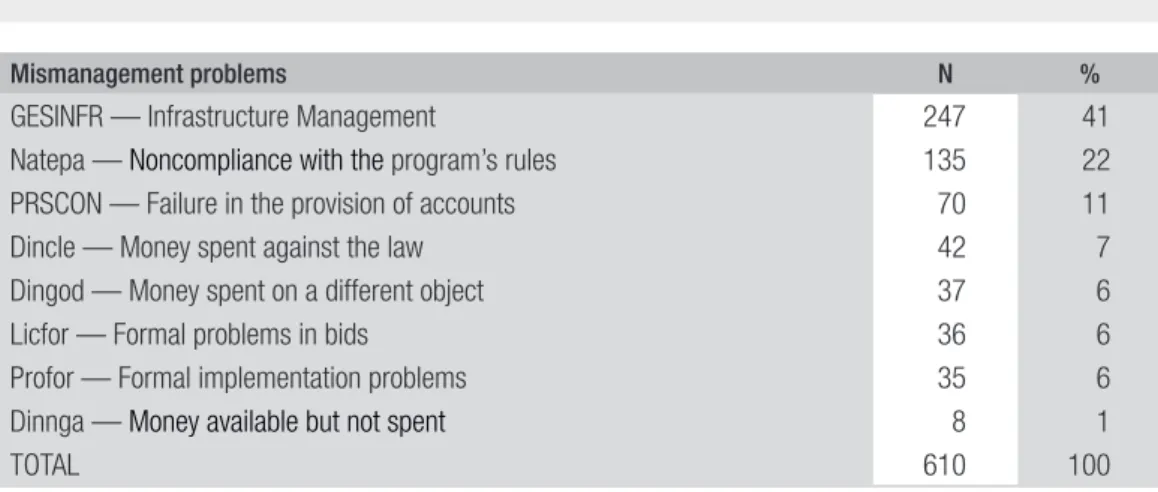
By analyzing the data, we have identified that 610 (70%) of records are mismanagement-related problems, while 256 (30%) are related to evidence of fraud. Therefore, the frequency of mismanage-ment-related problems is higher than those related to fraud. Table 1 presents the types of problems relating to mismanagement.
TABLE 1 MISMANAGEMENT PROBLEMS
Mismanagement problems N %
GESINFR —Infrastructure Management 247 41
Natepa — Noncompliance with the program’s rules 135 22
PRSCON —Failure in the provision of accounts 70 11
Dincle —Money spent against the law 42 7
Dingod —Money spent on a different object 37 6
Licfor —Formal problems in bids 36 6
Profor —Formal implementation problems 35 6
Dinnga — Money available but not spent 8 1
TOTAL 610 100
Essentially, three quarters (74%) of the problems are related to GESINFR, Natepa and PRSCON categories. The remaining problems add to 26%: Dincle, Dingod, Licfor, Profor, and Dinnga. Chart 2 presents the actions with higher incidence of irregularities and the types of problems.
CHART 2 MAIN ACTION AND PROBLEMS RELATED TO MISMANAGEMENT
Action Mismanagement problems identified
PNAE Food storage and inadequate environments for school meals, absence of
nutritionist, and lack of nutritional information on menus.
PNLD Failure to distribute books in schools or late distribution.
PNATE and Way to School Poor condition of vehicles carrying students (poor conditions or overcrowding).
Fundeb Failure to comply with the professionals’ working hours, existence of lay
teachers, violation of the wage floor and application of the minimum of 60% in the teachers’ remuneration.
Source: Elaborated by the authors.
Chart 2 shows that the mismanagement problems are concentrated in 33% of the actions mon-itored within the Ministry of Education. All problems are related to the management of resources by the city hall, directly affecting the quality of the service or good offered to school children: nu-tritional quality of snacks served, availability of books, transportation safety, and qualification and remuneration of teachers.
The CGU reports allow identifying the most recurring problems in the implementation of poli-cies. These are not only formal failures, but rather problems in the implementation of actions (such as poor food storage, poor distribution of books, inefficiency in the management of transportation contracts, and irregularities in the use of the Fundeb’s resources), and problems related to products or services offered to the population (insufficient or poor quality of snacks, lack of books, insecure transportation, and teaching under qualification).
These are the problems expected to be found in an administration with the diagnostic features described by Veloso and collaborators (2011): low institutionalization, low professional qualifica-tion of employees, and weak planning. Although programs such as “PNAE” and “PNLD” have been implemented many years ago, the deficiencies identified indicate that local managers have great dif-ficulty to perform routine activities and tasks with low levels of complexity, such as checking stocks of snacks and distributing textbooks, indicating that the low institutionalization of agencies and low qualification of local professionals can be significant factors in the explanation of such irregularities.
TABLE 2 EVIDENCE OF FRAUD PROBLEMS
Evidence of Fraud N %
Indfra — evidence of fraud in bids 121 47
Dindef — money spent on partial or defective delivery 102 40
Dinsem — money spent without any delivery 17 7
FRAPRF — fraud of programs by the city hall 16 6
TOTAL 256 100
Source: Elaborated by the authors.
Most problems (87% of the records) is in Indfra and Dindef categories. Indfra points to possible favoring of a participant in the bidding process, possible combination of result between suppliers (collusion), division of expenses, misuse of bidding waiver, and failure to conduct price survey. Dindef includes situations in which resources were spent in their entirety, but there were flaws in the product or service delivered, such as irregular works and/or constructions, overpricing, and problems in the acquisition of vehicles and fuel purchase.
The other categories of evidence of fraud comprise less than 15% of the problems: Dinsem and FRAPRF. The first refers to payment for a good or service without identification of the good or service. The second refers to actions of the city hall, contrary to the program rules and that entail receiving more federal resources than established or favoring a professional of the public administration. Chart 3 presents the actions with higher incidence of irregularities and problems identified.
CHART 3 MAIN ACTIONS AND PROBLEMS OF EVIDENCE OF FRAUD
Action Main problems identified
PNAE Simulation of the provision of snacks.
PNATE and Way to School Irregularities in bids for contracting of transportation services, purchase of vehicles and purchase of fuel.
Fundeb Irregularities in bids for contracting of transportation services, payment
to employees who did not performance the services, misrepresentation of students.
Implementation of Schools for Early Childhood Education
Irregular works and/or constructions
Support for the Restructuring of the Public Basic Education Network
Overpricing and irregularities in constructions, failure to perform services related to infrastructure.
Chart 3 shows that the problems related to the evidence of fraud are concentrated on five of MEC’s 12 actions, three of which are the same that show more mismanagement problems: PNAE, Fundeb and PNATE. Such result reinforces that the Ministry should pay more attention to these actions because, as the executor of the policy and resources, it is also responsible for achieving good results and, there-fore, it should collaborate in the construction of improvements on intergovernmental management. It should be noted that problems related to the management of purchase, contracts and construction works can also be related to the categories described by Veloso and collaborators (2011).
Precarious management and internal controls, and lack of professionalization of public ser-vants in these areas increase the likelihood of occurrence of irregularities and fraud. In other words, the fight against corruption also depends on improvements in management, and not only in areas dedicated to preventing fraud and management problems, such as internal control. All problems — management or fraud — directly or indirectly affect the quality of the service or good offered to children: absence or reduction of snack foods, school bus service, availability of infrastructure and/ or its low quality, with negative effects on school attendance, quality of the school environment and, therefore, on learning.
The source of the problems is not only the intention of defrauding bidding processes to obtain financial benefits, but also the fragility of administrative procedures, the structure of organizations, and the qualification of servants. The precise identification of the source of such problems (bad faith or inefficiency, and which inefficiencies “enable” bad-faith) depends on richer data than those provided by CGU and public databases. In our view, it depends on qualitative research conducted
in loco, oriented by the perspective that mismanagement is more common than corruption, and that actions devoted exclusively to combating corruption do not guarantee the treatment against problems of administrative and organizational character.
5. CONCLUSIONS
In 2014, three actions of the MEC presented problems related to mismanagement and evidence of fraud: PNAE, Fundeb and PNATE. Even though the irregularities can be considered responsibility of municipalities, the Ministry is the executor of the policy and resources and, therefore, responsible for the achievement of good results. Hence, the Ministry should take measures to build mechanisms to improve the management of these programs in its localities.
The federal government has been working on improving the management of other entities with positive results, such as the states by means of the PNAGE (Abrucio, 2005) and the audit courts by means of the Promoex (Abrucio, Arantes and Teixeira, 2005). These actions are important to strength-en the cooperation among states and improve public administration. Similar initiatives focused on municipal management are very important.
As already pointed out by literature, the CGU reports are an important source for analyzing the management of federal programs implemented in the states and municipalities. Despite the limitations of the reports, their analysis can complement studies on federal management and local management of federal programs. However, qualitative studies are needed to deepen the knowledge of the causes of the problems in the municipal management: what are the effective corruption problems and what are the most pressing management issues.
Future analyses should emphasize management issues instead of corruption ones, because the literature and this paper show that the most common problems are related to management problems. In addition, evidence of fraud may not solely arise from bad faith of servants, public agents or private players, but from management fragilities (created or maintained for different reasons, such as lack of resources, lack of knowledge or chance and bad faith). That does not mean that it is possible to combat all manners of fraud and corruption only with the creation or revision of administrative procedures and qualification of servers, but it is necessary to accurately identify the source of every problem to best define an appropriate and efficient solution.
REFERENCES
ABRUCIO, Fernando L. Reforma do Estado no fede-ralismo brasileiro: a situação das administrações pú-blicas estaduais. Revista Brasileira de Administração
Pública, Rio de Janeiro, v. 39, n. 2, p. 401-420, 2005.
ABRUCIO, Fernando L.; ARANTES, Rogério B.; TEIXEIRA, Marco A. C. A imagem dos tribunais de contas subnacionais. Revista do Serviço Público, Brasília, v. 56, n. 1, p. 57-85, 2005.
AVELINO, George; BARBERIA, Lorena G.; BIDER-MAN, Ciro. Governance in managing public health resources in Brazilian municipalities. Health Policy
and Plan, v. 29, issue 6, p. 694-702, 2013.
BANDIERA, Oriana; PRAT, Andrea; VALLETTI, Tommaso. Active and passive waste in government spending: evidence from a policy experiment.
Ame-rican Economic Review, v. 99, n. 4, p. 1278-1308,
2009.
BAVA, Silvio; PAULICS, Veronika; SPINK, Peter.
Novos contornos da gestão local: conceitos em
cons-trução. São Paulo: Eaesp, 2002.
BOWEN, Chieh-Chen; BOWEN, Willian M. Con-tent analysis. In: YANG, Kaifeng; MILLER, Gerald J.
Handbook of research methods in public
administra-tion. New York: CRC Press, 2008. p. 689-703.
BRASIL. Controladoria-Geral da União. Programa
de fiscalização por sorteios públicos. 2014. Available
at: <www.cgu.gov.br/assuntos/auditoria-e-fiscaliza- cao/avaliacao-de-programas-de-governo/programa-de-fiscalizacao-por-sorteios-publicos>. Acsessed on: 25 Abr. 2014.
BRASIL. Controladoria-Geral da União. Relatório do programa de fiscalização por sorteios públicos.
2016. Available at: <http://sistemas.cgu.gov.br/relats/ relatorios.php>. Accessed on: 25 Aug. 2016.
BRASIL. Ministério da Educação. Programas e
ações. s.d. Available at: <http://portal.mec.gov.br/
secretaria-de-educacao-basica/programas-e-acoes> Accessed on: 1o Oct. 2016.
CASTRO, Jorge A. de. Financiamento da educação pública no Brasil: evolução dos gastos. In: OLIVEI-RA, Romualdo P. de; SANTANA, Wagner (Org.).
Educação e federalismo no Brasil: combater as
desi-gualdades, garantir a diversidade. Brasília: Unesco, 2010. p. 169-190.
DIAS, Lidiane N. et al. Fatores associados ao des-perdício de recursos da saúde repassados pela União aos municípios auditados pela Controladoria Geral da União. Revista Contabilidade e Finanças (USP), v. 24, n. 63, p. 206-218, 2012.
DOWBOR, Ladislau; POCHMANN, Marcio.
Políti-cas para o desenvolvimento local. São Paulo: Perseu
Abramo, 2010.
FERRAZ, Claudio; FINAN, Frederico. Exposing cor-rupt politicians: the effect of Brazil’s publicly release audits on electoral outcomes. Quarterly Journal of
Economics,v. 123, n. 2, p. 703-745, 2008.
FERRAZ, Claudio; FINAN, Frederico; MOREIRA, Diana B. Corrupção, má gestão, e desempenho educacional: evidências a partir da fiscalização dos municípios. ANAIS do Encontro Nacional de Econo-mia, Salvador, p. 1-20, 2008.
FERREIRA, Marco A. M.; MEDINA, Silvana A.; REIS, Anderson de O. Pregão eletrônico e eficiên-cia nos gastos públicos municipais. Administração
Pública e Gestão Social, v. 6, n. 12, p. 74-81, 2014.
FNDE. Nota técnica n. 5002/2016. COSAN/CGPAE/ DIRAE. 2016. Available at: <www.fnde.gov.br/fnde- legis/action/UrlPublicasAction.php?acao=abrirA- toPublico&sgl_tipo=NTC&num_ato=00005002&-seq_ato=000&vlr_ano=2016&sgl_orgao=FNDE/ MEC>. Accessed on: 12 Dec. 2016.
JANUZZI, Paulo de M. Avaliação de programas públicos por meio da análise estruturada dos relató-rios de auditoria da Controladoria Geral da União.
Cadernos Gestão Pública e Cidadania, v. 16, n. 59,
p. 222-239, 2011.
MARIN, Tany I. S.; GAMA, Dayani S. S.; CAMPELO, Vittório S. Corrupção e ineficiência nos repasses federais: uma análise dos gastos do Ministério das Cidades nos municípios paraenses (2003-2013). In: CONGRESSO USP DE INICIAÇÃO CIENTÍFICA EM CONTABILIDADE, XI, 2014, São Paulo. Anais...
São Paulo: USP, 2014. p. 1-16.
MENDES, Marcos. Análise das irregularidades na
administração municipal do FUNDEF: constatações
do programa de fiscalização a partir de sorteios pú-blicos da Controladoria Geral da União. São Paulo: Transparência Brasil, 2004.
exe-cução de investimento em infraestrutura no Brasil.
Brasília: Ipea, 2016. (Texto para Discussão, 2252).
PEIXOTO, Sandro G. D. et al. Decentralization and corruption: evidence from primary health-care programmes. Applied Economics Letters, v. 19, n. 18, p. 1885-1888, 2012.
PERES, Ursula D.; MATTOS, Bruna. Eficiência do
gasto em educação no Brasil. Todos Pela Educação
(TPE): práticas educativas, fortalecimento local e agenda de política. São Paulo, 2015. (Relatório de Pesquisa. Todos pela Educação).
PINTO, José M. Federalismo, descentralização e planejamento da educação: desafios aos municípios.
Cadernos Pesquisa, v. 44, n. 153, p. 624-644, 2014.
RIBEIRO, Romiro. A lenta evolução da gestão de obras públicas no Brasil. E-Legis, n. 8, p. 82-103, 2012.
RIBEIRO, Romiro. Avaliação da execução do Programa de Aceleração do Crescimento (PAC) (2007/2014). Nota Técnica 15/2014. Brasília: Con-sultoria de Orçamento e Fiscalização Financeira; Câmara dos Deputados, 2014.
RODRIGUES, Daniele S.; SANTOS, Nálbia de A. Desperdícios ativos e passivos nos gastos com
saneamento e habitação: evidências empíricas no Programa de Aceleração de Crescimento (PAC). In: CONGRESSO USP DE INICIAÇÃO CIENTÍFI-CA EM CONTABILIDADE, XII, 2015, São Paulo.
Anais... São Paulo: Fipecafi, 2015. p. 1-15.
SOARES, José A.; BAVA, Silvio C. Os desafios da
gestão municipal democrática. São Paulo: Cortez,
1998.
SODRÉ, Antonio C. A.; ALVES, Maria F. C. Relação entre emendas parlamentares e corrupção municipal no Brasil: estudo dos relatórios do programa de fis-calização da Controladoria Geral da União. Revista
Administração Contemporânea [online], v. 14, n. 3,
p. 414-433, 2010.
VIEIRA, James B. O impacto das capacidades institucionais do setor público: um estudo explo-ratório sobre as causas e efeitos das improbidades na adminstração pública municipal brasileira. In: CGU. Prevenção e combate à corrupção no Brasil: 6o concurso de monografias: trabalhos premiados.
Brasília: CGU, 2011. p. 107-160.
VELOSO, João F. A. et al. Gestão municipal no Brasil: um retrato das prefeituras. Brasília: Ipea, 2011.
Cecília Olivieri
Phd in Public Administration and Government from EAESP/FGV and Professor of the Postgraduate Program in Public Policy Administration at EACH/USP. E-mail: [email protected].
Bruno Martinelli
Master in Public Policy Administration from EACH/USP. E-mail: [email protected].
Pedro Massucatto
Graduate student of Public Policy Administration at EACH/USP. E-mail: [email protected].
Carolina Bragança Silva