T
RANSLATION ANDT
RANSCULTURALA
DAPTATION OF THES
ELF-E
FFICACYS
CALE FORT
EACHERS OFS
TUDENTS WITHA
UTISM: A
UTISMS
ELF-E
FFICACYS
CALEFORT
EACHERS(
ASSET
)
1T
RADUÇÃO EA
DAPTAÇÃOT
RANSCULTURALD
AE
SCALAD
EA
VALIAÇÃOD
EA
UTOEFICÁCIA DEP
ROFESSORES DEA
LUNOS COMA
UTISMO: A
UTISMS
ELF-E
FFICACYS
CALEFORT
EACHERS(
ASSET
)
2Renata Corcini Carvalho CANABARRO3 Maria Cristina TrigueroVeloz TEIXEIRA4 Carlo SCHMIDT5
ABSTRACT: The teaching self-efficacy perception in relation to the professional practice may interfere in the schooling process of students with autism and may influence the motivation and performance of the teacher’s response to the challenging situations of these students’ inclusion process. The Autism Self-Efficacy Scale for Teachers (ASSET) evaluates the self-efficacy beliefs of teachers in their ability to perform teaching tasks with students with autism. In this context, this study verified indicators of semantic equivalence resulting from the process of translation and transcultural adaptation of the ASSET scale into the Portuguese language of Brazil and verified indicators of clarity and comprehension of this version in Portuguese through a pilot study. The methodological procedures involved the translation of the scale into the Brazilian Portuguese language and back-translation into English; analysis of semantic equivalence; evaluation of experts of the previous steps and adaptation of the scoring scale; verification of clarity and comprehension of the scale through the pilot study for consolidation of the final version. The ASSET Portuguese version of the scale showed adequate indicators of denotative and connotative equivalence after the stages of translation, back-translation and analysis of semantic equivalence. This made the systematization of the synthesis version of the instrument with few modifications possible in order to meet both the semantic adequacy in relation to the original version and the cultural adjustments, in the stage of expert evaluation and score adaptation. In the pilot study the synthesis version was evaluated as adequate by most teachers. In the final version of the scale, participants’ suggestions were included from the pilot study, considering the adequacy of both colloquial vocabulary and the maintenance of the effect of each item in Brazilian culture. We suggest new studies that evaluate other psychometric properties of the ASSET.
KEYWORDS: Special Education. Teaching self-efficacy. Autism. Transcultural adaptation.
RESUMO: A percepção de autoeficácia docente em relação à prática profissional pode interferir na escolarização de alunos com autismo e afetar a motivação e a atuação do professor frente às situações desafiantes do processo de inclusão desse alunado. A Autism Self-Efficacy Scale for Teachers (ASSET) avalia as crenças de autoeficácia dos professores em sua capacidade para desempenhar tarefas docentes no ensino de alunos com autismo. Nesse contexto, este estudo verificou indicadores de equivalência semântica resultantes do processo de tradução e adaptação transcultural da escala ASSET para a língua portuguesa do Brasil e verificou indicadores de clareza e compreensão dessa versão em português mediante estudo piloto. Os procedimentos metodológicos envolveram a tradução da escala para a língua portuguesa e retrotradução para a língua inglesa; análise de equivalência semântica, avaliação de especialistas
1 http://dx.doi.org/10.1590/S1413-65382418000200006
2 This paper reports a part of the study developed in the Doctoral Research entitled Consultoria colaborativa: influências na
autoeficácia docente e no processo de inclusão de alunos com transtorno do espectro autista (Collaborative consulting: Influences on teaching self-efficacy and the process of inclusion of students with autism spectrum disorder), at the Federal University of Santa Maria - UFSM, Santa Maria, Rio Grande do Sul, Brazil. Financial support: Programa de Licenciaturas (PROLICEN) - Teaching Degree Program - UFSM.
3 PhD student by the Graduate Program in Education of the Federal University of Santa Maria – UFSM, Santa Maria – RS, Brazil.
4 PhD in Health Philosophy from the Federal University of Santa Catarina - UFSC. Professor at the Postgraduate Program in
Developmental Disorders, Mackenzie Presbiterian University – UPM, São Paulo - SP, Brazil. [email protected].
5 PhD in Education from the Federal University of Rio Grande do Sul - UFRGS. Professor at the Department of Special Education
das etapas anteriores e adaptação da escala de pontuação; verificação de clareza e compreensão da escala mediante estudo piloto para consolidação de versão final. A versão da escala ASSET em português mostrou indicadores adequados de equivalência denotativa e conotativa após as etapas de tradução, retrotradução e análise da equivalência semântica. Isso possibilitou a sistematização da versão síntese do instrumento com poucas modificações para atender tanto às adequações semânticas em relação à versão original quanto aos ajustes culturais, na etapa de avaliação dos especialistas e adaptação da pontuação. No estudo piloto, a versão síntese foi avaliada como adequada pela maioria dos professores. Na versão final da escala, foram incluídas sugestões dos participantes a partir do estudo piloto, considerando as adequações tanto de vocabulário coloquial quanto de manutenção do efeito de cada item na cultura brasileira. Sugerem-se novos estudos que avaliem outras propriedades psicométricas da ASSET.
PALAVRAS-CHAVE: Educação Especial. Autoeficácia docente. Autismo. Adaptação transcultural.
1 I
NTRODUCTIONThe concept of self-efficacy was developed by the Canadian psychologist Albert Bandura, defined as ‘[...] belief in one’s capabilities to organize and execute the courses of action required to attain goals’ (Bandura, 1997, p. 3). Thus, when establishing itself as people’s perceptions of their abilities to perform a given action, self-efficacy can affect how they feel, think, motivate themselves and behave (Barros & Santos, 2010). The person will exhaust his/her potential if he/ she believes in his/her own ability to achieve a certain outcome (Deaton, 2015).
When transposing this concept to the educational context, teacher self-efficacy is understood as the teacher’s belief in his/her capacity to develop pedagogical actions that lead to the desired results. To Skaalvik and Skaalvik (2007, p. 612), self-efficacy is associated with ‘[...] beliefs in their own abilities to plan, organize, and carry out activities required to attain given educational goals’. In this context, teacher self-efficacy can be a potential predictor of teacher attitudes in the inclusive context: a) teachers with a high sense of self-efficacy may face difficult situations with the confidence that they will overcome them, demonstrating interest and dedication in carrying out the activities demanded by the challenging educational context, that is, they will tend to increase and sustain their efforts against eventual failures, recovering quickly their sense of effectiveness (Bandura, 1994); b) teachers with a low sense of self-efficacy, when faced with challenging situations that they perceive as personal/professional threats, may tend to feel intimidated, unmotivated, focusing more on possible adverse outcomes than on how they can develop their pedagogical activities in a successful way (Bandura, 1994).
According to Bandura’s assumptions (1994), there are four sources of influence for the development of self-efficacy: a) social persuasion, related to encouraging people, communicating that they can do something better; b) vicarious experience, related to watching someone performing a certain task, which may increase the positive belief in one’s own capability, derived from the observation of correctness and errors of the person; c) direct experience related to the learning curve, which implies the progressive improvement of learning a certain skill as a task is performed; d) physical and emotional state resulting from one’s own performance in the execution of tasks.
In order to evaluate the teacher self-efficacy, the Teacher Efficacy Scale (TES), by Gibson and Dembro (1984), and Teacher Interpersonal Self-Efficacy Scale (TISES), by Brouwers and Tomic (2001), are recognized. However, the study of Klassen, Tze, Betts and Gordon (2011) points out that these general self-efficacy measures do not cover the evaluation of teachers’ beliefs in relation to their effectiveness in performing specific teaching-related skills with students with special educational needs (SEN). Students with certain types of disabilities are classified as learners with SEN to indicate that they have individual needs in the educational and social environment (Política Nacional de Educação Especial na Perspectiva da Educação Inclusiva, 2007). SEN originated from deficiencies or learning difficulties (Declaração de Salamanca, 1997). Thus, the target population of Special Education in Brazil is formed of students who have sensory deficiencies, mental/intellectual disability, global developmental disorders/Autistic Spectrum Disorder (ASD), multiple deficiencies (association of two or more primary deficiencies) and high (gifted) abilities, as well as other conditions that can lead to learning difficulties characterized by attention problems and/or hyperactivity, dyslexia, among others (Política Nacional de Educação Especial na Perspectiva da Educação Inclusiva, 2007, 2008). Generally, the teacher’s belief about self-efficacy, in the case of Special Education teachers, can be singularly influenced by some factors. Previous studies cite some of these factors, namely: teacher stress or failures in student acquisition of learning skills; quality of education; and experience in teaching in Special Education, among others (Ruble, Usher, & McGrew, 2011; Ruble, Toland, Birdwhistell, McGrew, & Usher, 2013; Taliaferro, Hammond, & Wyant, 2015).
One of the neurodevelopmental conditions from which a student is considered as having SEN is ASD. ASD is one of the most serious disorders of child development due to its impact on adaptive functioning and should be diagnosed within the first two to three years of development. It is a clinically complex disorder characterized by impairments, at varying levels, in social cognition, communication, social interaction, behavior and sensory aspects (American Psychiatric Association [APA], 2014). ASD demands from the teacher specific knowledge for accommodation development and curricular flexibilizations that may or may not contribute to adequate self-efficacy beliefs (Schmidt, 2014). Scales that allow detecting the sense of self-efficacy of teachers in the professional performance along with students with ASD can be important tools to assist in the recognition and self-assessment of the teaching and learning process. Among the scales developed for evaluation of self-efficacy, only the Autism Self-Efficacy Scale for Teachers (ASSET) (Ruble et al., 2013) evaluates this domain which is specific to the performance of teachers of students with autism.
The scale consists of 30 items on the beliefs of Special Education teachers and their ability to perform teaching tasks in teaching students with autism. The items were composed of questions about how confident teachers feel in relation to the main knowledge and skills needed to assist the student with autism, identified from a best practice guide to educate students with autism (Ruble et al., 2013).
Considering that translation and back-translation processes are not sufficient to capture linguistic and sociocultural factors of an evaluation tool developed in a culture different from the one in which the test was constructed (Losapio et al., 2011), we opted for the transcultural adaptation of ASSET in order to use it in Brazil. Transcultural adaptation ‘[...] involves translation, cultural adjustments of words into the language and context to which it is being translated, enabling a better capture of the intended meaning’ (Losapio et al., 2011, p. 911).
Thus, this study aimed to verify semantic equivalence indicators, resulting from the translation and transcultural adaptation process of the ASSET scale for the Brazilian Portuguese language, and the indicators of clarity and comprehension of this version in Portuguese through a pilot study.
2 M
ETHODThis research is part of the study Consultoria colaborativa: influências na autoeficácia docente e no processo de inclusão de alunos com transtorno do espectro autista (Collaborative consulting: influences on teacher self-efficacy and the inclusion process of students with autism spectrum disorder), which was evaluated and approved (CAEE 68620017.1.0000.5346) by the Research Ethics Committee of the Federal University of Santa Maria (UFSM), Santa Maria, Rio Grande do Sul, Brazil.
Initially, contact was established with the ASSET main author, Lisa Ruble, from the University of Kentucky, Lexington, USA, who authorized the translation and adaptation of the scale into the Brazilian Portuguese language. The research was a methodological study of transcultural adaptation of the Autism Self-Efficacy Scale for Teachers (Ruble et al., 2013).
The process of transcultural adaptation has been used in several studies that involve the translation of instruments developed in differentiated cultural and linguistic contexts, showing effective results (Lemos, Conti, & Sougey, 2015; Losapio et al., 2011; Moraes, Hasselmann, & Reichenheim, 2002; Reis, Laguardia, & Martins, 2012; Silveira et al., 2013).
The research was conducted in six stages: (1) translation of the scale into the Brazilian Portuguese language; (2) back-translation into English; (3) semantic equivalence analysis; (4) evaluation of experts from previous stages and adaptation of the scoring scale; (5) verification of clarity and understanding of scale through a pilot study; (6) consolidation of final version.
S
TAGE1 - T
RANSLATIONOFTHESCALEINTOTHEB
RAZILIANP
ORTUGUESELANGUAGES
TAGE2 - B
ACK-
TRANSLATIONINTOTHEE
NGLISHLANGUAGEThe translations were back-translated into English by two independent translators, both bilingual, one with mother tongue and American culture, the other with mother tongue and English culture, both fluent in Portuguese.
S
TAGE3 - A
NALYSISOFSEMANTICEQUIVALENCEThe evaluation of the semantic equivalence for the appreciation of the linguistic meanings of the terms and expressions between the back-translations and the original instrument was carried out by a bilingual translator, proficient in English, with no knowledge of the original questionnaire, the translation or back-translation processes.
The equivalence of the denotative/referential meaning was evaluated, that is, the literal correspondence between words/terms that constitute the original ASSET scale and back-translations were evaluated. ‘This concerns the ideas or objects of the world to which one or several words refer to’ (Moraes et al., 2002, p. 166). For the analysis of the translator, three questionnaires were elaborated with the objective of disguising the original version of ASSET and its back-translations: the first contained the two back-translations; the second contained the original version and one of the back-translations; and the third contained the original version and the other back-translation. The evaluation was organized from a visual analogical scale that allowed the judgment of the percentage between 0 and 100% of the equivalence between the assertive pairs, that is, the percentage of literal similarity between the original and the back-translations. ‘The greater the literal correspondence between the terms in the version and the original, the greater the equivalence of the referential meaning’ (Silveira et al., 2013, p. 237). For the analysis of equivalence between the back-translations, the criterion of decision was used on the Pasquali’s (2016) pertinence item.
In order to evaluate the equivalence of the connotative/general meaning, each item of the original ASSET scale was also contrasted with the Portuguese translations in order to analyze whether the concepts involved in them had the same effect in the two different cultures. The result of this evaluation was systematized in a form, contemplating a qualitative classification established from four levels: unaltered (U); slightly altered (SA); very altered (VA); or completely altered (CA).
S
TAGE4 - E
VALUATIONOF EXPERTSFROM THEPREVIOUSSTAGES AND ADAPTATIONOF THE SCORINGSCALEThree experts in the field of autism have jointly analyzed the previous stages to generate the synthesis version of the instrument. For this, it was agreed that those items of the two translations that were evaluated as unaltered and slightly altered would be incorporated preferentially in this version, and the necessary modifications would be made to meet the conditions of the semantic equivalence analysis.
cultural reference in the different cultures (Silveira et al., 2013). In relation to the adjustment of the scoring scale, a change was made in the scoring form of the scale. In the preliminary study of the ASSET scale, the reliability of the data was analyzed using a Likert scale of 6 points, from the re-coded responses according to the respective intervals: 0 (0-50); 1 (51-60); 2 (61-70); 3 (71-80); 4 (81-90); and 5 (91-100). This produced a categorical variable of 6 points for each item. Based on the results identified in the study, the authors concluded that a 6-point response scale was considered more adequate (Ruble et al., 2013). Thus, from the proposed indication, the 30-item questionnaire of the ASSET, which originally consisted of a Likert scale, ranging from 0 (I cannot do anything) to 100 (I’m completely certain I can do it), was adapted, being then punctuated by a scale of 6 points ranging from 0 (I cannot do anything) to 5 (I can certainly do it).
S
TAGE5 - P
ILOTSTUDYTOVERIFYTHECLARITYANDCOMPREHENSIONOFTHESCALEIn this phase, a cross-sectional study was conducted to evaluate indicators of clarity and comprehension of the items of the scale version in the Brazilian Portuguese language. The sample selected under criteria of convenience was composed of 20 Special Education teachers from the Municipal Public School of Santa Maria, Rio Grande do Sul, Brazil, with experience in teaching students with autism. Prior consultation was established with the Municipality of Education Secretariat (known as SMEd) to request authorization for the pilot study of the scale version in Portuguese. The data were collected during the monthly continuous education meeting held by SMEd. Participants read the scale items and answered on a Likert scale to the question: ‘Did you understand what was requested?’. The possible answers were: 0 (‘I did not understand anything’); 1 (‘I understood a little’); 2 (‘I reasonably understood’); 3 (‘I understood almost everything, but I have doubts’); 4 (‘I understood almost everything’); 5 (‘I understood completely and I have no doubts’). Participants were asked to highlight words or phrases with vocabulary they did not know, to describe comprehension difficulties, and to suggest adequacies in a justified way.
S
TAGE6 - C
ONSOLIDATIONOFFINALVERSIONThe authors of the study evaluated the acceptability of the considerations arising from the evidence found in the pilot study. Scale items that received responses from 0 to 3 were considered insufficiently understood. The items that received response indication 4 for more than 15% of the sample were also re-evaluated. The analysis of these items was done considering the suggestions of the participants in the pilot study, as well as the adjustments of semantic adjustments necessary to the final version of the scale.
3 Results
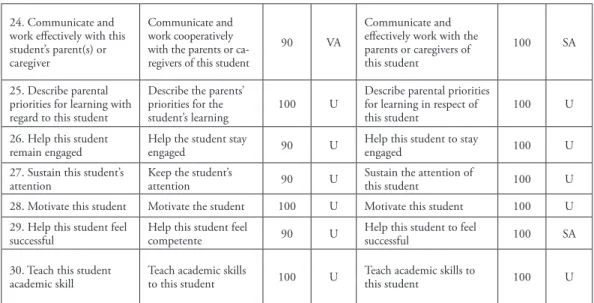
(2016). The data indicates that the items that were very altered in the back-translation belong predominantly to the back-translator 1 (4 items). Differently, the items did not undergo significant modifications in the back-translation performed by professional 2. In general, regarding the items of the original scale, there was an adequate equivalence of the denotative/ referential meaning with the items of the back-translations (Pasquali, 2016), since, with the exception of 4 items back-translated by professional 1, the remaining percentages are close to 100% correspondence (Table 1).
It was verified that the evaluation of the denotative/referential and connotative/ general meanings referring to items 15 (40% and VA) and 17 (70% and SA) of the back-translation made by professional 1 and back-translation 1 were influenced by the back-translation stage. The contents of the description, both of item 15 and item 17, are related to the items that precede it, that is, to the items 14 and 16, respectively. In the original scale, item 14 is ‘Design positive behavioral supports for this student’, however, item 15 is ‘Implement positive behavioral supports for this student’, contemplating its translation 1 ‘implementar esses apoios’ (implement these supports). The same relation was identified when analyzing items 16 and 17, which in the original scale are, ‘Collect data to monitor this student’s progress toward objectives’ and ‘Make use of data to re-evaluate this student’s goals or objectives’. However, translation 1 of item 17 was established as ‘Utilizar esses dados para avaliação dos objetivos’ (Use this data to assess goals). The translation 1 of items 15 and 17 was not established literally, but it considered the context of interrelations with the predecessor items. However, as the evaluation of the denotative/ referential and connotative/general meanings was established in the matching between the items of the original/back-translation 1 scale and the original/translation 1 scale, respectively, the discrepancy between the semantic equivalence evaluation of items 15 and 17 was verified.
Original Back-translator 1 DRM (%) CRM Back-translator 2 DRM(%) CRM
1. Conduct an assessment of this student’s develop-mental skills/learning skills
Carry out an assess-ment of developassess-mental and learning skills
90 U Conduct an assessment of the student’s developmen-tal/ learning skills
100 U
2. Describe this student’s characteristics that relate to autism
Describe the charac-teristics of the student
that relate to autism 100 U
Describe the characteristics of this student related to
autism 100 U
3. Describe the impli-cations for intervention based on this student’s characteristics of autism
Describe the implica-tions for intervention based on the charac-teristics of the student with autism
100 U
Describe the implications for intervention based on the autism characteristics of the student
90 SA
4. Translate assessment information into teaching goals and objectives for this student
Translate assessment information into teaching goals and objectives for this student
100 U
Translate assessment information into goals and learning objectives for this student
90 U
5. Write a measurable
objective for this student Write measurable goals for the student 90 U Write a measurable objec-tive for this student 100 U
6. Write a teaching plan for this student based on goals and objectives
Build a teaching plan for this student based
on their goals 90 SA
Write a teaching plan for this student based on goals
7. Generate teaching
activities for this student Generate teaching ac-tivities for this student 100 U Create teaching activities for this student 100 U
8. Organize the classroom to increase opportuni-ties for learning for this student
Organize the class-room to increase teaching opportunities for this student
90 SA Organize the classroom to enhance learning oppor-tunities for this student
100 U
9. Use visual structure to increase this student’s independence
Utilize visual elements and aids to increase the student’s indepen-dence
80 U
Use visual structure to increase the independence
of this student 100 U
10. Help this student understand others
Help the student to
understand others 100 U
Help this student to
understand others 100 U 11. Help this student be
understood by others Help the student be understood by others 100 U Help this student to be understood by others 100 U
12. Provide opportunities for communication in the classroom throughout the day for this student
Provide opportunities for interaction for this student in the classroom throughout the day
90 SA
Provide communication opportunities in the class-room throughout the day for this student
100 U
13. Assess the causes of problematic behaviors of this student
Assess the causes of this student’s
behavio-ral problems 90 U
Assess the causes of prob-lematic behavior of this
student 100 U
14. Design positive behavioral supports for this student
Plan strategies to achieve and ensure positive behavior from the student
70 U Outline positive behavior support for this student 90 SA
15. Implement positive behavioral supports for this student
Implement these
strategies 40 VA
Put in place positive behavior support for this student
90 SA
16. Collect data to moni-tor this student’s progress toward objectives
Collect data regarding the progress of this student in relation to proposed goals
90 U Collect data to monitor the progress of this student against goals
40 U
17. Make use of data to re-evaluate this student’s goals or objectives
Use this data to assess
goals 70 SA
Make use of the data to re-evaluate the goals and objectives of this student
100 U
18. Assess this student’s social interaction skills
Evaluate this student’s
social interaction skills 90 U
Assess the social
interac-tion skills of this student 100 U
19. Assess this student’s
play skills Evaluate this student’s play skills 90 U Assess this student’s ability to play 90 U
20. Teach this student
social interaction Teach this student social interactions 100 U Teach social interaction to this student 100 U
21. Teach this student play skills
Teach this student play
skills 100 U Teach this student to play 90 U
22. Train peer models to improve the social skills of this student
Teach the student’s peers to teach him/her
social skills 60 VA
Practice group models to improve the social skills of
this student 70 SA
23. Describe parental concerns regarding this student
Describe the concerns of this student’s parents
24. Communicate and work effectively with this student’s parent(s) or caregiver
Communicate and work cooperatively with the parents or ca-regivers of this student
90 VA
Communicate and effectively work with the parents or caregivers of this student
100 SA
25. Describe parental priorities for learning with regard to this student
Describe the parents’ priorities for the student’s learning
100 U Describe parental priorities for learning in respect of this student
100 U
26. Help this student
remain engaged Help the student stay engaged 90 U Help this student to stay engaged 100 U 27. Sustain this student’s
attention Keep the student’s attention 90 U Sustain the attention of this student 100 U 28. Motivate this student Motivate the student 100 U Motivate this student 100 U 29. Help this student feel
successful
Help this student feel
competente 90 U
Help this student to feel
successful 100 SA
30. Teach this student academic skill
Teach academic skills
to this student 100 U
Teach academic skills to
this student 100 U
Table 1. Comparative results in frequency and percentage between the back-translations of the items of the ASSET scale
Source: Elaborated by the authors.
Legend: DRM: denotative/referential meaning; CRM: connotative/referential meaning; U: unchanged; SA: slightly altered; VA: very altered.
Table 2 shows that only two items of the back-translation performed by professional 2 and five items of the back-translation made by the professional 1 presented a percentage of equivalence of the denotative/referential meaning lower than 90% (visual analog scale) in relation to the original ASSET scale items. The equivalence of the connotative/general meaning remained unchanged in more than 70% of the items in translation 1 and in 80% of the items in translation 2 in relation to the original scale.
Degree of equiva-lence between the back-translation items and the original ASSET scale
Denotative referential meaning
Evaluator’s judg-ment between the translation items and the original ASSET scale
Connotative/general meaning
Back-translator 1 Number and percentage of items that present equivalence
Back-translator 2 Number and percentage of items that present equiv-alence
Number and percentage of items that present equiv-alence Back-transla-tor 2 Number and percentage of items that pres-ent equivalence 90 – 100% 25 (83,3) 28 (93,3) Unchanged 22 (73,3) 24 (80,0)
70 > 90% 3 (10,0) 1 (3,3) Slightly altered 4 (13,3) 6 (20,0)
50 > 70% 1 (3,3) - Very altered 4 (13,3)
-> 50% 1 (3,3) 1 (3,3) Completely altered -
-Total 30 (100) 30 (100) Total 30 (100) 30 (100)
Table 2. Comparative global results of the analysis of semantic equivalence between the back-translations of items on the ASSET scale
From the analysis carried out in stage 4 by the specialists, the synthesis version of the scale was comprised of 30% of the translation items 1 (2, 3, 5, 10, 11, 13, 14, 26 and 29), 23.3% of the translation items 2 (6, 8, 12, 15, 17, 19, 24), 20% of the composition between items of the two translations (1, 16, 21, 22, 23 and 25) and 26.6% of the items that basically presented the same description in the translations of professionals 1 and 2, varying only in relation to the pronouns, prepositions and noun ‘aluno/estudante’ (pupil/student) (4, 7, 9, 18, 20, 27, 28 and 30).
Some specific changes were made, as shown in Table 3, as well as modifications involving general aspects in different items for the transcultural adaptation of the synthesis version. In this context, it is important to point out that, although the term ‘student’ in the original scale appears in the translation of professional 1 as ‘estudante’ and in 2 as ‘aluno’, the term ‘aluno’ was defined to contemplate all items of the synthesis version, since this is the terminology that appears in the main normative Brazilian documents about the educational rights of people with autism (Política Nacional de Educação Especial na Perspectiva da Educação Inclusiva, 2008; Lei Nº 12.764, 2012). Another modification adopted refers to the substitution of the demonstrative pronouns ‘este’ and ‘esse’, that preceded the noun ‘aluno’, by the article ‘o’, as well as of the contractions of the pronouns with the preposition ‘de’, that is ‘deste’ and ‘desse’, by the preposition ‘do’, approaching the description of the items to the colloquial language.
Item Description in the translation(s) Description proposed in the synthesis version
1
Realizar uma avaliação das habilidades de desenvolvimento e aprendizagem (T1)
(Carry out an assessment of developmental and learning skills)
Conduzir uma avaliação das habilidades de desenvolvimento/ aprendizagem do aluno (T2)
(Conduct an assessment of the student’s developmental/ learning skills)
Realizar uma avaliação das habilidades de desen-volvimento/ aprendizagem do aluno
(Carry out an assessment of the student’s devel-opmental/learning skills)
7
Gerar atividades de ensino para este estudante (T1) (Generate teaching activities for this student)
Criar atividades de ensino para este aluno (T2) (Create teaching activities for this student)
Elaborar atividades de ensino para o aluno
(Elaborate teaching activities for the student)
15 Implementar apoio de comportamento positivo para este aluno(T2) (Put in place positive behavior support for this student)
Implementar apoio para os comportamentos positivos do aluno
(Implement support for the positive behavior of the student)
16
Coletar dados a respeito do progresso desse aluno em relação aos objetivos propostos (T1)
(Collect data regarding the progress of this student in relation to proposed goals)
Coletar dados para monitorar o progresso deste aluno frente a objetivos (T2)
(Collect data to monitor the progress of this student against goals)
Coletar dados para monitorar o progresso do aluno em relação aos objetivos propostos
(Collect data to monitor the progress of the student in relation to the proposed goals)
17
Fazer uso dos dados para reavaliar as metas e objetivos deste aluno
(T2)
(Make use of the data to re-evaluate the goals and objectives of this student)
Fazer uso dos dados coletados para reavaliar as metas e os objetivos do aluno
21
Ensinar a este aluno habilidades de brincadeira (T1) (Teach this student play skills)
Ensinar este aluno a brincar (T2) (Teach this student to play)
Ensinar ao aluno habilidades de brincar
(Teach the student play skills)
22
Ensinar os pares do aluno a ensinar-lhe habilidades sociais (T1) (Teach the student’s peers to teach him/her social skills)
Treinar modelos de grupos para aprimorar as habilidades sociais deste aluno (T2)
(Practice group models to improve the social skills of this student)
Ensinar os pares para aprimorar as habilidades sociais do aluno
(Teach the peers to improve the social skills of the student)
23
Descrever as preocupações dos pais deste aluno (T1) (Describe the concerns of this student’s parents)
Descrever preocupações parentais em relação a este aluno (T2) (Describe parental concerns in respect of this student)
Descrever preocupações dos pais em relação ao aluno
(Describe parents’ concerns regarding the student)
24
Comunicar e efetivamente trabalhar com os pais ou cuidadores deste aluno (T2)
(Communicate and effectively work with the parents or care-givers of this student)
Comunicar e trabalhar efetivamente com os pais ou cuidadores do aluno
(Communicate and effectively work with the parents or caregivers of the student)
25
Descrever as prioridades dos pais para a aprendizagem do aluno
(T1)
(Describe the parents’ priorities for the student’s learning)
Descrever prioridades parentais para aprendizagem em relação a este aluno (T2)
(Describe parental priorities for learning in respect of this student)
Descrever prioridades dos pais em relação à apren-dizagem do aluno
(Describe parents’ priorities in relation to the student’s learning)
Table 3. - Changes and adaptations made between the translation stage and the semantic evaluation stage for the synthesis version
Source: Elaborated by the authors.
Legend: T1: Translation 1; T2: Translation 2.
Nore: As the purpose of this research is the construction of an Asset questionnaire in Portuguese language derived from an English version, Tables 3 and 4 present the items of the ASSET scale in both languages – the original items (English) and their respective translations (Portuguese).
necessary to replace the term ‘brincadeira’ with ‘brincar’6, which appears in translation 2, since it is understood that the teaching focused in this item involves the skills of playing, being ‘brincadeira’ understood as the action of playing.
In Table 3, a counterpoint is observed in item 23, which obtained a good evaluation of the denotative/referential meaning (100%), but the description of translation 2 was maintained, considering its good evaluation of the connotative/general meaning (U) in relation to the original scale. However, in this item, it was decided to replace the word ‘parentais’ (parental) with the term ‘pais’ (parents), which appears in translation 1. A similar process was established in item 25, which presented good semantic evaluation (100% and U) in both versions, but the option for the term ‘pais’ (parents) (translation 1) was maintained in relation to ‘parentais’ (parental) (translation 2). In this item, the description of translation 2 was maintained, and the need to change the terms of the sentence was evaluated to promote understanding of its meaning, thus the translation went from ‘Descrever prioridades parentais para aprendizagem em relação a este aluno’ (Describe parental priorities for learning in respect of this student) to ‘Descrever prioridades para os pais em relação à aprendizagem do aluno’ (Describe parents’ priorities in relation to the student’s learning). Item 7 also obtained good semantic evaluation (100% and U) in both versions, although the words ‘Gerar’ (Generate) (translation 1) or ‘Criar’ (Create) (translation 2), have proper meaning, they are not commonly used terms in the educational context, so it was decided to replace them with ‘Elaborar’ (Elaborate). Item 16 presented a change in the evaluation of the denotative/referential meaning (90% in the back-translation of professional 1 and 40% in the back-back-translation of professional 2), despite the fact that both translations present an unchanged connotative/general meaning (I); therefore, the composition between the items for semantic adaptation in the synthesis version was carried out: ‘Coletar dados para monitorar o progresso do aluno (translation 2) em relação aos objetivos propostos (translation 1)’ (Collect data to monitor the progress of the student (translation 2) in relation to the proposed goals (translation 1)).
Composition between the items of translations 1 and 2 was also the strategy used to extend the semantic evaluation of item 22 of the synthesis version in relation to the original scale, since there was a sharp discrepancy in the evaluation of the back-translation/translation 1 (60% and VA) and back-translation/translation 2 (70% and SA). In this item, the base of the description of translation 2 was chosen, replacing the fragment ‘Treinar modelos de grupos’ (Practice group models) by ‘Ensinar os pares’ (Teach the peers) that appears in translation 1. In item 17, the option was for the description of translation 2 due to the qualifier of the semantic evaluation (100% and U), the adjective inserted being ‘coletados’ (collected) next to the term ‘dados’ (data) to specify them, that is, ‘dados coletados’ (data collected). According to Table 3, the specific changes of items 15 and 24 involved the adequacy/restructuring in the description of the items, aiming at their agreement to the meaning expressed in the original scale and, therefore, seeking to broaden the equivalence of the general meaning. In item 15, the description ‘Implementar apoio de comportamento positivo para este aluno’ (Put in place positive behavior support for this student) was changed to ‘Implementar apoio para os comportamentos
6 Note of translation: in Portuguese, ‘brincadeira’ is a noun, which may have, in relation to the act of playing, the following
positivos do aluno’ (Implement support for the positive behavior of the student). In item 24, the description ‘Comunicar e efetivamente trabalhar com os pais ou cuidadores deste aluno’ was changed to ‘Comunicar e trabalhar efetivamente com os pais ou cuidadores do aluno’ (Communicate and effectively work with the parents or caregivers of the student). Another change made in the ASSET 30-item questionnaire was on the scoring scale. In this case, it started to be scored on a Likert scale of 6 points ranging from 0 (não posso fazer nada - I cannot do anything) to 5 (certamente posso fazer - I can certainly do it).
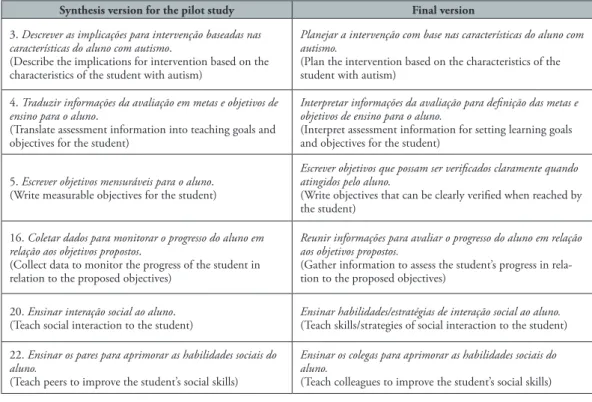
In the pilot phase, it was verified that there were adequate indicators of comprehension of the items by the Special Education teachers in relation to the scale (for 90% of the items teachers understood almost everything). Clarity and verbal understanding were assessed (they were asked: Did you understand what was requested?) - 89.82% of teachers said they understood almost everything. Items 3, 4, 5, 16, 20 and 22 were insufficiently understood and, due to that, adjustments were made. For example, item 16, the phrase ‘coletar dados para monitorar’ (Collect data to monitor) was changed to ‘reunir informações para avaliar’ (Gather information to assess); in item 22, the term ‘pares’ (peers) was replaced by ‘colegas’ (colleagues). Adjustments were made to resolve doubts about the terms and make the description of the items closer to the colloquial vocabulary that permeates the educational context (Table 4).
Synthesis version for the pilot study Final version
3. Descrever as implicações para intervenção baseadas nas características do aluno com autismo.
(Describe the implications for intervention based on the characteristics of the student with autism)
Planejar a intervenção com base nas características do aluno com autismo.
(Plan the intervention based on the characteristics of the student with autism)
4. Traduzir informações da avaliação em metas e objetivos de ensino para o aluno.
(Translate assessment information into teaching goals and objectives for the student)
Interpretar informações da avaliação para definição das metas e objetivos de ensino para o aluno.
(Interpret assessment information for setting learning goals and objectives for the student)
5. Escrever objetivos mensuráveis para o aluno. (Write measurable objectives for the student)
Escrever objetivos que possam ser verificados claramente quando atingidos pelo aluno.
(Write objectives that can be clearly verified when reached by the student)
16. Coletar dados para monitorar o progresso do aluno em relação aos objetivos propostos.
(Collect data to monitor the progress of the student in relation to the proposed objectives)
Reunir informações para avaliar o progresso do aluno em relação aos objetivos propostos.
(Gather information to assess the student’s progress in rela-tion to the proposed objectives)
20. Ensinar interação social ao aluno.
(Teach social interaction to the student) Ensinar habilidades/estratégias de interação social ao aluno.(Teach skills/strategies of social interaction to the student)
22. Ensinar os pares para aprimorar as habilidades sociais do aluno.
(Teach peers to improve the student’s social skills)
Ensinar os colegas para aprimorar as habilidades sociais do aluno.
(Teach colleagues to improve the student’s social skills)
Table 4. Adaptations carried out after the pilot study stage and description of the final version items
Source: Elaborated by the authors.
4 D
ISCUSSIONANDCONCLUSIONThe aim of the study was to verify indicators of semantic equivalence, resulting from the translation and transcultural adaptation process of the ASSET scale for the Brazilian Portuguese language, and to verify indicators of clarity and comprehension of this version in Portuguese through a pilot study. Considering that teacher self-efficacy constitutes a belief in the capacity to develop pedagogical actions that lead to the desired results (Bandura, 1997), a measure of self-efficacy can be a potential predictor of teacher attitudes in the inclusive educational context. When teachers believe that they may be able to respond to challenges, such as dealing with the teaching and learning of students in the process of inclusion, there will be a tendency to involve more efforts in order to persist and propose strategies that conduct to the process successfully.
Self-Efficacy Scale for Teachers (ASSET) is a significant contribution as it is currently the only instrument that specifically assesses the self-efficacy of teachers of students with autism.
ASSET was originally written in English and there are no published studies of its adaptation to other languages. For its use in Brazilian studies without prejudice to the original characteristics of the instrument and in a contextualized way to the linguistic demands of the Brazilian culture, the present study carried out its process of translation, back-translation and transcultural adaptation. A good equivalence of the denotative/referential meaning was found in relation to back-translation 2 and acceptable equivalence related to back-translation 1, since only 6.6% of the items of back-translation 2 and 16.6% of the items of back-translation 1 presented a degree of equivalence of the denotative/referential significance of less than 90% in relation to the original ASSET scale items. The equivalence of the connotative/general meaning remained unchanged in more than 70% of the items in translation 1 and in 80% of the items in translation 2 in relation to the original scale. It is important to note that the evaluation of the denotative/referential and connotative/general meanings referring to items 15 and 17 of back-translation 1 and translation 1 were influenced by the translation stage, which was not established in a literal way, but considered the context of interrelationships with the predecessor items, i.e. items 14 and 16, respectively. In this sense, the semantic equivalence evaluation data for back-translation 1 and translation 1 were influenced by the translation style adopted in items 15 and 17 by the translator responsible for that version, in stage 1, without compromising the equivalence of the denotative/referential and connotative/general meanings, since they involved synonymous terms.
The results of the stage that generated the synthesis version of the scale revealed that, in general, there were specific modifications related to terminological variation (e.g. estudante/ aluno (student/pupil)) and other variations related to grammatical changes to approximate the description of the items of the synthesis version to the colloquial language. An adaptation was also performed in the scoring form of the scale, considering the results of the study of the ASSET (Ruble et al., 2013). Thus, the Likert scale that constitutes the 30-item questionnaire of the ASSET has been adapted, being scaled by a 6-point scale ranging from 0 (I cannot do anything) to 5 (I can certainly do it).
The indicators of comprehension and clarity of the Portuguese version of the scale indicated that there was a good understanding of Special Education teachers, since 90% of the items were indicated as answers that showed sufficient clarity and verbal comprehension. However, analyzes were conducted for 20% of the items that were classified by teachers as insufficiently understood (items 3, 4 and 5) and for 15% of items in which teachers understood almost everything (items 3, 4, 5, 16, 20 and 22). The analysis considered the suggestions of the participants in the pilot study, as well as the adjustments of semantic adjustments necessary to the final version of the scale. In items 16 and 22, adjustments were made to resolve doubts about the terms and make the item description closer to the colloquial vocabulary that permeates the educational context. In relation to items 3, 4, 5 and 20, the adjustments were necessary so that the effect of each item was preserved in the two different cultures.
translation, back-translation and semantic equivalence analysis. This made the systematization of the synthesis version of the instrument possible with few modifications to meet both the semantic adequacy in relation to the original version and the cultural adjustments, in the stage of evaluation of the specialists and adaptation of the score. In the pilot study, the synthesis version was assessed as adequate by most teachers. For the final version of the scale (Table 5 and 6 – presented in Portuguese, then in English), the analysis of the suggestions of the participants in the pilot study was carried out, considering the adequacy of both the colloquial vocabulary and the maintenance of the effect of each item in the Brazilian culture. It is suggested to carry out future studies that verify other psychometric properties such as reliability index of the scale with test-retest measures, internal consistency and convergent validity, using instruments with similar measures.
ESCALA DE AUTOEFICÁCIA PARA PROFESSORES DE ALUNOS COM AUTISMO Nome:
Data:
Este questionário foi concebido para auxiliar na melhor compreensão dos tipos de coisas que criam dificuldades para os professores de alunos com autismo. Por favor, avalie seu grau de certeza em relação aos itens discutidos, no que diz respeito ao aluno com autismo, que você pode fazer. Escreva o número apropriado no espaço fornecido.
Escreva o número apropriado no espaço dado. Avalie seu grau de confiança ao marcar o número de 0 a 5 usando a escala dada abaixo:
0 (não posso fazer nada) 5 (certamente posso fazer)
Lembre-se de responder com o(s) aluno(s) em mente
Confiança (0-5) 1. Realizar uma avaliação das habilidades de desenvolvimento/aprendizagem do
aluno.
2. Descrever as características do aluno que se relacionam ao autismo. 3. Planejar a intervenção com base nas características do aluno com autismo. 4. Interpretar informações da avaliação para definição das metas e dos objetivos
de ensino para o aluno.
5. Escrever objetivos que possam ser verificados claramente quando atingidos pelo aluno.
6. Escrever um plano de ensino para o aluno baseado em metas e objetivos. 7. Elaborar atividades de ensino para o aluno.
8. Organizar a sala de aula para aumentar as oportunidades de aprendizagem para o aluno.
9. Utilizar estrutura visual para aumentar a independência do aluno. 10. Auxiliar o aluno a compreender os outros.
11. Auxiliar o aluno a ser entendido pelos outros.
12. Proporcionar oportunidades de comunicação em sala de aula ao longo do dia para o aluno.
13. Avaliar as causas dos problemas de comportamento do aluno. 14. Planejar apoio para os comportamentos positivos do aluno. 15. Implementar apoio para os comportamentos positivos do aluno.
16. Reunir informações para avaliar o progresso do aluno em relação aos objetivos propostos.
17. Fazer uso dos dados coletados para reavaliar as metas e os objetivos do aluno. 18. Avaliar as habilidades de interação social do aluno.
19. Avaliar a habilidade de brincar do aluno.
20. Ensinar habilidades/estratégias de interação social ao aluno. 21. Ensinar ao aluno habilidades de brincar.
22. Ensinar os colegas para aprimorar as habilidades sociais do aluno. 23. Descrever preocupações dos pais em relação ao aluno.
24. Comunicar e trabalhar efetivamente com os pais ou cuidadores do aluno. 25. Descrever prioridades dos pais em relação à aprendizagem do aluno. 26. Auxiliar o aluno a manter-se engajado.
27. Sustentar a atenção do aluno. 28. Motivar o aluno.
29. Auxiliar o aluno a sentir-se competente. 30. Ensinar habilidades acadêmicas ao aluno.
Table 5. Final version (Brazilian Portuguese Language) of the Autism Self-Efficacy Scale For Teachers(ASSET)
Source: Elaborated by the authors.
SELF-EFFICACYFOR TEACHERS OF STUDENTS WITH AUTISM SCALE
Name: Date:
This questionnaire has been designed to help better understand the types of things that create difficulties for teachers of students with autism. Please rate your degree of certainty in relation to the items discussed, with regard to the student with autism, which you can do. Write the appropriate number in the space provided.
Write the appropriate number in the space provided. Evaluate your confidence rate by writing the numbe from 0 to 5 using the scale given below.
0 (I cannot do anything) 5 (I can certainly do it) Make sure you respond with the student(s) in mind
Confidence (0-5) 1. Carry out an assessment of the student’s developmental/learning skills
2. Describe the characteristics of the student that relate to autism.
3. Plan the intervention based on the characteristics of the student with autism. 4. Interpret assessment information for setting learning goals and objectives for
the student.
5. Write objectives that can be clearly verified when reached by the student. 6. Write a teaching plan for the student based on goals and objectives. 7. Elaborate teaching activities for the student.
8. Organize the classroom to increase learning opportunities for the student.
9. Use visual structure to increase the student’s independence.
10. Help the student to understand others. 11. Help the student to be understood by others.
12. Provide communication opportunities in the classroom throughout the day for the student.
13. Assess the causes of problematic behavior of the student. 14. Plan support for the positive behavior of the student. 15. Implement support for the positive behavior of the student
16. Gather information to assess the student’s progress in relation to the proposed
objectives
17. Make use of the data collected to re-evaluate the goals and objectives of the student.
18. Assess the social interaction skills of the student.
19. Assess the student’s ability to play.
20. Teach skills/strategies of social interaction to the student. 21. Teach the student play skills.
22. Teach colleagues to improve the student’s social skills.
23. Describe parents’ concerns regarding the student.
24. Communicate and effectively work with the parents or caregivers of the student.
25. Describe parents’ priorities in relation to the student’s learning.
26. Help the student to remain engaged. 27. Sustaining the attention of the student. 28. Motivate the student.
29. Help the student feel successful. 30. Teach academic skills to the student.
Table 6. Final version of the Brazilian Autism Self-Efficacy Scale For Teachers(ASSET) (Brazilian)
R
EFERENCESAmerican Psychiatric Association (2014). Manual Diagnóstico e Estatístico de Transtornos Mentais (DSM-5) (4a ed.). Porto Alegre: Artes Médicas.
Bandura, A. (1994). Self-efficacy. In V. S. Ramachaudran (Ed.). Encyclopedia of human behavior (Vol. 4, pp. 71-81). New York: Academic Press.
Bandura, A. (1997). Self-efficacy:The exercise of control. New York: W. H. Freeman.
Barros, M., & Santos, A. C. B. dos. (2010). Por dentro da autoeficácia: um estudo sobre seus fundamentos teóricos, suas fontes e conceitos correlatos. Revista Espaço Acadêmico, Maringá, 10(112), 1-9. Brouwers, A., & Tomic, W. (2001). The factorial validity of scores on the teacher interpersonal
self-efficacy scale. Educational and Psychological Measurement, (61), 432-445.
Deaton, S. (2015). Social learning theory in the age of social media: Implications for educational practitioners. Journal of Educational Technology, 12(1), 1-6.
Declaração de Salamanca (1997). Sobre Princípios, Políticas e Práticas na Área de Necessidades Educativas Especiais. Retrieved July 02, 2016 from http://portal.mec.gov.br/seesp/arquivos/pdf/salamanca.pdf. Dybowski, C., Sehner, S., & Harendza, S. (2017). Influence of motivation, self-efficacy and situational
factors on the teaching quality of clinical educators. BMC Medical Education, 17(84), 1-8. Gibson, S., & Dembo, M. H. (1984). Teacher efficacy: A construct validation. Journal of Educational
Psychology, 76, 569-582.
Klassen, R. M., Tze, V. M. C., Betts, S. M., & Gordon, K. A. (2011). Teacher efficacy research 1998-2009: Signs of progress or unfulfilled promise? Educational Psychology Review, 23(1), 21-43.
Lei Nº 12.764, de 27 de dezembro de 2012. Institui a Política Nacional de Proteção dos Direitos da Pessoa com Transtorno do Espectro Autista; e altera o § 3o do art. 98 da Lei no 8.112, de 11 de dezembro de 1990. Retrieved from http://www.planalto.gov.br/ccivil_03/_ato2011-2014/2012/lei/l12764.htm. Lemos, I. L., Conti, M. A., & Sougey, E. B. (2015). Avaliação da equivalência semântica e consistência
interna da Game Addiction Scale (GAS): Versão em português. Jornal Brasileiro de Psiquiatria, Rio de Janeiro, 64(1), 8-16.
Losapio, M. F., Silva, L. G., Pondé, M. P., Novaes, C. M., Santos, D. N. dos, Argollo, N. ... Brasil, H. H. A. (2011). Adaptação transcultural parcial da escala Aberrant Behavior Checklist (ABC), para avaliar eficácia de tratamento em pacientes com retardo mental. Cadernos de Saúde Pública, Rio de Janeiro, 27(5), 909-923.
Moraes, C. L., Hasselmann, M. H., & Reichenheim, M. E. (2002). Adaptação transcultural para o português do instrumento “Revised Conflict Tactics Scales (CTS2)” utilizado para identificar violência entre casais. Cadernos de Saúde Pública, Rio de Janeiro, 18(1), 163-176.
Pasquali, L. (2016). TEP - Técnicas de Exame Psicológico: Os fundamentos (2a ed.). São Paulo: Vetor. Pfitzner-Eden, F. (2016). Why do I feel more confident? Bandura’s sources predict preservice teachers’
latent changes in teacher self-efficacy. Frontiers in Psychology, 7, 1-16.
Política Nacional de Educação Especial na Perspectiva da Educação Inclusiva (2008). Retrieved July 02, 2016 from http://portal.mec.gov.br/index.php?option=com_docman&view=download&alias=16690- politica-nacional-de-educacao-especial-na-perspectiva-da-educacao-inclusiva-05122014&Itemid=30192.
Reis, C. T., Laguardia, J., & Martins, M. (2012). Adaptação transcultural da versão brasileira do Hospital Survey on Patient Safety Culture: Etapa inicial. Cadernos de Saúde Pública, Rio de Janeiro, 28(11), 2199-2210.
Ruble, L. A., Usher, E. L., McGrew, J. H. (2011). Preliminary investigation of the sources of self-efficacy among teachers of students with Autism. Focus on Autism and Other Developmental Disabilities, 26(2), 67-74.
Ruble, L. A., Toland, M. D., Birdwhistell, J. L., McGrew, J. H., & Usher, E. L. (2013). Preliminary study of the Autism Self-Efficacy Scale for Teachers (ASSET). Res Autism Spectr Disord, 7(9), 1151-1159.
Scherer, R., Jansen, M., Nilsen, T., Areepattamannil, S., & Marsh, H. W. (2016). The quest for comparability: Studying the invariance of the Teachers’ Sense of Self-Efficacy (TSES) Measure across Countries. Plos One, 11(3), 1-29. Retrieved July 02, 2016 from https://www.ncbi.nlm.nih. gov/pmc/articles/PMC4784889/.
Schmidt, C. (2014). Autismo, educação e transdisciplinaridade. In C. Schmidt (Org.), Autismo, educação e transdisciplinaridade (1a reimp., Série Educação Especial, pp. 7-28). Campinas: Papirus.
Schmidt, C., Nunes, D. R. de P., Pereira, D. M., Oliveira, V. F. de, Nuernberg, A. H., & Kubaski, C. (2016). Inclusão escolar e autismo: Uma análise da percepção docente e práticas pedagógica. In.
Revista Psicologia:Teoria e Prática, São Paulo, 18(1), 222-235.
Silveira, C., Parpinelli, M. A., Pacagnella, R. C., Camargo, R. S. de, Costa, M. L., Zanardi, D. ... Andreucci, C. B. (2013). Adaptação transcultural da Escala de Avaliação de Incapacidades da
Organização Mundial de Saúde (WHODAS 2.0) para o Português. Revista da Associação Médica
Brasileira, São Paulo, 9(3), 234-240.
Skaalvik, E., & Skaalvik, S. (2007). Dimensions of teacher self-efficacy and relations with strain factor, perceived collective teacher efficacy, and teacher burnout. Journal of Autism and Developmental Disorders, 37(2), 354-366.
Taliaferro, A. R., Hammond, L., & Wyant, K. (2015). Preservice physical educators’ self-efficacy beliefs toward inclusion: The impact of coursework and practicum. Adapted Physical Activity Quarterly, 32(1), 49-67.7