FREE THEMES
Protocol for hypertensive individuals assisted
in Basic Health Care
Abstract Hypertension has low control rate in Brazil and around the World, resulting in social and medical costs; thus there is the need to apply control strategies. This study aimed to create and validate a protocol for consultation and monito-ring of hypertensive patients attended in primary health care. It is constituted a methodological re-search which uses the Delphi method for content validation. The analysis of the protocol by experts was performed in three cycles, using a scale that was not important to extremely important, with a graduation from 1 to 5. The analysis was perfor-med by the Likert scale, percentage of agreement, content validation index, Pearson correlation. The percentage of agreement was 96%. The CVI of 0.98. The Likert scale scored items, at least, as very important. The Pearson correlation was posi-tive for all items ranging from moderate to strong. The protocol is composed of 53 items, divided into seven dimensions. It was concluded that the pro-tocol enables more expressive and systematics mo-nitoring of hypertensive patients and it identifies social and individual conditions that contribute to high blood pressure, so it may be used to guide the consultation, encouraging dialogue between the professional and patient and effective recor-ding of care.
Key words Hypertension, Primary Health Care, Validation, Protocol
Rosimery Cruz de Oliveira Dantas 1
Angelo Giuseppe Roncalli 2
1 Unidade de Ciências da
Vida, Centro de Formação
de Professores,Universidade
Federal de Campina Grande. R. Aprígio Veloso 882, Universitário. 58429-900 Campina Grande PB Brasil. rmeryco_dantas@ hotmail.com
2 Departamento de
Dantas R
CO
, R
Introduction
Primary Health Care (PHC) encompasses the user’s first contact with the health system and is responsible for organizing care for their health, their families and the population. Therefore, it should be guided by the principles of first con-tact, longitudinally, comprehensiveness, coor-dination, family approach and community ap-proach1.
Because of its organizational context, PHC stands out with three essential functions: reso-lution, through which it is able, from its cogni-tive and intellectual capacity, to solve 85% of the public health problems of the population; com-munication, for which it is responsible for the reference and counter-reference of people, prod-ucts and information generated by the various components of the network; and accountability, which includes liaison with the population as-cribed based on territorial organization, manage-ment and sanitary and financial responsibility2.
However, even with the strengthening of PHC, hospitalizations due to diseases that could be controlled under the action of Primary Care (PC) continue to occur, such as hypertension. Systemic arterial hypertension (SAH) is defined as a multifactorial clinical condition charac-terized by elevated and sustained blood pres-sure (BP) levels, often associated with changes in functions and/or structures of target organs (heart, brain, kidneys and blood vessels) and me-tabolism, leading to an increased risk of fatal and non-fatal cardiovascular events3.
Three important items characterize hyper-tension: prevalence, as it affects 22.3% to 43.9% of the population over 18 years of age (32% on average, 50% in the 60-69 age group and 75% in the age group > 70 years) and accounts for a significant portion of primary network appoint-ments; transcendence, as it is one of the main risk factors associated with acute myocardial infarc-tion (AMI), cerebrovascular accident (stroke) and other injuries, including death, in addition to its silent development; vulnerability, since it is easily treatable and controllable under the PHC, as 50% to 80% of the cases are solved in the pri-mary network4-6.
Despite being considered a serious public health problem, it still presents a low control rate in Brazil (18% to 19.6%)6,7,causing medical and social costs, mainly due to its complications5,8. In the world scenario, the European average of control of SAH in PC is 8%. The USA, between 1988 and 2008, doubled the percentage of
con-trol (27.3% vs. 53.5%) and Canada quintupled it between 1992 and 2009 (13.2% vs. 64.6%), evi-dencing important advances in the detection and treatment of hypertension7. Canada, followed by Cuba, has the best indicators of prevalence (22% and 20%, respectively, in the general population; and 50% in the age group > 50 years), diagnosis (87% - 78%), treatment (82% - 61%) and con-trol (66% - 40%)6.
Due to these characteristics and lack of con-trol in blood pressure levels, hypertension has ac-counted, according to data from the DataSUS, in the period from 2008 to 2015, by 302,051 admis-sions of adults aged 20 to 59 years in Brazil, with an average of 37,756/year and a rate of 3.5/1000 hospitalizations9. It has shown a decreasing be-havior with a respective average decrease of 7.3%/year for women and 6.8%/year for men.
In order to achieve control of blood pressure levels in hypertensive patients, increasing the commitment of PC professionals in the form of teamwork is necessary, through democratic and participatory health and management practices, using highly complex and low-density technolo-gies10. Making PHC operational and effective as an organizing axis of the health system is a challenge for all, managers and professionals, because of the different forms of dispute of interest and under-standing of ways to manage the system and put the user as the center of the health care process11.
Strategies have been used to optimize care and follow-up of hypertensive patients in PHC. In the world scenario, the use of protocols for monitor-ing and control of SAH has been adopted with em-phasis12,13. In Brazil, the protocol for diagnosis of hypertension proposed by the Ministry of Health4 and by the Municipal Health Department of Cu-ritiba14 stand out, besides a specific instrument for nursing appointment as proposed by Codogno et al.15, which limits its use to a professional category, despite the recognition of the importance of the nursing appointment in the comprehensive care, as provided in Resolution 35816.
The Family Health Strategy (FHS), through its actions and ways of organizing the work process, should monitor hypertensive patients through monthly appointments, by a physician or nurse, by measuring weight, blood pressure, providing guidelines and prescription of drug and non-drug treatment, thus promoting mon-itoring and evaluation of the evolution of the in-stituted treatment.
e C
ole
tiv
a,
24(1):295-306,
2019
it requires longitudinal care, making them ineffi-cient for this specific action, even though they are not inefficient for the performance of the FHS17. Alves and Calixto18 emphasize that individuals with hypertension have difficulty in adhering to treatment, which is a major challenge for health professionals, who seek solutions to overcome it, and this is possible when the patient trusts in the information received and creates bond with the team. Dantas19 observed that most of the hyper-tensive patients complained about the quality of the appointment. This situation becomes an ob-stacle for the patient to trust and create a bond with the professionals and the service.
This scenario, coupled with the existence of protocols and recommendations for diagnosis and follow-up of hypertension patients elaborat-ed by the Ministry of Health, Municipal Health Associations and Secretariats, compiled in a vo-luminous and extensive way, raised the need for a compact instrument prepared for appointment and follow-up for hypertensive patients. This in-strument can be used by the family health team, as a means of operationalizing, systematizing and objectifying the appointment, making it a space for dialogue, listening and bonding based on a more holistic care, as well as to optimize records and favor adherence to treatment and, therefore, control of blood pressure levels.
The intention was to prepare an instrument of relevant importance for Collective Health, since it would be a data aggregator that, when analyzed, will provide relevant information for researchers, managers and professionals for deci-sion-making and management of care.
Therefore, the objective of this study was to build and validate a protocol for appointment and follow-up of patients with arterial hyperten-sion treated in Primary Care.
Method
This is a methodological research, which aimed to build a reliable, precise and applicable instru-ment that can be used by other researchers and professionals. The approach used was content va-lidity, following Delphi’s method, in which spe-cialists with extensive experience in the area were able to judge, remove and add items of interest to suit the instrument, evaluating the degree of rel-evance and representativeness of each constant element20-22.
The instrument was elaborated with ele-ments related to hypertension, which composed
the items organized by dimensions, obeying the premise of clarity, simplicity and objectivity, which offers easy-to-understand communica-tion, in order to provide an objective appoint-ment and effective follow-up, with eleappoint-ments that favor an analysis of changes that occurred over time on the clinical condition of the hyperten-sive. The theoretical references of the Brazilian Guidelines for Hypertension of the Brazilian Society of Cardiology3, The First Brazilian Posi-tioning in Hypertension and Diabetes Mellitus of the Brazilian Society of Cardiology and Brazilian Society of Nephrology7 and the Strategies for the care of the person with chronic disease - Systemic Arterial Hypertension of the Ministry of Health6 were used.
The construction followed the following steps:
1) Previous reading of the theoretical ref-erences for identification of variables and aggre-gation by dimension.
2) Presentation to a panel of judges com-posed of students and professors of the Graduate Program in Collective Health of the Federal Uni-versity of Rio Grande do Norte.
3) Adjustment of the initial proposal that generated the version presented to the experts, consisting of seven dimensions and 33 items: (1) characterization of the patient (name, date of birth, height, occupation, date of diagnosis, blood pressure, sex, schooling and income)3,6, (2) health indicators (BP, weight, waist, hip, waist circum-ference, physical activity, low-salt diet, low-fat diet, smoking, alcohol, discontinuation of treat-ment and comorbidities)3,6,7, (3) psychosocial in-dicators (stress, depression, low self-esteem and employment)3,6, (4) signs of hypertensive crisis (headache, visual changes, neurological deficit, visual deficit, dyspnea)3,6, (5) occurrence of com-plications (hospitalization, stroke, AMI)3,6,7, (6) laboratory tests (cholesterol, triglycerides, urea, creatinine)3,6,7 and (7) conducts.
4) Validation by experts.
Dantas R
CO
, R
analysis and the version were forwarded to be submitted to a last change. The experts could change the score in the evaluations of the items if they considered it pertinent, and they should justify each change. Each cycle had a deadline of 15 days to be returned. A reminder e-mail was sent on the seventh and 14th days.
For the selection of the experts, the inclusion criteria included having experience with hyper-tension, having recognized technical and scien-tific competence within this specific area and being fully engaged as a teaching professional or providing assistance in the FHS. Exclusion crite-ria were having less than one year of work in the FHS, being retired, being away for more than six months of their activities and having teaching practice that does not encompass the PHC/FHS or cardiology sector. A total of 30 professionals specialized in the topic were contacted and invit-ed by e-mail, representatives of higher invit-education institutions (HEI) and FHS professionals, dis-tributed as 15 nurses and 15 physicians. Of these, 20 accepted the invitation, totaling the sample of the study, being 11 nurses and nine physicians. Subsequently, the instructions for the instrument evaluation were sent out with regard to the writ-ing, comprehension and relevance of the items, with indication of reading of the theoretical ref-erences used in the construction for consultation. The instrument and the Free and Informed Con-sent Form approved by the Ethics Committee in Research of UFRN.
Data were analyzed by using the Likert scale. The individual analysis of each item was per-formed, and the percentage of agreement among the experts had an acceptable score of ≥ 90%. Its calculation was given by the number of answers 3, 4 and 5 divided by the number of experts20.
Then, the content validation index of the items (CVI-I) was calculated, considering the sum of the number of positive answers (3, 4 and 5) that characterize the importance of the item divided by the total value, in this case 100 points, equivalent to the maximum score x number of experts. The minimum threshold for acceptance is 0.80. The CVI was calculated by the averages of the CVI-I, which evaluated the agreement of the experts regarding the representativeness of the instrument and of the items whose minimum acceptance value was 0.90, since it is a new in-strument, as recommended by Polit and Beck22. Pearson’s correlation was used to select the items that would remain in the instrument, since its co-efficient is the most common strategy to evaluate intra-observer reliability20.
The analysis was presented in tables. The ta-ble of the answers averages distribution was pre-sented according to dimension. The table of the validation index was presented according to the items. Dimensions were identified by Roman nu-meral: I - Patient characterization, II - Health in-dicators, III - Psychosocial inin-dicators, IV - Signs of hypertensive crisis, V - Occurrence of compli-cations, VI – Laboratory tests and VII - Conducts.
Results
The initial instrument, after the cycles and eval-uations of the experts, went from 33 to 53 items with the inclusion of 20 items proposed by the experts. However, with the removal of three items that did not present a minimum agreement and CVI-I, it now has 50 items. The added and removed items were: I - patient characterization (sex, schooling, income (removed), body mass index (BMI), comorbidity); II - health indicator (insomnia); III - psychosocial indicator (employ-ment, family support and leisure); IV - signs of hypertensive crisis (cough - removed); V - occur-rence of complications (angina, heart failure, ne-phropathy, atherosclerosis, arrhythmias, periph-eral vascular disease); and IV - laboratory tests (potassium, elements and abnormal sediment - urine type 1 (EAS - removed), electrocardiogram (ECG)) (Figure 1).
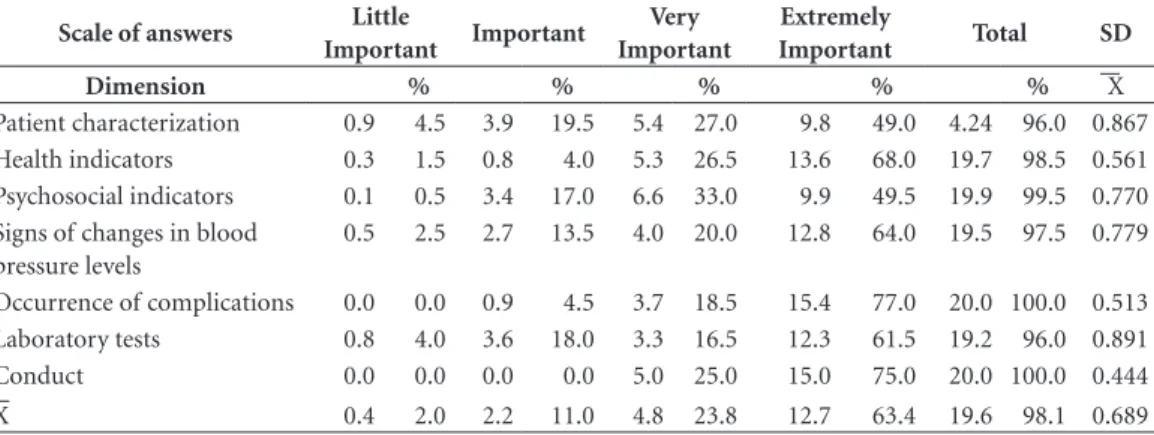
The analysis of the importance of the items that composed the instrument was represented by the average of answers of the experts and their proportion (Table 1). The answer “unimportant” was not quoted by the experts, so it was deleted from the Table. 98.1% of the experts agreed on the importance of the items, revealing, in their opinion, that the instrument meets the proposed objectives. Experts could change their opinion between cycles. In the third cycle, only two ex-perts changed their opinion, scoring a higher val-ue than the previous one, characterizing a posi-tive change in the evaluation of the item.
The statistical analysis presented in Table 2 allows the visualization of the scores of the items individually regarding: percentage of agreement, Likert Scale, CVI-I and Pearson Correlation.
e C
ole
tiv
a,
24(1):295-306,
2019
Figure 1. Protocol for appointment and follow-up for hypertensive patients in Primary Care.
Table 1. Distribution of the experts’ answers by the dimensions of the instrument, according to the degree of
importance.
Scale of answers Little
Important Important
Very Important
Extremely
Important Total SD
Dimension % % % % % X
Patient characterization 0.9 4.5 3.9 19.5 5.4 27.0 9.8 49.0 4.24 96.0 0.867
Health indicators 0.3 1.5 0.8 4.0 5.3 26.5 13.6 68.0 19.7 98.5 0.561
Psychosocial indicators 0.1 0.5 3.4 17.0 6.6 33.0 9.9 49.5 19.9 99.5 0.770
Signs of changes in blood pressure levels
0.5 2.5 2.7 13.5 4.0 20.0 12.8 64.0 19.5 97.5 0.779
Occurrence of complications 0.0 0.0 0.9 4.5 3.7 18.5 15.4 77.0 20.0 100.0 0.513
Laboratory tests 0.8 4.0 3.6 18.0 3.3 16.5 12.3 61.5 19.2 96.0 0.891
Conduct 0.0 0.0 0.0 0.0 5.0 25.0 15.0 75.0 20.0 100.0 0.444
Dantas R
CO
, R
Table 2. Percentage of Concordance, Content Validation Index, Likert Scale, and Pearson’s Correlation by Item.
Dimension/ Items %
Concord CVI-I Likert
Pearson (Min-Max)
p value (Min – Max)
I Name 100.0 0.85 4.25 0.45 – 0.85 0.044 – < 0.001
Sex 90.0 0.80 4.20 0.46 – 0.95 0.037 – < 0.001
Date of birth 100.0 0.90 4.50 0.45 – 0.86 0.047 – < 0.001
Date of diagnosis 100.0 0.86 4.30 0.49 – 0.81 0.027 – < 0.001
BP at the time of diagnosis 100.0 0.92 4.60 0.47 – 0.53 0.036 – 0.015
Height 90.0 0.80 4.20 0.45 – 0.95 0.049 – < 0.001
BMI 100.0 0.91 4.55 0.45 – 0.86 0.047 – < 0.001
Occupation 95.0 0.79 4.05 0.45 – 0.88 0.048 – < 0.001
Schooling 95.0 0.78 4.00 0.45 – 0.84 0.042 – < 0.001
Income 90.0 0.75 3.75 0.50 – 0.84 0.024 – < 0.001
Comorbidity 100.0 0.96 4.80 0.48 – 0.67 0.030 – 0.001
II BP 100.0 0.95 4.75 0.45 – 0.86 0.047 – < 0.001
Weight 100.0 0.93 4.65 0.45 – 0.83 0.048 – < 0.001
Waist 95.0 0.86 4.40 0.50 – 0.72 0.023 – < 0.001
Hip 95.0 0.81 4.15 0.45 – 0.70 0.049 – 0.001
Abdominal circumference 100.0 0.93 4.65 0.45 – 0.79 0.049 – < 0.001
Physical activity 100.0 0.96 4.80 0.45 – 0.86 0.045 – < 0.001
Low-salt diet 100.0 0.91 4.55 0.46 – 0.88 0.041 – < 0.001
Low-fat diet 100.0 0.91 4.55 0.45 – 0.90 0.048 – < 0.001
Smoking 100.0 0.93 4.65 0.45 – 0.92 0.049 – < 0.001
Alcohol 100.0 0.92 4.60 0.45 – 0.92 0.043 – < 0.001
Insomnia 100.0 0.81 4.05 0.45 – 0.79 0.042 – < 0.001
Treatment discontinuation 100.0 0.96 4.80 0.45 – 0.91 0.048 – < 0.001
III Stress 100.0 0.92 4.60 0.46 – 0.78 0.040 – < 0.001
Low self-esteem 100.0 0.86 4.30 0.45 – 0.91 0.049 – < 0.001
Depression 100.0 0.86 4.30 0.45 – 0.92 0.043 – < 0.001
Anxiety 100.0 0.88 4.40 0.46 – 0.93 0.037 – < 0.001
Family support 100.0 0.87 4.35 0.45 – 0.89 0.048 – < 0.001
Employment 100.0 0.83 4.15 0.45 – 0.91 0.048 – < 0.001
Recreation 95.0 0.79 4.05 0.45 – 0.93 0.045 – < 0.001
IV Headache 100.0 0.87 4.35 0.47 – 0.92 0.035 – < 0.001
Visual changes 100.0 0.89 4.45 0.46 – 0.91 0.037 – < 0.001
Neurological deficit 100.0 0.94 4.70 0.45 – 0.94 0.044 – < 0.001
Precordial pain 100.0 0.95 4.75 0.46 – 0.94 0.043 – < 0.001
Dyspnea 95.0 0.91 4.55 0.45 – 0.87 0.042 – < 0.001
Cough 90.0 0.75 3.95 0.46 – 0.76 0.043 – < 0.001
V Hospitaization 100.0 0.95 4.75 0.45 - 0.69 0.045 – 0.001
Stroke 100.0 0.98 4.90 0.45 - 0.85 0.047 – < 0.001
AMI 100.0 0.98 4.90 0.45 - 0.85 0.047 – < 0.001
Angina 100.0 0.95 4.75 0.45 - 0.90 0.045 – < 0.001
Cardiac insufficiency 100.0 0.95 4.75 0.45 - 0.90 0.045 – < 0.001
Nephropathy 100.0 0.95 4.75 0.46 - 0.91 0.043 – < 0.001
Atherosclerosis 100.0 0.92 4.60 0.45 - 0.87 0.045 – < 0.001
Arrhythmias 100.0 0.92 4.60 0.45 - 0.87 0.045 – < 0.001
Peripheral vascular disease 100.0 0.91 4.55 0.45 - 0.89 0.049 – < 0.001
e C
ole
tiv
a,
24(1):295-306,
2019
0.80, respectively). In the instrument, as a whole, the percentage of agreement between the experts was 99.4% and the protocol CVI was 0.90.
The score generated on the Likert Scale placed the items in the condition very important. Pear-son’s correlation showed that, despite the experts’ evaluation, the item Comorbidity, at dimension II, did not present any correlation. Knowing the importance of comorbidity to define the clini-cal condition of hypertension, dimension I was added, which presented correlation with sev-eral items, being maintained in the instrument in the said dimension. The correlations of the items were positive and maintained a moderate (Pearson > 0.45) to strong correlation (Pearson > 0.90) according to the classification of Dancey and Reily23.
In this way, the instrument was organized in eight dimensions and 50 items: I - Patient char-acterization, composed of 10 items that list the hypertensive patient data, allowing to draw a so-ciodemographic profile of this user; II - Health indicators, in which the 12 items allow the iden-tification, registration and analysis of cardiovas-cular and metabolic risk factors; III - Psychoso-cial indicators, which includes seven items that add contributing conditions to social and men-tal well-being; IV - Signs of high blood pressure levels, in which signs are distributed in five items and allow to identifying possible hypertensive crises; V - Occurrence of complications, present-ing nine items, mostly due to the lack of con-trol of pressure values; VI – Laboratory tests, in which the ones for the monitoring of the meta-bolic function stand out, consisting of six items; and VII - Conducts, composed only of the item Conducts, which allows the registration of the care provided (Figure 1).
Discussion
The protocol was designed and built as an instru-ment for appointinstru-ments and follow-up of hyper-tensive patients, since the diagnosis of hyperten-sion is determined by the physician, which usu-ally occurs during an appointment to the adult or elderly person. After this diagnosis, the patient starts to be monitored by the PHC health team in a monthly appointment. Mafaltti and Asuncion24 emphasize that after the diagnosis, there must be a connection between the user and the service, and a differentiated care should be provided by the multidisciplinary team, in order to avoid low levels of follow-up, measures must be taken.
The construction of the instrument followed a rigorous method20 and obeyed the theoretical precepts of the studied object3,6,7. The inclusion of other items in the study demonstrated the commitment and the effective participation of the experts, as well as the achievement of the purpose of the technique, which allowed an in-dividual analysis of the items and of the protocol as a whole, making it more consistent20 in achiev-ing the objectives for which it was proposed. This process collaborated with the clarity of the scope and evidenced the discriminative power of the items25.
This work has placed all dimensions in the condition of very important, and thus the pro-tocol has proved to be a potential strategy for appointments and follow-up of hypertensive patients, since it provides elements that favor decision-making on the clinical condition of the patient, management of the treatment, con-trol of blood pressure and the improvement of the indicators of morbidity and mortality due to cardiovascular diseases (CVD). As emphasized in
Dimension/ Items %
Concord CVI-I Likert
Pearson (Min-Max)
p value (Min – Max)
VI Cholesterol 100.0 0.91 4.55 0.45 – 0.90 0.049 - < 0.001
Triglycerides 100.0 0.91 4.55 0.45 – 0.90 0.049 - < 0.001
Urea 100.0 0.88 4.40 0.45 – 0.91 0.045 - < 0.001
Creatinine 100.0 0.88 4.40 0.45 – 0.91 0.045 - < 0.001
Potassium 95.0 0.82 4.20 0.45 – 0.91 0.048 - < 0.001
EAS 80.0 0.69 3.85 0.45 – 0.86 0.049 - < 0.001
ECG 100.0 0.90 4.50 0.45 – 0.84 0.047 - < 0.001
VII Conducts 100.0 0.95 4.75 0.45 – 0.86 0.047 – < 0.001
Dantas R
CO
, R
another study, the use of protocols increases the perception of patients and professionals about the advances in treatment and enables setting goals to be achieved25.
The items maintained a positive correlation that varied from moderate to high, demonstrat-ing that they achieved the proposed objective, since the scores were well above zero26. The ap-plication of the five-point Likert Scale, in which there is a neutral point, allowed the acquisition of consistent answers, with clarity for analysis, and evidenced the importance of the items of the instrument. Its applicability has become relevant because of the ability and experience of the re-spondents. For Dalmoro and Vieira27, the use of scales with points from 3 to 10 and the use of a neutral point allows an adequate level of reliabil-ity, as it leads to the identification of important relations between items and, consequently, to a high-validity construct. Among these, the most used is the one of 5 points, object of this study.
The protocol begins with the characteriza-tion data, which includes sociodemographic in-formation, making it possible to build the profile of the hypertensive patient and a more targeted decision-making. These data are relevant because they provide knowledge of information and fac-tors that may influence the therapeutic method and the quality of care provided by the health team3,15. The variable sex/age is important giv-en that hypertgiv-ension is more prevalgiv-ent in males, with a change in this trend after 50 years of age, when women reach menopause, and it is more prevalent in the elderly3,6. Knowing the date of diagnosis allows identifying the time of exposure of the patient to the disease and its possible clin-ical consequences, especially the injuries in target organs6,7.
The value of BP at the time of diagnosis al-lows a permanent evaluation of the evolution of the disease. Height and BMI are important indi-cators for metabolic risk assessment. Knowledge of comorbidities determines drug choice and specific guidelines for non-drug treatment3,6. Socioeconomic condition and schooling emerge as risk factors for CVD, since they are determi-nant in the adoption of conditions that improve quality of life. Health professionals should stim-ulate measures to improve patients’ lifestyle, but adopting these measures depends on the sub-ject’s understanding of their problem, the mo-tivations received and the conditions that they have6. Therefore, income and schooling, as social determinants of health, are closely related to hy-pertension28.
Health indicators aggregate information that allows the identification of risk factors for the maintenance of pressure values, and therefore they favor the adoption of specific measures by professionals, to be developed with and by the patient. The BP value at the time of appoint-ment allows an analysis, at each professional/ patient meeting, of the control of BP. Weight, measurement of waist, hip and abdominal cir-cumference, when measured and evaluated, serve as indicators of cardiovascular and metabolic risk6. Physical activity, and low-salt and low-fat diet allow nutritional evaluation of the patient and offer subsidies for the prevention and con-trol of hypertension, since weight reduction, adoption of healthy eating and life habits are the most non-pharmacological measure to control hypertension and reduce cardiovascular risks29. The items smoking and alcohol are recognized as individual cardiovascular risk factors to the in-stallation and low control of SAH3,9,30 and should therefore be a frequent target of researches.
Chronic insomnia is associated with an in-creased risk of developing hypertension in adult patients, and this risk becomes more pronounced in people with depression. In addition, in hyper-tensive patients, it favors the increase of blood pressure levels31,32. Regarding the discontinuation of treatment, this item favors the knowledge of the patient’s treatment, and with this, the adop-tion of strategies to reverse it. Discontinuaadop-tion of treatment is associated with patient non-recog-nition of the disease and difficult access to goods and services33.
Psychosocial indicators stand out because they incorporate conditions that change the emotional aspect and, therefore, the circulatory and respiratory system, favoring the installation of SAH. The variables stress, depression, anxiety and low self-esteem, characterized as emotional disturbances, trigger the limbic structures and produce cardiovascular and respiratory respons-es, causing visceral changrespons-es, among them, the in-crease of blood pressure levels 34. Therefore, the investigation of these variables at each appoint-ment is a primordial point since these situations favor the non-control of blood pressure even before the appropriate treatment. Family sup-port positively influences patients’ adherence to treatment18 and the family becomes a facilitator in this process35. This premise includes the im-portance of knowing the role of the family in the life of the hypertensive patient.
e C
ole
tiv
a,
24(1):295-306,
2019
may favor the appearance of other factors such as worry, work overload, sleep deficit, among oth-ers, besides determining the income itself. Dias and Pereira36 state that occupation is related to the increase in BP, and the lower the occupational status, the greater the tendency of increase, a fact explained by aggravating situations, such as job dissatisfaction, environmental and social stress, among others. In addition, a low occupation sta-tus limits the subject’s leisure options. The Bra-zilian Society of Hypertension points to leisure as the ninth commandment against hypertension, to combat stress37.
Changes in blood pressure levels, based on the classification of the Ministry of Health and the Brazilian Society of Cardiology3,6, as well as the sustainable values of the hypertensive patient, are important indicators of the onset of hyper-tensive crises, and should be identified early for the adoption of preventive measures. Headache is one of the symptoms of hypertensive crisis and, along with visual changes, neurological deficit, precordial pain and dyspnea, it comprises the set of symptoms that may aid in the identification of a hypertensive crisis29. These symptoms can be investigated by health professionals, including by the nursing technician or assistant and, in the presence thereof, the patient must be referred to the physician, as it characterizes a possible hyper-tensive crisis34.
Complications due to hypertension are close-ly related to the lack of control in the blood pressure levels and, therefore, it is essential to in-vestigate them at the time of the appointment. Stroke, AMI, angina, heart failure and peripheral vascular disease are conditions related to hyper-tension3. In the registry of the hypertensive pa-tient, after diagnostic confirmation in the FHS for follow-up by the team, a significant percent-age of hypertensive users presented one or more complications38. This explains why knowledge of these complications, based on an effective fol-low-up by the PHC teams and the adoption of strategies for prevention, diagnosis, treatment and control, helps to reduce future cardiovascu-lar complications and possible hospitalizations resulting from them and from the lack of control of blood pressure29,39.
Laboratory tests are characterized as diagnos-tic support in the initial appointment and during follow-up of the hypertensive patient. They also help identifying other risk factors and the
adop-tion of conducts. The Ministry of Health28 sug-gests that, during the follow-up of patients with hypertension, total cholesterol, HDL and LDL, triglycerides, creatinine, potassium, analysis of physical characteristics, elements and sediments in urine (type-1 urine) and accomplishment of electrocardiogram is performed. The profession-al should be attentive to the individuprofession-al accom-paniment of each patient, always considering the cardiovascular risk, the goals of care and the existing complications. Elevated urea levels are suggestive of secondary hypertension3.
During all appointments and follow-up, it is essential to record the interventions/actions proposed and/or performed, since it allows the knowledge of the clinical evolution of the patient and decision-making. For this reason, registra-tion becomes essential to patient care and an important source of knowledge for professionals, patients, families and the community40.
Conclusion
The control of pressure levels is an essential fac-tor for the improvement of health indicafac-tors regarding hospitalizations and the occurrence of complications due to hypertension and it in-creasingly requires the adoption of strategies for this purpose. The construction of a protocol allows a more expressive and systematic mon-itoring of the hypertensive user, as well as the identification of individual and social conditions that contribute, directly or indirectly, to maintain high blood pressure level. In addition, it becomes a guide for conducting the appointment, allow-ing a greater dialogue between the professional and the patient, as well as a space for records to happen more effectively, ensuring a more per-sonalized service, based on the individual needs of each patient.
Dantas R
CO
, R
Collaborations
e C ole tiv a, 24(1):295-306, 2019 References
1. Starfield B. Atenção primária: equilíbrio entre necessi-dades de saúde, serviços e tecnologia. Brasília: Unesco, Ministério da Saúde; 2002.
2. Organização Pan-Americana de Saúde (OPAS). A aten-ção à saúde coordenada pela APS: construindo as redes de atenção no SUS. Brasília: OPAS; 2011.
3. Sociedade Brasileira de Cardiologia. Sociedade Brasi-leira de Hipertensão. Sociedade BrasiBrasi-leira de Nefrolo-gia. VI Diretrizes Brasileiras de Hipertensão. Arq Bras Cardiol 2010; 95(1 Supl. 1):1-51.
4. Ferreira SRS, Bianchini IM, Glasenapp R, Nader EK, organizadores. Protocolo de Hipertensão Arterial Sistê-mica para a Atenção Primária em Saúde. Porto Alegre: Grupo Hospitalar Conceição; 2009.
5. Lucena MM, Medeiros JC, Dantas RCO. Conhecimen-to de Portadores de Hipertensão Arterial Acerca de seu Tratamento.Fiep Bulletin 2011; 81(spe. ed. - Article II): 6. Brasil. Ministério da Saúde (MS). Cadernos de Atenção
Básica-Estratégias para o cuidado da pessoa com doen-ça crônica-Hipertensão Arterial Sistêmica. Brasília: MS; 2010. Nº 37.
7. I Posicionamento Brasileiro Sobre Hipertensão Arte-rial Resistente [Artigo Especial]. Arq Bras Cardiol 2012; 99(1):576-585.
8. López-Jaramillo P, Sánchez RA, Diaz D, Cobos L, Bryce A, Parra-Carrillo JZ, Lizcano F, Lanas F, Sinay I, Sierra ID, Peñaherrera E, Bendersky M, Schmid H, Botero R, Urina M, Lara J, Foss MC, Márquez G, Harrap S, Ra-mírez AJ, Zanchetti A. Consenso latino-americano de hipertensão em pacientes com diabetes tipo 2 e sín-drome metabólica. Arq Bras Endocrinol Metab 2014; 58(3):205-225.
9. Brasil. Ministério da Saúde (MS). DataSUS. Brasília: MS; 2016.
10. Brasil. Conselho Nacional de Secretários de Saúde (CONASS). Acompanhamento e avaliação da atenção primária. Brasília: CONASS Documenta; 2004. 11. Matumoto S, Vieira KCS, Pereira MJB, Santos CB,
For-tuna CM, Mishima SM. Produção de atendimentos de enfermeiros em unidades da rede básica de saúde. Rev. Latino-Am. Enfermagem 2012; 20(4):[09 telas]. 12. Gbenga O, Plange-Rhule J, Gyamfi J, Chaplin W, Ntim
M, Apusiga K, Khurshid K, Cooper R. A cluster-rando-mized trial of task shifting and blood pressure control in Ghana: study protocol. Implementat Sci 2014; 9:73. 13. Stewart S1, Stocks NP, Burrell LM, de Looze FJ,
Ester-man A, Harris M, Hung J, Swemmer CH, Kurstjens NP, Jennings GL, Carrington MJ; VIPER-BP Study Investi-gators. More rigorous protocol adherence to intensive structured management improves blood pressure. J Hypertens 2014;32(6):1342-1350.
14. Maluf Júnior I, Zahdi MR, Unterstell N, Maluf EMCP, Sousa AB, Loures FD. Avaliação da Adesão de médicos ao Protocolo de Hipertensão Arterial da Secretaria Municipal de Saúde de Curitiba. Arq Bras Cardiol 2010; 94(1):86-91.
15. Codogno L, Toledo VP, Duran ECM. Consulta de en-fermagem e hipertensão arterial na estratégia saúde da família: proposta de instrumento. Rev Rene 2011; 12(n. esp.):1059-1065.
16. Conselho Federal de Enfermagem (COFEN). Resolu-ção nº 358, de 15 de outubro de 2009. Dispõe sobre a sistematização da assistência de enfermagem e a imple-mentação do processo de enfermagem em ambientes, públicos ou privados, em que ocorre o cuidado profis-sional de enfermagem, e dá outras providências. Diário Oficial da União 2009; 23 out.
17. Rabetti AC, Freitas SFT. Avaliação das ações em hiper-tensão arterial sistêmica na atenção básica. Rev Saude Publica 2011; 45(2):258-268.
18. Alves BA, Calixto AATF. Aspectos determinantes da adesão ao tratamento de hipertensão e diabetes em uma Unidade Básica de Saúde do interior paulista. J Health Sci Inst 2012; 30(3):255-260.
19. Dantas RCO. Saúde do homem e o controle da pressão arterial em usuários hipertensos no nível da atenção pri-mária a saúde [dissertação]. João Pessoa: Universidade Federal da Paraíba; 2013.
20. Alexandre NMC, Coluci MZO. Validade de conteúdo nos processos de construção e adaptação de instru-mentos de medidas. Cien Saude Colet 2011; 16(7):3061-3068.
21. Richardson RJ. Pesquisa Social: Métodos e Técnicas. 3ª ed. São Paulo: Atlas; 2010.
22. Polit DF, Beck CT. The content validity index: are you sure you know what’s being reported? Critique and re-comendations. Res Nurs Health 2006; 29(5):489-497. 23. Dancey C, Reidy J. Estatística Sem Matemática para
Psicologia Usando SPSS para Windows. Porto Alegre: Artmed; 2006.
24. Malfatti CRM, Assunção NA. Hipertensão arterial e diabetes na Estratégia de Saúde da Família: uma aná-lise da frequência de acompanhamento pelas equipes de Saúde da Família. Cien Saude Colet 2011; 16(Supl. 1):1383-1388.
25. Rodrigues MTP, Moreira TMM, Andrade DF. Elabo-ração e validação de instrumento avaliador da adesão ao tratamento da hipertensão. Rev Saude Publica 2014; 48(2):232-239.
26. Figueiredo Filho DB, Silva Júnior JA. Desvendando os Mistérios do Coeficiente de Correlação de Pearson (r).
Revista Política Hoje 2009; 18(1):115-146.
27. Dalmoro M, Vieira KM. Dilemas na construção de escalas tipo likert: o número de itens e a disposição influenciam nos resultados? RGO Revista Gestão Orga-nizacional 2013; 6(3):161-174.
28. Machado MC, Pires CGS, Lobão WM. Concepções dos hipertensos sobre os fatores de risco para a doença.
Cien Saude Colet 2012; 17(5):1357-1363.
29. Brasil. Ministério da Saúde (MS). Estratégias para o cui-dado da pessoa com doença crônica: hipertensão arterial sistêmica. Cad 37. Brasília: MS; 2013.
30. Cavalcanti AM, Soares MS, Castellano Júnior FF, So-bania SRF, organizadores. Protocolo de atenção à hiper-tensão arterial sistêmica. Curitiba: Secretaria Municipal de Saúde; 2004.
Dantas R
CO
, R
32. Quintana JF. A relação entre hipertensão com outros fatores de risco para doenças cardiovasculares e tra-tamento pela psicoterapia cognitivo comportamental.
Rev. SBPH 2011; 14(1):3-17.
33. Santa-Helena ET, Nemes MIB, Eluf Neto J. Fatores as-sociados à não-adesão ao tratamento com anti-hiper-tensivos em pessoas atendidas em unidades de saúde da família. Cad Saude Publica 2010; 26(12):2389-2398. 34. Fonseca FCA, Coelho RZ, Nicolato R, Malloy-Diniz
LF, Silva Filho HC. A influência de fatores emocio-nais sobre a hipertensão arterial. J Bras Psiquiatr 2009; 58(2):128-134.
35. Barreto MS, Marcon SS. Participação familiar no trata-mento da hipertensão arterial na perspectiva do doen-te. Texto Contexto Enferm 2014; 23(1):38-46.
36. Dias EM, Pereira RMN, Cavalcante HS, Ramalheiro NS, Silva NF, Carvalho Júnior MR. Perfil epidemioló-gico dos pacientes com hipertensão arterial sistêmica cadastrados na Casa Saúde da Família Águas Lindas II, Belém, PA. Rev Med (São Paulo) 2009; 88(3/4):191-198. 37. Santos SS, Vasconcelos DFSA. Hospitalizações por hi-pertensão arterial essencial em caráter de urgência no Brasil, 2008-2012. Rev. Ciênc. Méd. Biol. 2013; 12(n. esp.):465-471.
38. Tonello IMS, Nunes RMS, Panaro AP. Prontuário do paciente: a questão do sigilo e a lei de acesso à informa-ção. Inf. Inf. 2013; 18(2):193-210
39. Santos JC, Moreira TMM.Fatores de risco e complica-ções em hipertensos/diabéticos de uma regional sani-tária do nordeste brasileiro. Rev. esc. enferm. USP 2012; 46(5):1125-1132.
40. Sociedade Brasileira de Hipertensão (SBH). O que é hipertensão. [acessado 2016 Set 25]. Disponível em: http://www.sbh.org.br/geral/oque-e-hipertensao.asp
Article submitted 16/08/2016 Approved 28/02/2017
Final version submitted 01/03/2017
This is an Open Access article distributed under the terms of the Creative Commons Attribution License