Authors
Adriana Aparecida Buzzo Almodovar1
Márcia Liane Buzzo2
Fernando Pontes de Lima e Silva1
Ellen Gameiro Hilinski1
Adriana Bugno3
1 Instituto Adolfo Lutz, Núcleo de
Ensaios Biológicos e de Segurança, São Paulo, SP, Brasil.
2 Instituto Adolfo Lutz, Núcleo de
Contaminantes Inorgânicos, São Paulo, SP, Brasil.
3 Instituto Adolfo Lutz, Centro de
Medicamentos, Cosméticos e Saneantes, São Paulo, SP, Brasil.
Submitted on: 01/11/2018. Approved on: 05/28/2018.
Correspondence to:
Adriana Aparecida Buzzo Almodovar. E-mail: [email protected]
quality of water treated for dialysis in the state of São Paulo
Efetividade do programa de monitoramento da qualidade da água
tratada para diálise no estado de São Paulo
Introdução: A Insuficiência Renal Crônica caracteriza-se como uma doença que afeta as funções dos rins, podendo causar a falência irreversível dos órgãos ao longo do tempo. Dentre os principais fatores que podem causar a doença, destacam-se a hipertensão arterial e o diabetes mellitus. O número de pacientes com esse quadro clínico - que precisam submeter-se a procedimentos de tratamentos renais substitutivos, como a hemodiálise - vem aumentando no país. Materiais e métodos: No estado de São Paulo, uma ação conjunta entre o Instituto Adolfo Lutz, o Centro de Vigilância Sanitária e Grupos de Vigilância Sanitária vem promovendo, desde 2007, o Programa Estadual de Monitoramento de Água Tratada para Diálise para avaliar a qualidade química e microbiológica da água utilizada em tratamentos dialíticos, em atendimento à legislação vigente. Objetivo: O presente estudo teve como objetivo avaliar o Programa de Monitoramento desenvolvido entre 2010 a 2016, como ferramenta para tomadas de ações corretivas quando resultados insatisfatórios foram observados. Resultados: O nível de resultados satisfatórios no período variou de 85,8% a 98,0%, indicando aumento de adequação dos Serviços de Diálise na produção de água com qualidade necessária à preservação da saúde dos pacientes. Conclusão: Os resultados indicaram que o delineamento adotado no programa estadual de monitoramento, com novas colheitas após tomadas de ações conjuntas entre os órgãos do Sistema de Vigilância Sanitária e as equipes dos Serviços de Diálise do estado, apresenta alta efetividade.
RESUMO
Palavras-chave: Diálise Renal; Controle da Qualidade da Água; Monitoramento da Água; Desenvolvimento de Programas.
Introduction: Chronic kidney failure is a disease that affects the functions of the kidneys and can cause irreversible kidney failure over time. Among the main factors that cause this disease are hypertension and diabetes mellitus. The number of patients presenting this clinical condition has been increasing in Brazil, leading to an increase in renal replacement therapy, such as hemodialysis. Material and methods: In the state of São Paulo, a joint action between the Adolfo Lutz Institute, the Sanitary Surveillance Center, and the Sanitary Surveillance Groups have promoted the State Program for the Monitoring of Water Treated for Dialysis since 2007 to evaluate the chemical and microbiological quality of the water used in dialysis in compliance with the current legislation. Objective: This study aimed to evaluate the monitoring program developed between 2010 and 2016 as a tool for corrective action when unsatisfactory results are observed. Results: The level of satisfactory results during the period varied from 85.8 to 98.0%, indicating an increase in the adequacy of the dialysis services in producing water with adequate quality for patient health. Conclusion: The design adopted in the state monitoring program is highly effective based on new collections after the joint actions of the Sanitary Surveillance System and the State Dialysis Services.
ABSTRACT
Keywords: Renal Dialysis; Water Quality Control; Water Monitoring; Program Development.
INTRODUCTION
Chronic kidney failure (CKF) is defined as a progressive, slow, and irreversible deterioration of renal function concerning the elimination of toxic substances produced by the body, which accumulate in the blood. Its estimated prevalence of 8 to 16% has increased in the world population.1 Additionally, high
mortality rate, morbidity rates, and financial costs are associated with the disease,2-6 which justifies the
adoption of public health preventive measures.
In Brazil, chronic noncommunicable diseases (CNCDs), such as hypertension and diabetes mellitus, are the most important diseases for the development of CKF. These diseases are more prevalent in the age groups of 65 to 74 years and over 75 years, with prevalence rates of 52.7 and 55% for hypertension, and 19.9% and 19.6% for diabetes, respectively7.
In the more advanced stage of CKF, patients may rely on renal replacement therapies (RRTs), including hemodialysis or peritoneal dialysis, or on transplants.4,7-10 In 2013, hemodialysis was the
treatment of choice for 90% of chronic renal patients in Latin America, of whom 43% were from Brazil.10
Censuses performed by the Brazilian Society of Nephrology reveal a gradual increase in the number of chronic kidney patients in Brazil over the years. In 2016, the estimated number of patients undergoing dialysis treatment was 122,825. Of those, 113,122 underwent hemodialysis in 747 dialysis services in the country, 67% of whom were located in the southeast region.7 In 2015, the number of RRT services
registered in the state of São Paulo was 190.11 Studies
estimate a 28.4% increase in the number of patients undergoing weekly hemodialysis sessions in 2017.5
Hemodialysis is a widely used procedure for the treatment of renal deficiency in both its chronic and acute forms to normalize the electrolyte balance and remove toxic substances from the body through a dialysis solution composed mainly of water. Generally, the patient undergoes three weekly hemodialysis sessions and is exposed to approximately 120 liters of treated water at each session. Controlling the water quality used in the production of the dialysis solution is essential to avoid additional risks to the patient.12 Therefore, the water
used in dialysis services must comply with the minimum requirements for the chemical and microbiological parameters defined in the current legislation (Resolution RDC No. 11/2014,13 which includes Good Operating
Practice Requirements for Dialysis Services).
Considering the impact of water quality in dialysis on the patients’ safety, the state São Paulo established a program to monitor the quality of treated water for dialysis in a joint action between the State Sanitary Surveillance Center, the Adolfo Lutz Institute, Sanitary Surveillance Groups of state, and the municipalities. The program was conducted continuously in all active dialysis services of the state of São Paulo.14
The objective of this study was to present the development of the Program for Monitoring Treated Water for Dialysis for the systematic evaluation of the standards of water quality treated in dialysis services in the state of São Paulo between 2010 and 2016. The analysis was based on the parameters recommended in the current legislation and the orientation of health actions to preserve the safety of patients undergoing dialysis treatments.
MATERIAL AND METHODS
SAMPLES
The samples were collected by the Sanitary Surveillance Groups at the state and municipalities from the dialysis services of the state of São Paulo.
The procedures for collecting, preserving, packaging, and transporting samples defined in the Manual for Water Analysis of the Adolfo Lutz Institute15 were used. The procedures were based
on the recommendations of the American Public Health Association16 and were used to standardize
the procedures adopted by the collecting teams and ensure the reliability of the analytical results. In addition, the teams were periodically trained on the sampling procedures during the monitoring program.
The Adolfo Lutz Institute also provided the material for collection, prepared specifically for each test: sterile vials for microbiological tests, depyrogenated vials for bacterial endotoxins, decontaminated and preservative-free bottles for the chemical tests, and chemically decontaminated bottles containing appropriate preservatives for the analyses of metallic contaminants and mercury. All materials were made available to the Sanitary Surveillance Groups according to a previously defined schedule in isothermal boxes containing reusable ice.
COLLECTIONPOINTS
reuse point for all assays as defined in the Resolution RDC No. 154/2004.17 From 2014 onwards, the
Resolution RDC No. 11/201413 defined that samples
had to be collected at the exit of the water treatment system for the chemical tests and the determination of metals and mercury and at the point of reuse for the microbiological evaluation and bacterial endotoxin assessment.
ANALYTICALMETHODS
The laboratory work was conducted at the Adolfo Lutz Institute considering the parameters defined in the legislation as follows:
• Microbiological analysis: counting of heterotrophic bacteria (pour plate in R2A agar, incubation at 36°C for 96 h) and total coliforms (presence-absence method);
• Bacterial endotoxins: Limulus Amebocyte Lysate (LAL) - gel cloth method;
• Chemical analyses: nitrate (ultraviolet spectrophotometry), sulfate (turbidimetry), fluoride (potentiometry with selective electrode), conductivity, and pH;
• Determination of metals: aluminum, antimony, arsenic, barium, beryllium, cadmium, calcium, lead, copper, chromium, magnesium, potassium, silver, selenium, sodium, thallium, and zinc (inductively coupled argon plasma mass spectrometry);
• Determination of mercury (cold vapor atomic absorption spectrometry).
OUTLINEOFTHEPROGRAM
Between 2010 and 2014, the Monitoring Program consisted of an initial collection from all active
dialysis services in the state of São Paulo and a second collection only from the services that presented an unsatisfactory parameter in the first collection. As of 2015, the Program performed up to three collections, in addition to the initial one, from clinics that presented an unsatisfactory parameter in the first round to evaluate the effectiveness of the corrective actions performed by the dialysis services to adapt their water treatment systems.
RESULTS
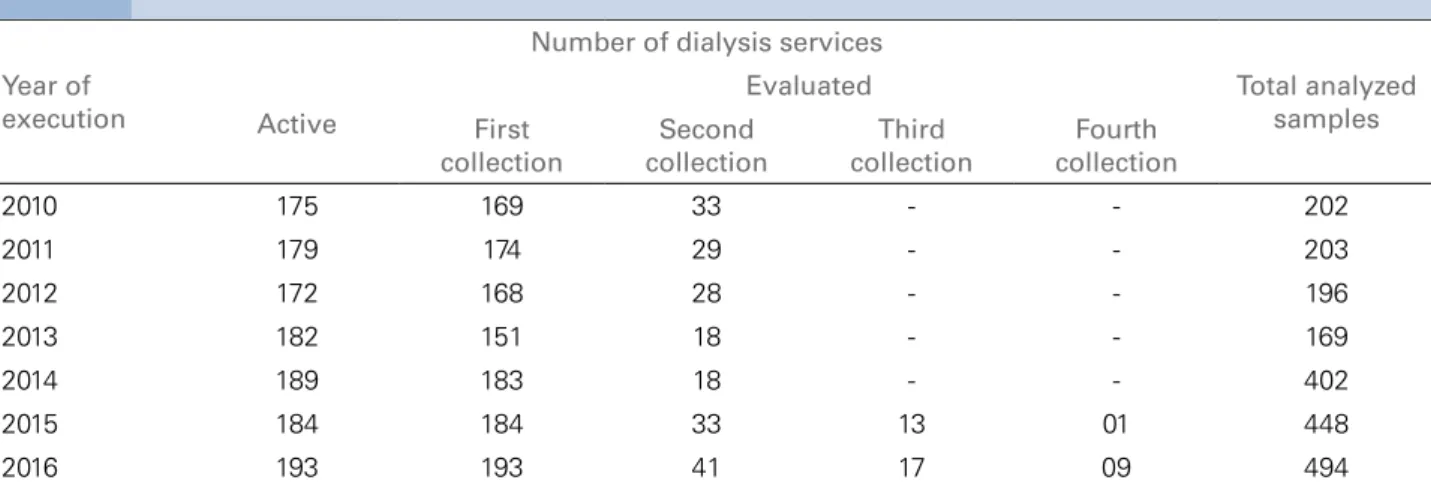
Table 1 shows the number of dialysis services of the state of São Paulo that were evaluated between 2010 and 2016 and the frequency of new sample collec-tions due to a previous inadequate parameter. During the study period, some active clinics were not evalu-ated due to changes in address, closure of activities not reported to the Sanitary Surveillance System, or a technical problem detected by the Surveillance Group teams.
Table 2 presents data of quality of water in the dialysis services from surveillance programs in other states of Brazil.
Figure 1 shows the distribution of dialysis services of São Paulo that presented water treatment and distribution systems in accordance with the standards defined by the current legislation.
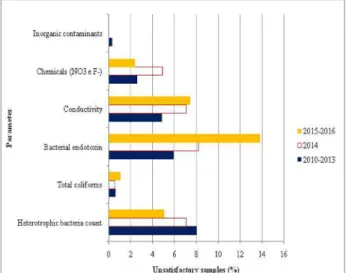
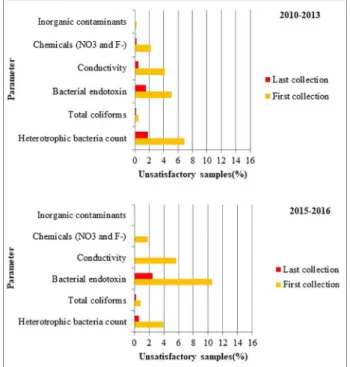
Considering the results obtained in the first collection of treated water samples in the dialysis services of the state of São Paulo, Figure 2 presents the incidence of inadequate parameters according to the maximum limits allowed in the legislation and Figure 3 show a comparison between unsatisfactory results recorded in the first and last collections of the Program.
Year of execution
Number of dialysis services
Total analyzed samples Active
Evaluated First
collection
Second collection
Third collection
Fourth collection
2010 175 169 33 - - 202
2011 179 174 29 - - 203
2012 172 168 28 - - 196
2013 182 151 18 - - 169
2014 189 183 18 - - 402
2015 184 184 33 13 01 448
2016 193 193 41 17 09 494
Figure 1. Frequency of services considered adequate for the quality of water treated used for dialysis evaluated by the State Monitoring Program.
Figure 2. Frequency of unsatisfactory results determined at the initial sample collection as a function of the analyzed parameter.
Place of study Year of execution 1 Unsatisfactory results (%) Reference
São Paulo 2007 49.0 14
São Paulo 2008 38.7 12
2009 28.7
Rio de Janeiro 2008 to 2010 27.3 18
Distrito Federal 2009 to 2010 21.8 19
Bahia 2012 31.0 20
Rio Grande do Norte 2012 to 2013 100.0 21
Place of study Year of execution
1 Unsatisfactory results (%)
Present study First collection Year
São Paulo
2010 20.1 5.3
2011 16.7 5.2
2012 17.3 6.6
2013 12.6 2.0
2014 20.2 14.2
2015 17.9 6.6
2016 27.5 9.9
1 At least one parameter that does not comply with the current legislation.
TABLE 2 MONITORINGOFTHEQUALITYOFWATERTREATEDUSEDINDIALYSISTREATMENTINDIFFERENTSTATESOF BRAZIL
DISCUSSION
The State Program for Monitoring the Quality of Water Treated for Dialysis has been conducted pe-riodically to test and evaluate the public health risk of the of the water treated in the state's dialysis ser-vices and to ensure that the quality of the water com-plies with the standards established in the current legislation.
The study evaluated the results obtained between 2010 and 2016. However, the water quality parameters were different during the periods from 2010 to 2013 and from 2015 to 2016 due to the
publication of Resolution RDC No. 11/2014,13 which
established different limits in relation to the earlier legislation17 for microbiological parameters and
bacterial endotoxins. Additionally, because there was a six-month period between March and September 2014 for the transition between the previous and current legislation, data from 2014 were excluded from the analysis.
Figure 3. Comparison of between unsatisfactory results of the initial and last sample collection as a function of the analyzed analytical parameter.
in 2013. During the following period, from 2015 to 2016, a decrease was observed in the number of clinics in compliance with the current water quality parameters to 77% on average (Figure 1).
Previous studies12,14,18-21 about the quality of water
used in treatment of CKF patients in the country (Table 2) found higher frequencies of unsatisfactory results than the present study, even when the results of the first sample collection of the year were compared. Because the first collection served as an initial snapshot of the water quality and distribution system in the dialysis service, each round of the Program presented variations in the incidence of parameters in disagreement with the maximum limits allowed in the legislation in force at the time (Figure 2). Bacterial endotoxins, conductivity, and chemical parameters had the highest incidences of unsatisfactory results at each round of the Program.
The worse results observed between 2015 and 2016 compared to the period from 2010 to 2013 is related to the more strict limits of the 2014 Resolution13
for microbiological parameters (from 200 CFU/mL to 100 CFU/mL) and bacterial endotoxins (from 2 EU/mL to 0.25 EU/mL) compared to the previous legislation. These limits required the dialysis services to adjust their water treatment and distribution systems to meet the new quality standards.
In addition to the restriction of the current legislation, the increase of unsatisfactory results also coincided with the water crisis in the state of São Paulo due to drought between 2014 and 2015.22 Water
scarcity during this period affected the water levels, caused serious social problems, and affected industry, agriculture, and the operation of basic institutions, such as hospitals and schools.22,23 The sustained reduction
of water reserves in the state for an extended period affected millions of people and altered the routines of health services and infrastructures.24 According to the
document Natural Disasters and Health in Brazil,25
the low rainfall index affected the quantity and quality of the water consumed by the population through eutrophication and algal blooms from catchment sources, intrusion of salt water into groundwater supplies, and biological contamination and chemical accumulation in the soil.24,25 Moreover, redistribution
of water from different regions to compensate for the drop in reservoirs, the mixing of water from various supply systems, the consumption of the dead volume behind dams, the intermittent supply of water, and the depressurization of the distribution network may have compromised water quality by making water distribution systems and alternative sources of supply more vulnerable to external contamination.26
The first collection of each annual round of the Program was intended to evaluate the adequacy of the water treatment and distribution systems. The surveillance was performed in accordance with the conceptual, technical, and operational delineation elaborated by the central levels of the Adolfo Lutz Institute and Sanitary Surveillance Center. The analytical results of the first collection were used as a tool for corrective actions when at least one parameter was in disagreement with the current quality standard. Based on the unsatisfactory report, the municipal or state Sanitary Surveillance Group responsible for the sample collection returned to the dialysis service with the clinical team to develop strategies and adjust the water treatment and distribution system. Additionally, the teams established effective protocols for the water supply with an appropriate quality standard for dialysis.
conducts taken to guarantee the quality and safety of dialysis treatment were effective. Reductions in the percentage of unsatisfactory samples were observed between the first and the last sample collections performed between 2010 and 2013 and between 2015 and 2016 for all evaluated parameters (Figure 3). The heterotrophic bacteria count was reduced by 74% between the first and last collections for the period from 2010 to 2013 and by 84% for the period from 2015 to 2016. The detection of bacterial endotoxins was reduced by 69% during the first period and by 77% during the second period. The conductivity and chemical parameters were reduced by 88% during the first period and by 100% during the second period. These data reinforce that the design adopted by the state monitoring program is highly effective, with new collections occurring after joint actions between the organs of the Sanitary Surveillance System and the teams of the State Dialysis Services.
CONCLUSION
Considering that water quality may impacts the mor-bidity and mortality of CKF patients undergoing dialysis treatments, the results of this study demon-strate that the systematic monitoring of dialysis ser-vices state of São Paulo by the Sanitary Surveillance System allows continuous improvement of the water treatment and distribution systems used by these ser-vices. The results also reinforce the importance of keeping the Monitoring Program as a tool to support joint actions between the Health Surveillance System and Health Services, to increase the effectiveness of water treatment and distribution systems used in di-alysis and minimize the risks associated with didi-alysis treatment.
ACKNOWLEDGEMENTS
The authors are grateful to the hemotherapy technical team of the Sanitary Surveillance Center of the state of São Paulo, who participated in the design of the Monitoring Program, to the technical teams of the Sanitary Surveillance Groups of the state and of the municipalities for sample collection, and the techni-cians of the Central and Regional labs of the Adolfo Lutz Institute who participated in the execution of the analyses.
REFERENCES
1. Jha V, Garcia-Garcia G, Iseki K, Li Z, Naicker S, Plattner B, et al. Chronic kidney disease: global dimension and perspectives. Lancet 2013;382:260-72. http://dx.doi.org/10.1016/S0140--6736(13)60687-X
2. Fassbinder TR, Winkelmann ER, Scheneider J, Wendland J, Oliveira OB. Functional Capacity and Quality of Life in Patients with Chronic Kidney Disease in Pre-Dialytic Treat-ment and on Hemodialysis--A Cross sectional study. J Bras Nefrol 2015;37:47-54. http://dx.doi.org/10.5935/0101-2800.20150008
3. Sesso RC, Lopes AA, Thomé FS, Lugon JR, Santos DR. Inqué-rito Brasileiro de Diálise Crônica 2013 - análise das tendên-cias entre 2011 e 2013. J Bras Nefrol 2014;36:476-81. http:// dx.doi.org/10.5935/0101-2800.20160009
4. Louvison MCP, Cecílio MAM, Osiano VLLR, Portas SLC, Ses-so R. Prevalência de pacientes em terapia renal substitutiva no Estado de São Paulo. BEPA Bol Epidemiol Paul 2011;8:23-42. 5. Menezes FG, Barreto DV, Abreu RM, Roveda F, Pecoits Fi-lho RFS. Panorama do tratamento hemodialítico financiado pelo Sistema Único de Saúde - uma perspectiva econômica. J Bras Nefrol 2015;37:367-78. http://dx.doi.org/10.5935/0101-2800.20150057
6. de Moura L, Prestes IV, Duncan BB, Thome FS, Schmidt MI. Dialysis for end stage renal disease financed through the Bra-zilian National Health System, 2000 to 2012. BMC Nephrol 2014;15:111. http://dx.doi.org/10.1186/1471-2369-15-111 7. Censo da Sociedade Brasileira de Nefrologia 2016. Diálise
peri-toneal no Brasil: cenário atual e desafios. Carmen Tzanno Bran-co Martins. [cited 2017 Jun 7]. Available from: http://www2. camara.leg.br/atividade-legislativa/comissoes/comissoes-perma- nentes/cssf/arquivos-de-eventos/audiencia-publica-27-04.17/mile-na-daher-sbn
8. Santos BP, Oliveira VA, Soares MC, Schwartz E. Doença renal crônica: relação dos pacientes com a hemodiálise. ABCS Health Sci 2017;42:8-14. http://dx.doi.org/10.7322/abcshs.v42i1.943 9. Bastos MG, Bregman R, Kirsztajn GM. Doença renal crônica:
frequente e grave, mas também prevenível e tratável. Rev Assoc Med Bras 2010;56:248-53.
10. Cusumano AM, Rosa-Diez GJ, Gonzalez-Bedat MC. Latin American Dialysis and Transplant Registry: Experience and contributions to end-stage renal disease epidemiology. World J Nephrol 2016;5:389-97. http://dx.doi.org/10.5527/wjn. v5.i5.389.
11. Ferreira MLD, Cardoso RL. Serviços de terapia substitutiva - monitoramento 2015. BEPA Bol Epidemiol Paul 2016;13:95-101.
12. Buzzo ML, Bugno A, Almodovar AAB, Kira CS,
Carva-lho MFH, Souza A, et al. A importância de programas de monitoramento da qualidade da água para diálise na se-gurança dos pacientes. Rev Inst Adolfo Lutz 2010;69:1-6.
13. Brasil. Ministério da Saúde. Resolução RDC No. 11, de 13 de março de 2014. Dispõe sobre os Requisitos de Boas Práticas de Funcionamento para os Serviços de Diálise e dá outras provi-dências. Diário Oficial da União [cited 2017 Jun 7]. Available from: http://www20.anvisa.gov.br/segurancadopaciente/index. php/legislacao/item/rdc-154-de-15-de-junho-de-2004
14. Marcatto MISJ, Grau MAF, Müller NCS. Projeto de reativação e implantação do Programa de Monitoramento da Água Trata-da para Hemodiálise do Estado de São Paulo, Agosto de 2009. BEPA Bol Epidemiol Paul 2010;7:6-12.
16. Rice EW, Baird RB, Eaton AD, Clesceri LS, eds; American Pu-blic Health Association (US) - APHA. Standard methods for the examination of water and wastewater. 22nd ed. Baltimore: Port City Press; 2012.
17. Brasil. Ministério da Saúde. Resolução RDC No. 154, de 15 de junho de 2004. Estabelece o Regulamento Técnico para o funcionamento dos Serviços de Diálise. Brasília: Diário Ofi-cial da União [cited 2017 Jun 7]. Available from: http://www. saude.mt.gov.br/upload/controle-infeccoes/pasta9/resolucao_rdc_ n154_2004_regulamento_servicos_dialise.pdf
18. Ramirez SS, Delgado AG, Romão CMA, Almeida AECC. Água para hemodiálise: estudo comparativo entre os resultados das análises fiscais e as análises de rotina realizadas em unidades de diálise no estado do Rio de Janeiro. VISA Debate 2015;3:104-9. http://dx.doi.org/10.3395/2317-269x.00488
19. Marchetti RGA, Caldas ED. Avaliação da qualidade microbio-lógica da água de consumo humano e de hemodiálise no Distri-to Federal em 2009 e 2010. Com Ciênc Saúde 2011;22:33-40. 20. Costa JSC. Proposta de monitoramento da qualidade da água
utilizada no tratamento hemodialítico no estado da Bahia. [Dissertation]. Salvador: Universidade Federal da Bahia; 2012 [cited 2017 Jun 7]. Available from: http://www.repositorio. ufba.br:8080/ri/bitstream/ri/12012/1/DISS%20MP.%20Jamil-le%20Chaou%c3%ad%20Costa.%202012.pdf
21. Barreto AFG, Cavalcante CAA, Moura JKS. Qualidade da água dos serviços de hemodiálises -Natal/RN. 17° Seminário Nacio-nal de Pesquisa em Enfermagem; junho de 2013; Natal/RN. [cited 2017 Dec 7]. Available from: http://www.abeneventos. com.br/anais_senpe/17senpe/pdf/1050po.pdf
22. Cesar Neto JC. A crise hídrica no estado de São Paulo. Geousp Esp Tempo (Online) 2016;19:479-84. [cited 2017 Nov 7]. Available from: http://www.revistas.usp.br/geousp/ article/viewFile/101113/112862. http://dx.doi. org/10.11606/ issn.2179-0892.geousp.2015.101113
23. Marengo JA, Nobre CA, Seluchi ME, Cuartas A, Alves LM, Mendiondo EM, et al. A seca e a crise hídrica de 2014-2015 em São Paulo. Rev USP 2014-2015;106:31-44. http://dx.doi. org/10.11606/issn.2316-9036.v0i106p31-44
24. Grigoletto JC, Cabral AR, Bonfim CV, Rohlfs DB, Silva EL, Queiroz FB, et al. Gestão das ações do setor saúde em situa-ções de seca e estiagem. Ciênc Saúde Coletiva 2016;21:709-18. http://dx.doi.org/10.1590/1413-81232015213.26212015 25. Organização Pan-Americana da Saúde (OPAS). Desastres
Na-turais e Saúde no Brasil. Brasília: Organização Pan-Americana da Saúde; 2014.