http://dx.doi.org/10.1590/1980-57642018dn12-040006
Attention-Deficit Hyperactivity
Disorder (ADHD) and narrative
discourse in older adults
Rafael Coelho1, Paulo Mattos1,2, Rosemary Tannock3,4
ABSTRACT. Attention-Deficit Hyperactivity Disorder (ADHD) encompasses other symptoms besides inattention, hyperactivity, and impulsivity, such as language problems. ADHD can have a non-remitting course and is also found in older individuals, although there are no studies on language problems in elderly individuals with the disorder. Objective: To investigate the presence of language impairment in older adults with ADHD. Methods: Language impairment was investigated in three older ADHD adults, and compared with two matched control subjects using a narrative discourse task. The transcript discourses were evaluated based on the Trabasso Model for discourse analysis, and then processed by the Speech Graph Analysis software. Results: Compared to control subjects, ADHD patient discourse had more Plot components and their networks exhibited more Edges. The patients had higher scores on the Narrative Inefficiency, Density and Diameter Indexes as well as on the Average Clustering Coefficient. The networks of control subjects were sequential, with little or no recursiveness, whereas those of ADHD subjects were convoluted. Conclusion: Our results suggest that language deficits described in children, adolescents and young adults with ADHD may persist in older adults with the disorder.
Key words: ADHD, language, narrative discourse, communication disorder, older adults, aging.
DÉFICIT DE ATENÇÃO E HIPERATIVIDADE (TDAH) E DISCURSO NARRATIVO EM IDOSOS
RESUMO. O Transtorno do Déficit de Atenção/Hiperatividade (TDAH) compreende diversos outros sintomas além de desatenção, hiperatividade e impulsividade, tais como problemas de linguagem. O TDAH pode cursar sem remissão, tendo sido demonstrado em indivíduos mais velhos, porém não há estudos investigando a linguagem em idosos com o transtorno. Objetivo: Investigar a presença de déficits de linguagem em adultos mais velhos portadores de TDAH. Métodos: Avaliou-se a presença de comprometimento de linguagem em três adultos mais velhos com TDAH, que foram comparados a dois indivíduos controles pareados, através de tarefa de discurso narrativo. A transcrição das narrativas foi avaliada com base no modelo de análise de narrativa de Trabasso, e então analisada com uso do programa Speech Graph Analysis. Resultados: Comparados aos indivíduos controles, adultos mais velhos com TDAH utilizaram mais componentes (Núcleos) da história em suas narrativas e suas redes mais Arestas. Eles apresentaram escores mais altos no Índice de Ineficiência, Diâmetro e Densidade e também no Coeficiente Médio de Grupamento. As redes dos indivíduos controles foram lineares e sequenciais, com pouca ou nenhuma recursividade, ao contrário das redes de adultos com TDAH. Conclusão: Estes resultados sugerem que problemas de linguagem já descritos em crianças, adolescentes e adultos com TDAH, podem persistir em adultos mais velhos com o transtorno.
Palavras-chave: TDAH, linguagem, discurso narrativo, transtorno de comunicação, adultos mais velhos, envelhecimento.
This study was conducted at the Instituto D’Or de Pesquisa e Ensino (IDOR), Rio de Janeiro, RJ, Brazil.
1Instituto D’Or de Pesquisa e Ensino (IDOR), Rio de Janeiro, RJ, Brazil. 2Instituto de Psiquiatria (IPUB), Universidade Federal do Rio de Janeiro (UFRJ), Rio de
Janei-ro, RJ, Brazil. 3The Hospital for Sick Children (SickKids), Toronto, ON, Canada. 4Ontario Institute of Studies in Education, University of Toronto, Toronto, ON, Canada.
Rafael Martins Coelho. Rua Voluntários da Pátria, 190 / sala 905 – 22270-001 Rio de Janeiro RJ – Brazil. E-mail: [email protected], [email protected]
Disclosure: Conflicts of interest are reported at the end of the paper.
I
t is now well established that Attention-deficit hyper-activity disorder (ADHD) comprises more deficits than its defining symptoms of inattention, hyperactiv-ity, and impulsivity; a wide range of neuropsychologi-cal deficits have also been described in ADHD.1 Amongthose deficits, a growing body of evidence has demon-strated language impairment in ADHD, such as deficits in expressive language (sentence initiation, word articu-lation and speech organization) and more frequent inap-propriate pragmatic behavior (no response to a question or request, more interruption/overlap of speakers, no feedback to speakers, poor cohesion, and lack of subject specificity).2-4 Some studies have demonstrated
linguis-tic deficits somewhat similar to those seen in Autism Spectrum Disorders.5 Although ADHD was first thought
to be a disorder present only in childhood and adoles-cence; it is now recognized as a persistent disorder not only into adulthood but also older age.6
Here we present a case series in which we demon-strate language impairment in three older adults with ADHD using a novel software program to analyze mac-rostructural aspects of language with the Trabasso coding approach for narrative discourse analysis.7-9
Discourse is a complex linguistic activity comprising dif-ferent levels (phonological, morphosyntactic, semantic-lexical, as well as semantic-pragmatic) in conjunction with other cognitive domains, such as executive func-tions.10 Narrative discourse, unlike other types of
dis-course – such as spontaneous and descriptive disdis-course – requires the speaker to verbally recount an episode experienced in the present (perception of visual stimuli, usually scenes) or past (memory) while respecting the temporal, causal and spatial relationships among events that unfold in particular scenarios, offering an ecological advantage in language evaluations.10
Although overall cognitive functioning in older adults with ADHD is not usually impaired when compared to age-matched individuals,11 there are no studies
investi-gating narrative language abilities in this group.
METHODS
Sample
The three patients reported were referred for neuropsy-chological examination at our private clinic for memory disorders (a 64-year-old male, merchant; a 61-year-old female nurse; and a 59-year-old female math teacher). All patients signed an informed consent approved by the Ethics Committee. The patients presented prob-lems involving memory functioning (retaining and recalling new information). All patients described a history of inattention symptoms dating back to early
adolescence (before the age of 12), lifelong problems with daily life management (suggestive of impaired executive functions) and persistent forgetfulness, which they considered to be worse now than before. The patients had never received a psychiatric diagnosis and were drug-naïve. None of the patients had impair-ment in their Activities of Daily Living (ADL) according to reliable collateral reports. All patients underwent the following evaluation: a) psychiatric, b) neurological, c) neuropsychological assessment, and d) neuroimaging. Neuropsychological testing comprised the following: a) auditory verbal memory (Logical Memory from the WAIS-IV Battery and Rey Auditory Verbal Learning Test), b) visual memory (Benton Visual Memory Test), c) working memory (Digit Span and Visual Memory Span), d) attention (Digit Span and Five Digits Test), e) visuoconstructive skills (Block Design), f) executive functions (Hayling Test, Word Association (FAS), Five Digits Test, Trail Making B), and g) a language evalua-tion (Naming, Word Associaevalua-tion (FAS), Reading and Writing). The results from all patients were within normal range, except for the Trail Making B test of the male patient, but this result had no clinical correlate. The narrative discourse analysis was performed on a separate occasion. All MRI scan results were considered normal by a trained neuroradiologist.
Patients reported no depressive symptomatology, and their scores on the Geriatric Depression Scale (GDS) were within normal range. None of the patients displayed any primary language deficit suggestive of Primary Progressive Aphasia (PPA). Also, they did not exhibit impaired performance on any of the cognitive domains in the neuropsychological evaluation; there-fore, they did not fulfill DSM-5 diagnosis for Major Neurocognitive Disorder (dementia) or Mild Neuro-cognitive Disorder (MCI – Mild Cognitive Impairment). All patients received an ADHD diagnosis according to guidelines proposed by Kooij.12 The control subjects
were a 63-year-old-woman, merchant and a 62-year-old-woman school teacher. Both controls had an active working life at the time of evaluation; had no memory or attention complaints, and neither had any impairment in Activities of Daily Living (ADL) according to reliable collateral reports. The patients and control individuals were matched by the Global Assessment Functioning (GAF) scale score, educational level and age.
Narrative task
a story while respecting the temporal and causal rela-tionships among events. For this, we used visual stimuli from the book “Frog, Where are you?”13 which has been
used previously for children with ADHD.4,14 This book,
containing no words, tells the story of a boy who loses his pet frog and begins a journey to get it back. The story unfolds in twenty-four frames evenly distributed throughout the book pages. These 24 drawings show events (narrative components) comprising a main plot-line (the search for the pet frog and the events directly related to the aim of getting it back) and a secondary plot-line (peripheral series of events which are not necessary for good comprehension of the story). There are many advantages regarding this strategy: a) a book containing no words with a coherent story provides an ecological way of eliciting and accessing narrative discourse; b) the events (in both main and secondary plotlines) happen sequentially one at a time, allowing investigation of the flow of the narrative discourse; c) each event occurs just once in the story, so linearity is expected in narratives; d) the book has been previously used in many studies as visual stimuli for narrative analysis4,9,14 in five different
languages with a wide range of ages, including children, adolescents and adults.7,9,15
The wordless picture book is presented to the patient who is given the following instruction: “Here is a pic-ture book. It’s about a boy and his pets, a frog and a dog. You should look at each page, and then tell me the story. I’m going to record the story you produce. You can look through the whole book as many times as you want before we start. It is not necessary to memorize the book, you’ll keep it with you. You should try telling the best possible story, pretending that I don’t know it.” The narrative produced by the patient is first recorded, then transcribed and submitted for analysis as described below.
Narrative evaluation and graph measures
We used the previous studies of Slobin, Trabasso and Von der Broek, Stein and Gleinn, Nickels and Trabasso and Stein9,16-18 , which propose complementary methods
to analyze macro and microstructural aspects of narra-tives (in this case series we focused on the macrostruc-tural aspects only). Stories are decomposed into primary events (from the main plotline – the events directly related to the main goal of finding the frog and getting it back), and secondary events of the narrative (from the secondary plotline). The narrative is then trans-formed into a written sequence in order to be analyzed by software. We used the Speech Graphs Analysis (SGA) software program19,20 for the narrative discourse
transcripted and analyzed by the Trabasso Model of discourse analysis16-18,21,22 generating a written sequence
of the story´s components. The output is a word-graph23
representing each component of the story as a node, and the link between the story components as an edge.
The Speech Graphs Analysis (SGA- http://neuro.ufrn. br/softwares/speechgraphs)19,20,24 is an open source
soft-ware program that portrays a text (in this case the tran-scribed narrative as a graph), representing each narrative nucleus as a node, and the link between each as an edge. The SGA quantifies the graph variations to calculate 14 speech graph attributes comprising general attributes, thereby providing several different measures, described in detail elsewhere.19 In this case series, we focused on
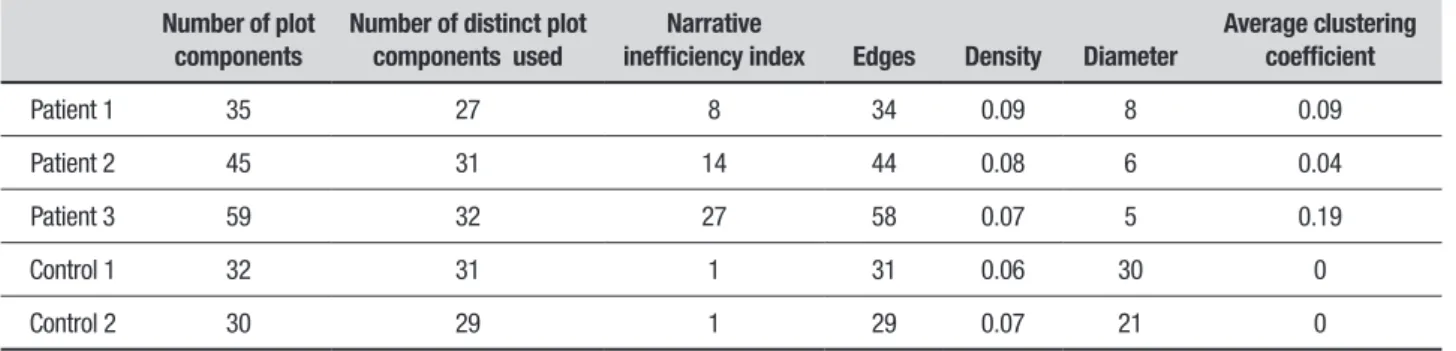
five parameters: a) WC – Word Count – total number of components from the final sequence (repeated com-ponents are included), in our study the Number of Plot Component; b) Nodes – total number of different narra-tive components produced (main elements of the story), in our study the Number of Distinct Plot Component; c) Edges – the links between narrative components; c) Density – index reflecting linearity of the narrative, in this case a measure of narrative efficiency ; d) Diameter – representing the maximum amount of linear infor-mation; also a measure of narrative efficiency; e) CC – Average Clustering Coefficient - representing major repeated nodes in the network; this is used as a mea-sure of an inefficient narrative. Since the book has no repeated events, a zero value is expected for CC. Positive values indicate inefficient or disorganized narratives. For comparison, we show the graphs of matched control individuals without memory complaints and normal performance on Activities of Daily Living; they belonged to the same social class as the patients and were invited to participate by the research group. The quantitative data displayed here aims to show how spe-cific parameters can be used to investigate difference between groups; the small sample size precluded statis-tical analysis, i.e., comparisons between groups.
RESULTS
The graphs produced by SGA analysis from the narra-tive discourse of an ADHD patient, and one graph of a control individual are shown below (Figures 1 and 2); the first portrays a clear lack of linearity, unlike the second. In addition, the graph for the ADHD patient has a signif-icantly greater density. Graphs of all ADHD patients and control individuals are shown in the supplemen-tary section (available on www.demneuropsy.com.br/).
Figure 1. ADHD subject (patient 3).
Figure 2. Control Subject (control 2).
Table 1. SGA Parameters of graphs for ADHD subjects and controls.
Number of plot components
Number of distinct plot components used
Narrative
inefficiency index Edges Density Diameter
Average clustering coefficient
Patient 1 35 27 8 34 0.09 8 0.09
Patient 2 45 31 14 44 0.08 6 0.04
Patient 3 59 32 27 58 0.07 5 0.19
Control 1 32 31 1 31 0.06 30 0
Control 2 30 29 1 29 0.07 21 0
by the software, Diameter, Density and CC seem to be those which differ the most between controls and ADHD; data are shown in Figures 3, 4 and 5.
DISCUSSION
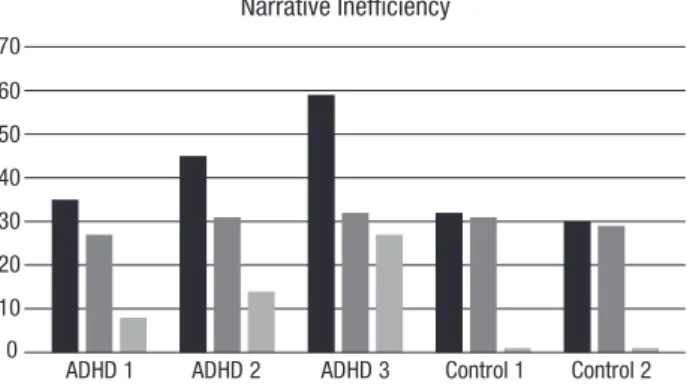
At the overall macrostructural level – i.e. from the visual inspection of the graphs - there is a clear contrast between the narratives of older adults with and without ADHD. While control narratives were typically sequen-tial, with no or little recursiveness (as expected given the linearity of events in the book), narratives were convoluted in ADHD patients. Clinically, their discourse was poorly organized, redundant, often portraying a more descriptive than narrative discourse, with too many details and some embellishment. This last aspect can be quantitatively demonstrated by the Diameter of narrative discourses, as the Diameter is the length of the longest among the shortest path between the node pairs of a network, and here indicates the linearity of the narrative (Figure 3). Although the Number of Plot Components (network nodes) was similar, two ADHD individuals clearly provided more narrative nuclei (as indicated by the Number of Plot Nuclei) when compared to controls, indicating the unnecessary use of more narrative components or nuclei in their narratives
(Narrative Inefficiency, Figure 4) without any improve-ment in the discourse, or even jeopardizing its quality.
0 5 10 15 20 25 30 35
ADHD 1 ADHD 2 ADHD 3 Control 1 Control 2
Diameter
Figure 3. Diameter is the length among the longest of the shortest path between the node pairs of a network. Diameter indicates the linearity of the narrative.
0 10 20 30 40 50 60 70
ADHD 1 ADHD 2 ADHD 3 Control 1 Control 2
Narrative Inefficiency
Number of Plot Nuclei Number of Distinctic Plot Nuclei Used Narrative Inefficiency Figure 4. Narrative Inefficiency. ADHD patients used more plot nuclei than control individuals without improvement in their narratives.
0 0,02 0,04 0,06 0,08 0,1 0,12 0,14 0,16 0,18 0,2
Average Clustering Coefficient (CC)
ADHD 1 ADHD 2 ADHD 3 Control 1 Control 2
Figure 5. Average Clustering Coefficient (CC): Given a node n, the Clus-tering Coefficient Map (CCMap) is the set of fractions of all n neighbors that are also neighbors of each other. Average CC is the sum of the Clus-tering Coefficients of all nodes in the CCMap divided by number of ele-ments in the CCMap. CC indicates convoluted or disorganized narratives.
there are no repeated events in the book, positive non-zero CC values in all ADHD patients indicate inefficient or disorganized narratives (Figure 5). In summary, the narrative discourses of the patients differed from those of control individuals.
The ADHD patients were thoroughly investigated through clinical, neuropsychological and neuroimaging evaluation and we are therefore confident that their lan-guage deficits were unrelated to abnormal aging, albeit Mild Cognitive Impairment or Primary Progressive Aphasia. These results suggest that language deficits pre-viously described in children, adolescents and adults with ADHD may persist into old age. Notably, the new meth-odology used in this study provides measurable results for language deficits previously described qualitatively.
The small sample size precluded statistical compari-sons; these preliminary results aim to demonstrate that quantitative analysis with specific scores can be useful in the investigation of language impairment in ADHD. Although individuals were not assessed by blinded examiners, their discourses were transcribed and ana-lyzed by the software, making potential bias negligible.
In conclusion, similar to that demonstrated in younger individuals with ADHD, our results suggest that language impairment is also present in elderly patients. Evaluations based on a more complex and quantitative analysis might provide a deeper understanding of the impact of ADHD on cognition. From a clinical perspec-tive, language impairment can be objectively described to patients and may also be used to address treatment strategy efficacy. Further studies assessing narrative dis-course involving a larger number of ADHD adults are warranted.
Author contributions. All the authors have contributed to the manuscript preparation and conceptualization and agreed to Dementia & Neuropsychologia submission.
Funding statement. This study received funding from the Instituto D’Or de Pesquisa e Ensino (IDOR), Brazil.
Conflict of interests. Paulo Mattos was on the speakers’ bureau and acted as a consultant for Shire in the previous five years; he also received travel awards to participate in scientific meetings from the company. Rosemary Tannock has received fees for unrestricted scientific talks from Shire, Eli Lilly, Medice, and OpoPharma in the past five years. Rafael Coelho has received travel awards to participate in scientific meetings from Shire.
REFERENCES
1. Sjöwall D, Roth L, Lindqvist S, Thorell LB. Multiple deficits in ADHD: Executive dysfunction, delay aversion, reaction time variability, and emotional deficits. J Child Psychol Psychiatry Allied Discip. 2013;54(6): 619-27.
2. Helland WA, Posserud M-B, Helland T, Heimann M, Lundervold AJ. Language Impairments in Children With ADHD and in Children With Reading Disorder. J Atten Disord. 2016;20(7):581-9.
3. Kim OH, Kaiser AP. Language Characteristics of Children with ADHD. Commun Disord Q. 2000;21(3):154-65.
4. Oram J, Fine J, Okamoto C, Tannock R. Assessing the Language of Children with Attention Deficit Hyperactivity Disorder. Am J Speech-Language Pathol. 1999;8(1):72-80.
5. Geurts HM, Embrechts M. Language profiles in ASD, SLI, and ADHD. J Autism Dev Disord. 2008;38(10):1931-43.
6. Michielsen M, Semeijn E, Comijs HC, Van De Ven P, Beekman ATF, Deeg DJH, et al. Prevalence of attention-deficit hyperactivity disorder in older adults in the Netherlands. Br J Psychiatry. 2012;201(4):298-305. 7. Berman RA. Cross-linguistic comparisons in child language research. J
Child Lang. 2014;41(suppl.1):26-37.
8. Mccabe A. Relating events in narrative: A crosslinguistic developmental study. J Child Lang. 1996;23(3):715-23.
9. Berman RA, Slobin DI. Relating Events in Narrative: A Crosslinguistic Developmental Study. 1 ed. Vol. 1. US: Psychology Press; 1994. 764 p. 10. Drummond C, Coutinho G, Fonseca RP, Assunção N, Teldeschi A, de Oliveira-Souza R, et al. Deficits in narrative discourse elicited by visual stimuli are already present in patients with mild cognitive impairment. Front Aging Neurosci. 2015;7:1-11.
11. Semeijn EJ, Korten NCM, Comijs HC, Michielsen M, Deeg DJH, Beekman ATF, et al. No lower cognitive functioning in older adults with attention-deficit/hyperactivity disorder. Int Psychogeriatrics. 2015;27(09):1467-76.
12. Kooij JJS, Michielsen M, Kruithof H, Bijlenga D. ADHD in old age: a
review of the literature and proposal for assessment and treatment. Expert Rev Neurother. 2016;16(12):1371-81.
13. Frog, Where Are You? New York: Dial Books; 2003. 32 p.
14. Peets K, Tannock R. Los errores y autocorrecciones en la narración distinguen el TDAH del TDAH con trastornos del lenguaje. Rev Logop Foniatr y Audiol. 2011;31(4):228-36.
15. Lustigman L, Berman RA. Form and function in early clause-combining. J Child Lang. 2016;43(1):157-85.
16. Nezworski T, Stein NL, Trabasso T. Story structure versus content in children’s recall. J Verbal Learning Verbal Behav. 1982;21(2):196-206. 17. Trabasso T, van den Broek P. Causal thinking and the representation of
narrative events. J Mem Lang. 1985;24(5):612-30.
18. Trabasso T, Nickels M. The Development of Goal Plans of Action in the Narration of a Picture Story. Discourse Process. 1992;15(3):249-75. 19. Bertola L, Mota NB, Copelli M, Rivero T, Diniz BS, Romano-Silva
MA, et al. Graph analysis of verbal fluency test discriminate between patients with Alzheimer’s disease, mild cognitive impairment and normal elderly controls. Front Aging Neurosci. 2014;6:185. doi: 10.3389/ fnagi.2014.00185
20. Mota NB, Vasconcelos NAP, Lemos N, Pieretti AC, Kinouchi O, Cecchi GA, et al. Speech graphs provide a quantitative measure of thought disorder in psychosis. PLoS One. 2012;7(4):1-9.
21. Trabasso T. Causal representation of narratives. Read Psychol. 1989;10(1):67-83.
22. Trabasso T, Wiley J. Goal plans of action and inferences during compre-hension of narratives. Discourse Process. 2005;39(2-3):129-64. 23. Cancho RFI, Sole R V. The small world of human language. Proc Biol
Sci. 2001;268(1482):2261-5.