www.ccarevista.ufc.br ISSN 1806-6690
Germination and vigor of long-pepper seeds (Piper hispidinervum) as a
function of temperature and light
1Germinação e vigor de sementes de pimenta-longa (
Piper hispidinervum
) em função
da temperatura e da luz
Francisco Pacheco Junior2, Josué Bispo da Silva3*, Jacson Rondinelli da Silva Negreiros4, Mirla Rose Gomes da
Silva3 e Sirlley Braga Farias5
ABSTRACT - The long pepper is considered a promising species because of offering the prospect of making Brazil self-sufficient in the production of safrole, an important essential oil used as a fixative for fragrances and having therapeutic properties. In establishing areas intended for the cultivation of this species, it is necessary to evaluate the physiological quality of the seeds used in the production of seedlings. The objective was to determine the conditions of temperature and luminosity for the test of germination and vigor in seeds of the long-pepper. Seeds from four different lots were used to make the following measurements: moisture content (105 3 °C for 24 hours), germination (20; 25; 30 and 35 °C with photoperiods of 12 and 24 hours, and alternating between 20-30 °C and 20-35 °C with 12 hours of light at the higher temperature), speed of germination index, speed of germination, seedling dry matter, seedling emergence, emergence rate index and relative frequency of germination. The experimental design was completely randomized with averages being compared by the Tukey test (P 0.05). The germination of long-pepper seeds can be assessed at 25 °C with 12h darkness - 12 h light, 25 °C with 24 h darkness, 30 °C with 12 h darkness - 12 h light and 30 °C with 24 h light, and the physiological potential at 30 °C with 24 h light.
Key words: Long pepper. Physiological potential. Forest seed.
RESUMO - A pimenta longa é considerada uma espécie promissora por apresentar a perspectiva de tornar o Brasil autosuficiente na produção de safrol, importante óleo essencial usado como fixador de fragrâncias e com propriedades terapêuticas. Na implantação de áreas destinadas à cultura dessa espécie é necessário avaliar a qualidade fisiológica das sementes utilizadas na formação de mudas. O objetivo foi determinar as condições de temperatura e luminosidade para o teste de germinação e vigor em sementes de pimenta longa. Foram utilizadas sementes de quatro lotes para as seguintes determinações: teor de água (105 3oC por 24 horas), germinação (20; 25; 30 e 35 °C com fotoperíodo de 12 e 24 horas,
e alternadas de 20-30 °C e 20-35 °C, com 12 horas de luz na temperatura mais alta), índice de velocidade de germinação, velocidade de germinação, matéria seca de plântulas, emergência de plântulas, índice de velocidade de emergência e freqüência relativa da germinação. O delineamento experimental foi o inteiramente casualizado e as médias comparadas por Tukey (P 0,05). A germinação de sementes de pimenta longa pode ser avaliada a 25 °C/12 h escuro - 12 h luz, 25 °C/24 h luz, 30 °C/12 h escuro - 12 h luz e 30 °C/24 h luz, e o potencial fisiológico a 30 °C/24 h luz.
Palavras-chave:Pimenta longa. Potencial fisiológico. Sementes florestais.
*Autor para correspondência
1Recebido para publicação em 13/09/2011; aprovado em 17/09/2012
Parte da Dissertação de Mestrado do primeiro autor, apresentada ao Programa de Pós-graduação em Agronomia, Produção Vegetal, CCBN/Universidade Federal do Acre
2Prefeitura Municipal de Rio Banco, Rua Coronel Alexandrino, 301, Rio Branco-AC, Brasil, 69.909-730, [email protected] 3Centro de Ciências Biológicas e da Natureza /UFAC, Campus universitário, BR 364, km 4, Distrito Industrial, Rio Branco-AC, Brasil,
69.915-900, [email protected], [email protected]
INTRODUCTION
The Long Pepper (Piper hispidinervum), a
shrub-like species of the Amazon region, has considerable commercial value in the production of safrole, an important secondary metabolite in obtaining heliotropine which is used as a fragrance, and piperonyl butoxide, used in the production of biodegradable insecticides
(PEREIRAet al., 2008).
During germination, a sequence of physiological events occur that are influenced by temperature and light, making it necessary therefore, to study the influence of these factors in order to understand the germination process of seeds from species of different ecological groups (FERREIRA; FIGLIOLIA; ROBERTO, 2007), especially aromatic and forest species, for which basic information about the germination eco-physiology is still lacking.
The seeds of many of these species require specific temperature regimes in order to germinate due to the influence of the ecological characteristics of
their habitat (SOUZAet al., 2007). For most tropical
species, the optimum temperature for germination
is between 15 and 30 °C (MACHADO et al., 2002).
There are also species where germination is favored by an alternating daily temperature, but this need may be associated with dormancy, although an alternating temperature can accelerate the germination of non-dormant seeds (OAK; NAKAGAWA, 2000). Marcos Filho (2005) adds that the temperature needed for germination does not have a specific value, but may be expressed in terms of cardinal temperatures, i.e., minimum, maximum and optimum, the latter being defined as that at which maximum germination occurs in a relatively short time.
Light is not always a limiting factor in seed germination, but its presence can help to reduce problems caused by low water-potential in the soil, and the effect of temperatures higher than the optimum (MARCOS FILHO, 2005).
The effects of temperature and light on the germination of forest species has been studied as a way to assess which ecological conditions are more conducive to triggering the germination process in a natural environment (GODOI; TAKAKI, 2005). Besides providing information on the dynamics of germination in these environments, the definition of the optimum temperature and light conditions will assist in defining a protocol to evaluate germination
(BRANCALIONet al., 2008).
For the seeds of several forest and aromatic species detailed information exists about undertaking the germination test following the Rules for Seed Analysis - RSA (BRAZIL, 2009), but the Long Pepper is not even included
in this publication, with there being little research work on the ideal conditions for germination and the physiological quality (ALMEIDA, 1999; BERGOet al., 2010), both basic
parameters in a program of seed production.
The objective of this study was to determine the conditions of temperature and luminosity for the evaluation of the germination and physiological quality of the seeds of the Long Pepper.
MATERIAL AND METHODS
The work was carried out at the Laboratory of Seeds and Native Seedlings at the Foundation for Technology in Acre, and the Laboratory of Molecular Biology and Morphogenesis of Embrapa Acre, in Rio Branco, Acre, in 2009. Three batches of seeds of the Long Pepper were used, supplied by different local producers, and one lot belonging to the germplasm bank of Embrapa Acre. Spikelets were harvested when mature, ie, those which showed a black colouration, indicating physiological maturity. Soon after harvesting they were immersed in water for 24 hours, macerated in a polyethylene sieve of 230 mesh, washed in water to remove the mucilage, left to dry on sheets of newsprint for 72 hours in a ventilated place (PIMENTELet al., 1998) and then subjected to the
following evaluations:moisture content: determined by
the greenhouse method (105 3 °C for 24 hours) with two sub-samples of 0.31gm of seeds. The results were
expressed as percentages (BRAZIL, 2009);germination
BLACK, 1994);seedling emergence: sowing was carried
out on polypropylene (Styrofoam ) trays, each of 200
cells, holding sand which had been treated in an oven (120 ºC for 30 minutes), with four replications of 50 seeds from each batch. The trays were kept in the shade and received supplemental water daily. Assessments were made for 30 days, and those seedlings with hypocotyls of 5 mm at the time of evaluation were considered as emerged. The results were expressed as a percentage of the emerged
seedlings; emergence speed index: determined through
a formula adapted from Maguire (1962) by the expression = IVE (E1/N1) + (E2/N2) + ... + ( En/Nn), where E1 is equal to the number of seedlings at the first count, N1 is equal to the number of days elapsed to the first count, G2equals the number of seedlings at the second count, N2 equals the number of days elapsed to the second count, and n equals the last count;seedling dry matter: 30 seedlings of each subsample were wrapped in kraft paper and placed in an oven with forced air circulation, at 70 °C until reaching constant mass, determined with precision analytical scales (0.0001 g). The results were expressed in grams; relative frequency of germination: determined as a function of incubation time in the germinator, by the formula Fr
= 100 (ni / ni), where ni is the number of germinated
seeds per day; ni is the sum of the total number of
germinated seeds (LABOURIAU, 1983).
The experimental design adopted was completely randomized. The batches were analyzed separately for each combination of temperature and brightness, and the results submitted to variance analysis by the F test (5%). The Tukey test (P 0.05) compared the averages when treatments were significant.
RESULTS AND DISCUSSION
The moisture content of the seeds of P.
hispidinervum showed values of 17.4; 17.2; 17.3 and
18.4% for batches 1; 2; 3 and 4 respectively. With the combinations of 35 ºC/12 h light, 35 ºC/24 h light and
alternating temperatures of 25 oC/12 h dark-35 oC/12
h light, germination was zero and therefore the data have not been presented, as too with the germination speed index, germination rate, seedling dry weight and relative frequency of germination. This result
disagrees with that of Machado et al. (2002) who
consider the maximum to be between 35 and 40 °C, i.e. seeds of tropical species should be tolerant to high temperatures. In this sense, there is an understanding that the presence of light can contribute to mitigating the effects of temperatures above the optimum for germination (MARK SON, 2005), but this was not observed at 35 ºC neither in 12 nor 24 hours of light.
High temperatures, albeit to a limited extent, are considered as optimal for the total germination of any one particular species, as they accelerate the biochemical processes involved in respiration, causing denaturation of the proteins and changes in membrane permeability, which lead to the loss of cellular material, a reduction in the supply of free amino acids, in the synthesis of proteins and in anabolic reactions (CARVALHO; NAKAGAWA, 2000). Marcos Filho (2005) adds that the effect of temperature is explained by enzymatic changes, by the physiological state of the seed or by the insolubility of oxygen under these conditions which increases demands and accelerates the respiratory activity of the seeds.
Seed germination from all batches was higher
at 25 and 30 oC compared to 35 oC, which was zero
(Table 1). This temperature variation is called thermo-inhibition and is characterized by the absence of germination when the temperature is slightly above the optimum. It is further noted that a constant temperature of 20 °C, especially in the presence of light for 24 hours, also limited the germination process of the seeds, but not so dramatically.
The treatment of 20 oC/24 h was unique in that
all batches showed inferior performance compared to the other treatments. Although light is cited as an environmental factor that can mitigate the consequences of suboptimal temperatures, its effects apply only to temperatures above the optimum (MARCOS FILHO, 2005), but when lower, the same benefits do not seem to be repeated.
The temperatures of both 25 and 30 °C in the presence of partial or total light, favoured a higher determination of the germination potential, with values between 67 and 98%, whereas for batches 1; 2 and 3, germination ranged from 89 to 98% at this temperature range, close to the average value of 91% found by Bergo
et al. (2010) in seeds of the Long Pepper. This ability
to germinate under different environmental conditions can have useful consequences, since for some seeds germination will occur irrespective of the conditions of their environment. These variations in the temperatures required by the species are an adaptive characteristic that give them a high capacity for establishing themselves in the field, since they allow the seeds to germinate at a higher range of temperatures. Batches 1 and 2 still managed to perform satisfactorily in the combinations of 20oC/12 h dark-12 h
light, and 20oC/12 h dark and 30oC/12 h light. Accordingly,
Carvalho and Nakagawa (2000) explain that more vigororous seeds germinate at a higher range of temperatures.
The germination speed index varied from 0.4 to 7.5 in batches 4 (20 oC/24 h light) and 1 (30oC/24 h light)
and 7.5. Work values from Bergo et al. (2010) ranged
from 4.67 to 7.05. It can be seen that 20oC/24 h light
caused the greatest delay in germination for all batches.
On the other hand, the combination of 30 oC/24 h was
the only one where all of the batches were able to display their vigour, a result which was also verified in the germination test, although batch 2 also outperformed the other treatments of 25oC/24 h light, 30oC/12 h dark-12 h
light, and 20oC/12 h dark- 30oC/12 h light, as did batch 1
in the treatment of 30oC/12 h dark-12 h light. This result
demonstrates that light influences the germination rate, as highlighted by Vidalet al. (2007) for seeds ofConyza bonariensis andConyza canadensis, but this effect occurs
only at appropriate temperatures.
Assessing the influence of temperature and light
on the germination process of seeds ofP. hispidinervum
at constant temperatures of 20 and 25oC in white light
and diffuse light, and alternating 20 oC/16 h
dark-30 oC/8 h white light, Bergo et al. (2010) found no
significant differences between the tested combinations on the total germination, but the speed of the process was higher at 25oC in white light of 720 lux, compared
to the 120 lux of the diffuse light, i.e. the white light has an illuminating capacity six times higher than the diffuse light, a result that led the authors to conclude that in this species light also reduces germination time. In the present work, the highest germination speed also occurred in that treatment where the availability of light was greater.
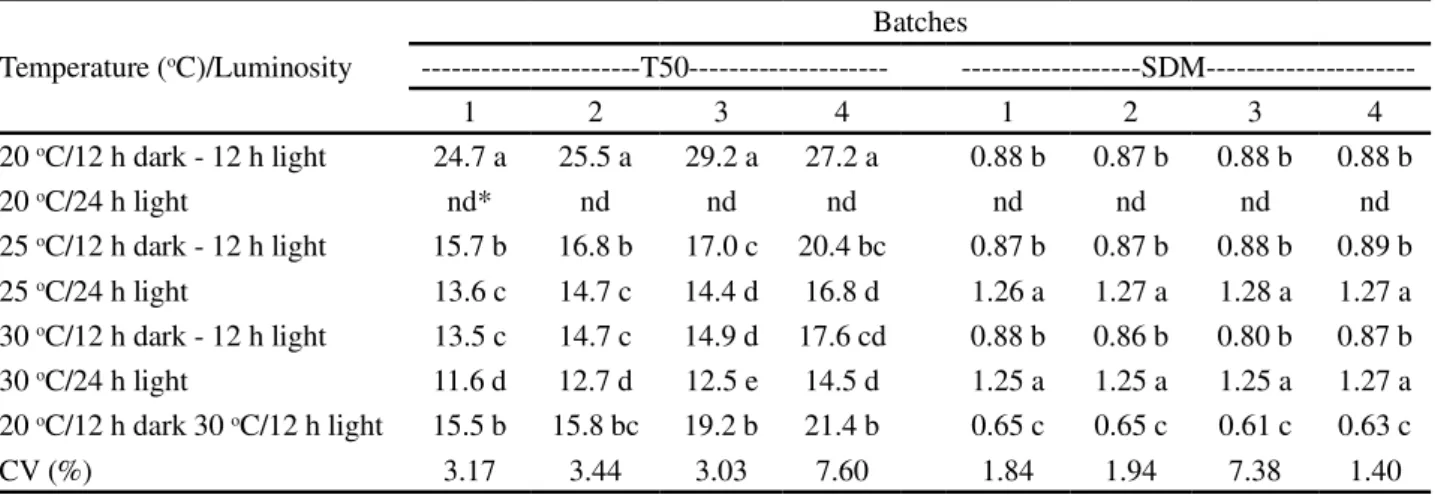
In assessing the time required for the germination of 50% of the seeds (T50), the treatment of 30oC/24 h light
yielded better results for all batches (Table 2), as also occurred in the tests for germination and the germination
speed index (Table 1). For the seedlings, the same treatment favoured higher dry matter accumulation, as well as that of 25 oC/24 h light (Table 2), i.e. both with
greater light availability. Brancalion et al. (2008) found
that for the seeds of jangada brava, although they may
have issued a primary root in the dark, the incidence of light also favored the development of the seedlings.
For Ferreiraet al. (2010), the importance of the
germination time is in the ability to evaluate the speed of occupancy of a species in a community. Accordingly, studies show that natural populations of Long Pepper typically occur in warm environments, with a direct incidence of light (ALMEIDA, 1999). The process of succession corresponds to the recovery of areas that after deforestation, will have changes in their microclimate which will determine the establishment of different species, depending on the ecological group to which they belong. ThereforeP. hispidinervum would belong to the ecological
group anthropic pioneers, whose seeds in general present positive photoblastism and/or thermoblastism, and germinate preferentially in open areas and clearings.
The response of the seeds to light is one of the factors controlling the germination time and can most often be seen in species with small seeds, such as the family Piperaceae. In these seeds, light serves more as a signal than as a resource for germination. Only adequate water, oxygen and temperatures are prerequisites for the growth of the embryo (BEWLEY, BLACK, 1994).
Germination, controlled by temperature and light is important for seedling establishment in forest clearings, which consist of environments with a large input of radiant
energy (VAZQUEZ-YANESet al. 1990). This availability
Table 1 - Germination (G%) and germination speed index (GSI) of seed batches of Piper hispidinervum as a function of temperature and luminosity
Temperature (oC)/Luminosity
Batches
---G%---
---GSI---1 2 3 4 1 2 3 4
20oC/12 h dark - 12 h light 91 a 77 a 50 c 59 bc 3.7 d 3.1 c 1.7 d 2.4 d
20oC/24 h light 55 b 19 b 28 d 21 d 1.9 e 0.5 d 0.9 e 0.4 e
25oC/12 h dark - 12 h light 96 a 89 a 94 a 72 abc 5.9 c 5.1 b 5.4 b 3.3 c
25oC/24 h light 92 a 92 a 93 a 74 ab 6.5 b 6.0 ab 6.1 b 4.4 b
30oC/12 h dark - 12 h light 98 a 90 a 92 a 67 abc 7.0 ab 5.9 ab 6.0 b 4.1 b
30oC/24 h light 93 a 89 a 94 a 75 a 7.5 a 6.5 a 7.2 a 5.2 a
20oC/12 h dark 30oC/12 h light 94 a 89 a 79 b 59 c 5.8 c 5.5 ab 4.3 c 3.3 c
CV (%) 3.80 8.71 6.81 10.74 4.92 10.96 7.36 8.61
Table 2 - Rate of germination (T50 days) and seedling dry matter (SDM g) of seeds ofPiper hispidinervum as a function of temperature and luminosity by the test of germination
Averages followed by different letters in any one column differ at a level of 5% by the Tukey Test; (* nd: not determined)
Temperature (oC)/Luminosity
Batches
---T50---
---SDM---1 2 3 4 1 2 3 4
20oC/12 h dark - 12 h light 24.7 a 25.5 a 29.2 a 27.2 a 0.88 b 0.87 b 0.88 b 0.88 b
20oC/24 h light nd* nd nd nd nd nd nd nd
25oC/12 h dark - 12 h light 15.7 b 16.8 b 17.0 c 20.4 bc 0.87 b 0.87 b 0.88 b 0.89 b
25oC/24 h light 13.6 c 14.7 c 14.4 d 16.8 d 1.26 a 1.27 a 1.28 a 1.27 a
30oC/12 h dark - 12 h light 13.5 c 14.7 c 14.9 d 17.6 cd 0.88 b 0.86 b 0.80 b 0.87 b
30oC/24 h light 11.6 d 12.7 d 12.5 e 14.5 d 1.25 a 1.25 a 1.25 a 1.27 a
20oC/12 h dark 30oC/12 h light 15.5 b 15.8 bc 19.2 b 21.4 b 0.65 c 0.65 c 0.61 c 0.63 c
CV (%) 3.17 3.44 3.03 7.60 1.84 1.94 7.38 1.40
of solar radiation influences the temperature variation, air humidity and soil temperature (PEZZOPANEet al., 2002).
In the work of Lima et al. (2006) with seeds
of the Ironwood, a temperature of 30 ºC was shown to be equally suitable for the optimization of the germination process, favouring germination and reducing the average time for its occurrence, while
35 °C produced a delay in germination. Also at 30oC,
seeds of the Baboonwood (Virola surinamensis (Rol.)
Warb.), submitted to 25; 30 and 35 oC, germinated
more intensely and in less time (FILES; SILVA; MORAES, 2007). These results reinforce the idea that most tropical and subtropical species show maximum germination potential at temperatures of up to 30°C
(MACHADOet al., 2002).
The average germination of the four batches was over 80% in the combinations of 25oC/12 h dark-12 h light,
25oC/24 h light, 30oC/12 h dark-12 h light, 30 oC/24 h
light and 20oC/12 h dark-30oC/12 h light, and over 65%
for 20oC/12 h dark-12 h light. In the works of Almeida
(1999), the total germination of seeds of the Long Pepper
under a constant temperature of 25 oC and alternating
temperatures of 25oC 22 h/35oC 2 h, 25oC 20 h/35oC 4 h
and 25oC 18 h/35oC 6 h reached an average of 41.5%,
while the germination rate was significantly lower under that treatment where the seeds were exposed for a longer time to 35 °C (25 °C 18 h/35 °C 6 h), which indicates a greater sensitivity to temperatures above 30oC, although
P. hispidinervum is considered to have adapted to hot areas (NUNES, 2004).
In seeds of Heliocarpus popayanensis, the
temperature of 35 oC was beneficial to the seeds up
to a maximum period of six hours (BRANCALION
et al., 2008) as was seen in the present work, in a
similar way to that observed in forest clearings. The fact that germination occurs at different temperatures and luminosities of 24 and 12 hours, indicates that the seeds of this species are able to germinate even in small clearings, indicating adaptation to the natural thermal and luminous fluctuations of the environment.
The emergence of seedlings in the greenhouse (Table 3) was lower than that of germination (Table 1), the difference probably being due to the laboratory conditions, which usually overestimate results compared
Table 3 - Emergence of seedlings (ES%) and rate of emergence index (REI) for seeds ofPiper hispidinervum
Averages followed by different letters in any one column differ at a level of 5% by the Tukey Test
Test Batches CV (%)
1 2 3 4
ES 31 BC 56 A 34 B 14 C 27.6
to in the field (GUEDES et al., 2009). This is expected
because environmental conditions which are inadequate for the seed-germination processes are often observed in the field, causing seedling emergence there to be less than that obtained in the germination test in the laboratory.
Since the goal of the germination test is to determine the maximum germination potential of a batch of seeds, this being possible only because it is considered that the test conditions are highly favorable to the germination process, the combinations of 25oC/12 h dark-12 h light, 25oC/24 h
light, 30oC/12 h dark-12 h light and 30oC/24 h light are
the most suitable for the germination test of long pepper seeds, especially the latter, by allowing the formation of larger seedlings in less time.
For seedling emergence batch 2 stood out, and for the speed of emergence index batches1 and 4 were superior, a superiority already seen in the germination test (Table 1) when, along with batch 1, they germinated satisfactorily in 20oC/12 h dark-30oC/12 h light. Despite
having been conducted under ambient conditions and in the shade, the light available in the emergence test, although not measured, and for only about 12 hours a day, may have been favourable to the rate of emergence, since not only the amount of radiation influences the photoblastic seeds, but also the light quality, as it is natural light.
This difference in germination and vigour among the batches may be due to the different environmental and management conditions to which each batch had been submitted, since they come from different places and producers, and the region of origin of the seeds, and events pre- and post harvest can interact with the genotype and consequently influence the conditions required for germination. The performance of a genotype is a result of the joint actions of the genotype, the environment and the interaction between these factors, this interaction reflecting the differences in the sensitivity of genotypes to environmental variations, resulting in changes in their development (ROCHA; VELLO, 1999) that can manifest themselves at germination.
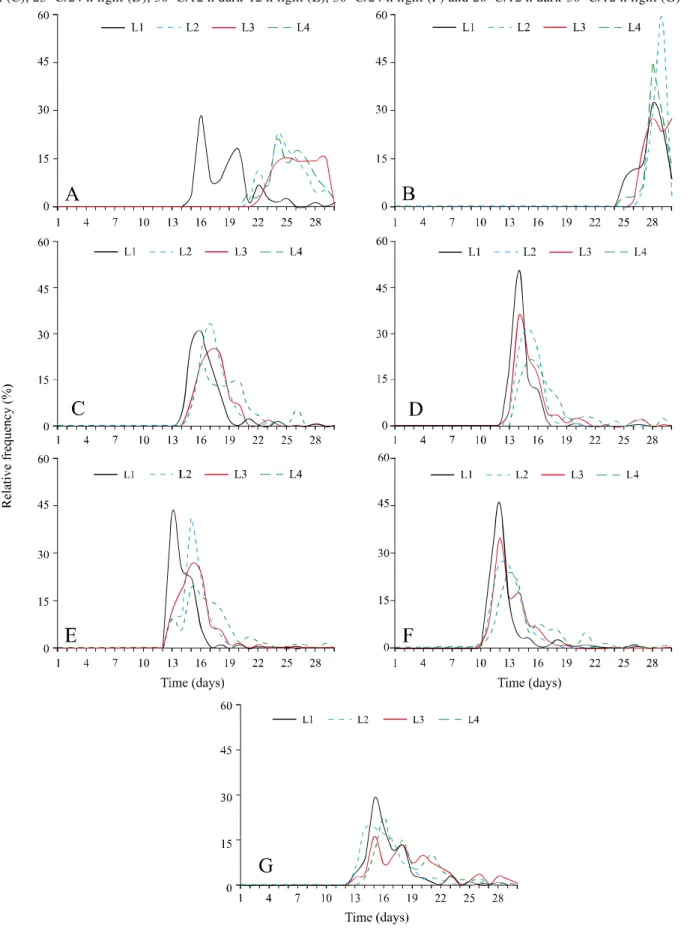
Relative frequency polygons for germination (Figure 1), which determine the proportion of seeds germinated daily throughout the period of the experiment, and were determined only for those treatments where germination took place, showed polymodal and heterogeneous distribution over the batches at a constant
temperature of 25 oC/12 h dark-12 hours of light, with
the start of germination being on the 14 th day for batch 1 and the 20 th day for the remainder. At alternating temperatures of 20oC/12 h dark-30oC 12 h light, in which
all batches germinated from the 12 th day onwards, the
distribution followed the same pattern, but evenly. For
the combination of 20 oC/24 h light, germination of
the batches followed a unimodal distribution and the greatest peak in germination frequency occurred, but there was a noticeable delay in relation to the other treatments, beginning on the 24 th day; a delay also seen for the GSI (Table 1). Greater homogeneity and a tendency to a unimodal distribution occurred in
treatments of 25 oC/12 h dark-12 h light, 25 oC/24 h
light, dark 30 oC/12 h dark-12 h light and 30 oC/24 h
light, where germination started 13; 12; 12 and 10 days respectively after sowing.
The better performance for germination of long
pepper seeds at 25 oC and especially at 30 oC, may be
related to the place of origin of the species, natural populations of which have so far only been found in the valley of the Acre river in Acre (EMBRAPA - BRAZILIAN COMPANY FOR AGRICULTURAL RESEARCH, 1998), which presents minimum, average
and maximum temperatures of 16; 24.5 and 32 oC
respectively (MOSQUE, 1996). The most favorable temperature for germination usually varies within the range of temperatures found at the ideal location for seedling emergence and establishment (RAMOS; VARELA, 2003; SOUZA et al., 2007).
Therefore, 25oC and 30oC would appear to be
the minimum and maximum temperatures respectively, the latter being the one where maximum germination occurred in a relatively short time, confirming Marcos Filho (2005).
As regards luminosity, the treatment of 30oC/24h
light, which allowed greatest dry matter accumulation, increased the speed of germination and reduced the time required for 50% of the seeds to germinate, it was the treatment that provided light for longer and thus demonstrated the influence of this environmental factor on the rate of germination, as pointed out by Vidalet al. (2007).
These results, in addition to providing information on the dynamics of germination in natural
environments (BRANCALION et al., 2008), allow
further knowledge about the germination process of long pepper seeds, in such a way as to provide help in establishing a protocol to evaluate the germination and vigour of the species, taking into consideration that there are already studies with recommendations for the
production of long pepper seedlings (PIMENTEL et
al., 1998), whose seeds are sold by Embrapa in Acre;
Figure 1 - Effect of treatments on the distribution of the relative frequency of germination of the seeds ofPiper hispidinervum during the period of incubation for the combinations of 20oC/12 h dark-12 h light (A), 20oC/24 h light (B), 25oC/12 h dark-12 h
CONCLUSION
Germination of the seeds of the Long Pepper can be evaluated at 25 °C/12 h dark-12 h light, 25 °C/24 h light, 30 °C/12 h dark-12 h light and 30 °C/24 h light, and physiological potential at 30 °C/24 h light.
REFERENCES
ALMEIDA, M. C. Banco de sementes e simulação de clareiras na germinação de Pimenta Longa (Piper hispidinervum C.DC.). 1999. 60 f. Dissertação (Mestrado em Ecologia e Manejo de Recursos Naturais) - Universidade Federal do Acre, Rio Branco, 1999.
BERGO, C. L. et al. Luz e temperatura na germinação de sementes de pimenta longa (Piper hispidinervum) e pimenta-de-macaco (Piper aduncum).Revista Brasileira de
Sementes, v. 32, n. 3, p. 170-176, 2010.
BEWLEY, J. D.; BLACK, M. Seeds: physiology of development and germination. 2. ed. New York: Plenum, 1994. 445 p.
BRANCALION, P. H. S.et al. Efeito da luz e de diferentes temperaturas na germinação de sementes de Heliocarpus popayanensisL.Revista Árvore,v. 32, n. 2, p. 225-232, 2008. BRASIL. Ministério da Agricultura e Reforma Agrária.
Regras para Análise de Sementes.Brasília: SNDA/ DNDV/ CLAV, 2009. 365 p.
CARVALHO, N. M.; NAKAGAWA, J. Sementes: ciência, tecnologia e produção. Jaboticabal: FUNEP, 2000. 588 p. EMPRESA BRASILEIRA DE PESQUISA AGROPECUÁRIA.
Protocolo de avaliação isoenzimática para a pimenta longa (Piper hispidinervum). Rio Branco: EMBRAPA/CPAFAC, 1998. 4 p. (Instruções técnicas, 12).
FERREIRA, M. G. R.et al. Emergence and initial growth of seedlings ofRollinia mucosa (Jacq.) Baill (Annonaceae) in different substrates.Semina: Ciências Agrárias,v. 31, n. 2, p. 373-380, 2010.
FERREIRA, C. A. R.; FIGLIOLIA, M. B.; ROBERTO, L. P. C. Ecofisiologia da germinação de sementes deCalophyllum brasiliensis Camb. Instituto Florestal Série Registros, n. 31, p. 173-178, 2007.
GODOI, S; TAKAKI, M. Efeito da temperatura e a participação do fitocromo no controle da germinação de sementes de embaúba. Revista brasileira de sementes, v. 27, n. 2, p. 87-90, 2005.
GUEDES, R. S. et al. Teste de comprimento de plântulas na avaliação fisiológica de sementes deErythrina velutinaWilld.
Semina: Ciências Agrárias, v. 30, n. 4, p. 793-802, 2009.
LABOURIAU, L. G.A germinação das sementes.Washington: Secretaria-Geral da OEA, 1983. 174 p.
LIMA, J. D. et al. Efeito da temperatura e do substrato na germinação de sementes de Caesalpinia ferrea Mart. ex Tul. (Leguminosae, Caesalpinoideae). Revista Árvore,v. 30, n. 4, p. 513-518, 2006.
LIMAS, J. D.; SILVA, B. M. S.; MORAES, W. S. Germinação e armazenamento de sementes deVirola surinamensis(Rol.) Warb. (Myristicaceae). Revista Árvore, v. 31, n. 1, p. 37-42, 2007.
MACHADO, C. F. et al. Metodologia para a condução do teste de germinação em sementes de ipê-amarelo (Tabebuia serratifolia (Vahl) Nicholson).Revista Cerne, v. 8, n. 2, p. 17-25, 2002.
MAGUIRE, J. D. Speed of germination-aid in selection and evaluation for seedling emergence and vigor.Crop Science,
v. 2, n. 1, p. 176-177, 1962.
MARCOS FILHO, J. Fisiologia de sementes de plantas cultivadas. Piracicaba: FEALQ, 2005. 495 p.
MESQUITA, C. C.O clima do Estado do Acre.Rio Branco: IMAC, 1996. 53 p.
NAKAGAWA, J. Testes de vigor baseados na avaliação de plântulas. In: KRZYZANOWSKI, F. C.; VIEIRA, R. D.; FRANÇA-NETO, J. B. (Ed.). Vigor de sementes: conceitos e testes. Londrina: ABRATES, 1999. cap. 2, p. 1-24.
NUNES, J. D. Citogenética de acessos de pimenta longa (Piperspp.). 2004. 30 f. Dissertação (Mestrado em Genética e Melhoramento de Plantas) - Universidade Federal de Lavras, Lavras, 2004.
PEREIRA, J. E. S. et al. Composição da matriz de encapsulamento na formação e conservação de sementes sintéticas de pimenta longa.Horticultura Brasileira, v. 26, n. 1, p. 93-96, 2008.
PEZZOPANE, J. E. M.et al. Temperatura do solo no interior de um fragmento de floresta secundária semidecidual.
Revista Brasileira de Agrometeorologia, v. 10, n. 1, p. 1-8, 2002.
PIMENTEL, F. A.et al.Recomendações para a produção
de mudas de pimenta longa no Estado do Acre. Rio Branco: EMBRAPA/CPAFAC, 1998. 3 p. (Comunicado técnico, 90). RAMOS, M. B. P.; VARELA, V. P. Efeito da temperatura e do substrato sobre a germinação de sementes de visgueiro do igapó (Parkia discolorBenth) Leguminosae, Mimosoideae. Revista de Ciências Agrárias, n. 39, p. 123-133, 2003.
SOUZA, E. B.et al. Germinação de sementes deAdenanthera pavonina L.em função de diferentes temperaturas e substratos.
Revista Árvore, v. 31, n. 3, p. 437-443, 2007.
VÁZQUEZ-YANES, C. et al. Light beneath the litter in a tropical forest: effect on seed germination.Ecology, v. 71, n. 5,
p. 1952-1958, 1990.