Assessment of rubber tree panels under crowns resistant
to South American leaf blight
Larissa Alexandra Cardoso Moraes(1), Adônis Moreira(1), José Roberto Antoniol Fontes(2), Everton Rabelo Cordeiro(2) and Vicente Haroldo de Figueiredo Moraes(3)
(1)Embrapa Soja, Rodovia Carlos João Strass, Distrito de Warta, Caixa Postal 231, CEP 86001‑970 Londrina, PR, Brazil E‑mail: [email protected], [email protected] (2)Embrapa Amazônia Ocidental, Rodovia AM 010, Km 29, Zona Rural, Caixa Postal 319, CEP 69010‑970 Manaus, AM, Brazil. E‑mail: [email protected]@cpaa.embrapa.br (3)In memoriam
Abstract – The objective of this work was to assess the performance of panel clones under crowns resistant to South American leaf blight (Microcyclus ulei). The experiment was carried out with 18 panel clones crown-budded with Hevea pauciflora x H. guianensis, in a Xanthic Ferralsol (Oxisol) in Manaus, AM, Brazil. The following parameters were evaluated: dry rubber yield, plant nutritional status, and anatomical and physiological characteristics of the latex
vessels. In the first three years of evaluation, the panel clones IAN 2878, IAN 2903, CNS AM 7905, CNS AM 7905 P1, and PB 28/59 showed the highest dry rubber yield potential, while the clones IAN 6158, IAN 6590, and IAN 6515
should not be recommended for crown budding. Higher potassium and copper foliar content in panel clones were associated to an increase in dry rubber yield. The simultaneous evaluation of anatomical and physiological characteristics of latex is fundamental for the selection of panel clones in the Amazon region. Crown budding is an
efficient technology for South American leaf blight management in endemic regions.
Index terms: Hevea, Microcyclus ulei, Amazon, crown budding, nutritional status.
Avaliação de painéis sob copas de seringueira resistentes ao mal‑das‑folhas
Resumo – O objetivo deste trabalho foi avaliar o desempenho de clones de painéis enxertados com copas resistentes ao mal-das-folhas (Microcyclus ulei). O experimento foi realizado com 18 clones de painéis enxertados com copas Hevea pauciflora x H. guianensis, em Latossolo Amarelo distrófico, em Manaus, AM. Foram avaliados os seguintes parâmetros: produtividade de borracha seca, estado nutricional das plantas e
características anatômicas e fisiológicas dos vasos laticíferos. Nos três primeiros anos de avaliação, os clones de painel IAN 2878, IAN 2903, CNS AM 7905, CNS AM 7905 P1 e PB 28/59 apresentaram os maiores potenciais de produção de borracha seca, enquanto que os clones IAN 6158, IAN 6590, and IAN 6515 não devem ser
recomendados para enxertia de copa. Maior conteúdo foliar de potássio e de cobre nos clones de painéis
esteve associado a maiores produções de borracha seca. A avaliação simultânea de características anatômicas e fisiológicas dos vasos laticíferos é fundamental para seleção de clones de painéis na Região Amazônica. A enxertia de copa é uma tecnologia eficiente para o manejo do mal‑das‑folhas, em regiões endêmicas. Termos para indexação: Hevea, Microcyclus ulei, Amazônia, enxertia de copa,estado nutricional.
Introduction
In the Amazon, South American leaf blight (SALB) caused by the fungus Microcyclus ulei P. Henn. V. Arx. has led to a decline in rubber production and to the consequent migration of Hevea plantations to other
locations without the disease (Gasparotto et al., 1997).
However, crossing Hevea spp. to obtain crown clones resistant to SALB has produced extremely positive results. The most promising clones achieved dry rubber yield above 1,000 kg ha-1 per year in the initial two
years of tapping (Moraes & Moraes, 2008), similar to the results obtained in other rubber regions in Brazil
(Gonçalves et al., 2001a; Virgens Filho et al., 2001; Gonçalves et al., 2007; Silva et al., 2010).
The potential of Hevea brasiliensis (Willd. ex A. Juss.) Müll. Arg. to produce latex depends on genetic and environmental factors. These variables are even more complex in crown budding, since two grafts are used in the same plant, i.e., root and panel, and panel and crown – the latter being the result of an interaction between two different species of Hevea with distinct physiological and anatomical characteristics, such as diameter and number of laticiferous vessel rings, senescence, resistance to diseases, and bark thickness.
to panel clone CNS AM 7905 – H. brasiliensis primary screening in the nursery, at Embrapa Amazônia Ocidental, Manaus, AM, Brazil (Moraes & Moraes, 2008). This clone lacks the depressive effect of crowns from different rubber tree species on dry rubber yield, which has not been observed in experiments with other productive clones
(Bahia & Sena‑Gomes, 1981; Moraes & Moraes, 1997,
2004). However, new studies should not be limited to just one clone. It is necessary to develop other promising panel
clones, in case clone CNS AM 7905 becomes susceptible
to any kind of disorder, such as predisposition to tapping panel dryness.
In the crown and panel screening process, besides rubber yield, the evaluation of the anatomical, biochemical, and biophysical characteristics of latex and of the plant nutritional status are important to check
the positive effect of crown clones on latex flow and regeneration (Jacob et al., 1989b; Moraes & Moraes, 1995).
The objective of this work was to assess the performance of 18 panel clones crown-budded with H. pauciflora x H. guianensis resistant to South American leaf blight (Microcyclus ulei), planted in a Xanthic Ferralsol (Oxisol) in Manaus, AM, Brazil.
Materials and Methods
The rubber tree trial was established in 2002 at the experimental area of Embrapa Amazônia Ocidental
(2º53'29"S and 59º58'40"W), in Manaus, AM, Brazil.
The soil is a Xanthic Ferralsol (Oxisol), with high clay content (730 g kg-1 of clay) and the following chemical
attributes: pH (H2O), 4.3; 1.55 g kg-1 of total N; 2.4 mg
dm-3 of P (Mehlich 1); 47.1 mg dm-3 of K; 7.2 mg dm-3
of Na; 0.24 cmolc dm-3 of Ca; 0.12 cmolc dm-3 of
Mg;1.45 cmolc dm-3 of Al; 8.04 cmolc dm-3 of H+Al;
46.9 g kg-1 of organic matter (OM); 0.25 mg dm-3
of Cu; 333.2 mg dm-3 of Fe; 5.15 mg dm-3 of Mn;
0.68 mg dm-3 of Zn (micronutrients were extracted by
Mehlich 1); 6.3 of V% (Claessen, 1997).
The climate of the region is classified as Afi, wet
tropical, according to Köppen, with abundant rainfall throughout the year (average of 2,250 mm), always higher than 60 mm in the month with the lowest rainfall, and average temperature of approximately
26ºC (Vieira & Santos, 1987).
The area was deforested in 1976 using a bulldozer, then cultivated with rubber trees until 1985, abandoned
for eleven years, and bulldozed again to remove tree trunks during soil preparation. A randomized complete block design was used with seven plants per plot and three replicates. A total of 18 panel clones
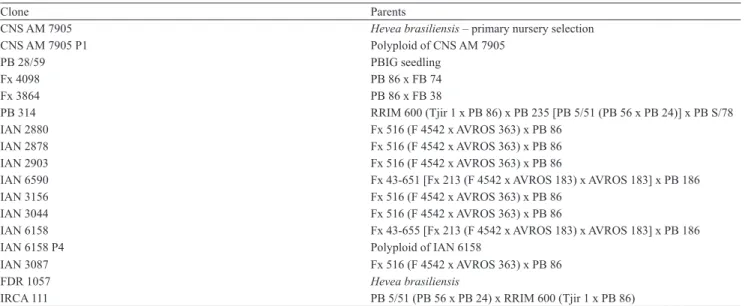
were assessed (Table 1); however, clone RRIM 600
(Tjir 1 x PB 86), currently the most planted in Southeast Brazil, was not included in the present work, since it showed unsatisfactory growth in the nursery under the edaphoclimatic conditions of the region.
Table 1. Clones evaluated and their parents, Manaus, AM, Brazil(1).
Clone Parents
CNS AM 7905 Hevea brasiliensis – primary nursery selection
CNS AM 7905 P1 Polyploid of CNS AM 7905
PB 28/59 PBIG seedling
Fx 4098 PB 86 x FB 74
Fx 3864 PB 86 x FB 38
PB 314 RRIM 600 (Tjir 1 x PB 86) x PB 235 [PB 5/51 (PB 56 x PB 24)] x PB S/78
IAN 2880 Fx 516 (F 4542 x AVROS 363) x PB 86
IAN 2878 Fx 516 (F 4542 x AVROS 363) x PB 86
IAN 2903 Fx 516 (F 4542 x AVROS 363) x PB 86
IAN 6590 Fx 43-651 [Fx 213 (F 4542 x AVROS 183) x AVROS 183] x PB 186
IAN 3156 Fx 516 (F 4542 x AVROS 363) x PB 86
IAN 3044 Fx 516 (F 4542 x AVROS 363) x PB 86
IAN 6158 Fx 43-655 [Fx 213 (F 4542 x AVROS 183) x AVROS 183] x PB 186
IAN 6158 P4 Polyploid of IAN 6158
IAN 3087 Fx 516 (F 4542 x AVROS 363) x PB 86
FDR 1057 Hevea brasiliensis
IRCA 111 PB 5/51 (PB 56 x PB 24) x RRIM 600 (Tjir 1 x PB 86)
(1)CNS, Centro Nacional de Seringueira, Amazonas; PB, Prang Besar; PBIG, Prang Besar Isolated Garden; Fx, Ford Cross; FB, Ford Belém; IAN, Instituto Agronô
Ilegitimate seeds of H. brasiliensis (random crossing) were sown in sand seedbeds, and the seedlings were transplanted into the nursery at the “white point” and “spider paw” growth stages. Before seedling
transplant into the final position, base grafting was
done in the panel clone nursery, and bare root plants were transferred to plastic bags. The seedlings were
transplanted into the final position after the second
emission of mature leaves (Moraes et al., 2008). Seedling management for crown budding followed the
procedures described by Zeid (1977). Crown budding
was carried out using H. pauciflora x H. guianensis
hybrids eight months after transplanting into the final
position and was concluded before the ninth month after panel clone base grafting. Plant density was 476 plants per hectare and crown budding height was 1.7 m, according to Moraes (2002).
Before plowing, 1.0 Mg ha-1 of dolomitic limestone
– 26.4% of CaO, 12.4% of MgO, 80.0% of effective
calcium carbonate (ECC) – was applied to the soil. Two months later, a broadcast application was done using triple superphosphate (686.3 kg ha-1 of P
2O5), copper
sulfate (5.0 kg ha-1 of Cu), zinc sulfate (5.0 kg ha-1 of
Zn), and boric acid (1.5 kg ha-1 of B),followed by soil
disaggregation using a rotary hoe. Fertilizer broadcast applications were split into six monthly doses starting
in the second month, using urea (696.9 kg ha-1 of N),
ammonium sulfate (464.4 kg ha-1 of N), and potassium
chloride (696.1 kg ha-1 of K
2O). The other cultivation
treatments (hoeing, spraying, etc.) were identical to those described by Moraes et al. (2008).
In the third year after planting, leaflet samples were
collected according to the method recommended by
Shorrocks (1962), in order to assess the nutritional status of the plants. Total leaf contents of N, P, K,
Ca, Mg, S, B, Cu, Fe, Mn, and Zn were determined following the methodology described by Malavolta
et al. (1997).
In the second year of tapping, latex samples were collected without stimulation from spiral cuts in the median part of the panel to determine contents of inorganic phosphorus (Pi), Mg, thiols (R-SH), bursting index of lutoids (BIL), and sucrose. In test tubes
containing 9.0 mL of 2.5% trichloroacetic acid, 1.0‑mL
latex composite samples were collected from three plants per plot, from each of the three blocks, 10 min
after tapping started. The tubes with 10% latex were
shaken, placed into polystyrene boxes containing ice,
and transported to the laboratory. After coagulation, the clots were pressed inside the test tubes using a glass stirring rod and removed, so that only the supernatant
remained in the tubes (Moraes & Moraes, 1995). The
Mg content in the latex was assessed in the supernatant
diluted in 2.5% trichloroacetic acid (Moraes & Moraes, 1997). Sucrose was determined using the anthrone method (Ashwell, 1957), while thiols (R‑SH), BIL,
and Pi were evaluated according to the methods
described by Boyne & Ellman (1972), Ribaillier (1968), and Tausski & Shorr (1953), respectively. The
circumference of the trunk was measured and virgin bark samples were collected 1.3 m above ground level to determine the number of latex vessel rings, density and diameter of laticiferous vessels, bark thickness, and average distance between consecutive latex vessel rings.
Tapping began in late 2007, five years after planting, when 80% of the plants had trunk circumference
over 45 cm, with two spiral-cut tappings per week, according to the following model: 1/2s, d/3, 6d/7,
10m/y, et. 2.5%, Pa (1:1) (Benesi & Oliveira, 2000).
Yield was expressed in kilograms of dry rubber per hectare per year, using the formula adapted from
Melhoramento Genético da Seringueira (1987),
in which: DRY is dry rubber productivity (kg ha-1 per
year), ADT is the appropriate days for tapping, TF
is the tapping frequency, NTT is the number of trees
being tapped per hectare (400 plants), and DRYTT is the dry rubber yield per tree per tapping.
Dry rubber yield, plant nutritional status, and latex anatomical and physiological characteristics were analyzed using analysis of variance. Mean differences were compared using cluster analysis (Scott & Knott,
1974), at 5% probability.
Results and Discussion
Over a three‑year period, panel clones PB 28/59, IAN 2878, CNS AM 7905 P1, CNS AM 7905, and IAN 2903 showed statistically better performance, with
average dry rubber yields over 1,800 kg ha-1 per year
(Table 2). These results are similar to those obtained by
Gonçalves et al. (2001a), Virgens Filho et al. (2001), and Gonçalves et al. (2007) for the best clones selected for the state of São Paulo, Brazil.
Nevertheless, the clones PB 314, IAN 6158, IAN 3087, IAN 6590, IAN 6515, IAN 6158 P4,
and FDR 1057, when crown-budded, showed poor performance, with dry rubber yields below 1,000 kg ha-1
per year, even though they produced good yield under
other edaphoclimatic conditions (Pereira et al., 1999; Gonçalves et al., 2001b; Silva et al., 2010). The poor
results found for these clones do not prevent their use
in future studies carried out in other regions. Gonçalves
et al. (2001b) tested nine clones from the Amazon region in a crown budding experiment, in a plateau in
the state of São Paulo, and concluded that three of them
had higher dry rubber yields than RRIM 600, the main clone cultivated in Brazil. Factors such as low natural
soil fertility in the Amazon (Moreira & Fageria, 2009)
and crown budding with different species of rubber tree, including H. pauciflora x H. guianensis (Moraes
& Moraes, 2008), may have negatively influenced latex
biosynthesis and, consequently, led to lower yields.
Except for IAN 6158, the clones evaluated had
average trunk circumference above 45 cm (Table 3), a parameter considered ideal to start tapping (Moraes et al., 2008).
The high content of Pi found for clones PB 28/59, IAN 3044, and IAN 3156 (Table 3) may have positively influenced yield, which was not observed for clones CNS AM 7905 P1 and CNS AM 7905. According to Jacob et al. (1989a) and Moraes & Moraes (2004), Pi content reflects the intensity of latex synthesis,
since two molecules of isopentenyl pyrophosphate are liberated for the incorporation of isoprene into the macromolecule of latex and P is liberated due to the use of adenosine triphosphate (ATP). The concentration of Mg in the latex ranged from 4.4 to 10.3 mmol L-1. Only
clone CNS AM 7905 had more than 10.0 mmol L-1
of Mg, an amount considered non-limiting to latex biosynthesis in laticiferous vessels (Moraes & Moraes,
1997, 2008).
Similarly to the results obtained by Jacob et al.
(1989b) and Moraes & Moraes (1997), the clones that had higher dry rubber yields (CNS AM 7905 P1, CNS AM 7905, and PB 28/59) showed the lowest
sucrose contents in the latex, possibly due to a more intensive use of this compound during latex biosynthesis and to the dilution effect caused by higher latex export.
R-SH content ranged from 0.05 to 0.58 mmol L-1
(IAN 2880 and IAN 6515, respectively), with a mean
value of 0.20 mmol L-1, considered low by Moraes &
Moraes (2004). It was expected that the clones with higher dry rubber yields show the highest R-SH contents and the lowest BIL values, since thiols play a vital role in maintaining membrane integrity, leading to low BIL values and preventing premature coagulation of the
latex (D’Auzac & Jacob, 1989); however, this was not
observed in the present study. These results could be explained by the higher number of latex vessel rings
found for clone PB 28/59 and by the higher diameter and density of laticiferous vessels for clones IAN 2880, CNS AM 7905, and CNS AM 7905 P1, which caused higher latex flow before coagulation.
The number and diameter of latex vessel rings are important characteristics of the laticiferous system that
are directly correlated to latex yield (Hénon & Nicolas, 1989; Webster & Paardekooper, 1989; Mesquita et al., Table 2. Dry rubber yield over a three-year period of
18 rubber tree panel clones crown-budded with Hevea
pauciflora x H. guianensis(1).
Panel Dry rubber yield (kg-1 ha-1 per year)
2008 2009 2010 Average
CNS AM 7905 1,822.8b 1,926.1a 1,979.3b 1,909.4a
CNS AM 7905 P1 1,928.3a 2,012.2a 2,349.0a 2,095.8a
PB 28/59 2,180.1a 1,834.1b 1,934.8b 1,983.0a
FX 4098 910.3d 1,171.2b 1,539.2c 1,206.9c
IAN 2880 1,700.0c 1,383.4c 1,468.8c 1,517.4b
IAN 2878 1,931.8a 1,782.4b 1,731.7b 1,815.3a
FX 3864 685.7e 1,617.9b 1,480.6c 1,261.4c
PB 314 1,226.5d 1,188.6c 583.4e 999.5d
IAN 2903 1,822.8b 2,238.8a 1,431.7c 1,831.1a
IAN 3156 1,159.0d 1,594.8b 1,069.7d 1,274.5c
IAN 3044 1,522.3c 1,665.7b 1,463.5c 1,550.5b
IAN 6158 699.6e 567.7e 672.8e 646.7e
IAN 3087 722.2e 746.5d 972.4d 813.7d FDR 1057 1,123.6d 831.8d 700.5e 885.3d IRCA 111 1,417.4c 966.5d 1,175.9d 1,186.6c
IAN 6158 P4 460.7e 796.2d 1,468.3c 908.4d
IAN 6590 0.0f 0.0f 0.0g 0.0g
IAN 6515 419.7e 424.3e 329.6f 391.2f
Mean 1,207.4 1,258.1 1,247.3 1,237.6
Standard deviation 624.7 624.5 609.3 578.0
CV (%) 13.72 - -
Minimal 0.0 0.0 0.0 0.0
Maximum 2,180.1 2,012.2 2,349.0 2,096.5
(1)Means followed by equal letters in the columns do not differ by the
Scott-Knott test at 5% probability. In average, four trees per block were conside
-red for the first year (2008), five trees per block for the second year (2009),
2006). However, this is not a general rule, as observed
by Tixier (1953) for clone AVROS 256, in Indochina,
Southeast Asia. In the present study, clones FDR 1057,
PB 314, and IAN 3087 showed a large number of latex vessel rings, above 29, which was the number reported by Gonçalves et al. (2001b) for clone RRIM 600, but
had low average dry rubber yields. Therefore, using these variables as the only criteria to select crown budding clones may cause loss of promising materials,
such as clones Fx 4098 and Fx 3864, which showed
average dry rubber yields above 1,200 kg ha-1 per year.
Factors including Mg, Pi, and sucrose contents in the latex, among others, may also interfere positively or negatively with yield.
The results observed for bark thickness were higher
than those obtained by Gonçalves et al. (2001b) for
Amazonian clones and for RRIM 600 (5.6±0.7 mm),
cultivated in the state of São Paulo. Average distance
between consecutive latex vessel rings (ADBCLVR)
ranged from 125.9 to 511.0 mm (IAN 2878 and IAN 6158, respectively), and the three clones with the
highest dry rubber yields were within the group with the lowest ADBCLVR values. As expected, an inverse relationship between the diameter of laticiferous vessels and ADBCLVR was observed.
Due to the lack of standard concentrations of foliar nutrients for the crown under study, data obtained for crown hybrids H. pauciflora x H. rigidifolia and H. pauciflora x H. guianensis by Pereira & Pereira
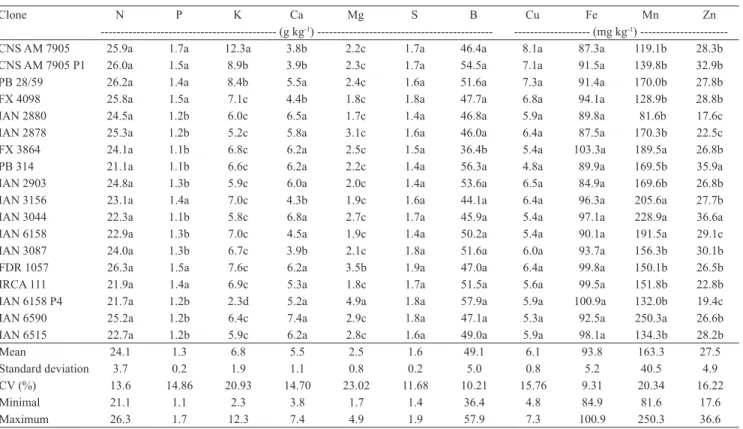
(1986) and Moraes & Moraes (2008), respectively, were used as reference. The mean foliar contents of N
(24.1±3.7 g kg-1), P (1.3±0.2 g kg-1), K (6.8±1.9 g kg-1),
Ca (5.5±1.1 g kg-1), S (1.6±0.2 g kg-1), Cu
(6.1±0.8 mg kg-1), and Mn (163.3±40.5 mg kg-1) found
in the present study were close to the range observed by these authors. However, the mean foliar contents of
B (49.1±5.0 mg kg-1), Fe (93.8±5.2 mg kg-1), and Zn
(27.5±4.9 mg kg-1) were lower than those reported by
Moraes & Moraes (2008).
The clones with mean dry rubber yields above
1,900 kg ha-1 (CSN AM 7905 P1, PB 28/59, and
CSN AM 7905) showed the highest foliar contents
of Cu and K, but intermediary foliar content of Mg
Table 3. Anatomical and physiological characteristics of latex produced by 18 rubber tree panel clones crown-budded with Hevea pauciflora x H. guianensis in the second year of tapping(1).
Clone Pi Mg Sucrose R-SH BIL d (5 mm) Number of rings LVD BT ADBCLVR Circumference
(mg L-1) (molar) --- (mmol L-1) --- (%) --- (mm) --- (cm)
CNS AM 7905 11.3d 7.0b 4.4e 0.09e 42.0a 66.1a 27d 13.6a 8.0b 208.0c 54.0b
CNS AM 7905 P1 7.1d 6.6b 2.5f 0.11e 40.0a 66.1a 39c 13.9a 11.6a 206.9c 50.6b
PB 28/59 29.3b 10.3a 4.8e 0.06e 29.3b 62.1b 55a 10.6b 10.4a 189.1c 58.0a
Fx 4098 9.3d 9.1a 11.1a 0.09e 41.1a 60.8b 13e 10.9b 7.8b 404.7b 57.8a
IAN 2880 10.3d 6.2b 7.4c 0.05e 30.6b 68.8a 43b 13.6a 9.1a 177.1c 53.4b
IAN 2878 8.0d 4.9c 6.6c 0.11e 34.5b 65.7a 39c 12.0b 7.2b 125.9c 52.6b
Fx 3864 10.8d 8.3a 10.7a 0.29c 32.4b 60.3b 15e 10.4b 8.6a 368.9b 53.6b
PB 314 13.2c 9.9a 6.5c 0.10e 34.3b 65.1a 39c 13.7a 8.8a 197.7c 46.1b
IAN 2903 7.1d 4.4c 5.6d 0.17d 36.3a 56.9b 33c 10.1b 7.6b 184.8c 48.6b
IAN 3156 16.0c 6.9b 5.8d 0.29c 33.3b 63.4a 35c 11.0b 9.9a 235.2c 50.6b
IAN 3044 17.6c 7.6a 7.4c 0.22d 20.4c 59.3b 44b 11.0b 9.0a 225.7c 49.6b
IAN 6158 8.2d 5.0c 8.0b 0.29c 29.2b 65.1a 25d 10.8b 6.4b 511.0a 42.2b
IAN 3087 8.4d 9.1a 10.0a 0.24d 30.1b 55.6b 47b 10.2b 9.8a 370.3b 62.6a
FDR 1057 8.2d 8.8a 9.1b 0.19d 31.4b 58.7b 39c 13.2a 8.8b 248.9c 64.4a
IRCA 111 10.2d 6.7b 7.4c 0.09e 30.9b 65.6a 31d 11.3b 10.3a 254.3c 54.9b
IAN 6158 P4 9.4d 4.7c 5.6d 0.33c 30.4b 61.8b 22d 11.6b 6.8b 265.1c 47.9b
IAN 6590 11.8d 5.8b 5.6d 0.45b 42.5a 65.4a 21d 10.6b 7.1b 189.6c 56.1a
IAN 6515 65.5a 8.3a 10.4a 0.58a 36.0a 58.9b 23d 9.8b 5.5b 136.5c 52.3b
Mean 14.5 7.2 7.1 0.20 35.0 62.5 33 11.6 8.5 250.0 53.1
Standard deviation 13.8 1.8 2.4 0.14 5.5 3.7 11.5 1.4 1.6 101.0 5.5
CV (%) 18.31 17.19 13.81 24.07 12.96 7.33 13.70 10.36 12.82 24.31 10.88
Minimal 7.1 4.4 2.5 0.05 20.4 55.6 13.0 9.8 5.5 129.9 42.2
Maximum 65.9 10.3 11.1 0.58 42.5 68.8 55.0 13.9 11.6 511.0 64.4
(1)Means followed by equal letters, in the columns, do not differ by the Scott‑Knott test at 5% probability. Pi, inorganic phosphorus in the latex; Mg, magne
(Table 4), considered an important criterion for crown selection (Moraes & Moraes, 2004). According to Jacob
et al. (1989b) and Tungngoen et al. (2009), higher foliar
content of Cu is an important feature, since this nutrient inhibits the activity of sucrose synthase, the enzyme responsible for sucrose neosynthesis in the latex, and maintains the substrate for latex synthesis available. The foliar content of K is equally important – this nutrient participates in glycolysis, respiration, laticiferous vessel formation, and osmotic rebalancing after tapping
(Jacob et al., 1989b). These results show that dry rubber
yield can be improved by using the correct fertilizer management indicated by the assessment of soil fertility and the nutritional status of rubber trees.
Conclusions
1. Crown budding is an efficient technology for
South American leaf blight management in endemic regions.
2. Panel clones IAN 2878, IAN 2903, CNS AM 7905, CNS AM 7905 P1, and PB 28/59 have
the highest average dry rubber yield potential, while
clones IAN 6158, IAN 6590, and IAN 6515 are not
recommended for the management system used in this study.
3. The simultaneous evaluation of anatomical and physiological characteristics of latex is fundamental for the selection of panel clones, under the edaphoclimatic conditions of the Amazon region.
4. Higher foliar content of Cu and K is associated to higher dry rubber yields of panel clones crown-budded with Hevea pauciflora x H. guianensis.
Acknowledgements
To Maria da Conceição Loureiro Campelo, Renaldo Silva de Araújo, Francisco Exgidras Leite Magalhães,
and Sérgio de Araújo Silva, from Embrapa Amazônia Ocidental, for data collection and support in laboratory analyses.
References
ASHWELL, G. Colorimetric analysis of sugar. In: COLOWICK,
S.P.; KAPLAN, N.O. (Ed.). Methods in enzymology. New York:
Academic Press, 1957. p.73‑75.
Table 4. Foliar nutrient content in 18 rubber tree panel clones crown-budded with Hevea pauciflora x H. guianensis(1).
Clone N P K Ca Mg S B Cu Fe Mn Zn
--- (g kg-1) --- --- (mg kg-1)
---CNS AM 7905 25.9a 1.7a 12.3a 3.8b 2.2c 1.7a 46.4a 8.1a 87.3a 119.1b 28.3b
CNS AM 7905 P1 26.0a 1.5a 8.9b 3.9b 2.3c 1.7a 54.5a 7.1a 91.5a 139.8b 32.9b
PB 28/59 26.2a 1.4a 8.4b 5.5a 2.4c 1.6a 51.6a 7.3a 91.4a 170.0b 27.8b
FX 4098 25.8a 1.5a 7.1c 4.4b 1.8c 1.8a 47.7a 6.8a 94.1a 128.9b 28.8b
IAN 2880 24.5a 1.2b 6.0c 6.5a 1.7c 1.4a 46.8a 5.9a 89.8a 81.6b 17.6c
IAN 2878 25.3a 1.2b 5.2c 5.8a 3.1c 1.6a 46.0a 6.4a 87.5a 170.3b 22.5c
FX 3864 24.1a 1.1b 6.8c 6.2a 2.5c 1.5a 36.4b 5.4a 103.3a 189.5a 26.8b
PB 314 21.1a 1.1b 6.6c 6.2a 2.2c 1.4a 56.3a 4.8a 89.9a 169.5b 35.9a
IAN 2903 24.8a 1.3b 5.9c 6.0a 2.0c 1.4a 53.6a 6.5a 84.9a 169.6b 26.8b
IAN 3156 23.1a 1.4a 7.0c 4.3b 1.9c 1.6a 44.1a 6.4a 96.3a 205.6a 27.7b
IAN 3044 22.3a 1.1b 5.8c 6.8a 2.7c 1.7a 45.9a 5.4a 97.1a 228.9a 36.6a
IAN 6158 22.9a 1.3b 7.0c 4.5a 1.9c 1.4a 50.2a 5.4a 90.1a 191.5a 29.1c
IAN 3087 24.0a 1.3b 6.7c 3.9b 2.1c 1.8a 51.6a 6.0a 93.7a 156.3b 30.1b
FDR 1057 26.3a 1.5a 7.6c 6.2a 3.5b 1.9a 47.0a 6.4a 99.8a 150.1b 26.5b
IRCA 111 21.9a 1.4a 6.9c 5.3a 1.8c 1.7a 51.5a 5.6a 99.5a 151.8b 22.8b
IAN 6158 P4 21.7a 1.2b 2.3d 5.2a 4.9a 1.8a 57.9a 5.9a 100.9a 132.0b 19.4c
IAN 6590 25.2a 1.2b 6.4c 7.4a 2.9c 1.8a 47.1a 5.3a 92.5a 250.3a 26.6b
IAN 6515 22.7a 1.2b 5.9c 6.2a 2.8c 1.6a 49.0a 5.9a 98.1a 134.3b 28.2b
Mean 24.1 1.3 6.8 5.5 2.5 1.6 49.1 6.1 93.8 163.3 27.5
Standard deviation 3.7 0.2 1.9 1.1 0.8 0.2 5.0 0.8 5.2 40.5 4.9
CV (%) 13.6 14.86 20.93 14.70 23.02 11.68 10.21 15.76 9.31 20.34 16.22
Minimal 21.1 1.1 2.3 3.8 1.7 1.4 36.4 4.8 84.9 81.6 17.6
Maximum 26.3 1.7 12.3 7.4 4.9 1.9 57.9 7.3 100.9 250.3 36.6
BAHIA, D.B.; SENA‑GOMES, A.R. Panel versus crown in some
clones of rubber tree (Hevea sp.). Revista Theobroma, v.11,
p.203‑208, 1981.
BENESI, J.F.C.; OLIVEIRA, M.A. de. Sangrador de seringueira:
sangria de seringueira. São Paulo: Senar, 2000. 57p.
BOYNE, A.F.; ELLMAN, G.L. A methodology for analysis of
tissue sulfhydryl components. Analytical Biochemistry, v.46,
p.639‑653, 1972.
CLAESSEN, M.E.C. (Org.). Manual de métodos de análises de
solo. Rio de Janeiro: Embrapa‑CNPS, 1997. 212p.
D’AUZAC, J.; JACOB, J.J. The composition of latex from Hevea
brasiliensis as a laticiferous cytoplasm. In: D’AUZAC, J.; JACOB,
J.L.; CHRESTIN, H. (Ed.). Physiology of rubber tree latex. Boca
Raton: CRC, 1989. p.59‑96.
GASPAROTTO, L.; SANTOS, A.F. dos; PEREIRA, J.C.R.;
FERREIRA, F.A. Doenças da seringueira no Brasil. Brasília:
Embrapa‑SPI; Manaus: Embrapa‑CPAA, 1997. 168p.
GONÇALVES, P. de S.; BORTOLETTO, N.; FURTADO, E.L.; SAMBUGARO, R.; BATAGLIA, O.C. Desempenho de clones de seringueira da série IAC 300 selecionados para a região noroeste
do Estado de São Paulo. Pesquisa Agropecuária Brasileira, v.36,
p.589‑599, 2001a.
GONÇALVES, P. de S.; BORTOLETTO, N.; SAMBUGARO, R.; FURTADO, E.L.; BATAGLIA, O.C.; ORTOLANI, A.A; GODOY JÚNIOR, G. Desempenho de clones de seringueira de
origem amazônica no planalto do Estado de São Paulo. Pesquisa
Agropecuária Brasileira, v.36, p.1469‑1477, 2001b.
GONÇALVES, P. de S.; SILVA, M. de A.; AGUIAR, A.T. da E.; MARTINS, M.A.; SCALOPPI JUNIOR, E.J.; GOUVÊA, L.R.L.
Performance of new Hevea clones from IAC 400 series. Scientia Agricola, v.64, p.241-248, 2007.
HÉNON, J.M.; NICOLAS, D. Relation between anatomical
characteristics of the laticiferous system and latex yield: search
for early selection criteria. In: D’AUZAC, J.; JACOB, J.L.;
CHRESTIN, H. (Ed.). Physiology of rubber tree latex. Boca
Raton: CRC, 1989. p.31‑55.
JACOB, J.L.; PREVÓT, J.C.; KEKWICK, G.O. General
metabolism of Hevea brasiliensis latex (with the exception of
isoprenic anabolism). In: D’AUZAC, J.; JACOB, J.L.; CHRESTIN,
H. (Ed.). Physiology of rubber tree latex. Boca Raton: CRC,
1989a. p.101‑144.
JACOB, J.L.; PREVÓT, J.C.; ROUSSEL, D.; LACROTTE, R.; SERRES, E.; D’AUZAC, J.; ESCHBACH, J.M.; OMONT, H. Yield
limiting factors, latex physiological parameter, latex diagnosis, and
clonal typology. In: D’AUZAC, J.; JACOB, J.L.; CHRESTIN, H.
(Ed.). Physiology of rubber tree latex. Boca Raton: CRC, 1989b.
p.348-382.
MALAVOLTA, E.; VITTI, G.C.; OLIVEIRA, S.A. de. Avaliação
do estado nutricional das plantas: princípios e aplicações. 2.ed.
Piracicaba: Associação Brasileira para Pesquisa do Potássio e do Fosfato, 1997. 319p.
MESQUITA, A.C.; OLIVEIRA, L.E.M.; MAZZAFERA, P.; DELÚ‑FILHO, N. Anatomical characteristics and enzymes of the
sucrose metabolism and their relationship with latex yield in the
rubber tree (Hevea brasiliensis Muell. Arg.). Brazilian Journal of Plant Physiology, v.18, p.263-268, 2006.
MELHORAMENTO genético da seringueira. Manaus:
Embrapa‑CNPSD, 1989. 23p. (Embrapa‑CNPSD. Documentos,
10).
MORAES, V.H. de F. Altura da enxertia de copa em seringueira.
Agrotrópica, v.14, p.55-60, 2002.
MORAES, V.H. de F.; MORAES, L.A.C. Características
fisiológicas do látex do clone de Hevea brasiliensis Fx 4098, sob
diferentes copas enxertadas de H. pauciflora. Revista de Ciências Agrárias, n.42, p.97‑107, 2004.
MORAES, V.H. de F.; MORAES, L.A.C. Desempenho de clones
de copa de seringueira resistentes ao mal-das-folhas. Pesquisa Agropecuária Brasileira, v.43, p.1495‑1500, 2008.
MORAES, V.H. de F.; MORAES, L.A.C. Diagnóstico do látex em
sangria precoce de seringueira com copas enxertadas: possibilidade
do emprego na seleção precoce de clones de copa e painel.
Agrotrópica, v.7, p.49‑62, 1995.
MORAES, V.H. de F.; MORAES, L.A.C. Efeito de copas
enxertadas de seringueira (Hevea spp.) sobre o teor de magnésio e
a regeneração do látex no painel do clone Fx 3899. Agrotrópica,
v.9, p.59‑66, 1997.
MORAES, V.H. de F.; MORAES, L.A.C.; MOREIRA, A.
Cultivo da seringueira com copas enxertadas resistentes ao mal‑das‑folhas. Manaus: Embrapa Amazônia Ocidental, 2008. 44p. (Embrapa Amazônia Ocidental. Documentos, 63).
MOREIRA, A.; FAGERIA, N.K. Soil chemical attributes of
Amazonas State, Brazil. Communications in Soil Science and Plant Analysis, v.40, p.2912‑2925, 2009.
PEREIRA, A.V.; PEREIRA, E.B.C. Adubação de seringais
de cultivo na Amazônia (primeira aproximação). Manaus:
Embrapa‑CNPSD, 1986. 32p. (Embrapa‑CNPSD. Circular técnica,
8).
PEREIRA, A.V.; VENTURIN, N.; PEREIRA, E.B.C.; FIALHO, J. de F.; JUNQUEIRA, N.T.V.; GONÇALVES, P. de S. Avaliação
preliminar do desempenho de clones de seringueira (Hevea spp.)
na região de Goiânia. Cerne, v.5, p.24‑35, 1999.
RIBAILLIER, D. Action in vitro de certain íon minéraux et composés organiques sur la stabilité des lutoïds du latex d’Hevea. Révue Générale des Caoutchoucs et Plastiques, v.45,
p.1395‑1398, 1968.
SCOTT, A.J.; KNOTT, M.A. A cluster analysis method for grouping
means in the analysis of variance. Biometrics, v.30, p.507-512,
1974.
SHORROCKS, V.M. Leaf analysis as a guide to nutrition of Hevea brasiliensis. V. Leaf sampling technique for mature trees. Journal of the Rubber Research Institute of Malaysia, v.17, p.167‑190,
1962.
SILVA, J.Q.; GONÇALVES, P. de S.; SCARPARE FILHO, J.A.; COSTA, R.B. da. Agronomical performance and profitability of exploitation systems in four rubber tree clones in São Paulo State.
TAUSSKY, H.H.; SHORR, E.A. A microcolorimetric method for
the determination of inorganic phosphorus. Journal of Biological Chemistry, v.202, p.675‑685, 1953.
TIXIER, P. Examen anatomique des écorces d’Hevea. Paris: Institut de Recherches sur le Caoutchouc en Indochine, 1953. 112p.
(Annual report).
TUNGNGOEN, K.; KONGSAWADWORAKUL, P.;
VIBOONJUN, V.; KATSUHARA, M.; BRUNEL, N.; SAKR, S.; NARANGAJAVANA, J.; CHRESTIN, H. Involvement of
HbPIPe;1 and HbTIP1;1 aquaporins in ethylene stimulation of latex yield through regulation of water exchanges between inner liber and latex cells in Hevea brasiliensis. Plant Physiology, v.151,
p.843‑856, 2009.
VIEIRA, L.S.; SANTOS, P.C.T.C. dos. Amazônia: seus solos
e outros recursos naturais. São Paulo: Agronômica Ceres, 1987.
416p.
VIRGENS FILHO, A. de C.; MOREIRA, A.; CASTRO, P.R. de C.E. Efeito da calagem e adubação da seringueira no estado
nutricional e produção de borracha seca. Pesquisa Agropecuária
Brasileira, v.36, p.1019‑1026, 2001.
WEBSTER, C.C.; PAARDEKOOPER, E.C. The botany of the rubber tree. In: WEBSTER, C.C.; BAULKWILL, W.J. (Ed.).
Rubber. New York: Longman, 1989. p.57‑84.
ZEID, P. Interim report on the development of advanced planting
material. In: RUBBER RESEARCH INSTITUTE OF MALAYSIA PLANTER’S CONFERENCE, 1., 1977, Kuala Lumpur.
Proceedings. Kuala Lumpur: RRIM, 1977. p.21‑46.