Environmental drivers of distribution and reef
development of the Mediterranean coral Cladocora
caespitosa
Rosa M. Chefaoui1, Pilar Casado-Amezúa2, José Templado3
Coral Reefs, 1-15.
DOI 10.1007/s00338-017-1611-8
View-only version:
http://rdcu.be/v3tP
1 2 3 4 5 6 7 8 9 10Title
Environmental drivers of distribution and reef development of the Mediterranean coral Cladocora caespitosa
Authors
Rosa M. Chefaoui1, Pilar Casado-Amezúa2, José Templado3
1 CCMAR-CIMAR Laboratório Associado, Centre for Marine Sciences, University of
Algarve, Campus de Gambelas, 8005-139 Faro, Portugal.
2 Hombre y Territorio Association, HyT, C/ Betania 13, E-41007, Sevilla, Spain.
3 National Museum of Natural History, MNCN-CSIC, José Gutiérrez Abascal 2,
E-28006, Madrid, Spain.
Correspondence author
Rosa M. Chefaoui
email: [email protected]
Keywords
Bioconstructions, conservation, habitat suitability, marine protected areas, niche modelling, Scleractinia. 11 12 13 14 15 16 18 19 20 21 22 23 24 25 26 27 28 29 30 31
Abstract
Cladocora caespitosa is the only Mediterranean scleractinian nearly equivalent to a tropical reef builder coral. While this species is part of the recent fossil history of the Mediterranean Sea, it is currently considered endangered due to its decline during the past decades. Environmental factors affecting the distribution and persistence of extensive bank reefs of this endemic species across its whole geographic range are poorly understood. In the present study, we examined the relationship between environmental parameters and the occurrence of C. caespitosa and that of its main types of assemblages using Ecological Niche Modelling (ENM) and ordination analysis. We predicted other suitable areas for the occurrence of the species, and assessed the coverage of the Marine Protected Areas (MPAs) for this coral. We found that the concentration of phosphate and wave height could be relevant factors affecting both the occurrence of this versatile species and the distribution of its extensive bioconstructions in the Mediterranean Sea. A set of factors (diffuse attenuation coefficient, calcite and nitrate concentrations, mean wave height, sea surface temperature, and shape of the coast) are likely acting as environmental barriers preventing the species to expand its distribution to the Atlantic Ocean and the Black Sea. Departures and uncertainties of our large-scale statistical results from previous physiological and ecological studies are also discussed under an integrative perspective. This study reveals that Mediterranean MPAs encompass 8 out of the 10 banks and 16 out of the 21 beds. Preservation of water clarity by avoiding phosphate discharges could improve the protection of this emblematic species. 32 33 34 35 36 37 38 39 40 41 42 43 44 45 46 47 48 49 50 51 52 53 54 55
Introduction
The Mediterranean Sea is considered a hotspot of biodiversity shaped by geological events, climatic changes and its narrow connection with the Atlantic Ocean (Boudouresque 2004; Templado 2014). The Mediterranean Basin holds an assortment of temperate and subtropical elements as well as a high number of endemisms (Coll et al. 2010). Extensive coral reef systems developed in the Mediterranean during warm geologic periods (Dabrio et al. 1981; Pomar 1991), but at the end of the Miocene the Mediterranean coral fauna underwent a drastic modification that led to the disappearance of almost all zooxanthellate corals and the well-established water coral reefs (Vertino et al. 2014). Conversely, the present Mediterranean shallow-water rocky bottoms are dominated by frondose algae, while long-lived, filter-feeding organisms proliferate within sciaphilous benthic communities (Zabala and Ballesteros 1989). The colonial zooxanthellate scleractinian Cladocora caespitosa is the only coral that can be considered as a remnant of the ancient Mediterranean reefs. C. caespitosa is, physiologically and morphologically, like the typical tropical reef-building corals in being zooxanthellate, colonial, and able to form extensive bioherms that may fuse in reef-like structures (Schuhmacher and Zibrowius 1985; Kružić et al. 2008a). Nevertheless, as these formations do not reach the water surface, Schuhmacher and Zibrowius (1985) classified C. caespitosa as constructional and formally ahermatypic. The oldest fossil banks of C. caespitosa were described by Aguirre & Jiménez (1998) from the Upper Pliocene shallow marine deposit of the Almería-Nijar basin (SE Spain). This coral species became very common in some Quaternary peri-Mediterranean basins and diverse Holocene and Pleistocene fossil banks have been described in different 56 57 58 59 60 61 62 63 64 65 66 67 68 69 70 71 72 73 74 75 76 77 78 79
areas (e.g. Cuerda et al., 1986; Bernasconi et al., 1997). Furthermore, Laborel (1987) mentioned the existence of extensive dead banks of C. caespitosa (dated around 2500-3000 yr ago) on the coasts of Tunisia and Corsica. Nowadays, when abundant, the colonies form beds of globose to hemispherical colonies, or a large framework of colonies (banks) (Peirano et al. 1998; Kružić and Požar-Domac 2003). The putative relict C. caespitosa banks may derive from beds as a consequence of the fusion of adjacent colonies under undisturbed conditions (Bianchi 2009). Apart from these assemblages, the species forms small and spread colonies recently fused from settled juveniles, which are irregularly distributed along the Mediterranean coast.
The decline of C. caespitosa with respect to its fossil distribution prompted Augier (1982) to include this coral in a list of marine endangered species. The regression of its populations is still in progress, mainly enhanced by mortality events that the coral has suffered in recent decades possibly due to the effects of global climate change (Rodolfo-Metalpa et al. 2000, 2005; Garrabou et al. 2009; Kersting et al. 2013a). Although climate change appears to be a major threat to the species and a major contributor to its continuing decline (Morri et al. 2001), other threats to the species survival are noted, such as the spread of invasive algae (Kružić 2007; Kersting et al. 2014b; Kersting et al. 2015), eutrophication due to anthropogenic activities such as sewage discharges or fish farming (Kružić and Požar-Domac 2007), trawling, and high sedimentation rates caused by dredging (Casado-Amezúa et al. 2015), among others. Moreover, bioconstructions formed by C. caespitosa harbour high diversity of micro and macrofauna (Koukouras et al. 1998; Pitacco et al. 2014), thus being considered a keystone species in the ecosystems where it occurs. Consequently, C. caespitosa has been included in the IUCN Red List, under the category of “Endangered”, with a 80 81 82 83 84 85 86 87 88 89 90 91 92 93 94 95 96 97 98 99 100 101 102 103
recommendation of continuous monitoring of the species populations (Casado-Amezúa et al. 2015).
C. caespitosa can be found in a wide variety of environments, from shallow waters to about 35 m depth. It lives on hard and soft bottoms, both exposed to strong currents and in sheltered places (Bellan-Santini et al. 2002). The species has not been found in dark enclaves but indirect and diffuse light is enough to ensure the existence of the zooxanthellates of this coral (Hoogenboom et al. 2010). The factors that govern the distribution of this emblematic species in the Mediterranean are not well understood, neither why this coral only exists as remnant bank reefs in few localities. Increased mortality at higher temperature apparently contradicts paleontological and retrospective growth indications that this coral is favoured by warmer conditions, and clearly requires further investigation (Peirano et al. 2004). Though a wealth of literature has explored ecological and physiological issues on C. cladocora at local scales, an analysis encompassing its distributional range is of interest to obtain a more comprehensive understanding of its environmental requirements. Here, we use Ecological Niche Modelling (ENM) and ordination analysis to provide more insight into the environmental response of the coral estimated through its occurrence and degree of colonies accretion. ENM has been widely used in terrestrial studies to predict species distributions by combining environmental data under different climatic conditions (past, present and future) with occurrence records. These correlative models can provide corroborative evidence for biogeographical hypotheses, and input for conservation decision making, among other contexts (see e.g. Peterson, 2011). Likewise, ENM provides insight of the species responses to the environment and predicts their potential distribution in previously unsampled waters (Wiley et al. 2003). In addition, we use 104 105 106 107 108 109 110 111 112 113 114 115 116 117 118 119 120 121 122 123 124 125 126 127
ordination analyses to elucidate factors conditioning the different bioconstructions of C. caespitosa, under the assumption that the optimal ecological conditions for the species are those found where most developed assemblages occur. Finally, given its endangered status, an assessment of the representation of this emblematic coral within MPAs is also produced.
In brief, the objectives of this study are: i) to explore the relationship between environmental parameters and both C. caespitosa occurrence data and the distribution of the different types of assemblages (banks and beds) in the Mediterranean Basin and its sub-basins; ii) to predict potential suitable habitats where new populations could be found; and iii) to assess the current coverage of the MPA system for C. caespitosa. Besides, by contrasting our large-scale statistical results with existing physiological and local environmental studies, we aim to identify uncertainties of our study and offer an integrative perspective.
Materials and methods
Species data and study area
We compiled occurrence data of C. caespitosa from the scientific literature, personal observations, and the Global Biodiversity Information Facility (GBIF; http://www.gbif.org/). We removed duplicates, and checked for records with georeferencing errors. After this just one observation per cell (156 presence cells) remained using a 0.083° × 0.083° (~ 9.2 km) resolution. The study area comprised the species’ known geographic range, the Mediterranean Basin, and adjacent areas (the nearby coasts of the Atlantic Ocean and the Black Sea). We delimited appropriate habitats according to the bathymetric distribution of the species (in the depth range 0-35 128 129 130 131 132 133 134 135 136 137 138 139 140 141 142 143 144 145 146 147 148 149 150 151
m) from the 30 arc-seconds General Bathymetric Chart of the Oceans (GEBCO; http://www.gebco.net/).
Predictors selection and environmental niche modelling
We selected an initial set of predictors based on our a priori assumptions on the species requirements (light availability, nutrients, temperature, etc.). We then tested statistically each predictor’s ability to explain the presence of the species in order to select those most relevant to be included in the models. Satellite-derived data for nitrate (from 1928 to 2008), phosphate (1922 - 1986), pH (1910 - 2007), photosynthetically available radiation (PAR; from 1997 to 2009) and calcite concentration (2002 - 2009) were obtained from the Bio-ORACLE dataset (Tyberghein et al. 2012; http://www.oracle.ugent.be/). Sea-floor morphology (bottom aspect and bottom slope) was computed from the GEBCO data using the package “raster” (Hijmans 2016) in R. Summer and winter maximum, minimum, and mean values of significant wave height were derived from near-real time merged data for 2009-2015 from Aviso (http://www.aviso.altimetry.fr/). The same measures (from 2003 to 2007) were derived from OSTIA system (http://ghrsst-pp.metoffice.com/pages/latest_analysis/ostia.html; Stark et al. 2007) for SST, and for diffuse attenuation coefficient for downward irradiance at 490 nm (Kd; Huot et al., 2005). Kd is calculated from satellite images and
has proved to be an excellent estimate of the traditional Secchi Disk Depth (SDD), as there is an inverse correlation between both values (Chen et al. 2007). Smaller Kd
values (~larger SDD) are found in waters with less attenuation of light as a function of depth, thus in waters with higher clarity.
152 153 154 155 156 157 158 159 160 161 162 163 164 165 166 167 168 169 170 171 172 173 174
In addition, six landscape metrics computed at the class level in FRAGSTATS (McGarigal et al. 2012) were considered as indicators of the shape of the coast: i) a measure of the edge contrast along the coastline (ECON_MN); ii) fractal dimension in-dex (FRAC_AM), a metric for shape complexity; iii) the mean perimeter-area ratio (PARA_MN) of the patch; iv) percentage of each landscape (sea or land) along the coast (PLAND); v) the index of shape complexity in relation to a square (SHAPE_MN); and vi) the index of the total edge contrast (TECI) (see Supplementary material Table S1). These landscape metrics were found to be good indicators of coastal features such as long beaches, gulfs and capes in Chefaoui (2014), and also were found to increase pre-dictive performance when integrated as predictors of a subtidal seagrass (see Chefaoui et al. 2016).
All variables were initially checked for Pearson correlations to discard among derived metrics (r≥|0.80|, p<0.001). Afterwards, the relevance of the remaining parameters to define the niche of the species was assessed using ENFA (Ecological Niche Factor Analysis; Hirzel et al. 2002). ENFA relies on presence-only data to compute a factor analysis which identifies marginality and specialization factors. Marginality is the ecological distance between the mean conditions found in the habitat and the species optimum (the mean of the species). The specialization computes the ratio of the variance of the global distribution to that of the species distribution in the multidimensional space (Hirzel et al. 2002). With a preliminary ENFA, we removed predictors not achieving marginality or specialization scores above 0.2. Once selected the final set of variables, another ENFA was performed with the remaining variables to obtain their contribution to relate the presences with the ENFA factors.
175 176 177 178 179 180 181 182 183 184 185 186 187 188 189 190 191 192 193 194 195 196 197
Due to the lack of reliable absence data for this coral, we selected a presence-only algorithm (Mahalanobis distance) as the main method to estimate the potential distribution of C. caespitosa. Mahalanobis distance (MD) generates an elliptic envelope (Clark et al. 1993), and has shown superior performance than rectilineal envelopes as it uses all the observations to calculate the optimal for the species (Farber and Kadmon 2003). Variables were scaled to equal their variance before computing the suitability map. ENFA and MD were fit using “adehabitat” (Calenge 2006) in R.
Notwithstanding, in order to make a comparison, we also produced a presence-absence model. We implemented generalized linear models (GLMs) and generalized additive models (GAMs) to fit our data, using the logit link function and the binomial error distribution. To reduce the uncertainty on the absences, pseudo-absences were randomly selected from environmentally distant habitats previously defined by MD (habitat suitability = 0), using a similar procedure as in Chefaoui and Lobo (2008). A stepwise model selection by Akaike’s Information Criterion (AIC) was performed in both directions, and the proposed model was compared to the null model to estimate the percentage of deviance explained (D2). To validate the model, we divided randomly the
data into a training set (70%) and an evaluation set (30%). The area under the receiver operating characteristic (ROC) curve (AUC) and the sensitivity (true positive rate) was calculated. Models were fitted in R using the “gam” and “MASS” packages.
Ordination analysis of C. caespitosa assemblages
We compiled available information describing abundance and morphology of colonies from the literature and experts' observations, and classified the assemblages according to Peirano et al. (1998) into two categories: i) “banks” formed by colonies connected in 198 199 200 201 202 203 204 205 206 207 208 209 210 211 212 213 214 215 216 217 218 219 220 221
a framework and reaching several decimeters in height and several square meters in surface area; and ii) “beds” consisting of a great number of subspherical colonies close to each other, concentrated in a small area but with a low coverage (Fig. 1). As intermediate stages may be found, we considered as beds any stage not reaching a true bank. Finally, 31 populations were classified as "banks" (10 localities) or "beds" (21 localities) (Fig. 2 and Supplementary material Table S2).
To explore the influence of environmental factors on the types of assemblages of C. caespitosa, we used a non-metric multidimensional scaling (NMDS), a robust unconstrained ordination technique commonly used in community ecology (Minchin 1987). By means of a two dimensional NMDS, we compared the environmental variables defining each locality (cell) where the assemblages were localized to identify clusters based on the two types of colonies. We also used NMDS to compare environmental differences among the eight Mediterranean subregions proposed by Notarbartolo di Sciara and Agardy (UNEP-MAP-RAC/SPA 2010) where the assemblages were found (see Table S2). We computed a two dimensional NMDS based on a distance matrix derived from the Bray-Curtis dissimilarity index. We extracted the correlation coefficient scores and assessed the significance of each environmental vector fitted onto the NMDS axes. To determine the significance of vector fits with ordination axes, permutation tests (n = 999) were used. Afterwards, we performed a smooth surface fitting of variables within ordinations estimated by a generalized additive model. NMDS analyses were conducted using metaMDS, envfit and ordisurf functions in the “vegan” package (Oksanen et al. 2015) in R.
Marine protected areas (MPAs) gap analysis
222 223 224 225 226 227 228 229 230 231 232 233 234 235 236 237 238 239 240 241 242 243 244 245
We obtained national and international Mediterranean MPAs GIS data from the World Database on Protected Areas (IUCN and UNEP-WCMC 2016) and the updated database of Natura 2000 sites designated under the Habitats Directive (http://www.eea.europa.eu/). From these sites, we excluded those with no effect on coral protection such as Special Protection Areas for wetlands (Ramsar sites), for birds (Birds Directive), and marine mammals sanctuaries. We overlaid C. caespitosa's occurrences and the locations of the two types of assemblages on MPAs to assess the coverage of protection. A buffer of 1 km around each point was created to avoid underrepresentation due to possible georeferencing errors. Besides, we calculated statistics for habitat suitability (HS) values predicted for the coral inside the regions covered by the different systems of MPAs.
Results
Ecological niche modelling and predicted distribution
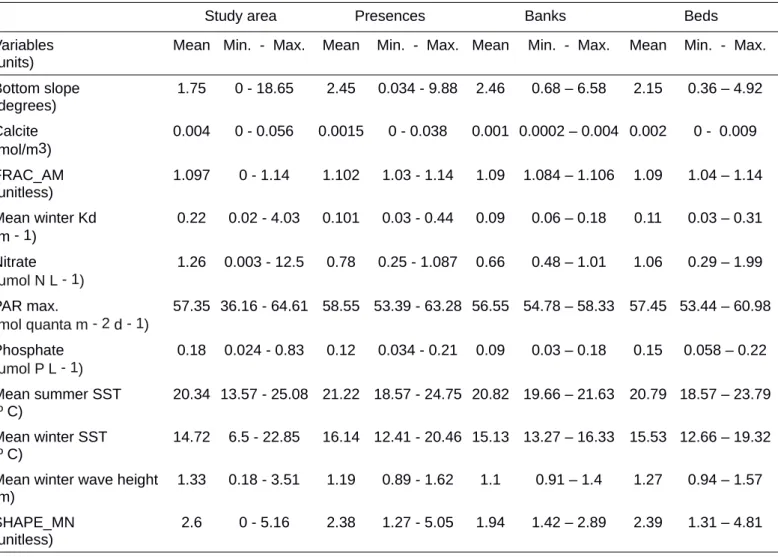
After correlation analysis, a total of 17 variables remained and were examined using the preliminary ENFA (see Supplementary material Table S3), which resulted in a final set of 11 variables (Table 1) used in the rest of analyses. Final ENFA results concluded that all variables from this final set were relevant for ENFA's marginality and/or specialization factors, thus contributing to explain the presence of C. caespitosa across the whole Mediterranean Basin (Table 1). According to ENFA, the presence of C. caespitosa is related to waters with lower concentrations of calcite and phosphate than the mean conditions of the study area (see Table 2 and Fig. 3). Higher SST in summer and winter with respect to the mean conditions seems also to determine the presence of C. caespitosa. The coral occurs in waters with lower values of Kd (< 0.44 m-1) and
246 247 248 249 250 251 252 253 254 255 256 257 258 259 260 261 262 263 264 265 266 267 268 269
higher PAR max., evidencing its preference for clear waters. Coasts with lower mean wave height than the whole area are more suitable for the species. Considering landscape metrics, we found that lower mean shape index (SHAPE_MN) was also relevant for the species, indicating that the species mainly occurs in coastlines with complex shapes.
We found GLM obtained a lower Akaike’s Information Criterion (AIC = 16) and fitted our data better (D2 = 100%) than quadratic and cubic smoothing splines used by
GAM (AIC = 68). Six variables were found significant by the GLM (Supplementary material Table S6). GLM validation achieved an AUC = 0.99 and sensitivity = 0.94 (Supplementary material Fig. S1). The GLM prediction discriminated between the known range of distribution of the species and the rest of the study area, but it was not able to ascertain the appropriateness for the species in the Mediterranean Sea (Supplementary material Fig. S2).
The MD analysis showed suitable habitat for the occurrence of C. caespitosa only within the Mediterranean Sea basin, excluding the Black Sea and Atlantic Ocean (Fig. 4).
Discrimination of factors influencing the types of assemblages
The NMDS ordination plot (stress value = 0.15) showed that the two types of assemblages (banks and beds) shared environmental space, with the exception of the banks located in the Adriatic Sea (Fig. 5a, b). The second axis of the ordination (NMDS2) described better the multivariable gradient with the largest variance among clusters, and the major direction of the gradient was indicated by the phosphate concentration and wave height, which showed highly significant correlations (p < 270 271 272 273 274 275 276 277 278 279 280 281 282 283 284 285 286 287 288 289 290 291 292 293
0.001) with NMDS2 axis (Table 1). C. caespitosa banks were mostly found in waters with lower values of the above mentioned variables than “beds” (Fig. 5c, d).
When separated by subregions, we found only two groups showing conditions different from the rest (Fig. 5b). The Adriatic waters -where the biggest banks are nowadays found- showed significantly lower phosphate concentrations and lower wave height (Fig. 5b). On the other hand, the Tyrrhenian Sea assemblages are found in waters with a higher calcite concentration and less water clarity.
MPA gap analysis
We found that 8 out of the 10 banks and 16 out of the 21 beds were represented in MPAs (Supplementary material Table S4). Of the 156 occurrence data analyzed, 61 (39.1%) were included in protected areas (Supplementary material Table S5). Natura 2000 network provides higher coverage than other national and international areas recognized by the government or under regional and international conventions. Moreover, there is an overlap between Natura 2000 network and the rest, and rarely was a location protected exclusively by a non Natura 2000 site. Regions covered by Natura 2000 network sites showed HS scores slightly higher (mean = 0.35) than those obtained for non Natura 2000 sites (mean = 0.29). Median HS value inside Natura 2000 network was also superior (Fig. 6).
Discussion
Environmental response of C. caespitosa and its assemblages
This is the first study disentangling the environmental factors that determine the distribution and development of the main assemblages of the endemic reef-former C. 294 295 296 297 298 299 300 301 302 303 304 305 306 307 308 309 310 311 312 313 314 315 316 317
caespitosa across the Mediterranean Sea. We found that the extensive populations (banks) shared particular conditions with respect to most of the beds (Fig. 5). Phosphate concentration and wave height seem to be convergent factors influencing the presence of this emblematic species and the distribution of its extensive bioconstructions. Gradients of these variables were significantly related to the degree of development of the assemblages, as banks were found in locations with lower wave height and phosphate concentration. Besides, ENFA inferred that C. caespitosa, independently of its type of assemblage, is favoured by waters with: i) lower concentrations of calcite and phosphate than the mean conditions of the study area, ii) higher mean SST in summer and winter, iii) lower values of Kd and higher PAR max., evidencing its preference for
clear waters, iv) lower mean wave height, and v) lower mean shape index (SHAPE_MN), indicating that the species mainly occurs in complex coastlines.
Our model inferred a preference of C. caespitosa for water clarity, and also that larger bioconstructions (banks) occur in clearer waters on average. This is in agreement with other studies that relate high light conditions with maximal symbiont (zooxanthel-lae) density (Hoogenboom et al. 2010; Ferrier-Pagès et al. 2011), and maximal auto-trophic carbon acquisition (Fonvielle et al. 2015) even similar to those measured for tropical symbiotic corals (Ferrier-Pagès et al. 2013). Nevertheless, unlike in tropical lat-itudes, the strong seasonal changes of irradiance in the Mediterranean Sea might be driving the coral host and its symbionts to a continuous metabolic acclimatization. In fact, C. caespitosa's metabolic optimization for acquisition of inorganic or organic nutri-ents via autotrophy or heterotrophy depending on light intensity has been proven in sev-eral studies (Hoogenboom et al. 2010; Tremblay et al. 2012; Ferrier-Pagès et al. 2013). Zooxanthellae autotrophy is especially important during summer time (Hoogenboom et 318 319 320 321 322 323 324 325 326 327 328 329 330 331 332 333 334 335 336 337 338 339 340 341
al. 2010; Ferrier-Pagès et al. 2011), when the coral has a higher growth rate (Montagna et al. 2007). While in winter, when light conditions and temperature are not optimal, heterotrophy plays an important role maintaining metabolism and calcification (Ferrier-Pagès et al. 2011). We found a response of this coral towards clearer waters, but its abil-ity to regulate autotrophic and heterotrophic metabolism is probably providing the spe-cies with the versatility required under Mediterranean's changing light conditions. The metabolic versatility may allow C. caespitosa to live in contrasting light conditions, in-cluding turbid waters (especially those derived from organic matter) and deeper waters where strong currents are present (Laborel 1961; Peirano et al. 1998; Kružić and Ben-ković 2008; Rodolfo-Metalpa et al. 2008a), by shifting to heterotrophy in response to light limitation, as high food supply by currents in turbid waters has also been found to enhance skeletal growth (Ferrier-Pagès et al. 2013). However, the Marmara Sea (exclud-ing the Dardanelles) and a large expanse of the Black Sea are out of the observed toler-ance range for water clarity (Table 2).
The Mediterranean coasts, unlike those of the Black Sea, are characterized by a nutrient-poor water and widespread phosphate deficit. The size of reef formations fol-lows a gradient in which extensive bioherms (banks) grow at the lowest concentrations of phosphate (ranging from 0.03 to 0.18 μmol P Lmol P L-1) (Fig. 5). We found the same ten-dency in relation to the general distribution of the coral as it occupies seawater with lower concentrations of phosphate than the mean found in the study area (Fig. 3). One explanation for these results could be the negative effect of phosphate on calcification of marine exo-skeletons (Simkiss 1964; Fabricius 2005), as it was punctually detected in Mljet bank (Kružić et al. 2012) where the process of coral calcification decreased or even completely stopped. Recently, Kateb et al. (2016) found that the extinction of some 342 343 344 345 346 347 348 349 350 351 352 353 354 355 356 357 358 359 360 361 362 363 364 365
populations of C. caespitosa in Gabes was probably caused by discharges of the phos-phate industry among other factors. Moreover, Fabricius (2005) found that long-term exposure to high levels of nutrients causes more changes to coral communities than short-term ones. Though the phosphate discharges reported by some of these studies represented also a complete degradation of the environmental system, and should be in-terpreted with caution, the long-term averaged data used in our study (from 1922 to 1986) might be evidencing a large-scale response of C. caespitosa towards phosphate concentrations. Besides, phosphate excess probably limits C. caespitosa growth, and in particular banks growth, by enhancing macroalgal competition for space and the prolif-eration of mucilages that can cover the coral colonies (Kružić and Požar-Domac 2007). However, in some places of oligotrophic waters, such as in Columbretes and For-mentera Islands, C. caespitosa shows some ability to compete with algae forming mixed assemblages and developing some of the most extensive populations known to date (Kersting and Linares 2012; Kersting et al. 2017a, 2017b). Thus, further research is re-quired to test the sensitivity of C. caespitosa to phosphate concentration.
We found that C. caespitosa does not occur where the average winter wave height is higher than 1.6 m, which could be preventing the occurrence of this coral in the Atlantic Ocean, where, in addition, the mean irradiance is about 20% lower at simi-lar latitudes than in the Mediterranean (Templado 2014). The moderate relevance in ENFA of the landscape metric (SHAPE_MN) might also indicate that complex coast-lines provide habitats sheltered from high waves at shallow depths. Besides, NMDS re-sults highlight that wave height where banks occur is significantly lower than that for bed locations. Schiller (1993) also noted that colony size is limited by storm distur-366 367 368 369 370 371 372 373 374 375 376 377 378 379 380 381 382 383 384 385 386 387 388
of the colonies, weakening them and making them more vulnerable to wave action. Colonies also occur in places subject to strong or moderate currents (Laborel 1961; Kružić et al. 2008a), which allow water exchange and can provide abundant suspended particulate food. Further, a complex coastline could be associated with irregular bottom topography and microscale habitat heterogeneity. This combination allows the coral to occupy sheltered habitats uniting wave protection and elevated water exchange with the open sea, common features in the location of two of the main buildups, in Mjlet Na-tional Park (Kružić and Benković 2008) and Columbretes Island (Kersting and Linares 2012). Hydrodinamic conditions have been suggested before to be converging with the bottom morphology and the reproductive strategy of the species for the development of large bioconstructions (Kersting and Linares 2012).
Regarding the SST, all occurrences were in waters with mean winter SST above 12 ºC, suggesting low SST is limiting overall distribution of the species. We also found this coral prefers higher SST in summer and winter than the mean conditions. Our re-sults are consistent with those obtained by Montagna et al. (2007) who points to SST as an important factor for C. caespitosa's calcification, with cessation of growth below 14 – 16 ºC. Such low mean SST can only occur during winter season in some regions of our study area, mainly the Black Sea, the Northern Adriatic and Atlantic, and the Gulf of Lion. Likewise, SST has been found significantly correlated to corallite growth rate and calcification (Kružić et al. 2012), being the optimum temperature for these pro-cesses often coincident with that of the photosynthesis of zooxanthellae.
It has been hypothesized that the largest fossil banks of C. caespitosa grew in a warmer past Mediterranean Sea (Peirano et al. 2004). However, this is somehow contradictory to the recent mortality events attributed to global warming (Cerrano et al. 390 391 392 393 394 395 396 397 398 399 400 401 402 403 404 405 406 407 408 409 410 411 412 413
2000; Rodolfo-Metalpa et al. 2000, 2005; Garrabou et al. 2009; Kersting et al. 2013a; Kružić et al. 2016). In aquaria experiments on thermo-tolerance of C. caespitosa polyps collected in the Ligurian Sea, Rodolfo-Metalpa et al. (2005) found that a long-term increase in SST at 24°C or above could produce a gradual necrosis of tissues and be lethal for the coral. Nevertheless, Kersting et al. (2013a) pointed out that C. caespitosa is exposed to temperatures greater than 24º for more than 60 days in Columbretes Islands without a significative necrosis. These differences between the mortalities in aquaria (Ligurian Sea) and in situ (Columbretes Islands) could be related to acclimatization to local conditions (as the colonies are naturally subjected to different thermal regimes), or to other factors acting together with temperature such as pathogens or food shortage (Kersting et al. 2013a). The different reproductive period observed between Adriatic and Western Mediterranean populations (early summer vs. early autumn, respectively, according to Kersting et al. 2013b) may suggest that thermal acclimatization may occur in different areas. On the other hand, Kersting et al. (2015) investigated the potential local adaptation to thermal stress in two populations in the Western Mediterranean subjected to contrasting thermal and necrosis histories and no significant differences were found between populations. The fact is that recurrent mortality events were coincident with registered positive thermal anomalies during summer season (Cerrano et al. 2000; Garrabou et al. 2009; Kersting et al. 2013a; Jiménez et al. 2014).
Bottom slope and calcite were not so useful discriminating the response of the species. Practically the whole study area is inside the coral's suitable range of slope. Re-garding calcite, its concentration has not been shown to be a limiting factor for this coral; on the contrary, there is a tendency of finding C. caespitosa and its extensive 414 415 416 417 418 419 420 421 422 423 424 425 426 427 428 429 430 431 432 433 434 435 436 437
build-ups in waters with lower concentrations of this mineral than the mean of the study area. Aragonite is the primary constituent of the external skeleton of this coral (Sondi et al. 2011) and its saturation in water is proportional to calcite concentration. Though cal-cification is a complex process, probably affected by environmental stresses such as ocean acidification and climate change (see e.g. Hoegh-Guldberg et al. 2007), according to Falini et al. (2015) precipitation of aragonite in corals is mainly controlled by the in-tra-skeletal organic matrix rather than surface ocean pH or calcium carbonate in seawa-ter.
Assemblages found in the Adriatic and the Tyrrhenian Sea (Ligurian Sea) dif-fered environmentally with respect to the rest of colonies (Fig. 5b). This provides evi-dence for coral adaptation to the particular conditions found in each Mediterranean sub-region regarding phosphate and calcite concentrations, water clarity, and the hydrodi-namism and currents associated to different wave height. Another possible indication of the species’ ability to adapt to the conditions of the different Mediterranean subregions may be the unusual plasticity of its reproductive traits (i.e. gonochoric vs. hermaphro-ditic, oocyte size, spawning period) that differs in the Western Mediterranean popula-tions from those of the Adriatic (Kersting et al. 2013b).
Potential distribution and uncertainties of the analyses
Our model did not find suitable habitats outside the Mediterranean Sea, though MD is a profile method able to estimate the potential niche, wider than the realized niche (Farber and Kadmon 2003). This result suggests a strong environmental barrier preventing the species to expand its distribution to the Atlantic and the Black Sea. From the factors discussed above, water clarity, winter SST, calcite, nitrate, and wave height seem to be 438 439 440 441 442 443 444 445 446 447 448 449 450 451 452 453 454 455 456 457 458 459 460 461
important in preventing the presence of the species outside the Mediterranean Sea according both to ENFA and GLM. In addition, the MD model detected suitable habitats along the Algerian coasts, and the GLM in the Gulf of Cadiz, beyond the Strait of Gibraltar, corresponding with regions that need additional sampling. However, common uncertainties associated to global models may be affecting the ENM. Though we have tried to use the most relevant variables for the species, there are other factors such as large-scale historical constraints, sampling bias, dispersal limitation and biotic interactions which are known to affect species distributions (see e.g. Svenning and Skov 2004; Beale and Lennon 2012; Chefaoui and Serrão 2017) and are difficult to take into account. The MD algorithm renders the distance between the environmental conditions optimal for the species and a given point (Calenge et al. 2008). Thus, suboptimal locations may show a low habitat suitability despite being able to host populations. With regard to the GLM, given the lack of reliable absences, we had to select pseudo-absences from pre-defined unsuitable habitats. Due to the environmental distance between the Mediterranean and the adjacent seas, GLM just could discriminate between the known distributional range and the rest of the study area, but it was not able to ascertain the appropriateness for the species in the Mediterranean Sea.
Uncertainty also exists regarding the lower suitability found in the majority of North African coasts as it might be related to sampling bias also observed for other species such as the seagrass Cymodocea nodosa (see Chefaoui et al. 2016) and which may produce inaccurate estimations of the niche and derived distributions (see e.g. Kadmon et al. 2004; Hortal et al. 2008). Besides, some of the dissimilarities between the general trends here identified and research studies on local conditions might be explained by the effect of the scale. Spatial resolution available for oceanic variables 462 463 464 465 466 467 468 469 470 471 472 473 474 475 476 477 478 479 480 481 482 483 484 485
coupled with the large extent of our study do not allow to discriminate microhabitats or factors determining local complexity (e.g. high-resolution bottom morphology) which may be affecting the presence of the coral. Local studies evidenced the high ecological plasticity of C. caespitosa (e.g. Hoogenboom et al. 2008; Kersting and Linares 2012; Kersting et al. 2017a). It can live in different light and SST conditions (Rodolfo-Metalpa et al. 2008b), as well as in habitats ranging from photophilic communities to circalittoral corralligenous assemblages (Kersting and Linares 2012). While turbid waters with alluvial input and high concentration of nutrients have been reported for banks and beds located in the eastern Ligurian Sea (Peirano et al. 1994) and in the Adriatic (Kružić and Benković 2008; Pitacco et al. 2014), the coral assemblages of Columbretes and Formentera islands are bathed by clear oligotrophic waters long away from any alluvial input. Our study does not allow to capture micro-conditions but global preferences that determine the distribution of this coral on a large scale, such as the contrasting conditions found for bioherms of similar degree of development among Adriatic, Thyrrenian and the rest of Mediterranean subregions.
In addition to the analysed environmental variables, dispersal capabilities and bi-otic factors may also be influencing the growth and distribution of colonies. Regarding dispersal, C. caespitosa polyps release eggs and sperm bundles covered in mucus coat-ing, so fertilization takes place in the surrounding water (Kružić et al. 2008a). This mechanism forces the eggs to stay near the parental colonies and probably causes that, although this coral is present throughout the Mediterranean, its populations are patchily distributed (Kersting and Linares 2012) showing tendency to a contagious dispersion, also favoured by its asexual reproduction by fragmentation or polyps removal (Kružić et al. 2008a). The negative buoyancy of the eggs may also favour retention mechanisms 486 487 488 489 490 491 492 493 494 495 496 497 498 499 500 501 502 503 504 505 506 507 508 509
(Kersting et al. 2014a). Therefore, the reproductive biology of this coral reduces dis-persal and determines that self-recruitment predominates, with sporadic long distance dispersion and low recruitment rates (Casado-Amezúa et al. 2014; Kersting et al. 2014a). Thus, current banks and beds of C. caespitosa probably come from an initial stochastic factor, a successful sporadic settlement event of larvae supplied from an ex-ternal source, and it is followed by subsequent self-recrutiment. Under this particular kind of dispersal, it could happen that not all suitable habitats for the species were already colonized and that is why we can have underestimated potential areas.
As indicated previously, there are also biotic interactions which may be affecting C. caespitosa's distribution. Peirano et al. (1998, 2004) hypothesized that, even if the species is competing successfully with frondose algae in particular places, C. caespi-tosa's local abundance is primarily controlled by competition with those species. Non-calcareus erect algae displace other rocky-bottom organisms where light is not a limit-ing factor and when the availability of nutrients is abundant and fluctuatlimit-ing (Zabala and Ballesteros 1989). Conversely, photosynthetic suspension feeders, such as C. caes-pitosa, will be favoured over frondose algae in intermediate situations of dimmed light and enough supply of particulate organic matter due to its capacity to combine au-totrophic and heterotrophic feeding mode. Therefore, although this coral has a prefer-ence for high level of irradiance, the dominance of photophilic algae and the impact of waves in Mediterranean shallow waters is probably limiting the occurrence of C. cae-spitosa's banks and beds to deeper waters or dimmed light environments at which algal compensation point occurs (Morri et al. 1994; Peirano et al. 1999; Rodolfo-Metalpa et al. 1999). Despite that, mixed assemblages of autochthonous algae and colonies of C. caespitosa can be found in some places, such as Columbretes and Formentera Islands 510 511 512 513 514 515 516 517 518 519 520 521 522 523 524 525 526 527 528 529 530 531 532 533
(Kersting and Linares 2012; Kersting et al. 2017a, 2017b). On the other hand, a nega-tive effect of invasive algae on the coral has also been reported. Morri et al. (2001) pointed to the invasive alga Caulerpa taxifolia as the cause of the death of a population in the French coast; and another invasive algae (Caulerpa racemosa var. cylindracea) was found to smother the coral causing retraction and tissue damages in Veliko jezero C. caespitosa’s bank (Kružić et al. 2008b).
MPAs coverage
We found that Mediterranean MPAs protect 8 out of the 10 banks, 16 out of the 21 beds, and 39.1% of presence locations of C. caespitosa not classified as an assemblage. Most of the banks (80%) are currently protected, Bonassola and Atalanta are the only banks not covered (though close to “Fondali Ponta Levanto” and “Koilada Kai Ekvoles Spercheiou - Maliakos Kolpos” Natura 2000 sites, respectively). Despite the efforts done to date to protect the species, seven of the studied “beds” remain unprotected (Ta-ble S4). Besides, less than half of presences are within boundaries of any MPA system (Table S5). After comparing the different MPA systems, we found that Mediterranean MPAs pertaining to Natura 2000 network provide higher coverage for current locations of the coral and are preserving regions with higher habitat suitability than other national and international MPA systems. Despite the fact that the main threat for the species seems to be climate change, protected sites may play an important role preserving C. caespitosa from other anthropogenic factors such as anchoring, dredging, fish farming or bottom trawling. C. caespitosa, as other long-lived coral species, is characterized by a slow growth rate (Kersting and Linares 2012) and slow dynamics (Kersting et al. 2014a) which makes it more susceptible to threats. Given the importance of this endan-534 535 536 537 538 539 540 541 542 543 544 545 546 547 548 549 550 551 552 553 554 555 556 557
gered coral as the only forming extensive build-ups in the Mediterranean basin, and its role in the maintenance of the structure of benthic communities, protection offered by current MPAs is crucial. Though we can not appraise in this study if current protection will be enough in the future, an increase in the coverage of MPAs and measures to pre-serve the clarity of the water and prevent phosphate discharges nearby banks and beds could help preserving this emblematic species.
This study is of interest at the time of identifying trends and sites that could be targeted for monitoring actions. Studies on the present environmental response of this coral besides providing an insight into its current status, may help identify reefs that become exposed to more ‘‘marginal’’ or “suboptimal” conditions by changing environmental parameters (see Kleypas et al. 1999). As Perry and Larcombe (2003) suggested, it is more appropriate that these kind of marginal coral settings be considered not as restricted or disturbed reef systems, but as alternative states of coral assemblages. Much more research is needed to understand the dynamics of these so-called “marginal reefs”.
Although the great ecological plasticity of Cladocora caespitosa is an advantage in a changing and diverse environment, some of the ongoing or future changes identified or expected in the Mediterranean (Templado 2014) may have an adverse impact on this species. The high frequency of mortality of this coral detected during the last decade probably exceeds its recovery potential, as it is showed by the low recruitment rates observed (Kersting et al. 2014a). Among these impacts can be stressed the high frequency of short-term extreme events such as heat waves and severe storms, strengthening of the stratification, slowing down of thermohaline circulation, increase of nutrient concentrations, decline of water transparency, and spread of mucilages and 558 559 560 561 562 563 564 565 566 567 568 569 570 571 572 573 574 575 576 577 578 579 580 581
invasive algae (Casado-Amezúa et al. 2015; Kersting et al. 2014b; Kersting et al. 2015). Considering that the projected progressive warming of seawater might lead to higher metabolism rates and lower prey availability due to longer stratification periods (Coma et al. 2009), the survival threshold of this coral could be exceeded sooner than expected under the influence of single stressors (Movilla et al. 2012). Mass mortality events of other scleractinian corals and gorgonian species have already reached depths of 45 m in the Adriatic Sea (Kružić et al. 2016). Since colonies living at shallower depths are more exposed to thermal stress, they will probably suffer higher mortality rates than those in deeper waters, as it has already been found in Columbretes Islands, where a significant difference in mortality was found between shallower and deeper colonies (Kersting et al. 2013a). If this is so, then it is expected that under a scenario of increasing frequency of positive thermal anomalies deep colonies and populations may be the relevant ones for the long term persistence of the species. Future work is needed to determine the processes that affect the resilience of this species, how the different impacts interact synergistically on it, as well as the historical causes of the decline of its reefs. Besides, we recognize the urgent need to conserve this coral under the changing climatic conditions of the Mediterranean basin.
Acknowledgements
We thank Diego Kersting and an anonymous referee for their useful and constructive comments to improve the manuscript. We also thank Jorge Lobo for his encouragement, and comments on a previous version of the manuscript. Ricardo Aguilar, Enric Balles-teros, Erik Caroselli, Julia Crespo, José Antonio Fayos, Carlos Jiménez, Baris Özalp, Pascal Romans, Manu San Félix, Eduard Serrano, and Alejandro Terrón-Sigler provided 582 583 584 585 586 587 588 589 590 591 592 593 594 595 596 597 598 599 600 601 602 603 604 605
us with useful observations on the occurrence of C. caespitosa. RMC was supported by the postdoctoral fellowship SFRH/BPD/85040/2012 from the Fundação para a Ciência e a Tecnologia (FCT, Portugal) and JT by the project ConCoast (CTM2014-57949-R) of the Spanish Ministry of Economy and Competitiveness. This article is a contribution to the European project COCONET from the VII FP of the European Commission. We also acknowledge FCT funding by "UID/Multi/04326/2013” to CCMAR.
Reference list
Aguirre J, Jiménez AP (1998) Fossil analogues of present-day Cladocora caespitosa coral banks: Sedimentary setting, dwelling community, and taphonomy (Late Pliocene, W Mediterranean). Coral Reefs 17:203–213
Augier H (1982) Inventaire et classification des biocènoses marines benthiques de la Méditerranée. Conseil de l’Europe. Collection Sauvegarde de la Nature, Strasbourg Beale C, Lennon J (2012) Incorporating uncertainty in predictive species distribution
modelling. Philos Trans R Soc B Biol Sci 367:247–258
Bellan-Santini D, Bellan G, Bitar G, Harmelin J-G, Pergent G (2002) Handbook for interpreting types of marine habitat for the selection of sites to be included in the national inventories of natural sites of conservation interest. UNEP-MAP
RAC/SPA, Tunis
Bernasconi M, Corselli C, Carobene L (1997) A bank of the scleractinian coral Cladocora caespitosa in the Pleistocene of the Crati Valley (Calabria, Southern Italy): growth versus environmental conditions. Bolletino la Soc Paleontol Ital 53– 61
Bianchi C (2009) Priority habitats according to the SPA/BIO protocol (Barcelona Convention) present in Italy. Identification sheets. III. 6. 1 14. Facies with Cladocora caespitosa. Biol Mar Mediterr 16:163–166
Boudouresque C-F (2004) Marine biodiversity in the Mediterranean: status of species, populations and communities. Sci reports Port-Cros Natl Park 20:97–146
Calenge C (2006) The package “adehabitat” for the R software: A tool for the analysis of space and habitat use by animals. Ecol Modell 197:516–519
606 607 608 609 610 611 612 613 614 615 616 617 618 619 620 621 622 623 624 625 626 627 628 629 630 631 632 633 634 635
Calenge C, Darmon G, Basille M, Loison A, Jullien J-M (2008) The factorial
decomposition of the Mahalanobis distances in habitat selection studies. Ecology 89:555–566
Casado-Amezúa P, Kersting DK, Templado J, Machordom A (2014) Regional genetic differentiation among populations of Cladocora caespitosa in the Western Mediterranean. Coral Reefs 33:1031–1040
Casado-Amezúa P, Kersting D, Linares CL, Bo M, Caroselli E, Garrabou J, Cerrano C, Ozalp B, Terrón-Sigler A, Betti F (2015) Cladocora caespitosa. The IUCN Red List of Threatened Species 2015: e.T133142A75872554.
Cerrano C, Bavestrello G, Bianchi CN, Cattaneo-Vietti R, Bava S, Morganti C, Morri C, Picco P, Sara G, Schiaparelli S, Siccardi A, Sponga F (2000) A catastrophic mass-mortality episode of gorgonians and other organisms in the Ligurian Sea (North-western Mediterranean), summer 1999. Ecol Lett 3:284–293
Chefaoui RM (2014) Landscape metrics as indicators of coastal morphology: A multi-scale approach. Ecol Indic 45:139–147
Chefaoui RM, Assis J, Duarte CM, Serrão EA (2016) Large-Scale Prediction of Seagrass Distribution Integrating Landscape Metrics and Environmental Factors: The Case of Cymodocea nodosa (Mediterranean–Atlantic). Estuaries and Coasts 39:123–137
Chefaoui RM, Serrão EA (2017) Accounting for uncertainty in predictions of a marine species: integrating population genetics to verify past distributions. Ecol Modell (in press)
Chefaoui RM, Lobo JM (2008) Assessing the effects of pseudo-absences on predictive distribution model performance. Ecol Modell 210:478–486
Chen Z, Muller-Karger FE, Hu C (2007) Remote sensing of water clarity in Tampa Bay. Remote Sens Environ 109:249–259
Clark JD, Dunn JE, Smith KG (1993) A multivariate model of female black bear habitat use for a geographic information system. J Wild Manage 57:519–526
Coll M, Piroddi C, Steenbeek J, Kaschner K, Ben Rais Lasram F, Aguzzi J, Ballesteros E, Bianchi CN, Corbera J, Dailianis T, Danovaro R, Estrada M, Froglia C, Galil BS, Gasol JM, Gertwagen R, Gil J, Guilhaumon F, Kesner-Reyes K, Kitsos M-S, Koukouras A, Lampadariou N, Laxamana E, López-Fé de la Cuadra CM, Lotze HK, Martin D, Mouillot D, Oro D, Raicevich S, Rius-Barile J, Saiz-Salinas JI, San Vicente C, Somot S, Templado J, Turon X, Vafidis D, Villanueva R, Voultsiadou E (2010) The Biodiversity of the Mediterranean Sea: Estimates, Patterns, and
Threats. PLoS One 5:e11842 636 637 638 639 640 641 642 643 644 645 646 647 648 649 650 651 652 653 654 655 656 657 658 659 660 661 662 663 664 665 666 667 668 669 670 671
Coma R, Ribes M, Serrano E, Jiménez E, Salat J, Pascual J (2009) Global warming-enhanced stratification and mass mortality events in the Mediterranean. Proc Natl Acad Sci U S A 106:6176–81
Cuerda J, Antich S, Soler A (1986) Las Formaciones Cuaternarias Marinas de Cala Pi (Mallorca). Bolletí Soc Història Nat Balear 30:95–104
Dabrio CJ, Esteban M, Martin JM (1981) The Coral Reef of Nijar, Messinian
(Uppermost Miocene), Almeria Province, S. E. Spain. J Sediment Res 51:521–539 Fabricius KE (2005) Effects of terrestrial runoff on the ecology of corals and coral
reefs: review and synthesis. Mar Pollut Bull 50:125–146
Falini G, Fermani S, Goffredo S (2015) Coral biomineralization: A focus on intra-skeletal organic matrix and calcification. Semin Cell Dev Biol 46:17–26 Farber O, Kadmon R (2003) Assessment of alternative approaches for bioclimatic
modeling with special emphasis on the Mahalanobis distance. Ecol Modell 160:115–130
Ferrier-Pagès C, Gevaert F, Reynaud S (2013) In situ assessment of the daily primary production of the temperate symbiotic coral Cladocora caespitosa. Limnol Oceanogr 58:1409–1418
Ferrier-Pagès C, Peirano A, Abbate M, Cocito S, Negri A, Rottier C, Riera P, Rodolfo-Metalpa R, Reynaud S (2011) Summer autotrophy and winter heterotrophy in the temperate symbiotic coral Cladocora caespitosa. Limnol Oceanogr 56:1429–1438 Fonvielle JA, Reynaud S, Jacquet S, LeBerre B, Ferrier-Pages C (2015) First evidence
of an important organic matter trophic pathway between temperate corals and pelagic microbial communities. PLoS One 10:e0139175
Garrabou J, Coma R, Bensoussan N, Bally M, Chevaldonné P, Cigliano M, Diaz D, Harmelin JG, Gambi MC, Kersting DK, Ledoux JB, Lejeusne C, Linares C, Marschal C, Pérez T, Ribes M, Romano JC, Serrano E, Teixido N, Torrents O, Zabala M, Zuberer F, Cerrano C (2009) Mass mortality in Northwestern
Mediterranean rocky benthic communities: Effects of the 2003 heat wave. Glob Chang Biol 15:1090–1103
Hijmans RJ (2016) raster: Geographic Data Analysis and Modeling. R package version 2.5-8.
Hirzel A, Hausser J, Chessel D, Perrin N (2002) Ecological-niche factor analysis: how to compute habitat-suitability maps without absence data? Ecology 83:2027–2036 Hoegh-Guldberg O, Mumby PJ, Hooten AJ, Steneck RS, Greenfield P, Gomez E, 672 673 674 675 676 677 678 679 680 681 682 683 684 685 686 687 688 689 690 691 692 693 694 695 696 697 698 699 700 701 702 703 704 705
Prieto R, Muthiga N, Bradbury RH, Dubi A, Hatziolos ME (2007) Coral reefs under rapid climate change and ocean acidification. Science 318:1737–42 Hoogenboom MO, Connolly SR, Anthony KRN (2008) Interactions between
morphological and physiological plasticity optimize energy acquisition in corals. Ecology 89:1144–1154
Hoogenboom M, Rodolfo-Metalpa R, Ferrier-Pagès C (2010) Co-variation between autotrophy and heterotrophy in the Mediterranean coral Cladocora caespitosa. J Exp Biol 213:2399–2409
Hortal J, Jiménez-Valverde A, Gómez J, Lobo J, Baselga A (2008) Historical bias in biodiversity inventories affects the observed environmental niche of the species. Oikos 117:847–858
Huot Y, Brown CA, Cullen JJ (2005) New algorithms for MODIS sun-induced chlorophyll fluorescence and a comparison with present data products. Limnol Oceanogr Methods 3:108–130
IUCN, UNEP-WCMC (2016) The World Database on Protected Areas (WDPA). Cambridge, UK UNEP-WCMC
Jiménez C, Hadjioannou L, Petrou A, Nikolaidis A, Evriviadou M, Lange MA (2014) Mortality of the scleractinian coral Cladocora caespitosa during a warming event in the Levantine Sea (Cyprus). Reg Environ Change DOI 10.1007/s10113-014-0729-2, 13 pp.
Kadmon R, Farber O, Danin A (2004) Effect of roadside bias on the accuracy of predictive maps produced by bioclimatic models. Ecol Appl 14:401–413
Kateb A El, Stalder C, Neururer C, Pisapia C, Spezzaferri S (2016) Correlation between pollution and decline of Scleractinian Cladocora caespitosa (Linnaeus, 1758) in the Gulf of Gabes. Heliyon 2:e00195
Kersting DK, Linares C (2012) Cladocora caespitosa bioconstructions in the
Columbretes Islands Marine Reserve (Spain, NW Mediterranean): distribution, size structure and growth. Mar Ecol 33:427–436
Kersting DK, Bensoussan N, Linares C (2013a) Long-Term Responses of the Endemic Reef-Builder Cladocora caespitosa to Mediterranean Warming. PLoS One
8:e70820
Kersting DK, Teixidó N, Linares C (2014a) Recruitment and mortality of the temperate coral Cladocora caespitosa: implications for the recovery of endangered
populations. Coral Reefs 33:403–407 707 708 709 710 711 712 713 714 715 716 717 718 719 720 721 722 723 724 725 726 727 728 729 730 731 732 733 734 735 736 737 738 739 740
Kersting DK, Casado C, López-Legentil S, Linares C (2013b). Unexpected patterns in the sexual reproduction of the Mediterranean coral Cladocora caespitosa. Mar Ecol Prog Ser 486:165-171
Kersting DK, Ballesteros E, De Caralt S, Linares C (2014b) Invasive macrophytes in a marine reserve (Columbretes Islands, NW Mediterranean): spread dynamics and interactions with the endemic scleractinian coral Cladocora caespitosa. Biol Invasions 16:1599–1610
Kersting DK, Cebrian E, Verdura J, Ballesteros E (2017b) Rolling corals in the Mediterranean Sea. Coral Reefs 36:245
Kersting DK, Cebrian E, Casado C, Teixidó N, Garrabou J, Linares C (2015)
Experimental evidence of the synergistic effects of warming and invasive algae on a temperate reef-builder coral. Sci Rep 5:18635
Kleypas JA, McManus JW, Meñez LAB (1999) Environmental Limits to Coral Reef Development: Where Do We Draw the Line? Am Zool 39:146–159
Koukouras A, Kühlmann D, Voultsiadou E, Vafidis D, Dounas C, Chintiroglou C, Koutsoubas D (1998) The macrofaunal assemblage associated with the
scleractinian coral Cladocora caespitosa (L.) in the aegean sea. Ann Inst Océanogr, Paris 74:97–114
Kružić P (2007) Anthozoan Fauna of Telascica Nature Park (Adriatic Sea , Croatia). Nat Croat 16:233–266
Kružić P, Benković L (2008) Bioconstructional features of the coral Cladocora caespitosa (Anthozoa, Scleractinia) in the Adriatic Sea (Croatia). Mar Ecol 29:125–139
Kružić P, Požar-Domac A (2003) Banks of the coral Cladocora caespitosa (Anthozoa, Scleractinia) in the Adriatic Sea. Coral Reefs 22:536–536
Kružić P, Požar-Domac A (2007) Impact of tuna farming on the banks of the coral Cladocora caespitosa in the Adriatic Sea. Coral Reefs 26:665
Kružić P, Sršen P, Benković L (2012) The impact of seawater temperature on coral growth parameters of the colonial coral Cladocora caespitosa (Anthozoa, Scleractinia) in the eastern Adriatic Sea. Facies 58:477–491
Kružić P, Žuljević A, Nikolić V (2008a) Spawning of the colonial coral Cladocora caespitosa (Anthozoa, Scleractinia) in the Southern Adriatic Sea. Coral Reefs 27:337–341
Kružić P, Žuljević A, Nikolić V (2008b) The highly invasive alga Caulerpa racemosa var. cylindracea poses a new threat to the banks of the coral Cladocora caespitosa 741 742 743 744 745 746 747 748 749 750 751 752 753 754 755 756 757 758 759 760 761 762 763 764 765 766 767 768 769 770 771 772 773 774 775
Kružić P, Rodić P, Popijač A, Sertić M (2016) Impacts of temperature anomalies on mortality of benthic organisms in the Adriatic Sea. Mar Ecol 37:1190–1209
Laborel J (1961) Sur un cas particulier de concrétionnement animal: concrétionnement à Cladocora caespitosa dans le Golfe de Talante. Rapp PV Réun Comm Int Explor Sci Mer Méditerr 16:430–432
Laborel J (1987) Marine biogenic constructions in the Mediterranean. Sci Rep Port-Cros natl Park 13:97–126
McGarigal K, Cushman SA, Ene E (2012) FRAGSTATS v4: spatial pattern analysis program for categorical and continuous maps.
Minchin PR (1987) An evaluation of the relative robustness of techniques for ecological ordination. Theory and models in vegetation science. Springer Netherlands, Dordrecht, pp 89–107
Montagna P, McCulloch M, Mazzoli C, Silenzi S, Odorico R (2007) The non-tropical coral Cladocora caespitosa as the new climate archive for the Mediterranean: high-resolution (~weekly) trace element systematics. Quat Sci Rev 26:441–462 Morri C, Peirano A, Bianchi CN (2001) Is the Mediterranean coral Cladocora
caespitosa an indicator of climatic change? Archo Ocean 22:139–144
Morri C, Peirano A, Bianchi CN, Sassarini M (1994) Present-day bioconstructions of the hard coral, Cladocora caespitosa (L.)(Anthozoa, Scleractinia), in the eastern Ligurian Sea (NW Mediterranean). Biol Mar Mediterr 1:371–372
Movilla J, Calvo E, Pelejero C, Coma R, Serrano E, Fernández-Vallejo P, Ribes M (2012) Calcification reduction and recovery in native and non-native
Mediterranean corals in response to ocean acidification. J Exp Mar Bio Ecol 438:144–153
Oksanen J, Kindt R, Blanchet FG, Legendre P, Minchin PR, O’Hara RB, Simpson GL, Solymos P, Stevens MHH, Wagner H (2015) vegan: Community Ecology Package. Peirano A, Morri C, Bianchi C (1999) Skeleton growth and density pattern of the
temperate, zooxanthellate scleractinian Cladocora caespitosa from the Ligurian Sea (NW Mediterranean). Mar Ecol Prog Ser 185:195–201
Peirano A, Morri C, Mastronuzzi G, Bianchi CN (1998) The coral Cladocora
caespitosa (Anthozoa, Scleractinia) as a bioherm builder in the Mediterranean Sea. Sea Mem Descr Cart Geol D’Italia 52:59–74
Peirano A, Morri C, Bianchi CN, Aguirre J, Antonioli F, Calzetta G, Carobene L, Mastronuzzi G, Orrù P (2004) The Mediterranean coral Cladocora caespitosa: A proxy for past climate fluctuations? Glob Planet Change 40:195–200
777 778 779 780 781 782 783 784 785 786 787 788 789 790 791 792 793 794 795 796 797 798 799 800 801 802 803 804 805 806 807 808 809 810 811
Perry CT, Larcombe P (2003) Marginal and non-reef-building coral environments. Coral Reefs 22:427–432
Peterson AT, Soberón J, Pearson RG, Anderson RP, Martínez-Meyer E, Nakamura M, Araújo MB (2011) Ecological niches and geographic distributions. Princeton University Press, Princeton and Oxford
Pitacco V, Orlando-Bonaca M, Mavric B, Lipej L (2014) Macrofauna Associated With a Bank of Cladocora Caespitosa (Anthozoa, Scleractinia) in the Gulf of Trieste (Northern Adriatic). Ann Ser Hist Nat 24:1–14
Pomar L (1991) Reef geometries, erosion surfaces and high-frequency sea-level changes, upper Miocene Reef Complex, Mallorca, Spain. Sedimentology 38:243– 269
Rodolfo-Metalpa R, Bianchi CN, Peirano A, Morri C (2000) Coral mortality in NW Mediterranean. Coral Reefs 19:24–24
Rodolfo-Metalpa R, Huot Y, Ferrier-Pagès C (2008a) Photosynthetic response of the Mediterranean zooxanthellate coral Cladocora caespitosa to the natural range of light and temperature. J Exp Biol 211:1579–1586
Rodolfo-Metalpa R, Peirano A, Houlbrèque F, Abbate M, Ferrier-Pagès C (2008b) Effects of temperature, light and heterotrophy on the growth rate and budding of the temperate coral Cladocora caespitosa. Coral Reefs 27:17–25
Rodolfo-Metalpa R, Bianchi CN, Peirano A, Morri C, Rodolfo-metalpa R (2005) Tissue necrosis and mortality of the temperate coral Cladocora Caespitosa. Ital J Zool 72:271–276
Rodolfo-Metalpa R, Peirano A, Morri C, Bianchi CN (1999) Coral calcification rates in the mediterranean scleractinian coral Cladocora caespitosa (L. 1767). Atti Assoc Ital Oceanol Limnol 37:11450–11452
Schiller C (1993) Ecology of the Symbiotic Coral Cladocora caespitosa (L.) (Faviidae, Scleractinia) in the Bay of Piran (Adriatic Sea): I. Distribution and Biometry. Mar Ecol 14:205–219
Schuhmacher H, Zibrowius H (1985) What is hermatypic? Coral Reefs 4:1–9
Simkiss K (1964) Phosphates as crystal poisons of calcification. Biol Rev Camb Philos Soc 39:487–505
Sondi I, Salopek-Sondi B, Skapin SD, Segota S, Jurina I, Vukelić B (2011) Colloid-chemical processes in the growth and design of the bio-inorganic aragonite structure in the scleractinian coral Cladocora caespitosa. J Colloid Interface Sci 354:181–9 812 813 814 815 816 817 818 819 820 821 822 823 824 825 826 827 828 829 830 831 832 833 834 835 836 837 838 839 840 841 842 843 844 845 846
Stark JD, Donlon CJ, Martin MJ, McCulloch ME (2007) OSTIA: An operational, high resolution, real time, global sea surface temperature analysis system. Oceans 2007-Europe, IEEE, pp 1–4
Svenning J-C, Skov F (2004) Limited filling of the potential range in European tree species. Ecol Lett 7:565–573
Templado J (2014) Future Trends of Mediterranean Biodiversity. The Mediterranean Sea. Springer Netherlands, Dordrecht, pp 479–498
Tremblay P, Ferrier-Pagès C, Maguer JF, Rottier C, Legendre L, Grover R (2012) Controlling effects of irradiance and heterotrophy on carbon translocation in the temperate coral Cladocora caespitosa. PLoS One 7:e44672
Tyberghein L, Verbruggen H, Pauly K, Troupin C, Mineur F, De Clerck O (2012) Bio-ORACLE: a global environmental dataset for marine species distribution
modelling. Glob Ecol Biogeogr 21:272–281
UNEP-MAP-RAC/SPA (2010) Overview of scientific findings and criteria relevant to identifying SPAMIs in the Mediterranean open seas, including the deep sea. Environment 71
Vertino A, Stolarski J, Bosellini FR, Taviani M (2014) Mediterranean Corals Through Time: From Miocene to Present. The Mediterranean Sea. Springer Netherlands, Dordrecht, pp 257–274
Wiley EO, Mcnyset KM, Peterson AT, Robins CR, Stewart AM (2003) Niche Modeling and Geographic Range Predictions in the Marine Environment Using a Machine-learning Algorithm. Nat Hist 16:120–127
Zabala ME, Ballesteros E (1989) Surface-dependent strategies and energy flux in benthic marine communities or, why corals do not exist in the Mediterranean. Sci Mar 53:3–17
Figure legends
Fig. 1 Bed of Cladocora caespitosa among algae near Espardell Island (Formentera, Spain). a) Irregular colonies comprising the bed, some partially dead (scale bar 10 cm). 847 848 849 850 851 852 853 854 855 856 857 858 859 860 861 862 863 864 865 866 867 868 869 870 871 872 873 874 875 876 877 878
b) Detail of a living colony (scale bar 1.5 cm). Photographs by Mar Soler and Paula Rodríguez-Flores (October 2016).
Fig. 2 Distribution of Cladocora caespitosa occurrences (red circles) and the two types of assemblages analyzed: “banks” (orange squares) and “beds” (yellow pentagons).
Fig. 3 Kernel density plots showing the distribution of occurrence data for Cladocora caespitosa (red) against the habitat conditions available in the study area (blue) over the main variables discussed.
Fig. 4 Potential distribution predicted by the MD algorithm for Cladocora caespitosa. Habitat suitability ranges from 0 (less suitable) to 1 (see scale in the right). Validation in the field of this prediction has still not been carried out.
Fig. 5 NMDS ordination of 31 populations of Cladocora caespitosa based on their environmental dissimilarity and Mediterranean subregions proposed by Notarbartolo di Sciara and Agardy (UNEP-MAP-RAC/SPA 2010): Alborán Sea, Algero-Provencal Basin (ALG), Tyrrhenian Sea (TY), Adriatic Sea (AD), Tunisian Plateau/Gulf of Sidra, Ionian Sea, Aegean Sea (AEG), and Levantine Sea. a) Extensive populations (“Banks”; in orange) show separate conditions with respect to most of the “Beds” (in blue). Vectors of environmental variables which significantly (p < 0.001) contributed to NMDS axes are plotted in red. b) Two separated clusters are found for the assemblages in Adriatic and Tyrrhenian subregions with respect to the rest. (c-d) Smooth surfaces of 879 880 881 882 883 884 885 886 887 888 889 890 891 892 893 894 895 896 897 898 899 900 901
relevant variables found in the previous NMDS fitted using a generalized additive model using the R function “ordisurf ” for: c) phosphate, and d) wave height.
Fig. 6 Comparison among habitat suitability (HS) values predicted by the MD model for Cladocora caespitosa in the entire study area and the regions covered by marine protected areas (MPAs) pertaining or not to Natura 2000 Network. Notches at medians allow comparison among different sample sizes and show that median HS scores predicted within Natura 2000 network are superior than those for other MPAs.
902 903 904 905 906 907 908 909 910
FIGURE 1 911
FIGURE 2 914
FIGURE 3 917
FIGURE 4 920
FIGURE 5 923
FIGURE 6 0.0 0.2 0.4 0.6 0.8 1.0 Study area Habitat suitability 0.0 0.2 0.4 0.6 0.8 1.0 Non Natura2000 0.0 0.2 0.4 0.6 0.8 1.0 Natura2000 926 928