ICEUBI 2015
*Open Access
Raquel Amaro, Sónia D. Coelho, M. Ramiro Pastorinho, Luís Taborda-Barata,
Maria A. Vaz-Patto, Marisa Monteiro, Miguel C.S. Nepomuceno, Joăo C.G. Lanzinha,
Joăo P. Teixeira, Cristiana C. Pereira, and Ana C.A. Sousa*
House dust fungal communities’ characterization:
a double take on the six by sixty by six
(6 × 60 × 6) project
DOI: 10.1515/eng-2016-0071Received March 30, 2016; accepted August 12, 2016
Abstract: Fungi are a group of microbes that are found with
particular incidence in the indoor environment. Their di-rect toxicity or capability of generating toxic compounds has been associated with a large number of adverse health effects, such as infectious diseases and allergies. Given that in modern society people spend a large part of their time indoors; fungal communities’ characterization of this environmental compartment assumes paramount impor-tance in the comprehension of health effects. House dust
*Corresponding Author: Ana C.A. Sousa: Department of Biology & CESAM, University of Aveiro, 3810-193 Aveiro, Portugal
and CICS-UBI Health Sciences Research Centre, University of Beira Interior, 6201-506 Covilhă, Portugal, E-mail:
Raquel Amaro: Department of Biology, University of Aveiro, 3810-193 Aveiro, Portugal
Raquel Amaro, Joăo P. Teixeira, Cristiana C. Pereira: Environmental Health Department, National Institute of Health, 4000-055 Porto, Portugal
Sónia D. Coelho: Department of Biology & CESAM, University of Aveiro, 3810-193 Aveiro, Portugal
M. Ramiro Pastorinho, Luís Taborda-Barata, Maria A. Vaz-Patto: CICS-UBI Health Sciences Research Centre, University of Beira Inte-rior, 6201-506 Covilhă, Portugal
M. Ramiro Pastorinho, Luís Taborda-Barata, Maria A. Vaz-Patto: Faculty of Health Sciences, University of Beira Interior, 6201-001 Covilhă, Portugal
Luís Taborda-Barata: Department of Allergy & Clinical Immunology, Cova da Beira Hospital, 6200-251 Covilhă, Portugal
Maria A. Vaz-Patto: Local Health Unit, Sousa Martins Hospital, 6300-035 Guarda, Portugal
Marisa Monteiro: LABSED, Faculty of Engineering, University of Beira Interior, 6201-001 Covilhă, Portugal
Miguel C.S. Nepomuceno, Joăo C.G. Lanzinha: LABSED, C-made, Faculty of Engineering, University of Beira Interior, 6201-001 Cov-ilhă, Portugal
Joăo P. Teixeira: Institute of Public Health (ISPUP), University of Porto, 4050-600 Porto, Portugal
*International Conference on Engineering 2015 – 2–4 Dec 2015 –
University of Beira Interior – Covilhã, Portugal
is an easy to obtain, time-integrative matrix, being its use in epidemiological studies on human exposure to environ-mental contaminants highly recommended. Furthermore, dust can carry a great variety of fungal content that un-dergoes a large number of processes that modulate and further complexify human exposure. Our study aims to identify and quantify the fungal community on house dust samples collected using two different methodologies (an approach not often seen in the literature): active (vacuum cleaner bags) and passive sampling (dust settled in petri dishes). Sampling was performed as part of the ongoing 6 × 60 × 6 Project in which six houses from Covilhă (Por-tugal), with building dates representative of six decades, were studied for a period of sixty days.
Keywords: indoor environmental quality; fungi; house
dust active sampling; passive sampling
1 Introduction
In modern society, most people spend a large part of their time indoors, being exposed to a broad number of con-taminants, which may come from the outdoors or be lo-cally generated as the result of household activities and building materials as well as from the decay of consumer products [1]. The indoor air pollution is considered a ma-jor cause of morbidity and mortality all over the world [2] and as such the study of indoor environmental quality is of great importance.
Fungi are a group of well-known microbes, that are easily found in all types of environments [3] with partic-ular incidence in the indoor environment. Their direct tox-icity or capability of generating toxic compounds (e.g., my-cotoxins and harmful antigens) has been associated with a large number of adverse health effects in humans, such as infectious diseases, allergies and other toxic effects [4]. Fungi produce tiny spores with those smaller than 10 µm being particularly hazardous to human health, as they
can enter the respiratory tract and reach the alveoli (the gaseous exchange areas of the lung), which may lead to respiratory infections and allergic reactions [5, 6].
Spores can be suspended in the air, deposited on var-ious surfaces and included within different matrices such as house dust [7]. This matrix results essentially from ma-terials tracked indoors and the settling of airborne parti-cles, a process that can take weeks or even months (es-pecially the latter), being therefore regarded as a time-integrated sample [8, 9]. Furthermore, house dust is an easy sample to obtain and its use in epidemiological stud-ies on human exposure to environmental contaminants, has been highly recommended [10, 11]. Its relevance as an important exposure source is exacerbated by the fact that in general, adults may ingest 50 mg of dust per day and in-hale 0.8 mg, and children (a risk group) may ingest 100 mg per day and inhale 2 mg [12].
Dust can carry a great variety of fungal content - intact fungal conidia, spores, hyphae and other. This microbial content undergoes processes of deposition, removal, pro-liferation, death and degradation, contributing towards the content and diversity of fungi in this type of sample [8].
To date several papers have been published on the fungal community in house dust samples (see e.g. Rin-tala et al. [8] , Sousa et al. [11], Chew et al. [16]). How-ever, there is still limited information on this topic, partic-ularly for Portuguese households. Furthermore, compar-isons between sampling strategies are scarce in the liter-ature. Hence, our study aims to identify and quantify the fungal community on house dust samples collected using two different methodologies: active and passive sampling. For this purpose, we analysed dust collected from vacuum cleaner bags and dust settled in petri dishes. The surveyed houses are part of the ongoing 6X60X6 Project in which six houses from Covilhă (Portugal), with building dates repre-sentative of six decades, were studied for a period of sixty days.
2 Materials and Methods
2.1 Sampling
Under the framework of the 6 × 60 × 6 project, six houses built from 1960 to 2010 in the urban area of Covilhă were studied for a period of sixty days. Covilhă is located in the interior center of Portugal in the Cova da Beira Region at an average altitude of 7000 m. During the period of the study the wind regime varied. The month of May was
character-ized by a dominant wind direction from NW with an aver-age speed of 6.3 km/h. In June the predominant wind di-rection was WNW with average speed of 3.9 km/h, shifting in July to a W dominance and an average speed of 3.3 km/h (http://webx.ubi.pt/~goa).
The Covilhă Municipality had for decades a very strong textile industry, and to this day Covilhă is synonym of fabrics. However, the crisis experienced by the sector in the 1980’s, led to a profound reconversion of the lo-cal economy, being led nowadays by the tertiary sector (http://www.pordata.pt).
The houses were selected by convenience and each participant signed an informed consent and completed a questionnaire about the household characteristics. At each house the master bedroom temperature and humid-ity values were recorded continuously using a temperature (∘C) and relative humidity (RH) data logger (EasyLog - EL-GFX-2, Lascar Electronics, accuracy: 0.35∘C; 0.1%RH).
House dust samples were collected by means of ac-tive and passive sampling. Acac-tive sampling included the use of the household vacuum cleaner. At the beginning of the study a new vacuum cleaner bag (Wonderbag Compact WB 305120) was fitted and the participants were asked to vacuum only inside the house (excluding e.g. garage and cars). At the end of the 60 days the bag was removed, sealed and transported to the CICS-UBI laboratory.
Passive sampling was performed in the master bed-room using sterile glass petri dishes that remained unlid-ded at the selected sampling sites during 60 days. The petri dishes were placed at sites that minimized possible dis-turbances by the normal routine of the inhabitants (e.g. on top of shelves). At the end of the sampling period the petri dishes were retrieved by the researchers, sealed and transported to the reference laboratory for fungal analysis at the National Institute of Health – Porto, Portugal (INSA) in thermal bags, and processed immediately upon arrival. Table 1 describes the characteristics of the houses and the sampling details.
2.2 Treatment of samples
In the laboratory the vacuum cleaner bags were opened and the samples sieved twice through stainless steel sieves of decreasing mesh (5 mm and 500 µm) to remove fibrous material and large pieces of debris in order to obtain a suit-able degree of homogeneity. Samples were then stored in polyethylene tubes and transported to the INSA laboratory where they were analysed.
Table 1. Characteristics of the surveyed houses with the indication of: number of occupants, area (m2), construction year (Const. year),
tem-perature (∘C) and relative humidity (%) registered in the master bedroom (min-max, average ± stdev) and the number of total Colony
Form-ing Units (CFU) usForm-ing active and passive samplForm-ing methods. For the active samplForm-ing method, the results are shown for the three different culture techniques used (direct plating, suspension and dilution).
Sample No. of House Const. Bedroom Active sampling Passive sampling ID occupants area (m2) year Temperature∘C Relative humidity % Direct Plating Suspension Dilution Suspension
(min-max, average± stdev) (min-max, average± stdev) (cfu/g) (1:50) (cfu/g) (1:10) (cfu/g) (cfu/g) House A 3 58.8 1961 20.0–33.5 27.4±3.3 21.8–57.5 37.5±5.8 Overgrowth 123 750 450 000 2 494 House B 2 112.3 1973 20.8-29.8 25.6±2.4 18.1-54.0 39.0±5.7 Overgrowth 49 750 235 000 4 333 House C 2 141.5 1983 19.7-30.3 25.4±2.7 21.3-60.2 46.9±6.6 Overgrowth 63 000 260 000 2 313 House D 3 139.1 1994 21.9-28.1 25.0±1.9 30.9-75.8 47.3±4.2 3550 49 000 155 000 1 090 House E 4 255.4 2000 20.8-29.6 25.7±2.4 27.2-60.8 42.4±5.2 2850 24 000 2 975 000 4 598 House F 1 109.4 2011 22.0-28.4 25.2±1.9 31.9-55.0 45.1±3.6 Overgrowth 35 750 117 500 3 115
3 Culture Methods: Fungal Culture
and Identification
For vacuum cleaner samples, we followed the procedure proposed by Verhoeff and collaborators [13]. Three differ-ent culture methods were used, in order to achieve an op-timal growth for analysis purposes:
1. Direct plating: 30 mg representative aliquot of sieved dust was plated directly onto Malt Extract Agar (MEA) with 1% cloramphenicol (MEA) plates using a sterile plastic spreader;
2. Suspension: 100 mg representative aliquot of sieved dust was mixed with 5 ml of liquid Sabouraud medium. The solution was shaken for 10 minutes. Subsequently, 100 µl of the prepared suspension was plated onto MEA plates with a sterile plastic spreader;
3. Dilution: 1 ml of the previous suspension was di-luted in 9 ml of liquid Sabouraud and shaken for 10 minutes. Afterwards, 100 µl of the diluted suspen-sion was plated onto MEA plates through a sterile plastic spreader.
As a measure of quality assurance, duplicates were made for each method/sample. All samples were incubated at 25 ± 3∘C for 72 ± 3 hours.
For passive samples, each petri dish was washed with 1 mL of liquid culture medium – Sabouraud with 1% clo-ramphenicol, and the obtained suspension was used for seeding over malt extract agar (MEA) and dichloran glyc-erol agar (DG-18) plates. Five plates of MEA and 5 plates of DG-18 were seeded with 100 uL of the suspension each, and incubated for 72 ± 3 hours at 25 ± 3∘C.
The quantification of the number of Colonies Forming Units (CFUs) was performed by naked eye count follow-ing the ISO 4833:2003 guideline. Fungal identification was performed either on the original sampling media (MEA) plates or after subculturing procedures, whenever colony
isolation and growth observation were needed. Subculture was made on MEA plates and incubated, at 25 ± 3∘C, for periods ranging from 3 days to 3 weeks.
Fungal samples were mounted on lactophenol blue and visualized under optical microscope and identifica-tion of fungal colonies was based upon phenotypic char-acteristics and followed standard mycological procedures according to their micro and macro-morphological charac-teristics [4].
4 Results and Discussion
The total number of cultivable fungi found in the analysed dust samples along with some of the house characteristics is depicted in Table 1. The average temperature was 25∘C in the majority of the houses whereas the relative humidity varied from 37.5% in house A to 47.3% in house D. Despite such differences in relative humidity and in the number of CFUs (Table 1) there was no significant correlation be-tween the average humidity found in bedrooms and the number of CFUs at the same location (Spearman correla-tion, p=0.242).
When comparing the two sampling methods clear differences were noticed between them, with a higher amount of CFU per gram of dust when dust is collected by means of active sampling. Such differences are easily ex-plained when one considers the differences between the two methods: passive sampling reflects only the airborne fungi from the main bedroom settled in the petri dish dur-ing 60 days, whereas the vacuum cleaner samples concern the entire house and even though the sampling period was the same (60 days), the collected dust might corresponded to a longer period as for example carpets and rugs tend to trap dust for several months.
Overall, our results are consistent with other studies on fungal communities’ in house dust (Table 2).
Table 2. Comparison of the total amount of fungi detected in different surveys worldwide. Total CFU/g: Total number of Colony Forming Units (CFU) per gram of dust.
*average values. na: information not available.
Location Sampling and culture method N0. samples Total CFU/g Reference
Boston, USA Portable canister vacuum cleaner with a cellulose thimble; suspen-sion
na 355 756* Chao et al., 2002 [15]
Boston, USA Portable canister vacuum cleaner with a cellulose extraction thim-ble; suspension
397 200 473* Chew et al., 2003 [16]
Baden-Württemberg, Germany Vacuum cleaner with special filter holder and gelatin filter; suspen-sion
397 1 500 – 1 235 000 Jovanovic et al., 2004 [17]
Brittany, France Dustream Collector sampler-fitted vacuum cleaner; Suspension
133 1 000 – 3 800 000 Dallongeville et al., 2015 [9]
Covilhă, Portugal Vacuum cleaner bags; suspension 6 24 000 – 123 750 This study
Covilhă, Portugal Passive sampling; suspension 6 1 090 - 4 598 This study
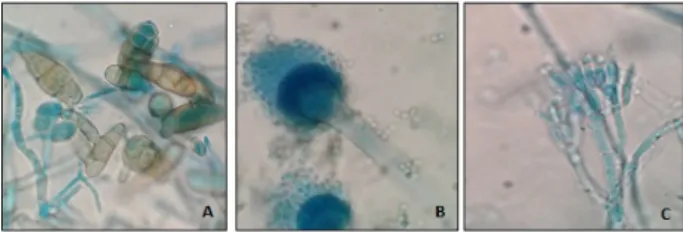
Generally, the most frequent fungi genera found in all samples were Alternaria sp., Aspergillus sp., Cladospo-rium sp., Penicillium sp., and yeasts (Figure 1). Aspergillus sp. and Penicillum sp. are found both in outdoor and in-door environments, where they are considered common fungi species [18]. Nevertheless, these genera also com-prise species that are important allergic agents with impli-cations in human respiratory health [5, 8].
Fig. 1. Most frequent genus detected. A) Alternaria sp.; B)
As-pergillussp.; C) Penicillium sp.
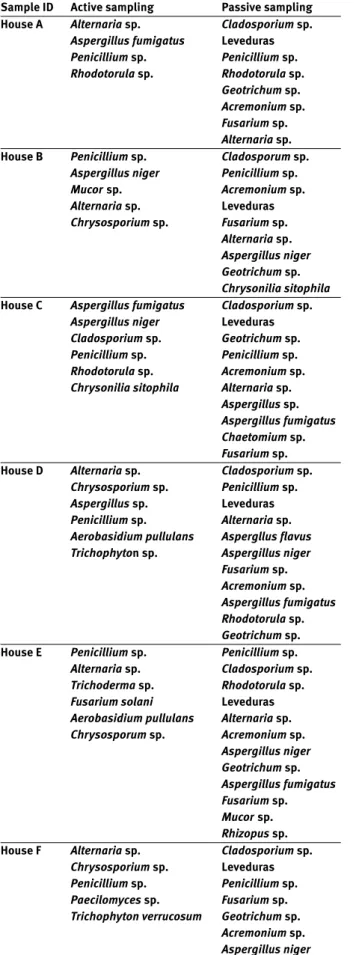
In a previous study conducted by our team in two Por-tuguese cities (Aveiro and Coimbra, n= 28), Aspergillus and Penicillium were also the most abundant genera found [11]. However, Alternaria sp., present in all the houses in the present study, was not detected in our previous study. Furthermore, when comparing samples obtained by ac-tive sampling in both studies, a higher diversity in the present study is evident. Such outcome is probably a con-sequence of an optimization of the protocol used in the current study, especially the aspect concerning dust sam-ples being processed immediately after collection (instead of being preserved at −20∘C). Regarding the taxon char-acterization, the passive sampling method proved to be more effective for the identification of fungi found in each
sample (Table 3). Such results are foremost a consequence of the lower counts of fungi obtained with this method, thus enabling a greater rate of success in obtaining iso-lated and identifiable colonies. Also, suspension proce-dures may lead to breakage of suspended fungal spores, preventing their growth. Furthermore, the low diversity of fungi found using the active method might be a conse-quence of the complex matrix that we are dealing with. Besides fungi this dust also includes a large variety of other biological and chemical contaminants, such metals, organometals, semi volatile organic compounds, includ-ing some antimicrobials, that may work as inhibitors and affect the viability of some fungal species.
The passive sampling technique using petri dishes provides a useful, simple and cost effective alternative for the fungal characterization of a particular set of the indoor environment and it should be considered in future moni-toring studies.
5 Conclusions and future
perspectives
House dust is a repository and concentrator of many con-taminants including biological ones such as fungi. The ob-tained results showed that house dust samples obob-tained through active sampling are very complex and should not be assessed by direct plating. Based on the results from the suspension and dilution methods we recommend the use of the dilution method. When aiming to analyse specific lo-cations inside a house, passive sampling using Petri dishes is a cost-effective and useful technique and should be used
Table 3. Identification of fungi found at each house using dust sam-ples from the vacuum cleaner bag (active sampling) and from the deposited dust on petri dishes (passive sampling).
Sample ID Active sampling Passive sampling
House A Alternaria sp. Aspergillus fumigatus Penicillium sp. Rhodotorula sp. Cladosporium sp. Leveduras Penicillium sp. Rhodotorula sp. Geotrichum sp. Acremonium sp. Fusarium sp. Alternaria sp. House B Penicillium sp. Aspergillus niger Mucor sp. Alternaria sp. Chrysosporium sp. Cladosporum sp. Penicillium sp. Acremonium sp. Leveduras Fusarium sp. Alternaria sp. Aspergillus niger Geotrichum sp. Chrysonilia sitophila
House C Aspergillus fumigatus Aspergillus niger Cladosporium sp. Penicillium sp. Rhodotorula sp. Chrysonilia sitophila Cladosporium sp. Leveduras Geotrichum sp. Penicillium sp. Acremonium sp. Alternaria sp. Aspergillus sp. Aspergillus fumigatus Chaetomium sp. Fusarium sp. House D Alternaria sp. Chrysosporium sp. Aspergillus sp. Penicillium sp. Aerobasidium pullulans Trichophyton sp. Cladosporium sp. Penicillium sp. Leveduras Alternaria sp. Aspergllus flavus Aspergillus niger Fusarium sp. Acremonium sp. Aspergillus fumigatus Rhodotorula sp. Geotrichum sp. House E Penicillium sp. Alternaria sp. Trichoderma sp. Fusarium solani Aerobasidium pullulans Chrysosporum sp. Penicillium sp. Cladosporium sp. Rhodotorula sp. Leveduras Alternaria sp. Acremonium sp. Aspergillus niger Geotrichum sp. Aspergillus fumigatus Fusarium sp. Mucor sp. Rhizopus sp. House F Alternaria sp. Chrysosporium sp. Penicillium sp. Paecilomyces sp. Trichophyton verrucosum Cladosporium sp. Leveduras Penicillium sp. Fusarium sp. Geotrichum sp. Acremonium sp.
as a complement to vacuum cleaner bags (that are able to integrate the dust borne fungi of the entire household).
A future sampling campaign will be performed in the studied houses during winter in order to evaluate the sea-sonal trends in dustborn fungi. Furthermore, the obtained results (in terms of species distribution and richness) will be correlated with the respiratory health of the partici-pants and a set of recommendations in order to reduce ex-posure will be prepared.
Acknowledgment: The authors wish to deeply
acknowl-edge all the volunteers’ that participated in this study. This work was supported by European Funds through COMPETE and by National Funds through the Por-tuguese Science Foundation (FCT) within project PEst-OE/SAU/UI0709/2014. Ana C. A. Sousa and Sónia D. Coelho acknowledge FCT for the grants SFRH/BPD/65884/2009 and SFRH/
BD/78168/2011 (supported by funding from the Hu-man Potential Operational Programme POPH, inscribed in the National Strategic Reference Framework and partially subsidized by the European Social Fund).
References
[1] WHO, WHO guidelines for indoor air quality?: Selected pollu-tants, World Health Organization Regional Oflce for Europe, 2010
[2] WHO, WHO guidelines for indoor air quality: dampness and mould, World Health Organization Regional Oflce for Europe, 2009
[3] Madigan M.T., Martinko J.M., Dunlap P.V., Clark D.P., Brock Biology of Microorganisms, 12th ed., Pearson Education, 2009 [4] Méheust D., Le Cann P., Reboux G., Millon L., Gangneux J-P.,
Indoor fungal contamination: health risks and measurement methods in hospitals, homes and workplaces,Crit Rev Micro-biol, 2014, 40, 248–260
[5] Araujo R., Cabral J.P., Fungal air quality in medical protected environments, In: Ashok Kumar (Ed), Air Qual, IntechOpen, 2010.
[6] Stetzenbach L.D., Buttner M.P., Cruz P., Detection and enu-meration of airborne biocontaminants, Curr Opin Biotechnol, 2004, 15, 170–174
[7] Nevalainen A., Täubel M., Hyvärinen A., Indoor fungi: compan-ions and contaminants, Indoor Air, 2015, 25, 125–156 [8] Rintala H., Pitkäranta M., Täubel M., Microbial communities
associated with house dust, in Laskin S.S. & Geoffrey M.G. (Eds) Adv Appl Microbiol, vol 78, Academic Press, 2012, 75-120 [9] Dallongeville A., Le Cann P., Zmirou-Navier D., Chevrier C.,
Costet N., Annesi-Maesano I., et al., Concentration and de-terminants of molds and allergens in indoor air and house dust of French dwellings, Sci Total Environ, (in press), DOI: 10.1016/j.scitotenv.2015.06.039
[10] Sousa A.C., Takahashi S., Tanabe S., Organic Contaminants in House Dust, Curr Org Chem, 2014, 18, 2181
[11] Sousa A.C., Almeida J.R.S.L., Pereira C.C., Ramiro Pastorinho M., Pereira Â.M.C., Nogueira A.J.A., et al., Characterization of fungal communities in house dust samples collected from cen-tral Portugal - A preliminary survey, J Toxicol Environ Health, 2014, 77, 972-982
[12] Coelho S.D., Sousa A.C.A., Isobe T., Tanabe S., Nogueira A.J.A., Flame Retardants in Indoor Dust - A Review on the Levels of Polybrominated Diphenyl Ethers and Hexabromocyclodode-canes, Curr Org Chem, 2014, 18, 2218-2230
[13] Verhoeff A.P., Hoekstra E.S., Samson R.A., Flannigan B., Flan-nigan M.E., Adan O.C.G., Fungal propagules in house dust. I. Comparison of analytic methods and their value as estimators of potential exposure, Allergy, 1994, 49, 533-539
[14] Fisher F., Cook N.B., Fundamentals of Diagnostic Mycology, Philadelphia (Pa): Saunders, 1998.
[15] Chao H.J., Milton D.K., Schwartz J., Burge H.A., Dustborne fungi in large oflce buildings, Mycopathologia, 2002, 154, 93-106
[16] Chew G.L., Rogers C., Burge H. A., Muilenberg M.L., Gold D.R., Dustborne and airborne fungal propagules represent a differ-ent spectrum of fungi with differing relations to home charac-teristics, Allergy, 2003, 58, 13-20
[17] Jovanovic S., Felder-Kennel A., Gabrio T., Kouros B., Link B., Maisner V., et al., Indoor fungi levels in homes of children with and without allergy history, Int J Hyg Environ Health, 2004, 207, 369-378
[18] Fairs A., Wardlaw A.J., Thompson Jr., Pashley C.H., Guidelines on Ambient Intramural Airborne Fungal Spores, J Investig Aller-gol Clin Immunol, 2010, 20, 490-498