2016/2017
Francisco Pereira Gonçalves
Acute and subacute functional
effects of relaxin-2 on human
mammary artery/
Efeitos funcionais agudos e
subagudos da relaxina-2 na artéria
mamária humana
Mestrado Integrado em Medicina
Área: Medicina básica (FOS 3.1)
Fisiologia
Tipologia: Dissertação
Trabalho efetuado sob a Orientação de:
Professor Doutor Paulo Castro Chaves
E sob a Coorientação de:
Professor Doutor Adelino Leite Moreira
Trabalho organizado de acordo com as normas da revista: Peptides
Efeitos funcionais agudos e subagudos da
relaxina-2 na artéria mamária humana
Projeto de Opção do 6º ano - DECLARAÇÃO DE INTEGRIDADE
Eu, Francisco Pereira Gonçalves, abaixo assinado, nº mecanográfico 201107394, estudante do 6º ano do Ciclo de Estudos Integrado em Medicina, na Faculdade de Medicina da Universidade do Porto, declaro ter atuado com absoluta integridade na elaboração deste projeto de opção.
Neste sentido, confirmo que NÃO incorri em plágio (ato pelo qual um indivíduo, mesmo por omissão, assume a autoria de um determinado trabalho intelectual, ou partes dele). Mais declaro que todas as frases que retirei de trabalhos anteriores pertencentes a outros autores, foram referenciadas, ou redigidas com novas palavras, tendo colocado, neste caso, a citação da fonte bibliográfica.
Faculdade de Medicina da Universidade do Porto, 09/03/2017
NOME
Francisco Pereira Gonçalves
NÚMERO DE ESTUDANTE DATA DE CONCLUSÃO
201107394 09-03-2017
DESIGNAÇÃO DA ÁREA DO PROJECTO
Medicina Básica (FOS 3.1) - Fisiologia
TÍTULO DISSERTAÇÃO
Acute and subacute functional effects of relaxin-2 on human mammary artery
ORIENTADOR
Paulo Castro Chaves
COORIENTADOR
Adelino Leite Moreira
ASSINALE APENAS UMA DAS OPÇÕES:
É AUTORIZADA A REPRODUÇÃO INTEGRAL DESTE TRABALHO APENAS PARA EFEITOS DE INVESTIGAÇÃO, MEDIANTE DECLARAÇÃO ESCRITA DO INTERESSADO, QUE A TAL SE COMPROMETE.
É AUTORIZADA A REPRODUÇÃO PARCIAL DESTE TRABALHO (INDICAR, CASO TAL SEJA NECESSÁRIO, Nº MÁXIMO DE PÁGINAS, ILUSTRAÇÕES, GRÁFICOS, ETC.) APENAS PARA EFEITOS DE INVESTIGAÇÃO, MEDIANTE DECLARAÇÃO ESCRITA DO INTERESSADO, QUE A TAL SE COMPROMETE.
DE ACORDO COM A LEGISLAÇÃO EM VIGOR, (INDICAR, CASO TAL SEJA NECESSÁRIO, Nº MÁXIMO DE PÁGINAS,
ILUSTRAÇÕES, GRÁFICOS, ETC.) NÃO É PERMITIDA A REPRODUÇÃO DE QUALQUER PARTE DESTE TRABALHO.
X
Faculdade de Medicina da Universidade do Porto, 09/03/2017 Assinatura conforme cartão de identificação:
Acute and subacute functional effects of
relaxin-2 on human mammary artery
Francisco Gonçalves
1,2, Rafael Martins,
1,2, Luís Mendonça
1,2, Tiago Laundos
Santos
3,4,
Mariana Pintalhão
1,2,5, Francisco Vasques Nóvoa
1,2,5, Mário Jorge
Amorim
6, Paulo Pinho
6, Diana Nascimento
3,4, Adelino Leite Moreira
1,2,6, Paulo
Castro Chaves
1,2,51 - Departamento de Cirurgia e Fisiologia, Universidade do Porto, Portugal. 2 - Unidade de Investigação Cardiovascular, Portugal.
3 - Instituto de Engenharia Biomédica (INEB), Universidade do Porto, Portugal.
4 - Instituto de Investigação e Inovação em Saúde (i3S), Universidade do Porto, Portugal. 5 - Internal Medicine Department, São João Hospital Centre, Porto, Portugal.
6 - Cardiothoracic Surgery Department, São João Hospital Centre, Porto, Portugal.
Endereço para correspondência:
Professor Doutor Paulo Castro-Chaves Departamento de Cirurgia e Fisiologia,
Faculdade de Medicina da Universidade do Porto
Alameda Professor Hernâni Monteiro; 4200-319 Porto, Portugal
ABSTRACT
Introduction: Despite classically associated with pregnancy, relaxin is a hormone with pleiotropic properties and an increasingly unveiled role in the pathophysiology of several cardiovascular diseases. Previous clinical trials have explored its therapeutic role on acute heart failure. However, the exact actions of relaxin on the human vascular territory are scarcely known.
Purposes: To study the acute and subacute functional effects of relaxin-2 on the vasoreactivity of the human mammary artery (HMA). To assess the expression of RXFP1, its main receptor, in this vascular territory.
Methods: HMA from 37 patients subjected to coronary artery bypass graft surgery (average age 69.3 years; 7 female) were sectioned into 2mm rings and mounted on a myograph (DMT myograph
system). On one protocol, the vessels were exposed to increasing concentrations of relaxin (10-10 -10-7M) or vehicle after pre-contraction with phenylephrine (10-5M), n=5. On a different protocol, the rings were treated for 24h with relaxin (10-7M) or vehicle and afterwards subjected to increasing concentrations of vasoconstrictors (10-9-10-5 M) - phenylephrine (n=8), endothelin-1 (n=6) and angiotensin II (n=11) – and of vasodilators (10-10-10-5 M) - acetylcholine (n=8) and sodium nitroprusside (n=11). Vessel rings were also incubated for 24h with relaxin or vehicle after endothelium removal, and their response to nitroprusside evaluated (10-10-10-5 M; n=7). Immunofluorescence labelling of RXFP1 was performed along with labelling for CD31 (endothelial cells) and α smooth muscle actin (smooth muscle cells). Functional responses are expressed as mean±standard error (%).
Results: After acute exposure to relaxin, no differences in the developed active tension were
observed between relaxin or vehicle treated groups. Following 24h treatment with relaxin or vehicle, vascular viability and the vasoconstrictor effects of phenylephrine, endothelin-1 and angiotensin II were similar between groups. However, vessel rings treated with relaxin showed higher relaxation when compared to vehicle treated rings, both in response to acetylcholine
(59.1±6.1% vs 46.2±6.2%; p<0.01) and nitroprusside (128.9±4.8% vs 118.7±5.1% p<0.05). The higher response to nitroprusside was preserved when treatment with relaxin followed endothelium removal (143.3±4.1% vs 132.8±3.3%; p<0.01). Immunofluorescence showed labelling for RXFP1 on smooth muscle and endothelial cells.
Conclusion: Treatment with relaxin-2 for 24h potentiates HMA vasodilatation without interfering
with the effects of several vasoconstrictors, and this effect is at least partially independent of the endothelium. We have also identified for the first time the presence of RXFP1 on the
endothelium and smooth muscle cells of HMA. Besides shedding further light on relaxin’s role on human vascular physiology, the present work may have implications in the understanding of HMA’s physiology, an important conduct for coronary revascularization procedures.
Acute and subacute functional effects of Francisco Gonçalves
relaxin-2 on human mammary artery March 2017
INTRODUCTION
Relaxin-2 is a peptide hormone initially described for its effects on the female reproductive tract during pregnancy, and is responsible as well for mediating the cardiovascular adaptations that occur during this period, inclusively through its actions on the systemic and renal vasculature. [1-3]
In the past two decades, growing evidence has attributed relaxin pleiotropic effects on the cardiovascular system. This hormone may play an import role on the pathophysiology of heart failure, hypertension and cardiac ischemic disease. [4-6] Effectively, several studies point towards compensatory production and release of relaxin by the myocardium during heart failure, and indeed plasmatic levels of relaxin correlate with clinical and echocardiographic parameters of right side heart overload. [7]
Additionally, relaxin has been evaluated as a possible therapeutic weapon in conditions such as heart failure, hypertension, pre-eclampsia and peripheral vascular disease. [2] The RELAX-AHF randomized clinical trial has demonstrated superiority of relaxin on dyspnoea relief and mortality reduction at 180 days in relation to placebo, in an acute heart failure setting. [8] In the context of cardiac ischemic disease, the demonstration of beneficial effects on the myocardial ischemia-reperfusion lesion both on a pig model subject to anterior descent artery occlusion [9] and on rat cardiomyocytes culture [10], may signal further therapeutic usefulness on coronary heart disease and acute myocardial infarction.
Laboratory studies on animal models attribute relaxin angiogenic, antioxidant, anti-inflammatory, antifibrotic and vasodilator actions [4, 5], that may constitute the basis of its cardioprotective potential. The vascular effects of relaxin, mediated by its main receptor, RXFP1, seem to occur through a rise in nitric oxide, with a probable involvement of metalloproteinases, ET-B receptor signalling, extracellular matrix modifications and possibly VEGF signalling. [11] However, the effects and mechanisms of action are markedly heterogenous between different vascular territories and studies in human are scarce. Indeed, several aspects of relaxin’s action on human vascular tissue await full characterization. [12]
Internal thoracic artery, or mammary artery (MA), is the preferred conduct for coronary artery bypass graft (CABG) surgery [13, 14], and is characterized by its relative resistance to atherosclerosis and endothelial dysfunction. [15, 16] These characteristics together with its clinical relevance justify the pertinence of further unravelling the factors that modulate its vasoreactivity. The present work aims to contribute for the enlightenment of relaxin’s role in human vascular physiology, with the main goals of characterizing its acute and subacute effects on MA vasoreactivity, the relevance of several clinical characteristics for the said effects and lastly to assess the presence of RXFP1, relaxin’s main receptor, in this vascular territory.
METHODS Sample collection and dissection of vascular rings
Spare MA segments were collected by the Cardiothoracic Surgery Team during 37 CABG procedures. Following collection, the segments were transported to the laboratory within 15 minutes in a physiological Krebs solution (T: 4ºC), with the following composition (mM): 130 NaCl; 4.7 KCl; 14.9 NaHCO3; 1.18 KH2PO4; 5.5 glucose; 1.17 MgSO4·7H2O e 1.6 CaCl2·2H2O. In the laboratory the adjacent connective tissue was removed and the vessel was sectioned into rings with 2 mm of length each. The patients included in the study were characterized in terms of demographic characteristics, past medical history and medication prescribed. The project was approved by the local Ethical Committee. The vascular rings obtained were used for both the functional and immunofluorescence protocols described below.
Functional Protocols
Experimental Preparation
Each functional protocol proceeded using 4 vascular rings obtained from a single patient. The rings were horizontally mounted in a myograph (Multi Wire Myograph System Model 620M -
DMT®) in Krebs solution (32ºC, pH 7.40), bubbling with a gaseous mixture (95% O2; 5% CO2). After normalization to an effective transmural pressure of 100 mmHg, per a previously described protocol [17], the rings stabilized during 60 min. Following this period, the vessel viability was assessed through inciting the maximum contractile response to KCl (0,1M). After washing and new stabilization for 30 min, the response to several vasoactive peptides was determined for each ring. Data was continuously acquired and digitally stored (PowerLab 4/30 ADInstruments). The following parameters were recorded: dimensions (segment and rings lengths and internal circumference, in μm), tension (T, mN/mm) and effective transmural pressure (ERTP, kPa).
1- Influence of the acute treatment with relaxin on MA’s vasoreactivity
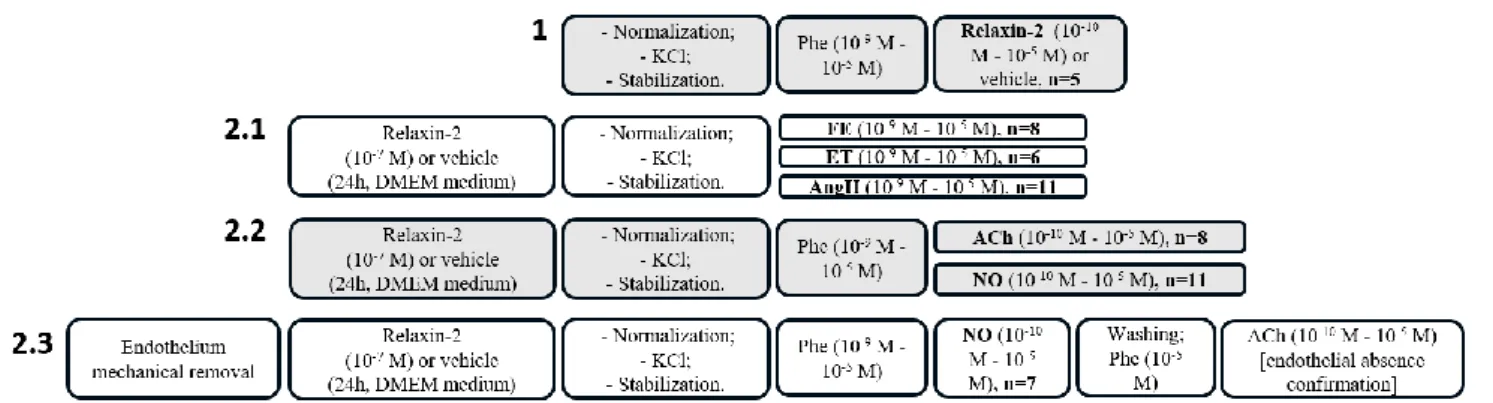
To study the immediate action of relaxin on MA, the rings obtained from the MA of 5 different patients were pre-contracted with phenylephrine (10-5M) and exposed to increasing concentrations (10-10 -10-7M) of relaxin-2 (SRP3147, Sigma-Aldrich®) or vehicle. (Figure 1 - 1)
2 – Influence of the subacute treatment with relaxin on MA’s vasoreactivity
For this subset of protocols, which aimed to assess the influence of the preceding treatment with relaxin on MA’s response to several vasoactive peptides, the vascular rings obtained from 30 different patients were randomized to incubation for 24 hours with relaxin (10 -7M) or vehicle in DMEM culture medium (37ºC; 5% CO2), preceding its assembly in the myograph. Following the normalization and contraction in response to KCl, described above, the rings were
Acute and subacute functional effects of Francisco Gonçalves
relaxin-2 on human mammary artery March 2017
subjected to the action of several vasoconstrictors (phenylephrine hydrochloride, endhotelin-1, human angiotensin II) or vasodilators (acetylcholine chloride, sodium nitroprusside). All the reagents were acquired from Sigma-Aldrich®.
Figure 1 – Study design: 1 – Influence of the acute treatment with relaxin on mammary artery’s (MA’s) vasoreactivity; 2 – Influence of the subacute treatment with relaxin on MA’s vasoreactivity, 2.1 vasoconstrictor response, 2.2 – vasodilator response, 2.3 – vasodilator response, in the absence of endothelium; Phe – phenylephrine, ET – endothelin-1, Ang II – angiotensin II, NO – nitroprusside, Ach – acetylcholine.
2.1 vasoconstrictor response
In these protocols, the vascular rings were subjected to increasing concentrations (109 -10-5 M) of phenylephrine (n=8 patients), endothelin-1 (n=6) or angiotensin II (n=11). (Figure
1 - 2.1)
2.2 – vasodilator response
In these protocols, the vascular rings were subjected to a pre-contraction with phenylephrine (10-9M - 10-5M) and then to increasing concentrations (10-10-10-5 M) of acetylcholine (n=8 patients) or sodium nitroprusside (n=11). (Figure 1 – 2.2).
2.3 – vasodilator response in the absence of endothelium
The vascular rings obtained from 7 different patients were subjected to mechanical endothelium removal using a silk suture wire (2.0), before proceeding to incubation with relaxin of vehicle as previously described. Vasocontraction was elicited using phenylephrine (10-9M - 10-5M) and followed by addition of increasing concentrations of nitroprusside (10 -10-10-5 M). Subsequently, a dose-response curve for acetylcholine (10-10-10-5 M) following contraction with phenylephrine (10-5M) was determined in order to confirm the absence of endothelium, as previously described. [17, 18] (Figure 1 – 2.3)
Immunofluorescence protocols
Vascular rings (see “Sample collection and dissection of vascular rings” above) were fixed overnight in 10% neutral buffered formalin and embedded in paraffin. Histological 3 μm sections were rehydrated and subjected to an antigen retrieval protocol with Tris/EDTA (pH=9.0; 96ºC; 35 min) and to treatment with Sudan Black B (0.5% (m/V) in ethanol 70%(V/V); room temperature; 5 min). Lastly, the sections were submitted to permeabilization with Triton X-100 (0.2%; room temperature; 5 min).
RXFP1 location
Two MA rings from different patients were used for identification of RXFP1. Following treatment described above, the sections were incubated overnight with a primary antibody for the RXFP1 receptor (1:200; HPA027067, rabbit polyclonal; Sigma-Aldrich), primary antibody for CD31 (1:250; SC-1506, goat polyclonal, Santa Cruz Biotechnology) and primary antibody for smooth muscle actin (1:400; A5228, mouse monoclonal, Sigma-Aldrich), at 4º C. Following washing, they were incubated with the corresponding secondary antibodies for 1 hour (A31573 donkey anti-rabbit; A21202 donkey anti-mouse; A11057 donkey anti-goat, respectively) and incubated in a 4’,6-diamidino-2-phenylindole medium (DAPI) prior to cover slip placement. The specificity of the immunostaining was assessed by omission of the primary antibodies. The images were obtained with wide-field microscopy (DMI6000B Microscope; Leica, Heidelberg, Germany), with a 63x amplification (1.3 NA).
Endothelium removal confirmation
Two out of all the rings subjected to mechanical endothelium removal were randomly selected for an immunofluorescence protocol. This protocol followed the steps described previously, but was performed with only the primary antibodies for CD31 and sma. Two rings not subjected to endothelium removal were used as positive controls.
Statistical analysis
The tensions achieved with vasoconstriction in response to KCl were expressed in Active Tension (AT, mN/mm). For all other vasoconstrictor responses, the instantaneous active tension was expressed as the percentage of the response to KCl (AT vasoconstrictor/KCl, %). For the vasodilator responses, the instantaneous active response was expressed as the percentage of the active tension generated in response to phenylephrine (AT vasodilator/PheMax, %). The results are presented as mean±standard error. Two-way repeated measures ANOVA was used for the comparison between the tension developed in the relaxin treated group and the vehicle treated one. P<0,05 was considered statistically significant.
Acute and subacute functional effects of Francisco Gonçalves
relaxin-2 on human mammary artery March 2017
RESULTS Functional protocols
Population characterization
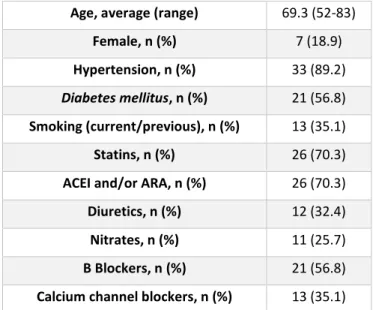
MA segments from 37 CABG were used. The demographic characteristics and relevant clinical data for these patients are presented in Table 1. The average age was 69.3 years (from 52 to 83 years old) and 7 patients were female (18.9%). No influence of any of these variables, including gender, was observed on the effect of relaxin on human MA.
Table 1 – Characterization of the population (ACEI: angiotensin converting enzyme inhibitors; ARA: angiotensin AT1 receptor antagonists)
1 - Influence of the acute treatment with relaxin on MA’s vasoreactivity
As Figure 2 represents, increasing concentrations (10-10-10-7M) of relaxin did not have an acute vasodilatory effect on MA pre-contracted with phenylephrine, and the AT was similar between the relaxin and vehicle-treated groups.
Age, average (range) 69.3 (52-83) Female, n (%) 7 (18.9) Hypertension, n (%) 33 (89.2)
Diabetes mellitus, n (%) 21 (56.8)
Smoking (current/previous), n (%) 13 (35.1) Statins, n (%) 26 (70.3) ACEI and/or ARA, n (%) 26 (70.3) Diuretics, n (%) 12 (32.4) Nitrates, n (%) 11 (25.7) Β Blockers, n (%) 21 (56.8) Calcium channel blockers, n (%) 13 (35.1)
Figure 2 – Evaluation of the influence of the acute treatment with relaxin-2 (10-10 M a 10-5 M)
or vehicle in MA pre-contracted with phenylephrine (10-9 - 10-5 M), n=5; AT – active
tension: percentage (%) of the response to 0,1 M KCl, expressed as average ± standard error.
2 – Influence of the subacute treatment with relaxin on MA’s vasoreactivity
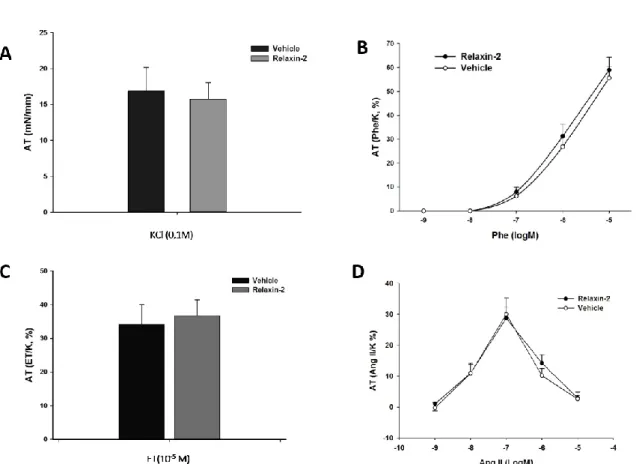
Globally, the AT (mN/mm) generated in response to KCl (0,1M) was similar for the vessels in the relaxin or vehicle-treated groups (15.75±2.32 mN vs 16.85±3.33 mN, respectively; n=32), reflecting comparable vascular viability between groups (Figure 3 – A).
2.1 vasoconstrictor response
No differences between the active tension developed by relaxin or vehicle treated groups was found for any of the studied vasoconstrictors. The average AT generated in response to the maximum concentration of phenylephrine (10-5 M; n=8; Figure 3- B) was 59.0± 5.4% for the relaxin treated rings and 55.6±4,9% for vehicle treated group. Only the maximum used concentration of endothelin generated vasoconstriction (10-5 M; n=6; Figure 3 - C), corresponding to an AT for the relaxin treated rings of 36.8±4.7% and for the vehicle treated rings of 34.2±5.8%. The dose-response curves for the relaxin or vehicle treated groups were similar, with no significantly different AT values for any of the used concentrations (Figure
Acute and subacute functional effects of Francisco Gonçalves
relaxin-2 on human mammary artery March 2017
Figure 3 – Vasoconstrictor response after incubation for 24h with either relaxin-2 (10-7 M) or vehicle; AT
(active tension - average ± standard error) expressed as mN/mm (graphic A) or as percentage (%) of the response to 0,1 M KCl (graphics B, C and D); A – Response to 0,1M KCl, n=19; B – Response to phenylephrine (Phe - 10-9 - 10-5 M), n=8; C – Response to endothelin-1 (ET - 10-5 M), n=6; D – Response to angiotensin II
(AngII - 10-9 - 10-5 M), n=11.
2.2 – vasodilator response
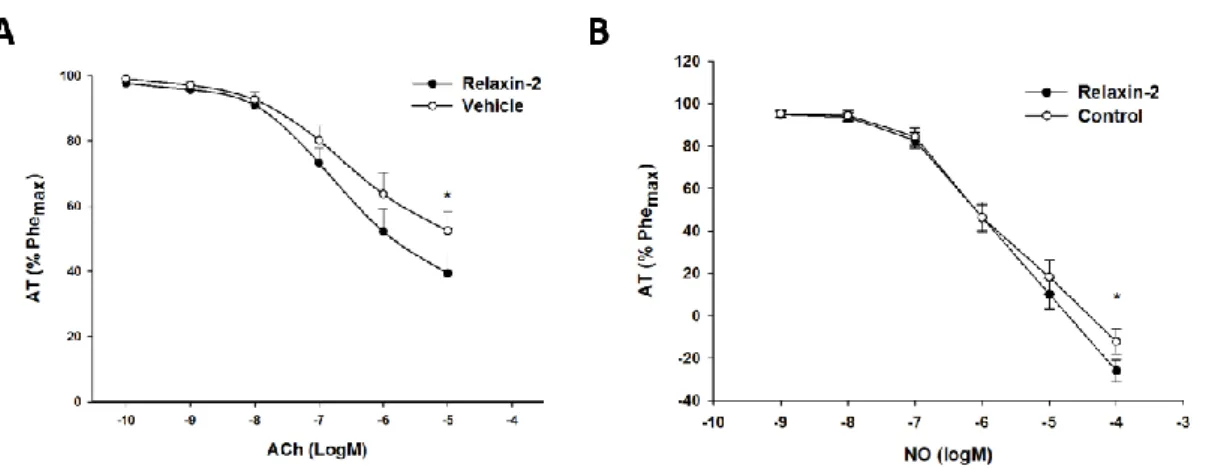
The relaxin pre-treated vascular rings showed a superior vasodilatory response to acetylcholine when compared with the vehicle treated group. Effectively, when the rings were incubated with relaxin, the total AT decrease following exposure to the maximum dose of acetylcholine (10-5 M) was 59.1±6.1%, compared to 46.2±6.2% for the rings incubated with vehicle (p<0.01; Figure 4 - A). Similarly, the vasodilator response to nitroprusside was higher in the relaxin treated rings, with a total AT decrease of 128.9±4.8% after addition of the highest dose of nitroprusside (10-5M), compared to only 118.7±5.1% for the vehicle treated rings (p<0.05; Figure 4 - B).
Figure 4 – Vasodilator response after incubation for 24h with either relaxin-2 (10-7 M) or vehicle; AT (active
tension - average ± standard error) expressed as percentage (%) of the response to phenylephrine (10-5 M);
A – Response to acetylcholine (Ach - 10-10 M - 10-5 M), n=8; B – Response to nitroprusside (NO - 10-10 M - 10 -5 M), n=11; * p<0.05, vs vehicle.
2.3 – vasodilator response in the absence of endothelium
Vasodilator response to concentrations of 10-7 M, 10-6 M and 10-5 M of nitroprusside was higher after incubation with relaxin with prior endothelium removal, when compared to vehicle. For the maximum concentration of nitroprusside, the total decrease in AT for the relaxin treated rings was 143.3±4.1%, with a decrease of only 132.8±3.3% by the vehicle treated rings (p<0.01; Figure 5).
Figure 5 - Vasodilator response to nitroprusside (NO - 10-10 M - 10-5 M), n=7, after endothelium removal
followed by incubation for 24h with either relaxin-2 (10-7 M) or vehicle; AT (active tension - average ±
Acute and subacute functional effects of Francisco Gonçalves
relaxin-2 on human mammary artery March 2017
Immunofluorescence protocols
Endothelium removal confirmation
The rings not subjected to endothelium removal (positive controls) showed immunostaining for CD31, reflecting the presence of endothelial cells. The rings subjected to endothelium removal showed no labelling for CD31 (Figure 6).
Figure 6 - Endothelium removal confirmation; A – positive control ring with endothelial cells labelled by CD31 (arrows); B –AM ring after mechanical endothelium removal (no labelling for CD31).
RXFP1 location
The immunofluorescence protocol showed specific labelling for RXFP1 in the AM of 2 patients and demonstrated its colocalization with CD31 and sma, supporting its expression by both human MA endothelial and smooth muscle cells (Figure 7).
Figure 7 - RXFP1 location on MA; A - immunostaining for RXFP1 superimposed with labelling for endothelial cells (CD31) and smooth muscle cells (alpha smooth muscle actin – α-sma); B – nuclear labelling (DAPI); C – Labelling for RXFP1; D – Labelling for α-sma; E – Labelling for CD31.
DISCUSSION AND CONCLUSION
This study constitutes the first description of relaxin’s functional effects on the human MA, a crucial vascular territory for the surgical approach to ischemic cardiomyopathy. In the present work, MA’s response to relaxin was assessed in two different settings. In the first protocol, we showed that relaxin was not able to induce, per se, a vasodilatory response by MA in the in vitro conditions described. However, in the second set of protocols, we observed that previous incubation for 24h with relaxin potentiated MA’s vasodilation in response both to acetylcholine, which effects are mediated by the endothelium, and to nitroprusside, which has a direct effect on the smooth muscle, without an apparent concomitant increase in the vasoconstrictor response to either phenylephrine, endothelin-1 or angiotensin II. In this study we also describe, for the first time, RXFP1’s expression on the endothelial and smooth muscle cells of this artery.
RXFP1, the human relaxin-2 receptor, is distributed in a similar way to its ligand, compatible with a predominantly paracrine or autocrine actions of relaxin [11] and with the usually low or even undetectable relaxin plasmatic levels in healthy individuals. In rat, this receptor is distributed in a heterogenous way between the smooth muscle cells and the endothelial cells accordingly to the vascular territory considered: it is mainly localized in the smooth muscle cells in femoral artery and vein and pulmonary arterioles and mainly in endothelial cells in aorta, cava vein and mesenteric artery and veins. [19] The expression of RXFP1’s mRNA was identified in subcutaneous human arteries [12] and in several human vascular cells, namely human umbilical artery and vein endothelial and smooth muscle cells, even though the protein was not expressed in the membrane of umbilical artery endothelial cells. [20] RXFP1 probably mediates the clear majority of relaxin’s vasodilatory actions [11] and this study demonstrates its unequivocal expression on the endothelial and smooth muscle layers, both of which are thus putative targets for relaxin.
Currently, information is lacking regarding relaxin’s action and respective mechanisms of signalling on human tissues with cardiovascular significance that endogenously express RXFP1. Despite this, the acute modulation of the vascular function by relaxin is already described in vivo in the human. In the clinical trial RELAX-AHF the group of patients treated with an intravenous infusion of relaxin showed a higher decrease of the systolic arterial pressure [8] and a previous clinical trial revealed hemodynamic changes mostly within 30 minutes of infusion of relaxin in patients with acute heart failure, namely reduction of the pulmonary capillary wedge pressure and pulmonary artery pressure, accompanied by a mild decrease of the systolic and diastolic arterial
Acute and subacute functional effects of Francisco Gonçalves
relaxin-2 on human mammary artery March 2017
pressures. [21] Studies in animal models and isolated arteries have demonstrated the specificity of relaxin’s acute vasodilator effect depending on the vascular territory considered. In human, the subcutaneous [12] and gluteal arteries showed vasodilation dependent on endothelium [22] in response to relaxin, but this effect was absent in myometrial and uteroplacentary arteries [23] and in resistance pulmonary arteries. [22] Our results have showed that relaxin does not constitute a potent acute vasodilator in the specific case of human MA. These findings additionally support the existence of local systems responsible for the action of this peptide, which might explain the variability of the short-term effects of relaxin in different settings.
Pharmacotherapy seems to be able to influence the acute response to relaxin, as evidenced by the attenuation of the vasodilation in response to relaxin in patients medicated with ACEIs (angiotensin-converting-enzyme inhibitors), which was further exacerbated when the patients were also on indomethacin. [22] Our population, in accordance to the usual characteristics of patients subjected to CABG, is prominently elderly, polymedicated and with several comorbidities. Effectively, a large proportion of patients was on ACEIs and/or ARAs (angiotensin II receptor antagonists) (70,3%) and the study characteristics does not allow us to exclude a possible interference of these drugs on the acute effect of relaxin. The expansion of the in vitro studies with human arteries and veins aiming to explore possible interactions will further clarify the relevance of concomitant presence of pharmacologic substances on the vascular effects of relaxin.
Alongside the acute effects, relaxin seems able to induce sustained vasodilation in human [8, 21], compatible with the modulation of MA’s vascular function by a 24h incubation with relaxin that we observed. This prolonged effect may be partially explained by the apparent absence of classical regulation of RXFP1, which is not subjected to phosphorylation, desensitization or internalization with exposure to high relaxin concentrations [24]. The downstream signalling also seems to be different depending with the exposure duration. Relaxin activates metalloproteinases (MMPs) with the ability to induce endothelin-1 functional antagonism through an increase in endothelial ET-B signalling, with the MMP-9 being most relevant in an acute setting and MMP-2 when the exposure is prolonged several days [25, 26]. In a prolonged exposure setting the vascular remodelling promoted by relaxin has an essential role, despite occurring only in certain vascular territories, in rat and mice [19, 27, 28]. Relaxin’s subacute and chronic vasodilatory effects seem to indeed rely on mechanisms distinct from those responsible for their acute effects and to vary depending on the specific vessel considered.
Studies in human tissues that corroborate the mechanisms that, in animal models and cell culture, are responsible for the non-acute effects of relaxin are scarce. The study of the mechanisms behind the chronic vascular actions of relaxin in humans bears intrinsic problems. We focused on the subacute effects of relaxin on a human vascular territory selected for its clinical relevance. It is important to note that endothelium removal did not abolish the influence of the treatment with relaxin on MA, which corroborates in an original way the presence of endothelium-independent mechanisms as part of relaxin’s action on MA. Effectively, despite most experimental evidence both in human and in animal models pointing towards endothelium-dependent relaxin vascular effects, most of these studies are specifically analysing relaxin’s role in an acute setting.
Furthermore, our study reveals no influence on vasoconstriction in response to phenylephrine, endothelin-1 and angiotensin II by previous incubation with relaxin, going against studies in rat, in which infusion of relaxin throughout 6h promoted a diminished response of mesenteric and aorta arteries to endothelin-1 [29] and in vivo antagonism of angiotensin II effects on peripheral vascular resistance [30], justifying the importance of further characterizating the vascular structural and molecular changes induced by relaxin in a context of subacute exposure.
In conclusion, the present study demonstrates that previous exposure to relaxin is able to modulate, at least partially through endothelium independent mechanisms, MA’s vasoreactivity, potentiating its vasodilation with no concomitant effects on vasoconstriction. This allows us to state that relaxin has an interesting profile of functional effects on human mammary artery, the preferred conduct for myocardial revascularization.
Acute and subacute functional effects of Francisco Gonçalves
relaxin-2 on human mammary artery March 2017
REFERENCES
1. Leo, C.H., et al., Vascular actions of relaxin: nitric oxide and beyond. Br J Pharmacol, 2016. 2. Raleigh, J.M., et al., Relaxin' the Heart: A Novel Therapeutic Modality. J Cardiovasc
Pharmacol Ther, 2016. 21(4): p. 353-62.
3. Cernaro, V., et al., Relaxin: new pathophysiological aspects and pharmacological
perspectives for an old protein. Med Res Rev, 2014. 34(1): p. 77-105.
4. Sarwar, M., et al., The actions of relaxin on the human cardiovascular system. Br J Pharmacol, 2016.
5. Du, X.J., et al., Cardiovascular effects of relaxin: from basic science to clinical therapy. Nat Rev Cardiol, 2010. 7(1): p. 48-58.
6. Conrad, K.P. and S.G. Shroff, Effects of relaxin on arterial dilation, remodeling, and
mechanical properties. Curr Hypertens Rep, 2011. 13(6): p. 409-20.
7. Pintalhao, M., et al., Relaxin serum levels in acute heart failure are associated with
pulmonary hypertension and right heart overload. Eur J Heart Fail, 2016.
8. Teerlink, J.R., et al., Serelaxin, recombinant human relaxin-2, for treatment of acute heart
failure (RELAX-AHF): a randomised, placebo-controlled trial. The Lancet, 2013. 381(9860):
p. 29-39.
9. Perna AM, M.E., et al., Novel drug development opportunity for relaxin in acute myocardial
infarction: evidences from a swine model. FASEB J, 2005. 19(11): p. 1525-7.
10. Boccalini, G., et al., Relaxin protects cardiac muscle cells from hypoxia/reoxygenation
injury: involvement of the Notch-1 pathway. FASEB J, 2015. 29(1): p. 239-49.
11. Bathgate, R.A., et al., Relaxin family peptides and their receptors. Physiol Rev, 2013. 93(1): p. 405-80.
12. McGuane, J.T., et al., Relaxin induces rapid dilation of rodent small renal and human
subcutaneous arteries via PI3 kinase and nitric oxide. Endocrinology, 2011. 152(7): p.
2786-96.
13. Umakanthan, J., et al., Barriers to the universal adoption of bilateral internal mammary
artery grafting. Int J Surg, 2015. 16(Pt B): p. 179-82.
14. Papakonstantinou, N.A. and N.G. Baikoussis, Total arterial revascularization: A superior
method of cardiac revascularization. Hellenic J Cardiol, 2016. 57(3): p. 152-156.
15. Grapow, M.T., et al., Human internal thoracic arteries from diabetic patients are resistant
to endothelial dysfunction. Fundam Clin Pharmacol, 2009. 23(5): p. 567-72.
16. Fonseca, D.A., P.E. Antunes, and M.D. Cotrim, Endothelium-dependent vasoactivity of the
human internal mammary artery. Coron Artery Dis, 2014. 25(3): p. 266-74.
17. Mendonca, L., et al., Angiotensin-(1-7) modulates angiotensin II-induced vasoconstriction
18. Yu, J., et al., Dexmedetomidine-Induced Contraction in the Isolated Endothelium-Denuded
Rat Aorta Involves PKC-delta-mediated JNK Phosphorylation. Int J Med Sci, 2015. 12(9): p.
727-36.
19. Jelinic, M., et al., Localization of relaxin receptors in arteries and veins, and region-specific
increases in compliance and bradykinin-mediated relaxation after in vivo serelaxin treatment. Faseb j, 2014. 28(1): p. 275-87.
20. Sarwar, M., et al., Serelaxin-mediated signal transduction in human vascular cells:
bell-shaped concentration-response curves reflect differential coupling to G proteins. Br J
Pharmacol, 2015. 172(4): p. 1005-19.
21. Ponikowski, P., A randomized, double-blind, placebo-controlled, multicentre study to
assess haemodynamic effects of serelaxin in patients with acute heart failure. Eur J Heart
Fail, 2014. 35.
22. Fisher, C., et al., Is the pregnancy hormone relaxin also a vasodilator peptide secreted by
the heart? Circulation, 2002. 106(3): p. 292-5.
23. Petersen, L.K., et al., Effects of human relaxin on isolated rat and human myometrium and
uteroplacental arteries. Obstet Gynecol, 1991. 78(5 Pt 1): p. 757-62.
24. Callander, G.E., W.G. Thomas, and R.A. Bathgate, Prolonged RXFP1 and RXFP2 signaling
can be explained by poor internalization and a lack of beta-arrestin recruitment. Am J
Physiol Cell Physiol, 2009. 296(5): p. C1058-66.
25. Jeyabalan, A., et al., Matrix metalloproteinase-2 activity, protein, mRNA, and tissue
inhibitors in small arteries from pregnant and relaxin-treated nonpregnant rats. J Appl
Physiol (1985), 2006. 100(6): p. 1955-63.
26. Jeyabalan, A., et al., Vascular matrix metalloproteinase-9 mediates the inhibition of
myogenic reactivity in small arteries isolated from rats after short-term administration of relaxin. Endocrinology, 2007. 148(1): p. 189-97.
27. Debrah, D.O., et al., Relaxin regulates vascular wall remodeling and passive mechanical
properties in mice. J Appl Physiol (1985), 2011. 111(1): p. 260-71.
28. Xu, Q., et al., Relaxin therapy reverses large artery remodeling and improves arterial
compliance in senescent spontaneously hypertensive rats. Hypertension, 2010. 55(5): p.
1260-6.
29. Dschietzig, T., et al., Relaxin, a pregnancy hormone, is a functional endothelin-1 antagonist:
attenuation of endothelin-1-mediated vasoconstriction by stimulation of endothelin type-B receptor expression via ERK-1/2 and nuclear factor-kappatype-B. Circ Res, 2003. 92(1): p.
32-40.
30. Debrah, D.O., et al., Relaxin increases cardiac output and reduces systemic arterial load in
Acute and subacute functional effects of Francisco Gonçalves
relaxin-2 on human mammary artery March 2017
ABSTRACT
Normas da revista selecionada