Universidade do Minho
Escola de Engenharia
Adão Carlos Fernandes Rodrigues
Analysis Of User Profile In Social
Networks
Universidade do Minho
Escola de Engenharia
Adão Carlos Fernandes Rodrigues
Analysis Of User Profile In Social
Networks
Dissertação de Mestrado
Área de Especialização Engenharia Informática
Trabalho efectuado sob a orientação do
Professor Doutor José Carlos Maia Neves
“Knowledge Discovery is the nontrivial extraction of implicit, previously unknown, and potentially useful information from data.”
Acknowledgements
First is a sincere gratitude to my adviser Professor Jose Carlos Maia Neves, who led and helped with her vast knowledge in the area, which made possible the success of the project. Likewise a thank you to my co-supervisor Professor Paulo Novais who helped me actively and intensively throughout the period of development of the dissertation.
I must thank the company that gave support and without it nothing would be pos-sible, Brandit Portugal - Integrated Marketing Solutions and Communications, provided all infrastructure as well as full support for any problem that arose in development.
I also want to thank my family and friends who always encouraged me and motivated in the most difficult times. Thanks also to my friend in particular Joana Festa, who through their opinion, criticism and suggestions along this route, influenced this project.
Thank you all
Contents
Acknowledgements iv
List of Figures viii
Abbreviations x 1 Introduction 1 1.1 Objective . . . 4 1.2 Research Methodology . . . 6 1.3 Structure . . . 6 1.4 Privacy Policy. . . 7 2 User Profiling 8 2.1 Information Filtering . . . 11 2.2 Information Retrieval . . . 12 2.3 Keywords Profiles. . . 13
2.4 Semantic Network Profiles . . . 14
2.5 Concept Profiles . . . 15 2.6 User Representations . . . 16 2.7 User Construction . . . 18 3 Intelligent Techniques 19 3.1 Bayesian Networks . . . 20 3.2 Decision Trees. . . 22 3.3 Case-Based Reasoning . . . 24 3.4 Association Rules . . . 26 3.5 Neural Networks . . . 27
3.6 K-Nearest Neighbor algorithm. . . 28
3.7 Comparasion . . . 29
3.7.1 User Classification and User Profile Building . . . 29
3.7.2 Based on Learning and Based on Statistics . . . 29
3.7.3 Learn from Single Users and Learn from All Users . . . 30
3.7.4 Differences between bayesian networks, decision trees and associ-ation rules. . . 30
3.7.5 Comparing some Random Forest Decision Tree implementations . 31
4 Related Work 34
Contents vii
4.1 Analysis of User Keyword Similarity in Online Social Networks . . . 35
4.2 Intelligent User Profiling . . . 36
4.3 Inter-Profile Similarity (IPS): A Method For Semantic Analysis Of Online Social Networks . . . 37
4.4 You Are Who You Know: Inferring User Profiles In Online Social Networks 38
4.5 Not Every Friend On A Social Network Can Be Trusted: Classifying Imposters Using Decision Trees . . . 39
4.6 ISLab Project . . . 40
5 Implementation 41
6 Testing and Evaluation 51
List of Figures
1.1 JSON Example . . . 3
1.2 List Of Categories . . . 3
2.1 Weight Keyword-Based . . . 14
2.2 Concept Hierarchies . . . 16
2.3 User Profiling Process . . . 17
3.1 Case-Based Reasoning Cycle . . . 25
3.2 Comparison Between Intelligent Techniques . . . 29
3.3 Benchmark between WiseRFTM and scikit-learn. . . 32
3.4 Benchmark between WiseRFTM and other implementations . . . 33
5.1 Getting Authorization And User Information . . . 41
5.2 Users’ Trainning . . . 42
5.3 Request Detail Information . . . 43
5.4 Distribution Of Facebook Categories . . . 44
5.5 Getting Detail Information And User Features . . . 45
5.6 WiseRFTM Implementation . . . 47
5.7 Features And Ground Truth . . . 48
5.8 All Process . . . 50
6.1 Estimator results before boosting . . . 52
6.2 Categories results before boosting . . . 53
6.3 Estimator results after boosting . . . 54
6.4 Categories results after boosting . . . 55
Abbreviations
SNS Social Network Sites BN Bayesian Networks CBR Case-Based Reasoning AR Association Rules NN Neural Networks K-NN K-Nearest Neighbor IPS Inter-Profile Similarity ML Machine Learning
Chapter 1
Introduction
The Internet is part of every peoples life when worldwide population is taken into account. With the dependency that was created around this, new forms of communi-cation have been created, where social networks sites (SNS) are also included. This structure exists since long before the thought of what Internet could be, appearing as a group of people who relate to each other. With the emergence of SNS, this concept remained, but the way people communicate and interact has changed. Nowadays there are numerous SNS that provide different types of services and diversified content where we can share information and interact with everyone.
Popular SNS such as MySpace and Facebook provide communication, storage and applications for hundreds of millions of users. Users join, establish links to friends, and leverage their links to share content, organize events, and search for specific users or shared resources. Provide platforms for organizing events, user-to-user communication, and are among the Internets most popular destinations [Wilson et al., 2009]. With different purposes, there are YouTube and Flickr that allow sharing videos and photos on the Internet, respectively. Also referred as a micro-blogging service, twitter are text-based posts of up to 140 characters displayed on the author’s profile page and delivered to other users, known as followers. This service consists to send and read each others texts.
Today, SNS have been the subjects of several studies with the purpose of studying users interactions and behavior. To quantify the impact of the observations and to in-crease significantly the accuracy of the users’ characterization, a great amount of data
Chapter 1. Introduction 2
has been collected in the context of many different studies. These studies are distin-guished by the different approaches each follows, according to their expected results or aspect under analysis. There is a number of different Artificial Intelligence techniques that have been applied to these research area, such like Ad Hoc, Neural networks or Genetic Algorithm, Case-Based Reasoning, Decision Tree, Bayesian Networks and As-sociation Rules. According to these studies, there is a need to find the best approach to follow, based on the profile structure, and get the most relevant information. Having this, a strong base of information is required to that it take effect immediately in the nearby future.
This work intends to create/identify user profiles through their actions on SNS. This identification aims to determine, in a specific way, which profile each user has, linking between some dimensions and their sets of variables: sociodemographic characteristics (gender, age, education) the specific type of practices conducted over the Internet (study, work, services, search for information, communication and entertainment), the context of use of SNS (home, school, workplace or other). In the scope of this master thesis, the study will be conducted on Facebook, the most popular SNS in the world, as it features a vast collection of data.
After a careful analysis, we are able to separate different types of users based on the association of their sets of variables. This analysis also deepens the knowledge about the various uses of SNS, and may also be useful to the market in that it provides substantive information concerning the forms of articulation between the social characteristics of users and their activities, schemes and contexts of use.
An overview to Facebook
Facebook was founded in February 2004 and nowadays have more than 425 million active users access Facebook through mobile devices across 200 mobile operators in 60 countries [Protalinski,2012]. This SNS let users use the site to interact with people they already know or to meet new people. Before this kind of interactions, users need to create a profile with personal information that will identify them on the social network. After this step, they can accumulate ’friends’ who can post comments on each others pages, and view each others profiles. Facebook members can also join virtual groups based on common interests, see what classes they have in common, and learn each others hobbies, interests, musical tastes, and romantic relationship status through the profiles [Ellison
Chapter 1. Introduction 3
et al., 2007]. The data collected for this study, was restricted to Facebook members ’likes’. Each user has associated a list of ids that has the necessary information from each like. Follows an example of a ’like’ json request below on Figure1.1.
Figure 1.1: JSON Example.
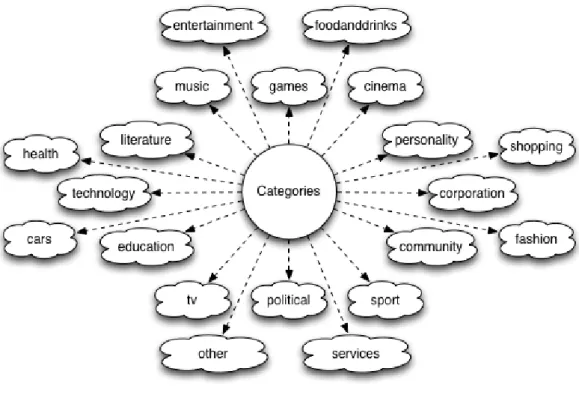
All this information will be filtered to a more compact response, with only the relevant information. Each like will be connected to a major category presented in Figure 1.2.
Chapter 1. Introduction 4
1.1
Objective
The information that exists on the Internet is increasing and is becoming a value resource. Many companies are trying to exploit this are with the goal of getting the users that can bring them success and money. To get those users, there is some information that needs to be collected and analyzed. Information that is individual from one user to another. This area is user profiling.
This work aims to identify user profiles within various SNS available today. All this identification goes through a very detailed analysis not only on the actions of users in such media as the characteristics that each user has [Bhattacharyya et al., 2011]. The importance of a theoretical scenario comes with the fact that it involves not only the growing and extending access of these services by citizens, business and public institu-tions, but also the expansion, diversification and intensification of its use in different contexts.
SNS have been growing very fast around the world, changing people’s way of in-teraction with the internet and their relationships with others. This happens because SNS make it easier for people to have new friendships or rediscover long ones. Also in terms of communication and consumption habits, it is possible to see this effect, just by looking at the present day life routines. Looking to the present day, we see clearly that social networks have become part of the daily routine of people, changing their habits completely. Influenced not only interpersonal relations but also, for example, the habit of watching television and reading. The insertion of sharing your videos and blogs almost killed this media. SNS are being used as workplaces where companies can build teams. These teams help solve problems faster, since these networks act as a great service for sharing information, not only among employees but also between partners. These services enable companies to combine skills of people working around the world.
The work involved has as main objective the creation of user profiles. The data capture is crucial for the characterization of each user. Thus it is important to gather data sources to help us evaluate these users. An evaluation passes through a careful analysis of the characteristics of each user. The collected data was analyzed according to the following dimensions: sociodemographic characteristics (gender, age, education) the specific type of practices conducted over the Internet (study, work, services, search
Chapter 1. Introduction 5
for information, communication and entertainment), the context of use of SNS (home, school, workplace or other). After considering these dimensions, we have information to make the profiling. To achieve the desired results some steps are commonly followed:
• Identify how many data sources / social networks exist; • Identify what information we can collect from each user; • Identify how / who users relate;
• Identify ways of categorizing users not only using their personal data, but with the preferences that appears on theirs profile;
• Identify the tastes and interests of users.
After identifying all these points, we will develop an algorithm that:
• Analyze the information and create users according to their profile; • Identify the issues that users are sharing or interacting;
• Through some parameters classify users by levels;
• Characterize the connection between users and their profiles.
Intends with the final solution not only help to study the profiles of users in the SNS but also present an algorithm which is able to categorize each user type considering the data that will be collected throughout the investigation.
One must take into account are the users with more data available that the degree of reliability is higher, when defining the profiles of each user. To obtain the data may also be used, if possible, Web Crawlers [Brandman et al.,2000] to keep our database as updated as possible. The collected data intends however that each user acts in a natural way in order to get reliable figures and not manipulated.
Chapter 1. Introduction 6
1.2
Research Methodology
To achieve the objectives present in the previous section a methodology was fol-lowed. First all the collected information was organized and evaluated with the purpose of give support and help to solve the problem in question. Second, that support will help to give the results expected. Finally, the results are analyzed and validated in order to trigger the final conclusions about the problem. To follow this methodology, some steps needs to be taken in account:
• Specify the problem discussed
• Update, whenever necessary, the related work • Implementation of the solution
• Validation of the solution • Analyze the results achieved
1.3
Structure
After presenting the problem in question and the objectives to resolve it, in section 2 is presented the process that refers to construction of a profile via the extraction from a set of data. This definition is essential to understand what data is important to collect to identify a user profile. In section 3, is presented a group of techniques that can be a solution to the problem found. In the Section 4, is presented some related works that helped to find the best approach to achieve the best results. Those works helped to observe the different methods used to acquire information about at specific user and finally build is own profile. In this studies are specified what each problem used to get the final results and what problems they exceeded. In the section 5, is presented the selected intelligent technique that will resolve the problem, followed by the steps that was needed to find the solution. In the section 6, is presented the tests made with the technique and the results that were achieved. Finally, in section 7, were made conclusions and possible directions that can be followed in the future. In the final Section, are presented some references that helped to substantiate the problem.
Chapter 1. Introduction 7
• Chapter1: Introduction • Chapter2: User Profiling
• Chapter3: Intelligent Techniques • Chapter4: Related Work
• Chapter5: Implementation
• Chapter6: Testing and Evaluation
• Chapter7: Conclusion and future directions
1.4
Privacy Policy
A major ethical care will be the privacy of user data that will directly or indirectly participate in the study. One of the risks that the data collection can present the user is limited to information that may be collected. To make sure that people, who is presented in these study, understand the nature and extent of the requests, all gathered data were authorized by them and they needed to accept our request to access their private content.
Chapter 2
User Profiling
A profile contains the most important information about a user like name, age, location, etc. When looking inside the context of users of software applications, profiling can be much more than just personal information. Every user differs on their preferences and find what kind of information can determinate who you are is essential.
Silvia Schiaffino and Anala Amandi [Schiaffino and Amandi,2009] discuss how the user profile is represented and how that information is acquired and build. The content of a user varies from one place to another because the context changed too. Getting an example: considering an online newspaper domain and a calendar management domain. On the first one, the user profile contains news about what he likes and dislikes reading. Taking the calendar management, there are information about time and date. The content of a user profile has to be learned using some techniques. Each individual user represents a different kind of information sometimes but there is a set of the most common contents between the users: the knowledge, background and skills, the goal and behavior, individual characteristics and users context.
Schiaffino refers that user interests are one of the most important part of the user profile in information retrieval, filtering systems and adaptive systems that are information- driven. The users behavior comes also as an important part of user profile. Depends on the domain and can be represented a pattern if it is repetitive, or has a routine. Users context appears as a quite new feature in user profiling. The information collected may be explicitly input by the user or implicitly gathered by a software agent. Explicitly input comes as the last option because is more intrusive, saving exceptions.
Chapter 2. User Profiling 9
It may be collected on the user’s client machine or gathered by the application server itself. Depending on how the information is taken, different data about the users may be extracted. In Personalized Services general, systems that collect implicit information place little or no burden on the user are more likely to be used and, in practice, perform as well or better than those that require specific software to be installed and/or explicit feedback to be collected. Getting all the demographic data actually turns out to be more accurate than surveys to customers themselves. Usually, all that is required to get full demographic data is a credit card number or the combination of name and zip code, information that is often collected during purchase or registration. The most reliable approach is software agents that are incorporated inside user’s computer. However, it requires user-participation in order to install the desktop software. User profiles may be based on heterogeneous information associated with an individual user or a group of users who showed similar interests [Gauch et al.,2007].
With all the information available on the Internet, getting only the essential part is crucial to successfully build a profile. The system may acquire explicit information using questionnaires or explicitly by watching users’ actions and behaviors. To learn a user profile from a user’s actions, some conditions need to be achieved. The user behavior must be a pattern otherwise there is no conditions to build an individual user profile. According to this conditions the user behaviour has to be repetitive and perform similar actions under different situations.
Types of information in a user profile [Schiaffino and Amandi,2009]:
• Personal information is one type of information to gather. Information as name, age, country, etc.
• Interests of a user are the most important information to gather. This information contains activities, works and much more that the user are interested.
• Behavior is one kind of information that is gathered implicitly. With the user behaviour there is a possibility to represent a pattern.
• Goals of a user are important to detect user’s objective. Find what the user wants is not trivial and can be very important.
Chapter 2. User Profiling 10
Explicit user information collection: The data collected may contain demo-graphic information such as birthday, marriage status, job, or personal interests. In addition to simple checkboxes and text fields, a common feedback technique is the one that allows users to express their opinions by selecting a value from a range. All these methodologies have the drawback that they cost the user’s time and require the users willingness to participate. If users do not voluntarily provide personal information, no profile can be built for them. With this method, the information is gathered through direct user interaction. With this kind of gathering information, comes some problems: first, users are not prepared to give information by filling long forms, second they can give wrong or false information about the question, and third they can not tell or write what they really want, feel or means to. Normally the information gathered with this way is demographic, like the user’s age, name and hobbies. In some cases this kind of information constitutes the factual profile, as Adomavicius and Alexander [Adomavicius and Tuzhilin,2001] reported.
Implicit user information collection: As Gauch [Gauch et al.,2007] said, user profiles are often constructed based on implicitly collected information, often called implicit user feedback. The main advantage of this technique is that it does not require any additional intervention by the user during the process of constructing profiles. On this method, there are agents that monitor user activities. Kelly [Kelly and Teevan,2003] shows an overview of the most popular techniques used to collect implicit feedback and the information about the user based on the user’s behaviour. This technique has its advantages when comparing to explicit, that removes the cost to the user of providing feedback. However, both techniques can be combined to achieve a better result.
Comparing Explicit and Implicit user information collection: Quiroga [Quiroga and Mostafa, 1999] compared the results obtained between profiles that were built using explicit, implicit and both ways together using a collection of 6000 health records, classified into 15 health areas referred to as classes. Each user used the sys-tem for 15 sessions and the profiles built with the combination feedback obtained the highest precision followed by explicit feedback alone and then implicit feedback alone. The differences presented on these results were found to be statistically relevant, telling that systems that implements a explicit or a combination of explicit and implicit feed-back, gives better results than an alone implicit feedback. Contradicting Quiroga, White [White et al., 2001] consider that profiles using implicit feedback or explicit feedback
Chapter 2. User Profiling 11
does not have significant differences. To find out, White performed experiments some users to answer specific questions on the web. The results told that users with im-plicit feedback were able to complete 61 in a total of 64 questions, against 57 of exim-plicit feedback. Since the differences were not statistically significant, the author concluded that were identical. In 2005, Teevan [Teevan et al.,2005] performed better results with the user profiles constructed with implicit feedback than the users with the explicit feedback. According to these authors, the experiences can change, depending on the information collected. Once the using of implict feedback is growing, this also means that the information gathered for this kind of profile is better too.
2.1
Information Filtering
There are some typical characteristics/features that is commonly used when trying to define information filtering [Belkin and Croft,1992]:
• An information filtering system is an information system designed for unstruc-tured or semistrucunstruc-tured data. Email messages are an example of semistrucunstruc-tured data in that they have well-defined header fields and an unstructured text body;
• Information filtering systems deal primarily with textual information where, in fact, unstructured data is often used as a synonym for textual data;
• Filtering systems involve large amounts of data;
• Filtering applications typically involve streams of incoming data;
• Filtering is based on descriptions of individual or group information preferences, often called profiles;
• Filtering is often meant to imply the removal of data from an incoming stream, rather than finding data in that stream;
Have been proposed different architectures to build an efficient filtering system. Moukas [Moukas,1997b] said that information filtering systems can be categorized along several different axes based on the technology/architecture they use for filtering the data. They can all be classified under two broad categories:
Chapter 2. User Profiling 12
• Content-based filtering try to recommend content/items to the users. As Lops [Lops et al.,2011] described, the basic process performed by a content-based con-sists in matching up the attributes of a user profile in which preferences and interests are stored, with the attributes of a content object (item), in order to recommend to the user new interesting items. This kind of system needs some techniques for representing and producing the user profile: content analyser, pro-file learner and filtering component. Some advantages and drawbacks have been found about this technique. This technique has it advantages and disadvantages. Systems that implements a content-based approach learn from the content of the text documents or a set of documents. The so-called vector representation is the most frequently used document representation in information retrieval and text learning [Mladenic,1999];
• Social (or collaborative) and Economic-based filtering has a different ap-proach when comparing to content-based filtering. The objective is to use the feedback and rating given from all different users and filter out irrelevant infor-mation. This index is not global, but is computed for each user on the fly by using other users with similar interests: documents that are liked by many people will have a priority over documents that are disliked. It takes into consideration parameters like the price of the document and its cost of transmission from the source to the user (in the case of company intranets) when making decisions on whether to filter it out or not [Moukas,1997b];
2.2
Information Retrieval
According to Belkin [Belkin and Croft,1992], information retrieval has some differ-ent characteristics when comparing to information filtering:
• Information Retrieval is normally used with static databases of information; • Information Retrieval is typically concerned with single uses of the system; • Information Retrieval systems is normally query based;
Chapter 2. User Profiling 13
As information filtering, information retrieval can be splited into different categories: boolean-based systems, vector-space based system and probabilistic systems [Salton and Buckley,1988]:
• Boolean-based systems use boolean operators (like AND,OR,NOT) to find an exact match;
• Vector-space based system is used for representing text documents with a multi-dimensional vector of keywords and weights. One of the advantages of this method is that allows ranking documents according to their possible relevance;
• Probabilistic systems identify relevant and non-relevant in the database items using inference network models;
2.3
Keywords Profiles
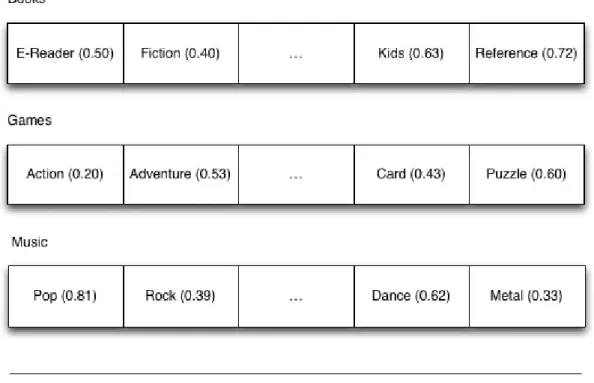
One of the most famous representation for user profiles are sets of keywords. Those keywords can be represented in many different ways. One keyword can represent a topic of interest or can be grouped into categories. Following this, each profile is represented in a form of keyword-vector where each keyword have a weight associated. Follows and example of a weight keyword-based user profile on Figure2.1:
Chapter 2. User Profiling 14
Figure 2.1: Weight Keyword-Based.
Gauch [Gauch et al.,2007] said that profiles represented in this way were among the first to be explored. These kind of contents are gathered from documents visited by the user or saved by the user during is experiment, or else the keywords were explicitly pro-vided by the user. Each keyword has associated a weight that represents its importance in the profile. Amalthaea [Moukas,1997a] is a system that creates keywords profiles. Is an evolving, multiagent ecosystem for personalized filtering, discovery, and monitoring of information sites. Amalthaea’s primary application domain is the World-Wide-Web and its main purpose is to assist users in finding interesting information.
2.4
Semantic Network Profiles
InfoWeb [Gentili et al., 2003] builded a semantic network that represent long-term user interests where each user profile is represented as a semantic network of concepts. Each network contains an amount of nodes unlinked where each node represents a con-cept with a specific weight. As more information is gathered from the user, more enriched will be with additional weight keywords. It uses a stereotype-based mechanism for the construction of the initial user model. The ability of InfoWeb to expand the query on the basis of the semantic network that makes up the user model has been appreciated by
Chapter 2. User Profiling 15
users because of the importance of inputting the right query to the system. According to InfoWeb [Gentili et al.,2003] their tests demonstrated that, after a certain number of queries, the system is sufficiently fast in reaching the stability of the model for a users domain of interest, thus obtaining satisfactory performance. The system has also shown its ability to adapt to sudden changes in user interests.
The goal of Sieg [Sieg et al., 2007] is to utilize the user context to personalize search results for a given query. The personalization is achieved by reranking the results returned from a search engine. An ontological approach to user profiling has proven to be successful in addressing the cold-start problem in recommender systems where no initial information is available early on upon which to base recommendations [Middleton et al.,2003]. The purpose of Sieg of using an ontology is to identify topics that can be interesting to the user. Every time the user interacts with the system, the ontological user profile is updated. Accurate the information about the user is very important. Too many factors are taking into account, as the time spent in each page, how many times the page is visited and which pages are bookmarked [Dumais et al.,2003].
2.5
Concept Profiles
Concept-based profiles and semantic network profile are related and both are rep-resented by nodes and connections between (Figure2.2). In concept nodes, each node is not represented as set of words or some specific word, these nodes contains more abstract topics that is considered relevant to the user. Determinate how much important some topic is to an user is not easy, and to reach that importance, each topic has a weight associated. Bloedorn [Bloedorn et al., 1996] has demonstrated that a relevant general-ization hierarchy together with a hybrid feature representation is effective for accurate profile learning.
Chapter 2. User Profiling 16
Figure 2.2: Concept Hierarchies.
Concept hierarchies were initially used to represent the content of Web pages but have more recently been used to represent user profiles. Most systems are based on a reference concept hierarchy, or taxonomy, from which a subset of the concepts and relationships are extracted and weighted to form a user profile. Because creating a broad and deep concept hierarchy is an expensive, mostly manual process, profiles are typically based on subsets of existing concept hierarchies [Gauch et al.,2007].
2.6
User Representations
Gauch [Gauch et al.,2007] said that user profiles are generally represented as sets of weighted keywords, semantic networks, or weighted concepts, or association rules. Key-word profiles are the simplest to build, but they require a large amount of user feedback in order to learn the terminology by which a topic might be discussed. According to the user interest, the system should reflect the user interest based on his/her activity. The information of a user in these cases is dynamically, since a static profile maintains the same information indefinitely. The content inside a dynamic profile may change con-stantly. Short-terms indicates interests that remains static to the user unlike long-terms that can changes over and over again. Profiles that can change over the time are called dyanmic profile and those that maintain the same information over time are called static profiles [Hoashi et al.,2000,Widyantoro et al.,2000]. Short-terms may be more difficult
Chapter 2. User Profiling 17
to find and manage than long-terms interests. The purpose of user profiling is to collect information about a user interests, and determinate how longer will take those interests, aiming to improve the quality of that information. The user profiling process generally consists in three main phases [Gauch et al.,2007] as we showed below in Figure 2.3.
Figure 2.3: User Profiling Process.
First, is gathered information about the user in question through a process. From user to user, the information collection can change, and each one will define which data can be extracted. After this phase, its time to center the attention to the user profile construction based on the data collected that may be represented in a variety of ways, depending of each profile. After this process, the user is exposed. There are different patterns to represent a user profile:
• Static user model are the most basic kinds of user models. Once the main data is gathered they are normally not changed again, they are static. Shifts in users’ preferences are not registered and no learning algorithms are used to alter the model.
• Dynamic user models allow a more up to date representation of users. Changes in their interests, their learning progress or interactions with the system are noticed and influence the user models. The models can thus be updated and take the current needs and goals of the users into account.
• Stereotype based user models are based on demographic statistics. Based on the gathered information users are classified into common stereotypes. The system then adapts to this stereotype. The application therefore can make assumptions
Chapter 2. User Profiling 18
about a user even though there might be no data about that specific area, because demographic studies have shown that other users in this stereotype have the same characteristics. Thus, stereotype based user models mainly rely on statistics and do not take into account that personal attributes might not match the stereo-type. However, they allow predictions about a user even if there is rather little information about him or her.
• Highly adaptive user models try to represent one particular user and therefore allow a very high adaptivity of the system. In contrast to stereotype based user models they do not rely on demographic statistics but aim to find a specific solution for each user. Although users can take great benefit from this high adaptivity, this kind of model needs to gather a lot of information first.
2.7
User Construction
Every user is represented by the information he has and the actions he make. To create a user profile is preferred to use a less intrusive method where we can extract from the user all the information that matters to identify that user. There are too many techniques that can be used, based on machine learning or information retrieval, depending on the user profile representation that is desired. Techniques usually used to contruct profiles are keywords profiles, semantic network profiles and concept profiles. Updating a user profile can be done automatically or manually. Normally, people use automatic methods beacuse are less intrusive to the user. On the first step, the system should gather the information of a single user. That information can be obtained in two ways: explicitly or implicitly.
Breu [Breu et al.,2008] suggest that a user profile can be represented as a proba-bilistic network. A probaproba-bilistic network provides a formal foundation for probaproba-bilistic inference. More importantly queries involving any subset of terms (attributes) may be posed to the network. Once the probabilist network is constructed, the document can be ranked according to the computed conditional probabilities. Such a network is learned from a sample of documents that are judged by the user to be relevant or non relevant.
Chapter 3
Intelligent Techniques
One of the difficult part of user profiling lies how to get all the information that matters from data. On this section, we will discuss some intelligent techniques for auto-matically creating user profiles coming from areas such as machine learning, data mining or information retrieval [Schiaffino and Amandi,2009]. The purpose goes through dis-cover patterns and behaviors and apply obtained knowledge to make decisions. There are three types of knowledge management systems: enterprise-wide knowledge manage-ment systems, knowledge work systems and intelligent techniques such as data mining, expert systems, neural networks, fuzzy logic, genetic algorithms and intelligent agents [Laudon and Laudon,2012]. Some techniques will be presented for extracting and encod-ing knowledge from data. For representation data analysis there are rule bases, decision trees, and artificial neural networks and there are many techniques for data analysis such as density analysis, classification, regression and clustering [Heckerman,2008]. The in-telligent techniques discussed in this chapter are: bayesian networks, decision trees, case-based reasoning, association rules, neural networks and k-nearest neighbor algo-rithm. Each technique has one purpose: discovering knowledge, distilling knowledge in form of rules or discovering optimal solutions [Laudon and Laudon, 2012]. After this discussion, we will make a comparison between those techniques and see what sets them apart.
Chapter 3. Intelligent Techniques 20
3.1
Bayesian Networks
Bayesian networks belong to the family of probabilistic graphical models that en-code probabilistic relationships among variables of interest. Represents a probability distribution where nodes represents random variables, attribute or feature, and arcs rep-resent probabilistic correlation between variables [Schiaffino and Amandi,2009]. These graphical structures are used to represent knowledge about an uncertain domain [ Net-works et al., 2007]. Graphical models when with undirected edges are normally called Markov networks, that are popular in statistical physics and computer vision. Accord-ing to Heckerman [Heckerman, 2008], this technique has, at least, four advantages for graphical model when used in conjuntion with statistical techniques:
• Encodes dependencies among all variables, even if some entries are missing. • Can be used to learn causal relationships and predict consequences of intervention. • Has both a causal and probabilistic semantics.
• Bayesian statistical methods in conjunction with bayesian networks avoids the overfitting of data.
Getting an example from Schiaffino, ”A BN is built gradually as a given user queries the database. When a user submits a query, the query is stored in the form of a case and a node is added to the network for each attribute involved in the query. Arcs are drawn between the correspondent nodes, considering the relationships established for the particular domain. Probability values are updated as attributes frequencies in queries are modified with each new query. Each variable can have only two values: true, representing that the attribute is present in the query, and false, indicating that the attribute is absent.”.
Naive Bayes
The simplest Bayesian classifier is Naive Bayes where it assumes that all attributes of the examples are independent of each other given the context of the class [McCallum and Nigam,1998]. It’s one of the most efficient and effective inductive learning algorithms for machine learning and data mining. Its competitive performance in classification is surprising, because the conditional independence assumption on which it is based, is
Chapter 3. Intelligent Techniques 21
rarely true in real- world applications [Zhang, 2004]. According to Fleuren [Fleuren,
2012], a Bayesian network is something that cannot be done automatically, because the domain can have specific knowledge. This author has presented some advantages and disadvantages:
Disadvantages:
• It is difficult to Bayesian network make a decision if there is a lack of relevant information and the classification will be damaged;
• The domain should be specific to actually classify users into meaningful classes; • Is something that needs to be done manually, particulary when variables are
dy-namic.
Advantages:
• Users can often be classified based on just a few variables; • Use information that is easily gathered;
• It only needs a small amount of data to estimate the parameters, means and variances of the variables, necessary for classification because independent variables are assumed.
Some comprehensive comparison with other classification algorithms in 2006 showed that Bayes classification is outperformed by other approaches, such as boosted trees and random forests. Caruana [Caruana and Niculescu-Mizil,2006] evaluate the performance of SVMs, neural nets, logistic regression, naive bayes, memory-based learning, random forests, decision trees, bagged trees, boosted trees and boosted stumps on eleven binary classification problems using a variety of performance metrics: accuracy, F-score, Lift, ROC arena, average precision, precision/recall break-even point, squared error and cross-entropy. With excellent performance on all eight metrics, calibrated boosted trees were the best learning algorithm overall. According to Caruana, random forests are close second, followed by uncalibrated bagged trees, calibrated SVMs, and uncalibrated neural nets. The models that performed poorest were naive bayes, logistic regression, decision trees, and boosted stumps. Although some methods clearly perform better or worse
Chapter 3. Intelligent Techniques 22
than other methods on average, there is significant variability across the problems and metrics. Even the best models sometimes perform poorly, and models with poor average performance occasionally perform exceptionally well.
3.2
Decision Trees
A decision tree is a technique that can help making a decision as how to classify a new user. Getting a user variables from a dataset, a user can be classified by comparing to those in the tree. A great aspect of decision trees is that they, unlike Bayesian networks, can contain a diverse set of variables that are not way related. However, when there is a lack of information, the user will be classified by the majority of that variable. As Fleureu said [Fleuren,2012], this is also known as a greedy algorithm, meaning that the best path down the tree will not necessarily be found due to a wrong turn based on a lack of information about a certain variable. This technique is commonly used in data mining. The goal is to create a model that predicts the value of a target variable based on several input variables. This model uses a set of binary rules to calculate the target result that can be used for classification (categorical variables) or regression (continuous variables). Two advantages of these methods is that offers simplicity of results and the tree methods are nonparametric and nonlinear. After this selection, different algorithms are used to find the best/indicate split method. Decision trees used in data mining are of two main types as described below:
Classification tree analysis is when the predicted outcome is the class to which the data belongs. They are used to predict cases or objects based on their dependent variables. Classification trees can have thousands of nodes and these need to be reduced to simplify the tree. When the model becomes too many complex, like having too many relative parameters to the number of observations, occurs overfitting. This happens because the criterion used for training the model is not the same as the criterion used to judge the efficiency of a model. Overfitting occurs when a model begins to memorize training data rather than learning to generalize from trend. As an extreme example, if the number of parameters is the same as or greater than the number of observations, a simple model or learning process can perfectly predict the training data simply by memorizing the training data in its entirety, but such a model will typically fail dras-tically when making predictions about new or unseen data, since the simple model has
Chapter 3. Intelligent Techniques 23
not learned to generalize at all. This type of model, can handle problems with more than two classes and provide a probabilistic output [Criminisi,2011].
Regression treeanalysis is when the predicted outcome can be considered a real number. The main difference between regression and classification is that the output label to be associated with an input data is continuous, so the training labels are con-tinuous. In terms of efficiency and flexibility, are both similar [Criminisi, 2011]. The terminal nodes, unlike classification tree, are predicted funtion values.
Some techniques, often called ensemble methods, construct more than one decision tree:
• Bagging decision trees, an early ensemble method, builds multiple decision trees by repeatedly resampling training data with replacement, and voting the trees for a consensus prediction. It is a relatively easy way to improve an existing method. One gains of this method is an increased of accuracy [Breiman,1996].
• Random Forest classifier uses a number of decision trees, in order to improve the classification rate. Each Decision Tree is made by randomly selecting the data from the available data. According to Breiman [Breiman,2001], the features are randomly selected in each decision split which reduces de correlation between trees and improves the prediction power and results in higher efficiency. Some random forests reported lower generalization error when comparing to other methods. For instance, random split selection [Dietterich,2000] does better than bagging. There are some desirable characteristics presented by Breiman:
– ”Its accuracy is as good as Adaboost” [Freund et al.,1996] (the most common implementation of boosting) ” and sometimes better”;
– ”Its relatively robust to outliers and noise”; – ”Its faster than bagging or boosting”;
– ”It gives useful internal estimates of error, strength, correlation and variable importance”;
– ”Its simple and easily parallelized”.
• Boosted Trees can be used for regression-type and classification-type problems [Hastie et al.,2001]. As Yang [Yang et al.,2005] concluded, the major advantages of boosted decision trees include their stability, their ability to handle large number
Chapter 3. Intelligent Techniques 24
of input variables, and their use of boosted weights for misclassified events to give these events a better chance to be correctly classified in succeeding trees.
• Rotation Forest in which every decision tree is trained by first applying principal component analysis (PCA) on a random subset of the input features [Rodr´ıguez et al.,2006].
3.3
Case-Based Reasoning
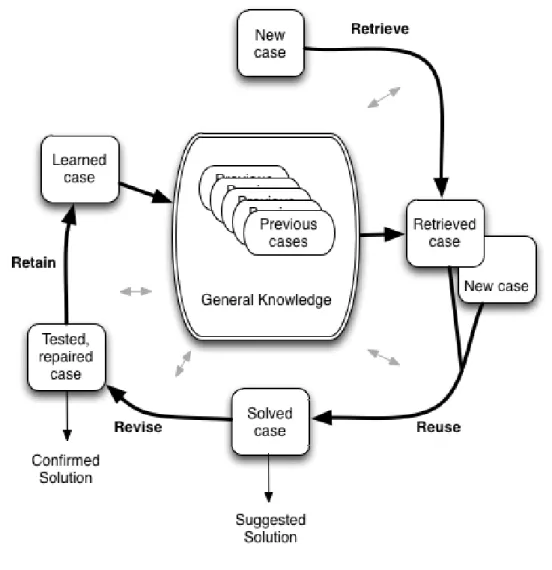
Case-based reasoning uses old cases to solve newer cases. It tries to remember similar situations and understand them with the objective to meet new demands. The solution pass not even for understand the similarities between two cases, but also what are the differences between those cases and create new solutions. But the question that needs to be made is: what happen when there are two different cases with the same result, but with different information? To anwser this problem, this method follows some steps to complete each case as showned on the next figure 3.1[Fleuren,2012].
Chapter 3. Intelligent Techniques 25
Figure 3.1: The Case-Based Reasoning Cycle.
The first step in CBR cycle is to RETRIEVE a similiar previous case which would be another existing customer with similar information. After this, the new case and the retrieve case are combined through REUSE into a solved case to find a new solution to the problem. The next step in the cycle is to apply this solution and to test its success through REVISE. The solution must be adjusted and repaired. When in Tested and Repaired Case step, the solution has been found. The final step in the cycle is to RETAIN the case and save it in the database of previous cases as a Learned Case [Fleuren,2012]. Case-Based Reasoning is a technique that solves new problems by remembering older experiences [Schiaffino and Amandi,2009]. Fleuren has an example where this technique can be used: ”when a doctor has a patient with a certain combination of symptoms, he might remember another patient in the past that had the same kind of symptoms, and propose the same diagnosis. This type of reasoning can be applied for building user
Chapter 3. Intelligent Techniques 26
profiles: when a new customer has a certain combination of interests, the CBR could look up what products customers with similar interests bought and propose these to the new customer”. Though Bayesian networks and decision trees are good tools, they have some weaknesses such as use generalization to approach a new user. But when applying case-based reasoning it find a best fit solution, evaluation each case separately. Due to the incremental learning the system is directly able to apply newly learned cases to new cases [Fleuren,2012].
3.4
Association Rules
Association rule learning is a data mining method to find relations between data [Tan and Steinbach, 2006]. For user profiling, this technique can be applied in some many ways. The task of this method is to find pairs of data that are, in some how, similar or complementary. Let’s take an example: when a customer goes to the market buying some products, sometimes there are some connections between the products. Every year, usually at september, mothers take the children to go buy school supplies: notebooks, pencils, erasers, pens and a lot of stuffs. According to this routine, the system can create relations between the products to advise other customers about what they should buy and when they need to buy this kind of products based on customers behaviour. Having a large data sets, this method can suggest to the customers that when people buys notebooks, they usually take pencils, erasers and pens. The system not only suggest similar products but also complementary products. That’s one great advantages of association rules. And the only think the user needs to do is to accept that advice or not. Taking this example, there is another funcionallity that the method can take from this kind of behavior. It can notify the customer, every september, that this is what he really needs at this time. So, the system make suggestion not only based on products, but also based on the season and time that some products is needed. This kind of system also have disadvantages. When they buy school supplies and because of something the customer buys a fridge, the system will create a relation between these things that have no relation. So the disadvantage of this method pass through the system may find association rules between products that are only related by coincidence. It is difficult to filter out these rules that seem to be nonsense. There are some different techniques for analyzing user data and producing information about a user from this
Chapter 3. Intelligent Techniques 27
data. Some techniques rely a lot on data collected from previous users of a website and others rely more on the collection of information about a certain user [Fleuren,2012].
3.5
Neural Networks
Neural networks was used to refer a network of biological neurons. They can be used to model complex relationships between inputs and outputs or to find patterns in data. A biological neural network consists of neurons that communicate with each by electrical signals. In an artificial neural network, the modern usage of the term, these are represented by nodes and connections between these nodes that is represented like the Figure ˙Each connection has a weight that can be changed based on the outcome result [Fleuren,2012]. This method is good in recognizing patterns. Getting on Fleuren example, ”it can learn to distinguish between the letters A and B, by putting more weight on the horizontal bottom row pixels and the vertical left column pixels, and less weight on the middle horizontal row pixels. These are the pixels where the letters A and B are more or less distinguishable”. Neural networks can be used to classify an user, using the gathered information of the user as input, into stereotypes based in certain assumptions [Chen et al.,2000]. Another example, ”suppose there is a user of whom it is known that he has an expensive car and lives in an expensive neighborhood and that this person is classified in the stereotype rich. From this, one may infer that this person may also like to play golf, since this is also part of that stereotype. Of course, these assumptions are not always accurate” [Fleuren,2012].
Neural networks can be really useful due to the fact that they can guess missing information in a user profile with quite a high level of detail. By applying stereotypes to a user, assumptions about a user will be made until the contrary has been proven. According to Fleuren, the best way of implementing this technique is when the website is able to identify the user with some certainty. This technique relies on the ability of building a profile over a longer period of time. There is the risk of users that share accounts or a single internet connection, taking the author example within a corporate environment, leading to mixed, inaccurate results. Another point of concern is that a neural network relies on feedback. As refered above, the weight of nodes are adjusted constantly based on the user outcome. The system only ”receives positive feedback when a user spends a lot of time on a product’s page or when he decides to buy a
Chapter 3. Intelligent Techniques 28
certain product and negative feedback when a user repeatedly ignores a suggestion or spends very little time on a product’s page” [Fleuren,2012]. The information will be all distorted.
3.6
K-Nearest Neighbor algorithm
The K-Nearest Neighbor, or K-NN, algorithm is a method well suited for generat-ing personalized query results. Is a non-parametric method for classifygenerat-ing objects based on closest training examples. This method preforms really great when in presence of a large amount of training set. Search results are personalized by comparing the cur-rent users profile to other user profiles and selecting the most similar one. Gemmell [Gemmell et al.,2009] describe how they use K-NN to suggest tags for a music piece a user wants to classify, based on the profile of the user. K-Nearest Neighbor algorithm is a method for classifying objects based on closest training examples, by a majority vote of its neighbors. Hall [Hall et al.,2008] said that the knn-nearest neighbor rule is arguably the simplest and most intuitively appealing nonparametric classification pro-cedure. However, application of this method is inhibited by lack of knowledge about its properties, in particular, about the manner in which it is influenced by the value of k; and by the absence of techniques for empirical choice of k. K-NN is a very simple method to understant and implements. Delany [Delany,2007] presented some advantages and disadvantages of this method:
Advantages:
• It’s easy to implement and debug;
• Can be very effective if the output of the classifier is useful;
• There are some noise reduction techniques that work only for K-NN, improving classifier’s accuracy [Delany and Cunningham,2004];
• Can greatly improve run-time performance on large case-bases. Disadvantages:
Chapter 3. Intelligent Techniques 29
• Is very sensitive to irrelevant or redundant features;
• May be outperformed by techniques like Support Vector Machines or Neural Net-works on very difficult classification tasks.
3.7
Comparasion
In order to compare these techniques a model has been devised in which different aspects of the different techniques are compared, see Figure3.2[Fleuren,2012].
Figure 3.2: A comparison between different user profiling techniques.
3.7.1 User Classification and User Profile Building
The purpose of most techniques is for classifying a user into a group based on the choices each user make. Neural networks is a technique where the purpose is to build a profile around a single user, trying to learn as much about a user and improve the profile as it goas along. A reason why building a profile around a certain user is difficult is that it can be difficult to confirm a website users identity. Therefore profile building techniques are less suitable for website environments [Fleuren,2012].
3.7.2 Based on Learning and Based on Statistics
There are a difference between those techniques that learn based on learning and those based on statistics. There is only one intelligent technique described here based on learning that is case-based reasoning, the others are base on statistics. Those techniques
Chapter 3. Intelligent Techniques 30
based on statistics simply use past experiences and old data to apply on new data. As Fleuren [Fleuren,2012] said, ”a system can create and revise a decision tree from the data it is not considered learning. The system does not learn to make a better tree by choices it made in the past”, but there are some techniques that depends on that decisions such as neural network. Association rules are based on statistics. Learning from the behavior of an user and the products selected by, the method can suggest new items to other user according to is behavior. Decision trees and Bayesian networks are techniques where the purpose is to calculate the chance of an user being from a certain class.
3.7.3 Learn from Single Users and Learn from All Users
There are only two techniques are based on learning. Case-based reasoning uses all the information gathered from the users. The system learns from old cases and tries to apply that knowledge to new cases. On the other hand, neural network only base it’s work on a single user, trying to fill it with the right information. As Fleuren said ”the system relies on stereotypes defined by other users, the network does not define these stereotypes itself” [Fleuren,2012].
3.7.4 Differences between bayesian networks, decision trees and
asso-ciation rules
Having studied these three techniques, can be concluded that each one of them should be used not only because is the best method, but taking into account the problem that needs to be solved.
• Bayesian networks are commonly used for classifying users that handle incom-plete data sets of information. Heckerman [Heckerman,2008] refered some points that can give several advantages for data analysis. First when some data is miss-ing, the model encodes dependencies among all variables. Second, can be used to learn causal relationships. Third, once having both a causal and probabilistic semantics, it’s one of the best possible representation for combining knowledge and data. And finally, combining Bayesian statistical with Bayesian networks offer an efficient for avoiding the overfitting;
Chapter 3. Intelligent Techniques 31
• Decision trees are very simple and have higher quality at classifying users on data sets with multiple variables. This method is specifically good in decision analysis, to help identify a strategy most likely to reach a goal. According to Fleuren, ”also decision trees can make stereotypes visible, allowing the technique to be suitable as a complement to neural networks”;
• Association rules ”do utilize classification but to a different extent. Association rules are useful for finding products that the user is likely to respond to based on the products he is buying or viewing” [Fleuren, 2012]. It’s a very popular and well researched method for discovering interesting relations between variables in a large data sets, identifying also strong rules between some information.
3.7.5 Comparing some Random Forest Decision Tree implementations
Some benchmarks have been made comparing different implementations of Random Forest. WiseRFTM comes as version of the popular machine learning algorithm, Ran-dom Forest, and appears to resolve problems of scability. This implementation is fast, scalable, memory efficient and one of the most beloved machine-learning algorithms, Random Forests. Here some benchmarks between this implementation and other com-petitors.
WiseRFTM vs scikit-learn
Richards [Joseph W. Richards,2012] made in 2012 a benchmark between these two implementations and found that WiseRFTM was a best solution. Richards presented a ”data set that consists of 70,000 pixelated images of handwritten digits, from 0 through 9, each image measuring 28-by-28 pixels”. To perform the comparison, he used 63,000 images as training data and a random 7,000 as testing data. Results can be seen below in Figure 3.3.
Chapter 3. Intelligent Techniques 32
Figure 3.3: Benchmark between WiseRFTM and scikit-learn.
On these results, can be seen that with a single core WiseRFTM enjoys a factor of 7 boost in speed over scikit-learn with a comparable accuracy and with 4 hyperthreaded cores WiseRFTM performs a 7.5x advantage in speed over scikit-learn. With these results, Richards [Joseph W. Richards, 2012] concluded that ”wiseRF is at least 5x faster and sometimes as much as 100x faster than scikit-learns random forest, with the factor improvement depending on the number of trees and number of cores used for training”.
WiseRFTM vs weka vs R vs scikit-learn
The benchmark presented by the official WiseRFTM website [WiseRF BENCH-MARKS,2013], shows that with a dataset of 60.000 instances, 784 feature dimensions and 10 classes the accuracy from WiseRF is as good or better than the other implemen-tations. Results can be seen below in Figure 3.3.
Chapter 3. Intelligent Techniques 33
Figure 3.4: Benchmark between WiseRFTM and other implementations.
Seeing these results can be detected that WiseRFTMperforms better than the others implementations. Comparing time train chart implementations, WiseRFTMperforms 29 times faster than Python sklearn, the second best result. Looking to the memory usage, WiseRFTM uses, approximately, 97% less memory than R implementation, the second best result.
Chapter 4
Related Work
With this work, we intend to categorize users around the social networks. The work involved has as main objective the creation of user profiles. The data capture is crucial for the characterization of each user. Thus it is important to gather data sources to help us evaluate these users. An evaluation passes through a careful analysis of the characteristics of each user. The collected data are analyzed according the dimensions referred previously.
To categorize these users, the studies referred in this chapter followed some different approaches based on what they considered to be the approach that would give them the best results, based on some set of approaches that exists like Ad Hoc, Neural, Genetic Algorithm, among others. According to these cases of studies, there is a need to find the best approach to follow, based on the profile structure, and get the most relevant information. Having a way to get all the necessary information, there is a need to find a model that can separate all the keywords semantically unlinked and connected those that are semantically linked. Is required to have a strong base of information to that it takes effect immediately in the nearby future and determinate the profile of each user with the higher degree as we can get.
To achieve the best results, studies of different cases were done with the goal of understand what problems were found and how they resolved them. With these articles, some doubts needs to be answer. How do we get the information from the users? How we can separate all the keywords semantically unlinked and connected those that are semantically linked? How do we get the keyword weight? How we can create each user
Chapter 4. Related Work 35
profile based on their information? Accordingly, we analyzed a series of articles that follow in models that may be useful and have a purpose similar to the results pretended.
4.1
Analysis of User Keyword Similarity in Online Social
Networks
The question that this article is trying to answer is: How do two people become friends? What role does homophile play in bringing two people closer to help them forge friendship? Is the similarity between two friends different from the similarity between any two people? How does the similarity between friends of a friend compare to similarity between direct friends? The goal of this study is to answer these questions, characterizing users profile entries and trying to find a similarity between a pair of users. On-line social networks (OSNs) helped them to study such problems using the set of rich data present about the users. A typical user profile in an on-line social network is characterized by its profile entries like location, hometown, activities, interests, favorite music, professional associations [Bhattacharyya et al., 2011]. The first topic to get their attention was about Keyword usage patterns. To measure the similarity between keywords and understand the usage scope of keywords as entered by different users in their on-line social network profiles; they analyzed Facebook profiles, considering only keywords that exist in the English dictionary.
After the capture, the questions raised were: How do we relate two keywords? How do we keep two keywords separated when they can not be related? so the real goal pass by clearly distinguish between related and unrelated keywords. Keywords can say to be related when they are semantically linked. Otherwise, they are unrelated and kept separated. To build a forest, they adopted a more ad hoc approach, allowing each keyword of a keyword pair to build its own tree. The next step passed through get the similarity between the users using all the Trees generated. To get the users similarity, there are three definitions to have in consideration. The first one is given to get the distance between two words, the second one to calculate the weak similarity between two users and the third one to determinate the strong similarity between two users. Then the keywords of user pairs were compared according to each of the heuristics defined above. This study allowed to say that this observation were significant because it shows
Chapter 4. Related Work 36
that users become more divergent in their interests to form new friendships, resulting in a decrease of similarity activities.
Briefly first they present results from the analysis on the number of keyword pairs the forest model was successful in matching. Second, showed results describing the variations in number of matches between keyword pairs and the variations in weak similarity and strong similarity for different number of keyword pairs between two users. Finally, the results are showing the variation in weak similarity and strong similarity based on different node degree of users and their individual number of keywords.
4.2
Intelligent User Profiling
This article aims to examine what information each user contains to create the exact profile. According to this, they face some issues: how the user profile is represented; how the user profile is acquired and built; and how the profile information is used [Schiaffino and Amandi, 2009]. A profile can be create getting the user information based on known qualities, based on what we consider to be the most important information or interesting facts about him or her. Having this, each user profile varies depending on the content that can be obtained. The user can explicitly provide all the information or it has to be learned using some intelligence approaches. This study indicates a variety of Artificial Intelligence techniques that have been used for user profiling such as case-based reasoning [Lenz et al.,1998], Bayesian networks [Horvitz et al.,1998], association rules [Adomavicius and Tuzhilin,2001], genetic algorithms ([Moukas,1997b], neural networks [Yasdi,1999].
Determining user profiling is always a hard work and chooses the best approach to follow is decisive to obtain the real success. Commonly, user profile interests and information are keyword-based models. All the obtained information is represented by weight vectors of keywords that determine the importance of that word in comparison with other words. These representations are commonly used in the Information Filter-ing and Information Retrieval areas. HavFilter-ing a way to determine the importance of a keyword, getting the information becomes the next step. To respond to this, there are two alternatives, or the information is obtained in the implicit way, that is provided directly by the user, or implicitly, through the observation of the users actions.