Universidade de Lisboa
Instituto Superior de Economia e Gestão
THREE ESSAYS ON CORPORATE TAXATION:
FINANCIAL REPORTING, VALUE, AND FIRM CREATION
Victor Maurílio Silva Barros
Orientador: Professor Doutor João Carlos Carvalho das Neves
Tese especialmente elaborada para obtenção do grau de Doutor em Gestão
Universidade de Lisboa
Instituto Superior de Economia e Gestão
THREE ESSAYS ON CORPORATE TAXATION:
FINANCIAL REPORTING, VALUE, AND FIRM CREATION
Victor Maurílio Silva Barros
Orientador: Professor Doutor João Carlos Carvalho das Neves
Tese especialmente elaborada para obtenção do grau de Doutor em Gestão
Júri:
Presidente: Professor Doutor Manuel Fernando Cília de Mira Godinho
Professor Catedrático e Presidente do Conselho Científico do Instituto Superior de Economia e Gestão da Universidade de Lisboa
Vogais: Professor Doutor Elísio Fernando Moreira Brandão
Professor Catedrático da Faculdade de Economia da Universidade do Porto
Professora Doutora Isabel Maria Estima Costa Lourenço
Professora Associada do ISCTE - Instituto Universitário de Lisboa
Professora Doutora Cristina Belmira Gaio Martins da Silva
Professora Auxiliar do Instituto Superior de Economia e Gestão da Universidade de Lisboa
Professor Doutor João Carlos Carvalho das Neves
Professor Catedrático do Instituto Superior de Economia e Gestão da Universidade de Lisboa
The Financial support from the Portuguese Foundation for Science and Technology (FCT) under the Doctoral Grant SFRH/BD/77985/2011 and project CMU-PT/Etech/0036/2008
i
Abstract
The doctoral thesis is composed by three self-contained empirical papers that can be read independently, plus an introduction and a conclusive chapter.
The first empirical paper, which is entitled “Corporate Taxation and Financial
Reporting Quality”1, examines whether the relation between tax enforcement and firms’
financial reporting quality varies with firms’ level of tax avoidance in Europe.
Incentives for tax avoidance are dissimilar across firms and jurisdictions, as the latter levy firms with different corporate taxation and employ different enforcement mechanisms. Thus, the simple view that higher tax enforcement increases the quality of financial reporting may also change with institutional characteristics. We predict and confirm that in Europe, overall tax enforcement is positively associated with financial reporting quality, although there is a greater incidence for firms engaged in more tax avoidance. We find a lower sensitivity to tax enforcement for firms engaged in less tax avoidance, which is consistent with the tendency for these firms to already report higher quality financial information. Furthermore, it is unclear whether our findings are sensitive to variations in other tax system characteristics and in institutional characteristics. In contrast to other studies, we show that the association between tax
enforcement and financial reporting quality is sensitive to firms’ level of tax avoidance,
rather than accounting for other differences at country level.
The second empirical paper – “Disclosure of Income Taxes and Firm Value: a Cross
Country Comparison of IFRS Adopters”2, examines whether disclosure of income taxes
is associated with firms’ value. We focus on all IAS 12 disclosure requirements in a
sample of IFRS adopters in Europe, rather than in the US. The disclosure of income taxes is measured by an index based on hand-collected data from annual reports, which made it possible to distinguish between mandatory and voluntary disclosure of income taxes. Results suggest no direct relation between mandatory disclosure of income taxes
and firms’ value. However, when the level of tax avoidance is taken into consideration
the association is significant. Tax avoidance strategies are viewed with scepticism by investors, although disclosure of income taxes mitigates this negative effect, especially
for tax aggressive firms, and for “poorly”-governed firms, which is measured by lower
institutional ownership. Findings suggest that disclosure of income taxes might play a
role in shaping the relation between tax avoidance strategies and firms’ value, rather
than the quality of corporate governance.
1 JEL classification: H26; K4; M40
Keywords: Tax Avoidance; Tax Enforcement; Financial Reporting Quality
2 JEL classification: H26; G14; M41; G30
ii
The third empirical paper is entitled as “Crossing the Border: Regional Tax
Differences and Firm Creation”3. Does the introduction of reduced corporate income tax
rates at regional level increases firm creation? Instead of focussing on existing corporate income tax rate differentials, we take advantage of a quasi-natural experiment to study the introduction of reduced corporate income tax rates at regional level. Results suggest that the creation of firms increased with the introduction of reduced corporate income tax rates for specific regions. However, further variations in the corporate income tax rate differential between regions appear to be ineffective in fostering the creation of firms. Indeed, the effect on firm creation is robust regarding border competition, whereby neighbouring municipalities compete for corporate income tax rates. Job creation appears to be positively affected, these new firms are typically small, and the likelihood of their survival appears to be enhanced by the tax change. The findings also highlight the influence of agglomerations in order to take advantage of the tax change. Taken altogether, the findings contrast with the previous literature, which is focussed on existing tax rate differentials, as we demonstrate that what really triggers the creation of new firms is when a tax rate differential between regions is created.
3 JEL classification: H25; L26; M13
iii
Resumo
A tese de doutoramento é composta por três artigos empíricos autónomos que podem ser lidos de forma independente, a que se acrescenta um capítulo introdutório e um capítulo conclusivo.
O primeiro artigo empírico, intitulado de “Corporate Taxation and Financial
Reporting Quality”4, analisa se a relação entre o nível de fiscalização da administração fiscal e a qualidade do relato financeiro das empresas varia de acordo com o nível de planeamento fiscal das empresas na Europa. Os incentivos ao planeamento fiscal não são iguais entre empresas e jurisdições, uma vez que estas últimas fazem incidir nas empresas diferentes tributações empresariais e os mecanismos de fiscalização das administrações fiscais variam igualmente entre jurisdições. Nesse sentido, a visão clássica de que uma maior fiscalização da administração fiscal tem efeitos positivos na qualidade do relato financeiro das empresas pode variar de acordo com as características institucionais dos respetivos países. Neste artigo, é previsto e confirmado que na Europa uma maior fiscalização da administração fiscal exerce um efeito positivo na qualidade do relato financeiro das empresas, no entanto esse efeito é mais acentuado para as empresas com maior nível de planeamento fiscal. Verificou-se uma menor sensibilidade para as empresas envolvidas em um menor nível de planeamento fiscal, situação que é consistente com o facto de essas empresas já exibirem um relato financeiro de melhor qualidade. Adicionalmente, os resultados parecem não ser sensíveis a variações em outras características fiscais e em características institucionais. Em contraste com outros estudos, é evidenciado que a associação entre a fiscalização das administrações fiscais e a qualidade do relato financeiro das empresas é sensível ao nível de planeamento fiscal das empresas, ao contrário de estudos existentes que sugerem a existência de efeitos diferentes de acordo com características específicas dos próprios países.
O segundo artigo empírico – “Disclosure of Income Taxes and Firm Value: a Cross
Country Comparison of IFRS Adopters”5, analisa se a divulgação de informação sobre impostos sobre o rendimento relaciona-se com o valor das empresas. O foco recai sobre os requisitos de divulgação da IAS 12, sendo a amostra composta por empresas Europeias que adotaram as IFRS, em vez de empresas cotadas nos EUA que têm sido alvo de mais investigação. A divulgação de informação sobre impostos sobre o rendimento é medida através de um índice construído através de recolha de informação diretamente dos relatórios e contas das empresas, permitindo dessa forma distinguir a divulgação de informação com caráter obrigatório da divulgação de informação
4 Classificação JEL: H26; K4; M40
Palavras-chave: Planeamento Fiscal; Fiscalização da Administração Fiscal; Qualidade do Relato Financeiro
5 Classificação JEL: H26; G14; M41; G30
iv
voluntária, ambas sobre impostos sobre o rendimento. Os resultados sugerem que não existe relação direta entre a divulgação de informação sobre impostos sobre o rendimento de caráter obrigatório e o valor das empresas. No entanto, quando é considerado o efeito moderador das estratégias de planeamento fiscal, a relação acima descrita é significativa. As estratégias de planeamento fiscal são vistas pelos investidores com ceticismo, todavia a divulgação de informação sobre impostos sobre o rendimento mitiga esse efeito negativo, sobretudo para as empresas com práticas mais agressivas de planeamento fiscal, bem como para as empresas com menor qualidade do
corporate governance, medido por uma menor presença de investidores institucionais na estrutura acionista das empresas. Os resultados sugerem que a divulgação de informação sobre impostos sobre o rendimento pode desempenhar um papel importante na definição da relação existente entre as estratégias de planeamento fiscal e o valor das empresas, ao invés da qualidade do corporate governance.
O terceiro artigo empírico é denominado de “Crossing the Border: Regional Tax Differences and Firm Creation”6. Será que a introdução de taxas de imposto sobre o rendimento empresarial reduzidas ao nível regional aumenta a criação de empresas? Em vez do foco recair sobre diferenciais de taxas de imposto já existentes entre regiões, este estudo toma partido de uma aproximação a uma experiência natural para analisar o momento da introdução de taxas de imposto sobre o rendimento empresarial mais reduzidas para algumas regiões. Os resultados sugerem que a criação de empresas aumenta com a introdução de taxas de imposto reduzidas sobre o rendimento empresarial. Contudo, variações posteriores no diferencial de taxas de imposto entre regiões parecem não ser eficazes para fomentar a criação de empresas. Além do mais, o efeito na criação de empresas parece ser influenciado por competições fiscais regionais, nas quais municípios vizinhos podem competir ao nível das taxas de imposto sobre o rendimento empresarial. A criação de emprego parece ser positivamente afetada com a alteração fiscal, as novas empresas são tipicamente de pequena dimensão e a probabilidade de sobrevivência parece melhorar como consequência da alteração fiscal. Os resultados também salientam a importância dos aglomerados para que as empresas aproveitem a alteração fiscal. Em geral, os resultados contrastam com a literatura que foca-se em diferenciais de taxas já existentes entre regiões, uma vez que neste estudo é demonstrado que o período mais relevante para despoletar a criação de novas empresas é o período da criação de um diferencial de taxas entre regiões.
6 Classificação JEL: H25; L26; M13
v
Acknowledgements
Submitting this thesis for public discussion was an intensive four-year journey rich in obstacles. Several people contributed significantly to overcome those obstacles, and I am deeply in debt for their contributions.
My deepest gratitude to Professor João Carvalho das Neves, that supervised me since my first steps in research. I have been fortunate to have a supervisor who gave me freedom to explore on my own, and at the same time with his patience and expertise guided me towards the right path when I found myself lost.
A very special thanks to Professor Clara Raposo for her suggestions, encouragement, and mentorship in the early stages of my academic career. I am also thankful to Professor Ana Venâncio for her patience, comments and suggestions. Both have provided an extraordinary contribution to Chapter 4.
I am in debt with Professor Martin Jacob and my friend Gabriel Geller for helpful comments and valuable suggestions. A special thank is due to faculty of PhD Program for sharing their knowledge throughout the coursework: Professors Amélia Bastos, Cristina Gaio, (once again) Clara Raposo, Luís Mota de Castro, Maria João Guedes, Pierre Hoonhout, Rui Brites, Sofia Lourenço, Tiago Gonçalves, and Vítor Gonçalves.
I have benefitted in Chapter 3 from the comments of participants at the 37th EAA Annual Congress in Estonia (2014) and from participants at the ISEG Management Department/ADVANCE Research Seminar (2015). Chapter 4 benefitted from the comments of participants at the 3rd INBAM Conference in Portugal (2012). Thanks to my fellow international doctoral students for their contributions during the 4th Doctoral Summer Program in Accounting Research at WHU in Germany (2013), and during the 9th Summer School on Accounting at University of Bern in Switzerland (2013).
I thank ISEG’s Management Department and ADVANCE for the financial support to
attend the EAA Congress. Regarding Chapter 4, I also would like to thank the Portuguese Ministry of Solidarity, Employment and Social Security for giving access to the matched employer-employee dataset, and the Portuguese National Statistical Institute for providing detailed data at municipal level.
Finally, I would like to thank my family and friends for their support. Specially, to my mother Ivone and my father José for their encouragement throughout years.
Elizabetth, any written acknowledgment is short to express my gratitude to your love, motivation, encouragement, and understanding. I hope that this achievement have made you proud!
vi
Table of Contents
Abstract i
Resumo iii
Acknowledgements v
Table of Contents vi
List of Tables ix
List of Figures xi
1. INTRODUCTION AND THESIS OVERVIEW 1
1.1. Introduction 1
1.1.1. Taxation as a Multidisciplinary Field of Study 2
1.1.2. Philosophical Approach 5
1.2. Corporate Tax Avoidance 6
1.2.1. Definition 6
1.2.2. Measuring Corporate Tax Avoidance 8
1.2.3. Competing and Complementary Theories on Corporate Tax Avoidance: the
Traditional Perspective versus the Agency Perspective 10
1.3. Contextualising this Research 14
1.3.1. The Role of Tax Enforcement on Financial Reporting 15
1.3.2. The Role of Disclosure on Firm Value 18
1.3.3. The Role of Tax Incentives on Firm Creation 20
1.4. References 22
2. CORPORATE TAXATION AND FINANCIAL REPORTING QUALITY 28
Abstract 28
2.1. Introduction 29
2.2. Literature Review 32
2.2.1. Tax Systems and Financial Reporting Quality 32
2.2.2. The Role of Institutional Characteristics 38
2.2.3. Research Hypotheses 41
2.3. Data and Research Design 45
2.3.1. Sample Selection 45
vii
2.3.3. Measuring Tax Enforcement 48
2.3.4. Measuring Tax Avoidance 49
2.3.5. Research Design 50
2.3.6. Descriptive Statistics 53
2.4. Empirical Results 55
2.4.1. Tax Enforcement and Financial Reporting Quality 55
2.4.2. The Role of Firms’ Level of Tax Avoidance and Statutory Tax Rates 56 2.4.3. The Role of Other Tax System Characteristics and Institutional Characteristics 58
2.4.4. Robustness Checks 60
2.5. Conclusions 64
2.6. References 66
Appendix A. Tables and Figures 72
3. DISCLOSURE OF INCOME TAXES AND FIRM VALUE: A CROSS
COUNTRY COMPARISON OF IFRS ADOPTERS 91
Abstract 91
3.1. Introduction 92
3.2. Literature Review 96
3.2.1. Research Hypotheses 102
3.3. Data and Research Design 104
3.3.1. Sample Selection 104
3.3.2. Measuring Disclosure of Income Taxes 104
3.3.3. Measuring Tax Avoidance 106
3.3.4. Measuring Firm Value 107
3.3.5. Research Design 108
3.4. Empirical Results 113
3.4.1. Mandatory Disclosure of Income Taxes: Determinants 113 3.4.2. Voluntary Disclosure of Income Taxes: Determinants 114 3.4.3. Disclosure of Income Taxes: Effect on Firm Value 114
3.4.4. Additional Analyses 115
3.4.5. Robustness Checks 118
3.5. Conclusions 119
3.6. References 120
Appendix B. Tables and Figures 125
viii
4. CROSSING THE BORDER: REGIONAL TAX DIFFERENCES AND FIRM
CREATION 144
Abstract 144
4.1. Introduction 145
4.2. Literature Review 148
4.2.1. Corporate Taxes and Firm Creation 149
4.2.2. Corporate Taxes and Firm Location Decisions 153
4.2.3. Research Hypotheses 157
4.3. The “Portuguese tax incentives to inlandness” 159
4.4. Data and Research Design 160
4.4.1. Sample Selection 160
4.4.2. Research Design 162
4.4.3. Descriptive Statistics 166
4.5. Empirical Results 167
4.5.1. Effect on Firm Creation 167
4.5.2. Location of New Firm: Crossing the Border 170
4.5.3. Effect on Job Creation 171
4.5.4. Firm Entry by Size 171
4.5.5. Firm Entry by Industries and Level of Technological Intensity 172
4.5.6. Survival of New Firms 173
4.5.7. Robustness Checks 174
4.6. Conclusion 177
4.7. References 178
Appendix D. Figures and Tables 184
Appendix E. The Portuguese tax incentives to inlandness 196 Appendix F. Assessment of the selection of eligible municipalities 201
5. CONCLUSIONS AND CONTRIBUTIONS 206
5.1. Conclusions, Contributions to Literature and Limitations 206
5.2. Contributions to Practice 210
ix
List of Tables
Table 2.1: Number of firms by country (2005 through to 2011) 72
Table 2.2: Data and variable construction 73
Table 2.3: Descriptive statistics by variable 75
Table 2.4: Descriptive statistics by country 76
Table 2.5: Correlation analyses 78
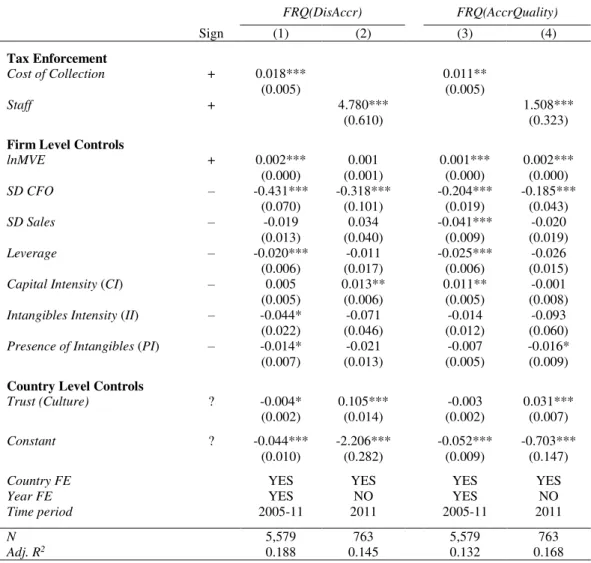
Table 2.6: Effect of tax enforcement on financial reporting quality 79 Table 2.7: The role of firm level of tax avoidance on the relation between tax
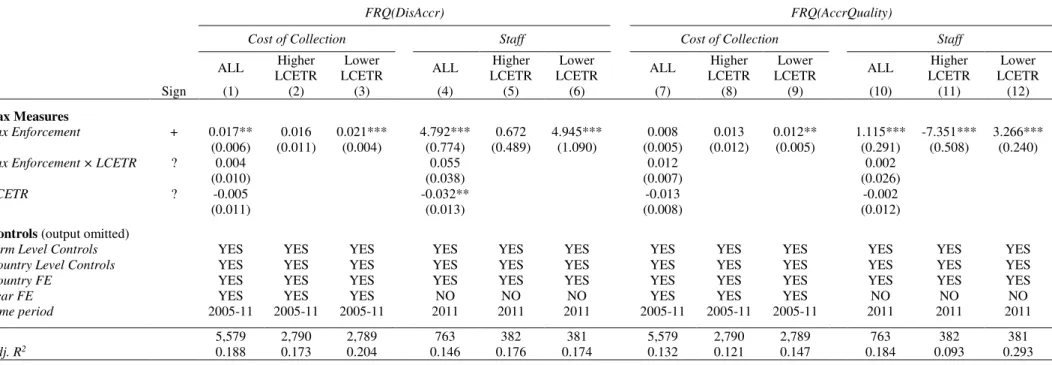
enforcement on financial reporting quality 80
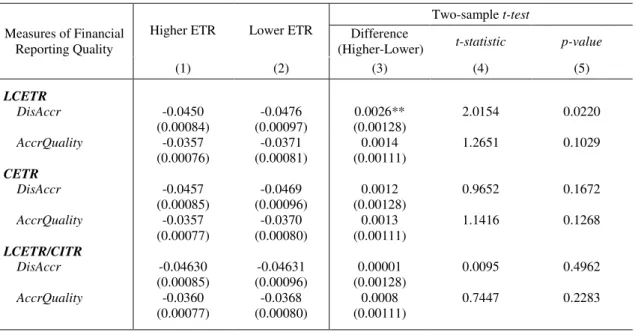
Table 2.8: Mean comparison of financial reporting quality by levels of tax avoidance 81 Table 2.9: The role of statutory corporate income tax rates on the relation between tax
enforcement and financial reporting quality 82
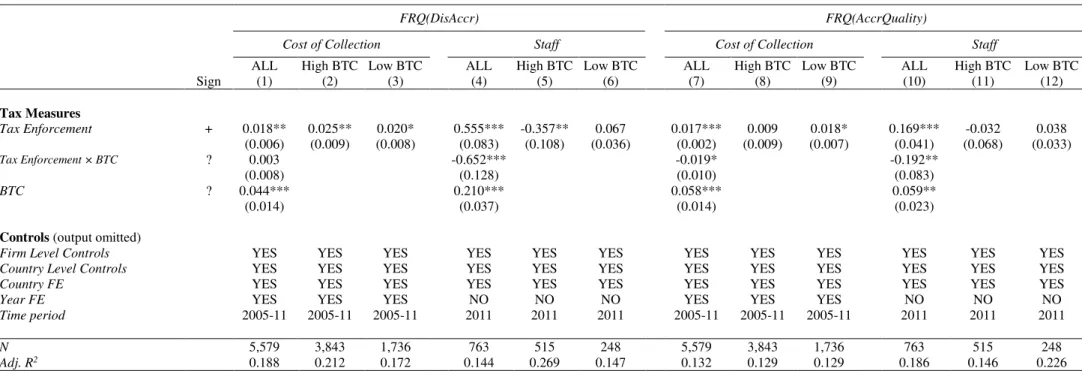
Table 2.10: The role of book-tax conformity (BTC) on the relation between tax
enforcement and financial reporting quality 83
Table 2.11: Discriminant analysis for book-tax conformity as grouping variable 84 Table 2.12: The role of legal origin on the relation between tax enforcement and
financial reporting quality 85
Table 2.13: Discriminant analysis for legal origin as grouping variable 86 Table 2.14: Robustness check: institutional controls 87 Table 2.15: Robustness check: alternative measures of tax avoidance 88 Table 2.16: Robustness check: random/fixed effect specification at firm level 89
Table 3.1: Number of firms by country (fiscal year of 2012) 125
Table 3.2: Data and variables construction 128
Table 3.3: Descriptive statistics 130
Table 3.4: Correlation analyses 131
Table 3.5: Determinants of mandatory disclosure of income taxes 132 Table 3.6: Determinants of voluntary disclosure of income taxes 133 Table 3.7: Effect of disclosure of income taxes on firm value 134 Table 3.8: Additional analyses: level of tax avoidance 136 Table 3.9: Additional analyses: quality of corporate governance 137
x
Table 3.11: Effect on firm value: random/fixed effect specification at country level 139 Table 3.12: Effect on firm value: alternative measures of tax avoidance 140 Table 3.13: Method for constructing disclosure scores on IAS 12 (Income Taxes) 141
Table 4.1: Portuguese statutory corporate income tax rates and reduced corporate
income tax rates applicable in eligible municipalities 185
Table 4.2: Data and variable construction 186
Table 4.3: Number of new firms pre and post the introduction of reduced corporate
income tax rates (1995 through to 2009) 187
Table 4.4: Descriptive statistics at municipality level 188 Table 4.5: Effect on firm creation and job creation 189
Table 4.6: Effect on firm creation: by firm size 191
Table 4.7: Effect on firm creation: by level of technological intensity, and industry 192
Table 4.8: Effect on new firms’ survival likelihood 193
Table 4.9: Robustness check 194
Table 4.10: Chronology of the legislative process of the Portuguese tax incentives to
inlandness 200
xi
List of Figures
Figure 2.1: Country variation on tax enforcement 77
Figure 3.1: Country variation on mandatory disclosure of income taxes 125 Figure 3.2:Test of H1 (Determinants): mandatory disclosure of income taxes and tax
avoidance 126
Figure 3.3:Firm value and tax avoidance 126
Figure 3.4:Test of H2 (Consequences): firm value and mandatory disclosure of income
taxes 127
Figure 3.5:Crossover interaction 135
Figure 4.1:Map of eligible and non-eligible municipalities for the ‘Portuguese tax
incentives to inlandness’ 184
xii
-1
1.
Introduction and Thesis Overview
1.1. Introduction
Research in taxation addresses several interesting questions with practical
implications for society. How do firms’ tax avoidance strategies and enforcement by tax
administrations shape firms’ financial reporting? Why do some firms disclose more
information about income taxes than others do, and how do investors value disclosure? Does the introduction of reduced corporate income tax rates in specific locations triggers firm and job creation? These questions are addressed in the three self-contained empirical papers of this thesis.7 The three empirical papers study different issues with a common theme: corporate taxation. This thesis is therefore connected to at least three strands of literature on taxation: (i) literature on tax enforcement and tax compliance; (ii) literature on disclosure of tax information, and; (iii) literature on tax incentives. This thesis therefore explores the consequences of corporate taxation on financial reporting, value, and firm creation.
Governments have put in place mechanisms to enforce their claims over firms’
pre-tax earnings. These enforcement mechanisms might well shape firms’ decisions
with regards to tax avoidance strategies, which inevitably influences financial reporting. On the other hand, the disclosure of income taxes during the financial reporting process might be viewed by shareholders in a twofold rational, as is discussed further below. On the other hand, governments might implement tax incentives in order to trigger
7 Throughout this thesis, we refer to the tax administration as being the government agency with the main legal
2
economic growth and job creation, such as lowering corporate income tax rates. An understanding of the several ramifications of the consequences of tax systems through different perspectives is required to shape tax environments in a more competitive
manner. For instance, the recent ‘tax inversion’ in the US, which followed on from the
fact that most firms are subject to high corporate income tax rates, shows the need to link taxation as a part of accounting research with taxation as party of economic research. By means of mergers and acquisitions, firms are shifting their domicile abroad to low-tax countries, such as the UK, the Netherlands, and Finland. These firms are also starting to relocate executives and head-office functions to the new tax domicile, as a tactical manoeuvre in order to anticipate the more demanding requirements of low-tax jurisdictions (The Economist, 2015, p. 57). As a consequence of the ‘tax inversion’ of
some of US larger firms, The Economist (2015, p. 57)says that “America is starting to lose not just tax revenues but jobs too”.
1.1.1.Taxation as a Multidisciplinary Field of Study
3
influence on another decision that is studied in accounting literature. For instance, let us
consider a government’s decision to implement tax incentives in order to foster firm
creation and as a way of encouraging the relocation of existing firms, which is reported in the economic and public finance literature. The intention of these existing firms might be to relocate their headquarters as a pure tax avoidance strategy and, inevitably, the relocation of headquarters, in one way or another, will influence firms’ financial reporting. In addition, the organisational form might shape firms’ tax avoidance
strategies. These topics are also widely studied in the accounting and finance literature.
From the perspective of taxation for both accounting and economic research, the range of issues emphasised in the literature is broad, and some of them are still far from
consensus. Taxation in the accounting and finance literature “includes tax research that
contributes to academic literature on the measurement and reporting of accounting information, the management and organisation of accounting functions, and the interaction between accounting information and capital market behaviour and individual
financial decision making.” (Lamb, 2005, p. 62). Of particular interest for the thesis is
the measurement and reporting of accounting information, combined with its interaction to capital markets (Chapter 3). In addition, how corporate tax avoidance strategies shape
firms’ financial reporting response to tax enforcement mechanisms (Chapter 2).
Taxation in economic literature focusses on the influence of taxation on the production and distribution of wealth (James, 2005), which is mostly covered by the public finance literature. In the words of James (2005), “a general theme in tax research
4
return these resources to society, though a balance between the equal redistribution of income and the supply of public goods. This implies that corporate taxation inevitably affects a wide range of economic decisions. Governments have mechanisms for conquering these goals. Monetary policy and fiscal policy play a role in determining economic growth, low levels of unemployment, and price stability (James, 2005). For
example, the introduction of tax incentives might shape firms’ and individuals’
incentives to work, save, and invest. Chapter 4 of this thesis focusses specifically on the consequences of tax incentives on decisions to create firms.
In recent years, research in taxation started to link different research fields and perspectives. In particular, researchers started to link public policies with financial accounting. The testimony about tax reform options in the US of Michelle Hanlon, a leading tax researcher and the editor of the Journal of Accounting and Economics, illustrates the complementarity of these research fields:
“The main point of my testimony is that financial accounting implications
for publicly traded companies can influence the effectiveness of tax policies, including policies related to investment. The financial accounting effects represent a non-tax cost (or benefit) that public companies consider in their decision-making process. Thus, public companies’ responses to tax policies
are not only governed by the tax effects, but also the financial accounting effects, often producing unintended consequences.” (Hanlon, 2012)
Michelle Hanlon highlights the fact that some tax policies influence firms’ financial
reporting and that managers trade-off both issues during their decision-making process. Furthermore, in a review of accounting quality literature with the adoption of IFRS,
5
as taxation.8 Indeed, all levels of Devereux and Maffini (2007) framework on multinational decisions are found in both accounting and economic research about taxation.9 For instance, location decisions proxied by foreign direct investment (FDI) flows appear to be positively influenced by corporate income tax rate cuts (de Mooij & Ederveen, 2003). On the other hand, there is evidence in the literature that firm’s
ownership structures are chosen as a response to legal and tax rules which are imposed by host countries (Lewellen & Robinson, 2013). Moreover, flexibility in reporting is valuable during the decision to locate investments (Shackelford, Slemrod, & Sallee, 2011). Dyreng and Lindsey (2009) focus on multinationals’ decisions to locate their
investment. They find out that operations in tax havens might benefit tax collection in a non-tax haven country in some cases. These are some examples of the interminglement of tax literature as accounting and as economic research that may fit into the same theoretical framework.
In this doctoral thesis, both accounting and economic approaches to taxation can be found. This is not a result of the research developed in each empirical paper covering different perspectives to study the same issue. Rather, the focus of the self-contained empirical papers is on different issues which should be studied through different perspectives of taxation research. It should be added that research in taxation developed in this thesis is always of a positive nature, rather than of a normative one.
1.1.2.Philosophical Approach
Research in taxation is dominated by a positivist approach to knowledge. The positivist approach is found in several ramifications of research in taxation, and in
8 IFRS is used here intangibly to refer to the accounting standards issued by the International Accounting Standard
Board (IASB) which were adopted by the European Commission.
6
particular, in research in taxation as accounting and economic research. This is a consequence of research in taxation being developed through using sophisticated data analyses. Nevertheless, the study of Oats (2012, p. 6) claims the need for tax researchers
to “become more reflexive and receptive to methodological and philosophical debates
taking place in other disciplines”. The author attempts to provide a framework for a
stream of research in taxation which is based on philosophical approaches other than positivist ones.
I position myself as being pragmatic in terms of the way I understand scientific knowledge. The research methods developed are of secondary interest, which means that the research questions being studied are the central issue. Decisions regarding research methods are of second-order of importance and are adapted to not only the research questions, but also to the field of study. Nonetheless, the research conducted in this thesis is of a positivism nature. Quantitative data is essential for answering research questions in each empirical paper of this thesis. Thus, the interpretation of the effects of corporate taxation in this thesis is not biased on the researcher’s view of the
phenomenon being studied, and conclusions drawn from econometric analyses might be generalised to other contexts.
1.2. Corporate Tax Avoidance
1.2.1.Definition
There is no consensus in the literature regarding a common definition of corporate tax avoidance. Some authors define the activity of avoiding taxes broadly. For instance,
7
taxes”. Dyreng, Hanlon, and Maydew (2008) narrow the definition to a time range:
“anything that reduces the firm’s cash effective tax rate over a long time period, i.e., ten
years”. These definitions somehow include both legal and illegal means of reducing
firms’ tax liability, as it is hard to assess the boundaries of legality. Some authors omit
illegal activities from their definition of tax avoidance. For instance, Slemrod and Gillitzer (2014, p. 11) consider that tax avoidance strategies are in place when
“taxpayers will re-arrange their affairs to legally reduce their tax liability, including
efforts to reduce their tax liability without altering real activities”. Tax avoidance might be defined as being just “legal actions taken to reduce tax liability” (Slemrod, 2004).
Similarly, the Cambridge Business English Dictionary defines tax avoidance as being “a
legal way of reducing the amount of tax a person or company would normally pay”10.
Sometimes the literature refers to tax avoidance and tax aggressiveness intangibly, and states that both include legal and illegal means of reducing corporate tax liability. Researchers often limit tax avoidance to legal activities, although they use proxies that inevitably capture both legal and illegal activities. Throughout this thesis, we adopt a broad definition of corporate tax avoidance of Dyreng et al. (2008), and do not distinguish between legal and illegal activities of avoiding taxes. The term tax evasion is exclusively used to refer to illegal activities.
The concept of tax avoidance is narrowed in the literature to tax aggressiveness, which is further narrowed to tax sheltering. Tax aggressiveness, as a component of tax
avoidance, can be defined as “behavior in which tax burden reduction is of first order
importance, with pre- or non-tax effects viewed as second-order, or marginal” and tax
aggressiveness “is a matter of judgment, degree, and scope” (Lisowsky, 2010). To
8
address a broad definition of corporate tax sheltering, the Treasury (1999) highlights its
main characteristics as including “lack of economic substance; inconsistent financial
and accounting treatment; presence of tax-indifferent parties”, amongst others. More
recently, Bankman (2004) refers to tax shelters as being “an activity that runs counter to
the intent of the legislature, so that we may expect that once a shelter becomes public,
the legislature will take steps to shut down the shelter”. Being transactions prohibited by
tax administrations, tax shelters are more severe than tax aggressiveness (Lisowsky, 2010), and are a special case of corporate tax avoidance which is likely to include illegal
means of reducing firms’ tax liability.
1.2.2.Measuring Corporate Tax Avoidance
To complement the broad definition of corporate tax avoidance presented above, among other related definitions, the literature has addressed several measures of corporate tax avoidance. Hanlon and Heitzman (2010) synthetise twelve tax avoidance measures and then group them into six groups: (i) effective tax rate measures; (ii) long-run effective tax rates; (iii) book-tax differences; (iv) discretionary or “abnormal” measures; (v) unrecognised tax benefits, and; (vi) tax shelters. More recently, Jacob and Schütt (2015) propose a new tax avoidance measure, based on a tax planning score, which captures the relation between historical levels of tax avoidance and variations in statutory tax rates. There is no universal consensus regarding a unique measure of corporate tax avoidance, either in the literature, or in practice. Which measures are
taken into consideration in managers’ decision-making processes? Graham, Hanlon,
9
decision-making process, rather than marginal tax rates, which are more complex to compute, due to features of the tax code on corporate income.11
A major constraint for establishing a common measure of tax avoidance might arise from several reasons. Firstly, information from firms’ financial statements should be complemented with firms’ tax returns, although the latter is rarely disclosed, either by
firms, or by tax administrations. Whether tax returns should be public is a question which is already addressed in the literature, although far from our scope. The research of Lenter, Slemrod, and Shackelford (2003) on this topic is widely recommended. Secondly, each measure focusses on different issues of corporate tax avoidance, which might include conforming and non-conforming tax avoidance. By conforming tax
avoidance, we refer to strategies “in which financial accounting income is reduced when
the tax strategy is employed” (Hanlon & Heitzman, 2010).
The first two groups of tax avoidance measures are often combined and comprise the main proxies used throughout this thesis. These effective tax rate measures influence both profits and liquidity. Distinguishing between the two impacts depends on whether a researcher focusses on book-based measures, or cash-based measures. Measures that only influence profits are indeed incomplete for use as a proxy for tax avoidance, as they mostly capture current tax expense and do not consider deferral tax strategies.
Dyreng et al. (2008) developed the measure labelled as “long-run cash effective tax
rate” (LCETR)12, which extends a previous measure – the cash effective tax rate over
one year (CETR). They show that LCETR captures long-run tax avoidance strategies more accurately and exhibits higher comparability across firms than other tax avoidance
11 Marginal tax rates correspond to the present value on taxes of an additional dollar of income, and are computed
considering specificities of the tax code.
12LCETR is measured as being the aggregate cash tax paid to the tax administration over a time range (three, five, or
ten years), scaled by aggregate pre-tax earnings within the same time range. For ease of interpretation, this measure is
10
measures, due to its ease of calculation. As it measures the overall cash tax paid to the
tax administration scaled by firms’ overall pre-tax earnings in a wide time range,
LCETR is not biased to the source of income and whether taxes are already paid. It
therefore captures firms’ global tax avoidance strategies, thus allowing researchers to
perform cross-section comparisons.
1.2.3.Competing and Complementary Theories on Corporate Tax Avoidance: the
Traditional Perspective versus the Agency Perspective
The traditional perspective on corporate tax avoidance argues that managers, by
engaging in tax avoidance strategies, behave in their shareholders’ best interest – which
is a mechanism to transfer value from the State to shareholders. Tax avoidance
strategies decrease firms’ tax liability, and thus increase the present value of future cash
flows available to shareholders. This corresponds to most of the framework of the classical work of Scholes, Wolfson, Erickson, Maydew, and Shevlin (2009, p. 3), as
“the taxing authority is an uninvited party to all contracts”. Under the traditional
perspective on corporate tax avoidance, shareholders are expected to respond positively
to news about firms’ involvement in strategies for avoiding taxes. However, recent
empirical evidence states that shareholders might penalise, or might not value tax avoidance strategies (e.g., Desai and Dharmapala (2009a); Wahab and Holland (2012)).
11
reputational costs of corporate tax avoidance strategies.13 A more prominent question is whether managers might be interested in paying more taxes. This question confronts a large stream of the literature in taxation. Recent developments in the taxation literature has brought controversy to this question. For instance, Erickson, Hanlon, and Maydew (2004) found evidence that firms pay more taxes in order to inflate accounting earnings. This finding calls for the primitive conflict of interest between the agent and the principal. This conundrum in the empirical evidence led to tax researchers refocussing on determinants of corporate tax avoidance, which resulted in the consolidation of the agency perspective on corporate tax avoidance (Desai & Dharmapala, 2009b).14
The agency perspective on corporate tax avoidance incorporates agency tension between managers and shareholders, as managers might use tax avoidance strategies as a mechanism of managerial opportunism and rent diversion. Desai and Dharmapala (2006) theorise that firm value is reduced if managers have both the incentive to reduce the corporate income tax liability through the understatement of taxable income, and the opportunity to understate the accounting profit. Chung, Goh, Lee, and Shevlin (2015)
demonstrates empirically that, in fact, managers extract rents from shareholders through tax avoidance strategies, and the effect is mitigated for firms with better monitoring mechanisms. According to the agency perspective on corporate tax avoidance, strategies for avoiding taxes lead to a lack of transparency, whereby information asymmetry increases. Despite the increase in free cash flows from tax avoidance strategies, shareholders place a premium on the increase of information asymmetry, by raising their cost of equity capital (e.g., Francis, Khurana, and Pereira (2005)). This behaviour
13 When the introduction of a tax scheme which led to paying almost no corporate taxes in the UK was revealed to
public, Starbucks faced a drop in sales and decided to voluntarily give about £20 million to the British tax authority in 2014, in order to prevent protests and boycotts that were affecting its sales.
14Desai and Dharmapala (2009b) refer to this as “narrowly, an ‘agency perspective on tax avoidance’ or, more
12
takes place because shareholders do not exclusively care about expected future cash flows (Shackelford et al., 2011). Instead, in their real decisions they are also concerned
about managers’ discretion over the timing of taxable income and/or book income
(Shackelford et al., 2011). Likewise, shareholders view some tax avoidance strategies negatively, as they may be a sign of involvement in tax fraud and tax shelters, amongst others (Hanlon & Slemrod, 2009).
To the best of our knowledge, the agency perspective on corporate tax avoidance incorporates two dimensions. Firstly, compensation arrangements to align managers and shareholders. Desai and Dharmapala (2006) find that incentive compensation is a significant determinant of tax avoidance activities across firms. On the other hand,
Minnick and Noga (2010) suggest that incentive compensation drives tax avoidance in the long-run, leading to higher returns for shareholders. Armstrong, Blouin, Jagolinzer, and Larcker (2015) find that the effect exerted by corporate governance on tax avoidance is found at the upper and lower tails of tax avoidance distribution. The effect is positive (negative) in the lower (upper) tail, meaning that different agency issues might arise from both extreme levels of tax avoidance. Ammann, Oesch, and Schmid (2011) construct two corporate governance indices, based on a set of 64 individual
governance attributes. They find a statistically positive association between firm’s level
of corporate governance and firm’s valuation. After tracking executives that served as
top executives at more than one firm, Dyreng, Hanlon, and Maydew (2010) find evidence that individual executives (either CEOs or CFOs) play a significant role in determining the level of tax avoidance. Armstrong, Blouin, and Larcker (2012)
demonstrates that incentive compensation of the tax director is negatively associated
13
director. Empirical evidence also shows that managers who are personally tax aggressive, tend to encourage their companies to be tax aggressive (Chyz, 2013).
Badertscher, Katz, and Rego (2013) suggest that greater separation between ownership and control leads to tax aggressiveness. In line with this finding, Chen, Chen, Cheng, and Shevlin (2010) provide evidence that non-family firms are more tax aggressive than family firms (i.e., firms that are owned or run by founding family members).
The second dimension regards enforcement by tax administration, which might
facilitate shareholders in monitoring managers’ actions. Tax enforcement will likely
involve penalties for detected non-compliance (Crocker & Slemrod, 2005), and thus higher enforcement might decreases managers tendency to practice tax avoidance. Consequently, this helps aligning managers and shareholders in a model where shareholders view tax avoidance as a value-diversion strategy. Xu, Zeng, and Zhang (2011) provide evidence for this second dimension, in which tax enforcement may serve as a corporate governance mechanism.
In a paper entitled ‘Theft and Taxes’, Desai, Dyck, and Zingales (2007) design a
triangular game for explaining the dynamics of firms’ value diversion and the amount of
taxes paid. This triangle includes the vertex of firms’ Insiders, the one related to
14
In a third interaction, Insiders might promote interest with the tax administration, if they are allowed to maximise their wealth, at the expense of sacrificing shareholder value creation. We add to the intuition of Desai et al. (2007), that tax incentives are somewhat a form of collusion between firms and tax administrations, which might either promote,
or constrain shareholders’ value.
1.3. Contextualising this Research
Devereux and Maffini (2007) set out a decision tree framework of four levels for the decisions that multinational firms face in an international context, in which taxation plays a role. They state that the primarily decision faced by firms is a location decision
– where to locate a new plant (first level) and in how many jurisdictions a multinational
should be located (second level). This address an important question: whether to produce at home and export, or to produce abroad? These two levels regard discrete choices that are expected to be relatively stable throughout time. On the contrary, the third and fourth levels of decision-making are dynamic, as they involve continuous choices and are conditional on the location decision in the first two levels. These levels of decision-making relate to the amount of capital expenditures applied in each jurisdiction (third level), and to the allocation of profits (fourth level). While the first, second, and third levels of decisions concern investment decisions, the fourth level relates to profit decisions. Both the accounting and economic perspectives of the tax literature study all of these levels of decisions.
To ‘control’ the effect of tax avoidance on managers decisions, governments might
15
detection and further prosecution of taxpayers with detected illegal tax avoidance. Secondly, the strengthening of penalties to be applied to these evaders. At least a third and a fourth policy responses might also be addressed. The requirement of additional
financial reporting in order to ease the assessment of firms’ taxable income and the
detection of illegal tax avoidance. Fourthly, governments might shape tax avoidance by implementing tax incentives, or through corporate income tax rate cuts. The three self-contained empirical papers of this thesis fit with the insights of Devereux and Maffini (2007) and Crocker and Slemrod (2005).
1.3.1.The Role of Tax Enforcement on Financial Reporting
Whether or not higher tax enforcement should be in place for the benefit of all taxpayers is a decision which is often faced by governments. A “tighter enforcement is
sometimes a more socially desirable way to raise revenue than an increase in statutory tax rates. Increased enforcement raises administrative costs but does not impose a greater burden on compliant taxpayers.” (Slemrod & Gillitzer, 2014, p. 8). However, enforcement might also spread benefits to shareholders. Tax enforcement by the tax
administration might serve as a mechanism to mitigate the ‘agency problem’ between
firms and shareholders. Desai et al. (2007) argue that tax enforcement disciplines managers, by discouraging wealth diversion from shareholders, which means that tax enforcement should mitigate incentives for tax avoidance. A major assumption of this
stream of literature is that managers are not aligned with shareholders’ interests.
16
reporting is affected. The reason why firms’ financial reporting quality might be
improved by higher enforcement by tax administrations is due to a spillover effect from the incentives for tax avoidance, as managers’ choices over tax issues inevitably
influence the quality of financial information reported to outsiders. Financial reporting is a mechanism for dealing with information asymmetry between managers and shareholders. Recent evidence suggests that tax enforcement decreases information asymmetry by triggering financial reporting of a higher quality (Hanlon, Hoopes, & Shroff, 2014).
Chapter 2, which corresponds to the first self-contained empirical paper, focusses on decisions that fit into both discrete and continuous choices of Devereux and Maffini (2007) framework. This aims to understand the role of corporate tax avoidance in the
relation between tax enforcement and firms’ financial reporting quality. Hanlon et al.
(2014) in a US-based study demonstrate that tax enforcement is positively associated
with financial reporting quality, due to a spillover effect from firms’ tax avoidance
strategies. The spillover effect is a key assumption in their study, although it is not tested, as their focus is on the quality of corporate governance.
A large amount of field studies find an overall positive relation between enforcement
by the tax administration and taxpayers’ compliance, and this effect might: vary with
17
instructions regarding self-reporting (Wenzel & Taylor, 2004). The studies of Hoopes, Mescall, and Pittman (2012) and Atwood, Drake, Myers, and Myers (2012) also find a negative association between tax enforcement and tax avoidance, although they fail to understand whether this relation is strong for all levels of the tax avoidance distribution. The simple view that tax enforcement mitigates tax avoidance, which in turn improves financial reporting quality, is not clear in the literature, especially outside the US, and this is a gap in the literature that requires further research.
Through an analysis using 5,579 firm-year observations of firms listed on the stock exchange of 14 European countries, over a time range from 2005 to 2011, is tested as to
whether firms’ level of tax avoidance plays a crucial role in the relation between tax
enforcement and financial reporting quality. The research question in Chapter 2 is as follows:
Does the influence of countries’ tax enforcement on firms’ financial reporting quality
varies with firms’ level of tax avoidance?
In addition to answering this question, the main objectives in this Chapter are to assess whether:
higher tax enforcement by tax administrations improves firms’ financial
reporting quality;
the relation described above is driven either by firms’ level of tax avoidance,
or by statutory corporate income tax rates at country level;
countries’ preferences for book-tax conformity influences the relation
18
the relation between countries’ tax enforcement and firms’ financial reporting
quality varies according to countries’ legal origin.
1.3.2.The Role of Disclosure on Firm Value
Regarding the third policy response to tax avoidance, which is described in Section 1.3 – through financial reporting – the literature points out that corporate misreporting is an important source of illegal tax evasion (Slemrod, 2004). The corporate information environment is comprised of three types of decisions (Beyer, Cohen, Lys, & Walther, 2010): (i) managers’ voluntary disclosure decisions; (ii) disclosures mandated by
regulators, and; (iii) reporting decisions by analysts. The focus of the second empirical paper (Chapter 3) is on the first two types.
Listed firms are required to provide information to stakeholders, in order to mitigate information asymmetries. The disclosure of tax-related information is a mechanism for increasing the transparency of tax avoidance activities, although two types of players are more likely to be interested in the disclosure of income taxes – shareholders and the
tax administration. Both players share an interest in firms’ profits. Shareholders expect
to be rewarded with a fraction of a firms’ net profits, whereas the tax administration acts
as a masked shareholder, claiming a priority interest in pre-tax profits (Scholes et al., 2009). How these players value disclosure of income taxes is an open question in the literature of taxation as accounting research.
Do firms’ corporate tax avoidance strategies influence the disclosure of information
19
and are connected to the fourth level of decision making of Devereux and Maffini (2007) framework. The tax literature on accounting research focusses on listed firms, due to a wider availability of data – annual financial reports and (occasionally) tax fillings. In the second empirical paper (Chapter 3) a cross-country analysis is performed in 2012 between 185 firms listed on the stock exchanges of 8 European countries. The research question under this paper can be summarised as:
Is disclosure of income taxes in the notes to the financial statements associated with
firms’ value?
Considering data features and research design, the main objectives proposed in Chapter 3 are to:
understand the determinants of firms’ mandatory disclosure of income taxes
under IAS 12 requirements, especially the role of tax avoidance;
understand the determinants of firms’ voluntary disclosure of income taxes,
especially the role of tax avoidance;
assess whether there is a direct relation between disclosure of income taxes
and firms’ value;
assess whether firms’ level of tax avoidance is a mechanism by which
disclosure of income taxes differently influences firms’ value;
assess whether the effect of disclosure of income taxes on firms’ value varies
20
1.3.3.The Role of Tax Incentives on Firm Creation
Regarding the fourth policy highlighted above in Section 1.3, Klemm (2010)
systematise tax incentives as follows: (i) tax holidays; (ii) special zones; (iii) investment tax credits or allowances; (iv) accelerated depreciation; (v) exemptions from various taxes; (vi) financing incentives, and; (vii) reduced tax rates. The latter type of tax incentive is the focus of the third empirical paper of this thesis (Chapter 4).
Theoretically, tax rate reductions decrease the incentives for tax avoidance, as they decrease the return of tax avoidance strategies (Desai et al., 2007). Tax avoidance strategies involve, amongst others, the managing of profits towards jurisdictions that levy a lower rate of corporate tax. Nevertheless, recent literature has come to demystify this issue. For instance, Dischinger, Knoll, and Riedel (2014) find that firms prefer to locate their earnings in the headquarters’ jurisdiction, even when corporate taxes are
higher than those of other jurisdictions in which firms operate. Specifically, a significant flow of income is shifted from subsidiaries to parent firms when parent firms face lower corporate income tax rates, whilst the opposite movement is reduced by more than 70%, when subsidiaries face a lower corporate tax burden than the parent
21
existing corporate income tax rate differentials, rather than on the first creation of the differential.
Chapter 4 focusses on the period of creation of a fiscal policy which was designed to trigger firm creation in specific locations, and is connected to the first level of decision-making of Devereux and Maffini (2007) framework, although it is not exclusive to multinational firms. The scope is narrowed in this Chapter for a sample of firms at Portuguese municipality level, per month, from 1995 to 2009. Thus, in the third empirical paper (in Chapter 4) the research question is as follows:
Does the introduction of reduced corporate income tax rates at regional level
increases firm creation?
In this context, the main objectives of this empirical paper are to:
assess whether firm creation increased during the period of introduction of
reduced corporate income tax rates at regional level, as a consequence of the tax change;
assess the influence of border competition on firm creation (i.e., between municipalities eligible for the tax change versus neighbouring municipalities which are non-eligible);
assess whether job creation increased in the period of introduction of reduced corporate income tax rates at regional level, as a consequence of the tax change;
22
understand whether survival likelihood improved for new firms located in
municipalities that benefitted from the tax change.
1.4. References
Alm, J., Jackson, B. R., & McKee, M. (2009). Getting the word out: Enforcement information dissemination and compliance behavior. Journal of Public Economics, 93(3-4), 392-402.
Ammann, M., Oesch, D., & Schmid, M. M. (2011). Corporate governance and firm value: International evidence. Journal of Empirical Finance, 18(1), 36-55. Armstrong, C. S., Blouin, J. L., Jagolinzer, A. D., & Larcker, D. F. (2015). Corporate
Governance, Incentives, and Tax Avoidance. Journal of Accounting and Economics, 60(1), 1-17.
Armstrong, C. S., Blouin, J. L., & Larcker, D. F. (2012). The incentives for tax planning. Journal of Accounting & Economics, 53(1-2), 391-411.
Atwood, T. J., Drake, M. S., Myers, J. N., & Myers, L. A. (2012). Home Country Tax System Characteristics and Corporate Tax Avoidance: International Evidence.
The Accounting Review, 87(6), 1831-1860.
Austin, C. R., & Wilson, R. J. (2015). Are Reputational Costs a Determinant of Tax Avoidance? 2013 American Taxation Association Midyear Meeting: Tax Avoidance in an International Setting.
Badertscher, B. A., Katz, S. P., & Rego, S. O. (2013). The separation of ownership and control and corporate tax avoidance. Journal of Accounting and Economics, 56(2-3), 228-250.
Bankman, J. (2004). The tax shelter problem. National Tax Journal, 57(4), 925-936. Beyer, A., Cohen, D. A., Lys, T. Z., & Walther, B. R. (2010). The financial reporting
environment: Review of the recent literature. Journal of Accounting and Economics, 50(2-3), 296-343.
23
Castro, L., & Scartascini, C. (2015). Tax compliance and enforcement in the pampas evidence from a field experiment. Journal of Economic Behavior & Organization, 116, 65–82.
Chen, S. P., Chen, X., Cheng, Q., & Shevlin, T. (2010). Are family firms more tax aggressive than non-family firms? Journal of Financial Economics, 95(1), 41-61.
Chung, S. G., Goh, B. W., Lee, J., & Shevlin, T. (2015). Corporate Tax Aggressiveness and Managerial Rent Extraction: Evidence from Insider Trading. Working Paper.
Chyz, J. A. (2013). Personally tax aggressive executives and corporate tax sheltering.
Journal of Accounting and Economics, 56(2-3), 311-328.
Crocker, K. J., & Slemrod, J. (2005). Corporate tax evasion with agency costs. Journal of Public Economics, 89(9-10), 1593-1610.
Da Rin, M., Di Giacomo, M., & Sembenelli, A. (2011). Entrepreneurship, firm entry, and the taxation of corporate income: Evidence from Europe. Journal of Public Economics, 95(9-10), 1048-1066.
de Mooij, R., & Ederveen, S. (2003). Taxation and foreign direct investment: A synthesis of empirical research. International Tax and Public Finance, 10(6), 673-693.
de Mooij, R., & Nicodème, G. (2008). Corporate tax policy and incorporation in the EU. International Tax and Public Finance, 15(4), 478-498.
DeBacker, J., Heim, B. T., Tran, A., & Yuskavage, A. (2015). The Impact of Legal Enforcement: An Analysis of Corporate Tax Aggressiveness after an Audit.
Journal of Law and Economics, forthcoming.
Desai, M. A., & Dharmapala, D. (2006). Corporate tax avoidance and high-powered incentives. Journal of Financial Economics, 79(1), 145-179.
Desai, M. A., & Dharmapala, D. (2009a). Corporate Tax Avoidance and Firm Value.
Review of Economics and Statistics, 91(3), 537-546.
Desai, M. A., & Dharmapala, D. (2009b). Earnings Management, Corporate Tax Shelters, and Book-Tax Alignment. National Tax Journal, 62(1), 169-186. Desai, M. A., Dyck, A., & Zingales, L. (2007). Theft and taxes. Journal of Financial
Economics, 84(3), 591-623.
24
Dischinger, M., Knoll, B., & Riedel, N. (2014). The role of headquarters in multinational profit shifting strategies. International Tax and Public Finance, 21(2), 248-271.
Djankov, S., Ganser, T., McLiesh, C., Ramalho, R., & Shleifer, A. (2010). The Effect of Corporate Taxes on Investment and Entrepreneurship. American Economic Journal: Macroeconomics, 2(3), 31-64.
Dyreng, S. D., Hanlon, M., & Maydew, E. L. (2008). Long-run corporate tax avoidance.
The Accounting Review, 83(1), 61-82.
Dyreng, S. D., Hanlon, M., & Maydew, E. L. (2010). The Effects of Executives on Corporate Tax Avoidance. The Accounting Review, 85(4), 1163-1189.
Dyreng, S. D., & Lindsey, B. P. (2009). Using Financial Accounting Data to Examine the Effect of Foreign Operations Located in Tax Havens and Other Countries on US Multinational Firms' Tax Rates. Journal of Accounting Research, 47(5), 1283-1316.
Erickson, M., Hanlon, M., & Maydew, E. L. (2004). How much will firms pay for earnings that do not exist? Evidence of taxes paid on allegedly fraudulent earnings. The Accounting Review, 79(2), 387-408.
Francis, J. R., Khurana, I. K., & Pereira, R. (2005). Disclosure Incentives and Effects on Cost of Capital around the World. The Accounting Review, 80(4), 1125-1162. Gallemore, J., Maydew, E. L., & Thornock, J. R. (2014). The Reputational Costs of Tax
Avoidance. Contemporary Accounting Research, 31(4), 1103-1133.
Graham, J. R., Hanlon, M., Shevlin, T., & Shroff, N. (2014). Incentives for Tax Planning and Avoidance: Evidence from the Field. The Accounting Review, 89(3), 991-1023.
Graham, J. R., Hanlon, M., Shevlin, T., & Shroff, N. (2015). Tax Rates and Corporate Decision Making. Working Paper.
Hanlon, M. (2012). Tax Reform Options: Incentives for Capital Investment and Manufacturing. March 6, 2012: United States Senate Committee on Finance. Hanlon, M., & Heitzman, S. (2010). A review of tax research. Journal of Accounting
and Economics, 50(2-3), 127-178.
25
Hanlon, M., & Slemrod, J. (2009). What does tax aggressiveness signal? Evidence from stock price reactions to news about tax shelter involvement. Journal of Public Economics, 93(1-2), 126-141.
Hoopes, J. L., Mescall, D., & Pittman, J. A. (2012). Do IRS Audits Deter Corporate Tax Avoidance? The Accounting Review, 87(5), 1603-1639.
Jacob, M., & Schütt, H. H. (2015). Firm Valuation and the Uncertainty of Future Tax Avoidance. FAccT Center Working Paper Nr. 13/2013.
James, S. (2005). Taxation Research as Economic Research. In M. Lamb, A. Lymer, J. Freedman, & S. James (Eds.), Taxation: An Interdisciplinary Approach to Research: Oxford University Press.
Klemm, A. (2010). Causes, benefits, and risks of business tax incentives. International Tax and Public Finance, 17(3), 315-336.
Kleven, H. J., Knudsen, M. B., Kreiner, C. T., Pedersen, S., & Saez, E. (2011). Unwilling or Unable to Cheat? Evidence From a Tax Audit Experiment in Denmark. Econometrica, 79(3), 651-692.
Lamb, M. (2005). Taxation Research as Accounting Research. In M. Lamb, A. Lymer, J. Freedman, & S. James (Eds.), Taxation: An Interdisciplinary Approach to Research: Oxford University Press.
Lamb, M., Lymer, A., Freedman, J., & James, S. (2005). Taxation: An Interdisciplinary Approach to Research: Oxford University Press.
Lenter, D., Slemrod, J., & Shackelford, D. (2003). Public Disclosure of Corporate Tax Return Information: Accounting, Economics, and Legal Perspectives. National Tax Journal, 56(4), 803-830.
Lewellen, K., & Robinson, L. (2013). Internal Ownership Structures of U.S. Multinational Firms Working Paper.
Lisowsky, P. (2010). Seeking Shelter: Empirically Modeling Tax Shelters Using Financial Statement Information. The Accounting Review, 85(5), 1693-1720. Minnick, K., & Noga, T. (2010). Do corporate governance characteristics influence tax
management? Journal of Corporate Finance, 16(5), 703-718.
Oats, L. (2012). Taxation: A Fieldwork Research Handbook. New York: Routledge. Pomeranz, D., Marshall, C., & Castellon, P. (2014). Randomized Tax Enforcement
26
Scholes, M. S., Wolfson, M. A., Erickson, M., Maydew, E. L., & Shevlin, T. (2009).
Taxes and Business Strategy: A Planning Approach (4th ed.). New Jersey: Pearson Prentice Hall.
Shackelford, D. A., Slemrod, J., & Sallee, J. M. (2011). Financial reporting, tax, and real decisions: toward a unifying framework. International Tax and Public Finance, 18(4), 461-494.
Slemrod, J. (2004). The economics of corporate tax selfishness. National Tax Journal, 57(4), 877-899.
Slemrod, J., Blumenthal, M., & Christian, C. (2001). Taxpayer response to an increased probability of audit: evidence from a controlled experiment in Minnesota.
Journal of Public Economics, 79(3), 455-483.
Slemrod, J., & Gillitzer, C. (2014). Tax Systems. Cambridge: The MIT Press.
Soderstrom, N. S., & Sun, K. J. (2007). IFRS adoption and accounting quality: A review. European Accounting Review, 16(4), 675-702.
Telle, K. (2013). Monitoring and enforcement of environmental regulations Lessons from a natural field experiment in Norway. Journal of Public Economics, 99, 24-34.
The Economist. (2015). Tax inversions: All my bags are packed. The Economist, Volume 416, Number 8951(August 15th - 21st 2015).
Treasury. (1999) The Problem of Corporate Tax Shelters: Discussion, Analysis and Legislative Proposals. US Department of the Treasury.
Wahab, N. S. A., & Holland, K. (2012). Tax planning, corporate governance and equity value. The British Accounting Review, 44, 111–124.
Wenzel, M., & Taylor, N. (2004). An experimental evaluation of tax-reporting schedules: a case of evidence-based tax administration. Journal of Public Economics, 88(12), 2785-2799.
27