A Work Project, presented as part of the requirements for the Award of a Master Degree in Management from the NOVA – School of Business and Economics.
ENTERPRISE ARCHITECTURE AND DIGITAL TRANSFORMATION
GRETA MARINI – 31760
A Project carried out on the Master in Management Program, under the supervision of: Professor Paulo Faroleiro
Abstract
The thesis examines the link between Digital Transformation and Enterprise Architecture, researching the implications of Digital Transformation on Enterprise Architecture, and recurring to the discipline of Enterprise Architecture in the context of Digital Transformation. Two categories of changes in the structure of organizations are identified: transformations that affect the management of internal resources, and transformations that affect how companies interact with their ecosystem. Additionally, 10 cases of Digital Transformation are modelled with an Enterprise Architecture approach. Finally, the paper suggests directions for future research on the subject.
Table of contents
Abstract ... 2
Introduction ... 4
Literature review ... 5
Literature review on Enterprise Architecture ... 5
Definition of Enterprise Architecture ... 5
Applications of Enterprise Architecture ... 5
Existing Enterprise Architecture frameworks in literature ... 6
Literature review on Digital Transformation ... 7
Definition of Digital Transformation ... 7
Digital Transformation at the organization level ... 9
Digital Transformation at ecosystem level ... 11
Enterprise requirements for Digital Transformation. ... 12
Problem and Research Question ... 13
Problem ... 13 Research Question ... 14 Proposal ... 14 Presentation of Results ... 16 Literature survey ... 16 Cases analysis ... 18 Validation ... 22 Conclusions ... 24
Limitations and Future Research Opportunities ... 24
Bibliography ... 26
List of Figures Figure 1………..………...19
Figure 2………...………..20
Introduction
Enterprise Architecture is a discipline that has its origins in Information System research and it describes the structure of an organization, along with its processes, resources and technologies (Kotusev, 2016). The practice has, among its goals, creating an IT environment that is unified and aligned to the architecture and strategy of the business, and driving the change of the organization’s structure towards the desired outcome (Lankhorst, 2013).
The Digital Transformation of companies is the result of technologically-induced changes in their processes, involving “the use of digital artifacts, systems and symbols within and around organisations” (Bounfour, 2016). However, Digital Transformation is a trend that it isn’t limited to the business aspect of the economy, but it is affecting also the public and its norms of conduct.
Digital disruption has pervaded today’s society, requiring organizations to reconfigure the way they deliver value to customers. Nonetheless, many companies have not yet defined a clear digital strategy and are not equipped to face a digital transformation of processes. While some tools to guide structural changes of businesses that include the IT perspective, such as Enterprise Architecture frameworks, are already in place, their use is still not extensive in all organizations (Goerzig and Bauernhansl, 2018).
The objective of the present study is to examine the link between Digital Transformation and Enterprise Architecture. In a double direction, the paper investigates the implications of Digital Transformation on the architecture of organizations, and it applies the discipline of Enterprise Architecture in the context of Digital Transformation.
The document is organized as follow: “Literature Review” presents a literature review on the themes of Enterprise Architecture and Digital Transformation; “Problem and Research Question” highlights gaps in existing knowledge and defines the research question; “Proposal” describes research methodology and design; “Presentation of Results”
summarizes the findings of the research; “Validation” assesses the coherence of the results; “Conclusions” draws the conclusions of the investigation; “Limitations and Future Research” identifies limitations of the investigation and recommendations for future research.
Literature Review
Literature review on Enterprise Architecture Definition of Enterprise Architecture
The discipline of Enterprise Architecture has its roots in the Information System environment. The work “A Framework for Information System Architecture” published by Zachman, 1987, is considered to be, by the majority of practitioners, the seminal Enterprise Architecture publication (Kotusev, 2016), and it followed several years of research on planning approaches to design Information Systems based on the characteristics of the business, such as strategy (King, 1978) or systems (IBM Corporation, 1975).
Even if an official definition of the term Enterprise Architecture is yet to be agreed upon, a multitude of interpretations has been given by scholars and organizations to allow an understanding of the expression (Mentz, et al., 2012). For instance, Lankhorst (2013) defines Enterprise Architecture as “a coherent whole of principles, methods, and models that are used in the design and realisation of an enterprise’s organisational structure, business processes, information systems, and infrastructure”. Hence, in the practice, the term Enterprise Architecture is used both to describe the design, or blueprint, of an organization itself, but also to indicate the discipline of analysing, designing, and planning business structures, that as a result produces the blueprint of such organization.
Applications of Enterprise Architecture
It has to be noted that the aim of Enterprise Architecture is not limited to giving a representation of an organization’s processes and structure, but it is relevant for different purposes. In previous
several objectives, such as: to represent the enterprise with an holistic perspective; to assist in the alignment between IT systems and the firm’s operating model; to identify opportunities for efficiency; to control the complexity of the organization; to assist communication and decision making; to support compliance to regulatory requirements (Ross, Weill, and Robertson, 2006; Bernard, 2012; Lankhorst, 2013).
Moreover, literature has uncovered the potential of Enterprise Architecture in business transformation: it is part of the discipline to determine, from an organizational point of view, how to achieve current and future goals of the enterprise by guiding changes in its structure. Similarly, architects improve the functionality of a building or give it a new purpose by going through the process of mapping its blueprint and outlining changes to it (Lankhorst, 2013).
Existing Enterprise Architecture frameworks in literature
To gain a better understanding of what is an Enterprise Architecture, and how it is designed, some of the frameworks of the discipline will be presented.
The Zachman Framework, in Appendix 1, first developed in 1987 by John Zachman, is a logical structure, usually taking the form of a 6x6 matrix, that provides the thirty-six categories to describe and represent an organization from different stakeholders’ perspectives (Zachman, 2018).
The Open Group Architecture Framework (TOGAF), developed by The Open Group in 1995 and subsequently updated, models the enterprise by breaking it down on four domains: business, application, data and technology architecture. The framework proposes at its core the Architecture Development Method (ADM, in Appendix 2), an iterative process aimed to create and manage architectures of an organization. The peculiarity of the ADM consists in representing the enterprise through three interconnected levels: the business layer, the application layer, and the technology layer (an example is available at Appendix 3). Nowadays,
TOGAF is the most renown methodology for Enterprise Architecture (Goerzig & Bauernhansl, 2018).
The Open Group has also developed ArchiMate, a standardized modelling language for Enterprise Architecture (archimatetool.com 2018) to describe, analyse and visualize the architecture in alignment with the TOGAF methodology.
Literature review on Digital Transformation Definition of Digital Transformation
Digital transformation is a trend that involves multiple industrial and societal areas (Gray and
Rumpe, 2017)
.
The term was first introduced by Patel and McCarthy (2000) with regards to the e-commerce phenomena. In literature, Digital Transformation has since then enriched its meaning to a more comprehensive sense: it is not limited to the adoption of online channels of distribution and marketing, but it indicates a change that affects human existence in all aspects (Stolterman and Fors, 2004).From a business point of view, Digital Transformation entails blending digital technology across the entire organization, producing changes in the way they operate and bring value to customers. Matt et al. (2015) state that Digital Transformation strategies have four dimensions that are common across industries and companies: “use of technologies, changes in value creation, structural changes, and financial aspects” (Matt, et al., 2015). Moreover, Schallmo and Williams (2018) indicate that a business transformation can be recognized as Digital when the changes of operations and models happen at a company-level by means of “value-added digitization initiatives” that are sustainable and result in an improvement of profitability. Through their definition, they underline that integrating technologies in the processes of an enterprise is a minor component of Digital Transformation, as for this purpose the technologies must also create value for the stakeholders involved.
Regarding the understanding of how data can be employed for value creation, Schildt (2017) suggests a classification of data analytics systems that distinguishes them between “open-ended systems” and “optimizing-oriented systems”. Open-ended systems have the purpose of delivering helpful insights on big amounts of data, recurring to semantic analysis or offering visualizations of numerical data.Instead, systems focused on optimization are those for which data, in the form of number or text, is analysed in order to minimize or maximize pre-defined outputs of processes. Their value consists in delivering choices that are more efficient and timelier than humans’ ones.
However, while one of the benefits of Digital Transformation is delivering an increase in efficiency, it does not have to be confused with the re-engineering of processes. Business Process Reengineering consists in the re-arrangement of processes of an organization in order to achieve cost reduction and quality improvement for products and services (Hammer and Champy, 1993). As noted by Proctor (2017), while Business Process Reengineering aims at pursuing automation of rule-based processes, Digital Transformation changes are not focused on automating processes only in the chase of efficiency, but they are also aimed at gathering data and use the data to reconfigure such rule-based processes in a novel way. Schallmo and Williams (2018) note: “the big difference […] is how employees interpret acquired know-how and use it to improve decision-making capabilities. […] digital transformation requires individuals to rethink old processes and reimagine new processes and decisions” (Schallmo and Williams, 2018). Organizations should avoid falling in the trap of focusing on technologies as an end to itself (Carr, 2003).
Companies aiming at digitally transforming themselves should implement a new way of working, ensuring that the entire organization is connected to share data, knowledge, and talent to be able to survive and succeed in the digital age: “sources of revenue, efficiency and the organization’s structure are all up for scrutiny” (Catlin, et al., 2017).
Digital Transformation at the organization level
Digital Transformation manifests itself in a variety of outcomes for companies, across the entire organization and economy. A series of examples of digital solutions in the practice are reported by Skilton (2015), spanning from digitalisation of the Supply Chain (digital channels, aggregated VMI, predictive maintenance), to Marketing (Content-to-Purchase marketing), to Financial Services (digital currencies, digital wallets, virtual payments, digital enterprise services), to Product Engineering (embedded software, machine learning and sensor services) and Human Resources (digital jobs). Moreover, the author provides additional examples in the hospitality industry (digitalisation of the customer experience) and in the general society (smart cities, digital government).
Additionally, digital disruption has brought a new approach to the management of IT and the data architecture of companies. Digital Transformation often requires the creation of a two-part environment, in which slow-paced legacy systems for critical functions are sided by the development of other systems that are instead able to support fast-moving interaction. IT systems, from a Digital Transformation perspective, have the purpose of linking all the actors and resources in the organization, and IT teams are following a continuous-delivery model to satisfy the needs for a successful and agile digitalization (Dörner and Edelman, 2015).
Another issue of digitalization emerges in the area of cybersecurity: networked companies need to implement dependable, reliable, safe and secure systems (Soley, 2014). It has already been suggested that the call for cybersecurity could be confronted with the development of standards and architectural frameworks to be used by businesses across the industry (Ernst and Frische, 2015).
Moreover, another concept worth citing in the context of Digital Transformation, is the notion of platform. In a systematic review on the platform literature, Thomas et al. (2014) identified
four streams of publications that explore the concept from different perspectives, as organizational, product family, market intermediary, and ecosystem platform.
The literature on organizational platforms investigates organizations as platforms that recombine their resources and capabilities to address market changes (for instance, the author quotes the investigations on modularity and theory of the firm by Balwin and Clark, 2000). Product family platforms are related to the technical architecture of the product and services, that allows for the interchangeability of its elements through modularity, standardization of interfaces and connectivity. An example of a product family platform is given by the automotive sector: vehicles are developed by manufacturers as an assembly of components, produced in-house or acquired from suppliers, whose combination defines the final model (Ro, et al., 2007). Regarding market intermediary platforms, a definition is provided by Parket et al. (2016) that define it as a “business based on enabling value-creating interactions between external producers and consumers” (Parker, et al., 2016). Generally, the platform owner supplies the market platform as a service or product that facilitate transactions of other products or services for which they don’t take ownership (Hagiu and Yoffie, 2009). This includes offline platforms such as credit cards and yellow pages, and online platforms such as the marketplaces eBay and Airbnb.
Finally, in the ecosystem platforms’ stream, the platform is understood as “the control point within a technology-based business system” (Thomas, et al., 2014). The term comprises both the concept of modularity and of market facilitation. An example of an ecosystem platform is Apple’s iOS, which can be enriched with the combination of different applications and that enables the interaction between smartphone users and developers through its App store. An additional relevant concept is that of modularity. Modularity is related to a platform of which features can be changed, by connecting to it modules through standardized interfaces. The attributes of the platform can, therefore, be modified without affecting the underlying
technology framework (Fiserv, 2016). Modularity is a central topic in the context of digital disruption, as the approach assists in the flexibility and speed of the organization’s responses to fast-paced technological development and changes in customer demands (Fiserv, 2016). At the same time, new technologies that improve the transmission, replication, and combination of data and software could potentially facilitate the creation of platforms and their leverage of modular technologies (Schildt, 2017a).
Digital Transformation at ecosystem level
The theme of Digital Transformation also adjoins to the shift of the view of the Supply Chain from a linear to a network perspective, supported by several authors such as Poirier and Reiter (1996), Aitken (1998) and Christopher (2011).
As Christopher (2011) notes, a firm would typically operate with several suppliers and customers, that can also be linked among each other. The author highlights the role of cooperation among several actors in the creation of value. Regarding this, it must be noted that Information Technology can potentially play a significant role in the value creation across the Supply Network because it provides the mean through which the cooperation among all actors can be achieved, as it allows them to exchange data across time and locations.
From digital disruption, new business models that take this notion to its highest degree have emerged: it is the case of the multisided platforms, for which the primary source for value creation of the business is precisely “enabling direct interactions between two or more customer or participant groups” (Hagiu, 2014). The concept of multisided platform falls within the marketing intermediary platform stream of Thomas et al. (2014), presented in the previous section.
Schrauf and Berttram (PwC, 2016b) propose what could be the evolution of the Supply Chain model, as required by digital disruption and as enabled by Digital Transformation. In the report, they present the transition from a traditional linear architecture to an integrated Supply Chain
ecosystem. The integrated supply chain ecosystem will be based on 5 pillars: transparency (supply chain members have a full view of the network), communication (information is accessible to everyone at the same time); collaboration (members coordinate the value capturing), flexibility (fast assessment of changes in the customers’ demand) and responsiveness (real-time adjustment of planning and operations) (PwC, 2016b).
The change of the context in which organizations will collaborate, and how they will collaborate, will nonetheless impact their structure. Not only their configuration should allow collaboration within company departments, but the Enterprise Architecture will have to allow collaboration across companies, through omnichannel solutions that can align objectives and processes of the organizations, resulting in “proactive acting, real-time planning, decision making and execution of supply chain responses to customer requirements and supply chain disruptions” (PwC, 2016b).
Integration among actors of ecosystems is already taking place to some level, with the development of solutions such as implementation of EDI between buyer/suppliers, or other ERP applications for Warehouse Management and similar. However, it needs to be underlined that these systems alone do not suffice to pursue Digital Transformation. As stated before, Digital Transformation is not only about the automation of processes through IT solutions, but it’s also about a change in the approach to customers, the collaboration with suppliers and relationships in the ecosystem, and the creation of new business models.
Enterprise requirements for Digital Transformation.
Westerman et al. (2014) offer a definition of what being a “Digital master” in the business environment means, identifying them as the organizations that “use to digital technologies to drive significantly higher levels of profit, productivity and performance”(Westerman, et al., 2014). In their perspective, two are the main types of capabilities required to succeed in mastering the adoption of new technologies. The first type is digital capabilities, in the meaning
of infrastructures but also human capabilities in crafting customer experience, operations, and business models. The second type of capabilities is related to leadership capabilities. As the authors stress throughout the book, to succeed in the digital era the requirements are “time, tenacity and leadership” (Westerman, et al., 2014) because its these features that allow a company to ceaseless integrate technology in the organization. Leadership, vision, and strategy are elements that are deemed to be essential to successfully take advantage of Digital Transformation also by other scholars and practitioners (see for instance Kane, et al., 2015). To conclude, Digital Transformation goes beyond traditional IT strategy because it’s not just a mean to improve business processes. It is not limited to the digitalisation and re-engineering of operations to achieve costs savings. Digital Transformation consists in the use of IT as a tool to gain an advantage over the competition and create value. To achieve a successful transformation, organizations are required to master capabilities not only in the management of IT but also in customer experience, operational processes, business models and leadership.
Problem and Research Question
Problem
Enterprise Architecture, and especially the TOGAF methodology, is a common tool to guide and implement changes to the Information Technology assets that support business processes, and it is a discipline that emerged from Information System communities and lacks popularity in the business environment. As highlighted by previous publications, with Digital Transformation organizations adopt new Information Technology assets that critically change their processes and how they relate to their ecosystem of customers, suppliers and partners. Nonetheless, there is a lack of literature on the link between Digital Transformation and Enterprise Architecture. Research about Enterprise Architecture on the matter has emerged strictly from IT environments (see for instance Hafsi and Assar, 2016, and Zimmermann, et al., 2015), while the business perspective is rather unexplored. In particular, there is a gap in
existing knowledge of an identification of the recurrent consequences of Digital Transformation on the Enterprise Architecture, that does not divide the technical aspects of digitalization from the business aspect of value creation. Filling such gap can potentially assist business practitioners in understanding the architectural changes to strategically pursue in the context of Digital Transformation, and their link to new value creation.
Research Question
In the light of the above, the paper examined the following research question:
RQ: What are the consequences of Digital Transformation on Enterprise Architecture?
Proposal
To conduct the investigation, the methodology of research involved both a qualitative and an empirical approach that comprised a qualitative synthesis of literature and the analysis of 10 case studies.
First, the research aimed at identifying, in previous publications, the recommendations of practitioners and scholars on the theme of Digital Transformation that are connected to aspects of Enterprise Architecture (such as IT structure, business processes, or organization structure). The sources of the research were the online libraries JSTOR; Google Scholar, Springer, and additional books and media content. The keywords used for the research were “digital transformation”, “organization design”, “digitalisation”, “enterprise architecture”, “IT structure”, “organization structure”.
Results have then been summarized and organized to gain a comprehensive insight into the implications of Digital Transformation on the architecture of an enterprise. Narrative research synthesis has, among its objectives, the purpose of advising professionals on best practices and introducing original perspectives on new topics (Rumrill and Fitzgerald, 2001). The use of qualitative literature synthesis as an instrument to build knowledge is supported by Denyer and Tranfield (2006).
Secondly, the research focused on identifying, in the practice, Enterprise Architecture’s changes as a result of Digital Transformation. For this purpose, 10 cases of Digital Transformation were depicted with Archi software, recurring to the ArchiMate language. The sources of information for the creation of the models is available in Appendix 4.
The effort of the models’ development was driven by the creation of a representation that can assist in the understanding of the implications of Digital Transformation on the Enterprise Architecture of an organization. The models should not only have identified with clarity the value created by the Digital Transformation, but also represented those parts of the Architecture necessary to gain an overview of the design of the digitally transformed enterprise within the context of its ecosystem.
The representations were simplified, to give a general overview of the changes following Digital Transformation on three layers of the Architecture, without considering detailed technical aspects that are not expected to bring additional value to the evaluation from a business perspective. The clustering of topically related elements is reported to be a special construct to increase the comprehensibility of knowledge representation to the intended audience (Lankhorst, 2013), therefore, the level of detail in the models is relatively low. The Viewpoints chosen for the design of the Enterprise Architectures of each case correspond to the “Motivation Viewpoint” and the “Introductory Viewpoint” proposed by Lankhorst (2013).
The “Motivation Viewpoint”, was used to understand the value created by the Digital Transformation, and it has been applied to describe the reasoning behind the introduction of the new digital technologies.
The “Introductory Viewpoint” follows the business-application-technology layered view of architecture suggested by the TOGAF framework, before and after the introduction of new digital solutions. The Viewpoint has been applied to represent: the organization’s set of business
activities, devices and software that are involved in the Digital Transformation, along with their services that realize the value creation; the logical elements in the ecosystem that are also affected by the Digital Transformation (such as clients or suppliers, and their activities); the type of relationship that link the elements together.
The “Introductory Viewpoint” has been chosen over more detailed Viewpoints because the interest of the paper is to present the architecture model only in its essence, to non-architects that may need a simpler notation than the one required by others.
General concepts and notations for the Motivation Viewpoint and the Introductory Viewpoint are presented in Appendix 5 and Appendix 6.
Finally, for the validation of the results, the research verified the coherence between the outcomes of the cases’ analysis and the theory supported by pre-existing publications.
Presentation of Results
Literature survey
The literature review has revealed several implications of Digital Transformation for the structure of enterprises. The findings are hereby presented in two categories of consequences. The first type of consequence for the organizations’ design is related to the way they manage internal resources. Companies in the pursue of Digital Transformation should shift their business structures from hierarchies to networks (Satell, 2016), to facilitate the flow of capabilities, assets and information within the boundaries, and to ensure flexibility and agility in responding to the demand that is brought by digitalization. In a more flexible and transparent organization, managers could be able to control a higher number of subordinates, and employees could be able to identify more opportunities to collaborate (Schildt, 2017b).
Organizations should tear down the organizational silos between functions (PwC, 2016a) and interconnect their own IT systems, allowing smooth and real-time sharing of information across all areas of the company. Regarding the connectivity within the company, one of the trends in
the context of Digital Transformation is the growing implementation of cloud solutions for the virtualisation of the Information Systems (Cisco, 2018). Additionally, the development of digital workspaces (Skilton, 2015), allows the workforce to acquire increasing flexibility and mobility across time and location. With a wide distribution of information, employees could self-organize their work (Schildt, 2017b).
Digitally transformed enterprises place new digital technologies and activities within the corporate structure. The use of new digital technology, such as autonomous robotics, augmented reality, simulations, additive manufacturing, alters the traditional processes.
Moreover, companies should assign talent to new units in charge of the management of cybersecurity, proprietary data and data architectures (Matt, et al., 2015) and to shared centres of excellence with the purpose of driving synergy in across the organization, run new initiatives or manage pre-existing ones (Westerman, et al., 2014).
In the context of digitalization, organizations should also nominate a Chief Digital Officer, whose role is to develop the vision for the Digital Transformation and coordinate the initiatives (Westerman, et al., 2014).
The second type of structural changes is related to the how companies interact with the ecosystem. Digitally transformed enterprises should design the organization to ensure connectivity and accessibility of the infrastructure to the ecosystem (PwC, 2016b) recurring to solutions for the sharing of information such as development of platforms for end-to-end control of the supply chain, supply chain technologies, cloud-based technologies (Accenture, 2014), and APIs (Song, 2018).
The relationships with suppliers are changed, establishing new communication systems, platforms for the exchange of data, but also new autonomous procurement (Skilton, 2015). With the adoption of new technologies, companies can also interact in novel ways with their customers, for instance developing digital channels of distribution and CRM (Skilton, 2015).
Additionally, they can expand to new market spaces: with virtualization, the business can grow its reach anywhere, to new segments and locations (Shimp, 2017).
Cases analysis
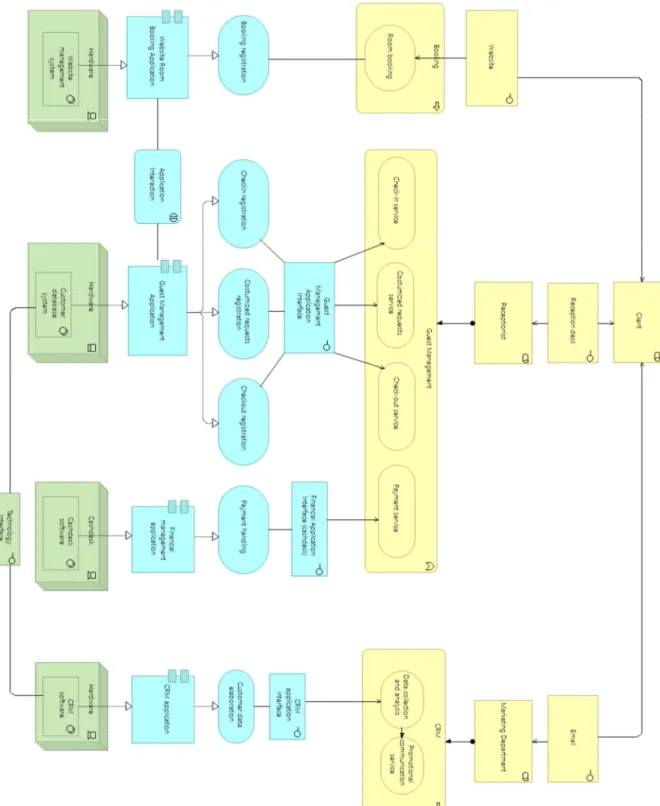
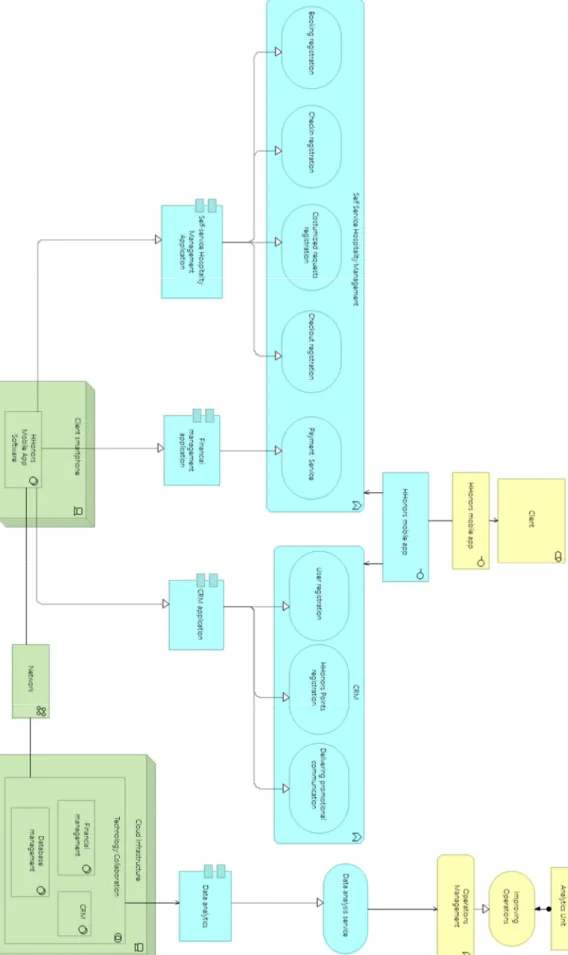
As introduced in the “Proposal” section, modelling the motivation behind Digital Transformation linked the new technology to the new value creation brought in by the transformation, and modelling the enterprise through the business-application-technology view highlighted how the new technologies are associated to changes in the structure of the operations. The complete results are available in Appendix (Appendix 7 to Appendix 16). In each of the models, the Motivation Viewpoint is linking the introduction of new applications and technologies to the realization of business goals, to represent how value is created by the Digital Transformation. For instance, in the case of Digital Transformation in the hospitality industry (Hilton Case Study, Figure 1), the implementation of the HHonors Platform can be linked, through the services provided by its applications, to specific sources of value creation. As an example, the introduction of a self-service hospitality management application increases the convenience of the services for its customers, which in turn it improves their experience, and it also impacts the need of interactions between customers and personnel. This has an influence on the number of employees needed, which reduction can ultimately decrease the costs of the company.
The representation of the before and after of the Digital Transformation highlights how the structure of the organizations has changed. For example, in the hospitality industry case (Hilton Case Study, Figure 2 and Figure 3) it is possible to observe that the introduction of the HHonors Platform has had an effect on several aspects of the architecture of the business. First, the business services are now carried out through different business interfaces. For instance, the check-in of the guests does not happen anymore through the physical interface “Reception Desk”, but through the digital interface “HHonors mobile app”. Secondly, the
changes in business activities and supporting technologies have made unnecessary some of the business roles. For example, the “Receptionist” business role ceases to have its assignments, since its services are executed by an autonomous technology. Also, new application services, such as “HHonors Point registration”, have been introduced. In certain instances, the technology realizing pre-existing services has changed: this is the case, for example, of the “delivering promotional communication” service. Finally, the technology infrastructure has been transformed, and the software and data of the company has been centralized recurring to cloud solutions.
Figure 1: Motivation Viewpoint of Digital Transformation (Hilton Case Study)
Similar observations can be done also for the other cases depicted in Appendix (Appendix 8 to Appendix 16), which details are not being presented in the paper for the sake of brevity. The results show that Digital Transformation affects the Architecture of the stakeholders involved. The implications affect the business, application and technology aspects, either if the transformation takes place through the development of in-house initiatives (such as the introduction of the Hilton’s HHonors platform and Maccabi’s Healthcare Services platform) or through the integration of technologies developed externally (such as the adoption of Google Nest thermostat for office management and StatPro Revolution platform for asset management).
The motivational aspects of Digital Transformation have recurring elements, such as: automation of the work-flow for the time aspect, automation of the work-flow for cost-saving purposes; access from remote to a service, customization of services, obtain data for the open-ended improvement of operations.
Additionally, some of the alterations in the business structures are common to more than a case. In particular, recurring architectural changes are: the introduction of an internal (application) interface to exchange information within the organization, or external (business) interface accessible from remote from the stakeholders; the introduction of new technologies (devices or software); increase of direct or indirect linkages among the actors involved; shift from event-triggered process to autonomous workflows; centralization of data and software through cloud computing; decentralization of data access; increased information acquisition for open-ended purposes, reduction of business roles assigned to service.
Validation
The results of the models are coherent with the existing knowledge on the subject: the analysis of the cases has uncovered results aligned from the literature survey on the implications of Digital Transformation on Enterprise Architecture. The alignment between the recurring
architectural changes identified in the case studies and the findings from the analysis of previous publications is reported in Table 1.
Change in Enterprise Architecture with Digital Transformation
Case Study Literature
Introduction of an internal (application) interface to exchange information
Hilton, Maccabi, Telus PwC, 2016b; Bharadwaj, et al., 2013
Introduction of a remote external (business) interface to exchange information
Hilton, Google Nest, Domino’s, Maccabi, Telus, StatPro
Revolution, Airbnb, Uber, BSH Homeconnect Skilton, 2015; Bharadwaj, et al., 2013 Introduction of new technologies (devices or software) linked to value creation
Hilton, Google Nest, Domino’s, Maccabi, Telus, StatPro
Revolution, Boeing, Airbnb, Uber, BSH Homeconnect
Westerman, et al., 2014; Bharadwaj, et al., 2013
Increase of direct or indirect linkages among the actors involved
Domino’s, Maccabi, Telus, Airbnb, BSH Homeconnect
PwC, 2016b; Bharadwaj, et al., 2013
Shift from event-triggered process to autonomous flows
Google Nest, Maccabi, Telus, Boeing
Parviainen, et al., 2017; Schildt, 2017b Digitalization of business
services
Hilton, Google Nest, Domino’s, Maccabi, Telus, StatPro
Revolution, Boeing, Airbnb, Uber, BSH Homeconnect
Bharadwaj, et al., 2013 ; Parviainen, et al., 2017
Centralization of data and software through cloud computing
Hilton, Google Nest, Domino’s, Maccabi, Telus, StatPro
Revolution, Boeing, Uber, Airbnb, BSH Homeconnect
Cisco, 2018; Accenture, 2014
Decentralization of data access Hilton, Google Nest, Domino’s, Maccabi, Telus, StatPro
Revolution, Boeing, Uber, Airbnb, BSH Homeconnect
PwC, 2016b
Increased information acquisition for open-ended purposes
Hilton, Google Nest, Domino’s, Maccabi, Telus, Boeing, BSH Homeconnect
Schildt, 2017b
Reduction of business roles assigned to services
Hilton, Maccabi, Telus, Airbnb, Uber, BSH Homeconnect
Parviainen, et al., 2017; Schildt, 2017b Table 1: Observations from cases and aligned previous publications
Conclusions
The purpose of the thesis was to examine the link between Digital Transformation and Enterprise Architecture. A preliminary literature review suggested a lack of content on the matter, and in particular, of a business perspective on the subject.
In a double direction, the paper first investigated the implications of Digital Transformation on Enterprise Architecture as suggested by previous literature. From the literature synthesis, the paper identified two categories of changes in the structure of organizations: transformations that affect the management of internal resources, and transformations that affect the interactions with the ecosystem.
The second part of the paper focused instead on identifying in the practice architectural changes in the context of Digital Transformation. 10 different cases were presented, applying Enterprise Architecture tools to represent Digital Transformation. The results were aligned with the suggestions of previous authors, and highlighted that Digital Transformation is linked to several changes in the structure of enterprises. The analysis, conducted through architecture mapping, documented that the innovations of Digital Transformation can be reconducted to value creation, and that they affect the Enterprise Architecture of the entities involved across their business, application and technology level. Additionally, the paper presented implications that were recurring in more than one case, suggesting that certain types of changes and solutions are more favoured in the context.
Limitations and Future Research Opportunities
The investigation can potentially assist business practitioners on better understanding what are the architectural mutations that typically should be pursued in the context of Digital Transformation, i.e., best practices of digitalization in the Enterprise Architecture for value creation.
However, the research presents some limitations related to the use of a qualitative literature methodology, which can be affected by biases and subjectivity. To reduce bias, it could be useful to verify the findings through empirical observations on a large sample of companies or through interviews to business practitioners.
Moreover, the identification of the implications did not quantify how the changes in the architectural structure contributed to the improvement of the bottom line of companies involved in the Digital Transformation. Regarding this issue, to assist decision-making in matters of Digital Transformation, future research should focus on quantifying the effect of architectural changes on a company’s performance. For instance, researchers could survey companies to pursue a quantitative analysis and determine what type of architecture changes have had a better impact on profitability.
The paper considered ten cases of Digital Transformation, from disparate industries, from which trends have emerged. The results suggest that pursuing Digital Transformation signifies implementing, at least to some extent, similar changes in the Enterprise Architecture. In future investigations, through a more extensive survey, it could be interesting to identify if the trends differ across industries, and if some significative patterns emerge in any of them. The outcomes could produce interesting new perspectives on competition for value creation across industries. Lastly, future research could focus on the definition of a Reference Architecture for Digital Transformation. The development of a Reference Architecture could benefit business practitioners and IT professionals alike in guiding the Digital Transformation of enterprises.
Bibliography
Accenture. 2014. “Prepare for Takeoff with a Supply Chain Control Tower.”
https://www.accenture.com/_acnmedia/Accenture/Conversion-Assets/DotCom/Documents/Local/it-it/PDF_3/Accenture-Prepare-for-Takeoff-Supply-Chain-Control-Tower.pdf (accessed 11 27, 2018). Aier, Stephan, Simon Weiss, Robert Winter, and Bernhard Rytz. 2016. “Untangling EA’s Long Path of
Becoming a Partner for Business Transformation: The Case of Swiss Federal Railways.” Edited by R., Pires, L., Rinderle-Ma, S. Dijkman. IEEE 20th International Enterprise Distributed Object Computing Workshop (EDOCW). Vienna: IEEE Computer Society. 91-97.
Airbnb Inc. 2018. https://www.airbnb.com/ (accessed 11 27, 2018).
Aitken, James M. 1998. “Supply chain integration within the context of a supplier association: case studies of four supplier associations.” PhD Thesis. Cranfield University.
archimatetool.com. 2018. Archi - Open Source ArchiMate Modelling. https://www.archimatetool.com/. Barroero, Thiago, Gianmario Motta, and Giovanni Pignatelli. 2010. “Business capabilities centric enterprise architecture.” In Enterprise architecture, integration and interoperability , 32-43. Springer Berlin Heidelberg. Bennet, John L., and Mary Wayne. 2013. Coaching for Change. Routledge.
Bernard, Scott. 2012. An Introduction to Enterprise Architecture . III. AuthorHouse.
Bharadwaj, Anandhi, Omar A. El Sawy, Paul A. Pavlou, and N. Venkatraman. 2013. “Digital Business Strategy: Toward a Next Generation of Insights.” MIS Quarterly 37(2): 471-482.
Boeing. 2017. Boeing Highlights Analytics Capability with Customer Orders, New Name.
https://boeing.mediaroom.com/2017-06-19-Boeing-Highlights-Analytics-Capability-with-Customer-Orders-New-Name (accessed 11 27, 2018).
Boeing. 2018. “IoT @ Boeing: From Flight Data Recorders to Factory RFID Analytics.” conf.slac.stanford.edu. https://conf.slac.stanford.edu/xldb2018/sites/xldb2018.conf.slac.stanford.edu/files/Tues_15.50%20Ian%20Wills on%20XLDB%202018%20Boeing%20IOT.pdf (accessed 12 20, 2018).
Bounfour, Ahmed. 2016. Digital Futures, Digital Transformation: From Lean Production to Acceluction. Springer International Publishing AG Switzerland.
Carr, Nicholas G. 2003. “IT doesn't matter.” Harvard Business Review, May.
Catlin, Tanguy, Johannes-Tobias Lorenz, Bob Sternfels, and Willmott Paul. 2017. A roadmap for a digital transformation. March. https://www.mckinsey.com/industries/financial-services/our-insights/a-roadmap-for-a-digital-transformation.
Christopher, Martin. 2011. Logistics and Supply Chain Management: Creating Value-adding Networks. IV. Harlow: Pearson.
Cisco. 2018. Cisco Global Cloud Index: Forecast and Methodology, 2016-2021.
https://www.cisco.com/c/en/us/solutions/collateral/service-provider/global-cloud-index-gci/white-paper-c11-738085.pdf (accessed 11 27, 2018).
Cruise, David. 2017. What is business transformation?. https://www.changeassociates.com/blog/post/what-is-business-transformation (accessed 11 27, 2018).
Denyer, David, and David Tranfield. 2006. “Using Qualitative Research Synthesis to Build an Actionable Knowledge Base.” Management Decision 22(2): 213-227.
Domino's. 2018. Track your Order with the Domino's Tracker to Know about your Pizza. https://www.dominos.com/en/pages/tracker/#!/order/ (accessed 11 27, 2018).
Ernst, Florian, and Patrik Frische. 2015. “Industry 4.0/industrial internet of things-related technologies and requirements for a successful digital transformation: An investigation of manufacturing businesses worldwide.” Fiserv. 2016. “Taking on Digital Disruption."
https://www.fiserv.com/resources/Taking%20on%20Digital%20Disruption_Modularity%20POV.pdf (accessed 11 27, 2018).
Goerzig, David, and Thomas Bauernhansl. 2018.“Enterprise Architectures for the Digital Transformation in Small and Medium-sized Enterprises.” 11th CIRP Conference on Intelligent Computation in Manufacturing Engineering. Gulf of Naples, Italy: Procedia CIRP. 540-545.
Gray, Jeff, and Bernhard Rumpe. 2017. “Models for the digital transformation.” Software & Systems Modeling. 16(2) May: 307-208.
Hafsi, Mouaad, and Said Assar. 2016. “What Enterprise Architecture Can Bring for Digital Transformation: An Exploratory Study.” IEEE 18th Conference on Business Informatics (CBI). 83-89. Paris, France.
Hagiu, Andrei. 2014. “Strategic Decions for Multisided Platforms.” MIT SLOAN Management Review 55(2). Home Connect GmbH. 2018. https://www.home-connect.com/ (accessed 12 30, 2018).
IBM Corporation. 1975. BSP: Business Systems Planning: Information Systems Planning Guide . I. White Plains, NY.
Intel Corporation. 2011. “Maccabi Healthcare Services.”
https://www.intel.com.au/content/dam/www/public/us/en/documents/white-papers/coordinated-healthcare-from-maccabi-and-intel-paper.pdf (accessed 11 28, 2018).
Pozzi, James. 2018. Boeing Unveils New Analytics, MRO Capabilities.
https://www.mro-network.com/maintenance-repair-overhaul/boeing-unveils-new-analytics-mro-capabilities (accessed 11 27, 2018).
Kane, Gerald C., Doug Palmer, Anh N. Phillips, David Kiron, and Natasha Buckley. 2015. “Strategy, not technology, drives digital transformation.” MIT Sloan Management Review and Deloitte University Press 14: 1-25.
King, William R. 1978. “Strategic Planning for Management Information Systems.” MIS Quarterly 2(1): 27-37. Kotusev, Svyatoslav. 2016. “The History of Enterprise Architecture: An Evidence-Based Review.” Journal of Enterprise Architecture.
Lankhorst, Marc. 2013. Modelling, Communication and Analysis. Berlin Heidelberg: Springer-Verlag. Mannes, John. 2017. Here is Uber’s first pitch deck. https://techcrunch.com/gallery/here-is-ubers-first-pitch-deck/ (accessed 11 27, 2018).
Matt, Christian, Thomas Hess, and Alexander Benlian. 2015. “Digital Transformation Strategies.” Business & Informatin Systems Engineering, 57(5) October: 339-343.
Mentz, Jan, Alta Van der Merwe, and Paula Kotze. 2012 “A Comparison of Practitioner and Researcher Definitions of Enterprise Architecture using an Interpretation Method.” In Advances in Enterprise Information Systems II, 11-26. C. Møller & S. Chaudhry eds, CRC Press.
Nest Labs. 2018. The Architecture of the Nest API. https://developers.nest.com/guides/api/architecture-overview (acessed 11 2018, 27).
Osterwalder, Alexander. 2004. “The Business Model Ontology. A Proposition in a Design Science Approach.” Lausanne, Switzerland: PhD Université de Lausanne. Ecole des Hautes Etudes Commerciales.
Parker, Geoffrey G., Marshall W. Van Alstyne, and Sangeet P. Choudary. 2016. Platform Revolution: How Networked Markets are Transforming the Economy - And How to Make Them Work for You. W. W. Norton & Company.
Parviainen, Päivi., Maarit Tihinen, Jukka Kääriäinen, and Susanna Teppola. 2017. “Tackling the digitalization challenge: how to benefit from digitalization in practice.” International Journal of Information Systems and Project Management 5(1): 63-77.
Patel, Keyur, and Mary P. McCarthy. 2000. Digital Transformation: The Essentials of e-Business Leadership. McGraw-Hill Education.
Poirier, Charles C., and Stephen E. Reiter. 1996. Supply Chain Optimization: Building the Strongest Total Business Network. I. San Francisco, CA: Berret-Koehler Publishers.
PwC. 2016a. “Dealing with market disruption - Seven strategies for breaking down silos.” strategyand.pwc.com. https://www.strategyand.pwc.com/media/file/Dealing-with-market-disruption.pdf (accessed 11 27, 2018). PwC. 2016b. “How digitization makes the supply chain more efficient, agile and customer-focused.” strategyand.pwc.com. https://www.strategyand.pwc.com/media/file/Industry4.0.pdf (accessed 11 27, 2018). Raymond, Andrew N., John R. Hollenbeck, Barry Gerhart, and Patrick M. Wright. 2018. Human Resource Management: Gaining a Competitive Advantage. XI. New York, NY: McGraw-Hill Education.
Ro, Young K., Jeffrey K. Liker, and Sebastian Fixson. 2007. “Modularity as a Strategy for Supply Chain Coordination: The Case of U.S. Auto.” IEEE Transactions on Engineering Management 54(1): 172 - 189. Ross, Jeanne W., Peter Weill, and David Robertson. 2006. Enterprise Architecture as Strategy: Creating a Foundation for Business Execution Harvard Business Publishing. Boston: Harvard Business School Press. Rumrill, Philip D. Jr., and Shawn .M. Fitzgerald. 2001. “Using narrative literature reviews to build a scientific knowledge base.” Work 16(2): 165-170.
Satell, Greg. 2016. We Need To Switch Our Mental Models From Hierarchies To Networks. August. https://www.digitaltonto.com/2016/we-need-to-switch-our-mental-models-from-hierarchies-to-networks/ (accessed 11 27, 2018).
Schallmo, Daniel R. A., and Christopher A. Williams. 2018. Digital Transformation Now! Guiding the Successful Digitalization of Your Business Model. Cham: Springer.
Schildt, Henri. 2017a. “Data-Driven Business - Modularity and Platforms.”
https://mycourses.aalto.fi/pluginfile.php/419256/mod_resource/content/1/2017-01%20DDB%20session3.pdf (accessed 11 17, 2018).
Schildt, Henri. 2017b. “Big data and organizational design – the brave new world of algorithmic management and computer augmented transparency.” Innovation 19(1): 23-30.
Shimp, Ginger. 2017. How Digital Transformation Is Rewriting Business Models.
https://www.digitalistmag.com/digital-economy/2017/04/19/digital-transformation-rewriting-business-models-05042457 (accessed 11 27, 2018).
Shontell, Alyson. 2011. Airbnb: A $1.3 Billion-Dollar Startup's First-Ever Pitch Deck.
https://www.businessinsider.com/airbnb-a-13-billion-dollar-startups-first-ever-pitch-deck-2011-9?IR=T#-2 (accessed 12 28, 2018).
Skilton, Mark. 2015. Building the Digital Enterprise: A Guide to Constructing Monetization Models Using Digital Technologies . Palgrave Macmillan.
Soley, Richard. 2014. “The Industrial Internet: The Opportunities... and the Roadblocks.” Journal of Information Technology Management 27(11): 6-10.
Song, David. 2018. 3 best practices for digital transformation. https://www.ibm.com/blogs/cloud-computing/2018/05/03/3-best-practices-digital-transformation/. (accessed 11 27, 2018).
StatPro Group plc. 2018. The StatPro Revolution Platform. https://www.statpro.com/products-and-services/revolution/ (accessed 11 27, 2018).
Stolterman, Erik, and Anna C. Fors. 2004. “Information technology and the good life.” In Information systems research, 687-692. Boston, MA: Springer.
Tambo, Torben, Jonas Bargholz, and Yde Lars. 2016. “Evaluation of Togaf as a Management of Technology Framework.” 25th International Conference of the International Association for Management of Technology (IAMOT 2016): Technology - Future Thinking. Orlando, FL: International Association for Management of Technology.
The Open Group. 2018. The TOGAF Standard, Version 9.2. http://pubs.opengroup.org/architecture/togaf9-doc/arch/chap05.html. (accessed 11 27, 2018).
Thomas, Llewellyn D. W., Erkko Autio, and David M. Gann. 2014. “Architectural Leverage: Putting Platforms in Context.” Academy of Management Perspectives 28(2): 198-219.
Uber Technologies Inc. 2018. www.uber.com (accessed 11 27, 2018).
Venkatraman, Archana. 2013. Domino’s Pizza plans to move web services to the cloud.
https://www.computerweekly.com/news/2240183707/Dominos-Pizza-plans-to-move-web-services-to-the-cloud (accessed 11 27, 2018).
Westerman, George, Didier Bonnet, and Andrew McAfee. 2014. Leading Digital: Turning Technology into Business Transformation. I. Boston: Harvard Business Review Press.
Zachman, John. 2018. The Concise Definition of The Zachman Framework by: John A. Zachman. https://www.zachman.com/about-the-zachman-framework (accessed 11 27, 2018).
Zimmermann, Alfred, Rainer Schmidt, Kurt Sandkuhl, Matthias Wißotzki, Dierk Jugel, and Michael Möhring. 2015.“Digital Enterprise Architecture - Transformation for the Internet of Things.” IEEE 19th International Enterprise Distributed Object Computing Workshop. Adelaide, SA, Australia.
Appendix 1 – Zachman Framework
Appendix 2 – TOGAF ADM
Appendix 3 – Business, Application and Technology Layers example
Appendix 4 – Sources for the modelling of the case studies
Company Case Study Source
Hilton Introduction of HHonors Platform Skilton, 2015 Google Nest Application of Google Nest thermostat in
house/office management
Skilton, 2015; Nest Labs 2018 Domino’s Digitalization of pizza delivery Venkatraman, 2013; Domino’s 2018 Maccabi Introduction of Maccabi Connected Care
Service
Skilton, 2015; Intel Corporation, 2011
Telus Introduction of Telus Home Health Monitoring Platform
Skilton, 2015 StatPro
Revolution
Introduction of StatPro Revolution Service
Skilton, 2015; StatPro Group PLC 2018
Boeing Development of Smart Maintenance service
Skilton, 2015; Boeing, 2017; Boeing, 2018; Pozzi, 2018
Uber Introduction of a new business model Uber Technologies Inc. 2018; Mannes, 2017
Airbnb Introduction of a new business model Airbnb Inc. 2018; Shontell, 2011 BSH Home
Appliances
Introduction of Homeconnect Platform Skilton, 2015; Home Connect GmbH 2018
Appendix 5 – Motivation Viewpoint concepts and notations
Notations employed for the Motivation Viewpoint of Digital Transformation Realization relation
Association relation Influencing relation
Appendix 6 – Introductory Viewpoint concepts
Concepts employed for the Introductory Viewpoint of Architecture
Business Layer
Application Layer
Notations employed for the Introductory Viewpoint of Architecture Association relation Serving relation Access relation Assignment relation Triggering relation Flow relation
Appendix 7 – Hilton Case Study Motivation Viewpoint + + + + + +
Motivation Viewpoint +
Motivation Viewpoint +
Appendix 8 – Google Nest Case Study
Motivation Viewpoint +
Appendix 9 – Domino’s Case Study
Motivation Viewpoint
+ +
Appendix 10 – Maccabi Case Study
Motivation Viewpoint +
Appendix 11 – Telus Case Study
Motivation Viewpoint +
+
Motivation Viewpoint +
Appendix 12 – StatPro Revolution Case Study
Motivation Viewpoint +
Motivation Viewpoint +
Motivation Viewpoint +
Appendix 13 – Boeing Case Study
Motivation Viewpoint
Appendix 14 – Airbnb Case Study
Appendix 15 – Uber Case Study
Appendix 16 – BSH Home Appliances