1
ONLINE JOBSEEKING PLATFORMS
Ana Madalena da Silva Pinto
Dissertation submitted as partial requirement for the conferral of
Master in Human Resources Management and Organizational Consulting
Supervisor:
Prof. Chris Brewster
2 1. Acknowledgements
I would like to thank my supervisor, Chris Brewster, who despite being out of the country was always available and encouraging. I would also like to thank Rita Correia of ICS who was extremely valuable to me throughout the completion of my thesis. Lastly, I would like to thank my family and friends for their continued support through this endeavour.
3 Table of Contents 1. Acknowledgements………..……2 2. Summary……….……...5 2.1. English………...,...…...5 2.2.Português………...………...…………...5 3. Executive Summary………...….….……....7 4. Literature Review………...……….……...….9
4.1.Internet use and job seeking………...………...…9
4.2.Wider uses and habits viz. the Internet………..………....……9
4.3. Motivations for Internet use & the ‘digital divide’ and its implications on online jobseeking……….………..…….…...…11
4.4. Job search website position and placement among other jobseeking dimensions………...………...12
4.5. Individuals’ uses and desires in job search sites……….……12
4.6.The ‘usability’ variable………..………..13
5. Conceptual Reference Framework………..……...…………...….14
5.1.Job search site use, usability and job search success……...…...…..14
6. Methodology………..……….…….…...…...16
6.1.Research Question………..……….…………....16
6.2.Hypotheses………..………..………..….16
6.3.Data Collection/Research Instruments………..…..…...…….….17
6.4.Pretesting the questionnaire………..……….……..….…...18
6.5.Assessing Reliability and Validity………..………….…...…….…18
6.6.Ethical Concerns………….……….……...…...……19
6.7.Research paradigm……….……..….……19
6.8.Sample………...………..…………20
6.8.1.Descriptive statistics: characterization of the sample………….……...20
6.9.Research design/Variables……..………..…..…….33
7. Further Analysis………..………...…34
7.1.Types of job search sites vs. job search success………..………..…...35
7.2.Factor 1 – Generalist users………...……….………..…….38
4
7.4. Factor 3 – Youthful users………...41
7.5. Cross-tabulations………...…………42
7.5.1. Job search success vs job site category………...……..………..43
7.5.2. Job search success vs job site category…..…….…….…………43
7.6. Qualitative Analysis – Interviews……….…………...………..46
7.6.1. Influence of gender, age and educational level on job search success………...………46
7.6.2. Job search success vs usability………..…...…..47
8. Conclusions………..…..………48
8.1. Limitations………..……..….….50
9. References………..………..……..52
10. Appendices………..…………..…….55
10.1. Questionnaire……….………..……...….…….55
10.2. Variable list and key……….……..59
10.2.1. Original variables………....……...59
10.2.2. New/transformed/computed variables…….………...66
10.3. List of Figures………...……71
5 2. Summary
2.1. English
Online jobseeking platforms are now widespread, but little research has been done so far on what drives them, what they are required for and what their success depends on, as well as how they influence the success of individual jobseekers. This dissertation includes a study on various aspects that potentially affect jobseeking success and pertain to online jobseeking platforms. This dissertation aims to investigate how the use of jobseeking platforms impacts the success of a job search, as well as how the success of that job search is affected by a site’s usability. These aspects were investigated through a jobseeking habits survey answered by 73 participants and analysed to draw conclusions on the sample and wider world. Due to the nature of the sample, a more qualitative approach was also taken, with individual respondents’ answers to an open-ended question also taken into account. The survey respondents were classified into three types: generalist users, specific users and youthful users, and further analysed to obtain a more accurate idea of their jobseeking habits and subsequent success. It was concluded that a higher educational level can be a strong precursor to job search success. Moreover, the use of jobseeking platforms does, in fact, impact the success of a job search, in this case positively.
2.2.Português
A utilização de plataformas de procura de emprego online são uma prática corrente. No entanto, pouca investigação foi realizada até ao momento sobre o que as impulsiona, para que são necessárias, assim como qual a maneira que influenciam o sucesso de indivíduos que se encontram à procura de emprego. Esta dissertação inclui um estudo sobre os vários aspetos que podem afetar o sucesso na procura de emprego e que dizem respeito às plataformas de procura de emprego online, tendo como objetivo investigar como a utilização de plataformas de procura de emprego online influencia o sucesso dessa procura de emprego, assim como a maneira que esse sucesso é influenciado pela facilidade de utilização dos sites. Estes aspetos foram investigados através de um questionário sobre hábitos de procura de emprego, preenchido por 73 participantes, e analisado para se poder apurar conclusões sobre a amostra e sobre o mundo em geral.
6
Devido à natureza da amostra, foi também adotada uma abordagem mais qualitativa, em que foram consideradas respostas fornecidas a uma pergunta aberta. Os participantes do questionário foram classificados em três tipos: generalistas, específicos e jovens. De seguida, estes participantes foram analisados mais a fundo para obter uma ideia mais precisa dos seus hábitos no que diz respeito à procura de emprego e respetivo sucesso. Foi concluído que um nível de formação mais elevado pode levar ao sucesso na procura de emprego. A utilização de plataformas de procura de emprego online também influencia o sucesso de uma procura, neste caso de forma positiva.
7 3. Executive Summary
Little research was found that attempted to link website usability and job search success, or even the use of job search websites and subsequent success, leading to the interest in exploring this particular topic. Most research on job search success tended to link it to psychological or psychosocial factors such as social gratification, motivation and self-efficacy.
Many factors were found throughout the literature to influence job search success. A Kuhn and Skuterud (2000) study investigated the possibility of a ‘digital divide’ in the area of Internet job search, and found that there was indeed a divide, albeit less pronounced, in those who were employed at the time of the study. Interestingly, the divide was found to be on racial and/or ethnic lines, with gender not having a particular influence on online job search rates. Other studies, such as that of Farfagalia, Peters, Dekkers and Park (2005) discovered differences in the type, and not quantity, of Internet use between men and women.
Two separate hypotheses were created for the purpose of this study: that the use of jobseeking platforms impacts the success of a job search, and that the success of a job search is affected by a site’s usability (ease of use). A questionnaire was created in order to obtain ideas about respondents’ jobseeking experiences and rate how important they found certain characteristics of jobseeking platforms. All of these characteristics were then measured as independent variables in the study. A variety of other questions about what other methods/websites respondents had used in the past, as well as their personal success rating for their most recent job search, among others, were also included, to gain a more accurate picture of the sample and the connections between variables.
Then the information obtained was analysed, starting with a characterization of the sample, with the most relevant characteristics for analysis being basic markers such as age, sex and educational level. Further analysis included classifying respondents into three types: generalist, specific and youthful users [of online jobseeking platforms]. Each type was analysed futher in order to obtain a more accurate idea of their individual jobseeking habits and success by type.
What this thesis shows is that a higher educational level can be a strong precursor to job search success. Moreover, the use of jobseeking platforms does, in fact, impact the
8
success of a job search, in this case positively. This could be a reflection on the nature of the participants and the lives they lead, as the sample skewed young, female and highly educated. Another key finding of this study is that the highly educated are equally or more likely to use generalist platforms to search for jobs, rather than industry-specific or location-specific ones. Moreover, the study indicated that younger users are more likely to use university/youth platforms or social networks to look for jobs. In terms of usability, one key finding of this study was that outdated information and other such errors on job search sites contributed to a more negative user experience on these platforms, with these issues being classified as annoying/lacking aspects.
In terms of the limitations of this study, surveys are a common breeding ground for human error, and despite every effort being taken to make the survey used for the study easy to navigate, and questions within it easy to understand and answer, people are shaped by their individual life experiences, education and training, families and social circles, and, more relevant in the case of this study, job search experiences, levels and types of internet use, gender, age, field of study and work, among many other diverse factors. Other limitations included a small sample size of 73 participants, which made data harder to process, especially given the fact that the sample, once again skewed young, female and highly educated.
9 4. Literature Review
4.1. Internet use and job seeking
The Internet itself has raised the fraction of employed workers who are looking for a new job in the economy (Kuhn and Skuterud, 2000). With increased access to a wealth of information on different and better employment opportunities, the Internet was bound to become a way out of less-than-ideal work situations for many people. On the one hand, increased Internet access and use brought a wealth of change and benefit to both recruiters and jobseekers. According to Krueger (2000), the [rise of] the Internet was even back at the start of the century rapidly changing the way workers search for jobs and employers recruit workers (…) [bringing] significant changes to unemployment, pay and productivity. On the other hand, many researchers, including Stevenson (2008), recognize and admit that very little is known about how the Internet has impacted job search and employment (Stevenson, 2008). Indeed, this lack of research can be due to many factors. The omnipresence of the Internet in daily life is undeniable, however, and the fast pace at which it moves does not help in the research domain.
4.2. Wider uses and habits viz. the Internet
According to Stafford, Stafford and Schkade (2004), mass communications researchers overlooked the Internet and the entirety of computer-mediated communication, focusing instead on the traditional broadcast and print media. Indeed, although the breadth of job search methods covers both of these categories, it can be said that job search website research has been lacking in recent years. Many of the main sites used for this purpose were established after 2000, and have not been studied to the same breadth and depth as more traditional job search mediums, identified by Kuhn and Skuterud (2000) as being: contacting an employer directly, contacting a public employment agency, contacting a private employment agency, contacting friends or relatives, contacting a school employment center, sending resumés/ filling out applications, checking union/ professional registers, placing or answering ads and using other active search methods.
Research carried out by Lin (2010) reinforces the idea that there has been a lack of attention paid to issues in online job search sites in academia. This researcher states that
10
despite the emerging interest among information system researchers in what she describes as the Internet recruiting phenomenon, the understanding of online job seeker behavior is limited and fragmented. Moreover, individuals’ motivations for using e-recruitment services have seldom been addressed.
Kuhn and Skuterud (2000) recognised that there was a possibility of overlap between the traditional job search methods and methods that involved use of the Internet. Furthermore, Fountain (2005) indicated that the Internet is becoming an increasingly important source of information about jobs, being at least as important as any single offline method.
Kuhn and Skuterud (2000) identified more than 2000 Internet job search sites existing at the time of their study, but little was known about their effects on labour markets. Considering this and the findings of other researchers, one can conclude that there is a significant gap in the Internet job search literature and in the reasons and motivations of individual users.
Coming to the gender differences on Internet usage, Farfagalia, Peters, Dekkers and Park (2005), in their cross-cultural study in the USA, Netherlands and South Korea, determined that there exist differences among men and women regarding Internet use and gratification, a concept explored in more depth in the other papers cited. Men and women differed in their motivations towards Internet use viz. social gratification, information motives and self-efficacy. There are also studies that found no differences between genders regarding computer use (Howard and Smith, 1986; Panasuraman and Igbana, 1990). But, Weiser (2000) identified several gender differences in preferences for specific Internet applications. His results showed that males use the Internet primarily for two reasons viz. entertainment and leisure, whereas women use it mainly for interpersonal communication and educational assistance. They also found that some gender differences were moderated by differences in age and Internet experience. Teo and Lim (1997) identified gender differences in terms of perceived ease of use, perceived usefulness and perceived enjoyment. On all three dimensions, males reported significantly higher mean scores on all the items measuring the above mentioned dimensions.
11 4.3. Motivations for Internet use & the ‘digital divide’ and its implications
on online jobseeking
Papacharissi and Rubin (2000) used their Internet usage scale and identified five primary motivations for using the Internet, namely interpersonal utility, to pass the time, information seeking, convenience and entertainment.
Working before Internet job seeking was widely established, Kuhn and Skuterud (2000) raised the question of whether there was a ‘digital divide’ along racial, ethnic or gender lines in Internet job searches. They found that this divide did in fact exist, as within the scope of the study, only 7% of unemployed Hispanic jobseekers looked for jobs online in December 1998, compared with 9% of blacks and over 16% of whites. The study also found, however, that the divides are less pronounced among people who are employed, with online search rates reaching 4 for Hispanics, 6 for blacks and 7 for whites. The same study found that among the unemployed, internet job search rates were about 15% for both men and women, showing that the digital divide in online job seeking is set mainly along racial and/ or ethnic lines.
The rapid growth of the Internet, coupled with its inherent higher level of interactivity than other traditional mass media, has led to the application of the uses and gratifications theory to understand the motivations of Internet use (Ruggiero, 2000). Severin and Taknard (1997) state that the uses and gratifications theory is a psychological communication perspective that focuses on individual use and choice by asserting that different people can use the same mass medium for very different purposes. The primary objective of the uses and gratifications theory is to explain and understand the psychological needs which shape peoples’ reasons for using the media and the reasons which motivate them to engage in certain media use behaviours for gratifications that fulfill their inherent needs (Rubin, 1994).
Kargaonker and Wolin (1999) applied this theory to improve the understanding of web usage by exploring web users’ motivations and concerns. They obtained seven different factors: social escapism, transactional security and privacy, information, interactive control, socialization (non-transactional), privacy and economic motivation. Luo (2002) further extended the Internet uses and gratifications studies and explored the effects of Internet usage motivations on attitude towards the website and satisfaction.
12
Recently, Stafford et al. (2004) empirically derived the dimensions of consumer Internet U&G among customers of a prominent Internet Service Provider (ISP). The study identified three main dimensions related to consumers’ use of the Internet: process gratifications, content gratifications and social gratifications. The gratification factors “wide exposure” and “career opportunities” were grouped as “content gratification” for the purposes of the study conducted by Roy (2009), as per the definition provided by Stafford et al. Song et al. (2004) uncovered seven gratification factors specific to the Internet: virtual community, information seeking, aesthetic experience, monetary compensation, diversion, personal status and relationship maintenance.
4.4. Job search website position and placement among other jobseeking dimensions
Kuhn and Skuterud also found that, perhaps unsurprisingly, Internet job search is more common among unemployed jobseekers than among any other labour force status group1, that is, unemployed workers who are not “on layoff”. However, it is also substantial among the employed.
4.5. Individuals’ uses and desires in job search sites
According to Werbel (2000), the job search process is a central issue in career research. This study examined the job search process in an abstract sense, developing a framework proposal of job search based on a seminal article by Schwab et al. (1987) that describes job search intensity as a function of motivation. Although the study examines different aspects of the process in abstract ways, the model used and findings obtained can certainly be applied to concrete motivations, mediums and outcomes. The overt simplicity of the model and its tenets, based on the assumption that job search intensity is a part of the active job choice process, allows one to better understand how the Self-Exploration and Environmental Exploration variables are motivators of job search intensity and later lead to Job Satisfaction and Initial Compensation.
1Other labour force status groups in the study: “Employed at work”, “Employed absent”, “Not in the
13 4.6. The ‘usability’ variable
In Lin’s (2000) study on the Applicability of the Extended Theory of Planned Behavior
in Predicting Job Seeker Intentions to Use Job-Search Websites, a research model,
described above, was developed to empirically examine certain factors affecting job seeker intentions to use job search sites. The results of the study showed that besides perceived usefulness and perceived ease of use showing a significant effect on attitude, perceived ease of use and self-efficacy also showed a significant effect on perceived behavioural control.
According to Davis (1989), perceived usefulness is defined as the extent to which users believe that using a given system will enhance their task performance. Davis et al. (1989) also put forward the idea that the attitudes of the user towards using the system are bound to change as their evaluation of the behavioural outcomes change. However, Lin (2010) does make a distinction in her paper between perceived usefulness and perceived ease of use. The latter is defined as the extent to which users believe that using the system will be free of effort. Indeed, the research model used includes both variables, as hypotheses, within the context of subjects’ attitudinal belief structures. Furthermore, the perceived ease of use variable led to the formulation of the further hypothesis “Perceived ease of use positively affects perceived behavioral control
related to using job search websites.”
The study ultimately found that job seekers’ attitudes, subjective norms and perceived behavioral control significantly affected intentions to use job search websites (Lin, 2010). In terms of the usability variable, both perceived usefulness and perceived ease of use showed a significant effect on attitude, interpersonal influence on subjective norm, and perceived ease of use and self-efficacy on perceived behavioural control. (Lin, 2010).
14 5. Conceptual Reference Framework
A number of issues were presented in the literature review that serve as bases for the conceptual reference framework of this dissertation. The review took an outside-in approach, starting with a more general view on Internet use, job seeking and related paradigms, and ending with a more thorough exploration of the concept of ‘usability’ and its relation to job seeking habits. A number of studies and theories were mentioned in the review, along with the variables studied within them. This reference framework aims to explore the main variables and theories from the literature review that relate the most to the research question. Therefore, the focus will mainly be on the usability variable, how it relates to job searching in general, and job search sites in particular, with closer attention being paid to instances where the usability variable is linked to measures of job search success.
5.1. Job search site use, usability and job search success
Lin (2010) described an ‘Internet recruiting phenomenon’ in her research on the Extended Theory of Planned Behavior to predict job seeker intentions in the use of job search websites. Job search site use in general is relevant to this dissertation; in order to understand what impacts the success of an individual’s search for employment, a general idea of that individual’s job seeking habits must be obtained. Within the context of exploratory research especially, obtaining background information on which to base findings is crucial, both for the validity of the research itself and for the results it provides.
Hsiu-Fen Lin’s, 2010, study on the applicability of the Extended Theory of Planned Behavior in predicting the intentions of jobseekers to use job-search websites developed a research model that empirically examined these intentions. Despite being on a different plane to issues explored in this dissertation, the study is of relevance in that its results showed that the variables perceived usefulness and perceived ease of use had a significant effect on the attitudes of participants. Moreover, perceived ease of use and self-efficacy also showed a significant effect on perceived behavioural control. Lin’s
15
study is useful in the context of this dissertation; while the dissertation examines how the use of online job search sites impacts the success of a search itself, Lin’s study examines the background intentions of users in using the online job search sites in the first place. Moreover, the usability variable plays a vital role in both the theories behind and results of the study, lending more credence to the theory that underpins the second issue being examined in this dissertation: how job search success is affected by a site’s usability.
Many factors were found throughout the literature to influence job search success. Kuhn and Skuterud’s 2000 study investigated the possibility of a ‘digital divide’ in the area of Internet job search, and found that there was indeed a divide, albeit less pronounced in those who were employed at the time of the study. Interestingly, the divide was found to be on racial and/ or ethnic lines, with gender not having a particular influence on online job search rates. Other studies, such as that of Farfagalia, Peters, Dekkers and Park (2005) discovered differences in the type, but not quantity, of Internet use between men and women.
Little research was found to attempt to link website usability and job search success, or even the use of job search websites and subsequent success, however, leading to the interest in exploring this particular topic. Most research on job search success tended to link it to psychological or psychosocial factors such as social gratification, motivation and self-efficacy.
The main issues examined in this dissertation are explained through the figure on the next page.
Summary figure
Job search site use
Job search success
16 6. Methodology
6.1. Research question
Given all the questions explored in the literature review, as well as the relative ‘gap’ in the literature available on the topic, the following research question was created:
How does the use of online job search sites impact the success of a job search, and how is that success affected by a site's usability (ease of use)?
6.2. Hypotheses
Based on the research question and the variables under study, two hypotheses can be created:
1. The use of jobseeking platforms impacts the success of a job search;
2. The success of a job search is affected by a site’s usability (ease of use).
Although little research has been made thus far attempting to link the use of jobseeking platforms to job search success, as mentioned before, it would be natural to assume that frequent use of these sites will lead to job search success, assuming, of course, that a job seeker applies to the jobs featured on said websites. When compared with job seekers who do not use these platforms, one would assume that given the prevalence of the Internet today, job seekers who go online to satisfy their jobseeking needs will be more successful than those who don’t.
In terms of the second hypothesis, once again one would assume that the easier a site is to use, the more candidates and recruiters will flock towards it. Given basic rules of logic and probability, the more candidates and job postings there are on a site (assuming they are there as a semi-direct consequence of the site’s high degree of ease of use), the more successful a job seeker will be in their search (and, of course, the more successful a job poster will be in finding candidates).
17 6.3. Data collection/Research instruments
A 15-point online questionnaire was created using Google Forms technology. The questionnaire itself was simply titled ‘Jobseeking Habits’ in order not to place too much focus on the variables and aspects under study, thus minimizing the chances of unintentional influence and bias on respondents. Moreover, the design of the questionnaire was basic, using block colours and the Google Forms default font.
The types of questions used were varied albeit specific, and care was taken in order to use simple language easily understood by most levels of English speakers. It was assumed beforehand that most respondents were unlikely to be native speakers of English, due to the fact that the study was taking place in the greater Lisbon area in Portugal, and the researcher is a native and resident of that area. Thus, explanations for certain questions were also provided when the meaning of the question could be deemed unclear. Moreover, an e-mail address was provided at the top of the webpage for respondents to use if they had any doubts about the questionnaire or the wider study.
The first five questions were designed to characterize the sample, in order to get a general idea of who the respondents were and what their background was. The first five questions asked for the respondent’s age, gender, educational level, and mother’s and father’s educational level.
The next six questions were mainly about the respondent’s jobseeking experience, with the first question in this group inquiring about the respondent’s previous methods used in searching for jobs. The next question asked the respondent to name all online jobseeking platforms he/ she had used in the past. Then, the respondent was asked to rate the success of their most recent job search on a 4-point Likert scale. This question measured the dependent variable in this study. The next question was also a rating question, where the respondent was required to rate how important they found a variety of characteristics in jobseeking platforms. These characteristics comprised usability/ ease of use, quantity of available jobs, quality of available jobs, average pay of available jobs, industry/ area of studies of available jobs, type of jobs (full time, part time, or internship) and geographical location of available jobs. All of these characteristics were then measured as the independent variables in this study. Next, there was a question about undesirable characteristics in online jobseeking websites, with the respondent being invited to select which were the issues that annoyed them/ they found lacking in
18
online platforms in their last job search. The last question in this group was open-ended and optional, with a text box where respondents were invited to elaborate on any experiences they had had in the past related to the issues brought up in the questionnaire.
The last four questions were mainly about the questionnaire itself, with one question asking how the respondents found out about or accessed it, another asking them to indicate whether they were willing to be contacted individually at a later date to elaborate on their answers, and the last one requesting the respondent’s e-mail, in case they would like to be contacted. This section also included a question on where the respondents would ideally be working at the time they were completing the questionnaire (possible answers: “In or near my hometown”, “Elsewhere in my home country”, “Abroad” and “Other” (with a space to elaborate on this last answer)).
6.4. Pretesting the questionnaire
Before releasing the questionnaire to the general public, it was sent to a group of six Master’s students in a similar situation to that of the researcher. This allowed for them to try out the questionnaire and point out any parts that could potentially be misinterpreted or otherwise deemed unclear by the participants.
6.5. Assessing Reliability and Validity
Care was taken in order to assure the quality of the study in all its forms, including internal and external quality.
According to Dean Brown (2000), construct quality can be defined as the degree to
which a test measures what it claims, or purports, to be measuring.
In order to assure the construct quality of the study, survey questions were made to be simple and unsurprising, similar to survey questions seen in many others before. Degrees of satisfaction or lack thereof were measured on a simple Likert scale, adapted to each question.
19 Internal quality can be defined as the assurance that a study follows the principles of cause and effect.
In order to assure this, the Cronbach’s alpha test was done for each question that was measured on a scale. This test revealed a reliable degree of satisfaction that these questions display internal consistency.
External quality can be defined as the ability to apply conclusions obtained from the study to other groups and situations.
Although the sample of respondents to the study was not in any way a truly random one, the conditions in which the questionnaire used in the study was put together and disseminated allowed for the questions within to be adequate for all kinds of individuals. The questions were debatably easy to read and follow, and the answering methods simple and on a relatable scale.
6.6. Ethical concerns
Issues of joblessness, (under)employment and education levels can be classified as sensitive information for most respondents. Care was taken in order to make the questionnaire as unbiased as possible. Moreover, it is also completely anonymous, and unless respondents chose to be contacted, tracing a questionnaire back to its original participant is virtually impossible.
6.7. Research paradigm
Given that the field of human resources is greatly inclusive in that it encompasses a variety of theories from many different fields, it cannot be considered an exact science in any meaningful sense. However, this dissertation’s research question and subject matter lend itself to mixed research methods including questionnaires/surveys and face-to-face interviews. As such, a methodology encompassing different approaches such as positivism and pragmatism would be appropriate.
20 6.8. Sample
The type of sample that is most appropriate for this dissertation is a convenience sample. The questionnaire taken by each individual in the sample was encouraged but completely voluntary, and no financial or other incentive was given for participation. The questionnaire was open to any and all individuals, whether they had work and/or job search experience or not. The variety of questionnaire respondents was unintentionally influenced by the researcher and her immediate circle of friends and acquaintances, and wider network.
6.8.1. Descriptive statistics: characterization of the sample
A total of 73 people completed the survey in mid-2016. A copy of the survey used can be found in the appendices. A breakdown of the answers to the questions in the survey can be found below.
In order to better visualize the results of the first question regarding respondent age, the answers were further broken down into categories from the original numbered ages, generating the table below (Table nº1).
Most of the sample subjects are in the middle category, signalling a majority in prime working age. Despite this, there is a reasonable distribution between the three age groups, with over one-third being under-25s, reflecting the dissemination of the survey among people in the researcher’s immediate network and University. Even so, respondents in this middle age bracket may possibly not accurately reflect recent jobseeking habits – this bracket is more likely than the one below it to be more settled in their current job situation, and less likely to be currently jobseeking.
Table nº1 – Distribution of sample by age category
Age category Frequency % of total
answers
0-25 26 35.6
26-50 44 60.3
51+ 3 4.1
Total 73 100.0
New variables were created based on suitable groupings of key variables such as age, level of qualification and job search success. These groupings and their respective keys can be found in the appendices. Tables detailing the breakdown of the sample according to these groupings can be found below.
21
Most respondents are between the two end age groups, and 41,1% (n=30) are between ages 25 and
34. However, many also belonged to the other groups, with 21 being part ofthe younger (ages 18
to 24) group and 22 being part of the older (ages 35 and above) group.
Table nº2 – Distribution of sample by new age category
Second age category Frequency % of total answers
18-24 21 28.8
25-34 30 41.1
35+ 22 30.1
Total 73 100.0
As can be seen in Table nº3 below, most subjects are female. This may be a reflection of the researcher’s own gender and network. In terms of the results obtained, the fact that most survey respondents are female may reflect on general Internet use habits, as explained earlier in the literature review regarding gender differences in Internet usage through the study of Farfagalia, Peters, Dekkers and Park (2005). Other studies referred to in the literature review, however, found no differences among genders regarding computer use, which naturally, by extension, would include Internet use.
Table nº3 – Distribution of sample by gender
Gender Frequency % of total
answers
Male 13 17.8
Female 60 82.2
22
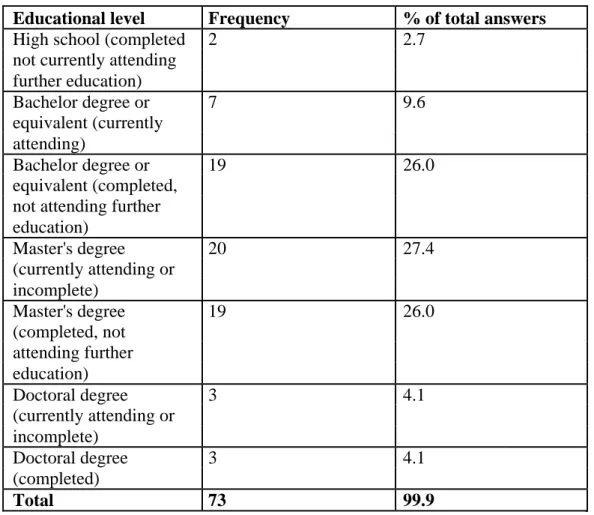
Most subjects (27.4%) were attending a Master’s degree at the time of completion of the survey. However, similarly large portions of the sample were comprised of people with completed postgraduate degrees and people with completed bachelor’s degrees who were not attending further education at the time.
Table nº4 – Distribution of sample by educational level
Educational level Frequency % of total answers
High school (completed 2 2.7
not currently attending further education) Bachelor degree or 7 9.6 equivalent (currently attending) Bachelor degree or 19 26.0 equivalent (completed, not attending further education) Master's degree 20 27.4 (currently attending or incomplete) Master's degree 19 26.0 (completed, not attending further education) Doctoral degree 3 4.1 (currently attending or incomplete) Doctoral degree 3 4.1 (completed) Total 73 99.9
23
Over half of respondents (53.4%) had a completed Bachelor’s degree, whether they were in the process of obtaining a Master’s degree or had already finished their studies. In contrast, 12,3% had a high school education (completed) or below, whether they were in the process of obtaining a Bachelor’s degree or did not continue their studies past high school. Moreover, only 4.1% of respondents had a completed doctoral degree. Table nº5 – Distribution of sample by qualification group
Educational level Frequency % of total answers
Up to end of Bachelor’s 9 12.3
degree
Doing (incomplete Master’s 39 53.4
degree
Doing (incomplete) PhD 22 30.1
PhD 3 4.1
Total 73 100.0
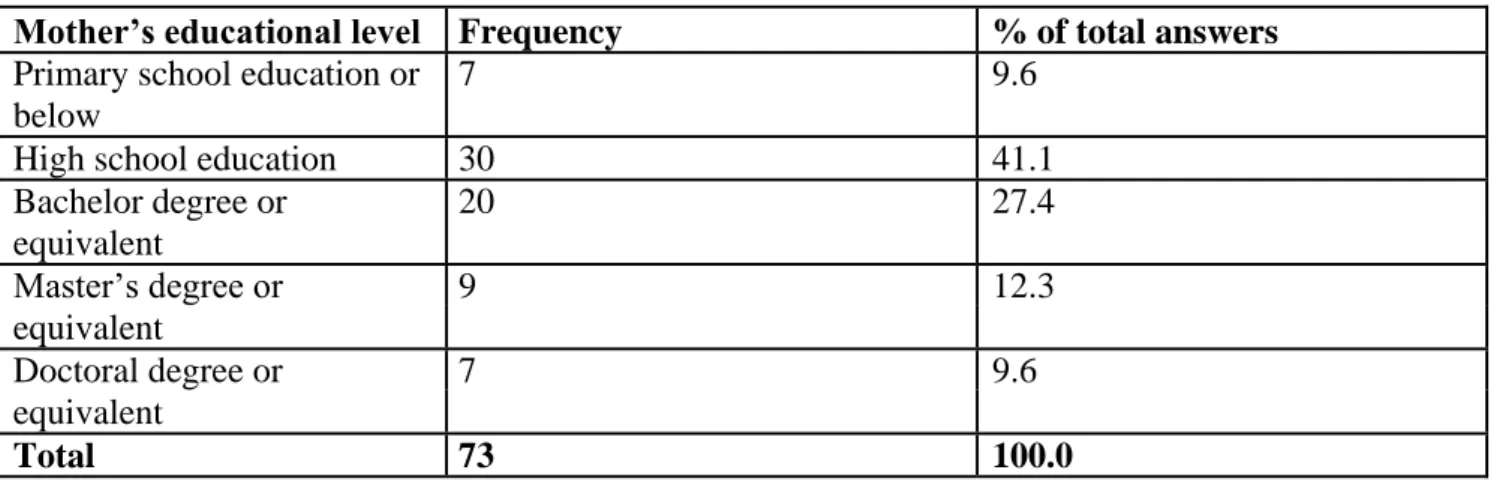
In general, most subjects’ mothers have high educational levels, with 30 (41.1%) having a high school education, 20 (27.4%) a bachelor’s or equivalent degree, 9 (12.3%) a Master’s or equivalent degree and 7 (9.6%) a doctoral degree or equivalent.
Table nº6 – Distribution of sample by mother’s educational level
Mother’s educational level Frequency % of total answers
Primary school education or 7 9.6
below
High school education 30 41.1
Bachelor degree or 20 27.4 equivalent Master’s degree or 9 12.3 equivalent Doctoral degree or 7 9.6 equivalent Total 73 100.0
24
Fathers’ educational levels followed a similar pattern to those of their female counterparts, with 26 (35.6%) of them having a high school education, 21 (28.8%) a bachelor degree or equivalent, 15 (20.5%) a Master’s degree or equivalent, and 7 (9.6%) a doctoral degree or equivalent.
Table nº7 – Distribution of sample by father’s educational level
Father’s Frequency % of total answers
educational level Primary school 4 5.5 education or below High school 26 35.6 education Bachelor degree or 21 28.8 equivalent Master’s degree or 15 20.5 equivalent Doctoral degree or 7 9.6 equivalent Total 73 100.0
25
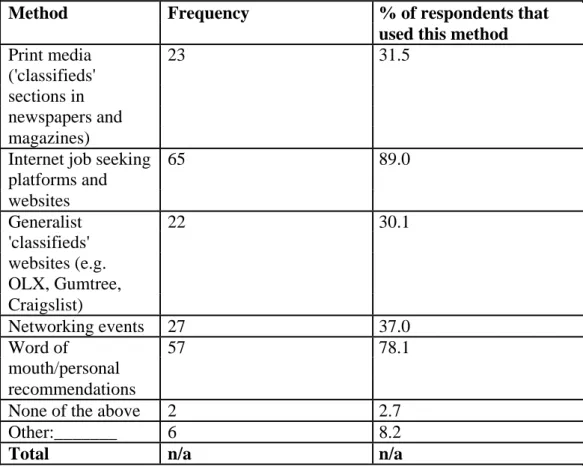
The most popular methods chosen by the sample to look for jobs were internet jobseeking platforms and websites (89% of respondents using this method), word of mouth/personal recommendations (78.1%) and networking events (37%). Given the current jobseeking and digital climate, these results are expected. They are even more expected given the age and educational backgrounds of the surveyed individuals.
Table nº8 – Distribution of sample by previous jobseeking methods
Method Frequency % of respondents that
used this method
Print media 23 31.5
('classifieds' sections in newspapers and magazines)
Internet job seeking 65 89.0
platforms and websites Generalist 22 30.1 'classifieds' websites (e.g. OLX, Gumtree, Craigslist) Networking events 27 37.0 Word of 57 78.1 mouth/personal recommendations
None of the above 2 2.7
Other:_______ 6 8.2
26
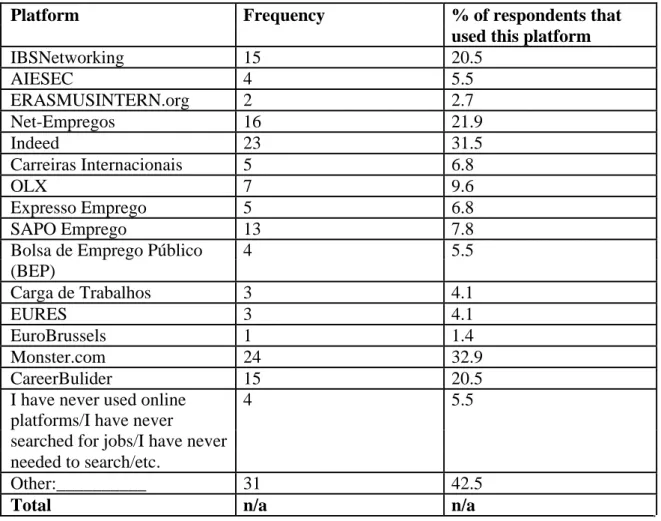
The platforms that proved to be most popular within the sample were other platforms not included in the answers (42.5% of respondents), Monster.com (32.9%) and Indeed (31.5%). Among the other platforms, respondents named Talent City, LinkedIn, Reed.co.uk, Apec.fr and Kijiji, among others. These results can be expected given the huge variety of online platforms currently available, many for free and with no signup required. Despite the lack of previous research in this area, this survey and study by extension further shows the current wealth of ways there are to search for jobs online.
Table nº9 – Distribution of sample by online platforms used in the past
Platform Frequency % of respondents that
used this platform
IBSNetworking 15 20.5 AIESEC 4 5.5 ERASMUSINTERN.org 2 2.7 Net-Empregos 16 21.9 Indeed 23 31.5 Carreiras Internacionais 5 6.8 OLX 7 9.6 Expresso Emprego 5 6.8 SAPO Emprego 13 7.8
Bolsa de Emprego Público 4 5.5
(BEP) Carga de Trabalhos 3 4.1 EURES 3 4.1 EuroBrussels 1 1.4 Monster.com 24 32.9 CareerBulider 15 20.5
I have never used online 4 5.5
platforms/I have never
searched for jobs/I have never needed to search/etc.
Other:__________ 31 42.5
27
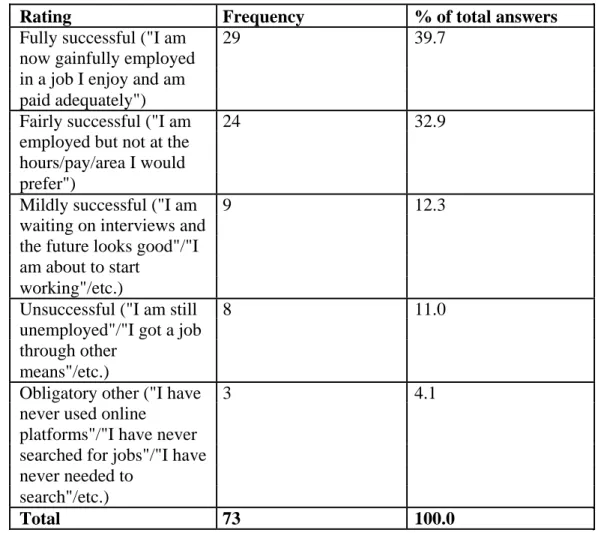
Most respondents considered their last job search to have been successful, with 39.7% being fully successful, 32.9% being fairly successful, and 12.3% being mildly successful. Given that the vast majority of respondents had used online jobseeking platforms in the past, these values reflect very well on the efficacy and success rates of online jobseeking platforms in general.
Table nº10 – Distribution of sample by personal success rating of most recent job search
Rating Frequency % of total answers
Fully successful ("I am 29 39.7
now gainfully employed in a job I enjoy and am paid adequately")
Fairly successful ("I am 24 32.9
employed but not at the hours/pay/area I would prefer")
Mildly successful ("I am 9 12.3
waiting on interviews and the future looks good"/"I am about to start
working"/etc.)
Unsuccessful ("I am still 8 11.0
unemployed"/"I got a job through other
means"/etc.)
Obligatory other ("I have 3 4.1
never used online
platforms"/"I have never searched for jobs"/"I have never needed to
search"/etc.)
28
The vast majority of respondents (53 out of 73) were fully or fairly successful in their job search. 9 respondents each were mildly successful or unsuccessful (selected “Unsuccessful” or “Obligatory other” in the questionnaire).
Table nº11 – Distribution of sample by new success rating category
Rating Frequency % of total
answers
Other/Unsuccessful 11 12.3
Mildly successful 9 15.0
Fairly/fully successful 53 72.6
Total 73 99.9
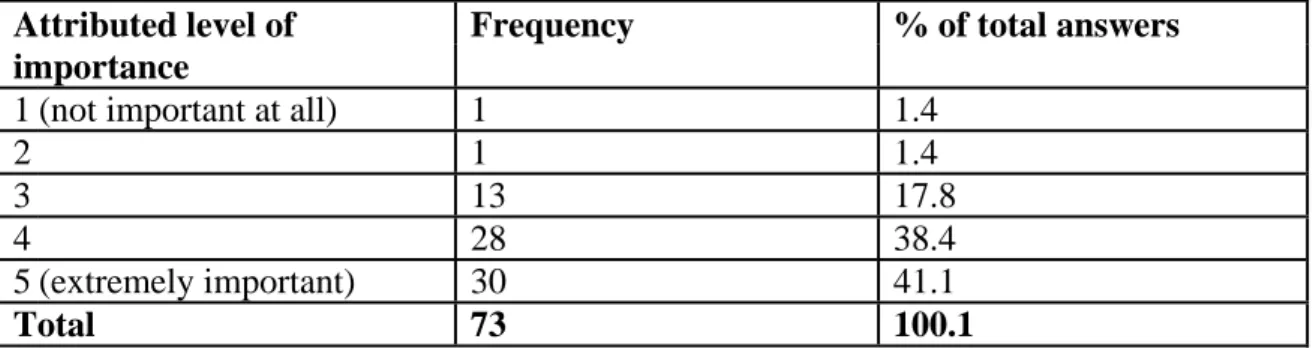
Few respondents found jobseeking platform usability unimportant, with only two out of 73 giving it a 1 or 2 level of importance out of 5. 13 respondents attributed an ‘average’ (3/5 rating) level of importance to this issue, and larger portions of the sample considered usability to be very (4/5 rating) or extremely important (28 and 30 respondents, respectively).
Table nº12 – Distribution of sample by attributed level of importance to ease of use in online jobseeking platforms
Attributed level of Frequency % of total answers
importance
1(not important at all) 1 1.4
2 1 1.4
3 13 17.8
4 28 38.4
5(extremely important) 30 41.1
29
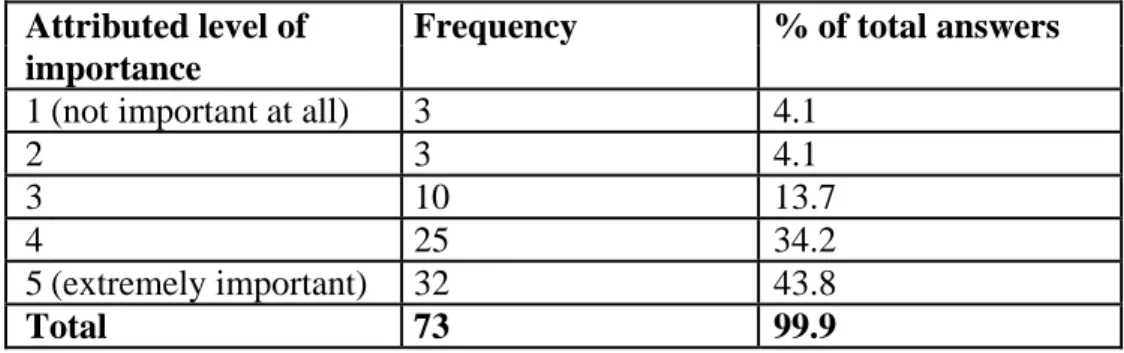
In a similar fashion to the last issue (usability/ease of use), respondents found the quantity of available jobs on a jobseeking platform to be more important than not. 43.8% thought this issue was extremely important, while only 4.1% (each) gave it 1/5 or 2/5 levels of importance.
Table nº13 – Distribution of sample by attributed level of importance to quantity of available jobs in online jobseeking platforms
Attributed level of Frequency % of total answers importance
1(not important at all) 3 4.1
2 3 4.1
3 10 13.7
4 25 34.2
5(extremely important) 32 43.8
Total 73 99.9
Most respondents found the quality of available jobs issue to be extremely important, giving it the maximum rating of 5/5. 44 out of 73 respondents answered in this way. In contrast, only one attributed the lowest level of importance to this issue, and none attributed the second lowest level of importance. Few respondents (11%) were ‘middle of the road’ (attributing a 3/5 level of importance) as well.
Table nº14 – Distribution of sample by attributed level of importance to quality of available jobs in online jobseeking platforms
Attributed level of Frequency % of total answers importance
1(not important at all) 1 1.4
2 0 0.0
3 8 11.0
4 20 27.4
5(extremely important) 44 60.3
30
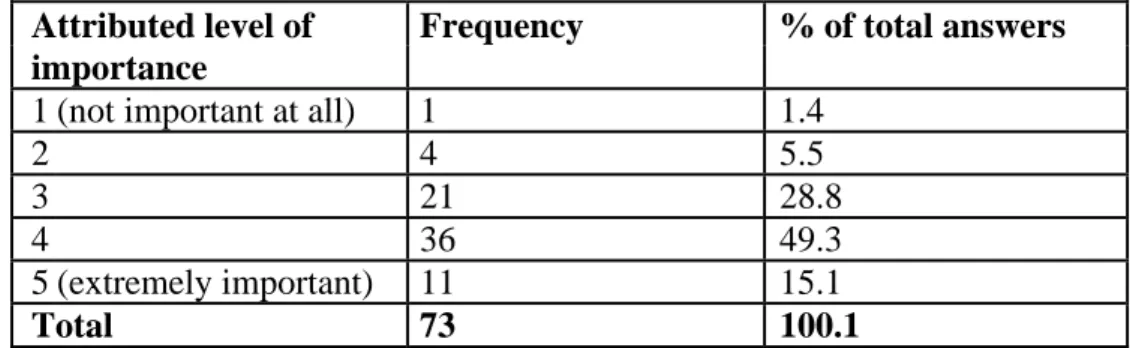
Most respondents were ambivalent about the average pay of available jobs on jobseeking platforms, with 3 and 4 out of 5 being the most popular scores for this issue. Close to half (49.3%) of respondents attributed a 4 and 28.8% a 3.
Table nº15 – Distribution of sample by attributed level of importance to average pay of available jobs in online jobseeking platforms
Attributed level of Frequency % of total answers importance
1(not important at all) 1 1.4
2 4 5.5
3 21 28.8
4 36 49.3
5(extremely important) 11 15.1
Total 73 100.1
The most common scores for this issue ware 4 (31 respondents) and 5 (25 respondents) out of 5, indicating that within the sample, industries/areas of studies were considered very to extremely important.
Table nº16 – Distribution of sample by attributed level of importance to industry/area of studies of available jobs in online jobseeking platforms
Attributed level of Frequency % of total answers importance
1(not important at all) 1 1.4
2 2 2.7
3 14 19.2
4 31 42.5
5(extremely important) 25 34.2
31
This issue also tended towards the extreme in terms of the importance attributed to it. 38.4% of respondents considered the type of jobs available on jobseeking platforms to be an extremely important issue, with 37% considered it to be very important, giving it a 4/5 rating. Only one respondent (1.4% of total answers) believed this issue was not at all important.
Table nº17 – Distribution of sample by attributed level of importance to type of jobs (full time/part time/internship) in online jobseeking platforms
Attributed level of Frequency % of total answers importance
1(not important at all) 1 1.4
2 3 4.1
3 14 19.2
4 27 37.0
5(extremely important) 28 38.4
Total 73 100.1
The responses to the issue of geographical location of available jobs followed exactly the same pattern as the previous one, type of jobs.
Table nº18 – Distribution of sample by attributed level of importance to geographical location of available jobs in online jobseeking platforms
Attributed level of Frequency % of total answers importance
1(not important at all) 1 1.4
2 3 4.1
3 14 19.2
4 27 37.0
5(extremely important) 28 38.4
32
The online platform issues that affected the most respondents in the sample were lacking information (31 respondents), quality of available jobs (28 respondents) and outdated information and lack of ability to sort jobs according to criteria (26 respondents each).
Table nº19 – Distribution of sample by annoying/lacking issues in online jobseeking platforms (limitations of online jobseeking platforms)
Issue Frequency % of respondents who
had this issue
Quantity of available 19 26
jobs
Quality of available 28 38.4
jobs
Lack of ability to sort 26 35.6
jobs according to criteria
Poor general website 15 12.5
usability
Lack of company 23 31.5
background checks on the part of the
platforms (e.g. jobs seeming 'fishy'/'too good to be true'/multi-level marketing or pyramid schemes, etc.)
Outdated information 26 35.6 (job advertisements staying up indefinitely, etc.) Lacking information 31 42.5 (contacts, job descriptions, working conditions, etc.) Other 11 15.1
33
Most respondents (56.2%) prefer to work in or near their hometowns. 26% would prefer to work abroad, with 13.7% preferring to work elsewhere in their home countries (not in their hometowns) and 4.1% preferring another option.
Table nº20 – Distribution of sample by ideal work location
Location Frequency % of total answers
In or near my 41 56.2 hometown Elsewhere in my home 10 13.7 country Abroad 19 26.0 Other 3 4.1 Total 73 100.0 6.9. Research design/Variables
A correlational study was designed in which the dependent variable was determined to be job search success, measured through the questionnaire to be disseminated, in a specific question or questions (a breakdown of each question and what it measures can be found in point 6.6). The independent variable was determined to be the usability of a (jobseeking) website. This variable was also to be measured through a question or questions in the same survey. Other independent variables measured in the questionnaire were quantity of available jobs, quality of available jobs, average pay of available jobs, industry/area of studies of available jobs, type of jobs (full time, part time, or internship) and geographical location of available jobs.
34
7. Further Analysis
In order to obtain accurate conclusions about the first issue to be explored in this dissertation, namely how the use of jobseeking platforms impacts the success of a job search, answers to the most relevant questions were extracted. The two variables considered for this purpose were jobseeking platform use and job search success. The questions that aimed to measure these variables were 6. Which of the following methods
have you used in the past to search for jobs? (to measure the former) and 8. How would you rate the success of your most recent job search? (for the latter).
As can be seen in the questionnaire, the possible answers to question 8 were the following:
Fully successful ("I am now gainfully employed in a job I enjoy and am paid adequately")
Fairly successful ("I am employed but not at the hours/pay/area I would prefer")
Mildly successful ("I am waiting on interviews and the future looks good"/"I am about to start working"/etc.)
Unsuccessful ("I am still unemployed"/"I got a job through other means"/etc.)
Obligatory other ("I have never used online platforms"/"I have never searched for jobs"/"I have never needed to search"/etc.)
As can be observed in the possible answers above, respondents had the possibility of selecting an “obligatory other” as an answer to the question.
35 7.1. Types of job search sites vs job search success
Taking into account question 7, Which of the following online platforms have you used
when searching for jobs?, the different answers given were classified according to the
type of sites used. The classification is shown in the following table: Table nº21 – Examples of jobseeking websites by category
Site classification Examples of sites
General ‘classifieds’ sites OLX
Kijiji
Industry-specific sites Carga de Trabalhos
The Bookseller Jobs4tourism.be Mytraveljob.be Freelancer Upwork TES TeachGeorgia
Generalist jobseeking platforms Net-Empregos
Indeed Expresso Emprego SAPO Emprego Monster.com CareerBuilder Seek Talent City Vacature.com Reed.co.uk Location-specific EURES USAJobs Recruit Ireland Carreiras Internacionais
Social Networks LinkedIn
36
University/youth websites IBSNetworking
AIESEC
ERASMUSINTERN.org Ratemyplacement
Since the classifications of various sites were debatable and arbitrary, tests were carried out to determine the relationships between the usage of sites from two of the classification groups at a time and the job search success of the participants. A Principal Components Analysis with Varimax Rotation and Kaiser Normalization was performed to identify such groups. This analysis was carried out to find out the three main types of platforms used.
Table nº22 – Rotated Component Matrix for created jobseeking website categories
Rotated Component Matrixa
Component 1 2 3 GeneralistPlatforms .842 -.123 -.297 NoPlatforms -.840 -.156 -.265 IndustrySpecific -.020 .837 -.246 LocationSpecific .052 .783 .268 UniWebsites .041 -.124 .741 SocialNetworks -.049 .119 .626
Extraction Method: Principal Component Analysis. Rotation Method: Varimax with Kaiser Normalization.
a. Rotation converged in 5 iterations.
The Rotated Component Matrix above identifies three components: one that includes only generalist platforms and no platforms, another that includes industry specific and location specific platforms, and a third component that includes social networks and university/youth-based platforms.
It is worth noting that in the first component mentioned, one first indicator of reliability is that the numbers obtained are near opposites, with the matrix having indicated 0.842 for generalist platforms and -0.840 for no platforms (the variable signalling participants who had not used any platforms at all in their job searches, or who had never searched for jobs). Based on this, the component was named generalist users.
37
For the second component, that included industry specific and location specific platforms, a reliability analysis was carried out that indicated a Cronbach’s Alpha statistic of 0.509, which indicates limited but acceptable internal consistency. Based on this, the component was named specific users
For the last component, that included university/youth websites and social networks, a Cronbach’s Alpha statistic of 0.067 was obtained, which is almost certainly influenced by the small sample size and very low amount of respondents indicating in the questionnaires that they used these kinds of platforms. Based on this, the component was named youthful users.
Then, two new variables were created which were the reverse scored versions of the ‘no platforms’ and ‘social’ variables. This variable inversion allows for a type of confirmation of the consistency and clarity of the questions and possible answers. A further two variables, General and Specific, pertained to whether users used more general or more specific platforms in their job search. For both variables, a null value indicates that the participant did not use any of the jobseeking platforms classified, 0,5 (in the case of specific platforms) indicates that the participant used either location specific or industry specific platforms, but not both. A value of 1 indicates the participant used both location specific and industry specific platforms.
Table nº23 – Distribution of sample by use of general jobseeking platforms
Use general jobseeking platforms? Frequency % of total answers
No 18 24.7
Yes 55 75.3
Total 73 100.0
Table nº24 – Distribution of sample by use of specific jobseeking platforms
Use specific jobseeking platforms? Frequency % of total answers
None 55 75.3
One 13 17.8
Both 5 6.8
38 7.2. Factor 1 – Generalist users
This factor included users that used generalist platforms or no platforms at all (had never looked for jobs online). 59 out of 73 participants, or 80.8% of the total, fall under this classification.
Table nº25 – Distribution of Factor 1 by gender
Male Female Total
GeneralistUsers 10 49 59
From those 59 generalist users, 10 are male and 49 are female.
Table nº26 – Distribution of Factor 1 by age category
18-24 25-34 35+ Total
GeneralistUsers 15 26 18 59
Generalist users fall mainly within the 25-34 age category, indicating a medium age range.
Table nº27 – Distribution of Factor 1 by educational category
Up to end Doing Doing PhD Total
of (incomplete) (incomplete)
Bachelor’s Master’s PhD
degree degree
GeneralistUsers 9 30 18 2 59
Most generalist users were in the process of obtaining their Master’s degree, with a significant proportion also in the process of obtaining a PhD.
The typical generalist user of jobseeking websites is a 25 to 34 year old female, currently undertaking a Master’s degree. As can be seen in the tables, the 59 total users are particularly well distributed among age groups, with a peak at the 25-34 age group,
39
and troughs on either side, namely in the 18-24 and 35+ categories. This is not unexpected for platforms such as Net Empregos, Monster.com or CareerBuilder, that contain a variety of job advertisements, including but not limited to internships, freelance work, temporary contracts and casual work, among others. Therefore, there are jobs that appeal to all age groups and career phases. In terms of the educational level of these users, the distribution is similar, with a peak in the middle category, but also a significant number (18 out of 59 generalist users) undertaking a PhD. This fact would not be as expected, since Portugal (where the researcher is from) does not have as many PhD candidates as other countries such as Germany, Switzerland or the UK. Moreover, since most PhD candidates/graduates work mostly in higher education institutions, usually in teaching or research, and not in companies, it would not be expected that they seek work on generalist websites. In fact, in the second factor extracted (Specific Users), that includes industry specific as well as location specific jobseeking websites, only 8 PhD candidates and 1 PhD graduate had used these kinds of sites in the past. Given the nature of the categories, it would be expected that more participants involved in PhDs would favour industry-specific platforms over generalist ones. Moreover, the industry-specific platform category includes sites such as TES and TeachGeorgia, which would be expected to attract more PhDs and others in the academic field.
7.3. Factor 2 – Specific Users
This factor included users that used location specific platforms or industry specific platforms or both. 18 out of 73 total participants in the survey fell under this classification.
Table nº28 – Distribution of Factor 2 by gender
Male Female Total
SpecificUsers 6 12 18
40
Table nº29 – Distribution of Factor 2 by age category
18-24 25-34 35+ Total
SpecificUsers 1 10 7 18
10 out of 18 specific users were in the 25-34 age range.
Table nº30 – Distribution of Factor 2 by educational category
Doing Doing PhD Total
(incomplete) (incomplete)
Master’s degree PhD
SpecificUsers 9 8 1 18
The typical specific user of a jobseeking platform is a 25-34 year old female, currently undertaking a Master’s degree. Although the typical user of this kind of platform may be the same as the previous (generalist one), it can be inferred that more generalist and more specific platforms attract similar types of users. Indeed, the nature of generalist platforms makes it so that any kind of job can be posted on it, and so it has the potential to attract all kinds of users in a whole breadth of situations. In fact, generalist platforms overwhelmingly top lists of most used and most popular jobseeking platforms, both on a local/national and global scale. In fact, very little research has been done so far on individual online jobseeking platforms, but the content of the platforms themselves offer a variety of clues as to who they seek to attract.
41 7.4. Factor 3 – Youthful users
This factor included users that used university/youth websites or social networks or both.
Table nº31 – Distribution of Factor 3 by gender
Male Female Total
YouthfulUsers 8 21 29
Table nº32 – Distribution of Factor 3 by age category
18-24 25-34 35+ Total
YouthfulUsers 12 11 6 29
Table nº33 – Distribution of Factor 3 by educational category
Up to end of Doing Doing Total
Bachelor’s (incomplete) (incomplete)
degree Master’s PhD
degree
YouthfulUsers 2 19 8 29
The typical youthful user of a jobseeking platform is an 18-24 year old female currently undertaking a Master’s degree. The main difference between this typical user and that of the other factors is the younger age of this user. This is to be expected given the nature of the platforms involved. Social networks are a fairly recent and youthful phenomenon, and the ability to post and reply to job advertisements therein even more so. LinkedIn, considered a social network due to the ability for users to create personal profiles and connect with others, is increasingly being used as a jobseeking platform, as well as a place for recruiters to find ideal candidates. Moreover, due to the rise in the use of mobile applications to carry out all kinds of daily activities, such as banking, budgeting, health and fitness or education, it makes sense that social networks could play a part in making looking and applying for jobs a mobile activity.
42 7.5. Cross-tabulations
Cross-tabulations, commonly known as crosstabs, were generated in order to obtain a general idea of correlations and links between variables.
7.5.1. Qualification level vs job search success
Table nº34 – Cross-tabulation of created educational level and success rating categories
Success Rating Category Total % of total
Obligatory % of Mildly % of Fairly/ % of total answers
other/ total successful total fully answers
Unsuccessful answers answers successful
Educational Up to end of 2 2.8% 1 1.4% 6 8.5% 9 12.7% level Bachelor’s degree Doing 5 7.0% 5 7.0% 28 39.4% 38 53.5% (incomplete) Master’s degree Doing 2 2.8% 3 4.2% 22.5% 21 29.6% (incomplete) 16 PhD PhD 0 0.0% 0 0.0% 3 4.2% 3 4.2% Total 9 12.7% 9 12.7% 53 74.6% 71 100.0%
In terms of the correlations possibly evidenced by the crosstab above, that crosses participants’ qualification and success levels, the category that applied to more participants was one that exemplified the second highest level of qualification with the highest level of success. Indeed, these types of results are not surprising given the overall results of the survey and trends in answers to the specific questions on individual qualification levels and perceptions of success.
43
7.5.2. Job search success vs job site category
Table nº35 – Cross tabulation of industry specific site users with success rating category
Success Rating Category Total % of
Obligatory % of Mildly % of Fairly/ % of total
total
other/ total successful total fully answers answers
unsuccessful answers answers successful
Industry No 9 12.7% 9 12.7% 45 63.4% 63 88.7%
Specific Yes 0 0.0% 0 0.0% 8 11.3% 8 11.3%
Total 9 12.7% 9 12.7% 53 74.7% 71 100.0%
For industry-specific job search sites, including but not limited to Upwork, Freelancer and TES, respondents who had used them in the past appeared to be overall more successful, with all 8 who used them having been fairly to fully successful in their most recent job search. In the case of respondents who had not used such sites, the success rate is slightly more modest, at 45 out of 63, or 71.4%, having been fairly to fully successful, and 9 respondents each having been classified as unsuccessful or only mildly successful (14.2% each).
Table nº36 – Cross-tabulation of general classifieds site users with success rating category
Success Rating Category Total % of
total
Obligatory % of Mildly % of Fairly/ % of total answers
other/ total successful total fully answers
unsuccessful answers answers successful
General No 7 9.9% 7 9.9% 48 67.6% 62 87.3%
Classifieds Yes 2 2.8% 2 2.8% 5 7.0% 9 12.7%
Total 9 12.7% 9 12.7% 53 74.6% 71 100.0%
Most respondents in the sample had not used sites classified as General Classifieds (e.g. OLX or Kijiji) in the past. However, of the 9 total that had, 5 had been fairly to fully successful in their most recent job search, with 2 each having been classified as unsuccessful or mildly successful.