Promoting healthy eating: A brief review of research on predictors and interventions
Cristina A.Godinho1 João Carvalho1 Maria Luísa Lima1
1. Instituto Universitário de Lisboa (ISCTE-IUL), CIS-IUL, Lisboa, Portugal
Word count (excluding figures/tables): 3077
Corresponding author: Cristina Godinho
CIS-IUL, Instituto Universitário de Lisboa Av. das Forças Armadas,
1649-026 Lisboa
Resumo
A alimentação tem um impacto importante na saúde e bem-estar. O presente artigo apresenta investigação realizada pelo nosso grupo sobre a psicologia social da alimentação e intervenções para a promoção de alimentação saudável. Estudos sobre preditores sociais, como o
comportamento de outros e normas culturais/sociais, e sobre preditores psicológicos, motivacionais e volitivos, assim como funções executivas, são apresentados. Estudos sobre intervenções utilizando mensagens persuasivas e o treino de funções executivas serão igualmente descritos. Por último, a contribuição desta linha de investigação é discutida, e algumas direções para investigação futura serão apresentadas.
Abstract
Eating behaviours have an important impact on health and well-being. This paper presents research conducted by our group on the social psychology of eating and interventions for the promotion of healthy eating. Studies are presented on the social predictors of eating, such as the behaviour of others and cultural/social norms, and on the psychological predictors, motivational and volitional, as well as executive functions. Intervention studies using health messages and training of executive functions will also be described. Finally, the contribution of this work is discussed and directions for future research are outlined.
Promoting healthy eating: A brief review of predictors and interventions
Introduction: On the importance of healthy eating
Eating is central to our lives. It is a survival need, as well as source of pleasure. We eat every day, several times a day, in multiple contexts, which are embedded in a specific temporal and cultural matrix. We know that what we choose to eat affects our health (Key, Allen, Spencer, & Travis, 2002) and our well-being (Hakkarainen et al., 2004), and there is a great potential for interventions geared towards changing eating behaviours to contribute to alleviating the disease burden and to fostering well-being (Emberson, Whincup, Morris, Walker, & Ebrahim, 2004; Rogers, 2001). Promoting healthy eating is thus a major goal for public health worldwide (WHO, 2003) and is one of the eight priority programs of the Portuguese General Health Directorate (DGS, 2012). The promotion of healthy eating is also the focus of one of the research lines we have been following in the Health for All (H4A) research group.
The main goal of this paper is to review some of the studies and projects that have been conducted by our research group on the social psychology of eating. We will first describe a conceptual model that integrates different social psychological determinants of healthy eating behaviours and establishes a backdrop for presenting our research and interventions in this domain. Next, we will briefly review some studies on the determinants of eating behaviours that have been conducted by our group, and intervention studies and projects that make use of different strategies to promote healthy eating behaviours. In these sections, our aim is not to present a comprehensive list of social and psychological predictors of healthy eating and of intervention methods that may be used to promote it; instead, our goal will be to highlight the work we have been developing in this arena, hoping it will stimulate more research around the social psychology of eating, on its close relationship with health promotion. Finally, we will conclude by stressing what can be the main implications of the presented work and the avenues for continuing this line of research.
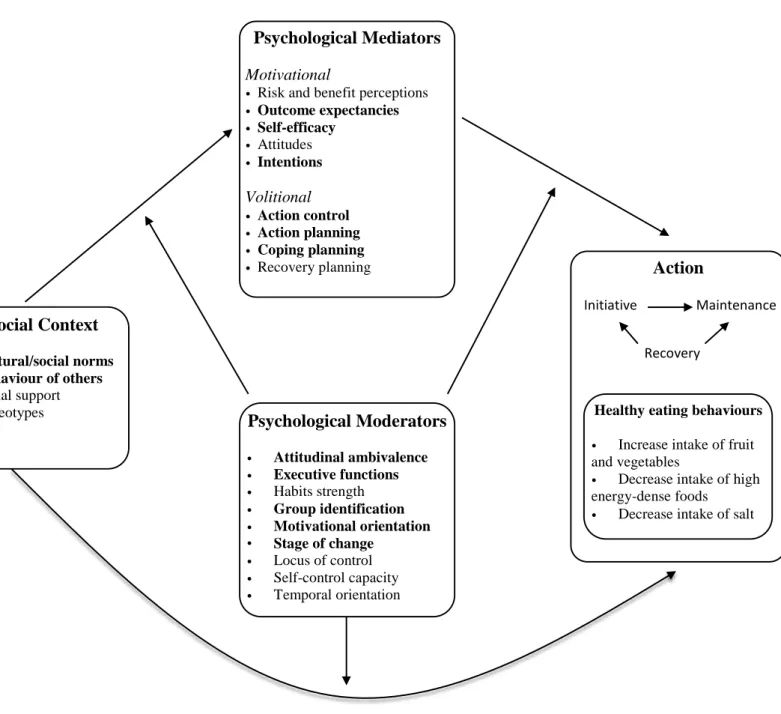
Social and psychological determinants of healthy eating: A conceptual framework Our research on the social psychology of eating is grounded on a general theoretical framework that builds on social psychological theories of health behaviour change and of self-regulation to identify relevant social and psychological determinants of eating behaviours (see Figure 1). A main assumption is that, although a myriad of different factors (e.g., biological, economic, cultural, political, environmental) may determine eating behaviours at different levels (e.g., individual, familial, societal), many of these factors exert their influence, at least partially, through individuals´ psychological mechanisms (Conner & Armitage, 2002). Moreover, these psychological determinants result from the interaction between the individual and its social context.
The motivational and volitional predictors of healthy eating behaviours are at the core of our conceptual model. The motivational predictors are psychological factors that play a crucial role for the establishment of behavioural intentions and goal setting, such as self-efficacy, perceived risks and benefits, outcome expectancies and attitudes. The volitional predictors are self-regulatory skills, related with planning and implementation intentions, which facilitate the translation of the individuals’ intentions into actual behaviour. Both types of psychological predictors may function as mediators between the social context and one’s eating behaviour and, hence, constitute important targets for interventions aiming to promote healthy eating.
Additionally, several social and psychological factors may moderate the impact of these psychological mechanisms on behaviour and, thus, should also be taken into account when designing and implementing interventions.
This conceptual model constitutes a general framework that articulates the different social and psychological determinants of healthy eating that have been the focus of our research, which will be briefly presented in the following section.
Social predictors. Eating is a social behaviour. Although innate preferences for sugar, salt and milk are documented (e.g., Steiner, 1977), food preferences are, to a large extent, established through socialisation (Beauchamp & Moran, 1984). We learn with others to like and dislike certain ingredients, we use food as a pretext for social gathering, and we form ideas about other people based on what and how much they eat (Conner & Armitage, 2002). For this reason, the context of eating behaviours is an important determinant of food choices. Social psychology has long shown the effects of the presence of others in our behaviour (Zajonc, 1965), including eating behaviour. For instance, in the presence of strangers we eat less (e.g., Mori, Chaiken, & Pliner, 1987) and we eat more when we are with friends (e.g., Lumeng & Hillman, 2007). This difference has been interpreted as the result of different social norms for the two contexts (Roth, Herman, Polivy, & Pliner, 2001), where the norm of “eating less” is a way of causing a better impression on others (e.g., Basow & Kobrynowicz, 1993; Chaiken & Pliner, 1987). However, previous research on eating decisions in social context did not consider the quality of the food (i.e., whether it was healthy or not). A line of research developed with Maria Batista used an experimental paradigm where participants were allowed to eat while performing a task
(completing a questionnaire) and had food available: pringles chips (non-healthy) and/or apple slices (healthy food). In this research we experimentally manipulated the context to understand its consequences on the amount of healthy and non-healthy food eaten. In one study (Batista & Lima, 2013), the type of relationship with the others in the room was controlled (alone vs. with two friends vs. with two strangers). For unhealthy food, we could replicate the basic finding of eating more in the presence of others, but only when they were friends. The reversed pattern occurred for healthy choices: participants increased their intake of apple slices only in the presence of strangers. In another study (Batista, Lima, Pereira, & Alves, in press), we found that eating choices were dependent on the contextual cues given by a confederate of the experimenter that either ate the same amount of slices of apple and chips (control condition) or asked: “Can I
eat just apples? They are much healthier, and chips are very fattening” (healthy cue condition) or “Can I just eat chips? I am really hungry, and apples aren’t very filling” (unhealthy cue
condition). Results showed a clear influence of the context on the eating response. In both studies, a psychological variable moderated the results: ambivalence towards the food item presented (i.e., the fact that the participants had, simultaneously, positive and negative feelings about it, Batista & Lima, 2010). In fact, the effects described above were much stronger for ambivalent participants than for non-ambivalent ones. This result has very important
implications for intervention, showing that ambivalence makes participants more vulnerable to contextual cues.
Psychological predictors. In order to change dietary habits it is first necessary to
understand the motivational and volitional processes involved. This was the aim of a longitudinal study we conducted on the psychological predictors of fruit and vegetable intake (Godinho, Alvarez, Lima, & Schwarzer, 2014). In line with motivational models of health behaviour change (Armitage & Conner, 2000) we found that positive outcome expectancies (i.e., expecting positive consequences resulting from eating the recommended intake of fruit and vegetables) and self-efficacy (i.e., feeling confident in the own ability to achieve that goal) were associated with higher intentions to increase the intake of fruit and vegetables. Intention was also, as expected, an important predictor of fruit and vegetable intake a week later. However, the main focus of this study was on the post-intentional mechanisms of behaviour change, given that a gap between people´s intentions and actual behaviour has been systematically reported (Webb & Sheeran, 2006). In this regard, we could confirm that coping planning (i.e., thinking about possible barriers to implement the intended behaviour and ways to overcome them) and action control (i.e., the self-monitoring of behaviour and effort to attain the intended goal) did sequentially contribute for the translation of intentions to eat fruit and vegetables into actual intake, even
when controlling for past behaviour, attesting their role as volitional mechanisms involved in dietary behaviour change.
In addition to the aforementioned factors, researchers have recently suggested that the translation of intentions into health behaviour is also a function of individual differences in higher-order cognitive processes, known as executive functions (Hofmann, Schmeichel, & Baddeley, 2012). Three main categories of executive functions have been identified (see Hofmann, Schmeichel, & Baddeley, 2012): 1) shifting, the capacity to flexibly alter goals and plans in response to changing environment; 2) updating, the capacity to monitor and update relevant information to accomplish goals; and 3) inhibitory control, the capacity to maintain focus on one’s goal by inhibiting irrelevant or conflicting information and goals. Importantly, individual differences in these capacities have been linked with a range of health behaviours (Hall, Fong, Epp, & Elias, 2008), including healthy eating (Allom & Mullan 2014).
Building on this framework, our group has initiated a line of research aiming to understand how different executive functions are related with the motivational and volitional predictors of distinct healthy eating behaviours (e.g., increase of fruit and vegetable intake, decrease of saturated fat and sugar) (Carvalho, Lima, & Ferreira, 2014). This will provide important knowledge about what executive functions should be targeted to improve the efficacy of interventions that have different or multiple goals.
Interventions to change eating behaviours
The social and psychological predictors mentioned in the previous section constitute useful targets for interventions aiming to promote changes in eating behaviours. A number of policies, methods and strategies may be selected and put in action in order to attain such a goal (for a review see Michie, van Stralen, & West, 2011). However, in the following section our attention will be devoted to two specific types of interventions: health communication, more specifically related to the delivery of health messages to persuade people to change their behaviours, and
service provision, with a particular emphasis on the training of executive functions to promote the implementation of behaviour change goals and plans.
Persuasive health messages. Health messages play an important role in public health efforts aiming to foster the adoption and maintenance of a wide range of health behaviours. An advantage of this type of intervention is that health messages have the potential of reaching a high number of people at a fairly low cost per head (WHO, 2002). However, not every message is effective, and research is needed on communication strategies that may effectively stimulate the adoption and maintenance of healthy eating patterns. Studies on two communication strategies – stage tailoring and message framing – will be presented as important means to increase messages´ effectiveness for the promotion of fruit and vegetable intake.
Stage tailoring is based on the theoretical assumptions established by stage models of health behaviour change. These models assume that behaviour change is not a single event, but rather a process that unfolds through a sequence of different phases, or stages (Weinstein, Rothman, & Sutton, 1998). At each stage, a different set of predictors is relevant for the transition for the next stage, and thus, stage models assume that interventions should be more effective when they are matched to the stage where the individual is at. The two studies that will be described next were conducted with the final aim of testing this assumption.
In a first mixed-method study, the Health Action Process Approach (HAPA; Schwarzer, 2008) guided the selection of contents that were then used for the development of two types of health messages promoting fruit and vegetables intake, one for people in a motivational stage (i.e., targeting risk perception, outcome expectancies and self-efficacy) and another for people in a volitional stage (i.e., targeting action planning, coping planning and self-efficacy) (Godinho, Alvarez, & Lima, 2013). These messages were then used as stimuli in a randomized controlled trial where the effects of three types of messages (motivational, volitional and control) that were
presented to individuals that were either in a motivational or a volitional stage (Godinho, Alvarez, Lima, & Schwarzer, under review).
Besides confirming the majority of predicted stage-specific effects, attesting the messages´ effectiveness in manipulating the intended predictors, a cross-over interaction effect for self-efficacy emerged. In other words, individuals receiving messages that were matched to their stage felt more confident in their ability to change their fruit and vegetable intake. This is a notable finding, considering that self-efficacy is one of the most important predictors of health behaviour change (Conner & Norman, 2005).
Another important communication strategy is the choice of the message´s frame. Health messages may try to persuade people to change eating habits by either stressing the benefits of change, i.e., using a gain frame (e.g., if you eat five portions of fruit and vegetables you will be protected against several diseases), or instead emphasizing the costs of failing to change, i.e., using a loss frame (e.g., if you don´t eat five portions of fruit and vegetables you will be
unprotected against several diseases). Research has shown that the choice of a given frame may have an impact on the performance of several health behaviours, even when both frames present factually equivalent arguments (Gallagher, & Updegraff, 2012). In two studies, we tested
whether messages are more effective for the promotion of fruit and vegetable intake when they are matched to the individual´s stage of change (Schwarzer, 2008) and to their motivational orientation, i.e., their action tendencies in terms of approach and avoidance (Gray, 1990).
Prior research had shown that a loss frame is more effective when people are highly involved with a certain issue and that, conversely, a gain frame is more effective when people are less involved with the issue (Maheswaran & Meyers-Levy, 1990). Therefore, to the extent that people intending to change their behaviour are likely to be more involved with messages about such behaviour, we expected that the loss frame would be more effective among volitional individuals (i.e., showing high baseline intention), and the gain frame for those in a motivational
stage (i.e., showing low baseline intention). This hypothesis was confirmed among volitional individuals, with a loss frame conducting to higher fruit and vegetable intake on the subsequent week, even when controlling for baseline intake (Godinho, Alvarez, & Lima, submitted). No difference was found, however, between the loss and gain framed message conditions among those in a motivational stage.
In this study, we also expected to replicate the findings from other studies that have shown a congruency effect, i.e., an increased effectiveness when the message frame is matched to individuals´ motivational orientation. As in previous research, we expected that gain-framed messages would be more persuasive among approach-oriented individuals, whereas avoidance-oriented individuals would be more persuaded by loss-framed messages (Mann, Sherman, & Updegraff, 2004). Our results confirmed this interaction (Godinho, Alvarez, & Lima, submitted). Among avoidance-oriented individuals, a loss framed message proved to be more effective, although there was not a clear advantage on the use of a particular type of frame among approach-oriented individuals.
In a second study using framed messages for the promotion of fruit and vegetable intake (Godinho, Updegraff, Alvarez, & Lima, submitted), we were also interested in finding out whether the perceived quality of the message could interfere with the congruency effect. Following the Elaboration Likelihood Model (Petty & Cacioppo, 1986), we hypothesized that, when a message is congruent with the individual´s dispositions in terms of approach-avoidance, the message will be perceived as more personally relevant and processed in greater depth. Thus, when exposed to congruently-framed messagess, individuals will be more sensitive to their evaluations regarding the message quality. As expected, when the frame was congruent, fruit and vegetable intake one week later was dependent on perceived message quality; those who
perceived the message to be of high quality reported higher fruit and vegetable intake, while those who perceived low quality reported lower levels of intake. These findings thus support
message elaboration as a possible mechanism underlying the congruency effect, in the sense that congruently-framed messages may be more persuasive because they are processed in greater depth.
Training executive functions. The accumulating evidence in support of the role played by executive functions on eating self-regulation suggests that the development of interventions targeting these executive functions is a promising way of promoting healthy eating. Based on this assumption, new training interventions have been proposed to improve people’s capacity to use different executive functions (e.g., Houben & Jansen, 2011; Houben, Wiers, & Jansen, 2011).
Inhibitory control training in particular has gathered much interest due to the pervasive availability of unhealthy foods that makes it difficult for people to inhibit their consumption. In these training interventions, the traditional procedures used to measure inhibitory capacity (e.g., Go/No-go and Stop-signal tasks) are modified to train people to inhibit behavioural responses when confronted with unhealthy foods (Houben & Jansen, 2011). Importantly, there is strong evidence suggesting a positive small-to-medium impact of inhibitory control training on healthy eating, although significant heterogeneity exists between procedures and measures (Allom, Mullan, & Hagger, submitted). Thus, although promising, inhibitory control training needs to continue to be systematically examined. Additionally, other executive functions should be targeted by similar training interventions given their potential to influence distinct eating behaviours.
Our research group has initiated a research project focused on improving the evaluation and efficacy of executive functions training interventions (Carvalho, Lima, & Ferreira, 2014). One of the main goals of the project is to develop a new methodology based on mathematical models of cognition (Sherman, Klauer, & Allen, 2011), allowing to evaluate with greater precision the effects of these training procedures in specific eating self-regulation processes. In
addition, we aim to improve the efficacy of training interventions by developing new ways of increasing people’s engagement with the intervention and, consequently, their performance. Building on the framework of gamification and its relation with self-determination (Rigby & Ryan, 2011), game-like elements – such as competition, use of rewards and punishments, greater interaction with the task, different degrees of difficulty – will be implemented to promote
motivation and engagement while training. With this research project, we intend to improve the overall efficacy of training interventions that have the potential to complement and augment the impact of other well-established intervention strategies, such as the use of health messages and action planning interventions (Hagger & Luszczynska, 2014).
Conclusion and future research directions
In the present paper, we reviewed studies and projects that have been or are being conducted by our research group on the social psychology of eating. One of the main goals was to provide a brief and comprehensive overview of important social and psychological predictors and mechanisms involved in healthy eating. Overall, we have shown how people’s food choices and eating behaviours are determined by their social context as well as by motivational and volitional psychological processes. The identification of these determinants is extremely important as they may inform future interventions for the promotion of healthy eating, such as health communications or the training of specific cognitive functions.
Despite the contribution of the presented work for understanding and changing eating patterns, important challenges still lie ahead for future research. One will be to integrate the research conducted on the social determinants with that of psychological predictors of dietary behaviours, as well as to continue the work on the interface between the identified executive functions and the motivational and volitional determinants of eating behaviour. Still another important endeavour will be the design and evaluation of interventions combining different strategies (e.g., persuasive health messages, environmental interventions, planning interventions,
executive functions training). In this way, we hope to continue contributing to the development of innovative and effective strategies for the promotion of healthy eating.
References
Allom, V., & Mullan, B. (2014). Individual differences in executive function predict distinct eating behaviours. Appetite, 80, 123-130. doi: 10.1016/j.appet.2014.05.007
Allom, V., Mullan, B. & Hagger, M. (submitted, March 2014). Does inhibitory control training improve behavior regulation? A meta-analysis.
Armitage, C. J., & Conner, M. (2000). Social cognition models and health behaviour: A
structured review. Psychology & Health, 15, 173-189. doi: 10.1080/08870440008400299 Basow, S. A., & Kobrynowicz, K. (1993). What is she eating? The effects of meal size on
impressions of a female eater. Sex Roles, 23, 335-344. doi: 10.1007/BF00289889 Batista, M. T., & Lima, M.L. (2010). Selecção de estímulos alimentares ambivalentes e
comparação de medidas em quatro indicadores de ambivalência atitudinal. Laboratório de Psicologia, 8(1), 121-148. doi:10.14417/lp.652
Batista, M.T., & Lima, M.L. (2013). Quem está comendo comigo?: Influência social indirecta no comportamento alimentar ambivalente. Psicologia: Reflexão e Crítica, 26, 113-121.
doi:10.1590/S0102-79722013000100013
Batista, M.T., Lima, M.L., Pereira, C., & Alves, H. (in press). I Love Chips and (H)ate Them Too: The Role of Ambivalence and Contextual Cues on Attitudinally Based Eating Behavior. Revista de Psicologia Social.
Beauchamp, G. K., & Moran, M. (1984). Acceptance of sweet and salty tastes in 2-year-old children. Appetite, 5, 291-305. doi: 10.1016/S0195-6663(84)80002-1
Chaiken, S., & Pliner, P. (1987). Women, but not men are what they eat: The effect of meal size and gender on perceived femininity and masculinity. Personality and Social Psychology Bulletin, 13, 166-176. doi: 10.1177/0146167287132003
Carvalho, J., Lima, M.L., Ferreira, M.B. (2014, May). The effects of training inhibitory control on the consumption of energy-dense foods. Communication presented in the 10th PhD Meeting in Social and Organizational Psychology, ISCTE, Lisbon, Portugal.
Conner, M. & Armitage, C. J. (2002). The social psychology of food. Buckingham: Open University Press.
Conner, M., & Norman, P. (2005). Predicting health behaviour: Research and practice with social cognition models (2nd Edition). Berkshire: Open University Press.
Direcção-Geral de Saúde (2012b). Plano Nacional de Saúde 2012-2016. Retrieved from: http://pns.dgs.pt/pns-versao-completa/
Emberson, J., Whincup, P., Morris, R., Walker, M., & Ebrahim, S. (2004). Evaluating the impact of population and high-risk strategies for the primary prevention of cardiovascular disease. European Heart Journal, 25, 484-491. doi: 10.1016/j.ehj.2003.11.012
Gallagher, K. M., & Updegraff, J. A. (2012). Health message framing effects on attitudes, intentions, and behavior: A meta-analytic review. Annals of Behavioral Medicine, 43, 101-116. doi: 10.1007/s12160-011-9308-7.
Godinho, C. A., Alvarez, M.J., & Lima, L. (2013). Formative research on HAPA model
determinants for fruit and vegetable intake: Target beliefs for audiences at different stages of change. Health Education Research, 28, 1014-1028. doi: 10.1093/her/cyt076.
Godinho, C. A., Alvarez, M.J., & Lima, L. (submitted). Emphasizing the losses or the gains: Comparing situational and individual moderators of framed messages to promote fruit and vegetable intake.
Godinho, C. A., Alvarez, M.J., Lima, L., & Schwarzer, R. (2014). Will is not enough: Coping planning and action control as predictors of fruit and vegetable intake. British Journal of Health Psychology, 19, 856-870. doi: 10.1111/bjhp.12084
Godinho, C. A., Alvarez, M.J., Lima, L., & Schwarzer, R. (under review). Health messages to promote fruit and vegetable consumption at different stages of change: A complete match-mismatch design.
Godinho, C. A., Updegraff, J. A., Alvarez, M. J., & Lima, L. (submitted). When is congruency helpful? Interactive effects of frame, motivational orientation, and perceived message quality on fruit and vegetable consumption.
Gray, J. A. (1990). Brain systems that mediate both emotion and cognition. Cognition & Emotion, 4, 269–288. doi: 10.1080/02699939008410799
Hagger, M. S., & Luszczynska, A. (2014). Implementation intention and action planning Interventions in health contexts: State of the research and proposals for the way forward. Applied Psychology: Health and Well‐Being, 6, 1-47. doi:10.1111/aphw.12017
Hakkarainen, R., Partonen, T., Haukka, J., Virtamo, J., Albanes, D., & Lönnqvist, J. (2004). Food and nutrient intake in relation to mental wellbeing. Nutrition Journal, 3, 14. doi: 10.1186/1475-2891-3-14
Hall, P. A., Fong, G. T., Epp, L. J., & Elias, L. J. (2008). Executive function moderates the intention-behavior link for physical activity and dietary behavior. Psychology & Health, 23, 309-326. doi: 10.1080/14768320701212099
Hofmann, W., Schmeichel, B. J., & Baddeley, A. D. (2012). Executive functions and self- regulation. Trends in Cognitive Sciences, 16, 174-180. doi:10.1016/j.tics.2012.01.006 Houben, K., & Jansen, A. (2011). Training inhibitory control: A recipe for resisting sweet
temptations. Appetite, 56, 345-349. doi:10.1016/j.appet.2010.12.017
Houben, K., Wiers, R. W., & Jansen, A. (2011). Getting a grip on drinking behavior training working memory to reduce alcohol abuse. Psychological Science, 22, 968-975. doi: 10.1177/0956797611412392
Key, T. J., Allen, N. E., Spencer, E. A., & Travis, R. C. (2002). The effect of diet on risk of cancer. The Lancet, 360(9336), 861-868. doi: 10.1016/S0140-6736(02)09958-0
Lumeng, J. C., & Hillman, K. H. (2007). Eating in larger groups increases food consumption. Archives of Disease in Childhood, 92, 384-387. doi:10.1136/adc.2006.103259
Maheswaran, D., & Meyers-Levy, J. (1990). The influence of message framing and issue involvement. Journal of Marketing Research, 27, 361–367. doi: 10.2307/3172593 Retrieved from http://www.jstor.org/stable/3172593
Mann, T., Sherman, D., & Updegraff, J. (2004). Dispositional motivations and message framing: A test of the congruency hypothesis in college students. Health Psychology, 23, 330–334. doi:10.1037/0278-6133.23.3.330
Michie, S., van Stralen, M. M., & West, R. (2011). The behaviour change wheel: A new method for characterising and designing behaviour change interventions. Implementation Science, 6(42), 1-11. doi: 10.1186/1748-5908-6-42.
Mori, D., Chaiken, S., & Pliner, P. (1987). ‘Eating lightly’ and the self-presentation of femininity. Journal of Personality and Social Psychology, 53, 693-702. doi:10.1037//0022-3514.53.4.693
Petty, R. E., & Cacioppo, J. T. (1986). The elaboration likelihood model of persuasion. In R. E. Petty and J. T. Cacioppo (Eds.), Communication and persuasion: Central and peripheral routes to persuasion (pp. 1-24). New York: Springer-Verlag.
Rigby, S., & Ryan, R. M. (2011). Glued to games: How video games draw us in and hold us spellbound. Oxford: Praeger.
Rogers, P. J. (2001). A healthy body, a healthy mind: Long-term impact of diet on mood and cognitive function. Proceedings of the Nutrition Society, 60, 135-143. doi:
10.1079/PNS200061
Roth, D. A., Herman, C. P., Polivy, J. & Pliner, P. (2001). Self-presentational conflict in social eating situations: A normative perspective. Appetite, 36, 165-171. doi:10.1006/appe.2000.0388
Schwarzer, R. (2008). Modeling health behavior change: How to predict and modify the adoption and maintenance of health behaviors. Applied Psychology, 57, 1-29. doi: 10.1111/j.1464-0597.2007.00325.x
Sherman, J. W., Klauer, K. C., & Allen, T. J. (2011). Mathematical modeling of implicit social cognition. In B. Gawronski and B. K. Payne (Eds.), Handbook of implicit social cognition: Measurement, theory, and applications (pp. 156-175). Guilford Press, 2010.
Steiner, J. E. (1977). Facial expressions of the neonate infant indication the hedonics of foodrelated chemical stimuli. In J.M. Weiffenbach (Ed.), Taste and development: The genesis of sweet preference (pp. 173–188). Washington, DC: U.S. Government Printing Office.
Webb, T. L., & Sheeran, P. (2006). Does changing behavioral intentions engender behavior change? A meta-analysis of the experimental evidence. Psychological Bulletin, 132, 249-268. doi: 10.1037/0033-2909.132.2.249
Weinstein, N. D., Rothman, A. J., & Sutton, S. R. (1998). Stage theories of health behavior: Conceptual and methodological issues. Health Psychology, 17, 290-299. doi:
10.1037/0278-6133.17.3.290
World Health Organization (2002). The world health report 2002: Reducing risks, promoting healthy life. Retrieved from: http://www.who.int/whr/2002/en/whr02_en.pdf?ua=1 World Health Organization (2003). Diet, nutrition and the prevention of chronic diseases:
Report of a Joint WHO/FAO Expert Consultation. Retrieved from: http://whqlibdoc.who.int/trs/who_trs_916.pdf
Figure 1. Conceptual framework depicting social and psychological predictors
(mediators and moderators) of healthy eating behaviours. Note. The determinants that have been the focus of studies and projects conducted by our group are highlighted.
Action
Initiative Maintenance
Recovery
Healthy eating behaviours
• Increase intake of fruit and vegetables
• Decrease intake of high energy-dense foods
• Decrease intake of salt Psychological Mediators
Motivational
• Risk and benefit perceptions • Outcome expectancies • Self-efficacy • Attitudes • Intentions Volitional • Action control • Action planning • Coping planning • Recovery planning Social Context • Cultural/social norms • Behaviour of others • Social support • Stereotypes Psychological Moderators • Attitudinal ambivalence • Executive functions • Habits strength • Group identification • Motivational orientation • Stage of change • Locus of control • Self-control capacity • Temporal orientation