Vol.48, Special n.: pp. 243-248, June 2005
ISSN 1516-8913 Printed in Brazil
BRAZILIAN ARCHIVES OF
BIOLOGY AND TECHNOLOGY
A N I N T E R N A T I O N A L J O U R N A L
Nitrification in Hybrid Reactor with a Recycled Plastic
Support Material
Delmira Beatriz Wolff
1*,
Juan Carlos Ochoa
2,
Etienne Paul
2and
Rejane Helena Ribeiro da
Costa
11Departamento de Engenharia Sanitária e Ambiental, CTC - Universidade Federal de Santa Catarina; Campus
universitário Trindade; 88010-970; [email protected]; Florianópolis - SC - Brasil. 2LIPE/GPI, Institut National des Sciences Appliquées de Toulouse; Complexe Scientifique de Ranguei; 31077 Toulouse; CEDEX 4 - France
ABSTRACT
This work investigated the nitrification in a hybrid moving bed pilot scale reactor, which used a low density recycled plastic support material for biomass growth. The filling rate was 20% of its working volume (22L). The feeding and recirculation outflow was 45L/day. The reactor operated at a temperature of 16oC, in two phases, according to the sludge retention time (SRT): A phase was 10 days and B phase was 3 days (average values). The applied average volumetric nitrogen and organic loads were 0.16KgTKN/m3.day and 1kgCOD/m3.day, respectively. The results showed an average nitrogen removal of 95% and average COD removal of 89%, in both A and B phases. Nitrogen removal rates were independents of the SRT.
Key words: Hybrid reactor, nitrification, support, wastewater treatment
*
Author for correspondence
INTRODUCTION
The biological nitrogen removal in effluent treatment conventionally is based on the processes of nitrification and denitrification. Nitrification is a oxidation process (NH4+ to NO2- and NO3) realised
by autotrophics and aerobic organisms, denitrification is an anoxic process (NO3- to N2)
realised by heterotrophics, facultative anaerobic organisms. In these processes, the conversion efficiency in a single reactor depends on the competition for space and substratum between the heterotrophics and autotrophics organisms (Zhang and Bishop, 1996). Aiming to reduce this competition and to upgrade the simultaneous removal of the organic and nitrogen substance in an single reactor, the hybrid reactors were developed. This process combines the fixed
operated at low temperature (16oC) and low SRT, using recycled plastic particles as support material for the biomass growth
.
MATERIALS AND METHODS
Apparatus
The experiment was carried out in a pilot-plant reactor, as shown in Fig.1.
The system was constituted by a clear PVC column with working volume of 22 liters (support + sludge) and a settling tank of 2.5 liters, where the sludge was recirculated to the reactor.
Figure 1 - Schematic diagram of HR system Computer (2) DO and pH probes (3) Temperature probe (4) Wastewater storage 4oC (5) Feed pump (6) Recirculation pump (7) Agitation (8) Biological reactor (9) Support separation device (10) Settler (11) Carbon source
Figure 2 - Support P4 - SEM micrographs electron microscopy view (35X)
CONSORT O2 1 2 HL
R321
SET CAL CONSORT O2
1 2 HL
R321
SET CAL
Vasc VL
4 1
2 3 8
5
6 7
10 9
11
CONSORT O2 1 2 HL
R321
SET CAL CONSORT O2
1 2 HL
R321
SET CAL CONSORT O2
1 2 HL
R321
SET CAL CONSORT O2
1 2 HL
R321
SET CAL
Vasc VL
4 1
2 3 8
5
6 7
10 9
Three peristaltics pumps were used for the feeding system, recycling of sludge and addition of a carbon source, respectively. The support homogenisation in the reactor was realised by mechanical agitation using two marine-helix devices and the supports were holding in the reactor by reducing the reactor outflow velocity as shown in Fig. 1 (9). Aeration was conducted by diffusion of compressed air (ascending aeration). The aeration was sequential, with air supply being cut off each 45 minutes in order to obtain the alternating aerobic and anoxic phases to perform nitrification and denitrification. The temperature was kept 16±1°C by means of a cryogenic unit and monitoring dissolved oxygen and pH concentration with two CONSORT units. The system was fed with real urban wastewater from local sewer of Toulouse (France), settled for 15 minutes and stored in a stainless steel tank, shaken and refrigerated to 4°C.
Material Support
As material support, a recycled plastic, called P4 was used. This material was wrinkled, had spherical shape, with a average diameter of 2.31 mm, density of 900 kg/m3 and potential specific surface for the microorganisms growth of the 2597 m2/m3support. With a 20% filling rate, the specific
surface in the reactor was 257 m2/m3reactor. The
material support was inoculated during one week for a activated sludge, and left 55 days in dynamic state for the biofilm development, before starting the daily reactor monitoring. Fig. 2 shows the scanning electron microscopy of a roughness particle.
The surface macroporosities of the support material were appropriate for cell attachment and biofilm formation. This material has been used with good results for Ochoa (1998) in an inversed fluidized bed reactor.
Operational conditions
The reactor was operated during 227 days in two phases (A and B), defined in function of the SRT ( phase A - average SRT of 10 days and phase B, average SRT of 3 days). The outflows of feeding
and recirculation were 45 L/day. The applied average volumetric loads, in total nitrogen and COD terms was 1kgCOD/m3.day and 0.16 kg TKN/m3.day, calculated in relation to the volume of liquid in the reactor.
Analyses
Daily analyses were carried out for Chemical Oxygen Demand - COD, total and volatile suspended solids (TSS and VSS), Total Kjeldahl Nitrogen - (TKN) and ammoniacal nitrogen (NH4)
(Standard Methods, 1998).
Mass balance for nitrogen: The available nitrogen for nitrification (Nnitrificable) was calculated by
equation 1.
N nitrifiable = Nin - Nassimilated (1)
where
Nin = TN.Qinput (2)
So, the nitrified nitrogen was obtained using
equation 3.
(
NH out NH assimilated)
in TKN
nitrified
N
N
N
N
, , ,4
4
+
−
=
(3)
RESULTS
The results obtained in the monitoring period of the reactor, phase A (SRT = 10 days) and phase B (SRT = 3 days) are presented. The partial nitrogen mass balance, represented for the concentration of available nitrogen for nitrification (Nnitrificable), and
Figure 3 - Mass Balance of nitrogen -nitrification- phase A
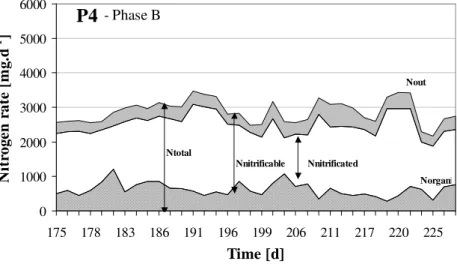
Figure 4 - Mass Balance of nitrogen -nitrification- phase B
Fig. 3 showed that during the first 12 days, the nitrified fraction was low comparative with the nitrificable fraction (total nitrogen removal during this period was 37%). This occurred because a period of 69 days was necessary to reach the maximal activity of the nitrifying biofilm on the material support. From 70th day, nitrification was stabilised. After this the results showed an average removal of 95% and maximum removal of 98% of TKN (average SRT=10 days). In
consequence, the nitrified fraction increased. With an SRT=3 days, the removal rate stabilised at around 94% in average and the maximum value was 96%.
Fig. 5 shows the variation of the TKN concentration input and output in the RH during the monitoring period. It was observed that the HR using the P4 support is robust, because it presented stability in the nitrogen removal with applied load variation. It Total nitrification was
0 1000 2000 3000 4000 5000 6000
175 178 183 186 191 196 199 206 211 217 220 225
Time [d]
N
it
ro
g
e
n
ra
te
[m
g
.d
-1 ]
P4
- Phase BNtotal
Nnitrificable Nnitrificated
Nout
Norganic
0 1000 2000 3000 4000 5000 6000
56 58 60 64 66 70 72 74 78 80 84 86 88 92 94 98 100
T i m e [d ]
N
it
rog
e
n
r
a
te
[m
g
.d
-1 ]
P 4
- Phase ANnitrificable
Ntotal Nnitrificated
Nout
obtained in reactor operating with a temperature of 16°C and low SRT, around 3 days. Wolff et al. (2003) observed that nitrification in hybrid reactors was not influenced by the SRT, because the autotrophic activity was mainly reached to the fixed biomass, where most of the nitrifiers were attached. This showed that this type of reactor is very interesting for nitrogen removal. The roughness of surface of the P4 support has positive effect on the bacterial growth, the macropores
protect the colonised bacteria for the shear stress, and increase the specific surface for the biofilm growth.
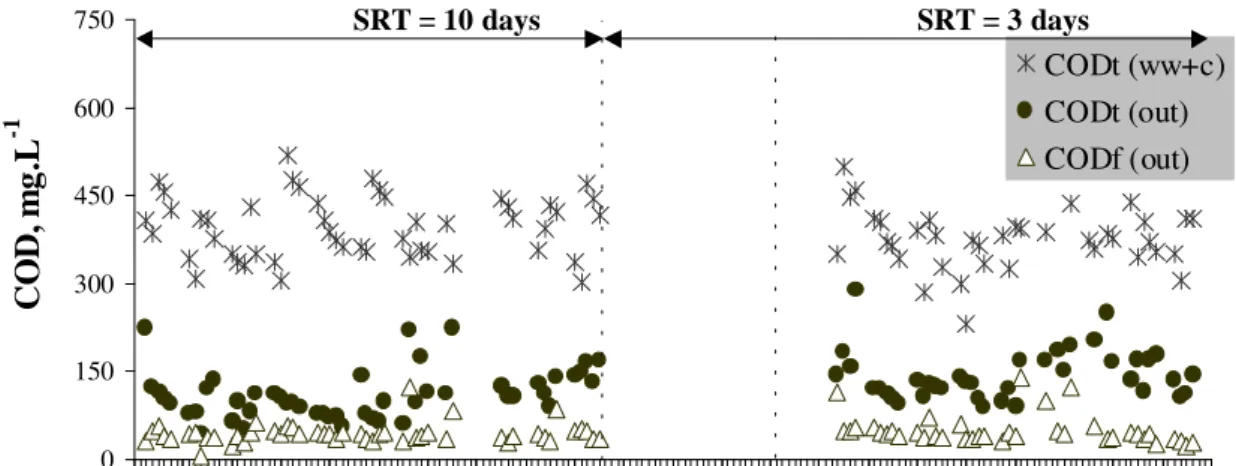
Fig. 6 shows the variation of the COD concentration during the monitoring period in phases A and B. Filtered COD showed an more stable performance than total COD and an average removal rate of 89% in terms of filtered COD was reached.
Figure 5. Variation of the TKN concentration input and output- phase A and B
Figure 6 - Variation of the COD concentration input and output, phase A and B.
0 10 20 30 40 50 60 70 80 90 100
54 62 70 78 86 94 102 110 118 126 134 142 150 158 166 174 182 190 198 206 214 222 230
T im e , d ay
T
K
N
,
m
g
N
.L
-1
Input
output SR T = 3days
SR T = 10 days
Stabilisation
0 150 300 450 600 750
54 62 70 78 86 94 102 110 118 126 134 142 150 158 166 174 182 190 198 206 214 222 230
Time, day
C
O
D
, m
g
.L
-1
CODt (ww+c) CODt (out) CODf (out)
The fast growing heterotrophic microorganisms can grow in biofilm and in suspension. Under these conditions, the organic matter is mainly oxidised by suspended microorganisms in suspension, while the ammonia compounds are mainly oxidised by the nitrifiers in the biofilm (Oyanedel et al., 2002).
CONCLUSION
The results showed that the hybrid moving-bed reactors constituted an excellent alternative for biological treatment with nitrification of sanitary sewer. The nitrification was reached with temperature of 16oC and very low SRT. The material support in recycled plastic (P4) was efficient in hybrid processes for nitrification, because it allowed the development and activity of biofilm with nitrifiers, which were protecting the hydrodynamic stress in its macropores. Moreover, the P4 presents the following advantages: (1) large specific surface for the bacterial growth; (2) easy to keep in suspension, consequently reduced costs to the aeration and possibility for the use of recycled material. On the other hand, it presents drawbacks as the size of particles (very small) and the difficulty of holding in the hybrid reactor.
ACKNOWLEDGEMENTS
The authors are grateful to CAPES for financial assistance.
RESUMO
Este trabalho investiga a nitrificação em um reator-piloto híbrido de leito móvel agitado, que utiliza um plástico reciclado de baixa densidade como material suporte para o crescimento da biomassa. O preenchimento do reator com o suporte era 20% de seu volume útil (22L). A vazão de alimentação e recirculação era de 45 L/dia. O reator foi operado com temperatura de 16oC, em duas fases, de acordo com a idade do lodo: fase A = 10 dias e fase B = 3 dias (valores médios). As cargas volumétricas médias aplicadas, de nitrogênio e orgânicas foram de 0.16KgNTK/m3dia e de 1kgDQO/m3dia, respectivamente. Os resultados mostraram uma
redução média de nitrogênio de 95% e de DQO de 89%, nas duas fases (A e B). A eficiência de remoção de nitrogênio deste reator mostrou ser independente da idade do lodo.
REFERENCES
Andreottola, G.; Foladori, P.; Ragazzi, M. and Tatano, F. (2000), Experimental comparison between MBBR and activated sludge system for the treatment of municipal wastewater Water Science and Techn., 41 : (4-5), 383-391.
Ochoa, J. C. (1998), Performances épuratoires d’un réacteur type lit fluidisé inversé pour l’élimination du carbone et de l’azote d’une eau résiduaire urbaine..
Toulouse : DEA/GPS INSA. 68 pp.
Ochoa, J. C.; Colprim, J.; Palacios B.; Paul, E. and Chatellier, P. (2002) Active heterotrophic and autotrophic biomass distribution between fixed and suspended systems in a hybrid biological reactor.
Water Scienceand Techn., 46 (1-2).
Odegaard, H.; Gisvold, B. and Strickland, J. (2000), The influence of carrier size and shape in the moving bed biofilm process. Water Science and Techn., 41 : (4-5), 383-391.
Oyanedel, V.; Garrido, J. M.; Colprim, J.; Lazarova, V. and Mendez, R. (2002) Comparison and modelling of the growth of heterotrophs and nitrifiers in biofilm and hybrid airlift reactors. International Specialised Conference on Biofilm Monitoring, Porto- Portugal, pp. 241-244. [CD ROM].
Standard Methods for the Examination of Water and Wastewater (1998). 20th ed. Am. Pub. Health
Assoc./Am. Works Assoc./Water Environ. Fed.
Washington DC, USA.
Wolff, D. B.; Ochoa, J. C.; Paul, E. and Costa, R. H. R. (2003). Estudo da biomassa heterotrófica e autotrophic ativa desenvolvida em reatores híbridos no tratamento de esgoto urbano. In: SINAFERM, Florianópolis - SC. Proccedings... Florianópolis. [CDROM].
Zhang T. and Bishop P. (1996) Evaluation of substrate and pH effects in a nitrifying biofilm. Water Environ. Research, 68 : (7), 1107-1115.