Review
Mechanical properties modeling of recycled aggregate concrete
Antonio Eduardo Bezerra Cabral
a,*, Valdir Schalch
b, Denise Carpena Coitinho Dal Molin
c,
José Luis Duarte Ribeiro
caDepartment of Structural Engineering and Civil Construction (DEECC), Federal University of Ceará (UFC), Campus Universitário do Pici, Bloco 710, CEP 60455-760, Fortaleza/CE, Brazil
bHydraulic and Sanitation Department (SHS) of the University of São Paulo (EESC/USP), Av. Trabalhador Sãocarlense, 400, Centro, CEP 13.566-590,
Caixa Postal 359, São Carlos/SP, Brazil
cNucleus Geared Towards Innovational Buildings (NORIE) of the Federal University of Rio Grande do Sul (UFRGS), Av. Osvaldo Aranha, 99,
3°andar, CEP 90.035-190, Porto Alegre/RS, Brazil
a r t i c l e
i n f o
Article history:
Received 19 February 2009
Received in revised form 11 October 2009 Accepted 15 October 2009
Available online 13 November 2009
Keywords: Recycled aggregate Mechanical properties Design of experiments C&D waste
a b s t r a c t
The variability observed in the composition of construction and demolition (C&D) waste is a problem that inhibits the use of recycled aggregates in concrete production. To contribute in this field, a research was carried out varying water/cement ratio and substitution percent of natural aggregates by recycled aggre-gates. The experimental program used samples of main Brazilian C&D waste sources, which are concrete, mortar and red ceramic bricks as well as tiles. Results of concrete compressive strength and elastic mod-ulus were statistically analyzed and modeled. The study shows that for both concrete properties, recycled coarse aggregate was more influential than recycled fine aggregate. However, the use of fine recycled red ceramic increased concrete strength. Coarse recycled red ceramic aggregate and fine recycled concrete aggregate exercised the largest and the smallest influence, respectively, in concrete properties.
Ó2009 Elsevier Ltd. All rights reserved.
Contents
1. Introduction . . . 421
2. Materials and methods . . . 422
2.1. Design of experiments . . . 422
2.2. Concrete production . . . 422
3. Results. . . 422
3.1. Compressive strength . . . 423
3.2. Elastic modulus . . . 425
3.3. Compressive strength and elastic modulus correlation . . . 427
4. Conclusion . . . 429
Acknowledgments . . . 429
References . . . 429
1. Introduction
Construction industry is a productive sector that has a consider-able role in the Brazilian economy. Between 1980 and 1996, this sector was responsible for 65% of total investment in the country. In 1999, this sector reached the mark of 70%. By 2001, this sector was responsible for 15.6% of the GNP, and construction of residential buildings represented around 7.5% of national GNP. Construction
industry is indeed the largest consumer of natural resources in the world, absorbing from 20% to 50% of all resources explored[1].
Construction activities demand a significant amount of natural materials, such as sand and gravel. In Brazil, there is an estimated annual consumption of 210 million tons of aggregates, only for the production of mortars and concretes, without considering the vol-ume used in paving and its losses[1]. In the USA, 40% of natural re-sources harvested have been used in construction operations[2]. The extraction of this material modifies the course of rivers and its beds, creating environmental problems. The extraction of rocks from mountains is also a dangerous activity to environment, since it alters landscapes and causes stability problems in them.
0950-0618/$ - see front matterÓ2009 Elsevier Ltd. All rights reserved. doi:10.1016/j.conbuildmat.2009.10.011
* Corresponding author. Tel.: +55 85 3366 9607; fax: +55 85 3366 9607. E-mail address:[email protected](A.E.B. Cabral).
Contents lists available atScienceDirect
Construction and Building Materials
As many industrial process, construction industry generates waste on large scale, as it might be responsible for 40% of the waste generated from the whole economy[1]. The annual C&D waste in the USA is estimated as 136 million tons and in the first 15 coun-tries of the European Union it reaches about 180 million tons[3]. Shanghai City alone, wastes 20 million tons annually [4]. Other studies reported that C&D waste corresponds to 50% of all munici-pal waste generated in Brazilian cities[5]. The waste is also large in other countries, as in the Hong Kong SAR, Canada and the UK, that currently takes up 33% to 65% of the existing landfill space[2].
The improper disposal of C&D waste is a problem faced by municipalities, not only in Brazil, but also in other countries of the world. Irregular disposal affects the environment directly, being responsible inline with other factors for floodings, damages to landscapes, road obstructions, disease proliferation, and other damages to human health and living beings.
As a result of high aggregate consumption, there is a critical shortage of natural aggregates for concrete production in many ur-ban areas, as well as an increasing amount of C&D waste, being generated in the same areas. A solution to these problems could be the recycling of C&D waste, generating recycled aggregates and its utilization in the construction industry itself, as an alterna-tive material.
Nevertheless, C&D waste varies its composition depending on location and time. Concrete, mortar and red ceramics appears as the main components of C&D waste, reaching above 70% by weight [5,6]. The heterogeneity influences the characteristics of recycled aggregates, therefore the use of aggregate types, produces some modifications in the behavior of produced concrete, regarding some properties[7]. Therefore, it is important to assess properties of recycled aggregate concrete, considering that the percentage of these main contents does vary.
Hence, the aim of this report is model concrete’s compressive strength and elastic modulus as a function of water/cement ratio as well as recycled aggregate types and quantities.
2. Materials and methods
2.1. Design of experiments
Seven independent variables (factors) were identified: fine recycled aggregates of red ceramic (brick ceramic) (FRB), coarse recycled aggregates of red ceramic (brick ceramic) (CRB), fine recycled aggregates of mortar (FRM), coarse recycled aggregates of mortar (CRM), fine recycled aggregates of concrete (FRC), coarse recy-cled aggregates of concrete (CRC) and water/cement ratio (w/c). These aggregates were produced using a jaw crusher and comes from a real rubble. The fine and coarse recycled aggregates have the same grading curves and fineness modulus (2.70 and 6.50) of theirs respectively natural aggregates.
The experimental design selected to study the effect of all seven factors on the response variables was a second order composite design[8]. The second order composite design contemplates a 272fractional factorial design (mixtures 1–32 inTable 1) plus 2kvertexes of star points (mixtures 33–46 inTable 1) and two central points (mixtures 47 and 48 inTable 1)[8].
The use of fractional factorial projects is quite useful when there are a large number of factors to be analyzed. Fractional designs allow time and cost optimiza-tion, since just a fraction of the total number of tests is performed. Fractional facto-rial designed have been previously used and reported by numerous researches [9–11].
Besides the traditional second order composite design, mixtures 49 and 50 were inserted into the experimental design, since these mixtures represent the condition where all aggregates (recycled and natural) are present. Regarding these mixtures, the water/cement ratio were the two averages of the lower and upper thirds, in other words, 0.46 and 0.74.Table 1shows all concrete mixtures tested in the exper-imental plan.
Compressive strength and elastic modulus are the response variables (depen-dent variables), which are measured following procedures described in Brazilian Standards NBR 5739/07 and NBR 8522/08, respectively.
The statistical analyses for compressive strength and elastic modulus were per-formed and models were obtaining. These models allow the prediction of concrete’s performance for 0–100% replacement of natural aggregates by recycled aggregates and water/cement ratio ranging from 0.46 to 0.74.
Water absorption, specific gravity and bulk density of recycled fine and coarse aggregates and natural fine and coarse aggregate were measured by the methods proposed by their respective Brazilian Standards. For each aggregate, those proper-ties were defined twice, through two samples. The average results for fine aggre-gates are inTable 2, while average results for coarse aggregates are inTable 3. The cement used was Brazilian Portland Cement type V and its properties are shown inTable 4.
2.2. Concrete production
The reference dosage of the natural aggregates was performed using the IPT/ EPUSP’s method[12]. The workability was fixed in 120 ± 20 mm based in the slump test method. Dosage diagram is shown inFig. 1.Table 5shows concrete composi-tion for the 0.46w/cratio, performed with natural aggregates.
When substituting the natural aggregates for the recycled ones, some adjust-ments in concrete dosage were necessary, such as volume compensation and pre-soaking water for recycled aggregates. The volume compensation of recycled aggre-gates employed in the pre-determined mixtures was done to compensate the fact that specific gravity of recycled aggregates is lower than natural aggregates and the simple mass substitution would result in higher volumes of recycled aggregates [13,14]. This would require more water and cement in order to produce equivalent mixtures. The volume compensation of the recycled aggregates in the experimental project mixtures was done according to:
MRA¼MNA: cRA cNA
ð1Þ
MRAis recycled aggregate mass (kg),MNAis natural aggregate mass (kg),cRAis specific gravity of recycled aggregate andcNAis specific gravity of natural aggregate. Afterwards, 10 min prior to mixing process, recycled aggregates were moist-ened with 80% of the water that would be absorbed in 24 h by the recycled aggre-gate mass corresponding to the mixture. This procedure was recommended by other authors[15]. This procedure allowed that aggregates were already moist when they went to the pan-mixer, avoiding that part of the mixing water could be absorbed by the aggregates, which would disturb the water/cement ratio[3]. Some superplasticizer mass were added to the mixtures to reach desired workabil-ity (120 ± 20 mm, as indicated by the slump test).
Four cylindrical specimens with 10 cm (diameter) by 20 cm (height) were casted for each produced mixture, according to the procedures of Brazilian Standard NBR 5738/08. The specimens were maintained in a humid chamber until the age of test (28 days). At this age, the specimens received a sulfur coat and were tested according to the Brazilian Standards NBR 5739/07 and NBR 8522/08 for compres-sive strength and elastic modulus, respectively.
The results were treated statistically and models for compressive strength and elastic modulus were produced. Using these models the behavior of specimens with different percentages of recycled aggregates andw/cratios were graphically illus-trated. A table presenting losses and earnings for each mixture was also generated.
3. Results
It is well established in literature that compressive strength follows Abram’s Law (Eq. (2)), while elastic modulus follows Eq.(3). However, to cope with the effect of the addition of recy-cled aggregates, a specific term (Eq.(4)) was added to these equa-tions. The value assumed by this term depends on type and content of recycled aggregate that replaces fine and coarse natural aggregate.
fc¼ b1 ba2=c
!
: ð2Þ
Ec¼ b3 a=c0;5
ð3Þ
½1 ða1:CRMþa2:FRMþa3:CRCþa4:FRCþa5:CRBþa6:FRBÞ ð4Þ
The coefficientsb1,b2andb3were obtained from the results of concrete specimens without recycled aggregates. The coefficients froma1toa6were obtained from the results of concretes produced with recycled aggregates.
3.1. Compressive strength
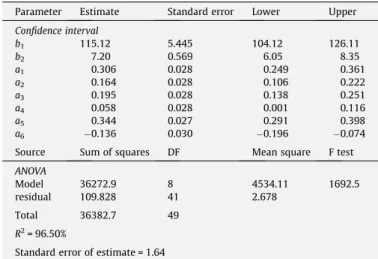
The parameter’s estimates for Eqs. (2) and (4) are shown in Table 6. Eq.(5)represents the model for compressive strength of concretes with recycled aggregates, considering possible inclusion
of coarse and fine aggregates from concrete, mortar or brick ceram-ics recycling.
fc¼ 115 7:2a=c
½1 ð0:306CRMþ0:164FRMþ0:195CRC
þ0:058FRCþ0:344CRB0:136FRBÞ ð5Þ
Table 1
Concrete mixtures defined according to the second order composite design.
Mixtures w/c Coarse aggregate (%) Fine aggregate (%)
Natural Concrete Brick ceramics Mortar Natural Concrete Brick ceramics Mortar
01 0.46 100 0 0 0 100 0 0 0
02 0.74 100 0 0 0 0 0 100 0
03 0.74 100 0 0 0 0 100 0 0
04 0.46 100 0 0 0 0 50 50 0
05 0.74 0 0 0 100 0 0 0 100
06 0.46 0 0 0 100 0 0 50 50
07 0.46 0 0 0 100 0 50 0 50
08 0.74 0 0 0 100 0 33 33 33
09 0.46 0 0 100 0 0 0 0 100
10 0.74 0 0 100 0 0 0 50 50
11 0.74 0 0 100 0 0 50 0 50
12 0.46 0 0 100 0 0 33 33 33
13 0.74 0 0 50 50 100 0 0 0
14 0.46 0 0 50 50 0 0 100 0
15 0.46 0 0 50 50 0 100 0 0
16 0.74 0 0 50 50 0 50 50 0
17 0.46 0 100 0 0 0 0 0 100
18 0.74 0 100 0 0 0 0 50 50
19 0.74 0 100 0 0 0 50 0 50
20 0.46 0 100 0 0 0 33 33 33
21 0.74 0 50 0 50 100 0 0 0
22 0.46 0 50 0 50 0 0 100 0
23 0.46 0 50 0 50 0 100 0 0
24 0.74 0 50 0 50 0 50 50 0
25 0.46 0 50 50 0 100 0 0 0
26 0.74 0 50 50 0 0 0 100 0
27 0.74 0 50 50 0 0 100 0 0
28 0.46 0 50 50 0 0 50 50 0
29 0.74 0 33 33 33 0 0 0 100
30 0.46 0 33 33 33 0 0 50 50
31 0.46 0 33 33 33 0 50 0 50
32 0.74 0 33 33 33 0 33 33 33
33 0.60 0 50 25 25 0 33 33 33
34 0.60 0 0 50 50 0 33 33 33
35 0.60 0 25 50 25 0 33 33 33
36 0.60 0 50 0 50 0 33 33 33
37 0.60 0 25 25 50 0 33 33 33
38 0.60 0 50 50 0 0 33 33 33
39 0.60 0 33 33 33 0 50 25 25
40 0.60 0 33 33 33 0 0 50 50
41 0.60 0 33 33 33 0 25 50 25
42 0.60 0 33 33 33 0 50 0 50
43 0.60 0 33 33 33 0 25 25 50
44 0.60 0 33 33 33 0 50 50 0
45 0.80 0 33 33 33 0 33 33 33
46 0.40 0 33 33 33 0 33 33 33
47 0.60 0 33 33 33 0 33 33 33
48 0.60 0 33 33 33 0 33 33 33
49 0.46 25 25 25 25 25 25 25 25
50 0.74 25 25 25 25 25 25 25 25
Table 2
Fine aggregates characteristics.
Aggregate Method
NM 30/00 NBR 9776/87 NM 45/02 Absorption
(%)
Specific gravity Bulk density (kg/m3)
Natural 0.42 2.64 1,560
Recycled concrete – FRC 7.55 2.56 1,430 Recycled mortar – FRM 4.13 2.60 1,390 Recycled brick ceramics – FRB 10.69 2.35 1,260
Table 3
Coarse aggregates characteristics.
Aggregate Method
NM 53/02 NM 53/02 NM 45/02 Absorption
(%)
Specific gravity
Bulk density (kg/m3)
Natural 1.22 2.87 1,440
TheR2statistic indicates that the model as fitted explains 96.5% of the variability in compressive strength. The standard error of the estimate shows the standard deviation of the residuals to be 1.64. Once the confidence interval does not contain zero, it can be as-sumed that all included terms in the model are significant for this confidence level (95%).
It is worth noting that the first term between parentheses refers to concrete strength without substitution of natural aggregates by recycled ones and it is a function of water/cement ratio. This term was previously defined, starting from an analysis of the values ob-tained when the water/cement ratio is 0.46, 0.60 and 0.74, being defined to minimize the prediction errors. The second term,
be-tween brackets, defines a percentile to be applied on the original strength, reducing or improving the strength in function of the recycled aggregate type and content. In this model, the percentage of substitution of fine or coarse natural aggregates for those recy-cled should be informed in the scale of 0 (0%)–1 (100%), while water/cement ratio is expressed in the usual scale, varying from 0.40 to 0.80. The sum for the percentage of substitution of natural aggregates by recycled ones should be equal or lower than 1 (100%) for each aggregate type (coarse and fine).
It is observed that coarse aggregate substitution produces an ef-fect larger than the substitution of fine ones. This is confirmed by the magnitude of the respective coefficients. This behavior is in agreement with other results reported in literature[11].
According to Eq.(5), substitution of natural aggregates by the recycled ones results in a reduction in concrete strength, except in the case of fine recycled aggregate of brick ceramics (FRB) that provides an increment in concrete strength.
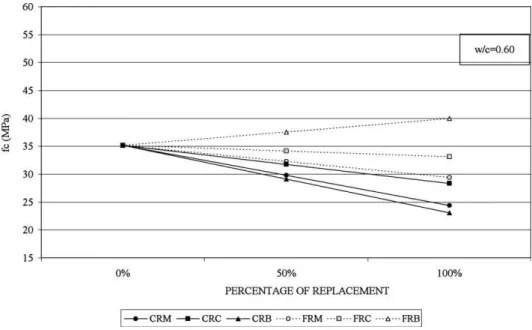
Figs. 2–4andTable 7present results obtained using Eq.(5). As can be seen inFigs. 2–4water/cement ratio influences concrete compressive strength. FRC and FRM exercise a negative influence in the strength. The lowest influence was performed by FRC, reduc-ing the compressive strength in 6% for 100% of substitution. This value is quite similar to results reported by Evangelista and Brito [17]. They obtained a 7.6% lower strength resistance concrete with 100% of fine recycled concrete aggregate[15].
The FRB produced an improvement in compressive strength, reaching a 14% increase associated to 100% replacement. This increase might be due to pozzolanic reactions. These reactions improve the interfacial transition zone between the paste and the aggregates and consequently improving the mechanical prop-erties of the concretes and mortars produced with this type of fine recycled aggregates[3,14]. Strength increase is also partly due to the roughness of particles in the recycled aggregates of ceramics that supplies a better bond between the cement paste and the
Table 4
Properties of Portland Cement used.
Oxide Composition (%)
MgO 4.85
SO3 3.10
Free lime 1.31
Al2O3 4.40
SiO2 18.55
Fe2O3 2.66
CaO 60.11
Alkaline equivalent 0.59
Insoluble residue 0.76
Loss on ignition 3.46
Fineness (Blaine method) 4916 cm2/g
Grip time
Begin 185 min
End 245 min
Strength
1 day 30.8 MPa
3 days 39.5 MPa
7 days 44.9 MPa
28 days 51.5 MPa
aggregates. Another possibility is that water absorbed by recycled aggregates becomes available for the continuous hydration of ce-ment[2,18,19]. That behavior was related by other researchers [20].
The weakest results were obtained when natural coarse aggre-gate was replaced by recycled coarse aggreaggre-gate of brick ceramics (CRB). According to the model, this replacement reduces the strength by 38% for a replacement of 100%. Such reduction value is quite coherent with others reports[16,21,10,22]. This behavior is probably due to the angular aggregates shape. This shape does not provide an efficient grain package and thus it produces con-cretes with large amounts of voids[2].
The coarse aggregate presenting the best performance consider-ing strength behavior was the CRC, although it has still shown a reduction of 28% for 100% replacement. However, the strength of the concrete mix that the coarse recycled concrete aggregate was made of influences the strength of the recycled concrete. The great-er the strength of the original concrete, the lessgreat-er influence the coarse recycled concrete aggregate will promote[23]. As the CRC used comes from rubble, the strength of original concrete is un-known, but probably is lesser that the strength of the recycled con-crete produced.
According to the model, fine recycled aggregates of mortar and concrete do not produce a large influence on concrete strength, showing a reduction of 15% and 7%, respectively, for a 100% replacement.
Nevertheless, to produce recycled aggregate concrete with the same or superior natural aggregate concrete’s compressive strength, an improvement of cement consumption or the use of mineral additions should be considered[4,6,15,19].
3.2. Elastic modulus
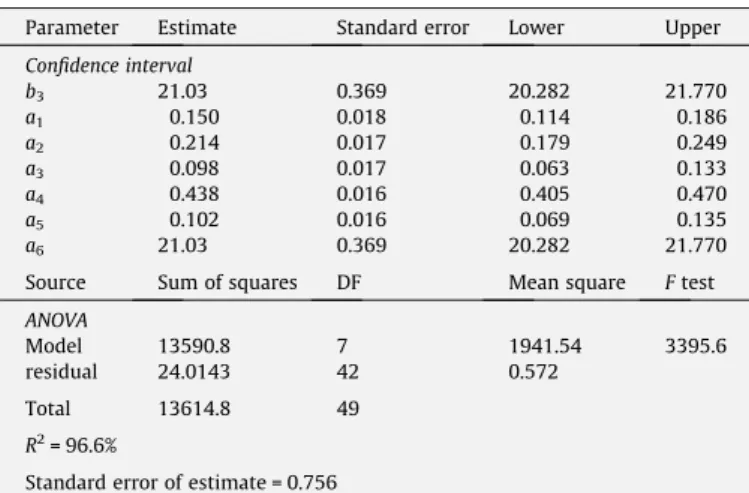
The procedure to obtain the parameter’s estimates for the elas-tic modulus model was the same described for the compressive strength model using multiple regression tools. Table 8 shows the parameter’s estimates. Eq. (7) presents the elastic modulus model for concretes with recycled aggregates, considering coarse and fine aggregates from concrete, mortar and brick ceramics recycling.
Ec¼ 21 a=c0:5
½1 ð0:344RMCþ0:150RMFþ0:214RCC
þ0:098RCFþ0:438RBCþ0:102RBFÞ ð6Þ
As can be seen inTable 8, modelR2statistic is high (96.6%). The standard error of the estimate shows that the standard deviation of the residuals is 0.76. Once coefficients’ confidence interval do not contain zero, it can be assumed that all included terms in the mod-el are significant for this confidence levmod-el (95%).
As for compressive strength model, percentage of substitution of fine or coarse aggregates are informed in the 0 (0%)–1 (100%) scale, while water/cement ratio ranges from 0.46 to 0.74. The sum of the substitution percentages for the recycled aggregates
Table 5
Composition of concrete with w/c ratio equal to 0.46, prepared with natural aggregates.
Cement (kg) Fine aggregate (kg) Coarse aggregate (kg) Water (kg)
5.952 9.642 15 2.738
Table 6
Parameter’s estimates and ANOVA for compressive strength model (Confidence level: 95%).
Parameter Estimate Standard error Lower Upper
Confidence interval
b1 115.12 5.445 104.12 126.11
b2 7.20 0.569 6.05 8.35
a1 0.306 0.028 0.249 0.361
a2 0.164 0.028 0.106 0.222
a3 0.195 0.028 0.138 0.251
a4 0.058 0.028 0.001 0.116
a5 0.344 0.027 0.291 0.398
a6 0.136 0.030 0.196 0.074
Source Sum of squares DF Mean square F test
ANOVA
Model 36272.9 8 4534.11 1692.5
residual 109.828 41 2.678
Total 36382.7 49
R2= 96.50%
Standard error of estimate = 1.64
should be equal or lower than 1 for each aggregate type (coarse and fine).
The first term in parenthesis in Eq.(6)refers to the elastic mod-ulus for concrete without any substitution of natural aggregates, which is a function of water/cement ratio. This term was previ-ously defined from an analysis of the values obtained when water/cement ranges from 0.46 to 0.74. The modeling was carried
out minimizing prediction errors. The second term, in brackets, de-fines a percentage to be applied over the original modulus, modi-fying it as a result of the substitution of the natural aggregate by the recycled one.
We observe that for all aggregate types when natural aggregate is replaced by recycled aggregate it results in a decrease on elastic modulus, which is consistent with results reported in literature [21,10,24–26].
Using the model described in Eq.(6),Figs. 5–7and inTable 9 were draw. From these figures and table the influence of water/ce-ment ratio on the performance of elastic modulus for recycled aggregates concretes may be observed. Following an increase in w/cratio from 0.46 to 0.60 and to 0.74, there is a reduction of 12% and 21% in the modulus, respectively.
It is also observed that substituting coarse aggregate produces a greater loss in modulus than substituting fine aggregate. This can be easily verified checking the magnitude of the coefficients in
Fig. 3.Compressive strength behavior as a function of percentage of replacement and type of recycled aggregate for a water/cement ratio equal to 0.60.
Fig. 4.Compressive strength behavior as a function of percentage of replacement and type of recycled aggregate for a water/cement ratio equal to 0.74.
Table 7
Compressive strength performance of recycled aggregate concretes.
Percentage of replacement (%) Type of recycled aggregate
CRM CRC CRB FRM FRC FRB
0 1.00 1.00 1.00 1.00 1.00 1.00
50 0.85 0.90 0.83 0.92 0.97 1.07
Eq.(6). This behavior is coherent, once concrete’s elastic modulus is intrinsically associated to volumetric fraction, specific gravity, modulus of elasticity of the aggregate, cement matrix, and charac-teristics of transition zone[27]. These authors point out that aggre-gate’s deformation is mainly associated to its porosity, and to a lesser degree, to maximum dimension of aggregate, form, texture, grading and mineralogical composition. According to them, it is the aggregate’s modulus that controls the restriction capacity of the matrix deformation and this is controlled by the porosity of the aggregate.
From the aforementioned statements and considering the char-acteristics of recycled aggregates used in this experiment (the spe-cific gravity of the recycled fine aggregates is lower than the specific gravity of the recycled coarse aggregates), it is consistent to state that elastic modulus of concretes produced with the for-mer ones is lower than elastic modulus of concretes produced with the latter ones.
The CRB exerts the highest influence in the concrete’s elastic modulus, reaching a 44% reduction in modulus value for a 100% substitution. Considering recycled aggregate’s characteristics, such behavior can be explained seeing that CRB has the least specific
gravity and the highest water absorption of all used aggregates, therefore being the most porous. Confirming these results, other authors [2,14,10,22,28] state that elastic modulus of concretes with coarse recycled ceramic aggregates is lower than conven-tional concrete’s modulus.
By the other hand, CRC is the recycled coarse aggregate that has less influence in elastic modulus of elasticity, since a decrease of 21% was observed for a replacement of 100%. This is consistent with results reported in literature, that also substituted natural coarse aggregate for recycled coarse aggregate of concrete, detect-ing a decrease of 19% in elastic modulus[20]. This decrease prob-ably occurs due to the high mortar ratio (around 40% of its volume) which is found in this type of recycled aggregate[13].
According toFigs. 5–7andTable 9, FRC and FRB exert the least influence on elastic modulus, with a reduction of 10% for a 100% substitution. The recycled fine aggregate of concrete is known to have a high natural rock ratio in its composition, a grinding result of the concrete with natural aggregate that has a high specific grav-ity and the least water absorption, among the recycled aggregates used.
Although FRB has increased compressive strength, a marginal decrease was observed in elastic modulus. It probably happens due to the fact that recycled brick ceramic aggregate are more prone to deformation, usually presenting lower modulus of elastic-ity than natural aggregate. This behavior was reported by other researchers[6,13,19].
3.3. Compressive strength and elastic modulus correlation
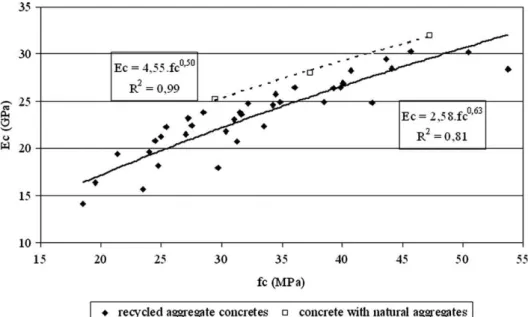
Using the models for compressive strength (Eq.(5)) and elastic modulus (Eq.(6)) of recycled aggregate concretes, a correlation be-tween those two variables was computed. A correlation of com-pressive strength and elastic modulus for conventional concretes was also carried out. The correlation between those two variables, for concretes with recycled and natural aggregates can be observed throughFig. 8.
According toFig. 8, for a same strength level, recycled aggregate concretes present smaller elastic modulus than concretes with nat-ural aggregates. That happens because, in general, recycled aggre-gates of C&D waste are more prone to deformation than natural aggregates, mainly due to cement matrix that is constantly present
Table 8
Parameter’s estimates and ANOVA for elastic modulus model (Confidence level: 95%).
Parameter Estimate Standard error Lower Upper
Confidence interval
b3 21.03 0.369 20.282 21.770
a1 0.150 0.018 0.114 0.186
a2 0.214 0.017 0.179 0.249
a3 0.098 0.017 0.063 0.133
a4 0.438 0.016 0.405 0.470
a5 0.102 0.016 0.069 0.135
a6 21.03 0.369 20.282 21.770
Source Sum of squares DF Mean square Ftest
ANOVA
Model 13590.8 7 1941.54 3395.6
residual 24.0143 42 0.572
Total 13614.8 49
R2= 96.6%
Standard error of estimate = 0.756
in the same, making concrete produced with recycled aggregates more elastic than concrete produced with natural aggregates [23,28,29].
This reduction in elastic modulus at a same compressive strength level is also expressed by the models. Eq.(7)represents the model that predict the behavior of concrete made with natural aggregates while Eq. (8) presents shows the model for recycled
aggregate concrete. R-squared associated with Eqs. (7) and (8) are 99% and 81%, respectively.
Ec¼4:55fc0;50 ð7Þ
Ec¼2:58fc0;63 ð8Þ
Eq.(7), which was obtained for concrete with natural aggregate, is quite close to the equation suggested by Brazilian StandardNBR 6118:2007, which is expressed in Eq. (9), presenting therefore coherence in the results.
Ec¼4;76fc0;50 ð9Þ
Several authors [9,14,29–32] present mathematical formula-tions to correlate elastic modulus and compressive strength of concretes with recycled aggregates. Some authors also correlate those two properties with the substitution percentage of recycled
Fig. 6.Modulus of elasticity behavior as a function of percentage of replacement and type of recycled aggregate for a water/cement ratio equal to 0.60.
Fig. 7.Modulus of elasticity behavior as a function of percentage of replacement and type of recycled aggregate for a water/cement ratio equal to 0.74.
Table 9
Elastic modulus performance of the recycled aggregate concretes.
Percentage of replacement (%) Type of recycled aggregate
CRM CRC CRB FRM FRC FRB
0 1.00 1.00 1.00 1.00 1.00 1.00
50 0.83 0.89 0.78 0.93 0.95 0.95
aggregates [33]. The equations proposed by those authors are pre-sented in Table 10. It can be observed that all equations have Ec=
a
fcb+c
format, which is similar to the Eq.(8)format.4. Conclusion
The replacement of natural aggregates by recycled aggregates modified concrete’s compressive strength and elastic modulus. In general, concrete produced with recycled aggregates had lower compressive strength, except concrete made of recycled fine aggregate from brick ceramic (RFB), where an increase in com-pressive strength was observed. According to the comcom-pressive strength model (Eq.(5)), recycled coarse aggregates have higher influence than recycled fine aggregates. Concrete’s elastic modu-lus was reduced for all types of recycled aggregates. The modumodu-lus of elasticity model (Eq.(6)) shows that recycled coarse aggregates exert greater influence than recycled fine aggregates. Among all aggregates tested, recycled coarse aggregate of red ceramic (RCB) exerted the larger influence on concrete’s elastic modulus, while recycled fine aggregate of concrete (RFC) exerted the least influence. For a same strength level, recycled aggregate concrete presented lower elastic modulus than concretes with natural aggregates.
Acknowledgments
The work presented in this paper is part of the Doctoral Thesis developed by the first author. The authors thank the Construction Innovation Nucleus (NORIE) of the Federal University of Rio Grande do Sul (UFRGS), in Brazil, to support the accomplishment of the experiments and the Brazilian Research Supporting Agency (CAPES) for the financial support through the PQI 106/08-03 agree-ment (CEFET/CE-EESC/USP).
References
[1] Marques Neto JC. Management of construction and demolition waste in Brazil. São Carlos: Rima; 2005 (in Portuguese).
[2] Agamuthu P. Challenges in sustainable management of construction and demolition waste. Waste Manage Res 2008;26:491–2.
[3] Bektas F, Wang K, Ceylan H. Effects of crushed clay brick aggregate on mortar durability. Constr Build Mater 2009;23:1909–14.
[4] Li J, Xiao H, Zhou Y. Influence of coating recycled aggregate surface with pozzolanic powder on properties of recycled aggregate concrete. Constr Build Mater 2009;23:1287–91.
[5] Cabral AEB. Mechanical properties and durability modeling of recycled aggregates concrete. considering the construction and demolition waste variability. Ph.D. thesis, University of São Paulo; 2007 (in Portuguese). [6] González-Fonteboa B, Martínez-Abella F. Concretes with aggregates from
demolition waste and sílica fume. Materials and mechanical properties. Build Environ 2008;43:429–37.
Fig. 8.Correlation between compressive strength and elastic modulus for concretes made with recycled and natural aggregates.
Table 10
Equations that correlate elastic modulus with compressive strength.
Author Equation Type of aggregate
Ravindrarajah et al. (2000)[32] Ec= 5.31fc0.5+ 5.38 Natural
Ec= 7.77fc0.33 Coarse recycled concrete
Ec= 3.48fc0.5+ 13.1 Coarse recycled concrete
Ec= 3.02fc0.5+ 10.7 Coarse and fine recycled concrete
Ravindrarajah and Tam (1985)[31] Ec= 4.63fc0.5 Coarse recycled concrete
Akhtaruzzaman and Hasnat (1983)[30] Ec= 8.3fc0.5 Coarse recycled red ceramic
Nagataki et al. (2000)[29] Ec=afc0.3 Coarse recycled concrete
Bairagi et al. (1993)[33] Ec= (578–1.34r)fc0.27whereris the recycled aggregate tenor Coarse recycled concrete
Leite (2001)[14] Ec= 4.63fc0.5
3.48 Coarse and fine recycled C&D waste
Lovato (2007)[9] Ec= 5.74fc0.513.39 Coarse and fine recycled C&D waste
[7] Bianchini G, Marrocchino E, Tassinari R, Vaccaro C. Recycling of construction and demolition waste materials: a chemical–mineralogical appraisal. Waste Manage 2005;25(2):149–59.
[8] Ribeiro JLD, Caten CST. Project of experiments. Porto Alegre: FEEng/UFRGS; 2001 (in Portuguese).
[9] Lovato PS. Parameters control verification of recycled aggregates from construction and demolition waste to concrete use. Master Thesis. Porto Alegre, Federal University of Rio Grande do Sul; 2007 (in Portuguese). [10] Cachim PB. Mechanical properties of brick aggregate concrete. Constr Build
Mater 2009;23:1291–7.
[11] Debieb F, Kenai S. The use of coarse and fine crushed bricks as aggregate in concrete. Constr Build Mater 2008;22:886–93.
[12] Helene PRL, Terzian P. Manual of dosage and control of concretes. São Paulo: PINI; 1992 (in Portuguese).
[13] Hansen TC, Narud H. Strength of recycled concrete made from crushed concrete coarse aggregate. Concr Int 1983(January):16–23.
[14] Leite MA. Evaluation of mechanical properties of concretes produced with recycled aggregates of construction and demolition wastes. Ph.D. thesis, Federal University of Rio Grande do Sul; 2001 (in Portuguese).
[15] Etxeberria M, Vázquez E, Marí A, Barra M. Influence of amount of recycled aggregates and production process on properties of recycled aggregate concrete. Cem Concr Res 2007;37:735–42.
[17] Evangelista L, Brito J. Mechanical behavior of concrete made with fine recycled concrete aggregates. Cem Concr Compos 2007;29:397–401.
[18] Suzuki M, Meddah MS, Sato R. Use of porous ceramic waste aggregates for internal curing of high-performance concrete. Cem Concr Res 2009;39:373–81.
[19] Corinaldesi V, Moriconi G. Influence of mineral additions on the performance of 100% recycled aggregate concrete. Constr Build Mater 2009;23: 2869–76.
[20] Binici H. Effect of crushed ceramic and basaltic pumice as fine aggregates on concrete mortars properties. Constr Build Mater 2007;21:1191–7.
[21] Xiao J, Li J, Zhang Ch. Mechanical properties of recycled aggregate concrete under uniaxial loading. Cem Concr Res 2005;35(6):1187–94.
[22] Senthamarai RM, Manoharan PD. Concrete with ceramic waste aggregate. Cem Concr Compos 2005;27:910–3.
[23] Tabsh SW, Abdelfatah AS. Influence of recycled concrete aggregates on strength properties of concrete. Constr Build Mater 2009;23:1163–7. [24] Hansen TC, BEgh E. Elasticity and drying shrinkage of recycled-aggregate
concrete. ACI J 1985;82(5):648–52.
[25] Ajdukiewicz A, Kliszczewicz A. Influence of recycled aggregates on mechanical properties of HS/HPC. Cem Concr Compos 2002;24(2):269–79.
[26] Gómez-Soberón JMV. Porosity of recycled concrete with substitution of recycled concrete aggregate: an experimental study. Cem Concr Res 2002;32(8):1301–11.
[27] Mehta PK, Monteiro PJM. Concrete: structure, properties and materials. 3rd ed. São Paulo: PINI; 2008.
[28] Rilem Recommendation. Specifications for concrete with recycled aggregates. 121-DRG guidance for demolition and reuse of concrete and masonry. Mater Struct 1994; 27(9): 557–9.
[29] Nagataki S, Iida K, Saeki T, Hisada M. Properties of recycled aggregate and recycled aggregate concrete. In: Proceedings international workshop on recycled aggregate. Niigata; 2000. p. 53–68.
[30] Akhtaruzzaman AA, Hasnat A. Properties of concrete using crushed brick as aggregate. Concr Int 1983;February:58–63.
[31] Ravindrarajah SR, Tam CT. Properties of concrete made with crushed concrete as coarse aggregate. Mag Concr Res 1985;37(130):29–38.
[32] Ravindrarajah SR, Stewart M, Greco D. Variability of recycled concrete aggregate and its effects on concrete properties: a case of study in Australia. In: Proceedings international workshop on recycled aggregate. Niigata; 2000. p. 9–25.