Analysis of the coffee harvesting process using an electromagnetic
shaker
Fábio Lúcio Santos1*, Daniel Marçal de Queiroz2, Francisco de Assis de Carvalho Pinto2 and Nerilson Terra Santos3
1
Departamento de Engenharia Mecânica, Universidade Estadual de Maringá, Av. Colombo, 5790, 87020-900, Maringá, Paraná, Brazil. 2Departamento de Engenharia Agrícola, Centro de Ciências Agrárias, Universidade Federal de Viçosa, Viçosa, Minas Gerais, Brazil. 3Departamento de Informática, Centro de Ciências Exatas e Tecnológicas, Universidade Federal de Viçosa, Viçosa, Minas Gerais, Brazil. *Author for correspondence. E-mail: [email protected]
ABSTRACT. Harvesting is one of the most important operations in coffee production systems. This operation has a high cost and impact on the final quality of the product. To reduce production costs, producers are looking for ways to mechanize this operation. Harvesting machines generally detach fruits from the coffee plant by vibration and/or impact. The objective of this work was to study the effect of the amplitude and frequency of vibration on the efficiency of coffee fruit harvesting. Vibration tests of coffee branches were performed in a laboratory using an electromagnetic shaker. The tests were performed using amplitudes in the range of 3.75 to 7.50 mm and frequencies from13.33 to 26.67 Hz. Coffee branches from two different varieties were used for evaluation, Catuaí Vermelho and Mundo Novo. It was verified that harvesting efficiency is directly related to the acceleration reached by the fruits during the harvesting process. The frequencies of 23.33 and 26.67 Hz and amplitudes of 6.25 and 7.50 mm resulted in the highest harvesting efficiency of ripe coffee cherries for both varieties. However, the harvesting efficiency for the Mundo Novo variety was higher than that of the Catuaí Vermelho variety at the studied frequency and amplitude ranges in this work.
Key words: coffee, harvesting, harvesting efficiency, ripeness stage.
RESUMO. Análise do processo de derriça do café utilizando uma máquina vibradora eletromagnética. A colheita é uma das operações mais importantes no sistema de produção do café pelo seu elevado custo e ao impacto que tem na qualidade do produto final. Para reduzir os custos de produção, têm-se buscado formas de mecanizar essa operação. As máquinas de colheita de café geralmente derriçam os frutos por meio de vibrações mecânicas e impacto. Este trabalho foi desenvolvido com o objetivo de estudar o efeito da amplitude e da frequência de vibração sobre a eficiência de derriça dos frutos de café. Para isso, ensaios usando uma máquina vibradora eletromagnética foram realizados em laboratório. Foram testadas amplitudes na faixa de 3,75 a 7,50 mm e frequências na faixa de 13,33 a 26,67 Hz. Os testes foram conduzidos utilizando-se ramos das variedades Catuaí Vermelho e Mundo Novo. A partir da análise dos resultados verificou-se que a eficiência de derriça dos frutos está diretamente relacionada à aceleração imposta aos frutos durante o procedimento de derriça. As frequências entre 23,33 e 26,67 Hz e amplitudes que variam entre 6,25 e 7,50 mm proporcionaram maior eficiência de derriça dos frutos cereja para ambas as variedades estudadas. A eficiência de derriça por vibração na variedade Mundo Novo foi superior à da variedade Catuaí Vermelho para os intervalos de frequência e amplitudes avaliados.
Palavras-chave: café, colheita, eficiência de derriça, estádio de maturação.
Introduction
The production chain of coffee is constituted by several operations, with harvest being the most expensive. A large labor contingent is necessary for harvesting. This operation also directly affects the final quality of coffee (PIMENTA; VILELA, 2003; CIRO, 2001). Prieto et al. (2008) affirmed that the concept of agricultural product quality has been changing during recent years and has been playing a fundamental role on the determination of
agricultural product prices. Coffee is considered one of the products that consumer markets have been most demanding of high quality.
harvesting, the main difficulties faced are the varying architectural characteristics of the plant and the non-uniformity of fruit ripeness (SOUZA et al., 2002).
Mechanical harvesting of coffee fruits has been accomplished by mechanical vibration. This principle of harvesting has been used to design machines for harvesting many types of fruits such as oranges, peaches and olives (ROSA et al., 2008; CASTRO-GARCÍA et al., 2008; WHITNEY et al., 2001). However, under certain conditions this process does not present desirable efficiencies. In order to improve this process, knowledge of the dynamic behavior of the harvesting system is necessary. The dynamic characteristics, frequency and vibration amplitude stand out as the most important for system evaluation (SOUZA et al., 2002; SESSIZ; ÖZCAN, 2006).
Táscon et al. (2005) analyzed the coffee harvesting process using portable coffee branch vibrators and verified the viability of this type of equipment for coffee harvesting. The results showed that when using portable vibrators, harvesting performance was 341.7 to 458.3% greater than traditional manual harvesting. Ciro (2001) performed a study in which the natural frequencies of the coffee fruit-stem system were obtained by using a two-degrees-of-freedom theoretical model. The results showed the importance of dynamic behavior analysis of the systems to better understand the process of detaching fruit from the coffee plant.
For coffee harvester design, it is important to study the dynamic behavior of coffee fruits when submitted to mechanical vibrations. Electromagnetic vibrators have been used as an essential tool to study mechanical harvesting processes of other products (ROSA et al., 2008). The advantage of the use of this equipment type in relation to mechanical systems is that the frequency, amplitude and vibration time can be easily controlled. Therefore, electromagnetic vibrations seem to be the correct tool to analyze, understand and develop systems for coffee harvesting by vibration.
The objective of this work was to determine the effect of the frequency and amplitude of vibration on cherry coffee fruit detachment efficiency for the
Catuaí Vermelho and Mundo Novo varieties when
using an electromagnetic shaker.
Material and methods
The work was developed in the Laboratory of Machine Design and Machine Vision (PROVISAGRO) of the Department of Agricultural Engineering at the Federal University of Viçosa.
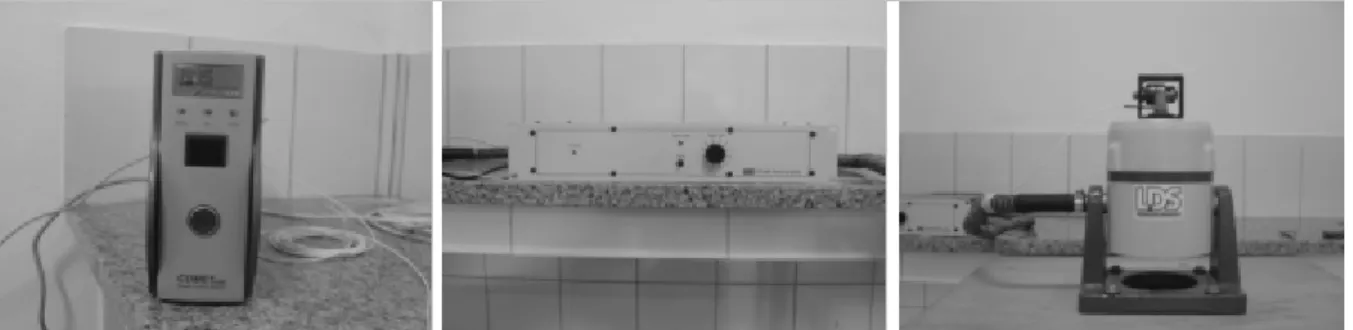
For performance of the vibration tests, a device produced by LDS (Ling Dynamic Systems) was used. This system, presented in Figure 1, was composed of a COMETUSB signal generator made by Dactron, a PA100E-CE amplifier and a model V. 406 electromagnetic shaker made by LDS.
Through a specific program supplied by LDS, the COMETUSB signal generator produced a sinusoidal, random or impact signal, which was amplified by the PA100E-CE amplifier before reaching the shaker. For this work, sinusoidal signals were used since this type of signal better represents the common type of excitement produced by mechanical coffee harvesters.
The shaker works in a dynamic range of 5 Hz to 9 kHz, with a maximum load of 198 N. The maximum displacement of the movable base is 17.6 mm (peak-to-peak), with a maximum acceleration of 100 times the acceleration of gravity. Another important characteristic of the utilized system was that a metallic device was fitted to the shaker to hold the coffee branches during the vibration tests. The system used to perform the vibration tests is showed in Figure 2.
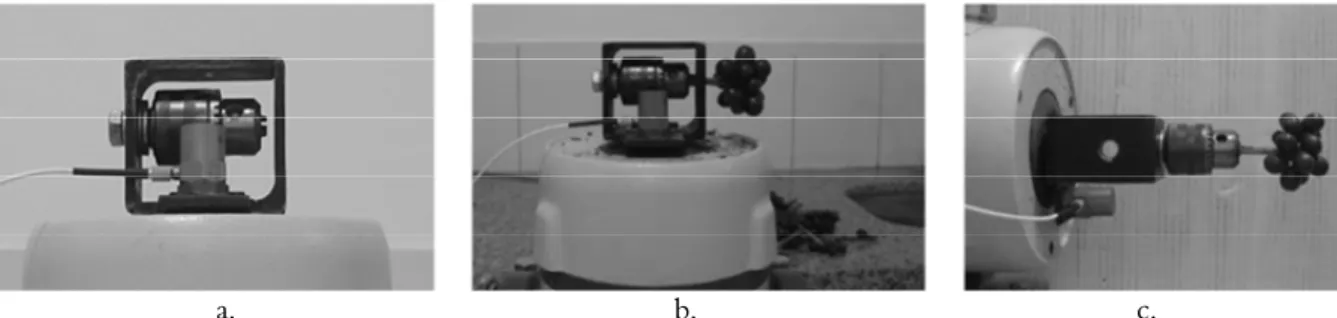
The employed system for attaching the coffee branch to the shaker is presented in Figure 3. This structure was composed of a rigid base, in which a holding device was adapted to keep the coffee branch linked to the shaker structure without damage. The holding device also allowed for changes in vibration direction, so transversal and longitudinal branch vibration tests were performed.
Figure 2. Experimental system used for performing the vibration tests.
Figure 3a shows the piezoelectric acceleration sensor used to control the vibration process. Acceleration measured by this sensor was used by the system to control the frequency and amplitude of vibration of the shaker.
The electromagnetic shaker was used to perform the vibration tests. A completely randomized factorial design with three replications was used. In this experiment, the evaluated factors that affect the efficiency of cherry fruit detachment were frequency, amplitude and direction of vibration, and length of the branch, for the varieties Catuaí Vermelho and
Mundo Novo. In all tests the branches were
submitted to 15 seconds of vibration. The levels of the studied factors used in this experiment are presented in Table 1.
Table 1. Levels tested for determining the coffee fruit
detachment efficiency.
Frequency (Hz) 13.33, 16.67, 20.00, 23.33, 26.67 Amplitude (mm) 3.75, 5.00, 6.25, 7.50 Direction of vibration Longitudinal, transversal Length of coffee branch (cm) 5, 10, 15
The branches used in this experiment were collected randomly in an experimental area located at the Federal University of Viçosa campus. Afterwards, the branches were cut to different lengths, as presented in the Table 1.
Detachment efficiency was calculated by dividing the number of removed ripe fruits per total number of ripe fruits presented on the branch before being submitted to vibration.
The obtained efficiency of fruit detachment data in this experiment were, initially, submitted to analysis of variance at a 5% significance level. The effect of the frequency and amplitude of vibration factors were studied by regression analysis; the models were chosen based on the determination coefficient and the significance of the regression coefficients, using the t-test under 1% of probability. All of the statistical analyses were performed using SAS software, version 8.0.
Results and discussion
In Tables 2 and 3, the results of the analyses of variance are presented for coffee fruit detachment efficiency obtained for branches collected from plants of the Mundo Novo and Catuaí Vermelho
varieties, respectively.
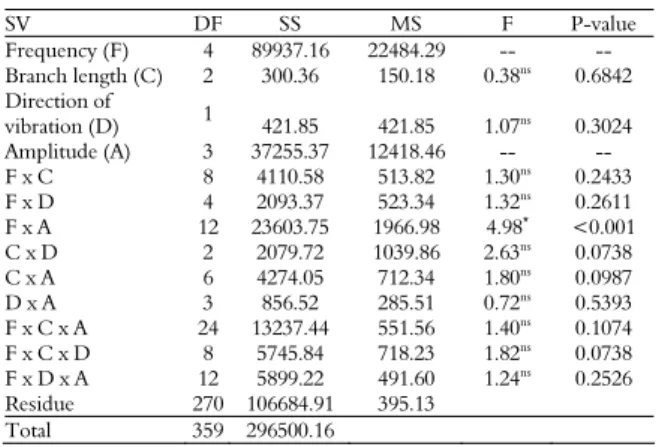
According to the results presented in Table 2, it was verified that for the Catuaí Vermelho variety, only the interaction between the frequency and amplitude factors was significant at the level of 5%. For the Mundo Novo variety, the interaction between the frequency and amplitude of vibration factors (F x A), between frequency and branch length (F x C) and between branch length and direction of vibration factor (C x D) were significant, as shown in Table 3.
Considering that the interaction between frequency and amplitude of vibration was significant for each studied variety, a study of those factors through regression analysis was performed using the response surface methodology. In Tables 4 and 5, the results of the regression analysis are presented for the Catuaí Vermelho and Mundo Novo varieties.
a. b. c.
Figure 3. a. Structure to attach the coffee branch. b. The system being used to test transversal vibration of the branch. c. The system
Table 2. Analysis of variance for cherry coffee fruit detachment efficiency for the Catuaí Vermelho variety.
SV DF SS MS F P-value
Frequency (F) 4 89937.16 22484.29 -- -- Branch length (C) 2 300.36 150.18 0.38ns
0.6842 Direction of
vibration (D) 1 421.85 421.85 1.07ns 0.3024 Amplitude (A) 3 37255.37 12418.46 -- -- F x C 8 4110.58 513.82 1.30ns 0.2433 F x D 4 2093.37 523.34 1.32ns
0.2611 F x A 12 23603.75 1966.98 4.98* <0.001 C x D 2 2079.72 1039.86 2.63ns 0.0738 C x A 6 4274.05 712.34 1.80ns
0.0987 D x A 3 856.52 285.51 0.72ns 0.5393 F x C x A 24 13237.44 551.56 1.40ns
0.1074 F x C x D 8 5745.84 718.23 1.82ns 0.0738 F x D x A 12 5899.22 491.60 1.24ns 0.2526 Residue 270 106684.91 395.13
Total 359 296500.16
*significant at 5% probability; nsnon-significant.
Table 3. Analysis of variance for cherry coffee fruit detachment
efficiency for the Mundo Novo variety.
SV DF SS MS F P-value
Frequency (F) 4 123862.26 30965.57 -- -- Branch length (C) 2 5549.58 2774.79 -- -- Direction of
vibration (D) 1 1505.94 1505.94 -- -- Amplitude (A) 3 83065.35 27688.45 -- -- F x C 8 8308.73 1038.59 3.27* 0.0014 F x D 4 2174.69 543.67 1.71ns
0.1476 F x A 12 43719.43 3643.29 11.47* <0.001 C x D 2 3023.46 1511.73 4.76* 0.0093 C x A 6 2246.64 374.44 1.18ns
0.3177 D x A 3 366.76 122.25 0.38ns 0.7639 F x C x A 24 10757.18 448.22 1.41ns
0.1002 F x C x D 8 2661.94 332.74 1.05ns 0.4004 F x D x A 12 4511.16 375.93 1.18ns 0.2945 Residue 270 85746.38 317.58
Total 359 377499.49
*significant at 5% probability; nsnon-significant.
Table 4. Regression analysis for the cherry coffee fruit
detachment efficiency for the Catuaí Vermelho variety considering the frequency and amplitude of vibration factors.
SV DF MS
Regression 3 47894.16*
Lack of adjustment 16 503.78ns Frequency, Amplitude, Frequency x
Amplitude 19 1698.49
Residue 270 395.13
Total 359
*significant at 5% of probability. nsnon-significant.
Table 5. Regression analysis for the cherry coffee fruit
detachment efficiency for the Mundo Novo variety considering the frequency and amplitude of vibration factors.
SV DF MS
Regression 3 80285.34*
Lack of adjustment 16 533.69ns Frequency, Amplitude, Frequency x
Amplitude 19 2544.24
Residue 270 317.58
Total 359
*significant at 5% of probability; nsnon-significant.
Equations (1) and (2) represent the models selected according to the regression analyses for the varieties Catuaí Vermelho and Mundo Novo, respectively. It can be observed in Tables 4 and 5
that the lack of adjustment for these models was insignificant.
Ed = 39.422 – 3.031 · F – 15.260 · A + 1.126 · F · A (R
2 = 0.71) (1) Ed = 57.535 – 4.673 · F – 19.668 · A + 1.524 · F · A (R2 = 0.80) (2)
where,
Ed – cherry coffee fruit detachment efficiency, %;
A – amplitude, mm, and
F – frequency, Hz.
The selected models relate the cherry coffee fruit detachment efficiency to the vibration amplitude and frequency. These factors are associated to the acceleration reached by the system submitted to sinusoidal oscillation. In this type of motion, the RMS acceleration is proportional to the product of the amplitude and square of the vibration frequency.
In Figures 4 and 5 the surface responses are presented relating the cherry coffee fruit detachment efficiency to the vibration frequency and amplitude for the varieties Catuaí Vermelho and Mundo Novo, respectively. It can be observed that for both varieties, the greatest detachment efficiency tended to occur at higher frequency and amplitude levels. Ciro (2001) obtained similar results analyzing coffee fruit detachment using a unidirectional slider crank shaker. Polat et al. (2007) also reported similar results when studying the mechanical harvesting of pistachio nuts. It was concluded that fruit removal percentage increased with an increase in shaking frequency and an increase in amplitude.
13 15 17 19 21 23 25 27 3.5 4.0 4.5 5.0 5.5 6.0 6.5 7.0 7.5 0 10 20 30 40 50 60 70 80 90 100
Amplitude of vibration, mm Frequency, Hz Ch e rry co ff ee f ru it d et ach m en t eff ici en cy , %
Figure 4. Response surface for the Catuaí Vermelho variety.
13 15 17 19 21 23 25 27 3.5 4.0 4.5 5.0 5.5 6.0 6.5 7.0 7.5 0 10 20 30 40 50 60 70 80 90 100
Amplitude of Vibration, mm Frequency, Hz Ch e rry co ffee fru it d e tach m en t e ffi ci en cy , %
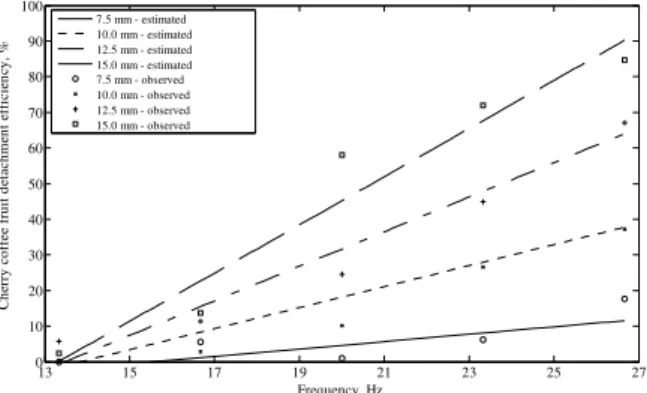
In Figures 6 and 7, the response surfaces for cherry coffee fruit detachment efficiency are presented for different levels of vibration amplitude and frequency for both varieties. At the selected vibration amplitude levels, the effect of the vibration frequency on the detachment efficiency is shown.
13 15 17 19 21 23 25 27
0 10 20 30 40 50 60 70 80 90 100 Frequency, Hz C h err y co ffee fru it d e tach men t eff ici en cy , %
7.5 mm - estimated 10.0 mm - estimated 12.5 mm - estimated 15.0 mm - estimated 7.5 mm - observed 10.0 mm - observed 12.5 mm - observed 15.0 mm - observed
Figure 6. Response surface for cherry coffee fruit detachment
efficiency generated at different vibration amplitude levels for different values of frequency for the Catuaí Vermelho variety.
13 15 17 19 21 23 25 27
0 10 20 30 40 50 60 70 80 90 100 Frequency, Hz C h er ry c o ffe e fr u it d et ac h m en t effi c ien cy , %
7.5 mm - estimated 10.0 mm - estimated 12.5 mm - estimated 15.0 mm - estimated 7.5 mm - observed 10.0 mm - observed 12.5 mm - observed 15.0 mm - observed
Figure 7. Response surface for cherry coffee fruit detachment
efficiency generated at different vibration amplitude levels for different values of frequency for the Mundo Novo variety.
It can be verified in Figures 5 and 6 that the cherry coffee fruit detachment efficiency tended to increase with higher values of frequency and amplitude for both studied varieties. This effect can be confirmed in the Tables 6 and 7, where the obtained experimental results of detachment efficiency are presented for different vibration frequency and amplitude values.
Table 6. Experimental results of the cherry coffee fruit
detachment efficiency (%) obtained for the Catuaí Vermelho
variety as a function of vibration amplitude and frequency.
Amplitude (mm) Frequency (Hz)
3.75 5.00 6.25 7.50
13.33 3.11 0.62 0.79 0.27
16.67 1.25 4.48 5.81 10.95
20.00 1.58 11.66 18.86 38.46
23.33 4.78 26.34 32.18 50.35
26.67 14.66 40.42 58.76 65.25
Table 7. Experimental results of the cherry coffee fruit
detachment efficiency (%) obtained for the Mundo Novo variety as a function of vibration amplitude and frequency.
Amplitude (mm) Frequency (Hz)
3.75 5.00 6.25 7.50
13.33 0.00 0.00 5.77 2.40
16.67 5.54 2.79 11.42 13.75
20.00 1.02 10.12 24.60 58.00
23.33 6.17 26.51 44.81 71.99
26.67 17.60 37.31 67.00 84.65
For both varieties, the frequency and amplitude combination of 26.67 Hz and 7.50 mm presented the highest fruit detachment efficiency. At this condition, average efficiencies were 65.25 and 84.65%, for the Catuaí Vermelho and Mundo Novo
varieties, respectively. Such results can be attributed to the increase of energy used in the fruit detachment process when the levels of these factors are increased (CIRO, 2001; POLAT et al., 2007).
The cherry coffee fruit detachment efficiency in the performed tests tended to be higher for branches of the Mundo Novo variety. This result can be attributed to the fact that the coffee fruit on the
Mundo Novo variety branches were not bunched as
close to each other as for the Catuaí Vermelho variety. When the fruits are very close to each other, the motion of fruits during the vibration process is reduced complicating the fruits detachment.
Conclusion
Cherry coffee fruit detachment efficiency by vibration is directly related to vibration frequency and amplitude.
For both varieties studied, the cherry coffee fruit detachment efficiency tended to increase with the augment in vibration frequency and amplitude of the branches.
The vibration frequency of 26.67 Hz and amplitude of 6.25 mm tended to present higher cherry coffee fruit detachment efficiency for both varieties under study.
The cherry coffee fruit detachment efficiency by vibration for the Mundo Novo variety tended to be greater than that of the Catuaí Vermelho variety for the frequency and amplitude intervals evaluated.
Acknowledgements
References
CASTRO-GARCÍA, S.; BLANCO-ROLDÁN, G. L.; GIL-RIBES, J. A.; AGÜERA-VEGA, J. Dynamic analysis of olive trees in intensive orchards under forced vibration. Trees, v. 22, n. 6, p. 795-802, 2008.
CIRO, H. J. Coffee harvesting I: Determination of the natural frequencies of the fruit stem system in coffee tress. Applied Engineering in Agriculture, v. 17, n. 4, p. 475-479, 2001.
PIMENTA, C. J.; VILELA, E. R. Efeito do tipo e época de colheita na qualidade do café. Acta Scientiarum. Agronomy, v. 25, n. 1, p. 131-136, 2003.
POLAT, R.; GEZER, I.; GUNER, M.; DURSUN, E.; ERDOGAN, D.; BILIM, H. C. Mechanical harvesting of pistachio nuts. Journal of Food Engineering, v. 79, n. 4, p. 1131-1135, 2007.
PRIETO, M.; MOUWEN, J. M.; PUENTE, S. L.; SÁNCHEZ, A. C. Concepto de calidad en la industria agroalimentária. Interciencia, v. 33, n. 4, p. 258-264, 2008. ROSA, U. A.; CHEETANCHERI, K. G.; GLIEVER, C. G.; LEE, S. H.; THOMPSON, J.; SLAUGHTER, D. C. An electro-mechanical limb shaker for fruit thinning. Computer and Electronics in Agriculture, v. 61, n. 2, p. 213-221. 2008.
SESSIZ, A.; ÖZCAN, M. T. Olive removal with pneumatic branch shaker and abscission chemical.
Journal of Food Engineering, v. 76, n. 2, p. 148-153, 2006.
SOUZA, C. M. A.; QUEIROZ, D. M.; PINTO, F. A. C.; CORRÊA, P. C. Derriça de frutos de café por vibração. Revista Brasileira de Armazenamento, Especial Café, v. 27, n. 4, p. 32-37, 2002.
SRIVASTAVA, A. K.; GOERING, C. E.; ROHRBACH, R. P. Engineering principles of agricultural machines. Michigan: ASAE, 1996.
TÁSCON, C. E. O.; MORA, R. B.; MEJÍA, F. A.; ARISTIZÁBAL-TÓRRES, I. D.; GÓMEZ, C. A. R.; URIBE, J. R. S. Cosecha del café con vibradores portátiles del tallo. Revista Facultad Nacional de Agronomía, v. 58, n. 1, p. 2697-2708, 2005.
WHITNEY, J. D.; BENSALEM, E.; SALYANI, M. The effect of trunk shaker patterns on florida orange removal. Applied Engineering in Agriculture, v. 17, n. 4, p. 461-464, 2001.
Received on March 29, 2009. Accepted on August 2, 2009.