Interference periods of velvet bean in sugarcane
Períodos de interferência de mucuna-preta na cultura da cana-de-açúcar
Fernanda Nunes BressaninI Nelson Jayme NetoI
Mariluce Pascoalina NepomucenoI Pedro Luís da Costa Aguiar AlvesI* Willians César CarregaI ISSN 1678-4596
ABSTRACT
The objective of the present study was to determine the periods of interference of velvet bean on ratoons of sugarcane cultivar ‘RB855536’ and to identify its potential for decreasing the crop yield and the quality of the harvested product. The experiment was arranged in a randomized block design, with 18 treatments divided into two groups and four replicates per
treatment. In the first group, the sugarcane was kept free from
velvet bean interference for nine different periods, beginning at bud sprouting: 0-15, 0-30, 0-45, 0-60, 0-90, 0-120, 0-150, and 0-180 days after budding (DAB) and 0-harvest. In the second group, sugarcane was grown in coexistence with velvet bean
during the same periods described for the first group. The critical
period of interference prevention for velvet bean in ratoons of sugarcane cv. ‘RB 855536’ lasted 138 days, from 50 DAB (pre-interference period [PIP]) to188 DAB (total period of weed interference prevention [TPIP]). Velvet bean interference caused a 50% decrease in sugarcane yield and negatively affected the quality of the harvested product.
Key words: Saccharum spp., Mucuna aterrima, weed, competition.
RESUMO
Objetivou-se determinar os períodos de interferência da mucuna-preta na soqueira cana-de-açúcar, cultivar ‘RB855536’, e o potencial de redução na produtividade da cultura e na qualidade do produto colhido. Foi utilizado o delineamento experimental em blocos casualizados, com quatro repetições por tratamento, aplicando-se 18 tratamentos divididos em dois grupos. No primeiro, a cultura permaneceu livre da interferência da mucuna-preta desde a brotação até nove épocas do seu ciclo de vida: 0-15, 0-30, 0-45, 0-60, 0-90, 0-120, 0-150, 0-180 dias após a brotação (DAB), 0-colheita. No segundo grupo, a cultura permaneceu em convivência com a
mucuna-preta desde a brotação até os mesmos períodos descritos anteriormente. O período crítico de prevenção à interferência da mucuna-preta na soqueira da cultura da cana-de-açúcar ´RB 855536´ abrangeu 138 dias do ciclo da cultura, de 50 DAB (PAI) a 188 DAB (PTPI). E a redução da produtividade da cana-de-açúcar em decorrência da interferência da mucuna-preta foi de 50%, afetando negativamente a qualidade do produto colhido.
Palavras-chave: Saccharum spp., Mucuna aterrima, planta daninha, competição.
INTRODUCTION
In the past, legumes were widely used
in cane field renewal. One of the most commonly
used legumes was velvet bean (Mucuna aterrima),
mostly due to its green manure properties
(AMBROSANO et al., 2013) and high vigor, being able to suppress the establishment of some weed species (SOARES et al., 2012).
However, the inadequate management
of the velvet bean resulted in increased amounts of its seeds in the soil, which exhibit dormancy
and phased germination, similarly to weeds
(CORREIA, 2011; SILVA et al., 2013 and SOUZA
et al., 2015). As a result, velvet bean became a weed, currently constituting a serious problem
for sugarcane production in the state of São Paulo (GALON et al., 2012; SILVA et al., 2013), with potential for seed dispersal into other areas or
states. Similarly to Brachiaria decumbens and
Panicum maximum (KUVA et al., 2001, 2003;
MARTINELLI et al., 2011),velvet bean can cause decreases in the amount of harvested sugarcane and number of economically viable stalks.
There is currently no information on the effects and periods of interference of velvet bean on sugarcane. Due to its indeterminate vigorous growth and twining and climbing stalks (GARCIA & MONTEIRO, 1997), velvet bean can cause stalk lodging, damaging crops. Weeds
such as morning glory (Ipomoeasp.) can hinder
light absorption by sugarcane, and consequently
photosynthesis and sucrose formation, when they grow over the top of the sugarcane plant (AZANIA et al., 2011). Velvet bean plants can also quickly
over grow other vegetation, smothering and
killing all other plants (TEDESCO, 2009), and can make harvest more difficult, compromising the operational performance of harvesters due to machine clogging, limiting the quality of the
harvested product.
The time and extension of the period of interference is, without a doubt, the most studied factor determining the degree of interference between weeds and crops (VIDAL et al., 2010). PITELLI and DURIGAN (1984) proposed three periods of weed and crop coexistence: the total period of weed interference prevention (TPIP), pre-interference period (PIP) and critical period of interference prevention (CPIP).
The objective of the present study was to determine the periods of interference of velvet bean on sugarcane and its potential for decreasing crop yield and the quality of harvested sugarcane.
MATERIALS AND METHODS
Second-cutting ratoons (cultivar
‘RB855536’) were used, following mechanical harvest performed in October 2012. The local soil is a yellow red dystrophic clay (EMBRAPA, 2006),
with clayey texture, pH 5.4, 13g dm-3 organic matter, 19.62mg dm-3 P (resin), 2.9mmol
c dm
-3 K, 24mmol c dm-3 Ca, 8.3mmol
c dm
-3 Mg, 50.2mmol c dm
-3 cation
exchange capacity (CEC) and 70.12 V%. The
local climate is Cwa subtropical according to the
Köppen climate classification, with short, mild and
dry winters and hot and rainy summers, with two
well-defined seasons.
The experiment was established in December 2012, when the cane field was beginning to bud (average of 25 tillers m-1). The area was
cultivated mechanically and fertilized with 178kg
ha-1 NPK (20-0-20). Experimental area was chosen
due to its history of natural infestation by velvet bean. Weeds other than velvet bean were removed through selective weeding. A randomized block experimental design was used, with four replicates per treatment. The experimental plots measured
75m2 (10m length x 5 rows spaced 1.5m apart), with
one row on each side of the plot and one meter on the two extremes of the rows as border, resulting in
36m2 useful area.
A total of 18 treatments were tested, separated into two groups. In the first group, nine different velvet bean interference-free periods
were tested, starting at budding: 0-15, 0-30, 0-45,
0-60, 0-90, 0-120, 0-150, and 0-180 days after budding (DAB), as well as 0-harvest. In the second
group, sugarcane was grown in coexistence with
velvet bean during the same periods described for the first group.
Velvet bean samples were collected at the end of determined periods, using iron quadrates with
sides 0.5m in length and 0.25m2 internal area. The quadrates were randomly thrown eight times inside
the useful area of the experimental plots. Plants inside
the quadrates were collected, and their dry weight was
measured. For the weed-free treatments (first group),
velvet bean samples were collected during sugarcane harvest, using iron quadrates with 1m2 internal area.
Plants inside the quadrate were collected, and their
dry weight was measured.
Sugarcane stalk yield was estimated through biometric measurements performed 12 months following the previous harvest, without straw burning. Total number of stalks fit for industrial processing was counted. The mean weight of ten stalks from each of the three central rows of the experimental plots, excluding the
borders, was calculated and extrapolated to t ha-1. Ten stalks from each treatment were also
collected at harvest to evaluate the following qualitative parameters of the juice, according to CONSECANA (2006): fiber content, Brix, purity and total recoverable sugars (TRS). The yield data were subjected to regression analysis using the Boltzmann sigmoidal model, according to KUVA et al. (2001), to determine the periods of interference of velvet bean, considering an arbitrary level of 5% acceptable yield loss.
Regression analysis was also performed for the relationship between velvet bean
accumulated dry weight and sugarcane yield and
weed-free (control) periods tested. Qualitative parameters of the juice were subjected to analysis of variance using the F test followed by Tukey’s test, at 5% probability.
RESULTS AND DISCUSSION
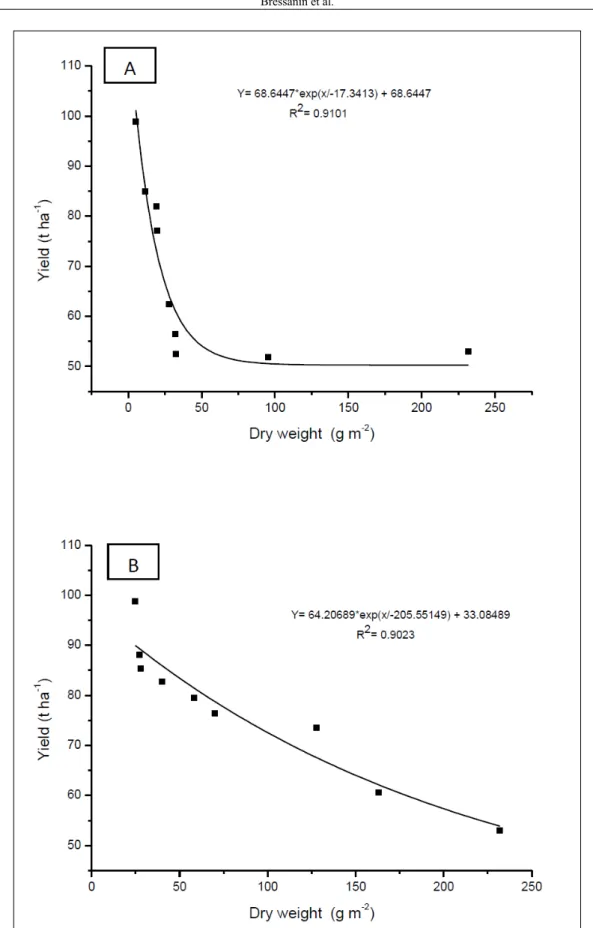
In all samplings, approximately 98% of the weed community consisted of velvet bean. The accumulated dry weight of velvet bean
increased with increasing coexistence period until
179 DAB, reaching 233g DWm-², even though
the plants were likely being shaded by sugarcane (Figure 1). Dry weight accumulation was higher starting at 120 DAB, for which a rate of dry weight accumulation of 3g day-1 was observed. Velvet
bean has very fast initial growth, covering 99% of the soil surface 58 days after seedling emergence (FAVERO et al., 2001).
Without control of velvet bean during
the whole crop cycle, velvet bean accumulated
approximately 231g DW m-² until harvest. Dry weight
accumulation decreased with increasing weed-free period (Figure 1). Control of velvet bean until 44
DAB was sufficient to considerably decrease (65%) its dry weight accumulation. At 120 DAB, the dry weight remained constant, at approximately 25g DW
m-². When used as green manure, the normal yield
of velvet bean is 6 to 8t DWha-1 or 0.6 to 0.8kg DW m-2 (BRAGA et al., 2006). However, FERRAZ and
LOPES (2003) reported velvet bean to produce up to
35t ha-1 green biomass.
Regression analysis showed an exponential decrease in sugarcane yield with
increasing velvet bean dry weight, for both types of coexistence (Figure 2). When velvet bean coexisted with sugarcane in the beginning of the crop cycle, accumulation of 4.37g DW m-2 velvet
bean resulted in a sugarcane yield decrease of 1t
ha-1. Sugarcane yield was estimated at 98.85t ha-1
and decreased approximately 50%, to 53t ha-1, with the increase in velvet bean dry weight to approximately 232g m-². As observed for velvet bean, dry weight increases in other weed species are expected to
result in decreased sugarcane yield. KUVA et al.
(2003) observed a negative correlation between weed dry weight accumulation and sugarcane
stalk production, with 3.26g m-² signal grass
(Brachiaria decumbens) and 1.27g m-² guinea grass (Panicum maximum) causing a decrease of
1t ha-1 in sugarcane stalk yield.
Sugarcane yield has been observed
to decrease up to 46% due to interference of I. hederifolia (SILVA et al., 2009) and up to 24%
due to interference of plants from the genera
Ipomoea, Merremia and Euphorbia (AZANIA et
al., 2009). A 33.4% decrease in ratoon cane yield
was observed due to a weed community with
predominance of Acanthospermum hispidum,
Alternanthera tenella and Panicum maximum
(MEIRELLES et al., 2009).
Considering a maximum acceptable
level of 5% yield loss, the sugarcane was negatively affected by coexistence with velvet bean beginning at 50 DAB (corresponding to the PIP) (Figure 3). Control of velvet bean until 188 DAB was necessary for yield losses to remain under 5% relative to the maximum production level (corresponding to TPIP). Thus, the critical
period of interference prevention (CPIP), i.e., of velvet bean control, was between 50 and 188 DAB. Control measures; therefore, need to be adopted starting at 50 DAB that can effectively eliminate velvet bean up to 188 DAB.
The CPIP is the period that should be covered by weeding or the effect of herbicides
because weeds already present at the area together with those that emerge during this
period are in a stage of development that will interfere with, and significantly decrease, crop yield (PITELLI, 1985). Different studies of weed interference on sugarcane have found different total periods of interference prevention (TPIP). A TPIP of 138 days after planting (DAP) was reported for interference of signal grass (KUVA et al., 2001), of 127 DAP for guinea grass and signal grass (KUVA et al., 2003), and of 137 DAB for interference of A. hispidum,A. tenella
and P. maximum on ratoon cane (MEIRELLES
et al., 2009).
Figure 3 - Sugarcane stalk yield (tons of cane ha-1 [TCH]) under different velvet bean coexistence and weed-free (control)
Significant differences in qualitative parameters of sugarcane juice were observed between treatments. For the weed-free (control) treatments, the lowest Brix, saccharose apparent (Pol) and purity values were observed for the treatments with the shortest weed-free periods, 0-15, 0-30 and 0-45 DAB, being below the recommended values of 18% Brix, 14% Pol and equal or higher than 85% purity (RIPOLI & RIPOLI, 2004). For the coexistence treatments, the lowest Brix, Pol and purity values were also observed for treatments with longer periods of coexistence with velvet bean. Brix was lower than recommended for the treatments 0-150 and 0-180 DAB and 0-harvest, purity was lowest for the treatments 0-180 DAB and 0-harvest, and Pol was lower than recommended only for the coexistence treatment 0-harvest. The highest mean fiber contents were observed for the weed-free treatment 0-90 DAB(11.22%) and for the coexistence treatments 0-15 (11.24%) and 0-45 DAB (11.06%).
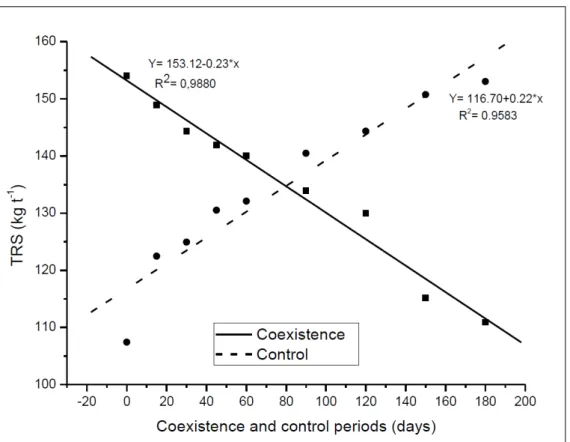
The levels of total recoverable sugars (TRS) per unit weight (kg t-1) gradually decreased
with increasing coexistence period. The TRS for the weed-free treatment (0-harvest) was adequate
because sugarcane was harvested at its optimal harvesting time. Sugarcane should be harvested in
July/August (PMGCA, 2008), and the experimental plots were harvested on 2 July 2013. The gradual decrease in TRS may have been because velvet bean is a climbing shrub that tends to wrap itself around sugarcane, breaking sugarcane stalks and causing smothering and consequent rotting of stalks.
SILVA et al. (2009) tested different periods of coexistence of I. hederifolia with the same sugarcane cultivar used in the present study
and observed no differences in TRS. This result was likely because the authors harvested the sugarcane seven months after budding instead of during its
optimal harvesting time.
The TRS levels were higher for shorter coexistence periods (Figure 4). TRS levels were 29.30% lower with coexistence until 180 DAB than for the control without velvet bean coexistence. This
decrease in TRS is not economically acceptable
because sugarcane is currently priced based on the
TRS concentration (sucrose, glucose and fructose) of the raw material when it reaches processing
(SACHS, 2007).
CONCLUSION
The critical period of interference prevention for velvet bean on ratoon sugarcane (cultivar ‘RB 855536’) lasted 138 days, from 50 DAB (PIP) to 188 DAB (TPIP). Velvet bean interference caused a 50% decrease in sugarcane yield and negatively affected the quality of the harvested product, which exhibited
decreased quality parameters.
ACKNOWLEDGEMENTS
Fundação de Amparo à Pesquisa do Estado de São Paulo (FAPESP), Conselho Nacional de Desenvolvimento Científico e Tecnológico (CNPq) provided scholarships to the first (Proc. n.2012/04775-4) and last (Proc. n.311281/2013-3) authors,
respectively.
REFERENCES
AMBROSANO, E.J.et al. Mass and nutrient accumulation by
green manures and sugarcane plant yield grown in succession,
in two locations of Sao Paulo, Brazil. Revista Brasileira de
Agroecologia, v.8, n.1, p.199-209, 2013. Available from: <http://
www.aba-agroecologia.org.br/revistas/index.php/rbagroecologia/ article/view/12944>. Accessed: Jan. 20, 2015. ISSN: 1980-9735.
AZANIA, C.A.M.et al. Chemical Management of Convolvulaceae and Euphorbiaceae in Sugarcane during Dry Season. Planta
Daninha, v.27, n.4, p.841-848, 2009. Available from: <http://
dx.doi.org/10.1590/S0100-83582009000400023>. Accessed: Jan. 20, 2015. doi: 10.1590/S0100-83582009000400023.
AZANIA, C.A.M.et al. Biologia e manejo químico de
corda-de-viola em cana-de-açúcar. Campinas: Instituto Agronômico (IAC),
2011. 18p. (Boletim Técnico IAC, 209). Available from: <http://
www.iac.sp.gov.br/publicacoes/publicacoes.../Boletim_209_
FINAL.pdf>. Accessed: Jan. 20, 2015.
BRAGA, N.R. et al. Mucuna-preta. Campinas: IAC, 2006.
Available from: <http://wwwiac.sp.gov.br/Tecnologias/ MucunaPreta/MucunaPreta.htm>. Accessed: Aug. 30, 2006.
CONSECANA: Manual de instruções. 5.ed. Piracicaba, SP, 2006.
p.48-53. Available from: <http://www.unica.com.br/publicaçoes>. Accessed: Oct. 25, 2015.
CORREIA, N.M. Eficácia do mesotrione aplicado isolado e em
mistura para o controle de corda-de-viola e de mucuna-preta em cana-soca. Álcoolbras, n.133, p.46-51, 2011.
EMBRAPA (EMPRESA BRASILEIRA DE PESQUISA AGROPECUÁRIA). Sistema brasileiro de classificação de
solos. 2.ed. Rio de Janeiro: Centro Nacional de Pesquisa de
Solos, 2006. 306p.
FAVERO, C.et al. Modifications in the population of spontaneous plants in the presence of green manure. Pesquisa Agropecuária
Brasieira, v.36, n.11, p.1355-1362, 2001. AvaLible from: <http://
www.scielo.br/pdf/pab/v36n11/6808.pdf>. Acessed: Dec.13, 2014.
doi: 10.1590/S0100-204X2001001100005.
FERRAZ, S. LOPES, E.A. Mucunapreta: aplanta mágica. In: CONGRESSO BRASILEIRO DE NEMATOLOGIA, 24., 2003, Petrolina, PE. Programas e resumos... Petrolina: Sociedade
Brasileira de Nematologia: Embrapa Semi-Árido, 2003. p.64-67.
GALON, L.et al. Macronutrients availability in sugarcane varieties grown under increasing densities of Brachiaria brizantha. Ciência
Rural, v.42 n.8, p.1372-1379, 2012. Available from: <http://
dx.doi.org/10.1590/S0103-84782012000800007>. Accessed: Dec.
12, 2014. doi: 10.1590/S0103-84782012000800007.
GARCIA, F.C.P. et al. Leguminosae-Papilionidae de uma floresta
pluvial de planície costeira. Naturalia, v.22, p.17-60, 1997.
KUVA, M.A.et al. Interference periods of weeds in the sugarcane
crop. II -Brachiaria decumbens. Planta Daninha, v.19, n.3,
p.323-330, 2001. Available from: <http://dx.doi.org/10.1590/ S0100-83582001000300003>. Accessed: Dec. 12, 2014. doi:
10.1590/S0100-83582001000300003.
KUVA, M.A.et al. Interference Periods of Weeds in the Sugarcane
Crop. III - Brachiaria decumbens and Panicum maximum.
Planta Daninha, v.21, n.1, p.37-44, 2003. Available from: <http://
dx.doi.org/10.1590/S0100-83582003000100005>. Accessed: Mar. 12, 2014. doi: 10.1590/S0100-83582003000100005.
MARTINELLI, C.A.et al. Interferência de plantas daninhas na
cultura da cana-de-açúcar e algumas práticas de controle. Revista
Científica Eletrônica de Agronomia, v.20, p.1-6, 2011. Available
from: <http://faef.revista.inf.br/site/e/agronomia-20-edicao-dezembro-de-2011.html#tab649>. Accessed: Dec. 12, 2014.
MEIRELLES, G.et al. Weed interference periods in ratoon sugarcane.
Planta Daninha, v.27, n.1, p.67-73, 2009. Available from: <http://
dx.doi.org/10.1590/S0100-83582009000100010>. Accessed: Dec.
12, 2014. doi: 10.1590/S0100-83582009000100010.
PITELLI, R.A.; DURIGAN, J.C.Terminologia para períodos
de controle e de convivência das plantas daninhas em culturas anuais e bianuais. Resumos... In: CONGRESSO BRASILEIRO
DE HERBICIDAS E PLANTAS DANINHAS, Belo Horizonte: SBHED, 1984. p.37-37.
PMGCA (PROGRAMA DE MELHORAMENTO GENÉTICO DE CANA-DE-AÇÚCAR do CCA/Ufscar). Variedades RB.
Primeira Edição – Novembro 2008. Available from: <https:// www.agencia.cnptia.embrapa.br/Repositorio/VariedadesRB _2008+apostila_000fxga3a3302wyiv80soht9hctswek2.pdf>.
Accessed: Mar. 31, 2014.
RIPOLI, T.C.C.; RIPOLI, M.L.C. Biomassa de cana-de-açúcar:
colheita, energia e ambiente. Piracicaba, Edição dos autores, 2004. 302p.
SACHS, R.C.C. Remuneração da tonelada de cana-de-açúcar no Estado de São Paulo. Informações Econômicas, v.37, n.2,
p.11-15, 2007. Available from: <ftp://ftp.sp.gov.br/ftpiea/publicacoes/ tec5-0207.pdf>. Accessed: Dec. 14, 2014.
SILVA, I.A.B.et al. Overcoming depth sowing and mulch density
cinerea. Planta Daninha,v.31, n.2, p.313-317, 2013. Available
from: <http://dx.doi.org/10.1590/S0100-83582013000200008>. Accessed: 25 Oct. 25, 2015.
SILVA, I.A.B. et al. Interference of a weed community with predominance of Ipomoea hederifolia on sugar cane ratton.
Planta Daninha, v.27, n.2, p.265-272, 2009. Available from:
<http://dx.doi.org/10.1590/S0100-83582009000200008>. Accessed: Dec. 12, 2014. doi:
10.1590/S0100-83582009000200008.
SOARES, M.B.B.et al. Plantas daninhas em área de reforma de cana crua com diferentes manejos do solo e adubos verdes em sucessão. Revista Agro@mbiente On-line, v.6, n.1, p.25-33, 2012.
Available from: <http://revista.ufrr.br/index.php/agroambiente/
article/view/683>. Accessed: Mar. 12, 2014.
SOUZA, G.C. et al. Germinação de sementes de mucuna-preta submetidas a diferentes períodos de armazenamento.
Revista Brasileira de Energia Renováveis, v.4, p.72-83, 2015.
Available from: <http://ojs.c3sl.ufpr.br/ojs/index.php/rber/article/ view/37692/pdf_44>. Accessed: Oct, 25, 2015.
TEDESCO, V. Utilização de Mucuna-preta como alternativa
ao uso do fogo. AscomRO, 2009. Available from: <http://www.
ecodebate.com.br>. Accessed: Mar. 15, 2012.
VIDAL, R.A.et al. Interference and economic threshold of Brachiaria plantaginea and Ipomoea nil in the common bean crop. Ciência Rural, v.40, n.8, p.1675-1681, 2010.
Available from: < h t t p : / / d x . d o i . o rg / 1 0 . 1 5 9 0 / S 0 1 0 3
ISSN 1678-4596 http://dx.doi.org/10.1590/0103-8478crerr20150630
ERRATUM
Artigo “Interference periods of velvet bean in sugarcane” publicado no fascículo v46n8 de agosto da Ciência Rural páginas 1329-1336, onde se lia:
“Approved 02.22.15”
leia-se:
“Approved 02.22.16”
Para a versão correta, acesse:
ERRATA
ISSN 1678-4596 e120150630

![Figure 3 - Sugarcane stalk yield (tons of cane ha -1 [TCH]) under different velvet bean coexistence and weed-free (control) periods, showing the pre-interference period (PIP), total period of weed interference prevention (TPIP) and critical period of in](https://thumb-eu.123doks.com/thumbv2/123dok_br/15947445.680136/5.892.171.768.589.1047/figure-sugarcane-different-coexistence-interference-interference-prevention-critical.webp)