Training and Professional Performance of Radical Sport
Instructors
Jairo Antônio da Paixão
Department of Sports, Federal University of Ouro Preto, Ouro Preto, 35400-000, Brazil
Abstract
Aspects related to the performance of professional radical sport instructors are herein analyzed regarding three detected educational levels: those who graduated in Physical Education, those whose diplomas are in other fields, and those who are high school graduates. By e xploring available lite rature and considering the educational levels of these professionals, it was possible to verify discrepancies regarding the procedures adopted by these instructors in conducting the activities that constitute radical sports, sometimes creating situations vulnerable to risk. In connection with this, there is a need for the institutions responsible for these sports to standardize the require ments for the education and performance of radica l sport instructors in Bra zil.Keywords
Radica l Sports, Professional Education, Instructors1. Introduction
The word – radica l sport – has the connotation of sensations related to risks, adventure, and strong emotions. This is true for those who practice the sports, as well as for those who don’t, due to imaginary fo rces created by this type of sport[3, 4].
Those who practice radical sports, either for co mpetit ion or recreat ion, put themselves at risk in d ifferent proportions, such as falls, collisions, scrapes and bruises, fractures, drowning, free zing and even death[12]. These risks occur because radical sports are designed for various types of atmospheres, which within possible reasoning, are forecasted and controlled. Thus, the outcome of the sport practiced can generally be successful. For e xa mple , a paragliding flight, the arrival at the top of a mountain, or even, the return fro m a dive performed in treacherous waters.
Reality has shown that in some cases using sophisticated equipment is not suffic ient to impede a serious accident. However, when the practice of a specific sport is coupled with procedures and strategies developed from knowledge of the sport module, there is a tendency to minimize accidents [12, 13].
As such, the participant should be equipped with a series of skills that include: physical intimacy with the equipment and necessary techniques, capacity to decipher information regarding climat ic conditions, and when an une xpected event occurs , to be ab le to dec id e and act upon st rateg ies to
* Corresponding author:
jairopaixao2004@y ahoo.com.br (Jairo Antônio da Paixão) Published online at http://journal.sapub.org/sports
Copyright © 2013 Scientific & Academic Publishing. All Rights Reserved
overcome the obstacle(s), successfully achieving comp letion of the chose trajectory. This knowledge should be sufficient to assure that the participant not only enjoys the adventure, but also maintains physical and emotional integrity, besides contemplating aspects regarding environment preservation for the sports module chosen.
These considerations furnish elements for reflection about the type of instruction to be received by both learners and e xperienced partic ipants. It is important that these people, who seek strong emotions and expose themselves to risky conditions, be assured that their instructors are competent in their fie ld, minimizing the risks for everyone involved.
In search of responses to these claims, by means of emp irical observations and scientific production that approach this topic, it beca me evident that in Bra zil there a re no officia l requisites for a professional dealing with radical sports in comparison with those who deal with physical education. Usually radical sport professionals are self-taught and receive minimu m knowledge through courses offered by some sport confederations or international certifying associations[3].
sports and their calculated risks[11].
The picture presented so far c ircu mscribes radica l sports as an intervention of innovative professional teaching, thought provoking and full of possibilit ies, but still void of a professional profile for the conduction of these activities.
Although the professional’s skills and competence are presented in a diffused manner, if co mpared with the status
that other professional categories have, it is necessary to think about the dynamics established between these ele ments that constitute the teacher’s job[14]. As part of these dynamics, it is worth noting the need for technical preparation, teaching methods, and pedagogy for the contents to be worked when conducting activities related to a radical sport model. For this, the sport’s particularities, comple xity and possibilities during the teaching process must be considered.
Given that Bra zil does not have a specific offic ial formation for this type of professional, in this study, observations and surveys were made about practicing radical sports instructors and it was observed that this instruction is performed by diffe rent types and educational levels of people. What prevails is their practica l e xpe rience in a given radical sport model. Fro m this data, it was possible to distinguish three educational levels for the instructors: high school, university graduates in Physical Education and those graduated from the university in other fie lds.
With this data, the objective of the study was to analyze the aspects related to the instructor’s professional performance in radical sports, using the three educational levels as a reference.
2. Materials and Methods
The present study employs methodological procedures for an exp loratory descriptive research[5, 10]. The line of research was to make a survey of available data[1, 8]. The elaboration and validation processes followed the Delphi technique[6, 16]. This technique involves emission of a series of questionnaires in such a way that a group of specialists (professors with e xperience in the area) co me to a consensus about the subject through discussions about the matters involved in the questionnaire. The number of phases emp loyed in the va lidation of the collected data varied fro m two to five or until each question received two-thirds affirmat ive replies[6, 9]. Using a succession of partners with three specialists in the area, a total of four phases, brought to the consensus in the investigative questions related to the education and professional performance of the instructor of radical sports, having as a reference the three previously mentioned educational levels. In this perspective, a semi-structured questionnaire was developed and applied to collect the necessary data.
After co mpiling the nu mber of federations e xisting in the State of Minas Gera is, info rmation was also sought about firms specializing in radica l sports that were associated with the State of Minas Gera is federation dealing with that
specific rad ical sport. By means of telephone calls, e mails, and information availab le on the sites of these firms, it was possible to achieve data about the instructors connected with them.
It was found that the number of instructors for the firms associated with the State of Minas Gerais Federation is 237 and that they are responsible for conducting 19 types of radical sports. These firms a re encountered in cit ies of diffe rent sized populations and demographic d imensions, including c ities of s mall and large sizes in the interior of the State.
To define the sample size, two values were e mployed. The success probability was fixed at 0.5 (with a 50-50 chance of success). Also considered was the confidence interval of 5%, whose intention was to assure a greater degree of precision. It was then possible to calculate the size of the sample by means for the fo llo wing formula1:
Where n0 is given by 0
0
1 ( 1) /
n
N
n
n
=
+ − Equation 1
2 2 0
( )
4
z k
d
n
= Equation 2n0=
1,962
= 3,8416 = 384,16 4(0,05) 2 0,01
As such, the sample size was:
n= 384,16 = 147 1+ (384,16-1) /237
Where: N = population size; n = samp le size; d = margin of error; z(k) = desired degree of confidence (using a confidence degree of 95%, which is equal to p = 0.05)
Selection of the instructors to define the sa mple – 147 instructors – was done in a p robabilistic manner, using the simp lified stratigraphic samp ling technique[2]. This technique involves specifying how many ele ments for each sample need to be considered for each level. This option was done to assure representation in the results obtained.
In this way, the modals offered by the firms were considered as layers and the instructors as units directly associated with these layers. A sample was selected fro m each firm that was proportional to the size of its population. After defin ing a period of six months (fro m January to July of 2010) for the collection of the data, the sampling group came up with a total of 109 instructors responsible for diffe rent modalit ies of radical sports. In terms of educational level, it was possible to detect 86 who had university level education (37 with Physical Education diplo mas and 49 with diplo mas fro m different courses, such as law, ad ministration, civil forestry engineering, mechatronics, agronomy, tourism, physical therapy, co mputer science, hu manities and psychology). The other 23 instructors had completed high school and were self-e mployed worke rs fro m various
1
segments of the work force .
The radical sports instructors were all ma le whose average age was 31±1.9 years o ld. Although wo men do participate in rad ica l sports, they we re not inc luded in the sample of th is study. The partic ipant’s average teaching e xperience was 7.2±3.9 years. The standard deviation considered significant was <0.05%.
The criteria for inc lusion were: instructors belonging to radical sports federations and the signing of a Consent Form indicating they were partic ipating of their own will and that all terms had been clarified[Termo de Consentimento Livre e Esclarecido (TCLE)]. Criteria for the e xc lusion of instructors were : the candidates did not belong to radical sports
federations in the State o f M inas or they did not show interest in partic ipating in the investigation.
With the goal of establishing a comparat ive analysis of the aspects related to working as a radica l sport instructor, having as a reference the three educational leve ls of the study’s participants, only the results from the alternat ives ma rked by the participants as being relevant we re considered. According to the 3-point Likert type intensity scale[7] e mp loyed in the survey, the participant attributed the number (1) as the most important, according to his perception of the question. The statistical analyses were performed using descriptive analysis.
3. Results
Table 1 presents the motives which contributed to why the interviewed participants decided to become instructors. Among the principal motives, the most evident were that they already had experience in the chosen sport and that nature served as the scenery, independent of the educational level.
Table 1. Principal motives that contributed to the performance of the radical sports instructors
Table 2 presents what the instructors perceived to be the possible environ mental impacts caused by the sport. Here, the instructors with only a high school education either said there was a negative impact (41.7%) or no impact (44%). The others did not perceive any significant environ mental da mage or impact.
Tabela 2. Possíveis impactos ambientais causados pela prática de esporte de aventura no meio natural
integrity, according to the instructors. In this table, there is a general agree ment regard ing the importance of do minating the techniques of the chosen sport, understanding the functioning of the specific equip ment, e xa mining it befo re it ’s use, and being aware that the risk factor is always present in the practice of this type of sport. Notice, however, that in refe rence to the issues of climat ic conditions and specific physical condit ioning de manded by certain types of the sport, only those with diplo mas in Physical Education perceived the impo rtance of these latter ite ms.
Table 3. Procedures to be adopted by instructors/apprentices regarding security and physical integrity, in the perception of the instructors
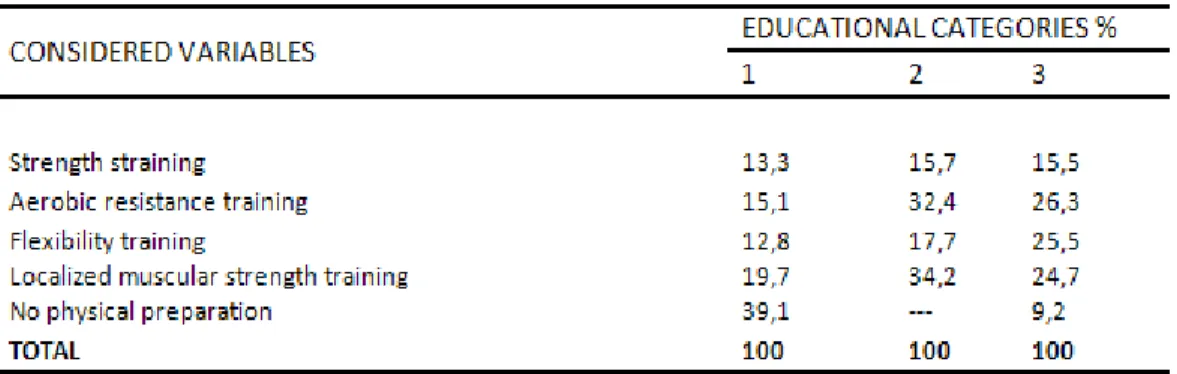
In Table 4 are encountered the results of the comp le mentary forms of physical preparat ion adopted by the instructors during their courses for the radical sport, divided by the three educational levels. Of the three levels, evident is the considerable percentage (39.1%) of the high-school level instructors who do not apply any form of physical preparation for their students.
Table 4. Complementary forms of physical preparation adopted by instructors of radical sports
4. Discussion
This type of professional act ivity does not generally belong to the formal econo my and occurs sporadically during certain t imes of the year, i.e. vacations, holidays, and many times, it is considered a hobby instead of a job, not being recognized as a profession, except when working for recognized sportive institutions. As such, the partic ipants indicated that it is d ifficu lt to be e mp loyed by a co mpany and to exe rc ise their specia lty as a full t ime job.
The fact that the instructors belong to three educational levels de monstrates that in Bra zil, there does not e xist uniformity in the regu lation of the activit ies for these sports. In other words, until the p resent date, there is no formal requisite stating that a radica l sports instructor has to have a specific d iplo ma (technical or un iversity) in orde r to teach the chosen sport.
Co mmon ly, in terms of a requisite to e xe rc ise the
profession as an instructor in a g iven rad ica l sport, the only one is that of a ce rtificate fro m a technical course, norma lly of short duration, e mitted by confederations and associations of that respective modality. Accord ing to Costa, this situation indicates that these instructors have not been offic ia lly professionalized [4].
Among the principa l motives that contributed to the chosen job of radical sports instructor, there was no significant diffe rence within the educational levels. Most important was there p rio r e xperience and re fined skills in the given sport. The characteristics that influence those that practice this type of sport are: practiced in nature, sense of risk, and strong emotions.
service, to c losely and c ritica lly e xa mine the form in wh ich the human actions affect the diffe rent natural environ ments when practic ing radica l sports for co mpet itive events or leisure. Since radica l sport instructors are not officia lly professionals - a fact that direct ly focuses on the type of education and min imu m skills required for these instructors – the awareness of this profession in relation to environ mental preservation beco mes re levant and deserves constant attention.
If on one side, there is a positive relat ionship between the interaction of man with nature while pract icing this type of sport, on the other side, this process merits attention, since the growing popularity of this activity results in an even greater e xp loration o f the majo r environmental factors involved in the development of this activity[15, 17]. Usually, when nature is perceived only as scenery for a given sport, environmental impacts provoked by it, becomes irre levant [11].
Regard ing the procedures to be adopted by the student during the course of h is chosen sport, taking into consideration his security and physical integrity, the instructors of this study were in genera l consensus. The most important procedures agreed upon we re : do miniu m of the skills of the chosen sport, intimacy with the equip ment and ma intenance of the equipment used, awareness of the risks involved and e mp loyment of the technology availab le for the pract ice of the same . Th is fact occurs because although there are no specific dip lo mas for this type of sports, information is constantly being e xchange between those participat ing in a given modality. Th is inc ludes specialized updating of in format ion through congresses and events, courses, and e xchange o f e xperiences a mong co-workers.
As for the adoption or not of co mple mentary fo rms of physical p reparation by the instructors fro m the three educational levels, those cited were : e xerc ises for strength, resistance, aerobics, fle xib ility, localized muscle building. It was verified that the instructors graduated in Physical Education adopted or even reco mmended these e xerc ises to be integrated in their courses. A significant parce l o f the instructors with university diplo mas in other areas and those with just a high school diploma d id not have the custom of imp le menting physical e xe rcises in their courses. Rare ly would the beginning student have the specific physical conditioning required by the chosen sport, i.e. to be able to go for long wa lks in a hostile land relief, or to be able to survive in adverse te mperatures without being able to count on a period of body adaptation, support team, or adequate security equip ment to face nature during the practice of the sport.
When considering the relevance of the procedures to be adopted for the development and biological, physical, psychological, and motor skill adaptations to be made for the specific sport, it is understood that in radical sports, these procedures acquire greater magnitude and comple xity. This is due to the intrinsic characteristics related to the corporal practices involved, such as risks, fear of heights, man-nature
contact in diffe rent natural environ ments (water, air o r land, including in the latter, deserts, mountains, forests), which in turn demand specific forms of conditioning, skills and capabilit ies that need to be developed.
Among the aspects (aerobics, strength, coordination adaptation, climate, equip ment and man ipulation, etc.) that deserve attention during the learning process for radical sports, the instructor must pay special attention to the particularities for the chosen sport. Depending on the sport, for e xa mple , a set of muscles could be more solic ited than others due to the type of muscular contraction (isotonic or isometrical); there is a lso the influence of alt itude and intensity predominant in its practice.
Noteworthy is the fact that even though non-competitive perspectives demand less intensity in the performing of these aspects, in nothing does it diminish it relevance in the teaching process. This is because other aspects are also important, such as technique, correct manipulation of equipment specific for the chosen sport, awareness of the natural environment and the procedures required for risk control, not to mention the increased emotions that these sports create.
These and other aspects that integrate the physical-motor skill dimension, coupled with the most diverse situations imposed by the outside environment, modify ing the perception of the physical-motor skill behavior of the individual, should be considered by the professionals that conduct practices connected with radica l sports, so as to orientate the participants during the teaching process. Regarding the State of M inas Ge rais, mountain climb ing is the most practiced radical sport, due to the State’s geographical relief. It is a sport that demands localized force, especially in the upper me mbers of the body. This requires greater attention on the part of the instructors to develop this area of the body as part of their course. This type of physical-motor skill inclusion in the course applies to other sports modals found int the State.
The diffe rent modalities of radical sports, practiced in diffe rent natural environments, have particularities and independent characteristics. It can happen that the instructors develop, as necessary, determined skills for their performance, which a re often intuitive, co ming fro m the practical e xperience of the mselves or others, or fro m short courses taken in their specific areas. These results confirm the idea that the participants involved in rad ical sports in Bra zil still does not have a professional identity. This fact could directly a ffect the quality of the services provided in this branch of sports in Bra zil.
5. Conclusions
previous experience in practic ing it. This situation confirms the uniqueness of this branch of sports in comparison with other traditional sport branches. Together with this, there is nature as the privileged scenery in which these sports are practiced, the risks, the strong emotions and the opportunity to maintain part of the practic ing environment: radica l sports, whether as a partic ipant, an e x-part icipant, but ma inly in the condition of “instructor”.
As for the educational levels of the professionals observed in this study, it was verified that the category in which the instructors presented the least variations regarded actions and procedures that demanded practical e xperience, such as technique, equipment usage and certain procedures to minimize the risks in the chosen sport. However, due to the limitat ions in the fra mework, as we ll as the education of the instructors in areas so different fro m that which is involved in the chosen sport, it was perceived that the instructors with high school education and those with diplo mas in different fie lds fro m that of Physical Education, had difficulty in articulating their knowledge with the actions adopted along the teaching process. For exa mp le, they had difficu lty in perceiving the importance of the comple mentary forms adopted for the physical preparations of the students during the course and while pract icing the radica l sport.
Even if the category of radical sports instructors in Bra zil is represented by individuals with diversified educational levels and in a ma jority of cases, in areas other than that of sports, when it comes to teaching, it was verified that these instructors have the necessary knowledge to perform their jobs. Besides their personal training, they obtain addition education through short courses, congresses and an e xchange of information between friends and co-workers.
Therefore, it is desirable and advisable for the entit ies, confederations and associations to try to standardize the education and profession of the radical sports instructor, and in doing so, support those who are interested in learn ing one or more of these sports in Brazil.
As a final reco mmendation, it is important to point out the need for new studies along these lines, involving other aspects connected to radical sports instructors and their practice locations, supplementing or differing fro m the characteristics presented in this study.
Finally, when considering the nature of this instructor’s job, it part icula rit ies, the attributions and skills needed by him/her, it is suggested that studies be made that aim at methodological p roposal for rad ical sports practiced in diffe rent natural environ ments, such as land, air and water.
REFERENCES
[1] Babbie, E. R., 2001, M étodos de Pesquisas de Survey, Belo Horizonte, Editora UFMG.
[2] Costa Neto, P. L. O., 2002, Estatística, São Paulo, Edgard Blucher.
[3] Costa, V. L. M ., 2000. Esportes de aventura e risco calculado na montanha: um mergulho no imaginário. São Paulo, M anole.
[4] Costa, V. L. M ., 2006, Prática de atividades de aventura no Brasil. In: Palestra proferida na aula inaugural do Programa de Doutoramento em Ciências do Desporto, Universidade de Trás-os-M ontes e Alto D’ouro, Vila Real, Portugal. [5] Drake, J. E., and M iller F. J., 1969, M arketing research:
Intelligence and management, Stranton, International Textbooks.
[6] Duffield, C., 1993, The Delphi Technique: a comparison of results obtained using two expert panels, Journal Nursing Study, 30, 277-237.
[7] Fehring, R. J., 1987, M ethods to validate nursing diagnoses, Heart Lung, 16 (6), 625-629.
[8] Gil, A. C., 2008, M étodos e técnicas de pesquisa social (6ª ed), São Paulo, Atlas.
[9] Kiss, M . A. P. D., 1982, Avaliação sistêmica de formação de recursos humanos para pesquisa em Educação Física e Desporto, Tese de Livre Docência não-publicada, programa de Pós- Graduação em Educação Física, Universidade de São Paulo, São Paulo, Brasil.
[10] M alhotra, N. K., 2001, Pesquisa de marketing: uma orientação aplicada, Porto Alegre, Bookman.
[11] M arinho, A., 2007, Lazer, natureza e aventura: compartilhando emoções e compromissos. Em Ana P.C. Almeida and L. P. Costa (orgs.), M eio ambiente, esporte, lazer & turismo(pp. 311-319), Rio de Janeiro, Editora Gama Filho.
[12] Paixão, J. A., 2011, Voo livre: práticas aventureiras e condutas de risco por entre as montanhas de minas, Revista Licere, (14)2, 106-121.
[13] Paixão, J. A., Costa, V. L. M ., Gabriel, R. E. C. D., and Kowaslki, M ., 2010, Práticas aventureiras e situações de risco no voo livre: uma análise a partir do conceito de redoma sensorial, Revista M otriz, (16)3, 672-581.
[14] Paixão J. A., and Tucher, G., 2010. Risco e aventura por entre as montanhas de M inas: a formação do profissional de esporte de Aventura, Revista Pensar a Prática, (13)3, 11-19. [15] Paixão, J. A., Costa, V. L. M ., and Gabriel, R. E. C. D., 2009,
Esporte de aventura e ambiente natural: dimensão preservacional na sociedade de consumo, Revista motriz, (15)2, 367-373.
[16] Thomas, J. R., and Nelson, J. K., 2007, M étodos de pesquisa em atividade física (5ª ed), Porto Alegre, Artmed.