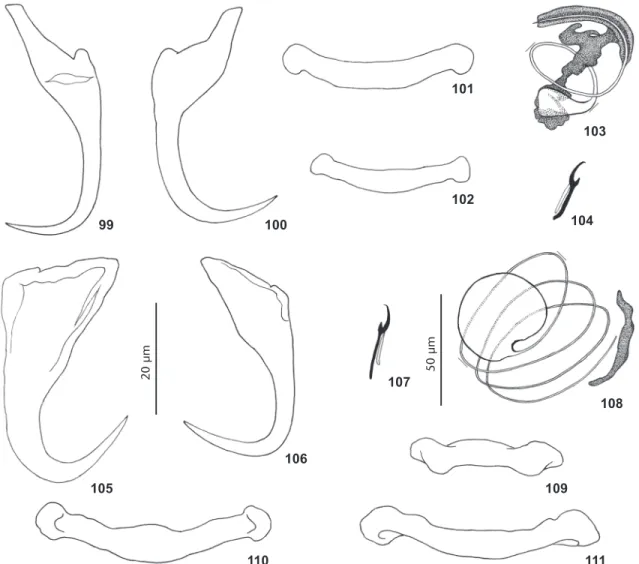
The Lutjanidae (Perciformes) includes 108 primarily reef-dwelling marine species (ESCHMEYER & FRICKE 2011) occurring in the tropical and subtropical waters of the eastern Pacific, Indo-west Pacific, and eastern and Indo-western Atlantic Oceans (ALLEN 1985). These fishes, commonly called snappers, are known to
harbor a comparatively high number of dactylogyrid species on their gills (see KRITSKY et al. 2009a). In 2001, a survey was initi-ated to determine the diversity of dactylogyrids from lutjanid hosts worldwide. The first installment stemming from this in-vestigation included the proposal of Haliotrematoides Kritsky,
Dactylogyrids (Monogenoidea: Polyonchoinea) parasitizing the gills of
snappers (Perciformes: Lutjanidae): Revision of
Euryhaliotrema
with new
and previously described species from the Red Sea, Persian Gulf, the
eastern and Indo-west Pacific Ocean, and the Gulf of Mexico
Delane C. Kritsky
Health Education Program, School of Health Professions, Campus Box 8090, Idaho State University, Pocatello, Idaho 83209, U.S.A. E-mail: [email protected]
ABSTRACT. Twenty one of 29 species of snappers (Lutjanidae), examined for dactylogyrids (Monogenoidea) from the Red Sea, Persian Gulf, the Indo-west and eastern Pacific Ocean, the Gulf of Mexico, and Caribbean Sea were parasitized by 16 new and 11 previously described species of Euryhaliotrema: Euryhaliotrema adelpha sp. nov., Euryhaliotrema anecorhizionsp. nov., Euryhaliotrema cardinalesp. nov., Euryhaliotrema chrysotaeniae, Euryhaliotrema cognatussp. nov.,
Euryhaliotrema cryptophallussp. nov., Euryhaliotrema diplopssp. nov., Euryhaliotrema distinctumsp. nov., Euryhaliotrema fajeravilae sp. nov., Euryhaliotrema fastigatum, Euryhaliotrema fatuum sp. nov., Euryhaliotrema ferocis sp. nov.,
Euryhaliotrema hainanense, Euryhaliotrema longibaculum, Euryhaliotrema mehencomb. nov., Euryhaliotrema paracanthi,
Euryhaliotrema paululumsp. nov., Euryhaliotrema perezponcei, Euryhaliotrema ramulumsp. nov., Euryhaliotrema seyisp. nov., Euryhaliotrema simplicissp. nov., Euryhaliotrema spirotubiforum, Euryhaliotrema tormocleithrumsp. nov., Euryhaliotrema torquecirrus, Euryhaliotrema tubocirrus, Euryhaliotrema xinyingense, and Euryhaliotrema youngisp. nov. Six species of
Euryhaliotrema, previously reported from lutjanid hosts, were not collected: Euryhaliotrema anguiformiscomb. nov.,
Euryhaliotrema guangdongense,Euryhaliotrema johni, Euryhaliotrema lutiani, Euryhaliotrema lutjani, and Euryhaliotrema nanaoensecomb. nov. The diagnosis of Euryhaliotrema was emended to include species having tandem or slightly overlapping gonads, a pretesticular germarium, a globose haptor with morphologically similar anchors and hooks, a coiled or meandering male copulatory organ, a dextral vaginal pore, and hooks with upright acute thumbs and slender shanks comprised of one subunit. A bulbous base of the MCO and presence of an accessory piece in the copulatory complex were no longer considered features defining the genus. As a result, Euryhaliotrematoides and Aliatrema were placed in subjective synonymy with Euryhaliotrema, and the following transfers were proposed: Euryhaliotrema annulocirrus comb. nov., Euryhaliotrema aspistiscomb. nov., Euryhaliotrema berenguelae comb. nov., Euryhaliotrema cribbicomb. nov., Euryhaliotrema grandiscomb. nov., Euryhaliotrema mehencomb. nov., Euryhaliotrema microphalluscomb. nov.,
Euryhaliotrema pirulum comb. nov., and Euryhaliotrema triangulovaginacomb. nov. In addition, the following new combinations were proposed based on the revised diagnosis of the genus: Euryhaliotrema anguiformiscomb. nov.,
Euryhaliotrema eukurodaicomb. nov., Euryhaliotrema kurodaicomb. nov., Euryhaliotrema monoporosumcomb. nov., and Euryhaliotrema nanaoensecomb. nov. The dactylogyrids, Protancyrocephalus rangusi (from a lutjanid host) and
Daitreosoma chaetodontis (from a chaetodontid host), were considered species inquirendae. Haliotrematoides tukerhamatus comb. nov. is considered the senior subjective synonym of Haliotrematoides nagabinae. New host records for some previously described species of Euryhaliotrema from lutjanid and chaetodontid hosts were reported.
KEY WORDS. Aliatrema; Dactylogyridae; Euryhaliotrema; Euryhaliotrematoides; Lutjanidae; Lutjanus spp.; Monogenoidea;
Yang & Sun, 2009 with 24 species (12 new) infesting lutjanid hosts; two dactylogyrid species from caesionid hosts and four from sparid hosts were also included in Haliotrematoides by KRITSKY et al. (2009a). The present paper represents the second install-ment stemming from this investigation and includes a revision of Euryhaliotrema Kritsky & Boeger, 2002 and descriptions and reports of 27 new and previously described species from lutjanid hosts.
MATERIAL AND METHODS
The gills of twenty nine species of snappers (Lutjanidae) were examined for dactylogyrids: yellowbanded snapper, Lutjanus adettii (Castelnau); mutton snapper, Lutjanus analis (Cuvier); schoolmaster snapper, Lutjanus apodus (Walbaum); mangrove red snapper, Lutjanus argentimaculatus (Forsskål); yellow snapper, Lutjanus argentiventris (Peters); mullet snapper, Lutjanus auratus (Günther); two-spot red snapper, Lutjanus bohar (Forsskål); northern red snapper, Lutjanus campechanus (Poey); Spanish red snapper, Lutjanus carponotatus (Richardson); Colo-rado snapper, Lutjanus coloColo-rado Jordan & Gilbert; cubera snap-per, Lutjanus cyanopterus (Cuvier); blackspot snapsnap-per, Lutjanus ehrenbergii (Peters); dory snapper, Lutjanus fulviflamma (Forsskål); blacktail snapper, Lutjanus fulvus (Forster); hump-back snapper, Lutjanus gibbus (Forsskål); grey snapper, Lutjanus griseus (Linnaeus); spotted rose snapper, Lutjanus guttatus (Steindachner); dog snapper, Lutjanus jocu (Bloch & Schneider); common blue stripe snapper, Lutjanus kasmira (Forsskål); mahogony snapper, Lutjanus mahogoni (Cuvier); Malabar blood snapper, Lutjanus malabaricus (Bloch & Schneider); five-lined snapper, Lutjanus quinquelineatus (Bloch); blubberlip snapper, Lutjanus rivulatus (Cuvier); Russell’s snapper, Lutjanus russellii (Bleeker); emperor red snapper, Lutjanus sebae (Cuvier); lane snapper, Lutjanus synagris (Linnaeus); brownstripe snapper, Lutjanus vitta (Quoy & Gaimard); yellowtail snapper, Ocyurus chrysurus (Bloch); and vermillion snapper, Rhomboplites aurorubens (Cuvier).
Snappers were collected by a variety of methods from marine waters off China, New Caledonia, Australia, the Maldive Islands, Egypt, Kuwait, Mexico, Nicaragua, Panama, and the USA by colleagues and friends (see Acknowledgments). Fish hosts were identified by the collectors using various resources available at the respective collection sites and facilities; scien-tific and common names of fishes are those provided in FishBase (FROESE & PAULY 2011) and verified in ESCHMEYER & FRICKE (2011). In most cases, the host’s gill basket was removed soon after capture at the site of collection and placed in hot (60°C) 4% formalin to relax and fix the parasites. Fixed gills from each fish were pooled or placed individually in vials; vials contain-ing the gills and respective fluids were labeled and shipped to Idaho State University for study. Dactylogyrids were subse-quently removed from the gills or sediment using a small probe and dissecting microscope. Some specimens were mounted
unstained in Gray and Wess medium (HUMASON 1979) or in ammonium picrate glycerine (MALMBERG 1970) for study of scle-rotized structures; other specimens were stained with Gomori’s trichrome or VanCleave’s hematoxylin (KRITSKYet al. 1978, BULLARD et al. 2004) and mounted in Canada balsam for observ-ing internal anatomy. Illustrations were prepared with the aid of a camera lucida or microprojector. Measurements, all in micrometers, represented straight-line distances between ex-treme points and were expressed as the mean followed by the range and number (n) of structures measured in parentheses; body length included that of the haptor; the measured dimen-sion of the male copulatory organ (MCO) was that represented in the respective drawings as the distance between the parallel lines. Numbering of hook pairs followed that proposed by MIZELLE (1936) (see MIZELLE & PRICE 1963); direction of the coil (clockwise vs. counterclockwise) of the MCO was determined using the method suggested by KRITSKYet al. (1985). Descrip-tions of new species were based on specimens collected from the type locality and type host; all other specimens of the re-spective species were considered voucher specimens. Unless otherwise indicated, measurements of the new species are from specimens collected from the type host and type locality. Type and voucher specimens collected during the present study were deposited in the U.S. National Parasite Collection (USNPC), Beltsville, Maryland, the Florida Fish and Wildlife Conserva-tion Commissions’s Fish and Wildlife Research Institutes’ In-vertebrate Specimen Collection (FSBC-I), St. Petersburg, Florida, and the helminth collections of the Queensland Museum (QM), Brisbane, Australia; and the Muséum national d’Histoire naturelle (MNHN), Paris, France, as indicated in the respective species accounts. In addition, the following museum specimens were examined: paratype, Euryhaliotrema xinyingense Pan & Zhang, 2006 [Natural History Museum, London, UK (NHMUK 2005.10.18.3-4)]; paratype, Euryhaliotrema hainanense Pan & Zhang, 2006 (NHMUK 2005.10.18.1-2); 3 voucher specimens, Euryhaliotrema torquecirrus (Zhukov, 1976) Kritsky & Boeger, 2002 (USNPC 91432); 2 voucher specimens, Euryhaliotrema tubocirrus (Zhukov, 1976) Kritsky & Boeger, 2002 (USNPC 91431); and 4 paratypes, Euryhaliotrematoides mehen Soler-Jiménez, Garcia-Gasca & Fajer-Ávila, 2012 (USNPC 104737, 104738, 104739 & 104740).
TAXONOMY
Table I. Occurrence of Euryhaliotrema species on the gills of snappers (Lutjanidae).
Euryhaliotrema species Host Locality
E. adelpha Kritsky & Justine sp. nov. Lutjanus quinquelineatus New Caledonia E. anecorhizion Kritsky & Mendoza-Franco sp. nov. Lutjanus argentiventris Eastern Pacific
E. cardinale Kritsky & Justine sp. nov. Lutjanus fulviflamma New Caledonia, Australia, Red Sea Lutjanus ehrenbergii Red Sea
E. chrysotaeniae (Young, 1968) Kritsky & Boeger, 2002 Lutjanus carponotatus Australia Lutjanus russellii New Caledonia Lutjanus quinquelineatus New Caledonia Lutjanus fulviflamma New Caledonia Lutjanus fulvus New Caledonia E. cognatus Kritsky & Galli sp. nov. Lutjanus bohar Republic of Maldives
Lutjanus gibbus Republic of Maldives E. cryptophallus Kritsky & Yang sp. nov. Lutjanus argentimaculatus China
E. diplops Kritsky, Yang & Justine sp. nov. Lutjanus argentimaculatus New Caledonia, China E. distinctum Kritsky & Galli sp. nov. Lutjanus bohar Republic of Maldives E. fajeravilae Kritsky & Mendoza-Franco sp. nov. Lutjanus argentiventris Eastern Pacific E. fastigatum (Zhukov, 1976) Kritsky & Boeger, 2002 Lutjanus griseus Gulf of Mexico
Lutjanus apodus Gulf of Mexico Lutjanus jocu Gulf of Mexico Lutjanus argentiventris Eastern Pacific
E. fatuum Kritsky & Justine sp. nov. Lutjanus fulviflamma New Caledonia, Australia Lutjanus fulvus New Caledonia
E. ferocis Kritsky & Yang sp. nov. Lutjanus malabaricus China
E. hainanense Pan & Zhang, 2006 Lutjanus argentimaculatus New Caledonia, China E. longibaculum (Zhukov, 1976) Kritsky & Boeger, 2002 Lutjanus synagris Gulf of Mexico E. mehen (Solar-Jiménez, Garcia-Gasca & Fajer-Ávila, 2012) comb. nov. Lutjanus guttatus Eastern Pacific E. paracanthi (Zhukov, 1976) Kritsky & Boeger, 2002 Lutjanus griseus Gulf of Mexico
Lutjanus jocu Gulf of Mexico Lutjanus argentiventris Eastern Pacific E. paululum Kritsky & Justine sp. nov. Lutjanus kasmira New Caledonia E. perezponcei Garcia-Vargas, Fajer-Ávila & Lamothe-Argumedo, 2008 Lutjanus guttatus Eastern Pacific E. ramulum Kritsky & Galli sp. nov. Lutjanus gibbus Republic of Maldives
E. seyisp. nov. Lutjanus fulviflamma Red Sea
Lutjanus russellii Persian Gulf E. simplicis Kritsky & Justine sp. nov. Lutjanus quinquelineatus New Caledonia E. spirotubiforum (Zhang, 2001) Wu, Zhu, Xie & Li, 2006 Lutjanus vitta New Caledonia Lutjanus russellii New Caledonia Lutjanus fulviflamma Red Sea, Australia Lutjanus ehrenbergii Red Sea
Lutjanus carponotatus Australia Lutjanus quinquelineatus New Caledonia Lutjanus fulvus New Caledonia E. tormocleithrum Kritsky & Galli sp. nov. Lutjanus gibbus Republic of Maldives E. torquecirrus (Zhukov, 1976) Kritsky & Boeger, 2002 Ocyurus chrysurus Gulf of Mexico
105463, 105464, respectively) occurred on yellow snapper, L. argentiventris, in the eastern Pacific Ocean off Panama. L. sebae from Australia, L. analis from the Gulf of Mexico, L. aratus and L. colorado from the eastern Pacific Ocean, L. cyanopterus from the Gulf of Mexico and Caribbean Sea, L. mahogoni from the Caribbean Sea, and L. rivulatus from New Caledonia were uninfected with species of the genus.
Class Monogenoidea Bychowsky, 1937
Subclass Polyonchoinea Bychowsky, 1937
Order Dactylogyridea Bychowsky, 1937
Dactylogyridae Bychowsky, 1933
Euryhaliotrema
Kritsky & Boeger, 2002
Syns Euryhaliotrematoides Plaisance & Kritsky, 2004; Aliatrema Plaisance & Kritsky, 2004
Emended diagnosis: Body fusiform or slightly flattened dorsoventrally, comprising body proper (cephalic region, trunk, peduncle) and haptor. Tegument usually smooth. Terminal and two bilateral cephalic lobes; three pairs of bilateral head or-gans; cephalic glands unicellular, lateral or posterolateral to pharynx. Eyespots two to four; granules small, ovate. Mouth subterminal, midventral, prepharyngeal; pharynx comprising muscular, glandular bulb; esophagus short; intestinal ceca two, confluent posterior to gonads, lacking diverticula. Common genital pore midventral near level of intestinal bifurcation. Gonads intercecal, tandem or slightly overlapping; germarium pretesticular, ventral. Vas deferens looping left intestinal cecum; seminal vesicle a simple dilation of vas deferens; one or two prostatic reservoirs. Copulatory complex comprising MCO and accessory piece; accessory piece may be lacking. MCO tubular, coiled or meandering, with bulbous or funnel-shaped base; coil with counterclockwise rings. Accessory piece, when present, serving as guide for distal portion of MCO, with or without
articulation process attached to base of MCO. Seminal recep-tacle pregermarial; vaginal pore dextral, marginal or submar-ginal; vagina sclerotized. Vitellaria in trunk, absent from regions of other reproductive organs. Haptor globose, armed with dor-sal and ventral anchor/bar complexes, seven pairs of similar hooks. Hook distribution normal; hook with upright acute thumb, slender shank comprised of one subunit. Parasites of marine and freshwater teleosts.
Type species: Euryhaliotrema chaoi Kritsky & Boeger, 2002 from Plagioscion sp. and P. squamosissimus (Heckel), Sciaenidae.
Other species:
1. E. adelpha Kritsky & Justine sp. nov. from Lutjanus quinquelineatus (Bloch), Lutjanidae.
2. E. ambassisi Pan & Lu, 2005 from Ambassis gymnocephalus (Lacepède), Ambassidae.
3. E. amydrum Kritsky & Bakenhaster, 2011 from Archosargus probatocephalus (Walbaum), Sparidae.
4. E. anecorhizion Kritsky & Mendoza-Franco sp. nov. from Lutjanus argentiventris (Peters), Lutjanidae.
5. E. anguiformis (Zhang, 2001) comb. nov. from Lutjanus vaigiensis (Quoy & Gaimard) [now L. fulvus (Forster)], Lutjanus kasmira (Forsskål), Lutjanus russellii (Bleeker), and Lutjanus monostigma (Cuvier), all Lutjanidae.
6. E. annulocirrus (Yamaguti, 1968) comb. nov. from Chaetodon auriga Forsskål, Chaetodon lunula (Lacepède), Chaetodon modestus Temminck & Schlegel [now Roa modesta (Temminck & Schlegel)], Chaetodon bellamaris Seale (now C. wiebeli Kaup), and Chaetodon vagabundus Linnaeus, all Chaetodontidae. 7. E. aspistis (Plaisance & Kritsky, 2004) comb. nov. from
Chaetodon auriga Forsskål, Chaetodon citrinellus Cuvier, Chaetodon lunula (Lacepède), Chaetodon reticulatus Cuvier, Chaetodon ulietensis Cuvier, and Chaetodon vagabundus Linnaeus, all Chaetodontidae.
8. E. atlanticum Kritsky & Boeger, 2002 from Paralonchurus brasiliensis (Steindachner), Sciaenidae.
9. E. berenguelae (Plaisance & Kritsky, 2004) comb. nov. from Table I. Continued.
Euryhaliotrema species Host Locality
E. tubocirrus (Zhukov, 1976) Kritsky & Boeger, 2002 Lutjanus campechanus Gulf of Mexico Lutjanus griseus Gulf of Mexico Lutjanus jocu Gulf of Mexico Lutjanus synagris Gulf of Mexico Rhomboplites aurorubens Gulf of Mexico E. xinyingense Pan & Zhang, 2006 Lutjanus argentimaculatus China, New Caledonia
E. youngisp. nov. Lutjanus carponotatus Australia
Lutjanus fulviflamma Australia
Euryhaliotrema sp. 1 Lutjanus adetti Australia
Euryhaliotrema sp. 2 Lutjanus argentiventris Eastern Pacific
Forcipiger flavisissimus Jordan & McGregor, Chaetodontidae. 10. E. bychowskyi (Obodnikova, 1976) Kritsky & Boeger, 2002 from Hapalogenys mucronatus (Eydoux & Souleyet), Haemulidae.
11. E. carbuncularium Kritsky & Bakenhaster, 2011 from Archosargus probatocephalus (Walbaum), Sparidae.
12. E. carbunculus (Hargis, 1955) Kritsky & Boeger, 2002 from Lagodon rhomboides (Linnaeus), Sparidae.
13. E. cardinale Kritsky & Justine sp. nov. from Lutjanus fulviflamma (Forsskål) and Lutjanus ehrenbergii (Peters), both Lutjanidae.
14. E. chrysotaeniae (Young, 1968) Kritsky & Boeger, 2002 from Lutjanus carponotatus (Richardson), Lutjanus fulviflamma (Forsskål), Lutjanus fulvus (Forster), Lutjanus kasmira (Forsskål), Lutjanus quinquelineatus (Bloch), and Lutjanus russellii (Bleeker), all Lutjanidae.
15. E. cognatus Kritsky & Galli sp. nov. from Lutjanus bohar (Forsskål) and Lutjanus gibbus (Forsskål), both Lutjanidae. 16. E. cribbi (Plaisance & Kritsky, 2004) comb. nov. from Chaetodon
vagabundus Linnaeus, Chaetodon auriga Forsskål, Chaetodon lunula (Lacepède), Chaetodon trifasciatus Park, Chaetodon ulietensis Cuvier, Forcipiger flavisissimus Jordan & McGregor, and Heniochus chrysostomus Cuvier, all Chaetodontidae. 17. E. cryptophallus Kritsky & Yang sp. nov. from Lutjanus
argentimaculatus (Forsskål), Lutjanidae.
18. E. diplops Kritsky, Yang & Justine sp. nov. from Lutjanus argentimaculatus (Forsskål), Lutjanidae.
19. E. distinctum Kritsky & Galli sp. nov. from Lutjanus bohar (Forsskål), Lutjanidae.
20. E. dontykoleos Fehlauer & Boeger, 2005 from Pachyurus junki Soares & Casatti, Sciaenidae.
21. E. dunlapae Kritsky & Bakenhaster, 2011 from Archosargus probatocephalus (Walbaum), Sparidae.
22. E. eukurodai (Zhang, Ding, Lin & Yu, 1994) comb. nov. from Acanthopagrus s. schlegelii (Bleeker), Sparidae.
23. E. fajeravilae Kritsky & Mendoza-Franco sp. nov. from Lutjanus argentiventris (Peters), Lutjanidae.
24. E. fastigatum (Zhukov, 1976) Kritsky & Boeger, 2002 from Lutjanus apodus (Walbaum), Lutjanus jocu (Bloch & Schneider), Lutjanus griseus (Linnaeus), Lutjanus argentiventris (Peters), and Lutjanus analis (Cuvier), all Lutjanidae. 25. E. fatuum Kritsky & Justine sp. nov. from Lutjanus
fulviflamma (Forsskål) and Lutjanus fulvus (Forster), both Lutjanidae.
26. E. ferocis Kritsky & Yang sp. nov. from Lutjanus malabaricus (Bloch & Schneider), Lutjanidae.
27. E. grandis (Mizelle & Kritsky, 1969) comb. nov. from Chaetodon auriga Forsskål, Chaetodon chrysurus Ahl (now C. paucifasciatus Ahl), Chaetodon citrinellus Cuvier, Chaetodon ephippium Cuvier, Chaetodon kleinii Bloch, Chaetodon lineolatus Cuvier, Chaetodon lunula (Lacepède), Chaetodon ornatissimus Cuvier, Chaetodon setifer Bloch (now C. auriga), Chaetodon trifasciatus Park, Chaetodon vagabundus Linnaeus, and Heniochus chrysostomus Cuvier, all Chaetodontidae. 28. E. guangdongense Li, Yan, Yul, Lan & Huang, 2005 from
Lutjanus argentimaculatus (Forsskål), Lutjanidae.
29. E. guangzhouense Li, 2005 from Sparus macrocephalus (Basilewsky) (now Acanthopagrus s. schlegelii), Sparidae. 30. E. hainanense Pan & Zhang, 2006 from Lutjanus argentimaculatus
(Forsskål), Lutjanidae.
31. E. johni (Tripathi, 1959) Kritsky & Boeger, 2002 from Lutjanus johnii (Bloch), Lutjanus fulviflamma (Forsskål), Lutjanus rhodopterus1, Lutjanus russellii (Bleeker), and L. vaigiensis (Quoy
& Gaimard) (now L. fulvus), all Lutjanidae; and Sparus macro-cephalus (Basilewsky) (now Acanthopagrus s. schlegelii), Sparidae. 32. E. kurodai (Ogawa & Egusa, 1978) comb. nov. from Acanthopagrus schlegelii (Bleeker), Acanthopagrus berda (Forsskål), and Acanthopagrus latus (Houttuyn), all Sparidae. 33. E. longibaculum (Zhukov, 1976) Kritsky & Boeger, 2002 from Lutjanus mahogoni (Cuvier) and Lutjanus synagris (Linnaeus), both Lutjanidae.
34. E. lovejoyi Kritsky & Boeger, 2002 from Plagioscion sp. and Plagioscion squamosissimus (Heckel), both Sciaenidae. 35. E. lutiani (Yamaguti, 1953) Kritsky & Boeger, 2002 from
Lutjanus sp. and Lutjanus vitta (Quoy & Gaimard), both Lutjanidae.
36. E. lutjani Li, 2006 from Lutjanus argentimaculatus (Forsskål), Lutjanidae, and Sparus macrocephalus (Basilewsky) (now Acanthopagrus s. schlegelii), Sparidae.
37. E. mehen (Soler-Jiménez, Garcia-Gasca & Fajer-Ávila, 2012) comb. nov. from Lutjanus guttatus (Steindachner), Lutjanidae.
38. E. microphallus (Yamaguti, 1968) comb. nov. from Chaetodon auriga Forsskål, Chaetodon citrinellus Cuvier, Chaetodon ephippium Cuvier, Chaetodon kleinii Bloch, Chaetodon lunula (Lacepède), Chaetodon ornatissimus Cuvier, Chaetodon reticulatus Cuvier, Chaetodon trifascialis Quoy & Gaimard, Chaetodon trifasciatus Park, Chaetodon vagabundus Linnaeus, Forcipiger flavisissimus Jordan & McGregor, and Heniochus chrysostomus Cuvier, all Chaetodontidae.
39. E. monacanthus Kritsky & Boeger, 2002 from Plagioscion sp. and Plagioscion squamosissimus (Heckel), both Sciaenidae.
1 No listings for the nominal species, Lutjanus rhodopterus, reported as host of Euryhaliotrema johni by WU et al. (2006) and of
Euryhaliotrematoides sp. HQDD by WUet al. (2007), were found in Fishbase (FROESE & PAULY 2011) or in the California Academy of Sciences Catalog of Fishes (ESCHMEYER & FRICKE 2011). The specific epithet “rhodopterus” has only been used for fishes assigned to Apogon
40. E. monoporosum (Pan & Zhang, 2000) comb. nov. from Chaetodon wiebeli Kaup and Chaetodon ornatissimus Cuvier, both Chaetodontidae.
41. E. nanaoense (Li, Yan, Yul, Lan & Huang, 2005) comb. nov. from Lutjanus argentimaculatus (Forsskål), Lutjanidae. 42. E. paracanthi (Zhukov, 1976) Kritsky & Boeger, 2002 from
Lutjanus apodus (Walbaum), Lutjanus griseus (Linnaeus), Lutjanus jocu (Bloch & Schneider), and Lutjanus argentiventris (Peters), all Lutjanidae.
43. E. paralonchuri (Luque & Iannacone, 1989) Kritsky & Boeger, 2002 from Paralonchurus peruanus (Steindachner), Sciaeni-dae.
44. E. paululum Kritsky & Justine sp. nov. from Lutjanus kasmira (Forsskål), Lutjanidae.
45. E. perezponcei García-Vargas, Fajer-Ávila & Lamothe-Argumedo, 2008 from Lutjanus guttatus (Steindachner), Lutjanidae.
46. E. pirulum (Plaisance & Kritsky, 2004) comb. nov. from Chaetodon auriga Forsskål, Chaetodon citrinellus Cuvier, Chaetodon lunula (Lacepède), Chaetodon trifasciatus Park, and Chaetodon vagabundus Linnaeus, all Chaetodontidae. 47. E. potamocetes Kritsky & Boeger, 2002 from Plagioscion sp.
and Plagioscion squamosissimus (Heckel), both Sciaenidae. 48. E. ramulum Kritsky & Galli sp. nov. from Lutjanus gibbus
(Forsskål), Lutjanidae.
49. E. sagmatum Kritsky & Boeger, 2002 from Umbrina xanti Gill, Sciaenidae.
50. E. seyi sp. nov. from Lutjanus fulviflamma (Forsskål) and Lutjanus russellii (Bleeker), both Lutjanidae.
51. E. simplicis Kritsky & Justine sp. nov. from Lutjanus quinquelineatus (Bloch), Lutjanidae.
52. E. spirotubiforum (Zhang, 2001) Wu, Zhu, Xie & Li, 2006 from Lutjanus vitta (Quoy & Gaimard), Lutjanus russellii (Bleeker), Lutjanus fulviflamma (Forsskål), Lutjanus ehrenbergii (Peters), Lutjanus carponotatus (Richardson), Lutjanus kasmira (Forsskål), Lutjanus quinquelineatus (Bloch), Lutjanus fulvus (Forster), Lutjanus stellatus Akazaki, and Lutjanus vaigiensis (Quoy & Gaimard) (now L. fulvus), all Lutjanidae. 53. E. spirulum Kritsky & Bakenhaster, 2011 from Archosargus
probatocephalus (Walbaum), Sparidae.
54. E. succedaneus Kritsky & Boeger, 2002 from Plagioscion sp. and Plagioscion squamosissimus (Heckel), both Sciaenidae. 55. E. thatcheri Kritsky & Boeger, 2002 from Plagioscion sp. and
Plagioscion squamosissimus (Heckel), both Sciaenidae. 56. E. tormocleithrum Kritsky & Galli sp. nov. from Lutjanus
gibbus (Forsskål), Lutjanidae.
57. E. torquecirrus (Zhukov, 1976) Kritsky & Boeger, 2002 from Lutjanus synagris (Linnaeus), Lutjanus griseus (Linnaeus), Lutjanus mahogoni (Cuvier), Lutjanus analis (Cuvier), and Ocyurus chrysurus (Bloch), all Lutjanidae.
58. E. triangulovagina (Yamaguti, 1968) comb. nov. from Chaetodon auriga Forsskål, Chaetodon citrinellus Cuvier, Chaetodon kleinii Bloch, Chaetodon lunula (Lacepède),
Chaetodon multicinctus Garrett, Chaetodon ornatissimus Cuvier, Chaetodon vagabundus Linnaeus, Chaetodon wiebeli Kaup, Forcipiger flavisissimus Jordan & McGregor, Forcipiger longirostris (Broussonet), Hemitaurichthys polylepis (Bleeker), and Heniochus chrysostomus Cuvier, all Chaetodontidae. 59. E. tubocirrus (Zhukov, 1976) Kritsky & Boeger, 2002 from
Lutjanus analis (Cuvier), Lutjanus apodus (Walbaum), Lutjanus cyanopterus (Cuvier), Lutjanus synagris (Linnaeus), Lutjanus jocu (Bloch & Schneider), Lutjanus campechanus (Poey), Lutjanus griseus (Linnaeus), Lutjanus mahogoni (Cuvier), Lutjanus buccanella (Cuvier), Lutjanus vivanus (Cuvier), and Rhomboplites aurorubens (Cuvier), all Lutjanidae.
60. E. xinyingense Pan & Zhang, 2006 from Lutjanus argentimaculatus (Forsskål), Lutjanidae.
61. E. youngi sp. nov. from Lutjanus carponotatus (Richardson) and Lutjanus fulviflamma (Forsskål), both Lutjanidae. 62. E. zhangjianyingi Pan & Lu, 2005 from Ambassis gymnocephalus
(Lacepède), Ambassidae.
Remarks: Euryhaliotrema was proposed by KRITSKY & BOEGER (2002) for some new and previously described species of Dactylogyridae from snappers (Lutjanidae), drums and croak-ers (Sciaenidae), porgies (Sparidae) and grunts (Haemulidae). The genus was primarily characterized by dactylogyrids hav-ing a bulbous base of the MCO. PLAISANCE & KRITSKY (2004) sub-sequently proposed Euryhaliotrematoides Plaisance & Kritsky, 2004 and Aliatrema Plaisance & Kritsky, 2004 for similar spe-cies parasitizing butterflyfishes (Chaetodontidae) but having “funnel-shaped” bases of the MCO; species of Aliatrema also lack an accessory piece in the copulatory complex (accessory pieces present in species of Euryhaliotrema and Euryhaliotrematoi-des). However, some of the dactylogyrids collected from snap-pers during the present survey possessed a mix of these morphological features, suggesting that re-evaluation of the three genera was necessary.
spirotubiforum (Fig. 164), E. adelpha (Figs 168, 169), E. paululum (Fig. 180), and E. youngi (Figs 186, 187), appear most similar to those of E. ferocis (Fig. 146) and E. fatuum (Fig. 94), both species of which possess an MCO associated with a small accessory piece. Because morphology of the copulatory complex no longer ap-pears diagnostic at the generic level, the diagnosis of Euryhaliotrema was expanded to include the valid species of Euryhaliotrematoides and Aliatrema, and the two latter genera were considered subjective synonyms of Euryhaliotrema. As a result of the proposed synonymies, the species previously assigned to Euryhaliotrematoides and Aliatrema were transferred to Euryhaliotrema as new combinations.
Studies involving phylogenetic analyses using molecular data have provided minimal and often conflicting evidence re-garding the validities of Euryhaliotrema, Aliatrema and Euryhaliotrematoides. While some of these studies have suggested possible monophyly of species parasitizing particular host groups, all have been based on comparatively few taxa that clearly un-derestimated species diversity. As a result, potential bias toward closely related species parasitizing specific host groups has likely occurred. For example, the analysis conducted by PLAISANCE et al. (2005) using 28S rDNA sequences of only seven species of Euryhaliotrematoides and Aliatrema cribbi (all from chaetodontid hosts) and Euryhaliotrema chrysotaeniae (from a lutjanid host), suggested that Euryhaliotrematoides was monophyletic, with Euryhaliotrema (represented by E. chrysotaeniae) serving as sister group of Euryhaliotrematoides + Aliatrema (see their fig. 2B). On the other hand, their analysis using 18S rDNA sequences showed Euryhaliotrematoides to be polyphyletic (see fig. 2A in Plaisance et al. 2005). WU et al. (2006) found Euryhaliotrema johni, Haliotrema spirotubiforum and Euryhaliotrema sp. ZHDDb (all para-sites of lutjanids) to form a “monophyletic” clade in their analysis of rDNA and, as a result, transferred H. spirotubiforum, a species lacking an accessory piece and having a funnel-shaped base of the MCO, to Euryhaliotrema. Later, WUet al. (2007), using se-quences from fifteen dactylogyrid species herein assigned to Euryhaliotrema (sensu lato), suggested that the species infesting chaetodontid, lutjanid and sparid hosts represented a major clade (their lineage 2). While their analysis suggested a monophyletic Euryhaliotrematoides, which included 7 species infesting chaetodontids and 1 from a lutjanid, it did not provide support for the monophyly of either Euryhaliotrema or Aliatrema (WU et al. 2007). Finally, KRITSKY et al. (2009a) suggested a monophyl-etic Euryhaliotrematoides comprising only four species from chaetodontid hosts but failed to justify Euryhaliotrema, while DANG et al. (2010), using sequences available in GenBank, indi-cated that Aliatrema and Euryhaliotrematoides were monophyl-etic within a clade containing a paraphylmonophyl-etic Euryhaliotrema and two species of Haliotrema Johnston & Tiegs, 1922.
A common relationship that emerged from all of the stud-ies employing molecular data, however, was a major clade com-prising the species of all three genera, suggesting that Euryhaliotrema, Euryhaliotrematoides and Aliatrema together
com-prised a monophyletic taxon. These findings further support the proposed synonymies of the three genera, with Euryhaliotrema having priority.
The phylogenetic analyses of WU et al. (2007) and KRITSKY et al. (2009a) suggested that two species of Haliotrema from a non-lutjanid or chaetodontid host should be transferred to Euryhaliotrema. In these studies, H. eukurodai Zhang, Ding, Lin & Yu, 1994 and H. kurodai Ogawa & Egusa, 1978, both from Sparus macrocephalus (Basilewsky) (now Acanthopagrus s. schlegelii), Sparidae, fell within respective clades of species herein assigned to Euryhaliotrema. Haliotrema eukurodai and H. kurodai lack an accessory piece in the MCO and otherwise possess all features of Euryhaliotrema as defined herein (see also OGAWA & EGUSA 1978, ZHANG et al. 1994). These features were verified for H. kurodai through examination of 10 voucher specimens col-lected from A. s. schlegelii in the South China Sea (USNPC 105466) by Dr. Yang Tingbao. Thus, the two species are trans-ferred to Euryhaliotrema as E. eukurodai (Zhang, Ding, Lin & Yu, 1994) comb. nov. and E. kurodai (Ogawa & Egusa, 1978) comb. nov., respectively.
Haliotrema monoporosum Pan & Zhang, 2000 was described in PAN (2000) from Chaetodon wiebeli (Chaetodontidae) collected off Wanning, Hainan Island (South China Sea), China, and char-acterized in part by possessing a perforation through a “swell-ing” near the midregion of the ventral bar. PLAISANCE & KRITSKY (2004) suggested that the species was probably valid, that it was differentiated from the similar Euryhaliotrematoides grandis (now Euryhaliotrema grandis) by the perforated ventral bar, and al-though a transfer was not made, that the species probably be-longed to Euryhaliotrematoides. Examination of 19 voucher specimens (USNPC 105461) obtained from the gills of Chaetodon ornatissimus collected off Moorea, French Polynesia, by L. Plaisance and colleagues for their studies on the Monogenoidea of chaetodontid fishes, revealed that the species possessed the morphological features required to place it in Euryhaliotrema as revised herein. Thus, it is transferred as Euryhaliotrema monoporosum (PAN & ZHANG 2000) comb. nov. Chaetodon ornatissimus represents a new host record for the species.
Two other dactylogyrid species, previously described from lutjanid or chaetodontid hosts, are herein considered species inquirendae. The original descriptions of both Protancyroce-phalus rangusi Gupta & Khanna, 1974 from the gills of Lutjanus rangus (Cuvier) (now L. bohar), Lutjanidae, off Port Blair (Andaman and Nicobar islands), India, and Daitreosoma chaeto-dontis Reichenbach-Klinke, 1959 from the gills of Chaetodon collare, Chaetodontidae, imported into Germany in 1958 are inadequate for species identification and appropriate generic placement. Attempts to locate type specimens of both species failed and it is presumed that they have been lost or destroyed (S. Klimpel and N. Agrawal, personal communications).
of Protogyrodactylus Johnston & Tiegs, 1922, which is charac-terized in part by species having an accessory sclerite associ-ated with the tip of the superficial root of the ventral anchor (see GALLI & KRITSKY 2008). REICHENBACH-KLINKE’s (1959) illustra-tion clearly shows that an accessory sclerite is absent in D. chaetodontis. Although GUPTA & KHANNA (1974) indicate that haptoral bars are absent in P. rangusi, the original drawings are so incomplete and diagrammatic that assignment of the spe-cies to Protancyrocephalus Bychowsky, 1957 is also problemati-cal. Based on GUPTA & KHANNA’s (1974) description of the species, P. rangusi could just as easily be assigned to Euryhaliotrema, Haliotrematoides or Tetrancistrum Goto & Kikuchi, 1917, all of which contain species parasitizing lutjanid hosts (KRITSKY et al. 2007, 2009a, nobis). That the type species of Protancyrocephalus, Protancyrocephalus strelkowi Bychowsky, 1957, was described from a member of the Pleuronectidae, a pleuronectiform fam-ily unrelated to the Lutjanidae, further suggests that the origi-nal assignment of P. rangusi to the genus is erroneous.
Because type specimens would be required to establish the validity and taxonomic position of both D. chaetodontis and P. rangusi and that these specimens have apparently been lost or destroyed, demonstrates the importance of preserving such specimens (including voucher specimens) used in devel-opment of published reports in an established museum. With-out the original reference material, it is highly unlikely that the status of the two species as species inquirendae will ever change and that they will ever be rediscovered during surveys of parasites of their respective hosts. Indeed, examination of L. bohar for the present study did not reveal any dactylogyrid speci-mens that could be assigned to P. rangusi based on the descrip-tion by GUPTA AND KHANNA (1974). Deposition of voucher specimens in established museums should not only occur for studies dealing with the taxonomy of respective groups but also should be done when species are recorded from various hosts and localities in ecological and phylogenetic studies. For example, the geographic records of Euryhaliotrema species re-ported in VIGNON et al. (2009) for their investigation on eco-logical affects of alien introductions and those reported by WU et al. (2006, 2007) for their phylogenetic studies using molecu-lar data, cannot be verified because representative voucher specimens were not preserved.
Euryhaliotrema tubocirrus
(Zhukov, 1976) Kritsky & Boeger, 2002
Figs 1-10 Syn. Haliotrema tubocirrus Zhukov, 1976
Redescription (based on 25 voucher specimens from L. campechanus, USNPC 105476, FSBC-I 093790): Body proper fusiform; greatest width usually in posterior trunk at level of testis. Tegument usually smooth, infrequently with transverse ridges or indistinct scales on posterior trunk and peduncle. Cephalic region narrow, with well-developed medial and two
bilateral cephalic lobes. Eyespots four, subequal in size; mem-bers of respective pairs equidistant; accessory chromatic gran-ules scattered throughout cephalic region. Pharynx subovate. Peduncle tapered posteriorly; haptor subhexagonal, with well-developed lateral lobes. Anchors similar; each with moderately developed superficial root, short deep root, slightly arced shaft, elongate point extending past level of tip of superficial root. Ventral bar rod shaped, with wave-like ventral surface impart-ing a broad W shape; dorsal bar variable, generally broadly V shaped, with variably developed anteromedial knob and pos-terior expansion or shield-like process. Hook with uniform shank, upright acute thumb; FH loop about shank length. MCO with bulbous base and coiled tubular shaft having about two and a half counterclockwise rings. Accessory piece multi-branched, with one branch enclosing and serving as guide for distal portion of shaft of MCO; articulation process absent. Testis elongate ovate; seminal vesicle pyriform; prostatic reser-voir small. Germarium subovate; oviduct, ootype not observed; Mehlis’ gland well developed, lying on both sides of anterior end of germarium; uterus delicate, ventral, frequently contain-ing developcontain-ing egg. Vaginal pore marginal on papilla lycontain-ing within indentation of lateral surface of anterior trunk; vaginal canal short, extending to pyriform pregermarial seminal re-ceptacle. Vitellaria dense, coextensive with gut; transverse vi-telline duct at level of or anterior to seminal receptacle. Egg ovate, with proximal filament.
Type host and locality: Lane snapper,Lutjanus synagris (Linnaeus), Lutjanidae: Campeche Bay (Area Havana).
Source of current specimens: Northern red snapper, Lutjanus campechanus, Lutjanidae (new host record): northern Gulf of Mexico, about 80 km off the Mississippi Coast (30°05’51.4”N, 88°40’46.2”W), 3 July 2007 and (29°26’33”N, 88°32’06”W), 4 August 2007; charter-boat landing, Pensacola Beach, Florida, 3 August 2007; Florida Middle Grounds, Gulf of Mexico (28°25’N, 84°12’W), 4-5 May 2009, 6 October 2009. Grey snapper, Lutjanus griseus, Lutjanidae: Rock jetty, Keys Marine Laboratory, Marathon Key (Florida Keys), Florida, 12 July 2003; Florida Middle Grounds, Gulf of Mexico (28°25’N, 84°12’W), 2 October 2009; Florida Bay, Everglades National Park, Florida (25.143°N, 80.703°W), 6-9 June 2009. Dog snap-per, Lutjanus jocu, Lutjanidae (new host record): Rock jetty, Keys Marine Laboratory, Marathon Key (Florida Keys), Florida (24°42’04”N, 81°07’30”W), 12 July 2003. Lane snapper, Lutjanus synagris, Lutjanidae: charter-boat landing, Pensacola Beach, Florida, 3 August 2007; Florida Middle Grounds, Gulf of Mexico (28°25’N, 84°12’W), 11 May 2009, 1-5 October 2009. Vermil-ion snapper, Rhomboplites aurorubens, Lutjanidae: charter-boat landing, Pensacola Beach, Florida, 3 August 2007; Florida Middle Grounds, Gulf of Mexico (28°25’N, 84°12’W), 6-8 May 2009, 2 October 2009.
Site of infection: Gills.
Figures 1-10. Euryhaliotrema tubocirrus from the northern red snapper, Lutjanus campechanus, in the Gulf of Mexico. 1. Whole mount (composite, ventral view). 2. Ventral bar. 3, 4, 5. Dorsal bars. 6. Copulatory complex (dorsal view). 7. Vagina and distal seminal receptacle. 8. Ventral anchor. 9. Hook. 10. Dorsal anchor. All figures are to the 25µm scale except Fig. 1 (200 µm scale).
FSBC-I 093790, 093791; 26 voucher specimens (from L. griseus), USNPC 105474, 105480, 105481, FSBC-I 093792; 6 voucher speci-mens (from L. jocu), USNPC 105470; 43 voucher specispeci-mens (from L. synagris), USNPC 91431, 105467, 105468, 105469, FSBC-I
093788; 16 voucher specimens (from R. aurorubens), USNPC 105471, 105472, 105473, FSBC-I 093789.
Previous records:Lutjanus analis: Campeche Bay (Area Havana) (as Haliotrema tubocirrus) (ZHUKOV 1976); Puerto Rico
1
2
3
4
5
8
9
6
7
10
200 µ
m
25 µ
(as Euryhaliotrema tubocirrus) (BOSQUES RODRÍGUEZ 2004). Lutjanus apodus: Campeche Bay (Area Havana) (as Haliotrema tubocirrus) (ZHUKOV 1976). Lutjanus buccanella: Puerto Rico (as Euryhaliotrema tubocirrus) (BOSQUES RODRÍGUEZ 2004). Lutjanus cyanopterus: Campeche Bay (Area Havana) (as Haliotrema tubocirrus) (ZHUKOV 1976). Lutjanus griseus: Puerto Rico (as Euryhaliotrema tubocirrus) (BOSQUES RODRÍGUEZ 2004). Lutjanus mahogoni: Puerto Rico (as Euryhaliotrema tubocirrus) (BOSQUES RODRÍGUEZ 2004). Lutjanus synagris: Campeche Bay (Area Havana) (as Haliotrema tubocirrus) (ZHUKOV 1976); Puerto Rico (as Euryhaliotrema tubocirrus) (BOSQUES RODRÍGUEZ 2004). Lutjanus vivanus: Puerto Rico (as Euryhaliotrema tubocirrus) (BOSQUES RODRÍGUEZ 2004). Rhomboplites aurorubens: Campeche Bay (Area Havana) (as Haliotrema tubocirrus) (ZHUKOV 1976).
Measurements: Table II.
Remarks: This species was originally described as Haliotrema tubocirrus from the gills of Lutjanus synagris (type species), L. analis, L. apodus, L. cyanopterus and Rhomboplites aurorubens from the environs of Havana, Cuba by ZHUKOV (1976). Three other lutjanid species from Puerto Rico, L. vivanus, L. griseus and L. buccanella, were recorded as new hosts for the parasite by BOSQUES RODRÍGUEZ (2004), who regarded E. tubocirrus to be the least host specific of the dactylogyrid species infest-ing lutjanids in the region. Two additional hosts, L. campechanus and L. jocu, were recorded for the parasite during the present survey, which would appear to support the hypothesis of BOSQUES RODRÍGUEZ (2004).
KRITSKY & BOEGER (2002) transferred this species to Euryhaliotrema based on the description and drawings provided in the original description by ZHUKOV (1976). Euryhaliotrema
Table II. Measurements of Euryhaliotrematubocirrus from four species of Lutjanus and Rhomboplitesaurorubens.
L. campechanus L. griseus L. jocu L. synagris R. aurorubens Body
Length 584 (499–724; n = 14) 519 (431–710; n = 9) 425–426 (n = 1) 485 (427–507; n = 5) 490 (429–516; n = 4) Width1 98 (84–119; n = 14) 86 (76–94; n = 9) 67–68 (n = 1) 111 (96–134; n = 5) 110 (94–124; n = 4)
Haptor
Length 59 (48–68; n = 15) 54 (45–61; n = 9) 60–61 (n = 1) 58 (46–68; n = 5) 64 (57–75; n = 4) Width 79 (65–87; n = 14) 71 (48–83; n = 9) 53–54 (n = 1) 78 (67–85; n = 5) 87 (70–97; n = 4) Pharynx
Width 32 (29–36; n = 14) 27 (25–30; n = 9) 30–31 (n = 1) 28 (25–31; n = 4) 33 (30–40; n = 4) MCO
Ring diameter 30 (25–33; n = 8) 30 (25–32; n = 13) 29 (26–30; n = 5) 29 (23–33; n = 26) 28 (23–31; n = 12) Testis
Length 56 (47–68; n = 10) 42 (36–48; n = 5) – 44 (43–45; n = 2) – Width 23 (16–29; n = 10) 22 (20–28; n = 5) – 24 (23–25; n = 2) – Germarium
Length 44 (31–60; n = 10) 46 (29–72; n = 6) – 56 (37–79; n = 3) 43–44 (n = 1) Width 24 (17–33; n = 10) 24 (20–29; n = 6) – 28 (23–31; n = 3) 26–27 (n = 1) Ventral anchor
Length 32 (30–35; n = 9) 31 (28–35; n = 13) 29 (27–32; n = 5) 31 (29–34; n = 22) 32 (28–33; n = 12) Dorsal anchor
Length 34 (33–36; n = 9) 31 (27–36; n = 13) 30 (28–32; n = 5) 33 (30–35; n = 23) 32 (29–35; n = 12) Ventral bar
Length 43 (42–44; n = 9) 41 (35–45; n = 12) 39 (37–41; n = 4) 42 (38–45; n = 17) 40 (35–42; n = 10) Dorsal bar
Length 32 (30–35; n = 9) 32 (30–38; n = 12) 31 (29–33; n = 4) 33 (29–35; n = 19) 34 (32–38; n = 11) Hook
Length 15 (14–16; n = 14) 15 (14–16; n = 27) 15 (14–17; n = 10) 15 (13–16; n = 33) 15 (14–16; n = 20) Egg
Length 61 (57–65; n = 2) – – – –
Width 50 (46–54; n = 2) – – – –
tubocirrus most closely resembles E. torquecirrus in the compara-tive morphology of the haptoral sclerites but is differentiated from the latter species by having two complete rings in the MCO (three or more complete rings in E. torquecirrus) and by possessing an accessory piece having a subequal length and width (accessory piece longer than wide in E. torquecirrus).
Euryhaliotrema fastigatum
(Zhukov, 1976)
Kritsky & Boeger, 2002
Figs 11-17
Syns Haliotrema fastigatum Zhukov, 1976; Euryhaliotrema griseus Fuentes Zambrano & Silva Rojas, 2006
Redescription (based on 19 voucher specimens from L. griseus, USNPC 105482, 105483): Body proper fusiform; greatest width in posterior trunk at level of gonads. Tegument smooth. Cephalic region broad; cephalic lobes moderately developed. Usually two pairs of eyespots; members of posterior pair with lens usually visible, larger, closer together than members of an-terior pair; accessory chromatic granules uncommon in cepha-lic, anterior trunk regions. Pharynx spherical. Peduncle broad, tapered posteriorly; haptor subhexagonal, with well-developed lateral lobes. Ventral anchor with elongate slightly depressed tip of superficial root, small knob-like deep root, short heavy shaft, elongate point extending past level of tip of superficial root; shaft and point with longitudinal superficial grooves. Dor-sal anchor thinned and frequently bent at union of base and shaft, with elongate superficial root, inconspicuous deep root, evenly curved shaft and elongate point; shaft and point with longitudinal superficial grooves; point extending past level of tip of superficial root. Bars similar, straight rods with expanded ends; ventral bar with small posteromedial projection usually visible. Hook with uniform shank, upright acute thumb; FH loop nearly shank length. MCO with bulbous base and coiled, deli-cate, tubular shaft having slightly more than two counterclock-wise rings. Accessory piece comprising variable sheath along distal shaft of MCO; articulation process absent. Gonads slightly overlapping. Testis ovate; vas deferens looping left intestinal cecum anterior to germarium; seminal vesicle pyriform; small prostatic reservoir lying posterior to base of MCO. Germarium pyriform; oviduct, ootype not observed; Mehlis’ gland well de-veloped anterior to germarium; uterus delicate, ventral; vaginal pore marginal; vaginal canal delicate, with small distal funnel, extending to pregermarial seminal receptacle. Vitellaria dense, coextensive with gut; transverse vitelline duct anterior to semi-nal receptacle. Egg not observed.
Type host and locality: Schoolmaster snapper, Lutjanus apodus (Walbaum), Lutjanidae: Gulf of Mexico (Area Havana).
Source of current specimens: Grey snapper, Lutjanus griseus, Lutjanidae: Rock jetty, Keys Marine Laboratory, Mara-thon Key (Florida Keys), Florida (24°42’04”N, 81°07’30”W), 12 July 2003; Gulf of Mexico, 80 km off Mississippi coast (30°05’51”N, 88°40’46”W), 3 July 2007; Florida Bay, Everglades
National Park, Florida (25.143°N, 80.703°W), 6-9 June 2009. Schoolmaster snapper, Lutjanus apodus, Lutjanidae: Rock jetty, Keys Marine Laboratory, Marathon Key (Florida Keys), Florida (24°42’04”N, 81°07’30”W), 12 July 2003. Dog snapper, Lutjanus jocu, Lutjanidae: Rock jetty, Keys Marine Laboratory, Marathon Key (Florida Keys), Florida (24°42’04”N, 81°07’30”W), 12 July 2003. Yellow snapper, Lutjanus argentiventris, Lutjanidae (new host record): off Taboga Island, Panama (8°49’N, 79°34’W), 24 May 2007; Perlas Archipelago, Panama (8°22’N, 79°01’W), 24 May 2007; Isla Saboga, Panama (8°38’N, 79°04’W); Isla Tabugilla, Panama (8°48’N, 79°31’W).
Site of infection: Gills.
Specimens studied: 34 voucher specimens (from L. griseus), USNPC 105482, 105483, 105484, FSBC-I 093793; 3 voucher specimens (from L. apodus), USNPC 105486; 17 voucher specimens (from L. jocu), USNPC 105490; 28 voucher specimens (from L. argentiventris), USNPC 105485, 105487, 105488, 105489. 105491.
Previous records: Lutjanus analis: Puerto Rico (as Euryhaliotrema fastigatum) (BOSQUES RODRÍGUEZ 2004). Lutjanus apodus: Gulf of Mexico (Area Havana) (as Haliotrema fastigatum) (ZHUKOV 1976). Lutjanus jocu: Gulf of Mexico (Area Havana) (as Haliotrema fastigatum) (ZH U K O V 1976); Puerto Rico (as Euryhaliotrema fastigatum) (BOSQUES RODRÍGUEZ 2004). Lutjanus griseus: Puerto Rico (as Euryhaliotrema fastigatum) (BOSQUES RODRÍGUEZ 2004); Laguna de la Restinga, Isla de Margarita, Ven-ezuela (as Euryhaliotrema sp. and E. griseus, respectively) (FUENTES ZAMBRANO et al. 2003, FUENTES ZAMBRANO & SILVA ROJAS 2006).
Measurements: Table III.
the Pacific counterpart is not made at this time in order to minimize possible unnecessary synonyms.
Euryhaliotrema fastigatum resembles a number of congene-rics, including E. cardinale, E. cognatus, E. diplops and E. tormocleithrum, by having a thinning of the base of the dorsal anchor near its junction with the anchor shaft. It most closely
resembles E. diplops by having longitudinal grooves along the surfaces of the anchor points and shafts but differs from this and other similar species by lacking an articulation process in the copulatory complex.
FUENTES ZAMBRANO & SILVA ROJAS (2006) described Euryhalio-trema griseus from the grey snapper, L. griseus, off Venezuela. Figures 11-17. Euryhaliotrema fastigatum from the grey snapper, Lutjanus griseus, in the Gulf of Mexico. 11. Whole mount (composite, ventral view). 12. Hook. 13. Copulatory complex (ventral view). 14. Dorsal bar. 15. Ventral bar. 16. Ventral anchor. 17. Dorsal anchor. All figures are to the 25 µm scale except Fig. 11 (100 µm scale).
11
16
15 12
14
17 13
100 µ
m
25 µ
This species is considered a junior subjective synonym of E. fastigatum based on their mutual host and likeness of the origi-nal drawings of E. griseus and those of E. fastigatum.
Euryhaliotrema paracanthi
(Zhukov, 1976)
Kritsky & Boeger, 2002
Figs 18-23 Syn. Haliotrema paracanthi Zhukov, 1976
Redescription (based on 10 voucher specimens from L. jocu): Body proper fusiform to pyriform; greatest width in pos-terior trunk. Tegument smooth. Cephalic region broad; cepha-lic lobes poorly developed. Eyespots usually absent or poorly developed; accessory chromatic granules sparsely scattered in cephalic, anterior trunk regions. Pharynx spherical. Peduncle broad; haptor subhexagonal, usually longitudinally shortened. Anchors similar; each with elongate superficial root, promi-nent deep root, curved shaft, moderately long point extending
just past level of tip of superficial root; superficial root of dor-sal anchor delicate, somewhat depressed. Ventral bar an elon-gate rod generally of uniform diameter, appearing as a broad V or W shape. Dorsal bar rod shaped, with slight submedial twists. Hook with uniform shank, upright acute thumb; FH loop about shank length. Genital pore with heavy muscular margins. MCO with bulbous base and coiled tubular shaft of about two coun-terclockwise rings. Accessory piece comprising sheath along distal shaft of MCO, with proximal flattened flange, subtermi-nal hook or spine; articulation process absent. Gonads slightly overlapping. Testis elongate ovate; seminal vesicle a fusiform dilation of vas deferens; single pyriform prostatic reservoir ly-ing posterior to base of MCO. Germarium subspherical to ovate; oviduct, ootype not observed; uterus delicate, ventral; vaginal pore marginal; distal vaginal vestibule with internal finger-like protuberance issuing from proximal wall; vaginal canal a sig-moid tube extending to large medioventral seminal receptacle. Vitellaria dense, coextensive with gut; transverse vitelline duct Table III. Measurements of Euryhaliotremafastigatum from four species of Lutjanus.
L. griseus L. apodus L. jocu L. argentiventris Body
Length 310 (260–358; n = 8) 274 (273–275; n = 2) 303 (287–328; n = 6) 270 (222–294; n = 7) Width1 60 (44–71; n = 10) 48 (41–55; n = 2) 60 (50–69; n = 6) 55 (47–64; n = 8)
Haptor
Length 53 (42–60; n = 11) 54 (50–57; n = 2) 55 (47–64; n = 8) 50 (44–57; n = 7) Width 68 (57–79; n = 10) 66 (54–78; n = 2) 69 (57–79; n = 5) 70 (61–79; n = 8) Pharynx
Width 20 (17–27; n = 9) 19 (17–21; n = 2) 20 (19–21; n = 7) 19 (16–21; n = 7) MCO
Ring diameter 12 (10–14; n = 10) 12 (11–13; n = 2) 12 (10–14; n = 7) 14 (12–17; n = 13) Testis
Length 60 (45–69; n = 8) – 58 (47–77; n = 3) 36 (27–44; n = 6) Width 21 (15–25; n = 8) – 21 (20–23; n = 3) 20 (15–23; n = 6) Germarium
Length 37 (30–42; n = 5) – 45 (33–57; n = 4) 36 (28–48; n = 4) Width 17 (14–20; n = 5) – 22 (21–25; n = 4) 18 (16–20; n = 4) Ventral anchor
Length 29 (25–32; n = 17) 29 (28–30; n = 2) 29 (27–31; n = 7) 27 (24–30; n = 15) Dorsal anchor
Length 40 (35–44; n = 15) 39 (37–41; n = 2) 40 (36–43; n = 8) 39 (36–42; n = 13) Ventral bar
Length 34 (27–38; n = 16) 35 (34–37; n = 2) 34 (28–36; n = 8) 35 (33–38; n = 13) Dorsal bar
Length 35 (28–39; n = 15) 34–35 (n = 1) 35 (33–38; n = 7) 36 (33–39; n = 14) Hook
Length 13 (12–15; n = 38) 13–14 (n = 4) 13–14 (n = 15) 14 (13–15; n = 25)
at level of or slightly posterior to seminal receptacle. Egg not observed.
Type host and locality: Schoolmaster snapper, Lutjanus apodus (Walbaum), Lutjanidae: Gulf of Mexico (Area Havana). Source of current specimens: Grey snapper, Lutjanus griseus, Lutjanidae (new host record): Florida Bay, Everglades National Park, Florida (25.143°N, 80.703°W), 7 June 2009. Dog snapper, Lutjanus jocu, Lutjanidae (new host record): Rock jetty, Keys Marine Laboratory, Marathon Key (Florida Keys), Florida
(24°42’04”N, 81°07’30”W), 12 July 2003. Yellow snapper, Lutjanus argentiventris, Lutjanidae (new host record): off Taboga Island, Panama (8°49’N, 79°34’W), 24 May 2007; Perlas Archi-pelago, Panama (8°22’N, 79°01’W), 24 May 2007.
Site of infection: Gills.
Specimens studied: 3 voucher specimens (from L. griseus), USNPC 105492, FSBC-I 093794; 10 voucher specimens (from L. jocu), USNPC 105493; 20 voucher specimens (from L. argentiventris), USNPC 105494, 105495.
Figures 18-29. Haptoral and copulatory sclerites of two species of Euryhaliotrema from snappers in the western hemisphere. 18-23.
Euryhaliotrema paracanthi from the dog snapper, Lutjanus jocu, from the Gulf of Mexico. 18. Copulatory complex (ventral view). 19. Hook. 20. Ventral bar. 21. Dorsal bar. 22. Ventral anchor. 23. Dorsal anchor. 24-29. Euryhaliotrema torquecirrus from the yellowtail snapper,
Ocyurus chrysurus, from the Gulf of Mexico. 24. Copulatory complex (ventral view). 25. Dorsal bar. 26. Dorsal anchor. 27. Hook. 28. Ventral anchor. 29. Ventral bar. All figures are to the 25 µm scale.
25 µ
m
18
19
20
21 22
23
24
25
26
27
28
Previous record: Lutjanus apodus: Gulf of Mexico (Area Havana) (as Haliotrema paracanthi) (ZHUKOV 1976).
Measurements: Table IV.
Remarks: This species has not been reported since its origi-nal description from L. apodus off Havana, Cuba, by ZHUKOV (1976). Although BOSQUEZ RODRÍGUEZ (2004) examined 7 speci-mens of L. apodus as well as members of twelve other lutjanid species for helminth parasites, E. paracanthi was not found on these hosts from the marine waters off Puerto Rico. Euryhaliotrema paracanthi is easily differentiated from other species of Euryhaliotrema infesting lutjanid hosts by possessing a subter-minal spine or hook on the accessory piece.
The identification of specimens collected from L. argentiventris from the eastern Pacific off Panama as E. paracanthi during the present study was considered provisional. Like E. fastigatum on this host, the specimens from western Panama may represent a cryptic species that is nearly identical mor-phologically to E. paracanthi from the Gulf of Mexico. The two species may represent another example of a geminate species
pair off North America that developed as a result of the upris-ing of the Panamanian Isthmus. Assignment of a new species name to the Pacific counterpart is not made at this time in order to minimize possible unnecessary synonyms.
Euryhaliotrema torquecirrus
(Zhukov, 1976) Kritsky & Boeger, 2002
Figs 24-29 Syn. Haliotrema torquecirrus Zhukov, 1976
Type host and locality: Yellowtail snapper, Ocyurus chrysurus (Bloch), Lutjanidae: Campeche Bay (Area Havana).
Source of current specimens: Yellowtail snapper, Ocyurus chrysurus, Lutjanidae: open Gulf of Mexico off Florida, 29 April 2008.
Site of infection: Gills.
Specimens studied: 4 voucher specimens (from O. chrysurus), USNPC 105496, FSBC-I 093795; 3 voucher speci-mens from O. chrysurus collected near Havana, Cuba, and iden-tified by E. V. Zhukov, USNPC 91432.
Table IV. Measurements of Euryhaliotrema paracanthi from three species of Lutjanus.
L. jocu L. argentiventris L. griseus Body
Length 278 (234–299; n = 5) 272 (246–287; n = 6) –
Width1 62 (52–71; n = 5) 60 (48–78; n = 8) –
Haptor
Length 42 (33–49; n = 5) 39 (34–45; n = 6) –
Width 67 (48–79; n = 5) 67 (61–81; n = 6) –
Pharynx
Width 20 (19–21; n = 2) 19 (17–21; n = 5) –
MCO
Ring diameter 22 (20–23; n = 4) 19 (17–23; n = 7) 22 (18–25; n = 3) Testis
Length 41–42 (n = 1) 32–33 (n = 1) –
Width 18–19 (n = 1) 16–17 (n = 1) –
Germarium
Length 38–39 (n = 1) 31–32 (n = 1) –
Width 19–20 (n = 1) 20–21 (n = 1) –
Ventral anchor
Length 24 (22–26; n = 5) 23 (22–25; n = 7) 24 (22–25; n = 3) Dorsal anchor
Length 26 (25–27; n = 5) 28 (25–30; n = 7) 26 (24–27; n = 3) Ventral bar
Length 39 (36–40; n = 5) 41 (36–47; n = 7) 40 (36–44; n = 3) Dorsal bar
Length 28 (26–31; n = 5) 29 (25–32; n = 6) 27 (23–31; n = 2) Hook
Length 15 (14–16; n = 10) 15 (14–16; n = 11) 15 (14–16; n = 6)
Previous records: Ocyurus chrysurus: Campeche Bay (Area Havana) (as Haliotrema torquecirrus) (ZHUKOV 1976); Puerto Rico (as Euryhaliotrema torquecirrus) (BOSQUES RODRÍGUEZ 2004). Lutjanus synagris: Campeche Bay (Area Havana) (as Haliotrema torquecirrus) (ZHUKOV 1976); Puerto Rico (as Euryhaliotrema torquecirrus) (BOSQUES RODRÍGUEZ 2004). Lutjanus griseus: Puerto Rico (as Euryhaliotrema torquecirrus) (BOSQUES RODRÍGUEZ 2004). Lutjanus mahogoni: Puerto Rico (as Euryhaliotrema torquecirrus) (BOSQUES RODRÍGUEZ 2004). Lutjanus analis: Puerto Rico (as Euryhaliotrema torquecirrus) (BOSQUES RODRÍGUEZ 2004).
Measurements: MCO (proximal ring diameter) 29 (26-35; n = 4). Ventral anchor 25 (24-27; n = 3) long; dorsal anchor 23 (22-25; n = 3) long. Ventral bar 32-33 (n = 2) long; dorsal bar 34 (31-37; n = 3) long. Hook 15 (14-16; n = 5) long.
Remarks: Four E. torquecirrus were recovered in associa-tion with several Haliotrematoides heteracantha (Zhukov, 1976) Kritsky, Yang & Sun, 2009 (USNPC 105465, FSBC-I 093787) from the gills of its type host, Ocyurus chrysurus, collected from the open Gulf of Mexico off Florida. The morphology of the haptoral and copulatory sclerites of these specimens corre-sponded to that originally described for the species by ZHUKOV (1976) and that of available specimens collected by Dr. Zhukov near Havana, Cuba (USNPC 91432). Although satisfactory for specific identification, the specimens were insufficient to pro-vide a needed redescription of the species.
Euryhaliotrema torquecirrus most closely resembles E. perezponcei from the spotted rose snapper, L. guttatus, from off the western coast of southern North America and also may be confused with E. tubocirrus parasitizing various lutjanids occur-ring off the eastern coast of the continent. It differs from E. perezponcei by lacking a submedial branch on one component of the accessory piece and by having slightly more robust haptoral anchors. It is easily distinguished from E. tubocirrus by the com-parative morphologies of the respective copulatory complexes. In E. torquecirrus, the coil of the MCO comprises a minimum of three rings (about two rings in E. tubocirrus), and the accessory piece includes two (apparently unarticulated) components (ac-cessory piece of E. tubocirrus with multiple branches). Euryhaliotrema torquecirrus and E. perezponcei apparently repre-sent another example of a geminate species pair occurring off the eastern and western coasts of North America, respectively.
Euryhaliotrema longibaculum
(Zhukov, 1976)
Kritsky & Boeger, 2002
Figs 30-36 Syn. Haliotrema longibaculum Zhukov, 1976
Redescription: Body proper fusiform to subtriangular, slightly flattened dorsoventrally; greatest width in posterior trunk at level of testis. Tegument smooth. Cephalic region broad; cephalic lobes poorly developed. Four eyespots; mem-bers of posterior pair of eyespots slightly larger, closer together than those of anterior pair; accessory chromatic granules
un-common in cephalic and anterior trunk regions. Pharynx spherical. Peduncle broad, slightly tapered posteriorly; haptor subrectangular to trapezoidal. Ventral anchor with broad su-perficial root, small to nonexistent deep root, elongate point extending past level of tip of superficial root; dorsal anchor with elongate straight superficial root, short to nonexistent deep root, delicate elongate point extending past level of tip of su-perficial root; shaft of both anchors with irregular diameter, angular bend near its midlength. Ventral bar an elongate broadly V-shaped rod, inverted or not. Dorsal bar a straight rod with slight twist near midlength and with expanded ends. Hook with uniform shank, upright acute thumb; FH loop about shank length. MCO a U-shaped tube with funnel-shaped base. Accessory piece comprising variably flattened rod attached to base of MCO by articulation process. Gonads tandem or slightly overlapping (germarium ventral when overlapped). Testis ovate; seminal vesicle an elongate dilation of distal vas deferens; pro-static reservoir small, lying to right and posterior to MCO. Germarium ovate; oviduct, ootype, uterus and Mehlis’ gland not observed; vaginal pore marginal; vaginal vestibule with internal sclerotized wall; vaginal canal indistinct along most of its length; seminal receptacle small, lying immediately an-terior to germarium. Vitellaria dense, coextensive with gut; transverse vitelline duct anterior to seminal receptacle. Egg not observed.
Type host and locality: Mahogony snapper, Lutjanus mahogoni (Cuvier), Lutjanidae: Campeche Bay (Area Havana). Source of current specimens: Lane snapper, Lutjanus synagris, Lutjanidae: Florida Middle Grounds, Florida (28°25’N, 84°12’W), 1 October 2009.
Site of infection: Gills.
Specimens studied: 20 voucher specimens (from L. synagris), USNPC 105497, FSBC-I 093796.
Previous records: Lutjanus synagris: Campeche Bay (Area Havana) (as Haliotrema longibaculum) (ZHUKOV 1976). Lutjanus mahogoni: Campeche Bay (Area Havana) (as Haliotrema longibaculum) (ZHUKOV 1976).
Measurements: Body 219 (191-236; n = 8) long; greatest width (excluding haptor) 67 (55-80; n = 7). Haptor 36 (31-44; n = 9) long, 78 (71-82; n = 7) wide. Pharynx 20 (18-21; n = 7) wide. MCO 26 (22-26; n = 7) long. Ventral anchor 28 (26-30; n = 10) long; dorsal anchor 43 (40-46; n = 10) long. Ventral bar 31 (29-33; n = 8) long; dorsal bar 37 (32-43; n = 9) long. Hook 15 (14-16; n = 18) long. Germarium 33 (32-34; n = 3) long, 16 (14-18; n = 3) wide; testis 23 (20-26; n = 5) long, 14 (11-21; n = 5) wide.
indi-cated that the base of the MCO is funnel shaped with a wide proximal opening, further supporting the present proposal for synonymy of Euryhaliotrema and Euryhaliotrematoides.
Euryhaliotrema longibaculum most closely resembles E. fatuum, a parasite of L. fulvus and L. fulviflamma from the west-ern Pacific Ocean, by possessing dorsal anchors with an
elon-gate superficial root, poorly developed deep root and elonelon-gate point extending anteriorly to near the level of the union of the anchor shaft and base. In addition, elongate narrow ventral bars, comparatively straight dorsal bars and similar ventral anchors are common to both species. Euryhaliotrema longibaculum differs from E. fatuum by possessing an articula-Figures 30-36. Euryhaliotrema longibaculum from the lane snapper, Lutjanus synagris, in the Gulf of Mexico. 30. Whole mount (compos-ite, ventral view). 31. Hook. 32. Copulatory complex (ventral view). 33. Ventral bar. 34. Dorsal bar. 35. Dorsal anchor. 36. Ventral anchor. All figures are to the 20 µm scale except Fig. 30 (100 µm scale).
100 µ
m
20 µ
m
31
32
33
34
35 36
tion process in the copulatory complex connecting the acces-sory piece to the base of the MCO (articulation process absent, MCO and accessory piece non-articulated in E. fatuum).
The original description of this species (as Haliotrema longibaculum) by ZHUKOV (1976) was based on ten specimens from the lane snapper, L. synagris, while the original figures were made of a specimen obtained from the mahogony snap-per, L. mahogoni, both fishes of which were collected off Cuba. Although ZHUKOV (1976) designated a “type specimen” and deposited it as No. 5505 in the helminth collection of the Zoo-logical Institute, Russian Academy of Sciences, St. Petersburg, Russia, he did not specifically designate or mention the type host when he proposed the species. According to Dr. Pavel Gerasev of the Zoological Institute in St. Petersburg, the host of the holotype (ZIS 5505) was the mahogany snapper, which is therefore considered the type host of the species.
Euryhaliotrema mehen
(Soler-Jiménez,
García-Gasca & Fajer-Ávila, 2012)
comb. nov.
Figs 37-42Syn. Euryhaliotrematoides mehen Soler-Jiménez, García-Gasca & Fajer-Ávila, 2012
Type host and locality: Spotted rose snapper, Lutjanus guttatus (Steindachner), Lutjanidae: Cerritos, Mazatlán, Sinaloa, Mexico (23°18’44”N, 106°29’37”W).
Source of current specimens: Spotted rose snapper, Lutjanus guttatus, Lutjanidae: off Taboga Island, Panama (8°49’N, 79°34’W), 24 May 2007; Perlas Archipelago, Panama (8°22’N, 79°01’W), 24 May 2007.
Site of infection: Gills.
Specimens studied: 10 voucher specimens, USNPC 105498, 105499; 4 paratypes of Euryhaliotrematoides mehen, USNPC 104737, 104738, 104739, 104740.
Previous records: Lutjanus guttatus: Cerritos, Mazatlán, Sinaloa, Mexico (23°18’44”N, 106°29’37”W) (as Euryhaliotre-matoides mehen) (SOLER-JIMÉNEZ et al. 2012); Mazatlan Bay, Sinaloa, Mexico (23°14’29”N, 106°24’35”W) (as Euryhaliotrema-toides sp.) (SOLER-JIMÉNEZ & FAJER-ÁVILA 2012).
Measurements: Body 277 (269-286; n = 3) long; greatest width (excluding haptor) 64 (52-73; n = 3). Haptor 43 (36-51; n = 3) long, 72 (60-79; n = 3) wide. Pharynx 21-22 (n = 3) wide. MCO 27 (25-29; n = 5) long. Ventral anchor 34 (30-35; n = 7) long; dorsal anchor 46 (43-48; n = 7) long. Ventral bar 55 (50-60; n = 7) long; dorsal bar 40 (37-45; n = 6) long. Hook 16 (15-17; n = 13) long. Germarium 37-38 (n = 1) long, 20-21 (n = 1) wide; testis 34 (20-38; n = 2) long, 22 (19-25; n = 2) wide.
Remarks: The specimens assigned to this species and col-lected from spotted rose snapper off Panama were initially iden-tified as Euryhaliotrema longibaculum. Recently, SOLER-JIMÉNEZ et al. (2012) described Euryhaliotrematoides mehen for specimens collected from spotted rose snapper off the Pacific coast of Mexico. These authors recognized the morphological
simila-rity of the two species, stating that E. mehen differed from E. longibaculum by differences in the morphology of the copula-tory complex, anchors and bars. Most significantly, SOLER-JIMÉNEZ et al. (2012) reported the copulatory complex of E. mehen to have a tubular MCO with a thickened fleshy edge of the base and a membranous accessory piece enveloping the distal por-tion of the MCO like a scarf. However, examinapor-tion of four paratypes deposited in the USNPC (194737-740) by SOLER-JIMÉNEZ et al. (2012) (2 specimens stained in Gomori’s trichrome & 2 specimens mounted unstained in Gray & Wess medium) sug-gested that the “scarf” represents the interior wall of the geni-tal atrium into which portions of the accessory piece are incorporated; the accessory pieces of the two unstained mens are morphologically identical to those of present speci-mens from Panama (see Fig. 38). The base of the MCO possesses a small inner cavity that may impart what appears to be a thick-ened, low density wall of the base; the cavity is not apparent in all specimens, suggesting that the character is not sufficient to differentiate the two species. Finally, differences observed in the anchors and bars of the two species were minimal and easi-ly fall within expected intraspecific variation among dactylogyrids. The only remaining criterion for separating E. mehen from E. longibaculum is the respective geographic and host ranges. In order to prevent unwarranted synonyms, E. mehen is provisionally accepted as a valid species until the im-pact of the Panamanian Isthmus on speciation within this group of parasites is determined. Because Euryhaliotrema and Euryhaliotrematoides are herein considered synonyms, it remains necessary, however, to transfer Euryhaliotrematoides mehen to Euryhaliotrema as a new combination.