Artigo Original
Telma Iacovino Monteiro-Luperi1 Debora Maria Bei-Lopes1
Descritores
Linguagem infantil Desenvolvimento da linguagem Fonoaudiologia Comunicação Criança Keywords
Child language Language development Speech, language and hearing sciences Communication Child
Correspondence address: Debora Maria Bei-Lopes
Rua Cipotânea, 51, Cidade Universitária, São Paulo (SP), Brasil, CEP: 05360-160. E-mail: [email protected]
Received: 05/21/2013
Study carried out at the Laboratory of Investigation on Language Development and Its Alterations, Department of Physical Therapy, Speech-Language Pathology and Audiology, and Occupational Therapy, School of Medicine, Universidade de São Paulo – USP – São Paulo (SP), Brazil.
(1) Department of Physical Therapy, Speech-Language Pathology and Audiology, and Occupational Therapy, School of Medicine, Universidade de São Paulo – USP – São Paulo (SP), Brazil.
Financial support: Coordination for the Improvement of Higher Education Personnel (CAPES). Conlict of interests: nothing to declare.
normal language development in past tense task
Desempenho de pré-escolares em desenvolvimento normal de
linguagem em tarefa de lexão de tempo verbal no passado
ABSTRACT
The acquisition of tense inlection is a gradual process, and the children appear unaware of the signiicance of inlectional endings, without recognizing that there is a general rule for deriving one form from another. Purpose: To investigate the ability of past tense in children with normal language development (NLD). Methods: The subjects were 30 children with NLD, aged between 4 and 6 years. To evaluate the use of past tense, we developed a test composed of 30 regular and irregular verbs. The analysis of the answers considered the correct ones, the replacement, overregularization and errors. Results: The 4 years old children with NLD had worse performance than the children of 5 and 6 years in correct answers and total score. There was no difference between the numbers of replacement based on age. By the age of 4, we observed more tense inlection errors. The overregularization errors did not differ between age groups. By the age of 4, children had more regular than irregular verbs correct answers. Conclusion: The 4 years old children with NLD had worse performance than 5 and 6 years old children, because they are still improving the use of verbs in their productions. At this age, we observed tense inlection errors. The 5 and 6 years old children already master the skill of past tense and do not differenciate.
RESUMO
INTRODUCTION
Language development maturation entails the development of a child’s ability to process increasingly complex informa-tion(1), and it is, therefore, evolutionary(2,3). The irst phrasal
productions of children consist of imitating structures they hear frequently from adults(4,5), who set the model they adopt
as the basis for these productions. In this sense, the morpho-syntactic knowledge necessary to conjugate phrasal structures is a gradual process(6,7).
When children use a conjugated form for the irst time, it appears that they do not know the meaning of this conjugation and are unaware of the existence of any rule that differentiates one word from another. It is a gradual process, from the irst conjugation of a speciic word to the identiication of a pattern that enables the generalization of knowledge(8).
Thus, children who are in the midst of the learning process costumarily use substitutions for structures they do not know and generalize the use of a known rule, applying it to unknown situations(5). These mistakes appear in the process of grammar
acquisition and indicate that a child has formulated a general conjugation principle(8,9). It also marks the stage of verb
con-jugation acquisition(10). As the number of contexts experienced
by a child increases, the understanding of the meaning of con-jugational markers becomes more generalized and less depen-dent on context(5).
According to the theory of Words and Rules, the distinction between regular and irregular conjugation involves the distinc-tion between lexicon and grammar. Thus, irregular forms are words acquired and stored as any other simple word, but with grammatical traces attached to the lexical content; and irregular forms are words that can be produced and generalized accord-ing to a rule, in similarity to phrases and sentences, within the grammatical system(9,11).
Research studies carried out with English speakers show that children undergoing normal development utilize verbs conjugated in the past around 2 years of age(12), and that they
improve this use between their third and fourth year of life(5).
For English speakers, beginning to use verbs in the past can pose dificulties in the morphological construction of some verb types, such as the irregular ones; therefore, in this initial period, a frequent occurrence of generalization mistakes is observed(13).
Children who speak Brazilian Portuguese (BP) begin to use verbs with a certain conidence between 2 years and 2 years plus six months of age(14), while they improve the use of verbs
between 2 and 4 years of age(15). They show more dominance
of the several functions that a verb can have between 5 and 6 years of age(16).
This study is justiied by the importance of knowing lan-guage development in relation to speciic aspects that can be the basis for precise diagnoses that aim at better suiting the rehabilitation process of children with language alterations, as well as tailoring the therapy focus and promoting rehabilitation optimization whenever possible.
In light of this, the purpose of this study was to analyze the performance of children who speak Brazilian Portuguese (BP) undergoing Normal Language Development (NLD)
concerning the linguistic ability to conjugate verbs in the past tense and to gather reference data to investigate the normal-ity of the abilnormal-ity studied. The hypotheses of the study were that there would be differences in performance across the age ranges, considering the evolution of the linguistic ability to conjugate verbs in the past tense in the age ranges studied; that 4-year-old participants would resort to verb substitution and make generalization mistakes more frequently than indi-viduals who were 5 years of age; and that these substitutions would not be detected in the 6-year age range.
METHODS
The study was conducted at Universidade de São Paulo. This research study was approved by the clinics hospital eth-ics committee under report number 0605/07. The participants’ legal guardians signed the informed consent.
The individuals were 30 children of both sexes in NLD, aged between 4 to 6 years and 11 months, with an age aver-age of 5 years and 4 months. Ten individuals were 4 years old, ten were 5 years old, and ten were 6 years old. They attended municipal JK and SK classes, lived in the city of São Paulo, had no complaints of language development alterations (con-irmed by a standardized Phonology Veriication test(17) and
by a standardized Expressive Vocabulary Veriication test(18)),
and were not under psychological, neurological and/or psy-chiatric care. The tasks used indicated the age range, there-fore we included only children who were within normality standards, which, we believe, ensures typical development patterns, considering that, for each age range studied, intel-lectual level assessments are not considered reliable. The par-ticipants’ hearing was indirectly assessed in a natural situation, and none of the children demonstrated any dificulty to com-prehend the requests made in a normal voice tone. A formal hearing assessment was not conducted.
In order to evaluate the children’s grammatical use of verbs in the past, we developed a test composed of 30 verbs (20 regular and 10 irregular), selected from the collection corpus of a previ-ous study(16) speciically to represent the most common actions
or situations in the children’s routine. The verbs were displayed on boards with black-and-white images. All images that compose the test album were judged by ive speech-language patholo-gists — PhDs or PhD candidates — with the purpose of ensur-ing the clarity of the images. Followensur-ing the initial appraisal, we altered 12 out of the 30 images in accordance with the judges’ suggestions; the modiied igures were analyzed by them again and finally approved with 100% agreement. For all verbs selected, a sentence was developed to elicit the production of the conjugated verb in the past tense (Appendix 1).
Figure 1 displays an example of the boards used in the verb tests.
to the individuals along with a sentence referring to the verb represented by the image. For instance, “The girl is kissing her father. She kisses him every night before going to bed”. Then, the researcher started the last sentence, which should be completed by the individuals, intonating it properly so that the children would understand that they should inish the sentence. For instance; “Yesterday she _______ (kissed her father)”.
The individuals’ answers were registered on a speciic pro-tocol, and three points were attributed to each correct answer, considering when they used the expected verb in the past tense. The same amount of points was attributed to substitutions of a regular verb by a regular verb (R-R), of a regular verb by an irregular verb (R-I), and of an irregular verb by an irregular verb (I-I) without altering the meaning of the sentence, as, for instance, “abraçou” (“hugged”) when the expected was “ bei-jou” (“kissed”), because the lexical item was adequately mod-iied without decreasing the complexity of the conjugation. Two points were attributed to substitutions of an irregular verb by a regular verb (I-R), because although the inal sentence was correct, the choice for a regular verb to substitute an irregular verb might indicate that the child has not yet mastered how to conjugate irregular verbs and prefers to use regular verbs instead. When the individuals generalized a conjugation, that is, conjugated an irregular verb using a rule to conjugate a regular verb, as, for instance “fazeu” instead of “fez” (“did”/ “made”), one point was attributed. This point was attributed because although the child conjugated the verb incorrectly, he/she was able to formulate the general principle of the conjugation rule of verbs in the past tense. No points were attributed for incor-rect answers, that is, when the individuals did not use verbs in the past (VTM), as in “dorme” (“sleep”/ “sleeps”) instead of
“dormiu” (“slept”), when they did not answer (DNA), when the answer was unintelligible segment (US), or when another grammatical category was used (GCM).
RESULTS
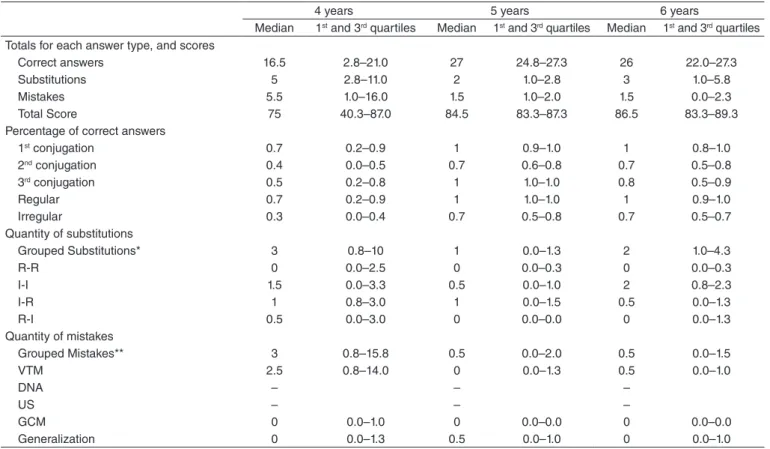
Firstly we present the statistical descriptive data for the 4, 5 and 6-year-old individuals undergoing NLD in Table 1, with median values and intervals between the 1st and the 3rd quartiles.
The results indicate that individuals in different age ranges differed in the quantity of correct answers (p=0.000) and to the overall test score (p=0.044) but not in relation to the quantity of substitutions and mistakes. The post hoc analyses indicate that only the 4-year-old individuals differed from the rest, both in correct answers as well as intotal score, as visualized in Graph 1.
The participants in all age ranges differed in relation to all categories of correct answers (p=0.004 for irst-conjugation verbs, p=0.000 for second- conjugation verbs, p=0.001 for third-conjugation verbs, p=0.001 for regular verbs, and p=0.000 for irregular verbs). The 4-year-old individuals had less correct answers than the other participants in all categories. Concerning third- conjugation verbs, however, we found differences among individuals in all age ranges, with an atypical pattern: 4<6<5. These data are displayed in Graph 2.
There were no differences concerning the frequency of substitutions based on age: R-R (H=0.80, gl=2, p=0.664), I-I (H=4.75, gl=2, p=0.093) and I-R(H=2.54, gl=2, p=0.128). In our subsequent analysis, we grouped the substitution categories in which conjugation complexity was not decreased, with the pur-pose of verifying potential differences among the age ranges. Based on these groupings, we did not ind any differences in the quantity of this type of substitution by age either (H=4.89, gl=2, p=0.082). In order to analyze the I-R substitutions, we set up two types of grouping; in the irst, the individuals who did not present any occurrences of substitutions were separated from those who presented at least one occurrence. The χ2test
indicated that there was no statistically signiicant associations between the occurrence of I-R and each group (χ2=2.1, gl=2,
p=0.35). After this, we arranged a second grouping using a new separation criteria; the individuals who presented up to one I-R occurence were separated from those who presented more than one occurrence. Once again the χ2test did not indicate any
association between these variables (χ2=1.36, gl=2, p=0.506).
The individuals in all age ranges differed only in relation to VTM mistakes (H=3.13, gl=2, p=0.044). The post hoc analyses indicated that the 4-year-old participants presented more VTM mistakes than the others, as displayed in Graph 3.
In the subsequent analysis, VTM mistakes, DNA, US, and GCM were grouped with the purpose of verifying potential differences among the groups. In this analysis, generalization mistakes were not included in the grouping. The results indi-cate that there was no difference concerning the quantity of mistakes grouped (VTM, US, DNA and GCM) based on the individuals’ age (H=4.77, gl=2, p=0.091).
who did not present any occurrences of this mistake were sep-arated from those who presented at least one occurrence. The χ2test indicated that there was no statistically signiicant
asso-ciations between the occurrence of generalizations and each group (χ2=0.83, gl=2, p=0.659). After this, we arranged a
sec-ond grouping using a new separation criteria; the individuals who presented up to one generalization occurence were sep-arated from those who presented more than one occurrence. Once again the χ2test did not indicate any association between
these variables (χ2=0.58, gl=2, p=0.749).
Considering that the group of 4-year-old individuals was the only one that differentiated itself from the others, we con-ducted nonparametric tests with paired samples in order to verify any differences concerning the types of correct answers. The results showed a larger quantity of correct answers for regular verbs than for irregular verbs (p=0.008) and signiicant differ-ences regarding the quantity of correct answers for each con-jugation (χ2=10.52, gl=2, p=0.005). Our analyses indicated a
larger quantity of correct answers for irst-conjugation verbs than for second-conjugation verbs (p=0.007), but there were no Table 1. Performance of the individuals undergoing normal language development in tasks of past-tense verb conjugation, by age
4 years 5 years 6 years
Median 1st and 3rd quartiles Median 1st and 3rd quartiles Median 1st and 3rd quartiles Totals for each answer type, and scores
Correct answers 16.5 2.8–21.0 27 24.8–27.3 26 22.0–27.3
Substitutions 5 2.8–11.0 2 1.0–2.8 3 1.0–5.8
Mistakes 5.5 1.0–16.0 1.5 1.0–2.0 1.5 0.0–2.3
Total Score 75 40.3–87.0 84.5 83.3–87.3 86.5 83.3–89.3
Percentage of correct answers
1st conjugation 0.7 0.2–0.9 1 0.9–1.0 1 0.8–1.0
2nd conjugation 0.4 0.0–0.5 0.7 0.6–0.8 0.7 0.5–0.8
3rd conjugation 0.5 0.2–0.8 1 1.0–1.0 0.8 0.5–0.9
Regular 0.7 0.2–0.9 1 1.0–1.0 1 0.9–1.0
Irregular 0.3 0.0–0.4 0.7 0.5–0.8 0.7 0.5–0.7
Quantity of substitutions
Grouped Substitutions* 3 0.8–10 1 0.0–1.3 2 1.0–4.3
R-R 0 0.0–2.5 0 0.0–0.3 0 0.0–0.3
I-I 1.5 0.0–3.3 0.5 0.0–1.0 2 0.8–2.3
I-R 1 0.8–3.0 1 0.0–1.5 0.5 0.0–1.3
R-I 0.5 0.0–3.0 0 0.0–0.0 0 0.0–1.3
Quantity of mistakes
Grouped Mistakes** 3 0.8–15.8 0.5 0.0–2.0 0.5 0.0–1.5
VTM 2.5 0.8–14.0 0 0.0–1.3 0.5 0.0–1.0
DNA – – –
US – – –
GCM 0 0.0–1.0 0 0.0–0.0 0 0.0–0.0
Generalization 0 0.0–1.3 0.5 0.0–1.0 0 0.0–1.0
*Total sum of R-R, I-I, R-I; **total sum of VTM, DNA, US and GCM
Caption: R-R = regular to regular; I-I = irregular to irregular; I-R = irregular to regular; R-I = regular to irregular; VTM = verb tense modification; DNA = did not answer; US = unintelligible segment; GCM = grammatical category modification
100 %
80
60
40
20
0
Correct answers
Aubstitutions Mistakes Total score of the age ranges
*
*
4 years 5 years 6 years
*Significant value p<0.05
Graph 1. Correct answers, substitutions, mistakes and total score of the age ranges
100 %
80
60
40
20
0
1st conj. 2nd conj. 3rd conj. Regular Irregular *
*
* *
* *
*
4 years 5 years 6 years
*Significant value p<0.017
Caption: conj. = conjugation
differences between the irst and the third conjugations (p=0.340) or between the second and the third conjugations (p=0.033).
DISCUSSION
We veriied signiicant differences between the group with 4-year-old individuals and the other groups in regards to correct answers and total scores. The 4-year-old participants had poorer performances in comparison to the other groups. The groups with 5 and 6-year-old individuals did not differ in relation to either of these variables. According to the international literature, it is between the third and the fourth year of their lives that children improve the use of verb conjugations(5). Studies conducted with
BP-speaking children point out that improvements in the use of verbs occur between the second and the fourth year of life. In this sense, the indings of the present study, which indicate that 4-year-old individuals achieve a smaller number of correct answers when conjugating verbs in the past tense than the 5-year-olds, corrob-orate international and national indings that these children are still improving verb use in their productions at 4 years of age.
Upon observation of the mistakes made by the 4-year-old individuals, we found that the occurrence of verb tense modiica-tion was the mistake that differentiated the groups. Before using verb tense conjugations that differentiate one form from the other, these children utilized the present tense with marked frequency(19).
In this study, the groups with 5 and 6-year-old participants did not differ from one another, and both presented a high rate of correct answers, thus indicating that children dominate the ability to conjugate verbs in the past tense from their ifth year of life. This result conirms the indings presented in a research study with BP speakers in which 5 and 6-year-old children showed that they mastered the several functions that a verb can have(16).
The groups with individuals in the speciied age ranges dif-fered in all categories of correct answers, namely regular and irregular verbs, and irst, second and third-conjugation verbs. In all these categories, the 4-year-old individuals presented less correct answers than the other participants.
The fact that all categories were different for the 4-year age range may be simply relecting the result discussed previously, namely that 4-year-old individuals have poorer performances than their 5 and 6-year-old peers, regardless of verb type.
Third-conjugation verbs were an exception among the results presented as they showed an atypical pattern, namely the lack of improvement in performance as the children get older. In this category, the 4-year-old individuals had poorer performances than the other groups, as expected, but the individuals in the group with 6-year-olds had poorer performances than those presented by the 5-year-old.
With the exception of third-conjugation verbs, the results obtained show that 4-year-old individuals are the ones who dif-fer from the other age ranges because they have not yet mas-tered the ability to conjugate all verb types.
To analyze the data concerning verb substitution, we grouped pertinent subsitutions that did not decrease conjugation com-plexity, that is, substitutions of verbs in the same category (R-R and I-I) and R-I substitutions. I-R substitutions were not included in this group because although the inal sentence was correct, choosing a regular verb to replace an irregular verb might indicate that the child has not yet mastered the conjuga-tion of irregular verbs and prefers to use regular verbs instead. Upon analyzing the group of pertinent substitutions without decrease in conjugation complexity, we did not ind signiicant differences based on the participants’ age.
The analysis of I-R substitutions also showed that there was no signiicant statistical association between their occur-rence and age.
These data refute the hypothesis initially formulated for this study. We expected that I-R substitutions would be more frequent in the 4-year age range and that the occurence of this type of substitution would disappear between 5 and 6 years of age, thus indicating mastery of this ability(16). Considering
that we have not yet observed the full ability to use verbs in the productions of children at 4 years of age, we expected that the 4-year-olds would present a smaller percentage of correct answers for irregular verbs, as the rules to conjugate these verbs are acquired later(5,8). Therefore, in the 4-year
age range, correct answers should be less frequent owing to a larger number of mistakes made by generalizing the rules of conjugation.
For the analysis of the data referring to mistakes made to conjugate verbs in the past tense, we arranged groupings of VTM mistakes, DNA, US and GCM. Generalization mistakes were not included because although the conjugations were incor-rect, the children were able to formulate the general principle of the rules of conjugation in the past tense. There were no dif-ferences between the quantity of mistakes grouped and age, and no association between age and generalization mistakes.
The fact that the generalization mistakes did not differ according to the age ranges might indicate that the 4-year-old individuals are no longer in the initial stages of acquiring past-tense morphology, considering that, according to a recent research study conducted with English speakers, generaliza-tion mistakes are frequent in the irst producgeneraliza-tion of verbs con-jugated in the past tense(13).
As in the case of the substitutions, we expected that gen-eralization mistakes would be more marked in the group with 4-year-olds, and that this type of mistake would disappear as the individuals’ ages progressed.
3.0
2.5
2.0
1.5
1.0
0.5
0.0
VTM DNA US GCM Gen
*
4 years 5 years 6 years
*Significant value p<0.05
Caption: VTM = verb tense modification; DNA = did not answer; US = unintelligible segment; GCM = grammatical category modification; Gen = generalization
Although the mistakes and substitutions did not characterize the performance of the 4-year-old group, the intragroup analyses indicated that individualsin this age range obtain more correct answers when using regular verbs than irregular verbs. This, in turn, is in agreement with the theory of the gradual evolution of the ability to conjugate verbs in the past, in which the tra-jectory of the complete mastery of this ability spans from the irst conjugation up to the identiication of a pattern that can be applied to new situations(8). In this course, irregular verbs
are subject to conjugation mistakes more frequently, given that the conjugation of irregular verbs depends on an individual’s exposure to a given verb(20); these mistakes function as
predic-tors of the stage of verb conjugation acquisition(10).
Another inding regarding the group with 4-year-olds is that the highest rate of correct answers was obtained with irst-conjugation verbs. The literature available on verbs and verb conjugations does not provide any information about different verb conjuga-tions in the process of verb conjugation acquisition or about the frequency of all conjugations in BP or another language.
Therefore, a study conducted with 3-year-old children could provide interesting information on this matter, given that we veriied in this study that 4-year-olds have not yet mastered the ability to conjugate verbs in the past tense, but the mistakes and substitutions that would supposedly indicate the process of acquisition of this ability were not suficient to enable a study of the acquisition process of verb conjugation based on these mistakes. In children younger than 3 years of age, the detec-tion of these mistakes could provide important informadetec-tion to be used in studies on past-tense verb conjugations.
Another aspect to be highlighted, concerns the contribution of our ingings to language diagnoses, especially in young chil-dren, as the parameters presented here could aid in diagnoses and precise rehabilitation therapy of this ability, thus illing possible gaps in the process of language assessment.
Obviously, as the purpose of the present study was not to establish development parameters but to analyze the performance of BP-speaking children undergoing NLD in tasks of past-tense conjugation and to gather data referring to the normality of this ability without the intention of creating or elaborating a test, we did not adopt psychometric criteria. Nevertheless, our indings can serve as the basis for future studies that have the purpose of constructing and validating standardized tests.
CONCLUSION
The purpose of the present study was to analyze the per-formance of BP-speaking children undergoing NLD in tasks of past-tense verb conjugation. We veriied that the 4-year-old individuals had poorer performances than the 5 and 6-year-olds, as they are still improving the use of verbs in their productions. At 4 years of age, the individuals presented more mistakes of verb tense modiication and obtained more correct answers with conjugating regular irst-conjugation verbs than irregular verbs. At 5 and 6 years of age, the individuals did not show any dif-ferences in performance and had high rates of correct answers, indicating that children master the ability to conjugate verbs in the past tense from their ifth year of life.
*TIML is the author of the dissertation from which this article originated, also responsible for data collection, tabulation and analysis, and overall elaboration of the paper; DMBL contributed in project elaboration and supervised the aforementioned dissertation and article elaboration.
REFERENCES
1. Pawloska M, Leonard LB, Camarata SM, Brown B, Camarata MN. Factors accounting for the ability of children with SLI to learn agreement morphemes in intervention. J Child Lang. 2008; 35(1):25-53.
2. McClelland JL, Patterson K. Rules or connections in past-tense inflections: what does the evidence rule out? Trends Cogn Sci. 2002;6(11):465-72.
3. Watt N, Wetherby A, Shumway S. Prelinguistic predictors of language outcome at 3 years of age. J Speech Lang Hear Res. 2006;49(6):1224-37.
4. Akhtar N. Acquiring basic word order: evidence for data-driven learning of syntactic structure. J Child Lang. 1999;26(2):339-56. 5. Tomasello M. Do young children have adult syntactic competence?
Cognition. 2000;74(3):209-53.
6. Hadley PA, Rispoli M, Fitzgerald C, Bahnsen A. Predictors of morfphosyntactic growth in typically development toddlers: contributions of parent input and child sex. J Lang Speech Lang Hear Res. 2011;54(2):549-66.
7. Rispoli M, Hadley PA, Holt J. The growth of tense productivity. J Lang Speech Lang Hear Res. 2009;52(4):930-44.
8. Bishop DVM. Grammatical knowledge in sentence comprehension. In: Bishop DVM. Uncommon understanding: development and disorders of language comprehension in children. Hove, UK: Psychology Press; 1997. p.115-49.
9. Pinker S. The infinite library. In: Pinker S. Word and rules: the ingredients of language. New York: Harper Perennial; 1999. p. 1-20. 10. Kidd E, Jarrad AGL. Sex differences in pat tense overregulation.
Dev Science. 2008;11(6):882-9.
11. Pinker S, Ullman MT. The past and future of past tense. Trends Cogn Sci. 2002;11(6):456-63.
12. Bassano D, Laaha S, Maillochon I, Dressler W. Early acquisition of verb grammar and lexical development: evidence from periphrastic constructions in French and Austrian German. First Lang. 2004;24(1):33-70.
13. Marcus GF, Pinker S, Ullman M, Hollander M, Rosen TJ, Xu F. Overregularization in language acquisition. Monogr Soc Res Child Dev. 1992;57(4):34-69.
14. B a r b o s a J B . O u s o d o s ve r b o s n o d e s e nvo l v i m e n t o d a linguagemReVEL. 2005;3(5):1-18.
15. Befi-Lopes DM, Cárceres AM. Análise da diversidade de verbos enunciados na fala espontânea de pré-escolares brasileiros. Pró-Fono R Atual Cient. 2010;22(1):3-6.
16. A r a u j o K . D e s e m p e n h o g r a m a t i c a l e m c r i a n ç a s c o m desenvolvimento normal de linguagem e com distúrbio específico de linguagem [tese]. São Paulo: Faculdade de Medicina, Universidade de São Paulo; 2007.
17. Wertzner HF. Fonologia (Parte A). In: Andrade CRF, Befi-Lopes DM, Fernandes FDM, Wertzner HF, orgs. ABFW – Teste de Linguagem Infantil nas áreas de fonologia, vocabulário, fluência e pragmática. 2ª edição. Barueri: Pró-Fono; 2004.
18. Befi-Lopes DM. Vocabulário (Parte B). Andrade CRF, Befi-Lopes DM, Fernandes FDM, Wertzner HF, orgs. ABFW – Teste de Linguagem Infantil nas áreas de fonologia, vocabulário, fluência e pragmática. 2ª edição. Barueri: Pró-Fono; 2004.
19. Grienstead J. Case, inflection and subject licensing in child Catalan and Spanish. J Child Lang. 2000;27(1):119-55.
Appendix 1. Protocol for registering the individuals’ answers
PROTOCOLO DE REGISTRO – MARCAÇÃO DE TEMPO VERBAL
Nome:
D.N.: Data da Avaliação:
1. O menino está abraçando sua mãe. Ele a abraça todos os dias quando acorda. Ontem ele _____________ (abraçou) sua mãe. 2. A mulher está lavando a roupa. Ela lava a roupa todos os dias. Ontem ela _____________ (lavou) as roupas.
3. O menino está tendo aula na escola. Ele tem aula na escola todos os dias. Ontem ele _____________ (teve) aula na escola. 4. A moça está comprando pão. Ela compra pão todas as manhãs. Ontem ela _____________ (comprou) pão.
5. O homem está vendendo balas. Ele vende balas todos os dias. Ontem ele _____________ (vendeu) balas.
6. A mãe está trazendo lores para casa. Ela trás lores para casa todos os dias. Ontem ela _____________ (trouxe) lores para casa. 7. O bebê está dormindo no berço. Ele dorme no berço todos os dias. Ontem ele _____________ (dormiu) no berço.
8. O menino está brincando com a bola. Ele brinca com a bola todos os dias. Ontem ele _____________ (brincou) com a bola. 9. A menina está comendo pão. Ela come pão todos os dias no café da manhã. Ontem ela _____________ (comeu) pão. 10. O menino está pondo os brinquedos na caixa. Ele põe os brinquedos na caixa todos os dias. Ontem ele _____________ _ (pôs)
os brinquedos na caixa.
11. O garoto está correndo no jardim. Todos os dias ele corre no jardim. Ontem ele _____________ (correu) no jardim. 12. O homem está tomando banho. Ele toma banho todos os dias. Ontem ele _____________ (tomou) banho.
13. A mulher está dançando no salão. Todas as noites ela dança no salão. Ontem ela _____________ (dançou) no salão. 14. O menino está rezando. Ele reza todas as noites antes de dormir. Ontem ele _____________ (rezou) antes de dormir. 15. O garoto está querendo biscoito. Ele quer biscoito todos os dias. Ontem ele _____________ (quis) biscoito.
16. O garoto está subindo a escada. Ele sobe a escada todos os dias. Ontem ele _____________ (subiu) a escada.
17. A menina está arrumando o quarto. Ela arruma o quarto todos os dias. Ontem ela _____________ (arrumou) o quarto. 18. O garoto está sendo malvado com o irmão. Ele é malvado com ele todos os dias. Ontem ele _____________ (foi) malvado com ele. 19. A mulher está limpando o chão. Ela limpa o chão todos os dias. Ontem ela _____________ (limpou) o chão.
20. A criança está escovando os dentes. Ela escova os dentes todos os dias quando acorda. Ontem ela _____________ (escovou) os dentes. 21. O menino está indo para a escola. Ele vai para a escola todos os dias. Ontem ele _____________ (foi) para a escola. 22. A moça está cantando uma música. Ela canta todos os dias. Ontem ela _____________ (cantou) uma música. 23. A mamãe está fazendo comida. Ela faz comida todos os dias. Ontem ela _____________ (fez) comida.
24. A menina está beijando seu pai. Ela beija o pai todas as noites antes de dormir. Ontem ela _____________ (beijou) o pai. 25. A menina está vindo para casa. Ela vem para casa todos os dias. Ontem ela _____________ (veio) para casa.