AR
TIGO
AR
TICLE
1Escola Nacional de Saúde Pública, Fiocruz. Av. Brasil 4036/913, Manguinhos. 21040-361 Rio de Janeiro RJ Brasil.
Nonbioequivalent prescription drug interchangeability,
concerns on patient safety and drug market dynamics in Brazil
Intercambialidade de medicamentos não-bioequivalentes,
segurança do paciente e dinâmica do mercado farmacêutico
no Brasil
Resumo A partir da vigência da lei dos genéricos (1999), três tipos de produtos farmaceuticamente equivalentes são comercializados no Brasil: o me-dicamento inovador de refência (REF), o produto “similar” (S), e o genérico (G). O similar (nome de fantasia) e o genérico (nome genérico) tomam de empréstimo do REF (nome de fantasia) os da-dos clínicos de segurança e eficácia e a posologia. G (mas não S) é bioequivalente ao, e intercambiável com REF. Desde 2003, a Agência Nacional de Vi-gilância Sanitária (Anvisa) exige dados de testes de biodisponibilidade relativa para registrar (ou renovar o registro de) medicamentos S. Em 2014, a Anvisa estendeu o conceito de intercambialidade aos medicamentos similares com biodisponibili-dade “comparável”, i.e., um medicamento similar “equivalente” (EQ). Medicamentos para doenças crônicas e “fármacos de dose crítica” estão lista-dos entre os produtos EQ aprovalista-dos. A intercam-bialidade de medicamentos não-bioequivalentes suscita grande preocupação quanto a falhas tera-pêuticas e eventos adversos. Os receios são ainda maiores se os pacientes trocam um medicamento por outro durante o tratamento de doenças como epilepsia, insuficiência cardíaca, hipertensão, dia-betes e/ou os produtos farmacêuticos substituídos tem um índice terapêutico estreito.
Palavras-chave Medicamentos genéricos,
Pro-dutos farmacêuticos, Equivalência terapêutica, Legislação
Abstract Since the enforcement of Generics Act (1999), three types of pharmaceutically equiv-alent products are marketed in Brazil: innova-tive reference (REF), “similar” (S) and generic (G) drugs. The S (brand name) and G (generic name) borrow from REF (brand name) clinical data on safety and efficacy and dosage regimen. G (but not S) is bioequivalent to and interchange-able with REF. Starting in 2003, Brazilian San-itary Surveillance Agency (Anvisa) has required data on relative bioavailability tests (with REF) to approve (or renew registration of) S drugs. In 2014, Anvisa extended interchangeability notion to similar drugs with a “comparable” bioavail-ability, i.e., an “equivalent” similar drug (EQ). Drugs for chronic diseases and “critical dose med-icines” are listed among the EQ drugs approved. Interchangeability of nonbioequivalent medicines raises deep concerns regarding therapeutic failures and adverse events. Concerns are even more wor-risome if patients switch from one drug to another during an ongoing treatment for illnesses such as epilepsy, congestive heart failure, hypertension, diabetes and/or substitutable drugs have a narrow therapeutic index.
Key words Generics, Drugs, Therapeutic equiva-lence, Legislation
Francisco José Roma Paumgartten 1
P
aumg
ar
tt
en FJR,
O
li
ve
Introduction
In Brazil, patients often find on the pharmacy shelves four distinct types of products containing the same active ingredient of the medicine spec-ified on their prescription. That is, a “reference” drug identified by a brand name, its “similar” and “equivalent” drugs (identified by brand names as well) and the corresponding generic drugs (la-belled by the active ingredient generic name). The packing of “generic” drugs bears a yellow band with the “G” symbol. All “equivalent” drugs are listed on the list of interchangeable similar drugs published (and periodically updated) by the Brazilian Sanitary Surveillance Agency (Anvi-sa), and their package insert information contain a statement saying that they are equivalent to a
reference medicine (“Similar drug equivalent to
the reference drug”)1.If patients have a valid
pre-scription for a reference drug, pharmacists may offer them the generic (G) and/or equivalent (EQ) medicines that can substitute the one spec-ified on the prescription. Nonetheless, if doctors specified either a G or an EQ drug on the pre-scription, pharmacists should warn patients that these drugs can only be substituted by the corre-sponding reference medications. In other words, while a reference medicine can be replaced with
either its G or EQ drugs, and vice versa, G and
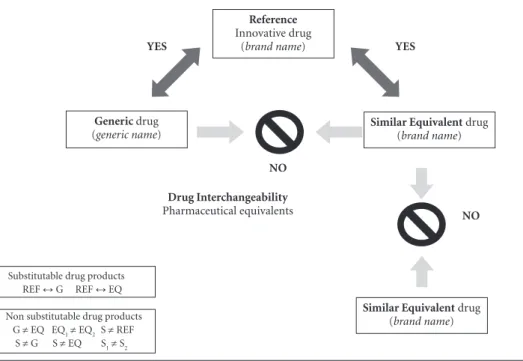
EQ products are not interchangeable with each other. Figure 1 shows a diagram illustrating the Brazilian rules for pharmaceutical interchange-ability or substitutinterchange-ability.
The scientific rationale behind the forego-ing rules for pharmaceutical interchangeability resides on two distinct yet closely related phar-macokinetic notions, bioequivalence and relative bioavailability.
In this article, we examined the Brazil’s cur-rent regulation for prescription drug substitut-ability in light of the concepts of drug bioavail-ability, relative bioavailability and bioequiva-lence. Addressing this topic, we highlighted the risks posed by making nonbioequivalent phar-maceutical products interchangeable, particular-ly when drugs have a narrow therapeutic index and are prescribed for chronic medical condi-tions such as convulsive disorders, congestive heart failure, cancer and others.
Methods
This article describes, explains and critically appraises the rules for prescription drug
inter-changeability or substitutability introduced by the Brazilian Sanitary Surveillance authority (Anvisa). The authors, at the outset, undertook a thorough literature search to identify references relevant to the drug regulation topic addressed in the paper. Biomedical literature electronic databases (Medline/Pubmed, BVS Brazil/Bi-reme (http://www.brasil.bvs.br) and the Virtual Library on Health of the Brazilian Ministry of Health (BVS MS, www.bvsms.saude.gov.br/in-dex.php) were searched covering a time windown between the inception of the database and Sept 25, 2016. Depending on the database, the search was conducted using a variety of searching terms in English (e.g., “generics AND bioequivalence”, “generics AND interchangeability”, “generics substitution”, “generics legislation”, drug inter-cangeability”, “guidance and bioequivalence”, ”drug switchability” and others) and/or corre-sponding terms in Portuguese (BVS-MS, BVS Brazil/Bireme). Moreover, authors went over an updated version (updated on Sept 19, 2016) of a Brazilian Sanitary Surveillance Agency (Anvisa)’s compilation of legislation on health products to identify all regulations and laws applicable to this
drug regulatory topic2. The literature search was
aimed to select documents and articles relevant
to address questions such as “What are the
cur-rent Brazilian rules for drug interchangeability or substitutability of prescription drugs at the phar-macies?”, “Is there a scientific rationale for making drug products with ‘comparable’ bioavailability, although not being proven bioequivalent products, interchangeable with each other?”, “Are the con-cerns regarding generic drug substitution justified?”
phar-aúd
e C
ole
tiv
a,
22(8):2549-2558,
2017
maceutically equivalent product, when the phar-macist dispenses it without prior authorization of the initial prescriber. The corresponding adjec-tives in Portuguese (intercambiável, substituível, e.g. “Dicionário Houaiss da língua portuguesa”) convey essentially the same meaning (capable of being exchanged or that are replaceable with each other) and are more often than not employed as synonyms. Throughout this article, the English terms drug interchangeability (interchangeable) and drug substitutability (substitutable) are used to express the same concept.
Results and discussion
Bioavailability, relative bioavailability and bioequivalence
Drug bioavailability – or absolute bioavail-ability – refers to the fraction of an adminis-tered dose of a drug (unchanged) that reaches the intravascular compartment, i.e., the systemic
circulation. If a drug is injected directly into the intravascular compartment (e.g., by intravenous
injection, iv), the absorption phase and a
possi-ble pre-systemic clearance are circumvented so
that it is fair to assume that after iv
administra-tion the drug bioavailability is 100%. Owing to incomplete absorption and first-pass metabolism – which depend on a number of variables, and may vary from patient to patient – bioavailabil-ity after administration by extravascular routes, including the oral route - is generally less than 100%. The term bioavailability may also refer to a measurement of the rate and degree to which a pharmacologically active compound reaches its site of action in the organism. The absolute bioavailability is determined by comparing the area under the plasma concentration versus time curve (AUC) of a drug after application by one extravascular route (usually the oral route) with
the AUC obtained after iv injection of the same
molar dose3,4. That is, for oral administration of
drug “D” the bioavailability or fraction absorbed (F) is:
Figure 1. The Brazilian rules for pharmaceutical interchangeability or substitutability. Innovative reference drugs
(REF) are interchangeable with either a proven bioequivalent generic drug (G) or a similar equivalent drug (EQ) with a “comparable” bioavailability. G and EQ drugs, however, are not interchangeable with each other, nor are interchangeable two EQ products or two similar (S) drugs containing the same active compound. REF, S, G and EQ are pharmaceutically equivalent products, yet not necessarily bioequivalent or therapeutically equivalent drug products. ↔ : drugs substitutable for each other; ≠: drugs non substitutable for each other.
Substitutable drug products REF ↔ G REF ↔ EQ
Non substitutable drug products G ≠ EQ EQ1≠ EQ2 S ≠ REF
S ≠ G S ≠ EQ S1≠ S2
Generic drug
(generic name)
YES
Similar Equivalent drug
(brand name)
Reference
Innovative drug (brand name)
Similar Equivalent drug
(brand name)
Drug Interchangeability
Pharmaceutical equivalents
YES
NO
P
aumg
ar
tt
en FJR,
O
li
ve
F (D) = AUC 0-∞(D) oral / AUC0-∞ (D) iv
If the oral AUC is equal to the iv AUC (i.e., F
= 1) it is fair to assume that the drug is complete-ly absorbed after oral administration. In most cases, however, F < 1.
Likewise absolute bioavailability (F), relative bioavailability is also a ratio of AUCs. In the lat-ter case, however, it is the ratio of AUC for one formulation of the active compound to the AUC calculated for a distinct formulation of the com-pound, provided AUCs were obtained for the same molar dose of a drug given through the same route of administration. That is, “relative bioavailability” refers to a ratio of bioavailability (AUCs) between two distinct products contain-ing the same active contain-ingredient, such as a compar-ison of bioavailability between two similar med-icines, or between a “reference” drug and one of
its “similar” drugs3,4.
If the bioavailability (i.e., the rate and extent of availability) of an active ingredient common to two distinct pharmaceutical products is near-ly the same, whenever the drugs are given in the same molar dose and through the same route of administration (e.g., oral route), the two drug products are considered as being bioequivalent. It is expected that two bioequivalent drug
for-mulations have comparable in vivo performances
and, therefore, share a common optimized dose regimen and an identical clinical efficacy and
safety profile5,6.
Reference, similar, similar equivalent and generic drugs
A reference innovative drug contains at least one pharmacologically active ingredient that is, or was, under patent by a research & develop-ment pharmaceutical company. To achieve an innovative drug marketing approval, sponsors have to provide data from a comprehensive set of nonclinical and clinical studies demonstrating that it is effective and safe for the proposed ther-apeutic indications. The optimized dosage regi-men for the reference drug (informed in package inserts to guide prescribers and patients) relies on the empiric evidence arising from clinical tri-als conducted by the pharmaceutical company. The manufacturer’s proposal on the usual dosage regimen and dose adjustments is part of a new drug application for marketing authorization.
A similar drug (S) is a product pharmaceuti-cally equivalent to an innovative reference drug. Drugs are pharmaceutical equivalents if they
contain the same active ingredient, are of the same dosage form (e.g., tablet, capsule, solution,
ointment, cream, etc), are equal in strength or
concentration (i.e., have a same amount of active ingredient in the dosage form, or dose unit) and are given by the same route of administration. Although being pharmaceutical equivalents, similar and reference innovative drugs are not proven bioequivalent products. Notwithstanding this fact, a similar drug borrows from its refer-ence innovative drug the non-clinical and clinical demonstration of efficacy and safety and the rec-ommended dosage regimen.
Until 2003, there was virtually no informa-tion on the bioavailability of most similar drugs marketed in the country. Prescribers were then unaware of the degree to which bioavailability of similar drugs deviated from that of the refer-ence drug previously tested in clinical trials. The Resolutions RDC n. 133 and RDC n.134, issued by the Brazilian Sanitary Surveillance Agency (Anvisa) on May 29, 2003, however, introduced a set of more stringent criteria for registration of similar drugs among which a requirement
for data on relative bioavailability tests (i.e., the
similar medicine tested against the reference
product)7,8. In 2014, Anvisa issued a regulation
(RDC 58/2014, Art. 2) stating that similar drug products are potentially interchangeable with a reference medicine, pending the analysis by the agency of results of pharmaceutical equivalence and relative bioavailability/bioequivalence stud-ies, or if sponsors demonstrate that they are to be classified among those types of drugs that are
exempted from these studies1. Still according to
RDC 58/2014, package insert of interchangeable similar drugs (EQ) shall contain information on the interchangeability. Moreover, RDC 58/2014 says that Anvisa is committed to updating a list of interchangeable similar drug products and
re-spective reference drugs on its website1.
The Technical Regulation for Similar Drugs
(RDC 133/2003) allows the sponsor to alter the formulation of a similar drug to make its
kinet-ic parameters (Cmax, AUC, and Tmax) compatible
with those of the reference drug7. If sponsors
aúd
e C
ole
tiv
a,
22(8):2549-2558,
2017
Some changes in a similar drug formulation and manufacturing process other than a mere alteration in the concentration of the active in-gredient, such as modifying excipients and phar-maco-technical properties (thickness, hardness, friability, disintegration, drug particle size, and others), can make it bioequivalent to another pharmaceutical product. Nonetheless, if AUC - and/or other kinetic parameters – of similar and reference drugs become comparable at expenses of changes in the active ingredient concentration or drug unit, similar and corresponding refer-ence drugs cannot be considered as bioequiva-lent drug products. Moreover, if concentration of a similar drug dosage form (dose unit) is altered, the similar and its corresponding reference drug would no longer be pharmaceutical equivalent products.
A generic drug is by definition (Federal Act
9.787/1999) a pharmaceutical product “..similar
to a reference or innovative product, which intends to be interchangeable with it, generally produced after the expiration or waiver of the patent protec-tion or of any other rights of exclusiveness, upon verification of its effectiveness, safety and quality, and designated by the CBD (Common Brazil-ian Denomination) or, in its absence, by the INN (International Nonproprietary Name)”. Except for types of drugs exempt from bioequivalence study, and some particular cases for which
phar-maceutical equivalence tests may replace in vivo
bioequivalence assays, the demonstration that a generic drug is in fact interchangeable with the corresponding reference drug product requires
a clinical bioequivalence study9. In other words,
G and the corresponding reference drug are not only pharmaceutically equivalent but also ther-apeutically equivalent products for which one could expect a same optimized dosage regimen, efficacy and safety.
Logical inference chain is not applicable to drug interchangeability rules
A logical inference chain would say; if A is equal to B and B is equal to C, then C is equal to A. As shown in Figure 1 diagram, a logical in-ference chain does not hold true for drug inter-changeability rules adopted in Brazil. The reason why a logical inference chain is not applicable to drug substitutability rules is because G, EQ and the corresponding reference drug are not identi-cal pharmaceutiidenti-cal products regarding rate and extent of bioavailability, even if they are consid-ered as therapeutically comparable (REF vs EQ)
or sufficiently bioequivalent (REF vs G) to a same reference drug product.
It is of note that a bioequivalence assay is typ-ically a two-treatment crossover study design in-volving a limited number of adult volunteers (24 to 36) who receive single oral doses of a test drug
and its reference product4,6,10. The kinetic
param-eters related to the extent (i.e., AUC0-t up to the
last measure, and AUC0-∞ extrapolated to
infini-ty) and the rate (Cmax andTmax) of bioavailability
are determined for both drug products.
Accord-ing to Anvisa’s Guide for drug relative
bioavail-ability/bioequivalence tests (RE no 1170/2006)10
two pharmaceutical products are bioequivalent if the upper and lower limits of 90% Confidence Intervals (CIs) determined for geometric means
of AUCs ([AUC0-t -test drug] / [AUC0-t –REF])
and Cmax ([Cmax -test drug] / [Cmax –REF])
ra-tios are greater than 0.8 and smaller than 1.25. If
“time to peak concentration” (Tmax) is a clinically
relevant parameter for a particular medication,
eventual discrepancies in Tmax values should also
be considered before concluding that two drugs are bioequivalent. The foregoing bioequivalence criteria for registration of generic drugs in Brazil are consistent with international guidelines and criteria adopted in the US Food and Drug Ad-ministration (FDA), Canada (Health Canada), Europe (European Medicines Agency -EMA) and
Australia11,12.
The primary concern underpinning regula-tory rigorous criteria for drug bioequivalence is to ensure that patients are protected against ap-proval of generic products that are not bioequiv-alent and, consequently, not safely interchange-able with a reference drug. As aforementioned, the conclusion that two products are (or are not) bioequivalent stands on a statistical criterion, i.e., 90% CI for ratios of peak plasma concentrations
(Cmax) and plasma concentration-time curves
areas (AUC0-t) must lie entirely between 80 (0.8)
and 125% (1.25) boundaries. This calculation and numerical index provide an indication of the certainty of conclusions based on bioequiva-lence test results. It is of note that the width of the 90% CI reflects to some degree the within-sub-ject variability in the test and the product vari-ability. In principle, a test product that does not differ from the REF might eventually fail to pass bioequivalence study criteria if variability of one or both products is high and the study involves
a small number of volunteers (i.e., the test has
insufficient statistical power)4,6,10,12. It is also
P
aumg
ar
tt
en FJR,
O
li
ve
REF product exhibit large differences in the av-erage response of pharmacokinetic parameters. Notwithstanding these possibilities, one can say, taking into account the test design and statistical criteria, that there is no more than a 5% chance that an approved G drug is not truly bioequiva-lent to a REF drug product.
Nonetheless, as noted by Peterson13, the
cri-terion adopted for bioequivalence has been
mis-interpreted as implying that “bioavailability (Cmax
and AUCs) must be within the range of 80-125%
of the reference product”13,14.This
misinterpreta-tion may lead to unfounded concerns that inter-changeability between REF and G drugs might endanger patients’ health, a self-serving myth promoted by the so-called “innovative” pharma-ceutical industry. Actually, as demonstrated by
Birkett5, differences in C
max and AUC values of G
and REF drugs must generally be less than 10% to satisfy the 90% CI bioequivalence requirement. In practice, Birkett’s estimation is confirmed by a survey of 127 bioequivalence studies submitted to US FDA (applications approved in 1997) which revealed that the observed average differences (±
SD) between G and REF drugs in Cmax, AUC0-t,
and AUC0-∞ were ± 3.47% (± 2.84), ± 3.25% (±
2.97) and ± 4.29% (± 3.72), respectively15.
One of the reasons why a logical inference chain is by no means applicable to drug inter-changeability rules is because while G is suf-ficiently bioequivalent to REF, bioequivalence between EQ and REF remains unproven. None-theless, even if a bioequivalent test shows that EQ is bioequivalent to REF, one could not reach the conclusion (based on the statistical criteria for bioequivalence) that EQ is bioequivalent to G, unless one undertakes an additional test com-paring directly G against EQ. Moreover, tests (bioequivalence and relative bioavailability) and criteria that lead Anvisa to conclude that G is in-terchangeable with REF are distinct from those that indicate that bioavailability of EQ and REF are sufficiently “comparable” to make them inter-changeable with each other.
Risks of making non-bioequivalent drug products interchangeable
Notwithstanding the rigorous testing and regulatory criteria to assure bioequivalence, some physicians and patient organizations have questioned whether it would be safe to switch from a REF to a G drug (and vice versa) in the
case of medicines with a narrow therapeutic index (or critical dose medicines). This would hold particularly true for patients who are under treatment for chronic medical conditions such as epilepsy, hypertension, diabetes, congestive heart
failure, cancer, and others16-22. In principle,
rela-tively small variations in plasma concentrations of critical dose medicines, such as antiepileptic drugs (carbamazepine, phenytoin, gabapentin, lamotrigine, sodium valproate, and others), di-goxin, lithium, cyclosporine, warfarin, and oth-ers, may cause adverse effects or loss of efficacy. However, it is unclear whether there is in fact a significant risk from REF substitution with G drugs in all cases of critical dose medicines. For instance, although there are reports that substi-tution of anti-epileptic drugs in certain individ-uals may be problematic leading to breakthrough
seizures16-19, a systematic review by Yamada and
Welty23 reached the conclusion that the strongest
levels of evidence available suggested that G an-tiepileptic drug substitution was not problem-atic. Moreover, a number of studies, systematic reviews and meta-analyses do not lend to notion that switching from brandname to generic med-icines might result in loss or worsened control of
disease symptoms24-26.
Owing to the fact that EQ and REF drugs are not proven bioequivalent products, substitution of REF by EQ raises justifiable concerns regard-ing potential adverse health outcomes. Along this line, the main issue of concern regarding inter-changeability is not so much on the dosage reg-imen (which EQ borrowed from REF) of an ini-tial therapy to achieve the same health outcome, but, rather, on the eventual switching from one drug to another during an ongoing treatment for a chronic condition. In a patient individual ba-sis, variations in active ingredient plasma levels due to switching from one product to another may result in the disease control failure or drug adverse events. The extension of substitutability concept to nonbioequivalent EQ drugs
(intro-duced by Anvisa’s RDC 58/2014)1 not only
loos-ened safety standards for drug interchangeability but also, what is worse, overlooked the marked health risks posed by switching critical dose drug products which are not bioequivalent.
aúd
e C
ole
tiv
a,
22(8):2549-2558,
2017
Chart 2. Bioequivalence with innovative reference drug and other disctinctive characteristcs of prescription drugs
marketed in Brazil.
Drug product Innovative reference
drug (REF) Generic drug (G)
Similar equivalent
drug (EQ) Similar drug (S)
Labeling
Name Brand-name Generic name Brand-name Brand-name
Indication on the external packing
No Yellow band – G
symbol
No No
Efficacy and Safety (proof)
Nonclinical studies Required Not required Not required Not required
Clinical studies Required Not required Not required Not required
Interchangeability EQ, G REF, G REF Not
intercheangeable
Pharmacy sale prices Reference Cheaper
(at least 35% lower than REF)
No price limit No price limit
Pharmaceutical equivalence
Reference Pharmaceutical
equivalent
Pharmaceutical equivalent
Pharmaceutical equivalent Bioequivalence
(proof)
Reference Proven bioequivalent Not required Not required
“Comparable” bioavailability yet not proven bioequivalent
Reference Proven bioequivalent “Comparable”
bioavailability
Bioavailability parameters discrepancy *
* Based on the outcome of relative bioavailability tests, a dosage regimen adjustment may be required so that drug plasma levels are kept above the minimum therapeutic levels and below the maximum non-toxic levels (RDC 133/2003).
Chart 1. Pharmacologically active ingredients of similar equivalent drugs (EQ) for chronic medical conditions
(some of which are critical dose medicines) listed by ANVISA among those similar drugs interchangeable with brand-name reference drugs (REF). From a list updated on ANVISA website on August 31, 2016.
(http://portal.anvisa.gov.br/documents/33836/352782/Lista+de+medicamentos+similares+intercambi%C3%A1 veis/27d0f06c-5082-4a92-a667-08b4763a498f)
Drug therapeutic class Active ingredient
Anticoagulant drugs sodium warfarin
Antidepressant drugs amitriptyline, citalopram, venlafaxine, escitalopram,
lithium carbonate
Antidiabetic drugs metformin, pioglitazone, glimepriride
Antiepileptic / anticonvulsant drugs gabapentin, valproic acid, sodium valproate, phenytoin, carbamazepine, lamotrigine, topiramate, phenobarbital
Antihyperlipidemic drugs (statins) atorvastatin, rosuvastatin, simvastatin
Antihypertensive drugs
Angiotensin converting enzyme (ACE) inhibitors captopril, enalapril, ramipril
Angiotensin II receptor antagonists losartan, candesartan, valsartan, telmisartan, olmesartan, irbesartan
Antipsychotic drugs olanzapine, haloperidol, risperidone, clozapine,
chlorpromazine
Cardiac glycosides digoxin
Gout treatment colchicine
Oncologic drugs docetaxel, etoposide, imanitib, carboplatin, methotrexate,
P
aumg
ar
tt
en FJR,
O
li
ve
Changes in drug interchangeability rules, moving forward, backward and sideways
The so-called “similar” drugs are a uniqueness of Brazilian pharmaceutical market. According to the former Brazilian Patent Act promulgated on
December 21st, 1971 (Federal Act 5772/1971)27
drugs and pharmaceutical ingredients could not be patented in the country. Owing to this fact, the
basic sanitary surveillance law (Act 6360/1976)28
authorized registration and sales of drugs that shared with an innovative drug a same active ingredient, that is, “similar” drugs. Since 1996, a new patent law recognized patent rights over certain products and innovative ideas including drugs. In 1999, Brazil’s Congress passed the
Ge-neric drug Act (Act 9787/1999)9 amending the
Sanitary Surveillance Act (Act 6360/1976)28. The
Generics Act stated that all similar drugs and their innovative reference drugs must be labelled with brand names, while G drugs must be designated by their generic names, and be bioequivalent and therapeutically interchangeable with REF drugs.
As previously commented, RDC58/20141
made similar equivalent drugs (EQ), an unprov-en bioequivalunprov-ent product, interchangeable with REF drugs. Apparently, agency’s decision to loos-en safety standards for drug interchangeability aimed to increase the number of alternatives to innovative branded drugs thereby forcing down prices of prescription drugs. Initially, Brazilian health authorities (Ministry of Health and Direc-tor of Anvisa) announced that, likewise generics packing requirements, external packing of sim-ilar equivalent drugs would bear a yellow band and a large EQ symbol ensuring a prompt recog-nition by potential consumers, and in addition to that would have to be cheaper than the reference drug29,30. Facing a strong criticism by
pharmaceu-tical companies, health authorities stepped back
in relation to both requirements31,32. As
summa-rized in Chart 2 for the two types of drugs po-tentially interchangeable with a reference drug, G drugs have to be bioequivalent, identified by a generic name, and sold at lower prices, while EQ drugs are not proven bioequivalent drugs, and have brand names and no price limit. Celebrated by some politicians and authorities as a Colum-bus’ egg idea to lower prescription drug prices,
RDC 58/20141 was in fact a clumsy regulatory
intervention on the drug market that brought more confusion than clarity and certainly loos-ened country’s regulatory standards for patient safety protection. The long-term impact of RDC 58/2014 on the development of generics market and prescription drug-pricing dynamics in Bra-zil, however, remain largely unclear.
Concluding remarks
A major safety concern about the interchange-ability of medicines is whether or not, and the extent to which dosage regimens established with basis on clinical trials of an innovative drug are valid for a pharmaceutically equivalent yet dis-tinct formulation of the same active ingredient produced by another manufacturer.
Theoretically, even relatively small variations in drug bioavailability (rate and extent) and plas-ma levels arising from differences in product for-mulation and/or manufacturing process might lead to therapeutic failure or adverse events when a test drug borrows the dosage regimen from its innovative reference medicine. Along this line, one generally agrees upon that if a test drug and its reference drug are sufficiently bioequivalent products, they are potentially interchangeable medicines.
In Brazil, a new rule for drug
interchangeabil-ity introduced in 2014 (RDC 58/2014)1 extended
substitutability (adopted for generic drugs since 1999) to a novel category of pharmaceutical products, i.e., the so-called “similar equivalent” drugs for which therapeutic equivalence is ac-cepted based on “comparable” bioavailability de-termined in relative bioavailability tests.
aúd
e C
ole
tiv
a,
22(8):2549-2558,
2017
Collaborations
FJR Paumgartten and ACAX Oliveira jointly con-ceived the main ideas discussed in the article and are equally responsible for its conclusions. ACAX Oliveira and FJR Paumgartten reviewed the lit-erature and FJR Paumgartten elaborated a first draft of the manuscript. Both authors critically reviewed successive drafts of the paper and ap-proved the final version to be published.
References
1. Brasil. Ministério da Saúde (MS). Agência Nacional de Vigilância Sanitária - Anvisa. Resolution RDC 58/2014. Deals with agency’s requirements for deciding that a similar drug is interchangeable with its reference med-icine. [cited 2016 Sept 27]. Available at: http://bvsms. saude.gov.br/bvs/saudelegis/anvisa/2014/rdc0058 _10_10_2014.pdf
2. Brasil. Ministério da Saúde (MS). Agência Nacional de Vigilância Sanitária - Anvisa. Estoque Regulatório da Anvisa. [Consolidado_Estoque_Regulatório_Portal.xlsx - Excel; updated on Sept 19, 2016]. [cited 2016 Sept 27]. Available at: http://www.portal.anvisa.gov.br/legislacao 3. Midha KK, Gordon McKay G. Bioequivalence; Its
His-tory, Practice, and Future. AAPS J 2009; 11(4):664-670. 4. United States Food and Drug Administration (US
FDA). Guidance for Industry. Statistical Approaches to Establishing Bioequivalence. 2001. 48 p. [cited 2016 Sept 7]. Available at: http://www.fda.gov/downloads/ Drugs/.../Guidances/ucm070244.pdf
5. Birkett DJ. Generics – equal or not? Aust Prescr 2003; 26:85-87.
6. European Medicines Agency (EMA). Guideline on the investigation of bioequivalence. 2010, 27 p. [cited Sept 6, 2016]. Available at: http://www.ema. europa. eu/ docs/en_GB/document_library/Scientific_ guideline/ 2010/01/ WC500070039. pdf
7. Brasil. Ministério da Saúde (MS). Agência Nacional de Vigilância Sanitária - Anvisa. Resolution RDC 133/2003. Deals with agency’s requirements for similar drug regis-tration in Brazil. [cited 2016 Sept 6]. Available at: http:// www.anvisa.gov.br/medicamentos/legis/resol.htm 8. Brasil. Ministério da Saúde (MS). Agência
Nacio-nal de Vigilância Sanitária - Anvisa. Resolution RDC 134/2004. Deals with agency’s requirements for intro-ducing changes in the formulation and manufacturing process of registered medicines. [cited Sept 6, 2016.]. Available at: http://www.anvisa.gov.br/medicamentos/ legis/resol.htm
9. Brasil. Federal Act 9787/1999. Generics Act [cited Sept 12, 2016]. Available at: http:// http://www.anvisa.gov. br/ medicamentos/ legis/resol.htm
10. Brasil. Ministério da Saúde (MS). Agência Nacional de Vigilância Sanitária - Anvisa. Resolution RE 1170/2006. Guide for drug relative bioavailability/bioequivalence tests. [cited Sept 18, 2016]. Available at: http://www.lex. com.br/doc_839912_ RESOLUCAO_1170_ DE_19_ DE_ABRIL_DE_2006.aspx
11. Davit B, Braddy AC, Conner DP, Yu LX. International guidelines for bioequivalence of systemically available orally administered generic drug products: a survey of similarities and differences. AAPS J 2013; 15(4):974-990.
12. Galgatte UC, Jamdade VR, Aute PP, Chaudhari PD. Study on requirements of bioequivalence for registra-tion of pharmaceutical products in USA, Europe and Canada. Saudi Pharm J 2014; 22(5):391-402. 13. Peterson GM. Generic substitution: a need for
clarifica-tion. Br J Clin Pharmacol 2011; 71(6):966-967. 14. Duerden MG, Hughes DA. Generic and therapeutic
substitutions in the UK: are they a good thing? Br J Clin Pharmacol 2010; 70(3):335-341.
P
aumg
ar
tt
en FJR,
O
li
ve
16. Berg MJ, Gross RA, Tomaszewski KJ, Zingaro WM, Haskins LS. Generic substitution in the treatment of epilepsy: case evidence of breakthrough seizures. Neu-rology 2008; 71(7):525-530.
17. Privitera MD. Generic antiepileptic drugs: current con-troversies and future directions. Epilepsy Curr 2008; 8(5):113-117.
18. Peterson GM. Generic substitution of antiepileptics: need for a balanced view. CNS Spectr 2011;16(8):169-175.
19. Borgherini G. The bioequivalence and therapeutic effi-cacy of generic versus brand-name psychoactive drugs. Clinical Therapeutics 2003; 25(6):1578-1592.
20. Gidal BE, Tomson T. Debate: Substitution of generic drugs in epilepsy: is there cause for concern? Epilepsia 2008; 49(Supl. 9):56-62.
21. Bialer M. Generic products of antiepileptic drugs (AEDs): is it an issue? Epilepsia 2007; 48(10):1825-1832.
22. Soinska-Schneider A. Reservation notes against gener-ic substitution – solely medgener-ical considerations? [thesis]. Oslo: University of Oslo; 2011.
23. Yamada M, Welty TE. Generic substitution of an-tiepileptic drugs: a systematic review of prospective and retrospective studies. Ann Pharmacother 2011; 45(11):1406-1415
24. Corrao G, Soranna D, Arfè A, Casula M, Tragni E, Mer-lino L, Mancia G, Catapano AL. Are generic and brand-name statins clinically equivalent? Evidence from a real data-base. Eur J Intern Med 2014; 25(8):745-750. 25. Kesselheim AS, Misono AS, Lee JL, Stedman MR,
Brookhart MA, Choudhry NK, Shrank WH. Clinical equivalence of generic and brand-name drugs used in cardiovascular disease: a systematic review and me-ta-analysis. JAMA 2008; 300(21):2514-2526.
26. Godman B, Bennie M, Baumgärtel, Sovic-Brkičić L, Burkhardt T, Fürst J, Garuoliene K, Gomes M, Markov-ic-Pekovic V, Martin A, Sermet C, Skiold P, van Woer-kom M, Voncina L, Gustafsson LL. Essential to increase the use of generics in Europe to maintain comprehen-sive health care? Farmacoeconomia.Health Economics and therapeutic pathways 2012; 13(Supl. 3):5-20. 27. Brasil. Federal Act 5772/1971. Industrial Property Code.
[cited Sept 12, 2016]. Available at: http://www.lexml. gov.br/urn/urn:lex:br:federal:lei:1971-12-21;5772
28. Brasil. Lei nº 6.360, de 23 de setembro de 1976. Dis-põe sobre a Vigilância Sanitária a que ficam sujeitos os Medicamentos, as Drogas, os Insumos Farmacêuticos e Correlatos, Cosméticos, Saneantes e Outros Produ-tos, e dá outras Providências. [Federal Act 6.360/1976. Deals with sanitary surveillance of medicines, pharma-ceutical ingredients, cosmetics, disinfectants and other products]. Diário Oficial da União 1976; 24 set. [cited Sept 6, 2016]. Available at: http://www.planalto.gov.br/ ccivil_03/leis/L6360.htm
29. Brasil. Ministério da Saúde (MS). Blog da Saúde. Ser-viços. Brasileiros terão mais opções na compra de me-dicamentos. Published on 16/01/2014. [cited 2016 Sep 28]. Available at: http://www.blog.saude.gov.br/ser- vicos/33508-brasileiros-terao-mais-opcoes-na-com-pra-de-medicamentos.html
30. Mendes P. Bem Estar - Medicamento similar deve pas-sar por testes de equivalência, propõe Anvisa. G1.Portal da Globo.com Published on 16/01/2014. [cited 2016 Sep 28]. Available at: http://g1.globo.com/bemestar/ noticia/2014/01/medicamento-similar-deve-passar -por-testes-de-equivalencia-propoe-anvisa.html 31. Conselho Regional de Farmácia de São Paulo (CRF
-SP). Notícias. Atenção Farmacêuticos. Publicada RDC que estabelece regras para intercambialidade de medi-camentos similares com os de referência. Published on 14/10/2014. [cited 2016 Sep 28]. Available at: http:// portal.crfsp.org.br/index.php/noticias/5890-nova-reg-ra.html
32. Formenti L. Anvisa muda regras para compra de medi-camento similar. Estadão conteúdo. Estado de São Pau-lo. [Internet] Published on 9/10/2014. [cited 2016 Sep 28]. Available at: http://www.estadao.com.br/noticias/ geral,anvisa-muda-regra-para-compra-de-medica-mento-similar,1574316
Artigo apresentado em 24/10/2016 Aprovado em 10/04/2017