AR
TICLE
1 Instituto de Medicina Social, Universidade do Estado do Rio de Janeiro. R. São Francisco Xavier 524/7º/ Blocos D/E, Maracanã. 20550-900 Rio de Janeiro RJ Brasil.
[email protected] 2 Núcleo de Assistência Farmacêutica, Escola Nacional de Saúde Pública Sérgio Arouca, Fiocruz.
Incorporation of new medicines by the National Commission
for Incorporation of Technologies, 2012 to June 2016
Abstract The National Commission for incorpo-ration of Health Technologies (CONITEC), estab-lished in 2011, advises the Ministry of Health in decisions related to the incorporation, exclusion or change of medicines, products and procedures in the Unified Health System (SUS).The study in-vestigated the decision-making process, profile of demands and incorporation of new medicines in the SUS from January/2012 to June/2016, based on data available on the CONITEC website. All submissions were evaluated and characterized by technology and applicant type. The incorporations were analyzed according to the Anatomical-Ther-apeutic-Chemical classification, International Classification of Disease of the clinical indication and active record in the National Health Sur-veillance Agency. In the period, 485 submissions were received, 92.2% concerning requests for in-corporation and 62.1% for medicines, of which 93 (30.1%) received a favorable recommendation for incorporation. Domestic demands were more successful than externally originated ones. Six un-registered drugs were incorporated. Infectious and parasitic diseases and musculoskeletal diseases constituted the main clinical indications. The rec-ommendation of incorporation occurred mainly based on the additional clinical benefits and low budget impact.
Key words Medicines, Health technology
assess-ment, Decision making, Unified Health System
Rosângela Caetano 1
Rondineli Mendes da Silva 2
Érica Militão Pedro 1
Ione Ayala Gualandi de Oliveira 1
Aline Navega Biz 1
C
ae
tano R
Introduction
The 1988 Federal Constitution of Brazil affirms the right to health as being a social right and establishes that the state ought to ensure health care, including public financing that allows uni-versal access and equity in the distribution of medicines and other technologies in health.
The impossibility of the Brazilian Nation-al HeNation-alth System (SUS), that is chronicNation-ally un-derfunded, to meet health needs and growing demands for new technologies has triggered the phenomenon of health litigation for the provi-sion of medical procedures or therapies that have not been incorporated into the public health system. Many of these legal cases seek to ensure the right of access for patients to expensive med-icines that are not always available on SUS and many times without any proven benefits or in
some cases are considered deleterious1,2.
This situation has led to the approval of Law n° 12401 in April 2011 which aimed to regulate the concept of integrality and make therapeutic assistance more readily available. It also regulated the incorporation of health technologies in the
context of SUS3.
This law has established the National Com-mittee for Health Technology Incorporation (Conitec) with the task of providing assistance to the Brazilian Ministry of Health (MoH) about the decisions on incorporation, exclusion or changes in new medicines, medical devices and procedures. It is also required to provide assis-tance in the constitution or changes in the stan-dard treatment guidelines and in updating the
National List of Essential Medicines4,5. Also in
2011 the Decree n° 7646 provided regulation in the composition, competencies, and function of
Conitec5.
These regulatory instruments defined the flow, criteria, and deadlines for the evaluation and incorporation of technologies in the pub-lic health system. The operational structure of Conitec consists of two bodies: the Plenary and the Executive Secretariat, with the first being re-sponsible for making recommendations on the incorporation, disinvestment or alteration of technologies for SUS. The Plenary assembly has 13 members, including representatives from sev-en secretariats of the Ministry of Health, from its regulatory bodies (the Brazillian Health Regula-tory Agency — Anvisa and National RegulaRegula-tory Agency for Private Health Insurance and Plans — ANS), from the National Council of Health Secretaries (CONASS) and National Council of
Municipal Health Secretaries (CONASEMS), and representatives from civil society, from the Feder-al Council for Medicine (CFM) and the NationFeder-al Council of Health (CNS). The society´s involve-ment in Conitec´s decisions is provided not only by the presence of those two representatives, but also by social participation in the consultations
and public hearings5.
All requests for incorporation/exclusion of technologies submitted to Conitec implies the opening of an administrative process. A set of re-quirements must be fulfilled by the applicant and some documents must be submitted, including: number and validity of the technology registra-tion in Anvisa; scientific evidence showing that the technology is at least as effective and safe as those available in SUS for the intended use; an economic evaluation study comparing the re-quested technology with those available in the SUS, and the price set by the Drug Market Reg-ulation Chamber (CMED) of Anvisa, in the case
of medicines5.
The Plenary´s initial recommendations must be submitted for public consultation for 20 days (which can be reduced to 10 days when the pro-cess is classified as an “emergency”). After con-tributions are evaluated, Conitec deliberates once again, and its final recommendation is forwarded to the Secretary of Science, Technology and Stra-tegic Inputs of MoH (SCTIE) for a final decision, which is subsequently published in the Govern-ment’s official gazette. If the result is favorable towards incorporation, the technology must be made accessible to the population in a maximum
of 180 days5.
The creation of the Committee represented an important step in the development and insti-tutionalization of Health Technology Assessment (HTA) in the country. HTA aims to support the health system in taking financial decisions, and in the aquisition and appropriate use of technol-ogies. It also has the task of disinvesting in obso-lete technologies or those which are ineffective. Ir can also contribute to the increase in transpar-ency and accountability in the decision-making process, since HTA supports the development of
policies based on evidence6.
According to information of Conitec’s actions published in 2014, more than 100 new technol-ogies were incorporated into SUS up until that period. This amount corresponds to about three times the annual average of new technologies in-corporated in the period before the creation of
Conitec7. Changes that occurred in both form
e C
ole
tiv
a,
22(8):2513-2525,
2017
based on the constitution of Conitec were sig-nificant, changing the dynamics and the quality of the entry of new products in SUS. All of these modifications, however, are still quite recent, and its potential impact has not yet been sufficiently studied due to the limited time.
This study examined the recommendation process and the profile of the incorporations of new medicines into SUS approved by Conitec be-tween 2012 and June 2016.
Methodology
This is an exploratory study that is both descrip-tive and retrospecdescrip-tive. It takes a qualitadescrip-tive-quan- qualitative-quan-titative approach that is related to the requests presented to Conitec that occurred between
Jan-uary 1st, 2012 (the commencement year of
opera-tion) and June 30th, 2016.
The main data sources were public infor-mation available on Conitec´s website (http:// conitec.gov.br/) including: (i) the records of the requests for health technologies that were sub-mitted, (ii) technical recommendation reports from Conitec, (iii) officially published decisions from the SCTIE Secretary published in the Gov-ernment´s official gazette, and (iv) contributions given through public consultations.
Information obtained from the electronic pages of the Conitec website was extracted by two independent reviewers on a database spe-cially developed for this purpose, using EpiData® software. Divergences in the extractions were re-solved by consensus.
One same technology may have been sub-mitted to Conitec more than once, in cases of requests for distinct therapeutic indications, requests made in more than one occasion by different applicants, requests for changes in the target population or even the reapplication of a request that had been denied in a previous analy-sis. In addition, some requests that included dif-ferent technologies in the same submission were also individualized, so as to constitute separate demands. In this way, individual units of anal-ysis used in this work were demand/technology specific. The reason of request was categorized according to specific classification made by Co-nitec: incorporation, exclusion and widening of use, with this last one encompassing both chang-es in indication/use requchang-ests as of a new prchang-esen- presen-tation/model.
The requested technologies were initially classified as medicine (including vaccines and
bi-ological medicines), medical device, medical cedure or STG/use protocols. The “STG/use pro-tocol” aggregated Clinical Protocols and Thera-peutic Guidelines, Diagnostic and TheraThera-peutic Guidelines in Oncology and National Guidelines (as called by Conitec). These were guidance doc-uments on the best practices to be followed by health professionals and managers, and protocols of use (more strict normative documents, estab-lishing criteria, parameters and standards for the use of a specific technology for certain diseases/ conditions). For some specific analysis, technol-ogies were subdivided into “medicine” and “dif-ferent from medicine”, that encompassed all the other technologies.
All the applicants´ names were registered, and the requests were categorized as: (1) “internal” when from MoH secretariats and departments, agencies connected to MoH (Anvisa and ANS), or from a state (SES) or municipal (SMS) health secretariats, and (2) “external” (other organs of the Federal Government, the judiciary, health in-stitutions and teaching and research inin-stitutions, medical and professional societies, health care professionals, patients’ associations and other non-governmental organizations, and patients or their relative/caregiver). The status of the requests on 06/30/2016 was classified into two broad groups: “processes in course” and “closed processes”. Processes in course included the following situations: (a) analysis of document conformity, (b) compliant processes awaiting analysis by the Conitec technicians, (c) under public consultation, (d) under review after pub-lic consultation, and (e) awaiting scrutiny of the final recommendation by the SCTIE secretary. “Closed processes” included (a) discontinuance for (i) formal non-conformity of the documen-tation, (ii) due to a request from the applicant, (iii) or based on a decision from Conitec, (b) de-cisions of incorporation, (c) dede-cisions of non-in-corporation, (d) technology exclusion decisions, and (e) the request has already been incorporat-ed in SUS.
The request for medicines that were the ob-ject of final recommendations by the Conitec Plenary constituted the second plan of analysis. The medicines were categorized by the Anatom-ical Therapeutic ChemAnatom-ical (ATC) Classification System up to the fifth level (active substance)
using the WHO Collaborating Centre for Drug
Statistics Methodology8. The clinical condition registered in the request was classified according
to the 10th version of the International
C
ae
tano R
The carrying out of public consultations was checked as well as the total number of responses received.
The final recommendation referring to medi-cines submitted for a decision in the Plenary was categorized as: (i) incorporation of a new drug that was not present on the list for financing by SUS up to the date of the decision, (ii) incorpo-ration of a new indication, in cases of medicines already present on the list but for different in-dications to the one approved by Conitec, (iii) maintenance of the drug on the list for financing, when it was found to have already been incor-porated, (iv) non-incorporation of the medicine on SUS, (v) exclusion of medicine for a specif-ic indspecif-ication/ICD and (vii) exclusion just for a specific presentation of the medicine. The first three categories were subsequently aggregated as “incorporation”, with the rest being aggregated in the category “different from incorporation”.
All justifications present in the final recom-mendation reports identified as motivating the decision for “incorporation” by Conitec were registered. Finally, it was verified whether Co-nitec’s final recommendation was accepted by the SCTIE secretary in its final decision published in the Government’s Official Gazette. Stata® soft-ware version 12 was used for data tabulation and analysis. For descriptive analysis, we used abso-lute and relative frequencies for discrete variables and mean, median and standard deviation values for continuous variables. In the analysis of cate-gorized variables, Pearson’s Chi-squared test was used considering significance level of 5%.
Data on requests, technical recommendation reports and contributions from the public con-sultations can be publicly accessed and are freely available on Conitec’s website, exempting this study from the appreciation and prior approval of the Ethics Committee in Research.
Results
Conitec received 485 submissions in the peri-od of the study, 92.2% of which were related to requests for incorporation of new technologies. Medicines were the main object of application (62.1%) independent of the request´s nature. Even though the requests for exclusion on SUS represented just 7% of the requests, they were primarily concentrated on medicines (Table 1).
More than 95% of submissions were found to have been discontinued on 30/06/2016. Of the 17 submissions that were without final decisions yet,
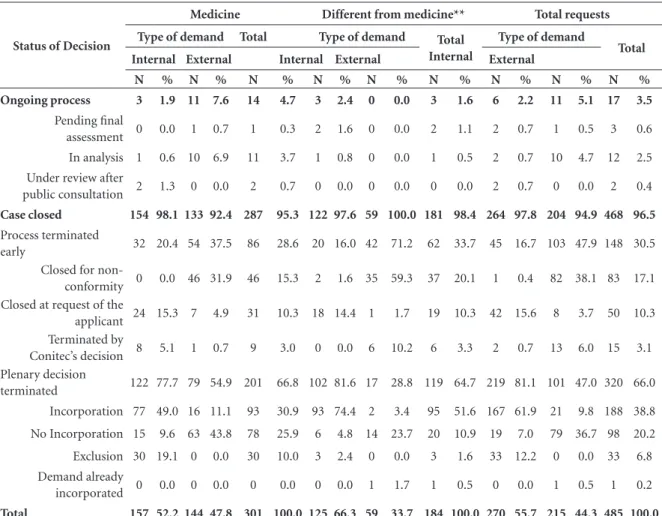
14 were of medicines. Of the 301 requests relat-ed to mrelat-edicines, 287 (95.3%) were discontinurelat-ed. About 30% (86 processes) had early discontin-uance, generally for non-conformity to proce-dures (53.5% of the cases) or for decisions taken by the applicant (36%). Twenty-one submissions for medicines had two or more different plein-tiffs. Internal requests corresponded to 52.2% of submissions related to medicines during the pe-riod (Table 2). For external requests, those from the pharmaceutical industry were predominant (40.9% of total).
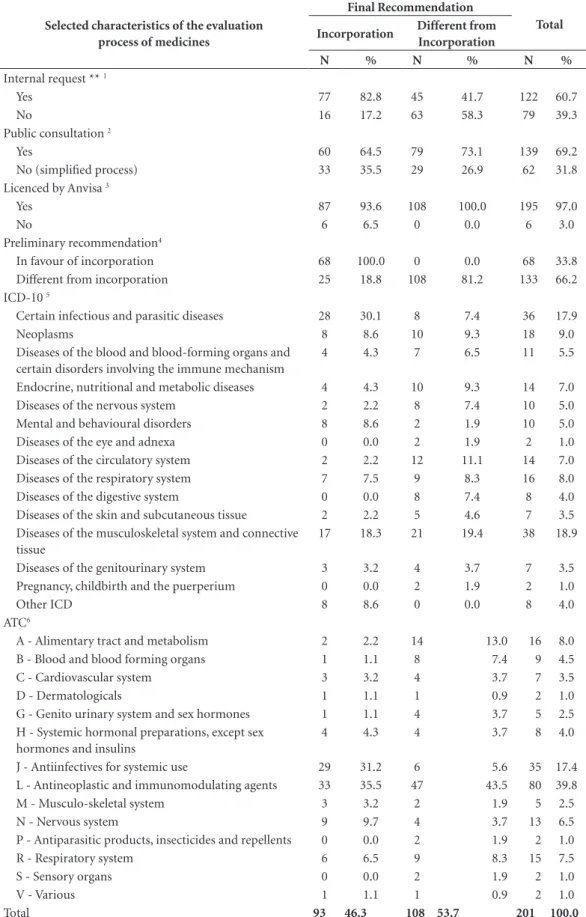
Two hundred and one processes related to medicines were deliberated by the Plenary (66.8%). Of these, 60.7% were originated in-ternally, most of them being from the Health Care Secretariat (Secretaria de Atenção à Saúde -SAS) (23.4% of requests with deliberation). Ninety-three medicines received favorable rec-ommendations for incorporation, including six vaccines and two immunobiological medicines (30.9% of total requests for medicines and 46.3% of those submitted to the Plenary). Internal re-quests for incorporation of medicines were more successful when compared with those that were originated externally: 82.8% of the requests that received favorable decisions for inclusion were from MoH, Anvisa or SES/SMS (p = 0.000) (Ta-ble 3).
Approximately 70% (139/201) of the deci-sions about medicines were the object of public consultations, while 62 went through more sim-plified processes, with no significant statistical differences in relation to favorable recommenda-tions to incorporation (p = 0.186) (Table 3).
The number of contributions received in public consultations for medicines with favor-able recommendation for incorporation were extremely diverse, varying from 0 to 530 (average of 108, median of 61). Nine medicines incorpo-rated received more than 250 responses (just one
had more than 500): fingolimod for the 3rd line
e C
ole
tiv
a,
22(8):2513-2525,
2017
medicines received more than 250 contributions with six receiving more than 500.
During the period, there was the recommen-dation for incorporation of six medicines
with-Table 1. Distributionof demands according to nature of the request and type of technology, Conitec, 2012 to 2016*.
Nature of request
Technology Type
Total
Medicine Medical Device Medical
Procedure STG
N % N % N % N % N %
Incorporation to SUS 267 59.7 64 14.3 105 23.5 11 2.5 447 92.2 Exclusion of SUS 31 91.2 0 0.0 3 8.8 0 0.0 34 7.0 Change of use ** 3 75.0 0 0.0 1 25.0 0 0.0 4 0.8 Total 301 62.1 64 13.2 109 22.5 11 2.3 485 100.0
Caption: STG — Standard Treatment Guidelines
Notes: * - Demands submitted until June 30th, 2016; ** - change of use involves requests for change of indication/use and a new presentation/model. P = 0,024.
Table 2. Distribution of requests according to type of technology, final status of decision and type of demand, Conitec, 2012 to 2016*.
Status of Decision
Medicine Different from medicine** Total requests
Type of demand Total Type of demand Total
Internal
Type of demand
Total
Internal External Internal External External
N % N % N % N % N % N % N % N % N %
Ongoing process 3 1.9 11 7.6 14 4.7 3 2.4 0 0.0 3 1.6 6 2.2 11 5.1 17 3.5
Pending final
assessment 0 0.0 1 0.7 1 0.3 2 1.6 0 0.0 2 1.1 2 0.7 1 0.5 3 0.6 In analysis 1 0.6 10 6.9 11 3.7 1 0.8 0 0.0 1 0.5 2 0.7 10 4.7 12 2.5 Under review after
public consultation 2 1.3 0 0.0 2 0.7 0 0.0 0 0.0 0 0.0 2 0.7 0 0.0 2 0.4
Case closed 154 98.1 133 92.4 287 95.3 122 97.6 59 100.0 181 98.4 264 97.8 204 94.9 468 96.5
Process terminated
early 32 20.4 54 37.5 86 28.6 20 16.0 42 71.2 62 33.7 45 16.7 103 47.9 148 30.5 Closed for
non-conformity 0 0.0 46 31.9 46 15.3 2 1.6 35 59.3 37 20.1 1 0.4 82 38.1 83 17.1 Closed at request of the
applicant 24 15.3 7 4.9 31 10.3 18 14.4 1 1.7 19 10.3 42 15.6 8 3.7 50 10.3 Terminated by
Conitec’s decision 8 5.1 1 0.7 9 3.0 0 0.0 6 10.2 6 3.3 2 0.7 13 6.0 15 3.1 Plenary decision
terminated 122 77.7 79 54.9 201 66.8 102 81.6 17 28.8 119 64.7 219 81.1 101 47.0 320 66.0 Incorporation 77 49.0 16 11.1 93 30.9 93 74.4 2 3.4 95 51.6 167 61.9 21 9.8 188 38.8 No Incorporation 15 9.6 63 43.8 78 25.9 6 4.8 14 23.7 20 10.9 19 7.0 79 36.7 98 20.2 Exclusion 30 19.1 0 0.0 30 10.0 3 2.4 0 0.0 3 1.6 33 12.2 0 0.0 33 6.8 Demand already
incorporated 0 0.0 0 0.0 0 0.0 0 0.0 1 1.7 1 0.5 0 0.0 1 0.5 1 0.2
Total 157 52.2 144 47.8 301 100.0 125 66.3 59 33.7 184 100.0 270 55.7 215 44.3 485 100.0
C
ae
tano R
Table 3. Selected characteristics of submissions related to medicines evaluated by the Plenary of Conitec, 2012 to 2016*.
Selected characteristics of the evaluation process of medicines
Final Recommendation
Total
Incorporation Different from
Incorporation
N % N % N %
Internal request ** 1
Yes 77 82.8 45 41.7 122 60.7
No 16 17.2 63 58.3 79 39.3
Public consultation 2
Yes 60 64.5 79 73.1 139 69.2
No (simplified process) 33 35.5 29 26.9 62 31.8 Licenced by Anvisa 3
Yes 87 93.6 108 100.0 195 97.0
No 6 6.5 0 0.0 6 3.0
Preliminary recommendation4
In favour of incorporation 68 100.0 0 0.0 68 33.8 Different from incorporation 25 18.8 108 81.2 133 66.2 ICD-10 5
Certain infectious and parasitic diseases 28 30.1 8 7.4 36 17.9
Neoplasms 8 8.6 10 9.3 18 9.0
Diseases of the blood and blood-forming organs and certain disorders involving the immune mechanism
4 4.3 7 6.5 11 5.5
Endocrine, nutritional and metabolic diseases 4 4.3 10 9.3 14 7.0 Diseases of the nervous system 2 2.2 8 7.4 10 5.0 Mental and behavioural disorders 8 8.6 2 1.9 10 5.0 Diseases of the eye and adnexa 0 0.0 2 1.9 2 1.0 Diseases of the circulatory system 2 2.2 12 11.1 14 7.0 Diseases of the respiratory system 7 7.5 9 8.3 16 8.0 Diseases of the digestive system 0 0.0 8 7.4 8 4.0 Diseases of the skin and subcutaneous tissue 2 2.2 5 4.6 7 3.5 Diseases of the musculoskeletal system and connective
tissue
17 18.3 21 19.4 38 18.9
Diseases of the genitourinary system 3 3.2 4 3.7 7 3.5 Pregnancy, childbirth and the puerperium 0 0.0 2 1.9 2 1.0
Other ICD 8 8.6 0 0.0 8 4.0
ATC6
A - Alimentary tract and metabolism 2 2.2 14 13.0 16 8.0 B - Blood and blood forming organs 1 1.1 8 7.4 9 4.5
C - Cardiovascular system 3 3.2 4 3.7 7 3.5
D - Dermatologicals 1 1.1 1 0.9 2 1.0
G - Genito urinary system and sex hormones 1 1.1 4 3.7 5 2.5 H - Systemic hormonal preparations, except sex
hormones and insulins
4 4.3 4 3.7 8 4.0
J - Antiinfectives for systemic use 29 31.2 6 5.6 35 17.4 L - Antineoplastic and immunomodulating agents 33 35.5 47 43.5 80 39.8 M - Musculo-skeletal system 3 3.2 2 1.9 5 2.5
N - Nervous system 9 9.7 4 3.7 13 6.5
P - Antiparasitic products, insecticides and repellents 0 0.0 2 1.9 2 1.0
R - Respiratory system 6 6.5 9 8.3 15 7.5
S - Sensory organs 0 0.0 2 1.9 2 1.0
V - Various 1 1.1 1 0.9 2 1.0
Total 93 46.3 108 53.7 201 100.0
e C
ole
tiv
a,
22(8):2513-2525,
2017
out active registers on Anvisa (3% of the delib-erations bythe Plenary) (Table 3). All of those requests came from MoH secretariats (two from the Health Surveillance Secretariat (Secretaria de Vigilância em Saúde - SVS), three from the SAS and one from SAS/SCTIE together) and four were made using the simplified process without public consultation.
Infectious and parasitic diseases (IPD) and musculoskeletal disorders accounted for 48.4% of all requests for medicines with a positive recom-mendation for incorporation. These two groups jointly with neoplasms, mental disorders and be-havior and circulatory diseases made up 64.5% of incorporated medicines. Regarding the pro-portion of approvals amongst the requests that were subject to a deliberation, products related to mental health and IPD stood out (approximately 80% of the approved requests) (Table 3).
Antineoplastics and immunomodulato-ry agents (group L) accounted for more than a third of medicines that were incorporated as well as being the most common group amongst the requests without favorable recommendations for incorporation. We also took note of the partici-pation of J (anti-infectious for systemic use) and N (the nervous system) groups (Table 3).
Regarding the distribution of delibera-tions and decisions by Plenary involving med-icines, 2013 (28.9%) and 2015 (22.9%) stood out. However, 2012 showed a larger proportion of favorable recommendations for incorpora-tion (68.4%) followed closely by 2015 (60.9%) (Graphic 1).
Close to 75% of medicines incorporated by June 2016 had two or more justifications for this recommendation in the reports (an average of 2.2). The justifications that stood out (Table 4) were additional clinical benefits (40.9%), low impact on finances-budget (25.8%), a clinical need not filled by SUS and recommendations for incorporation in other countries (both with 21.5%).
One or more constraints to incorporation were present in 26.9% of recommendations for medicines approved during the period (an av-erage of 2.4 constraints). The main condition stated in the reports to make inclusion on SUS feasible were the reduction of the selling price to the government and the incorporation connect-ed to developing and updating a STG, specifying conditions for access and use.
The SCTIE secretary accepted all the recom-mendations made by Conitec’s Plenary without exception.
Discussion
Since 2006, with the creation of the former ‘Comissão de Incorporação de Tecnologias’ (CITEC) from the Ministry of Health, there have been flows and routines established for the anal-ysis of the incorporation of health technologies. With the establishment of Conitec, the submis-sion of requests to the Committee became a mandatory and indispensable process for the corporation of technologies on SUS and the in-clusion of new products on the list for financing.
Based on Law 12.401/2011 the request can be made uninterruptedly and without pre-defined periods for submission of new requests. Since then, almost 500 submissions were made cor-responding to an average of 107 requests/year. Most were related to requests for the incorpo-ration of medicines (261/485), whether of new drugs and presentations not presenton the SUS list until then or requests for the expansion of the use of medicines already available for clinical conditions/subpopulations that were not covered up to that point.
Graphic 1. Distribution of medicines with
recommendations submitted to the Plenary per year and final recommendation of the decision, Conitec, 2012 a 2016*.
Notes: * Demands submitted until June 30th, 2016. 0
10 20 30 40 50 60
18 40
12 16
28 18
9 22
26 12
2012 2013 2014 2015 2016
Incorporation Different from incorporation 38
58
28
46
C
ae
tano R
The emphasis of requests for incorporation of medicines certainly has a connection with the known access constraints to this important tech-nology for the protection and recuperation of health. Medicines represent an expressive com-ponent in the increase of spending in health in the world and also in Brazil. Data from Health
Satellite Accounts 2010-201310 indicates that
ex-penditure involving medicines represents 1.6% of the Gross Domestic Product in Brazil and more than 20% of final spending on goods and health services in 2013.
Various medicines were the object of more than one request in the period, be they due to a different clinical recommendation, early discon-tinuance of the process or even prior decisions for non-incorporation. Amongst these, the drugs everolimus, fingolimod, cetuximab, golimumab, rituximab, tocilizumab, and trastuzumab stood out with six or more requests during the period.
Everolimus, which is used for rejection of transplants and oncology therapy, was requested eight times. One process was discontinued due to documental non-conformity and two due to a request from the applicant. The same pleintiff – SAS/MoH – subsequently requested again and had its request approved for the same indications
requested before hand (immunosuppression in cardiac and hepatic transplants). Everolimus was also incorporated for pulmonary transplants (SCTIE’s request), but two of the incorporation requests made by the industry (for subependy-mal giant cell astrocytoma associated with tuber-ous sclerosis and advanced breast cancer) were refused.
Fingolimod is another case with repeated submissions (eight in total that came from man-ufacturers, organizations connected to clinical research and ordinary people). The first one was submitted in 2012 and all of them were for treat-ing multiple sclerosis (MS). Two processes were discontinued due to non-conformity of the pro-cess. The medicine´s incorporation was
request-ed separately for the 1st, 2nd and 3rd line treatment
of the disease, with the first two being refused in July/2013. In May/2014, after public consultation (530 responses), fingolimod was incorporated
for 3rd line treatment, restricted to “patients with
remission-recurrent stages of MS with failure in the use of beta interferon and glatiramer as well as not being apt to use natalizumab and not
having contraindications in using fingolimod”11.
Such incorporation was conditioned to the up-dating of the STG with a clear definition of the
Table 4. Justifications in Conitec recommendation reports favourable to the incorporation of medicines, 2012 to 2016.*
Justifications reported for the favorable decision on incorporation N†
%‡
(relative total medicines incorporated)
Clinical need not filled 20 21.5
Gravity and/or prevalence of disease 9 9.7
Lack of therapeutic alternative in the SUS 7 7.5
Additional clinical benefit 38 40.9
Less adverse events 12 12.9
Greater ease of use 10 10.8
Low cost/lower cost than options available 15 16.1 Evidence of cost-effectiveness in relation to options available 13 14.0
Low budgetary impact 24 25.8
Incorporation in other countries 20 21.5
Quality of available evidence 4 4.3
Recommendation in STG or therapeutic guides of the SUS without presence of financing medicines lists
7 7.5
Extension of the list for treatment already existing in the SUS 7 7.5
Other reasons 18 19.4
e C
ole
tiv
a,
22(8):2513-2525,
2017
use criterias, its availability in specialized centers having adequate infrastructure for monitoring cardiovascular risks, and a price’s reduction to below the values of the annual cost of treatment per patient of the products already available on SUS.
This and other cases gave rise to a suspicion that multiple requests – generally proposed at first for more broad populations, and that would continue to be restricted as the denials have been occuring, or with progressive reductions of pro-posed prices in order to minimize the budgetary impact – may be one of the strategies used to try the incorporation of medicines on SUS.
On the other hand, the number of process-es that were discontinued prematurely due to lack of documentary compliance was significant (30.1% of the demands of medicines). There are no publicly available registers of the reasons for the refusals. A study on the submitted requests to Conitec up until July 2015 showed that the main justifications for the rejections were due to a lack of or inadequate economic evaluation and bud-getary impact studies and of the evidence compi-lation on effectiveness and safety (totaling 51.3%
of rejections)12. It also refers to the progressive
reduction of refusals (only 4% from January to July 2015) based on the availability of method-ological guides for required studies and training made available for the associations of medicine manufacturers.
All of the rejections for non-conformity that were observed had external origins, despite the fact that some reports of “internal requests” were quite simple. In many cases those reports were the mere presentation of the technology’s caracther-istics and of very simple estimates of budgetary impact. Data available, however, does not allow us to advance in the investigation of possible rea-sons for those apparent differences in treatment. Of the 485 submissions made during the studied period, 320 had final deliberations un-til the end of data collection, 201 of which were related to medicines. Of these, 46.2% received favorable recommendations for incorporation which was a significantly reduced proportion compared to medical devices and procedures whose combined percentage of recommenda-tions for incorporation was 79%.
The fluctuation observed in the number of recommendations submitted to the Conitec Ple-nary may reflect the variation in the number of submissions, whose annual distribution has not been shown by the available data. In the period of CITEC, there was no stipulated deadline for the
evaluations and recommendations. All processes submitted without evaluations at the moment of regulation by the Law 12401/2011, had to be
rep-resented at Conitec13, potentially contributing to
the increases in the number of requests made in its first years of operation. The establishment of clearer rules for requests and decisions for incor-poration may have also stimulated the pleas from the claimants.
Medicines that were entirely new on SUS re-sponded to 44.1% of recommendations for in-corporation while 51.5% represented approvals of new indications for medicines that were al-ready available.
Amongst the last group, dolutegravir was
in-corporated in October 2015 for 3rd line treatment
of HIV/AIDS. Conitec’s preliminary recommen-dation was against the incorporation, justified by the lack of evidence of long-term safety and in children under 12years of age, greater expe-rience of real-life use with raltegravir and erro-neous choice of the type of economic evaluation by the applicant. After public consultation (268 responses), with new information on drug safety and the presentation of new studies of cost-mini-mization and budgetary impact, carried out with updated prices for new medicine and alternative technology, the recommendation was unani-mously changed for favourable to
incorpora-tion14. In September 2016, there was a new
deci-sion for incorporation of dolutegravir for chang-es in the indication of its use for initial treatment
(1st line) replacing efavirenz and being associated
with “two in one” (tenofovir + lamivudine). The reasons suggested for the widening of use during a period smaler than a year included greater ef-fectiveness (due to lower viral resistance rates through the time of treatment) and less adverse events as well as a significant reduction inprices (from US$ 5.10 to US$ 1.53) based on centralized
purchaseson a large scale15.
This situation of changes amongst the initial and final recommendations after public consul-tation did not represent an exception as this was the case for 18.8% of the preliminary recom-mendations for non-incorporation of medicines. The presentation of new evidence on safety and effectiveness, new economic evaluations, budget-ary impact, with correction of pointed mistakes and proposals for price reductions were the main reasons identified for the changes in recommen-dations.
C
ae
tano R
pointed out by the association for the
pharma-ceutical industry (Interfarma)13. The extent to
which the Committee responsible for evaluating the incorporation of new medicines belongs to the structure of the Ministry of Health, which finances what will be included, interferes in Conitec’s decisions needs to be the subject of in-depth studies. The international literature ar-gues that the ‘ideal’ organizational structure for bodies with the responsibility for HTA at the na-tional level would be hierarchically independent
programs, even if financed by public funds16,17.
About a third of the medicine processes where decisions are made through the Plenary occurred in the simplified process and without public consultations. All of them came from MoH. The most part of the simplified processes approved during the period referred to requests for the widening of use.
Decree nº 7.646, that regulated the processes for the evaluation of requests for incorporation to be used in SUS, sets out that all the recommen-dations issued by the Plenary are to be submitted
for public consultation5. However, article 29 of
this decree sets out the possibility of as implified administrative process in cases that are relevant to the public interest without details of appli-cable situations. According to Conitec reports, these processes concern “the widening of use or exclusion of technologies, new medicines presen-tations or incorporation with a tradition in use”, and with the requests “involving low-cost tech-nologies and budgetary impact for SUS or being related to the elaboration or revision of STG”.
Six medicines without licensing by Anvisa were incorporated in the period: Biotin (bioti-dinase deficiency), injectable doxycycline and chloramphenicol oral suspension (spotted fever), hydroxyurea 100mg tablet (sickle cell disease), hydrocortisone cypionate (congenital adrenal hyperplasia), and hydroxocobalamin hydrochlo-ride (cyanide poisoning). All came from ‘inter-nal’ requests. Only two of the recommendations were submitted for public consultation. Main justifications for incorporation of these prod-ucts were the clinical necessity that had not been filled, gravity of the clinical condition, absence of an alternative therapy on SUS or any addition-al clinicaddition-al benefit about available options. These reports also mention that these drugs would be the object of processes for centralized purchases
from abroad, by the Ministry of Health18,19.
Licensing is an essential regulatory tool in the evaluation of safety, efficacy, and quality of drugs, resulting in the protection of public
health20. Even taking into account the
justifica-tions, medicine incorporation without registra-tion goes against the clearly established criteria in the legal framework for the evaluation of
sub-mission for incorporation5. The Brazilian
legis-lation also impedes the aquisition, dispensation, and financing unlicensed medicines at all levels
of the public health system21,22, except in cases set
out in law23,24.
The high quantity of drugs for the treatment of chronic hepatitis C (boceprevir, telaprevir, sofosbuvir, daclatasvir and simeprevir) and for infections due to HIV (darunavir, dolutegravir sodic, maraviroc, and raltegravir) incorporated in the period were cases that stood out.
Telaprevir and boceprevir were incorporat-ed in July 2012 for the treatment of infection for genotype 1 which is the most common form
pre-dominantly in the country25. They were excluded
in May 2016 based on the introduction of new antivirals in July 2015. As justifications for the exclusion, a Conitec report showed that even if there were an increase in the chances of a sus-tained virologic response, prolonged treatments and a large number of daily tablets would still be needed. The inclusion of associated use of inject-able interferon and ribavirinwould also be neces-sary. Another reason given was the significantly frequent adverse blood side effects, that would require other medicines for the treatment of
neu-tropenia (filgrastim) and anemia (epoetin alfa)26.
The new antivirals would have more favorable characteristics namely: greater safety and
effica-cy (≥ 80% of viral negativation for all genotypes,
including in individuals with advanced cirrhosis and co-infections with HIV/HCV), treatment (oral use, two pills/day, less need for monitoring effectiveness and safety), favoring the adminis-tration and follow-up of the treatment for three months on average. Also, costs of the acquisition of treatments with the association of new drugs were mentioned as being inferior to those of the
therapy with telaprevir and boceprevir26,27.
e C
ole
tiv
a,
22(8):2513-2525,
2017
trials, being necessary caution with new drugs28.
Efficacy of the new antivirals compared to the available options was based on indirect
compar-isons, given the absence of head-to-head studies.
These drugs are very high-cost, and the estimated budgetary impact for SUS were between R$ 467 to R$ 666 million/year, considering the treatment of 15,000 infected individuals for different geno-types. Despite the importance of hepatitis C as a public health problem in Brazil, these several aspects are certainly a matter of great concern given the potential health impacts and scarce re-sources for health care in the country. Additional clinical benefits compared totechnologies that were already available, having low impact on the finances and budget and the clinical needs not being fulfilled, were all the main justifications used for incorporations of the new medicines on SUS in 2015. International studies that examined processes related to the reimbursement of drugs have been attracting attention for the important therapeutic value and additional benefits as
rele-vant criteria for decision-making29. On the other
hand, estimates of the influence of small budget-ary impacts was possibly amplified by the large number of recommendations for incorporation conducted as simplified processes, which are ap-plied for requests that involve criteria including low costs and low budgetary impact for SUS’ forecast, among others.
Studies of the process and factors that influ-ence the decisions of the responsible government bodies for the incorporation of technologies into the health system showed multiple and varied
criteria in different countries30,31. These elements
may differ even in relation to a single type of
technology32 or in a single country and agency33.
Green and Hutton compared different existing programs in NICE related to HTA, and showed that clinical efficacy/effectiveness and cost-effec-tiveness are criteria uniformly used by the pro-grams for decision-making. However, they also showed different degrees of requirements related to the quality of evidence, evaluation methods (presence of reference case, types of economic evaluations, cost-effectiveness threshold, etc.), infrastructure requirements, and the type of benefits for patients and for NHS compared to
available technologies33.
A national study evaluating HTA experienc-es on 16 countriexperienc-es mapped 21 criteria related to the disease’s impact, the technology’s, economic issues, the quality of evidence and questions on equity, ethics, social and organizational issues.
An examination of 12 reports drafted by Conitec showed that in the same way for the evaluated countries, information on effectiveness, safety, and cost-effectiveness were considered relevant in the process of the incorporation of
technolo-gies by the Committee34.
It is worth mentioning, however, that Conitec reports were selected by convenience samples. Also, many of the reports that were examined in the present study are limited and in turn are mere descriptions or simple estimates of budgetary impacts, reinforcing the importance of a neces-sary enhancement of the criteria and transparen-cy of the processes used by Conitec.
Some limitations of the study deserve to be to be pointed out. There is no information on Co-nitec’s website about dates of submission. This absence makes it impossible to examine the com-pliance of some of the legal deadlines established by law such as a maximum of 270 days between submission and evaluation. Although all Conitec reports are publicly available, there is no access to the original documents submitted, only what is registered in the reports. The format, size, and content of reports are very heterogeneous and some are very simple. The legal requirement of an economic evaluation study comparing the proposed technology with those available on SUS was not present in all reports, especially in cases of simplified processes. Lastly, it did not always seem clear, specially in internal requests, which were based on information brought by the requesters and which were based on evidence ob-tained by Conitec’s technicians.
C
ae
tano R
References
1. Biehl J, Petryna A, Gertner A, Amon JJ, Picon PD. Judi-cialisation of the right to health in Brazil. Lancet 2009; 373(9682):2182-2184.
2. Figueiredo TA, Pepe VLE, Osorio-de-Castro CGS. Um enfoque sanitário sobre a demanda judicial de medica-mentos. Physis 2010; 20(1):101-118.
3. Guimarães R. Technological incorporation in the Uni-fied Health System (SUS): the problem and ensuing challenges. Cien Saude Colet 2014; 19(12):4899-4908. 4. Brasil. Lei nº 12.401, de 28 de abril de 2011. Altera a Lei
no 8.080, de 19.09.1990, para dispor sobre a assistência terapêutica e a incorporação de tecnologia em saúde no âmbito do Sistema Único de Saúde. Diário Oficial da União 2011; 24 abr.
5. Brasil. Decreto nº 7.646, de 21 de dezembro de 2011. Dispõe sobre a Comissão Nacional de Incorporação de tecnologias no Sistema Único de Saúde e sobre o processo administrativo para incorporação, exclusão e alteração de tecnologias em saúde pelo Sistema Único de Saúde, e dá outras providências. Diário Oficial da União 2011; 22 dez.
6. International Network of Agencies for Health Technol-ogy Assessment (INAHTA). The International Network of Agencies for Health Technology Assessment. The In-fluence of Health Technology Assessment. A conceptu-al paper. 2014. [acessado 2016 set 22]. Disponível em: http://www.inahta.org/wp-content/uploads/2014/03/ INAHTA_Conceptual-Paper_Influence-of-HTA1.pdf 7. Brasil. Ministério da Saúde (MS). Balanço Conitec:
2012-2014. Brasília: MS; 2014.
8. WHO Collaborating Centre for Drug Statistics Meth-odology. Anatomical-Therapeutic-Chemical classifica-tion index. Oslo: Norwegian Institute of Public Health; 2016. [acessado 2016 set 15] Disponível em: http:// www.whocc.no/atc_ddd_index/
9. Brasil. Ministério da Saúde (MS). Departamento de Informática do SUS. 2016. [acessado 2016 set 15]. Dis-ponível em: http://www.datasus.gov.br/cid10/V2008/ cid10.htm
10. Instituto Brasileiro de Geografia e Estatística (IBGE). Conta-satélite de saúde: Brasil, 2010-2013. Rio de Ja-neiro: IBGE; 2015.
11. Brasil. Ministério da Saúde (MS). Relatório Conitec nº 113: Fingolimode para o tratamento da esclerose múltipla. 2014. [acessado 2016 out 15]. Disponível em: http://conitec.gov.br/images/Incorporados/Fingoli-modeEM_FINAL.pdf
12. Rabelo RB, Petramale CA, Silveira LC, Santos VCC, Gonçalves HC. A Comissão Nacional de Incorporação de Tecnologias no SUS: um balanço de seus primeiros anos de atuação. Revista Eletrônica Gestão & Saúde 2015; 6(Supl. 4):3225-3240.
13. Associação da Indústria Farmacêutica de Pesquisa. Incorporação de Tecnologia no Sistema Único de Saúde (SUS). São Paulo: Interfarma; 2015.
14. Brasil. Ministério da Saúde (MS). Relatório Conitec nº 182: Dolutegravir sódico para 3ª linha de tratamento da infecção pelo HIV. 2015. [acessado 2016 out 15]. Disponível em: http://conitec.gov.br/images/Consul-tas/Relatorios/2015/Relatorio_Dolutegravir_2015.pdf Collaborations
e C
ole
tiv
a,
22(8):2513-2525,
2017
15. Brasil. Ministério da Saúde (MS). Relatório Conitec nº 227: Ampliação de uso dos medicamentos antir-retrovirais dolutegravir (DTG) e darunavir (DRV), já disponibilizados pelo Ministério da Saúde para o tra-tamento da infecção pelo HIV. 2016. [acessado 2016 out 15]. Disponível em: http://conitec.gov.br/images/ Relatorios/2016/Relatorio-DolutegravirDarunavir-fi-nal-Republicacao.pdf.
16. Banta D, Jonsson E. Commentary. Int J Technol Assess Health Care 2006; 22:280-282.
17. Stephens JM, Handke B, Doshi JA. International sur-vey of methods used in health technology assessment (HTA):does practice meet the principles proposed for good research? Comp Eff Res 2012; 2:29-44.
18. Brasil. Ministério da Saúde (MS). Relatório Conitec nº 57: Hidroxiureia para crianças com doença falciforme. 2013. [acessado 2016 out 15]. Disponível em: http:// conitec.gov.br/images/Incorporados/Hidroxiureia-fi-nal.pdf
19. Brasil. Ministério da Saúde (MS). Relatório Conitec nº 96: Doxiciclina injetável e o Cloranfenicol suspensão para terapêutica da febre maculosa brasileira e outras riquetsioses. 2014. [acessado 2016 out 15]. Disponível em: http://conitec.gov.br/images/Incorporados/Doxi-ciclina-e-Clorafenicol-FINAL.pdf
20. Gava CM, Bermudez JA, Pepe VLE, Reis ALA. Novos medicamentos registrados no Brasil: podem ser con-siderados como avanço terapêutico? Cien Saude Colet 2010; 15(Supl. 3):3403-3413.
21. Luiza VL, Silva RM, Moraes EL, Mattos LV. Compras públicas de medicamentos no Brasil: uma análise a partir do marco regulatório. In: Hasenclever L, Oliveira MA, Paranhos J, Chaves G, organizadores. Desafios de Operação e Desenvolvimento do Complexo Industrial da Saúde. Rio de Janeiro: E-papers; 2016. p. 127-66. 22. Brasil. Lei nº 6.360, de 23 de setembro de 1976.
Dis-põe sobre a Vigilância Sanitária a que ficam sujeitos os Medicamentos, as Drogas, os Insumos Farmacêuticos e Correlatos, Cosméticos, Saneantes e Outros Produtos, e dá outras Providências. Diário Oficial da União 1976; 24 set.
23. Brasil. Lei Federal nº 8.666, de 21 de junho de 1993. Regulamenta o art. 37, inciso XXI, da Constituição Federal, institui normas para licitações e contratos da Administração Pública e dá outras providências. Diário Oficial da União 1993; 22 jun.
24. Brasil. Decreto nº 8.077, de 14 de agosto de 2013. Re-gulamenta as condições para o funcionamento de em-presas sujeitas ao licenciamento sanitário, e o registro, controle e monitoramento, no âmbito da vigilância sa-nitária, dos produtos de que trata a Lei n° 6.360, de 23 de setembro de 1976, e dá outras providências. Diário Oficial da União 2013; 15 ago.
25. Brasil. Ministério da Saúde (MS). Relatório Conitec nº 1: Inibidores de protease, telaprevir e boceprevir, para tratamento da hepatite crônica C. 2012. [acessado 2016 out 15]. Disponível em: http://conitec.gov.br/images/ Relatorios/2012/Boceprevir_Telaprevir_final.pdf
26. Brasil. Ministério da Saúde (MS). Relatório Conitec nº 222: Telaprevir, boceprevir, filgrastim e alfaepoetina para o tratamento da hepatite C. 2015. [acessado 2016 out 15]. Disponível em: http://conitec.gov.br/images/ Relatorios/2016/Relatorio_Telaprevir-Boceprevir-Fil-grastim-Alfaepoetina_Hepatite_Recomendacao.pdf 27. Brasil. Ministério da Saúde (MS). Relatório Conitec nº
164: Sofosbuvir, daclatasvir e simeprevir para o trata-mento da hepatite viral C crônica. 2015. [acessado 2016 out 15]. Disponível em: http://conitec.gov.br/images/ Relatorios/2015/Antivirais_HepatiteC_final.pdf 28. Ahmad SR. Adverse drug event monitoring at the Food
and Drug Administration. J Gen Intern Med 2003; 18(1):57-60.
29. Franken M, le Polain M, Cleemput I, Koopmanschap M. Similarities and differences between five European drug reimbursement systems. Int J Technol Assess Heal-th Care 2012; 28(4):349-357.
30. Schwarzer R, Siebert U. Methods, procedures, and contextual characteristics of health technology assess-ment and health policy decision making: comparison of health technology assessment agencies in Germany, United Kingdom, France, and Sweden. Int J Technol As-sess Health Care 2009; 25(3):305-314.
31. Spinner DS, Birt J, Walter JW, Bowman L, Mauskopf J, Drummond MF, Copley-Merriman C. Do different clinical evidence bases lead to discordant health-tech-nology assessment decisions? An in-depth case series across three jurisdictions. Clinicoecon Outcomes Res 2013; 5:69-85.
32. Clement FM, Harris A, Li JJ, Yong K, Lee KM, Manns BJ. Using effectiveness and cost-effectiveness to make drug coverage decisions: a comparison of Britain, Aus-tralia, and Canada. JAMA 2009; 302(13):1437-43. 33. Green W, Hutton J. Health technology assessments in
England: an analysis of the NICE Medical Technolo-gies Evaluation Programme. Eur J Health Econ 2014; 15(5):449-452.
34. Pereira VC, Salomon FCR, Souza AB. Critérios para de-cisões sobre incorporação de tecnologias em saúde no Brasil e no mundo. Revista Eletrônica Gestão & Saúde 2015; 6(Supl. 4):3066-3093.
Article submitted 26/10/2016 Approved 24/03/2017