AR
TICLE
1 Departamento de Psicologia, Faculdade de Educação, Universidade Federal do Amazonas. Av. General Rodrigo Otávio Jordão Ramos 3.000, Campus Universitário Japiim. 69077-000 Manaus AM Brasil.
[email protected] 2 Secretaria Municipal de Saúde de Manaus. 3 Programa de Pós-Graduação Mestrado e Doutorado em Psicologia, Universidade Católica Dom Bosco.
Suicidal ideation and attempted suicide in elderly people –
subjective experiences
Abstract We discuss the subjective experienc-es of elderly people who show suicidal ideation and/or attempts at suicide, based on their own reports. We understand the concept of ‘subjective’ as referring to intra-psychic experience resulting from social, economic, relationship or biograph-ical conditions. Although the subject is sparsely covered in the literature, it is important, because it is in the field of subjectivity that ideations of, and attempts at, suicide develop and occur until they become a concrete act. Empirical data were collected through semi-structured interviews fo-cusing on: social characterization, portrayal and mode of life, previous mental state, atmosphere of the attempt, effects on the health of the elderly person and family. Based on the analysis of the meanings that emerge, five empirical categories were generated: (1) subject’s feeling of being in a non-place; (2) absence of acceptance of losses; (3) suffering due to ingratitude of family mem-bers; (4) feeling of uselessness of, and in, life; (5) re-signification of the situations that generate sui-cide-related conduct. The results point to a funda-mental need to incorporate knowledge about the subjective processes into programs for prevention of suicide among the elderly who have ideation of, or attempts at, suicide.
Key words Suicide attempt, Suicide ideation,
Subjectivity, Elderly people, Family Denise Machado Duran Gutierrez 1
Amandia Braga Lima Sousa 2
G
u
tie
r
r
ez DMD
Introduction
This article analyzes subjective experiences re-ported by a group of elderly people. The concept ‘subjective’ is understood to refer to a process of subjectivation which is not limited to the indi-vidual experience, nor is reduced to, nor allows itself to be determined by, purely social processes. It is understood that the individual and the social have a reciprocal influence upon each other with-in a multidimensional dynamic, which is
contra-dictory, recursive and in permanent movement1.
Thus, the subjectivity refers to the outlook of the person: his/her opinions, feelings, believes and desires; and their recognition emphasizes that an individual does not have a passive relationship with the world. On the contrary, an individual is an agent that experiences reality in a particular way, interpreting it and making choices. For this reason, as an agent, the individual both adheres to what is offered to him institutionally and also causes changes in a wide range of organizations in which he is included, seeking always to act
ac-cording to his or her desires and objectives2.
When we talk here of the experience of elder-ly people who have persistent ideation of suicide or have attempted it, we enter the philosophical, psychological and sociological field of the stud-ies of subjectivity which, although they are very distinct in terms of areas of knowledge, have one orientation in common: the character of human experience is that every phenomenon that is lived is associated with a singular point of view.
In the opinion of Nagel3, the subjective character
of experience implies that the mind produces a type of cognitive focus on certain aspects created by reality – whether it be the social, economic, political, or reality or a reality in terms of rela-tionships. The subjectivity of the perception of reality, when it refers to a given social group that is more or less homogeneous, as in the case of the elderly people who were interviewed, implies that the perception of all things, concepts and ‘truths’ are at the same time different between the individuals of that group, and also bring them to-gether.
Thus, although she/he lives in an objective world where things, people and cultures in com-mon exist, each individual has a unique perspec-tive on the world. These themes have been dealt with by important philosophers such as
Heideg-ger4, who distinguishes common experiences and
singular experiences lived, and Sartre5, who deals
with freedom of choice of the subject even in the most difficult circumstances in which everything
appears to him to be externally determined. Sar-tre even said that each human being is irreducible (which goes against the idea of the massified hu-man being), and for this reason he or she always
is what he or she has succeeded in making out of
what reality has made out of him or her. It is important to note that a large part of the authors who deal with subjectivity never place it outside the social-cultural and historic
real-ity6-8 – with the exception of some currents of
psychology, in which the notions of subjectivity are focused on the intra-psychic process and are considered not to have importance for the
com-prehension of shared human experiences9. Other
scientists and philosophers, on the other hand, consider that it is in objective reality that people make their choices in an individual way.
This singular synthesis of a social reality that is individually experienced enabled the reports of the elderly people who were interviewed to be known. These elderly people live in the same his-toric time, in the same social space, they belong to the same social segments and to the same age groups and they share opinions, believes, values
and attitudes. Bourdieu10 has given the name
habitus to such a group of dispositions that are at
the same time collective and individual.
These initial considerations are important because what is dealt with in this article are re-flections about the private experiences and at the same time similar experiences, of some elderly men and women who have reacted with per-sistent suicidal ideation or attempts at suicide to the difficulties related to age itself, the illnesses, the questions of relationships, discrimination and other problems. In terms of methodology, this study heard their interpretations of the sit-uations of suffering that led them to seek an ear-ly death; and also, it was possible to bring their histories together in empirical categories which
cover the principal points of importance11 that
they have presented in relation to those events. The theme of subjective experiences, and of the structure of the subjectivity of the elderly person who has tried to kill himself, who pres-ents suicidal ideation, is practically absent in the health literature, and also in the literature of the social and human sciences in Brazil. Even
inter-nationally, there are very few texts available12. In
aúd
e C
ole
tiv
a,
20(6):1731-1740,
2015
In an attempt to fill this lacuna, we have pre-sented the results of a field study, and, based on the points of view expressed by a group of elderly people, we discuss how they perceive their links of affection and what is the feeling and the mean-ing that they give to the problems that they face in this phase of life.
It is important to point out that no diagnosis is being made about old age, nor about the ex-periences of older people in Brazil, but only of a small group to whom the investigators had access in a survey, though with a highly respected meth-odology. This is true, in particular, because ‘old’, ‘elderly’ and ‘old age’ are not general categories of analysis. Each one of these terms hides a very great complexity of differentiations, any analysis
of which is not the purpose of this study13,14. The
group studied here is part of the segment of those elderly people who, due to social condition, due to questions of physical illness, due to personal problems of isolation, due to abandonment or negligence by the family, or due to some type of mental suffering, feel particularly vulnerable. The reports of ideations and attempts at suicide analyzed in this study were full of emotion, ex-pressions of conflicts, narratives of losses and pain, experiences of precarious work and living accommodation, and relationship difficulties. These problems accumulated over the length of
a life and flowed out in old age15, in a
perspec-tive which is treated here as ‘procedural’. It can be said that each one of these old people is, in this stage of life, going over the data of his or her history, reconstructing them with the threads of the present. This stage of life can be seen in personal experience as a time of decadence, a time of isolation, or it can be seen as a time of protagonism and maturation. In this sense, in-dependently of whether a person is suffering from some type of infirmity or lack of autonomy, nothing substitutes the involvement of the sub-ject in the conduct of his or her existence. Pres-ervation of health, which often is independent of personal desire, is one thing, while maintenance of the moral autonomy that is at the root of the expectation of having a happy and realized life, is another. Various anthropological studies show that there is no linear relationship between being
ill or feeling ill and decadent16-24. Almost always
the older person reaps in the final stage of ex-istence what he or she planted in the world. No one becomes a respective, healthy and wise old person if they did not construct their life in that
direction25.
Methodology
The data presented here are part of a multi-cen-tric qualitative investigation which brings to-gether quantitative and qualitative data on 57 cases of elderly people, among 87 interviewed in 14 municipalities in five regions of Brazil.
The sources for contact with the subjects were the official data banks on hospital records, and information from professionals of Brazil’s Unified Health System (SUS), and from manag-ers of long-term care institutions. The field work involved interviews with old people who were contacted by letter, by telephone, or by scheduled visits with or without mediation of health pro-fessionals.
The data were collected through semi-struc-tured interviews, with a script made up of open questions, relating to various aspects of the living experience of the subjects: social-demographic characterization; characterization of their con-dition and way of life, evaluation of the atmo-sphere of the suicide attempt; evaluation of the risk and the mental state that preceded each one of the attempts, and impacts of these events on their health and on their family. Anthropologi-cal and social aspects of the loAnthropologi-calities were inter-linked with analysis of the emotional states of the individual in such a way as to provide a context for the data.
An attempt was made to understand the specificities of the situation of the subjects who made suicide attempts or had suicidal ideation, independently of where they lived. Each inter-view was analyzed in depth, in an approach that took into consideration the reports of those in-terviewed, interpretations of the researchers and the data of contextualization. The final analysis consisted of a reorganization of the qualitative information based on the categories emerging in the empirical process, and which related to the processes of subjectivization of the subjects.
The research project that was the basis of the information presented here was approved by the Ethics Research Committee of the Oswaldo Cruz Foundation (CEP/Fiocruz). All the participants in the study signed the Informed Consent Form. The recommendations and the ethical
precau-tions specified by CNS Resolution 466/1226 were
obeyed, and any participants who were in a vul-nerable state were directed to the referral services for accompaniment.
indi-G u tie r r ez DMD
cation of gender, age and locality – while their identity is preserved.
Results and discussion
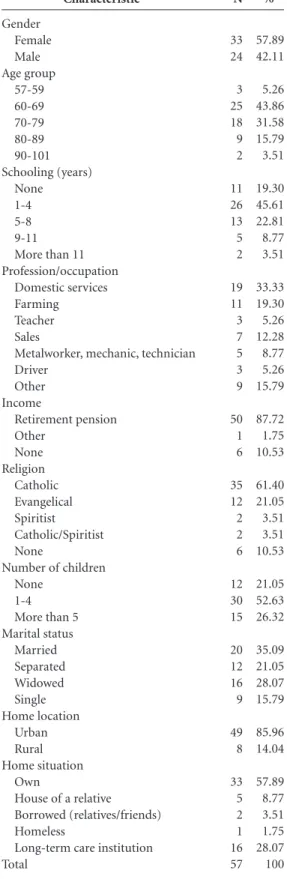
Initially, a characterization is presented of the group of elderly people whose speech, as reported, is the subject of analysis in this article. (Table 1).
Significant indications of this categorization relates are that a majority of the people inter-viewed: were female; were in the age range 60 to 69; had between one and four years of schooling; had practiced activities related to agriculture; were retired, were Catholics, had between one and four children, were married, lived in an ur-ban location; and had their own home or lived in a long-term care home. These socio-demograph-ic data made it possible to have a panorama of the situation of the people interviewed.
The empirical categories that emerged from the speeches and stories of the people inter-viewed (men and women) who attempted sui-cide or had persistent suicidal ideation are now presented – the categories that emerged from the empirical data, and are subject to superimposi-tion and many other interacsuperimposi-tions, since this is a complex subject – are: (1) the ‘nowhere’ situation of the subject; (2) non-acceptance of losses; (3) suffering due to ungratefulness of family mem-bers; (4) a sense of existential uselessness; and (5) re-signification of the situations that generate the suicide-related conduct.
1. The feeling of being ‘nowhere’
The lack of capacity to provide care or finan-cial support to the family was seen by some of the elderly people interviewed as a situation in which they feel ‘dislocated’ or without a defined role in the environment in which they live. The difficulties of finding a new place in their fami-lies were expressed in several of the interviews, as one of the elements which led them to thinking about or attempting suicide. The speech reflected an anguish caused by occupying a space in which they would not like to be, or where they did not
feel accepted, as this speech reveals: All that I have
in life is displeasure, grief! My participation is only that I am alive, no more than that: because I don’t do anything: I have an empty life (woman, 83
years old, Piriri, Piauí State).Minayo and
Coim-bra Júnior27 point out that it is necessary to
un-derstand how the stereotyped construction of the social position of the elderly person comes into
Table 1. Characterization of the participants (N = 57).
Characteristic Gender Female Male Age group 57-59 60-69 70-79 80-89 90-101 Schooling (years) None 1-4 5-8 9-11 More than 11 Profession/occupation
Domestic services Farming Teacher Sales
Metalworker, mechanic, technician Driver Other Income Retirement pension Other None Religion Catholic Evangelical Spiritist Catholic/Spiritist None
Number of children None
1-4 More than 5 Marital status Married Separated Widowed Single Home location Urban Rural Home situation Own
House of a relative Borrowed (relatives/friends) Homeless
Long-term care institution Total N 33 24 3 25 18 9 2 11 26 13 5 2 19 11 3 7 5 3 9 50 1 6 35 12 2 2 6 12 30 15 20 12 16 9 49 8 33 5 2 1 16 57 % 57.89 42.11 5.26 43.86 31.58 15.79 3.51 19.30 45.61 22.81 8.77 3.51 33.33 19.30 5.26 12.28 8.77 5.26 15.79 87.72 1.75 10.53 61.40 21.05 3.51 3.51 10.53 21.05 52.63 26.32 35.09 21.05 28.07 15.79 85.96 14.04 57.89 8.77 3.51 1.75 28.07 100
aúd
e C
ole
tiv
a,
20(6):1731-1740,
2015
existence. In the name of excess of care and of a cultural template of what one can do and cannot do, often the elderly person is condemned to re-traction, to inactivity, or relegated to old people’s
parties, as this elderly person expressed it: It was
just loneliness, only loneliness – they ‘put’ me in places: Go out to a course, hydro-gymnastics, and all the time, it was sadness (woman, 63, Teresina, Piauí State).
In their evaluations of current life, various elderly people emphasized that they experienced a profound sadness and inability to deal with the space that they occupy because, even when they are surrounded by various people in the family, they feel lack of communication in terms of af-fection and comprehension. In some speeches, many of them showed that they see themselves as a problem to others, because they believe that they make other people uncomfortable and they themselves are uncomfortable. Thus, as one of
them said: It’s better to go soon (man, 65, Manaus,
Amazonas State). And also this lady: I really do
feel uncomfortable because I displace the head of the house from his bed, from his room. It’s that I need to occupy my grandson’s room. So I feel very embarrassed, because I’m causing a lot of trouble. I feel myself as being an excess. (woman, 83, Piriri,
Piauí). This situation is especially painful, as in
the case of this woman who was widowed and was obliged to leave the home in which she lived, get rid of a large part of her belongings and move to the house of her son. It becomes even more embarrassing when the person has some type of dependency, is losing autonomy and needs to be taken care of in relation to their basic needs. The sensation of being a problematic, ‘displaced’ per-son, then gets worse.
Thus, the perception of ‘being in a place that is nowhere’ has two sides: The prejudiced view of society (almost always by the family itself) and the internalization of that view by the elderly people themselves. In the first case, in general, the social imagination presents a negative view of aging. Society maintains and reproduces the idea that the worth of a person is measured by how much he or she produces and how much he or she earns and, for this reason, the old-er people outside the labor market and, almost always, receiving a very small pension or being totally financially dependent, is a dead weight and useless. In 2005 a survey carried out by the
Aging Portal (Portal do Envelhecimento – www.
portaldoenvelhecimento.com) concentrated on the following question: ‘What is the image of the old person that Brazilian society is creating?’ This
survey, among other results, obtained the follow-ing response: 45% of those answerfollow-ing online said that an old person is a being with accumulated experience; 36% answered that he/she is a weight to be carried; 12% considered her/him unpro-ductive; and for 7%, old is synonymous with ill. Thus, the negative view on old people is part of the worldview of at least 55% of the Brazilian population. Among the old people themselves, the ideology that they are useful and disposable is impregnated in their own vision of the world,
as Norbert Elias remembers:28
The fragility of old people is often enough to separate those who are growing old from those who are alive. Their decadence isolates them. They can become less sociable and their feelings more warm, while their need for other people is not extin-guished. This is the most difficult thing: The tacit isolation of old people, the gradual cooling of their relationships in relation to those with whom they had relations of affection, the separation in relation to human beings in general, everything that gave them meaning and security.
2. Non-acceptance of the losses
Many of the elderly people interviewed re-ferred to the loss of beloved people as wounds that were still open, painful, throbbing and ir-recoverable. For these people, there was no pro-cess of symbolic recomposition, or refilling with meaning the experience of mourning for the death of their beloved, nor for other types of lacks or absences.
For example, an elderly person with per-sistent suicidal ideation and some suicide at-tempts reported that she was prevented by her husband from adopting children. In her intimate
self this was an irrecoverable gap: It’s his fault
[she is referring to her husband] my not having
had a child (woman, 68, Fortaleza, Ceará State). Another interviewee, who lost her mother 30 years ago, has had her emotional life frozen in time, intensely suffering this lack, drowned in
sensations of guilt: I still haven’t got used to it. I
don’t know if I failed her in something. Every time I go there [the cemetery], I talk to her, I have a conversation, I give her a blessing, I ask for help
(woman, 64, Fortaleza, Ceará). Another woman
attributes her intense attack of suicide ideation to the death, eight years ago, of her mother, with
whom she had a very special tie: It was because
G
u
tie
r
r
ez DMD
her house (woman, 61 Manaus, Amazonas). This person’s speech expresses her depressive state marked by regret and by the sensation of not having given attention and duly manifested her affection for her mother, at the last opportunity she had of meeting her.
For one elderly man, the strong identification with his son, who died prematurely and abrupt-ly, generated a profound sense of emptiness as if he had lost part of himself. He never managed to
reconstruct himself: I lost my second son. The only
one who was my mate, my comrade, my friend. I would never be here if he was alive. He was proud of my being his father. I felt as if I had lost a part of my body (man, 71, Fortaleza, Ceará).The son who had died was portrayed as someone who gave him personal value and satisfaction, as well as serving as a defense against impositions that were placed on him by family members about his way of leading his life when older – such as, for example, institutionalizing him.
A woman who lived through various person-al crises accompanied by suicidperson-al ideation sees the peak of her crisis as happening when she was obliged to separate from the grandchildren who she was bringing up. Through them, she recov-ered a part of her social function and meaning
of life. It was because of the little grandchildren
that I brought up from when they were babies. This depression was the worst, I still miss them
to-day [cries]. This is brutality. After they had been
brought up they took them away from me (woman, 74, Manaus, Amazonas). They are open wounds as sources of permanent suffering.
The losses referred to by the elderly people interviewed are many, and do not relate only to links of affection interrupted by death or aban-donment. Frequently, they are associated with decay of physical abilities, appearance, social function or financial security. These old people enter a depressed state, feeling as if their world has shrunk, their choices have been hampered and their interests and preferences have become less available. In some – those who are unable to overcome their losses positively – all of this caus-es an unbearable sadncaus-ess.
Thus, suicidal ideation is associated with the need that the elderly person feels to resolve or put an end to an intolerable situation, to feelings of loss of a situation, condition or person who was considered fundamental, associated with the per-ception of inability to create a more pleasurable
universe for himself29.
In an empirical study about suicide of old
people in Brazil15, the authors report that for
8.9% of cases in men and 15.2% of cases in wom-en, family members recognize prior ideations and attempts motivated by losses of key people as preponderant factors for that outcome. In an-other survey on the same subject in the city of
Rio de Janeiro15, the researchers also found the
impacts of losses in reports by family members on increased suicidal ideations and attempts at suicide. The situations that were most depress-ing for both women and men who died from self-aggression were unresolved mourning for the death of husbands, wives and sons and, in second place, the losses that affected their role, their social identity and their financial security. These findings coincide with the findings in this present study.
3. Suffering due to ungratefulness of family members
The explicit complaint of abandonment in terms of affection and in material terms, by the family, was a constant feature of the interviews with the subjects. Although they enunciate many reasons why their family rejected them, and why the family might be unconcerned about their life and their wellbeing, the feelings of loneliness that arise from this are profound and reiterated. One
elderly person reported that they [the sons] are
each one happily being themselves. My sons are not bad sons. Sometimes I blame myself because my daughters are not really nice. Because I was a mother who would always be there very close to them (woman, 64, Fortaleza, Ceará). Another
elderly man commented: My family has the
ca-pability, but doesn’t help, they don’t even visit me.
She [the niece that he brought up] has never even
given me a bar of soap (man, 64, Fortaleza, Ceará). While some of these men and women showed their disappointment with their children, others rebelled and demand satisfaction. They talk as if the investment that they made in all their life
history should now provide some return, like a
savings account that had been built up and that they could call on when they were old. This
el-derly man put it this way: I want them to give me
affection and love, as I gave my mother. I worked a lot to build my things, but they don’t remember me
(man, 66, Manaus, Amazonas). The hallmark of
these conflicts is an undeniable lack arising from
these processes of abandonment, because the fact is that any person only finds satisfaction, value
and wellbeing in relation to an other30. When
aúd
e C
ole
tiv
a,
20(6):1731-1740,
2015
person languishes, feels him or herself to be an obstacle, and loses meaning in life.
What the elderly subjects say about abandon-ment and the neglect is usually interspersed with symbolic adjustments that re-establish the family members as people who are busy and justified
in their absences, for example this woman: My
children are nice people, but they have their own problems … They live only for work (woman, 64
Fortaleza, Ceará). The tensions and
contradic-tions between, on the one hand, the sensation of injustice and abandonment and, on the other, the blame for thinking ill of their children, constitute a subjective situation marked by a symbolic in-ability to bring the two sides together. How, after all, could such good and dedicated parents speak ill of their own children? Thus, family relation-ships are seen by the people interviewed with a great deal of ambivalence, as this woman sums up: My children do me a lot of bad, but they also do me a lot of kindness (woman, 74, Manaus, Am-azonas).
The complaint of elderly people in relation to their family members is that there is a lack of comprehension of their needs, of their desires: the elderly, even when they are together with re-lations, are not seen and are not taken into
ac-count. As one interviewee put it: I think that they
[the sons and daughters] have problems with me,
because I like to buy my things and they criticize
me (woman, 71 Recife, Pernambuco State).
Lins de Barros31 points out that, even for
el-derly people who are autonomous, the view of society and family about them is in general one based on a concept of assistance. For example, for many producers of cultural products who create activities for this age group, the worldview about old age is one of ‘a lack’, and of ‘a problem’, that they need to solve, compensating them with any activities that can fill up their time.
To express care in the name of the supposed
natural incompetence of the elderly person
gen-erates contradictory feelings in that person: The person may not accept, or protest against, what
is offered to him or her as good. But, if he or she
prefers to keep quiet, he/she will experience an emptying of his/her own desires and powers.
Ser-ra30 refers to this type of care in the form of
ten-derness that masks the power and the authoritar-ianism of adults as a veritable symbolic violence against the elderly person.
In the context of family relations, one must also consider as a factor of negligence and aban-donment the situation of men and women who, in their previous lives, were violent, negligent or
conflicting with their own children, and with other relations. When these people come to need care from those children or relations, that is when rifts, rivalries and hurts come to the sur-face. Thus, on the one side, many elderly people feel remorse for not having corresponded to the family’s expectations. But at the same time they need and demand healthcare, company and per-sonal help. Not uncommonly, they receive indif-ference, abandonment or negligent behavior – as
in the comment by this interviewee: All of us are
human beings! So, if it’s a guy with good charac-ter, the family will give help. But most older people, both men and women, don’t assume what they’ve done. Were they really a good father, a good moth-er, a good grandmother? (man, 74, Rio de Janeiro, RJ). The logic that serves as the moral founda-tion for the indifference of the family group in relation to the father, mother or any other elderly relative who has mistreated them or, often,
aban-doned them, is that the person reaps what they
sowed. And this takes place even in the face of the dependency, incapacity and fragility of the per-son who is seeking support.
Finally, it is important to recognize, in con-sidering the relationship of the elderly person with the family – the social group that is most close to that person and in relation to which that person has an expectation of reciprocity – that the most potent factor associated with persistent suicide attempts and suicidal ideation is social
isolation15.
4. Feeling of uselessness in and of life
Asked about what their sources of help and support are in situations of need, many old peo-ple interviewed repeated the following
expres-sion: It’s just me and God (man, 71 Fortaleza),
denoting not exactly the consolation and securi-ty that comes from a Supreme Being, but a sen-sation of desperation, of low worth and of lack of support. This interviewee expressed this
sen-sation in clear terms: My children put me here [he
is referring to a long-term care home], it’s because
I was no good for anything anymore, like an old shoe that’s no longer any use (man, 71, Fortaleza, Ceará).
The feeling of loneliness and uselessness is also common even among elderly people who
continue to live with their families: As we get old,
G
u
tie
r
r
ez DMD
am (man, 66, Manaus, Amazonas). One woman
evokes expressions from the world of production, ruled by the values of utility and productivity – to express the feeling of total less-worth, the feeling
of being disposable and useless. It’s like this plastic
cup here, it’s no good for anything anymore, so we pick it up and throw it in the garbage! (woman,
74, Manaus, Amazonas).And as the report of one
elderly person confirms: My life is over. There’s no
longer Sunday, Monday, Christmas. For me it’s all just one thing (man, 74, Rio de Janeiro/RJ).
Clearly, in this process of loss of the meaning of life, there are two sides: That of society (and of the family), for whom the elderly person no longer has any usefulness, and that of the culture that has been implanted in the person, prevent-ing him/her from findprevent-ing another personal place.
From this point of view, in an intense pro-cess of changes in the biography of the subjects in old age, often the contact with the new does not necessarily mean opening to new experienc-es; it does not ensure tolerance for the discomfort that this causes and, even less so, adhesion to the
non-familiar. On the contrary, in general, the el-derly person does not like great chances in his/ her habits, customs and of the locations where they lived. A process of institutionalization, for example, instead of boosting the person to some new movement that is creative, and overcoming, can release a chain of traumatic experiences of distress and feelings of a total emptying-out of meaning in life.
5. Constructing new meaning from the situations that generate suicidal conduct
For many elderly people, the process of get-ting old is marked by contradictions in which tendencies to depression and disconnection from the world coexist with, and alternate with, an in-terior force that helps them to overcome difficul-ties, making the world, for them, a place where it is possible to live with wellbeing and satisfaction. Some of the people interviewed, even having narrated their sufferings and difficulties arising from not being judged valuable by their families, or arising from losses, have also reported that at some moment in their lives they have become capable of coming out of the isolation and the sentences of less-worth, and reconstituting life projects. Engagement in some social activity, in collective and creative projects, based on person-al initiatives or those of colleagues, and together with other people in the community, is funda-mental, because it brings out dormant energies,
such as the satisfaction of being useful. This is what one sees in the speech of one interviewee living in a long-term institution, which the state
had attempted to close: When I arrived here, we
founded a newspaper. I have copies of it in my file. We began to help each other. We were doing some-thing for the home that the state wanted to close
(man, 73 Rio de Janeiro/RJ).
The initiative of creating a project to orient families not to abandon their old people in long-term institutions has been the experience of an-other interviewee who considers himself capable of influencing and changing his environment:
This project that I’m thinking of putting in place here, I hope to create opportunities to help my fam-ily to understand some of the things that they didn’t understand when they sent me here. Places like this home should exist, but they should be much better: A place where you have the pleasure of being, of feeling well, independent of anything – money, or family. (man, 71, Fortaleza, Ceará).
Some men and women moved out of a state of suicidal ideation by reconstituting their love life, investing in the finishings of the places they lived, and finding some activity in which they feel useful. Affection, a space of one’s own, and work, are the three pillars of reference of the elderly person.
In general, elderly people are unanimous in stating their aspirations that involve personal as-pects (peace and tranquility); material asas-pects in relation to the immediate environment (home and clothes that are clean and beautiful); and re-lations of affection (company of the family, some distraction, interesting activities). Here is what
one interviewee said: I want to have peace, to be
calm, to be in a place where I have a nicely-ar-ranged kitchen – and I’m not succeeding in doing that. [I would like] to live closer to everything, clos-er to the girls, I would like to have more attention from them, more pleasurable moments (woman, 64, Manaus, Amazonas).
The desire to exercise one’s personal power, even if in a tenuous manner, is seen in the
com-ment of this interviewee: For me, I would change
everything; I would take everything out, and sell it, do something, move to some other place (wom-an, 64 Manaus, Amazonas). However, as noted above, very frequently elderly people’s desires are deprived of vitality by the interference of the family, imbued as they are with cultural views that muzzle old people, delegating to them the
role of people who are unable and don’t decide
aúd
e C
ole
tiv
a,
20(6):1731-1740,
2015
Final considerations
The results of the study presented here help wid-en understanding on the subjective experiwid-ence of old people who have suicidal ideation or who try to kill themselves, because of their negative per-sonal experiences of aging. At the same time, the study offers empirical evidence for the develop-ment of programs for prevention founded on the real experience of the elderly person who goes through suicidal ideation or suicide attempts.
The main feelings and meanings that stand out in the reports of these older people on their expe-riences of suicidal ideation and suicide attempts are: (1) pity, for losses, over time, of power, and of a place in society that they have constituted; (2) non-acceptance of, and reluctance to process, in terms of affect, loss of people who were dear to them, in old age or at any time during their lives; (3) difficulties in dealing with a lack of grat-itude from family members, generating the feel-ing that the cycle of sowfeel-ing and reapfeel-ing has not been completed; and (4) feeling of uselessness, of oneself and of the life that one leads.
Although the study is of old people who are fragile and weakened in their capacity to act in the world, one finds in them a capacity for
criti-cism and reflection about life that should be giv-en value, supported and giv-enhanced, for the pur-pose of a process of personal reconstruction and recomposition of meaning.
The vision assumed here, in relation to the data discussed, is that of recognition of the elder-ly person in his or her condition as subject; capa-ble of producing subjective meanings that open or close possibilities of re-orientation in relation to their specific conditions of life, including in relation to suicidal behavior – a process of taking the individual as a subject and seeing him/her in full, as an active and singular being who cannot be subjected to ‘universalizing’ procedures, even when he is part of a collective. To give a voice to the old person in the family, in the community, in the social and health services signifies this recog-nition. Understanding that person’s experiences and desires in the different ways of integrating the person socially is one of the best projects for prevention of suicide, since it promotes wellbe-ing and quality of life, even when the person is dependent. For this reason, there is a need for work in favor of cultural changes in which spaces are opened up for the emergence of new symbols that provide new meaning for old age as a posi-tive and important moment in the cycle of life.
Collaborations
G
u
tie
r
r
ez DMD
Lins de Barros M. Velhice ou terceira idade? Estudos An-tropológicos sobre identidade, memória e política. Rio de Janeiro: Editora FGV; 2000.
Debert, GG, Brigeiro M. Fronteiras de gênero e sexuali-dade na velhice. Rev Brasileira de Ciências Sociais 2012; 27(80):37-54.
Debert GG. Velho, terceira idade, idoso ou aposentado? Sobre diversos entendimentos acerca da velhice. Revis-ta Coletiva 2010; 5.
Debert GG. A antropologia e os estudos dos grupos e das categorias de idade. In: Lins de Barros MM, organi-zador. Velhice ou Terceira Idade? Estudos Antropológicos sobre identidade, memória e política. 2ª ed. Rio de Janei-ro: FGV; 2000. p. 49-57.
Peixoto C. Entre os estigmas e a compaixão e os termos classificatórios: velho, velhote, idoso, terceira idade. In: Lins de Barros MM, organizador. Velhice ou Terceira Idade? Estudos antropológicos sobre identidade, me-mória e política . 2ª ed. Rio de Janeiro: FGV; 2000. p. 69-84.
Minayo MCS. Visão antropológica do envelhecimen-to. In: Ferrigno JC, organizador. Velhices: reflexões con-temporâneas. São Paulo: SESC, PUC; 2007. p. 47-60. Brasil. Ministério da Saúde (MS). Conselho Nacional de Saúde. Resolução nº 466, de 12 de dezembro de 2012. Diário Oficial da União 2013; 13 jun.
Minayo MCS, Coimbra-Júnior CEA, editores. Entre a liberdade e a dependência: reflexões sobre o fenômeno social do envelhecimento. Antropologia, saúde e envelhe-cimento. Rio de Janeiro: Editora Fiocruz; 2002. Elias N. A solidão dos moribundos. Rio de Janeiro: Jorge Zahar; 2001.
Mitty E, Flores S. Suicide in Late Life. Geriatr Nurs
2008; 29(3):160-165.
Serra JN. Violência simbólica contra os idosos: forma sigilosa e sutil de constrangimento. Pol. Publi. 2010. 14(1):95-102.
Lins de Barros MM. Testemunho de vida: um estudo antropológico de mulheres na velhice. In: Lins de Bar-ros MM, organizador. Velhice ou Terceira Idade? Estudos antropológicos sobre identidade, memória e política. Rio de Janeiro: FGV; 2006. p. 113-168.
Article submitted 06/03/2015 Approved 17/03/2015
Final version submitted 29/03/2015 20.
21.
22.
23.
24.
25.
26.
27.
28.
29.
30.
31.
References
González RF. Sujeito e subjetividade: uma aproximação histórico-cultural. São Paulo: Thomson Learning; 2003. Touraine A. A busca de si: diálogo sobre o sujeito. Rio de Janeiro: Bretrand; 2004.
Nagel T. Como é ser um Morcego? Cad. Hist. Fil. Ci. 2005; 15(1):245-262.
Heidegger M. Carta sobre o Humanismo. Lisboa: Gui-marães & Cª. Editores; 1980.
Sartre JP. O existencialismo é um humanismo. 4ª ed. Tradução e notas de Vergílio Ferreira. Lisboa: Editorial Presença, Martins Fontes; 1978.
Mancebo D. Modernidade e produção de subjetivida-des: breve percurso histórico. Psicol. Cienc. Prof. 2002; 22(1):100-111.
Mori VD, González RF. A saúde como processo subje-tivo: uma reflexão necessária. Psicologia: teoria e prática
2012; 14(3):140-152.
Mansano SRV. Sujeito, subjetividade e modos de subje-tivação na contemporaneidade. Revista de Psicologia da UNESP 2009; 8(2).
Moreira AG, Silveira HMML. Teorias da Subjetivida-de: convergências e contradições. Revista ContraPonto
2011; 1(1):58-69.
Bourdieu P. A economia das trocas simbólicas. São Pau-lo: Perspectiva; 1974.
Schutz A. Le chercheur et le quotidien. Paris: Méridiens Klinck sieck; 1987.
Im MY, Kim YJ. A Phenomenological Study of Suicide Attempts in Elders. J Korean Acad Nurs 2011; 41(1):61-71.
Camarano AA. Envelhecimento da população brasileira: uma contribuição demográfica [texto para discussão]. Rio de Janeiro: IPEA; 2002.
Minayo MCS . Cuidar do processo de morrer e do luto.
Cien Saude Colet 2013; 18(1):1-2.
Cavalcante FG, Minayo MCS. Autópsias psicológicas e psicossociais de idosos que morreram por suicídio no Brasil. Cien Saude Colet 2012; 17(8):1943-1954. Bassit AZ. Histórias de mulheres: reflexões sobre a ma-turidade e a velhice. In: Minayo MCS e Coimbra Júnior CEA, organizadores. Antropologia, Saúde e Envelheci-mento. Rio de Janeiro: Fiocruz; 2002. p. 175-189. Motta AB. Chegando pra idade. In: Lins de Barros MM, organizador. Velhice ou Terceira Idade? Estudos antropo-lógicos sobre identidade, memória e política. 2ª edição. Rio de Janeiro: FGV; 2000. p. 223-235.
Motta AB. Envelhecimento e sentimento do corpo. In: Minayo MCS, Coimbra Júnior CEA, organizadores.
Antropologia, Saúde e Envelhecimento. Rio de Janeiro: Fiocruz, 2002. p. 37-50.
Heck RM e Langdon EJM. Envelhecimento, relações de gênero e o papel das mulheres na organização da vida em uma comunidade rural. In: Minayo MCS, Coim-bra-Júnior CEA, organizadores. Antropologia, Saúde e Envelhecimento. Rio de Janeiro: Fiocruz; 2002. p. 129-151.
1.
2.
3.
4.
5.
6.
7.
8.
9.
10.
11.
12.
13.
14.
15.
16.
17.
18.