AR
TICLE
1 Escola Nacional de Saúde Pública, Fiocruz. R. Leopoldo Bulhões 1480, Manguinhos. 21041-210 Rio de Janeiro RJ Brasil. [email protected]
The National Permanent Health Education Policy
in Public Health Schools: reflections from practice
Abstract This study aimed to analyze aspects of the implementation of the National Permanent Health Education Policy of the Brazilian Minis-try of Health, based on the experiences of Pub-lic Health Schools. Five workshops were held in schools located in different regions of the country, taking into account an analysis of the conceptual and organizational basis of the policy. The meth-odological premises hinged on a reflexivist ap-proach based on a dialogue between the research team and school participants, which built on the identification and meaning of the experiences of these institution in permanent health education (PHE). This study shows that the principles and values of the PHE were adequate in these schools and employed as pedagogical practice, not only in clearly educational situations, as formative processes, but also in the very institutional devel-opment management and actions, as well as in their political action. The important role of these schools as co-fosterers of PHE in the country and their capacity of mobilizing different social agents should be emphasized.
Key words Permanent health education, School, Public policies
Maria Lúcia de Macedo Cardoso 1
Patricia Pol Costa 1
Delaine Martins Costa 1
Caco Xavier 1
C
ar
doso MLM Introduction
The expansion of health services and actions net-works promoted by the implementation of the Unified Health System (SUS) in 1990 reoriented actions and strategies related to work manage-ment and training of health workers, generating several innovative experiences in the fields of
management, care and training1.
The review of the operational conferences and norms in the late 1970s, when the Health Reform movement began, already pointed to the need for a specific public policy for Health Edu-cation that reevaluated the traditional proposals
misaligned vis-à-vis the needs of services2. In this
course, the Ministry of Health (MS) established, in 2003, the Labor Management and Health Edu-cation Secretariat (SGTES), assuming the institu-tional responsibility for the construction and im-plementation of the National Permanent Health Education Policy (PNEPS) as SUS strategy for
the training and development of sector workers3.
Two Ordinances were enacted: GM Nº
198/20044 and GM Nº 1996/20075. Both propose
that the processes of qualification of workers build on the references of health needs and local reality, that aim to transform professional prac-tices and the own work organization and that, above all, they be structured from the question-ing of health work processes. They recognize the role of the multidisciplinary team and the social character of the educational action carried out in collective work processes, without denying the
importance of specific technical training2. The
main difference between the two Ordinances is in the guidelines and the devices for their imple-mentation in the states.
In this movement, the number of public health education institutions in the three man-agement levels increased at state, municipal and federal levels. The common mission of these in-stitutions of training cadres for the public health
system6. Their operation is guided mainly by
de-mands imposed by public health policies, incor-porating into their agendas courses and projects formulated from agreements or tenders, espe-cially by the MS. In their daily routine, they play functional roles within the structures to which they belong, but because of the nature of their mission, they are open to a dialogical coexistence,
favored by the very dynamics of the SUS7.
These institutions are environments with own values, experiences, ideas and practices. A labora-tory of technological incorporations, the School is a place of apprehension and synthesis,
estab-lishment of relationships, mediations and trans-lation. If, on the one hand, the School appears as a dialectical social institution, on the other, it is a complex institutionalized organization, which
shifts between different planes and dimensions8.
Keeping in mind the changes under way within the PNEPS configurations, in 2008, re-searchers from the Sérgio Arouca National School of Public Health, Oswaldo Cruz Foun-dation (ENSP/Fiocruz), submitted to the MS a proposal to study the challenges facing Schools in their technical-pedagogical, administrative and communication realms. Conducted in 17 states, the result strengthened the organization of
net-worked schools9. The Brazilian Network of
Pub-lic Health Schools (RedEscola) – whose Executive Secretariat is headquartered at ENSP/FIOCRUZ – now consists of 50 public health education in-stitutions distributed throughout the country.
Considering Schools as a privileged locus for the training of SUS workers, RedEscola has fo-cused its reflection on the role of these schools and the position of these institutions within the PNEPS, both in its conceptual bases and in the MS-related organizational devices. Different ac-tions and studies have subsidized this reflection, and, with this intention, the research project to
which this paper10 refers emerged.
Methodology
Between 2014 and 2016, five research workshops were held in Public Health Schools. Besides the regional criteria, participation in the discussion on PHE within RedEscola and work in Perma-nent Education Hubs or in the Teaching-Service Integration Commissions (CIES) were also deci-sive for the selection of Schools.
The following schools were chosen: School of Public Health of Paraná, School of Public Health of Minas Gerais, School of Public Health of Goiás, School of the SUS of Tocantins and School of Public Health of Pernambuco. It is noteworthy that the invitations included the participation of local partner institutions, which added to the research the School of Public Health of the Mu-nicipality of Aparecida de Goiânia, the School of Public Health of the Municipality of Goiânia, the School of Public Health of the Municipality of Palmas and the Aggeu Magalhães / Fiocruz-PE Research Center. Hence, nine educational insti-tutions participated in the research.
aúd
e C
ole
tiv
a,
22(5):1489-1500,
2017
reflexivist epistemology and which shares com-mon assumptions with those expressed in poli-tics. One assumes that knowledge is a creative process directly related to improvisation, whose practice refers to the coordination of perceptions
and actions, as Ingold11 explains.
Workshops were conceived as conversational spaces in which “discussion groups are carried out as a dialogical device to produce knowledge
about the subject under investigation”12. This
re-source derives from the qualitative research, es-pecially from the approaches of the field of social
constructionism13,14 and from the systemic
facil-itation of collective processes15, allowed to
pro-mote among the school workers a moment of col-laborative reflection of knowledge construction.
We chose this methodology, in which reflec-tion is developed jointly, based on the premise that meanings are built in interaction and that the intentionality of the actions produced in
so-cial processes are a central aspect13. We based the
choice of the discussion group on the apprecia-tion of the interacapprecia-tion between the study partic-ipants and the visibility for the relational process
of knowledge production13.
Since the study did not focus on the partic-ular views of certain social agents, but rather on the understanding of how the group of workers in each School experienced PHE, we decided to use the group as a research resource, considering that specific interactive contexts provide oppor-tunities for collective reflections. Emphasis was thus on the situated character of collectively
con-structed knowledge16.
The methodology sought to produce a mo-ment of joint reflection in which Schools’ work-ers could bring in their conceptions and experi-ences. Instead of starting from a research hypoth-esis to be confirmed or refuted, the objective was to stir a reflection on the implementation of PHE from the identified experiences, according to the narrated contexts.
We avoided starting from a norm-defined concept to evaluate the level of implementation of the policy. We also did not wish to reproduce a researchers x researched situation, given a set of aspects: i) the recognition of the expertise of Schools’ workers that participated in the work-shops, since they implement the policy and that this is inserted in social processes that are affected by social agents; ii) the belief in the critical capac-ity of workers and in a possible criticism being part of dialogues; iii) the premise that the pres-ence of the researchers affects the relationships established in the research and that, therefore,
re-searchers act as facilitators of the dialogue; iv) the possible collective construction of knowledge.
Based on a common methodology, each workshop counted on the researchers’ willing-ness to create a conversational context that gen-erated trust among the participants and to adapt, if necessary, the proposed script, coordinating actions and perceptions. Each meeting lasted 12 hours, was recorded – with the consent of all participants – and provided elements for the fi-nal systematization process. We performed data
analysis using Logos software17.
The guiding questions were formulated at the initial stage, when a review of the literature on PHE was carried out. At the time, we realized that there was little academic output on policy imple-mentation and an emphasis on normative and conceptual aspects, which left us puzzled about implementation practices.
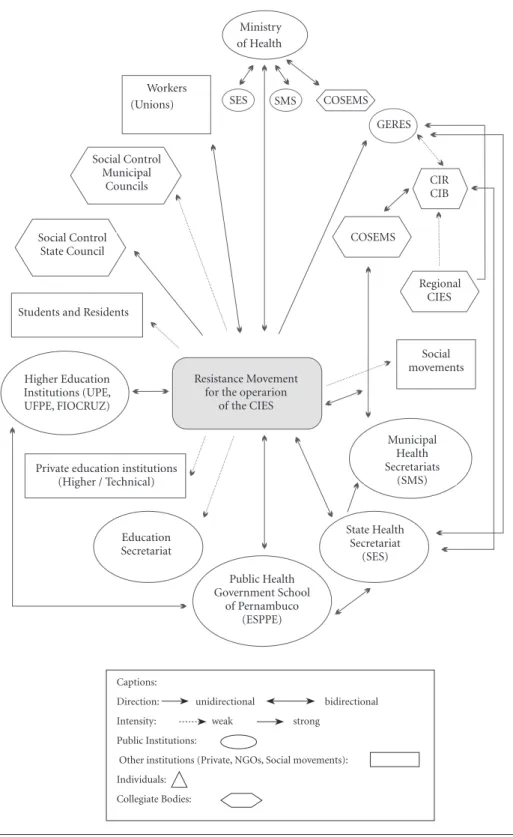
The reflection generated by these questions was transposed to drawings, in order to map the relationships for each experiment, according to representations shown in captions of Figure 1. This resource showed great dialogical potential throughout the research and produced diagrams that show the complex social relationships un-derlying PHE, including human and financial resource flows.
Figure 1 is the reproduction of a diagram de-veloped at the Recife Workshop, which demon-strated the full understanding of the method-ological proposal and allowed the participants themselves to perceive, in a reflexive process, the complex relationships in which such experienc-es are involved. In addition, we were aware that the workshop time would not allow people to
“drown in details”18, but that it would not be
pos-sible to ignore them either. For this reason, the use of the diagram was pertinent, as suggested by Becker on examining the use of ““thinking with
drawings” in surveys18.
Results
Conceptual Basis of Permanent Health Education
C
ar
doso MLM
Figure 1. Institutional relationships of PHE experience identified in the School of Public Health of Pernambuco.
Source: Pesquisa A Política Nacional de Educação Permanente em Saúde: análise dos fatores condicionantes à sua implementação, em diálogo com as experiências das Escolas de Saúde Pública, CNPq/ENSP/Fiocruz, 2013-2016.
Captions:
Direction: unidirectional bidirectional
Intensity: weak strong
Public Institutions:
Other institutions (Private, NGOs, Social movements):
Individuals:
Collegiate Bodies:
SES SMS COSEMS
GERES Ministry
of Health
Workers (Unions)
Social Control Municipal
Councils
Social Control State Council
Students and Residents
CIR CIB
COSEMS
Regional CIES
Social movements
Municipal Health Secretariats
(SMS)
State Health Secretariat
(SES) Public Health
Government School of Pernambuco
(ESPPE) Education
Secretariat Private education institutions
(Higher / Technical) Higher Education Institutions (UPE, UFPE, FIOCRUZ)
Resistance Movement for the operarion
aúd
e C
ole
tiv
a,
22(5):1489-1500,
2017
promotion of dialogue between education and
health services2.
Despite advances, there remained a critique to the hegemonic education model based on timely courses that aimed at updating, qualifying or even specializing a specific professional cate-gory. They occurred outside the work environ-ment and used transmissive methods of knowl-edge.
In the words of Paulo Freire19,
transmis-sion-based pedagogic methods predominate the lecturing relationships, in which educating be-comes an act of depositing, classified by him as “banking education”, since knowledge would be a kind of donation of those who know (educators) to those who do not know (students). In this way of educating, teachers have the last word, leaving students with the role of passive acceptance of
the content that is “deposited” in them19.
Ribeiro and Mota20 explain the impact of this
transmission model:
Professionals are elevated to the paradise of ‘how it should be’, translation of the truth of accu-mulated and updated scientific knowledge applica-ble in a kind of universal and unique representa-tion of patients and services. When they return to their work, however, they find themselves confront-ed in their everyday realities with the impossibility of applying the acquired knowledge20.
PHE draws on the use of active methodolo-gies of knowledge, contrary to the transmissive ones. It is, more specifically, a problem-solving pedagogy, based on the dialogic-dialectic rela-tionship between educator and learner, that is,
they both learn together21. In this conception,
to problematize means “to analyze the practice”, which presupposes to break with the individual logic, shifting to team analysis.
Davini21 says that problem-solving pedagogy
allows greater integration among professionals and between professionals and the community, seeking solutions, acting in both the profession-al and the affective sphere, strengthening sociprofession-al and professional commitments, as well as devel-oping group awareness and contributing to the strengthening of professional identities.
Another PHE important concept is mean-ingful learning, when knowledge is constructed taking into account the knowledge previously acquired by the learner, so that it makes sense in their daily practices. The concept also suggests that the transformation of professional practices be based on the critical reflection on the reality of the daily routine of real professionals, working in
the network of health services3.
Ribeiro and Motta20 reinforce this view:
“There is no learning if stakeholders are not aware of the problem and if they do not recog-nize themselves in their singularity”. Such action would imply to stimulate in these stakeholders/ workers transformations in their way of acting and thinking, in order to involve them actively in the dynamics of institutions, in a movement of knowledge and decisions horizontalization.
The PHE concept was already being de-veloped and disseminated in Brazil by the Pan American Health Organization (PAHO) in the 1980s and is now seen as a strategy for the reor-ganization of practices and policies for training, care and management in line with SUS princi-ples – Universality, Equity and Comprehensive-ness – and its guidelines for decentralization and
popular participation22. The operational
trans-lation taken as guiding reference of this strategy was called the “Four-Square Model of Permanent
Health Education”23, that is, teaching,
manage-ment, care and social control.
The structuring axis of PHE is the work cate-gory; this is where practices carried out both in-dividually and collectively are foreseen, presup-posing the active participation of workers in their own learning process. This category is the focus of the management and structuring of the ser-vices, attuned to the transformations of the work world, either adapting to new labor relationships
or to the growing demands of the health system3.
Considering the complexity of the Brazilian
health system, Ceccim24 affirms that PHE is
nec-essary for the consolidation of practices aimed at solving the health problems of local populations. The expected result is workspace democratiza-tion, development of the learning and teaching capacity, search for creative solutions to prob-lems, teamwork development, improved health care quality and humanization of service.
Different authors assign to the PHE model the ability to cause changes in work processes.
Sarreta25 says that the differential is the collective
construction of new work strategies commit-ted to the principles and guidelines of the SUS and the needs of each region through the prob-lem-solving of daily practices, aiming to recover actions and develop autonomy and participation.
Rovere26 points out that PHE presupposes a
adopt-C
ar
doso MLM ing such values, the PNEPS seeks to break with
health system verticalization, creating arenas for confronting problems.
PHE experiences in Public Health Schools
In the research workshops, we asked partic-ipants to select experiences that they identified as PHE. At the end of the five workshops, we collected 25 experiences: 15 of them referred to courses, while four addressed political articula-tions and six institutional processes of Schools or State Health Secretariats.
PHE in the Courses
The main courses are of several types: im-provement, training, pedagogical training, resi-dency, specialization and masters’ degree. These courses serve a wide range of audiences: pro-fessionals from the state and municipal health secretariats, community health workers, en-demic diseases’ control agents, municipal and state councilors, social movements, tutors and residency preceptors. As for the format, there are both classroom and distance education courses, regionalized courses (such as the case of some residencies) and even courses in the workshop format. The chart shown in Figure 2 summarizes responses given by workshop participants when asked about the aspects that characterize the courses described as PHE experiences.
Data collected allowed clustering in three large blocks: relationship with the service, peda-gogical practices and regionalization.
The relationship with services was highlight-ed in all the experiences presenthighlight-ed. Many courses were designed from the demand for services or from specific groups, such as the Landless Move-ment, in Minas Gerais. Several initiatives aim to transform work processes or, as final work, the elaboration of intervention projects in the health facilities in which the students work, as well as collective and individual proposals. Work is the structuring axis of PHE and the reflection from the practice is highlighted as a fundamen-tal aspect of these courses. However, on-service training faces three major challenges: managers’ lack of knowledge and dismissal of PHE; tutors and teachers lack of understanding about PHE’s pedagogical principles – which hampers innova-tions and often leads to transmissive pedagogical practices with preset content and not suited to the local context; and the precarious work rela-tionships that lead to discontinuous presence of
students-workers and tutors/preceptors at the workplaces, in the case of some courses. As em-phasized in one of the workshops, the human re-sources policy applied in the SUS in recent years, anchored in the Social Health Organizations (OSS) and temporary contracts, is contradictory to the PHE policy.
In the research, it was evident that the ped-agogical practices used in the courses constitute the main identification of the PHE. The so-called “active methodologies of knowledge”, based on the problem-solving pedagogy – that seek critical reflection from practical questions, discussed in a team, in dialogue with theory – and in meaning-ful learning – that considers previous knowledge and experience of participants – are the hallmark of all courses. These methodologies lead to pro-posals for intervention in practice.
Distance Learning (EaD) was underscored as a teaching modality with a potential for exchange and integration. On the other hand, monitoring and evaluation processes were nonexistent in courses, especially regarding the impact on par-ticipants’ own practice, as well as on the health indicators of the serviced population, in contra-diction to what is provided in the two ordinances that implement the PHE policy. Work with mul-tidisciplinary teams is also a rare aspect in the course experiences analyzed. There are still train-ing for specific categories of workers, especially those that are at the extremes of social valoriza-tion, such as Community Health Workers and physicians. It is also common to find manage-ment professionals separated from health pro-fessionals. Physicians hardly participate in mul-tidisciplinary pedagogical proposals. A striking example is multi-professional residencies where doctors are not included, since the category has a specific residency. There are some efforts to work with multidisciplinarity, such as the Care-givers of Long Stay Institutions for the Elderly, in Goiás. This aspect deserves more attention in the evaluation processes of such experiences. On the one hand, it is necessary to understand how to deal with the power relationships inherent to health teams, and, on the other hand, to analyze the extent to which PHE contributes to a more egalitarian appreciation of all workers and their perceptions of health, care and management.
aúd
e C
ole
tiv
a,
22(5):1489-1500,
2017
it was criticized, especially when dealing with “ready-made” courses from the MS, with single didactic material and closed curricula, since they do not allow an adaptation to local and regional realities and needs. The effort to consider local conditions and cultural diversity builds on meth-odology and teachers, tutors or preceptors who have not always been prepared for this pedagogi-cal conception. The need for the contents of such courses to be constructed more horizontally and negotiated between MS and schools was strongly emphasized.
A deadlock is the issue of certification, since this is necessary for the valorization of the work-ers’ curriculum, but which, on the other hand, is linked to pedagogical principles that conflict with those of Permanent Education, such as closed curricula, external control, workload, evaluation type, among others.
PHE in Political Articulations and Institutional Development
The political processes experienced by the schools identified as PHE experiences are var-ied actions. As examples of such experiences, we mention the participation of the Curitiba school in the Conference of Local Development and in the implementation of the SUS Research Pro-gram, and the elaboration of the State PHE Plan and the Movement of Resistance for the Opera-tion of CIES in Pernambuco.
These were processes considered as PHE practices by Schools, which justified them by bringing some of their essential characteristics: participatory and collective planning; articu-lation between different stakeholders, such as health professionals, users and managers, or even different sectors of public power, such as educa-tion and health; recognieduca-tion of regional particu-larities; and proposals for intervention in
reali-Figure 2. Characteristics of PHE identified in the courses of Public Health Schools.
Teaching-service integration Service demand Reflection from practice Intervention projects Problem-solvind Partipatory planning Articulation with users and managers Recognizing regional reality Theoretical training Active methodologies Behavioral change Exchange of experiences Diversity of participation Improving the health of the population Evaluation and monitoring Regionalization/decentralization Learning to deal with chance Faculty training Learning materials suitable for the region
PHE c
har
act
er
ist
ics
0 1 2 3 4 5 6 7 8 9
C
ar
doso MLM ties. Schools are important political agents in the
field of health in their states and municipalities and, as such, carry the PHE principles in their actions, to the extent that they absorb them as pedagogical practices inseparable from their po-litical action.
Initiatives focused on the institutional de-velopment of the Schools themselves are also re-ferred to as PHE’s practices. The following were mentioned: in Goiânia, management of work processes and updated legislation; in Palmas, pedagogical workshops; in Curitiba, the pro-cess of selection of PHE projects; in Recife, the structuring of the School of Pernambuco and the coordination of a research program for the SUS in the state. Participative planning and service demand were the main characteristics, as well as the process of reflection from the practice, prob-lem-solving and exchange of experiences. Ap-preciating the regional reality was emphasized in the School of Pernambuco’s structuring process, for example. With regard to the so-called “Four-Square Model of PHE”, it is evident that social control is the most fragile part of this process. Few experiences include articulation between managers and health professionals, and few con-sider social control bodies.
Policy’s Institutionality
In order to understand, in the light of the results of this study, how Schools experienced in their states and in their educational and man-agement practices the implementation of the National PHE Policy and how they appropriated and processed, in their territories, PHE’s princi-ples and concepts, we need to first understand how formulation and national implementation of such a policy occurred – or how it was first attempted.
The conduction and induction of PNEPS, in accordance with Ordinance Nº 198/2004, was designed to be implemented in a loco-regional manner through the Permanent Health Educa-tion Hubs (PEPS), which should: identify train-ing needs; mobilize the traintrain-ing of managers, actions and services for the integration of the care network; propose policies and establish in-ter-institutional relationships; formulate training and trainers policies; establish the agreement and negotiation between management, social control, trainers, students and services, in addition to es-tablishing cooperative relations. Managers, stu-dents, social control stakeholders, health work-ers, associations and other service representatives
and educational institutions4 could participate in
the PEPS. The implementation of the number of hubs in each state of the Federal Government fol-lowed a criterion of the state itself, agreed in the Bipartite Interagency Commission (CIB), with subsequent approval in the State Health Council (CES), as shown in Figure 3.
Each state educational institution presented its projects in the Regional Hubs. If approved, they were again submitted to the State Hub for later approval by the CIB and CES. Upon approv-al, the project was forwarded to the MS, which decentralized funds directly to the institution.
Three years later, in 2007, the Ministry of Health reissued the PNEPS, adapting it to the operational guidelines and the Health Pact reg-ulation implemented the previous year, through Ordinance Nº 1996. The Pact reinforces the im-portance of the planning and management tools of the SUS, advances the construction of specific legal instruments and places great emphasis on regionalization and the articulated and solidary
commitment of federated entities5.
Such a reorientation has caused more chang-es in the organization of politics in the statchang-es than in its conceptual appropriation. Hubs would continue to be composed of the same stakehold-ers, but would be reorganized into Teaching-Ser-vice Integration Centers (CIES), now coordinat-ed by the of Regional Management Collegiates (CGR) and guided by the Regional Plan of Ac-tion for Permanent Health EducaAc-tion (PAREPS), as shown in Figure 4.
The idea would be to break with the logic of buying and paying educational procedures – the so-called “course counter” – a practice that would have been installed in the Hubs. Another fundamental change was the decentralization of the federal resource of the National Fund for the State Health Funds, aiming at the implementa-tion and execuimplementa-tion of the Permanent Health Ed-ucation actions. Thus, the CIES should construct the projects and strategies of intervention in the field of the workers development training to be submitted to the CGR for approval at the CIB. There was an intention to increase the regional capacity for intervention in the area of Health through Permanent Education as a guide to the
Health Education practices5.
Institutionality experienced in Schools
aúd
e C
ole
tiv
a,
22(5):1489-1500,
2017
further implementation of the policy. When de-centralization of funds was assured, these were guided by priority lines of action, provided by Ordinance Nº 1996/2007, which, however, did not always correspond to the needs of the states, requiring negotiation power between federal and state management for adaptation to the regional health reality.
Nowadays, in addition to these funds, Schools have counted on the health secretariats, especially state secretariats to collaborate and support their actions, and with the direct negotiations with the CIBs, in detriment of the agreements in the CIES.
Problems related to funding have triggered institutional issues. If Ordinance Nº 198/2004 guaranteed financial decentralization between the MS and the institution after direct agreement in the Hubs, generating the aforementioned “counter logic”, the second Ordinance result-ed in an exacerbation of devices that endresult-ed up hampering access not only to resources, but also to the very experience of the policy in its basic principles.
The research identified the difficulty in the decentralization of the CIES in health regions, even because the state management itself found it hard to adapt to the new proposal for region-alization of the Health Pact. Hence, two findings became evident: the weakening of CIES as a set-ting for agreements or solidary co-management; and the replacement of this role by the CIB, which turned out be, for the Schools, an “easier way” to agree on and finance actions.
Another aspect to be highlighted refers to the composition of the CIES, when these exist, be-cause it is impaired in the representation of the stakeholders that compose them, especially in relation to workers and users, who could be rep-resented by the health councils. This gap unbal-ances the “Four-Square Model of PHE”, which is fundamental in the conception of PNEPS.
Research participants view Schools as fun-damental structures for the operation of the PNEPS, as well as, in some cases, an environment that houses the CIES and, in others, those re-sponsible for conducting the policy in the state.
Figure 3. Organization of the National Permanent Health Education Policy established by Ordinance 198/2004.
Source: Pesquisa A Política Nacional de Educação Permanente em Saúde: análise dos fatores condicionantes à sua implementação em diálogo com as experiências das Escolas de Saúde Pública, CNPq/ENSP/Fiocruz, 2013-2016.
Ministry of Health
Permanent Education Hub
Project Forwarded for Ratification
Returns the Project
CIB CES
Executive Secretariat Collegiate
A
ccr
edits and
Financ
es the P
ro
je
ct
Fo
rwar
ds P
ro
je
ct t
o
C
ar
doso MLM
Figure 4. Organization of the National Permanent Health Education Policy established by Ordinance Nº
1996/2007.
Source: Pesquisa A Política Nacional de Educação Permanente em Saúde: análise dos fatores condicionantes à sua implementação, em diálogo com as experiências das Escolas de Saúde Pública, CNPq/ENSP/Fiocruz, 2013-2016.
Ministry of Health
CIES
CIES
CIES
Regional Management
Collegiate CIB SES
$
$ PAREPS
In addition, they are aware of their relevance to society and to the strategic training of staff for the public health system. In turn, they resent that the MS does not recognize them as an inducing and legitimate space for the political discussion of PHE. Some reported the difficult communi-cation between the School and the national co-ordinators of the Policy, which is restricted only to the financial transfers of large pre-established programs.
In the Workshops, it was unanimous to in-dicate the lack of monitoring and evaluation of the impact of the actions, although the two Ordi-nances provide for the construction of a specific Commission for such purpose. Likewise, partic-ipants affirm that Health Education actions do not receive from the municipal or state manag-er the same importance of care actions. On the other hand, while funding was considered an important aspect, scarcity or lack of funds was not characterized as the main problem for the implementation of actions.
In spite of the obstacles and challenges posed for the implementation of PNEPS in their prin-ciples and guidelines, we identified that there is a broad domain of the concept and commitment to its political-pedagogical ideology for health training. More than that, there is also great con-cern regarding the future and directions of pol-itics, as well as regarding the Permanent Health Education itself.
Final considerations
If, in the guise of a spontaneous narrative, we gathered the main elements resulting from this research and resumed some concepts already mentioned in order to simply “tell what we have seen and learned”, we would certainly have two salient viewpoints: one on the very forms of do-ing, that is, of the relationships and processes oc-curring from (our) experiences in the workshops in the states; and the other, capable of producing an overview – although quite accurate, as would the eyes of an eagle see from the heights at the same time all the valley and the small prey that is hidden in the vegetation – about the loco-re-gional uses that Schools make of the devices of the PHE Policy and its concepts.
Initially suspicious and reticent – “yet anoth-er workshop about what we already know, yet an-other research where they will ask us some things and then go to their computers and worksheets to draw the obvious conclusions” -, Schools’ workers soon realized that the cold relation “re-searcher-informant” was not the one we used. When they saw themselves as interlocutors of a study that also (and especially) interested them, as teachers-researchers, participants gradually began to intervene in (and cause) dialogue.
aúd
e C
ole
tiv
a,
22(5):1489-1500,
2017
took place according to the principles of PHE – the opposite would seem to us an undesir-able idiosyncrasy, but we were not sure, at first, if we would achieve the expected results, mainly because the workshop days have become a sig-nificant learning moment for all. They also said that the dialogic methodology, as well as the “di-agrammatic” thinking we suggested for mapping institutional relations, provided the Schools with an accurate reflection on their own practices and the clearer visualization of their problems, strengths, management processes and pedagog-ical practices. According to many, “they had no idea of the complex relationships and the variety and diversity of experiences” they experienced day by day.
On the other hand, the second story deserves a backdrop. We know that the Ministry of Health formulated, implemented and induced the PHE Policy in the national territory. However, the MS itself ended up opposing to its own Policy, de-manding vertical courses, establishing guidelines in disagreement with needs and creating devic-es that somehow ended up unbalancing power relations. In addition, PHE’s funding has been successively reduced to the detriment of other priorities.
The good news is that PHE’s principles, bases and concepts were “accepted” and were definitely incorporated into the practices and activities of the Schools in their territories, in such a way that even non-PHE actions ended up being executed according to the principles of problem-solving, teaching-service dialogue, shared knowledge and experiences and meaningful learning.
Put simply, Schools seem to have believed more in PHE than the policymakers themselves, at the national level. They did not stop doing PHE just because funding subsided until it was suspended. Instead, they incorporated its pre-cepts into their institutional development ac-tions, assimilated concepts and methods, appro-priated them and transformed them into their own unique needs and possibilities.
Hence, what we perceive when confronted with the “life of Schools” in their local contexts is that they have been paving the way to become in-creasingly democratic institutions, building (and becoming themselves) foci of reflection, provid-ing the necessary arenas for creative copprovid-ing of problems in work reality. This is what we have informally called the “Permanent Health Edu-cation Culture” in the Brazilian Health Schools certainly has a very important role in this recent construction.
Collaborations
MLM Cardoso, PP Costa, DM Costa, C Xavier, RMP Souza contributed equally to the produc-tion of this paper.
Acknowledgments
C
ar
doso MLM References
1. Silva JA. Estratégias de qualificação e inserção de tra-balhadores de nível médio na área da saúde. In: Negri B, Faria R, Viana ALD, organizadores. Recursos Huma-nos em Saúde: Política, Desenvolvimento e Mercado de
Trabalho. Campinas: Instituto de Economia, Unicamp;
2002.
2. Costa PP. Dos projetos à política pública, reconstruindo a
história da educação permanente em saúde [dissertação].
Rio de Janeiro: Fiocruz; 2006.
3. Brasil. Ministério da Saúde (MS). Política de Educação Permanente e Desenvolvimento para o SUS - Caminhos
para Educação Permanente em Saúde. Brasília: MS; 2004.
4. Brasil. Portaria nº 198 GM/MS, de 13 de fevereiro de 2004. Institui a Política Nacional de Educação Perma-nente em Saúde como estratégia do Sistema Único de Saúde para a formação e o desenvolvimento de traba-lhadores para o setor e dá outras providências. Diário Oficial da União 2004; 13 fev.
5. Brasil. Portaria nº 1.996 GM/MS, de 20 de agosto de 2007. Dispõe sobre as diretrizes para a implementação da Política Nacional de Educação Permanente em Saú-de. Diário Oficial da União 2007; 20 ago.
6. Rede Brasileira de Escolas de Saúde Pública (RedEsco-la). Regulamento da Rede Brasileira de Escolas de Saúde Pública. Rio de Janeiro: Fiocruz; 2015.
7. Nunes T, Bicca A, Salazar F, Portela G, Furtado L, Car-doso ML, Pol P, Souza R. Educação em Saúde Pública/ Coletiva no Brasil: rede, sinergias e renovação. Rio de Ja-neiro: Fiocruz; 2013.
8. Xavier C. Vida de Escola - Educação e Comunicação. Rio de Janeiro: RedEscola/Ensp/Fiocruz; 2016 (não publi-cado)
9. Escola Nacional de Saúde Pública Sérgio Arouca (ENSP/ Fiocruz). Projeto REGESUS. Relatório Resumido da Pes-quisa nacional de Escolas de Saúde Pública. Inovação na
Educação em Saúde Pública com Diálogo e Parceria. Rio
de Janeiro: ENSP/Fiocruz; 2010.
10. Cardoso MLM, coordenadora. A Política Nacional de Educação Permanente em Saúde: análise dos fatores con-dicionantes à sua implementação em diálogo com as ex-periências das Escolas de Saúde Pública - Relatório Final
de Pesquisa. Rio de Janeiro: ENSP/Fiocruz; 2016 (não
publicado).
11. Ingold T. Making, growing, learning. Two lectures pre-sented at UFMG. Educ em Rev 2013; 29(3):301-323. 12. Tiveron JDP, Guanaes-Lorenzi C. Tensões do trabalho
com grupos na Estratégia de Saúde da Família. Psico
2013; 44(3):391-401.
13. Crotty MJ. The foundation of social research: meaning
and perspective in the research processs. London: Sage
Publication; 1998.
14. Guanaes C, Mattos ATR. Contribuições do movimen-to construcionista social para o trabalho com famílias na Estratégia de Saúde da Família. Saúde e Soc 2011; 20(4):1005-1017.
15. Fuks SI. La facilitación sistémica de procesos colecti-vos.“Artesanía de contextos” focalizada en la promoci-ón de la creatividad y de los procesos participativos en grupos, comunidades y redes. Rev IRICE 2009; 20:63-76. 16. Gracia TI. O “giro” linguístico. In: Iñiguez L, coordena-dor. Manual de análise do discurso em Ciências Sociais. Petrópolis: Vozes; 2004. p. 19-49.
17. Logos 2.5, Gerenciador de banco de dados textuais, © 1998/2006, Kenneth R. de Camargo Jr.
18. Becker HS. Falando da sociedade Ensaios sobre as dife-rentes maneiras de representar o social. Rio de Janeiro: Jorge Zahar Ed.; 2009.
19. Freire P. Pedagogia do Oprimido. 17ª ed. Rio de Janeiro: Paz e Terra; 1987.
20. Ribeiro ECO, Motta JIJ. Educação Permanente como estratégia na reorganização dos serviços. Divulgação em
Saúde pra Debate 1996; 12:39-44.
21. Davini MC. Educación Permanente em Salud. Washing-ton: OPAS; 1995. (OPAS Serie PALTEX para ejecutores de programas de salud).
22. Brasil. Constituição da República Federativa do Brasil, 1988. Atualizada até a EC nº38, de junho de 2002. Rio de Janeiro: Expressão e Cultura; 2002.
23. Ceccim RB, Feuerwerker LCM. O quadrilátero da for-mação para a área da saúde: ensino, gestão, atenção e controle social. Physis 2004; 14(1):41-65.
24. Ceccim RB. Educação Permanente em Saúde: desafio ambicioso e necessário. Interface (Botucatu) 2004/2005; 9(16):161-177.
25. Sarreta FO. Educação permanente em saúde para os
tra-balhadores do SUS. Franca: UNESP; 2009.
26. Rovere MR. Gestión de la educación permanente: una relectura desde una perspectiva estratégica. Educ. Med.
Salud 1993; 27(4):489-515.
Article submitted 07/07/2016 Approved 12/09/2016