Objective: This study aimed to assess the knowledge of puerperal mothers about the Guthrie test.
Methods: A total of 75 mothers who sought primary care between October 2014 and February 2015 were investigated. The form was applied by the main researcher and the data was analyzed, using descriptive statistics with Microsoft Oice Excel, and Statistical Package for Social Sciences (SPSS) programs. Association tests and statistical power were applied.
Results: Among the 75 mothers, 47 (62.7%) would have liked to receive more information about the newborn screening, especially regarding the correct sample collection period, followed by the screened morbidities. Most participants (n=55; 85.9%) took their children to be tested between the third and the seventh day of birth, as recommended by the Brazilian Health Ministry. Fifty-four women (72%) were unable to name the morbidities screened by the test in Minas Gerais, and they were also unaware that most have genetic etiology. The health professional who informed the mother about the Guthrie test was mainly the physician. This information was given prenatally to 57% of the cases, and to 43 % at the time of discharge from the hospital. The association test showed that mothers with higher education have more knowledge of the purpose and importance of the Guthrie test. The statistical power was 83.5%.
Conclusions: Maternal knowledge of the Guthrie test is supericial and may relect the health team’s usual practice.
Keywords: Pediatrics; neonatal screening; health education.
Objetivo: Identiicar o conhecimento das puérperas sobre o teste do pezinho.
Métodos: Foram investigadas 75 puérperas que buscaram atendimento na atenção primária no período de outubro de 2014 a fevereiro de 2015. Um formulário foi aplicado pela pesquisadora principal e os dados resultantes foram analisados por estatística descritiva por meio dos programas Microsoft Office Excel e Statistical Package for Social Sciences (SPSS). Foi feito teste de associação e determinado o poder estatístico.
Resultados: Das 75 puérperas, 47 (62,7%) gostariam de receber maiores esclarecimentos sobre o teste do pezinho, com destaque para o período adequado de coleta, seguido pelas doenças triadas. A maioria das participantes (n=55; 85,9%) levou seu ilho para realização do teste entre o terceiro e o sétimo dia de vida, conforme preconizado pelo Ministério da Saúde. Das puérperas, 54 (72%) não souberam citar quais são as doenças triadas pelo teste do pezinho em Minas Gerais nem sabiam que a maioria delas tem etiologia genética. O proissional de saúde que informou sobre esse teste foi um médico. Essa orientação ocorreu durante o pré‑natal em 57% dos casos e, na alta hospitalar em 43%. O teste de associação mostrou que as mães com maior escolaridade possuem maior conhecimento sobre a inalidade e a importância do teste do pezinho. O poder estatístico encontrado foi de 83,5%.
Conclusões: O conhecimento das puérperas sobre o teste do pezinho é supericial e pode ser relexo da atuação da equipe de saúde. Palavras‑chave: pediatria; triagem neonatal; educação em saúde.
ABSTRACT
RESUMO
*Corresponding author. Email: [email protected] (A.B.T. de Marqui). aUniversidade Federal do Triângulo Mineiro (UFTM), Uberaba, MG, Brazil.
Received on June 3, 2016; approved on October 28, 2016; available online on May 11, 2017.
KNOWLEDGE OF PUERPERAL
MOTHERS ABOUT THE GUTHRIE TEST
Conhecimento das puérperas sobre o teste do pezinho
INTRODUCTION
he Guthrie test, included in the Neonatal Screening Program (NNSP), aims at detecting infectious diseases and genetic charac-teristics, especially inborn errors of metabolism, asymptomatic at birth. his examination enables the early diagnosis and treatment of the patients with these diseases, in order to avoid damage to the child, such as intellectual disabilities.1-3 For the Guthrie test a
few drops of blood are taken from the heel of the newborn (NB), and collected on ilter paper. he correct period for the sample collection should not be less than 48 hours of protein feeding and should not exceed 30 days from birth; however, the ideal period would be between the third and seventh day of birth in newborns.2
In Brazil, the NNSP was regulated by Decree No. 822 of June 6, 2001, and deployed in three phases, according to the level of organization and coverage of each state, as a possibility to trace four diseases.4 In 2012, the fourth phase was deployed,
which included the additional screening for two more disor-ders, thus totaling six.5 he State of Minas Gerais, Southeastern
Brazil, was found in phase IV of the NNSP and identiies six diseases: phenylketonuria (PKU), congenital hypothyroidism (CH), hemoglobinopathies (Hb), cystic ibrosis (CF), con-genital adrenal hyperplasia (CAH) and biotinidase deiciency (BD).4,5 he good prognosis of the entities identiied by the
Guthrie test depends on early diagnosis, treatment, and mon-itoring since the irst months of the birth.6 It is worth noting
that in order to include the diseases to be investigated in neo-natal screening (NS), the following requirements must be met: if untreated, the disorder causes serious consequences for the health of the afected;there is a treatment that can substantially modify the natural history of the disease;the treatment is sig-niicantly more efective when deployed in preclinical phase of disease; thereshould be a screening test which is simple, ei-cient, and applicable on a large scale and low cost, and; the disorder should be common enough.3
he diseases detected by the Guthrie test show varied inci-dences, mostly in some Brazilian states. In the city of Maringá, Paraná state, in the period from 2001 to 2006, the incidence in relation to the number of live births (LB), were PKU – 1:20,529; CH – 1:2,281; Hb – 1:3,421; CF – 1:10,264 and BD – 1:6,843 of LB. In Santa Catarina, between the years 2004 and 2006, the fol-lowing incidences were reported: PKU – 1:28,862, CH – 1:2,876, CF – 1:5,121, Hb – 1:14,446, and for CAH – 1:11,655 of LB.8
he incidence of PKU was 1:28,309 and 1:33,068 of LB for the states of Tocantins9 and Mato Grosso,10 respectively. In those states,
incidence of 1:4,6329 and 1:9,44810 LB were reported to CH. he
Neonatal Screening Program of the Clinical Hospital of the School of Medicine of Ribeirão Preto (HCRP) at the Universidade de São Paulo (USP), Brazil, declared incidence of 1:2,595, 1:19,409 and 1:4,120 LB for CH, PKU, and Hb, respectively.11
he Guthrie test represents an action of preventive pedi-atrics, and the largest initiative of the Uniied Health System (SUS) in the area of genetics. It is characterized by ive steps: universal screening, active search, conducting diagnostic tests, treatment, and periodic evaluation of the system. In the irst step, all infants should be screened and the actions of the nurs-ing team, the obstetrician, and pediatrician are fundamental. hese professionals are responsible for the guidance to parents regarding the existence of the Guthrie test, the beneits of early detection of diseases to be sorted and what they are, the risks for the newborn not submitted to the test, the appropriate age for its implementation, the need for diagnostic tests for those who are positive in the screening, the possibility of false positive and false negative and the process of monitoring and receiv-ing the results. he second stage comprises the active search, characterized by monitoring results and by the location of the newborn and his family, especially if the result of the screen-ing is changed. In the third step diagnostic tests are performed in which positive results are diferentiated from the negative results. he treatment is the fourth step, usually carried out throughout life, and monitored by a multidisciplinary team of referral service in Neonatal Screening. he ifth step is a criti-cal evaluation of the system, which should be constant because it allows analyzing the efectiveness of NS.3 Some published
studies have shown low understanding of the theme Guthrie test, both among health professionals12,13 and parents.6,14-18
his study presents the following guiding question: what do mothers know about Guthrie test? Considering that moth-ers are in charge of taking care of newborns, this study is jus-tiied by the importance of measuring their knowledge of the Guthrie test, because only a correct understanding, and in a timely manner, will encourage them to take their children to the sample collection event in the appropriate period, which would avoid subsequent sequels, especially the intellectual dis-abilities. Added to this, the inlow of appropriate information will inluence positively mother’s behavior to ensure the pro-motion of health and the welfare of their children. hus, the aim of this study was to identify the knowledge of the puer-peral women about the Guthrie test.
METHOD
his is a study of the descriptive, cross-sectional, and quan-titative approach. he data were obtained after approval of the project by the Human Research Ethics Committee at the
153 to February 2015, at the Center for Comprehensive Women’s Healthcare of the municipality of the state of Minas Gerais.
he inclusion criteria were as follows: a woman over 18 years of age who had given birth recently and her child was up to 40 days of age. In addition, she had accepted to participate in the research by signing the informed consent form (ICF). he age of the neonate was based on the fact that the postpar-tum period lasts approximately six weeks after the birth and, in this short interval, the information provided by the mothers would be more reliable due to the proximity of the period rec-ommended by the Ministry of Health (MOH) to perform the examination. herefore, we included 75 women who fulilled the inclusion criteria and who sought medical care in primary care, especially for aid in the management of breastfeeding during the data collection period. hose who were excluded did not meet these criteria.
A form for data collection was elaborated by the researchers, using as a model based on the results of scientiic articles that have been published on this topic and validated among mem-bers of our research group. he choice of the form is justiied because the questionnaire was illed out by the researcher and had greater acceptance, as the mother had her son in her arms. he same person administered the questionnaire to all women who had recently delivered. he questionnaire contained closed questions, some dichotomous variables (“yes” or “no”) and other of multiple-choice. he open questions were restricted to per-sonal information of the mother –age and contact telephone number – and of the neonate –dates of birth of the child and data collection. he form was composed of two parts: socio-demographic characterization and understanding of the puer-peral women about the Guthrie test. he interviewees had its identity preserved, being identiied by means of numbers.
he data were tabulated and analyzed by means of descrip-tive statistics with the programs Microsoft Oice Excel and the Statistical Package for Social Sciences(SPSS) version 21.0. To analyze the association between age, education, number of children, and income with the correct answers for purpose and importance of the Guthrie test, the chi-square test was used, adopting the signiicance level of α=0.05. In order to
deter-mine the statistical power, with the sample size of 75 mothers, the variables importance of the test and education were used, and the signiicance level of α=0.05 was applied.
RESULTS
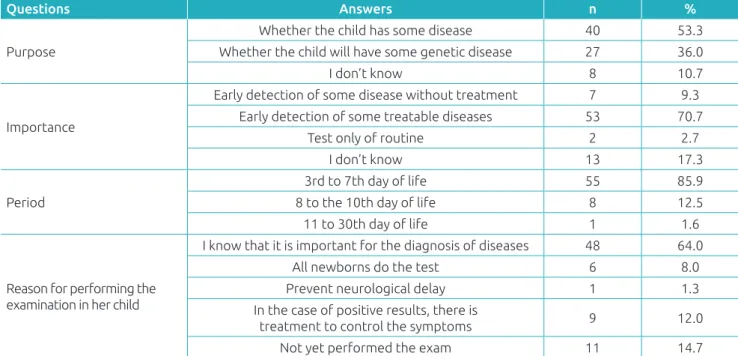
Table 1 shows the sociodemographic characterization of the puerperal women investigated. With respect to the interview-ees’ knowledge of the Guthrie test, the results obtained for this category are shown in Tables 2 and 3. Almost all (74; 98.7%)
women are aware of the importance of the test for their child, and the majority (64; 85.3%) already performed the examination on their sons, whereas few (11; 14.7%) are yet to do so. Although most of them believe the test is import-ant, 15 participants reported not knowing the importance, or that the Guthrie test is a routine examination. In relation to the health professional who provided information about the Guthrie test, the majority mentioned a doctor – cited by 45 women (60%) – followed by nursing staf (nursing assistant, licensed practical nurses, and nurses) –mentioned by 30 of them (40%). When questioned about the diseases screened through the Guthrie test, 54 (72%) did not know how to quote them. Only few women partially reported the
Table 1 Sociodemographic characterization of 75
puerperal women investigated.
Variables n %
Age (years)
18 to 23 15 20.0
24 to 30 32 42.7
31 to 36 20 26.7
37 to 42 8 10.6
Marital status
Married 43 57.3
Single 17 22.7
Lives along with the companion 14 18.7
Divorced/separated 1 1.3
Education
Basic Education 6 8.0
Education (includes technical course) 41 54.7
Higher Education 18 24.0
Graduate School 10 13.3 Monthly family income
Up to BRL 1,000.00 14 18.7 BRL 1,000.00 to BRL 2,000.00 23 30.7 BRL 2,000.00 to BRL 3,000.00 16 21.3 BRL 3,000.00 to BRL 4,000.00 5 6.7 More than BRL 4,000.00 17 22.6 Women who contributed
to the family income 55 73.3 Number of children
1 52 69.3
2 14 18.7
3 7 9.3
diseases that are detected by this test. hese results are pre-sented in Table 4. With regard to the occasion the puerperal women received guidelines, 57% reported having received them during the prenatal care and 43% at hospital discharge. he quality of the information received was considered good for 45% of them.
In the analysis of the association of the mothers’ knowledge of the purpose and importance of the Guthrie test, with the variables such as age, number of children, income, and schooling, only the latter exhibited statistical signiicance. With respect to the purpose of the Guthrie test, it was observed that, of the 47 women with secondary education, 11 (23.4%) of them answered correctly to
Table 2 Women’s knowledge of the Guthrie test.
Questions Answers n %
Heard about
neonatal screening Yes 32 42.7
Heard about Guthrie test Yes 75 100.0
The Guthrie test is
Required 64 85.4
Optional 4 5.3
I don’t know 7 9.3
Need for further clariication
on the Guthrie test Yes 47 62.7
Issues that I would like to know in more detail*
Diseases that can be detected 44 58.7 What is the purpose of the test 32 42.7 Information on how to proceed if the result is positive 36 48.0
Adequate period for sample collection 74 98.7
The Guthrie test is performed by*
Collection of blood from the foot of the newborn 72 96.0 Collection of blood in the leg by venous puncture 5 6.7
Stamp of the foot of child/don’t know 2 2.7
%: in relation to the total number of responses in each variable: Guthrie test; NS: neonatal screening; *in this question, the mother could indicate more than one answer.
Table 3 Women’s knowledge of the purpose, the importance, the period of completion, and reason that led her
to perform the Guthrie test in his son.
Questions Answers n %
Purpose
Whether the child has some disease 40 53.3 Whether the child will have some genetic disease 27 36.0
I don’t know 8 10.7
Importance
Early detection of some disease without treatment 7 9.3
Early detection of some treatable diseases 53 70.7
Test only of routine 2 2.7
I don’t know 13 17.3
Period
3rd to 7th day of life 55 85.9 8 to the 10th day of life 8 12.5 11 to 30th day of life 1 1.6
Reason for performing the
examination in her child
I know that it is important for the diagnosis of diseases 48 64.0 All newborns do the test 6 8.0 Prevent neurological delay 1 1.3 In the case of positive results, there is
treatment to control the symptoms 9 12.0
Not yet performed the exam 11 14.7
155 the questions, whereas among 28 women who were more edu-cated, 16 (57.1%) answered correctly, thereby indicating a signif-icant association (p=0.003). With regard to the importance of the Guthrie test, among 47 interviewees who had completed second-ary education, 28 (59.6%) of them answered correctly and, among the 28 with higher education or more, 25 (89.3%) answered cor-rectly, thereby indicating again a signiicant association (p=0.006). In other words, more educated mothers have greater knowledge of the purpose and importance of the Guthrie test. he statistical power was found to be 83.5%, which is appropriate to the stan-dards commonly used for determining the sample size.
DISCUSSION
he scientiic literature generally refers to neonatal screening as synonymous to the Guthrie test, 15,17-19 and this reveals a
mis-understanding in the deinition of those terms. he Guthrie test is one of the tests included in the NNSP, which also covers the hearing screening test, the vision screening or the red relex examination, cardiac screening or pulse oximetry, and the lingual frenulum evaluation. All mothers have heard about the Guthrie test, thus corroborating the data available in the literature.14,17,19
However, most people are not aware of NS, which show thereby the need to clarify to these mothers the association between both. With regard to the test characteristics, the majority of the interviewees were aware it is mandatory. his obligation was established by Law no. 8.069/1990, and corresponds to the Statute of Children and Adolescents (ECA). All mothers men-tioned that the test is important for the health of the child, which corroborate the literature.6,14,16 his examination detects
diseases that could lead to neurological delay, among other changes. hus, upon diagnosis, it is possible to establish the early treatment, thereby preventing damage to the newborn.
An interesting inding of the study was the fact that approxi-mately 63% of the puerperal women would like to receive further
information about the Guthrie test, with emphasis on the period appropriate for the sample collection, followed by the diseases screened. his inding is consistent with a previous study, which showed that 44% of the participants would like to have more information about the subject.6 In our study, despite not
know-ing the appropriate period, the majority of participants (85.9%) took their children for the test between the third and seventh day of birth, as recommended by the Ministry of Health. his sit-uation also occurred with mothers who went to the Municipal Health Centers of Rio de Janeiro.15 One possible explanation for
this result is the guidance provided by health professionals when they were discharged from the hospital after delivery. his guid-ance consisted of alerting the mothers to take their children for the test as soon as possible, without however specifying the appropriate period.18 he mother’s unawareness about the appropriate time for
the completion of the test is evident in the scientiic literature.16-20
However, in relation to the information on the Guthrie test, a recent study conducted in Rio Grande do Sul showed that moth-ers would like to know why the Guthrie test is carried out, how the test procedure would be and what are the diseases detected.18
In our study, mothers did not know what are the diseases investigated by the Guthrie test. hese data corroborate those already seen in the literature.6,16,18,20 A study conducted at the
Municipal Health Center of Rio de Janeiro showed that 40 (80%) women who were interviewed did not know the names of the diseases screened, whereas 5 of them (10%) knew the name of at least one disease and the other 5 (10%) reported wrong dis-eases.20 he diseases that the women knew the most about were
the Hb and the PKU. A recent study conducted in São Carlos, a city in the interior of São Paulo state, Brazil, with 119 mothers of children with altered screening test for Hb, showed that 96.6% (n=15) of them were informed about the adequate period for the sample collection for the test and only 4 (3.4%) were informed about the diseases that would be investigated and about the risks of not performing the test.21 his same study analyzed the
infor-mation received by mothers in primary health care, at the time of sample collection for the Guthrie test. Of the total of 119 moth-ers, only 34 were informed of how the test was performed and 12 of them, on the characteristic of the screening, which implies the need to carry out further tests.21
Regarding to the purpose of the test, in this study, a sig-niicant number of interviewees replied that the test aimed at detecting a disease. his suggests that mothers do not know that the majority of the diseases investigated bear genetic etiol-ogy and that, therefore, if any disease is detected, there is a risk of recurrence among siblings. his fact was also observed in a study conducted in the city of Cáceres, Mato Grosso, Brazil, in which the participants have associated the Guthrie test with the discovery of diseases in general.17
Table 4 Diseases investigated by Guthrie test, according
to the report of the puerperal women.
Disease* n %
Sickle cell anemia and
other blood disorders 14 29.8 Phenylketonuria 10 21.3 Congenital hypothyroidism 8 17.0
Cystic ibrosis 7 14.9
Congenital adrenal hyperplasia 4 8.5
Biotinidase deiciency 4 8.5
he mothers investigated, emphasized the importance of the Guthrie test to detect diseases for which there is treatment. his inding was very important, considering that the NNSP was established to identify early incurable diseases, but they have a good prognosis if diagnosed and treated in the neonatal period. he main goal of the NNSP is the prevention and reduction of morbidity and mortality caused by diseases screened.2,4 A
sur-vey with 55 multiparous mothers in the state of Mato Grosso, showed that a small group (6.1%) associated the test with the discovery of diseases and the completion of treatment, but with a focus on the cure.17 In our study, only one mother stated that
the test prevents neurological delay, that is, the preventive char-acteristic of the Guthrie test was therefore compromised.
he majority (91%) of the puerperal women responded that the Guthrie test is performed by means of collecting blood from the foot of the newborn. his result was expected due to the name of the examination. A few mentioned the possibility of blood collection by venipuncture. In this sense, it is neces-sary to clarify the possible locations and forms for sample col-lection of biological material.
In this study, the healthcare professional who communicated more about the Guthrie test was the doctor, a inding that is consis-tent with the literature.15,19,22 Delvivo et al.,22 for example, showed
that the guidelines were given by medical professionals in 77% of cases, and by nurses, in 23% of them. An alarming result was the fact that only 3% of those mothers received adequate guidance on the Guthrie test. However, a recent survey showed that, in 93.3% of cases, the nurse was the health care professional responsible for the provision of information about neonatal screening to mothers, and the physicians were responsible for only 5.9% of the cases.21
In another study in the city of Cáceres, Mato Grosso, Brazil, 51% of mothers reported having received information from nurses and 22.4% of them from physicians.17
As for the orientation on the Guthrie test, the ideal is to be performed during the prenatal, because during this period the pregnant woman has more available time, is more attentive, and is able to better assimilate information. In the puerperal period, the woman is more concerned with the care of the neo-nate, such as feeding, hygiene, vaccination, and the adaptation to accommodate a new family member. At that time, the puer-peral women live diferent emotions that may lead to an overload, and which may inluence the guidance provided after discharge from the hospital. In our study, the guidance occurred primarily in the prenatal period (57%), and secondly at the time of dis-charge (43%). A qualitative study with seven primiparous puer-perae showed that the little and brief information they received were provided in the maternity ward.18 Regarding the prenatal
period, it is advisable to check the approach of this theme in the consultations due to its extreme importance for neonatal health.
he puerpera investigated, considered good quality of information received. Despite this result, the knowledge that was presented was supericial. A study carried out in Juiz de Fora, Minas Gerais, showed that only 3% of mothers received guidelines which were considered complete, and 62% rated the information as incom-plete and/or misleading.22
It is also worth noting that recent studies on neonatal hear-ing screenhear-ing were performed with nurshear-ing professionals23 and
mothers,24 addressing an approach similar to this study. A
quan-titative study with 80 mothers of infants who underwent the ear test for their children showed that almost all of them considered the test important, and were instructed to perform it; however, 51% did not know what the test would detect. he health pro-fessionals responsible for the guidance were the physicians (53%) and nurses (44%), which corroborates the data of our study.24
In this study, women with higher schooling had a greater knowledge of the purpose and importance of the Guthrie test. Although there is a relationship between education and income, this has not had signiicant inluence in the analysis. Multiparous women could demonstrate greater knowledge of the subject; however, in our study, the majority of them were primiparous (approximately 70%). However, the data from this study emphasizes the need for greater guidance to mothers about the Guthrie test, as it represents the greatest preventive pediatrics action related to genetics around the world. In Brazil, mothers who have good knowledge of the subject, contribute to the efectiveness of neonatal screening. his research is of signiicant relevance to the child’s health, because it is related to research on diseases among newborns.
he limitations of this study were the sample by conve-nience and the non-probabilistic sample. However, we pre-sented a description of how the sample was obtained aiming at addressing the credibility of the indings. Added to this, a statistical power above 80% ensures the reliability of the ind-ings presented. he questionnaire was not submitted to the pretest or pilot study, but appreciated by our research group in order to verify its applicability.
In summary, mother’s knowledge of the Guthrie test is super-icial and may be a consequence of the poor performance of the health care team. Our data emphasize the need to prioritize permanent education actions in health services that focus on the neonatal screening, thereby aiming to improve the quality of the care provided to the mother and the newborn.
Funding
his study did not receive funding.
Conflict of interests
157
REFERENCES
1. Souza CF, Schwartz IV, Giugliani R. Triagem neonatal de distúrbios metabólicos. Ciênc Saúde Coletiva. 2002;7:129‑37.
2. Brasil. Ministério da Saúde. Secretaria de Assistência à Saúde. Manual de normas técnicas e rotinas operacionais do programa nacional de triagem neonatal. Série A. Normas e manuais técnicos. 2nd ed. Brasília: Ministério da Saúde; 2004.
3. Leão LL, Aguiar MJ. Triagem neonatal: o que os pediatras deveriam saber. J Pediatr (Rio J). 2008;84:80‑90.
4. Brasil. Ministério da Saúde. Portaria n° 822, de 06 de junho de 2001. Institui, no âmbito do Sistema Único de Saúde, o Programa Nacional de Triagem Neonatal – PNTN. Brasília: Ministério da Saúde; 2001.
5. Brasil. Ministério da Saúde. Portaria n° 2.829, de 14 de dezembro de 2012. Inclui a fase IV no Programa Nacional de Triagem Neonatal – PNTN. Brasília: Ministério da Saúde; 2012.
6. Garcia MG, Ferreira EA, Oliveira FP. Análise da compreensão de pais acerca do Teste do Pezinho. Rev Bras Crescimento Desenvolv Hum. 2007;17:1‑12.
7. Luz GS, Carvalho MD, Pelloso SM, Higarashi IH. Prevalência das doenças diagnosticadas pelo Programa de Triagem Neonatal em Maringá, Paraná, Brasil: 2001‑2006. Rev Gaucha Enferm. 2008;29:446‑53.
8. Nunes AK, Wachholz RG, Rover MR, Souza LC. Prevalência de patologias detectadas pela triagem neonatal em Santa Catarina. Arq Bras Endocrinol Metab. 2013;57:360‑7.
9. Mendes LC, Santos TT, Bringel FA. Evolução do Programa de Triagem Neonatal no Estado do Tocantins. Arq Bras Endocrinol Metab. 2013;57:112‑9.
10. Stranieri I, Takano OA. Avaliação do Serviço de Referência em Triagem Neonatal para hipotireoidismo congênito e fenilcetonúria no Estado de Mato Grosso, Brasil. Arq Bras Endocrinol Metab. 2009;53:446‑52.
11. Magalhães PK, Turcato MF, Angulo IL, Maciel LM. Neonatal screening program at the university hospital of the Ribeirão Preto School of Medicine, São Paulo University, Brazil. Cad Saúde Pública. 2009;25:445‑54.
12. Benincasa TO, Oliveira CB, Zanoni IH, Lima SA, Martins DC. Triagem Neonatal: a percepção teórica da equipe de enfermagem da Unidade de Terapia Intensiva Neonatal. Rev Inst Ciênc Saúde. 2009;27:109‑14.
13. Acosta DF, Streling IS, Gomes VL. Triagem Neonatal: (Re) Pensando a Prática de Enfermagem. Rev Enferm UFPE on line.2013;7:572‑8.
14. Reichert AP, Pacífico VC. Conhecimento de mães quanto a importância do Teste do Pezinho. Rev Bras Enferm. 2003;56:226‑29.
15. Amorim JF, Souza MH. O conhecimento das mães acerca da Triagem Neonatal. R Enferm UERJ. 2005;13:27‑31.
16. Abreu IS, Braguini WL. Triagem neonatal: o conhecimento materno em uma maternidade no interior do Paraná, Brasil. Rev Gaucha Enferm. 2011;32:596‑601.
17. Santos EC, Gaíva MAM, Santos JG, Abud SM. O conhecimento de puérperas sobre a triagem neonatal. Cogitare Enferm. 2011;16:282‑8.
18. Al‑Alam AC, Soares MC, Meincke SM, Dilélio AS, Escobal AP. Entendimento das Mães acerca da triagem neonatal: um estudo qualitativo. J Nurs Health. 2012;1:75‑81.
19. Oliveira JG, Sandrini D, Costa DC, Serradilha AF, Parro MC. Triagem neonatal ou teste do pezinho: conhecimento, orientações e importância para a saúde do recém‑nascido. CuidArte Enferm. 2008;2:71‑6.
20. Salles M, Santos IM. O conhecimento das mães acerca do teste do pezinho em uma unidade básica de saúde. Rev Pesq: Cuidado é Fundamental Online. 2009;1:59‑64.
21. Silva CA, Baldim LB, Nhoncanse GC, Estevão IF, Melo DG. Triagem neonatal de hemoglobinopatias no município de São Carlos, São Paulo, Brasil: análise de uma série de casos. Rev Paul Pediatr. 2015; 33:19‑27.
22. Delvivo EM, Nazareth JB, Salvador M, Salimena AM, Dias IM. Teste do pezinho: desvelando o conhecimento das mães sobre o exame. HU Revista. 2012;38:45‑50.
23. Griz SMS, Barbosa CP, Lima TR, Menezes DC, Silva AR. Triagem auditiva neonatal: necessidade de divulgação para proissionais de enfermagem. Rev Ciênc Med. 2015;24:1‑10.
24. Jardim JB, Hahn GV. Triagem auditiva neonatal: conhecimento das mães sobre o teste da orelhinha. Pediatr Mod. 2014;50:453‑60.