" %
Rev Saúde Pública 2004;38(2):247-54 www.fsp.usp.br/rsp
Are severe occlusal problems more frequent
in permanent than deciduous dentition?
Má oclusão severa é mais freqüente na
dentição permanente do que na decídua?
Paulo Frazão, Paulo Capel N arvai, M aria do Rosário D ias de O liveira Latorre and Roberto Augusto Castellanos
Departamento de Prática de Saúde Pública da Faculdade de Saúde Pública da Universidade de São Paulo. São Paulo, SP, Brasil
Based on the thesis of doctoral presented on Faculdade de Saúde Pública da Universidade de São Paulo, 1999. Received on 3/6/2002. Reviewed on 17/3/2003. Approved on 28/11/2003.
Correspondence to: Paulo Frazão
Departamento de Prática de Saúde Pública Faculdade de Saúde Pública - USP Av. Dr Arnaldo, 715
011246-904 São Paulo, SP, Brasil E-mail: [email protected] Keywords
Malocclusion, epidemiology. Dentition, primary. Dentition, permanent. Prevalence. Meta-analysis. Cross-sectional studies. Dental health services.
D escritores
Maloclusão, epidemiologia. Dentição primária. Dentição permanente. Prevalência. Meta-análise. Estudos transversais. Serviços de saúde bucal.
Abstract
Objective
To determine the prevalence and severity of occlusal problems in populations at the ages of deciduous and permanent dentition and to carry out a meta-analysis to estimate the weighted odds ratio for occlusal problems comparing both groups.
Methods
Data of a probabilistic sample (n=985) of schoolchildren aged 5 and 12 from an epidemiological study in the municipality of São Paulo, Brazil, were analyzed using univariate logistic regression (MLR). Results of cross-sectional study data published in the last 70 years were examined in the meta-analysis.
Results
The prevalence of occlusal problems increased from 49.0% (95% CI =47.4%-50.6%) in the deciduous dentition to 71.3% (95% CI =70.3%-72.3%) in the permanent dentition (p<0.001). Dentition was the only variable significantly associated to the severity of malocclusion (OR=1.87; 95% CI =1.43-2.45; p<0.001). The variables sex, type of school and ethnic group were not significant. The meta-analysis showed that a weighted OR of 1.95 (1.91; 1.98) when compared the second dentition period with deciduous and mixed dentition.
Conclusions
In planning oral health services, some activities are indicated to reduce the proportion of moderate/severe malocclusion to levels that are socially more acceptable and economically sustainable.
Resumo
Objetivo
Analisar a prevalência e severidade de problemas oclusais em populações em idades relacionadas à dentição decídua e permanente, e efetuar uma meta-análise para estimar odds ratio ponderada para problemas oclusais comparando os dois grupos.
Métodos
" & Rev Saúde Pública 2004;38(2):247-54 www.fsp.usp.br/rsp Severe occlusal problems
Frazão P et al
Resultados
Aprevalência dos problemas oclusais aumentaram de 49,0% (IC 95% =47,4-50,6) na dentição decídua para 71,3% (IC 95% =70,3-72,3) na dentição permanente (p<0,001). O tipo de dentição foi a única variável estatisticamente associada à presença de má oclusão moderada/severa (OR=1,87; IC 95% =1,43-2,45; p<0,001). Sexo, tipo de escola e etnia não foram estatisticamente associados. A meta-análise mostrou que o odds ratio ponderado foi 1,95 na comparação da dentição permanente com a dentição decídua/mista.
Conclusões
No planejamento de ações e serviços odontológicos, algumas atividades são indicadas com a finalidade de reduzir a proporção de má oclusão moderada/severa para níveis mais aceitáveis socialmente e sustentáveis economicamente.
INTRODUCTION
The formation, maturation and wearing away of occlusion in deciduous and permanent dentition can be understood as points on the same continuum, the same phenomenon which undergoes constant change over time, whose ingredients or components act on, interact, and condition each other. Thus, the occlusal characteristics observed in both temporary and per-manent dentition are part of a single process referred to as growth and development of maxillary bones and maturing occlusion.3
Statements bearing out this process can be found in some scientific studies.15,19,20,22,24
Maloccluded teeth can cause the individual psy-chosocial problems related to impaired dentofacial esthetics; disturbances of oral function, such as mas-tication, swallowing, and speech; and greater suscep-tibility to trauma, accentuated periodontal disease or tooth decay related to malocclusion.16
Oral-facial development thus conceived can be di-vided into two main stages: an early stage and a more advanced one. The early stages of development start in the pre-natal period and continue until the total substitution of the temporary dentition by the per-manent one. Later stages include the phases from ado-lescence to the aging of the stomatognatic system.16
In the scientific literature, the number of epide-miological studies of malocclusion in both tempo-rary and permanent dentition is small, and only a few allow an approach for determining whether the preva-lence of occlusal problems in the secondary denti-tion is higher than that of the primary dentidenti-tion. Maloc-clusion has become subject of attention in some re-gions where dental caries on children is declining. Knowing whether these problems are more frequently seen in a certain period of childhood development
may help decision makers in planning and managing health systems.
The purpose of this study was to summarize evi-dence to answer the following question: Are occlusal problems more frequent and more severe at the age related to permanent dentition than at the age of de-ciduous dentition? If so, in what extent?
M ETH O D S
The study was conducted in two phases.
Phase 1
First, data from a schoolchildren’s oral heath sur-vey conducted in São Paulo, Brazil, in 1996, were examined. Estimates of caries prevalence were de-signed and included data from a multistage random sample of 2,491 schoolchildren aged 5 to 12 years. The sample subjects were randomly drawn from schools distributed throughout the city. The list of the educational units was retrieved from the “Secretaria de Educação do Estado de São Paulo” (Education Department of the State of São Paulo). Four strata corresponding to public and private pre-schools and public and private elementary pre-schools were created. Thirty schools were randomly selected in each stratum and 103 educational units distrib-uted in 58 city districts participated. Data regarding age, sex, type of school (public or private), and eth-nic group (African Brazilian, white, yellow or black) were collected.23
" '
Rev Saúde Pública 2004;38(2):247-54 www.fsp.usp.br/rsp
Severe occlusal problems Frazão P et al
ous anomalies generally regarded as unacceptable and affecting facial appearance, or a significant re-duction in chewing function, or impairment of speech; specifically, the presence of one or more of the fol-lowing conditions of the four anterior incisors: max-illary overjet estimated to be 9 mm or more; man-dibular overjet; anterior crossbite equal to or greater than a full tooth; open bite; midline shift estimated to be more than 4 mm; and crowding or spacing esti-mated to be more than 4 mm. The examiners followed a number of adaptations recommended by the Col-lective Oral Health research group of the School of Public Health of the University of São Paulo, in which no defined occlusal deviations in these criteria such as posterior crossbite (uni or bilateral), overbite or vertical crossing over above 2 mm, should be catego-rized as code [1] in order not to overestimate the maloc-clusion severity in the study population.
Before data collection, the examiners were cali-brated to increase agreement related to conditions found in the field. The inter-examiner error measured in this process was 26.7%. During data collection, 163 children (6.5% of the sample) were reexamined to calculate intra-examiner error, which was 4.9%.
To compare occlusal status between deciduous and permanent dentitions, 985 children aged 5 and 12 were investigated (response rate of 82.9%). Data on ages 6 to 11 was excluded from the database for two reasons: first, the sample size was practically twice as large for ages 5 and 12, and thus adequate for infer-ences concerning the population of those age groups for the whole city;12 and second, the transition period from temporary to permanent dentition could add confounding factors to the use of occlusal indexes since this period is marked by intense biological dy-namism5 which could increase the wide variation of opinions on occlusion status among professionals.17
Though inter-examiner error reached scores higher than recommended,25 it was observed that many of these discrepancies had occurred due to the diffi-culty of making a distinction between the variable categories “normal” and “mild”, as seen with other epidemiological instruments. As the main goal of the analysis was to compare the prevalence of more severe occlusal problems in the ages 5 and 12, and since accidental results are unlikely to occur after a great number of observations, this limitation of the measurement instrument was not considered detri-mental to the reliability of the results obtained given the sample size (n=985).
The Chi-square test and univariate logistic regres-sion model were used to analyze the relationship
be-tween moderate/severe malocclusion (Y=1) and no malocclusion and mild malocclusion (Y=0) and in-dependent variables (gender (X1), school (X2), eth-nics (X3) and dentition (X4)). The probability of mod-erate or severe malocclusion [Prob(Y=1)] was
esti-mated using the following logistic function:
where βi are the regression coefficients and the odds ratio (OR=exp(βi )).
The software packages used were C-sample at Epi Info 6.04b, developed by the US’s Centers for Dis-ease Control and Prevention, and Multiple Logistic Regression by Unconditional and Conditional Meth-ods (MULTLR), v. 07/89, developed by Nelson Campos Jr. and Eduardo L. Franco at the Ludwig In-stitute for Cancer Research, São Paulo.
Phase 2
During the second phase, research over the past 70 years was examined and some cross-sectional epide-miological studies were reanalyzed using meta-analy-sis.6 The problem explored was the effect observed in the probability of occurrence of malocclusion be-tween early development stages (mainly related to the deciduous dentition) and late development stages (mainly related to the permanent dentition). Two vari-ables were investigated in literature review to answer the study hypothesis: moderate or severe occlusal problems as an outcome variable, and age as prob-ably associated with the effect and representative of the development stages of interest in the study.
The studies were identified using the following keywords: malocclusion, epidemiology, schoolchil-dren, deciduous dentition, permanent dentition, in three databases: Medline of National Library of Medi-cine (http://www.ncbi.nlm.nih.gov/pubmed/), Lilacs (Latin American and Caribbean Literature in Health Sciences), from the PAHO/WHO Latin American and Caribbean Information Center in Health Sciences (http://www.bireme.br), and Bibliografia Brasileira de Odontologia (Brazilian Dentistry Bibliography), from the Information Center in Oral Health Sciences con-ducted by Documentation Service of the “Faculdade de Odontologia da Universidade de São Paulo” (Dental School of the University of São Paulo).
Given that surveys based on scientific studies listed in electronic databases are liable to miss relevant published studies1 and that conclusions may be
bi-) (
^
0
exp 1
1 )
/ 1 (
iXi i
X Y prob
p β β
+
-+ = =
# Rev Saúde Pública 2004;38(2):247-54 www.fsp.usp.br/rsp Severe occlusal problems
Frazão P et al
ased when the studies included in the meta-analysis do not represent all investigations carried out in the field of research,11 a thorough examination of all ref-erences listed in the first studies found was carried out as an alternative strategy to identify studies which could possibly be overlooked when only the elec-tronic means is used.
The main inclusion criterion for sectional studies was the selection of original scientific articles in which the same measurement instrument for occlu-sion was applied in population samples with age ranges related to deciduous and permanent dentition to allow for the post-stratification into two strata re-lated to the development stages. Six studies were in-cluded based on this criterion. Studies related to a certain occlusion development stage, e.g. early or late, were also included as long as they allowed for com-parison in time and space. When any two surveys matched this and each of them related to one type of dentition, both were included. Based on this crite-rion, surveys by the United States Health Statistics Division assessing the occlusal status of children aged 6 to 11 and adolescents aged 12 to 17 was in
the periods of 1963-65 and 1966-70, respec-tively, were selected and considered a single study for analysis. Data from the Third Na-tional Health and Nutrition Examination Survey in United States were not included as they did not have information about occlu-sal conditions near deciduous dentition. Rates related to moderate/severe malocclu-sion were considered whenever possible.
After the selection of studies, individual re-analysis was carried out. The results pre-sented by the authors were examined using contingency tables (2x2) in order to test the presence and intensity of the association between occlusal problems and type of den-tition. The relationship between these
vari-ables was analyzed using Chi-square test with Yates correction and the odds ratios of the outcome vari-able (and their respective 95% confidence intervals).
To calculate the weighted odds ratio it was first checked whether the odds ratios were homogeneous or not through the χ2 test, according to the following expression:
χ2 = ∑w
i (log OR – ORweighted) 2
where the degrees of freedom of χ2
crític = number of studies -1
Then, if odds ratios were homogeneous – which means that the different studies produced estimates corresponding to common effects – the fixed effect analysis method11 was applied and weighted odds ratios with their respective confidence intervals (95%) were calculated, according to the following statisti-cal expressions:
ORweighted = ∑ wi . ln(OR) / ∑wi
*Note: Subjects with skin between white and black presenting mixed traits not included in white, black or yellow categories w ere considered African-Brazilian.
Table 1 – Logistic regression analysis of moderate/severe malocclusion. São Paulo, 1996.
Variable Categories (N ) Prob (Y=1) O R 95% CI p ln L(p) p
(O R) (W ald) (χ2)
Sex 0: Men (483) 0.34
1: Women (502) 0.32 0.94 0.72-1.22 0.6223 -624.509 0.6223 [Prob (Y=1)=1/(1+exp (-0.6746 - 0.0668 X1)]
School 0: Private (483) 0.33
1: Public (502) 0.33 1.01 0.77-1.31 0.9605 -624.629 0.9605 [Prob (Y=1)=1/(1+exp (-0.7118 + 0.0067 X1)]
Ethnic groups 0: White (565) 0.32
1: Yellow (26) 0.42 1.57 0.71-3.48 0.2689 2: African-Brazilian* (333) 0.33 1.05 0.79-1.41 0.7162
3: Black (61) 0.39 1.39 0.81-2.39 0.2376 -623.434 0.4949 [Prob (Y=1)=1/(1+exp (-0.7603 + 0.4501 X1 + 0.0536 X2 + 0.3274 X3)]
D entition 0: Deciduous (490) 0.26
1: Permanent (495) 0.40 1.87 1.43-2.45 <0.0001 -614.154 <0.0001 [Prob (Y=1)=1/(1+exp (-1.0396 + 0.6257 X1)]
Figure 1 - Percentual distribution of schoolchildren according to occlusal status and type of dentition. São Paulo, 1996.
Percentual distribution of schoolchildren according to occlusal status and type of dentition. São Paulo, 1996.
51.0
28.7 22.9
31.5 26.1
39.8
0 10 20 30 40 50 60
Deciduous Permanent Type of dentition
%
No malocclusion Mild malocclusion
Moderate/severe malocclusion
#
Rev Saúde Pública 2004;38(2):247-54 www.fsp.usp.br/rsp
Severe occlusal problems Frazão P et al
where wi is the opposite of standard error square
C. I. (ORweighted) = ORweighted± 1.96 . SE (ORweighted)
where SE (ORweighted) =1 / ∑ wi
RESU LTS
The prevalence of any occlusal problems in-creased from 49.0% (95% CI =47.4%-50.6%) in the deciduous dentition to 71.3% (95% CI =70.3%-72.3%) in the permanent dentition (p<0.001) as shown in Figure 1.
Dentition was the only significant variable associ-ated to the severity of malocclusion (OR=1.87; 95% CI =1.43-2.45; p<0.001). Logistic regression analysis indicated that the risk estimate for the population with permanent dentition to have severe/moderate malocclusion grew from 26% to 40% as shown in Table 1. The variables sex, type of school, and ethnic dif-ferences between Whites and African-Brazil-ians were not statistically significant. Thus, the data was analyzed using only the uni-variate logistical regression model.
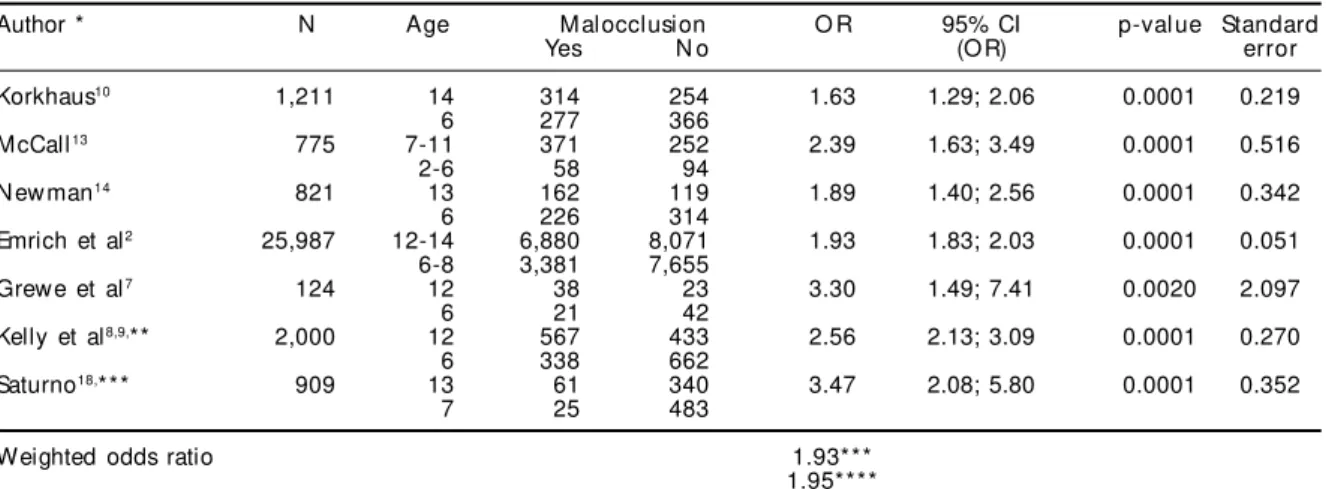
The meta-analysis was carried out based on major studies published over the twenti-eth century. In Table 2, samples, ages, and results of these studies are described. The es-timates showed that the proportion of the population aged 12 years and over with mod-erate/severe occlusal problems is much greater than the proportion of those cases in the younger population, supporting the
in-Figure 2 - Val ue of w ei ghted odds rati o and of odds rati o from
epidemiological studies on occlusal problems and type of dentition, and respective 95% confidence intervals.
Note: * all studies 1 include
** it excludes study by Emrich et al2 Korkhaus10
McCall13
Newman14
Emrich et al2
Grewe et al7
Kelly et al8,9
Saturno18
Weighted Odds ratio*
Weighted Odds ratio**
0 1 2 3 4 5 6 7 8
Odds ratio
Table 2 – Re-analysis of studies of malocclusion prevalence, according to author (year), sample size, compared ages, odds
ratio and confidence intervals, statistical significance, and standard error.
Author * N Age M alocclusion O R 95% CI p-val ue Standard
Yes N o (O R) error
Korkhaus10 1,211 14 314 254 1.63 1.29; 2.06 0.0001 0.219
6 277 366
McCall13 775 7-11 371 252 2.39 1.63; 3.49 0.0001 0.516
2-6 58 94
N ew man14 821 13 162 119 1.89 1.40; 2.56 0.0001 0.342
6 226 314
Emrich et al2 25,987 12-14 6,880 8,071 1.93 1.83; 2.03 0.0001 0.051 6-8 3,381 7,655
Grewe et al7 124 12 38 23 3.30 1.49; 7.41 0.0020 2.097
6 21 42
Kelly et al8,9,** 2,000 12 567 433 2.56 2.13; 3.09 0.0001 0.270
6 338 662
Saturno18,*** 909 13 61 340 3.47 2.08; 5.80 0.0001 0.352
7 25 483
Weighted odds ratio 1.93***
1.95**** *See the complete references in the list in the end of the article
**The cut-off value was TPI>3 ***Yes = only severe malocclusion ***All studies included
****Emrich et al2 study excluded
ferences generated by the occlusal analysis in the sample of schoolchildren aged 5 and 12 from the municipality of São Paulo.
It was observed that the problems increased on a scale of 1.29 to 7.41 times. The prevalence was higher in development stages related to permanent denti-tion. Two calculations were performed in the meta-analysis: the first one included all studies and the second one excluded the study by Enrich et al2 due to sample size difference when compared to other studies. The results obtained were similar (Table 2).
# Rev Saúde Pública 2004;38(2):247-54 www.fsp.usp.br/rsp Severe occlusal problems
Frazão P et al
1.95 [1.91; 1.98] when comparing the second denti-tion period with deciduous and mixed dentidenti-tion.
D ISCU SSIO N
Since 1928 studies have been published evaluat-ing the relationship between demographic character-istics and malocclusion in children. But none of them analyzed the effect observed in the odds of occur-rence of malocclusion between early and late devel-opment stages. Analyzing the data from a new per-spective helped clarify the role of type of dentition in the prevalence of malocclusion.
Meta-analysis is a research strategy that has been increasingly applied to help decision-making based on scientific evidence in health. Statistical analysis of an ensemble of studies, considered as primary units, focuses on the contrast and combination of results from different studies to identify both the consistent standards and the sources of discrepancies between the results. The importance of combining the data in this study was to have an estimate that summarizes the effect of time period or type of dentition on the severity of occlusal conditions. This may be useful to assess changes in the severity rate of malocclusion between deciduous and permanent dentition.
Only a handful of studies compared the frequency of occlusal problems between the two types of denti-tion. In fact, the number of studies that allows this comparison at similar time and place is small. In the last two decades the majority of the studies investi-gated populations in late stages of dental develop-ment. Moreover, it should be noted that the scientific production related to the epidemiology of maloc-clusion is virtually negligible both in the field of oral health epidemiology, where predominates stud-ies of dental carstud-ies and the effects of fluoride use, and orthodontics, mainly concerned with the study of cra-nial-facial characteristics in individuals/population groups and the effects of orthodontic/orthopedic therapy in patients. In both fields, instruments and methods used to determine the distribution of these problems and related factors never reached a reason-able minimal consensus in the scientific community. If even the concept of normal occlusion has been and still is object of never-ending arguments, since cra-nial-facial growth and development standards are not the same for different population groups, what can be said of the instruments and methods used in research? On one hand, the number of epidemiological investi-gations related to this phenomenon has been increas-ing in recent years; on the other hand, the application of more sophisticated methods of statistical analysis, design of more representative population samples and
use of occlusal indices adequate to the purposes of each study are very recent features.
The analysis of data related to the characteristics of occlusion obtained through the oral health survey conducted in 1996 with children in the city of São Paulo showed that the type of dentition had a strong association (OR=1.87; 95% CI =1.43-2.45; p<0.001) with more severe occlusal problems when age 5 re-lated to deciduous dentition was compared to age 12 related to permanent dentition.
Besides the fact that there is low correlation be-tween a single age and type of dentition, another limitation of this cross-sectional study was the lack of control for the orthodontic treatment variable. As only a little bit of schoolchildren has access to or-thodontic treatment this aspect probably did not influence the results observed between the two den-titions. It should be taken into account that, although the sample was sufficiently large to show changes in the rate of malocclusion from one dentition to another, individual changes in the categories could not be assessed. This would have required longitu-dinal data collection.
Some epidemiological studies of dental occlusion which prevalence and/or severity of changes were analyzed showed that malocclusion increases with age.2,7,10,13,14,18
Meta-analysis was applied to the results of these studies. Unlike the first phase when there was no dif-ficulty in establishing equivalence criteria between age and dentition, in the second one, the pure appli-cation of this rule was not possible because there were no studies with such characteristics. The option was to expand this rule. Then, prevalence estimates at 6, 7, and 8 years of age were considered for indication of occlusal conditions on development stages close to deciduous dentition. The sole exception was McCall’s study13 that conducted examinations at ages between two and 11 years old, and stratified the re-sults into two groups: 2-6 and 7-11 years old.
The final results of meta-analysis showed that odds of malocclusion in development stages related to permanent dentition were almost twice when com-pared to deciduous dentition (weighted OR=1.95) strengthening the association observed (OR=1.87) in the cross-sectional study between both dentitions.
# !
Rev Saúde Pública 2004;38(2):247-54 www.fsp.usp.br/rsp
Severe occlusal problems Frazão P et al
especially in Appendix I where the examiner training and criteria used for TPI are described, the authors’ perception becomes clear when they report that: “the results of the replicate examinations indicate that the level of examiner agreement was not as high during the survey of youths as it was during the survey of children. The lower level of agreement during the survey of youths is at least partly due to the fact that the variability of tooth displacement scores, and there-fore of TPI scores, is greater among youths than among children. For instance, about 26% of U.S. youths aged 12-17 have tooth displacement scores greater than 7, but only about 2% of children 6-11 have scores that high. And about twice as many youths (25.1%) as children (11.4%) have TPI scores greater than 7. Thus there is a greater probability of wider measures ing the examinations conducted on youths than dur-ing those conducted on children”.
Similarly, Saturno18 reported that: “when analyz-ing the severity of malocclusions and the need for orthodontic treatment we found the explanation for the evidence that abnormalities increase with age, provided that neither preventive nor interceptive measures were taken in earlier ages”. Analyzing traits of malocclusion related to different stages of dental development, Thilander et al21 observed 17.4% of crowding at deciduous dentition contrariwise 59.4% at permanent dentition. The prevalence of malocclu-sion was also significantly higher among 12-13 year old subjects compared to 5-6 year old subjects in a recent study in India.4
If this knowledge is not refuted by further studies – it is important to emphasize the temporary character of scientific observations and theories, and that lon-gitudinal studies are highly advisable for the con-solidation of this knowledge as an epidemiological fact – it should be, from a public health point of view, considered some of the possible implications for health care systems.
Summing up, surveys and screenings for identifi-cation and treatment of severe cases are recom-mended not only in the permanent dentition, but also in the deciduous/mixed dentition. This aspect and the introduction of specific protection activi-ties in maternal-childhood programs directed to oral-facial development from ages 0-6 are measures that should be considered in the normative and strategic planning carried out in health care systems. Early treatment of caries and preventive programs includ-ing oral hygiene, use of fluoride, and control of en-vironmental factors associated to malocclusion such as short-term breast-feeding, premature tooth loss, respiratory infection, deleterious suction habits, di-etary lower consistency seem still to be the best means of reducing the high prevalence of malocclu-sion. Methods of intervention should be investi-gated and implemented as early as possible in order to increase the proportion of normal occlusion popu-lation on one hand, and on the other hand, to reduce the proportion of moderate/severe malocclusion to levels which are socially more acceptable and eco-nomically sustainable.
REFEREN CES
1. Dickersin K, Hewitt P, Mutch L, Chalmers I, Chalmers TC. Perusing the literature: comparison of MEDLINE searching with a perinatal clinical trials database. Control Clin Trials 1985;6:306-17.
2. Emrich RE, Brodie AG, Blayney JR. Prevalence of Class I, Class II, and Class III malocclusions (Angle) in an urban population: an epidemiological study. J Dent Res 1965;44:947-53.
3. Frazão P. Epidemiologia da oclusão dentária e os sistemas de saúde. São Paulo: 1999. [Tese de Douto-rado, Faculdade de Saúde Pública da Universidade de São Paulo].
4. Goel P, Sequeira P, Peter S. Prevalence of dental disease amongst 5-6 and 12-13 year old school children of Puttur municipality, Karnataka State-India. J Indian Soc Pedod Prev Dent 2000;18:11-7.
5. Graber TM. Orthodontics: principles and practice. Philadelphia: WB Saunders; 1972. p. 260.
6. Greenland S. Meta-analysis. In: Rothman KJ, Greenland S. Modern epidemiology. 2nd ed. Philadelphia: Lippincott-Raven; 1998. p. 643.
7. Grewe JM, Cervenka J, Shapiro BL, Witkop Junior CJ. Prevalence of malocclusion in Chippewa indian children. J Dent Res 1968;47:302-5.
8. Kelly JE, Sanchez M, Van Kirk LE. An assessment of the occlusion of the teeth of children. Washington (DC): National Center for Health Statistics, US Public Heath Service, Series 11 - no 130; 1973.
9. Kelly JE, Harvey CR. An assessment of the occlusion of the teeth of youths 12-17 years. Washington (DC): National Center for Health Statistics, US Public Heath Service, Series 11 - no 162; 1977.
# " Rev Saúde Pública 2004;38(2):247-54 www.fsp.usp.br/rsp Severe occlusal problems
Frazão P et al
11. LaValley M. A consumer’s guide to meta-analysis. Arthritis Care Res 1997;10:208-13.
12. Lwanga SK, Lemeshow S. Sample size determination in health studies: a practical manual. Geneva: World Health Organization; 1991.
13. McCall JO. A study of malocclusion in preschool and school children. Dent Items Interest 1944;66:131-3.
14. Newman GV. Prevalence of malocclusion in children six to fourteen years of age and treatment in
preventable cases. J Am Dent Assoc 1956;52:566-75.
15. Planas P. Reabilitación neuro-oclusal (RNO). Barcelo-na: Salvat; 1987.
16. Proffit WR, Fields HW. Contemporary orthodontics. Saint Louis: C. V. Mosby; 1995.
17. Richmond S, O’Brien KD, Roberts CT, Andrews M. Dentists’ variation in the determination of orthodontic treatment need. Brit J Orthod 1994;21:65-8.
18. Saturno LD. Características de la oclusión de 3.630 escolares del area metropolitana de Caracas. Acta Odontol Venezol 1980;18:237-61.
19. Simões WA. Prevenção de oclusopatias. Ortodontia 1978;11:117-25.
20. Summers CJ. The occlusal index: a system for identifying and scoring occlusal disorders. Am J Orthod 1971;59:552-67.
21. Thilander B, Pena L, Infante C, Parada SS, Mayorga C. Prevalence fo malocclusion and orthodontic treatment need in children and adolescents in Bogota, Colombia. An epidemiological study related to different stages of dental development. Eur J Orthod 2001;23:153-67.
22. Tschill P, Bacon W, Sonko A. Malocclusion in the deciduous dentition of Caucasian children. Eur J Orthod 1997;19:361-7.
23. Universidade de São Paulo. Faculdade de Saúde Pública. Núcleo de Estudos e Pesquisas de Sistemas de Saúde. [Epidemiological survey of dental caries, malocclusion and dental fluorosis in 5 to 12-year-old children attending public and private schools at the Municipality of São Paulo, in 1996]. São Paulo: FSP-USP; 1997. p. 72. [Technical Report].
24. Varrela J, Alanen P. Prevention and early treatment in orthodontics: a perspective. J Dent Res 1995;74:1436-8.