Revista Gaúcha
de Enfermagem
How to cite this article:
Zanon BP, Paula CC, Padoin SMM. Revealing an HIV diagnosis for children and adolescents: subsidy for the practice of care. Rev Gaúcha Enferm. 2016;37(spe):e2016-0040. doi: http:// dx.doi.org/10.1590/1983-1447.2016. esp.2016-0040.
doi: http://dx.doi.org/10.1590/1983-1447.2016.esp.2016-0040
Revealing an HIV diagnosis for children and
adolescents: subsidy for the practice of care
Revelação do diagnóstico de HIV para crianças e adolescentes: subsídios para prática assistencial Revelación del diagnóstico de VIH para niños y adolescentes: subsidio para la práctica asistencial
a Universidade Federal de Santa Maria (UFSM),
Programa de Pós-graduação em Enfermagem. Santa Maria, Rio Grande do Sul, Brasil.
b Universidade Federal de Santa Maria (UFSM),
De-partamento de Enfermagem. Santa Maria, Rio Grande do Sul, Brasil.
Bruna Pase Zanona
Cristiane Cardoso de Paulab
Stela Maris de Mello Padoinb
ABSTRACT
Objective: To collectively build a guide for following-up on HIV diagnosis disclosure to children and adolescents in a specialized service.
Method: Convergent-care research approach with observation triangulation, interview and groups, conducted from May to June 2015 with seven health professionals in a pediatric outpatient clinic for infectious diseases. Thematic content analysis was developed.
Results: The discussion of understanding the disclosure, its triggers, actors involved, used strategies, and limits and possibilities listed by the professionals subsidized the construction of a guide to be applied in the stages: analyzing children’s questions and curiosities; evaluating their cognitive ability; discussing the reasons to reveal; listing the professionals involved on follow-up process; including family; developing strategies for disclosure.
Conclusion: This guide may mediate changes in care practice to ensure the child’s rights and to make the professionals co-accountable.
Keywords: HIV. Child health. Adolescent health. Truth disclosure.
RESUMO
Objetivo: Construir coletivamente um guia para acompanhamento do processo de revelação do diagnóstico de HIV para crianças e adolescentes em serviço especializado.
Método: Pesquisa convergente assistencial, com triangulação de observação, entrevista e grupos, realizada de maio a junho de 2015, com sete profissionais de saúde de um Ambulatório de Doenças Infecciosas Pediátricas. Foi desenvolvida análise de conteúdo temática.
Resultados: A discussão da compreensão da revelação, seus disparadores, atores envolvidos, estratégias utilizadas, limites e pos-sibilidades elencados pelos profissionais subsidiaram a construção do guia a ser aplicado em etapas: analisar questionamentos e curiosidades das crianças; avaliar sua capacidade cognitiva; discutir os motivos para revelar; elencar os profissionais envolvidos no acompanhamento do processo; incluir a família; elaborar estratégias de revelação.
Conclusões: Este guia pode mediar mudanças na prática assistencial, tanto para garantir o direito da criança quanto para correspon-sabilizar os profissionais.
Palavras-chave: HIV. Saúde da criança. Saúde do adolescente. Revelação da verdade.
RESUMEN
Objetivo: Construir colectivamente una guía para acompañar a la revelación del diagnóstico de VIH para los niños y adolescentes en un servicio especializado.
Método: La investigación convergente asistencial con la triangulación de la observación, la entrevista y grupos, que tuvo lugar entre mayo y junio/2015, con siete profesionales de una Clínica de Enfermedades Infecciosas Pediátricas. Se desarrolló un análisis de contenido temático.
Resultados: El análisis de la comprensión de la revelación, sus factores desencadenantes, las partes interesadas, las estrategias utilizadas, límites y posibilidades apoyaron la construcción de la guía para ser aplicada en etapas durante: analizar las preguntas y curiosidades de los niños; evaluar la capacidad cognitiva; analizar las razones para revelación; una lista de los profesionales involucra-dos del proceso de revelación; incluyen la familia; desarrollar estrategias de revelación.
Conclusión: Esta guía puede mediar cambios en la práctica de atención tanto para garantizar el derecho del niño y responsabilizar a los profesionales.
INTRODUCTION
In Brazil, from 2007 to 2015, there were 495 cases of Human Immunodeficiency Virus (HIV) in the age group from zero to nine years of age, as well as 5,204 cases in the age group from 10 to 19 years of age, being vertical transmission the most common cause(1). The investment in public policies aimed specifically at this problem has provided an increase in life expectancy due to the re-duction of the morbimortality of infected children. This situation has implied in the transition from infancy to ad-olescence(1-2) and reflected in challenges for health prac-tice professionals from such fields as medicine, nursing, psychology and social service. There are challenges from the clinical to the biopsychosocial level, such as adequa-tion of treatment, evaluaadequa-tion of adhesion, monitoring of growth and development, all of which reflect the need to disclose the diagnosis of HIV(3).
This revelation makes it possible for the child or ado-lescent to discover or confirm their diagnosis when they suspected or already knew about it(4). It is a gradual, pro-gressive, continuous process, following an individual ap-proach contextualized according to family and society(5). It is possible to count with strategies such as dialogue, playful stories, staging, videos, among others, developed both by family members and professionals. This process is not finished once the information is given; it also includes a monitoring of the developments generated(6).
To do so, professionals must deal with situations that extrapolate the clinic. A well-trained team needs to be in-volved and face the obstacles needed to obtain the con-sent of the family to share the information regarding this illness with the child, so they can offer support both to the family and to the child or adolescent, also guaranteeing co-accountability in the health care plan. Therefore, it rep-resents a task not yet systematized in the routine assistance offered to the population(7) – as is the case of the Spikes protocol, whose objective is to transmit bad news(8). There-fore, it is still unclear for the professionals when to reveal, and what is the role of each professional as they follow-up on this process. Although they know the necessity and the benefits offered by the follow-up of the reveal process, spe-cialized services do not go through this stage systemati-cally, showing the existence of a gap in the knowledge of health professionals, including nurses.
The following question is thus raised: what are the essential elements for the follow-up of this process? And the objective: collective elaboration of a guide for the fol-low-up of the process of revealing an HIV diagnosis for chil-dren and adolescent in a specialized service.
METHOD
This is an investigation originated from a master’s de-gree dissertation(9). It is a Converging-Care Research (CCR), characterized by the articulation of the production of sci-entific knowledge and the practice of care, and aiming to find alternatives for problems, conducting changes and/ or introducing innovations in the routine of health care. It involves four phases: conception, instrumentation, investi-gation and analysis (Figure 1)(10).
In the conception stage, the researcher scheduled a meeting with the health team in the Infectious Pediatric Diseases Outpatient Clinic at the University Hospital of Santa Maria (HUSM). The professionals pointed out that the greatest difficulty in the practice of care is revealing the di-agnosis of HIV for children and adolescents. Therefore, the theme of the study was selected (the disclosure of an HIV diagnosis for children and adolescents), the guiding ques-tion defined (What acques-tions can be developed to support this disclosure process, to improve the health care and fol-low-up?) and the objective established (the collective cre-ation of a guide to follow-up the revealing of an HIV diag-nosis for children and adolescents in a specialized service). In face of the necessity of such a guide, the professionals aided in the collective (re)building of certain concepts of the theme, which was part of the production of field data, which happened in from May to June 2015.
At the end of the instrumentation stage, the following was defined: setting (the Outpatient Clinic); participants (health professionals); data collection techniques (partic-ipant observation, semi-structured individual interviews and convergence groups); and analysis type (thematic content analysis).
Regarding the setting, the HUSM is a public hospital, and a reference for the care of HIV patients. It is located in the Midwest of the state of Rio Grande do Sul, and attends the 4th Health Region Administration. It is an organ of the UFSM in teaching, research and extension.
The investigation stage included the collection and orga-nization of results. Three techniques were developed: partici-pant observation, semi-structured interview and convergence group. The participant observation aimed at thoroughly ana-lyzing the occurrence of the disclosure of an HIV diagnosis in the service. The activities developed by the health profession-als were observed: consultations, conduction of discussions, family groups and adolescent groups. A guide was followed for the observation and a field journal used with the purpose of adequately recording the information.
The interviews were previously scheduled in the work-place. A semi-structured guide was elaborated, the audio files were recorded, literally transcribed in text editors, cod-ed with the letter “P”, for “professional”, and numbercod-ed in se-quence (P1-7).
From the results and observations of the interviews, a guide was proposed and submitted to the collective of the convergence group (10). Its objective was: guiding the health professionals in the follow-up of the process of re-vealing the diagnosis of HIV for children and adolescents. And its goal is: formally incorporating the disclosure of the diagnosis in the specialized service.
The convergence group had two meetings. The first one had as its objective: the presentation of the results of
interviews; the comparison of those with scientific litera-ture; and the presentation of the proposed guide. And the second: to discuss collectively the content and appearance of the guide, adapting it to the specialized service.
In the analysis stage, for the triangulation of the re-search corpus, the exam of results was concomitant to their production, and they were subjected to a themat-ic content analysis(11). The pre-analysis corresponded to the organization of the research corpus. Exhaustive lis-tening and the skimming of the text were performed. A chromatic coding was developed, according to simi-lar ideas. In the exploration of the material, statements with the same meaning were removed, subsidizing the constitution of categories. The recording units that refer to words, phrases and expressions that give meaning to the statements and support to the five analyzed cate-gories were numbered. In the treatment of results, infer-ences and interpretations were sought, according to the scientific literature.
All ethical considerations were respected, according to the Resolution 466/12 from the National Health Council. This project was approved by the Research Ethics Commit-tee of the UFSM in January 12, 2015, under the protocol no 39967714.4.0000.5346.
Figure 1 – Diagram of the production of data from the Converging-Care Research for the creation of a guide for the
fol-low-up after the disclosure of an HIV diagnostic for children and adolescents in a specialized service. Santa Maria, 2015.
Source: Research data, 2015.
Prac tice
of car e Resear
ch
Conception stage The objective of the research
was collectively determined during a meeting with the health team of the service specialized in HIV.
Collective construction of a guide to follow up with the HIV diagnostic
for children/adolescents in a specialize service.
Instrumentation phase Production techniques
were defined: Participant observation. Semi-structured interview.
Convergence group.
Investigation stage The following techniques
were executed: Participant observation: field journey and script. Semi-structured interview:
thematic script. Convergence group: meetings
to discuss the content and appearance
of the guide.
Analysis stage A thematic content analysis was developed from the results obtained in the triangulation of the techniques. Subsidies for
RESULTS AND DISCUSSION
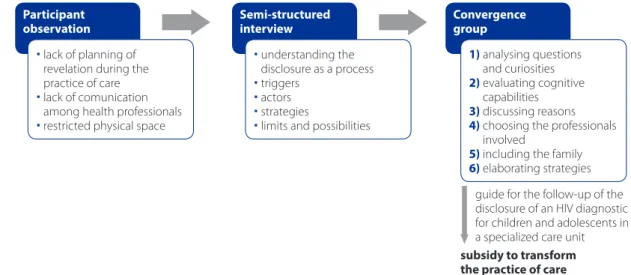
Participant observation made it possible to verify that there was neither a planning for the disclosure in the care practices nor was there communication among health pro-fessionals. The restrict physical space also influenced nega-tively discussions about such disclosure. The observation helped composing questions for the semi-structured script of the interviews. Five themes resulted from the analysis: un-derstanding of the HIV diagnosis disclosure as a process; trig-ger for the disclosure; who takes part in the disclosure; strate-gies for disclosure; and potential and limits for the disclosure. These culminated in the proposition of the guide (Figure 2).
Understanding the HIV diagnosis disclosure as a process
The disclosure of the HIV diagnosis was understood as a complex and obscure question, indicating that this was a different issue in the care of this population. It is neces-sary, and it must be a decision shared with the family, and is therefore, a process.
The complexity and obscurity are related to the stig-matization and to the prejudice rooted in society. Health professionals have pointed out that the HIV diagnosis is dif-ferent from those of other diseases. They recognized that part of the reveal is saying the name of the disease and its consequences, and not only disclosing medical diagnosis. Both the family and the health professionals must be re-sponsible for the revelation, together with the capability of the child or adolescent to understand.
[...] when we talk about diagnosis, we usually report med-ical diagnosis [...]. The revelation of the diagnosis is much more than that, the ICD is just a mark (P1).
[...] it’s an extremely complex question to work with, espe-cially when it involves HIV, which is a different diagnosis, due to the stigmatization of this illness [...](P2).
[...] I see it as something necessary, combined with the lev-els of understanding of the children [...](P3).
Revealing involves the name of the disease, it’s causes, consequences [...] understanding and meaning for that in-dividual [...] it’s not enough to say what it is, some involve-ment is needed (P5).
The revelation of an HIV diagnosis for the child or adoles-cent must simultaneously involve family members and health professionals, that is, it must be a shared and prolonged deci-sion. It should consider the particularities of the social context, the age group and cognitive maturity. The communication be-tween children and adolescents, health professional and rela-tives, aims to promote dialogue, and is paramount to establish guidelines for an ethical conduction of the revealing process, guaranteeing protection and care for those involved(12).
The professionals expressed that the disclosure is a process that is slowly conducted, and is not over with the naming of the disease. It contemplates follow-up stages before, during and after the revelation itself, that is, the mo-ment in which they are told they have HIV. It can last years and involve many consultations.
Figure 2 – Triangulation process of the corpus from the Converging-Care Research for the creation of a guide for the
follow-up after the disclosure of an HIV diagnostic for children and adolescents in a specialized service. Santa Maria, 2015.
Source: Research data, 2015.
lack of planning of revelation during the practice of care lack of comunication
among health professionals restricted physical space
understanding the disclosure as a process triggers
actors strategies
limits and possibilities
1) analysing questions and curiosities
2) evaluating cognitive capabilities
3) discussing reasons
4) choosing the professionals involved
5) including the family
6) elaborating strategies Participant
observation
Semi-structured interview
Convergence group
[...] the complexity, it involves other questions, where is the child inserted, how is she being prepared to assume her own care and live with a disease that has no cure, but treatment [...]. We use to take from two to three months to reveal [...] It’s a process [...] (P1).
[..] it isn’t simply saying they have HIV, saying the diagnostic and leaving behind the responsibility. It is so delicate that the patient and her family need preparation and support [...]. It is a process because it needs to be told slowly, until they can understand. It’s not just a moment, previous and posterior monitoring are necessary [...] (P2).
[...] there is a long way before the reveal of seropositivity for the child or the adolescent [...]. A building that becomes stronger [...], it is never done in one consultation, in one, two or three months [...], but in one or three years. [...] a process [...](P4).
[...] process is the word that best defines the disclosure. Saying the name of the disease is not the end [...] it starts before and has to continue afterwards (P7).
Considering its understanding as a process, the par-ticipants mentioned that the reveal happens in stages, throughout which information is slowly revealed, until the stage where the disease is named(5,7). An honest dialogue between the child or adolescent and their caretaker allows them to reveal it to them, but later, another, a more adult explanation, can be carried out(6).
Triggers for the reveal of the HIV diagnosis
The professionals mentioned the following triggers for the reveal: curiosity and questions about the disease and its risks; cognitive maturity; family structure; sexuality; and adhesion.
The need to answer the questions of the child who wants to know what she has [...] (P3).
[...] (the reveal process starts with) the behavior and curi-osity of the child. From the moment the child is interested, you need to start an approach, probe what is it that this child wants to know [...](P6).
[...] we guide ourselves (in the process of diagnosis disclos-ing) by the questions of the child herself [...] (P7).
The reveal starts with the curiosity and the questions asked by the child regarding the disease, including
ques-tions to the family members and professionals when it comes to the reasons for visiting the service. Through the answers, the diagnostic is slowly revealed(6).
The health professionals indicated that the reveal should happen the earliest possible, and that it should consider the cognitive maturity of the child or adolescent and their family and social structure, changing from case to case and independent of age. Health professionals, howev-er, stated that little children, under 13 years of age, should not know about their diagnostic, due to their low ability of understanding.
There isn’t a predetermined age, it’s a context, the children who socialize with her need to be socially and psycholog-ically prepared [...]. It needs to start with the evolution of the cognitive and psychological development of the child, not to mention the family and social structures of the child [...] (P1).
[...] the earlier the better, since there’s the whole thing that since a young age the child understands more and more of what’s going on with her [...] It’s useless to want a small child to understand what HIV is [...] (P2).
[...]before 13 years of age, it does nothing, only generates more confusion [...](P5).
[...] depends on the ability of the child to understand what the illness is, usually there’s an attempt to reveal the earliest possible, without delaying too much. There’s no minimum or maximum age [...] (P6).
[...] each case has to be considered separately, you can’t choose a standard age [...] (P7).
Researches indicate that the disclosure should start the earliest possible, with caution to provide clear and precise information, that go hand in hand with family and profes-sional support. The average age in which the children were informed about the diagnosis was nine year of age(5,13). How-ever, it is believed that the discussion regarding the health of these children should happen around their sixth year of age, mentioned as the school age, since it is in this stage that children acquire the ability to relate events and mental representations, expressed both verbally and symbolically(7).
are most likely to be informed of their diagnosis, as most believe they are already mature enough to have a specific discussion about HIV(4-5,13). The disclosure is divided by fam-ily members in partial and complete stages.
The awakening to sexuality in adolescents is a warning sign to begin the disclosure, and in such cases the beginning of affective relationships and sexual life function as triggers.
If the child is not mature, sexual relationships, maybe it’s not the time to reveal (P1).
The most important moment for the reveal is the preado-lescence, when they are about to become fertile [...] at this point everyone should know, they should hasten to tell it [...] (P3).
[...] because, if the child is dating, we worry about that [...] (P4).
[...] in the care that this adolescent needs to have when starting his sexual life [...] (P7).
The beginning of adolescence is one of the main trig-gers. The eminence of the beginning of sexual life, aroused by adolescence, becomes a factor that precipitates disclo-sure. The caregivers worry about the possibility of the ad-olescent infecting other people during unprotected sex-ual relationships(6). The disclosure was used by the family members as a way to control the behavior of the adoles-cent regarding sexuality, since they can, from the moment they know about the diagnosis, take better care of them-selves and prevent the transmission of the virus(7).
Another trigger for the reveal was the improvement of the antiretroviral treatment. Health professionals believed that the child and the adolescent, after finding out about their diagnostic, adhered better to the treatment, which contributes for an improvement in their health condition.
[...] the greatest hardship (in daily care) is adhesion [...] (not knowing the diagnosis) is an obstacle for under-standing the need to continue taking the medication correctly [...] (P1).
[...] we started noticing that they need to understand what’s happening to them, and that directly reflects in the adhesion to treatment [...] if you don’t know what is that medication for, maybe you won’t be so responsible about it [...]. The issues that lead us to reveal the diagnosis are spe-cific, considering the needs they have and how these issues will influence their adhesion to treatment (P2).
[...] (the revelation of the diagnostic happens) mostly, to reach the objective of continuing their treatment [...], be-cause you can’t make a 13-year-old child take five pills a day without her knowing what is it that she’s taking [...] (P5).
To achieve adhesion, family and professionals opt to reveal the diagnosis, as they believe that the adolescent, once informed of their serologic condition, will become partly responsible for the treatment. In addition to the ad-hesion, the beginning of the treatment, as well as the need to explain the medication, has stood out as a factor allied to the reveal(5-6,13).
The disclosure is also reflects the right of the child to know the name of their disease, and an obligation of the health professional to inform them(7). The health profes-sional is responsible for answering the questions of the child or adolescent regarding the use of the medication and its clinical aspects, and to warn them about the risks of the disease(13).
Who takes part in the reveal
The actors of the reveal are the health professionals, the family members and the children and adolescents them-selves. They must count with a multiprofessional team, in-cluding: psychologists, nurses, physicians and social work-ers, since the joint care is the most adequate. They should prioritize those professionals who have the greatest bonds to the patients.
[...] generally, the revelation happens with those who have the greatest connection [...] this is the person who should be called to talk in that moment [...] (P1).
[...] the diagnostic shouldn’t be revealed by an isolated member of the team [...], it should be a multiprofessional diagnosis [...]. A reference professional should reveal the di-agnosis and a team should be constituted to offer support for the patient [...] (P2).
[...] there should be a team [...] and the professionals would be the nurse, the doctor and the psychologist, since they are the ones who see him every time he comes for consul-tations [...] (P3).
[...] obligation to inform what he has and the risks he’s un-der [...] (P5).
pro-fessionals who are involved in this event, one can high-light the nurses, physicians and social workers, being the attending physician the main responsible(12). The relatives need professional aid to conduct the disclosure(5).
The family must be a part of this process, since they are the ones who live with this child or adolescent. In this case, the role of health professionals would be that of giving sup-port, before, during, and after the disclosure. Thus, the family can start to approach the kid at home. However, if this is not satisfactory, health professionals can help in this process.
[...] it’s impossible to reveal the diagnosis without the help of the family, since they are the ones who are with him ev-ery day, who know the routine [...] (P2).
[...] the family should reveal, and we should be the support, but the family are the ones who should be responsible for it (the revelation of the HIV diagnostic), it’s the life of the child (P5).
It can happen that the parents start at home, and when they are willing we offer for them to reveal together with the team [...]. Normally, we guide them to start at home, and if they don’t feel confident, we try another approach in the health care unit (P6).
[...] For the patient, the family is the responsible for mak-ing the revelation, it is important that they are the ones to have this attitude [...], we (health professionals) will be present before, during and after, but it’s something that should be done by the family (P7).
The family is essential for the disclosure, as they are responsible for the daily care. The caregivers are therefore characterized as the ones who should reveal the HIV diag-nosis(5). Other family members, however (grandmothers, aunts and cousins) were mentioned as people who can help in the revelation process(12). Most family members think it would be more adequate to start the reveal at home. However, during the process, they felt the need of professional aid to answer the questions of the child or ad-olescent regarding the disease(5-6).
For the child this is decisive (the revelation process), you need to establish a pact and work with the family, guide, including about the risks that exist for this reveal or not re-veal [...] (P7).
Family has an important function in the adaptation of people who live with HIV to this new reality. Thus, their
acceptance and adhesion to the HAART can be improved. However, they cannot always rely on this support(12).
Some children and adolescents find out about their di-agnosis by themselves. Frequent visits to the physician, read-ing of records and exam requests are clues to the revelation.
[...] they understand things here and there and assemble it (an understanding of the HIV diagnosis) [...] they end up coming to the outpatient clinic and reading the exam re-quests [...]. Until one day they establish that they know the diagnosis [...] (P5).
The child and the adolescent can find out by them-selves about their diagnoses, hearing conversations be-tween a family member and the physician or discussions between people who are not part of their social network(4).
Strategies for the reveal of the HIV diagnosis
The professionals use different techniques to reveal the diagnosis for children and adolescents. The strategy for children is playful, with the use of dolls, drawings and sto-ries to reveal the situation to the kid, avoiding impacting words like HIV. For the adolescents, virtual and process-re-lated strategies of direct approach are used, so they can understand and think about their disease. Both, however, demand psychological follow-up.
[...] the language must be according to the level of knowl-edge of the child [...] the playful, explaining with a doll how it works or getting a little ball and drawing the virus and ask him to draw his understanding of what he has and how to see it [...] (P1).
With younger children there’s a childish approach, you have a little monster that attacks your little soldiers, that gets you weak and ill [...] the word HIV is avoided [...]. When the child is older I explain: you have a virus, a very tiny or-ganism that enters in our oror-ganism and destroys its de-fenses. I speak in a way that I think the child is going to understand, and sometimes, I ask the child to explain back what I said (P5).
With children we try to be playful, to approach it playfully [...]. We try to see up to what point the child wants informa-tion [...]. With teenagers we have to be direct, try to speak in a direct way [...] (P6).
child is comfortable to ask questions. Playing helps estab-lishing the imagination of the children(15).
The virtual strategy, chosen for the adolescent, must involve computational tools, as well as dialogues to clarify doubts.
[...] the teenager is visual [...] I’d use computation tools, a lot of eye-to-eye conversation, the identifying of doubts and clarifying of their needs [...] (P1).
The professional should support the adolescents pro-moting spaces for dialogue and providing information on the clinical and biopsychosocial aspects of HIV(16).
The strategy used in the process is carried out through questioning, and clues are given for them to find them-selves. It is necessary to start from what they know and work towards the reveal.
[...] trying to understand what they know about medica-tion, and whether they know what HIV is [...] We have to start from what they know, prepare to give them the news, to reduce their anguish, being honest and sincere, there’s no point in delaying it [...]. You don’t have to use anything pre-determined, you have to analyze each case [...]. You have to be direct, but at the same time investigate what they know [...] (P2).
[...] you give tips, say things until he has clear information regarding the illness [...]. I would give him conditions so he found out, in a calm manner, until a real understanding of what he has was found [...] (P3).
To develop the disclosure through a procedural strat-egy one must start from questions regarding the medica-tions, frequent visits to the health services and routine of laboratory exams. The right to know the truth about their serological condition should be considered, as well as the benefits of the revelation and the ability to keep a secret(17).
The strategy to include the family in this process is para-mount, when the revelation is for a child. The family should be listened to, and its fears considered and worked out.
When the reveal is for a child, you have to work with the family. Listen and work with them regarding the fears the family has and the existing risks [...] (P7).
The family is part of the support network for the chil-dren and adolescents, considering their importance to confront a disease which is still marked by prejudice, aban-donment and finitude of life. The family support in the
dis-closing process leads the child or adolescent to face their health condition with more courage and calm(18).
The strategy of psychological care involves the referral of the adolescent to psychological sessions, to develop a precise approach to this disclosure.
[...] this necessity was observed and a referral to sessions of psychological care was scheduled [...] (P7).
The importance of the health professional must be high-lighted, as it will make the reveal and the confrontation eas-ier, minimizing the emotional problems generated by the diagnosis, for the kid, the adolescent and their relatives(19).
Possible actions and limits for the reveal of the HIV diagnosis
Among the possible actions to reveal the information for the child or adolescent, the professionals suggested the use of a multiprofessional team and the permanent fol-low-up in the same health service.
[...] the revelation of the diagnoses happens here, the refer-ence is the service, as they start to follow-up with the ser-vice and stay for a long time [...] (P2).
The revelation is done in the health service, there’s a multi-disciplinary team to do it[...] (P6).
The children and adolescents who live with HIV must be under constant follow-up in specialized health services, to answer the specific demands of their serological condi-tion. Most develop a bond with the professionals that care for them. An established social support, especially when conducted by health professionals, facilitates disclosure. It allows for them not to feel alone when confronting a dis-ease with the peculiarities of the HIV(16).
Among the limits to the reveal, however, are the lack of communication, articulation and integration among pro-fessionals, in addition to the lack of theoretical knowledge in the team, and to the physical structure of the service. Things take place, if there is not a plan nor is a formal mo-ment chosen for the reveal.
Physical structure [...], logistic issues would be the greatest difficulties [...] (P1).
for the revelation of this diagnostic, they are not trained, and there’s a lack of conversation, of discussion inside the team [...] (P2).
The lack of integration and conversation in the team [...] the lack of autonomy [...] nobody takes the first step and it’s necessary [...]. The lack of interaction among health profes-sionals, of each one stating their opinions [...] (P3).
I’ve done it a couple of times, but most patients end up sort of ran over, when they see it, they already know and I don’t know how they got to know, I don’t know if it was a formal moment or if the child got some info there and some here and put together [...] (P5).
It happens (the revelation of an HIV diagnosis in this ser-vice) [...] but there’s no protocol, or discussion among the professionals [...]. There’s no group work or bigger discus-sion, it’s often done in isolation [...] (P7).
The professionals feel unprepared to the process of dis-closing the information for the child and the adolescent. That demands an investment in health policies that con-solidate the action plan, so the information is disclosed in a realistic and warm way(7).
The professionals must create spaces to debate the aspects of the disclosure, so that the gap in their theoret-ical knowledge is filled, questioning how the team mem-bers approach the revelation, what are the resources and instruments used to start the conversation with the kid and the adolescent and what is the participation level of the family members(7).
A boundary that stood out when compared to the oth-ers is the family’s resistance to reveal this information, espe-cially that of the grandparents. They fear the prejudice and have difficulties discussing and accepting the disease. This fear, however, is the result of a sensationalist media from the decades of 80 and 90, which portrayed HIV as one of the worst possible diseases.
[...] the grandparents are really panicked to talk about this [...] (P4).
[...] the family frequently doesn’t want to talk about the disease, so they don’t have to answer the questions of the children [...] they don’t want to deal with it and assume re-sponsibility [...] (P5).
The resistance of the family, sometimes the family doesn’t want to reveal it because they’re afraid the kid will tell
oth-ers at school [...]. One of the greatest difficulties is the par-ents’ difficulty in accepting their own disease and that of the child, for fear of prejudice [...] (P6).
The knowledge of the disease by people in the fam-ily or in the same social circle is to this day a reason for discrimination, and a for the family to delay revealing the information to the child and to the adolescent. They are afraid of societal judgment, and attempt to avoid the ex-posure of their children(11).
As possibilities to overcome these limits, the health pro-fessionals mentioned the search for theoretical knowledge, the articulation among themselves, and the moments for meeting and discussing the revelation, preparing the fami-lies and constructing a document that can aid them.
Having a team leader, a person who can work and stay strong in that team [...], convincing people about the im-portance of revealing the HIV diagnosis and working with the team and the family members [...] and having an in-strument to aid in the revelation [...] (P4).
[...] conducting a training workshop with the team, study-ing a group revelation, discussstudy-ing cases and producstudy-ing an instrument and really using it [...]. Working with the care-giver before working with the child or the teenager [...] (P5).
[...] Surveying the critical cases and having a reference team [...]. Having some material in the service that can be used as basis, some type of protocol [...] (P7).
To consolidate the reveal in a specialized service, it is necessary to create a plan aimed at comprehending the objective and subjective knowledge of the children, ado-lescents, and their relatives. Many variables should be con-sidered that involve the silence and offer subsidies for the reveal process to happen effectively(18).
Subsidies for the change of the practice of care
The group was a space in which the health profession-als could discuss the reveal of the HIV diagnosis in the Pe-diatric Infectious Diseases Outpatient Clinic of the HUSM, sharing ideas about the best way to accomplish the revela-tion, so that it happens as it should: a gradual, progressive and continuous process.
fol-low-up (Chart 1). It is worth highlighting the need to eval-uate the stage in which the child or adolescent find them-selves and support them and their family to advance in the process, and for that, it is necessary to identify their needs.
It is paramount to understand that the stages are inter-dependent and can be developed simultaneously. There-fore, this guide states that practice-based evidence should be the basis of the decisions in the process of disclosure, to diminish the use of tacit data. It recommends an integra-tion of scientific evidence to the data of the user, combin-ing his preferences and values to the clinical expertise of the professionals.
In the first stage, the professionals must consider the questions posed by the curiosities of the child, adolescent and their family members, which are demonstrated through questions regarding the need for consultations, exams, use of medications, and frequent trips to the hospital.
In the second stage, the professionals must identify, through observation, the behavior, the cognitive maturity, the family and social structure of the child or adolescent. No age is perfect; however, it is suggested that the HIV di-agnosis should be revealed as early as possible. Therefore, the revelation process can be divided in partial (from nine to 11 years of age) and complete (13 to 14 years of age).
In the third stage, the professionals should identify the reasons to reveal, among which stand out: adhesion to the antiretroviral treatment, beginning of sexual life, ad-vanced age, death of the parents/orphanhood, illness of the child or adolescent, duty to inform regarding the ill-ness and risk prevention.
In the fourth stage, the professionals should identify, during conversations with the relatives, the children and adolescents, which actors should take part in the process. Stand out: the multiprofessional team, family members
(parents, aunts, grandparents, among others), the health professional with a stronger bond, and children or adoles-cents who find out by themselves.
In the fifth stage the professionals must identify ways to include the family in the revelation, among which: guiding regarding the importance of the revelation, as soon as pos-sible; demystifying fears and doubts; giving support to the relatives in this moment.
In the last stage, the professionals must trace strategies for the revelation. For children, stand out: stories and toy therapy. For adolescents: using computation tools (social networks, websites, documentaries, videos), as well as di-alogues to clarify the doubts. This happens through ques-tioning and starts from what they already know.
CONCLUSIONS
In face of the proposal to collectively construct a guide, the participants of the CCR have outlined it in six stages, which allowed them to, among other things, re-think their practice of care. Through the multiprofessional approach to the care of children and adolescents diag-nosed with HIV, the nurses should act together with the team of the specialized service, following up the process of revealing the diagnosis. Some actions that deserve to be highlighted are the nursing childcare consultations, adhesion evaluations, support groups to the family mem-bers and playful activities used as strategies in this con-text, in which the nurse can identify, guide and/or inter-vene in the stages the Guide proposes. Professionals are expected to conduct and support family members in the revelation process, consequently promoting the adhe-sion to the treatment and the autonomy of children and adolescents for the care of themselves.
Stages Description
1th Analysis of questions and curiosities of children and adolescents to start disclosing the HIV diagnosis.
2nd Evaluation of the cognitive capability of children and adolescents to understand information regarding the HIV diagnosis.
3rd Discussion of the reasons that lead to the reveal of the HIV diagnosis for children and adolescents.
4th Listing the professionals that are involved during the process of revealing the HIV diagnosis for children and adolescents.
5th Including the family in the process of disclosing the diagnostic of HIV for children and adolescents.
6th Elaborating strategies for the reveal of an HIV diagnostic for children and adolescents.
Chart 1 – Stages of the Guide for monitoring the disclosing of the HIV diagnosis for children and adolescents inside a
specialized health service. Santa Maria, 2015.
The use of the CCR allowed for the research to be con-ducted in the same space where the researcher/nurse is inserted, shortening the distance between practice and research, and especially, ensuring that the service would receive something back, in this case, the guide for the fol-low-up of the HIV diagnosis reveal for children and ado-lescents in a specialized service. It also stimulated the in-volvement of the participants, as they felt co-responsible for the research, and that strengthened the transference of knowledge to the practice of care.
Therefore, the contribution offered by this study is the guide for the follow-up of the disclosure of an HIV diagnos-tic to children and adolescents who attend a specialized service, a guide that can subsidize changes in the practice of care, both to guarantee the children’s right to know their diagnosis and to lay part of the accountability on the health professionals.
It is necessary to recognize as a limitation that the con-vergence group was composed only of professionals from a specialized service. Therefore, the research group com-mitted itself to a methodological research to validate the content, the appearance and the applicability of the guide.
REFERENCES
1. Ministério da Saúde (BR), Secretaria de Vigilância Sanitária, Departamento de DST, AIDS e Hepatites Virais. Boletim Epidemiológico HIV-aids. 2015;4(1):1-95. 2. Brum CN, Paula CC, Padoin SMM, Souza, IEO, Neves ET, Zuge SS. Revelação do
diagnóstico de HIV para adolescentes: modos de cotidiano. Esc Anna Nery. 2015 Oct-Dec;19(4):679-84. doi: http://dx.doi.org/10.5935/1414-8145.20150091. 3. Mesquita NF, Torres OM. A equipe de saúde na atenção integral ao ado-lescente vivendo com HIV/AIDS. 2013;17(4):730-9. doi: http://dx.doi. org/10.5935/1414-8145.20130018.
4. Mawn BE. The changing horizons of US families with pediatric HIV. West J Nurs Res. 2012 Mar; 34(2):213-29.doi: http://dx.doi.org/10.1177/0193945911399087. 5. Adebe W, Teferra S. Disclosure of diagnosis by parents and caregivers to children
infected with HIV: prevalence associated factors and perceived barriers in Addis Ababa, Ethiopia. AIDS Care. 2012 Feb;24(9):1097-102. doi: http://dx.doi.org/1 0.1080/09540121.2012.656565.
6. Brondani JP, Pedro ENR. A story for children to help children with HIV understand the health-disease process. Rev Gaúcha Enferm. 2014 Mar; 34(1):14-21. doi: http://dx.doi.org/10.1590/S1983-14472013000100002.
7. Mumburi LP, Hamel BC, Philemon RN, Kapanda GN, Msuya, LJ. Factors as-sociated with HIV-status disclosure to HIV-infected children receiving care at
Kilimanjaro Christian Medical Centre in Moshi, Tanzania. Pan Africa Med J. 2014 May;18(50):1-8. doi: http://dx.doi.org/10.11604/pamj.2014.18.50.2307. 8. Traiber C, Lago PM. Comunicação de más notícias em pediatria. Bol Cient Pediatr.
2012;1(1):3-7.
9. Zanon BP. Processo de revelação do diagnóstico de HIV para crianças e ado-lescentes: convergência entre teoria e prática [dissertação]. Santa Maria (RS): Universidade Federal de Santa Maria; 2016.
10. Trentini M, Paim L, Silva DMGV. Pesquisa convergente assistencial: delineamen-to provocador de mudanças nas práticas de saúde. 3. ed. Pordelineamen-to Alegre: Moriá; 2014.
11. Minayo MCS. O Desafio do conhecimento: pesquisa qualitativa em saúde. 13. ed. São Paulo: Hucitec; 2013.
12. Bubadué RM, Paula CC, Carnevale F, Marín SCO, Brum CN, Padoin SMM. Vul-nerabilidade ao adoecimento de crianças com HIV/aids frente em transição da infância para adolescência. Esc Anna Nery. 2013 Sep-Dec;17(4):705-12. doi: http://dx.doi.org/10.5935/1414-8145.20130015.
13. Madiba S, Mokwena K. Profile and HIV diagnosis disclosure status of children enrolled in a pediatric antiretroviral program in Gauteng Province, South Africa. J Trop Med Public Health. 2013 [cited 2016 Nov 29];44(6):1010-20. Available from: http://www.tm.mahidol.ac.th/seameo/2013-44-6-full/09-5533-1.pdf. 14. Piaget J. Seis estudos da psicologia. 25. ed. Rio de Janeiro: Forense Universitária;
2012.
15. Oliveira CM, Maia EBS, Borba RIH, Ribeiro CM. Brinquedo terapêutico na as-sistência à criança: percepção de enfermeiros nas unidades pediátricas de um hospital universitário. Rev Soc Bras Enferm Ped. 2015 [cited 2016 Nov 29];15(1):21-30. Available from: http://sobep.org.br/revista/images/stories/ pdf-revista/vol15-n1/vol_15_n_2-artigo-de-pesquisa-3.pdf.
16. Gomes GC, Pintanel AP, Strasburg AC, Xavier DM. Face singular do cuidado familiar à criança portadora do vírus HIV/aids. Acta Paul Enferm. 2012 Mar;25(5):749-54. doi: http://dx.doi.org/10.1590/S0103-21002012000500016.
17. Galano E, Marco MA, Silva MH, Succi RCM, Machado DM. Entrevista com familiares: um instrumento fundamental no planejamento da revelação do diagnóstico de HIV/aids para crianças e adolescentes. Ciênc Saúde Co-letiva. 2012 Oct;17(10):2739-48. doi: http://dx.doi.org/10.1590/S1413-81232012001000022.
18. Silva LMS, Tavares JSC. The family’s role as a support network for people liv-ing with HIV/aids: a review of Brazilian research into the theme. Ciênc Saúde Coletiva. 2015 Dec;20(4):1109-18. doi: http://dx.doi.org/10.1590/1413-81232015204.17932013.
19. Nascimento L, Contim CLV, Arantes EO, Dias IMAV, Siqueira LP, Santos MMC. Ser mãe portadora de HIV: permeabilidade que permeia o risco da transmis-são vertical. Rev Enferm UERJ. 2015 May-Jun; 23(3):401-6. doi: http://dx.doi. org/10.12957/reuerj.2015.3849.
20. Zanon BP, Almeida PB, Brum CN, Paula CC, Padoin SMM, Quintana AM. Revela-ção do diagnóstico de HIV dos pais. Rev Bioét. 2016 Sep-Dec;24(3):557-66. doi: http://dx.doi.org/10.1590/1983-80422016243155.
Corresponding author: Bruna Pase Zanon
E-mail: [email protected]