SUMMARY
Objective: To estimate the prevalence of excessive daytime sleepiness (EDS) and to iden-tify associated factors in women aged 35 to 49 years from the “Pindamonhangaba Health Project” (PROSAPIN). Methods: his was a cross-sectional observational study of 372 women aged 35 to 49 years, randomly selected from the Family Health Strategy (FHS) program of the city of Pindamonhangaba – SP, Brazil, where the “Pindamonhangaba Health Project” (PROSAPIN) is being developed. EDS was assessed through interviews using the Epworth Sleepiness Scale and the associated factors through questions that in-vestigated socio-demographic characteristics, gynecological history, presence of comor-bidities, lifestyle, sleep routine, and use of drugs capable of altering the state of alertness; anthropometric variables were also measured. he prevalence of EDS was estimated with a 95% conidence interval (95% CI) and the associated factors were identiied through a multiple logistic regression model performed with the Stata sotware, release 10.0. Results: EDS prevalence was 18.5% (95% CI: 14.7-22.9) and the associated factors were: profession related to domestic services (OR = 2.2, 95% CI: 1.1-4.3), physical activity level above the mean of the study population (OR = 1.9, 95% CI: 1.1-3.4), and presence of features suggestive of anxiety (OR = 1.9, 95% CI: 1.1-3.4). Conclusion: he prevalence of EDS in women aged 35-49 years from PROSAPIN was high and associated with sociode-mographic characteristics, presence of comorbidities, and lifestyle.
Keywords: Disorders of excessive sleepiness; women; public health.
©2012 Elsevier Editora Ltda. All rights reserved. Study conducted at Faculdade de
Saúde Pública, Universidade de São Paulo, São Paulo, SP, Brazil
Submitted on: 03/14/2011
Approved on: 03/28/2012
Financial support:
Study linked to the Pindamonhangaba Health Project (PROSAPIN), which was supported by Fundação
de Amparo à Pesquisa do Estado de São Paulo (FAPESP), Process #06/57016-2
Correspondence to:
Elaine Cristina Alves Pereira Avenida Doutor Arnaldo, 715
Cerqueira César São Paulo – SP, Brazil CEP: 01246-904 [email protected]
Conflict of interest: None.
Prevalence of excessive daytime sleepiness and associated factors in
women aged 35-49 years from the “Pindamonhangaba Health Project”
(PROSAPIN)
ELAINE CRISTINA ALVES PEREIRA1, ANA CAROLINA BASSO SCHMITT2, MARIA REGINA ALVES CARDOSO3, WENDRY MARIA PAIXÃO PEREIRA4, GERALDO LORENZI-FILHO5, JUAN ENRIQUE BLUMEL6, JOSÉ MENDES ALDRIGHI3
1 MSc in Public Health; Professor at Fundação Universitária Vida Cristã (FUNVIC), São Paulo, SP, Brazil
2 PhD in Public Health; Professor of the Department of Physical Therapy, Speech Therapy and Occupational Therapy, Faculdade de Medicina, Universidade de São Paulo (FMUSP),
São Paulo, SP, Brazil
3 Associate Professors, Faculdade de Saúde Pública, Universidade de São Paulo (FSP/USP), São Paulo, SP, Brazil 4 MSc; Professor, Universidade de Taubaté (UNITAU), Taubaté, SP, Brazil
INTRODUCTION
Excessive daytime sleepiness (EDS) is a frequent com-plaint in the population and can result from diseases such as obstructive sleep apnea syndrome (OSAS)1,2; de-pression; anxiety;use of drugs for heart disease, hyper-tension, diabetes, allergies, muscle contractures3; and habits such as alcoholism, sedentary lifestyle4, and insuf-icient sleep5,6.
It compromises quality of life due to the impairment it causes in work performance, interpersonal relations, and cognitive and neuropsychological functions7, in addition to causing a higher risk of car accidents5, and metabolic8 and cardiovascular9 diseases.
Its prevalence is higher in individuals aged between 20 and 49 years, that is, during the most productive phase in life5,10-14. It is known that high demands at work and the incessant quest for professional development are sources of physical exhaustion; this, associated with non-restorative sleep, either due to the small number of hours slept or the poor quality of sleep, result in EDS15.
In females, excessive sleepiness is further aggravated by the accumulation of domestic responsibilities such as taking care of home and children16; apart from the fact that, ater the age of 37, women sufer from hormonal luctuations that lead to symptoms such as anxiety or de-pression, hot lashes, and night sweats that also interfere with sleep, making it lighter, intermittent, and shorter17.
It is essential that health professionals know the trig-gers of this condition and develop primary care strate-gies to prevent its occurrence or to minimize its nega-tive efects on quality of life. hus, this study aimed to estimate the prevalence of EDS in women aged 35 to 49 years treated by the “Pindamonhangaba Health Project” (PROSAPIN), and to identify possible anthropometric, sociodemographic, clinical, and lifestyle-related factors that may be associated with its occurrence.
METHODS
POPULATION
his is a cross-sectional study conducted in the munici-pality of Pindamonhangaba, in the countryside of the state of São Paulo, with women aged 35 to 65 years en-rolled in the Family Health Strategy (FHS). At the time of the study, the municipality had a primary health care network consisting of 18 family health teams covering 34% of the population (45,537 individuals)18.
he reference population consisted of 7,212 women who were in the age group of interest and were registered in the FHS. Of these, 875 were randomly selected by sys-tematic sampling with stratiication by age and health unit. To calculate the sample size, the lowest prevalence of all variables studied in PROSAPIN were considered: 20% of metabolic syndrome19, a maximum error of 3% in 95% of the possible samples, and possible losses.
Of the 875 women, 126 did not participate in the study for the following reasons: two had cognitive deicit, 121 refused to participate or had changed address, one was unable to stand during the anthropometric measure-ments, and two were hospitalized during the data collec-tion period. hus, 749 women (85.6%) participated in the study.
he present article corresponds to an arm of PROSAPIN that studies EDS only in women younger than 50 years, i.e. from 35 to 49 years, thus providing a sample of 372 individuals.
PROSAPIN was authorized by the Health Secretariat of Pindamonhangaba and approved by the Ethics Com-mittee of the School of Public Health, Universidade de São Paulo (FSP/USP) under protocol No. 1324.
DEPENDENT VARIABLE: EXCESSIVE DAYTIME SLEEPINESS
For the investigation, the Epworth Sleepiness Scale was used, which quantiies the propensity of the individual to fall asleep in the following routine situations: sitting and reading; watching TV; sitting in a public place, with-out activity (waiting room, meeting, movie theater); as a train, car, or bus passenger, riding for an hour with-out stopping; laying to rest in the aternoon when cir-cumstances permit; sitting and talking to someone; sit-ting quietly ater lunch without alcohol ingestion; and in the car while stopped for a few minutes in heavy traic. his scale attributes a value to each question that corresponds to the chance of falling asleep: 0 = no, 1 = small, 2 = moderate, and 3 = high chance. Together, they generate a maximum score of 24 and a minimum of 0, identifying sleepy individuals as those with scores greater than 1020.
INDEPENDENT VARIABLES
Anthropometric measurements were obtained (weight, height, and hip and abdomen circumferences) and in-terviews were conducted in order to obtain information on sleep (latency and number of hours slept), sociode-mographic characteristics, gynecological history, and use of medications that can alter alertness. Furthermore, co-morbidities and lifestyle were also assessed in the inter-view using validated instruments for: depression (Beck Depression Inventory)21, anxiety (Beck Anxiety Invento-ry)22, obesity (World Health Organization’s Classiication of Obesity)23, obstructive sleep apnea (Berlin Question-naire)24, usual physical activity (Baecke Questionnaire)25, and smoking and drinking (I National Survey on pat-terns of alcohol consumption and smoking in the Brazil-ian population)26,27.
Table 1 – Sociodemographic characteristics of 372 women aged 35 to 49 years, PROSAPIN, 2008
Variables n* %
Marital status
Married 283 81
Separated/divorced 56 16
Widowed 10 3
Religion
Catholic 244 66
Protestant and others 128 34
Level of schooling
Up to 8th grade 260 72
9th grade or further 100 28
Occupation
Does not work 176 48
Housework 81 22
Other types of work 105 28
Retired/pensioner 7 2
Income per capita (MW)
Up to 1 MW 288 83
More than 1 MW 60 17
*The total number of women for each variable was not the same due to the lack of answers. PROSAPIN, The Pindamonhangaba Health Project; MW, minimum wages.
Variables n* %
Menstrual regularity
Yes 250 68
No 119 32
Hypertension
Yes 108 29
No 262 71
Diabetes mellitus
Yes 19 5
No 342 95
Obesity or overweight
Yes 129 35
No 241 65
PCOS
Yes 66 19
No 290 81
Hiperuricemia
Yes 29 8
No 316 92
OSAS
High risk 62 17
Low risk 301 83
Depression
Yes 110 30
No 262 70
Anxiety
Yes 187 50
No 185 50
*The total number of women for each variable was not the same due to the lack of answers. PCOS, polycystic ovary syndrome; OSAS, obstructive sleep apnea syndrome.
Table 2 – Clinical history of 372 women aged 35 to 49 years, PROSAPIN, 2008
DATA ANALYSIS
he prevalence of EDS was estimated with 95% CI. Bivariate analyses were performed to identify possible associations between EDS and independent variables. A multiple logistic regression model was designed, ini-tially including all variables that were associated with EDS in the bivariate analyses, and later testing the re-maining variables. All analyses were performed using the sotware Stata, release 10.0.
RESULTS
372 women aged 35 to 49 years with a mean age of 41.5 ± 4.0 years were studied. he prevalence of EDS was 18.5% with 95% CI of 14.7% to 22.8%.
Table 1 shows the sociodemographic characteristics of the studied women, who were mostly married (81%), white (51%), Catholic (66%), and who attended school until the 8th grade (72%). 48% had no paid work. Among those who worked, 22% had occupations related to do-mestic services (housekeepers, maids, cooks, etc.), and 83% had a per capita income of up to one minimum wage.
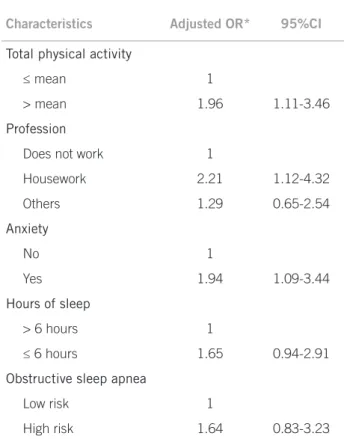
Characteristics Adjusted OR* 95%CI
Total physical activity
≤ mean 1
> mean 1.96 1.11-3.46
Profession
Does not work 1
Housework 2.21 1.12-4.32
Others 1.29 0.65-2.54
Anxiety
No 1
Yes 1.94 1.09-3.44
Hours of sleep
> 6 hours 1
≤ 6 hours 1.65 0.94-2.91
Obstructive sleep apnea
Low risk 1
High risk 1.64 0.83-3.23
* Adjusted by the variables in the table and by menstrual regularity.
Table 3 – Adjusted odds ratios (OR) with the respective 95% conidence intervals (95% CI) for clinical and epide-miological characteristics of women from PROSAPIN with EDS, 2007-2008
Table 2 also shows information on depression, anxi-ety, and sleep apnea. As the instruments used for the investigation of these diseases were validated question-naires for screening features suggestive of the disease in epidemiological studies, and not to deine diagnosis, it can be said that 30%, 50%, and 17% of the women had features suggestive of depression, anxiety, and obstruc-tive sleep apnea (OSA), respecobstruc-tively.
Regarding lifestyle, a questionnaire that quantiies the level of usual physical activity, i.e., occupational energy expenditure in physical exercise or leisure activities and during locomotion, with the total physical activity being the sum of all these energy expenditures, was used for the assessment of physical activity. his instrument has no cutof point, as it compares an individual only with other individuals belonging to the same population. Its analysis is based on through the mean value of energy expendi-ture in the population, indicating that some people are above or below the mean of this population. hus, 55% of the women studied had a level of total physical activity up to the mean of the studied population.
Additionally regarding lifestyle, 24% were smokers, 25% drank alcohol, 37% reported the habit of sleeping fewer than six hours per night, and 27% reported using drugs that interfered with the state of alertness.
When the bivariate analyses were performed, as-sociations between EDS and the level of occupational physical activity, leisure, and locomotion above the mean of that of the studied population (OR = 2.2, 95% CI: 1.3-3.7); professions related to domestic services (OR = 2.5, 95% CI: 1.3-4.8); presence of PCOS (OR = 1.9, 95% CI: 1.0-3.5); and fewer than six hours of sleep per night (OR = 1.8, 95% CI: 1.1-3.2) were identiied.
he inal multiple logistic regression model identiied the following factors as independently associated with EDS in the study population: level of occupational physical ac-tivity, leisure and locomotion above the mean of that of the study population; professional services related to domestic services; and features suggestive of anxiety28 (Table 3).
his model also included the participants’ menstrual regularity, and menstrual irregularity was not associated with the occurrence of EDS (OR = 1.2, 95% CI: 0.7-2.1).
DISCUSSION
Although no studies that investigated EDS exclusively in women aged 35-49 years were identiied, the existing ones showed that part of their sample consisted of wom-en in this age range10,29-35.
In Brazil, only two population studies were found with a random sample that investigated exclusively EDS, with the inclusion of individuals of both genders older than 18 years. he irst, conducted in the countryside of the state of Bahia, reported a prevalence of 21.5%29.he second, conducted in the capital of the state of Mato Grosso do
Sul, found a prevalence of 18.9%10. Both studies showed no prevalence stratiied by gender and age, which makes it diicult to compare them with the present results.
he prevalence of EDS in other countries also shows variation. In hailand, 19.5% of the population has ex-cessive sleepiness symptoms30; in Norway, 17.7%31; in Latin America (Mexico, Chile, Venezuela, and Uruguay), 16.4%32; in Korea, 12.2%33; in Spain, 11.6%34;and in Japan, 2.5%35. Although all of these studies included individuals of both genders aged > 18 years, only two showed the prevalence of EDS separated by gender, but not by age. hus, in Korea excessive sleepiness is present in 13.7% of women31 and in Japan, in 2.2% of the women35.
Some studies report that EDS is more prevalent among the elderly36,2. However, other studies demon-strate that the frequency of the condition is higher in in-dividuals aged 20 to 49 years5,10-14. Corroborating these indings, this study found a high prevalence of EDS (18.5%) among women aged 35 to 49 years.
when compared to the only study conducted in Bra-zil, in which the proportion of women with PCOS in Bahia was 8.5%39.
The first hypothesis for the difference between the two studies refers to the type of instrument used for data collection. Fernandes39 assessed the prevalence of PCOS using ultrasound equipment, while the present study’s prevalence was assessed through a question-naire, in which self-reporting of this disease included the woman in the group of affected individuals.
At first glance, the divergence suggests overestima-tion of the present study’s PCOS prevalence. However, when comparing the prevalence of SAH reported by the present study’s participants (29%) with the prevalence of hypertension measured by the anthropometry team (28%) the quality of the reported data is observed. Thus, a second hypothesis, that there actually is a difference between the prevalence of PCOS between the North-east and SouthNorth-east regions, becomes more relevant. The similarity between the reported and measured data reinforces the validity of the present study, mainly related to the high prevalence of EDS in women aged 35-49 years.
EDS may derive from several factors, but the endo-crine system appears to be of particular importance. Gracia et al.17 found that in the presence of progressive hormonal fluctuations of early menopausal transition, from 37 years of age onward, significant changes occur in sleep architecture, caused by the insufficiency of pro-gesterone in the premenstrual phase.
In fact, difficulty in falling asleep or recurrent noc-turnal awakenings are common premenstrual symp-toms, affecting 20% to 40% of women in the menopaus-al transition, which, by reducing the number of hours of sleep, allow the onset of EDS40.
In the bivariate analysis, there was a clear associa-tion between EDS and sleeping fewer than six hours a night, a fact already well-documented in the young population, for which there was an increased prevalence of EDS from 15.6% in 1960 to 37.1% in 200141. It seems that the main reason for this increase is professional, as the young individual, concerned about earning an in-come, starts working early and often has more than one job15. In the case of women, the situation becomes even more complex due to the accumulation of responsibili-ties for the care of children and home16.
However, the association between sleeping fewer than six hours a night and the presence of EDS lost part of its statistical significance in the multivariate analy-sis. A possible explanation is that the interviewees were questioned regarding the number of hours slept dur-ing the night, without any questions about the habit of sleeping during the day. Considering that 47.7% of par-ticipants did not work outside the home, the habit of
daytime sleep may have been a confounding factor, not fully controlled in the analysis.
Another significant risk factor for the development of EDS in the present study was the domestic nature of work (maids, housekeepers, cooks, washerwomen or cleaning aid) possibly due to the long working hours inherent to these activities, which include little or no rest intervals42.
According to the physical activity questionnaire used (Baecke)25, it was observed that participants who had a level of physical activity with intensity and fre-quency greater than the mean of the studied sample had a higher risk of developing EDS. Although some studies have reported that physical activity reduces or elimi-nates EDS, in a more refined analysis, all studies that re-ported reduction of EDS had the bias of including only physical activity programs, without considering usual physical activities originating from daily activities4,36, which prevents comparison with the present results.
Therefore, it is believed that a level of physical ac-tivity above the average for a specific population may mean an activity overload, favoring an increase in EDS. It was also observed that the presence of features suggestive of anxiety was another risk factor for EDS, a result that is similar to that obtained by Kravitz et al.43, in which 35% of women in menopausal transition who had this emotional disorder had difficulty falling sleep.
Other possible factors responsible for EDS are the concerns of everyday life, such as little help from the spouse regarding household chores, lack of social strat-egies to ensure the education and care of children, and fear of not providing adequate care for children and of not dedicating appropriately to one’s career16.
Any type of worry may be a triggering agent of the process: difficulties in falling asleep, fewer hours of sleep, malaise, fatigue, and EDS on the following day.
Obesity and WC ≥ 88 cm are other risk factors for the development of EDS. However, the latter has been more involved in the onset of OSA syndrome, charac-terized by repeated pauses in breathing, lasting ≥ 10 seconds, followed by transiently waking or superficial sleep throughout the night, which results in sleep frag-mentation or deprivation, of which the main clinical manifestation is EDS1,2,44.
The study found no association between EDS, waist circumference, and OSA, possibly because the women classified as overweight or obese (BMI > 25), or with waist circumference ≥ 88 cm, had a homogenous distri-bution of fat in the hip and abdomen regions (gynecoid shape).
he professional activities related to domestic services may have been associated with EDS due to the fact that many participants were not employed during the study period (some lived on welfare provided by the federal government) and the low level of schooling may not have allowed other types of work rather than domestic ones. However, it is important to emphasize that professions like those require great physical efort, and consequently cause fatigue.
Finally, some information about the present study must be considered. First, as it is an epidemiological study, the focus was to screen for features suggestive of some diseases and not to perform diagnoses.
Second, as this is a transversal study, it does not allow for conclusions regarding causality. Another point to be taken into account that the data were obtained through interviews, thus important information may have been omitted. In spite of the use of validated tools, the multiple sleep latency test was not performed to conirm EDS.
CONCLUSION
he prevalence of EDS in women aged 35-49 years from PROSAPIN was high and among the main risk factors for its occurrence, a level of physical activity greater than the mean observed in the studied population a profession associated to housework and characteristics suggestive of anxiety must be emphasized; these results are relevant in terms of public health.
REFERENCES
1. Bixler EO, Vgontzas AN, Lin HM, Calhoun SL, Vela-Bueno A, Kales A. Ex-cessive daytime sleepiness in a general population sample: the role of sleep apnea, age, obesity, diabetes, and depression. J Clin Endocrinol Metab. 2005;90:4510-5.
2. Tsuno N, Jaussent I, Dauvilliers Y, Touchon J, Ritchie K, Besset A. Deter-minants of excessive daytime sleepiness in a French community-dwelling elderly population. J Sleep Res. 2007;16:364-71.
3. Gooneratne NS, Weaver TE, Cater JR, Pack FM, Arner HM, Greenberg AS, et al. Functional outcomes of excessive daytime sleepiness in older adults. J Am Geriatr Soc. 2003;51:642-9.
4. Toledo Guimarães CLH, Carvalho LB, Yanaguibashi G, Prado GF. Physically active elderly women sleep more and better than sedentary women. Sleep Med. 2008;9:488-93.
5. Kim H, Young T. Subjective daytime sleepiness: dimensions and correlates in the general population. Sleep. 2005;5:625-34.
6. Kezirian EJ, Harrison SL, Ancoli-Israel S, Redline S, Ensrud S, Claman DM, et al. Study of Osteoporotic Fractures Research Group. Behavioral correlates of sleep-disordered breathing in older women. Sleep. 2007;30:1181-8. 7. Bittencourt LR, Silva RS, Santos RF, Pires ML, Mello MT. Excessive daytime
sleepiness. Rev Bras Psiquiatr. 2005;27(Supl I):16-21.
8. Aloia MS, Arnedt JT, Smith L, Skrekas J, Stanchina M, Millman RP. Examin-ing the construct of depression in obstructive sleep apnea syndrome. Sleep Med. 2005;6:115-21.
9. Davies DP, Rodgers H, Walshaw D, James OF, Gibson GJ. Snoring, daytime sleepiness and stroke: a case-control study of irst-ever stroke. J Sleep Res. 2003;12:313-8.
10. Souza JC, Magna LA, Reimão R. Excessive daytime sleepiness in the Campo Grande general population, Brazil. Arq Neuropsiquiatr. 2002;60:558-62. 11. Liu X, Uchiyama M, Klim K, Okawa M, Shibui K, Kudo Y, et al. Sleep loss and
daytime sleepiness in the general adult population of Japan. Psychiatry Res. 2002;93:1-11.
12. Doi Y, Minowa M. Gender diferences in excessive daytime sleepiness among Japanese workers. Soc Sci Med. 2003;56:883-94.
13. Hasler G, Buysse DJ, Gamma A, Adjacic V, Eich D, Rössler W, et al. Excessive daytime sleepiness in young adults: a 20-year prospective community study. J Clin Psychiatr. 2005;66:521-9.
14. Gander PH, Marshall NS, Harris R, Reid P. he Epworth Sleepiness Scale: inluence of age, ethnicity, and socioeconomic deprivation. Epworth Sleepi-ness scores of adults in New Zealand. Sleep. 2005;28:249-53.
15. Young TB. Epidemiology of daytime sleepiness: deinitions, symptomatology and prevalence. J Clin Psychiatr. 2004;65(Suppl 16):12-6.
16. Spindola T, Santos RS. Mujer y Trabajo - la historia de vida de madres traba-jadoras en enfermería. Rev Latinoam Enferm. 2003;11:593-600.
17. Gracia CR, Sammel MD, Freeman EW, Lin H, Langan E, Kapoor S, et al. Deining menopause status: creation of a new deinition to identify the early changes of the menopausal transition. Menopause. 2005;12:128-35. 18. Brasil. Ministério da Saúde: Sistema de Informação da Atenção Básica. [cited
21 jun 2007]. Available from: http://www.datasus.gov.br.
19. Royer M, Castelo-Branco C, Blümel JE, Chedraui PA, Danckers L, Bencosme A, et al. he US National Cholesterol Education Programme Adult Treatment Panel III (NCEP ATP III): prevalence of the metabolic syndrome in postmenopausal Latin American women. Climacteric. 2007;10(2):164-70. 20. Johns MW. A new method for measuring daytime sleepiness: the Epworth
sleepiness scale. Sleep. 1991;14:540-5.
21. Beck AT, Rial WY, Rickels K. Short form of depression inventory: cross-validation. Psychol Rep. 1974;34:1184-6.
22. Beck AT, Steer RA, Brown G. Beck anxiety checklist. University Pensylvania; 1985.
23. World Health Organization (WHO). Physical status: the use and interpreta-tion of anthropometry. Geneve: WHO; 1996
24. Netzer NC, Stoohs RA, Netzer CM, Clark K, Strohl KP. Using the Berlin Questionnaire to identify patients at risk for the sleep apnea syndrome. Ann Intern Med. 1999;131:485-91.
25. Florindo AA, Latorre MR. Validation and reliability of the Baecke question-naire for the evaluation of habitual physical activity in adult men. Rev Bras Med Esporte. 2003;9:129-15.
26. Marques ACPR, Zaleski M, Caetano R, Laranjeira R, Pinsky I, Gigliotti A, et al. Estudo da prevalência de fumantes em uma amostra probabilística da população brasileira em 2006. São Paulo; 2006.
27. Castro-Costa E, Ferri CP, Lima-Costa MF, Zaleski M, Pinsky I, Caetano R, Laranjeira R. Alcohol consumption in late-life - the irst Brazilian National Alcohol Survey (BNAS). Addict Behav. 2008;33(12):1598-601.
28. Cunha JA. Manual da versão em português das Escalas de Beck. São Paulo: Casa do Psicólogo; 2001.
29. Souza JC, Magna LA, Aiache S, Magna NS. Excessive daytime sleepiness in the general population of a Brazilian city. J Bras Psiquiatr. 2008;57:34-7. 30. Tubtimtes S, Sukying C, Prueksaritanond S. Sleep problems in out-patient of
primary care unit. J Med Assoc hai. 2009;92:273-8.
31. Pallesen S, Nordhus IH, Omvik S, Sivertsen B, Tell GS, Bjorvatn B. Preva-lence and risk factors of subjective sleepiness in the general adult population. Sleep. 2007;30:619-24.
32. Bouscoulet LT, Vázquez-García JC, Muiño A, Márquz M, López MV, Oca MM, et al. Prevalence of sleep related symptoms in four Latin American cities. J Clin Sleep Med. 2008;4:579-85.
33. Joo S, Baik I, Yi H, Jung K, Kim J, Shin C. Prevalence of excessive daytime sleepiness and associated factors in the adult population of Korea. Sleep Med. 2009;10:182-8.
34. Vela-Bueno A, De Iceta M, Fernández C. Prevalence of sleep disorders in Madrid, Spain. Gac Sanit. 1999;13:441-8.
35. Kaneita Y, Ohida T, Uchiyama M, Takemura S, Kawahara K, Yokoyama E, et al. Excessive daytime sleepiness among the Japanese general population. J Epidemiol. 2005;15:1-8.
36. Whitney CW, Enright PL, Newman AB, Bonekat W, Foley D, Quan SF. Cor-relates of daytime sleepiness in 4578 elderly persons: the Cardiovascular Health Study. Sleep. 1998;21:27-36.
37. Fernandes RCL, Rozental M. Avaliação da sintomatologia depressiva de mulheres no climatério com escala de rastreamento populacional para de-pressão CES-D. Rev Psiquiatr Rio Gd Sul. 2008;30:192-200.
38. Polissen AF, Araújo DAC, Polissen F, Mourão Junior CA, Polissen J, Fernandes ES, Guerra MO. Depressão e ansiedade em mulheres climatéricas: fatores associados. Rev Bras Ginecol Obstet. 2009;31:28-34.
39. Fernandes, LG. Síndrome dos ovários policísticos em Salvador, Brasil: um estudo de prevalência na atenção primária de saúde. Bahia [dissertação]. Ba-hia: Instituto de Saúde Coletiva, Universidade Federal da Bahia; 2009. 40. Lee KA, Baker FC, Newton KM, Ancoli-Israel S. he inluence of
reproduc-tive status and age on women’s sleep. J Womens Health. 2008;17:1209-14. 41. Crispim CA, Zalcman I, Dáttilo M, Padilha HG, Tuik S, Mello MT. Relation
between sleep and obesity: a literature review. Arq Bras Endocrinol Metab. 2007;51:1041-9.
42. Diogo MF. Signiicance in cleaning and conservation activities. Psicol Es-tudo. 2007;12:483-92.
43. Kravitz HM, Ganz PA, Bromberger J, Powell LH, Sutton-Tyrrell K, Meyer PM. Sleep diiculty in women at midlife: a community survey of sleep and the menopausal transition. Menopause. 2003;10:19-28.