The effect of educational intervention on the disease knowledge of
diabetes mellitus patients
1Dalma Alves Pereira
2Nilce Maria da Silva Campos Costa
3Ana Luíza Lima Sousa
4Paulo César Brandão Veiga Jardim
5Cláudia Regina de Oliveira Zanini
61 Paper extracted from Master’s Dissertation “Efeito da ação educativa sobre o conhecimento da doença e o controle metabólico de pacientes com diabetes mellitus tipo 2”, presented to Faculdade de Nutrição, Universidade Federal de Goiás, Brazil.
2 RN, MSc, Hospital das Clínicas, Universidade Federal de Goiás, Brazil. 3 PhD, Professor, Faculdade de Nutrição, Universidade Federal de Goiás, Brazil. 4 PhD, Professor, Faculdade de Enfermagem, Universidade Federal de Goiás, Brazil. 5 PhD, Professor, Faculdade de Medicina, Universidade Federal de Goiás, Brazil.
6 PhD, Professor, Escola de Música e Artes Cênicas, Universidade Federal de Goiás, Brazil.
Corresponding Author: Dalma Alves Pereira
Universidade Federal de Goiás. Hospital das Clínicas 1ª Av. Qd. 68, s/n
St. Leste Universitário
CEP: 74605-020, Goiânia, GO, Brasil E-mail: [email protected]
Rev. Latino-Am. Enfermagem
2012 May.-June;20(3):478--85
www.eerp.usp.br/rlae
Original Article
The prevention of diabetes and its complications is a challenge for the healthcare team. The
aim of this study was to evaluate the effect of educational action on the disease knowledge
of patients with type 2 diabetes. A randomized clinical trial was conducted with 62 patients
registered in a service of reference in the treatment of hypertension in 2010. Data were
collected through a questionnaire applied to the Intervention (IG) and Control (CG) groups at the
beginning and at the end of the study. The IG participated in group educational activities, using
problematization methodology. The results showed a signiicant increase in knowledge about
diabetes in the patients of the IG, in all the topics (p<0.05). In the CG, some changes were
observed in knowledge, however, these were fewer when compared with the IG. In conclusion,
it was possible to increase disease knowledge through the performance of educational activities.
Clinical trial identiier: RBR-58n26h
Efeito de intervenção educativa sobre o conhecimento da doença em pacientes com diabetes mellitus
A prevenção do diabetes e suas complicações é um desaio para a equipe de saúde. O objetivo desta pesquisa foi avaliar o efeito de ação educativa sobre o conhecimento da doença em
pacientes portadores de diabetes tipo 2. Foi realizado ensaio clínico randomizado com 62
pacientes cadastrados em serviço de referência para tratamento da hipertensão arterial, no
ano 2010. Os dados foram obtidos através de questionário aplicado aos grupos intervenção (GI) e controle (GC), no momento inicial e no inal do estudo. O GI participou de atividades educativas em grupo, utilizando a metodologia problematizadora. Os resultados mostraram aumento signiicativo do conhecimento sobre diabetes nos pacientes do GI, em todas as questões (p<0,05). No GC, algumas alterações observadas no conhecimento foram bem
menores quando comparadas ao GI. Conclui-se que foi possível elevar os conhecimentos
sobre a doença por meio da realização de atividades educativas. O registro clínico obteve identiicador primário: RBR-58n26h
Descritores: Enfermagem em Saúde Comunitária; Educação em Saúde; Diabetes Mellitus;
Autocuidado.
Efectos de intervención educativa sobre el conocimiento de la enfermedad en pacientes con diabetes mellitus
La prevención de diabetes y sus complicaciones es un desafío para el equipo de salud. El objetivo de esta investigación fue evaluar el efecto de acción educativa sobre el conocimiento de la enfermedad en pacientes portadores de diabetes tipo 2. Fue realizado ensayo clínico
aleatorizado con 62 pacientes registrados en servicio de referencia en tratamiento de la
hipertensión arterial en 2010. Los datos fueron obtenidos a través de un cuestionario aplicado a los grupos Intervención (GI) y Control (GC), al inicio y al inal del estudio. El GI participó de actividades educativas grupales, utilizando la metodología problematizadora. Los resultados muestran un aumento signiicativo del conocimiento sobre la diabetes en pacientes del GI, en todas las cuestiones (p<0,05). En el GC, algunas alteraciones
observadas, fueron mucho menores cuando comparadas al GI. Se concluye que fue posible
elevar los conocimientos sobre la enfermedad por medio de realización de actividades educativas. Número del Registro clínico, Identiicador primario: RBR-58n26h
Descriptores: Enfermería en Salud Comunitaria; Educación en Salud; Diabetes Mellitus;
Autocuidado.
Introduction
Diabetes Mellitus (DM) presents a high morbidity and mortality, with signiicant reduction in the quality of life of patients. It is one of the major cause of kidney failure, lower limb amputations, blindness and cardiovascular
disease. Therefore, prevention of diabetes and its
complications has been a public health priority, however,
integral care to patients with diabetes and their families
remains a challenge for the healthcare team(1). Health
education is one of the strategies that can help reduce
the high prevalence of complications in people with DM
(2). Educating patients with DM may play a key role by
encouraging to take responsibility for and supporting
them in the day to day control of their condition(3).
Studies from around the world have shown the
positive effects of the educational process on diabetes,
with the meta-analysis(4) inding that patients present
improvements in glycemic control, and in the prevention
and control of the acute and chronic complications,
when they receive effective treatment, self-management
support and regular monitoring. Other authors(2,5)
Rev. Latino-Am. Enfermagem 2012 May.-June;20(3):478--85.
480
skills that involve bodily, dietary, therapeutic and other
practices performed by the patient, to improve metabolic
control and preserve or improve the quality of life at a
reasonable cost. This process incorporates the needs,
goals and life experiences of people with diabetes and is
guided by evidence-based standards.
The American Standardization of Diabetes
Self-Management Education (DSME) highlights the importance
of the educational process based on the educational needs
of the population, considering the medical history of the individual, their age, cultural inluences, health beliefs and attitudes, diabetes knowledge, willingness to learn, education level, family support and inancial status(2).
However, there is a signiicant deicit of knowledge and skills in the management of the disease in 50% to 80% of
individuals with diabetes and glycemic control is achieved
by less than half of the patients under treatment with
type 2 Diabetes Mellitus (DM2)(6-7). The great dificulty
lies in inding the way to promote self-control or self-care. Thus, educational techniques have evolved over the last
decade, changing didactic presentations for interventions
that promote the autonomy of the patient, with their
participation and collaboration(8-9).
What is critical in choice of pedagogic health education
concept is that it provides the user with the possibility of
critique and the elaboration of knowledge, because only
when the factors of perception and information processing
are altered does learning becomes meaningful to
people(10). The problematization methodology(11) of Freire
is guided by the perception of reality, by protagonism
and by working in groups. In his view, learning should
be linked to awareness of a real situation experienced by
the learner, in this case the patient. For Freire, teaching
is not to transfer knowledge but to create opportunities
for its construction(12-13). Thus, it becomes imperative to
perform work that can promote the learning of patients
who have the disease and the knowledge that can inluence its metabolic control. The aim of the present study was to evaluate the effect of educational actions,
using pedagogic problematization methodology, on the
knowledge of diabetes of patients with DM2, in a service
of reference for the treatment of arterial hypertension.
Method
This randomized clinical trial was conducted
between March and October 2010, in an outpatient clinic
which is a reference center for the treatment of arterial
hypertension. In the survey carried out for the calculation
of the study sample 1000 hypertensive patients enrolled
at the outpatient clinic and in routine follow-up, of both sexes were identiied. Among them 279 had Diabetes
Mellitus (28% prevalence) and of these, 47 individuals
(17%) were using insulin.
The sample was calculated from the population of
232 patients with DM2 not using insulin, margin of error
of 3% of the mean of the glycated hemoglobin, with an
increase of 25%. A total of 76 hypertensive individuals
with DM were selected and randomization was carried out, using a simple lottery, into two groups of 38 subjects: Intervention Group (IG) and Control Group (CG). The
study included patients who accepted the invitation, who were not participating in another research project, who did not use insulin before or during the study and who
had the physical and economic conditions to travel to the
study site.
The IG participated in 12, fortnightly educational
meetings over six months, each with an average duration
of two hours. The IG patients who participated in at least
eight educational meetings, which allowed for a maximum
of four absences, were considered in the analysis. The
CG patients did not participate in educational meetings,
however, along with those of the IG, were accompanied
in the outpatient visit routine, with consultations every
three months. In the CG, four patients were excluded:
one due to starting insulin therapy and three due to their
failure to attend the scheduled consultations. In the IG,
ten patients were excluded due to their low attendance at
the meetings. Thus, 62 patients with DM2, 28 in the IG
and 34 in the CG, participated in the study.
For the data collection regarding disease knowledge
the Diabetes Knowledge Questionnaire(14), validated for
the DM2 patient population, was used. This instrument,
divided into eight topics with a total of 31 questions, was
applied to all the study participants, at two times: at the
beginning of the study, before any educational activity,
and the end of the study. The evaluation of the knowledge
was obtained from the proportion of correct answers in
each topic of the survey. The value 1 was given for each
correct response alternative and a total for each topic of
the survey was obtained.
The educational intervention was performed in the IG
with the use of pedagogic problematization methodology(15)
and its planning and organization were based on two
steps: The survey of the thematic universe of the patients and the development of the educational activities. The irst two educational meetings aimed to identify the learning
needs and prior knowledge about the disease of the study
participants. The dynamic of discussion circles(15) was
help them in the treatment. The content discussed in these
meetings was recorded, transcribed, interpreted and the
central themes were highlighted(15). After detailed reading
of the data collected, they were subjected to exhaustive procedures, in which all the relevant words and phrases
were considered, which was the moment when it was veriied that the data met the aim of the study. The words and phrases most frequently registered(16) and capable of
being utilized in the educational meetings were selected,
grouped into thematic units and worked into situations
problems at subsequent meetings.
To organize the educational activities a teaching plan
was developed for each of the generative themes to be
worked: the anatomy and pathophysiology of the DM;
self-care: glycemic control of the DM, diet plan, physical
exercise, medication; chronic complications of the DM;
obesity; evaluation of self-care and quality of life. The
themes were discussed with the coordination of the principal
researcher who used the Technical Standards and Manuals
of the Ministry of Health(1) as the theoretical reference. In
each teaching plan different resources were used, such
as pictures, phrases written by the patients themselves,
posters, music, a trip, questions and verbal expressions of
meaningful experiences. The group decoded the problem
situation through means of dialogue and the reports of
experiences of colleagues, seeking to comprehend the
individual with DM. The points that deserved further
discussion were elucidated by the coordinator, who
organized the content for better conscientization of the
key points, relating them to real situations experienced
by the group. At the end of the activity the group was
asked to verbalize solutions applicable to the reality of
the participants. Through this dynamic, the GI prepared
self-care measures, such as changes in behavior, adopting
healthy eating habits, practicing physical activity, prevention
of complications and the control of the DM, which led the group to relection and to action, with the possibility of transforming the reality of the patients with DM.
Data Analysis
The Shapiro-Wilk normality test of the Statistical
Package for the Social Sciences® (SPSS) version 15.0
was used to verify the distribution of the continuous
quantitative variables. The normality of the distribution
of each question was tested using the t test for the
parametric data and the Mann-Whitney- U and Wilcoxon
W for nonparametric data. The quantitative variables
were presented as mean and standard deviation and the
categorical variables were presented as proportions.
Ethical aspects
The project was approved by the Research Ethics Committee of the Clinical Hospital of the Federal University
of Goias, Brazil, under protocol No. 020/2010. All the
patients who participated signed the Terms of Free Prior
Informed Consent in duplicate.
Results
Characterization of the study population
A total of 62 patients completed the study, 28 in the
IG and 34 in the CG. The mean age of the study population
was 65.8 years (SD ± 10.02), and 75.8% were female.
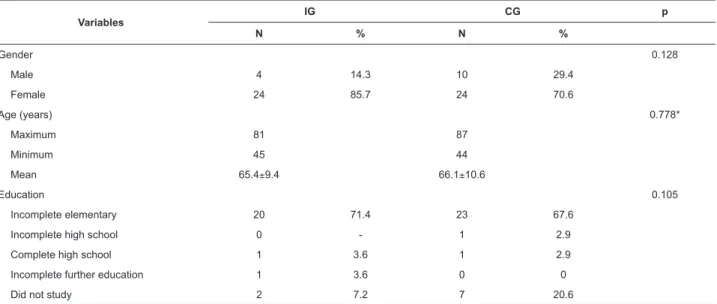
Table 1 shows the characteristics of the groups studied in
relation to the sociodemographic variables.
Variables
IG CG p
N % N %
Gender 0.128
Male 4 14.3 10 29.4
Female 24 85.7 24 70.6
Age (years) 0.778*
Maximum 81 87
Minimum 45 44
Mean 65.4±9.4 66.1±10.6
Education 0.105
Incomplete elementary 20 71.4 23 67.6
Incomplete high school 0 - 1 2.9
Complete high school 1 3.6 1 2.9
Incomplete further education 1 3.6 0 0
Did not study 2 7.2 7 20.6
Table 1 - Sociodemographic characteristics of the Intervention and Control Groups. Goiânia, GO, Brazil, 2010
Rev. Latino-Am. Enfermagem 2012 May.-June;20(3):478--85.
482
Evaluation of the disease knowledge of the
patients with DM
At the beginning of the study, both groups presented
similar knowledge when they responded to the questionnaire
(Table 2). The mean percentage of total correct answers was
20.7% in the IG, with the minimum of 10 and the maximum
of 37 points out of a total of 106 points (Table 2). At the end of the study, the increase in disease knowledge was signiicantly higher among the IG patients (p<0.05). In the topic “family
support”, which relates to the participation of the family in the patient’s treatment, there was no signiicant change in percentage between the groups at the end of the study.
The patients showed greater knowledge at the
beginning of the study in the questions related to diet
(45%) and clinical parameters (50%) in both groups.
At the end of educational intervention, as can be seen
from Table 2, the percentage increased to 78.8% and
93% respectively in the IG. In the CG the results rose
to 50.0% regarding diet and decreased to 43.0% in
clinical parameters. The topics that the IG participants
presented less knowledge of at the beginning of the study
were related to foot care (11.5%) and hypoglycemia
(7.5%). At the end of the study, these percentages had
increased considerably in the IG (44.6% and 37.5%
respectively). (Table 2).
Topics Evaluation Intervention Group (%) Control Group (%) p
General questions Beginning 22.7 23.8 0.645
End 51.7 28.1 0.000
Physical activity Beginning 20.1 21.2 0.441
End 37.8 26.3 0.000
Diet Beginning 45.6 44.4 0.804
End 79.0 49.7 0.000
Foot care Beginning 11.5 11.5 0.969
End 44.8 17.4 0.000
Clinical parameters Beginning 49.4 49.0 0.888
End 93.8 45.1 0.000
Hypoglycemia Beginning 7.3 6.8 0.355
End 62.8 10.9 0.000
Chronic complications Beginning 27.7 27.2 0.807
End 62.5 35.7 0.000
Family support Beginning 16.7 17.6 0.198
End 20.2 18.6 0.307
Total Beginning 20.7 20.9 0.938
End 48.3 25.6 0.000
Table 2 – Evaluation between the Groups of the percentage of correct answers in the Diabetes Knowledge Questionnaire
at the beginning and end of the study. Goiânia, GO, Brazil, 2010
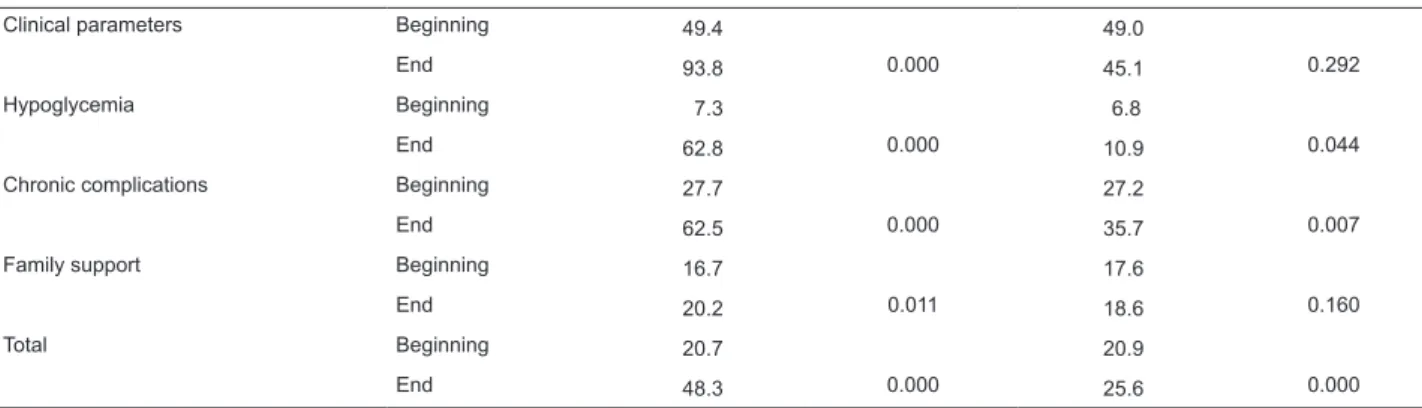
In the intragroup evaluation regarding the responses
to the questionnaire applied at the two times, there was signiicant improvement of knowledge in the IG in all the
topics (p<0.05). In the CG, in contrast, the scores for the
items diet, clinical parameters and family support did not signiicantly improve (Table 3).
Knowledge about diabetes Evaluation
Intervention Group Control Group
% correct answers p % correct answers p
General questions Beginning 22.7 23.8
End 51.7 0.000 28.1 0.006
Physical activity Beginning 20.1 21.2
End 37.8 0.000 26.3 0.002
Diet Beginning 45.6 44.4
End 79.0 0.000 49.7 0.084
Foot care Beginning 11.5 11.5
End 44.8 0.000 17.4 0.009
Table 3 - Intra-Group evaluation of the percentage of correct answers in the Diabetes Knowledge Questionnaire at the
beginning and end of the study. Goiânia, GO, Brazil, 2010
Discussion
This study sought to follow conscientization
problematization methodology for the education of the
diabetic patients, which generated satisfactory results
with regards to the increase in disease knowledge, and the stimulation of relections on the condition of being diabetic. This allowed the IG participants to develop
self-care measures, related to changing behavior, adopting
healthy habits and practicing physical activity. These
data are corroborated by another study that used this
methodological approach and reported that the conscious
DM patient is open to dialogue, expresses him/herself and
acts as a responsible agent in the self-care process(17).
Changes in eating behavior and the practice of physical
activity in DM2 patients are very important in the evaluation of group education programs in diabetes and are subject to the improvement of knowledge and the modiication of attitudes about the disease(18). The education level can be
considered a determinant factor in the effectiveness of an
educational program, especially in patients with DM, who
need to acquire certain knowledge to be able to develop
their self-care(19). A low education level is reported as a
factor that can affect adherence to the pharmacological
treatment, because the drugs for the treatment of diabetes
are considered complex and require comprehension of
their use by the patients(20). The two groups, IG and CG,
were found to be homogeneous in relation to education,
as 66.7% and 67.6% of the participants respectively,
had incomplete primary education, which enabled the
comparison of learning between them. Other studies also
found a predominance of this education level in patients
with DM(6,19). The advanced age found in this population did
not represent dificulties in learning, a different result than was found in a study that examined the barriers to diabetes
education and concluded that older people, among other dificulties, also present limitations in education(9).
The educational program implemented in this study
increased the knowledge of diabetes of the IG patients in
all the topics analyzed. Other studies that have developed
group educational programs for patients with DM, using
participatory teaching strategies, such as role plays,
relating of experiences and walking, also found an increase
in knowledge about the disease(6,19). A review carried out
with 72 studies on DM2 self-management education with
follow up periods of between six to 12 months found
positive results regarding understanding the disease and
concluded that educational interventions that involve the
collaboration of the patients may be more effective(21).
The availability of knowledge and the strengthening
of active attitudes in relation to the disease, directed
toward the person with diabetes and their family, through
educational health practices, has been linked to the
prevention of complications through self-management
of the disease, which enables a person to exist better
with their condition(2). Current health education practices
recognize the importance of new teaching strategies
that valorize the autonomy of people with diabetes and
promote the taking of conscious decisions, making them
self-managers of their health(22). These are the goals of
education for empowerment, which uses an interactive
approach through the strategy of solving problems
inspired by the contributions of Freire, applied in health
education since the start of the 1990s(5).
The dialogism, the reports of experiences of the group and the relections regarding their own acts were an effective way to create the possibility of adherence to a
new lifestyles and the development and acquisition of
self-care attitudes for the DM patient. There is evidence that
knowledge about the characteristics and complications of
diabetes greatly improves the evolution of the disease,
because it leads to early detection and to a reduction in
the rate of installation of chronic complications(23). In this
study, the IG obtained a higher increase of knowledge
in the topics: general aspects of the disease; foot care;
hypoglycemia; and chronic complications. Knowledge
about the disease is the basis for the development of
self-care actions in diabetes, although the acquisition of
knowledge does not necessarily translate into a change in
behavior. The lifestyle and beliefs may also have a strong
Clinical parameters Beginning 49.4 49.0
End 93.8 0.000 45.1 0.292
Hypoglycemia Beginning 7.3 6.8
End 62.8 0.000 10.9 0.044
Chronic complications Beginning 27.7 27.2
End 62.5 0.000 35.7 0.007
Family support Beginning 16.7 17.6
End 20.2 0.011 18.6 0.160
Total Beginning 20.7 20.9
End 48.3 0.000 25.6 0.000
Rev. Latino-Am. Enfermagem 2012 May.-June;20(3):478--85.
484
inluence(4,17-18). To increase the knowledge of individuals
with DM seems to be essential for reinforcing their ability and conidence to develop self-care actions, which together contribute to better disease management(24).
Family support has been described as an essential
factor for stimulating the self-care of patients with DM(25).
In this study, family participation in the educational
activities was encouraged. The change in this topic, although signiicant in the IG, was small in the intra-groups comparison and did not have the same behavior as the other topics where the change was signiicant. To achieve family interaction in any educational process that
occurs outside the home environment is a challenge. It is
unusual for family members to monitor and be involved in
the care of diabetic individuals. The main limitation of this
study was the reduction of the sample size in relation to
the initial calculation. However, it was possible to identify signiicant changes in the behavior of the different groups.
Conclusions
In this study, despite the initial lack of knowledge
encountered in the study population, it was possible to
increase their knowledge about diabetes mellitus. The
educational activities carried out using conscientization
problematization methodology encouraged the participation
of the group and fostered learning. The working in groups
method used in this study was shown to be a feasible and
appropriate strategy for the development of educational
activities, which can help to promote the autonomy of the patients and enable the active participation of the subjects in the construction of new knowledge.
The implementation of a structured program of care
for the chronic diseases, which increases the efforts to
perform educational strategies with proactive approaches
and the participation of the patients in all the phases
of planning, development and implementation of the
educational activities, could be the basis for preventive
interventions and for health promotion. In an active
education proposal, the person with DM should be the main subject and the health professional a facilitator of learning that stimulates the potential and the ability to
re-invent reality in people, achieving the production of their
health. This work shows that the individual with Diabetes
may be co-responsible for their health and that their
recovery is conditional on their active participation.
Acknowledgement
We acknowledge endocrinologist Luciana Muniz
Sanches Jardim for their collaboration in the planning of
this research.
References
1. Ministério da Saúde (BR). Cadernos de atenção básica:
diabetes mellitus. Brasília (DF): Ministério da Saúde;
2006. 56 p. (Série A. Normas e manuais Técnicos, n. 16).
2. Funnell MM, Brown TL, Childs BP, Haas L, Hosey GM,
Jensen B, et al. National Standards for Diabetes
Self-Management Education. Diabetes Care. 2008;31(1):12-54.
3. Davies MJ, Heller S, Skinner TC, Campbell MJ, Carey ME,
Cradock S, et al. Effectiveness of the diabetes education
and self management for ongoing and newly diagnosed
(DESMOND) programme for people with newly diagnosed
type 2 diabetes: cluster randomised controlled trial. Br
Med J. 2008;336(7642):1-11.
4. Jarvis J, Skinner TC, Carey ME, Davies MJ. How can
structured self-management patient education improve
outcomes in people with type 2 diabetes?. Diabetes
Obesity Metabolism. 2010;12(1):12-9.
5. Ciryno AP, Schraiber LB, Teixeira RR. Education for Type 2
Diabetes Mellitus Self-care: from compliance to empowerment.
Interface Comunicação Saúde Educ. 2009;13(30):93-106.
6. Otero LM, Zanetti ML, Ogrizio MD. Knowledge of
diabetic patients about their disease before and after
implementing a diabetes education program. Rev.
Latino-Am. Enfermagem. 2008;16(2):231-7.
7. Sociedade Brasileira de Diabetes (SBD). Diretrizes
da sociedade brasileira de diabetes 2007: tratamento e
acompanhamento do diabetes mellitus. São Paulo; 2007.
8. Norris SL, Lau J, Smith SJ, Schmid CH, Engelgau
MM. Sef-management education for adults with type
2 diabetes: a meta-analysis of the effect on glycemic
control. Diabetes Care. 2002;25(7):1159-71.
9. Rhee MK, Cook CB, EL-Kebi I, Lyles RH, Dunbar VG,
Panayioto RM, et al. Barriers to diabetes education in
urban patients: perceptions, patterns, and associated
factors. Diabetes Educ. 2005;31(3):410-7.
10. Leite MMJ, Prado C, Peres HC. Educação em saúde: desaios para uma prática inovadora. São Caetano do Sul: Difusão; 2010. 87 p.
11. Bordenave JD, Pereira AM. Estratégia de
ensino-aprendizagem. 24ª. ed. Petrópolis: Vozes; 2002. 312 p.
12. Freire P. Pedagogia da autonomia: saberes necessários
à prática educativa. 25ª. ed. Rio de Janeiro: Paz e Terra;
2002. 54 p.
13. Freire P. Conscientização: teoria e prática da libertação.
Uma introdução ao pensamento de Paulo Freire. 3ª. ed.
São Paulo: Moraes; 1980. 87 p.
14. Otero LM. Implementação e avaliação de atendimento
ao paciente diabético utilizando o Protocolo Staged
Diabetes Management. [Tese de doutorado]. Ribeirão
Preto (SP): Escola de Enfermagem de Ribeirão Preto da
15. Freire P. Educação como Prática de Liberdade. 19a. ed.
Rio de Janeiro: Paz e Terra; 1989. 150 p.
16. Bardin L. Análise de conteúdo. Lisboa: Edições 70;
2009. 288 p.
17. Rêgo MAB, Nakatani AYK, Bachion MM. Educação para
a saúde como estratégia de intervenção de enfermagem
às pessoas portadoras de diabetes. Rev Gaúcha Enferm.
2006;27(1):60-70.
18. Torres HC, Franco LJ, Stradioto MA, Hortale VA,
Schall VT. Avaliação estratégica de educação em grupo e
individual no programa educativo em diabetes. Rev Saúde
Pública. 2009;43(2):291-8.
19. Miyar LO. Impact of a health promotion program carried
out by nursing among type 2 diabetes patients,within
the community. Rev. Latino-Am. Enfermagem.
2003;11(6):713-9.
20. Pace AE, Ochoa-Vigo K, Caliri MHL, Fernandes APM.
Knowledge on diabetes mellitus in the self care process.
Rev. Latino-Am. Enfermagem. 2006;14(5):728-34.
21. Norris SL, Engelgau MM, Narayan KMV. Effectiveness
of self-management training in type 2 diabetes. Diabetes
Care. 2001;24(3):561-87.
22. Funnell MM, Anderson RM. Empowerment and
Self-Management of Diabetes. Clin Diabetes. 2004;22(3):
123-7.
23. Silva CAB. A educação no tratamento das doenças
crônico-degenerativas. Rev Bras Promoção Saúde.
2006;19(4):195-6.
24. Sousa VD, Zauszniewski JA. Toward a theory of
diabetes self-care management. J Theory Construct Test.
2005;9(2):61-7.
25. Santos ECB, Zanetti ML, Otero LM, Santos MA. Care
according to diabetes patients and their main caregivers.
Rev. Latino-Am. Enfermagem. 2005;13(3):397-406.