Effect of Neoadjuvant Chemotherapy Followed by Surgical
Resection on Survival in Patients With Limited Metastatic
Gastric or Gastroesophageal Junction Cancer
The AIO-FLOT3 Trial
Salah-Eddin Al-Batran, MD; Nils Homann, MD; Claudia Pauligk, PhD; Gerald Illerhaus, MD; Uwe M. Martens, MD; Jan Stoehlmacher, MD; Harald Schmalenberg, MD; Kim B. Luley, MD; Nicole Prasnikar, MD; Matthias Egger, MD; Stephan Probst, MD; Helmut Messmann, MD; Markus Moehler, MD; Wolfgang Fischbach, MD; Jörg T. Hartmann, MD; Frank Mayer, MD; Heinz-Gert Höffkes, MD; Michael Koenigsmann, MD; Dirk Arnold, MD; Thomas W. Kraus, MD; Kersten Grimm, MD; Stefan Berkhoff, MD; Stefan Post, MD; Elke Jäger, MD; Wolf Bechstein, MD; Ulrich Ronellenfitsch, MD; Stefan Mönig, MD; Ralf D. Hofheinz, MD
IMPORTANCESurgical resection has a potential benefit for patients with metastatic adenocarcinoma of the stomach and gastroesophageal junction.
OBJECTIVETo evaluate outcome in patients with limited metastatic disease who receive chemotherapy first and proceed to surgical resection.
DESIGN, SETTING, AND PARTICIPANTSThe AIO-FLOT3 (Arbeitsgemeinschaft Internistische Onkologie–fluorouracil, leucovorin, oxaliplatin, and docetaxel) trial is a prospective, phase 2 trial of 252 patients with resectable or metastatic gastric or gastroesophageal junction adenocarcinoma. Patients were enrolled from 52 cancer care centers in Germany between February 1, 2009, and January 31, 2010, and stratified to 1 of 3 groups: resectable (arm A), limited metastatic (arm B), or extensive metastatic (arm C). Data cutoff was January 2012, and the analysis was performed in March 2013.
INTERVENTIONSPatients in arm A received 4 preoperative cycles of fluorouracil, leucovorin, oxaliplatin, and docetaxel (FLOT) followed by surgery and 4 postoperative cycles. Patients in arm B received at least 4 cycles of neoadjuvant FLOT and proceeded to surgical resection if restaging (using computed tomography and magnetic resonance imaging) showed a chance of margin-free (R0) resection of the primary tumor and at least a macroscopic complete resection of the metastatic lesions. Patients in arm C were offered FLOT chemotherapy and surgery only if required for palliation. Patients received a median (range) of 8 (1-15) cycles of FLOT.
MAIN OUTCOMES AND MEASURESThe primary end point was overall survival.
RESULTSIn total, 238 of 252 patients (94.4%) were eligible to participate. The median (range) age of participants was 66 (36-79) years in arm A (n = 51), 63 (28-79) years in arm B (n = 60), and 65 (23-83) years in arm C (n = 127). Patients in arm B (n = 60) had only retroperitoneal lymph node involvement (27 patients [45%]), liver involvement (11 [18.3%]), lung involvement (10 [16.7%]), localized peritoneal involvement (4 [6.7%]), or other (8 [13.3%]) incurable sites. Median overall survival was 22.9 months (95% CI, 16.5 to upper level not achieved) for arm B, compared with 10.7 months (95% CI, 9.1-12.8) for arm C (hazard ratio, 0.37; 95% CI, 0.25-0.55) (P< .001). The response rate for arm B was 60% (complete, 10%; partial, 50%), which is higher than the 43.3% for arm C. In arm B, 36 of 60 patients (60%) proceeded to surgery. The median overall survival was 31.3 months (95% CI, 18.9-upper level not achieved) for patients who proceeded to surgery and 15.9 months (95% CI, 7.1-22.9) for the other patients.
CONCLUSIONS AND RELEVANCEPatients with limited metastatic disease who received neoadjuvant chemotherapy and proceeded to surgery showed a favorable survival. The AIO-FLOT3 trial provides a rationale for further randomized clinical trials.
TRIAL REGISTRATIONclinicaltrials.gov Identifier:NCT00849615 JAMA Oncol. doi:10.1001/jamaoncol.2017.0515
Published online April 27, 2017.
Supplemental content
Author Affiliations:Author affiliations are listed at the end of this article.
Corresponding Author:Salah-Eddin Al-Batran, MD, Institute of Clinical Cancer Research, Krankenhaus Nordwest, UCT-University Cancer Center, Steinbacher Hohl 2-26, 60488, Frankfurt am Main, Germany ([email protected]).
G
astric cancer is often diagnosed in locally advanced or metastatic stage and, therefore, has a poor prognosis. Systemic chemotherapy is recommended for patients with stage II or III disease as neoadjuvant or perioperative ment and for patients with stage IV as a single-modality treat-ment. In the latter case, only 10% of the patients survive lon-ger than 2 years. Unlike with other tumor entities, such as colon and ovarian cancer, in which multimodality approaches are frequently used for select patients in stage IV, patients with metastatic gastric cancer generally receive only palliative chemotherapy.A number of retrospective analyses examined the role of surgery of the primary tumor and/or metastases for patients with stage IV gastric cancer and suggested that surgery might be associated with prolonged survival in select patients, such as those 70 years or younger who had 1 metastatic site,1those with 1 incurable site and excellent response to systemic pre-operative chemotherapy,2,3and those with liver metastases in whom complete resection was possible.4However, the role of surgical intervention for metastatic gastric cancer remains an open question. A recent trial in Asia (REGATTA) randomized 175 patients with gastric cancer and a single noncurable site to chemotherapy alone or to initial gastrectomy (without re-section of the metastases) followed by chemotherapy. That trial failed to show improvements in survival.5
In the debate on how to conduct further studies in this field, we consider 3 theoretical aspects to be important: (1) the proper selection of suitable candidates for surgery, (2) the clear defi-nition of the goal of the surgery (eg, palliative or curative), and (3) the necessity to administer effective systemic chemo-therapy prior to surgery.
Here, we report on the feasibility and efficacy of using induction chemotherapy with fluorouracil, leucovorin, oxalipl-atin, and docetaxel (FLOT) followed by surgical resection with curative or life-prolonging intent for select patients with lim-ited metastatic gastric cancer. We chose FLOT treatment because of its confirmed tolerability6,7and ability to induce consider-able rates (up to 20%) of complete pathological regression.8-10
Methods
Patient Eligibility
Patients with histologically confirmed, previously untreated, nonmetastatic, operable (>T2, N any, and M0 or any T, N+, and M0) or metastatic (T any, N any, and M1) adenocarcinoma of the stomach or esophagogastric junction were eligible to par-ticipate in this AIO–FLOT3 (Arbeitsgemeinschaft Internis-tische Onkologie–fluorouracil, leucovorin, oxaliplatin, and docetaxel) trial (NCT00849615).Patients with recurrent disease were not. An Eastern Cooperative Oncology Group performance status of 0 to 2, sufficient bone marrow and kidney function, and no concurrent, uncontrolled medical illness were required of trial participants. The protocol (available inSupplement 1) and the patient informed consent form were approved by the ethics committees of all participating cancer care centers (eAppendix 1 inSupplement 2). Participants provided written informed consent.
Clinical Staging and Group Stratification
Patients underwent preoperative staging that consisted of endoscopy, endoscopic ultrasonography, and computed to-mography (CT) or magnetic resonance imaging (MRI) of the chest, abdomen, and pelvis. Patients who were potentially re-sectable or had limited metastases were recommended to undergo diagnostic laparoscopy. In case of suspected bone le-sions on CT scans, additional bone scans were required.
After pretreatment staging, patients were stratified by the investigator into 1 of 3 groups—resectable (arm A), limited metastatic (arm B), or extensive metastatic (arm C)—using the following criteria:
•Arm A, resectable tumors without distant metastases (cM0).
•Arm B, metastatic tumors (cM1) with all of the following criteria fulfilled:
•abdominal, retroperitoneal lymph node metastases only (eg, para-aortic, intra-aortic-caval, peripancreatic, or mesente-rial lymph nodes) or 1 incurable organ site with or without retroperitoneal lymph node metastases;
•no clinically visible (on CT scans or because of ascites) or symptomatic carcinomatosis of peritoneum or pleura and no diffuse (>P2 score; eAppendix 2 inSupplement 2) peri-toneal carcinomatosis on diagnostic laparoscopy;
•fewer than 5 liver metastases, if the single organ site is the liver;
•Eastern Cooperative Oncology Group performance status of 0 or 1; and
•normal serum alkaline phosphatase levels.
•Furthermore, the following specific cases were predefined in the study protocol: localized peritoneal carcinomatosis (P1 or P2 score), according to the classification of the Japa-nese Research Society for Gastric Cancer, was allowed and considered 1 incurable organ site. Bilateral or unilateral Krukenberg tumors were allowed and considered 1 incur-able organ site. Unilateral or bilateral adrenal gland metas-tases were also considered 1 incurable organ site. Extra-abdominal lymph node metastases, such as supraclavicular lymph node involvement, were allowed and considered 1 incurable organ site.
•Arm C, metastatic patients who did not fulfill the criteria of arm B.
Key Points
QuestionIs there a survival benefit for patients with limited metastatic gastric or gastroesophageal junction cancer who receive neoadjuvant chemotherapy followed by surgical resection?
FindingsIn this phase 2 trial that enrolled 252 patients with resectable or metastatic gastric or gastroesophageal junction adenocarcinoma, 60 of the 238 eligible patients were classified as having limited metastatic stage and 36 of these 60 patients had surgery, including resection of the primary tumor and metastases. The median overall survival was 31.3 months for patients who underwent surgery and 15.9 months for the other patients.
MeaningPatients with limited metastatic gastric or
Retroperitoneal lymph node involvementwas defined as an abnormally increased number of retroperitoneal lymph nodes measuring more than 1 cm in the short-axis diameter or a single lymph node measuring more than 2 cm in the short-axis diameter. The stratification was confirmed by central review (S.-E.A.-B.). If necessary, central review requested additional information and documents or contacted the investigator to achieve consensus.
Treatment Plan
The FLOT chemotherapy consisted of oxaliplatin, 85 mg/m2; leucovorin, 200 mg/m2; and docetaxel, 50 mg/m2. Each is an intravenous infusion followed by fluorouracil, 2600 mg/m2, as a 24-hour continuous intravenous infusion on day 1, repeated every 2 weeks.6(FLOT is a 2-week regimen.)
Patients in arm A received 4 cycles of preoperative FLOT followed by surgery and 4 postoperative cycles. Patients in arm B received 4 cycles of FLOT and proceeded to surgery if restaging showed a realistic chance for margin-free (R0) resection of the primary tumor and at least a “macroscopic complete resection” of the metastatic lesions. For final de-cision, we took into consideration the current patient’s Eastern Cooperative Oncology Group performance status, comorbidity, organ function, and response to FLOT treat-ment. After surgery, patients in arm B received 4 additional postoperative cycles of FLOT (8 cycles in total). Patients who did not proceed to surgery after the fourth cycle con-tinued to receive 4 additional cycles (8 cycles in total). Patients in arm C received 8 cycles, and surgical interven-tions were allowed for palliative reasons. In treatment arms B and C, the maximum duration of FLOT treatment could be extended to a maximum of 12 cycles at the investigator’s discretion.
Surgery
Restaging through CT or MRI scans and endoscopy of the up-per gastrointestinal tract was repeated after 4 cycles prior to surgical treatment, which was 3 weeks after the last cycle of preoperative chemotherapy. Surgery was performed accord-ing to German standards: the AIO-FLOT3 trial protocol sug-gested transthoracic esophagectomy with resection of the proximal stomach (Ivor-Lewis procedure) and 2-field lymph-adenectomy for type I gastroesophageal junction cancers and gastrectomy with transhiatal distal esophagectomy plus D2 lymphadenectomy for types II and III gastroesophageal junc-tion cancers. For gastric cancer, total or subtotal distal gas-trectomy with D2 lymphadenectomy was recommended. The study protocol provided recommendations on surgical inter-vention for these specific situations in arm B: para-aortic in-volvement, peripheral or central liver metastases, localized peritoneal carcinomatosis, and metastases to adrenal glands (eAppendix 2 inSupplement 2).
Toxicity Assessment
Toxic effects were graded according to the National Cancer In-stitute’s Common Toxicity Criteria, version 3.0.11 Postopera-tive morbidity and mortality were recorded.
Evaluation of Efficacy Outcomes
Response in the metastatic groups (arms B and C) was classi-fied according to RECIST (Response Evaluation Criteria in Solid Tumors), version 1.0.12Tumor assessment through CT or MRI scans was carried out every 8 weeks during and after the end of the study treatment (for patients who discontinued the study without disease progression).R0 resectionwas defined as no tumor identified on microscopic examination of proximal, dis-tal, or circumferential margins.
End Points and Statistical Analysis
We assumed that if patients in arm B (independent of whether patients had an operation) showed a better outcome than did patients in arm C, we could justify the further evaluation of neoadjuvant chemotherapy followed by surgical resection in the patient group of arm B. Therefore, the primary end point was overall survival (OS), and the study had 80% power to detect a 45% risk reduction of death in arm B compared with arm C (hazard ratio [HR], 0.55), withP< .05 in the 2-tailed log-rank test indicating statistical significance. Assuming that approximately 30% of metastatic patients in the study group would match the criteria for arm B (did not reflect the natural prevalence of this group), we calculated the sample size to be 192 (arm B, 64; arm C, 128). Arm A did not have an effect on sample size calculation and was capped at 50 patients. Progression-free survival was mea-sured from the date of arm assignment until disease pro-gression or death of any cause. Similarly, OS was measured from the date of arm assignment until death of any cause. Data cutoff was January 2012, and the analysis was per-formed in March 2013. Patients were analyzed in the arm to which they were assigned.
Results
Patient Characteristics
27 of 60 patients (45%), followed by patients with liver me-tastases (11 [18.3%]).
Chemotherapy and Surgical Treatment
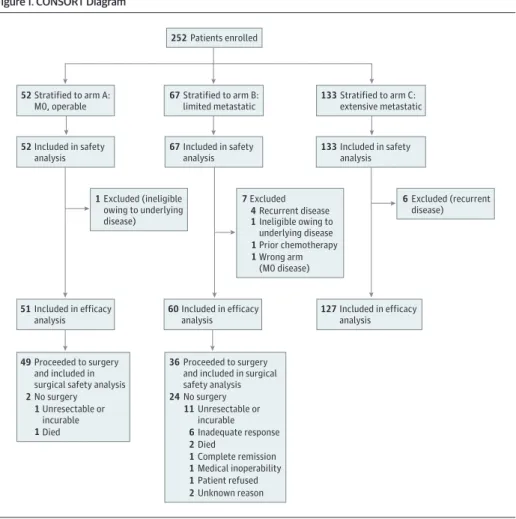
Patients received a median (range) of 8 (1-15) cycles of FLOT. The median (range) numbers of preoperative and postoperative cycles were 4 (preoperative, 3-15; postoperative, 1-7) for each arms of A and B. Forty-nine patients (96.1%) in arm A, 36 (60%) in arm B, and 15 (11.8%) in arm C proceeded to any surgical re-section. R0 resections of the primary tumor were achieved in 40 patients (81.6%) in arm A, 29 (80.6%) in arm B, and 5 (33.3%) in arm C. As shown in eTable 2 inSupplement 2, fewer patients in arm B than in arm A had a right transthoracic esophagec-tomy with 2-field lymph node dissection despite the fact that junctional tumors were more frequent in arm B.
In arm B, surgery was performed in 18 of 27 patients (66.7%) with retroperitoneal lymph node metastases, 6 of 11 (54.5%) with liver metastases, 6 of 10 (60%) with lung metastases, 2 of 4 (50%) with local peritoneal carcinomatosis, and 4 of 8 (50%) with other metastases. Metastasectomy of at least 1 metastatic lesion was performed in 17 of the 36 patients (47.2%) who were assigned to surgery in arm B. These surgical proce-dures included D3 lymphadenectomy in 7 patients, peritonec-tomy in 3, multivisceral resections in 3, hepatecperitonec-tomy in 3, and adrenalectomy in 1. Among the 18 patients with retroperito-neal lymph node metastases who underwent a resection,
meta-static lymph node involvement could be confirmed in 11 pa-tients but was not assessable in 3 papa-tients who had complete pathological regression and could not be confirmed in the other 4 patients. Complete pathological regression (stage of T0) was reported in 6 of 36 patients (16.7%) of arm B who underwent resection. Complete regression in resected metastatic le-sions, as indicated by fibrotic changes and the absence of ma-lignant cells, was noticed in 3 patients (retroperitoneal lymph nodes in 2 patients and liver lesions in 1 patient). The reasons for not assigning patients to surgery in arm B were unresect-able or incurunresect-able metastatic lesions in 11 of 60 patients (18.3%), inadequate response in 6 (10%), death in 2 (3.3%), complete response in 1 (1.7%), medical inoperability in 1 (1.7%), patient refusal in 1 (1.7%), and unknown in 2 (3.3%), as reported by the investigator.
Efficacy Outcomes
Median follow-up for surviving patients was 28.6 months (arm A, 30.3 months; arm B, 27.5 months; arm C, 24.4 months). Me-dian OS was 22.9 (95% CI, 16.5-upper level not achieved) months in arm B and 10.7 (95% CI, 9.1-12.8) months in arm C (HR, 0.37; 95% CI, 0.25-0.55;P< .001). Median OS in arm A was not achieved and compared favorably with the median OS in arm B. The analysis of progression-free survival among the arms revealed distributions similar to OS distributions (Figure 2).
Figure 1. CONSORT Diagram
252Patients enrolled
52Stratified to arm A: M0, operable
52Included in safety analysis
1Excluded (ineligible owing to underlying disease)
51Included in efficacy analysis
49Proceeded to surgery and included in surgical safety analysis
2No surgery Unresectable or incurable
1
1Died
67Stratified to arm B: limited metastatic
67Included in safety analysis
7Excluded
4Recurrent disease
1Ineligible owing to underlying disease
60Included in efficacy analysis
133Stratified to arm C: extensive metastatic
133Included in safety analysis
6Excluded (recurrent disease)
127Included in efficacy analysis
36Proceeded to surgery and included in surgical safety analysis
24No surgery
11Unresectable or incurable
6Inadequate response
2Died
1Complete remission
1Medical inoperability
1Patient refused
2Unknown reason
1Prior chemotherapy
Within arm B, patients who proceeded to surgery had more favorable median OS (31.3 months [95% CI, 18.9-upper level not achieved] vs 15.9 months [95% CI, 7.1-22.9]) and progression-free survival (26.7 months [95% CI, 9.1-upper level not achieved] vs 8.4 months [95% CI, 4.1-10.4]) than the other patients in arm B (Figure 2). Outcomes with 95% CIs are shown inTable 1. Among the subgroups of arm B, only patients with retroperitoneal lymph node metastases had the best prognosis, whereas patients with liver metasta-ses showed a less favorable survival (eFigure inSupplement 2). The overall response rate (complete and partial response) to chemotherapy was higher in arm B patients than in arm C patients (60.0% vs 43.3%;P= .04). Response rates are shown inTable 2.
We compared the baseline characteristics and comorbidi-ties of patients who proceeded to surgery with those who did not within arm B. No differences in age, sex, location of the primary tumor, histological type, type of metastases, and other
characteristics were found. However, patients who did not un-dergo surgery had significantly more active comorbidities than patients who had surgery (20 of 24 [83.3%] vs 18 of 36 [50.0%]; P= .009), particularly of the cardiovascular type (15 of 24 [62.5%] vs 10 of 36 [27.8%];P= .008), and less complete re-sponses (1 of 24 [4.2%] vs 5 of 36 [13.9%]; Table 2) during chemotherapy.
Safety
The safety analysis comprised all 252 patients. The safety profile of FLOT was in line with the profile of previous studies.6,7,10,13Patients in arm C had significantly more Com-mon Toxicity Criteria all-grades anemia, pain, and elevated alkaline phosphatase levels, most likely correlated with the high tumor burden (eTable 3 inSupplement 2). Severe post-surgical morbidity (fulfilling the criteria of a serious adverse event) affected 5 patients (10.2%) in arm A and 3 patients (8.3%) in arm B (eTable 4 inSupplement 2). Numbers do not
Figure 2. Survival Analyses
1.0 0.8 0.6 0.4 0.2 1.0 0.8 0.6 0.4 0.2 1.0 0.8 0.6 0.4 0.2 0
0 3 6 9 12 15 18 21 24 27 33
Propor tion Sur viving Time, mo 30 Progression-free survival A
No. at risk Arm A Arm B Arm C 51 60 127 47 56 100 44 44 65 39 36 37 38 25 23 34 22 11 32 20 8 28 19 5 26 17 5 25 11 3 15 6 2 2 0 0 Arm A Arm A Arm B Arm B Arm C Arm C 0
0 3 6 9 12 15 18 21 24 27 33
Propor tion Sur viving Time, mo 30 Overall survival B
No. at risk Arm A Arm B Arm C 51 60 127 50 58 113 48 53 97 44 46 77 43 41 54 38 38 35 36 35 25 34 30 19 32 24 13 31 16 6 19 9 4 2 1 0 1.0 0.8 0.6 0.4 0.2 0
0 3 6 9 12 15 18 21 24 27
Propor tion Sur viving Time, mo Progression-free survival C
No. at risk No surgery Surgery 24 36 20 34 13 29 10 24 3 21 1 18 1 12 0 9 0 3 0 0
Arm B, surgery Arm B, surgery
Arm B, no surgery
Arm B, no surgery
0
0 3 6 9 12 15 18 21 24 27
Propor tion Sur viving Time, mo Overall survival D
No. at risk No surgery Surgery 24 36 22 36 19 34 16 30 13 25 9 22 4 16 1 10 1 4 0 0
Kaplan-Meier analysis of progression-free survival (A) and overall survival (B) in patients with resectable (arm A), limited metastatic (arm B), or extensive metastatic (arm C) disease as well as progression-free survival (C) and overall
represent the overall postsurgical morbidity because only those that resulted in serious adverse events are reported. In-hospital mortality after surgery occurred in 1 patient in arm A.
Discussion
The AIO-FLOT3 trial was an exploratory, phase 2 study that prospectively evaluated the feasibility and efficacy of induction chemotherapy followed by surgery for patients with limited metastatic gastric cancer who had additional favorable prognostic factors. Sixty patients had limited metastatic disease (arm B), and they had a considerable median OS of 22.9 months. Of the 60 patients, 36 (60%) proceeded to surgery. The median OS was 31.3 months for patients who underwent surgery and 15.9 months for the other patients. Both groups had survival rates that were markedly better than the expected survival for metastatic disease, which were generally accepted to be 9 to 11 months in recent trials. The important question is to what extent surgery contributed to the favorable outcome of the resected group. Because of the lack of randomization, rel-evant selection bias may exist. For instance, a difference in comorbidity was observed between the groups. Patients assigned to surgery had less active comorbidity than the patients who did not have surgery (50.0% vs 83.3%). The most common reason for not assigning patients to surgery
was the investigator’s decision that metastatic lesions were unresectable or incurable after neoadjuvant chemotherapy. Conversely, this means that patients assigned to surgery were superselected. Nevertheless, within these limitations, the considerable survival in the surgical group of arm B remains promising. A median survival of 31 months is more than we would expect in a superselected group of patients with metastatic disease.
Patients with retroperitoneal lymph node metastases or liver metastases represented the 2 largest subgroups of arm B. Patients with retroperitoneal lymph node metastases showed the best survival. This patient group may be of a particular in-terest for such a bimodality therapy approach.14-18One impor-tant point is whether CT or MRI was sufficient to determine retroperitoneal involvement. The accuracy of CT or MRI for de-fining lymph node involvement is dependent on the anatomi-cal location. In the abdomen, the upper limit of the short-axis diameter of normal nodes varies from 6 to 10 mm.19The study protocol went beyond these definitions, requiring either too many lymph nodes (lymph node clusters) greater than 1 cm in the short axis or single lymph nodes greater than 2 cm. Therefore, we do not believe that arm B was inflated by pa-tients with nonmetastatic lymphatic hyperplasia. The less fa-vorable outcome of patients with liver metastases leads us to recommend to either exclude this group in future trials or limit the group to patients in whom complete (R0) resection is judged possible at initial evaluation. Nevertheless, few pa-tients with metastatic gastric cancer will have initially resect-able liver disease.4,20
The REGATTA trial5randomized 175 patients with gastric cancer and a single noncurable site confined to liver, perito-neum, or para-aortic lymph nodes to chemotherapy alone or gastrectomy followed by chemotherapy. The study did not show any improvement of OS by gastrectomy (median OS, 16.6 months without gastrectomy and 14.3 months with gastrectomy).5The concept of the REGATTA trial differs from the concept of the AIO-FLOT3 trial in 2 important ways. First, patients in the REGATTA trial did not receive neoadjuvant chemotherapy. Second, the surgical intervention was re-stricted to only gastrectomy with D1 lymphadenectomy with-out any resection of metastatic lesions, making the study palliative rather than curative. As mentioned in the
Introduc-Table 1. Median Overall Survival and Progression-Free Survival by Arm
Study Arm
Survival
Median OS (95% CI), mo Median PFS (95% CI), mo
Arm A NA NA
Arm B
All 22.9 (16.5-NA) 10.7 (8.0-16.5)
With surgery 31.3 (18.9-NA) 26.7 (9.1-NA)
Without surgery 15.9 (7.1-22.9) 8.4 (4.1-10.4)
Arm C 10.7 (9.1-12.8) 6.3 (5.0-7.6)
Abbreviations: NA, not achieved; OS, overall survival; PFS, progression-free survival.
Table 2. Response Rates According to RECIST for Patients With Limited (Arm B) and Extensive (Arm C) Metastatic Disease
Study Arm
Best Responsea
Complete Response, No. (%) [95% CI]
Partial Response, No. (%) [95% CI]
Overall Response, Complete + Partial, No. (%)
[95% CI]b Stable Disease, No.(%) [95% CI]
Progressive Disease/ Not Evaluable, No. (%) [95% CI]
Arm B
All (n = 60) 6 (10.0) [4.3-20.5] 30 (50.0) [37.7-62.3] 36 (60.0) [47.4-71.4] 18 (30.0) [19.8-42.6] 5 (8.3) [3.2-18.5]
With surgery (n = 36)
5 (13.9) [5.6-29.1] 15 (41.7) [27.1-57.8] 20 (55.6) [39.6-70.5] 14 (38.9) [24.8-55.2] 1 (2.8) [<0.01-15.4]
Without surgery (n = 24)
1 (4.2) [<0.01-21.9] 15 (62.5) [42.6-78.9] 16 (66.7) [46.6-82.2] 4 (16.7) [6.1-36.5] 4 (16.7) [6.1-36.5]
Arm C (n = 127) 5 (3.9) [1.5-9.1] 50 (39.4) [31.3-48.1] 55 (43.3) [35-52] 44 (34.6) [26.9-43.3] 23 (18.1) [12.3-25.8]
a
Best responserefers to the best response achieved as evaluated by comparison of baseline tumor assessment with all available, subsequent tumor assessments until surgical resection was conducted, if applicable. Tumor assessments performed after surgery were not relevant for response.
b
tion, we believe the use of neoadjuvant therapy and the pur-suit of a potentially curative surgery are 2 crucial factors in a multimodality approach to a biologically aggressive disease such as metastatic gastric cancer. Administering chemo-therapy first helps prevent a delay in administration of the sys-temic treatment component, which has been proven to be ef-fective. Moreover, administering chemotherapy first provides a tool for selecting patients with the highest likelihood to ben-efit from additional surgery, on the basis of their response to treatment and other factors.
Limitations
The main limitation of the AIO-FLOT3 trial was the lack of ran-domization. Another limitation was the use of CT or MRI to
determine retroperitoneal involvement. Both of these topics were addressed in the discussion.
Conclusions
To our knowledge, the AIO-FLOT3 trial is the first prospec-tive study to evaluate neoadjuvant chemotherapy followed by surgery in patients with metastatic gastric and gastroesopha-geal junction cancer. Within the limitations of a nonrandom-ized phase 2 study, the results reported here showed that the concept was feasible and provided a rationale for an ongoing, randomized, phase 3 trial21funded by the German Research Foundation Deutsche Forschungsgemeinschaft.
ARTICLE INFORMATION
Accepted for Publication:January 25, 2017. Published Online:April 27, 2017. doi:10.1001/jamaoncol.2017.0515
Author Affiliations:Institute of Clinical Cancer Research, Krankenhaus Nordwest, Universitären Centrum für Tumorerkrankungen-University Cancer Center, Frankfurt, Germany (Al-Batran, Pauligk); Medical Department II, Klinikum Wolfsburg, Wolfsburg, Germany (Homann); Medical Department I, Universitätsklinikum Freiburg, Freiburg, Germany (Illerhaus); now with Clinic for Hematology, Oncology, and Palliative Care, Klinikum Stuttgart, Kriegsbergstraße, Stuttgart, Germany (Illerhaus); Medical Department III, SLK-Kliniken GmbH, Heilbronn, Germany (Martens); Medical Clinic and Polyclinic, Universitätsklinikum Carl Gustav Carus, Dresden, Germany (Stoehlmacher); now with Institute for Clinical Genetics, Bonn, Germany (Stoehlmacher); Medical Department II, Universitätsklinikum Jena, Jena, Germany (Schmalenberg); now with Medical Department IV, Krankenhaus
Dresden-Friedrichstadt, Dresden, Germany (Schmalenberg); Medical Department I Hematology/Oncology, Universitätsklinikum Schleswig-Holstein, Lübeck, Germany (Luley); Medical Department I, Klinikum Ludwigsburg, Ludwigsburg, Germany (Prasnikar); now with Medical Department II, Asklepios Klinik Altona, Hamburg, Germany (Prasnikar); Medical Department, Ortenau Klinikum Lahr, Lahr, Germany (Egger); Department of Hematology and Oncology, Klinikum Bielefeld, Bielefeld, Germany (Probst); Medical Department III, Zentralklinikum Augsburg, Augsburg, Germany (Messmann); Medical Department I, Universitätsklinik Mainz, Mainz, Germany (Moehler); Medical Department II, Klinikum Aschaffenburg, Aschaffenburg, Germany (Fischbach); Medical Department II,
Universitätsklinikum der Eberhard-Karl-Universität, Tübingen, Germany (Hartmann, Mayer); now with Clinic for Hematology, Oncology, and Immunology, Franziskus Hospital Bielefeld, Bielefeld, Germany (Hartmann); now with Gemeinschaftspraxis, Friedrichshafen, Germany (Mayer); Tumorclinic, Klinikum Fulda, Fulda, Germany (Höffkes); MediProjekt, Gesellschaft für Medizinstatistik und Projektentwicklung, Hannover, Germany (Koenigsmann); Clinic and Polyclinic for Internal Medicine IV, Universitätsklinikum Halle, Halle, Germany (Arnold); now with CUF Hospitals Cancer Centre, Lisboa, Portugal (Arnold); Department of
Surgery, Krankenhaus Nordwest, Frankfurt, Germany (Kraus, Grimm, Berkhoff); Medical Department, Universitätsmedizin Mannheim, Mannheim, Germany (Post, Ronellenfitsch, Hofheinz); Department of Oncology and Hematology, Krankenhaus Nordwest, Frankfurt, Germany (Jäger); Department of General and Visceral Surgery, University Hospital Frankfurt, Frankfurt, Germany (Bechstein); Department of General and Visceral Surgery, Universitätsklinik Köln, Köln, Germany (Mönig).
Author Contributions:Drs Al-Batran and Pauligk had full access to all of the data in the study and take responsibility for the integrity of the data and the accuracy of the data analysis.
Study concept and design:Al-Batran, Hofheinz. Acquisition, analysis, or interpretation of data: Al-Batran, Homann, Pauligk, Illerhaus, Martens, Stoehlmacher, Schmalenberg, Luley, Prasnikar, Egger, Probst, Messmann, Moehler, Fischbach, Hartmann, Mayer, Höffkes, Koenigsmann, Arnold, Kraus, Grimm, Berkhoff, Post, Jäger, Bechstein, Ronellenfitsch, Mönig, Hofheinz.
Drafting of the manuscript:Al-Batran, Pauligk. Critical revision of the manuscript for important intellectual content:All authors.
Statistical analysis:Al-Batran, Moehler, Hartmann, Koenigsmann, Kraus, Grimm.
Obtained funding:Al-Batran.
Administrative, technical, or material support: Al-Batran, Homann, Pauligk, Schmalenberg, Luley, Egger, Probst, Messmann, Moehler, Fischbach, Hartmann, Arnold, Kraus, Grimm, Berkhoff, Ronellenfitsch, Hofheinz, Mayer, Höffkes. Study supervision:Al-Batran, Post, Jäger, Mönig.
Conflict of Interest Disclosures:Dr Al-Batran has an advisory role with Merck, Roche, Celgene, Lilly, and Nordic Pharma; is a speaker for Roche, Celgene, Lilly, and Nordic Pharma; and has received research grants from Sanofi, Merck, Roche, Celgene, Vifor, Medac, Hospira, and Lilly. Dr Arnold has an advisory role with Roche, Bayer, Merck Serono, and Servier, and has received research grants from Roche/ Genentech and Sanofi. Dr Ronellenfitsch has received research grants from GSK Oncology and Novartis Oncology. No other disclosures were reported.
Funding/Support:The AIO-FLOT3 trial was supported by grants from Sanofi, Germany.
Role of the Funder/Sponsor:The funding source had no role in the design and conduct of the study; collection, management, analysis, and
interpretation of the data; preparation, review, or approval of the manuscript; and decision to submit the manuscript for publication.
Additional Contributions:Michael Scholz, Dipl-Stat, Trium Analysis Online, provided statistical analysis, and Karin Scheffler, MCA, provided study monitoring for this study. Both received financial compensation.
REFERENCES
1. Hartgrink HH, Putter H, Klein Kranenbarg E, Bonenkamp JJ, van de Velde CJ; Dutch Gastric Cancer Group. Value of palliative resection in gastric cancer.Br J Surg. 2002;89(11):1438-1443. 2. Yoshida M, Ohtsu A, Boku N, et al. Long-term survival and prognostic factors in patients with metastatic gastric cancers treated with
chemotherapy in the Japan Clinical Oncology Group (JCOG) study.Jpn J Clin Oncol. 2004;34(11):654-659. 3. Lee JH, Paik YH, Lee JS, et al. Candidates for curative resection in advanced gastric cancer patients who had equivocal para-aortic lymph node metastasis on computed tomographic scan.Ann Surg Oncol. 2006;13(9):1163-1167.
4. Cheon SH, Rha SY, Jeung HC, et al. Survival benefit of combined curative resection of the stomach (D2 resection) and liver in gastric cancer patients with liver metastases.Ann Oncol. 2008;19 (6):1146-1153.
5. Fujitani K, Yang HK, Mizusawa J, et al; REGATTA study investigators. Gastrectomy plus
chemotherapy versus chemotherapy alone for advanced gastric cancer with a single non-curable factor (REGATTA): a phase 3, randomised controlled trial.Lancet Oncol. 2016;17(3):309-318. 6. Al-Batran SE, Hartmann JT, Hofheinz R, et al. Biweekly fluorouracil, leucovorin, oxaliplatin, and docetaxel (FLOT) for patients with metastatic adenocarcinoma of the stomach or esophagogastric junction: a phase II trial of the Arbeitsgemeinschaft Internistische Onkologie.Ann Oncol. 2008;19(11): 1882-1887.
7. Al-Batran SE, Pauligk C, Homann N, et al. The feasibility of triple-drug chemotherapy combination in older adult patients with oesophagogastric cancer: a randomised trial of the
Arbeitsgemeinschaft Internistische Onkologie (FLOT65+).Eur J Cancer. 2013;49(4):835-842. 8. Homann N, Pauligk C, Luley K, et al. Pathological complete remission in patients with
5-fluorouracil, oxaliplatin and docetaxel.Int J Cancer. 2012;130(7):1706-1713.
9. Al-Batran SE, Hofheinz RD, Pauligk C, et al. Histopathological regression after neoadjuvant docetaxel, oxaliplatin, fluorouracil, and leucovorin versus epirubicin, cisplatin, and fluorouracil or capecitabine in patients with resectable gastric or gastro-oesophageal junction adenocarcinoma (FLOT4-AIO): results from the phase 2 part of a multicentre, open-label, randomised phase 2/3 trial.
Lancet Oncol. 2016;17(12):1697-1708. 10. Schulz C, Kullmann F, Kunzmann V, et al. NeoFLOT: multicenter phase II study of perioperative chemotherapy in resectable adenocarcinoma of the gastroesophageal junction or gastric adenocarcinoma—very good response predominantly in patients with intestinal type tumors.Int J Cancer. 2015;137(3):678-685. 11. Common Terminology Criteria for Adverse Events v3.0 (CTCAE).https://ctep.cancer.gov /protocoldevelopment/electronic_applications /docs/ctcaev3.pdf. Published August 9, 2006. Accessed April 3, 2017.
12. Therasse P, Arbuck SG, Eisenhauer EA, et al. New guidelines to evauate the response to treatment in solid tumors.J Natl Cancer Inst. 2000; 92(3):205-216.
13. Lorenzen S, Pauligk C, Homann N,
Schmalenberg H, Jäger E, Al-Batran SE. Feasibility of perioperative chemotherapy with infusional 5-FU, leucovorin, and oxaliplatin with (FLOT) or without (FLO) docetaxel in elderly patients with locally advanced esophagogastric cancer.Br J Cancer. 2013;108(3):519-526.
14. Oyama K, Fushida S, Kinoshita J, et al. Efficacy of pre-operative chemotherapy with docetaxel, cisplatin, and S-1 (DCS therapy) and curative resection for gastric cancer with pathologically positive para-aortic lymph nodes.J Surg Oncol. 2012;105(6):535-541.
15. Kanda T, Yajima K, Kosugi S, Ishikawa T, Ajioka Y, Hatakeyama K. Gastrectomy as a secondary surgery for stage IV gastric cancer patients who underwent S-1-based chemotherapy: a multi-institute retrospective study.Gastric Cancer. 2012;15(3):235-244.
16. Tanaka C, Kunieda K, Kawai M, et al. Three cases of gastric cancer with para-aortic lymph node metastases succesfully treated by S-1/CDDP combination therapy followed by curative resection [in Japanese].Gan To Kagaku Ryoho. 2010;37(6): 1105-1109.
17. Dittmar Y, Rauchfuss F, Goetz M, et al. Non-curative gastric resection for patients with
stage 4 gastric cancer—a single center experience and current review of literature.Langenbecks Arch Surg. 2012;397(5):745-753.
18. Suzuki Y, Iwasaki Y, Ohashi M, et al. A case of marked response to CPT-11+CDDP neoadjuvant chemotherapy for advanced gastric cancer with paraaortic lymph node metastasis enabling curative resection and over 10-year survival [in Japanese].
Gan To Kagaku Ryoho. 2009;36(6):983-986. 19. Ganeshalingam S, Koh DM. Nodal staging.
Cancer Imaging. 2009;9:104-111.
20. Okano K, Maeba T, Ishimura K, et al. Hepatic resection for metastatic tumors from gastric cancer.
Ann Surg. 2002;235(1):86-91.