Resumo
Este estudo analisa a experiência de stress labo-ral numa amostra de profissionais de segurança pública, observando igualmente a importância dos processos de avaliação cognitiva do modelo transacional (Lazarus, 1991, 2000) no ajustamento aos contextos de trabalho.Foram incluídos 196 pro-fissionais de segurança pública, que responderam a um protocolo de avaliação sobre stress ocupa-cional, avaliação cognitiva primária e secundária,
burnout e sintomatologia depressiva.Os resultados apontaram experiências laborais mais negativas nos profissionais casados, nos que não praticavam exercício físico, nos que exerciam maioritariamente funções no exterior das instalações de trabalho, nos que trabalhavam mais horas por semana e nos que possuíam categorias profissionais mais baixas. Os processos de avaliação cognitiva foram deter-minantes na explicação da experiência de stress
ocupacional, burnout e sintomatologia depressiva. O stress ocupacional e a avaliação cognitiva foram variáveis importantes na predição do burnout.Em conclusão, os resultados evidenciaram a importân-cia das variáveis pessoais e profissionais na experi-ência de stress laboral, bem como a adaptabilidade do modelo transacional no estudo do stress laboral nesta classe de profissionais.
Palavras-chave: Stress; Avaliação cognitiva; Bur-nout; Sintomatologia depressiva.
Anabela Esteves
Masters in Psychology from the School of Psychology of the Uni-versity of Minho.
Address:: Universidade do Minho, Escola de Psicologia, Campus de Gualtar, CEP 4710-057, Braga, Portugal.
E-mail: [email protected]
A. Rui Gomes
Doctorate in Psychology. Assistant Professor. School of Psychology of the University of Minho.
Address: Universidade do Minho, Escola de Psicologia, Campus de Gualtar, CEP 4710-057, Braga, Portugal.
E-mail: [email protected]
Occupational stress and cognitive appraisal: a
study with security forces
Stress
ocupacional e avaliação cognitiva: um estudo com
Abstract
This study analyzes the occupational stress in a sample of security forces, also observing the impor-tance of cognitive appraisals of the transactional model (Lazarus, 1991, 2000) in adjustment to work contexts. The study included 196 police officers who responded to the following measures: sources of pro-fessional stress, primary and secondary cognitive appraisals, burnout, and depressive symptomatolo-gy. The results indicated more negative professional experiences in participants who were married, who did not engage in physical activities, performed their jobs mainly outside the workplace, worked hi-gher numbers of hours per week, and had the lowest professional categories. The processes of cognitive appraisal were determinant in the explanation of occupational stress, burnout, and depressive symp-tomatology. The occupational stress and cognitive appraisal dimensions were predictors of burnout. The results highlighted the importance of personal and professional variables in the explanation of the participants’ professional experiences and the usefulness of the transactional model in studying occupational stress.
Keywords: Stress; Cognitive Appraisal; Stress; Bur-nout; Depressive Symptomatology.
Introduction
The workplace has undergone numerous trans-formations. In an increasingly competitive global market, companies and other employers demand performances and availability from the worker, which can affect their quality of life. Notable exam-ples of this situation are flexibility of schedules, occupational mobility, and versatility on the job. Therefore, it is not surprising that occupational stress is increasingly being seen as a phenomenon endemic to the worker and workplace (Isles, 2005; Dewe et al., 2010).
If the impact of stress can have positive conse-quences and be a part of the human condition, it is also true that excessive stress can negatively affect the physical and psychological health of individu-als. In fact, occupational stress is implied in the adoption of risk behaviors and is associated with behaviors such as nonattendance, low involvement, and abandonment of work, leading to psychological consequences of feelings of anxiety, burnout, and depression (Goetzel et al., 2004; Cooper and Dewe, 2008). Thus, occupational stress has increasingly received attention from the scientific community because of its high costs and effects over individuals and their organizations (Bevan, 2003; Crompton and Lyonette, 2007).
Although all professions generate some degree of stress, some deserve more attention, given the high levels of pressure they are presented with. In this case, we found working for the security forces can be considered as one of the occupations most at risk in terms of occupational stress (Richardsen et al., 2006). Yet curiously, investigations performed on this population are still insufficient (Maslach-Pines and Keinan, 2006). Thus, it is appropriate to conduct studies that seek to understand the conditions un-der which these professionals work.
occupation and observe the possible psychological consequences in terms of burnout and depressive symptomatology. In fact, the research has shown that exposure to occupational stress can lead to heal-th and welfare problems. The possible consequences of these multiple professional demands are burnout and depression, which in turn cause damages both to the individual and organization (i.e., lack of motiva-tion, nonattendance, reduced professional efficacy, and low performance) (Abdollahi, 2002; Burke and Mikkelsen, 2006; Maslach-Pines and Keinan, 2006).
Second, the research aimed to observe the im-portance of cognitive appraisal processes upon ex-periencing stress, burnout, and depressive sympto-matology. This analysis was conducted on the basis of the transactional model of Lazarus (2000), which represents one of the most widespread proposals regarding human adaptation in different operating contexts. As per the model, stress occurs every time the individual assesses that the demands posed by a situation exceed his personal resources to deal with it (Lazarus and Folkman, 1984). Thus, rather than identifying the possible sources of stress and possible consequences on the individual, it is im-portant to observe the processes that interconnect the stressful situation and the way in which each individual assesses the situation and what meaning it has upon him.
This “transaction” between the situation (or environment) of stress and the individual requires consideration of two crucial processes of cognitive appraisal (Lazarus, 2001). One of them is the primary cognitive appraisal, which occurs when the individu-al assesses and determines a personindividu-al meaning to the situation and what might be at stake with regard to his or her well-being. The end result of this ap-praisal can lead to a feeling of challenge perception (if the person believes that he or she can effectively deal with the situation) or a negative experience marred by feelings of threat perception or damage (if the person feels he or she will have difficulties in effectively dealing with the situation). Despite the importance of the primary cognitive appraisal, it is not sufficient to determine the final meaning assigned to the situation of stress. In order to do so, we need to consider the secondary cognitive ap-praisal processes, which indicate what can be done
toward dealing with the situation itself. At this level, individuals perform an analysis of the resources or specific skills they believe they possess in order to deal with the situation. As previously mentioned, despite the dissemination and acceptance of this model, it is curious to note that very few studies exist on its applicability regarding the study of occupational stress. This in itself is confirmed by Dewe and collaborators (2010) upon discovering that the model is widely accepted in the study of stress in general, yet very little is known with regard to its use to explain confrontation of occupational stress. Therefore, herein, we have included a procedure regarding the primary and secondary cognitive ap-praisal processes.
To be specific, this study sought to achieve the following objectives:
i) To analyze the global levels of stress and stress factors, as well as the levels of burnout and depres-sive symptomatology;
ii) To analyze the differences in the experience of stress, cognitive appraisal, burnout, and depressive symptomatology in terms of the personal and pro-fessional characteristics of the sample;
iii) To analyze the differences in the experience of stress, burnout, and depressive symptomatology in terms of the primary and secondary cognitive appraisal processes;
iv) To analyze the associations between the primary and secondary cognitive appraisals; and
v) To observe the predictors of the experience of burnout.
Method
Participants
Tools and Procedures
A set of procedures aimed at gathering information about the variables being analyzed was followed with all professionals involved. In general, the values of fidelity (Cronbach’s alpha) presented very acceptable levels in virtually every dimension and are provided in the description of the procedure.
Demographic Questionnaire – This tool assessed personal (i.e., gender and age) and professional (i.e., amount of hours worked per week and professional category) variables of the participants of this study.
Public Police - Security Professionals Stress Questionnaire (QSPS-P) (Gomes1) - This tool assessed
the potential sources of stress involved in the permance of the occupational duties of the security for-ces, containing two distinct parts. In the first part, it assesses the global level of stress at work in a single item (0 = No stress; 4 = Elevated stress). In the second part, 25 items related to the potential sources of stress associated to the specific professional activity were listed and responded to on a 5-point Likert-type scale (0 = No stress; 4 = Elevated stress). The items considered seven factors: i) dealing with citizens, refers to the negative feelings of the professionals with regard to the people with whom they work for (α = 0.91); ii) relationships at work, describes the discomfort of professionals with regard to the re-lationships with their colleagues and professional superiors (α = 0.86); iii) work overload, relates to the excessive workload and excessive number of hours required (α = 0.90); iv) career progression and salary, indicates the feelings of discomfort related to the lack of perspectives of developing a professional career and dissatisfaction with regard to their sa-laries (α = 0.88); v) life threats, reports the negative experiences of the professionals in situations in which they place their personal physical integrity at risk (α = 0.91); vi) home-work interface, describes the difficulties of family relationships and the lack of support of significant individuals (α = 0.93); and vii) work conditions, describes the difficulties they feel with regard to the lack of human resources and materials for the adequate performance of their pro-fessional duties (α = 0.93). The most elevated values
signify a greater perception of stress in each of the assessed domains.
Cognitive Appraisal Scale (CAS) (Gomes and Teixeira, 2013) – This tool assessed the cognitive appraisal processes on a primary level in three di-mensions: i) importance given to their professional activity (α = 0.91); ii) threat perception, assessment of the profession as being disturbing and negative (α = 0.73); and iii) challenge perception, assessment of the profession as being stimulating and exhilarating (α = 0.86). On a secondary level, two dimensions were assessed: i) coping potencial, indicates the levels at which the individual feels they have the personal resources to deal with the demands of professional activities (α = 0.79), and ii) control perception, indi-cates the level at which the individual feels to have the power of decision over his work (α = 0.68). All the items were answered on a 7-point Likert-type scale (i.e., 0 = Not at all important; 3 = More or less; 6 = Very important), where the most elevated values signify a greater primary and secondary appraisal in each dimension in question.
Maslach Burnout Inventory – General Version
(MBI-GV) (original version by Schaufeli et al., 1996 and adaptations by Afonso and Gomes, 2009) – This tool assessed the levels of burnout depicted by workers not included in the traditional professions related to assistance, ranging in three dimensions; i) emotional exhaustion, feeling of being overloaded and emotional exhaustion due to work demands (α = 0.91); ii) cynicism, reflects indifference and attitudes of detachment toward work (α = 0.70); and iii) profes-sional efficacy, expectations related to effectiveness of the professionals regarding work (α = 0.82). The inventory consists of 16 items distributed among the three aforementioned subscales, in which the items are responded to on a 7-point Likert-type scale (0 =
Never; 6 = Everyday). Thus, the most elevated values represent greater levels of emotional exhaustion, cynicism, and professional efficacy.
Beck Depression Inventory (BDI) (original by Beck et al., 1961 and adaptation by McIntyre and McIntyre, 1995)- This inventory assessed the severi-ty of the depressive symptoms (α = 0.86). It consists
of 21 items, each one with four statements organized in accordance to the seriousness of the symptom, ranging from 0 (corresponding to not serious at all) up to three (corresponding to serious). The global value varies between 0 (without depressive sympto-matology) and 63 (with depressive symptosympto-matology).
Procedure
This study was granted formal approval in writing from the institution where the data was collected, which is in accordance with the internal policies of the Centre for Research in Psychology of the uni-versity to which the authors of this work belong. Therefore, national and European regulations that govern investigations related to human beings and the management of personal data collected from participants in this study were duly followed. Following the definition of an adequate calendar for the collection of data within the institution being analyzed in this study, an appraisal protocol, which included an introduction letter addressed to the par-ticipants regarding the objectives and implications of the research, emphasizing the voluntary nature of the study, and the confidentiality of the replies obtained, was distributed. The appraisal protocol was distributed in 2011 to 200 professionals, of which 196 questionnaires were returned and con-sidered valid for the present study, representing a participation rate of 98%.
Results
For the purpose of analysis and statistical proces-sing of data, the Statistical Package for Social Scien-ces (SPSS version 18.0) program was used. Next, we describe the procedures performed.
Descriptive statistics of the variables being studied
Starting from the global levels of stress experienced by professionals upon performing their professional activities, it is important to highlight that 45.9% indicated a moderate level of stress and 28.1% described their activities as being very stressful (joining the values “very” and “elevated” stress of the Likert scale). The stress factors that cause the greatest discomfort among professionals are related to work conditions, home-work interface, and their dealing with citizens.
Regarding the levels of burnout and following Gomes and collaborators (2010) indications, the obtained data indicated that 1.3% of professionals had complaints regarding emotional exhaustion, followed by 4.9% with problems regarding cynicism and 4.1% with low professional efficacy. None of the participants in the present study admitted to problem occurrences in all three areas.
Regarding depressive symptomatology, and wi-thin a global perspective of the sample, we noticed that 16.8% (n = 33) of the professionals presented low or moderate symptoms of depression and 83.2% (n = 163) did not present any problems at this level.
Differences in the variables due to personal and professional characteristics
The objective of this analysis was to test the diffe-rences in the dimensions analyzed by the appraisal tools (dependant variables) with regard to a few personal and professional characteristics of the samples (independent variables). In order to do so, five analysis groups were constituted on the basis of the dimension of the collected sample and interest for the research in this specific subject area: marital status (single and married), physical exercise (involvement or not in regular physical activities), context of professional duties (majority of work within the facilities or outside), number of hours worked per week (works more or less than 40 hours per week), and professional category (soldier, corporal, or sergeant).
Next, the conditions for the application of the parametric tests were evaluated, and no problems were perceived. Whenever assumptions of normality were not guaranteed, a comparative analysis of the results of the parametric tests and corresponding nonparametric tests was performed, following the indications of Fife-Schaw (2006). In these cases, the conclusions of both tests were the same.
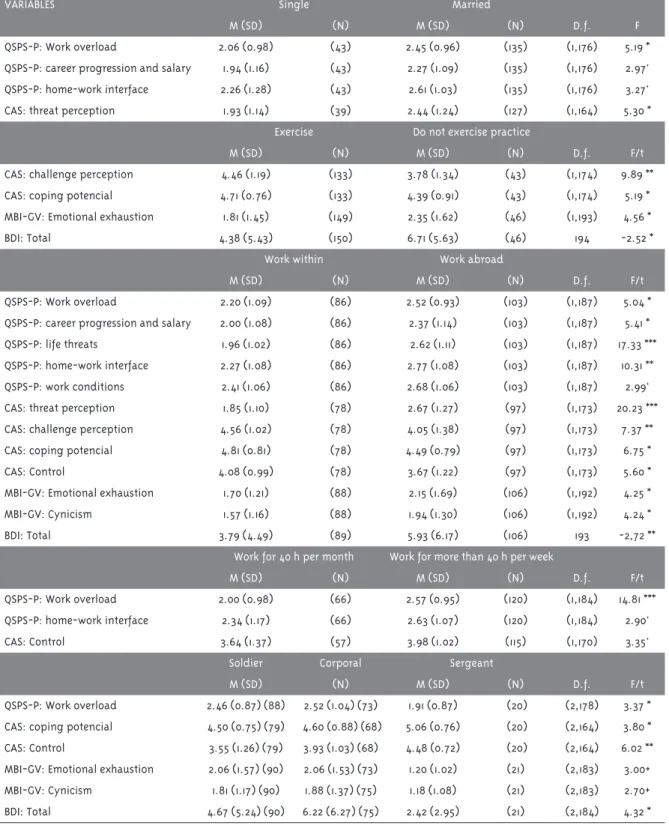
Starting with the comparison regarding the marital status, it was perceived that those who were married presented greater stress related to work overload, career progression, and salary and with regard to home-work interface as well as greater levels in the category of threat perception at work.
The comparison with regard to physical exercise showed that professionals with active lifestyles viewed their work as being more challenging and possessed a greater coping potencial. Similarly, they presented less emotional exhaustion and lower depressive symptomatology.
Regarding the context of performing their pro-fessional duties, the results were very clear, indi-cating that the professionals, who performed their duties primarily outside the facilities (such as patrol activities), presented greater stress levels on five of the areas assessed by QSPS-P, assessed their pro-fession more negatively (greater threat perception and lower challenge perception, confrontation, and control), showed greater emotional exhaustion and cynicism, and greater depressive symptomatology. The number of hours worked per week indicated that higher workloads represented greater stress associated to work overload and home-work interfa-ce; however, in contrast, it implied a greater control perception regarding work.
For the last set of comparisons, corporals showed higher levels of stress related to the pressures of work overload than those indicated by sergeants. Regarding cognitive appraisal, soldiers presented a lower coping potencial and control compared with sergeants. In the case of burnout, both soldiers and corporals presented greater emotional exhaustion and cynicism than that perceived for sergeants. With respect to depressive symptomatology, the corporals indicated having greater problems compared with sergeants.
Differences in the variables regarding cognitive appraisal
In this section, it was possible to observe the exis-tence of differences in the experiences of stress, burnout, and depressive symptomatology (depen-dent variables) with regard to primary and secon-dary cognitive appraisals (independent variables).
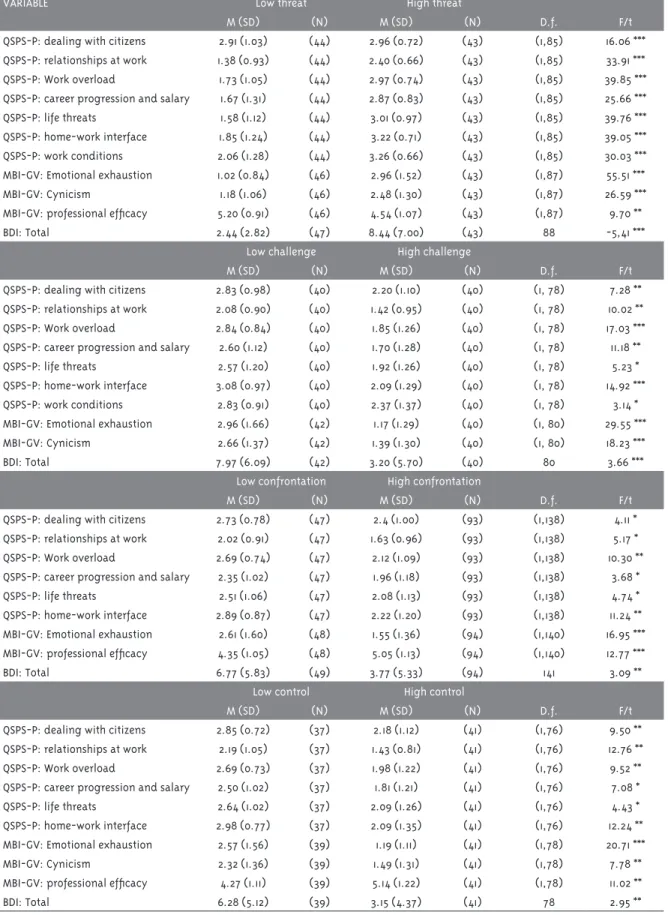
The analysis procedure was defined on the basis of the process of facing stress. In other words, the dimension of importance in CAS served to limit the database only to include the participants who assessed their work as being minimally significant, in view of the fact that all processes of facing stress are dependent on the importance granted by the person to the situation in question (Lazarus, 1999). Thus, following indications of previous studies, the “cut-off” line was established as being a value equal or smaller than two to remove participants from the following analysis (Gomes and Teixeira, 2013). Following this verification, the following compari-son groups were constituted: low and high threat perception, low and high challenge perception, low and high coping potencial, and low and high control. Note that the same analysis assumptions and comparisons as the assessments performed pre-viously were followed. Table 2 presents the results of all areas in which significant values were verified. For the comparison regarding the acknowledge-ment of threat perception, the data demonstrated that the professionals who assessed their work as being more threatening revealed a greater stress level in all the factors assessed by QSPS-P, greater burnout in all areas assessed in the burnout inven-tory, and greater depressive symptomatology.
Regarding the challenge perception, the profes-sionals who assessed their activities as being less challenging were the ones who presented a greater level of occupational stress in all areas of QSPS-P. Similarly, these professionals also presented greater emotional exhaustion and cynicism and greater depressive symptomatology.
The third set of analysis compared the coping potencial. In this case, the professionals with the lo-west coping potencial presented the greatest stress levels in five of the areas assessed by QSPS-P, greater emotional exhaustion, lower professional efficacy, and greater depressive symptomatology.
Table 1 - Significant differences as a function of personal and professional characteristics of the sample
VARIABLES Single Married
M (SD) (N) M (SD) (N) D.f. F
QSPS-P: Work overload 2.06 (0.98) (43) 2.45 (0.96) (135) (1,176) 5.19 *
QSPS-P: career progression and salary 1.94 (1.16) (43) 2.27 (1.09) (135) (1,176) 2.97+
QSPS-P: home-work interface 2.26 (1.28) (43) 2.61 (1.03) (135) (1,176) 3.27+
CAS: threat perception 1.93 (1.14) (39) 2.44 (1.24) (127) (1,164) 5.30 *
Exercise Do not exercise practice
M (SD) (N) M (SD) (N) D.f. F/t
CAS: challenge perception 4.46 (1.19) (133) 3.78 (1.34) (43) (1,174) 9.89 **
CAS: coping potencial 4.71 (0.76) (133) 4.39 (0.91) (43) (1,174) 5.19 *
MBI-GV: Emotional exhaustion 1.81 (1.45) (149) 2.35 (1.62) (46) (1,193) 4.56 *
BDI: Total 4.38 (5.43) (150) 6.71 (5.63) (46) 194 -2.52 *
Work within Work abroad
M (SD) (N) M (SD) (N) D.f. F/t
QSPS-P: Work overload 2.20 (1.09) (86) 2.52 (0.93) (103) (1,187) 5.04 *
QSPS-P: career progression and salary 2.00 (1.08) (86) 2.37 (1.14) (103) (1,187) 5.41 *
QSPS-P: life threats 1.96 (1.02) (86) 2.62 (1.11) (103) (1,187) 17.33 ***
QSPS-P: home-work interface 2.27 (1.08) (86) 2.77 (1.08) (103) (1,187) 10.31 **
QSPS-P: work conditions 2.41 (1.06) (86) 2.68 (1.06) (103) (1,187) 2.99+
CAS: threat perception 1.85 (1.10) (78) 2.67 (1.27) (97) (1,173) 20.23 ***
CAS: challenge perception 4.56 (1.02) (78) 4.05 (1.38) (97) (1,173) 7.37 **
CAS: coping potencial 4.81 (0.81) (78) 4.49 (0.79) (97) (1,173) 6.75 *
CAS: Control 4.08 (0.99) (78) 3.67 (1.22) (97) (1,173) 5.60 *
MBI-GV: Emotional exhaustion 1.70 (1.21) (88) 2.15 (1.69) (106) (1,192) 4.25 *
MBI-GV: Cynicism 1.57 (1.16) (88) 1.94 (1.30) (106) (1,192) 4.24 *
BDI: Total 3.79 (4.49) (89) 5.93 (6.17) (106) 193 -2,72 **
Work for 40 h per month Work for more than 40 h per week
M (SD) (N) M (SD) (N) D.f. F/t
QSPS-P: Work overload 2.00 (0.98) (66) 2.57 (0.95) (120) (1,184) 14.81 ***
QSPS-P: home-work interface 2.34 (1.17) (66) 2.63 (1.07) (120) (1,184) 2.90+
CAS: Control 3.64 (1.37) (57) 3.98 (1.02) (115) (1,170) 3.35+
Soldier Corporal Sergeant
M (SD) (N) M (SD) (N) D.f. F/t
QSPS-P: Work overload 2.46 (0.87) (88) 2.52 (1.04) (73) 1.91 (0.87) (20) (2,178) 3.37 *
CAS: coping potencial 4.50 (0.75) (79) 4.60 (0.88) (68) 5.06 (0.76) (20) (2,164) 3.80 *
CAS: Control 3.55 (1.26) (79) 3.93 (1.03) (68) 4.48 (0.72) (20) (2,164) 6.02 **
MBI-GV: Emotional exhaustion 2.06 (1.57) (90) 2.06 (1.53) (73) 1.20 (1.02) (21) (2,183) 3.00+
MBI-GV: Cynicism 1.81 (1.17) (90) 1.88 (1.37) (75) 1.18 (1.08) (21) (2,183) 2.70+
BDI: Total 4.67 (5.24) (90) 6.22 (6.27) (75) 2.42 (2.95) (21) (2,184) 4.32 *
Associations among primary and secondary cog-nitive appraisals
In the process of cognitive appraisal, we observed the existence of associations between measures of primary (i.e., threat perception and challenge per-ception) and secondary (i.e., coping potencial and control) cognitive appraisals using the chi-square test, given the transformation of the CAS dimen-sions into categorical variables (i.e., high and low levels in each factor).
Therefore, first, the results show a significant association between threat perception and coping potencial (χ2 (1) = 11.38, p < 0.01), indicating that professionals with high threat perception mostly tended to consider their activity with less coping potencial (72.7%), whereas the group with low threat perception mostly tended to perceive an elevated coping potencial (70%).
In this same sense, the association between thre-at perception and control was significant (χ2 (1) = 5.66,
p < 0.05), indicating that participants who rated their activity as being of high threat perception mos-tly belonged to the group that recorded less control (66.7%) and the low-threat group mostly belonged to the group with high control (71.4%).
The association between the dimensions of challenge perception and confrontation was signi-ficant (χ2 (1) = 21.12, p < 0.001), indicating that the group that assessed their activity as being of high challenge perception tended to primarily perceive a high coping potencial (72.3%), whereas the group specifying low challenge perception primarily ten-ded to perceive a low coping potencial (93.8%).
Finally, the association between dimensions of challenge perception and control was significant (χ2(1) = 27.83, p < 0.001), in which participants who rated their activities as high challenge perceptionmostly reflected high control (86.7%), whereas the group that rated it as low challenge perception mostly reflected a lower control over their professional activities (93.8%).
Predictor Variables of burnout experience
For the last set of analysis, we attempted to un-derstand which dimensions of stress and cognitive appraisal (CAS) would best predict the burnout experience (in its three dimensions). In order to do so, hierarchical regression analyses were performed (“enter” method), simultaneously observing the
ab-sence of problems in the multicollinearity indicators (levels of tolerance, variance inflation factor, and condition index) and the absence of autocorrelations (Durbin-Watson).
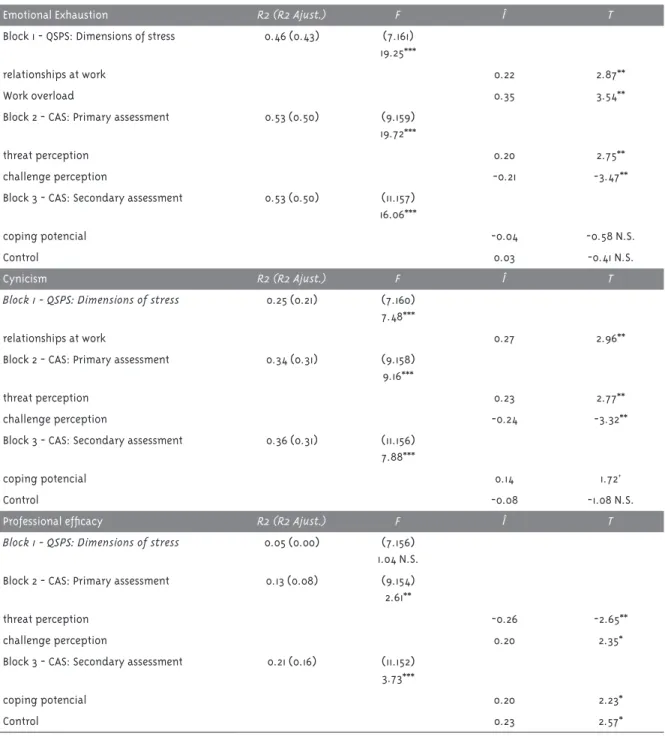
The predictor variables (levels of stress and pri-mary and secondary cognitive appraisals) were in-cluded in the model in the order of importance with regard to the explanation of the predictor variable (level of burnout) (see Table 3).
Therefore, starting with emotional exhaustion, this was defined by greater levels of stress associa-ted to relationships at work and work overload. On the other hand, emotional exhaustion was indicated by a greater perception of threat and lower challenge perception. The levels of secondary cognitive apprai-sals were not indicators of emotional exhaustion. Regarding cynicism, this level was explained by greater levels of stress associated with problems in relationships at work. On the other hand, it was indicated by a greater perception of threat and lo-wer challenge perception. Regarding the secondary cognitive appraisal, cynicism was a predictor of greater coping potencial (although in this case, the differences were marginally significant).
In this analysis, it was necessary to remove an outlier from the performed analysis. Regarding pre-dictors of professional efficacy, the levels of stress did not prove to be significant. However, the same was not true for the primary cognitive appraisal because the tendency for low professional efficacy was predicted by lower perceived threat and greatest challenge perception. Similarly, low professional efficacy was predicted by greater coping potencial and greater perceived control about work. In this analysis, five outliers of the performed analysis were removed.
Discussion
Table 2 - Differences in psychological dimensions as a function of the processes of cognitive assessment
VARIABLE Low threat High threat
M (SD) (N) M (SD) (N) D.f. F/t
QSPS-P: dealing with citizens 2.91 (1.03) (44) 2.96 (0.72) (43) (1,85) 16.06 ***
QSPS-P: relationships at work 1.38 (0.93) (44) 2.40 (0.66) (43) (1,85) 33.91 ***
QSPS-P: Work overload 1.73 (1.05) (44) 2.97 (0.74) (43) (1,85) 39.85 ***
QSPS-P: career progression and salary 1.67 (1.31) (44) 2.87 (0.83) (43) (1,85) 25.66 ***
QSPS-P: life threats 1.58 (1.12) (44) 3.01 (0.97) (43) (1,85) 39.76 ***
QSPS-P: home-work interface 1.85 (1.24) (44) 3.22 (0.71) (43) (1,85) 39.05 ***
QSPS-P: work conditions 2.06 (1.28) (44) 3.26 (0.66) (43) (1,85) 30.03 ***
MBI-GV: Emotional exhaustion 1.02 (0.84) (46) 2.96 (1.52) (43) (1,87) 55.51 ***
MBI-GV: Cynicism 1.18 (1.06) (46) 2.48 (1.30) (43) (1,87) 26.59 ***
MBI-GV: professional efficacy 5.20 (0.91) (46) 4.54 (1.07) (43) (1,87) 9.70 **
BDI: Total 2.44 (2.82) (47) 8.44 (7.00) (43) 88 -5,41 ***
Low challenge High challenge
M (SD) (N) M (SD) (N) D.f. F/t
QSPS-P: dealing with citizens 2.83 (0.98) (40) 2.20 (1.10) (40) (1, 78) 7.28 **
QSPS-P: relationships at work 2.08 (0.90) (40) 1.42 (0.95) (40) (1, 78) 10.02 **
QSPS-P: Work overload 2.84 (0.84) (40) 1.85 (1.26) (40) (1, 78) 17.03 ***
QSPS-P: career progression and salary 2.60 (1.12) (40) 1.70 (1.28) (40) (1, 78) 11.18 **
QSPS-P: life threats 2.57 (1.20) (40) 1.92 (1.26) (40) (1, 78) 5.23 *
QSPS-P: home-work interface 3.08 (0.97) (40) 2.09 (1.29) (40) (1, 78) 14.92 ***
QSPS-P: work conditions 2.83 (0.91) (40) 2.37 (1.37) (40) (1, 78) 3.14 *
MBI-GV: Emotional exhaustion 2.96 (1.66) (42) 1.17 (1.29) (40) (1, 80) 29.55 ***
MBI-GV: Cynicism 2.66 (1.37) (42) 1.39 (1.30) (40) (1, 80) 18.23 ***
BDI: Total 7.97 (6.09) (42) 3.20 (5.70) (40) 80 3.66 ***
Low confrontation High confrontation
M (SD) (N) M (SD) (N) D.f. F/t
QSPS-P: dealing with citizens 2.73 (0.78) (47) 2.4 (1.00) (93) (1,138) 4.11 *
QSPS-P: relationships at work 2.02 (0.91) (47) 1.63 (0.96) (93) (1,138) 5.17 *
QSPS-P: Work overload 2.69 (0.74) (47) 2.12 (1.09) (93) (1,138) 10.30 **
QSPS-P: career progression and salary 2.35 (1.02) (47) 1.96 (1.18) (93) (1,138) 3.68 *
QSPS-P: life threats 2.51 (1.06) (47) 2.08 (1.13) (93) (1,138) 4.74 *
QSPS-P: home-work interface 2.89 (0.87) (47) 2.22 (1.20) (93) (1,138) 11.24 **
MBI-GV: Emotional exhaustion 2.61 (1.60) (48) 1.55 (1.36) (94) (1,140) 16.95 ***
MBI-GV: professional efficacy 4.35 (1.05) (48) 5.05 (1.13) (94) (1,140) 12.77 ***
BDI: Total 6.77 (5.83) (49) 3.77 (5.33) (94) 141 3.09 **
Low control High control
M (SD) (N) M (SD) (N) D.f. F/t
QSPS-P: dealing with citizens 2.85 (0.72) (37) 2.18 (1.12) (41) (1,76) 9.50 **
QSPS-P: relationships at work 2.19 (1.05) (37) 1.43 (0.81) (41) (1,76) 12.76 **
QSPS-P: Work overload 2.69 (0.73) (37) 1.98 (1.22) (41) (1,76) 9.52 **
QSPS-P: career progression and salary 2.50 (1.02) (37) 1.81 (1.21) (41) (1,76) 7.08 *
QSPS-P: life threats 2.64 (1.02) (37) 2.09 (1.26) (41) (1,76) 4.43 *
QSPS-P: home-work interface 2.98 (0.77) (37) 2.09 (1.35) (41) (1,76) 12.24 **
MBI-GV: Emotional exhaustion 2.57 (1.56) (39) 1.19 (1.11) (41) (1,78) 20.71 ***
MBI-GV: Cynicism 2.32 (1.36) (39) 1.49 (1.31) (41) (1,78) 7.78 **
MBI-GV: professional efficacy 4.27 (1.11) (39) 5.14 (1.22) (41) (1,78) 11.02 **
Starting with the first objective, two aspects need to be highlighted.
First, the values of stress, burnout, and depressi-ve symptomatology redepressi-vealed the emotional demands of this profession. Therefore, almost 30% of the professionals described their activity as being very stressful, a value below that of other studies in this area (Maslach-Pines and Keinan, 2006; Afonso and Gomes, 2009) but within the levels found by Des-champs and collaborators (2003) with professionals of the French police (33%). Within the stress factors that can contribute to this result, it was possible to observe a connection with literature in the field, spe-cifically with regard to home-work interface (Burke and Mikkelson, 2006; Richardsen et al., 2006), dea-ling with citizens (Kop et al., 1999), and poor work conditions and work overload (Deschamps et al., 2003). Regarding the predictors of burnout, the level of exhaustion was the most prevalent (13.3%), follo-wed by cynicism (4.9%) and low professional efficacy (4.1%). These results confirm the pattern shown by Afonso and Gomes (2009) with professionals of the Portuguese military, but interestingly, in a study by Kop and collaborators (1999) with professionals of the German police (1999), the dimensions of cynicism and lack of personal accomplishment (effectiveness) stood out. Regarding depressive symptomatology, the results demonstrated that 16.8% of professionals experienced some degree of symptomatology. These results are higher than those found in the study by Santos and Queiroz (2008) for the Portuguese police, which revealed that 4.6% of professionals had pro-blems at this level.
Second, the analysis of differences in the expe-riences of stress, burnout, and depressive sympto-matology showed a worse adjustment toward work in married professionals, in those who did not exercise, in those who performed their activities primarily outdoors, in those who worked more hours per week, and in those who ranked in lower occupational cate-gories. In general, there are studies that highlight the importance of some of these variables within the work context, such as marital status (Dechamps et al., 2003), active lifestyles (Ogden, 2004), the num-ber of weekly hours worked (Burke and Mikkelsen, 2006; Gonzalo et al., 2010), and educational back-ground (Afonso and Gomes, 2009).
Regarding the importance of the cognitive appraisal processes in the experiences of stress, burnout, and depressive symptomatology (second, third, and fourth goals), it is important to highlight the key role of primary and secondary appraisals in adjusting these professionals to work. Professionals who rated their activity as more threatening, less challenging, and showed less coping potencial and control over work were those who usually experien-ced higher stress, burnout, and depressive sympto-matology. On the other hand, it is also important to highlight the relationship established between the primary and secondary appraisals, in view of the fact that, as expected, the professionals who per-ceived a greater threat and lower challenge tended to primarily experience a lower coping potencial and lower control over their work. These results confirm the assumptions proposed in Lazarus and collaborators (Lazarus and Folkman, 1984; Lazarus, 1991) transactional perspective, and the data from this study suggests its applicability to the study of stress in the occupational context. Moreover, the effects of the processes of cognitive appraisal were not only noticeable with regard to the experience of stress but also had effects over two indicators of “extreme” psychological distress, which were the cases of burnout and depressive symptomatology.
Table 3 - Regression models for the prediction of the dimensions of burnout
Emotional Exhaustion R2 (R2 Ajust.) F Î T
Block 1 - QSPS: Dimensions of stress 0.46 (0.43) (7.161)
19.25***
relationships at work 0.22 2.87**
Work overload 0.35 3.54**
Block 2 - CAS: Primary assessment 0.53 (0.50) (9.159)
19.72***
threat perception 0.20 2.75**
challenge perception -0.21 -3.47**
Block 3 - CAS: Secondary assessment 0.53 (0.50) (11.157)
16.06***
coping potencial -0.04 -0.58 N.S.
Control 0.03 -0.41 N.S.
Cynicism R2 (R2 Ajust.) F Î T
Block 1 - QSPS: Dimensions of stress 0.25 (0.21) (7.160)
7.48***
relationships at work 0.27 2.96**
Block 2 - CAS: Primary assessment 0.34 (0.31) (9.158)
9.16***
threat perception 0.23 2.77**
challenge perception -0.24 -3.32**
Block 3 - CAS: Secondary assessment 0.36 (0.31) (11.156)
7.88***
coping potencial 0.14 1.72+
Control -0.08 -1.08 N.S.
Professional efficacy R2 (R2 Ajust.) F Î T
Block 1 - QSPS: Dimensions of stress 0.05 (0.00) (7.156)
1.04 N.S.
Block 2 - CAS: Primary assessment 0.13 (0.08) (9.154)
2.61**
threat perception -0.26 -2.65**
challenge perception 0.20 2.35*
Block 3 - CAS: Secondary assessment 0.21 (0.16) (11.152)
3.73***
coping potencial 0.20 2.23*
Control 0.23 2.57*
N. S.: not significant; +p
shows the possibility of this facet being explained in a separate way than that of the other two dimensions of burnout. In any case, greater stress associated with relationships at work and work overload, in conjunction with significant negative primary and secondary cognitive assessments (greater threat, less challenging, less coping potencial, and less control), contributed in the explanation of the phe-nomenon of burnout.
In summary, the results of this research show the complex and multidimensional nature of the phenomenon of occupational stress and demons-trate that the understanding of this phenomenon should not focus exclusively on the identification of stress-inducing variables and the potential conse-quences on the individual, but it should also explore the cognitive processes involved in the perception of the demands at work. In parallel, in the future, it is crucial to study if these cognitive appraisal processes have a connection with specific coping strategies used by people to cope with occupatio-nal stress because they represent one of the core elements of the transactional model (Lazarus and Folkman, 1984; Lazarus, 1991).
References
ABDOLLAHI, A. K. Understanding police stress research. Journal of Forensic Psychology Practice, Philadelphia, v. 2, n. 2, p. 1-24, 2002.
AFONSO, J. M. P.; GOMES, A. R. Stress ocupacional em profissionais de segurança pública: um estudo com militares da Guarda Nacional Republicana.
Psicologia: Reflexão e Crítica, Porto Alegre, v. 22, n. 2, p. 294-303, 2009.
BECK, A. et al. An inventory for measure depression. Archives of General Psychiatry, Chicago, v. 4, n. 6, p. 561-571, 1961.
BEVAN, S. (Org.). Attendance management. London: Work Foundation, 2003.
BURKE, R. J.; MIKKELSEN, A. Burnout among Norwegian police officers: potential antecedents and consequences. International Journal of Stress Management, Washington, DC, v. 13, n. 1, p. 64-83, 2006.
COOPER, C. L.; DEWE, P. J. Well-being: absenteeism, presenteeism, costs and challenges. Occupational Medicine, Oxford, v. 58, n. 8, p. 522-524, 2008.
CROMPTON, R.; LYONETTE, C. Are we all working too hard: women, men, and changing attitudes to employment. In: PARK, A. et al. (Org.). British social attitudes: perspectives on a changing society. London: Sage, 2007. p. 55-70.
DESCHAMPS, F. et al. Sources and assessment of occupational stress in the police. Journal of Occupational Health, Tokyo, v. 45, n. 6, p. 358-364, 2003.
DEWE, P. J.; O’DRISCOLL, M. P.; COOPER, C. L. (Org.). Coping with work stress: a review and critique. Chichester: Wiley, 2010.
FIFE-SCHAW, C. Levels of measurement. In: BREAKWELL, G. M. et al. (Org.). Research methods in psychology. 3. ed. London: Sage, 2006. p. 50-63.
GOETZEL, R. Z. et al. Health, absence, disability, and presenteeism cost estimates of certain physical and mental health conditions affecting U.S. employers. Journal of Occupational and Environmental Medicine, Philadelphia, v. 46, n. 4, p. 398-412, 2004.
GOMES, A. R.; TEIXEIRA, F. Influência dos processos de avaliação cognitiva na atividade laboral: um estudo com bombeiros portugueses.
PsicoUSF, Itatiba, v. 18, n. 2, p. 309-320, 2013.
GOMES, A. R.; CRUZ, J. F.; CABANELAS, S. Estresse ocupacional em profissionais de saúde: um estudo com enfermeiros portugueses.
Psicologia: Teoria e Pesquisa, Brasília, DF, v. 25, n. 3, p. 307-318, 2009.
GOMES, A. R. et al. Stress ocupacional no ensino: um estudo com professores dos 3º ciclo e ensino secundário. Psicologia e Sociedade, Florianópolis, v. 22, n. 3, p. 587-597, 2010.
GONÇALO, H. et al. Stresse ocupacional em forças de segurança: um estudo comparativo. Análise Psicológica, Lisboa, v. 28, n. 1, p. 165-178, 2010.
Received on: 11/01/2012 Presented again on: 22/11/2012 Approved on: 26/12/2012
KOP, N.; EUWEMA, M. C.; SCHAUFELI, W. B. Burnout, job stress and violent behaviour among dutch police officers. Work and Stress, London, v. 13, n. 4, p. 326-340, 1999.
LAZARUS, R. S. (Org.). Emotion and adaptation. New York: Oxford University Press, 1991.
LAZARUS, R. S. (Org.). Stress and emotion: a new synthesis. New York: Springer, 1999.
LAZARUS, R. S. Toward better research on stress and coping. American Psychologist, Washington, DC, v. 55, n. 6, p. 665-673, 2000.
LAZARUS, R. S. Relational meaning and discrete emotions. In: SCHERER, K. R.; SCHORR, A.; JOHNSTONE, T. (Org.). Appraisal processes in emotion. Oxford: Oxford University Press. 2001. p. 37-67.
LAZARUS, R. S.; FOLKMAN, S. (Org.). Stress, appraisal, and coping. New York: Springer, 1984.
MASLACH-PINES, A.; KEINAN, G. Stress and burnout in Israeli border police. International Journal of Stress Management, Washington, DC, v. 13, n. 4, p. 519-540, 2006.
McINTYRE, T.; McINTYRE, S. Inventário de depressão de Beck: versão portuguesa. Braga: Universidade do Minho, 1995.
OGDEN, J. (Org.). Psicologia da saúde. 2. ed. Lisboa: Climepsi, 2004.
RICHARDSEN, A. M.; BURKE, R. J.;
MARTINUSSEN, M. Work and health outcomes among police officers: the mediating role of police cynicism and engagement. International Journal of Stress Management, Washington, DC, v. 13, n. 4, p. 555-574, 2006.
SANTOS, S. M.; QUEIRÓS, C. Um estudo
exploratório sobre o suicídio nas forças policiais portuguesas. Psicologia, Saúde e Doenças, Lisboa, v. 9, n. 1, p. 147-148, 2008.
SCHAUFELI, W. B. et al. Maslach Burnout