A Work Project, presented as part of the requirements for the Award of a Masters Degree in Management from the Nova School of Business and Economics
Determinants of Portuguese Trade: 1986-2010
Fernando Emanuel Martins Mascarenhas Mendonça #1164
A project carried out with the supervision of: Professor Luís Campos e Cunha
And also with the collaboration of: Professor Iliyan Georgiev
1 Abstract
This paper aims to assess the determinants of Portuguese trade in the years 1986 to 2010. The beginning of this period is marked by the Portuguese entry to the EEC and the Single European Act in 1985, the introduction of Euro in 1999, while the end is defined by the 2007 financial crisis and the late 2010 sovereign debt crisis. The results show that some sectors of the Portuguese economy suffered a structural change in their behavior, regarding international trade. Apart from some exceptions, the results also show that, in general, the economy behaved as expected. Capital stocks (K), human capital (HC) and infrastructures (IF) promote higher exports whereas economies of scale (ES) has an ambiguous contribution. For the Retail (G), Construction (F) and Health/ Social Work (N+O+P) sectors, the results suggest an increase of intra-industry trade.
2 I. Introduction
Since 2011, the Portuguese economy is under a macroeconomic adjustment program aimed at correcting its public debt level and other macroeconomic imbalances. Contrary to the prevailing explanation, which rested on the idea that the lack of competitiveness, current account deficits and slow growth of the Portuguese economy was a result of real appreciation, it was argued by Campos e Cunha (2008) 1 and later empirically confirmed by Diana Correia (2013)2 that Portugal suffered from a resemble form of Dutch Disease phenomenon in which the main problem was a kind of Euro wealth effect. Even though the current situation has provoked the call for external help, for many years Portugal, as many other countries, has been operating an External Balance deficit, which was corrected in the last two years. Unfortunately the lack of available data for some variables since 2010 prevented an analysis for this period.
Understanding which factors explain the trade pattern is essential for developing policies and structural reforms that aim to improve it. Having said this, and continuing the analysis developed by Fátima M. Roque, Paula Fontoura and Pedro P. Barros in “Teorias do Comércio Internacional e Padrão de Especialização da Indústria
Transformadora Portuguesa”, I will focus my analysis in the years 1986 to 2010.
Considering the time frame, I find it interesting to divide it and compare the results before and after the introduction of Euro. This was a change of regime, with many consequences. Interest rates fell considerably (real long-term interest rates for example went from 6.1% in 1996 to 0.9% in 2005 and short-term rates went from 4.9% to 0.3% for the same period), which promoted higher investment and consumption resorting to
3 credit. Net national savings fell from approximately 4 billion euros in 1995 to -7.5 in 2006. By 2008 Portugal had net borrowing needs of approximately 19.5 billion euros.
II. Related Literature
Several authors have been developing studies and analyzing the Portuguese economy in this specific subject, but since 1986 these studies are scarce or do not exist. The results achieved by these papers are very important as they provide a base for comparison, explain the methodology used, and allow us to better understand the mechanisms and changes in the Portuguese economy throughout a relatively large period of time.
According to “Teorias do Comércio Internacional e Padrão de Especialização da Indústria Transformadora Portuguesa”, the Portuguese pattern of trade, in the years
1973-82, shows a comparative advantage in products from industries which are intensive in non-qualified labour and a comparative disadvantage in products from industries which are capital intensive and with high concentration level (economies of scale). In “The Impact of Protection on the Evolution of the Portuguese Pattern of
Trade: 1974-86”, the results reinforce the conclusions from the previous paper but they
show a significant change in the relationship of net exports to physical capital, where the comparative disadvantage with respect to physical capital ceases to exist.
4 A very important result was provided from “Determinants of Portuguese External
Imbalances” (2013) by Diana Helena G. Correia, who empirically showed that real
exchange rate appreciation is not behind the Portuguese current plus capital account deficit, but rather the other way around. This allows us to exclude the real exchange rate as a variable in the analysis.
III. Model
Despite several limitations, almost every empirical research done on this subject was based on the simplest version of the HOS model (1), to which several variables were introduced and tested for their significance.
( ) (1)
Other variables were introduced in an attempt to explain different factors that exist in the economy and are not covered in the basic version of HOS model. These factors are of supposed major importance, like human capital or economies of scale, and are supposed to affect the performance of foreign trade.
Taking into consideration previous empirical research, and considering the economic relevance of several factors throughout the time frame in question, a model was developed which I believe can explain the evolution of Portuguese imports and exports. As can be seen in the two equations below, besides Capital stocks (K), both Human Capital (HC) and Economies of Scale (ES) were included. An Infrastructure (IF) index was also considered as well as the national External Balance (EB):
5
Instead of analyzing net exports, as in previous papers, I chose to analyze exports (X) and imports (M) separately. This analysis will allow a more objective understanding of how and by what degree the many variables affect the Portuguese Trade Balance. If for example, exports rise in a certain period, the model will be able to separate the effects that caused it. Another advantage of using this type of separated analysis is that it enhances the importance of scale effects, as argued by Leamer.
Measuring capital stocks (K) was one of the most complicated tasks on this paper. Although this would apparently be a fairly simple task due to the many estimations for capital stocks, these estimations are nationwide, and estimations for capital endowments by sector are very scarce or do not exist for Portugal. The way I computed capital stocks by sector was through an extrapolation of the Spanish economy. Firstly, and since net capital formation for each year and sector was available, the only data missing was the stock for one year. The extrapolation consisted in measuring the Portuguese economy dimension relatively to the Spanish economy. This was achieved by dividing the Spanish output (VA) of each sector by the Portuguese, throughout the time frame and computing a geometric average. Assuming both economies have relatively similar capital/ value added endowments for the various sectors, I divided the Spanish stocks by these coefficients and came up with the stocks for Portugal per sector.
Human capital (HC) was computed by preforming a normalized ratio, to the level of each industry, between the average wage and the national minimum wage. The general idea behind this is that every euro paid above minimum wage is compensation of human capital. It is expected that higher wages reflect higher labour productivity and
6 For the purpose of measuring intra-industry trade, the variable „economies of scale‟ (ES) was introduced in the model. A simple observation forces one to think of economies of scale due to the substantial amount of trade in similar products among the advanced industrialized countries. This variable was computed by merging two different methods: the Herfindahl-Hirschmann Index and a normalized ratio, to the level of each industry, between the number of companies with 250 employees or more and the total number of companies. If on one hand, low values for this variable should indicate high competition and the absence of economies of scale, because it suggests a high number of small companies competing against each other, on the other hand higher values would suggest the existence of economies of scale, which provides a competitive advantage for those companies.
Infrastructure (IF) and justice effectiveness indexes were introduced as these are supposedly factors directly correlated with investment. Economically speaking, it is expected that a higher endowment of these two factors will attract more investment and
makes business deals „cheaper‟, which will not have a direct impact on the trade balance
but in the medium/ long term is expected to have a positive effect. The justice effectiveness index was later discarded due to the low significant impact and erratic behavior on both imports and exports.
7 IV. Data
As pointed out by Leamer, the goal of the aggregation methods is to identify a list of aggregates that is brief enough to be quickly learned and easily remembered, but not so brief that essential features of the data are hidden. With that in mind, and in order to better understand how the Portuguese economy behaved throughout the time frame, instead of analyzing the economy as a whole, an effort has been made to assess the performance of each sector.
The 11 industries aggregates considered in this paper are formed from the 17 alphabetic categories of SITC (Standard Industrial Trade Classification), which in turn can go up to 719 different classes. Some of the categories were merged together as they are typically correlated and usually associated with the same sector of the economy, like agriculture and fishing. The 17 original aggregates, lettered from A to Q, were all included in the 11 final aggregates constructed for the purpose of this paper. A list of the 11 categories and their respective description can be found in annex.
8 V. Results
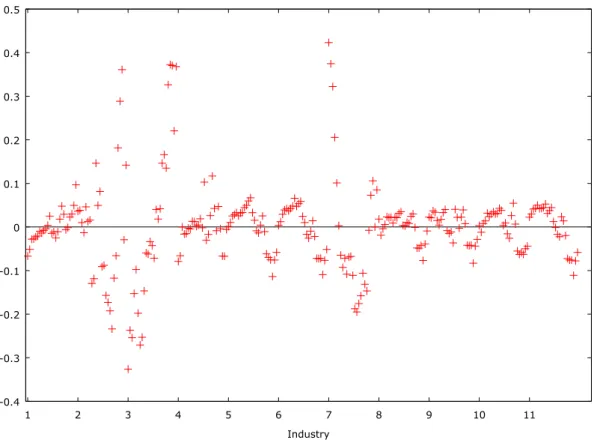
As mentioned before, the model was estimated considering two time frames (before and after the introduction of Euro) and considering every industry for each variable. This had to be made separately for each variable, considering the short number of periods relative to the number of variables combined with the number of industries, which would cause an overfitting effect (many of the residuals are essentially zero, so the parameter estimates fit the noise rather that an underlying relationship only). As so, in order to assess which of the variables are relevant, variable coefficients were used one factor at a time (first, 22 capital (K) coefficients – 11 industries before and after Euro – and 2 coefficients for each of the other factors – one before and one after Euro, the same for all industries – second, 22 human capital (HC) coefficients and two for the other factors, etc.). It might be interesting to reveal that for all the estimations the adjusted R-squared was around 97% and the F-test came up with a virtually null p-value, which despite being indicators of a good model will not be given too much importance as individual coefficient analysis is much more revealing and can provide us with the conclusions aimed with this paper. On the other hand, as shown in figures 1 and 2 in annex, the residuals for Mining (C), Manufacturing (D) and Hotel (H) sectors show a relatively large variance, especially for imports. This is not a good sign and weakens the conclusions for these industries.
9 The main results for exports are:
As shown in table 1.1, none of the industries reveals a strong correlation (|βi|>1)
between Capital Stocks and the level of exports. Even so, pre-Euro Agriculture (A+B), Mining (C), Manufacturing (D), Hotel (H) and pre-Euro Transport (I) sectors show a positive correlation between their coefficients and exports, suggesting higher levels of exports for higher levels of capital stocks (K) for these sectors.
The only industry that seems to have a strong correlation between its Human
Capital coefficient and its exports is Manufacturing (D). Table 2.1 shows that Mining (C), post-Euro Agriculture (A+B), Electricity (E), Financial Intermediation (J+K) and Public Administration (L+M+Q) sectors have a positive but weak (|βi|<1) correlation. On the other hand, Hotels and Restaurants (H) reveal a negative correlation in both periods. This unexpected result is analyzed, in chapter „conclusion‟.
Regarding Economies of Scale, the majority of the coefficients are strong
(|βi|>1). Manufacturing (D) coefficient changes from negative to positive. Hotels (H) have a strong positive correlation on the first period. For post-Euro period, the results for Mining (C), Construction (F) and Retail (G) suggest that the intra-industry trade has risen due to the presence of economies of scale. Post-Euro Public Administration (L+M+Q) sector reveal a negative but weak coefficient.
Agriculture (A+B) and Manufacturing (D) maintain a positive but weak (|βi|<1)
10 The results on table 5.1 suggest that Agriculture (A+B), Manufacturing (D) and
post-Euro period Mining (C) exports increase with the level of external deficit. This unexpected result is rationalized in the next chapter.
Regarding imports:
From table 1.2, it is possible to identify 3 groups of industry, concerning the
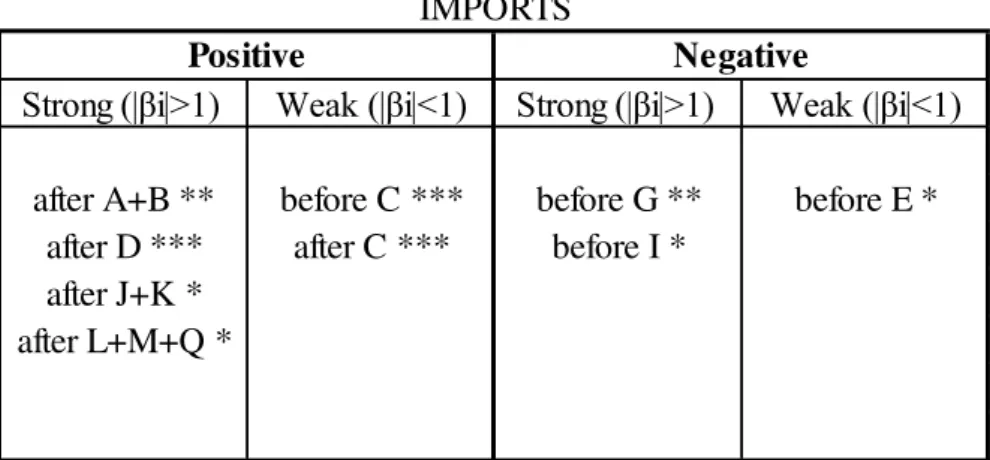
contribution of Capital Stocks to their imports. Mining (C) appears to maintain a positive correlation between its coefficient and the level of imports throughout the two periods, but with a higher intensity in the pre-Euro period. Also with a positive but weak (|βi|<1) correlation appears the pre-Euro Financial Intermediation sector (J+K). The only industry that has a negative correlation, despite being a weak one (|βi|<1), is pre-Euro Manufacturing (D).
Table 2.2 contains the results for Human Capital, which demonstrates a strong
(|βi|>1) positive correlation with the level of imports for post-Euro Agriculture (A+B), Manufacturing (D), Financial Intermediation (J+K) and Public Administration (L+M+Q). Mining (C) shows a positive but weak (|βi|<1) correlation throughout the entire time frame. Pre-Euro Retail (G), Transport (I) and Electricity (E) sectors have a negative correlation, with the latter demonstrating a weaker intensity (|βi|<1).
For Economies of Scale there are only strongly correlated industries (|βi|>1). On
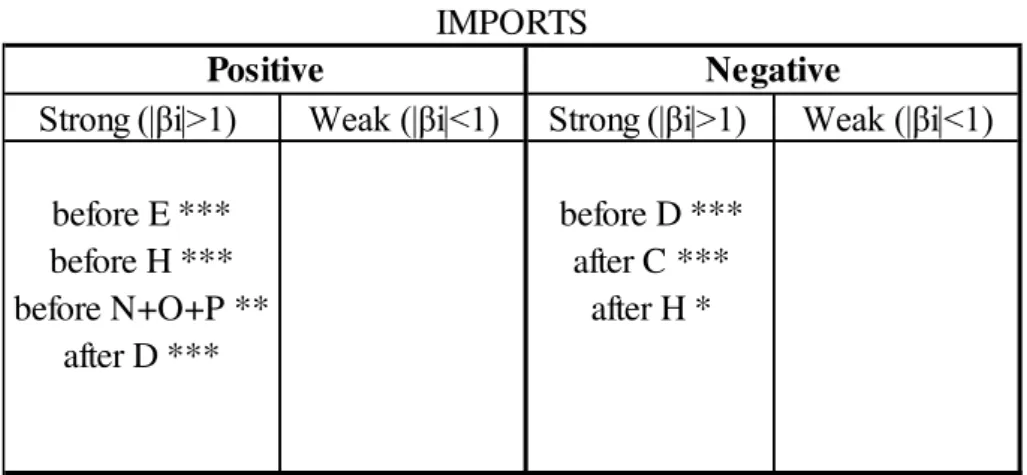
the positive side there is pre-Euro Electricity (E), Hotel (H), Health (N+O+P) and post-Euro Manufacturing (D) sectors. Pre-post-Euro Manufacturing (D), post-post-Euro Mining (C) and Hotel (H) sectors show a negative correlation for this variable.
Regarding Infrastructures, Manufacturing (D), post-Euro Mining (C) and
pre-11 Euro Public Administration (L+M+Q), Health (N+O+P), post-Euro Retail (G) and Financial Intermediation (J+K) sectors have a negative correlation.
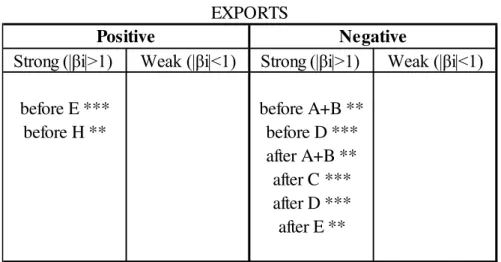
Finally, concerning the External Balance, only strongly correlated industries
(|βi|>1) appear on table 5.2. As expected, the great majority of the industries show a
12 VI. Conclusions
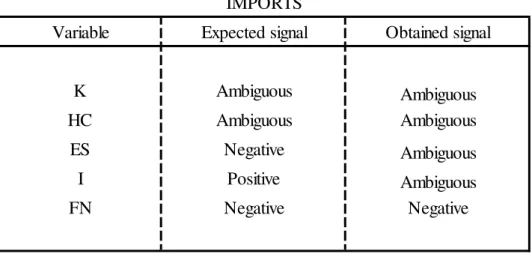
From the results, it is clear that some sectors of the Portuguese economy suffered structural changes in their behavior regarding imports and exports with the introduction of Euro. In addition to that, some of them show unexpected behavior concerning their coefficients. In order to better illustrate this paradigm a table has been constructed presenting the expected and the obtained signals for all the variables (tables 6.1 and 6.2).
Regarding exports for the Hotel industry (H), the Human Capital (HC) results
(contrary to expectations), could mean that the economic crisis has caused a deterioration of quality of tourism, attracting low-demanding consumers. But it is important to remind that the residuals for this sector (H) show some off scale observations, and this situation could be one of those cases.
Comparing the results before and after the introduction of Euro for both imports
and exports, regarding Economies of Scale (ES), there is a clear shift in some
industries‟ behavior. The Health sector (N+O+P) is an example, which has its
coefficient signal changed from positive to negative. This shift is probably due to the growth of intra-industry trade.
Infrastructures (IF) are expected to a have a positive effect on both exports and
13 Looking at table 5.2, it is clear that the majority of the industries behave as
expected, when it comes to External Balance (EB). If the national external deficit increases, it means that net imports should be increasing. Because the data for the external balance (EB) is nationwide, the interpretation for this variable should be a general one and not discriminated for every industry. Nevertheless the cases of Agriculture (A+B) and Manufacturing (D) sectors show a positive correlation, meaning that when the external deficit increases, these sectors export more. However, for those sectors even with exports increasing, the net exports (X-M) decreases.
14 References:
Roque, Fátima M., Fontoura and Paula. P. Barros, Pedro. 1989. “Teorias do Comércio Internacional e Padrão de Especialização da Indústria Transformadora Portuguesa.” Working Paper Nº 136. ISSN 0871-2573.
Courakis, Anthony S., Roque, Fátima M. and Fontoura, Paula. 1990. “The Impact of Protection on the Evolution of the Portuguese Pattern of Trade: 1974-86.” Working Paper Nº 162, ISSN 0871-2573.
Roque, Fátima M. 1983. “Trade theory and the Portuguese pattern of trade.” Working Paper ISSN 0870-3531, ZDB-ID 4394823.Economia - Lisboa - Vol. 7.1983, 3, p. 455-469.
Roque, Fátima M. and Courakis, Anthony S. 1983. “An enquiry into the determinants of the net exports pattern of Portugal‟s trade in manufactures.” In Perspectivas do Desenvolvimento Industrial Português.- 65-100: Lisboa.
Campos e Cunha, L. 2008. “Is the Dutch Disease Pandemic in the South?” In
Challenges Ahead for the Portuguese Economy. 147- 158: Lisboa, Portugal. Imprensa de Ciências Sociais ICS, ISBN 978-972-671227-5.
Leamer, Edward E. 1984. “Sources of International Comparative Advantage: Theory and Evidence.” London, England. The MIT Press.
Wooldridge, Jeffrey M. 2010. “Basic Linear Unobserved Effects Panel Data Models” In
15 ANNEX
DATA
All time series are yearly data. Variables
X –Exports as a percentage of GVA (source: PORDATA, EU KLEMS) M– Imports as a percentage of GVA (source: PORDATA, EU KLEMS)
K– Capital stock as a percentage of GVA (source: AMECO, PORDATA, EU KLEMS) HC– Human Capital as a percentage of GVA (source: PORDATA, EU KLEMS) ES– Economies of Scale (source: INE, GEP/MTSS)
IF– Infrastructure index (source: INE) Base year (2010 = 1.00)
EB– External Balance as a percentage of GVA (source: AMECO, EU KLEMS)
SITC Aggregation
A+B– Agriculture, farming of animals, hunting, forestry; Fishing C– Mining and quarrying
D– Manufacturing
E– Production of electricity, of gas and of water supply F– Construction
G– Wholesale and retail trade; repair of motor vehicles, motorcycles and personal and household goods
H– Hotels and restaurants
I– Transport, storage and communication
16 L+M+Q – Public administration and defense; compulsory social security; Education; Extra-territorial organizations and bodies
N+O+P – Health and social work; Other community, social and personal service activities; Activities of households as employers of domestic staff and production activities of households for own use
Estimation Tables
Table 1.1 – Capital (K) coefficients for both periods (before and after Euro):
NOTE: Significant coefficients for a confidence level of: *** 99%; ** 95%; * 90%
Table 1.2 – Capital (K) coefficients for both periods (before and after Euro): Strong (|βi|>1) Weak (|βi|<1) Strong (|βi|>1) Weak (|βi|<1)
before A+B ** before D *
before C *** before H *** before I ** after C *** after D *** after H ***
EXPORTS
Positive Negative
Strong (|βi|>1) Weak (|βi|<1) Strong (|βi|>1) Weak (|βi|<1)
before C *** before J+K *** before D ***
after C ***
IMPORTS
17 Table 2.1 – Human Capital (HC) coefficients for both periods:
Table 2.2 – Human Capital (HC) coefficients for both periods:
NOTE: Significant coefficients for a confidence level of: *** 99%; ** 95%; * 90% Table 3.1 – Economies of Scale (ES) coefficients for both periods:
Strong (|βi|>1) Weak (|βi|<1) Strong (|βi|>1) Weak (|βi|<1)
before D *** before C *** before F *
after D *** after A+B *** before H ***
after C *** after H *
after E ** after J+K ** after L+M+Q *
EXPORTS
Positive Negative
Strong (|βi|>1) Weak (|βi|<1) Strong (|βi|>1) Weak (|βi|<1)
after A+B ** before C *** before G ** before E *
after D *** after C *** before I *
after J+K * after L+M+Q *
IMPORTS
Positive Negative
Strong (|βi|>1) Weak (|βi|<1) Strong (|βi|>1) Weak (|βi|<1)
before H *** before N+O+P ** before D *** after L+M+Q **
after D *** after C *** after N+O+P *
after F * after G * EXPORTS
18 Table 3.2 – Economies of Scale (ES) coefficients for both periods:
NOTE: Significant coefficients for a confidence level of: *** 99%; ** 95%; * 90% Table 4.1 – Infrastructure (IF) coefficients for both periods:
Table 4.2 – Infrastructure (IF) coefficients for both periods:
Strong (|βi|>1) Weak (|βi|<1) Strong (|βi|>1) Weak (|βi|<1)
before E *** before D ***
before H *** after C ***
before N+O+P ** after H *
after D ***
IMPORTS
Positive Negative
Strong (|βi|>1) Weak (|βi|<1) Strong (|βi|>1) Weak (|βi|<1)
after C *** before A+B * before H ***
before D *** after A+B ** after D ***
after E **
EXPORTS
Positive Negative
Strong (|βi|>1) Weak (|βi|<1) Strong (|βi|>1) Weak (|βi|<1)
before D *** after E * before E * before H ***
after C *** before L+M+Q **
after D *** before N+O+P **
after G * after H ** after J+K ** IMPORTS
19 Table 5.1 – External Balance (EB) coefficients for both periods:
NOTE: Significant coefficients for a confidence level of: *** 99%; ** 95%; * 90%
Table 5.1 – External Balance (EB) coefficients for both periods:
NOTE: Significant coefficients for a confidence level of: *** 99%; ** 95%; * 90% Strong (|βi|>1) Weak (|βi|<1) Strong (|βi|>1) Weak (|βi|<1)
before E *** before A+B **
before H ** before D ***
after A+B ** after C *** after D *** after E ** EXPORTS
Positive Negative
Strong (|βi|>1) Weak (|βi|<1) Strong (|βi|>1) Weak (|βi|<1)
after G ** before A+B ***
after H ** before D ***
after N+O+P ** before F *
before G *** before H ** before N+O+P *
after A+B ** after C *** after D *** after E *** IMPORTS
20 Variable K HC ES I FN Ambiguous Positive
Expected signal Obtained signal
Positive Positive Ambiguous Positive Ambiguous EXPORTS Positive Positive Positive Variable K HC ES I FN Obtained signal IMPORTS Ambiguous Ambiguous Negative Negative Positive Negative Ambiguous Ambiguous Ambiguous Ambiguous Expected signal
Table 6.1 –Expected versus obtained signals of variables’ coefficients
21 Figure 1 –Exports’ residuals chart
Figure 2 –Imports’ residuals chart -0.4
-0.3 -0.2 -0.1 0 0.1 0.2 0.3 0.4 0.5
1 2 3 4 5 6 7 8 9 10 11
Industry
Regression residuals (= observed - fitted X)
-2 -1 0 1 2 3 4 5
1 2 3 4 5 6 7 8 9 10 11
Industry