resumo
Invesigou-se a prevalência de excesso de peso e obesidade abdominal e variáveis as-sociadas em mulheres. Estudo transversal com 298 mulheres (20-59 anos), usuárias de uma unidade da Estratégia Saúde da Famí-lia, em São Paulo-SP. Considerou -se o exces-so de peexces-so: índice de massa corporal≥25kg/ m2; a obesidade abdominal: circunferência da cintura 0,80m ou razão cintura-qua-dril≥0,85. Realizou-se análise de regressão logísica. O excesso de peso afetou 56% das mulheres, sendo 37% sobrepeso e 19% obesidade, e associou-se com a idade, ren-da familiar, tabagismo e hipertensão. 59% inham obesidade abdominal associada à idade e hipertensão. Observou-sea elevada prevalência de excesso de peso e obesida-de abdominal em mulheres, reforçando a importância da avaliação de circunferên-cia da cintura e/ou razão cintura-quadril no exame ísico, além do índice de massa corporal, auxiliadores da predição de risco. Evidencia-se a necessidade de interven-ções, junto à comunidade, que promovam a diminuição do excesso de peso e da obe-sidade abdominal.
descritores Mulheres Obesidade
Obesidade abdominal Sobrepeso
Fatores socioeconômicos Programa Saúde da Família
Overweight and abdominal obseity in women
users of a Family Health Strategy Unit*
O
riginal
a
r
ticle
AbstrAct
We performed an invesigaion of the prev-alence of overweight and abdominal obe-sity and associate variables in women. A cross-secional study with 298 women (20-59 years), users of a Family Health Strategy unit, in São Paulo-SP. Overweight was con-sidered as follows: body mass index≥25kg/ m2; abdominal obesity: waist circumfer-ence 0.80m or waist-hip raio≥0.85. Logis-ical regression analysis was performed. Overweight afected 56% of the women, 37% were overweight and 19% were obese, and was associated with age, fam-ily income, tobacco use and hypertension. Of all the paricipants, 59% had abdominal obesity associated to age and hyperten-sion. A high prevalence of overweight and abdominal obesity was observed in the women, thus reinforcing the importance of assessing the waist circumference and/ or waist-hip raio in the physical examina-ion, besides the body mass index, which are aspects that help to predict risk. It is evidenced there is a need for community intervenions that promote the reducion of overweight and abdominal obesity.
descriptors Women
Obesity
Obesity, abdominal Overweight
Socioeconomic factors Family Health Program
resumen
Se invesigó prevalencia de sobrepeso y obesidad abdominal y variables asociadas en mujeres. Estudio transversal con 298 mujeres (20-59 años), pacientes de Uni-dad de la Estrategia Salud de la Familia, en São Paulo-SP. Se consideró exceso de peso: índice de masa corporal ≥25kg/m2; obesi-dad abdominal: circunferencia de cintura 0,80m o relación cintura-caderas ≥0,85. Se realizó análisis de regresión logísica. El ex-ceso de peso afectó al 56% de las mujeres, resultando 37% sobrepeso y 19% obesidad, se asoció con edad, renta familiar, taba-quismo e hipertensión. El 59% presenta-ba obesidad abdominal, asociada a edad e hipertensión. Se reiteró alta prevalencia de exceso de peso y obesidad abdominal en mujeres, reforzando la importancia de evaluación de circunferencia de cintura y/o relación cintura-caderas en examen ísico, además del índice de masa corporal, adyu-vantes de predicción de riesgo. Se eviden-cia necesidad de intervenciones conjuntas de promoción y disminución del exceso de peso y obesidad abdominal.
descriptores Mujeres
Obesidad
Obesidad abdominal Sobrepeso
Factores socioeconómicos Programa de Salud Familiar
maria Fernanda cristóvão1, Ana paula sayuri sato2, elizabeth Fujimori3
ExcEsso dE pEso E obEsidadE abdominal Em mulhErEs atEndidas Em unidadE da Estratégia saúdE da Família
ExcEso dE pEso y obEsidad abdominal En mujErEs atEndidas En unidad dE EstratEgia salud dE la Familia
introduction
Excess weight and body fat distribuion are associated to higher risk of chronic diseases. However, abdominal obesity, which is deined as android obesity, poses a great-er risk than excess weight per se(1).
Regarding the epidemiologic magnitude, studies show an increasing tendency for excess weight and abdominal obesity in developed and developing countries(1). In Bra-zil, data from the 2008-2009 Household Budget Survey (Pesquisa de Orçamentos Familiares - POF) evidence an
increase in excess weight rates among adults since the 1970’s, which today afects almost half of all Brazilian women(2). The body measures and anthropometric in-dexes recommended for the clinical assessment of excess weight and abdominal obesity include the Body Mass In-dex (BMI), the Waist Circumference (WC) and the Waist-Hip Raio (WHR)(1,3-4).
Obesity integrates the group of non-transmissible chronic diseases and stands out because it is at the same ime a disease and an associated factor for other diseas-es in this group. Thus, nursing profdiseas-ession-
profession-als have the role of measuring the anthro-pometric data, assess the risk cases, and, whenever necessary, refer individuals to specialist professionals or services(4).
The objecive of this study was to inves-igate the prevalence of excess weight and abdominal obesity in women and idenify the associated variables based on a reanaly-sis of a broader invesigaion, considering the cut-of points currently recommended by the Ministry of Health.
metHod
This populaion-based, cross-secional study was per-formed with a sample of 298 women of ages between 20-59 years, users of a Family Health Strategy (FHS) unit lo-cated in a socially unprivileged area in the east side of São Paulo. The study integrates a broader invesigaion devel-oped in 1999, approved by the Research Ethics Commitee at the University of São Paulo School of Nursing (Process number 23/99).
The sample was selected using the clusters technique and the probabilisic sampling of domiciles from every micro-area covered by the studied service. The sample size was calculated considering the prevalence of obe-sity (25%)(5), with the conidence level of 95%. Only one woman per household was included and those without women in the required age group, or with women who were pregnant, breasfeeding or refused to paricipate were redrawn.
The women’s body weight was measures using por-table digital scales with a capacity for 150 kg and precision
of 100 g. Their height was measured using a lexible mea-suring tape with precision of 0.1cm, and 60º triangle ruler. Flexible tape with a 0.1cm precision was used to assess the WC, measured around the natural waist or on the smallest curvature between the rib cage and the iliac crest, and the hip circumference was assessed at the height of the great-er trochantgreat-ers. The women’s BMI [weight (kg)/height2 (m)] and WHC [WC/hip circumference] were obtained. Women were considered with excess weight (BMI≥25kg/ m2) or obese (BMI≥30kg/m2), and abdominal obesity was deined as WC≥0.80m or WHR≥0.85(1,4).
The women’s life and work condiions were character-ized using socioeconomic-demographic, biological and behavioral variables. Their blood pressure was measured, and they were considered to be hypertensive if the sys-tolic arterial pressure was ≥140mmHg and/or diassys-tolic was ≥90mmHg or had a report of taking ani-hypertensive medicaion.
The data were analyzed using the Staisical Package for Social Sciences. The dependent variables were ex-cess weight and abdominal obesity, and the independent were the socioeconomic-demographic, biological and behavioral characterisics. Variables with p<0.20 in the univariate analysis were in-cluded in two muliple regression logisics models, with a signiicance level of 5%. The Hosmer & Lermershow (H&L) test was used to verify the validity of the model.
resuLts
About half the women were younger than 40 years (57%), with less than eight years of educaion (54%), and a family in-come of less than two minimum salaries (52%). Most lived with a partner (71%) and had two or more children (63%); 26% were tobacco users, 20% were menopausal, and 23% were hypertensive.
Excess weight afected 56%, of which 36.9% were overweight and 19.1% obese. Of all women, 57.4% and 28.5% had altered WC and WHR measures, respecively. Considering the altered WC/WHR, 58.7% has abdominal obesity (Table 1).
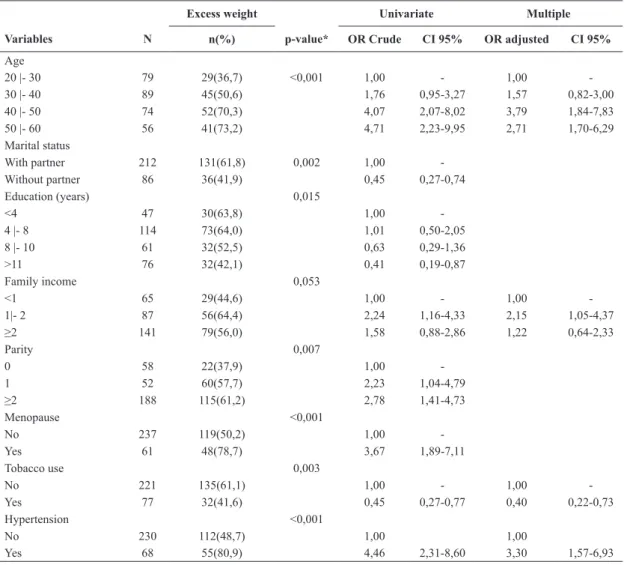
Table 2 presents results from the univariate and mul-iple analyses adjusted for the presence of excess weight (BMI≥25kg/m2). In the univariate analysis, excess weight increased signiicantly with age and was more common among women with a partner, lower educaion level, in-termediate family income, with children, menopausal, non-smokers and hypertensive. Variables presening p<0.20 were include in the muliple analysis, whose re-sults are also described in Table 2. In this adjusted analy-sis, maintained a signiicant associaion (p<0.05), only age, family income, tobacco use and hypertension. regarding the
epidemiologic magnitude, studies show an increasing tendency for excess weight and abdominal
obesity in developed and developing
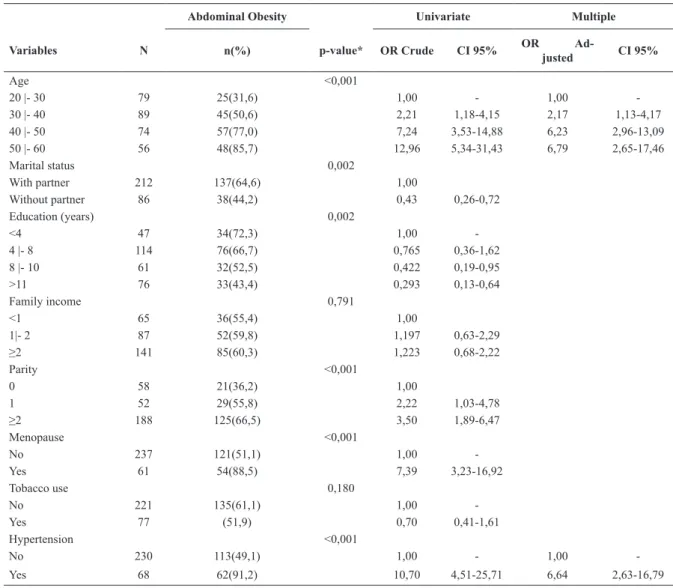
Table 3 presents the analyses for the presence of ab-dominal obesity. In the univariate analysis, the propor-ion of women with abdominal obesity also increased signiicantly with age and was associated with the marital status, educaion, parity, menopause and hypertension. With the analysis adjusted for the possible confounding variables, most posiive associaions disappeared, re-maining only age and hypertension. Women older than 40 years had a ive-fold chance to having abdominal obe-sity compared to those of ages between 20 and 30 years. Similarly, hypertensive women were about ive imes more likely to have abdominal obesity than those with normal blood pressure.
discussion
In the present study, the prevalence of excess weight (56.0%), considering the presence of overweight (36.9%)
Table 1 - Distribution of the women according to their nutritional state,
waist circumference (meters), waist-hip ration and abdominal obesity - São Paulo, 1999
Variables n %
Nutritional state
Low weight 10 3,4
Adequate weight 121 40,6
Overweight 110 36,9
Obesity 57 19,1
Waist circumference
<80 127 42,6
≥80 171 57,4
Waist-hip ratio
<85 213 71,5
≥85 85 28,5
Abdominal obesity
No 123 41,3
Yes 175 58,7
Excess weight Univariate Multiple
Variables N n(%) p-value* OR Crude CI 95% OR adjusted CI 95%
Age
20 |- 30 79 29(36,7) <0,001 1,00 - 1,00
-30 |- 40 89 45(50,6) 1,76 0,95-3,27 1,57 0,82-3,00
40 |- 50 74 52(70,3) 4,07 2,07-8,02 3,79 1,84-7,83
50 |- 60 56 41(73,2) 4,71 2,23-9,95 2,71 1,70-6,29
Marital status
With partner 212 131(61,8) 0,002 1,00
-Without partner 86 36(41,9) 0,45 0,27-0,74
Education (years) 0,015
<4 47 30(63,8) 1,00
-4 |- 8 114 73(64,0) 1,01 0,50-2,05
8 |- 10 61 32(52,5) 0,63 0,29-1,36
>11 76 32(42,1) 0,41 0,19-0,87
Family income 0,053
<1 65 29(44,6) 1,00 - 1,00
-1|- 2 87 56(64,4) 2,24 1,16-4,33 2,15 1,05-4,37
≥2 141 79(56,0) 1,58 0,88-2,86 1,22 0,64-2,33
Parity 0,007
0 58 22(37,9) 1,00
-1 52 60(57,7) 2,23 1,04-4,79
≥2 188 115(61,2) 2,78 1,41-4,73
Menopause <0,001
No 237 119(50,2) 1,00
-Yes 61 48(78,7) 3,67 1,89-7,11
Tobacco use 0,003
No 221 135(61,1) 1,00 - 1,00
-Yes 77 32(41,6) 0,45 0,27-0,77 0,40 0,22-0,73
Hypertension <0,001
No 230 112(48,7) 1,00 1,00
Yes 68 55(80,9) 4,46 2,31-8,60 3,30 1,57-6,93
* chi-square test h&l test = 0,89
Table 2 - Univariate and multiple analyses between excess weight and socioeconomic, biological and behavioral characteristics in a logistic regression
and obesity (19.1%) was higher than the naional patern obtained by the Telephone-based Surveillance of Risk and Protecive Factors for Chronic Diseases (Vigilância de Fa-tores de Risco e Proteção para Doenças Crônicas por In-quérito Telefônico - VIGITEL), performed in the Brazilian capitals and Federal District in 2006(6) and 2008(7), and the POF 2008-2009(2).
According to data from VIGITEL, the prevalence of ex-cess weight (BMI³25kg/m2) and obesity (BMI³30kg/m2) among women in 2006 was 38.8% and 11.5%, respecive-ly(6) and in 2008, excess weight afected 40% of women(7). The analysis of the data from POF 2008-2009(2) evidenced that there was a coninuous increase in the prevalence of excess weight and obesity over the last 34 years, and that among women the prevalence of excess weight nearly doubled in this period, increasing from 28.7% in 1974/75 to 48.0% in 2008-2009. The same was observed for
obe-sity, which also increased from 8.0% to 16.9%. It is empha-sized that the values observed in the studied sample are also above the naional mean at the ime of study (POF 2002-2003), which was 40.9% of excess weight and 13.5% obesity(2).
The ideniied high prevalence of excess weight can probably be explained by the underprivileged social situ-aion of the studied women, because about half of them had less than eight years of educaion and a family income lower than two minimum salaries. There is evidence that the quality of the diet is closely related to the socioeco-nomic class level, in a way that underprivileged individuals have a high consumpion of high-density, cheaper foods that provide greater saiety(8-9).
In addiion, a high prevalence was found for abdomi-nal obesity (58.7%), considering a change in the
mea-Table 3 - Univariate and multiple and adjusted analysis between abdominal obesity and socioeconomic, biological and behavioral characteristics in a
logistic regression model - São Paulo, 1999
Abdominal Obesity Univariate Multiple
Variables N n(%) p-value* OR Crude CI 95% OR
Ad-justed CI 95%
Age <0,001
20 |- 30 79 25(31,6) 1,00 - 1,00
-30 |- 40 89 45(50,6) 2,21 1,18-4,15 2,17 1,13-4,17
40 |- 50 74 57(77,0) 7,24 3,53-14,88 6,23 2,96-13,09
50 |- 60 56 48(85,7) 12,96 5,34-31,43 6,79 2,65-17,46
Marital status 0,002
With partner 212 137(64,6) 1,00
Without partner 86 38(44,2) 0,43 0,26-0,72
Education (years) 0,002
<4 47 34(72,3) 1,00
-4 |- 8 114 76(66,7) 0,765 0,36-1,62
8 |- 10 61 32(52,5) 0,422 0,19-0,95
>11 76 33(43,4) 0,293 0,13-0,64
Family income 0,791
<1 65 36(55,4) 1,00
1|- 2 87 52(59,8) 1,197 0,63-2,29
≥2 141 85(60,3) 1,223 0,68-2,22
Parity <0,001
0 58 21(36,2) 1,00
1 52 29(55,8) 2,22 1,03-4,78
≥2 188 125(66,5) 3,50 1,89-6,47
Menopause <0,001
No 237 121(51,1) 1,00
-Yes 61 54(88,5) 7,39 3,23-16,92
Tobacco use 0,180
No 221 135(61,1) 1,00
-Yes 77 (51,9) 0,70 0,41-1,61
Hypertension <0,001
No 230 113(49,1) 1,00 - 1,00
-Yes 68 62(91,2) 10,70 4,51-25,71 6,64 2,63-16,79
surement of WC (57.4%) or WHR (28.5%). There are no naional studies that evaluate abdominal obesity and, furthermore, the studies use diferent indicators and cut-of points, which make any data comparison diicult. The frequency of women with WC≥0.80m was close to the 62% found in Pelotas, RS(10), 58% in Maranhão(11), 59% in Goiânia(12), but was above the 38% found in Salvador(13). Some studies use WC≥0.88m, but in the present study, it was chosen to evaluate high risk rather than very high risk, which is what this cut-of point deines(1).
Regarding the variables associates with excess weight and abdominal obesity, and controlling the confounding variables by muliple analysis, most posiive associaions disappeared. The age kept a relevant associaion, paricu-larly for women of age above 40 years, an age group in which excess weight and abdominal obesity afected over 70%. The problem, however, begins early, because more than 30% of the women with less than 30 years of age al-ready had excess weight and/or abdominal obesity, which in the age group between 30-40 years already afected half the women. This associaion, however, was found in several studies(3,5-6,11,13-17).
A posiive associaion was found between income and the presence of excess weight, common in developing countries(18). However, the ideniied high prevalence of excess weight, which is much higher than that found in the country, appears to indicate a tendency observed in developed countries, where obesity is concentrated in the most underprivileged populaions(8), as that of the pres-ent study, which was socially deprived. This tendency has already been reported in Southern Brazil, where the risk for excess weight was up to three-fold among women of less favored social class(15) and the prevalence was higher among those of smaller income(19).
Another factor related to excess weight, but not to abdominal obesity, was tobacco use, which appeared as protector, as women who smoked had half the chance of presening excess weight compared to those who did not smoke. This relaionship was observed in some Brazilian studies(5,17) but not in others(7,11,13-14).
Hypertension showed a posiive associaion with ex-cess weight and/or abdominal obesity. Similar results have been reported in the literature, in which women with ex-cess weight and an increased WHR presented a higher risk for hypertension(20); hypertensive women have a greater chance for having excess weight and abdominal fat(13); obese women were twice as likely to be hypertensive than eutrophic women(21); there is a progressive increase in the risk for hypertension for each increase in BMI levels(6).
Considering that since the 1970s the frequency of excess weight has increased more than one percentage point per year, if this perspecive is maintained, in ten years two-thirds of the Brazilian adult populaion will have excess weight, which is similar to the magnitude found in the United States(2). These problems also afect nursing professionals, who, although knowing the severity of the problems related to obesity and hypertension, present some diiculty for changing lifestyles(22).
Although the present study was developed in an area covered by one same health system, the high prevalence of excess weight and abdominal obesity is evidence of the need for efecive local intervenions for prevenion and control and indicates important elements to be inves-igated in new studies, such as the socio-environmental determinants.
concLusion
A high prevalence of excess weight and abdominal obesity was observed among the studied women. Excess weight was associated to age, income, and arterial hyper-tension. Abdominal obesity was associated to age and arterial hypertension. These results are similar to other Brazilian studies and reinforce the importance of includ-ing the WC and WHR assessment in the physical examina-ion, besides the BMI, which help predict the risk. These results evidence the need for intervenions that promote the reducion of excess weight and abdominal obesity in the community.
reFerences
1. World Health Organizaion (WHO). Obesity: prevening and managing the global epidemic: report of a WHO Expert Con-sultaion on Obesity. Geneva; 1998.
2. Insituto Brasileiro de Geograia e Estaísica (IBGE). Pesquisa de orçamentos familiares 2008-2009. Rio de Janeiro; 2010.
3. Janssen I, Heymsield SB, Allison DB, Kotler DP, Ross R. Body mass index and waist circumference independently contrib-ute to the predicion of non-abdominal, abdominal subcuta-neous and visceral fat. Am J Clin Nutr. 2002;75(4):683-8.
4. Brasil. Ministério da Saúde; Secretaria de Atenção à Saúde; Departamento de Atenção Básica. Obesidade. Brasília; 2006.
5. Gigante DP, Barros FC, Post Cl, Olinto MTA. Prevalência de obesidade em adultos e seus fatores de risco. Rev Saúde Pu-blica. 1997;31(3):236-46.
7. Sá NNB, Moura EC. Excesso de peso: determinantes sócio de-mográicos e comportamentais em adultos, Brasil, 2008. Cad Saúde Pública. 2011;27(7):1380-92. 2
8. Swinburn B, Egger G. The runaway weight gain train: too many accelerators, not enough brakes. BMJ. 2004;329(7468):736-9.
9. Darmon N, Drewnowski A. Does social class predict diet qual-ity? Am J Clin Nutr. 2008;87(5):1107-17.
10. Olinto MTA, Costa JSD, Gigante DP, Menezes AM, Macedo S. Níveis de intervenção para obesidade abdominal: pre-valência e fatores associados. Cad Saúde Pública. 2006, 22(6):1207-15.
11. Veloso HJF, Silva AAM. Prevalência e fatores associados à obesidade abdominal e ao excesso de peso em adultos ma-ranhenses. Rev Bras Epidemiol. 2010;13(3):400-12.
12. Carnelosso ML, Barbosa MA, Porto CC, Silva SA, Carvalho MM, Oliveira ALI. Prevalência de fatores de risco para doen-ças cardiovasculares na região leste de Goiânia (GO). Ciênc Saúde Coleiva. 2010;15 Supl.1:1073-80.
13. Oliveira LPM, Assis AMO, Silva MCM, Santana MLP, San-tos NS, Pinheiro SMC, et al . Fatores associados a excesso de peso e concentração de gordura abdominal em adultos na cidade de Salvador, Bahia, Brasil. Cad Saúde Pública. 2009;25(3):570-82.
14. Kac G, Velásquez-Meléndez G, Coelho MASC. Fatores asso-ciados à obesidade abdominal em mulheres em idade re-produiva. Rev Saúde Pública. 2001;35(1):46-51.
15. Teichmann L, Olinto MTA, Costa JSD, Ziegler D. Fatores de risco associados ao sobrepeso e a obesidade em mulheres de São Leopoldo, RS. Rev Bras Epidemiol. 2006;9(3):360-73.
16. Oliveira EO, Velásquez-Meléndez G, Kac G. Fatores demográ-icos e comportamentais associados à obesidade abdominal em usuárias de centro de saúde de Belo Horizonte, Minas Gerais, Brasil. Rev Nutr. 2007;20(4):361-9.
17. Holanda LGM, Marins MCC, Souza Filho MD, Carvalho CMRG, Assis RC, Leal LMM, et al Excesso de peso e adiposi-dade central em adultos de Teresina-PI. Rev Assoc Med Bras. 2011;57(1):50-5.
18. Monteiro CA, Moura EC, Conde WL, Popkin BM. Socieco-nomic status and obesity in adult populaions of develop-ing countries: a review. Bull World Health Organ. 2004; 82 (12):940-6.
19. Sousa TF, Nahas MV, Silva DAS, Duca GFD, Peres MA. Fatores associados à obesidade central em adultos de Florianópolis, Santa Catarina: estudo de base populacional. Rev Bras Epi-demiol. 2011;14(2):296-309.
20. Ferreira HS, Florêncio TMTM, Fragoso MAC, Melo FP, Silva TG. Hipertensão, obesidade abdominal e baixa estatura: as-pectos da transição nutricional em uma população favelada. Rev Nutr. 2005;18(2):209-18.
21. Correia LL, Silveira DMI, Silva AC, Campos JS, Machado MMT, Rocha HAL, et al. Prevalência e determinantes de obe-sidade e sobrepeso em mulheres em idade reproduiva resi-dentes na região semiárida do Brasil. Ciênc Saúde Coleiva. 2011;16(1):133-45.