resumo
Quesiona-se de que forma o enfermeiro pode contribuir para a consolidação da Es-tratégia Saúde da Família (ESF), no âmbito do Sistema Único de Saúde (SUS), na busca da autonomia proissional. Discutem-se os limites e as possibilidades do trabalho do enfermeiro na ESF para a consolidação do SUS; avalia-se a oferta de consultas de en-fermagem realizadas pela ESF de Belo Ho-rizonte (BH); relete-se sobre a face políica da autonomia nos posicionamentos dos enfermeiros. Estudo de caso de natureza quani-qualitaiva. Foi avaliada a oferta de consultas de enfermagem em Unidades Básicas de Saúde (UBS) a parir de dados secundários e parâmetros oiciais, como indicaivos de autonomia. Em seguida, analisou-se a autonomia no trabalho da ESF por meio de grupos focais. O enfer-meiro pode fortalecer a ESF para a conso-lidação do SUS, se melhor compreender o contexto sócio-histórico, a ambiguidade das relações de poder e a práica social da proissão, aperfeiçoando-a críica, coleiva e criaivamente.
descritores
Enfermagem
Autonomia proissional Práica proissional Programa Saúde da Família
The limitations and possibilities of nurses’
work in the family health strategy: in the
search for autonomy
*O
r
i
g
i
n
a
l
a
r
ti
c
le
AbstrAct
The paper addresses how nurses can con-tribute to the consolidaion of the Family Health Strategy (FHS) within the Brazilian Naional Health System (Sistema Único de Saúde - SUS), in the search for profes-sional autonomy. Objecives: To discuss the limitaions and possibiliies of nursing work in the FHS aimint at the consolida-ion of the SUS; evaluate the available nursing appointments carried out by the FHS in Belo Horizonte (BH); relect on the poliical aspects of nurses’ autonomy on job posiions. This is a quani-qualitaive stud study. We evaluated the availabliiy of nursing appointments in basic Health Units (BHs) based on secondary data and oicial parameters as indicators of auton-omy. Subsequently, through focal groups, we analyzed nurses’ autonomy in the FHS. Nurses can strengthen the FHS for the consolidaion of the SUS, as long as they improve their understanding of the socio-historical context of nursing, the ambiguity of power relaionships and social pracice of the profession, improving it criicism, collecively and creaively.
descriptors
Nursing
Professional autonomy Professional pracice Family Health Program
resumen
Se cuesiona de qué forma el enfermero puede contribuir para consolidar la Estra-tegia Salud de la Familia (ESF), en el ámbito del Sistema Único de Salud (SUS), en bús-queda de la autonomía profesional. Se dis-cuten los límites y posibilidades del trabajo del enfermero en la ESF para consolidación del SUS; evaluar oferta de consultas de enfermería realizadas por la ESF Belo Hori-zonte (BH); relexionar sobre la faz políica de autonomía en la posición del enferme-ro; Estudio de caso cuani-cualitaivo. Se evaluó oferta de consultas de enfermería en Unidades Básicas de Salud (UBS) desde datos secundarios y parámetros oiciales, como indicaivos de autonomía. Luego, se analizó la autonomía de trabajo de la ESF mediante grupos focales. El enfermero puede fortalecer la ESF para consolidación del SUS, comprendiendo mejor el contexto socio-histórico, la ambigüedad de relacio-nes de poder y la prácica social de la pro-fesión, perfeccionándola críica, coleciva y creaivamente.
descriptores
Enfermería
Autonomia profesional Prácica profesional Programa de Salud Familiar
maria raquel Gomes maia pires1
Limites e possibiLidades do trabaLho do enfermeiro na estratégia saúde da famíLia: em busca da autonomia
Límites y posibiLidades deL trabajo deL enfermero en La estrategia saLud de La famiLia: en búsqueda de La autonomía
* this study was presented at the round table “gestão e gerência na consolidação do sus”, 2º simpósio internacional de políticas e prácticas em saúde coletiva na perspectiva da enfermagem – sinpesc, university of são paulo school of nursing, são paulo, oct 9-11. 2011. 1phd in art, Ludic and educative
introduction
The Family Health Strategy (FHS), a form of priority organizaion of the primary healthcare policy of the Bra-zilian Naional Health System (SUS)(1), deines an
impor-tant ield of acivity for the nurse, paricularly due to the managerial, educaional and care skills assumed by this professional. However, the work of the nurse in primary healthcare is not necessarily new for Brazilian nursing, originaing from the need for the State to organize public health in the 1920s(2). Similar to the fragile construcion
of Brazilian ciizenship, the public policies, including those of health, from which emerges the consituion of profes-sional nursing, originate from the tensions between the State and the market, with litle paricipaion of civil soci-ety(3). Any analysis of the nursing pracice must take into
account this naional scenario for the desired changes. The criical producion that analyzes the emergence of professional nursing in Brazil tends to highlight the passive character of its origin, linked to the interests
of the State, and not the social agents that performed at the ime, with a challenge to autonomy(4-6). That is, in the model of
Night-ingalian professionalism, based in moder-nity, the formaion of the nurse ideologi-cally masked the reality that consituted the nursing care in the early twenieth century, performed by lay praciioners, the religious, prositutes, slaves - people from poor social class or with behavior seen as inappropriate for the Catholic and bourgeois morality of the middle class.
The atempt to raise the status of the nurse, the social and technical division of labor, the denial of the social pracice of its agents, the scieniicism, the ideology
sur-rounding the founding myths - of sacralized, asexual and vocaional images - conform the archetype of the profes-sion. These issues need criical recogniion if the contra-dicions that hamper the achievement of technical and poliical autonomy of the profession, as expressed in their care, are to be overcome(7-8).
The poliical autonomy, able to face the contradicions of the pracice, inherently ariculates with the technical dimension of doing, giving it argumentaive strength and cohesion of subjects around common ideals. It is the abil-ity to make one’s own history, to recreate possibiliies, to conquer and be opportuniies for life(9). The hegemony of
the technical dimension of the work is predominant in the proile of nurses in the representaions that they make in their pracice(10). However, for the conquest of poliical
autonomy, there is a need to deepen the understanding that it is not enough to advance in the technical dimen-sion of scieniic knowledge, disconnected from the ability to criically relect and modify realiies(7-9).
In this theoreical ambience, the exercise of the free-dom of choice and of decision-making regarding the pracices, linked to scieniic knowledge, is immersed in ambivalent relaionships of power that consitute the subject(11), which require greater reconstrucive
compre-hension. To remove the poliical face of the knowledge, which feeds the autonomous acions of the nurse, is to become vulnerable to manipulaion for the interests of others - whether the professionals, managers, representa-ives of the market, or the government, within the health policy. It is expected that the physician of the team, the manager of the service, the secretary or the minister of health conirm the recogniion and freedom of acion that is so required in the profession. To wait for rewards or to complain, without the appropriate broad analysis of the context and of the power relaionships in which the pro-fessional work is inserted, is poliical fragility that must be overcome.
In order to exercise the protagonism sought by nurs-ing, with emphasis on the nurse as the team-forming
agent, it is useful to slightly reverse the logic of the quesions that have always been made about the work of this professional in the SUS. That is, for the poliical dimen-sion of the autonomy that is sought, it is litle to ask for the spaces of acion ofered in Family Healthcare, by the government, in the historically observed tendency(2,4-6). It is
now worth quesioning, in an authorial and purposeful way, how the nurse can contrib-ute to the consolidaion of this strategy of change in the Primary Healthcare area of the SUS.
With this problemaizaion, the aims are to discuss the limits and possibiliies of the work of the nurse in the Family Health Strategy for the consolidaion of the SUS, in light of autonomy; to evaluate the ofer of nursing consul-taions performed in primary healthcare units (PHUs) in Belo Horizonte (BH) as indicaive of the autonomy of the profession; to relect on the poliical face of the autonomy in the posiioning of these nurses.
metHod
This is a case study with a quanitaive and qualita-ive approach, which analyzes the work of the nurse in the Family Health Strategy through a variety of research techniques, using triangulaion of methods and data(12).
The study took place in two complementary steps, around which the techniques and informaion sources used are described. In the irst step, the frequency of nursing con-sultaions indicates possible evidence of autonomy by sin-gularizing the private acivity of the nurse in the health-care services. The suitability of these consultaions to the
the political autonomy, able to face the contradictions of the
practice, inherently articulates with the technical dimension
of doing, giving it argumentative strength and cohesion
local and naional parameters of the primary health-care/SUS was veriied(13-14). The secondary data base was
used from the study Evaluaion of primary healthcare in Belo Horizonte: use, provision and accessibility of the
services(15-16), where the sources were the Healthcare
System Network and the Fênix System of the Municipal Secretary of Health of Belo Horizonte (SMSA-BH), 2008 to 2009. The total number of nursing consultaions were compared to the FHS consultaions, in relaion to that recommended, both in the general care and in the pro-grammaic acions (child health, prenatal care and con-trol of arterial hypertension), in a PHU in Belo Horizonte.
The qualitaive deepening of the poliical autonomy occurred through the rereading of the statements from four focus groups conducted in the research cited, which also evaluated the organizaion of the work of the FHS(15).
The subjects of the research regarding the primary health-care of BH were 30 professionals, 14 physicians and 16 nurses, all of the FHS teams of 10 PHUs of BH, random-ly selected in the nine districts of the SMSA-BH. For the present study, the posiions of the 16 nurses involved in these focus groups were analyzed. The invesigaion was approved by the research ethics commitees of UFMG - Protocol 053/06 - and of SMSA-BH - Protocol 19/2006.
The analysis of the poliical autonomy of the nurse was based in formal quality references (or technique), and policies of the profession(7-8). An examinaion was made
regarding the proximity or distance of the statements con-cerning the characterisics: a) criical view of the reality and the social pracice; b) quesions about the inconsis-tencies of the profession; c) inclusion of the poliical face of the knowledge in the arguments; d) contextualized un-derstandings of the autonomy and power unit; e) the con-cept of themselves as historical subjects. The statements were analyzed in the light of depth hermeneuics (DH)(17) -
a method that reveals how the symbolic forms (signiicant construcions that require interpretaion) are employed to maintain power relaionships (ideology).
results And discussion
a) Evaluaion of the producion of the nursing consulta
-ion in the PHU in Belo Horizonte
The Family Health Strategy of Belo Horizonte covers approximately 75% of the populaion of the city. The basic network has professionals who ofer support for the ac-ions of the FHS teams in the PHU itself, such as the sup-port team (pediatricians, clinical praciioners, gynecolo-gists, social workers), the mental health teams, oral health teams and the rehabilitaionnucleus(14).
The mean number of consultaions of the nurse in the programmaic aciviies was 35%; the remainder (65%)
comes from the spontaneous demand of the PHU(a).
How-ever, the mean number of consultaions was not distrib-uted evenly among the 10 PHUs, ranging from 15% to 67% for programmaic aciviies and 33% to 85% for the spon-taneous demand, which provides diversity in the pracice of the nurse in the FHS. The mean number of consulta-ions ofered by the nurse was 13.2% in relaion to the to-tal of the FHS, however, this percentage varied from 8.4% to 18.9% between the 10 PHUs, with a standard deviaion of 2.9% and median of 12.3%.
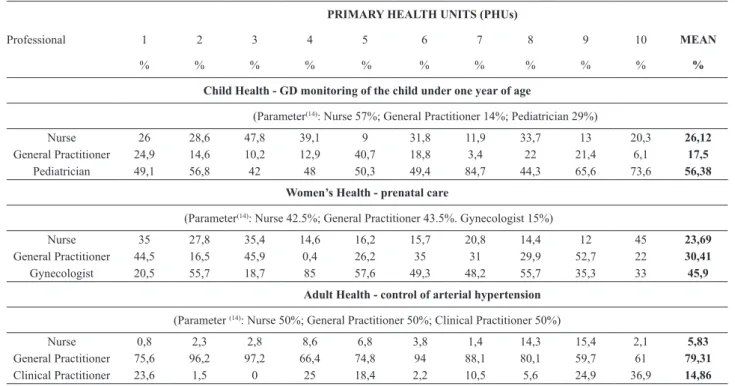
In monitoring the growth and development in children under one year of age (Table 1), the mean of nursing con-sultaions was litle more than a quarter (26.1%), when the parameter recommends more than half (57%)(14), ranging
from 9% (UBS 5) to 47.8% (UBS 3). The pediatrician as-sumes a major part of the consultaions of the children in the PHU (mean 56.3%, recommended 29%)(14). The
per-formance of the pre-natal consultaions follows the trend of low performance of nursing consultaions when the mean is observed (23.6%; parameter 42.5%), however, compliance above that recommended occurred in UBS 10 (45%) and was well below the mean (12%) in UBS 9. It was veriied that the gynecologist assumes the majority of the provision of prenatal consultaions (mean 45.9%), three imes higher than that directed by the local policies (pa-rameter 15%), to the detriment of the consultaions of the general praciioner (30.4 %), which, on average, is also lower than expected (parameter 43.5%). In three PHUs (1, 3, 9) the consultaions of the general praciioner were within the recommended levels. Monitoring the hyper-tensive paients through nursing consultaions in the PHU corresponds to a mean of 5.8%, when it should be 50% for the users who need this care. The majority of the con-sultaions are assumed by the general praciioner of the FHS (79.3%), reaching close to 100% in some PHUs (97.2% PHU 3; 96.2% PHU 2; 94% PHU 6).
The low producion of nursing consultaions of the FHS of BH, both in the total of the PHU and within the programmaic acions, indicates worrying repercussions, both for the primary care policy and for the autonomous pracice of the profession. In the context of the policy, it can be seen that the heterogeneity of scenarios compli-cates any linear evaluaion, without taking into account the context of the pracices and the reality of each health-care service. For nursing, the scenario of low producion of consultaions can mean a retreat from the clinical in the work of the profession, necessary for the autonomy thatis sought(10,18-19). Other studies show that the precarious
con-diions of work of the FHS, the quoidian stress, the risk of illness through the work, and the conlictual relaion-ships in the healthcare team accentuate the diiculies to be overcome(20-21).
(a) in the guidelines for the organization of the primary healthcare in belo
b) Autonomy in the posiioning of the nurse in the FHS in Belo Horizonte
Although the producion of nursing consultaions is an indicator to gauge the situaion of autonomy of the nurse, it is insuicient to express the poteniality of their work in the FHS. The list of pracices cataloged in the Internaional Classiicaion of Public Health Pracices (CIPESC), in the di-mensions of management, care, educaion and research, highlights the breadth of the acions of this profession-al(18-19). Therefore, it was sought to reveal the autonomy of
the nurse from the socio-historical context, of the charac-terisics of the work in the PHU and of the poliical mean-ings produced by their discourses.
The categories that summarize the socio-historical context of the nurses, originaing from the statements, are: a) family relaionships, motherhood and painful situ-aions with the users; b) poliical correctness: litle expla-naion of what one thinks; c) Family Health, let’s strug-gle: some examples reproduced the oicial discourse of change of pracices through the FHS uncriically, compro-mising more dialogical aitudes.
The nurses, in general women, chose stories of the per-sonal life, considered remarkable, to present themselves. The centrality of the afect predominated in the contextual-izaion of those interviewed, both in the signiicant events of life and work, as well as in the pictures chosen. In some
professionals, the statements either tended to either side, or revealed a distancing from the proacive postures of change, faced with the scenario of the working pracices. In other cases, the oicial discourse of Family Healthcare was reproduced, vigorously, with primacy of the technical dimension of doing. Although the small amount of criical relecion is indicated as a trait of the poliical fragility(7-8),
the value of engagement for the required changes should be highlighted. One of the representaives of this catego-ry, ambiguously, revealed a high degree of determinaion and commitment to everything carried out; showed pro-fessional security and performed constant self-evaluaion pracices, more deeply relecing on the situaions. With regard to the work of the nurse in the PHU, it was found that, when they carry out the clinical dimension and the management of the teamwork process beter, there is a posiive impact on the organizaion of the acions in the PHU, this being one of the potenial acions expected for the public health(18).
A close look at the socio-historical context of nurses indicates the inluence of gender, of social class and of the formaion regarding the proile they present. There is a certain non-homogeneous tendency towards conserva-ism of the statements, whether in relaion to social tradi-ions, to the role of men and women in society, or to the centrality of the biomedical model in the care. The exces-sively technical formaion inhibits a deepening of the
ethi-Table 1 - Percentage of consultations offered by nurses, general practitioners and support physicians in the programmatic actions in the PHUs
investi-gated - Belo Horizonte, 2008-2009.
Professional
primary healTh uniTS (phus)
1 2 3 4 5 6 7 8 9 10 mean
% % % % % % % % % % %
Child health - GD monitoring of the child under one year of age
(Parameter(14): Nurse 57%; General Practitioner 14%; Pediatrician 29%)
Nurse 26 28,6 47,8 39,1 9 31,8 11,9 33,7 13 20,3 26,12
General Practitioner 24,9 14,6 10,2 12,9 40,7 18,8 3,4 22 21,4 6,1 17,5
Pediatrician 49,1 56,8 42 48 50,3 49,4 84,7 44,3 65,6 73,6 56,38
Women’s health - prenatal care
(Parameter(14): Nurse 42.5%; General Practitioner 43.5%. Gynecologist 15%)
Nurse 35 27,8 35,4 14,6 16,2 15,7 20,8 14,4 12 45 23,69
General Practitioner 44,5 16,5 45,9 0,4 26,2 35 31 29,9 52,7 22 30,41
Gynecologist 20,5 55,7 18,7 85 57,6 49,3 48,2 55,7 35,3 33 45,9
adult health - control of arterial hypertension
(Parameter (14): Nurse 50%; General Practitioner 50%; Clinical Practitioner 50%)
Nurse 0,8 2,3 2,8 8,6 6,8 3,8 1,4 14,3 15,4 2,1 5,83
General Practitioner 75,6 96,2 97,2 66,4 74,8 94 88,1 80,1 59,7 61 79,31
Clinical Practitioner 23,6 1,5 0 25 18,4 2,2 10,5 5,6 24,9 36,9 14,86
gd: growth and development
cal, poliical and social relecion, with a tendency to su-periciality in the analysis, in some of the discourses. The majority of the nurses demonstrated diiculty in analyz-ing the ambiguity of the power relaionships in the team, in the service or in the health policy, compromising the poliical nature of their acivity(7-9).
Between the extremes, or in the gaps, there were the ways out, the utopias or the new possibiliies, inherent in the process of change that is being sought with Fam-ily Healthcare, and the autonomous acion of the nurse. Those subjects closest to the poliical autonomy made explicit the criical analyses of their own work, of the team and of the PHU, highlighing the limitaions and the advances of the FHS; saw more clearly the tensions and contradicions of the pracice; demonstrated, in a certain way, the knowledge that they are able do beter, detail-ing anxieies faced with the structural challenges of the pracice. The majority of the nurses presented fragility in the poliical autonomy, tending to avoid the responsibility of the social actor, with litle comprehension of the con-text of the health policy, of the power relaionships of the healthcare team and of the nursing. Those who showed proximity with the poliical autonomy, in the minority, criicized the context and the professional pracice, saw more clearly the ambiguity of the power relaions in the team, although with litle analyical depth, and placed themselves as social agents of the changes, even though
exhausted in the midst of quoidian pressures for results
and care(20-21).
conclusion
The nurse inds an important space of actuaion in the Family Health Strategy and can strengthen it for the con-solidaion of the SUS, to beter comprehend the socio-historical context and the ambiguity of the power relaion-ships in the social pracice of the profession, improving it criically, collecively and creaively. The possibiliies of this contribuion for consolidaing the principles of the FHS, with repercussions for the SUS, include the centrality of this professional in the formaion and organizaion of the nur-sing workforce in the healthcare services; the potenial for teamwork and the organizaion of the services in the PHU, characterisic of their doing; the diversity of acions de-veloped in public healthcare, arising from their formaion and pracice; the use of the CIPESC for the diagnosis and relecion-acion regarding the social pracice of its agents and the strategic spaces they occupy in the health policy, whether in management, educaion, care, or in research. As a limitaion to advances in the autonomy of the nurse and in the primary healthcare policy of the SUS the follow-ing can be highlighted, the fragility of its poliical discourse; the small amount of appropriaion regarding the histori- city of the profession; the atachment to idealized images of nursing that do not correspond to the reality of the social pracice; and the precariousness of the relaionships and working condiions in the Family Health Strategy. A criical culture of relecion has to be developed regarding the po-liical fragiliies of nursing, so that the quest for autonomy is a quality exercise of their doing and of commitment to the changes of the care model.
reFerences
1. Brasil. Ministério da Saúde. Portaria GM/MS nº 648. Estabe-lece a Políica Nacional de Atenção Básica. Diário Oicial da União 2006; 28 mar.
2. Moreira MCN, Nunes MC. A Fundação Rockefeller e a cons-trução da idenidade proissional de enfermagem no Bra-sil na Primeira República. Hist Ciênc Saúde-Manguinhos. 1999;5(3):621-45.
3. Carvalho JM. Cidadania no Brasil: o longo caminho. 5ª ed. Rio de Janeiro: Civilização Brasileira; 2004.
4. Germano RM. Educação e ideologia da enfermagem no Brasil. São Paulo: Cortez; 1985.
5. Almeida MCP. O saber de enfermagem e sua dimensão prái-ca. São Paulo: Cortez; 1989.
6. Pires D. Hegemonia médica na saúde e na enfermagem. São Paulo: Cortez; 1989.
7. Pires MRGM. Pela reconstrução dos mitos da enfermagem a partir da qualidade emancipatória do cuidado. Rev Esc
8. Pires MRGM, Götems LBD. Análise da gestão do cuidado no Programa de Saúde da Família: referencial teórico-metodológico. Rev Bras Enferm. 2009; 62(2):294-9.
9. Demo P. Poliicidade: razão humana. Campinas: Papirus; 2002.
10. Gomes AMT, Oliveira, DCD. Autonomia proissional em um desenho atômico: representações sociais de enfer-meiros. Rev Bras Enferm. 2010;63(4):608-15.
11. Foucault M. A hermenêuica do sujeito. São Paulo: Marins Fontes; 2004.
12. Minayo MCS, Assis SG, Souza ER. Avaliação por triangula-ção de métodos: abordagem para programas sociais. Rio de Janeiro: FIOCRUZ; 2005.
13. Brasil. Ministério da Saúde; Secretaria de Atenção à Saúde; Departamento de Atenção Básica. PROGRAB: Programação para Gestão por Resultados na Atenção Básica. Brasília; 2006.
15. Pires MRGM, Gotems LBD. Avaliação da Atenção Básica em Belo Horizonte: organização, oferta e acessibilidade dos serviços [relatório de pesquisa]. Belo Horizonte: Escola de Enfermagem, Universidade Federal de Minas Gerais; 2009.
16. Passos CM. O trabalho do enfermeiro na Atenção Básica de Belo Horizonte: avaliação das ações programáicas [disserta-ção]. Belo Horizonte: Escola de Enfermagem, Universidade Federal de Minas Gerais; 2011.
17. Thompson JB. Ideologia e cultura moderna: teoria social críica na era dos meios de comunicação de massa. Petrópo-lis: Vozes; 1995.
18. Wit RR, Girard MA, Malerba H, Fengler KPM. Projeto CIPESC-BRASIL: caracterização da enfermagem no cenário de Porto Alegre. Rev Gaucha Enferm. 2002;22(1):103-13.
19. Barros DG, Chiesa AM. Autonomia e necessidades de saúde na sistemaização da assistência de Enfermagem no olhar da saúde coleiva. Rev Esc Enferm USP. 2007;4(n.esp):793-8.
20. Maqui ABT, Jahn AC, Resta DG, Calome ICS. Caracterização das equipes da Saúde da Família e de seu processo de tra-balho. Rev Esc Enferm USP. 2010;44(4):956-61