INTRODUCTION
Benign prostatic hyperplasia (BPH) is a highly prevalent disease in elderly men. By the age of 60, almost 60% of the cohort in the Balti-more Longitudinal Study of Aging had some de-gree of clinical BPH (1). The gold standard
surgi-cal treatment for BPH is transurethral resection of the prostate (TURP) (2). Recent surgical techniques using lasers, such as photoselective vaporiza-tion of the prostate (PVP), holmium laser enucle-ation of the prostate (HoLEP) and thulium laser enucleation of the prostate (ThuLEP) have been popularized, with a number of reports document-Purpose: To appraise the evaluation methods for learning curve and to analyze
the non-mentor-aided learning curve and early complications following the hol-mium laser enucleation of the prostate.
Materials and Methods: One-hundred and forty (n=140) consecutive patients who underwent HoLEP from July 2008 to July 2010 by a single surgeon (SJO) were enrolled. Perioperative clinical variables, including enucleation time, morcellation time, enucleation ratio (enucleation weight/transitional zone volume), enucleation effi cacy (enucleated weight/enucleation time), enucleation ratio effi cacy (enucle-ation ratio/enucle(enucle-ation time), and early complic(enucle-ation rate were analyzed.
Results: Mean prostate volume was 62.7 mL (range 21-162) and preoperative International Prostate Symptom Score (IPSS) was 19.0 (4-35). Mean enucleation time and morcellation time were 49.9±23.8 (S.D.) min and 11.0±9.7 min, respec-tively. Median duration of postoperative indwelling catheter was 1 (1-7) day and median hospital stay was 1 (1-6) day. There were a total of 31 surgery-related complications in 27 patients (19.3%), and all were manageable. There was an in-creasing trend of enucleation effi cacy in the fi rst 50 cases. However, enucleation effi cacy was linearly correlated with the prostate size (correlation coeffi cients, R=0.701, p<0.001). But, enucleation ratio effi cacy could eliminate the confound-ing effect of the prostate size (R=-0.101, p=0.233). The plateau of enucleation ratio effi cacy was reached around the twenty-fi fth case.
Conclusions: Our results demonstrated that the operative learning curve plateau is reached after about 25 cases. We propose that a more appropriate parameter for estimating the operative learning curve is enucleation ratio effi cacy, rather than enucleation effi cacy.
Enucleation ratio effi cacy might be a better predictor
to assess learning curve of holmium laser enucleation
of the prostate
_______________________________________________
Chang Wook Jeong, Jin Kyu Oh, Min Chul Cho, Jung-Bum Bae, Seung-June Oh
Department of Urology, Seoul National University Hospital, Seoul, Korea
ABSTRACT ARTICLE INFO
_______________________________________________________________ _____________________
Key words:
Prostatic Hyperplasia; Lasers; Solid-State; Prostatectomy; Learning curve
Int Braz J Urol. 2012; 38: 362-72
________________
Submitted for publication: July 21, 2011
________________
363
IBJU|HOLEP: LEARNING CURVE AND ITS PROPER ESTIMATION
ing their merits. HoLEP can confidently remove the entire enlarged adenoma through the use of Holmium:YAG laser in the natural tissue plane of the surgical capsule.
After the first clinical report by Gilling et al. in 1996, several randomized control trials have been reported (3). Compared to TURP or open prostatectomy, HoLEP has similar clinical outcome, lower postoperative complication rate and requires shorter hospital stay (4-8). In addi-tion, HoLEP appears to be a true endourological alternative to open prostatectomy, because it can effectively treat a very large prostate (9,10).
However, a steep operative learning curve may be the main hindrance to widespread use of HoLEP despite its advantages. Some researchers have argued that a surgeon needs between 20 and 30 cases of experience to attain competen-cy (6,11), while others have argued that up to 50 cases are needed (12,13). This discrepancy comes mainly from the absence of an accurate way to evaluate the operative learning curve. Therefore, the purpose of this study was to evaluate a prop-er method to assess the learning curve to attain competency to perform enucleation of prostate using HoLEP.
MATERIALS AND METHODS
One-hundred and forty (n=140) consecu-tive patients who underwent HoLEP for the treat-ment of BPH from July 2008 to July 2010 were enrolled. All patients were treated by a single sur-geon (SJO). Preoperatively, history taking, physi-cal examination with digital rectal exam, Inter-national Prostate Symptom Score (IPSS), quality of life (QoL), frequency-volume chart, urinalysis, prostate-specific antigen, transrectal ultrasonog-raphy and pressure-flow study were performed on each patient.
Protocol for the HoLEP procedure is as fol-lows. Each patient was placed in the lithotomy position under spinal anesthesia. The urethra was dilated with a 30 Fr metal catheter prior to intro-duction of a working sheath. We used a 80W hol-mium laser (VersaPulse® PowerSuite™, Lumenis, Yokneam, Israel), 550 µm end-firing laser fiber (SlimLine™, Lumenis, Yokneam, Israel), 26 Fr
con-tinuous-flow resectoscope with a dedicated inner sheath, and a 30o telescope (27040 XAL and 27005
BA, Karl Storz, Tuttlingen, Germany) for enucle-ation of adenomas. Enucleenucle-ation was performed in 7 steps: 1. apical incision (lateral side to verumon-tanum), 2. bladder neck incision (5 and 7 o’clock positions) and conjoining transverse incision in front of verumontanum, 3. median lobe enucle-ation, 4. upward separation of lateral lobes, 5. lon-gitudinal incision at 12 o’clock, 6. downward inci-sion of lateral lobes (to 3 and 9 o’clock side), and 7. connecting mucosal incision of apical prostate and enucleation of lateral lobes. For morcellation, we changed the resectoscope to a 26 Fr nephro-scope with an adapter (27293 AA and 27040 LB, Karl Storz, Tuttlingen, Germany). Enucleated tis-sue was morcellated using a VersaCut™ morcellator (Lumenis, Yokneam, Israel). After the procedure, a 22 Fr Foley catheter was placed. Postoperatively, continuous bladder irrigation was applied as the occasion demanded. Usually, on the first or second postoperative day, the patient was discharged after removal of the urethral Foley catheter and sponta-neous urination was confirmed.
Perioperative clinical variables, includ-ing enucleation weight, enucleation time, mor-cellation time, enucleation ratio (enucleation weight/transitional zone volume), enucleation efficacy (enucleated weight/enucleation time), enucleation ratio efficacy (enucleation ratio/ enucleation time), and early complications were recorded prospectively on a planned data regis-try form. These data were retrieved from the reg-istered database, and then analyzed. This study was approved by the institutional review board (IRB) of Seoul National University Hospital.
RESULTS
Patients’ mean age was 68.9±6.1 (S.D.) years, and mean preoperative prostatic specific antigen level was 3.5±3.1 (S.D.) ng/mL. Mean prostate volume was 62.7 mL (range 21-162) and preoperative International Prostate Symptom Score (IPSS) was 18.8±7.7 (S.D.). Mean preoper-ative maximum flow rate and postvoid residual were 9.6±4.7 (S.D) mL/sec and 86.5±124.6 (S.D.) mL, respectively. Various operative parameters re-lated to learning curve were summarized in Ta-ble-1 along with the number of cases experienced. There was no TURP conversion. Median duration of postoperative catheter indwelling and hospital stay was equal to 1 day (mean 1.61, range 1-7 and mean 2.61, range 1-6, respectively). Preopera-tive and postoperaPreopera-tive functional outcomes at 6 months are presented in Table-2.
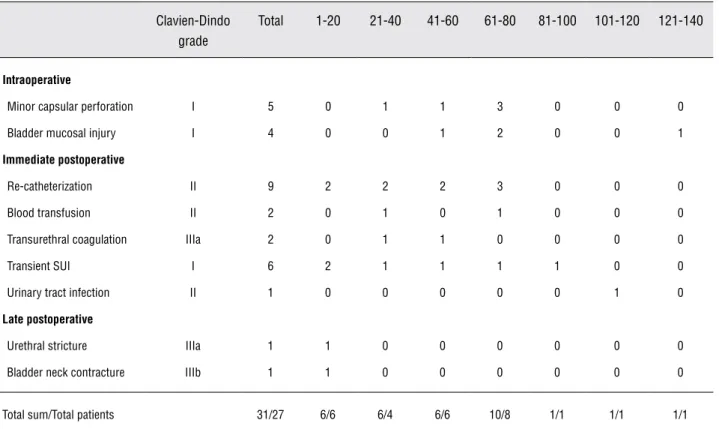
A total of 31 surgery-related complications were recorded in 27 patients (19.3%) (Table-3). How-ever, all complications were mild and transient, so they were easily and properly managed. No patient developed stress urinary incontinence persistent for more than 3 months.
Enucleation efficacy had a strong linear cor-relation with total prostate volume (corcor-relation co-efficient, R=0.701, p<0.001) and transitional zone volume (R=0.740, p<0.001) (Figure-1). Figure-2 summarizes the changes in operative parameters in the order of sequential cases. Enucleation efficacy was increased in the first 50 cases, however the enu-cleation ratio did not change significantly. The esti-mated prostate volume did not changed in the first 20 cases, compared to the next 20 cases (mean val-ues 53.9 vs. 50.6 mL, p=0.587). However, there was significant increase in estimated prostate volume from case number 41 to 60, compared to the prior 20 cases (mean value 70.1 mL, p=0.015). Enucleation ratio efficacy, having eliminated the confounding effect of prostate size, reached a plateau around the twenty-fifth case. And this parameter agreed with the surgeon’s confidence in his operative skills.
DISCUSSION
TURP and open prostatectomy have been the treatments of choice for moderate (30-80 mL)
and large (>80-100 mL) size BPH prostates respec-tively (2,14). TURP has been the standard surgical treatment for symptomatic BPH. TURP has high rate of success and imposes low economic burden. However, in 2.0-4.8% of cases, transfusion is re-quired, and TURP syndrome, a dilutional hypona-tremia that occurs when the irrigant is absorbed into the bloodstream, occurs in 1.1% of cases. The chance of TURP syndrome significantly increases when the prostate gland is larger than 45g, or the resection time is longer than 90 min (15). Most of all, one study showed that 14.7% of patients who underwent TURP required reoperation at the eighth year of follow-up (16). For these reasons, many al-ternative treatment options are been actively re-searched.
HoLEP is the most extensively studied laser therapy for BPH. Randomized control studies have shown that symptom improvement attained after HoLEP is comparable to that obtained following TURP, with favorable results including removed tissue weight, duration of catheterization, hospital stay, need for blood transfusions, and the absence of TURP syndrome (4,5,17-19). Similar treatment outcomes have been demonstrated when HoLEP was compared to open prostatectomy for the treat-ment of large prostates. Surgical time and removed tissue weight were better in open prostatectomy, but duration of catheterization, hospital stay and bleeding were better in HoLEP (9,11,20,21). The rationale behind lower amount of removed tissue weight during HoLEP comes from vaporization ef-fect during enucleation (5). These merits, proven in long-term follow-up studies, suggest that HoLEP is a viable alternative to TURP and open prosta-tectomy.
365
IBJU
|
HOLEP: LEARNING CURVE AND ITS PROPER ESTIMA
TION
Table 1 - Operative parameters related to learning curve with number of cases treated.
Total 1-20 21-40 41-60 61-80 81-100 101-120 121-140
Prostate volume (mL) 62.0 ± 27.1 53.9 ± 17.5 50.6 ± 21.0 70.1 ± 27.3 61.3 ± 25.8 78.4 ± 36.3 57.3 ± 21.1 67.7 ± 29.8
Transitional zone volume (mL) 35.0 ± 21.2 26.5 ± 14.1 27.1 ± 21.5 42.4 ± 21.5 29.4 ± 12.7 47.8 ± 28.0 32.0 ± 18.4 39.8 ± 21.3
Enucleation time (min) 49.9 ± 23.8 74.4 ± 34.4 34.3 ± 10.8 45.7 ± 9.9 42.3 ± 13.0 60.4 ± 27.9 45.8 ± 19.6 46.2 ± 17.2
Morcellation time (min) 11.0 ± 9.7 15.1 ± 7.5 10.9 ± 8.4 12.1 ± 8.5 9.8 ± 5.9 14.2 ± 18.7 5.8 ± 3.6 9.3 ± 5.4
Enucleation weight (gm) 22.7 ± 19.1 12.2 ± 8.8 16.4 ± 13.3 25.7 ± 16.5 22.9 ± 17.7 35.9 ± 27.6 21.9 ± 20.7 24.1 ± 16.7
Enucleation ratio (gm/mL) 0.60 ± 0.28 0.45 ± 0.27 0.58 ± 0.21 0.59 ± 0.19 0.73 ± 0.37 0.65 ± 0.33 0.61 ± 0.31 0.56 ± 0.18
Enucleation efficacy (gm/min) 0.44 ± 0.27 0.20 ± 0.18 0.44 ± 0.24 0.54 ± 0.24 0.50 ± 0.24 0.53 ± 0.35 0.42 ± 0.25 0.49 ± 0.24
Enucleation ratio efficacy (gm/mL/min) 0.0133±0.0063 0.0071±0.0047 0.0178±0.0069 0.0131±0.0040 0.0176±0.0069 0.0111± 0.0052 0.0139±0.0051 0.0127± 0.0041
Table 2 - Preoperative and follow-up functional outcomes.
Preoperative (n=140) 2 wks - 1 mo
(n=129) 3 mo (n=91)
6 mo (n=63)
Maximum flow rate (mL/sec) 9.6 ± 4.7 19.3 ± 9.2 20.9 ± 10.5 21.2 ± 8.2
Postvoid residual (mL) 86.5 ± 124.6 23.4 ± 29.9 27.4 ± 42.3 23.4 ± 34.1
IPSS (total) 18.8 ± 7.7 12.0 ± 7.7 6.8 ± 5.5 7.3 ± 6.5
QoL 4.2 ± 1.2 2.7 ± 1.7 2.0 ± 1.4 1.8 ± 1.5
Data presented as mean ± standard deviation. IPSS= international prostate symptom score; QoL=quality of life
Table 3 - Intra- and postoperative complications according to the number of cases treated.
Clavien-Dindo grade
Total 1-20 21-40 41-60 61-80 81-100 101-120 121-140
Intraoperative
Minor capsular perforation I 5 0 1 1 3 0 0 0
Bladder mucosal injury I 4 0 0 1 2 0 0 1
Immediate postoperative
Re-catheterization II 9 2 2 2 3 0 0 0
Blood transfusion II 2 0 1 0 1 0 0 0
Transurethral coagulation IIIa 2 0 1 1 0 0 0 0
Transient SUI I 6 2 1 1 1 1 0 0
Urinary tract infection II 1 0 0 0 0 0 1 0
Late postoperative
Urethral stricture IIIa 1 1 0 0 0 0 0 0
Bladder neck contracture IIIb 1 1 0 0 0 0 0 0
Total sum/Total patients 31/27 6/6 6/4 6/6 10/8 1/1 1/1 1/1
SUI = stress urinary incontinence
HoLEP can be performed effectively after about 50 cases, with an outcome comparable to that of ex-perts (12). Their conclusion was based on enucle-ation efficacy analysis and complicenucle-ation rate. Seki et al. argued that HoLEP can be taught even with-out a proper instructor, and in that report at least 50 cases of operative experience was needed to
367
IBJU|HOLEP: LEARNING CURVE AND ITS PROPER ESTIMATION
Figure 1. Correlation between prostate size and enucleation efficacy. (A) Total prostate volume. (B) Transitional zone volume. (Linear regression with 95% mean prediction interval).
Figure 2. Changes in operative parameters related to learning curve in order of sequences. (A) Enucleation efficacy. (B) Enucleation ratio. (C) Prostate volume. (D) Enucleation time. (E) Enucleation ratio efficacy.
A B
C
E
369
IBJU|HOLEP: LEARNING CURVE AND ITS PROPER ESTIMATION
to attain competency (12,13). Enucleation efficacy is considered to be a more objective parameter to estimate operative learning curve. However, there is a discrepancy between enucleation efficacy and self confidence regarding the HoLEP procedure.
In July 2008, our institution began offer-ing HoLEP. There was no experienced urologist in the Republic of Korea at the time, and HoLEP was self-taught by reviewing expert videos. Our results, demonstrating quick symptomatic improvement and a reasonable complication rate, are consis-tent with that previously published (23). Moreover, while Placer et al. reported that persistent stress urinary incontinence (4.8%) occurred during ini-tial enucleation of large-sized prostates in the self-taught situation, there was no persistent stress uri-nary incontinence in our series (24).
In this study, enucleation efficacy increased in the initial cases, and the plateau was reached around the fiftieth case. In contrast, the enucleation ratio did not show significant difference. However, enucleation efficacy had a strong linear correlation with prostate size. This implies that HoLEP is more effective for larger prostates, and enucleation ef-ficacy is also confounded by prostate size. There was no difference between the first 20 cases and the next 20 cases in terms of prostate volume, but the subsequent 20 cases were of significantly larger prostates than the prior 20 cases. Thus, during the first 40 cases the enucleation efficacy has increased mainly by technical improvement, and during the later period increased efficacy was obtained due to case selection of larger prostates after the surgeon had gained confidence. This can also be observed in the enucleation time curve. This phenomenon is consistent with a previous report (24).
As a result, we propose a new parameter, ‘enucleation ratio efficacy’, to estimate the op-erative learning curve for HoLEP. It is defined as enucleation ratio divided by enucleation time and this is identical to enucleation efficacy divided by transitional zone volume. This new parameter can eliminate the confounding effect of prostate size from enucleation efficacy. In this series, the correlation coefficient between enucleation ra-tio efficacy and prostate size was only -0.101 (p=0.233). Furthermore, the enucleation ratio ef-ficacy stabilized after 25 cases, and this
observa-tion was consistent with the surgeon’s confidence in his operative skills. We believe this parameter reflects the surgeon’s skills more accurately than enucleation efficacy by eliminating size as a con-founding effect. Both enucleation efficacy and enucleation ratio efficacy reduced after reaching the plateau. We think that it occurred because the surgeon, once having gained confidence, had more time for meticulous bleeding control and completing the procedure.
The clinical outcomes were not different between the groups along cases. In all patients, objective outcomes (maximum flow rate and post void residual volume) significantly improved im-mediately from the first visit. In contrast, subjective outcomes, especially IPSS total score, stabilized 3 months after surgery.
While the surgeon’s competency to perform HoLEP could be attained after 25 cases, complica-tions were significantly reduced after 80 cases, al-though they were mild. Overall, 19.3% of patients experienced complications related to surgery. How-ever, most of these complications were mild and transient. Clavien classification (25) III complica-tions developed in 4 patients (2.9%), and higher-grade adverse events did not occur. Surgeons should be careful in minimizing complications af-ter gaining confidence with their surgical skills by the lesson from this series. Seki et al. reported high incidence of urethral stricture (7%) and they laid the responsibility to the larger nephroscopes (26Fr). However, only one patient (0.7%) experienced ure-thral stricture in our series. We do not believe that a systematic use of a 26Fr working sheath could increase the incidence of urethral complications, if surgeon carefully performs HoLEP.
In the analysis, there were three patients whose prostate volumes were less than 25 mL. Their transitional zone volumes were between 8 - 9 mL and anatomical obstructions secondary to median lobe enlargement were found on urethro-cystoscopy. These cases could be ideal candidates for transurethral incision of the prostate. However, we chose HoLEP rather than transurethral incision in an attempt to remove the whole adenoma. We included these cases in the study cohort, because that faithfully reflects our real practice.
Our study has several limitations. The ma-jor pitfall is the retrospective nature of the study. Notwithstanding, all consecutive patients were enrolled to avoid potential selection bias. Further-more, all data were collected prospectively using a planned data registry form. It would be more in-formative if long-term follow-up results could be presented. However, we believe that surgical com-petency could be reasonably assessed with short-term outcomes of six months. The other limitation is that the study was conducted on patients op-erated by one surgeon. Our proposed parameter, enucleation ratio efficacy, should be evaluated with several surgeons in the future, to determine if it is generally acceptable.
CONCLUSIONS
Our results demonstrated that the learning curve can be overcome after about 25 cases, even in a non-mentor-aided situation. We believe that a more appropriate parameter for estimating the learning curve is enucleation ratio efficacy rather than enucleation efficacy.
ABBREVIATIONS
BPH = Benign prostatic hyperplasia;
TURP = transurethral resection of the prostate; PVP = photoselective vaporization of the prostate; HoLEP = holmium laser enucleation of the prostate; ThuLEP = thulium laser enucleation of the prostate; IPSS = International Prostate Symptom Score; QoL = quality of life;
IRB = institutional review board; SUI = stress urinary incontinence
CONFLICT OF INTEREST
None declared.
REFERENCES
1. Arrighi HM, Metter EJ, Guess HA, Fozzard JL: Natural his-tory of benign prostatic hyperplasia and risk of prostatec-tomy. The Baltimore Longitudinal Study of Aging. Urology. 1991; 38(1 Suppl): 4-8.
2. AUA guideline on management of benign prostatic hyper-plasia (2003). Chapter 1: Diagnosis and treatment recom-mendations. J Urol. 2003; 170: 530-47.
3. Gilling PJ, Cass CB, Cresswell MD, Fraundorfer MR: Hol-mium laser resection of the prostate: preliminary results of a new method for the treatment of benign prostatic hyper-plasia. Urology. 1996; 47: 48-51.
4. Montorsi F, Naspro R, Salonia A, Suardi N, Briganti A, Zanoni M, et al.: Holmium laser enucleation versus trans-urethral resection of the prostate: results from a 2-center, prospective, randomized trial in patients with obstructive benign prostatic hyperplasia. J Urol. 2004; 172: 1926-9. 5. Gupta N, Sivaramakrishna, Kumar R, Dogra PN, Seth A:
Comparison of standard transurethral resection, transure-thral vapour resection and holmium laser enucleation of the prostate for managing benign prostatic hyperplasia of >40 g. BJU Int. 2006; 97: 85-9.
6. Kuntz RM, Lehrich K: Transurethral holmium laser enucle-ation versus transvesical open enucleenucle-ation for prostate adenoma greater than 100 gm.: a randomized prospective trial of 120 patients. J Urol. 2002; 168: 1465-9.
7. Elzayat EA, Elhilali MM: Holmium laser enucleation of the prostate (HoLEP): long-term results, reoperation rate, and possible impact of the learning curve. Eur Urol. 2007; 52: 1465-71.
8. Gilling PJ, Mackey M, Cresswell M, Kennett K, Kabalin JN, Fraundorfer MR: Holmium laser versus transurethral re-section of the prostate: a randomized prospective trial with 1-year follow up. J Urol. 1999; 162: 1640-4.
9. Kuntz RM, Lehrich K, Ahyai SA: Holmium laser enucleation of the prostate versus open prostatectomy for prostates greater than 100 grams: 5-year follow-up results of a ran-domised clinical trial. Eur Urol. 2008; 53: 160-6.
10. Humphreys MR, Miller NL, Handa SE, Terry C, Munch LC, Lingeman JE: Holmium laser enucleation of the prostate--outcomes independent of prostate size? J Urol. 2008; 180: 2431-5.
371
IBJU|HOLEP: LEARNING CURVE AND ITS PROPER ESTIMATION
12. Shah HN, Mahajan AP, Sodha HS, Hegde S, Mohile PD, Bansal MB: Prospective evaluation of the learning curve for holmium laser enucleation of the prostate. J Urol. 2007; 177: 1468-74.
13. Seki N, Mochida O, Kinukawa N, Sagiyama K, Naito S: Hol-mium laser enucleation for prostatic adenoma: analysis of learning curve over the course of 70 consecutive cases. J Urol. 2003; 170: 1847-50.
14. Madersbacher S, Alivizatos G, Nordling J, Sanz CR, Em-berton M, de la Rosette JJ: EAU 2004 guidelines on as-sessment, therapy and follow-up of men with lower urinary tract symptoms suggestive of benign prostatic obstruction (BPH guidelines). Eur Urol. 2004; 46: 547-54.
15. Mebust WK, Holtgrewe HL, Cockett AT, Peters PC: Trans-urethral prostatectomy: immediate and postoperative com-plications. A cooperative study of 13 participating institu-tions evaluating 3,885 patients. J Urol. 1989; 141: 243-7. 16. Madersbacher S, Lackner J, Brössner C, Röhlich M,
Stan-cik I, Willinger M, et al.: Reoperation, myocardial infarction and mortality after transurethral and open prostatectomy: a nationwide, long-term analysis of 23,123 cases. Eur Urol. 2005; 47: 499-504.
17. Kuntz RM, Ahyai S, Lehrich K, Fayad A: Transurethral hol-mium laser enucleation of the prostate versus transurethral electrocautery resection of the prostate: a randomized pro-spective trial in 200 patients. J Urol. 2004; 172: 1012-6. 18. Tan AH, Gilling PJ, Kennett KM, Frampton C, Westenberg
AM, Fraundorfer MR: A randomized trial comparing hol-mium laser enucleation of the prostate with transurethral resection of the prostate for the treatment of bladder outlet obstruction secondary to benign prostatic hyperplasia in large glands (40 to 200 grams). J Urol. 2003; 170: 1270-4.
19. Ahyai SA, Lehrich K, Kuntz RM: Holmium laser enucleation versus transurethral resection of the prostate: 3-year fol-low-up results of a randomized clinical trial. Eur Urol. 2007; 52: 1456-63.
20. Elzayat EA, Elhilali MM: Holmium laser enucleation of the prostate (HoLEP): the endourologic alternative to open prostatectomy. Eur Urol. 2006; 49: 87-91.
21. Naspro R, Suardi N, Salonia A, Scattoni V, Guazzoni G, Co-lombo R, et al.: Holmium laser enucleation of the prostate versus open prostatectomy for prostates >70 g: 24-month follow-up. Eur Urol. 2006; 50: 563-8.
22. Du C, Jin X, Bai F, Qiu Y: Holmium laser enucleation of the prostate: the safety, efficacy, and learning experience in China. J Endourol. 2008; 22: 1031-6.
23. Naspro R, Bachmann A, Gilling P, Kuntz R, Madersbacher S, Montorsi F, et al.: A review of the recent evidence (2006-2008) for 532-nm photoselective laser vaporisation and holmium laser enucleation of the prostate. Eur Urol. 2009; 55: 1345-57.
24. Placer J, Gelabert-Mas A, Vallmanya F, Manresa JM, Mené-ndez V, Cortadellas R, et al.: Holmium laser enucleation of prostate: outcome and complications of self-taught learn-ing curve. Urology. 2009; 73: 1042-8.
25. Dindo D, Demartines N, Clavien PA: Classification of sur-gical complications: A new proposal with evaluation in a cohort of 6336 patients and results of a survey. Ann Surg. 2004; 240: 205-13.
______________________ Correspondence address:
EDITORIAL COMMENT
There are very consistent publication in the literature demonstrating even the superiority of Ho-Lep compared to TURP and open prostatectomy. However, the method continues to spread with diffi-culty, probably due to five factors. The difficulty of learning the technique, the need for morcelation, the need for investment, the existence of several other
laser equipment for prostate surgery and the fact that TURP still solve the most of cases. The work has a very interesting approach, subtracting the effect on surgical time produced by large adenomas, de-monstrating that the learning curve may be lower than expected and would not need a mentor. His weak point is the parameter with only one surgeon.
Dr. Sandro Faria
Hospital Vera Cruz, Campinas Avenida Andrade Neves, 402 - Centro, Campinas SP, 13013-908, Brazil E-mail: [email protected]
EDITORIAL COMMENT
HoLEP is, so far, the most extensively stu-died laser technique for treatment of BPH and a “steep learning curve” is the described major dra-wback of this method. In the present article, the authors evaluated, in a non-mentor-aided fashion, the ideal method to assess the learning curve of HoLEP. They concluded that the best method to estimate the operative learning curve is the
enu-cleation ratio efficacy (enuenu-cleation ratio/enuclea-tion time), rather than enuclearatio/enuclea-tion efficacy. What is remarkable in their study is the low overall com-plication rate considering their lack of experience. This means that urologists should be encouraged to start performing HoLEP as an option for larger prostates that are not suitable for TURP, since its complications seems to be mild and not frequent.
Dr. Alberto Azoubel Antunes
Division of Urology University of Sao Paulo Medical School